

Testing theory of mind in large language models and humans
Open accessPublished version of a preprint
The DOI matches its Crossref record; 63 of the 63 references it cites were found in a registry or an index.
Abstract
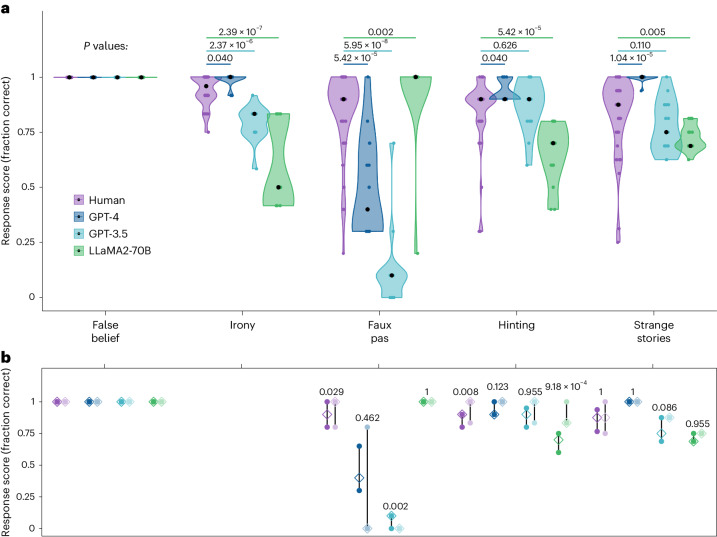
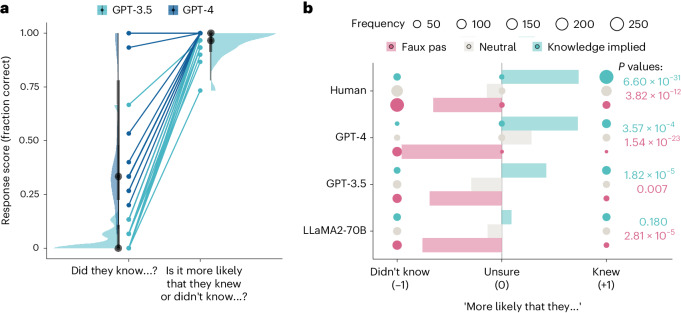
At the core of what defines us as humans is the concept of theory of mind: the ability to track other people’s mental states. The recent development of large language models (LLMs) such as ChatGPT has led to intense debate about the possibility that these models exhibit behaviour that is indistinguishable from human behaviour in theory of mind tasks. Here we compare human and LLM performance on a comprehensive battery of measurements that aim to measure different theory of mind abilities, from understanding false beliefs to interpreting indirect requests and recognizing irony and faux pas. We tested two families of LLMs (GPT and LLaMA2) repeatedly against these measures and compared their performance with those from a sample of 1,907 human participants. Across the battery of theory of mind tests, we found that GPT-4 models performed at, or even sometimes above, human levels at identifying indirect requests, false beliefs and misdirection, but struggled with detecting faux pas. Faux pas, however, was the only test where LLaMA2 outperformed humans. Follow-up manipulations of the belief likelihood revealed that the superiority of LLaMA2 was illusory, possibly reflecting a bias towards attributing ignorance. By contrast, the poor performance of GPT originated from a hyperconservative approach towards committing to conclusions rather than from a genuine failure of inference. These findings not only demonstrate that LLMs exhibit behaviour that is consistent with the outputs of mentalistic inference in humans but also highlight the importance of systematic testing to ensure a non-superficial comparison between human and artificial intelligences.
Overview
The claims and statistics of this paper haven’t been checked yet.
Free: it reads the open-access text and checks the first 5 claims that cite a source we can check. Create a free account to check every claim.
Integrity signals
Registry
Cites
Statistics
Figures
Verification
Claims the paper makes
The claims and statistics of this paper haven’t been checked yet.
Free: it reads the open-access text and checks the first 5 claims that cite a source we can check. Create a free account to check every claim.
Claims other papers make about this one
Each is checked against this paper’s own text: does it say what the citing paper says it does?
The source backs part of the claim, not all of it — or backs it for a different population, condition or comparison.
In the citing paper
“Recent studies have shown that Large Language Models (LLMs), including GPT-3 and GPT-4, can excel in tasks that seemingly require ToM (Kosinski, 2023; van Duijn et al., 2023; Strachan et al., 2024; Street et al., 2024)”
From Can "consciousness" be observed from large language model (LLM) internal states? Dissecting LLM representations obtained from Theory of Mind test with Integrated Information Theory and Span Representation analysis (2025) · cites this paper as Strachan et al., 2024
Experimental — accuracy not yet measuredThe source backs part of the claim, not all of it — or backs it for a different population, condition or comparison.
In the citing paper
“This is amplified by the ability of LLMs to infer as well—or better—than humans the beliefs and intentions of an interlocutor from text (26).”
From The benefits and dangers of anthropomorphic conversational agents (2025) · cites this paper as [26]
Experimental — accuracy not yet measuredThe source backs part of the claim, not all of it — or backs it for a different population, condition or comparison.
In the citing paper
“later models demonstrate an increasing ability to reliably infer unobservable mental states in others (Strachan et al., 2024;Holterman and Deemter, 2023;Moghaddam and Honey, 2023).”
From Machine Psychology (2023) · cites this paper as Strachan et al., 2024
Experimental — accuracy not yet measuredThe cited source says what the claim attributes to it.
In the citing paper
“Specifically, these subjects are adult native English speakers (aged 18-70) with no history of psychiatric conditions or dyslexia, as specified in Strachan et al. (2024).”
From Can "consciousness" be observed from large language model (LLM) internal states? Dissecting LLM representations obtained from Theory of Mind test with Integrated Information Theory and Span Representation analysis (2025) · cites this paper as Strachan et al., 2024
The cited source says what the claim attributes to it.
In the citing paper
“These models are increasingly achieving or surpassing human performance benchmarks in various domains, including medical diagnostic dialogue28, persuasive communication29, theory of mind30, making people feel heard31, responding to relationship issues32 and helping people reframe negative situations to reduce negative emotions33.”
From “It happened to be the perfect thing”: experiences of generative AI chatbots for mental health (2024) · cites this paper as [30]
4 more claims about this paper
Create a free account to see every claim other papers make about this one.
Self-check
Percentages, sums and reported differences re-computed from the paper’s own numbers.
The self-check needs the paper’s full text.
Citations
Cites
The Proceedings of the National Academy of Sciences
Richards, J. W. (1915) · Science · doi:10.1126/science.42.1074.161 · Cited by 13,983
Does the chimpanzee have a theory of mind?
Premack, D., & Woodruff, G. (1978) · Behavioral and Brain Sciences · doi:10.1017/s0140525x00076512 · Cited by 8,743 · cited 1×
“3), dozens of tasks have been developed to study it, including indirect measures of belief attribution using reaction times 4–6 and looking or searching behaviour 7–9 , tasks examining the ability to infer mental states from photographs of eyes 10 , and language-based tasks assessing false belief…”
BackgroundWimmer, H. (1983) · Cognition · doi:10.1016/0010-0277(83)90004-5 · Cited by 6,305
Baron‐Cohen, S., Wheelwright, S., Hill, J., Raste, Y., & Plumb, I. (2001) · Journal of Child Psychology and Psychiatry · doi:10.1111/1469-7610.00715 · Cited by 4,555 · cited 1×
“…indirect measures of belief attribution using reaction times 4–6 and looking or searching behaviour 7–9 , tasks examining the ability to infer mental states from photographs of eyes 10 , and language-based tasks assessing false belief understanding 11,12 and pragmatic language comprehension 13–16 .”
The principles of psychology, Vol I.
James, W. (1890) · doi:10.1037/10538-000 · Cited by 4,514
Happé, F. G. E. (1994) · Journal of Autism and Developmental Disorders · doi:10.1007/bf02172093 · Cited by 2,352 · cited 2×
“We selected a set of well-established theory of mind tests spanning different abilities: the hinting task 14 , the false belief task 11,33 , the recognition of faux pas 13 , and the strange stories 15,16 .”
BackgroundMethodThe Neural Basis of Mentalizing
Frith, C. D., & Frith, U. (2006) · Neuron · doi:10.1016/j.neuron.2006.05.001 · Cited by 1,855
Three-year-olds’ difficulty with false belief: The case for a conceptual deficit
Perner, J., Leekam, S. R., & Wimmer, H. (1987) · British Journal of Developmental Psychology · doi:10.1111/j.2044-835x.1987.tb01048.x · Cited by 1,550 · cited 1×
“…indirect measures of belief attribution using reaction times 4–6 and looking or searching behaviour 7–9 , tasks examining the ability to infer mental states from photographs of eyes 10 , and language-based tasks assessing false belief understanding 11,12 and pragmatic language comprehension 13–16 .”
BackgroundSparks of Artificial General Intelligence: Early experiments with GPT-4
Bubeck, S., Chandrasekaran, V., Eldan, R., Gehrke, J., Horvitz, E., Kamar, E., Lee, P., Lee, Y. T., Li, Y., Lundberg, S., et al. (2023) · arXiv · doi:10.48550/arxiv.2303.12712 · Cited by 1,526 · cited 3×
“One example is the false belief test, one of the most widely used tools so far for testing the performance of LLMs on social cognitive tasks 19,21–23, 25, 51 , 52 .”
BackgroundMethodToward a second-person neuroscience
Schilbach, L., Timmermans, B., Reddy, V., Costall, A., Bente, G., Schlicht, T., & Vogeley, K. (2013) · Behavioral and Brain Sciences · doi:10.1017/s0140525x12000660 · Cited by 1,510
Research works printed but not linked: 1
- Gandhi, K., Fränken, J.-P., Gerstenberg, T. & Goodman, N. D. Understanding social reasoning in language models with language models. In Advances in Neural Information Processing Systems Vol. 36 (MIT Press, 2023).
Cited by
Evaluating large language models in theory of mind tasks
Kosinski, M. (2024) · Proceedings of the National Academy of Sciences · doi:10.1073/pnas.2405460121 · Cited by 339
“58 and 59 ), others found that LLMs’ performance was inconsistent and brittle ( 26 , 60 , 61 ).”
BackgroundTorous, J., Linardon, J., Goldberg, S. B., Sun, S., Bell, I., Nicholas, J., Hassan, L., Hua, Y., Milton, A., & Firth, J. (2025) · World Psychiatry · doi:10.1002/wps.21299 · Cited by 323
“It happened to be the perfect thing”: experiences of generative AI chatbots for mental health
Siddals, S., Torous, J., & Coxon, A. (2024) · npj Mental Health Research · doi:10.1038/s44184-024-00097-4 · Cited by 241
“…or surpassing humanperformancebenchmarksin variousdomains,including medical diagnostic dialogue 28 , persuasive communication 29 , theory of mind 30 , making people feel heard 31 , responding to relationship issues 32 and helping people reframe negative situations to reduce negative emotions 33…”
(2024) · doi:10.21203/rs.3.rs-4612612/v1 · Cited by 241
Why human–AI relationships need socioaffective alignment
Kirk, H. R., Gabriel, I., Summerfield, C., Vidgen, B., & Hale, S. A. (2025) · Humanities and Social Sciences Communications · doi:10.1057/s41599-025-04532-5 · Cited by 131
Human-AI agency in the age of generative AI
Krakowski, S. (2025) · Information and Organization · doi:10.1016/j.infoandorg.2025.100560 · Cited by 162
Evaluating Large Language Models in Theory of Mind Tasks
Kosinski, M. (2023) · arXiv · doi:10.48550/arxiv.2302.02083 · Cited by 339
“58 and 59 ), others found that LLMs’ performance was inconsistent and brittle ( 26 , 60 , 61 ).”
BackgroundGenerative AI in Marketing and Principles for Ethical Design and Deployment
Hermann, E., & Puntoni, S. (2025) · Journal of Public Policy & Marketing · doi:10.1177/07439156241309874 · Cited by 136
“…creating text-to-concept similarity measures (Le Mens et al. 2023), ability to track other people ’ s mental states (i.e., theory of mind abilities; Strachan et al. 2024) Close to human-level performance in these areas: (cid:129) Solving novel and dif fi cult tasks including mathematics, coding,…”
LLMs achieve adult human performance on higher-order theory of mind tasks
Street, W., Siy, J. O., Keeling, G., Baranès, A., Barnett, B., McKibben, M., Kanyere, T., Lentz, A., y Arcas, B. A., & Dunbar, R. (2026) · Frontiers in Human Neuroscience · doi:10.3389/fnhum.2025.1633272 · Cited by 134
The benefits and dangers of anthropomorphic conversational agents
Peter, S., Riemer, K., & West, J. D. (2025) · Proceedings of the National Academy of Sciences · doi:10.1073/pnas.2415898122 · Cited by 110
The homogenizing effect of large language models on human expression and thought
Sourati, Z., Ziabari, A. S., & Dehghani, M. (2026) · Trends in Cognitive Sciences · doi:10.1016/j.tics.2026.01.003 · Cited by 131
Zhang, J. J., Wang, Y. W., Ruan, Q., & Yang, Y. (2024) · Tourism Management Perspectives · doi:10.1016/j.tmp.2024.101279 · Cited by 109
Multi-agent embodied AI: advances and future directions
Feng, Z., Xue, R., Yuan, L., Yu, Y., Ding, N., Liu, M., Gao, B., Sun, J. Q., Zheng, X., & Wang, G. (2026) · Science China Information Sciences · doi:10.1007/s11432-025-4820-4 · Cited by 117
A Survey on Human Preference Learning for Aligning Large Language Models
Jiang, R., Chen, K., Bai, X., He, Z., Li, J., Yang, M., Zhao, T., Nie, L., & Zhang, M. (2025) · ACM Computing Surveys · doi:10.1145/3773279 · Cited by 85
Hagendorff, T., Dasgupta, I., Binz, M., Chan, S. C. Y., Lampinen, A., Wang, J. X., Akata, Z., & Schulz, E. (2023) · arXiv · doi:10.48550/arxiv.2303.13988 · Cited by 68
“While early experiments with models like GPT-3 showed that they struggle to solve theory of mind tasks ( 83 ), later models demonstrate an increasing ability to reliably infer unobservable mental states in others ( 84 – 88 ).”
Conceptualizing generative AI as style engines: Application archetypes and implications
Riemer, K., & Peter, S. (2024) · International Journal of Information Management · doi:10.1016/j.ijinfomgt.2024.102824 · Cited by 63
Emergence of polarization in networks of large language model agents
Piao, J., Lu, Z., Chen, G., Xu, F., Hu, Q., Santos, F. P., Li, Y., & Evans, J. A. (2026) · Nature Communications · doi:10.1038/s41467-026-78228-y · Cited by 67
From robots to chatbots: unveiling the dynamics of human-AI interaction
Łukasik, A., & Gut, A. (2025) · Frontiers in Psychology · doi:10.3389/fpsyg.2025.1569277 · Cited by 74
From Tools to Agents: Meta-Analytic Insights into Human Acceptance of AI
Li, B., Lai, E. Y., & Wang, X. (. (2025) · Journal of Marketing · doi:10.1177/00222429251355266 · Cited by 79
Understanding World or Predicting Future? A Comprehensive Survey of World Models
Ding, J., Zhang, Y., Shang, Y., Zhang, Y., Zong, Z., Feng, J., Yuan, Y., Su, H., Li, N., Sukiennik, N., et al. (2026) · ACM Computing Surveys · doi:10.1145/3746449 · Cited by 169
“Testing ToM [240] 2024 NHB Language Benchmark High-order ToM [241] 2024 arxiv Language Benchmark COKE [274] 2024 ACL Language Learning MuMA-ToM [232] 2024 ACL Language&Vision Benchmark SimToM [271] 2024 ACL Language Learning EAI [179] 2024 NeurIPS Language Benchmark LLM-ToM [130] 2024 PNAS Lanauge…”
The simulation of judgment in LLMs
Loru, E., Nudo, J., Di Marco, N., Santirocchi, A., Atzeni, R., Cinelli, M., Cestari, V., Rossi-Arnaud, C., & Quattrociocchi, W. (2025) · Proceedings of the National Academy of Sciences · doi:10.1073/pnas.2518443122 · Cited by 57
“Recent studies have explored whether LLMs replicate human heuristics [4, 42, 43] or reflect ideological biases learned during training [44–46], but most focus on output-level metrics such as accuracy or bias.”
Unraveling Human-AI Teaming: A Review and OutlookPreprint
Lou, B., Lu, T., Raghu, T. S., & Zhang, Y. (2025) · SSRN Electronic Journal · doi:10.2139/ssrn.5211067 · Cited by 68
Take caution in using LLMs as human surrogates
Gao, Y., Lee, D., Burtch, G., & Fazelpour, S. (2025) · Proceedings of the National Academy of Sciences · doi:10.1073/pnas.2501660122 · Cited by 52
Human-like object concept representations emerge naturally in multimodal large language models
Du, C., Fu, K., Wen, B., Sun, Y., Peng, J., Wei, W., Gao, Y., Wang, S., Zhang, C., Li, J., et al. (2025) · Nature Machine Intelligence · doi:10.1038/s42256-025-01049-z · Cited by 83
Companionship in code: AI's role in the future of human connection
Andersson, M. (2025) · Humanities and Social Sciences Communications · doi:10.1057/s41599-025-05536-x · Cited by 39
“…Current research on Large Language Models (LLMs) like ChatGPT highlights their remarkable capabilities to process and mimic human language, even in communicatively complex contexts such as sarcasm, humour, or metaphor (Andersson and McIntyre, 2025; Gorenz and Schwarz, 2024; Strachan et al., 2024).”
Jones, C., & Bergen, B. K. (2026) · Artificial Intelligence Review · doi:10.1007/s10462-026-11517-6 · Cited by 63
Large language models are proficient in solving and creating emotional intelligence tests
Schlegel, K., Sommer, N. R., & Mortillaro, M. (2025) · Communications Psychology · doi:10.1038/s44271-025-00258-x · Cited by 46
“I should stress, however, that we would be reluctant to trouble our referees again unless we thought that their comments had been addressed in full.”
A beautiful loop: An active inference theory of consciousness.
Laukkonen, R., Friston, K., & Chandaria, S. (2025) · Neuroscience & Biobehavioral Reviews · doi:10.1016/j.neubiorev.2025.106296 · Cited by 45
The Minds We Make: A Philosophical Inquiry into Theory of Mind and Artificial Intelligence
Yıldız, T. (2025) · Integrative Psychological and Behavioral Science · doi:10.1007/s12124-024-09876-2 · Cited by 56
“Recent studies, such as those by Strachan et al. (2024) and Kosinski (2023), examine how generative language models simulate cognitive processes that appear to mirror ToM tasks.”
Strategic behavior of large language models and the role of game structure versus contextual framing
Lorè, N., & Heydari, B. (2024) · Scientific Reports · doi:10.1038/s41598-024-69032-z · Cited by 117
Wang, Y., Huang, J., Du, L., Guo, Y., Liu, Y., & Wang, R. (2025) · Computers and Education Artificial Intelligence · doi:10.1016/j.caeai.2025.100481 · Cited by 60
Responsible AI Integration in Mental Health Research: Issues, Guidelines, and Best Practices
Beg, M. J. (2024) · Indian Journal of Psychological Medicine · doi:10.1177/02537176241302898 · Cited by 44
Large language models for clinical decision support in gastroenterology and hepatology
Wiest, I. C., Bhat, M., Clusmann, J., Schneider, C. V., Jiang, X., & Kather, J. N. (2025) · Nature Reviews Gastroenterology & Hepatology · doi:10.1038/s41575-025-01108-1 · Cited by 50
“A key question moving forward is which decisions in health care should be made by LLMs, which by clinicians, and which through collaboration, especially as AI-augmented clinicians are, perhaps counterintuitively, not always more effective than either alone 112,189 .”
Fostering effective hybrid human-LLM reasoning and decision making
Passerini, A., Gema, A. P., Minervini, P., Sayin, B., & Tentori, K. (2025) · Frontiers in Artificial Intelligence · doi:10.3389/frai.2024.1464690 · Cited by 52
Andersson, M., & McIntyre, D. (2025) · Journal of Pragmatics · doi:10.1016/j.pragma.2025.02.001 · Cited by 45
Taillandier, P., Zucker, J., Grignard, A., Gaudou, B., Huynh, N. Q., Kong, H., & Drogoul, A. (2026) · Frontiers in Artificial Intelligence · doi:10.48550/arxiv.2507.19364 · Cited by 39
“While models can achieve high accuracy on prototypical Theory of Mind (ToM) problems, altering contextual cues or task narratives causes significant drops in performance, suggesting shallow linguistic pattern matching rather than authentic social inference (Strachan et al. 2024; Ullman 2023).”
Is AI heritage tourism interpretations better at deepening your cultural memory?
Wang, L., Ruan, W.-Q., & Li, Y.-Q. (2025) · Journal of Hospitality and Tourism Management · doi:10.1016/j.jhtm.2025.03.011 · Cited by 38
Collecting Qualitative Data at Scale with Large Language Models: A Case Study
Cuevas, A., Scurrell, J. V., Brown, E. M., Entenmann, J., & Daepp, M. I. G. (2025) · Proceedings of the ACM on Human-Computer Interaction · doi:10.1145/3710947 · Cited by 46
Inventing with Machines: Generative AI and the Evolving Landscape of IS Research
Gopal, R. D., Li, J., Riemer, K., Sarker, S., Singh, P. V., Susarla, A., Bichler, M., & Thatcher, J. (2025) · Information systems research · doi:10.1287/isre.2025.editorial.v36.n4 · Cited by 40
“Second, “reasoning” in LLMs is still evolving (Mitchell and Krakauer 2023, Strachan et al. 2024).”
Imagining and building wise machines: the centrality of AI metacognition
Johnson, S. G. B., Karimi, A.-H., Bengio, Y., Chater, N., Gerstenberg, T., Larson, K., Levine, S., Mitchell, M., Rahwan, I., Schölkopf, B., et al. (2026) · Trends in Cognitive Sciences · doi:10.1016/j.tics.2026.01.002 · Cited by 49
How does anthropomorphism promote consumer responses to social chatbots: mind perception perspective
Li, B., Yao, R., & Nan, Y. (2025) · Internet Research · doi:10.1108/intr-04-2024-0583 · Cited by 36
Embedding Fear in Medical AI: A Risk-Averse Framework for Safety and Ethics
Thurzo, A., & Thurzo, V. (2025) · AI · doi:10.3390/ai6050101 · Cited by 37
“LLMs already perform at or above human levels in identifying indirect requests or false beliefs, albeit they struggle with more nuanced social cognition like detecting faux pas [90].”
Emotional arousal: how artificial intelligence-generated content influences tourism decision-making
Zhu, S., Song, M., & Duan, Y. (2024) · Tourism Recreation Research · doi:10.1080/02508281.2024.2439321 · Cited by 41
“Human beings are good at reading between the lines (Chen et al., 2024), and can more accurately grasp and meet the emotional needs of potential tourists, and provide a higher level of emotional value (Strachan et al., 2024).”
Six Fallacies in Substituting Large Language Models for Human Participants
Lin, Z. (2025) · Advances in Methods and Practices in Psychological Science · doi:10.1177/25152459251357566 · Cited by 66
“In actual tests, for example, GPT-4 outperforms humans in detecting and interpreting irony, recognizing indirect requests or hints in conversation (Strachan et al., 2024), and performing analogical reasoning tasks (Webb et al., 2023) and probabilistic reasoning tasks, such as the Linda/Bill…”
InfluentialLanguage Models use Lookbacks to Track Beliefs
Prakash, N., Shapira, N., Sharma, A. S., Riedl, C., Belinkov, Y., Shaham, T. R., Bau, D., & Geiger, A. (2026) · International Conference on Learning Representations · doi:10.48550/arxiv.2505.14685 · Cited by 39
“Recent studies have established that language models (LMs) can solve some tasks requiring ToM reasoning (Street et al., 2024; Strachan et al., 2024a; Kosinski, 2024), while others have highlighted shortcomings (Sclar et al., 2025; Shapira et al., 2024; Kim et al., 2023a, inter alia ).”
Toward LLM-agent-based modeling of transportation systems: A conceptual framework
Liu, T., Yang, J., & Yin, Y. (2025) · Artificial Intelligence for Transportation · doi:10.1016/j.ait.2025.100001 · Cited by 53
Dubey, S., Ghosh, R., Chatterjee, S., Dubey, M. J., Das, S., & Benito‐León, J. (2024) · Medical Research Archives · doi:10.18103/mra.v12i6.5383 · Cited by 28
“17 The implications of these results are significant for understanding the potential and limitations of large language models in replicating human cognitive processes.”
BackgroundTakata, R., Masumori, A., & Ikegami, T. (2024) · Entropy · doi:10.3390/e26121092 · Cited by 37
Winder, P. D., Hildebrand, C., & Hartmann, J. (2025) · PLoS ONE · doi:10.1371/journal.pone.0325459 · Cited by 37
“This finding is important in light of prior work showing that LLM advice is often perceived as strikingly more positive even though the advice might carry inherent bias or when the advice is objectively worse compared to expert humans [27,82–86].”
Large Language Models in Psychiatry: Current Applications, Limitations, and Future Scope
Liu, Z., Bao, Y., Zeng, S., Qian, R., Deng, M., Gu, A., Li, J., Wang, W., Cai, W., Li, W., et al. (2024) · Big Data Mining and Analytics · doi:10.26599/bdma.2024.9020046 · Cited by 32
Chen, L., Zhang, Y., Feng, J., Chai, H., Zhang, H., Fan, B., Ma, Y., Zhang, S., Li, N., Liu, T., et al. (2026) · Humanities and Social Sciences Communications · doi:10.1057/s41599-026-07316-7 · Cited by 37
“…rationally; (3) self-explanation and Human-like concept understanding [53] Human-like emotion understanding [33] Human-like emotional intelligence [146] Human-like theory of mind [107] Human-like decision-making influenced by emotion Rationality [122] Rationality emergence in large ( > 40 B )…”
A roadmap for evaluating moral competence in large language models
Haas, J., Bridgers, S., Manzini, A., Henke, B., May, J., Levine, S., Weidinger, L., Shanahan, M., Lum, K., Gabriel, I., et al. (2026) · Nature · doi:10.1038/s41586-025-10021-1 · Cited by 25
Comparing AI and human decision-making mechanisms in daily collaborative experiments
Wang, L., Jiang, Z., Hu, C., Zhao, J., Zhu, Z., Chen, X. M., Wang, Z., Liu, T., He, G., Yin, Y., et al. (2025) · iScience · doi:10.1016/j.isci.2025.112711 · Cited by 29
“13,14 However, the existing research presumes that LLMs mirror human cognitive mechanisms, 15–18 but there is insufficient evidence that their decision-making processes align with those of humans, particularly in cases with collaborative decisions among multiple subjects.”
The Benchmarking Epistemology: Validity Theory for Evaluating Machine Learning Models
Freiesleben, T., & Zezulka, S. (2026) · Philosophy of Science · doi:10.1017/psa.2026.10280 · Cited by 28
“For example, benchmarks have been designed to test whether models have capabilities like a stable sense of morality (Jiang et al. 2021), a theory of mind (Strachan et al. 2024), or legal reasoning (Masry et al. 2022).”
A large-scale comparison of divergent creativity in humans and large language models
Wang, D., Huang, D., Shen, H., & Uzzi, B. (2025) · Nature Human Behaviour · doi:10.1038/s41562-025-02331-1 · Cited by 47
Cognitive Modeling Using Artificial Intelligence
Frank, M. C., & Goodman, N. D. (2025) · Annual Review of Psychology · doi:10.1146/annurev-psych-030625-040748 · Cited by 55
LLMs achieve adult human performance on higher-order theory of mind tasks
Street, W., Siy, J. O., Keeling, G., Baranes, A., Barnett, B., McKibben, M., Kanyere, T., Lentz, A., Arcas, B. A. Y., & Dunbar, R. I. M. (2024) · arXiv · doi:10.48550/arxiv.2405.18870 · Cited by 24
Using large language models to facilitate academic work in the psychological sciences
Sohail, A., & Zhang, L. (2025) · Current Psychology · doi:10.1007/s12144-025-07438-2 · Cited by 25
“Certain models are further able to exhibit complex behavior consistent with mentalistic inference (Strachan et al., 2024 ) and demon - strate similar heuristics and context-sensitive responses akin to loss aversion and effort reduction commonly observed in humans (Suri et al., 2024 ).”
Huang, Y., Wang, W., Zhou, J., Zhang, L., Lin, J., Liu, H., Hu, X., Zhou, Z., & Dong, W. (2025) · Information Processing & Management · doi:10.1016/j.ipm.2025.104152 · Cited by 22
Lehr, S. A., Saichandran, K. S., Harmon‐Jones, E., Vitali, N., & Banaji, M. R. (2025) · Proceedings of the National Academy of Sciences · doi:10.1073/pnas.2501823122 · Cited by 40
“Large language models (LLMs) have surprised their creators and the scientific community by exhibiting emergent abilities once thought to be uniquely human, such as humanlike cognition and reasoning ( 1 – 6 ), although the full extent of these accomplishments is debated ( 3 , 7 – 10 ).”
Quantifying uncert-AI-nty: Testing the accuracy of LLMs’ confidence judgments
Cash, T. N., Oppenheimer, D. M., Christie, S., & Devgan, M. (2025) · Memory & Cognition · doi:10.3758/s13421-025-01755-4 · Cited by 32
Can AI with High Reasoning Ability Replicate Human-like Decision Making in Economic Experiments?
Kitadai, A., Lugo, S. D. R., Tsurusaki, Y., Fukasawa, Y., & Nishino, N. (2025) · Group Decision and Negotiation · doi:10.1007/s10726-025-09946-9 · Cited by 29
Talukder, M. B., & Kumar, S. (2024) · Advances in information security, privacy, and ethics book series · doi:10.4018/979-8-3693-1511-8.ch005 · Cited by 23
Are LLMs Socially Adaptive? Contrasting Belief Evolution in Large Language Models and Humans
Yu, L., Liu, H., Xie, C., Liu, S., Yin, Z., Chen, C., Li, G., Torr, P. H. S., & Wu, Z. (2026) · ACM SIGKDD Conference on Knowledge Discovery and Data Mining (KDD) · doi:10.1145/3770855.3818977 · Cited by 23
Gan, R., Qiu, Y., Liao, J., Zhang, Y., Wu, J., Peng, X., Lee, T. M. C., & Huang, R. (2024) · Neuroscience & Biobehavioral Reviews · doi:10.1016/j.neubiorev.2024.105918 · Cited by 22
A Primer on Large Language Models and their LimitationsPreprint
Johnson, S., & Hyland-Wood, D. (2025) · Qeios · doi:10.32388/nhjyvs · Cited by 21
Chatting with bots: AI, speech acts, and the edge of assertion
Williams, I., & Bayne, T. (2024) · Inquiry · doi:10.1080/0020174x.2024.2434874 · Cited by 29
What makes children perceive or not perceive minds in generative AI?
Xu, Y., Thomas, T., Yu, C., & Pan, Z. (2025) · Computers in Human Behavior Artificial Humans · doi:10.1016/j.chbah.2025.100135 · Cited by 27
What Autism Taught Us About Our Social Nature
Frith, U., & Frith, C. (2025) · Current Directions in Psychological Science · doi:10.1177/09637214241311922 · Cited by 20
Marchetti, A., Manzi, F., Riva, G., Gaggioli, A., & Massaro, D. (2025) · Cyberpsychology Behavior and Social Networking · doi:10.1089/cyber.2024.0536 · Cited by 30
Large Language Models as Theory of Mind Aware Generative Agents with Counterfactual ReflectionPreprint
Yang, B., Guo, J., Iwasawa, Y., & Matsuo, Y. (2025) · arXiv (Cornell University) · doi:10.48550/arxiv.2501.15355 · Cited by 22
“With the recent striking progress in LLMs, several researchers have endeavored to evaluate the ToM reasoning capabilities of these models (Sahu et al., 2022; Gandhi et al., 2023; Jamali et al., 2023; Street et al., 2024; Strachan et al., 2024).”
Ma, Q., Koedinger, K. R., & Wu, T. (2026) · CHI Conference on Human Factors in Computing Systems · doi:10.1145/3772318.3791283 · Cited by 23
“To enable higher-level reasoning, we extract more semantically meaningful insights from the raw logs by utilizing LLMs’ reasoning and Theory-of-Mind capabilities, inspired by recent work [29, 50, 56, 63].”
Biassoni, F., & Gnerre, M. (2025) · Patient Education and Counseling · doi:10.1016/j.pec.2025.108663 · Cited by 18
Refoua, E., Elyoseph, Z., Wacker, R., Dziobek, I., Tsafrir, I., & Meinlschmidt, G. (2025) · Computers in Human Behavior Reports · doi:10.1016/j.chbr.2025.100702 · Cited by 19
Large Language Models as Psychological Simulators: A Methodological Guide
Lin, Z. (2026) · Advances in Methods and Practices in Psychological Science · doi:10.1177/25152459251410153 · Cited by 29
“…applications proliferate rapidly—for example, using LLMs to simulate cross-cultural personality differences (Niszczota et al., 2025), probe theory of mind capabilities (Strachan et al., 2024), generate psycholinguistic norms (Trott, 2024a), and forecast human behavior (Schoenegger et al., 2024).”
Gonzalez, K., Kanitz, R., & Briker, R. (2024) · The Journal of Applied Behavioral Science · doi:10.1177/00218863241279916 · Cited by 18
“…have shown promise to excel in interpersonal domains as well (e.g., listening, interpreting, persuasion; Dillion et al., 2024; Matz et al., 2024; Strachan et al., 2024), once people are aware that they are interacting with AI, it neutralizes the ability for AI to outperform humans on these…”
The Evaluation of GenAI Capabilities to Implement Professional Tasks
Kouzminov, Y., & Kruchinskaia, E. V. (2024) · Foresight-Russia · doi:10.17323/2500-2597.2024.4.67.76 · Cited by 20
“The LLMs, on the contrary, usually operate according to common knowledge (Strachan et al., 2024).”
Language Models as Critical Thinking Tools: A Case Study of PhilosophersPreprint
Ye, A., Moore, J., Novick, R., & Zhang, A. X. (2024) · arXiv (Cornell University) · doi:10.48550/arxiv.2404.04516 · Cited by 22
“To support more diverse forms of interaction beyond question answering or task execution 2 , LMs will need to significantly improve in theory of mind (Kosinski, 2024; Jamali et al., 2023).”
BackgroundMetacognitive Myopia in Large Language ModelsPreprint
Scholten, F., Rebholz, T. R., & Hütter, M. (2024) · arXiv (Cornell University) · doi:10.48550/arxiv.2408.05568 · Cited by 21
“Under optimal conditions, such as a consistently valid sample, their statistical predictions outperform human predictions (Meehl, 1954; Strachan et al., 2024).”
BackgroundPhysician Use of Large Language Models: A Quantitative Study Based on Large-Scale Query-Level Data
Qiu, L., Tang, C., Bi, X., Burtch, G., Chen, Y., & Zhang, H. (2025) · Journal of Medical Internet Research · doi:10.2196/76941 · Cited by 17
HumanLLM: Towards Personalized Understanding and Simulation of Human Nature
Lei, Y., Wang, T., Lian, J., Hu, Z., Lian, D., & Xie, X. (2026) · ACM SIGKDD Conference on Knowledge Discovery and Data Mining (KDD) · doi:10.1145/3770854.3780294 · Cited by 17
Social Perception of Faces in a Vision-Language Model
Hausladen, C. I., Knott, M., Camerer, C. F., & Perona, P. (2025) · ACM Conference on Fairness, Accountability, and Transparency (FAccT) · doi:10.1145/3715275.3732041 · Cited by 22
“Therefore, in the following, we compare CausalFace to the two observational datasets concerning six metrics: WEAT score, markedness, Skew@k, MaxSkew@k, and NDKL.”
Legal perspectives on AI and the right to digital literacy in education
Panagopoulou, F., Parpoula, C., & Karpouzis, K. C. (2025) · Frontiers in Computer Science · doi:10.3389/fcomp.2025.1692268 · Cited by 14
From humans to machines: Researching entrepreneurial AI agents built on large language models
Obschonka, M., & Fisch, C. O. (2025) · Journal of Business Venturing Insights · doi:10.1016/j.jbvi.2025.e00581 · Cited by 16
Ennion, M., & McLellan, R. (2025) · doi:10.21428/8c225f6e.540b41b5 · Cited by 17
Psychomatics—A Multidisciplinary Framework for Understanding Artificial Minds
Riva, G., Mantovani, F., Wiederhold, B. K., Marchetti, A., & Gaggioli, A. (2025) · Cyberpsychology Behavior and Social Networking · doi:10.1089/cyber.2024.0409 · Cited by 15
Seeking Inspiration through Human-LLM Interaction
Lin, X., Huang, H., Huang, K., Shu, X., & Vines, J. (2025) · CHI Conference on Human Factors in Computing Systems · doi:10.1145/3706598.3713259 · Cited by 24
Schlesener, E. A., Ziolkowski, M., Wong, S., Westmoreland, B., & Babu, S. V. (2026) · ACM Transactions on Interactive Intelligent Systems · doi:10.1145/3774779 · Cited by 16
Does ChatGPT have a typical or atypical theory of mind?
Attanasio, M., Mazza, M., Donne, I. L., Masedu, F., Greco, M. P., & Valenti, M. (2024) · Frontiers in Psychology · doi:10.3389/fpsyg.2024.1488172 · Cited by 17
A Systematic Literature Review on the Negative Impacts of AI-Generated Virtual Digital Humans
Yang, Y., Li, S., & Qiu, S. (2025) · IEEE Access · doi:10.1109/access.2025.3564041 · Cited by 18
“Strachan et al. found that AI’s poor performance in rudeness detection stems from a conservative approach to conclusions rather than reasoning failures [69].”
Large language models (LLMs) as research Subjects: Status, opportunities and challenges
Zhao, C., Habule, M., & Zhang, W. (2025) · New Ideas in Psychology · doi:10.1016/j.newideapsych.2025.101167 · Cited by 16
How large language models encode theory-of-mind: a study on sparse parameter patterns
Wu, Y., Guo, W., Liu, Z., Ji, H., Xu, Z., & Zhang, D. (2025) · npj Artificial Intelligence · doi:10.1038/s44387-025-00031-9 · Cited by 31
“In contrast, tasks such as faux pas and irony detection involve some degree of subjectivity 6 , making automatic evaluation more challenging.”
Guiding Generative Storytelling with Knowledge Graphs
Pan, Z., Andronis, A., Hayek, E., Wilkinson, O. A. P., Lasy, I., Parry, A., Gadney, G., Smith, T. J., & Grierson, M. (2025) · International Journal of Human-Computer Interaction · doi:10.1080/10447318.2025.2603634 · Cited by 15
“Under certain conditions, they exhibited high levels of playfulness, immersion, and creativity.”
Pi, Z., Vadaparty, A., Bergen, B. K., & Jones, C. R. (2024) · arXiv (Cornell University) · doi:10.48550/arxiv.2406.14737 · Cited by 18
“Various studies aiming to evaluate the ToM capabilities of LLMs have produced inconsistent conclusions (Kosinski, 2024; Ullman, 2023; Shapira et al., 2023; Kim et al., 2023; Gandhi, Fr¨anken, Gerstenberg, & Goodman, 2023; Jones, Trott, & Bergen, 2023; J. W. Strachan et al., 2024).”
Yager, K. G. (2024) · Digital Discovery · doi:10.1039/d4dd00178h · Cited by 12
Holyoak, K. J. (2024) · Journal of Cognitive Psychology · doi:10.1080/20445911.2024.2395573 · Cited by 23
Evaluating the ability of large Language models to predict human social decisions
Xiao, F., & Wang, X. T. (2025) · Scientific Reports · doi:10.1038/s41598-025-17188-7 · Cited by 24
“Recent research shows that while GPT-4 excels in purely rational tasks 44 , it struggles in subtle social contexts, causing faux pas or social blunders 11 .”
GPT-4o reads the mind in the eyes
Strachan, J. W. A., Pansardi, O., Celotto, M., Scaliti, E., Saxena, K., Yi, C., Manzi, F., Rufo, A., Manzi, G., Graziano, M. S. A., et al. (2026) · Computers in Human Behavior · doi:10.1016/j.chb.2026.108992 · Cited by 15
Self-citationCan Machines Think Like Humans? A Behavioral Evaluation of LLM Agents in Dictator GamesPreprint
Ma, J. (2024) · arXiv (Cornell University) · doi:10.48550/arxiv.2410.21359 · Cited by 17
CHATGPT: ¿EL FUTURO DEL APRENDIZAJE? PERCEPCIONES Y USO ENTRE ESTUDIANTES UNIVERSITARIOS
Marfil, L. A. F., Parás, C. V., & Cuervo, P. B. (2024) · Etic net Revista científica electrónica de Educación y Comunicación en la Sociedad del Conocimiento · doi:10.30827/eticanet.v24i2.31026 · Cited by 15
Metadata
- Authors
- Strachan, J. W. A., Albergo, D., Borghini, G., Pansardi, O., Scaliti, E., Gupta, S., Saxena, K., Rufo, A., Panzeri, S., Manzi, G., Graziano, M. S. A., & Becchio, C.
- Affiliations
- University Medical Center Hamburg-Eppendorf (DE)
- University of Trento (IT)
- Italian Institute of Technology (IT)
- Universität Hamburg (DE)
- Princeton University (US)
- Corresponding author
- Strachan, James W. A.
- Becchio, Cristina
- ORCID
- Venue
- Nature Human Behaviour
- Published
- 2024-05-20
- Volume
- 8
- Issue
- 7
- Pages
- 1285-1295
- ISSN
- 2397-3374 (ISSN-L)
- PMC
- PMC11272575
- OpenAlex
- W4398143508
- Semantic Scholar
- 7d16a2de08fc5053e1026ffaa0bbd279302abca2
- Cited by
- 299
- References
- 58
- Citations by year
- 2026: 125 · 2025: 136 · 2024: 37
- FWCI
- 232.53
- Type
- journal article
- Language
- en
- Open access
- hybrid
- doi.org
- Licence
- cc-by
- creativecommons.org/licenses/by/4.0 (tdm)
- creativecommons.org/licenses/by/4.0 (vor)
- Locations
- Nature Human Behaviour (publishedVersion, cc-by)
- Research Square (acceptedVersion, cc-by)
- PubMed Central (publishedVersion, cc-by-nc)
- PubMed (publishedVersion)
- Institutional Research Information System University of Turin (University of Turin) (submittedVersion, cc-by-nc)
- HAL (submittedVersion)
- RePEc: Research Papers in Economics (submittedVersion)
- OSF Preprints (OSF Preprints) (submittedVersion)
- Funders
- Alexander von Humboldt-Stiftung
- European Commission (101071191)
- Universitätsklinikum Hamburg-Eppendorf
- Topics
- Social Sciences › Psychology › Developmental and Educational Psychology › Child and Animal Learning Development
- Social Sciences › Psychology › Social Psychology › Social Robot Interaction and HRI
- Social Sciences › Arts and Humanities › Philosophy › Philosophy and Theoretical Science
- Keywords
- theory of mind, large language models, false belief understanding, indirect requests, irony detection, faux pas, misdirection, GPT-4, Llama 2, human-AI comparison, belief attribution
- MeSH terms
- Adolescent, Adult, Female, Humans, Language, Male, Middle Aged, Models, Psychological, Young Adult, Theory of Mind
About these checks
Registry, retraction, Cites and statistics results are computed, not judged, with one exception: a printed reference that no index lists is read once by a model before it counts as a citation error. Claims are extracted by a model and kept only when their quote appears verbatim in the text; each cited source is then checked, with a model’s help, for whether it says what the claim relies on. Those verdicts can be wrong — read the claim’s quote and the cited source before relying on one.
Statistics and arithmetic are recomputed, not judged.
Confidence bands are shown only for fields calibrated on our annotated test set. None is calibrated yet, so no band is shown.
What counts as a claim ›How we measure confidence ›How we check this ›
Are you an author, or do you see a problem with this page? Request a review
Data sources
Bibliographic data: Semantic Scholar, OpenAlex, Crossref.
Contains information from the Semantic Scholar Academic Graph Datasets, made available under the ODC Attribution License (ODC-BY 1.0).
Semantic Scholar’s data is described in: Kinney, R., et al. (2023). The Semantic Scholar Open Data Platform. arXiv:2301.10140.
