

Testing theory of mind in large language models and humans
Open accessPublished version of a preprint
The DOI matches its Crossref record; 63 of the 63 references it cites were found in a registry or an index.
Abstract
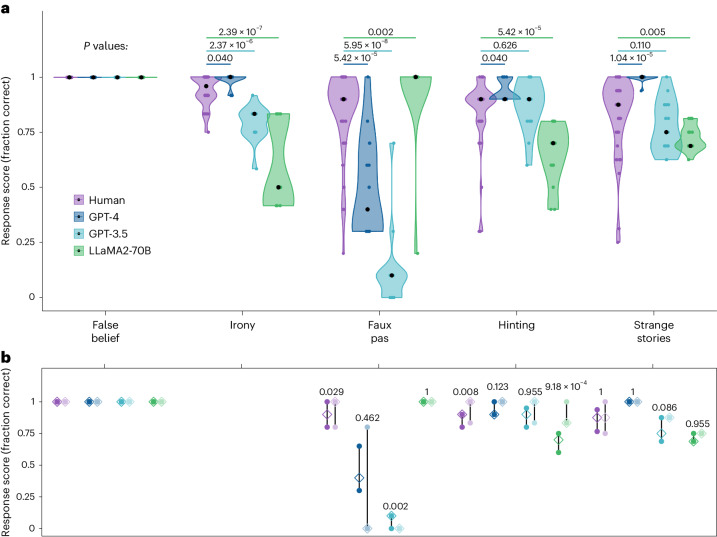
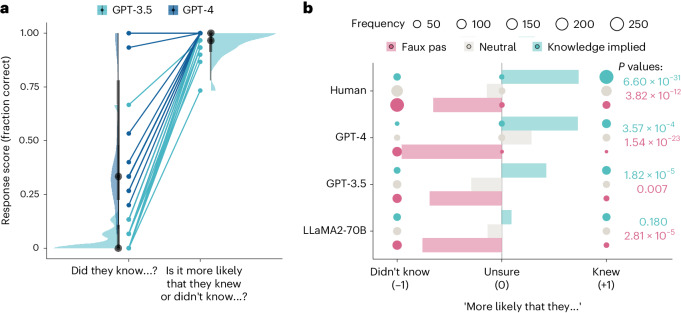
At the core of what defines us as humans is the concept of theory of mind: the ability to track other people’s mental states. The recent development of large language models (LLMs) such as ChatGPT has led to intense debate about the possibility that these models exhibit behaviour that is indistinguishable from human behaviour in theory of mind tasks. Here we compare human and LLM performance on a comprehensive battery of measurements that aim to measure different theory of mind abilities, from understanding false beliefs to interpreting indirect requests and recognizing irony and faux pas. We tested two families of LLMs (GPT and LLaMA2) repeatedly against these measures and compared their performance with those from a sample of 1,907 human participants. Across the battery of theory of mind tests, we found that GPT-4 models performed at, or even sometimes above, human levels at identifying indirect requests, false beliefs and misdirection, but struggled with detecting faux pas. Faux pas, however, was the only test where LLaMA2 outperformed humans. Follow-up manipulations of the belief likelihood revealed that the superiority of LLaMA2 was illusory, possibly reflecting a bias towards attributing ignorance. By contrast, the poor performance of GPT originated from a hyperconservative approach towards committing to conclusions rather than from a genuine failure of inference. These findings not only demonstrate that LLMs exhibit behaviour that is consistent with the outputs of mentalistic inference in humans but also highlight the importance of systematic testing to ensure a non-superficial comparison between human and artificial intelligences.
Overview
The claims and statistics of this paper haven’t been checked yet.
Free: it reads the open-access text and checks the first 5 claims that cite a source we can check. Create a free account to check every claim.
Integrity signals
Registry
Cites
Statistics
Figures
Verification
Claims the paper makes
The claims and statistics of this paper haven’t been checked yet.
Free: it reads the open-access text and checks the first 5 claims that cite a source we can check. Create a free account to check every claim.
Claims other papers make about this one
Each is checked against this paper’s own text: does it say what the citing paper says it does?
The source backs part of the claim, not all of it — or backs it for a different population, condition or comparison.
In the citing paper
“Recent studies have shown that Large Language Models (LLMs), including GPT-3 and GPT-4, can excel in tasks that seemingly require ToM (Kosinski, 2023; van Duijn et al., 2023; Strachan et al., 2024; Street et al., 2024)”
From Can "consciousness" be observed from large language model (LLM) internal states? Dissecting LLM representations obtained from Theory of Mind test with Integrated Information Theory and Span Representation analysis (2025) · cites this paper as Strachan et al., 2024
Experimental — accuracy not yet measuredThe source backs part of the claim, not all of it — or backs it for a different population, condition or comparison.
In the citing paper
“This is amplified by the ability of LLMs to infer as well—or better—than humans the beliefs and intentions of an interlocutor from text (26).”
From The benefits and dangers of anthropomorphic conversational agents (2025) · cites this paper as [26]
Experimental — accuracy not yet measuredThe source backs part of the claim, not all of it — or backs it for a different population, condition or comparison.
In the citing paper
“later models demonstrate an increasing ability to reliably infer unobservable mental states in others (Strachan et al., 2024;Holterman and Deemter, 2023;Moghaddam and Honey, 2023).”
From Machine Psychology (2023) · cites this paper as Strachan et al., 2024
Experimental — accuracy not yet measuredThe cited source says what the claim attributes to it.
In the citing paper
“Specifically, these subjects are adult native English speakers (aged 18-70) with no history of psychiatric conditions or dyslexia, as specified in Strachan et al. (2024).”
From Can "consciousness" be observed from large language model (LLM) internal states? Dissecting LLM representations obtained from Theory of Mind test with Integrated Information Theory and Span Representation analysis (2025) · cites this paper as Strachan et al., 2024
The cited source says what the claim attributes to it.
In the citing paper
“These models are increasingly achieving or surpassing human performance benchmarks in various domains, including medical diagnostic dialogue28, persuasive communication29, theory of mind30, making people feel heard31, responding to relationship issues32 and helping people reframe negative situations to reduce negative emotions33.”
From “It happened to be the perfect thing”: experiences of generative AI chatbots for mental health (2024) · cites this paper as [30]
4 more claims about this paper
Create a free account to see every claim other papers make about this one.
Self-check
Percentages, sums and reported differences re-computed from the paper’s own numbers.
The self-check needs the paper’s full text.
Citations
Cites
The Proceedings of the National Academy of Sciences
Richards, J. W. (1915) · Science · doi:10.1126/science.42.1074.161 · Cited by 13,983
Does the chimpanzee have a theory of mind?
Premack, D., & Woodruff, G. (1978) · Behavioral and Brain Sciences · doi:10.1017/s0140525x00076512 · Cited by 8,743 · cited 1×
“3), dozens of tasks have been developed to study it, including indirect measures of belief attribution using reaction times 4–6 and looking or searching behaviour 7–9 , tasks examining the ability to infer mental states from photographs of eyes 10 , and language-based tasks assessing false belief…”
BackgroundWimmer, H. (1983) · Cognition · doi:10.1016/0010-0277(83)90004-5 · Cited by 6,305
Baron‐Cohen, S., Wheelwright, S., Hill, J., Raste, Y., & Plumb, I. (2001) · Journal of Child Psychology and Psychiatry · doi:10.1111/1469-7610.00715 · Cited by 4,555 · cited 1×
“…indirect measures of belief attribution using reaction times 4–6 and looking or searching behaviour 7–9 , tasks examining the ability to infer mental states from photographs of eyes 10 , and language-based tasks assessing false belief understanding 11,12 and pragmatic language comprehension 13–16 .”
The principles of psychology, Vol I.
James, W. (1890) · doi:10.1037/10538-000 · Cited by 4,514
Happé, F. G. E. (1994) · Journal of Autism and Developmental Disorders · doi:10.1007/bf02172093 · Cited by 2,352 · cited 2×
“We selected a set of well-established theory of mind tests spanning different abilities: the hinting task 14 , the false belief task 11,33 , the recognition of faux pas 13 , and the strange stories 15,16 .”
BackgroundMethodThe Neural Basis of Mentalizing
Frith, C. D., & Frith, U. (2006) · Neuron · doi:10.1016/j.neuron.2006.05.001 · Cited by 1,855
Three-year-olds’ difficulty with false belief: The case for a conceptual deficit
Perner, J., Leekam, S. R., & Wimmer, H. (1987) · British Journal of Developmental Psychology · doi:10.1111/j.2044-835x.1987.tb01048.x · Cited by 1,550 · cited 1×
“…indirect measures of belief attribution using reaction times 4–6 and looking or searching behaviour 7–9 , tasks examining the ability to infer mental states from photographs of eyes 10 , and language-based tasks assessing false belief understanding 11,12 and pragmatic language comprehension 13–16 .”
BackgroundSparks of Artificial General Intelligence: Early experiments with GPT-4
Bubeck, S., Chandrasekaran, V., Eldan, R., Gehrke, J., Horvitz, E., Kamar, E., Lee, P., Lee, Y. T., Li, Y., Lundberg, S., et al. (2023) · arXiv · doi:10.48550/arxiv.2303.12712 · Cited by 1,526 · cited 3×
“One example is the false belief test, one of the most widely used tools so far for testing the performance of LLMs on social cognitive tasks 19,21–23, 25, 51 , 52 .”
BackgroundMethodToward a second-person neuroscience
Schilbach, L., Timmermans, B., Reddy, V., Costall, A., Bente, G., Schlicht, T., & Vogeley, K. (2013) · Behavioral and Brain Sciences · doi:10.1017/s0140525x12000660 · Cited by 1,510
Research works printed but not linked: 1
- Gandhi, K., Fränken, J.-P., Gerstenberg, T. & Goodman, N. D. Understanding social reasoning in language models with language models. In Advances in Neural Information Processing Systems Vol. 36 (MIT Press, 2023).
Cited by
Items 301–400 of 428
LLM-based Simulations of Human Behavior in Psychological Research
Sánchez, S. F. (2025) · Proceedings of the AAAI/ACM Conference on AI Ethics and Society · doi:10.1609/aies.v8i1.36603 · Cited by 1
Chuanchen, D. U., ZHENG, Y., Qianqian, G. U. O., & Guoxiong, L. I. U. (2025) · Advances in Psychological Science · doi:10.3724/sp.j.1042.2025.2027 · Cited by 3
Wilson, J. R., Rabkina, I., Roberts, M., & Hiatt, L. M. (2025) · IEEE RO-MAN · doi:10.1109/ro-man63969.2025.11217737 · Cited by 2
“Recent advances in LLM technology suggest that LLMs can perform spatial reasoning [8] and work well for various ToM tasks (e.g., [2], [9]).”
Shared Learning Effects in Evaluations of Machine Teammates
Erven, L., Thill, S., & Solaki, A. (2025) · IEEE RO-MAN · doi:10.1109/ro-man63969.2025.11217878
“…agents [19], encompassing the implementation of agents with ToM reasoning capabilities [20], [21], evaluations and benchmarking of artificial systems for ToM reasoning [22], and effects on team performance, perceptions of trustworthiness, and explainabil-ity in hybrid teams [4], [23], [24].”
Amorocho, J. D., Balsa, A. I., Giraldo-Huertas, J. J., Bloomfield, J., Patrone, P., & Cid, A. (2025) · PsyArXiv (OSF Preprints) · doi:10.31234/osf.io/qtkxf_v1
Zhou, X., & Zheng, J. (2025) · Research Square · doi:10.21203/rs.3.rs-7665724/v1
Sensory context improves language prediction in humans and LLMs
Botch, T. L., & Finn, E. S. (2026) · Proceedings of the National Academy of Sciences · doi:10.1073/pnas.2600317123
A Social Cognitive-Inspired Social Media Sentiment Classification Model
Natesh, N., & Vijayakumar, M. V. (2025) · Engineering Technology & Applied Science Research · doi:10.48084/etasr.12663
Editorial: Theory of mind in robots and intelligent systems
Gurney, N., Hughes, D., Pynadath, D. V., & Wang, N. (2025) · Frontiers in Robotics and AI · doi:10.3389/frobt.2025.1750134
Epifani, S., Castigliego, G., Razzicchia, G., Seiwald-Sonderegger, E., & Kecskemeti, L. (2026) · JMIR AI · doi:10.2196/90750
“Recent research has suggested that, under certain conditions, LLMs may display performance compatible with theory-of-mind tasks, showing an apparent capacity to represent others’ mental states [6,7].”
Towards Safety Evaluations of Theory of Mind in Large Language Models
Aoshima, T., & Akiyama, M. (2025) · IEICE Transactions on Information and Systems · doi:10.1587/transinf.2025icp0005 · Cited by 1
Outraged AI: Large language models prioritise emotion over cost in fairness enforcementPreprint
Wu, Z., Liu, H., Dai, Y., Tan, H., Lei, Y., & Zhou, Y. (2025) · Research Square · doi:10.21203/rs.3.rs-7830884/v1
Zhou, H. (2024) · eScholarship@McGill (McGill) · doi:10.82308/44261
Neuromoninaista retoriikkaa keskustelevalla tekoälyllä
Luostarinen, V. (2024) · Aaltodoc (Aalto University)
Politically Speaking: LLMs on Changing International AffairsPreprint
Cao, X., Chung, W. K., Zhao, Y., & Zhou, L. M. (2025) · arXiv (Cornell University) · doi:10.48550/arxiv.2510.24582
Why Are You Upset?A Framework for Dynamic Behavior Management in Child-Robot Interactions
Berettieri, G., Bixio, A. A., Grassi, L., Recchiuto, C. T., & Sgorbissa, A. (2026) · Lecture notes in networks and systems · doi:10.1007/978-3-032-33874-7_8
Homo Silicus is Hyper-Rational: Why LLM Agents Fail to Replicate Attention-Driven TradingPreprint
Garcia, J. (2025) · Research Square · doi:10.2139/ssrn.5901742 · Cited by 2
Observer, Not Player: Simulating Theory of Mind in LLMs through Game ObservationPreprint
Wang, J., & Liu, T. Y. (2025) · arXiv (Cornell University) · doi:10.48550/arxiv.2512.19210
“A growing body of work probes whether large language models exhibit theory-of-mind-like competencies Strachan et al. [2024].”
From Doubt to Action: Empowering LLMs with the DIVE Protocol for Robust False Belief Handling
Wang, Z., Ashihara, Y., Omori, T., & Osawa, M. (2025) · International Conference on Human-Agent Interaction (HAI) · doi:10.1145/3765766.3765815
Understanding the Limitations of Large Language Models in Credibility-Tracking Tasks
Chandrasekaran, A., & Zaroukian, E. G. (2026) · Lecture notes in computer science · doi:10.1007/978-3-032-13184-3_18
Psychometric Comparability of LLM-Based Digital TwinsPreprint
Zhang, Y., & Ma, Z. (2026) · SSRN Electronic Journal · doi:10.2139/ssrn.5967255
Niftiyev, İ. (2026) · IGI Global eBooks · doi:10.4018/979-8-3373-5017-2.ch004
Do LLMs Possess Strategic Intelligence? Testing LLMs in Iterated Prisoner’s DilemmasPreprint
Kommandeur, J., Vonk, M., Spiegeleire, S. D., & Sweijs, T. (2026) · Research Square · doi:10.21203/rs.3.rs-8405969/v1
Generative Agents and Expectations: Do LLMs Align with Heterogeneous Agent Models?Preprint
Gusella, F., & Vicario, E. (2026) · SSRN Electronic Journal · doi:10.2139/ssrn.6066372
Goyal, K., Dixit, R. S., Choudhary, S. L., & Goyal, P. (2026) · Journal of Business Analytics · doi:10.1080/2573234x.2026.2617555 · Cited by 1
Are AI language models scientific models of language?
Ladyman, J., & Nefdt, R. M. (2026) · European Journal for Philosophy of Science · doi:10.1007/s13194-026-00770-9 · Cited by 1
“Strachan et al. (2024) conduct a comparative study of different LM families, with different training regimes and architectures, and their respective performance on ToM tests.”
What Smart AIs Can Do without Consciousness
Strasser, A. (2026) · Journal of Artificial Intelligence and Consciousness · doi:10.1142/s2705078526400023
Understanding Before Syntax: Reframing Innateness in Language and AI
Matta, D. (. (2026) · PhilPapers (PhilPapers Foundation) · doi:10.5281/zenodo.19171788
Akben, M., Gude, V., & Ajjan, H. (2026) · Scientific Reports · doi:10.1038/s41598-026-45331-5
Liu, Z., Janowicz, K., Karimi, M., Shi, M., Majić, I., & Fortacz, A. (2026) · Transactions in GIS · doi:10.1111/tgis.70242 · Cited by 3
“Nonetheless, compared to other cognitive capacities, such as the theory of mind (Kosinski 2024; Strachan et al. 2024), prototype theory remains underexplored in LLM evaluation.”
Grimaldi, D., & Carrasco-Farré, C. (2026) · Research Square · doi:10.21203/rs.3.rs-9161370/v1
Alsuhimi, S. A. (2026) · Applied Neuropsychology Adult · doi:10.1080/23279095.2026.2654006
Beyond the Empathy Fallacy: A Meta-analysis of Artificial Empathy in Human-AI Interactions
Huang, Y., Chen, H., & Zeng, S. (2026) · CHI Conference Extended Abstracts on Human Factors in Computing Systems (CHI EA) · doi:10.1145/3772363.3798640 · Cited by 1
ChatGPT Is a People Pleaser, Especially When Taking Human vs. AI Advice
Rieger, T., & Roesler, E. (2026) · CHI Conference Extended Abstracts on Human Factors in Computing Systems (CHI EA) · doi:10.1145/3772363.3798923
Peter, S., Riemer, K., & West, J. (2026) · Hawaii International Conference on System Sciences (HICSS) · doi:10.24251/hicss.2026.516 · Cited by 1
Ferraris, M., Cerquitelli, T., & Petrocelli, M. (2025) · Rivista di estetica · doi:10.4000/164lc
LLM-Enhanced Modeling of Social Desirability-Aware Forced-Choice Personality Assessment
Tu, Y., Shi, H., & Zheng, C. (2026) · Electronics · doi:10.3390/electronics15091792
Yuan, Z., Jia, C., Lan, M., Zhao, L., Chen, Z., Yang, M., Liu, X., Ni, N., & Wu, S. (2026) · PLoS ONE · doi:10.1371/journal.pone.0345117
A pragmatic study of teacher dialogues with a large language model-based AI chatbot
Tan, S. C., Tan, Y. Y., Yuan, G., Teo, C. L., & Dai, L. (2026) · Linguistics and Education · doi:10.1016/j.linged.2026.101541
Vegas, D. M., Esteban, C. B., & López-Montilla, N. (2026) · doi:10.60096/fundacionavanza/3472026
The Impact of AI Technology Implementation on Companies’ Revenue Growth
Iurasova, O. (2026) · Applied Business Issues & Solutions · doi:10.57005/ab.2025.1.1
Wei, X., Zhang, X., Jiang, X., & You, L. (2026) · International Conference on Computer Network Security and Software Engineering (CNSSE) · doi:10.1145/3803633.3803650
Cortical knowledge structures guide word concept learning
Zhang, G., Wang, X., Zhang, D., Xie, S., Zhu, L., & Bi, Y. (2026) · Nature Communications · doi:10.1038/s41467-026-72868-w
“Wepromptedthesemodelstoperformthesame task as in Experiment 2 (learning experiment), conducted in inde-pendentchatsessionswith20repetitionsperword-concept(following a procedure similar to Strachan et al. 49 ), with temperature=1.0 and top-P =1.0 to sample from the models ’ original output distributions (Fig.”
InfluentialIS PHENOMENAL CONSCIOUSNESS NECESSARY FOR MINDREADING?
RUSU, V.-I. (2026) · Revista Română de Filosofie Analitică · doi:10.62229/rrfaxviii-2/1
Rethinking the Red lines Against AI Existential Risks
Zeng, Y., Guan, X., Lu, E., & Fan, J. (2026) · Springer eBooks · doi:10.1007/978-3-032-11814-1_5
Wang, R., & Chang, Y. (2026) · Journal of Business Research · doi:10.1016/j.jbusres.2026.116303
Essays on Artificial Intelligence and Human Behavior in the Marketplace
Zhou, P. (2026) · UA Campus Repository (The University of Arizona)
Cong, T. (., Eisenschlos, J. M., Gomm, D. (., Grinsztajn, L., Müller, A. C. (. C. )., Sanghi, A. (., Bodensohn, J.-M. (.-M., Borisov, V. (., Cochez, M., Eggensperger, K., et al. (2025) · Centrum Wiskunde & Informatica (CWI), the national research institute for mathematics and computer science in the Netherlands · Cited by 4
Tessa, M., Cidjeu, D. D., Carli, R., Abchiche, S., Aldarwish, A., Tchappi, I., & Najjar, A. (2026) · Procedia Computer Science · doi:10.1016/j.procs.2026.04.093
Humane artificial intelligence. From foundations to application and policy framework
Riva, G., & Chiriatti, M. (2025) · PubliCatt (Università Cattolica del Sacro Cuore)
Can Large Language Models Reason Strategically? Evidence From Attacker–Defender Signaling Games
Unal-Eyi, S., & Zhuang, J. (2026) · Risk Analysis · doi:10.1111/risa.70284
“This suggests that while the model possesses some functional capacity for theory of mind reasoning (Strachan et al. 2024 ), it lacks the behavioral regulation that translates such reasoning into proportionate caution in humans.”
The meek shall inherit the Earth: personality, empathy, and the human shaping of LLMs
Mangalam, M. (2026) · AI and Ethics · doi:10.1007/s43681-026-01215-y
“Contemporary LLMs already show non-trivial performance on ToM, empathy, and con - versational benchmarks at the population level [71, 118]; our claim concerns how those capacities are calibrated to individual users over time, not whether base models possess them.”
Kurshan, E. (2026) · ACM International Conference on Computing Frontiers (CF) · doi:10.1145/3801487.3802805
Chinese Consumer Response to AI Functions on Online Secondhand Platforms
Zou, J. (2026) · Communication and Media in Asia Pacific (CMAP) · doi:10.14456/cmap.2026.4
Mori, R., Harada, K., Mizuno, S., Onishi, T., Horiguchi, I., Sakamoto, K., Horibe, K., Kojima, T., Matsuo, Y., & Iwasawa, Y. (2026) · Transactions of the Japanese Society for Artificial Intelligence · doi:10.1527/tjsai.41-4_an40-g
LLMs, Epistemic Responsibility, and the Prospects for AGI
Wolf, M. P. (2026) · Minds and Machines · doi:10.1007/s11023-026-09790-z
“While Strachan, et al. (2024) took note of these concerns in their experimental design, several of the authors from Shapira, et al. (2023) have been similarly critical of that study in interviews (Strick - land, 2024).”
Understanding Large Language ModelsPreprint
Keller, Y., & Eisenmann, T. (2026) · arXiv (Cornell University) · doi:10.48550/arxiv.2607.01006
“Strachan et al. (2024) compiled a dataset of many ToM tasks from various previous works and found that GPT-4 not only performs on human level in false belief tasks, but even performs above human level in tasks designed to test understanding of non-literal communication and irony.”
SINGH, D., & Anand, P. (2026) · Research Square · doi:10.21203/rs.3.rs-10206806/v1
Kostka, A., & Chudziak, J. A. (2026) · Knowledge · doi:10.3390/knowledge6030017
“While the emergent ToM capacity described in Section 2.3 has been demonstrated in controlled tests [18,30,31], this ability has proven brittle in dynamic, multi-turn collaborations.”
InfluentialRamasamy, R., Charumathy, T., Tharini, C., Premkishor, S. K., Pavithra, B., & Ragam, P. (2026) · Research Square · doi:10.21203/rs.3.rs-9831985/v1
Fu, S., Sedikides, C., Zhou, W., & Zhou, X. (2026) · Personality and Social Psychology Bulletin · doi:10.1177/01461672261499423
Gunser, V. E., Brucker, B., Gottschling, S., Richter, S., & Gerjets, P. H. (2026) · Computers in Human Behavior Artificial Humans · doi:10.1016/j.chbah.2026.100349
Simulated quiet quitting risk in generative agents under crisis management strategies
Hong, R., Yao, F., Ye, P., Wang, T., & Zhang, Z. D. (2026) · Discover Computing · doi:10.21203/rs.3.rs-9988749/v1
Transferring Strategic Thinking From Large to Small Language Models for Multi-Agent Systems
Lorè, N., Ilami, S., & Heydari, B. (2026) · ASME Open Journal of Engineering · doi:10.1115/1.4072118 · Cited by 1
Gao, H., Smardon, R., Bakar, S. A., Maulan, S., & Yang, J. (2026) · Land · doi:10.3390/land15071240
Belief-reality separation lives in routing over a shared value slot in language modelsPreprint
Steele, O., Wen, J., & Han, Y. (2026) · arXiv (Cornell University) · doi:10.48550/arxiv.2607.11945
What General Intelligence Requires: Non-Reducible Constraints Across Levels of DescriptionPreprint
Bakshi, S. (2026) · arXiv (Cornell University) · doi:10.48550/arxiv.2607.18943
From Digital Twins to Entangled Twins: A Phenomenological Model for Industry 5.0
Ferro, F., Privitera, A. G., Gulli, A., & Geronazzo, M. (2025) · Philosophical Problems in Science (Zagadnienia Filozoficzne w Nauce) · doi:10.59203/zfn.79.729
Selected Evidence, Omitted Information, and Belief Updating in Large Language Model Decision SupportPreprint
Deng, Z., & Yan, J. (2026) · SSRN Electronic Journal · doi:10.2139/ssrn.7066638
Challenges and Pathways for China’s AI Development
C I C C Research CICC Global Institute (2026) · Springer eBooks · doi:10.1007/978-981-92-3270-3_7
LMMSE: A clinically inspired framework for cognitive evaluation of large language models
Park, C., & Kim, C. (2026) · Information Sciences · doi:10.1016/j.ins.2026.123956
Chen, Z.-S., Jiao, W.-C., Tsang, Y.-P., Wu, C.-H., & Wang, X.-J. (2026) · Group Decision and Negotiation · doi:10.1007/s10726-026-10017-w · Cited by 1
“Indeed, related research has already positioned LLMs as novel instru - ments for exploring decision processes and preferences, serving as surrogates for or complements to traditional psychological experiments (Yax et al. 2024; Strachan et al. 2024; Wang et al. 2025).”
The self-positivity bias of large language models
Peng, Z. (2026) · Scientific Reports · doi:10.1038/s41598-026-63768-6 · Cited by 1
“Previous researchers have found that large language models (LLMs) produce output patterns that are behaviorally analogous to human responses in tasks involving moral judgment, economic decision-making (such as the Ultimatum Game), reasoning, trust, and emotional understanding 40,43–47 .”
A Multi-Agent Approach to Vulnerability Detection
Sydänmaa, J. (2026) · Osuva (University of Vaasa)
Mustola, V. (2026) · Jyväskylä University Digital Archive (University of Jyväskylä)
The Impact of AI on Increasing the Software Project Productivity in Pakistan and Finland
Ansari, A. (2026) · Osuva (University of Vaasa)
Tang, X., Fang, Y., Wu, T., Pan, X., Zhan, J., Liu, Z., Ali, F., Guo, J., Chen, J., & Wu, F. (2026) · Learning and Individual Differences · doi:10.1016/j.lindif.2026.102990
Beyond Human-like Responses: Evaluating the Implicit Personality Alignment of Large Language ModelsPreprint
HU, Q., Xie, F., Li, Z., Hu, X., Zhang, M., Shen, M., & Zhou, J. (2026) · SSRN Electronic Journal · doi:10.2139/ssrn.7312181
The Governance Gap in Contemporary LLM-Based Agentic Systems: A Structural Diagnostic Review
Valdez-Cantú, C., Cantoral-Ceballos, J. A., & Alvarado-Uribe, J. (2026) · AI · doi:10.3390/ai7080322
Boldi, A., Gabbatore, I., & Bosco, F. M. (2026) · SSRN Electronic Journal · doi:10.2139/ssrn.7366891
Fact and Ideology in the Machine: Modelling Knowledge and Belief in Neural Models from Text
Saynova, D. (2025) · Chalmers Research (Chalmers University of Technology)
Son, M., & Lee, P. (2026) · Organizational Research Methods · doi:10.1177/10944281261475596
Mapping the Emerging Social Science of Large Language ModelsPreprint
Zhao, Z., Yang, Y., Jia, X., Dong, Z., & Wang, C. (2026) · arXiv (Cornell University) · doi:10.48550/arxiv.2609.07598
Speech as Inference, Signal, and Social Action: A Sequence-Sensitive Integrative ReviewPreprint
Svet, M. (2026) · SSRN Electronic Journal · doi:10.2139/ssrn.7435323
Large Language Models Predict Human Social Behavior via Interpretable MechanismsPreprint
Ye, Y., Fang, Y., Gao, X., Kurtz-David, V., Hula, A., Fan, C., Long, T., & Shen, B. (2026) · bioRxiv (Cold Spring Harbor Laboratory) · doi:10.64898/2026.09.06.749667
“Beyond that, theory of mind, the ability to consider others’ actions in one’s own decisions, plays a crucial role in comprehending and responding to complex social interactions (Lore et al., 2024; Gurney et al., 2024; Strachan et al., 2024).”
InfluentialSalinas-Layana, A., Jiménez-Molina, Á., Lira, D., Montoya, F. V., Venegas, A., Muñoz, N., Chandía, M., Rojas, R., & Martínez, V. (2026) · JMIR Research Protocols · doi:10.2196/91677
“LLMs show strong performance on “theory-of-mind tasks” (eg, interpreting indirect requests, tracking false beliefs, and inferring intentions), at times approaching or exceeding human levels [6], and are often perceived as empathic conversational partners [7].”
Beyond Human-like Responses: Evaluating the Implicit Personality Alignment of Large Language ModelsPreprint
HU, Q., Xie, F., Li, Z., Hu, X., Zhang, M., Shen, M., & Zhou, J. (2026) · SSRN Electronic Journal · doi:10.2139/ssrn.7468072
Mindel, J. R., Xie, S., Chan, Y. K., Swartz, H. A., Kraut, R. E., Zhu, H., Fang, A., & Wu, T. (2026) · ACM Conference on Human-AI Complementarity and Alignment · doi:10.1145/3834580.3838750
Does the MEM Model Explain the "Hard Problem" of Phenomenal Consciousness?Preprint
Galus, W. L. (2026) · Qeios · doi:10.32388/bfdt0t.2
Zhang, K., Chen, J., Liu, Y., Zhu, Y., Ding, N., Jiang, L., Lang, C., Li, B., & Hu, W. (2026) · arXiv (Cornell University) · doi:10.48550/arxiv.2609.16589
Epistemic Injustice in LLMs: Mind Audit and Intervention Based on Thought Attribution
Zhai, Y. (2026) · IFIP advances in information and communication technology · doi:10.1007/978-3-032-37199-7_4
What Do You Mean? Exploring the Alleged Theory of Mind Abilities of Large Language Models
Lombardi, A., & Lenci, A. (2026) · Transactions of the Association for Computational Linguistics · doi:10.1162/tacl.a.807
Do we carry the false belief that LLMs have a theory of mind?Preprint
Griffen, N. (2026) · Research Square · doi:10.21203/rs.3.rs-11116672/v1
AI agents in human social decision-making: A framework from social inference to social action
Yin, Y., Yu, G., Pan, J., & Zhu, L. (2026) · Cognitive Science Research · doi:10.1016/j.csres.2026.09.001
Evaluating role-prompted LLM responses on autism-related Theory-of-Mind tasks
Salmani-Zarchi, M. M., Dousti, M. J., Khaledi, H. K., Mohajeri, M. M., Vahabie, A., & Faili, H. (2026) · Computers in Human Behavior · doi:10.1016/j.chb.2026.109185
Xenoid Intelligence: AGI, Technological Cognition, and the Governance of Non-Human Cognitive Form
Chaib-draa, B. (n.d.) · PhilPapers (PhilPapers Foundation)
Greco, M. P. (n.d.) · Archivio Istituzionale della Ricerca - Università degli Studi dell Aquila
Pansardi, O. (n.d.) · Institutional Research Information System University of Turin (University of Turin)
Self-citation
Metadata
- Authors
- Strachan, J. W. A., Albergo, D., Borghini, G., Pansardi, O., Scaliti, E., Gupta, S., Saxena, K., Rufo, A., Panzeri, S., Manzi, G., Graziano, M. S. A., & Becchio, C.
- Affiliations
- University Medical Center Hamburg-Eppendorf (DE)
- University of Trento (IT)
- Italian Institute of Technology (IT)
- Universität Hamburg (DE)
- Princeton University (US)
- Corresponding author
- Strachan, James W. A.
- Becchio, Cristina
- ORCID
- Venue
- Nature Human Behaviour
- Published
- 2024-05-20
- Volume
- 8
- Issue
- 7
- Pages
- 1285-1295
- ISSN
- 2397-3374 (ISSN-L)
- PMC
- PMC11272575
- OpenAlex
- W4398143508
- Semantic Scholar
- 7d16a2de08fc5053e1026ffaa0bbd279302abca2
- Cited by
- 299
- References
- 58
- Citations by year
- 2026: 125 · 2025: 136 · 2024: 37
- FWCI
- 232.53
- Type
- journal article
- Language
- en
- Open access
- hybrid
- doi.org
- Licence
- cc-by
- creativecommons.org/licenses/by/4.0 (tdm)
- creativecommons.org/licenses/by/4.0 (vor)
- Locations
- Nature Human Behaviour (publishedVersion, cc-by)
- Research Square (acceptedVersion, cc-by)
- PubMed Central (publishedVersion, cc-by-nc)
- PubMed (publishedVersion)
- Institutional Research Information System University of Turin (University of Turin) (submittedVersion, cc-by-nc)
- HAL (submittedVersion)
- RePEc: Research Papers in Economics (submittedVersion)
- OSF Preprints (OSF Preprints) (submittedVersion)
- Funders
- Alexander von Humboldt-Stiftung
- European Commission (101071191)
- Universitätsklinikum Hamburg-Eppendorf
- Topics
- Social Sciences › Psychology › Developmental and Educational Psychology › Child and Animal Learning Development
- Social Sciences › Psychology › Social Psychology › Social Robot Interaction and HRI
- Social Sciences › Arts and Humanities › Philosophy › Philosophy and Theoretical Science
- Keywords
- theory of mind, large language models, false belief understanding, indirect requests, irony detection, faux pas, misdirection, GPT-4, Llama 2, human-AI comparison, belief attribution
- MeSH terms
- Adolescent, Adult, Female, Humans, Language, Male, Middle Aged, Models, Psychological, Young Adult, Theory of Mind
About these checks
Registry, retraction, Cites and statistics results are computed, not judged, with one exception: a printed reference that no index lists is read once by a model before it counts as a citation error. Claims are extracted by a model and kept only when their quote appears verbatim in the text; each cited source is then checked, with a model’s help, for whether it says what the claim relies on. Those verdicts can be wrong — read the claim’s quote and the cited source before relying on one.
Statistics and arithmetic are recomputed, not judged.
Confidence bands are shown only for fields calibrated on our annotated test set. None is calibrated yet, so no band is shown.
What counts as a claim ›How we measure confidence ›How we check this ›
Are you an author, or do you see a problem with this page? Request a review
Data sources
Bibliographic data: Semantic Scholar, OpenAlex, Crossref.
Contains information from the Semantic Scholar Academic Graph Datasets, made available under the ODC Attribution License (ODC-BY 1.0).
Semantic Scholar’s data is described in: Kinney, R., et al. (2023). The Semantic Scholar Open Data Platform. arXiv:2301.10140.
