

Isolation of an archaeon at the prokaryote–eukaryote interface
Open accessPublished version of a preprint
The DOI matches its Crossref record; 97 of the 97 references it cites were found in a registry or an index.
Abstract
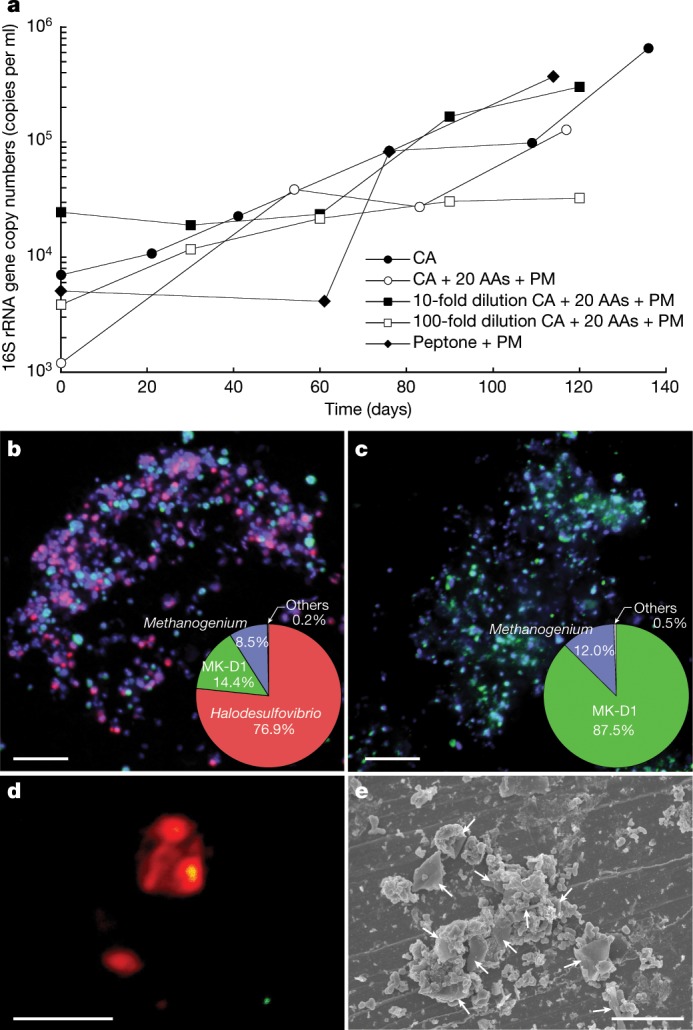
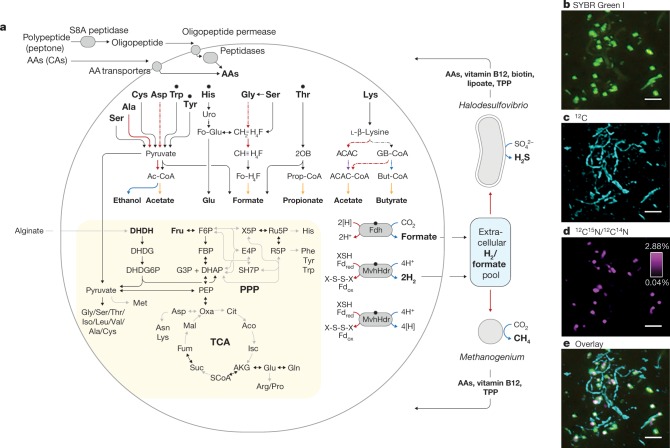
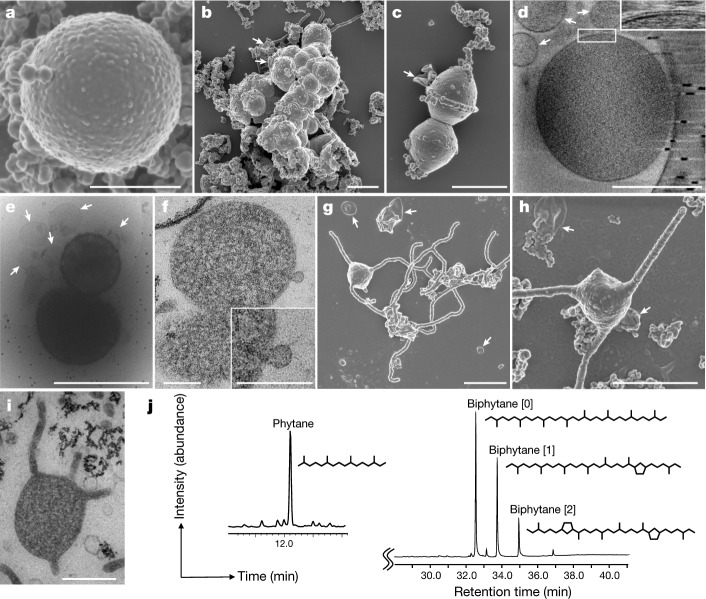
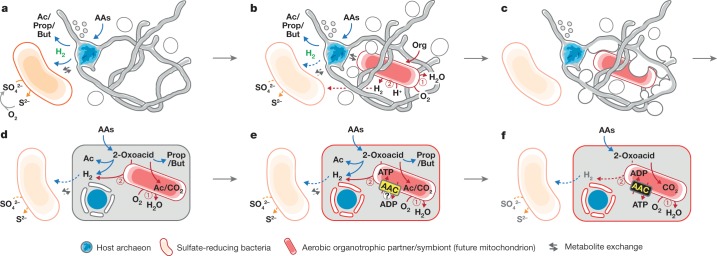
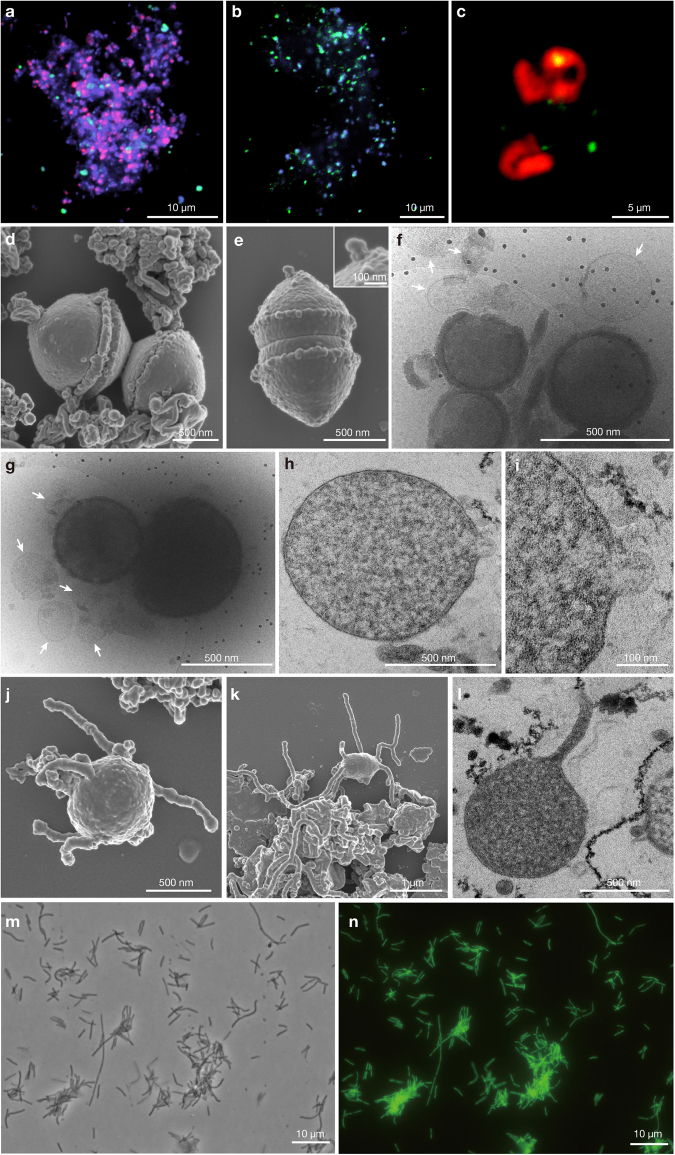
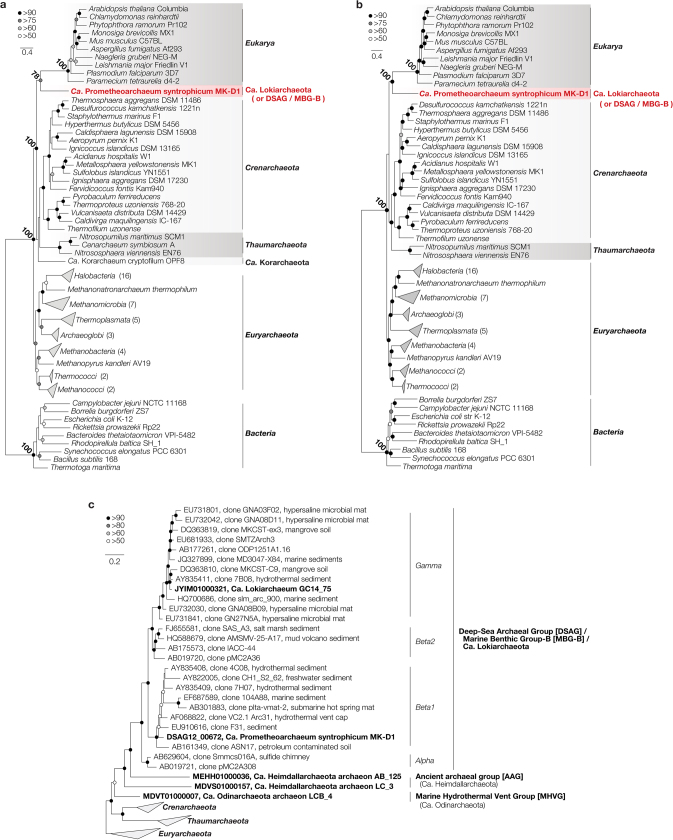
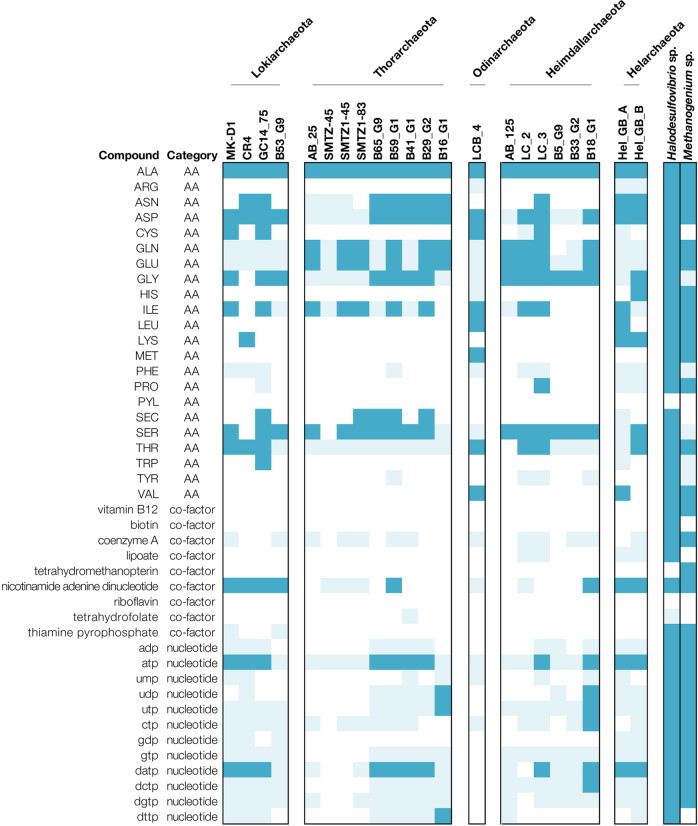
The origin of eukaryotes remains unclear 1-4. Current data suggest that eukaryotes may have emerged from an archaeal lineage known as 'Asgard' archaea 5,6. Despite the eukaryote-like genomic features that are found in these archaea, the evolutionary transition from archaea to eukaryotes remains unclear, owing to the lack of cultured representatives and corresponding physiological insights. Here we report the decade-long isolation of an Asgard archaeon related to Lokiarchaeota from deep marine sediment. The archaeon-'Candidatus Prometheoarchaeum syntrophicum' strain MK-D1-is an anaerobic, extremely slow-growing, small coccus (around 550 nm in diameter) that degrades amino acids through syntrophy. Although eukaryote-like intracellular complexes have been proposed for Asgard archaea 6, the isolate has no visible organelle-like structure. Instead, Ca. P. syntrophicum is morphologically complex and has unique protrusions that are long and often branching. On the basis of the available data obtained from cultivation and genomics, and reasoned interpretations of the existing literature, we propose a hypothetical model for eukaryogenesis, termed the entangle-engulf-endogenize (also known as E 3) model.
Overview
The claims and statistics of this paper haven’t been checked yet.
Free: it reads the open-access text and checks the first 5 claims that cite a source we can check. Create a free account to check every claim.
Integrity signals
Registry
Cites
Statistics
Figures
Verification
Claims the paper makes
The claims and statistics of this paper haven’t been checked yet.
Free: it reads the open-access text and checks the first 5 claims that cite a source we can check. Create a free account to check every claim.
Claims other papers make about this one
Each is checked against this paper’s own text: does it say what the citing paper says it does?
The source backs part of the claim, not all of it — or backs it for a different population, condition or comparison.
In the citing paper
“Furthermore, ATP synthase evolution supports scenarios on eukaryotic origins from an asgardarchaeal host3,4,13,14 and alphaproteobacterial symbiont107,108”
From ATP synthase evolution on a cross-braced dated tree of life (2023) · cites this paper as [14]
Experimental — accuracy not yet measured
Self-check
Percentages, sums and reported differences re-computed from the paper’s own numbers.
The self-check needs the paper’s full text.
Citations
Cites
Trimmomatic: a flexible trimmer for Illumina sequence data
Bolger, A. M., Lohse, M., & Usadel, B. (2014) · Bioinformatics · doi:10.1093/bioinformatics/btu170 · Cited by 65,548
MAFFT Multiple Sequence Alignment Software Version 7: Improvements in Performance and Usability
Katoh, K., & Standley, D. M. (2013) · Molecular Biology and Evolution · doi:10.1093/molbev/mst010 · Cited by 46,209
MUSCLE: multiple sequence alignment with high accuracy and high throughput
Edgar, R. C. (2004) · Nucleic Acids Research · doi:10.1093/nar/gkh340 · Cited by 44,662
The SILVA ribosomal RNA gene database project: improved data processing and web-based tools
Quast, C., Pruesse, E., Yilmaz, P., Gerken, J., Schweer, T., Yarza, P., Peplies, J., & Glöckner, F. O. (2012) · Nucleic Acids Research · doi:10.1093/nar/gks1219 · Cited by 33,055
RAxML version 8: a tool for phylogenetic analysis and post-analysis of large phylogenies
Stamatakis, A. (2014) · Bioinformatics · doi:10.1093/bioinformatics/btu033 · Cited by 32,291
MrBayes 3.2: Efficient Bayesian Phylogenetic Inference and Model Choice Across a Large Model Space
Ronquist, F., Teslenko, M., van der Mark, P., Ayres, D. L., Darling, A., Höhna, S., Larget, B., Liu, L., Suchard, M. A., & Huelsenbeck, J. P. (2012) · Systematic Biology · doi:10.1093/sysbio/sys029 · Cited by 27,843
SPAdes: A New Genome Assembly Algorithm and Its Applications to Single-Cell Sequencing
Bankevich, A., Nurk, S., Antipov, D., Gurevich, A. A., Dvorkin, M., Kulikov, A. S., Lesin, V. M., Nikolenko, S. I., Pham, S., Prjibelski, A. D., et al. (2012) · Journal of Computational Biology · doi:10.1089/cmb.2012.0021 · Cited by 25,987
BLAST+: architecture and applications
Camacho, C., Coulouris, G., Avagyan, V., Ma, N., Papadopoulos, J., Bealer, K., & Madden, T. L. (2009) · BMC Bioinformatics · doi:10.1186/1471-2105-10-421 · Cited by 22,074
Prokka: rapid prokaryotic genome annotation
Seemann, T. (2014) · Bioinformatics · doi:10.1093/bioinformatics/btu153 · Cited by 18,818
Guindon, S., Dufayard, J.-F., Lefort, V., Anisimova, M., Hordijk, W., & Gascuel, O. (2010) · Systematic Biology · doi:10.1093/sysbio/syq010 · Cited by 18,376
Research works printed but not linked: 1
- Chikaraishi, Y. et al. Instrumental Optimization for Compound-specific Nitrogen Isotope Analysis of Amino Acids by Gas Chromatography/Combustion/Isotope Ratio Mass Spectrometry in Earth, Life and Isotopes (eds Ohkouchi, N. et al.) 367–386 (Kyoto Univ. Press, 2010). 20658677
Cited by
Items 701–773 of 773
Liu, R., Cai, R., Wang, M., Zhang, J., Zhang, H., Li, C., & Sun, C. (2024) · Figshare · doi:10.6084/m9.figshare.26738034
Liu, R., Cai, R., Wang, M., Zhang, J., Zhang, H., Li, C., & Sun, C. (2024) · Figshare · doi:10.6084/m9.figshare.26738037
Pinto, L. C. D. A. (2021) · Portuguese National Funding Agency for Science, Research and Technology (RCAAP Project by FCT) · Cited by 2
Phillips, A. P. R. (2021) · Illinois Digital Environment for Access to Learning and Scholarship (University of Illinois at Urbana-Champaign)
Revisiting the mercury cycle in marine sediments: A potential multifaceted role for Desulfobacterota
Bertilsson, S. (2024) · Epsilon Open Archive (Sveriges lantbruksuniversitet biblioteket (Swedish University of Agricultural Sciences))
CLUSTard: An automated pipeline for metagenomic clustering using read abundance over time
Cansdale, A. (2020) · White Rose eTheses Online (University of Leeds, The University of Sheffield, University of York) · Cited by 1
PHYLOGENOMIQUE DES ARCHEES & RELATIONS AVEC LES EUCARYOTES
Gouy, R. (2024) · ORBi (University of Liège)
Role of Hel308 helicase in origin-independent DNA replication in two species of Haloferax
Harrison, C. (2024) · Nottingham ePrints (University of Nottingham)
Hodson, K. (2023) · Nottingham ePrints (University of Nottingham)
Zheng, J. (2023) · Digital Access to Scholarship at Harvard (DASH) (Harvard University)
Phylogenetic and functional characterization of Asgard primases
Li, Z., Liu, Y., Huang, L., & Li, M. (2025) · Molecular Biology and Evolution · doi:10.1093/molbev/msaf330
Zhang, S., Zhu, H., Ning, S. O. N. G., Lu, Z., & Li, M. (2025) · Scientia Sinica Vitae · doi:10.1360/ssv-2025-0354
Localization of Asgard archaeal ESCRT proteins to eukaryotic cellular structures
Naripogu, K. B., Tee, Y. H., Senju, Y., Bershadsky, A. D., & Robinson, R. C. (2026) · Biochemical and Biophysical Research Communications · doi:10.1016/j.bbrc.2026.153301
Archaea with a sweet tooth: isolation of novel sugar-degrading thermoacidophiles
Kohtz, A. J. (2026) · mSystems · doi:10.1128/msystems.01329-25
Bacterial ancestry of the mitochondrial ATP exporterPreprint
Gogoi, J., & Sankaranarayanan, R. (2026) · bioRxiv (Cold Spring Harbor Laboratory) · doi:10.64898/2026.03.31.715626
Lannes, R. (2019) · theses.fr (ABES) · doi:10.70675/0b6a9095z5dfaz4dd3zbc18z8dabe66a4e67 · Cited by 1
Etudes des interactions entre virus et hôtes archéens hydrothermaux hyperthermophiles
Thiroux, S. (2019) · theses.fr (ABES) · doi:10.70675/8993e3d5z507cz4c6ez95dcz99d8b6cd38c2 · Cited by 1
Isolation and characterization of hyperthermophilic archaeal viruses
Baquero, D. P. (2020) · theses.fr (ABES) · doi:10.70675/10cf5616zd69az43f3z9f17z26d9cc89cbcf
Deep eukaryotic phylogenomics : the holomycota branch
Galindo, L. J. (2020) · theses.fr (ABES) · doi:10.70675/c372f454zda6dz4820zb255z176dd65f68a1
Metabarcoding and metagenomic approaches to decipher microbial communities in suboxic environments
Reboul, G. (2020) · theses.fr (ABES) · doi:10.70675/f0308064z2fe8z44fczb92dzb797ed7fe3ed · Cited by 1
Markoš, A., & Horský, J. (2026) · Biosemiotics/Biosemiotics. Bookseries · doi:10.1007/978-3-032-16131-4_10
Schatz-Daas, D. (2021) · theses.fr (ABES) · doi:10.70675/a6e97303z9403z43f4zb4b3ze23004da7753 · Cited by 2
Phylogenomics & Molecular studies of Lhr-type SF2 helicases in Archaea and Bacteria
Hajj, M. (2021) · theses.fr (ABES) · doi:10.70675/0d717105za31dz4eacza5c1zffbbec62cdea
Structure and assembly of nuclear pore complexes by correlative AFM and super-resolution microscopy
Vial, A. (2021) · theses.fr (ABES) · doi:10.70675/f9bdc92eza428z4389za376zb8d6459780b7
Ecological drivers of Promethearchaeati’s specialization for deep subsurface environments
Smith, L., & Lloyd, K. G. (2026) · Communications Biology · doi:10.1038/s42003-026-09786-6
“In general, the perspective could benefit from a clearer structure with a more clear question that is being addressed throughout the perspective that is effectively communicated in the abstract and introduction.”
InfluentialIn vivo study of DNA topology in hyperthermophilic archaeon Thermococcus kodakarensis
Villain, P. (2021) · theses.fr (ABES) · doi:10.70675/63695de5z98cbz413bzb06bz74a37611259c
Role of aIF5B in archaeal translation initiation
Kazan, R. (2022) · theses.fr (ABES) · doi:10.70675/271059cdz82bcz4d1ez9c06z1f66f8033eb6
Phylogenetic and biochemical insights into the diversity of TET peptidases in Archaea
Chagny, É. (2024) · theses.fr (ABES) · doi:10.70675/c4cf81c6z7877z418ezb38ezc18669f33e16
Meichel, H. (2023) · theses.fr (ABES) · doi:10.70675/669245a3z8a42z4953zbaedz2ce6b4472fd5 · Cited by 1
Identifying remote homology and gene remodelling using network-based approaches
Sussfeld, D. (2024) · theses.fr (ABES) · doi:10.70675/16bae834z8f7fz4918zbf55zb905a74f7bdf
Gomez-Raya-Vilanova, M. V. (2024) · theses.fr (ABES) · doi:10.70675/426feb97z7f5ez4a21z911ezefbbc5456dc5
Evolution of the eukaryote (epi)genome : Insights from orphan protists
Blaz, J. (2023) · theses.fr (ABES) · doi:10.70675/68387a32zd0bfz4f4fz89f9zfa56c5677bb4
Community structure and methylation of microbes in an artificially forced sediment core
Zhao, R., & Biddle, J. F. (2026) · Microbiology Spectrum · doi:10.1128/spectrum.03533-25
Bacterial ancestry of the mitochondrial ATP exporterPreprint
Gogoi, J., & Sankaranarayanan, R. (2026) · eLife · doi:10.7554/elife.111475
Bacterial ancestry of the mitochondrial ATP exporterPreprint
Gogoi, J., & Sankaranarayanan, R. (2026) · eLife · doi:10.7554/elife.111475.1
The isolation of industrially important microorganisms
Stanbury, P. F., Whitaker, A., & Hall, S. J. (2026) · Elsevier eBooks · doi:10.1016/b978-0-323-99273-2.00007-5
Prokaryotic Cells and Endosymbiotic Origin of Eukaryotic Cells
Miller, W. B., Baluška, F., Slijepčević, P., & Reber, A. S. (2026) · Springer eBooks · doi:10.1007/978-3-032-23779-8_6
Exploring life’s hidden majority: microbial dark matter symposium highlights
Flamholz, Z., Mulay, S. A., Leshyk, V. O., Caporaso, J. G., Eisen, J. A., Kelly, L., Lloyd, K. G., Osburn, M. R., Podar, M., Roux, S., et al. (2026) · mSphere · doi:10.1128/msphere.00587-25
“The achievement was worth the wait given its implication for eukaryogenesis (41).”
Cai, H., Zhou, Y. B., Gu, L., Liu, L., Zhao, R., Chen, X., & Yang, M. (2026) · Industrial Crops and Products · doi:10.1016/j.indcrop.2026.123845
On the timing of eukaryotic origin
Song, N., Pang, K., Feng, X., & Li, M. (2026) · Biological reviews/Biological reviews of the Cambridge Philosophical Society · doi:10.1002/brv.70201
Metabolic inhibition can enable compact physical integration of microbial partnersPreprint
Krishnan, N., Garay, J., Kun, Á., Broom, M., & Zachar, I. (2026) · bioRxiv (Cold Spring Harbor Laboratory) · doi:10.64898/2026.07.13.738165
“1) and to the origin of mitochondria according to some proposed theories [18,25], though the benefit of increased surface contact was never tested.”
InfluentialA rhizarian genome reveals an osmotrophic route to extracellular digestion in eukaryotesPreprint
Öztoprak, H., Graf, J., Jacobs, R., Kaiser, F., & Dumack, K. (2026) · bioRxiv (Cold Spring Harbor Laboratory) · doi:10.64898/2026.07.16.738196
“In bacteriology, genomes provided valuable information on their functions, including an improved understanding of processes such as nitrogen cycling, fermentation, and the spread of antimicrobial resistance (Collineau et al., 2019; Herold et al., 2020; Imachi et al., 2020; Zehr & Capone, 2020).”
Archaeal Diversity Sheds New Light on the Origin of the Eukaryotic Endomembrane System
Lu, Z., Zhang, S., Song, N., Feng, X., Zhou, Z., Liu, Y., & Li, M. (2026) · Annual Review of Microbiology · doi:10.1146/annurev-micro-042524-032136
Valenzuela, B., Navarrete-Diaz, I., Cayo, M., Solís-Cornejo, F., & Zamorano, P. L. (2026) · International Journal of Molecular Sciences · doi:10.3390/ijms27156905
“The detection of Promethearchaeota is of particular interest given the evolutionary significance of Asgard -related archaea in current models of eukaryotic evolution [22,23].”
Functional Specialization of Clathrin‐Independent Endocytic Routes: Mechanisms and Cellular Roles
Benvenuto, A. F., Fardin, A., Balestra, M., Fiore, P. P. D., Tordonato, C., & Sigismund, S. (2026) · Traffic · doi:10.1111/tra.70049
“Cultivation of Candidatus Prometheoarchaeum syntrophicum and Candidatus Lokiarchaeum ossiferum provided the first morphological insights, but neither species showed clear internal compartmentalization [229, 231, 232].”
Zou, X., Zhang, B., Gu, B., Gong, Y., Bai, Y., & Zhang, L. (2026) · Applied Microbiology and Biotechnology · doi:10.1007/s00253-026-14009-3
A minimal Asgard archaeal ESCRT-III system remodels membranes across scalesPreprint
Schwille, P., Zivkovic, H., Hrebík, D., Frohn, B. P., Basquin, J., Riggi, M., & Briggs, J. A. G. (2026) · Research Square · doi:10.21203/rs.3.rs-10742307/v1
Struillou, A., Deschamps, P., Moreira, D., & López‐García, P. (2026) · ISME Communications · doi:10.1093/ismeco/ycag253
“Two cultured Asgard archaeal 16S rRNA gene sequences ( Prometheoarchaeum syn-trophicum [ 19] and Lokiarchaeum ossiferum [ 20]) were subsequently added to the phylogenetic dataset ( Supplementary Fig.”
Research Institute for Global Change Annual Report FY2019
(2021) · Institutional Repositories DataBase (IRDB)
Hologenomic interactions promote the higher-order evolvability of phenotypic complexity
Pyron, R. A., & Colston, T. J. (2026) · Trends in Genetics · doi:10.1016/j.tig.2026.08.007
These bizarre, much-coveted microbes are revealing the origins of complex life
Quill, E. (2026) · Nature · doi:10.1038/d41586-026-02849-y
From endosymbiont to signalling hub: evolution and functional integration of mitochondria
Hazır, Z. D., Türkel, İ., & Kubat, G. B. (2026) · Journal of Mitochondria Plastids and Endosymbiosis · doi:10.1080/28347056.2026.2737069
Development of down-flow hanging sponge (DHS) process—history
Onodera, T. (2026) · Elsevier eBooks · doi:10.1016/b978-0-443-44696-2.00005-2
Eco-bioengineering process and microbiology of down-flow hanging sponge reactors
Ohashi, A., & Kubota, K. (2026) · Elsevier eBooks · doi:10.1016/b978-0-443-44696-2.00014-3
Tsui, K., Raj, E. N., Tsai, A. P., Wang, B., Wen, C., & Li, C.-J. (2026) · International Journal of Biological Sciences · doi:10.7150/ijbs.140360
“The evolution of the eukaryotic cell is founded upon a singular, transformative endosymbiotic event occurring approximately 1.5 billion years ago, when an archaeal host internalized an -proteobacterium [1-3].”
InfluentialMicrobes as Key Players During Evolution: I From the Beginnings to the Appearance of Eukaryotes
Schirrmacher, V. (2026) · International Journal of Molecular Sciences · doi:10.3390/ijms27198790
“The cultured cell, Prometheo-archaeum syntrophicum , has octopus-like tentacles with which it makes contact with the co-cultured bacteria to enable the exchange of important molecules [61].”
InfluentialWan, Z., Liao, M., Wang, L., Bi, H., & Gong, C. (2026) · World Journal of Microbiology and Biotechnology · doi:10.1007/s11274-026-05289-y
“In plant cell walls, hemicellulose is tightly intertwined with cellulose and lignin to form a reinforced framework, which (Imachi et al. 2020) strengthens the wall and makes it harder to break down (Gao et al. 2025).”
Higashi, S. L., & Ikeda, M. (2026) · Chemical Communications · doi:10.1039/d6cc05341f
Leng, H. (2026) · ORBi (University of Liège)
Marine holobionts: a model arena for host–microbe biology, from ecosystem function to biotechnology
Piazza, D., Graziano, M., Avesani, A., Fondi, M., Bosi, E., & Martino, M. E. (2026) · Sustainable Microbiology · doi:10.1093/sumbio/qvag045
Hidden introns and repeated gains shape the heavily interrupted tRNA genes of Asgard archaeaPreprint
Goswami, S., Ghosh, A. K., & Sinha, K. (2026) · bioRxiv (Cold Spring Harbor Laboratory) · doi:10.64898/2026.10.13.758758
“Asgard archaea are the prokaryotes most closely related to eukaryotes (Spang et al., 2015; Zaremba-49 Niedzwiedzka et al., 2017; Imachi et al., 2020; Eme et al., 2023; Zhang et al., 2025).”
Phagocytosis without mitochondria is a lineage trait of planctomycetal bacteria of preyPreprint
Wurzbacher, C. E., Hammer, J. B., Haufschild, T., Buyuktarakci, B. S., Gonzales, A. J., Bouderka, F., Soares, A., Mueller, J. M., Millan, L. F. M., Ferrelli, M. L., et al. (2026) · bioRxiv (Cold Spring Harbor Laboratory) · doi:10.64898/2026.10.26.761892
Li, Y.-Y., FRAZIER, K. B., & Tay, F. R. (2026) · Experimental Gerontology · doi:10.1016/j.exger.2026.113372
Graseck, M., Pretorius, D., Edwards, S., Nikov, G. I., Hamm, J., Baum, B., Spang, A., Ovchinnikov, S., & Karlusich, J. J. P. (2026) · bioRxiv (Cold Spring Harbor Laboratory) · doi:10.64898/2026.10.28.762692
A symbiogenic merger enabled by oxygen initiated the evolution of eukaryotes
Speijer, D. (2026) · Proceedings of the National Academy of Sciences · doi:10.1073/pnas.2620770123
Prokaryotes bridging the lipid divide
García-Domínguez, R., & Devos, D. P. (2026) · FEMS Microbiology Reviews · doi:10.1093/femsre/fuag056
Metadata
- Authors
- Imachi, H., Nobu, M. K., Nakahara, N., Morono, Y., Ogawara, M., Takaki, Y., Takano, Y., Uematsu, K., Ikuta, T., Ito, M., Matsui, Y., Miyazaki, M., Murata, K., Saito, Y., Sakai, S., Song, C., Tasumi, E., Yamanaka, Y., Yamaguchi, T., Kamagata, Y., Tamaki, H., & Takai, K.
- Affiliations
- Japan Agency for Marine-Earth Science and Technology (JP)
- National Institute of Advanced Industrial Science and Technology (JP)
- Marine Works Japan Ltd. (Japan) (JP)
- National Institute for Physiological Sciences (JP)
- Nagaoka University of Technology (JP)
- Corresponding author
- Imachi, Hiroyuki
- Nobu, Masaru K.
- ORCID
- Venue
- Nature
- Published
- 2020-01-15
- Volume
- 577
- Issue
- 7791
- Pages
- 519-525
- ISSN
- 0028-0836 (ISSN-L)
- 1476-4687
- PMC
- PMC7015854
- OpenAlex
- W2999376388
- Semantic Scholar
- ca5317ffc225685e3a40aed38069ed97c2151db3
- Cited by
- 624
- References
- 96
- Citations by year
- 2026: 56 · 2025: 82 · 2024: 89 · 2023: 81 · 2022: 109 · 2021: 101 · 2020: 105
- FWCI
- 33.18
- Type
- journal article
- Language
- en
- Open access
- green
- www.ncbi.nlm.nih.gov
- Licence
- cc-by
- www.springernature.com/gp/researchers/text-and-data-mining (tdm)
- www.springernature.com/gp/researchers/text-and-data-mining (vor)
- Locations
- Nature (publishedVersion)
- Europe PMC (PubMed Central) (publishedVersion, cc-by)
- PubMed Central (publishedVersion, cc-by)
- PubMed (publishedVersion)
- Zenodo (CERN European Organization for Nuclear Research) (submittedVersion)
- Funders
- Japan Society for the Promotion of Science (18K18795, 20H02019, 16H06280, 18H03367, 18H02426, 18H04468, 19H01005, 16H04083, 18H05295)
- Topics
- Life Sciences › Agricultural and Biological Sciences › Ecology, Evolution, Behavior and Systematics › Protist diversity and phylogeny
- Physical Sciences › Physics and Astronomy › Astronomy and Astrophysics › Origins and Evolution of Life
- Physical Sciences › Environmental Science › Ecology › Microbial Community Ecology and Physiology
- Keywords
- Asgard archaea, Lokiarchaeota, eukaryotic origin, syntrophy, amino acid catabolism
- MeSH terms
- Amino Acids, Archaea, Eukaryotic Cells, Lipids, Models, Biological, Phylogeny, Prokaryotic Cells, Symbiosis, Geologic Sediments, Evolution, Molecular, Genome, Archaeal
About these checks
Registry, retraction, Cites and statistics results are computed, not judged, with one exception: a printed reference that no index lists is read once by a model before it counts as a citation error. Claims are extracted by a model and kept only when their quote appears verbatim in the text; each cited source is then checked, with a model’s help, for whether it says what the claim relies on. Those verdicts can be wrong — read the claim’s quote and the cited source before relying on one.
Statistics and arithmetic are recomputed, not judged.
Confidence bands are shown only for fields calibrated on our annotated test set. None is calibrated yet, so no band is shown.
What counts as a claim ›How we measure confidence ›How we check this ›
Are you an author, or do you see a problem with this page? Request a review
Data sources
Bibliographic data: Semantic Scholar, OpenAlex, Crossref.
Contains information from the Semantic Scholar Academic Graph Datasets, made available under the ODC Attribution License (ODC-BY 1.0).
Semantic Scholar’s data is described in: Kinney, R., et al. (2023). The Semantic Scholar Open Data Platform. arXiv:2301.10140.
