

Massive haplotypes underlie ecotypic differentiation in sunflowers
Open accessPublished version of a preprint
The DOI matches its Crossref record; 94 of the 94 references it cites were found in a registry or an index.
Abstract
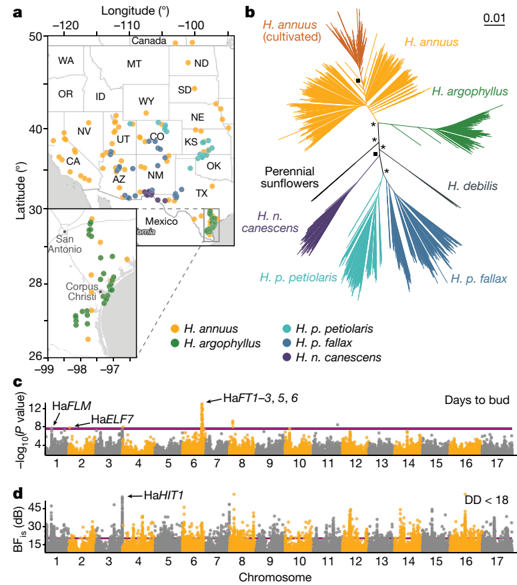
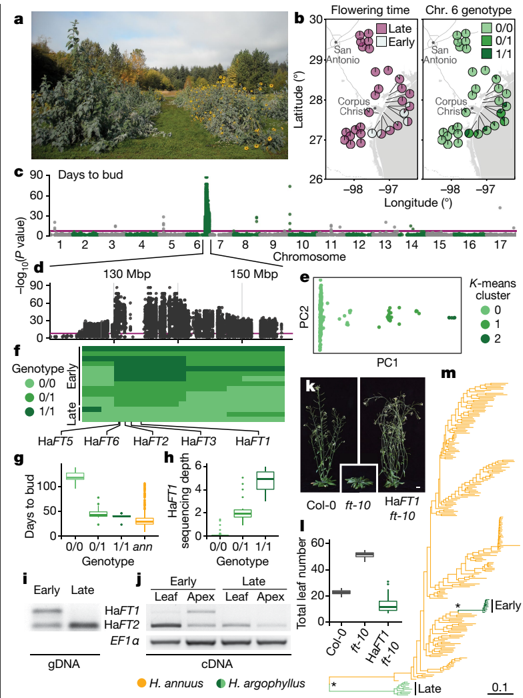
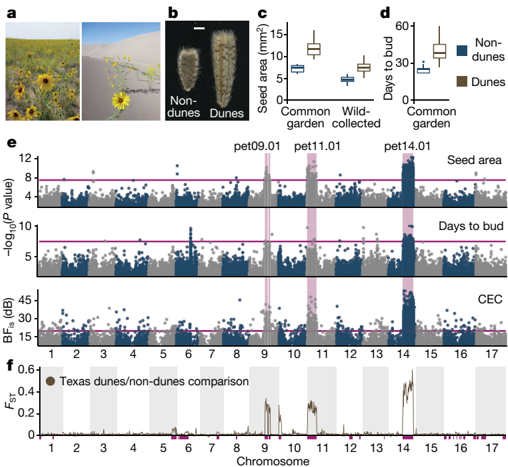
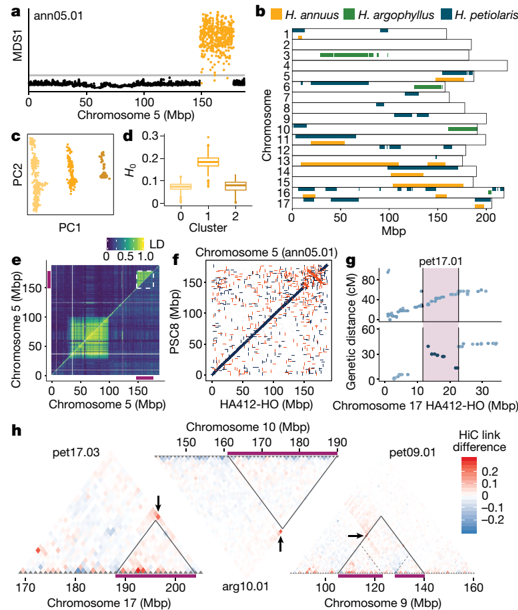
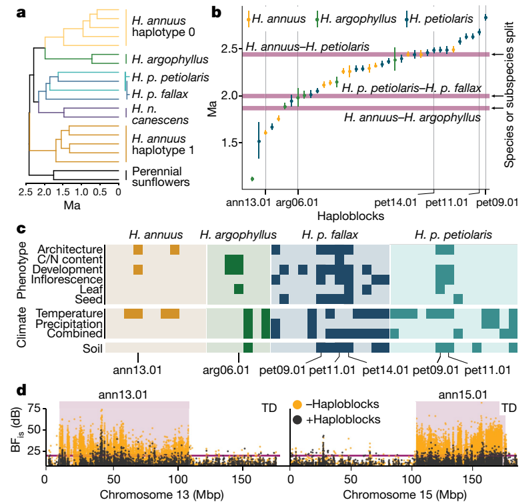
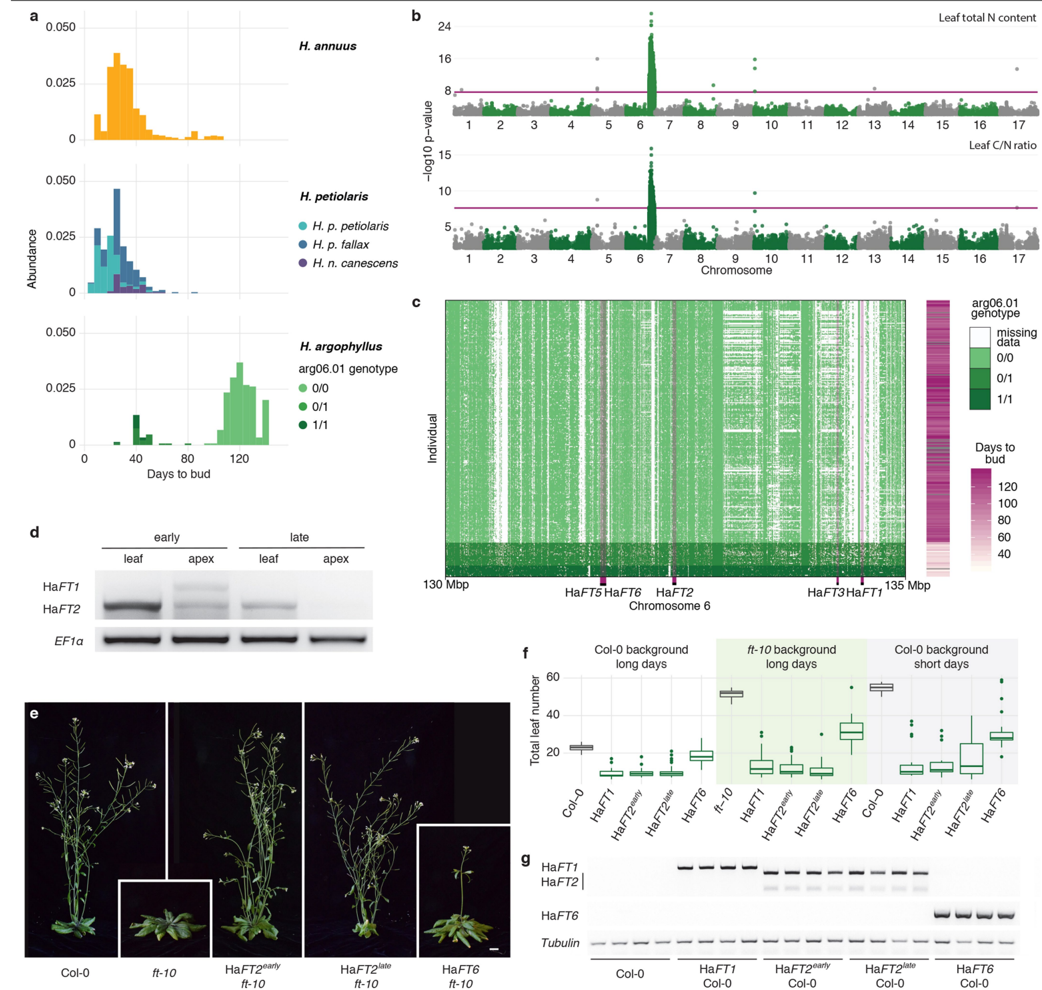
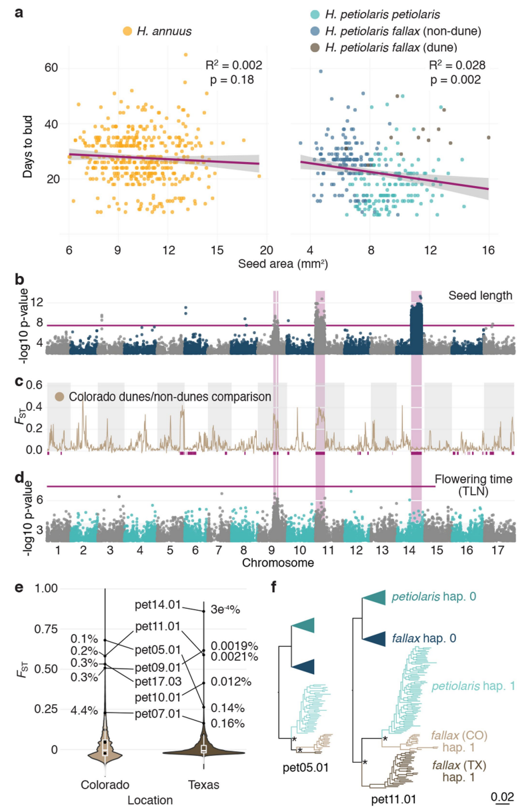
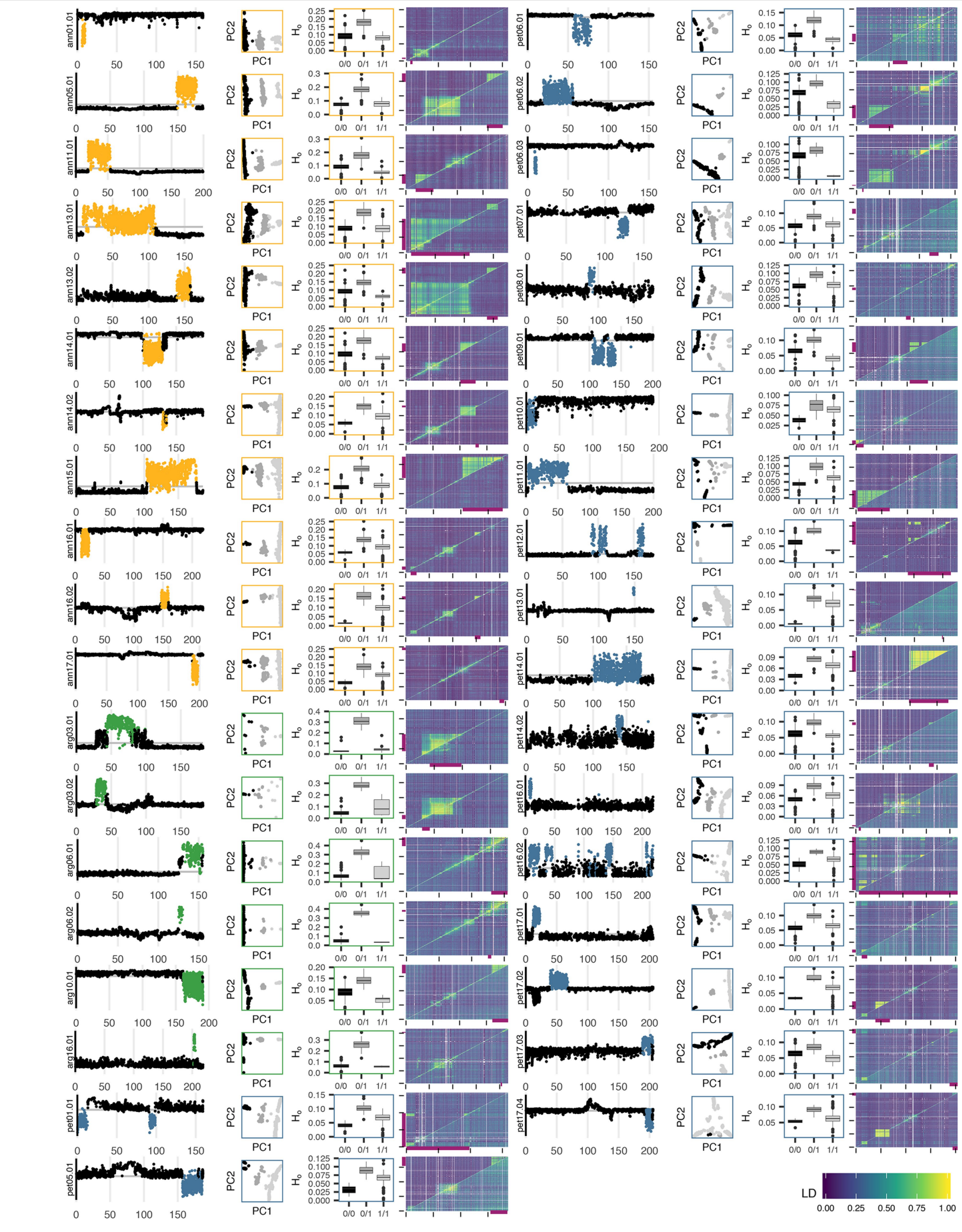
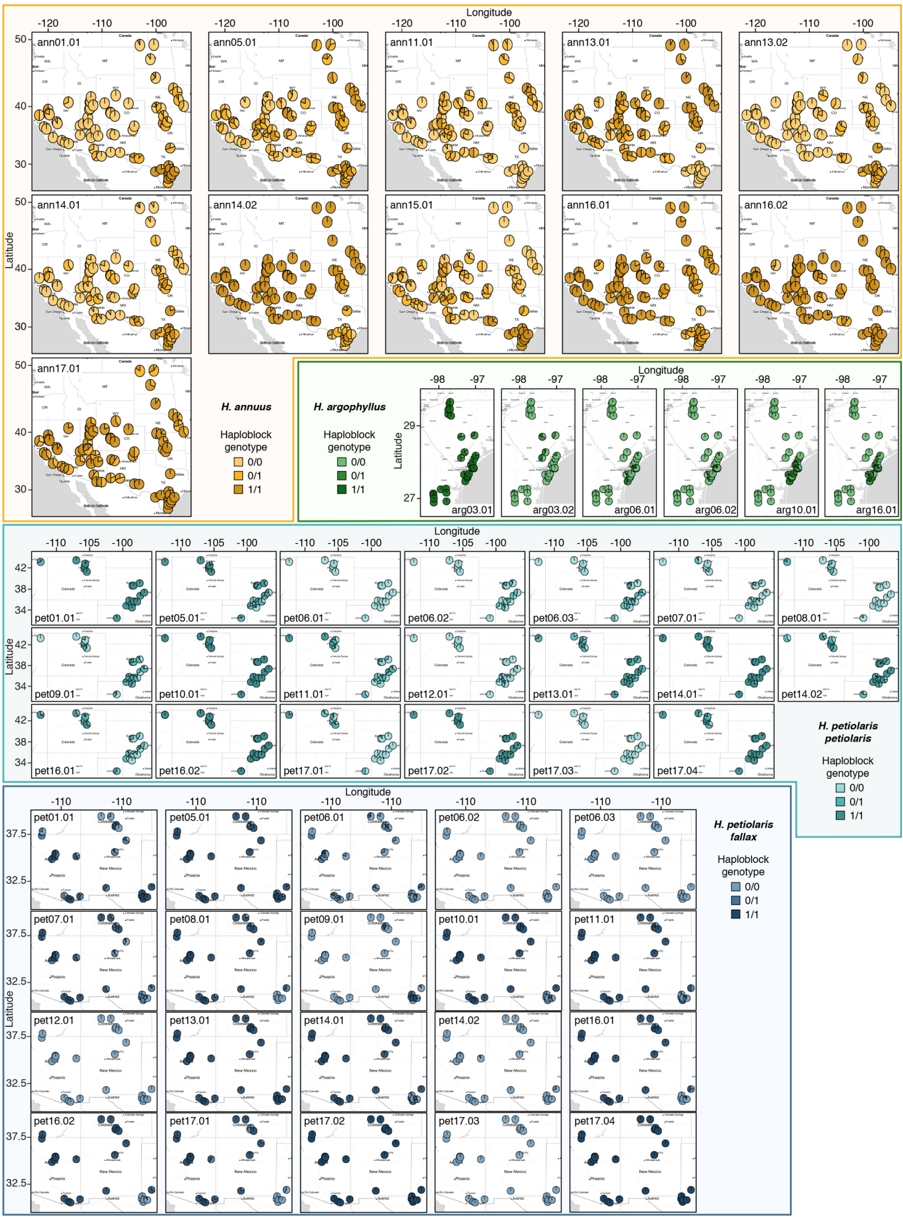
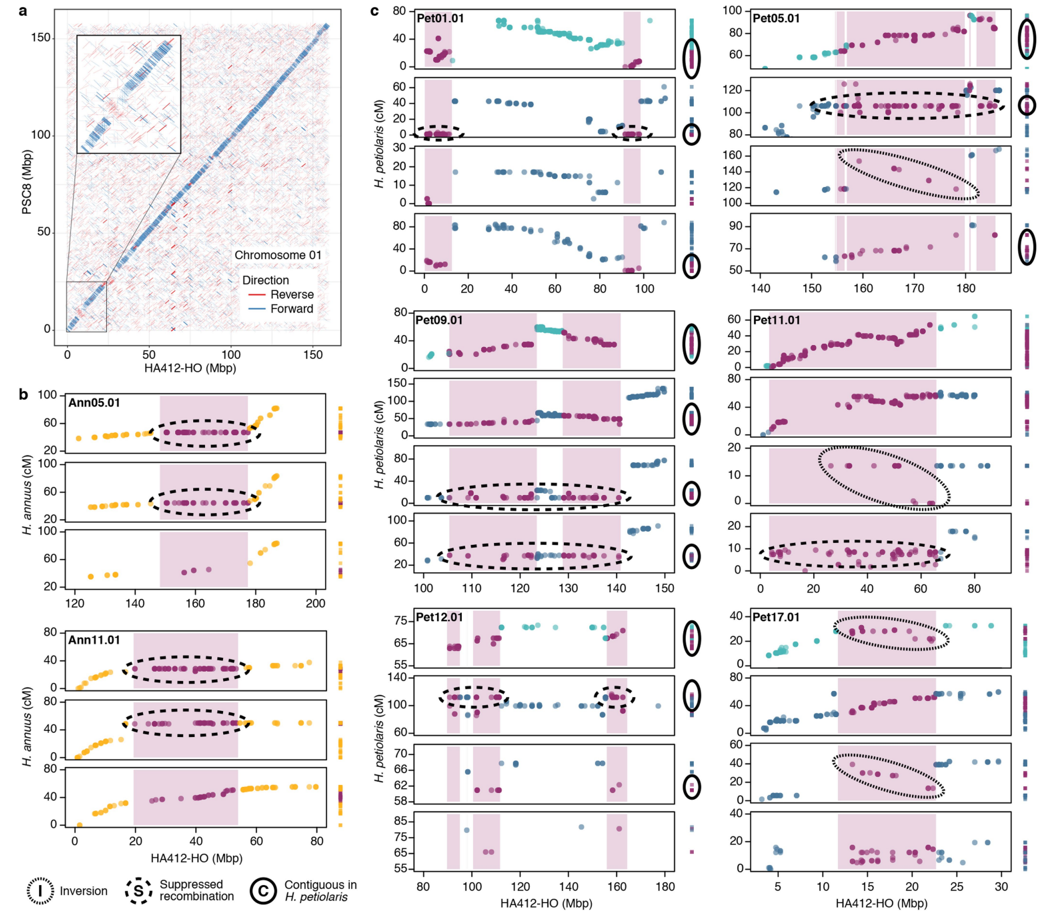
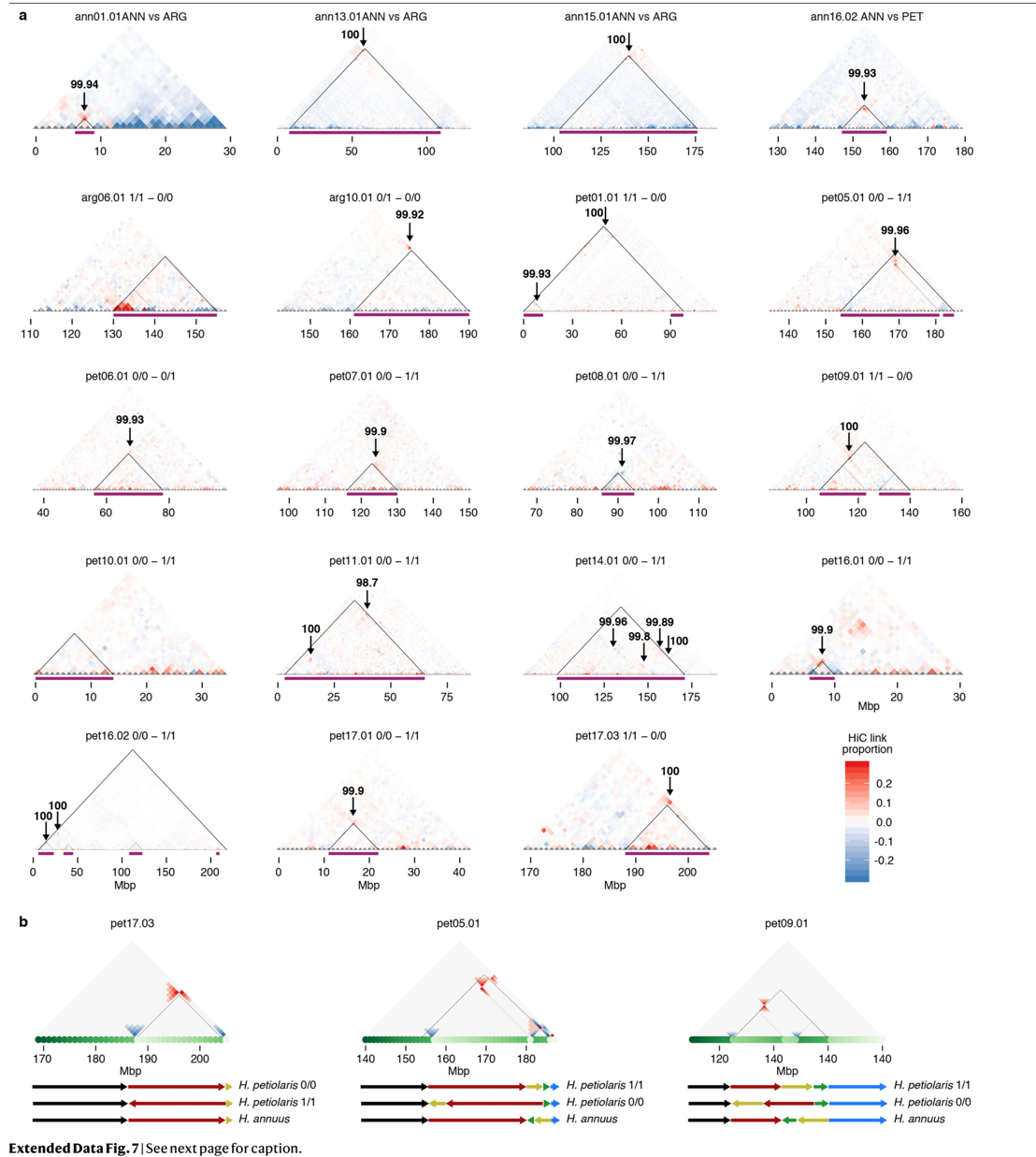
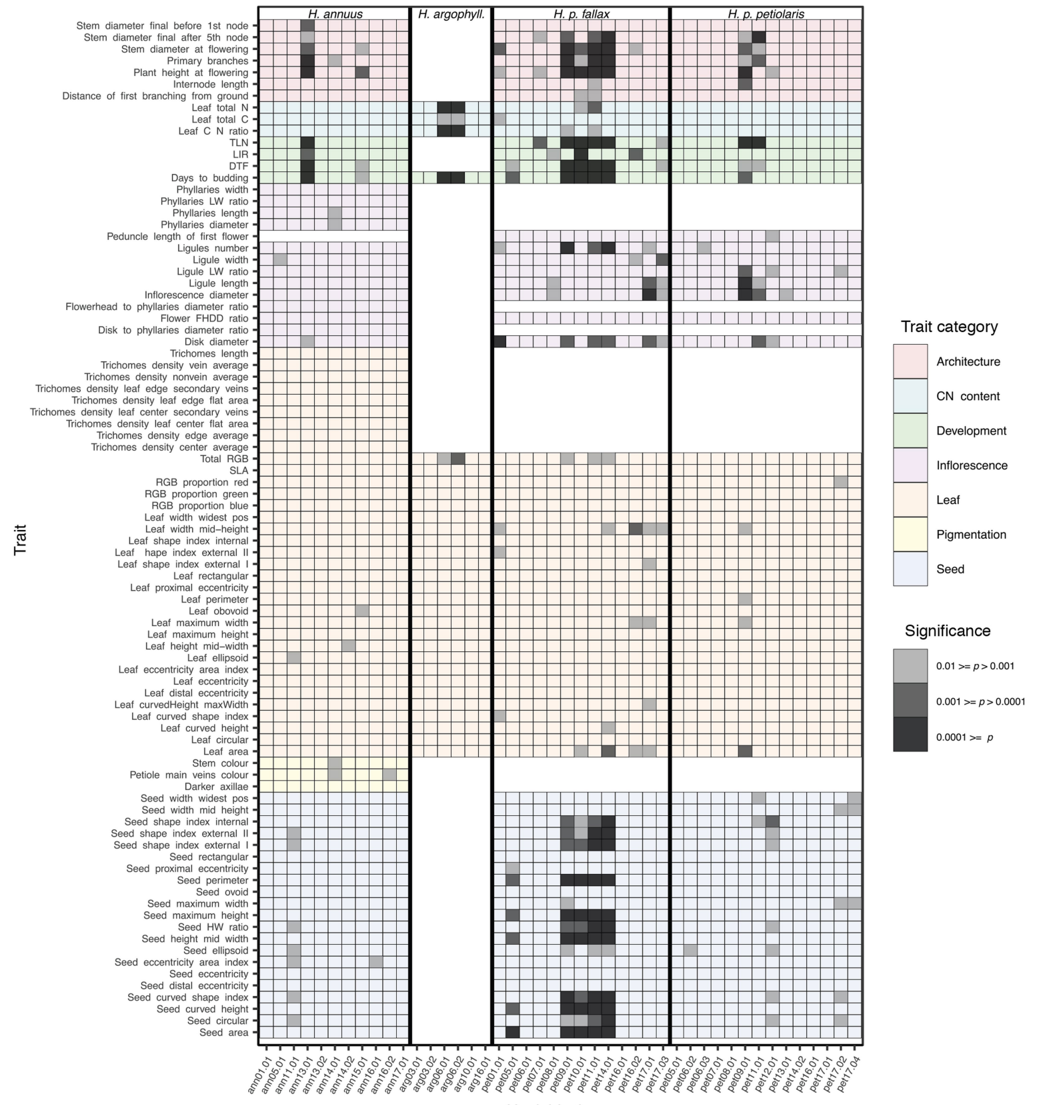
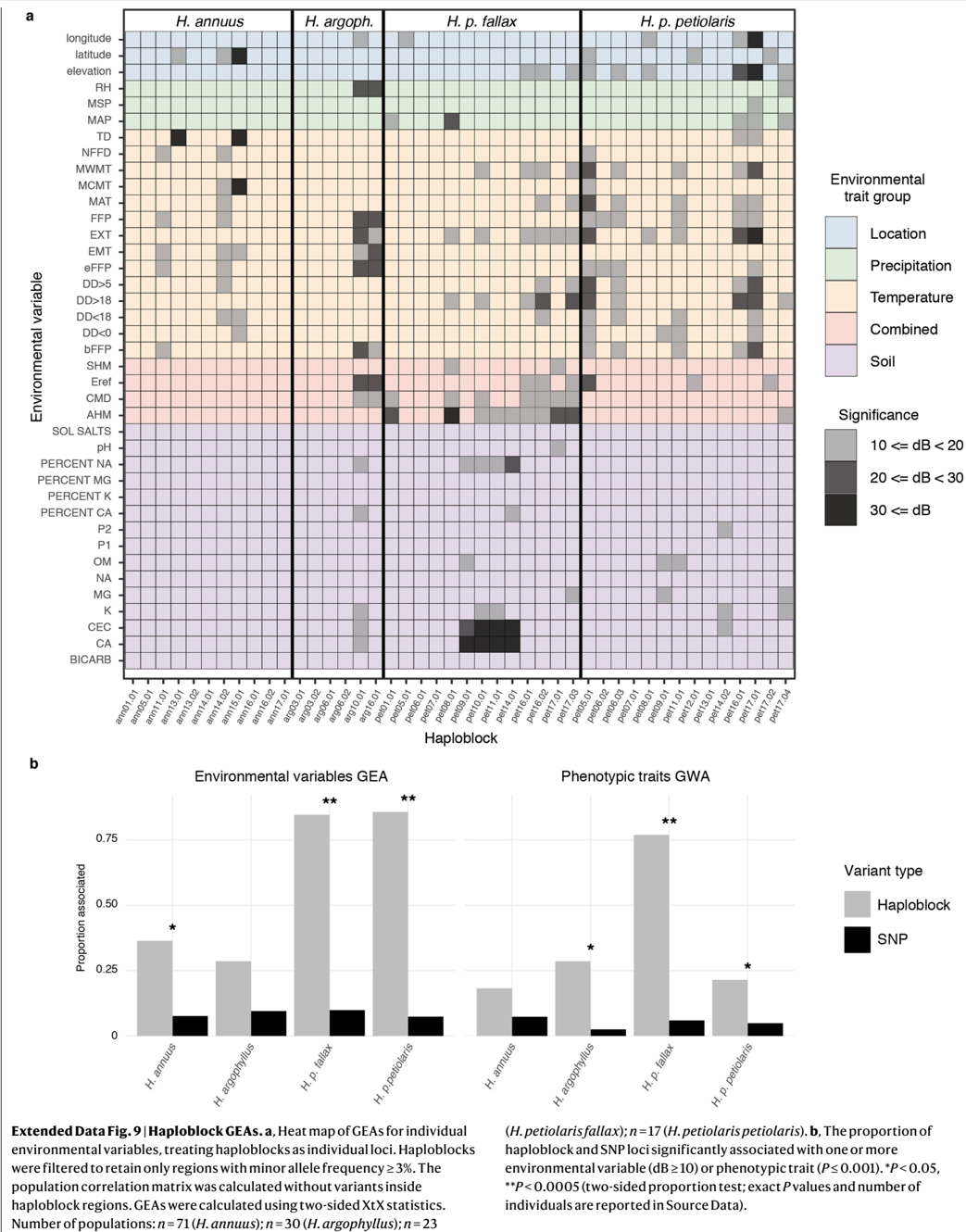
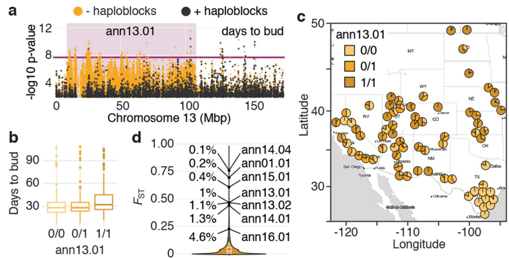
Species often include multiple ecotypes that are adapted to different environments1. However, it is unclear how ecotypes arise and how their distinctive combinations of adaptive alleles are maintained despite hybridization with non-adapted populations2–4. Here, by resequencing 1,506 wild sunflowers from 3 species (Helianthus annuus, Helianthus petiolaris and Helianthus argophyllus), we identify 37 large (1–100 Mbp in size), non-recombining haplotype blocks that are associated with numerous ecologically relevant traits, as well as soil and climate characteristics. Limited recombination in these haplotype blocks keeps adaptive alleles together, and these regions differentiate sunflower ecotypes. For example, haplotype blocks control a 77-day difference in flowering between ecotypes of the silverleaf sunflower H. argophyllus (probably through deletion of a homologue of FLOWERING LOCUS T (FT)), and are associated with seed size, flowering time and soil fertility in dune-adapted sunflowers. These haplotypes are highly divergent, frequently associated with structural variants and often appear to represent introgressions from other—possibly now-extinct—congeners. These results highlight a pervasive role of structural variation in ecotypic adaptation. Resequencing analyses of three species of wild sunflower identify large non-recombining haplotype blocks that correlate with ecologically relevant traits, soil and climate characteristics, and that differentiate species ecotypes.
Overview
The claims and statistics of this paper haven’t been checked yet.
Free: it reads the open-access text and checks the first 5 claims that cite a source we can check. Create a free account to check every claim.
Integrity signals
Registry
Cites
Statistics
Figures
Verification
Claims the paper makes
The claims and statistics of this paper haven’t been checked yet.
Free: it reads the open-access text and checks the first 5 claims that cite a source we can check. Create a free account to check every claim.
Claims other papers make about this one
Each is checked against this paper’s own text: does it say what the citing paper says it does?
The source backs part of the claim, not all of it — or backs it for a different population, condition or comparison.
In the citing paper
“An apparent example of the latter comes from sunflower, where hemizygosity or complete loss of a homolog of FLOWERING LOCUS T underlies a shift in flowering time between sympatric ecotypes of the silverleaf sunflower (Todesco et al., 2020).”
From Genomics of plant speciation (2023) · cites this paper as Todesco et al., 2020
Experimental — accuracy not yet measuredThe source backs part of the claim, not all of it — or backs it for a different population, condition or comparison.
In the citing paper
“As well, introgression is reduced for genes or genomic regions underlying RI (Barb et al., 2014; Kenney and Sweigart, 2016; Todesco et al., 2020).”
From Genomics of plant speciation (2023) · cites this paper as Todesco et al., 2020
Experimental — accuracy not yet measuredThe source backs part of the claim, not all of it — or backs it for a different population, condition or comparison.
In the citing paper
“Other examples come from studies of adaptive introgression or homoploid hybrid speciation (see Speciation with gene flow, introgression, and hybrid speciation), in which alleles or SVs critical to RI have been identified in parental populations (Nevado et al., 2020; Todesco et al., 2020; Wang et al., 2021b).”
From Genomics of plant speciation (2023) · cites this paper as Todesco et al., 2020
Experimental — accuracy not yet measuredThe source backs part of the claim, not all of it — or backs it for a different population, condition or comparison.
In the citing paper
“Examples include the origin of dune sunflower ecotypes in the southwestern US, in which traits associated with dune adaptation and RI map to inversions, which are old and pre-date ecotype divergence (Ostevik et al., 2016; Huang and Rieseberg, 2020; Todesco et al., 2020).”
From Genomics of plant speciation (2023) · cites this paper as Todesco et al., 2020
Experimental — accuracy not yet measuredThe cited source says what the claim attributes to it.
In the citing paper
“genomic studies have shown that when adaptation and speciation have progressed, chromosomal inversions or other recombination cold spots become crucially important in settings characterized by gene flow (e.g., Todesco et al., 2020)”
From Genomics of plant speciation (2023) · cites this paper as Todesco et al., 2020
1 more claim about this paper
Create a free account to see every claim other papers make about this one.
Self-check
Percentages, sums and reported differences re-computed from the paper’s own numbers.
The self-check needs the paper’s full text.
Citations
Cites
Fiji: an open-source platform for biological-image analysis
Schindelin, J., Arganda-Carreras, I., Frise, E., Kaynig, V., Longair, M., Pietzsch, T., Preibisch, S., Rueden, C., Saalfeld, S., Schmid, B., et al. (2012) · Nature Methods · doi:10.1038/nmeth.2019 · Cited by 66,890
Trimmomatic: a flexible trimmer for Illumina sequence data
Bolger, A. M., Lohse, M., & Usadel, B. (2014) · Bioinformatics · doi:10.1093/bioinformatics/btu170 · Cited by 65,548
NIH Image to ImageJ: 25 years of image analysis
Schneider, C. A., Rasband, W. S., & Eliceiri, K. W. (2012) · Nature Methods · doi:10.1038/nmeth.2089 · Cited by 64,638
The Sequence Alignment/Map format and SAMtools
Li, H., Handsaker, B., Wysoker, A., Fennell, T., Ruan, J., Homer, N., Marth, G., Abecasis, G., Durbin, R., & 1000 Genome Project Data Processing Subgroup (2009) · Bioinformatics · doi:10.1093/bioinformatics/btp352 · Cited by 62,041
IQ-TREE: A Fast and Effective Stochastic Algorithm for Estimating Maximum-Likelihood Phylogenies
Nguyen, L.-T., Schmidt, H. A., von Haeseler, A., & Minh, B. Q. (2015) · Molecular Biology and Evolution · doi:10.1093/molbev/msu300 · Cited by 26,046
ModelFinder: fast model selection for accurate phylogenetic estimates
Kalyaanamoorthy, S., Minh, B. Q., Wong, T. K. F., von Haeseler, A., & Jermiin, L. S. (2017) · Nature Methods · doi:10.1038/nmeth.4285 · Cited by 18,449
The variant call format and VCFtools
Danecek, P., Auton, A., Abecasis, G., Albers, C. A., Banks, E., DePristo, M. A., Handsaker, R. E., Lunter, G., Marth, G. T., Sherry, S. T., et al. (2011) · Bioinformatics · doi:10.1093/bioinformatics/btr330 · Cited by 16,200
Algorithm AS 136: A K-Means Clustering Algorithm
Hartigan, J. A., & Wong, M. A. (1979) · Applied Statistics · doi:10.2307/2346830 · Cited by 14,523
Heinz, S., Benner, C., Spann, N., Bertolino, E., Lin, Y. C., Laslo, P., Cheng, J. X., Murre, C., Singh, H., & Glass, C. K. (2010) · Molecular Cell · doi:10.1016/j.molcel.2010.05.004 · Cited by 13,382
Rapid isolation of high molecular weight plant DNA
Murray, M. G., & Thompson, W. F. (1980) · Nucleic Acids Research · doi:10.1093/nar/8.19.4321 · Cited by 12,098
Research works printed but not linked: 1
- 43. Heiser, C. B. Three new annual sunflowers (Helianthus) from the southwestern United States. Rhodora 60, 272-283 (1958).
Cited by
Items 401–500 of 517
Allendorf, F. W., Funk, W. C., Aitken, S. N., Byrne, M. M., & Luikart, G. (2022) · Oxford University Press eBooks · doi:10.1093/oso/9780198856566.003.0022 · Cited by 1
Martin, C. H. (2022) · National Science Review · doi:10.1093/nsr/nwad006 · Cited by 1
Population Differentiation with Introgression
dos Santos, E. M., & de Brito, R. A. (2023) · Springer eBooks · doi:10.1007/978-3-031-34854-9_5 · Cited by 1
Mee, J. A., Carson, B., & Yeaman, S. (2024) · The American Naturalist · doi:10.1086/730186 · Cited by 2
Self-citationGenomic insights into local adaptation of upland cotton in China and Pakistan
Han, Z., Si, Z., Rahman, M., He, L., Li, Y., Khan, A. Q., Mao, Y. J., Zulfiqar, S., Ishfaq, S., Mohsan, M., et al. (2024) · Theoretical and Applied Genetics · doi:10.1007/s00122-024-04624-x · Cited by 1
“Local adaptation of a species to a particular environment is largely driven by the extent of diversity in morphological and physiological traits present among the population (Todesco et al. 2020).”
Ancient inversion polymorphisms are locally adaptive in a widespread butterfly species
Seixas, F., Dendy, S., Guan, S., Rosser, N. S., Grishin, N. V., Davies, N., Ortega, M. T., Myers, T. C., Counterman, B. A., Papa, R., et al. (2026) · Science Advances · doi:10.1126/sciadv.adv1982 · Cited by 1
Utilization of pangenomics for the molecular dissection of crop traits
Aziz, M. A., & Masmoudi, K. (2025) · Elsevier eBooks · doi:10.1016/b978-0-443-26791-8.00020-0 · Cited by 3
Feder, J. L., Hood, G. R., Doellman, M. M., Schuler, H., Miller, L. A., Tait, C. C., Glover, M. M., & Meyers, P. J. (2021) · Elsevier eBooks · doi:10.1016/b978-0-12-822562-2.00025-6 · Cited by 3
Shagheyegh, S., Jahani, M., Todesco, M., Owens, G. L., Bercovich, N., Rieseberg, L. H., & Yeaman, S. (2023) · eLife · doi:10.7554/elife.88604.1 · Cited by 1
Self-citationPham, K., & Soltis, P. S. (2023) · Elsevier eBooks · doi:10.1016/b978-0-12-822562-2.00056-6 · Cited by 1
Gompert, Z., Lucas, L. K., Donley, A., Foriser, M. L., Fordyce, J. A., & Nice, C. C. (2025) · bioRxiv (Cold Spring Harbor Laboratory) · doi:10.1101/2025.11.28.691233 · Cited by 1
Chida, A. R. (2023) · doi:10.11575/prism/41620 · Cited by 1
The genetic architecture of local adaptation is historically contingentPreprint
Duan, T., Whitlock, M. C., & Booker, T. R. (2026) · bioRxiv (Cold Spring Harbor Laboratory) · doi:10.64898/2026.02.01.703099 · Cited by 2
“…corroborated by outlier tests for genetic differentiation or other signals of population-specific selection (e.g., Evans et al., 2023; Lai et al., 2019; Leroy et al., 2020; Lovell et al., 2021; Razgour et al., 2019; Shi et al., 2023; Todesco et al., 2020; Whiting et al., 2024; Zou et al., 2024).”
Divergent habitat selection across many loci maintains species boundaries during introgressionPreprint
Harenčár, J. G., Uckele, K. A., & Kay, K. M. (2026) · bioRxiv (Cold Spring Harbor Laboratory) · doi:10.64898/2026.05.28.728564 · Cited by 1
Sánchez-Villegas, R., Mohan, A. V., Gómez-Ramos, I., Luceño, M., Míguez, M., Maguilla, E., Márquez‐Corro, J. I., Herrero-Doblado, D., Sargheini, N., Marques, A., et al. (2026) · bioRxiv (Cold Spring Harbor Laboratory) · doi:10.64898/2026.07.21.739116 · Cited by 1
Demographic history and genomics of local adaptation in blue tit populationsPreprint
Perrier, C., Rougemont, Q., & Charmantier, A. (2019) · bioRxiv (Cold Spring Harbor Laboratory) · doi:10.1101/864975
“…adaptive gene sets from recombination (Kirkpatrick 2006; 2010; Stapley et al. 2017; Wellenreuther et al. 2019) and hence enable their persistence and rapid redeployment in heterogeneous environments despite high gene flow (Lowry & Willis 2010; Sinclair-Waters et al. 2017; Todesco et al. 2019).”
Study of the Impact of Past Scientific Research on Current ResearchPreprint
Altschuler, E. L. (2020) · PhilSci-Archive (University of Pittsburgh)
Evolutionary genetics: Inversions — Do not quail but go big!
Ishigohoka, J., & Liedvogel, M. (2022) · Current Biology · doi:10.1016/j.cub.2021.12.016
Natural variation in viral susceptibility of Caenorhabditis elegans
van Sluijs, L. (2021) · doi:10.18174/532060
Allendorf, F. W., Funk, W. C., Aitken, S. N., Byrne, M. M., & Luikart, G. (2022) · Oxford University Press eBooks · doi:10.1093/oso/9780198856566.003.0013
Allendorf, F. W., Funk, W. C., Aitken, S. N., Byrne, M. M., & Luikart, G. (2022) · Oxford University Press eBooks · doi:10.1093/oso/9780198856566.003.0016
Conservation Genetics in Practice
Taylor, H. R. (2022) · Oxford University Press eBooks · doi:10.1093/oso/9780198856566.003.0024 · Cited by 1
Allendorf, F. W., Funk, W. C., Aitken, S. N., Byrne, M. M., & Luikart, G. (2022) · Oxford University Press eBooks · doi:10.1093/oso/9780198856566.003.0018
Allendorf, F. W., Funk, W. C., Aitken, S. N., Byrne, M. M., & Luikart, G. (2022) · Oxford University Press eBooks · doi:10.1093/oso/9780198856566.003.0017
Allendorf, F. W., Funk, W. C., Aitken, S. N., Byrne, M. M., & Luikart, G. (2022) · Oxford University Press eBooks · doi:10.1093/oso/9780198856566.003.0012
Allendorf, F. W., Funk, W. C., Aitken, S. N., Byrne, M. M., & Luikart, G. (2022) · Oxford University Press eBooks · doi:10.1093/oso/9780198856566.003.0010
Vangestel, C., Corte, Z. D., Belleghem, S. M. V., Vandekerckhove, M., Gharbi, K., & Hendrickx, F. (2022) · bioRxiv (Cold Spring Harbor Laboratory) · doi:10.1101/2022.10.08.511421
Small, S. T., Costantini, C., Sagnon, N., Guelbeogo, M. W., Emrich, S., Kern, A. D., Fontaine, M. C., & Besansky, N. J. (2022) · bioRxiv (Cold Spring Harbor Laboratory) · doi:10.1101/2022.11.21.517335
Smaller, denser, smarter: improved Strand-seq library preparation, inversion genotyping, and phasing
Hanlon, V. C. T. (2023) · University of Groningen research database (University of Groningen / Centre for Information Technology) · doi:10.33612/diss.570000248
Segmenting and Genotyping Large, Polymorphic Inversions
Nowling, R. J., Keyser, S. H., Moran, A. R., Peters, J. G., & Leskiewicz, D. (2023) · IEEE International Conference on Electro Information Technology · doi:10.1109/eit57321.2023.10187331
(2022) · Oxford University Press eBooks · doi:10.1093/oso/9780198856566.002.0003
(2022) · Oxford University Press eBooks · doi:10.1093/oso/9780198856566.002.0009
(2022) · Oxford University Press eBooks · doi:10.1093/oso/9780198856566.002.0010
(2022) · Oxford University Press eBooks · doi:10.1093/oso/9780198856566.002.0006
Probability, Statistics, and Coding
Allendorf, F. W., Funk, W. C., Aitken, S. N., Byrne, M. M., & Luikart, G. (2022) · Oxford University Press eBooks · doi:10.1093/oso/9780198856566.005.0001
(2022) · Oxford University Press eBooks · doi:10.1093/oso/9780198856566.002.0004
(2022) · Oxford University Press eBooks · doi:10.1093/oso/9780198856566.002.0011
Plant Gene Regulatory Networks: Methods and Protocols
Kaufmann, K., & Vandepoele, K. (2023) · Methods in molecular biology · doi:10.1007/978-1-0716-3354-0
Hybridization and Diversification
Mitchell, N. (2023) · Oxford University Press eBooks · doi:10.1093/obo/9780199941728-0152
Filtering out redundant sites to alleviate the p>>n problem in genomic selectionPreprint
Xie, Z., Xu, X., Ma, Y., Wang, J., Wu, C., Wei, S., He, J., Feng, X., & Li, N. (2023) · Research Square · doi:10.21203/rs.3.rs-3665572/v1
When Plant Breeding Meets Population Genomics
Bergero, R. (2021) · Agricultural Research & Technology Open Access Journal · doi:10.19080/artoaj.2021.26.556328
The genomic consequences of selection across development
James, M. E., & Ortíz-Barrientos, D. (2024) · Molecular Ecology · doi:10.1111/mec.17280
“Third, genomic regions linked to ecologically divergent traits often fall within large haploblocks of reduced recombination, such as chromosomal inversions (Todesco et al., 2020), aligning with theories of divergence by natural selection with gene flow (Lenormand & Otto, 2000).”
BackgroundLiu, B., Chen, J., Yang, Y., Shen, W., Guo, J., & Dou, Q. (2023) · Figshare · doi:10.6084/m9.figshare.22600231
Natural genetic diversity of the nematode Meloidogyne hapla in nematode-plant interaction
Maulana, M. I. (2024) · doi:10.18174/672369 · Cited by 1
Sympatry and Patterns of Genetic Differentiation in Sympatry
Feder, J. L., & Egan, S. P. (2024) · Elsevier eBooks · doi:10.1016/b978-0-12-822563-9.00148-7
Rieseberg, L. H., Sibbett, B., Freeland, J. R., & Rivera‐Colón, A. G. (2024) · Molecular Ecology · doi:10.1111/mec.17633
“…have largely resolved these concerns (Kirkpatrick and Barton 2006; Connallon and Olito 2022), and evolutionary genomic studies have shown that chromosomal rearrangements are important drivers of adaptation and speciation in many plant and animal groups (Fuller et al. 2019; Todesco et al. 2020).”
Self-citationBuiza, J. I., & Ozols-Narbona, W. (2025) · Czech Journal of Genetics and Plant Breeding · doi:10.17221/7/2025-cjgpb
Šarančić, S. L., Pleić, N., Križanović, K., Surina, B., Mitić, D., & Radosavljević, I. (2025) · Frontiers in Plant Science · doi:10.3389/fpls.2025.1571608 · Cited by 1
James, M. E., & Ortíz-Barrientos, D. (2025) · Elsevier eBooks · doi:10.1016/b978-0-443-15750-9.00112-9
Ouellet‐Fagg, C. L., Easton, A. A., Parsons, K. J., Nugent, C. M., Danzmann, R. G., & Ferguson, M. M. (2025) · Genome · doi:10.1139/gen-2024-0180
Pervasive Intraspecific Genetic Local Adaptation Within the Natural Gut MicrobiomePreprint
Jasper, R. J., Kapopoulou, A., Peischl, S., Yılmaz, B., Becker, J., & Bank, C. (2025) · bioRxiv (Cold Spring Harbor Laboratory) · doi:10.1101/2025.06.06.658271
“In eukaryotes, both theory and empirical data support the idea that inheriting coadapted allele sets promotes local adaptation, often via chromosomal inversions that suppress recombination and preserve beneficial combinations across generations (36 – 41).”
Stuart, K. C., Oomen, R. A., Tigano, A., Wellenreuther, M., Wold, J., Field, D. L., & Mérot, C. (2025) · Authorea · doi:10.22541/au.174853973.36642913/v3
Shifting balancing selection on a chromosomal inversion in island populationsPreprint
Ishigohoka, J., & Liedvogel, M. (2025) · bioRxiv (Cold Spring Harbor Laboratory) · doi:10.1101/2025.09.10.675386
“Indeed, some traits under spatially varying selection have been shown to be associated with genotype of inversions with a clinal distribution (Hager et al., 2022; Huang et al., 2020; Kapun et al., 2016; Sanchez-Donoso et al., 2022; Todesco et al., 2020).”
Pangenomes empower the investigation of biological adaptations
Liu, Y., Kainer, D., Jannah, A. L., & Cooper, M. (2025) · Elsevier eBooks · doi:10.1016/b978-0-443-26791-8.00018-2
Linked selection of insertions and deletions in coding regions of the great tit genomePreprint
Chen, Y., Wilcox, J. J. S., & Gossmann, T. I. (2025) · bioRxiv (Cold Spring Harbor Laboratory) · doi:10.1101/2025.09.26.678803 · Cited by 1
“[ 29, 30, 31, 32].”
Additional file 4 of Genomic signals of local adaptation in Picea crassifolia
Shuo, F., Xi, E., Wan, W., & Ru, D. (2024) · Figshare · doi:10.6084/m9.figshare.26635203
Morales‐Cruz, A., Aguirre-Liguori, J. A., Zhou, Y., Minio, A., Riaz, S., Walker, A. M., Cantu, D., & Gaut, B. S. (2021) · Figshare · doi:10.6084/m9.figshare.16570072
Additional file 7 of Genomic signals of local adaptation in Picea crassifolia
Shuo, F., Xi, E., Wan, W., & Ru, D. (2024) · Figshare · doi:10.6084/m9.figshare.26635212
Morales‐Cruz, A., Aguirre-Liguori, J. A., Zhou, Y., Minio, A., Riaz, S., Walker, A. M., Cantu, D., & Gaut, B. S. (2021) · Figshare · doi:10.6084/m9.figshare.16570069
Liu, B., Chen, J., Yang, Y., Shen, W., Guo, J., & 窦全文 (2023) · Figshare · doi:10.6084/m9.figshare.22600225
Additional file 6 of Genomic signals of local adaptation in Picea crassifolia
Shuo, F., Xi, E., Wan, W., & Ru, D. (2024) · Figshare · doi:10.6084/m9.figshare.26635209
Additional file 1 of Genomic signals of local adaptation in Picea crassifolia
Shuo, F., Xi, E., Wan, W., & Ru, D. (2024) · Figshare · doi:10.6084/m9.figshare.26635194
Pichler, V., Sanou, A., Love, R. R., Caputo, B., Pombi, M., Toé, K. H., Guelbeogo, M. W., Sagnon, N., Ferguson, H. M., Ranson, H., et al. (2024) · Figshare · doi:10.6084/m9.figshare.26633031
Morales‐Cruz, A., Aguirre-Liguori, J. A., Zhou, Y., Minio, A., Riaz, S., Walker, A. M., Cantu, D., & Gaut, B. S. (2021) · Figshare · doi:10.6084/m9.figshare.16570075
Additional file 3 of Genomic signals of local adaptation in Picea crassifolia
Shuo, F., Xi, E., Wan, W., & Ru, D. (2024) · Figshare · doi:10.6084/m9.figshare.26635200
Guppy, J. L. (2023) · ResearchOnline at James Cook University (James Cook University) · doi:10.25903/4bjf-my45
Additional file 2 of Genomic signals of local adaptation in Picea crassifolia
Shuo, F., Xi, E., Wan, W., & Ru, D. (2024) · Figshare · doi:10.6084/m9.figshare.26635197
Additional file 5 of Genomic signals of local adaptation in Picea crassifolia
Shuo, F., Xi, E., Wan, W., & Ru, D. (2024) · Figshare · doi:10.6084/m9.figshare.26635206
An integrative ecological and evolutionary genomic study of lake Daphnia across time
Wersebe, M. J. (2023) · SHAREOK (University of Oklahoma; Oklahoma State University; Central Oklahoma University)
Genetic variation and resilience to climate change in Mediterranean-type trees
Filipe, J. C. (2021) · Murdoch University Research Portal
Contributions to the molecular toolbox for domesticated sunflower (Helianthus annuus L.)
Moxley, D. R. (2025) · cIRcle (University of British Columbia) · doi:10.14288/1.0449889
White, J. (2024) · CU Scholar (University of Colorado Boulder)
Sun, J.-J., Xia, X.-M., Liu, C., Wang, X.-Y., Kan, S.-L., Wan, T., Marais, E., Maggs-Kölling, G., Ran, J., Wang, Q.-F., et al. (2026) · Cell Reports · doi:10.1016/j.celrep.2025.116836 · Cited by 1
Ivanizs, L., Gaál, E., Kruppa, K., Farkas, A. T., Mikó, P., Türkösi, E., Rakszegi, M., Kovács, P., Kalapos, B., Gulyás, A., et al. (2026) · Plant Molecular Biology · doi:10.1007/s11103-026-01689-8
“These structural variations in heterozygous form effectively suppress recom - bination events within the inverted chromosomal region (Wellenreuther and Bernatchez 2018; Todesco et al. 2020).”
Yang, P., & Zhang, W. (2026) · Elsevier eBooks · doi:10.1016/b978-0-443-21964-1.00069-0
Shoaib, M., Ali, A., Blanco‐Martin, B., Kant, S., & Hayden, M. (2026) · Research Square · doi:10.21203/rs.3.rs-8961141/v1
Genomic approach to detecting barriers to gene flow
Burban, E. (2024) · theses.fr (ABES) · doi:10.70675/eee1fbcezca9dz4b70za861z54a03d20fa17
Geng, J., Xu, W., Chen, G., Cai, L., Peng, X., Wang, Z., Zhao, B., & Cui, R. (2026) · Journal of Heredity · doi:10.1093/jhered/esag033
PHYA and PHYC as Candidate Loci for Flowering Time and Developmental Plasticity in Wheat
Babanna, S. T., Burko, Y., Willige, B. C., Wolde, G. M., Schnurbusch, T., & Golan, G. (2026) · Plant Cell & Environment · doi:10.1111/pce.71006
Ingold, M., Gao, Q.-M., Mandel, J. R., McNellie, J. P., Keepers, K. G., Barb, J. G., Burke, J. M., Rieseberg, L. H., & Hulke, B. S. (2026) · Theoretical and Applied Genetics · doi:10.1007/s00122-026-05346-y
“…185 Mbp, one of which is also significant in the Minnesota early 2016 trial, lie just outside a known inversion/introgression spanning 148–177 Mb (Todesco et al. 2020), suggesting that the entire introgression is associated with individual seed homogeneity in relation to FA composition, in…”
Self-citationGenomic forecasts of maladptation in Lycaeides butterfliesPreprint
Goodwin, K. B., Chaturvedi, S., Lucas, L. K., & Gompert, Z. (2026) · bioRxiv (Cold Spring Harbor Laboratory) · doi:10.64898/2026.05.16.725655
Drought escape as an adaptive strategy across an aridity gradient in wild sunflowerPreprint
Neupane, R., Silva, B. R., Santiago, L. S., & Ostevik, K. L. (2026) · bioRxiv (Cold Spring Harbor Laboratory) · doi:10.64898/2026.05.26.728009
Self-citationMoroldo, M., Blanchet, N., Pouilly, N., Pateyron, S., Martin‐Magniette, M., Delannoy, É., Cassan, C., Gibon, Y., Carrère, S., Marti, G., et al. (2026) · BMC Plant Biology · doi:10.1186/s12870-026-09110-8
“Inversions con-trol adaptive phenotypic variations by locally reducing recombination in many species, including sunflower [94].”
Gao, C., Ma, W., Wang, X., Guo, P., Wang, Y., Huang, J., Lin, N., Zhang, K., & Shang, F. (2026) · Acta Botanica Yunnanica · doi:10.1016/j.pld.2026.06.001
Promoter Structural Variants are Drivers of Genome-Wide Differential Expression in MaizePreprint
Munasinghe, M., Read, A. C., Schulz, A. J., Brandvain, Y. J., Springer, N. M., & Hirsch, C. N. (2026) · bioRxiv (Cold Spring Harbor Laboratory) · doi:10.64898/2026.06.23.734061
Recent Advancements in Breeding and Genomics of Minor Grass Species
Zafar, S., Iqbal, J., Abbasi, B. A., Rasheed, R., Ashraf, M. A., Afzal, H., Khan, S., Ijaz, S., Ullah, Z., Murtaza, G., et al. (2026) · Springer eBooks · doi:10.1007/978-981-95-9249-4_12
Azzam, C. R., Rizk, M. S., Arafa, R. A., Khaled, K. A., & Gaafar, R. M. (2026) · Journal of Genetic Engineering and Biotechnology · doi:10.1016/j.jgeb.2026.100762
“This is consistent with reports of inversion-maintained haplotypes in sun-flower 42 .”
What has population genomics told us about the dynamics of selection and plant adaptation?
Gaut, B. S., Wright, S., Wang, T., & Morrell, P. L. (2026) · Molecular Biology and Evolution · doi:10.1093/molbev/msag171 · Cited by 1
Reconstruction of speciation by modification of major-effect genes in Petunia
Lüthi, M. N., Chopy, M., Berardi, A. E., Tenreira, T., Cannarozzi, G. M., Li, C., Jäggi, L., Binaghi, M., Freitas, L. B., Timmermans, M. C. P., et al. (2026) · Current Biology · doi:10.1016/j.cub.2026.07.007
Maintenance of phenotypic divergence in two sympatric monkeyflowers with weak reproductive isolationPreprint
Arenas‐Castro, H., Cochran, C., Evans, Q., Chen, H., & Coughlan, J. M. (2026) · bioRxiv (Cold Spring Harbor Laboratory) · doi:10.64898/2026.07.28.741377
“…predicted and mapped the genetic basis of adaptive divergence in hybridizing species to few loci of large effect or within structural variants [22,30,32,67,100], our integration of top-down and bottom-up genomic approaches revealed a more nuanced view of the maintenance of multivariate trait…”
Evolutionary ecology: Islands within islands
Wan, T. (2026) · Current Biology · doi:10.1016/j.cub.2026.06.050
Genomic and eco-geographic features of locally adapted inversions in wild sunflowersPreprint
Yu, Y., González‐Segovia, E., Wang, J., Legendre, A., Gautier, V., Muños, S., Todesco, M., & Rieseberg, L. H. (2026) · bioRxiv (Cold Spring Harbor Laboratory) · doi:10.64898/2026.08.04.742882
“Most inversion frequency changes from coastal to interior Texas, similar to inversion patterns found in H. argophyllus, which is also in southeastern Texas (Todesco et al. 2020).”
InfluentialSelf-citationEnvironmental Association Analyses in Plants and the Influence of Methodological Decisions
Bedford, J. A., Carine, M. A., & Chapman, M. A. (2026) · Molecular Ecology · doi:10.1111/mec.70508
Natola, L., Hudon, J., & Irwin, D. E. (2026) · bioRxiv (Cold Spring Harbor Laboratory) · doi:10.64898/2026.08.15.745054
Metadata
- Authors
- Todesco, M., Owens, G. L., Bercovich, N., Légaré, J.-S., Soudi, S., Burge, D. O., Huang, K., Ostevik, K. L., Drummond, E. B. M., Imerovski, I., Lande, K., Pascual-Robles, M. A., Nanavati, M., Jahani, M., Cheung, W., Staton, S. E., Muños, S., Nielsen, R., Donovan, L. A., Burke, J. M., Yeaman, S., & Rieseberg, L. H.
- Affiliations
- University of British Columbia (CA)
- University of Calgary (CA)
- Centre National de la Recherche Scientifique (FR)
- University of California, Berkeley (US)
- University of Georgia (US)
- Corresponding author
- Bercovich, Natalia
- Rieseberg, Loren H.
- ORCID
- Venue
- Nature
- Published
- 2020-07-08
- Volume
- 584
- Issue
- 7822
- Pages
- 602-607
- ISSN
- 0028-0836 (ISSN-L)
- 1476-4687
- OpenAlex
- W3041530105
- Semantic Scholar
- 40d310f779c5d38d98a95569455c446bca0cfec3
- Cited by
- 513
- References
- 94
- Citations by year
- 2026: 60 · 2025: 85 · 2024: 80 · 2023: 93 · 2022: 98 · 2021: 65 · 2020: 28
- FWCI
- 46.03
- Type
- journal article
- Language
- en
- Open access
- hybrid
- doi.org
- Licence
- cc-by
- www.springer.com/tdm (tdm)
- www.springer.com/tdm (vor)
- Locations
- Nature (publishedVersion, cc-by)
- bioRxiv (Cold Spring Harbor Laboratory) (acceptedVersion)
- PubMed (publishedVersion)
- HAL (submittedVersion, cc-by-nc-nd)
- HAL (submittedVersion, other-oa)
- HAL (submittedVersion)
- RePEc: Research Papers in Economics (submittedVersion)
- eScholarship (California Digital Library) (submittedVersion, cc-by-nc-nd)
- Funders
- National Science Foundation (1444522)
- Genome Canada (LSARP2014-223SUN)
- Compute Canada
- Genome British Columbia (LSARP2014‐223SUN, 223SUN)
- Topics
- Life Sciences › Agricultural and Biological Sciences › Plant Science › Sunflower and Safflower Cultivation
- Life Sciences › Biochemistry, Genetics and Molecular Biology › Genetics › Chromosomal and Genetic Variations
- Life Sciences › Biochemistry, Genetics and Molecular Biology › Genetics › Genetic Mapping and Diversity in Plants and Animals
- Keywords
- ecotypic differentiation, sunflower, Helianthus petiolaris, Helianthus argophyllus, structural variants, introgression, flowering time, FLOWERING LOCUS T, seed size, soil fertility, adaptive alleles, hybridization
- MeSH terms
- Acclimatization, Alleles, Haplotypes, Helianthus, Phylogeny, Seeds, Flowers, Ecotype
About these checks
Registry, retraction, Cites and statistics results are computed, not judged, with one exception: a printed reference that no index lists is read once by a model before it counts as a citation error. Claims are extracted by a model and kept only when their quote appears verbatim in the text; each cited source is then checked, with a model’s help, for whether it says what the claim relies on. Those verdicts can be wrong — read the claim’s quote and the cited source before relying on one.
Statistics and arithmetic are recomputed, not judged.
Confidence bands are shown only for fields calibrated on our annotated test set. None is calibrated yet, so no band is shown.
What counts as a claim ›How we measure confidence ›How we check this ›
Are you an author, or do you see a problem with this page? Request a review
Data sources
Bibliographic data: Semantic Scholar, OpenAlex, Crossref.
Contains information from the Semantic Scholar Academic Graph Datasets, made available under the ODC Attribution License (ODC-BY 1.0).
Semantic Scholar’s data is described in: Kinney, R., et al. (2023). The Semantic Scholar Open Data Platform. arXiv:2301.10140.
