

Massive haplotypes underlie ecotypic differentiation in sunflowers
Open accessPublished version of a preprint
The DOI matches its Crossref record; 94 of the 94 references it cites were found in a registry or an index.
Abstract
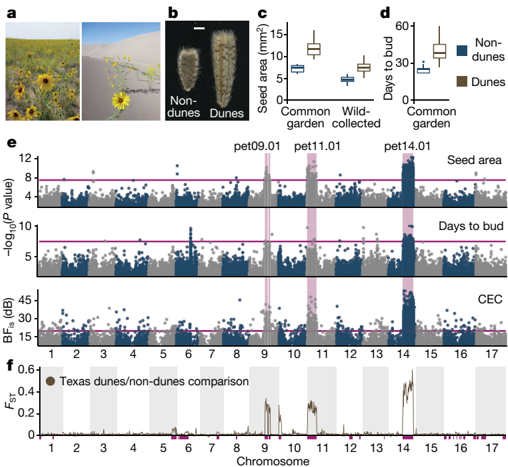
Species often include multiple ecotypes that are adapted to different environments1. However, it is unclear how ecotypes arise and how their distinctive combinations of adaptive alleles are maintained despite hybridization with non-adapted populations2–4. Here, by resequencing 1,506 wild sunflowers from 3 species (Helianthus annuus, Helianthus petiolaris and Helianthus argophyllus), we identify 37 large (1–100 Mbp in size), non-recombining haplotype blocks that are associated with numerous ecologically relevant traits, as well as soil and climate characteristics. Limited recombination in these haplotype blocks keeps adaptive alleles together, and these regions differentiate sunflower ecotypes. For example, haplotype blocks control a 77-day difference in flowering between ecotypes of the silverleaf sunflower H. argophyllus (probably through deletion of a homologue of FLOWERING LOCUS T (FT)), and are associated with seed size, flowering time and soil fertility in dune-adapted sunflowers. These haplotypes are highly divergent, frequently associated with structural variants and often appear to represent introgressions from other—possibly now-extinct—congeners. These results highlight a pervasive role of structural variation in ecotypic adaptation. Resequencing analyses of three species of wild sunflower identify large non-recombining haplotype blocks that correlate with ecologically relevant traits, soil and climate characteristics, and that differentiate species ecotypes.
Overview
The claims and statistics of this paper haven’t been checked yet.
Free: it reads the open-access text and checks the first 5 claims that cite a source we can check. Create a free account to check every claim.
Integrity signals
Registry
Cites
Statistics
Figures




Verification
Claims the paper makes
The claims and statistics of this paper haven’t been checked yet.
Free: it reads the open-access text and checks the first 5 claims that cite a source we can check. Create a free account to check every claim.
Claims other papers make about this one
Each is checked against this paper’s own text: does it say what the citing paper says it does?
The source backs part of the claim, not all of it — or backs it for a different population, condition or comparison.
In the citing paper
“An apparent example of the latter comes from sunflower, where hemizygosity or complete loss of a homolog of FLOWERING LOCUS T underlies a shift in flowering time between sympatric ecotypes of the silverleaf sunflower (Todesco et al., 2020).”
From Genomics of plant speciation (2023) · cites this paper as Todesco et al., 2020
Experimental — accuracy not yet measuredThe source backs part of the claim, not all of it — or backs it for a different population, condition or comparison.
In the citing paper
“As well, introgression is reduced for genes or genomic regions underlying RI (Barb et al., 2014; Kenney and Sweigart, 2016; Todesco et al., 2020).”
From Genomics of plant speciation (2023) · cites this paper as Todesco et al., 2020
Experimental — accuracy not yet measuredThe source backs part of the claim, not all of it — or backs it for a different population, condition or comparison.
In the citing paper
“Other examples come from studies of adaptive introgression or homoploid hybrid speciation (see Speciation with gene flow, introgression, and hybrid speciation), in which alleles or SVs critical to RI have been identified in parental populations (Nevado et al., 2020; Todesco et al., 2020; Wang et al., 2021b).”
From Genomics of plant speciation (2023) · cites this paper as Todesco et al., 2020
Experimental — accuracy not yet measuredThe source backs part of the claim, not all of it — or backs it for a different population, condition or comparison.
In the citing paper
“Examples include the origin of dune sunflower ecotypes in the southwestern US, in which traits associated with dune adaptation and RI map to inversions, which are old and pre-date ecotype divergence (Ostevik et al., 2016; Huang and Rieseberg, 2020; Todesco et al., 2020).”
From Genomics of plant speciation (2023) · cites this paper as Todesco et al., 2020
Experimental — accuracy not yet measuredThe cited source says what the claim attributes to it.
In the citing paper
“genomic studies have shown that when adaptation and speciation have progressed, chromosomal inversions or other recombination cold spots become crucially important in settings characterized by gene flow (e.g., Todesco et al., 2020)”
From Genomics of plant speciation (2023) · cites this paper as Todesco et al., 2020
1 more claim about this paper
Create a free account to see every claim other papers make about this one.
Self-check
Percentages, sums and reported differences re-computed from the paper’s own numbers.
The self-check needs the paper’s full text.
Citations
Cites
Fiji: an open-source platform for biological-image analysis
Schindelin, J., Arganda-Carreras, I., Frise, E., Kaynig, V., Longair, M., Pietzsch, T., Preibisch, S., Rueden, C., Saalfeld, S., Schmid, B., et al. (2012) · Nature Methods · doi:10.1038/nmeth.2019 · Cited by 66,890
Trimmomatic: a flexible trimmer for Illumina sequence data
Bolger, A. M., Lohse, M., & Usadel, B. (2014) · Bioinformatics · doi:10.1093/bioinformatics/btu170 · Cited by 65,548
NIH Image to ImageJ: 25 years of image analysis
Schneider, C. A., Rasband, W. S., & Eliceiri, K. W. (2012) · Nature Methods · doi:10.1038/nmeth.2089 · Cited by 64,638
The Sequence Alignment/Map format and SAMtools
Li, H., Handsaker, B., Wysoker, A., Fennell, T., Ruan, J., Homer, N., Marth, G., Abecasis, G., Durbin, R., & 1000 Genome Project Data Processing Subgroup (2009) · Bioinformatics · doi:10.1093/bioinformatics/btp352 · Cited by 62,041
IQ-TREE: A Fast and Effective Stochastic Algorithm for Estimating Maximum-Likelihood Phylogenies
Nguyen, L.-T., Schmidt, H. A., von Haeseler, A., & Minh, B. Q. (2015) · Molecular Biology and Evolution · doi:10.1093/molbev/msu300 · Cited by 26,046
ModelFinder: fast model selection for accurate phylogenetic estimates
Kalyaanamoorthy, S., Minh, B. Q., Wong, T. K. F., von Haeseler, A., & Jermiin, L. S. (2017) · Nature Methods · doi:10.1038/nmeth.4285 · Cited by 18,449
The variant call format and VCFtools
Danecek, P., Auton, A., Abecasis, G., Albers, C. A., Banks, E., DePristo, M. A., Handsaker, R. E., Lunter, G., Marth, G. T., Sherry, S. T., et al. (2011) · Bioinformatics · doi:10.1093/bioinformatics/btr330 · Cited by 16,200
Algorithm AS 136: A K-Means Clustering Algorithm
Hartigan, J. A., & Wong, M. A. (1979) · Applied Statistics · doi:10.2307/2346830 · Cited by 14,523
Heinz, S., Benner, C., Spann, N., Bertolino, E., Lin, Y. C., Laslo, P., Cheng, J. X., Murre, C., Singh, H., & Glass, C. K. (2010) · Molecular Cell · doi:10.1016/j.molcel.2010.05.004 · Cited by 13,382
Rapid isolation of high molecular weight plant DNA
Murray, M. G., & Thompson, W. F. (1980) · Nucleic Acids Research · doi:10.1093/nar/8.19.4321 · Cited by 12,098
Posterior summarization in Bayesian phylogenetics using tracer 1.7
Rambaut, A., Drummond, A. J., Xie, D., Baele, G., & Suchard, M. A. (2018) · Systematic Biology · doi:10.1093/sysbio/syy032 · Cited by 11,159
UFBoot2: Improving the Ultrafast Bootstrap Approximation
Hoang, D. T., Chernomor, O., von Haeseler, A., Minh, B. Q., & Vinh, L. S. (2018) · Molecular Biology and Evolution · doi:10.1093/molbev/msx281 · Cited by 10,881
Li, H. (2011) · Bioinformatics · doi:10.1093/bioinformatics/btr509 · Cited by 6,486
Versatile and open software for comparing large genomes
Kurtz, S., Phillippy, A., Delcher, A. L., Smoot, M., Shumway, M., Antonescu, C., & Salzberg, S. L. (2004) · Genome Biology · doi:10.1186/gb-2004-5-2-r12 · Cited by 5,254
Aligning sequence reads, clone sequences and assembly contigs with BWA-MEM
Li, H. (2013) · DROPS (Schloss Dagstuhl – Leibniz Center for Informatics) · doi:10.48550/arxiv.1303.3997 · Cited by 5,159
Yu, G., Smith, D. K., Zhu, H., Guan, Y., & Lam, T. T. (2017) · Methods in Ecology and Evolution · doi:10.1111/2041-210x.12628 · Cited by 4,823
Bayesian phylogenetic and phylodynamic data integration using BEAST 1.10
Suchard, M. A., Lemey, P., Baele, G., Ayres, D. L., Drummond, A. J., & Rambaut, A. (2018) · Virus Evolution · doi:10.1093/ve/vey016 · Cited by 3,792
Variance component model to account for sample structure in genome-wide association studies
Kang, H. M., Sul, J. H., Service, S. K., Zaitlen, N. A., Kong, S.-Y., Freimer, N. B., Sabatti, C., & Eskin, E. (2010) · Nature Genetics · doi:10.1038/ng.548 · Cited by 2,817
Snakemake—a scalable bioinformatics workflow engine
Köster, J., & Rahmann, S. (2012) · Bioinformatics · doi:10.1093/bioinformatics/bts480 · Cited by 2,780
A high-performance computing toolset for relatedness and principal component analysis of SNP data
Zheng, X., Levine, D., Shen, J., Gogarten, S. M., Laurie, C., & Weir, B. S. (2012) · Bioinformatics · doi:10.1093/bioinformatics/bts606 · Cited by 2,524
Sambamba: fast processing of NGS alignment formats
Tarasov, A., Vilella, A. J., Cuppen, E., Nijman, I. J., & Prins, P. (2015) · Bioinformatics · doi:10.1093/bioinformatics/btv098 · Cited by 2,413
A One-Penny Imputed Genome from Next-Generation Reference Panels
Browning, B. L., Zhou, Y., & Browning, S. R. (2018) · The American Journal of Human Genetics · doi:10.1016/j.ajhg.2018.07.015 · Cited by 2,092
Scaling accurate genetic variant discovery to tens of thousands of samples
Poplin, R., Ruano-Rubio, V., DePristo, M. A., Fennell, T. J., Carneiro, M. O., Van der Auwera, G. A., Kling, D. E., Gauthier, L. D., Levy-Moonshine, A., Roazen, D., et al. (2017) · bioRxiv (Cold Spring Harbor Laboratory) · doi:10.1101/201178 · Cited by 1,915 · cited 1×
“59 Poplin, R. et al. Scaling accurate genetic variant discovery to tens of thousands of samples. BioRxiv, doi:10.1101/201178 (2017).”
BackgroundInfluentialpGreen: a versatile and flexible binary Ti vector for Agrobacterium-mediated plant transformation
Hellens, R. P., Edwards, E. A., Leyland, N. R., Bean, S., & Mullineaux, P. M. (2000) · Plant Molecular Biology · doi:10.1023/a:1006496308160 · Cited by 1,562
A Pair of Related Genes with Antagonistic Roles in Mediating Flowering Signals
Kobayashi, Y., Kaya, H., Goto, K., Iwabuchi, M., & Araki, T. (1999) · Science · doi:10.1126/science.286.5446.1960 · Cited by 1,390
Hi–C: A comprehensive technique to capture the conformation of genomes
Belton, J.-M., McCord, R. P., Gibcus, J. H., Naumova, N., Zhan, Y., & Dekker, J. (2012) · Methods · doi:10.1016/j.ymeth.2012.05.001 · Cited by 1,257
JEFFREYS, H. (1922) · Nature · doi:10.1038/109132a0 · Cited by 1,217 · cited 1×
“68 Jeffreys, H. Theory of Probability. Oxford University Press, London/New York/Oxford (1961).”
Chromosome inversions, local adaptation and speciation
Kirkpatrick, M., & Barton, N. (2006) · Genetics · doi:10.1534/genetics.105.047985 · Cited by 1,178
Cost-effective, high-throughput DNA sequencing libraries for multiplexed target capture
Rohland, N., & Reich, D. (2012) · Genome Research · doi:10.1101/gr.128124.111 · Cited by 1,152
Wang, T., Hamann, A., Spittlehouse, D., & Carroll, C. (2016) · PLOS ONE · doi:10.1371/journal.pone.0156720 · Cited by 1,101
SyRI: finding genomic rearrangements and local sequence differences from whole-genome assemblies
Goel, M., Sun, H., Jiao, W.-B., & Schneeberger, K. (2019) · Genome Biology · doi:10.1186/s13059-019-1911-0 · Cited by 1,045
SKEPTICISM TOWARDS SANTA ROSALIA, OR WHY ARE THERE SO FEW KINDS OF ANIMALS?
Felsenstein, J. (1981) · Evolution · doi:10.1111/j.1558-5646.1981.tb04864.x · Cited by 1,000
Arabidopsis : a laboratory manual
Weigel, D., & Glazebrook, J. (2002) · Cited by 995
Endler, J. A. (1973) · Science · doi:10.1126/science.179.4070.243 · Cited by 853
The sunflower genome provides insights into oil metabolism, flowering and Asterid evolution
Badouin, H., Gouzy, J., Grassa, C. J., Murat, F., Staton, S. E., Cottret, L., Lelandais-Brière, C., Owens, G. L., Carrère, S., Mayjonade, B., et al. (2017) · Nature · doi:10.1038/nature22380 · Cited by 802
Self-citationLowry, D. B., & Willis, J. H. (2010) · PLoS Biology · doi:10.1371/journal.pbio.1000500 · Cited by 679
Eco-Evolutionary Genomics of Chromosomal Inversions
Wellenreuther, M., & Bernatchez, L. (2018) · Trends in Ecology & Evolution · doi:10.1016/j.tree.2018.04.002 · Cited by 625
Yeaman, S., & Whitlock, M. C. (2011) · Evolution · doi:10.1111/j.1558-5646.2011.01269.x · Cited by 607
Self-citationChromosomal rearrangements maintain a polymorphic supergene controlling butterfly mimicry
Joron, M., Frezal, L., Jones, R. T., Chamberlain, N. L., Lee, S. F., Haag, C. R., Whibley, A., Becuwe, M., Baxter, S. W., Ferguson, L., et al. (2011) · Nature · doi:10.1038/nature10341 · Cited by 574
Genome-Wide Scan for Adaptive Divergence and Association with Population-Specific Covariates
Gautier, M. (2015) · Genetics · doi:10.1534/genetics.115.181453 · Cited by 512
NextGenMap: fast and accurate read mapping in highly polymorphic genomes
Sedlazeck, F. J., Rescheneder, P., & von Haeseler, A. (2013) · Bioinformatics · doi:10.1093/bioinformatics/btt468 · Cited by 442
The genetic mosaic suggests a new role for hitchhiking in ecological speciation
VIA, S., & WEST, J. (2008) · Molecular Ecology · doi:10.1111/j.1365-294x.2008.03921.x · Cited by 347
Yamashita, K., Motohashi, M., & Yashiki, T. (1989) · Journal of Chromatography B: Biomedical Sciences and Applications · doi:10.1016/s0378-4347(00)83043-1 · Cited by 285
Sunflower pan-genome analysis shows that hybridization altered gene content and disease resistance
Hübner, S., Bercovich, N., Todesco, M., Mandel, J. R., Odenheimer, J., Ziegler, E., Lee, J. S., Baute, G. J., Owens, G. L., Grassa, C. J., et al. (2018) · Nature Plants · doi:10.1038/s41477-018-0329-0 · Cited by 276
Self-citationStages in the evolution of plant species
Clausen, J. (1951) · Medical Entomology and Zoology · Cited by 272
Local PCA Shows How the Effect of Population Structure Differs Along the Genome
Li, H., & Ralph, P. (2019) · Genetics · doi:10.1534/genetics.118.301747 · Cited by 221
Origin of extant domesticated sunflowers in eastern North America
Harter, A. V., Gardner, K. A., Falush, D., Lentz, D. L., Bye, R. A., & Rieseberg, L. H. (2004) · Nature · doi:10.1038/nature02710 · Cited by 208
Self-citationRecombination rate evolution and the origin of species
Ortiz-Barrientos, D., Engelstädter, J., & Rieseberg, L. H. (2016) · Trends in Ecology & Evolution · doi:10.1016/j.tree.2015.12.016 · Cited by 202
Self-citationAdaptive introgression of abiotic tolerance traits in the sunflower Helianthus annuus
Whitney, K. D., Randell, R. A., & Rieseberg, L. H. (2010) · New Phytologist · doi:10.1111/j.1469-8137.2010.03234.x · Cited by 198
Self-citationWerner, J. D., Borevitz, J. O., Warthmann, N., Trainer, G. T., Ecker, J. R., Chory, J., & Weigel, D. (2005) · Proceedings of the National Academy of Sciences · doi:10.1073/pnas.0409474102 · Cited by 180
Reinforcement and divergence under assortative mating
Kirkpatrick, M. (2000) · Proceedings of the Royal Society of London. Series B: Biological Sciences · doi:10.1098/rspb.2000.1191 · Cited by 171
Supergene Evolution Triggered by the Introgression of a Chromosomal Inversion
Jay, P., Whibley, A., Frézal, L., Rodríguez de Cara, M. Á., Nowell, R. W., Mallet, J., Dasmahapatra, K. K., & Joron, M. (2018) · Current Biology · doi:10.1016/j.cub.2018.04.072 · Cited by 170
Multiple chromosomal inversions contribute to adaptive divergence of a dune sunflower ecotype
Huang, K., Andrew, R. L., Owens, G. L., Ostevik, K. L., & Rieseberg, L. H. (2020) · Molecular Ecology · doi:10.1111/mec.15428 · Cited by 168
Self-citationHigh-quality genome (re)assembly using chromosomal contact data
Marie-Nelly, H., Marbouty, M., Cournac, A., Flot, J.-F., Liti, G., Parodi, D. P., Syan, S., Guillén, N., Margeot, A., Zimmer, C., et al. (2014) · Nature Communications · doi:10.1038/ncomms6695 · Cited by 165
Lee‐Yaw, J. A., Grassa, C. J., Joly, S., Andrew, R. L., & Rieseberg, L. H. (2019) · New Phytologist · doi:10.1111/nph.15386 · Cited by 163
Self-citationRodríguez, G. R., Moyseenko, J. B., Robbins, M. D., Morejón, N. H., Francis, D. M., & van der Knaap, E. (2010) · Journal of Visualized Experiments · doi:10.3791/1856 · Cited by 159
Chromosomal inversion differences correlate with range overlap in passerine birds
Hooper, D. M., & Price, T. D. (2017) · Nature Ecology & Evolution · doi:10.1038/s41559-017-0284-6 · Cited by 148
Recombination suppressors and the evolution of new species
Trickett, A. J., & Butlin, R. K. (1994) · Heredity · doi:10.1038/hdy.1994.180 · Cited by 138
Rowan, B. A., Patel, V., Weigel, D., & Schneeberger, K. (2015) · G3 Genes|Genomes|Genetics · doi:10.1534/g3.114.016501 · Cited by 125
Strasburg, J. L., & Rieseberg, L. H. (2008) · Evolution · doi:10.1111/j.1558-5646.2008.00415.x · Cited by 122
Self-citationeasyGWAS: A Cloud-Based Platform for Comparing the Results of Genome-Wide Association Studies
Grimm, D. G., Roqueiro, D., Salomé, P. A., Kleeberger, S., Greshake, B., Zhu, W., Liu, C., Lippert, C., Stegle, O., Schölkopf, B., et al. (2017) · The Plant Cell · doi:10.1105/tpc.16.00551 · Cited by 118
Andrew, R. L., & Rieseberg, L. H. (2013) · Evolution · doi:10.1111/evo.12106 · Cited by 116
Self-citationMegabase-scale inversion polymorphism in the wild ancestor of maize
Fang, Z., Pyhäjärvi, T., Weber, A. L., Dawe, R. K., Glaubitz, J. C., González, J. D. J. S., Ross-Ibarra, C., Doebley, J., Morrell, P. L., & Ross-Ibarra, J. (2012) · Genetics · doi:10.1534/genetics.112.138578 · Cited by 104 · cited 1×
“34 Fang, Z. et al. Megabase-scale inversion polymorphism in the wild ancestor of maize. Genetics 191, 883-894 (2012). All rights reserved.”
BackgroundContributions of Flowering Time Genes to Sunflower Domestication and Improvement
Blackman, B. K., Rasmussen, D. A., Strasburg, J. L., Raduski, A. R., Burke, J. M., Knapp, S. J., Michaels, S. D., & Rieseberg, L. H. (2010) · Genetics · doi:10.1534/genetics.110.121327 · Cited by 98
Self-citationThe Effect of Neutral Recombination Variation on Genome Scans for Selection
Lotterhos, K. E. (2019) · G3 Genes Genomes Genetics · doi:10.1534/g3.119.400088 · Cited by 92
Feder, J. L., Gejji, R., Powell, T. H. Q., & Nosil, P. (2011) · Evolution · doi:10.1111/j.1558-5646.2011.01321.x · Cited by 90
Sambatti, J. B. M., Strasburg, J. L., Ortiz-Barrientos, D., Baack, E. J., & Rieseberg, L. H. (2012) · Evolution · doi:10.1111/j.1558-5646.2011.01537.x · Cited by 89
Self-citationArostegui, M. C., Quinn, T. P., Seeb, L. W., Seeb, J. E., & McKinney, G. J. (2019) · Molecular Ecology · doi:10.1111/mec.15037 · Cited by 89
Dapsone hypersensitivity syndrome causing disseminated intravascular coagulation: Figure 1
Figtree, M. C., Miyakis, S., Tanaka, K., Martin, L. K., Koneçny, P., & Krilis, S. A. (2009) · BMJ Case Reports · doi:10.1136/bcr.11.2008.1257 · Cited by 84
HYBRIDIZATION IN THE ANNUAL SUNFLOWERS: HELIANTHUS ANNUUS x H. DEBILIS VAR. CUCUMERIFOLIUS
HEISER, C. B. J. (1951) · Evolution · doi:10.1111/j.1558-5646.1951.tb02758.x · Cited by 84
Ostevik, K. L., Andrew, R. L., Otto, S. P., & Rieseberg, L. H. (2016) · Evolution · doi:10.1111/evo.13027 · Cited by 84
Self-citationQiu, F., Baack, E. J., Whitney, K. D., Bock, D. G., Tetreault, H. M., Rieseberg, L. H., & Ungerer, M. C. (2018) · New Phytologist · doi:10.1111/nph.15465 · Cited by 71
Self-citationSpecies tree estimation of diploid Helianthus (Asteraceae) using target enrichment
Stephens, J. D., Rogers, W. L., Mason, C. M., Donovan, L. A., & Malmberg, R. L. (2015) · American Journal of Botany · doi:10.3732/ajb.1500031 · Cited by 67
Self-citationPhysiological Selection; an Additional Suggestion on the Origin of Species.
Romanes, G. J. (1886) · Journal of the Linnean Society of London Zoology · doi:10.1111/j.1096-3642.1886.tb01869.x · Cited by 67
Recent nonhybrid origin of sunflower ecotypes in a novel habitat
Andrew, R. L., Kane, N. C., Baute, G. J., Grassa, C. J., & Rieseberg, L. H. (2013) · Molecular Ecology · doi:10.1111/mec.12038 · Cited by 60
Self-citationConnecting the sun to flowering in sunflower adaptation
Blackman, B. K., Michaels, S. D., & Rieseberg, L. H. (2011) · Molecular Ecology · doi:10.1111/j.1365-294x.2011.05166.x · Cited by 59
Self-citationNormalization of Genomic DNA Using Duplex-Specific Nuclease
Shagina, I. A., Bogdanova, E., Mamedov, I. Z., Lebedev, Y. B., Lukyanov, S., & Shagin, D. A. (2010) · BioTechniques · doi:10.2144/000113422 · Cited by 49
A Polygenic Genetic Architecture of Flowering Time in the WorldwideArabidopsis thalianaPopulation
Zan, Y., & Carlborg, Ö. (2018) · Molecular Biology and Evolution · doi:10.1093/molbev/msy203 · Cited by 46
Wang, L., Tsai, M.-C., Chang, K.-Y., Fan, Y.-S., Yeh, C.-H., & Wu, S.-J. (2011) · Journal of Experimental Botany · doi:10.1093/jxb/err060 · Cited by 43
Baute, G. J., Owens, G. L., Bock, D. G., & Rieseberg, L. H. (2016) · American Journal of Botany · doi:10.3732/ajb.1600295 · Cited by 43
Self-citationSwiftOrtho: A fast, memory-efficient, multiple genome orthology classifier
Hu, X., & Friedberg, I. (2019) · GigaScience · doi:10.1093/gigascience/giz118 · Cited by 39
Matvienko, M., Kozik, A., Froenicke, L., Lavelle, D. O., Martineau, B., Perroud, B., & Michelmore, R. W. (2013) · PLoS ONE · doi:10.1371/journal.pone.0055913 · Cited by 37
Cao, Y., Wen, L., Wang, Z., & Ma, L. (2015) · Molecular Plant · doi:10.1016/j.molp.2015.09.004 · Cited by 36
Genomic sequence and copy number evolution during hybrid crop development in sunflowers
Owens, G. L., Baute, G. J., Hübner, S., & Rieseberg, L. H. (2018) · Evolutionary Applications · doi:10.1111/eva.12603 · Cited by 32
Self-citationOstevik, K. L., Samuk, K., & Rieseberg, L. H. (2020) · Genetics · doi:10.1534/genetics.120.303026 · Cited by 32
Self-citationCommon gardens in teosintes reveal the establishment of a syndrome of adaptation to altitude
Fustier, M., Martinez-Ainsworth, N. E., Aguirre-Liguori, J. A., Venon, A., Corti, H., Rousselet, A., Dumas, F., Dittberner, H., Camarena, M. G., Grimanelli, D., et al. (2019) · PLoS Genetics · doi:10.1371/journal.pgen.1008512 · Cited by 31
Local adaptation along an environmental cline in a species with an inversion polymorphism
Wellenreuther, M., Rosenquist, H., Jaksons, P., & Larson, K. (2017) · Journal of Evolutionary Biology · doi:10.1111/jeb.13064 · Cited by 30
Preparation of Total DNA from "Recalcitrant Plant Taxa
Zeng, J. (2002) · Journal of Integrative Plant Biology · Cited by 29
Raduski, A. R., Rieseberg, L. H., & Strasburg, J. L. (2010) · International Journal of Molecular Sciences · doi:10.3390/ijms11020492 · Cited by 22
Self-citationNitrogen stress response of a hybrid species: a gene expression study
Brouillette, L. C., & Donovan, L. A. (2010) · Annals of Botany · doi:10.1093/aob/mcq203 · Cited by 16
Self-citationMason, C. M. (2018) · International Journal of Plant Sciences · doi:10.1086/696366 · Cited by 14
Ancestral reconstruction of sunflower karyotypes reveals non-random chromosomal evolutionPreprint
Ostevik, K. L., Samuk, K., & Rieseberg, L. H. (2019) · bioRxiv (Cold Spring Harbor Laboratory) · doi:10.1101/737155 · Cited by 6
Self-citationThe ecology and genetics of adaptation and speciation in dune sunflowers
Ostevik, K. L. (2016) · cIRcle (University of British Columbia) · doi:10.14288/1.0228559 · Cited by 5
Self-citationThe landscape of divergence in silverleaf sunflowers
Moyers, B. T. (2015) · cIRcle (University of British Columbia) · doi:10.14288/1.0166207 · Cited by 4 · cited 1×
“7 Moyers, B. T. The landscape of divergence in silverleaf sunflowers. PhD dissertation (2015).”
Background
Research works printed but not linked: 1
- 43. Heiser, C. B. Three new annual sunflowers (Helianthus) from the southwestern United States. Rhodora 60, 272-283 (1958).
Cited by
A roadmap for understanding the evolutionary significance of structural genomic variation
Mérot, C., Oomen, R. A., Tigano, A., & Wellenreuther, M. (2020) · Trends in Ecology & Evolution · doi:10.1016/j.tree.2020.03.002 · Cited by 357
“For balanced SVs (Figure 1), analyses can either focus on SNPs genotyped within the rearranged region [5], or consider the SV as an individual locus, with the latter being a more powerful approach to finding associations with phenotypic and environmental variation [46].”
BackgroundInfluentialThe genomic consequences of hybridization
Moran, B. M., Payne, C., Langdon, Q., Powell, D. L., Brandvain, Y., & Schumer, M. (2021) · eLife · doi:10.7554/elife.69016 · Cited by 311
Genomic mechanisms of climate adaptation in polyploid bioenergy switchgrass
Lovell, J. T., MacQueen, A. H., Mamidi, S., Bonnette, J., Jenkins, J., Napier, J. D., Sreedasyam, A., Healey, A., Session, A., Shu, S., et al. (2021) · Nature · doi:10.1038/s41586-020-03127-1 · Cited by 245
The evolutionary genomics of species’ responses to climate change
Aguirre-Liguori, J. A., Ramírez-Barahona, S., & Gaut, B. S. (2021) · Nature Ecology & Evolution · doi:10.1038/s41559-021-01526-9 · Cited by 201
Conservation and the Genomics of Populations
Allendorf, F. W., Funk, W. C., Aitken, S. N., Byrne, M., Luikart, G., & Antunes, A. (2022) · doi:10.1093/oso/9780198856566.001.0001 · Cited by 207
Metadata
- Authors
- Todesco, M., Owens, G. L., Bercovich, N., Légaré, J.-S., Soudi, S., Burge, D. O., Huang, K., Ostevik, K. L., Drummond, E. B. M., Imerovski, I., Lande, K., Pascual-Robles, M. A., Nanavati, M., Jahani, M., Cheung, W., Staton, S. E., Muños, S., Nielsen, R., Donovan, L. A., Burke, J. M., Yeaman, S., & Rieseberg, L. H.
- Affiliations
- University of British Columbia (CA)
- University of Calgary (CA)
- Centre National de la Recherche Scientifique (FR)
- University of California, Berkeley (US)
- University of Georgia (US)
- Corresponding author
- Bercovich, Natalia
- Rieseberg, Loren H.
- ORCID
- Venue
- Nature
- Published
- 2020-07-08
- Volume
- 584
- Issue
- 7822
- Pages
- 602-607
- ISSN
- 0028-0836 (ISSN-L)
- 1476-4687
- OpenAlex
- W3041530105
- Semantic Scholar
- 40d310f779c5d38d98a95569455c446bca0cfec3
- Cited by
- 513
- References
- 94
- Citations by year
- 2026: 60 · 2025: 85 · 2024: 80 · 2023: 93 · 2022: 98 · 2021: 65 · 2020: 28
- FWCI
- 46.03
- Type
- journal article
- Language
- en
- Open access
- hybrid
- doi.org
- Licence
- cc-by
- www.springer.com/tdm (tdm)
- www.springer.com/tdm (vor)
- Locations
- Nature (publishedVersion, cc-by)
- bioRxiv (Cold Spring Harbor Laboratory) (acceptedVersion)
- PubMed (publishedVersion)
- HAL (submittedVersion, cc-by-nc-nd)
- HAL (submittedVersion, other-oa)
- HAL (submittedVersion)
- RePEc: Research Papers in Economics (submittedVersion)
- eScholarship (California Digital Library) (submittedVersion, cc-by-nc-nd)
- Funders
- National Science Foundation (1444522)
- Genome Canada (LSARP2014-223SUN)
- Compute Canada
- Genome British Columbia (LSARP2014‐223SUN, 223SUN)
- Topics
- Life Sciences › Agricultural and Biological Sciences › Plant Science › Sunflower and Safflower Cultivation
- Life Sciences › Biochemistry, Genetics and Molecular Biology › Genetics › Chromosomal and Genetic Variations
- Life Sciences › Biochemistry, Genetics and Molecular Biology › Genetics › Genetic Mapping and Diversity in Plants and Animals
- Keywords
- ecotypic differentiation, sunflower, Helianthus petiolaris, Helianthus argophyllus, structural variants, introgression, flowering time, FLOWERING LOCUS T, seed size, soil fertility, adaptive alleles, hybridization
- MeSH terms
- Acclimatization, Alleles, Haplotypes, Helianthus, Phylogeny, Seeds, Flowers, Ecotype
About these checks
Registry, retraction, Cites and statistics results are computed, not judged, with one exception: a printed reference that no index lists is read once by a model before it counts as a citation error. Claims are extracted by a model and kept only when their quote appears verbatim in the text; each cited source is then checked, with a model’s help, for whether it says what the claim relies on. Those verdicts can be wrong — read the claim’s quote and the cited source before relying on one.
Statistics and arithmetic are recomputed, not judged.
Confidence bands are shown only for fields calibrated on our annotated test set. None is calibrated yet, so no band is shown.
What counts as a claim ›How we measure confidence ›How we check this ›
Are you an author, or do you see a problem with this page? Request a review
Data sources
Bibliographic data: Semantic Scholar, OpenAlex, Crossref.
Contains information from the Semantic Scholar Academic Graph Datasets, made available under the ODC Attribution License (ODC-BY 1.0).
Semantic Scholar’s data is described in: Kinney, R., et al. (2023). The Semantic Scholar Open Data Platform. arXiv:2301.10140.
