

Massive haplotypes underlie ecotypic differentiation in sunflowers
Open accessPublished version of a preprint
The DOI matches its Crossref record; 94 of the 94 references it cites were found in a registry or an index.
Abstract
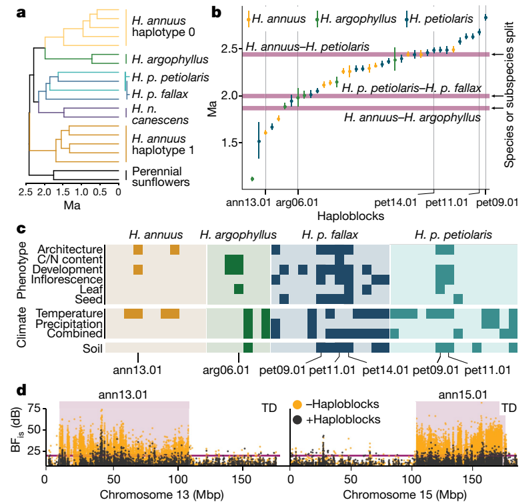
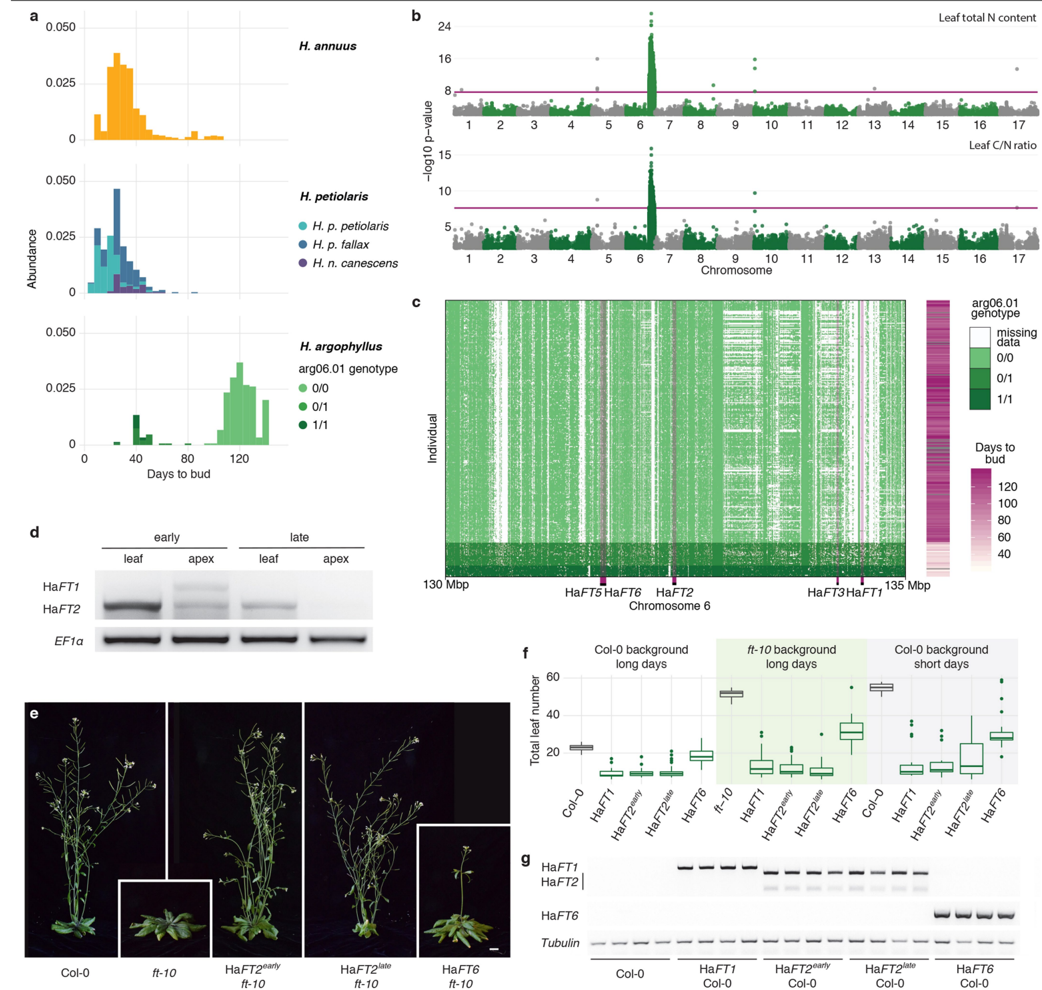
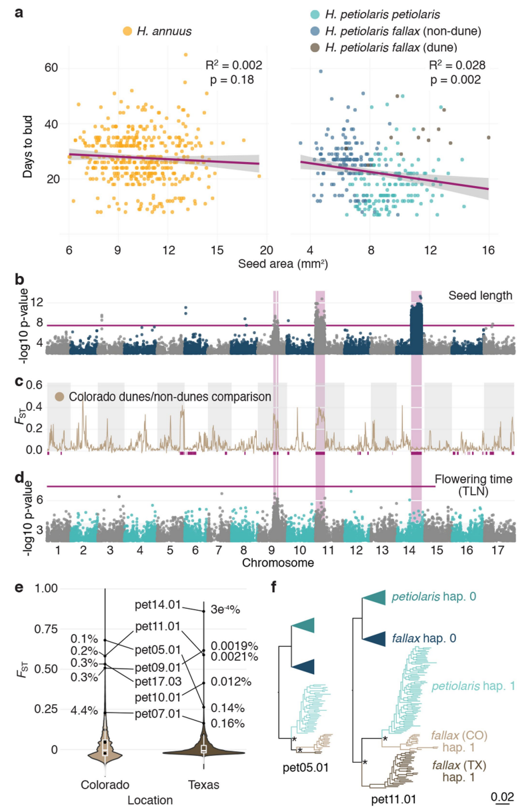
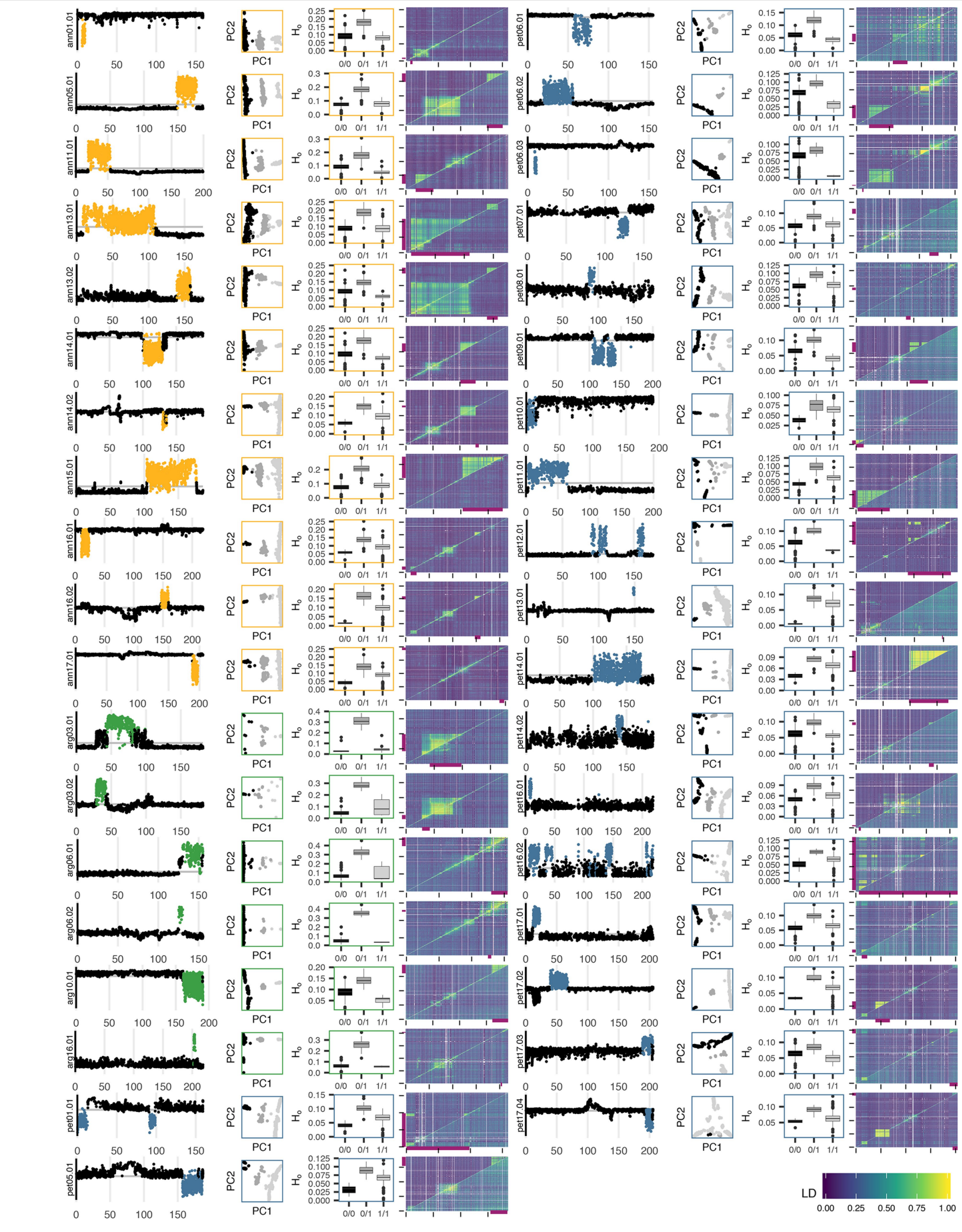
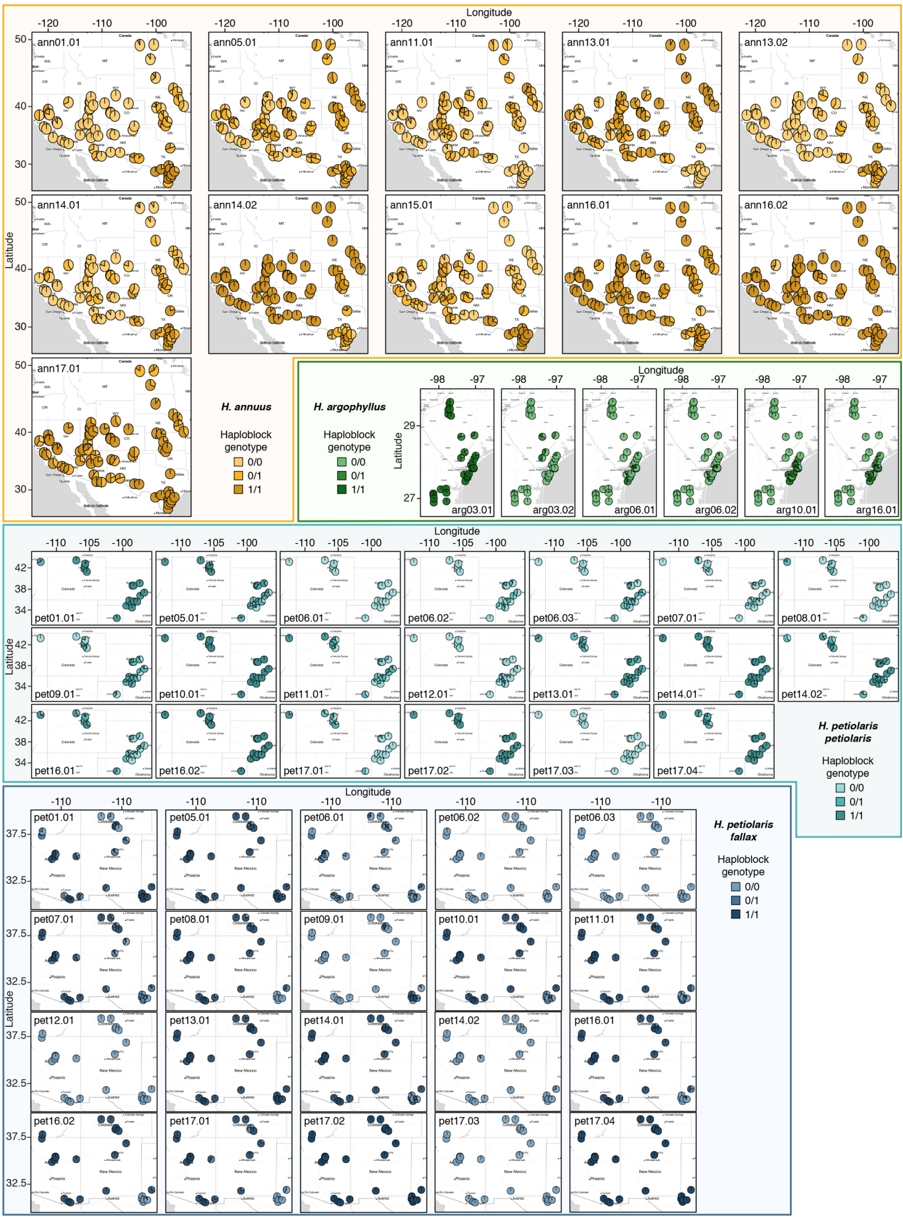
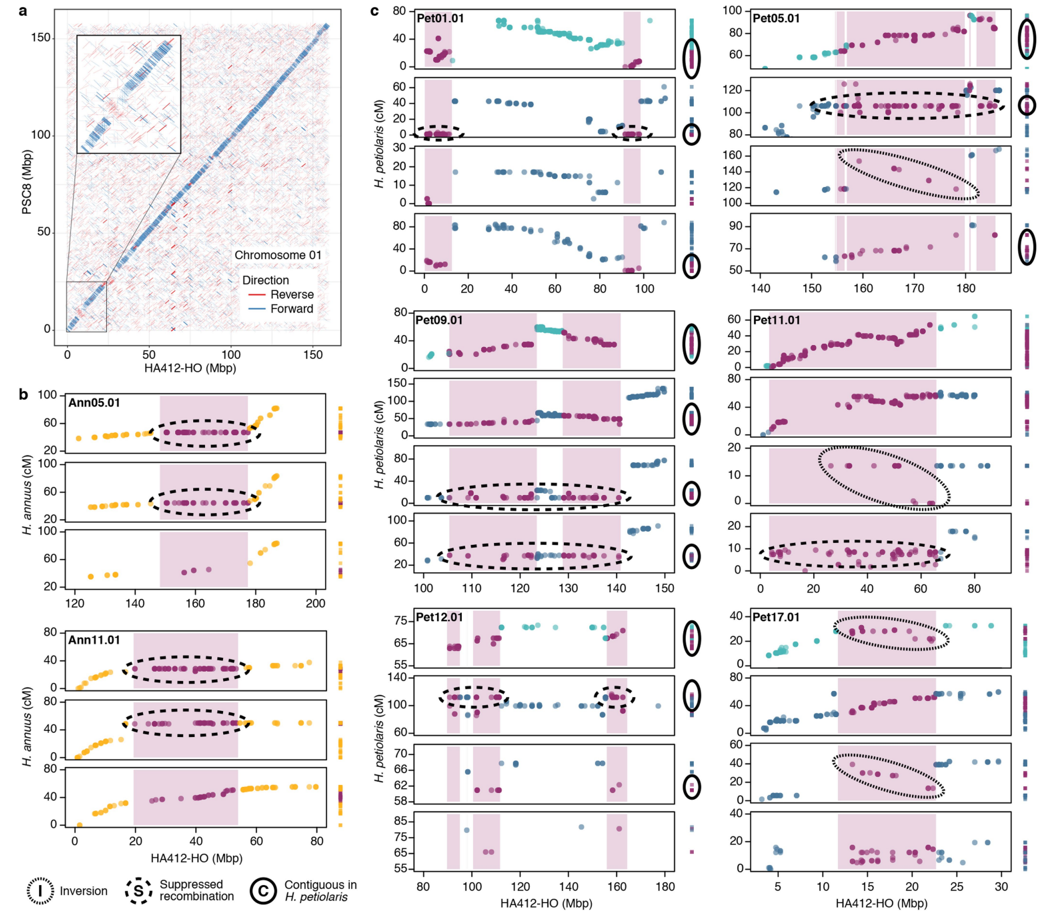
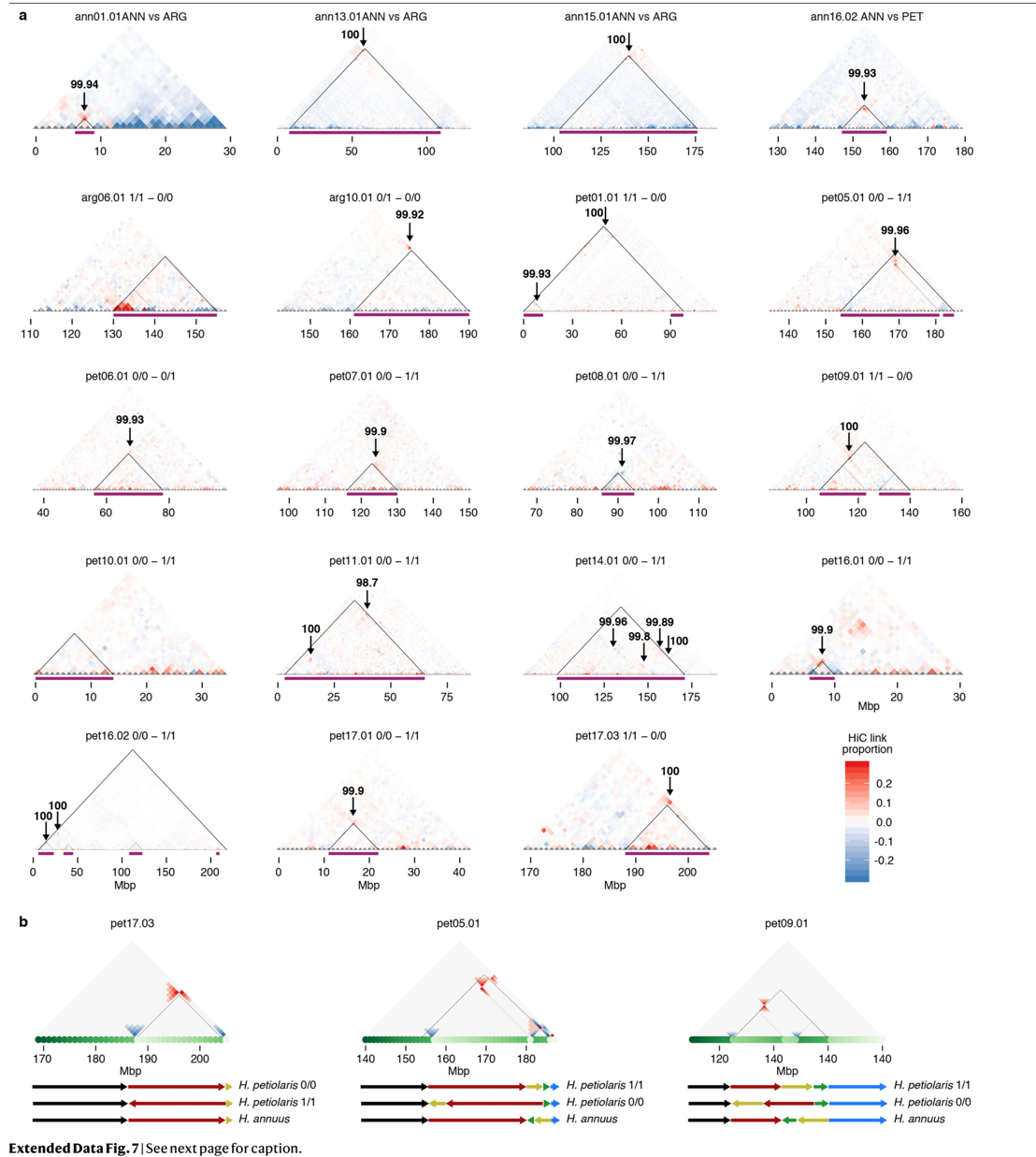
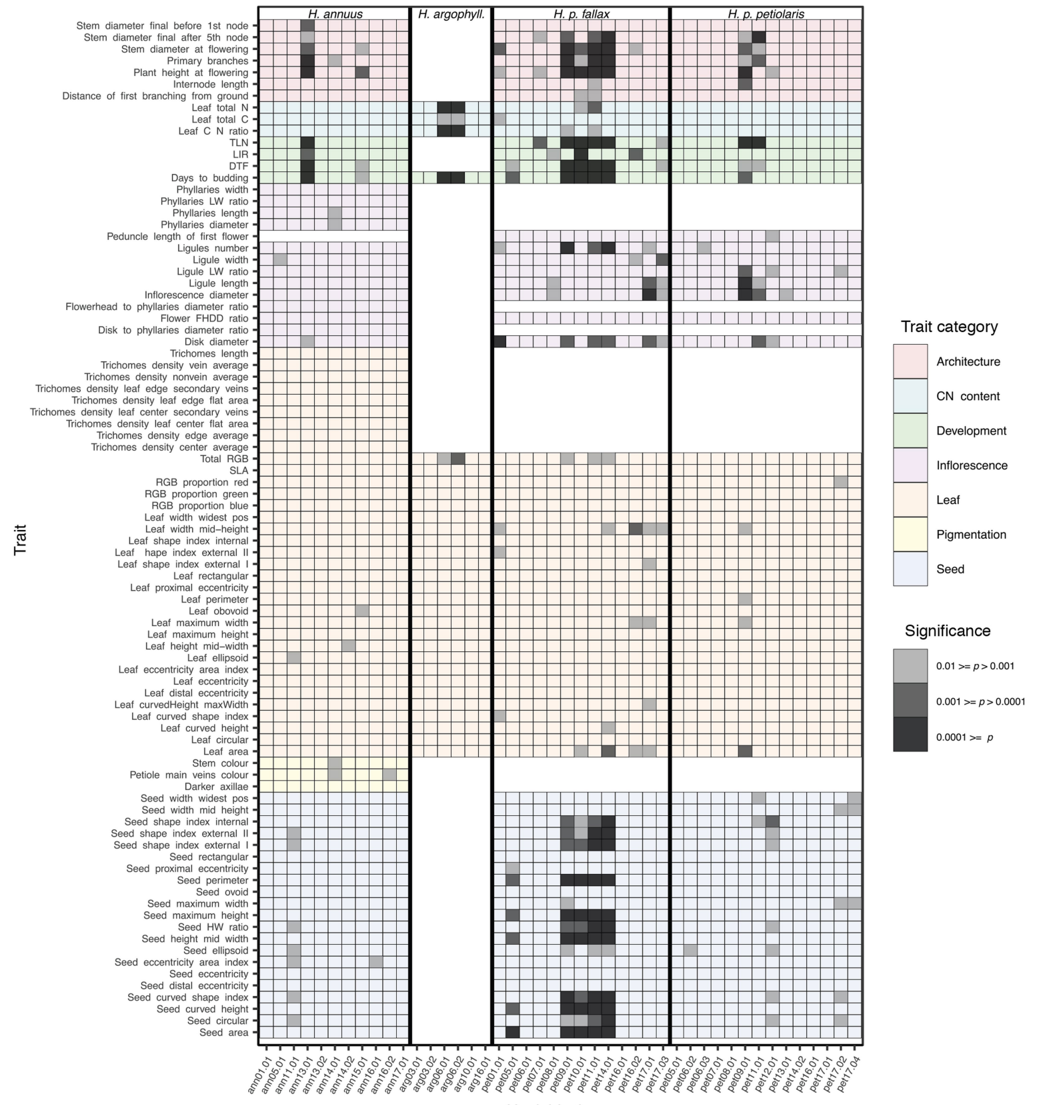
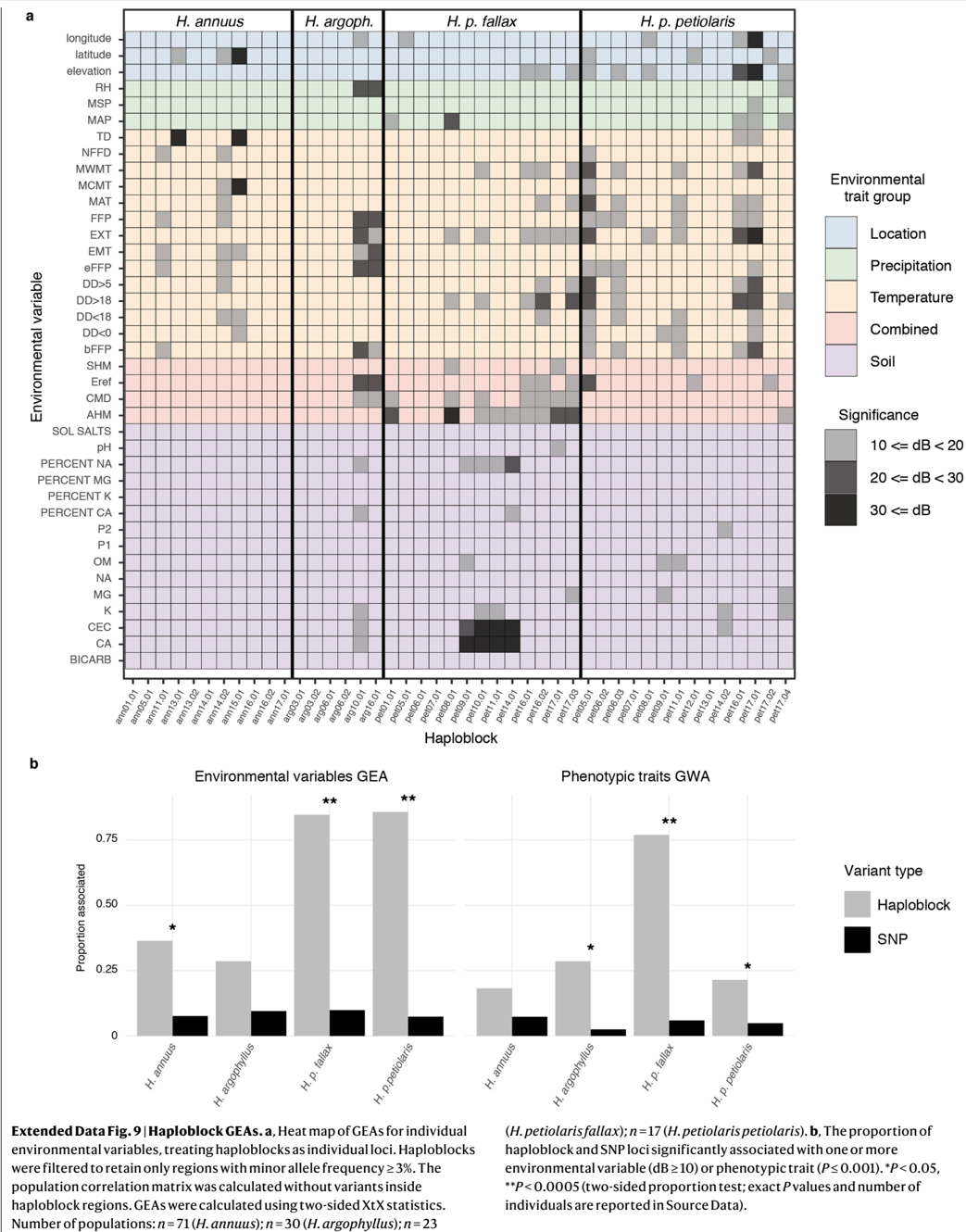
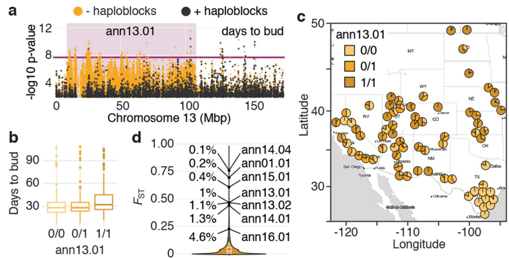
Species often include multiple ecotypes that are adapted to different environments1. However, it is unclear how ecotypes arise and how their distinctive combinations of adaptive alleles are maintained despite hybridization with non-adapted populations2–4. Here, by resequencing 1,506 wild sunflowers from 3 species (Helianthus annuus, Helianthus petiolaris and Helianthus argophyllus), we identify 37 large (1–100 Mbp in size), non-recombining haplotype blocks that are associated with numerous ecologically relevant traits, as well as soil and climate characteristics. Limited recombination in these haplotype blocks keeps adaptive alleles together, and these regions differentiate sunflower ecotypes. For example, haplotype blocks control a 77-day difference in flowering between ecotypes of the silverleaf sunflower H. argophyllus (probably through deletion of a homologue of FLOWERING LOCUS T (FT)), and are associated with seed size, flowering time and soil fertility in dune-adapted sunflowers. These haplotypes are highly divergent, frequently associated with structural variants and often appear to represent introgressions from other—possibly now-extinct—congeners. These results highlight a pervasive role of structural variation in ecotypic adaptation. Resequencing analyses of three species of wild sunflower identify large non-recombining haplotype blocks that correlate with ecologically relevant traits, soil and climate characteristics, and that differentiate species ecotypes.
Overview
The claims and statistics of this paper haven’t been checked yet.
Free: it reads the open-access text and checks the first 5 claims that cite a source we can check. Create a free account to check every claim.
Integrity signals
Registry
Cites
Statistics
Figures
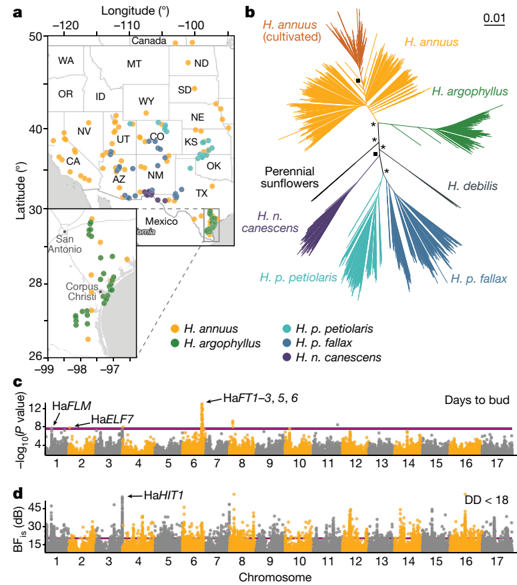
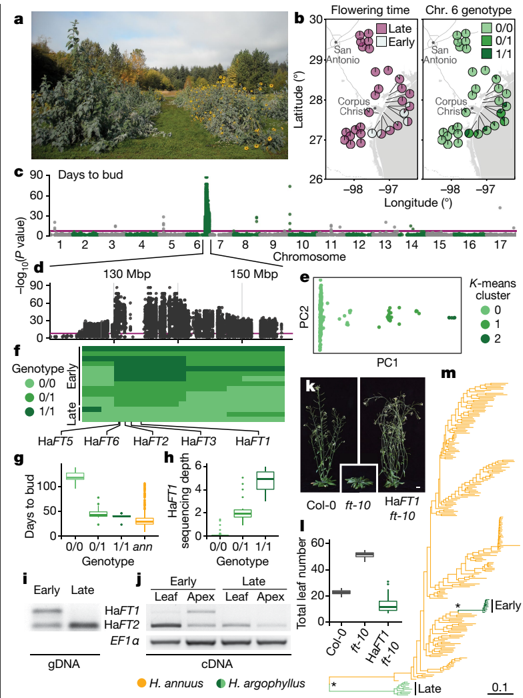
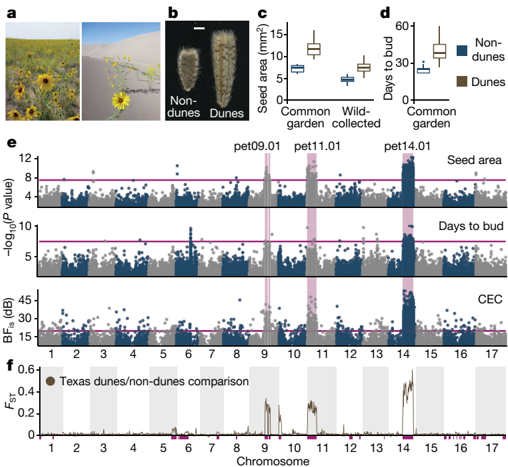
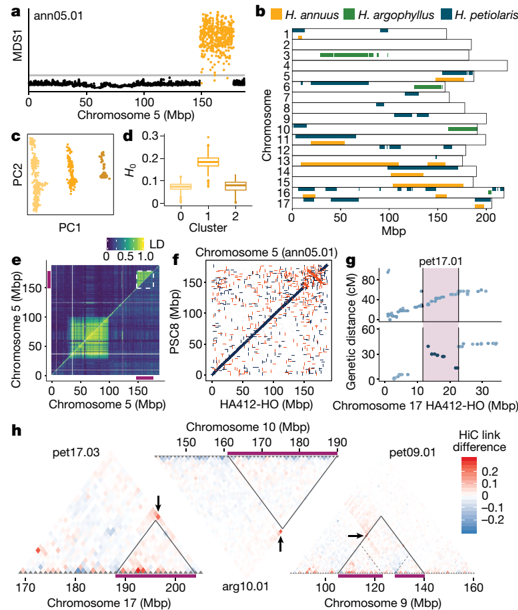
Verification
Claims the paper makes
The claims and statistics of this paper haven’t been checked yet.
Free: it reads the open-access text and checks the first 5 claims that cite a source we can check. Create a free account to check every claim.
Claims other papers make about this one
Each is checked against this paper’s own text: does it say what the citing paper says it does?
The source backs part of the claim, not all of it — or backs it for a different population, condition or comparison.
In the citing paper
“An apparent example of the latter comes from sunflower, where hemizygosity or complete loss of a homolog of FLOWERING LOCUS T underlies a shift in flowering time between sympatric ecotypes of the silverleaf sunflower (Todesco et al., 2020).”
From Genomics of plant speciation (2023) · cites this paper as Todesco et al., 2020
Experimental — accuracy not yet measuredThe source backs part of the claim, not all of it — or backs it for a different population, condition or comparison.
In the citing paper
“As well, introgression is reduced for genes or genomic regions underlying RI (Barb et al., 2014; Kenney and Sweigart, 2016; Todesco et al., 2020).”
From Genomics of plant speciation (2023) · cites this paper as Todesco et al., 2020
Experimental — accuracy not yet measuredThe source backs part of the claim, not all of it — or backs it for a different population, condition or comparison.
In the citing paper
“Other examples come from studies of adaptive introgression or homoploid hybrid speciation (see Speciation with gene flow, introgression, and hybrid speciation), in which alleles or SVs critical to RI have been identified in parental populations (Nevado et al., 2020; Todesco et al., 2020; Wang et al., 2021b).”
From Genomics of plant speciation (2023) · cites this paper as Todesco et al., 2020
Experimental — accuracy not yet measuredThe source backs part of the claim, not all of it — or backs it for a different population, condition or comparison.
In the citing paper
“Examples include the origin of dune sunflower ecotypes in the southwestern US, in which traits associated with dune adaptation and RI map to inversions, which are old and pre-date ecotype divergence (Ostevik et al., 2016; Huang and Rieseberg, 2020; Todesco et al., 2020).”
From Genomics of plant speciation (2023) · cites this paper as Todesco et al., 2020
Experimental — accuracy not yet measuredThe cited source says what the claim attributes to it.
In the citing paper
“genomic studies have shown that when adaptation and speciation have progressed, chromosomal inversions or other recombination cold spots become crucially important in settings characterized by gene flow (e.g., Todesco et al., 2020)”
From Genomics of plant speciation (2023) · cites this paper as Todesco et al., 2020
1 more claim about this paper
Create a free account to see every claim other papers make about this one.
Self-check
Percentages, sums and reported differences re-computed from the paper’s own numbers.
The self-check needs the paper’s full text.
Citations
Cites
Fiji: an open-source platform for biological-image analysis
Schindelin, J., Arganda-Carreras, I., Frise, E., Kaynig, V., Longair, M., Pietzsch, T., Preibisch, S., Rueden, C., Saalfeld, S., Schmid, B., et al. (2012) · Nature Methods · doi:10.1038/nmeth.2019 · Cited by 66,890
Trimmomatic: a flexible trimmer for Illumina sequence data
Bolger, A. M., Lohse, M., & Usadel, B. (2014) · Bioinformatics · doi:10.1093/bioinformatics/btu170 · Cited by 65,548
NIH Image to ImageJ: 25 years of image analysis
Schneider, C. A., Rasband, W. S., & Eliceiri, K. W. (2012) · Nature Methods · doi:10.1038/nmeth.2089 · Cited by 64,638
The Sequence Alignment/Map format and SAMtools
Li, H., Handsaker, B., Wysoker, A., Fennell, T., Ruan, J., Homer, N., Marth, G., Abecasis, G., Durbin, R., & 1000 Genome Project Data Processing Subgroup (2009) · Bioinformatics · doi:10.1093/bioinformatics/btp352 · Cited by 62,041
IQ-TREE: A Fast and Effective Stochastic Algorithm for Estimating Maximum-Likelihood Phylogenies
Nguyen, L.-T., Schmidt, H. A., von Haeseler, A., & Minh, B. Q. (2015) · Molecular Biology and Evolution · doi:10.1093/molbev/msu300 · Cited by 26,046
ModelFinder: fast model selection for accurate phylogenetic estimates
Kalyaanamoorthy, S., Minh, B. Q., Wong, T. K. F., von Haeseler, A., & Jermiin, L. S. (2017) · Nature Methods · doi:10.1038/nmeth.4285 · Cited by 18,449
The variant call format and VCFtools
Danecek, P., Auton, A., Abecasis, G., Albers, C. A., Banks, E., DePristo, M. A., Handsaker, R. E., Lunter, G., Marth, G. T., Sherry, S. T., et al. (2011) · Bioinformatics · doi:10.1093/bioinformatics/btr330 · Cited by 16,200
Algorithm AS 136: A K-Means Clustering Algorithm
Hartigan, J. A., & Wong, M. A. (1979) · Applied Statistics · doi:10.2307/2346830 · Cited by 14,523
Heinz, S., Benner, C., Spann, N., Bertolino, E., Lin, Y. C., Laslo, P., Cheng, J. X., Murre, C., Singh, H., & Glass, C. K. (2010) · Molecular Cell · doi:10.1016/j.molcel.2010.05.004 · Cited by 13,382
Rapid isolation of high molecular weight plant DNA
Murray, M. G., & Thompson, W. F. (1980) · Nucleic Acids Research · doi:10.1093/nar/8.19.4321 · Cited by 12,098
Research works printed but not linked: 1
- 43. Heiser, C. B. Three new annual sunflowers (Helianthus) from the southwestern United States. Rhodora 60, 272-283 (1958).
Cited by
Items 101–200 of 517
Predictability and parallelism in the contemporary evolution of hybrid genomes
Langdon, Q. K., Powell, D. L., Kim, B. Y., Banerjee, S. M., Payne, C. Y., Dodge, T. O., Moran, B. M., Fascinetto‐Zago, P., & Schumer, M. E. (2022) · PLoS Genetics · doi:10.1371/journal.pgen.1009914 · Cited by 38
“ferentiate species, conflicting with the prevailing wisdom that inversions should resist introgression (S18 Fig; see [39, 55, 56] for similar findings).”
BackgroundResultDeciphering the evolution and complexity of wheat germplasm from a genomic perspective
Wang, Z., Miao, L.-F., Chen, Y., Peng, H., Ni, Z., Sun, Q., & Guo, W. (2023) · Journal of genetics and genomics/Journal of Genetics and Genomics · doi:10.1016/j.jgg.2023.08.002 · Cited by 37
Genetic trade‐offs underlie divergent life history strategies for local adaptation in white clover
Wright, S. J., Goad, D. M., Gross, B. L., Muńoz, P., & Olsen, K. M. (2021) · Molecular Ecology · doi:10.1111/mec.16180 · Cited by 34
A caste differentiation mutant elucidates the evolution of socially parasitic ants
Trible, W., Chandra, V., Lacy, K. D., Limón, G., McKenzie, S. K., Olivos-Cisneros, L., Arsenault, S. V., & Kronauer, D. J. C. (2023) · Current Biology · doi:10.1016/j.cub.2023.01.067 · Cited by 33
Ostevik, K. L., Samuk, K., & Rieseberg, L. H. (2020) · Genetics · doi:10.1534/genetics.120.303026 · Cited by 32
“We depleted high-copy fragments based on Todesco et al. (2019) using the following steps: (1) denature the libraries using high temperatures, (2) allow the fragments to rehybridize, (3) digest the double-stranded fragments with duplex-specific nuclease (Zhulidov et al. 2004), and (4) amplify the…”
BackgroundMethodInfluentialSelf-citationDallaire, X., Bouchard, R., Hénault, P., Ulmo‐Diaz, G., Normandeau, É., Mérot, C., Bernatchez, L., & Moore, J. (2023) · Genome Biology and Evolution · doi:10.1093/gbe/evad229 · Cited by 31
RepeatOBserver : Tandem Repeat Visualisation and Putative Centromere Detection
Elphinstone, C., Elphinstone, R., Todesco, M., & Rieseberg, L. H. (2025) · Molecular Ecology Resources · doi:10.1111/1755-0998.14084 · Cited by 31
Self-citationA novel deletion in FLOWERING LOCUS T modulates flowering time in winter oilseed rape
Vollrath, P., Chawla, H. S., Schießl, S., Gabur, I., Lee, H., Snowdon, R. J., & Obermeier, C. (2021) · Theoretical and Applied Genetics · doi:10.1007/s00122-021-03768-4 · Cited by 36
Vekemans, X., Castric, V., Hipperson, H., Müller, N. A., Westerdahl, H., & Cronk, Q. (2021) · Molecular Ecology · doi:10.1111/mec.16020 · Cited by 31
Local Adaptation in Marine Foundation Species at Microgeographic Scales
Hays, C. G., Hanley, T. C., Hughes, A. R., Truskey, S. B., Zerebecki, R. A., & Sotka, E. E. (2021) · Biological Bulletin · doi:10.1086/714821 · Cited by 32
Genomic population structure and local adaptation of the wild strawberry Fragaria nilgerrensis
Hu, Y., Feng, C., Yang, L., Edger, P. P., & Kang, M. (2022) · Horticulture Research · doi:10.1093/hr/uhab059 · Cited by 36
“Whole-genome resequencing data have been increasingly used to infer the genetic basis of adaptively important traits [33, 34] or to detect potential local adaptive genetic variants associated with environmental variables [35, 36].”
BackgroundWheat speciation and adaptation: perspectives from reticulate evolution
Zhao, X., Fu, X., Yin, C., & Lü, F. (2021) · aBIOTECH · doi:10.1007/s42994-021-00047-0 · Cited by 33
Coral Reef Population Genomics in an Age of Global Change
Pinsky, M. L., Clark, R. D., & Bos, J. T. (2023) · Annual Review of Genetics · doi:10.1146/annurev-genet-022123-102748 · Cited by 33
Evolution repeats itself in replicate long-term studies in the wild
Nosil, P., de Carvalho, C. F., Villoutreix, R., Zamorano, L. S., Sinclair‐Waters, M., Planidin, N. P., Parchman, T. L., Feder, J. L., & Gompert, Z. (2024) · Science Advances · doi:10.1126/sciadv.adl3149 · Cited by 33
“S1 to S9 legend for data S1 References Other Supplementary Material for this manuscript includes the following: data S1”
Park, B., & Burke, J. M. (2020) · Genes · doi:10.3390/genes11030266 · Cited by 36
“Filtered reads were aligned to the HA412-HOv2 genome assembly [30] with BWA-MEM 0.”
MethodSelf-citationGenome architecture and diverged selection shaping pattern of genomic differentiation in wild barley
Zhang, W., Tan, C., Hu, H., Pan, R., Xiao, Y., Ouyang, K., Zhou, G., Jia, Y., Zhang, X., Hill, C. B., et al. (2022) · Plant Biotechnology Journal · doi:10.1111/pbi.13917 · Cited by 31
“Recent studies suggest that SV have a significant role in ecological adaptation and population divergence (G € oktay et al ., 2021; Hu et al ., 2022; Huang et al ., 2020; Todesco et al ., 2020).”
The genomic basis of reproductive and migratory behaviour in a polymorphic salmonid
Tigano, A., & Russello, M. A. (2022) · Molecular Ecology · doi:10.1111/mec.16724 · Cited by 29
Structural genomic variation and migratory behavior in a wild songbird
Delmore, K. E., Doren, B. M. V., Ullrich, K. K., Curk, T., van der Jeugd, H. P., & Liedvogel, M. (2023) · Evolution Letters · doi:10.1093/evlett/qrad040 · Cited by 30
“There is growing evidence SVs could also have the opposite effect, facilitating adaptation and speciation (Chakraborty et al., 2019; Kirkpatrick & Barton 2006; Todesco et al., 2020; Weischenfeldt et al., 2013).”
BackgroundGene expression and alternative splicing contribute to adaptive divergence of ecotypes
Innes, P. A., Goebl, A. M., Smith, C. C. R., Rosenberger, K. J., & Kane, N. C. (2023) · Heredity · doi:10.1038/s41437-023-00665-y · Cited by 32
“…of these regions were recently shown to harbor large chromosomal inversions that vary in frequency across the landscape and are associated with divergent traits and environmental variables, including seed size, vegetation cover, and NO 3 nitrogen levels (K. Huang et al. 2020; Todesco et al. 2020).”
InfluentialCopy number variation contributes to parallel local adaptation in an invasive plant
Wilson, J., Bieker, V. C., van Boheemen, L. A., Connallon, T., Martin, M. D., Battlay, P., & Hodgins, K. A. (2025) · Proceedings of the National Academy of Sciences · doi:10.1073/pnas.2413587122 · Cited by 28
A Genomic Perspective on Species Delimitation
Singhal, S., Leaché, A. D., Fujita, M. K., Cadena, C. D., & Zapata, F. (2025) · Annual Review of Ecology Evolution and Systematics · doi:10.1146/annurev-ecolsys-102723-055311 · Cited by 31
Whiting, J. R., Paris, J. R., van der Zee, M. J., Parsons, P. J., Weigel, D., & Fraser, B. A. (2021) · PLoS Genetics · doi:10.1371/journal.pgen.1009566 · Cited by 27
“Such 453 patterns can arise when diverged haplotypes are introgressed from more ancient lineages, or 454 even different species, as observed in flatfish [70], sunflowers [23], and Heliconius butterflies 455 [24].”
BackgroundGenome-wide polymorphism and genic selection in feral and domesticated lineages of Cannabis sativa
Woods, P., Price, N., Matthews, P. D., & McKay, J. (2022) · G3 Genes Genomes Genetics · doi:10.1093/g3journal/jkac209 · Cited by 27
“Chromosomal inversions have been previously associated with broad high F ST regions in other plant species such as sunflower (Todesco et al. 2020).”
John, M., Ankenbrand, M. J., Artmann, C., Freudenthal, J. A., Korte, A., & Grimm, D. G. (2022) · Bioinformatics · doi:10.1093/bioinformatics/btac455 · Cited by 29
“Genome-wide Association Studies (GWAS) are an integral tool to detect associations between genetic markers within a population of individuals and a complex trait or disease that is measured in the same population (Atwell et al., 2010; The 1001 Genomes Consortium, 2016; Todesco et al., 2020).”
BackgroundAllen Orr and the genetics of adaptation
Connallon, T., & Hodgins, K. A. (2021) · Evolution · doi:10.1111/evo.14372 · Cited by 26
“…hybrid models that straddle population and quantitative genetics have popped up over the last century (e.g., Wright 1935; Robertson 1960; Hill 1982; Turelli and Barton 2004), yet these are exceptions to the vast majority of theoretical work that falls entirely within one conceptual silo or the…”
BackgroundAn evolutionary look into the history of lentil reveals unexpected diversity
Guerra‐García, A., Haile, T. A., Ogutcen, E., Bett, K. E., & von Wettberg, E. (2022) · Evolutionary Applications · doi:10.1111/eva.13467 · Cited by 27
Lüthi, M. N., Berardi, A. E., Mandel, T., Freitas, L. B., & Kuhlemeier, C. J. (2022) · Current Biology · doi:10.1016/j.cub.2022.11.006 · Cited by 26
Stankowski, S., Chase, M. A., McIntosh, H., & Streisfeld, M. A. (2023) · Molecular Ecology · doi:10.1111/mec.16849 · Cited by 26
“Despite being very closely related ( d a = 0.005; Stankowski et al., 2019), the eco-types show extensive divergence across a suite of floral traits, including colour, size, shape and placement of reproductive parts (Figure 1; Streisfeld & Kohn, 2005; Tulig, 2000; Waayers, 1996).”
InfluentialLópez-Hernández, F., Burbano‐Erazo, E., Pacheco, R. I. L., Cordero, C. C. C., Villanueva-Mejía, D. F., Rivera, A. P. T., & Cortés, A. J. (2023) · Agronomy · doi:10.3390/agronomy13051396 · Cited by 26
Ishigohoka, J., Bascón-Cardozo, K., Bours, A., Fuß, J., Rhie, A., Mountcastle, J., Haase, B., Chow, W., Collins, J., Howe, K., et al. (2024) · Evolution · doi:10.1093/evolut/qpae117 · Cited by 26
“6, 9) had the clearest clustering patterns with three groups of individuals in PCA , which is expected for a haplotype block with two distinct alleles (Huang et al., 2020; Ma & Amos, 2012; Todesco et al., 2020).”
BackgroundMostert‐O'Neill, M. M., Reynolds, S. M., Acosta, J. J., Lee, D. J., Borevitz, J., & Myburg, A. A. (2020) · Molecular Ecology · doi:10.1111/mec.15615 · Cited by 26
Genome Architecture and Speciation in Plants and Animals
Wang, S., Mank, J. E., Ortíz-Barrientos, D., & Rieseberg, L. H. (2025) · Molecular Ecology · doi:10.1111/mec.70004 · Cited by 27
“…with 21 detected in deer mouse ( Peromyscus maniculatus ; Harringmeyer and Hoekstra 2022), ~35 across three species of sunflower (Huang et al. 2020; Todesco et al. 2020), 18 in rough periwinkles ( Littorina ; Westram et al. 2021; Reeve et al. 2024) and 7 in sea-weed flies ( Coelopa frigida ; Mérot…”
Self-citationEuclide, P. T., Larson, W. A., Shi, Y., Gruenthal, K. M., Christensen, K. A., Seeb, J., & Seeb, L. W. (2023) · Molecular Ecology · doi:10.1111/mec.17126 · Cited by 25
“…others also exhibiting moderate gene flow (neutral F ST ≈ 0.01) that have been used to investigate the genetic basis of adaptive divergence: (1) seaweed flies sampled across an environmental gradient (Mérot et al., 2021 ) and (2) ecotypes of sunflowers (Huang et al., 2020; Todesco et al., 2020 ).”
InfluentialZhang, T., Peng, W., Xiao, H., Cao, S., Chen, Z., Su, X., Luo, Y., Liu, Z., Peng, Y., Yang, X., et al. (2024) · Journal of Integrative Plant Biology · doi:10.1111/jipb.13653 · Cited by 27
Global Genomics of Man-O'-War (Physalia) Reveals Ocean Surface Biodiversity
Church, S. H., Abedon, R. B., Ahuja, N., Anthony, C. J., Destanović, D., Ramirez, D. A., Rojas, L. M., Albinsson, M. E., Trasobares, I. Á., Bergemann, R., et al. (2024) · Current Biology · doi:10.1016/j.cub.2025.05.066 · Cited by 26
Battlay, P., Hendrickson, B. T., Mendez-Reneau, J. I., Santangelo, J. S., Albano, L. J., Wilson, J., Caizergues, A. E., King, N., Puentes, A., Tudoran, A., et al. (2025) · Nature Ecology & Evolution · doi:10.1038/s41559-025-02751-2 · Cited by 27
The Evolution of Locally Adaptive Chromosome Inversions in Mimulus guttatus
Kollar, L. M., Stanley, L. E., Raju, S. K. K., Lowry, D. B., & Niederhuth, C. E. (2025) · Molecular Ecology · doi:10.1111/mec.17708 · Cited by 26
“Population genetic methods based on short read sequencing have recently been used to identify large regions of suppressed recombination that have the potential to be chromosomal rear-rangements (Todesco et al. 2020).”
Inversions contribute disproportionately to parallel genomic divergence in dune sunflowers
Huang, K., Ostevik, K. L., Jahani, M., Todesco, M., Bercovich, N., Andrew, R. L., Owens, G. L., & Rieseberg, L. H. (2024) · Nature Ecology & Evolution · doi:10.1038/s41559-024-02593-4 · Cited by 28
“To assess genome-wide patterns of adaptive divergence, we used WGS samples and an SNP dataset for H. petiolaris from previous studies 22,24 .”
InfluentialSelf-citationPopulation Genomics of Adaptive Radiation
Combrink, L. L., Golcher‐Benavides, J., Lewanski, A. L., Rick, J. A., Rosenthal, W. C., & Wagner, C. E. (2024) · Molecular Ecology · doi:10.1111/mec.17574 · Cited by 24
“…convergent patterns of trait evolution emerge (as in Roberts Kingman et al. 2021), especially across radiations, and how patterns of trait evolution drive barriers to gene flow, particularly through pleiotropic loci or genomic regions of low recombination such as inversions (Todesco et al. 2020).”
Prioritizing parents from global genebanks to breed climate-resilient crops
Campbell, Q., Álvarez, N. P. C., Domingo, R., von Wettberg, E., Runck, B. C., Nandkangré, H., Halpin-McCormick, A., Fumia, N., Neyhart, J., Kilian, B., et al. (2025) · Nature Climate Change · doi:10.1038/s41558-025-02333-x · Cited by 23
“For crops that do not meet these criteria (for example, sunflower, for which the number of suitable landraces is low), then one can potentially make genomic predictions using locally adapted wild genotypes as the training population 38,52 .”
Self-citationThe Insights into Mitochondrial Genomes of Sunflowers
Makarenko, M., Omelchenko, D. O., Usatov, A. V., & Алексеевна, Г. В. (2021) · Plants · doi:10.3390/plants10091774 · Cited by 23
“Sunflowers occupy diverse habitats, including various disturbed or extreme habitats [10]; have high evolution rates [11]; and have a significant variation in ploidy level and genome length [12].”
BackgroundLee, J. S., Jahani, M., Huang, K., Mandel, J. R., Marek, L. F., Burke, J. M., Langlade, N., Owens, G. L., & Rieseberg, L. H. (2022) · Journal of Advanced Research · doi:10.1016/j.jare.2022.04.008 · Cited by 23
Self-citationLeveraging Single-Cell Populations to Uncover the Genetic Basis of Complex Traits
Minow, M. A. A., Marand, A. P., & Schmitz, R. J. (2023) · Annual Review of Genetics · doi:10.1146/annurev-genet-022123-110824 · Cited by 22
“In contrast to inbreeding tolerance, some plants withstand wide hybridization events, with certain interspecific crosses producing viable offspring and with cross-species introgression driving plant trait evolution (140).”
BackgroundSeixas, F., Edelman, N. B., & Mallet, J. (2021) · Genome Biology and Evolution · doi:10.1093/gbe/evab069 · Cited by 26
Regional differences in leaf evolution facilitate photosynthesis following severe drought
Branch, H. A., Moxley, D. R., & Angert, A. L. (2024) · New Phytologist · doi:10.1111/nph.19963 · Cited by 24
A Beginner's Guide to Structural Variants in Eco‐Evolutionary Population Genomics
Stuart, K. C., Oomen, R. A., Tigano, A., Wellenreuther, M., Wold, J., Field, D. L., & Mérot, C. (2026) · Molecular Ecology · doi:10.1111/mec.70216 · Cited by 25
“Recombination suppression areas are not necessarily inversions : Inversions are often indirectly detected from the analysis of sequence variation, as suppressed local recombination generally leaves a signal of high linkage disequilibrium and divergence (e.g., local PCAs, (Todesco et al. 2020)).”
Population genomic signatures of the oriental fruit moth related to the Pleistocene climates
Cao, L., Song, W., Chen, J.-C., Fan, X., Hoffmann, A. A., & Wei, S. (2022) · Communications Biology · doi:10.1038/s42003-022-03097-2 · Cited by 23
Agricultural landscape genomics to increase crop resilience
Campbell, Q., Bedford, J. A., Yu, Y. H., McCormick, A., Álvarez, N. P. C., Runck, B. C., Neyhart, J., Ewing, P. M., Ortíz-Barrientos, D., Gao, L., et al. (2025) · Plant Communications · doi:10.1016/j.xplc.2025.101260 · Cited by 28
“To understand what the output of a successful GEA study should look like, we briefly explore a GEA study of wild sunflowers ( Hel-ianthus ) that accounts for the above considerations in its design (Todesco et al., 2020).”
Self-citationLong, Z., Sang, Y., Feng, J., Zhang, X., Shi, T., Zhang, L., Mao, K., Rieseberg, L. H., Liu, J., & Wang, J. (2025) · Molecular Biology and Evolution · doi:10.1093/molbev/msaf116 · Cited by 21
“Consistent with recent studies in sunflowers (Todesco et al. 2020), deer mice (Harringmeyer and Hoekstra 2022), and an invasive weed species (Battlay et al. 2023), our results indicate that haploblock polymorphisms may also be closely linked to local environmental adaptation in natural populations…”
InfluentialSelf-citationToward haplotype studies in polyploid plants to assist breeding
Yuan, Y., Scheben, A., Edwards, D., & Chan, T. (2021) · Molecular Plant · doi:10.1016/j.molp.2021.11.004 · Cited by 21
Sex determination and sex chromosome evolution in land plants
Renner, S. S., & Müller, N. A. (2022) · Philosophical Transactions of the Royal Society B Biological Sciences · doi:10.1098/rstb.2021.0210 · Cited by 21
Dutta, A., McDonald, B. A., & Croll, D. (2023) · PLoS Pathogens · doi:10.1371/journal.ppat.1011801 · Cited by 23
Inskeep, K. A., Doellman, M. M., Powell, T. H. Q., Berlocher, S. H., Seifert, N. R., Hood, G. R., Ragland, G. J., Meyers, P. J., & Feder, J. L. (2021) · Molecular Ecology · doi:10.1111/mec.15908 · Cited by 23
“…in cases of migratory birds (Gomez- Bahamon et al., 2020; Ketterson et al., 2015; Taylor et al., 2019), specialist insects (Burban et al., 2019; Hippee et al., 2016; Hood et al., 2019; Levy et al., 2018) and flowering plants (Martin & Willis, 2007; Osborne et al., 2020; Todesco et al., 2020).”
Backgroundvan Sluijs, L., Bosman, K. J., Pankok, F., Blokhina, T., Wilten, J. I. H. A., Molder, D. T., Riksen, J. A. G., Snoek, B. L., Pijlman, G. P., Kammenga, J. E., et al. (2022) · Frontiers in Cellular and Infection Microbiology · doi:10.3389/fcimb.2021.758331 · Cited by 21
Owens, G. L., Todesco, M., Bercovich, N., Légaré, J., Mitchell, N., Whitney, K. D., & Rieseberg, L. H. (2021) · Molecular Ecology · doi:10.1111/mec.16008 · Cited by 20
“Variants were filtered using the GATK VQSR using a set of 67 cultivated H. annuus as the truth set, and the 90% tranche was retained (Badouin et al., 2017; Bolger et al., 2014; Sedlazeck et al., 2013; Van der Auwera et al., 2013).”
MethodSelf-citationButler, J. B., Freeman, J. S., Potts, B. M., Vaillancourt, R. E., Kahrood, H. V., Ades, P. K., Rigault, P., & Tibbits, J. F. G. (2022) · Tree Genetics & Genomes · doi:10.1007/s11295-022-01558-7 · Cited by 21
“These could represent large adaptive haploblocks (Todesco et al. 2020) caused by recombination-inhibiting structural variation such as inversions (Vallejo et al.”
BackgroundGenetic mapping of a pollinator preference trait: Nectar volume in sunflower (Helianthus annuus L.)
Barstow, A. C., Prasifka, J. R., Attia, Z., Kane, N. C., & Hulke, B. S. (2022) · Frontiers in Plant Science · doi:10.3389/fpls.2022.1056278 · Cited by 20
“petiolaris and is known to affect fitness in sand dune versus non-dune environments (Todesco et al., 2020).”
BackgroundWold, J., Guhlin, J. G., Dearden, P. K., Santure, A. W., & Steeves, T. E. (2023) · Molecular Ecology Resources · doi:10.1111/1755-0998.13783 · Cited by 24
Biotic interactions promote local adaptation to soil in plants
Dorey, T., Frachon, L., Rieseberg, L. H., Kreiner, J. M., & Schiestl, F. P. (2024) · Nature Communications · doi:10.1038/s41467-024-49383-x · Cited by 21
“How quickly organisms adapt to the multivariate local habitat conditions 15,35 , and which genomic changes enable such adaptation 17 is not well known, despite the importance of rapid adaptation to the survival of many organisms in the face of regional-and global change.”
Self-citationAhrens, C. W., Rymer, P. D., & Miller, A. D. (2025) · Evolution · doi:10.1093/evolut/qpaf216 · Cited by 23
Ostevik, K. L., Rifkin, J. L., Xia, H., & Rausher, M. D. (2021) · Evolution Letters · doi:10.1002/evl3.205 · Cited by 21
Self-citationSmall, S. T., Costantini, C., Sagnon, N., Guelbeogo, M. W., Emrich, S., Kern, A. D., Fontaine, M. C., & Besansky, N. J. (2023) · Proceedings of the National Academy of Sciences · doi:10.1073/pnas.2219835120 · Cited by 20
“Well-characterized examples include the annual and perennial ecotypes of yellow monkeyflowers (3), dune and nondune ecotypes of sunflowers (4), marine and freshwater ecotypes of three-spined stickleback fish (5), and forest/prairie ecotypes of deer mice (6).”
BackgroundInfluentialGuo, J., Zhao, W., Andersson, B. A., Mao, J., & Wang, X. (2023) · Plant Communications · doi:10.1016/j.xplc.2023.100574 · Cited by 19
“Asymmetric introgression is commonly observed in hybridizing species complexes (e.g., Arnold et al., 2010; De La Torre et al., 2014; Todesco et al., 2020) and can result from selection on hybrids, genetic incompatibility, or premating barriers between hybridizing populations.”
BackgroundJusten, H. C., Easton, W. E., & Delmore, K. E. (2024) · Proceedings of the National Academy of Sciences · doi:10.1073/pnas.2313442121 · Cited by 21
Centromeres are hotspots for chromosomal inversions and breeding traits in mango
Wilkinson, M. J., McLay, K., Kainer, D., Elphinstone, C., Dillon, N., Webb, M., Wijesundara, U. K., Ali, A., Bally, I. S. E., Munyengwa, N., et al. (2024) · New Phytologist · doi:10.1111/nph.20252 · Cited by 22
Local genetic adaptation to habitat in wild chimpanzees
Ostridge, H. J., Fontsere, C., Lizano, E., Soto, D. C., Schmidt, J. M., Saxena, V., Álvarez-Estapé, M., Barratt, C. D., Gratton, P., Bocksberger, G., et al. (2025) · Science · doi:10.1126/science.adn7954 · Cited by 22
Allendorf, F. W., Funk, W. C., Aitken, S. N., Byrne, M. M., & Luikart, G. (2022) · Oxford University Press eBooks · doi:10.1093/oso/9780198856566.003.0001 · Cited by 19
Nian, W., Li, Y., Shen, C., Yang, Y., Wang, H., Yao, T., Zhang, X., Lindsey, K., & Lin, Z. (2022) · The Plant Journal · doi:10.1111/tpj.16041 · Cited by 20
The role of hybrid seed inviability in angiosperm speciation
Coughlan, J. M. (2023) · American Journal of Botany · doi:10.1002/ajb2.16135 · Cited by 19
Wersebe, M. J., Sherman, R. E., Jeyasingh, P. D., & Weider, L. J. (2022) · Molecular Ecology · doi:10.1111/mec.16383 · Cited by 18
Mahelka, V., Krak, K., Fehrer, J., Caklová, P., Nejedlá, M. N., Čegan, R., Kopecký, D., & Šafář, J. (2021) · The Plant Journal · doi:10.1111/tpj.15167 · Cited by 20
Lv, R., Gou, X., Li, N., Zhang, Z., Wang, C., Wang, R., Wang, B., Yang, C., Gong, L., Zhang, H., et al. (2023) · The Plant Journal · doi:10.1111/tpj.16338 · Cited by 16
Widespread inversions shape the genetic and phenotypic diversity in rice
He, W., He, H., Yuan, Q., Zhang, H., Li, X., Wang, T., Yang, Y., Yang, L., Yang, Y., Liu, X., et al. (2023) · Science Bulletin · doi:10.1016/j.scib.2023.12.048 · Cited by 17
Inversions encounter relaxed genetic constraints and balance birth and death of TPS genes in Curcuma
Liao, X., Xie, D., Bao, T., Hou, M., Li, C., Nie, B., Sun, S., Peng, D., Hu, H., Wang, H., et al. (2024) · Nature Communications · doi:10.1038/s41467-024-53719-y · Cited by 17
Karunamuni, R. A., Huynh‐Le, M., Fan, C. C., Thompson, W. K., Lui, A. J., Martínez, M. E., Rose, B. S., Mahal, B. A. V., Eeles, R. A., Kote‐Jarai, Z., et al. (2021) · Prostate Cancer and Prostatic Diseases · doi:10.1038/s41391-021-00403-7 · Cited by 16
Biodiversity, resilience and the stability of evolutionary systems
Nosil, P., Feder, J. L., & Gompert, Z. (2021) · Current Biology · doi:10.1016/j.cub.2021.01.022 · Cited by 18
Signatures of natural selection in a foundation tree along Mediterranean climatic gradients
Filipe, J. C., Rymer, P. D., Byrne, M. M., Hardy, G. E. S. J., Mazanec, R., & Ahrens, C. W. (2022) · Molecular Ecology · doi:10.1111/mec.16351 · Cited by 16
Demographic history and genomics of local adaptation in blue tit populations
Perrier, C., Rougemont, Q., & Charmantier, A. (2020) · Evolutionary Applications · doi:10.1111/eva.13035 · Cited by 20
Balancing selection maintains hyper-divergent haplotypes in C. elegansPreprint
Lee, D., Zdraljevic, S., Stevens, L., Wang, Y., Tanny, R. E., Crombie, T. A., Cook, D. E., Webster, A. K., Chirakar, R., Baugh, L. R., et al. (2020) · bioRxiv (Cold Spring Harbor Laboratory) · doi:10.1101/2020.07.23.218420 · Cited by 16
Bridging micro and macroevolution: insights from chromosomal dynamics in plants
Benítez‐Benítez, C., Mohan, A. V., Sánchez-Villegas, R., Gómez-Ramos, I., Valdés-Florido, A., Lucek, K., Slovák, M., Kolář, F., Leitch, I. J., Luceño, M., et al. (2025) · Frontiers in Plant Science · doi:10.3389/fpls.2025.1606450 · Cited by 17
“Nonetheless, the genus Helianthus L. (sun fl owers) serves as the most iconic model system for understanding HHS, where CRs play a crucial role in establishing chromosomal sterility and driving speciation (Rieseberg et al., 1995; Ostevik et al., 2020; Todesco et al., 2020).”
Hybrid evolution repeats itself across environmental contexts in Texas sunflowers ( Helianthus )
Mitchell, N., Luu, H., Owens, G. L., Rieseberg, L. H., & Whitney, K. D. (2022) · Evolution · doi:10.1111/evo.14536 · Cited by 16
Self-citationSoudi, S., Jahani, M., Todesco, M., Owens, G. L., Bercovich, N., Rieseberg, L. H., & Yeaman, S. (2023) · eLife · doi:10.7554/elife.88604 · Cited by 19
“The large extent of the genome covered by CRAs is mainly driven by their occurrence within many different haploblocks, which tend to be unique to each species and cover substantial portions of their genomes ( Todesco et al., 2020 ).”
BackgroundMethodInfluentialSelf-citationThe long and short of hyperdivergent regions
Moya, N. D., Yan, S. M., McCoy, R. C., & Andersen, E. C. (2024) · Trends in Genetics · doi:10.1016/j.tig.2024.11.005 · Cited by 17
De‐Kayne, R., Gordon, I. J., Terblanche, R. F., Collins, S. C., Omufwoko, K. S., Martins, D. J., & Martin, S. H. (2025) · PLoS Biology · doi:10.1371/journal.pbio.3003043 · Cited by 15
“Second, even without physical expansion, the repertoire of traits affected by an inversion supergene may expand over time as additional alleles become established at other loci within the region of recombination suppression [11,17].”
Liu, S., Shi, C., Chen, C., Tan, Y., Tian, Y., Macqueen, D. J., & Li, Q. (2025) · Cell Reports · doi:10.1016/j.celrep.2025.115697 · Cited by 17
Genealogical Analysis of Replicate Flower Colour Hybrid Zones in Antirrhinum
Pal, A., Shipilina, D., Moan, A. L., McNairn, A. J., Grenier, J. K., Kučka, M., Coop, G., Chan, Y. F., Barton, N., Field, D. L., et al. (2025) · Molecular Ecology · doi:10.1111/mec.70067 · Cited by 17
Local adaptation to climate has facilitated the global invasion of cheatgrass
Gamba, D., Vahsen, M. L., Maxwell, T. M., Pirtel, N. L., Romero, S. J., Ee, J. J. V., Penn, A., Das, A., Ben-Zeev, R., Baughman, O. W., et al. (2025) · Nature Communications · doi:10.1038/s41467-025-64799-9 · Cited by 15
“Such a large haploblock could indicate a structural variant, a potential driver of local adaptation 51,52 .”
Ranathunge, C., Pramod, S., Renaut, S., Wheeler, G. L., Perkins, A., Rieseberg, L. H., & Welch, M. E. (2021) · Symmetry · doi:10.3390/sym13060933 · Cited by 15
Self-citationLiu, B., Tao, X.-Y., & Dou, Q. (2021) · Acta Botanica Yunnanica · doi:10.1016/j.pld.2021.12.003 · Cited by 15
Selection on standing genetic variation mediates convergent evolution in extremophile fish
Ryan, K., Greenway, R., Landers, J., Arias‐Rodríguez, L., Tobler, M., & Kelley, J. L. (2023) · Molecular Ecology · doi:10.1111/mec.17081 · Cited by 17
Genomic determinants, architecture, and constraints in drought-related traits in Corymbia calophylla
Ahrens, C. W., Murray, K., Mazanec, R., Ferguson, S., Bragg, J. G., Jones, A., Tissue, D. T., Byrne, M. M., Borevitz, J., & Rymer, P. D. (2024) · BMC Genomics · doi:10.1186/s12864-024-10531-8 · Cited by 14
Climate change and plant genomic plasticity
Pozzi, C. M., Gaiti, A., & Spada, A. (2025) · Theoretical and Applied Genetics · doi:10.1007/s00122-025-05010-x · Cited by 14
“…emphasized slow adaptation through the accumulation of small genetic changes, newer research suggests that larger, more abrupt changes in the genome’s structure might also be important drivers of the local adaptation process under environmental pressure (Todesco et al. 2020; Whiting et al. 2024).”
Dittberner, H., Tellier, A., & de Meaux, J. (2022) · Molecular Biology and Evolution · doi:10.1093/molbev/msac015 · Cited by 15
The rate of chromosomal inversion fixation in plant genomes is highly variable
Hirabayashi, K., & Owens, G. L. (2023) · Evolution · doi:10.1093/evolut/qpad027 · Cited by 14
Self-citationReticulate evolution of the tertiary relict Osmanthus
Li, Y., Li, X., Nie, S., Zhang, M., Yang, Q., Xu, W., Duan, Y., & Wang, X. (2023) · The Plant Journal · doi:10.1111/tpj.16480 · Cited by 15
Schneller, N. M., Strugnell, J. M., Field, M. A., Johannesson, K., & Cooke, I. (2025) · Molecular Ecology · doi:10.1111/mec.17776 · Cited by 16
“…and flies suggests that over time, Type I inversion polymorphisms may accumulate stronger barriers, eventually leading to reproductive incompatibilities and potentially even speciation (Ayala et al. 2013; Faria and Navarro 2010; Johannesson et al. 2024; Le Moan et al. 2024; Todesco et al. 2020).”
Subrahmaniam, H. J., Roby, D., & Roux, F. (2021) · Frontiers in Plant Science · doi:10.3389/fpls.2021.683373 · Cited by 14
An accurate assignment test for extremely low‐coverage whole‐genome sequence data
Ferrari, G., Atmore, L. M., Jentoft, S., Jakobsen, K. S., Makowiecki, D., Barrett, J. H., & Star, B. (2021) · Molecular Ecology Resources · doi:10.1111/1755-0998.13551 · Cited by 14
Ruigrok, M., Xue, B., Catanach, A. S., Zhang, M., Jesson, L. K., Davy, M. W., & Wellenreuther, M. (2022) · Genes · doi:10.3390/genes13071129 · Cited by 14
Nian, W., Li, Y., Meng, Q., Chen, M., Wu, M., Zhang, R., Xu, Z., Sun, J., Zhang, X., Nie, X., et al. (2023) · Journal of Advanced Research · doi:10.1016/j.jare.2023.02.002 · Cited by 14
“The abnormal population structure in genomic region in sea-island cotton was detected by local PCA/ population structure (lostruct) [17,73].”
BackgroundMethodInfluential
Metadata
- Authors
- Todesco, M., Owens, G. L., Bercovich, N., Légaré, J.-S., Soudi, S., Burge, D. O., Huang, K., Ostevik, K. L., Drummond, E. B. M., Imerovski, I., Lande, K., Pascual-Robles, M. A., Nanavati, M., Jahani, M., Cheung, W., Staton, S. E., Muños, S., Nielsen, R., Donovan, L. A., Burke, J. M., Yeaman, S., & Rieseberg, L. H.
- Affiliations
- University of British Columbia (CA)
- University of Calgary (CA)
- Centre National de la Recherche Scientifique (FR)
- University of California, Berkeley (US)
- University of Georgia (US)
- Corresponding author
- Bercovich, Natalia
- Rieseberg, Loren H.
- ORCID
- Venue
- Nature
- Published
- 2020-07-08
- Volume
- 584
- Issue
- 7822
- Pages
- 602-607
- ISSN
- 0028-0836 (ISSN-L)
- 1476-4687
- OpenAlex
- W3041530105
- Semantic Scholar
- 40d310f779c5d38d98a95569455c446bca0cfec3
- Cited by
- 513
- References
- 94
- Citations by year
- 2026: 60 · 2025: 85 · 2024: 80 · 2023: 93 · 2022: 98 · 2021: 65 · 2020: 28
- FWCI
- 46.03
- Type
- journal article
- Language
- en
- Open access
- hybrid
- doi.org
- Licence
- cc-by
- www.springer.com/tdm (tdm)
- www.springer.com/tdm (vor)
- Locations
- Nature (publishedVersion, cc-by)
- bioRxiv (Cold Spring Harbor Laboratory) (acceptedVersion)
- PubMed (publishedVersion)
- HAL (submittedVersion, cc-by-nc-nd)
- HAL (submittedVersion, other-oa)
- HAL (submittedVersion)
- RePEc: Research Papers in Economics (submittedVersion)
- eScholarship (California Digital Library) (submittedVersion, cc-by-nc-nd)
- Funders
- National Science Foundation (1444522)
- Genome Canada (LSARP2014-223SUN)
- Compute Canada
- Genome British Columbia (LSARP2014‐223SUN, 223SUN)
- Topics
- Life Sciences › Agricultural and Biological Sciences › Plant Science › Sunflower and Safflower Cultivation
- Life Sciences › Biochemistry, Genetics and Molecular Biology › Genetics › Chromosomal and Genetic Variations
- Life Sciences › Biochemistry, Genetics and Molecular Biology › Genetics › Genetic Mapping and Diversity in Plants and Animals
- Keywords
- ecotypic differentiation, sunflower, Helianthus petiolaris, Helianthus argophyllus, structural variants, introgression, flowering time, FLOWERING LOCUS T, seed size, soil fertility, adaptive alleles, hybridization
- MeSH terms
- Acclimatization, Alleles, Haplotypes, Helianthus, Phylogeny, Seeds, Flowers, Ecotype
About these checks
Registry, retraction, Cites and statistics results are computed, not judged, with one exception: a printed reference that no index lists is read once by a model before it counts as a citation error. Claims are extracted by a model and kept only when their quote appears verbatim in the text; each cited source is then checked, with a model’s help, for whether it says what the claim relies on. Those verdicts can be wrong — read the claim’s quote and the cited source before relying on one.
Statistics and arithmetic are recomputed, not judged.
Confidence bands are shown only for fields calibrated on our annotated test set. None is calibrated yet, so no band is shown.
What counts as a claim ›How we measure confidence ›How we check this ›
Are you an author, or do you see a problem with this page? Request a review
Data sources
Bibliographic data: Semantic Scholar, OpenAlex, Crossref.
Contains information from the Semantic Scholar Academic Graph Datasets, made available under the ODC Attribution License (ODC-BY 1.0).
Semantic Scholar’s data is described in: Kinney, R., et al. (2023). The Semantic Scholar Open Data Platform. arXiv:2301.10140.
