

SARS-CoV-2 B.1.617.2 Delta variant replication and immune evasion
Open accessPublished version of a preprint
The DOI matches its Crossref record; 70 of the 70 references it cites were found in a registry or an index.
Abstract
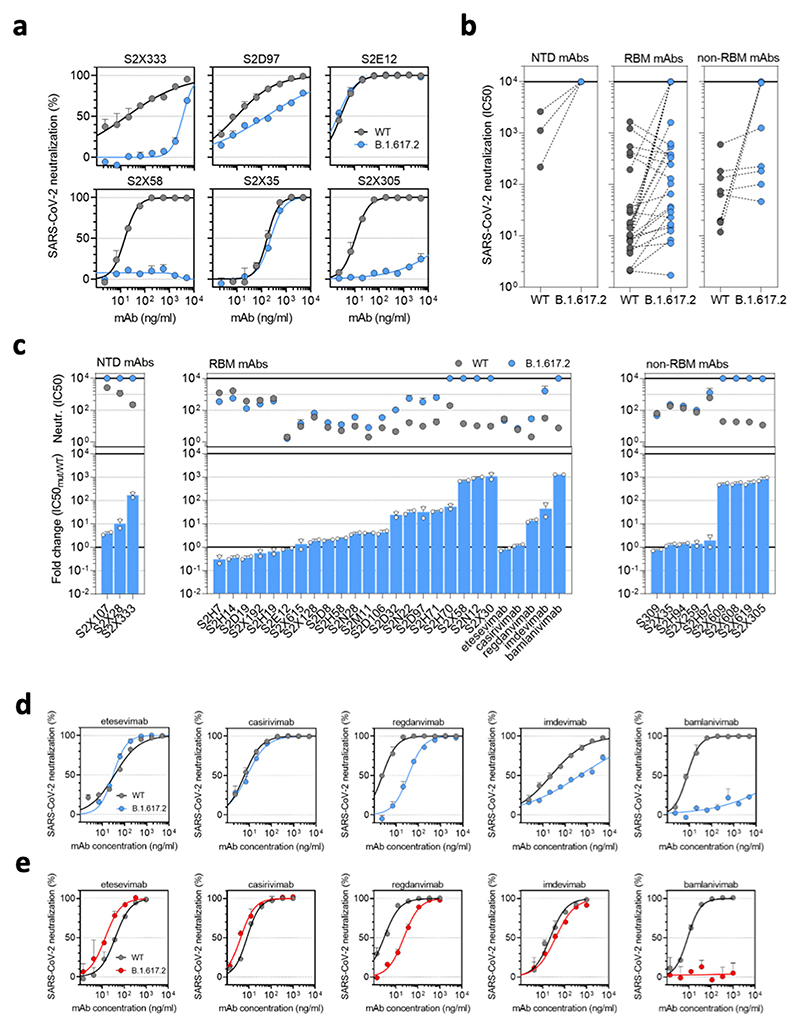
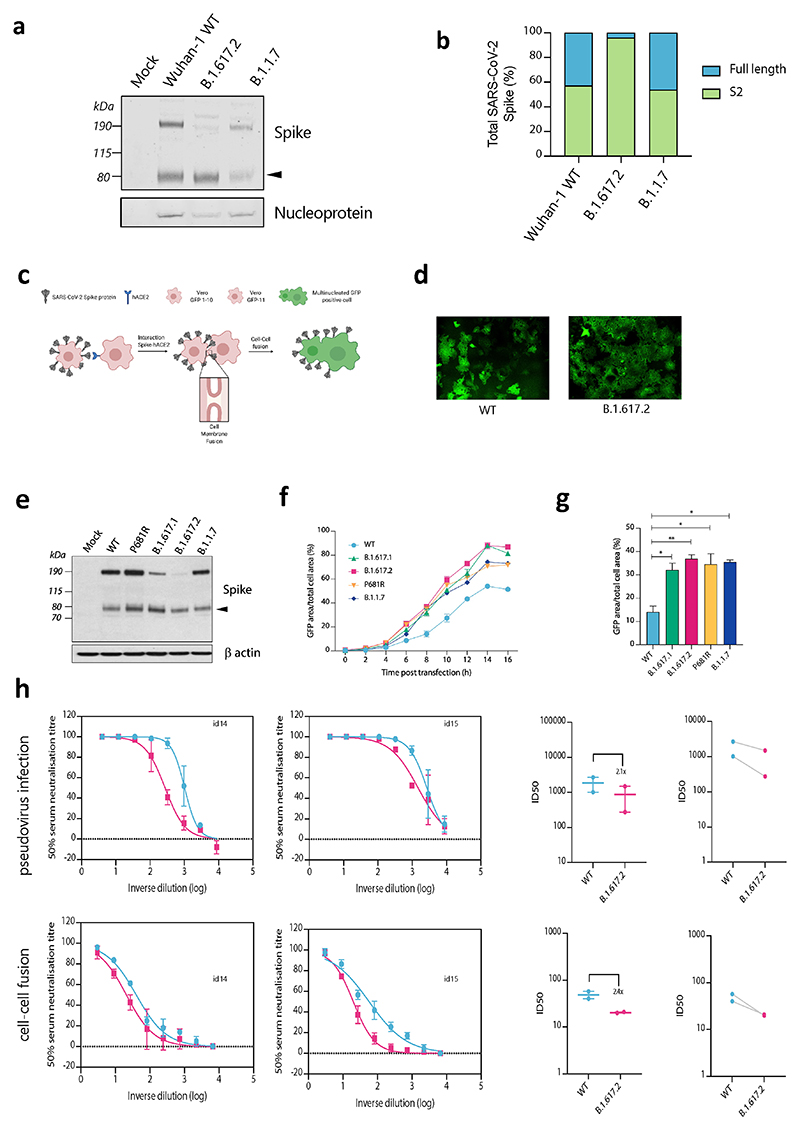
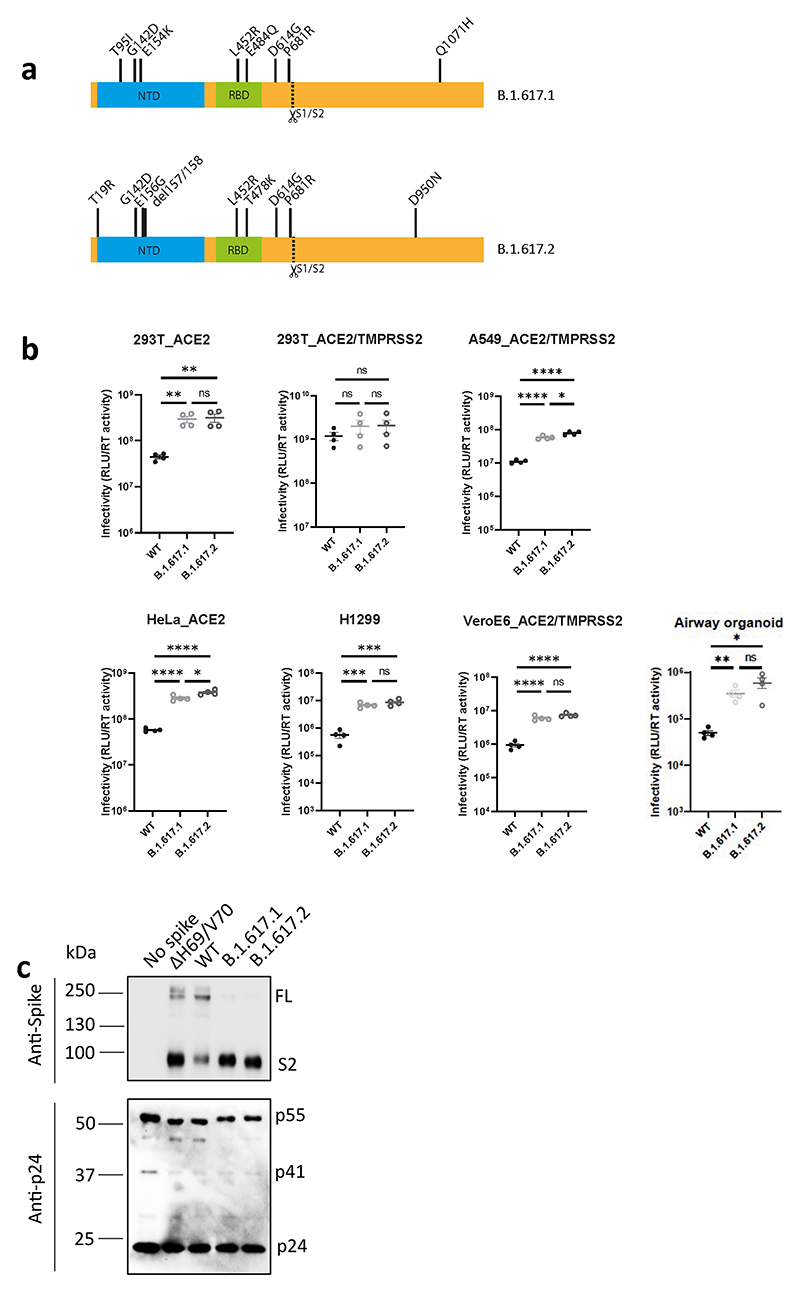
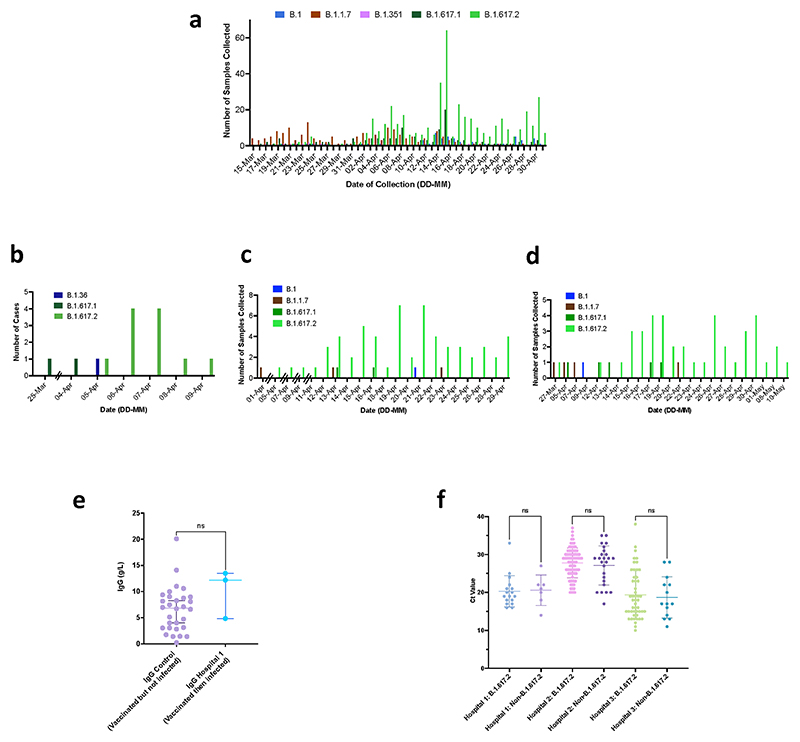
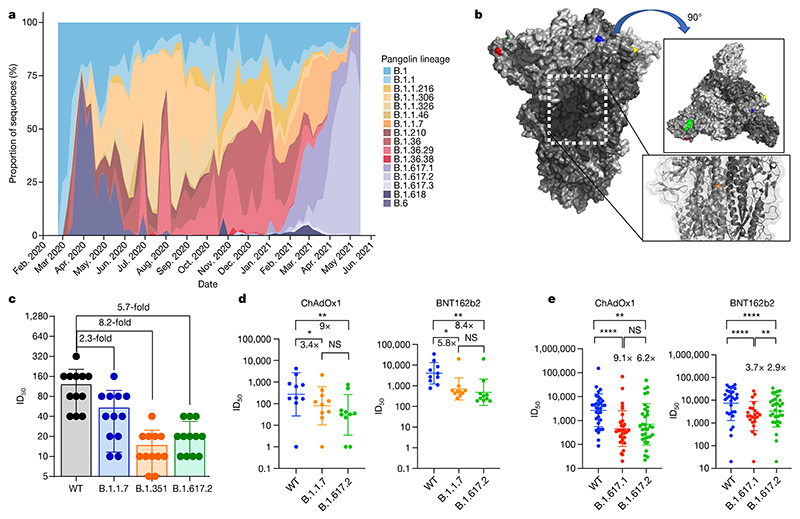
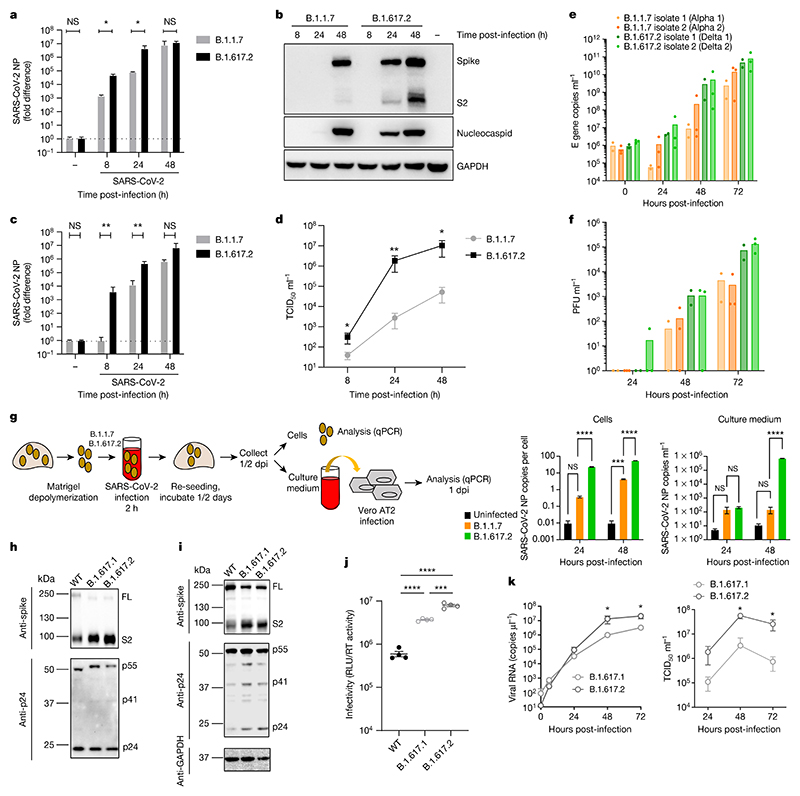
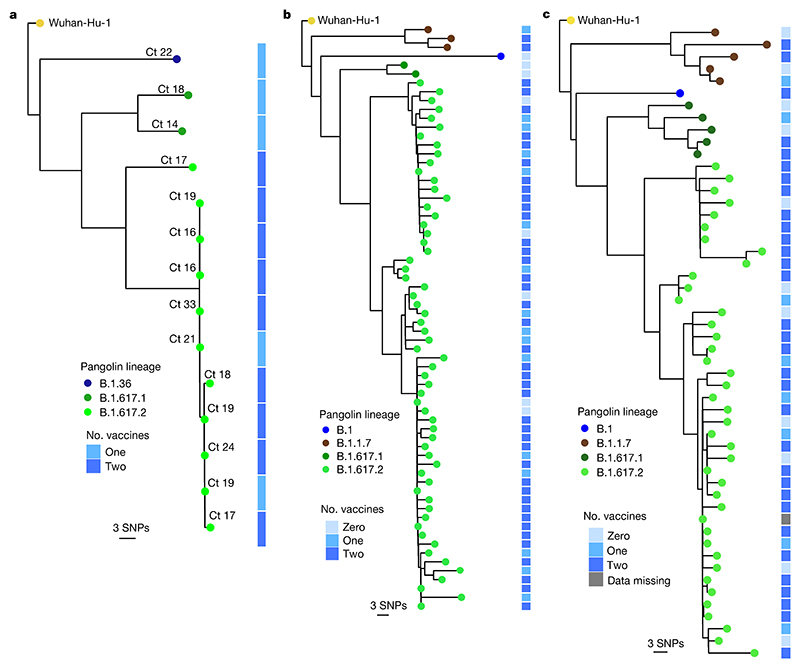
The B.1.617.2 (Delta) variant of severe acute respiratory syndrome coronavirus 2 (SARS-CoV-2) was first identified in the state of Maharashtra in late 2020 and spread throughout India, outcompeting pre-existing lineages including B.1.617.1 (Kappa) and B.1.1.7 (Alpha) 1 . In vitro, B.1.617.2 is sixfold less sensitive to serum neutralizing antibodies from recovered individuals, and eightfold less sensitive to vaccine-elicited antibodies, compared with wild-type Wuhan-1 bearing D614G. Serum neutralizing titres against B.1.617.2 were lower in ChAdOx1 vaccinees than in BNT162b2 vaccinees. B.1.617.2 spike pseudotyped viruses exhibited compromised sensitivity to monoclonal antibodies to the receptor-binding domain and the amino-terminal domain. B.1.617.2 demonstrated higher replication efficiency than B.1.1.7 in both airway organoid and human airway epithelial systems, associated with B.1.617.2 spike being in a predominantly cleaved state compared with B.1.1.7 spike. The B.1.617.2 spike protein was able to mediate highly efficient syncytium formation that was less sensitive to inhibition by neutralizing antibody, compared with that of wild-type spike. We also observed that B.1.617.2 had higher replication and spike-mediated entry than B.1.617.1, potentially explaining the B.1.617.2 dominance. In an analysis of more than 130 SARS-CoV-2-infected health care workers across three centres in India during a period of mixed lineage circulation, we observed reduced ChAdOx1 vaccine effectiveness against B.1.617.2 relative to non-B.1.617.2, with the caveat of possible residual confounding. Compromised vaccine efficacy against the highly fit and immune-evasive B.1.617.2 Delta variant warrants continued infection control measures in the post-vaccination era.
Overview
The claims and statistics of this paper haven’t been checked yet.
Free: it reads the open-access text and checks the first 5 claims that cite a source we can check. Create a free account to check every claim.
Integrity signals
Registry
Cites
Statistics
Figures
Verification
Claims the paper makes
The claims and statistics of this paper haven’t been checked yet.
Free: it reads the open-access text and checks the first 5 claims that cite a source we can check. Create a free account to check every claim.
Claims other papers make about this one
Each is checked against this paper’s own text: does it say what the citing paper says it does?
The cited source says what the claim attributes to it.
In the citing paper
“Neutralization of Delta variant pseudovirus was decreased relative to wild type for all subgroups (Figure 2C), as has been previously reported (Mlcochova et al., 2021; Planas et al., 2021).”
From mRNA-based COVID-19 vaccine boosters induce neutralizing immunity against SARS-CoV-2 Omicron variant (2022) · cites this paper as Mlcochova et al., 2021
Self-check
Percentages, sums and reported differences re-computed from the paper’s own numbers.
The self-check needs the paper’s full text.
Citations
Cites
MAFFT Multiple Sequence Alignment Software Version 7: Improvements in Performance and Usability
Katoh, K., & Standley, D. M. (2013) · Molecular Biology and Evolution · doi:10.1093/molbev/mst010 · Cited by 46,209
Hoffmann, M., Kleine-Weber, H., Schroeder, S., Krüger, N., Herrler, T., Erichsen, S., Schiergens, T. S., Herrler, G., Wu, N.-H., Nitsche, A., et al. (2020) · Cell · doi:10.1016/j.cell.2020.02.052 · Cited by 20,286
A SIMPLE METHOD OF ESTIMATING FIFTY PER CENT ENDPOINTS12
REED, L. J., & MUENCH, H. (1938) · American Journal of Epidemiology · doi:10.1093/oxfordjournals.aje.a118408 · Cited by 19,926
IQ-TREE 2: New models and efficient methods for phylogenetic inference in the genomic era
(2019) · doi:10.1101/849372 · Cited by 16,873
IQ-TREE 2: New Models and Efficient Methods for Phylogenetic Inference in the Genomic Era
Minh, B. Q., Schmidt, H. A., Chernomor, O., Schrempf, D., Woodhams, M. D., von Haeseler, A., & Lanfear, R. (2020) · Molecular Biology and Evolution · doi:10.1093/molbev/msaa015 · Cited by 16,873
A simple method of estimating 50 per cent end points
Muench, H. (1938) · Medical Entomology and Zoology · Cited by 8,376
Detection of 2019 novel coronavirus (2019-nCoV) by real-time RT-PCR
Corman, V. M., Landt, O., Kaiser, M., Molenkamp, R., Meijer, A., Chu, D. K., Bleicker, T., Brünink, S., Schneider, J., Schmidt, M. L., et al. (2020) · Eurosurveillance · doi:10.2807/1560-7917.es.2020.25.3.2000045 · Cited by 7,344
Yu, G., Smith, D. K., Zhu, H., Guan, Y., & Lam, T. T. (2017) · Methods in Ecology and Evolution · doi:10.1111/2041-210x.12628 · Cited by 4,823
Ou, X., Liu, Y., Lei, X., Li, P., Mi, D., Ren, L., Guo, L., Guo, R., Chen, T., Hu, J., et al. (2020) · Nature Communications · doi:10.1038/s41467-020-15562-9 · Cited by 3,097
GISAID: Global initiative on sharing all influenza data – from vision to reality
Shu, Y., & McCauley, J. (2017) · Eurosurveillance · doi:10.2807/1560-7917.es.2017.22.13.30494 · Cited by 3,039
Research works printed but not linked: 2
- Reed, L. J. & Muench, H. A simple method of estimating ifty percent endpoints. Am. J. Hyg. 27, 493-497 (1938).
- Papa, G. et al. Furin cleavage of SARS-CoV-2 Spike promotes but is not essential for infection and cell-cell fusion. PLoS Pathog. 17, e1009246 (2021). · DOI · Paper page
Cited by
Rapid epidemic expansion of the SARS-CoV-2 Omicron variant in southern Africa
Viana, R., Moyo, S., Amoako, D. G., Tegally, H., Scheepers, C., Althaus, C. L., Anyaneji, U. J., Bester, P. A., Boni, M. F., Chand, M., et al. (2022) · Nature · doi:10.1038/s41586-022-04411-y · Cited by 1,690
SARS-CoV-2 variant biology: immune escape, transmission and fitness
Carabelli, A. M., Peacock, T. P., Thorne, L. G., Harvey, W. T., Hughes, J., COVID-19 Genomics UK Consortium, de Silva, T. I., Peacock, S. J., Barclay, W. S., de Silva, T. I., et al. (2023) · Nature Reviews Microbiology · doi:10.1038/s41579-022-00841-7 · Cited by 1,291
Self-citationStriking antibody evasion manifested by the Omicron variant of SARS-CoV-2
Liu, L., Iketani, S., Guo, Y., Chan, J. F.-W., Wang, M., Liu, L., Luo, Y., Chu, H., Huang, Y., Nair, M. S., et al. (2022) · Nature · doi:10.1038/s41586-021-04388-0 · Cited by 1,290
SARS-CoV-2 Omicron spike mediated immune escape and tropism shift
Meng, B., Ferreira, I. A. T. M., Abdullahi, A., Goonawardane, N., Saito, A., Kimura, I., Yamasoba, D., Gerba, P. P., Fatihi, S., Rathore, S., et al. (2021) · doi:10.1101/2021.12.17.473248 · Cited by 1,147
Self-citationAltered TMPRSS2 usage by SARS-CoV-2 Omicron impacts infectivity and fusogenicity
Meng, B., Abdullahi, A., Ferreira, I. A. T. M., Goonawardane, N., Saito, A., Kimura, I., Yamasoba, D., Gerber, P. P., Fatihi, S., Rathore, S., et al. (2022) · Nature · doi:10.1038/s41586-022-04474-x · Cited by 1,146
Self-citationBroadly neutralizing antibodies overcome SARS-CoV-2 Omicron antigenic shift
Cameroni, E., Bowen, J. E., Rosen, L. E., Saliba, C., Zepeda, S. K., Culap, K., Pinto, D., VanBlargan, L. A., De Marco, A., di Iulio, J., et al. (2022) · Nature · doi:10.1038/s41586-021-04386-2 · Cited by 1,080
Self-citationmRNA-based COVID-19 vaccine boosters induce neutralizing immunity against SARS-CoV-2 Omicron variant
Garcia-Beltran, W. F., St. Denis, K. J., Hoelzemer, A., Lam, E. C., Nitido, A. D., Sheehan, M. L., Berrios, C., Ofoman, O., Chang, C. C., Hauser, B. M., et al. (2022) · Cell · doi:10.1016/j.cell.2021.12.033 · Cited by 1,045
“Neutralization of the Delta variant pseudovirus was decreased relative towild type for all subgroups (Figure 2C), as has beenpreviously reported (Mlcochova et al., 2021; Planas et al., 2021).”
The biological and clinical significance of emerging SARS-CoV-2 variants
Tao, K., Tzou, P. L., Nouhin, J., Gupta, R. K., de Oliveira, T., Kosakovsky Pond, S. L., Fera, D., & Shafer, R. W. (2021) · Nature Reviews Genetics · doi:10.1038/s41576-021-00408-x · Cited by 1,009
Self-citationFiolet, T., Kherabi, Y., MacDonald, C.-J., Ghosn, J., & Peiffer-Smadja, N. (2022) · Clinical Microbiology and Infection · doi:10.1016/j.cmi.2021.10.005 · Cited by 911
Tarke, A., Coelho, C. H., Zhang, Z., Dan, J. M., Yu, E. D., Methot, N., Bloom, N. I., Goodwin, B., Phillips, E., Mallal, S., et al. (2022) · Cell · doi:10.1016/j.cell.2022.01.015 · Cited by 858
SARS-CoV-2 Omicron variant replication in human bronchus and lung ex vivo
Hui, K. P. Y., Ho, J. C. W., Cheung, M.-C., Ng, K.-C., Ching, R. H. H., Lai, K.-L., Kam, T. T., Gu, H., Sit, K.-Y., Hsin, M. K. Y., et al. (2022) · Nature · doi:10.1038/s41586-022-04479-6 · Cited by 836
Attenuated fusogenicity and pathogenicity of SARS-CoV-2 Omicron variant
Suzuki, R., Yamasoba, D., Kimura, I., Wang, L., Kishimoto, M., Ito, J., Morioka, Y., Nao, N., Nasser, H., Uriu, K., et al. (2022) · Nature · doi:10.1038/s41586-022-04462-1 · Cited by 682
Self-citationAttenuated replication and pathogenicity of SARS-CoV-2 B.1.1.529 Omicron
Shuai, H., Chan, J. F.-W., Hu, B., Chai, Y., Yuen, T. T.-T., Yin, F., Huang, X., Yoon, C., Hu, J.-C., Liu, H., et al. (2022) · Nature · doi:10.1038/s41586-022-04442-5 · Cited by 654
Self-citationEnhanced fusogenicity and pathogenicity of SARS-CoV-2 Delta P681R mutation
Saito, A., Irie, T., Suzuki, R., Maemura, T., Nasser, H., Uriu, K., Kosugi, Y., Shirakawa, K., Sadamasu, K., Kimura, I., et al. (2022) · Nature · doi:10.1038/s41586-021-04266-9 · Cited by 615
Self-citationLiu, Y., & Rocklöv, J. (2021) · Journal of Travel Medicine · doi:10.1093/jtm/taab124 · Cited by 556
Receptor binding and complex structures of human ACE2 to spike RBD from omicron and delta SARS-CoV-2
Han, P., Li, L., Liu, S., Wang, Q., Zhang, D., Xu, Z., Han, P., Li, X., Peng, Q., Su, C., et al. (2022) · Cell · doi:10.1016/j.cell.2022.01.001 · Cited by 490
COVID-19 vaccine development: milestones, lessons and prospects
Li, M., Wang, H., Tian, L., Pang, Z., Yang, Q., Huang, T., Fan, J., Song, L., Tong, Y., & Fan, H. (2022) · Signal Transduction and Targeted Therapy · doi:10.1038/s41392-022-00996-y · Cited by 434
Cell-cell communication: New insights and clinical implications
Su, J., Song, Y., Zhu, Z., Huang, X., Fan, J., Qiao, J., & Mao, F. (2024) · Signal Transduction and Targeted Therapy · doi:10.1038/s41392-024-01888-z · Cited by 433
Structural and functional characterizations of infectivity and immune evasion of SARS-CoV-2 Omicron
Cui, Z., Liu, P., Wang, N., Wang, L., Fan, K., Zhu, Q., Wang, K., Chen, R., Feng, R., Jia, Z., et al. (2022) · Cell · doi:10.1016/j.cell.2022.01.019 · Cited by 424
Gangavarapu, K., Latif, A. A., Mullen, J. L., Alkuzweny, M., Hufbauer, E., Tsueng, G., Haag, E., Zeller, M., Aceves, C. M., Zaiets, K., et al. (2023) · Nature Methods · doi:10.1038/s41592-023-01769-3 · Cited by 394
Virological characteristics of the SARS-CoV-2 Omicron BA.2 spike
Yamasoba, D., Kimura, I., Nasser, H., Morioka, Y., Nao, N., Ito, J., Uriu, K., Tsuda, M., Zahradnik, J., Shirakawa, K., et al. (2022) · Cell · doi:10.1016/j.cell.2022.04.035 · Cited by 380
Self-citationEvolution of enhanced innate immune evasion by SARS-CoV-2
Thorne, L. G., Bouhaddou, M., Reuschl, A.-K., Zuliani-Alvarez, L., Polacco, B., Pelin, A., Batra, J., Whelan, M. V. X., Hosmillo, M., Fossati, A., et al. (2022) · Nature · doi:10.1038/s41586-021-04352-y · Cited by 370
Abani, O., Abbas, A., Abbas, F., Abbas, M., Abbasi, S., Abbass, H., Abbott, A., Abdallah, N., Abdelaziz, A., Abdelfattah, M., et al. (2022) · The Lancet · doi:10.1016/s0140-6736(22)00163-5 · Cited by 369
Self-citationHuman genetic and immunological determinants of critical COVID-19 pneumonia
Zhang, Q., Bastard, P., Effort, C. H. G., Karbuz, A., Gervais, A., Tayoun, A. A., Aiuti, A., Belot, A., Bolze, A., Gaudet, A., et al. (2022) · Nature · doi:10.1038/s41586-022-04447-0 · Cited by 366
SARS-CoV-2 variant evasion of monoclonal antibodies based on in vitro studies
Cox, M., Peacock, T. P., Harvey, W. T., Hughes, J., Wright, D. W., COVID-19 Genomics UK (COG-UK) Consortium, Willett, B. J., Thomson, E., Gupta, R. K., Peacock, S. J., et al. (2023) · Nature Reviews Microbiology · doi:10.1038/s41579-022-00809-7 · Cited by 344
Self-citationGenomic characterization and Epidemiology of an emerging SARS-CoV-2 variant in Delhi, India
Dhar, M. S., Marwal, R., Radhakrishnan, V., Ponnusamy, K., Jolly, B., Bhoyar, R. C., Sardana, V., Naushin, S., Rophina, M., Mellan, T. A., et al. (2021) · doi:10.1101/2021.06.02.21258076 · Cited by 296
Self-citationGenomic characterization and epidemiology of an emerging SARS-CoV-2 variant in Delhi, India
Dhar, M. S., Marwal, R., VS, R., Ponnusamy, K., Jolly, B., Bhoyar, R. C., Sardana, V., Naushin, S., Rophina, M., Mellan, T. A., et al. (2021) · Science · doi:10.1126/science.abj9932 · Cited by 296
Self-citationMembrane fusion and immune evasion by the spike protein of SARS-CoV-2 Delta variant
Zhang, J., Xiao, T., Cai, Y., Lavine, C. L., Peng, H., Zhu, H., Anand, K., Tong, P., Gautam, A., Mayer, M. L., et al. (2021) · Science · doi:10.1126/science.abl9463 · Cited by 296
The changing epidemiology of SARS-CoV-2
Koelle, K., Martin, M. A., Antia, R., Lopman, B., & Dean, N. E. (2022) · Science · doi:10.1126/science.abm4915 · Cited by 295
SARS-CoV-2 Variants of Concern
Choi, J. Y., & Smith, D. M. (2021) · Yonsei Medical Journal · doi:10.3349/ymj.2021.62.11.961 · Cited by 293
Molecular basis of immune evasion by the Delta and Kappa SARS-CoV-2 variants
McCallum, M., Walls, A. C., Sprouse, K. R., Bowen, J. E., Rosen, L. E., Dang, H. V., De Marco, A., Franko, N., Tilles, S. W., Logue, J., et al. (2021) · Science · doi:10.1126/science.abl8506 · Cited by 288
Self-citationPlanas, D., Staropoli, I., Michel, V., Lemoine, F., Donati, F., Prot, M., Porrot, F., Guivel-Benhassine, F., Jeyarajah, B., Brisebarre, A., et al. (2024) · Nature Communications · doi:10.1038/s41467-024-46490-7 · Cited by 263
mRNA Vaccines in the COVID-19 Pandemic and Beyond
Hogan, M. J., & Pardi, N. (2022) · Annual Review of Medicine · doi:10.1146/annurev-med-042420-112725 · Cited by 256
A COVID-19 peptide vaccine for the induction of SARS-CoV-2 T cell immunity
Heitmann, J. S., Bilich, T., Tandler, C., Nelde, A., Maringer, Y., Marconato, M., Reusch, J., Jäger, S., Denk, M., Richter, M., et al. (2022) · Nature · doi:10.1038/s41586-021-04232-5 · Cited by 255
Shah, M., & Woo, H. G. (2022) · Frontiers in Immunology · doi:10.3389/fimmu.2021.830527 · Cited by 255
Broadly neutralizing antibodies overcome SARS-CoV-2 Omicron antigenic shift
Cameroni, E., Bowen, J. E., Rosen, L. E., Saliba, C., Zepeda, S. K., Culap, K., Pinto, D., VanBlargan, L. A., Marco, A. D., di Iulio, J., et al. (2021) · Nature · doi:10.1038/d41586-021-03825-4 · Cited by 254
Self-citationRapid epidemic expansion of the SARS-CoV-2 Omicron variant in southern Africa
Viana, R., Moyo, S. M., Amoako, D. G., Tegally, H., Scheepers, C., Althaus, C. L., Anyaneji, U. J., Bester, P. A., Boni, M. F., Chand, M., et al. (2022) · Nature · doi:10.1038/d41586-021-03832-5 · Cited by 253
Wratil, P. R., Stern, M., Priller, A., Willmann, A., Almanzar, G., Vogel, E., Feuerherd, M., Cheng, C.-C., Yazici, S., Christa, C., et al. (2022) · Nature Medicine · doi:10.1038/s41591-022-01715-4 · Cited by 253
Repeated Omicron exposures override ancestral SARS-CoV-2 immune imprinting
Yisimayi, A., Song, W., Wang, J., Jian, F., Yu, Y., Chen, X., Xu, Y., Yang, S., Niu, X., Xiao, T., et al. (2024) · Nature · doi:10.1038/s41586-023-06753-7 · Cited by 253
Imprinted antibody responses against SARS-CoV-2 Omicron sublineages
Park, Y.-J., Pinto, D., Walls, A. C., Liu, Z., De Marco, A., Benigni, F., Zatta, F., Silacci-Fregni, C., Bassi, J., Sprouse, K. R., et al. (2022) · doi:10.1101/2022.05.08.491108 · Cited by 251
Self-citationImprinted antibody responses against SARS-CoV-2 Omicron sublineages
Park, Y.-J., Pinto, D., Walls, A. C., Liu, Z., De Marco, A., Benigni, F., Zatta, F., Silacci-Fregni, C., Bassi, J., Sprouse, K. R., et al. (2022) · Science · doi:10.1126/science.adc9127 · Cited by 249
Self-citationEvans, J. P., Zeng, C., Carlin, C., Lozanski, G., Saif, L. J., Oltz, E. M., Gumina, R. J., & Liu, S.-L. (2022) · Science Translational Medicine · doi:10.1126/scitranslmed.abn8057 · Cited by 236
Madewell, Z. J., Yang, Y., Longini, I. M., Halloran, M. E., & Dean, N. E. (2022) · JAMA Network Open · doi:10.1001/jamanetworkopen.2022.9317 · Cited by 236
SARS-CoV-2 prolonged infection during advanced HIV disease evolves extensive immune escape
Cele, S., Karim, F., Lustig, G., San, J. E., Hermanus, T., Tegally, H., Snyman, J., Moyo-Gwete, T., Wilkinson, E., Bernstein, M., et al. (2022) · Cell Host & Microbe · doi:10.1016/j.chom.2022.01.005 · Cited by 235
“The Delta variant has evolved a transmission advantage over other SARS-CoV-2 strains (Mlcochova et al., 2021).”
SARS-COV-2 Variants: Differences and Potential of Immune Evasion
Hirabara, S. M., Serdan, T. D. A., Gorjao, R., Masi, L. N., Pithon-Curi, T. C., Covas, D. T., Curi, R., & Durigon, E. L. (2022) · Frontiers in Cellular and Infection Microbiology · doi:10.3389/fcimb.2021.781429 · Cited by 226
Nucleocapsid mutations R203K/G204R increase the infectivity, fitness, and virulence of SARS-CoV-2
Wu, H., Xing, N., Meng, K., Fu, B., Xue, W., Dong, P., Tang, W., Xiao, Y., Liu, G., Luo, H., et al. (2021) · Cell Host & Microbe · doi:10.1016/j.chom.2021.11.005 · Cited by 226
Kuodi, P., Gorelik, Y., Zayyad, H., Wertheim, O., Wiegler, K. B., Abu Jabal, K., Dror, A. A., Nazzal, S., Glikman, D., & Edelstein, M. (2022) · npj Vaccines · doi:10.1038/s41541-022-00526-5 · Cited by 219
The SARS-CoV-2 Lambda variant exhibits enhanced infectivity and immune resistance
Kimura, I., Kosugi, Y., Wu, J., Zahradnik, J., Yamasoba, D., Butlertanaka, E. P., Tanaka, Y. L., Uriu, K., Liu, Y., Morizako, N., et al. (2022) · Cell Reports · doi:10.1016/j.celrep.2021.110218 · Cited by 218
“A common feature of the Lambda, Delta, and Epsilon variants is a substitution in L452 of the SARS-CoV-2 S protein: the Lambda variant harbors the L452Q mutation, while the Delta and Epsilon variants possess the L452R mutation (Mlcochova et al., 2021; Motozono et al., 2021).”
Self-citationEfficient recall of Omicron-reactive B cell memory after a third dose of SARS-CoV-2 mRNA vaccine
Goel, R. R., Painter, M. M., Lundgreen, K. A., Apostolidis, S. A., Baxter, A. E., Giles, J. R., Mathew, D., Pattekar, A., Reynaldi, A., Khoury, D. S., et al. (2022) · Cell · doi:10.1016/j.cell.2022.04.009 · Cited by 207
“Of these VOC, the Delta (B.1.617.2) variant had considerable impact due to its increased infectivity and partial escape from neutralizing antibodies (Mlcochova et al., 2021; Planas et al., 2021).”
InfluentialCOVID-19 vaccines in patients with cancer: immunogenicity, efficacy and safety
Fendler, A., de Vries, E. G. E., GeurtsvanKessel, C. H., Haanen, J. B., Wörmann, B., Turajlic, S., & von Lilienfeld-Toal, M. (2022) · Nature Reviews Clinical Oncology · doi:10.1038/s41571-022-00610-8 · Cited by 204
Virological characteristics of the SARS-CoV-2 Omicron BA.2.75 variant
Saito, A., Tamura, T., Zahradnik, J., Deguchi, S., Tabata, K., Anraku, Y., Kimura, I., Ito, J., Yamasoba, D., Nasser, H., et al. (2022) · Cell Host & Microbe · doi:10.1016/j.chom.2022.10.003 · Cited by 199
Self-citationHuai Luo, C., Paul Morris, C., Sachithanandham, J., Amadi, A., Gaston, D. C., Li, M., Swanson, N. J., Schwartz, M., Klein, E. Y., Pekosz, A., et al. (2022) · Clinical Infectious Diseases · doi:10.1093/cid/ciab986 · Cited by 198
SARS-CoV-2 breakthrough infections elicit potent, broad, and durable neutralizing antibody responses
Walls, A. C., Sprouse, K. R., Bowen, J. E., Joshi, A., Franko, N., Navarro, M. J., Stewart, C., Cameroni, E., McCallum, M., Goecker, E. A., et al. (2022) · Cell · doi:10.1016/j.cell.2022.01.011 · Cited by 196
“Moreover, multiple S mutations in the N-terminal domain and receptor-binding domain have been shown to promote immune evasion (McCallum et al., 2021a, 2021b; Mlcochova et al., 2021; Suryadevara et al., 2021; Ying et al., 2021).”
InfluentialSelf-citationNeutralization, effector function and immune imprinting of Omicron variants
Addetia, A., Piccoli, L., Case, J. B., Park, Y., Beltramello, M., Guarino, B., Dang, H. V., de Melo, G. D., Pinto, D., Sprouse, K. R., et al. (2023) · Nature · doi:10.1038/s41586-023-06487-6 · Cited by 185
Self-citationThe Evolution and Biology of SARS-CoV-2 Variants
Telenti, A., Hodcroft, E. B., & Robertson, D. L. (2022) · Cold Spring Harbor Perspectives in Medicine · doi:10.1101/cshperspect.a041390 · Cited by 180
Alpha to Omicron: Disease Severity and Clinical Outcomes of Major SARS-CoV-2 Variants
Esper, F. P., Adhikari, T. M., Tu, Z. J., Cheng, Y., El-Haddad, K., Farkas, D. H., Bosler, D. S., Rhoads, D. D., Procop, G. W., Ko, J. S., et al. (2022) · The Journal of Infectious Diseases · doi:10.1093/infdis/jiac411 · Cited by 179
The evolving SARS-CoV-2 epidemic in Africa: Insights from rapidly expanding genomic surveillance
Tegally, H., San, J. E., Cotten, M., Moir, M., Tegomoh, B., Mboowa, G., Martin, D. P., Baxter, C., Lambisia, A. W., Diallo, A., et al. (2022) · Science · doi:10.1126/science.abq5358 · Cited by 178
“The fourth VOC observed was Delta (13), which rose to prominence inApril 2021 in India, where it fueled an explosive secondwave.”
Mutations in SARS-CoV-2 variants of concern link to increased spike cleavage and virus transmission
Escalera, A., Gonzalez-Reiche, A. S., Aslam, S., Mena, I., Laporte, M., Pearl, R. L., Fossati, A., Rathnasinghe, R., Alshammary, H., van de Guchte, A., et al. (2022) · Cell Host & Microbe · doi:10.1016/j.chom.2022.01.006 · Cited by 178
Emerging SARS-CoV-2 Variants: A Review of Its Mutations, Its Implications and Vaccine Efficacy
Ramesh, S., Govindarajulu, M., Parise, R. S., Neel, L. T., Shankar, T., Patel, S., Lowery, P., Smith, F., Dhanasekaran, M., & Moore, T. (2021) · Vaccines · doi:10.3390/vaccines9101195 · Cited by 177
Memory B cell repertoire from triple vaccinees against diverse SARS-CoV-2 variants
Wang, K., Jia, Z., Bao, L., Wang, L., Cao, L., Chi, H., Hu, Y., Li, Q., Zhou, Y., Jiang, Y., et al. (2022) · Nature · doi:10.1038/s41586-022-04466-x · Cited by 175
Self-citationThe Mechanism and Consequences of SARS-CoV-2 Spike-Mediated Fusion and Syncytia Formation
Rajah, M. M., Bernier, A., Buchrieser, J., & Schwartz, O. (2022) · Journal of Molecular Biology · doi:10.1016/j.jmb.2021.167280 · Cited by 173
Two Years into the COVID-19 Pandemic: Lessons Learned
da Silva, S. J. R., do Nascimento, J. C. F., Mendes, R. P. G., Guarines, K. M., da Silva, C. T. A., da Silva, P. G., de Magalhães, J. J. F., Vigar, J. R. J., Silva‐Júnior, A., Kohl, A., et al. (2022) · ACS Infectious Diseases · doi:10.1021/acsinfecdis.2c00204 · Cited by 174
COVID-19 Diagnosis: A Comprehensive Review of the RT-qPCR Method for Detection of SARS-CoV-2
Dutta, D., Naiyer, S., Mansuri, S., Soni, N., Singh, V., Bhat, K. H., Singh, N., Arora, G., & Mansuri, M. S. (2022) · Diagnostics · doi:10.3390/diagnostics12061503 · Cited by 172
Self-citationWillingness to Receive the Booster COVID-19 Vaccine Dose in Poland
Rzymski, P., Poniedziałek, B., & Fal, A. (2021) · Vaccines · doi:10.3390/vaccines9111286 · Cited by 170
Omicron spike function and neutralizing activity elicited by a comprehensive panel of vaccines
Bowen, J. E., Addetia, A., Dang, H. V., Stewart, C., Brown, J. T., Sharkey, W. K., Sprouse, K. R., Walls, A. C., Mazzitelli, I. G., Logue, J. K., et al. (2022) · Science · doi:10.1126/science.abq0203 · Cited by 166
Self-citationMolecular characteristics, immune evasion, and impact of SARS-CoV-2 variants
Sun, C., Xie, C., Bu, G., Zhong, L., & Zeng, M. (2022) · Signal Transduction and Targeted Therapy · doi:10.1038/s41392-022-01039-2 · Cited by 167
Antibody-mediated neutralization of SARS-CoV-2
Gruell, H., Vanshylla, K., Weber, T., Barnes, C. O., Kreer, C., & Klein, F. (2022) · Immunity · doi:10.1016/j.immuni.2022.05.005 · Cited by 162
Aggarwal, A., Akerman, A., Milogiannakis, V., Silva, M. R., Walker, G. J., Stella, A. O., Kindinger, A., Angelovich, T. A., Waring, E., Amatayakul‐Chantler, S., et al. (2022) · EBioMedicine · doi:10.1016/j.ebiom.2022.104270 · Cited by 158
Nanotechnology-based strategies against SARS-CoV-2 variants
Huang, X., Kon, E., Han, X., Zhang, X., Kong, N., Mitchell, M. J., Peer, D., & Tao, W. (2022) · Nature Nanotechnology · doi:10.1038/s41565-022-01174-5 · Cited by 155
Antigenic cartography of SARS-CoV-2 reveals that Omicron BA.1 and BA.2 are antigenically distinct
Mykytyn, A. Z., Rissmann, M., Kok, A., Rosu, M. E., Schipper, D., Breugem, T. I., van den Doel, P. B., Chandler, F., Bestebroer, T., de Wit, M., et al. (2022) · Science Immunology · doi:10.1126/sciimmunol.abq4450 · Cited by 153
COVID-19 pandemic dynamics in India, the SARS-CoV-2 Delta variant and implications for vaccination
Yang, W., & Shaman, J. L. (2022) · Journal of The Royal Society Interface · doi:10.1098/rsif.2021.0900 · Cited by 151
Drivers of adaptive evolution during chronic SARS-CoV-2 infections
Harari, S., Tahor, M., Rutsinsky, N., Meijer, S. E., Miller, D., Henig, O., Halutz, O., Levytskyi, K., Ben‐Ami, R., Adler, A., et al. (2022) · Nature Medicine · doi:10.1038/s41591-022-01882-4 · Cited by 151
Uversky, V. N., Redwan, E. M. M. M., Makis, W., & Rubio‐Casillas, A. (2023) · Vaccines · doi:10.3390/vaccines11050991 · Cited by 144
Neutralization of SARS-CoV-2 Omicron sub-lineages BA.1, BA.1.1, and BA.2
Evans, J. P., Zeng, C., Qu, P., Faraone, J. N., Zheng, Y.-M., Carlin, C., Bednash, J. S., Zhou, T., Lozanski, G., Mallampalli, R. K., et al. (2022) · Cell Host & Microbe · doi:10.1016/j.chom.2022.04.014 · Cited by 145
Andre, M., Lau, L. S., Pokharel, M. D., Ramelow, J., Owens, F., Souchak, J., Akkaoui, J., Ales, E., Brown, H. H., Shil, R. K., et al. (2023) · Biology · doi:10.3390/biology12091267 · Cited by 147
Zabidi, N. Z., Liew, H. L., Farouk, I. A., Puniyamurti, A., Yip, A. J. W., Wijesinghe, V. N., Low, Z. Y., Tang, J. W.-T., Chow, V. T. K., & Lal, S. K. (2023) · Viruses · doi:10.3390/v15040944 · Cited by 146
Chung, Y.-S., Lam, C.-Y., Tan, P.-H., Tsang, H. F., & Wong, S. C. C. (2024) · International Journal of Molecular Sciences · doi:10.3390/ijms25158155 · Cited by 143
SARS-CoV-2 spike engagement of ACE2 primes S2′ site cleavage and fusion initiation
Yu, S., Zheng, X., Zhou, B., Li, J., Chen, M., Deng, R. X., Wong, G., Lavillette, D., & Meng, G. (2021) · Proceedings of the National Academy of Sciences · doi:10.1073/pnas.2111199119 · Cited by 141
Antibody-mediated broad sarbecovirus neutralization through ACE2 molecular mimicry
Park, Y.-J., De Marco, A., Starr, T. N., Liu, Z., Pinto, D., Walls, A. C., Zatta, F., Zepeda, S. K., Bowen, J. E., Sprouse, K. R., et al. (2022) · Science · doi:10.1126/science.abm8143 · Cited by 140
Self-citationContext-specific emergence and growth of the SARS-CoV-2 Delta variant
McCrone, J. T., Hill, V., Bajaj, S., Pena, R. E., Lambert, B. C., Inward, R. P. D., Bhatt, S., Volz, E., Ruis, C., Dellicour, S., et al. (2022) · Nature · doi:10.1038/s41586-022-05200-3 · Cited by 138
Self-citationAccelerated SARS-CoV-2 intrahost evolution leading to distinct genotypes during chronic infection
Chaguza, C., Hahn, A. M., Petrone, M. E., Zhou, S., Ferguson, D. J. P., Breban, M. I., Pham, K., Peña-Hernández, M. A., Castaldi, C., Hill, V., et al. (2023) · Cell Reports Medicine · doi:10.1016/j.xcrm.2023.100943 · Cited by 136
Wang, X., Zhao, X., Song, J., Wu, J., Zhu, Y., Li, M., Cui, Y., Chen, Y., Yang, L., Liu, J., et al. (2022) · Emerging Microbes & Infections · doi:10.1080/22221751.2022.2030200 · Cited by 132
Self-citationRole of COVID-19 Vaccines in SARS-CoV-2 Variants
Zhou, Z., Zhu, Y., & Chu, M. (2022) · Frontiers in Immunology · doi:10.3389/fimmu.2022.898192 · Cited by 131
Yin, Q., Luo, W., Mallajosyula, V. V. A., Yang, B., Guo, J., Xie, J., Sun, M., Verma, R., Li, C., Constantz, C. M., et al. (2023) · Nature Materials · doi:10.1038/s41563-022-01464-2 · Cited by 128
Recent developments in the immunopathology of COVID ‐19
Zhang, H., Sun, Y., Wang, Y., Yazıcı, D., Azkur, D., Öğülür, İ., Azkur, A. K., Yang, Z., Chen, X., Zhang, A., et al. (2022) · Allergy · doi:10.1111/all.15593 · Cited by 125
Immunogenicity and Reactogenicity of Vaccine Boosters after Ad26.COV2.S Priming
Sablerolles, R. S. G., Rietdijk, W. J. R., Goorhuis, A., Postma, D. F., Visser, L. G., Geers, D., Schmitz, K. S., Garcia Garrido, H. M., Koopmans, M. P. G., Dalm, V. A. S. H., et al. (2022) · New England Journal of Medicine · doi:10.1056/nejmoa2116747 · Cited by 124
Mutations of SARS-CoV-2 spike protein: Implications on immune evasion and vaccine-induced immunity
Mengist, H. M., Kombe, A. J. K., Mekonnen, D. S., Abebaw, A., Getachew, M., & Jin, T. (2021) · Seminars in Immunology · doi:10.1016/j.smim.2021.101533 · Cited by 126
Aggarwal, A., Stella, A. O., Walker, G., Akerman, A., Esneau, C., Milogiannakis, V., Burnett, D. L., McAllery, S., Silva, M. R., Lu, Y., et al. (2022) · Nature Microbiology · doi:10.1038/s41564-022-01135-7 · Cited by 121
COVID-19: Challenges of Viral Variants
Jacobs, J. L., Haidar, G., & Mellors, J. W. (2022) · Annual Review of Medicine · doi:10.1146/annurev-med-042921-020956 · Cited by 119
Virological characteristics of the SARS-CoV-2 BA.2.86 variant
Tamura, T., Mizuma, K., Nasser, H., Deguchi, S., Padilla‐Blanco, M., Oda, Y., Uriu, K., Tolentino, J. E., Tsujino, S., Suzuki, R., et al. (2024) · Cell Host & Microbe · doi:10.1016/j.chom.2024.01.001 · Cited by 117
Self-citationBolze, A., Luo, S., White, S., Cirulli, E. T., Wyman, D., Dei Rossi, A., Machado, H., Cassens, T., Jacobs, S., Schiabor Barrett, K. M., et al. (2022) · Cell Reports Medicine · doi:10.1016/j.xcrm.2022.100564 · Cited by 116
Replication kinetics and infectivity of SARS-CoV-2 variants of concern in common cell culture models
Mautner, L., Hoyos, M., Dangel, A., Berger, C., Ehrhardt, A., & Baiker, A. E. (2022) · Virology Journal · doi:10.1186/s12985-022-01802-5 · Cited by 115
COVID-19 vaccine breakthrough infections
Gupta, R. K., & Topol, E. J. (2021) · Science · doi:10.1126/science.abl8487 · Cited by 114
Self-citationUpdate on the effectiveness of COVID-19 vaccines on different variants of SARS-CoV-2
Firouzabadi, N., Ghasemiyeh, P., Moradishooli, F., & Mohammadi‐Samani, S. (2023) · International Immunopharmacology · doi:10.1016/j.intimp.2023.109968 · Cited by 113
Emerging Delivery Systems for Enabling Precision Nucleic Acid Therapeutics
Bian, X., Zhou, L., Luo, Z., Liu, G., Hang, Z., Li, H., Li, F., & Wen, Y. (2025) · ACS Nano · doi:10.1021/acsnano.4c11858 · Cited by 110
Population immunity predicts evolutionary trajectories of SARS-CoV-2
Meijers, M., Ruchnewitz, D., Eberhardt, J., Łuksza, M., & Lässig, M. (2023) · Cell · doi:10.1016/j.cell.2023.09.022 · Cited by 111
RNA G-quadruplex in TMPRSS2 reduces SARS-CoV-2 infection
Liu, G., Du, W., Sang, X., Tong, Q., Wang, Y., Chen, G., Yuan, Y., Jiang, L., Cheng, W., Liu, D., et al. (2022) · Nature Communications · doi:10.1038/s41467-022-29135-5 · Cited by 108
Self-citationTeruel, N., Mailhot, O., & Najmanovich, R. (2021) · PLoS Computational Biology · doi:10.1371/journal.pcbi.1009286 · Cited by 105
SARS-CoV-2 and innate immunity: the good, the bad, and the “goldilocks”
Sievers, B. L., Cheng, M. T. K., Csiba, K., Meng, B., & Gupta, R. K. (2023) · Cellular and Molecular Immunology · doi:10.1038/s41423-023-01104-y · Cited by 107
Self-citationEditorial: The XBB.1.5 (‘Kraken’) Subvariant of Omicron SARS-CoV-2 and its Rapid Global Spread
Parums, D. V. (2023) · Medical Science Monitor · doi:10.12659/msm.939580 · Cited by 104
Metadata
- Authors
- Mlcochova, P., Kemp, S. A., Dhar, M. S., Papa, G., Meng, B., Ferreira, I. A. T. M., Datir, R., Collier, D. A., Albecka, A., Singh, S., Pandey, R., Brown, J., Zhou, J., Goonawardane, N., Mishra, S., Whittaker, C., Mellan, T., Marwal, R., Datta, M., Sengupta, S., Ponnusamy, K., Radhakrishnan, V. S., Abdullahi, A., Charles, O., Chattopadhyay, P., Devi, P., Caputo, D., Peacock, T., Wattal, C., Goel, N., Satwik, A., Vaishya, R., Agarwal, M., The Indian SARS-CoV-2 Genomics Consortium (INSACOG), Chauhan, H., Dikid, T., Gogia, H., Lall, H., Verma, K., Dhar, M. S., Singh, M. K., Soni, N., Meena, N., Madan, P., Singh, P., Sharma, R., Sharma, R., Kabra, S., Kumar, S., Kumari, S., Sharma, U., Chaudhary, U., Sivasubbu, S., Scaria, V., Oberoi, J. K., Raveendran, R., Datta, S., Das, S., Maitra, A., Chinnaswamy, S., Biswas, N. K., Parida, A., Raghav, S. K., Prasad, P., Sarin, A., Mayor, S., Ramakrishnan, U., Palakodeti, D., Seshasayee, A. S. N., Thangaraj, K., Bashyam, M. D., Dalal, A., Bhat, M., Shouche, Y., Pillai, A., Abraham, P., Potdar, V. A., Cherian, S. S., Desai, A. S., Pattabiraman, C., Manjunatha, M. V., Mani, R. S., Udupi, G. A., Nandicoori, V., Tallapaka, K. B., Sowpati, D. T., The Genotype to Phenotype Japan (G2P-Japan) Consortium, Kawabata, R., Morizako, N., Sadamasu, K., Asakura, H., Nagashima, M., Yoshimura, K., Ito, J., Kimura, I., Uriu, K., Kosugi, Y., Suganami, M., Oide, A., Yokoyama, M., Chiba, M., Saito, A., Butlertanaka, E. P., Tanaka, Y. L., Ikeda, T., Motozono, C., Nasser, H., Shimizu, R., Yuan, Y., Kitazato, K., Hasebe, H., Nakagawa, S., Wu, J., Takahashi, M., Fukuhara, T., Shimizu, K., Tsushima, K., Kubo, H., Shirakawa, K., Kazuma, Y., Nomura, R., Horisawa, Y., Takaori-Kondo, A., Tokunaga, K., Ozono, S., The CITIID-NIHR BioResource COVID-19 Collaboration, Baker, S., Dougan, G., Hess, C., Kingston, N., Lehner, P. J., Lyons, P. A., Matheson, N. J., Owehand, W. H., Saunders, C., Summers, C., Thaventhiran, J. E. D., Toshner, M., Weekes, M. P., Maxwell, P., Shaw, A., Bucke, A., Calder, J., Canna, L., Domingo, J., Elmer, A., Fuller, S., Harris, J., Hewitt, S., Kennet, J., Jose, S., Kourampa, J., Meadows, A., O’Brien, C., Price, J., Publico, C., Rastall, R., Ribeiro, C., Rowlands, J., Ruffolo, V., Tordesillas, H., Bullman, B., Dunmore, B. J., Fawke, S., Gräf, S., Hodgson, J., Huang, C., Hunter, K., Jones, E., Legchenko, E., Matara, C., Martin, J., Mescia, F., O’Donnell, C., Pointon, L., Pond, N., Shih, J., Sutcliffe, R., Tilly, T., Treacy, C., Tong, Z., Wood, J., Wylot, M., Bergamaschi, L., Betancourt, A., Bower, G., Cossetti, C., De Sa, A., Epping, M., Fawke, S., Gleadall, N., Grenfell, R., Hinch, A., Huhn, O., Jackson, S., Jarvis, I., Krishna, B., Lewis, D., Marsden, J., Nice, F., Okecha, G., Omarjee, O., Perera, M., Potts, M., Richoz, N., Romashova, V., Yarkoni, N. S., Sharma, R., Stefanucci, L., Stephens, J., Strezlecki, M., Turner, L., De Bie, E. M. D. D., Bunclark, K., Josipovic, M., Mackay, M., Rossi, S., Selvan, M., Spencer, S., Yong, C., Allison, J., Butcher, H., Caputo, D., Clapham-Riley, D., Dewhurst, E., Furlong, A., Graves, B., Gray, J., Ivers, T., Kasanicki, M., Le Gresley, E., Linger, R., Meloy, S., Muldoon, F., Ovington, N., Papadia, S., Phelan, I., Stark, H., Stirrups, K. E., Townsend, P., Walker, N., Webster, J., Scholtes, I., Hein, S., King, R., Mavousian, A., Lee, J. H., Bassi, J., Silacci-Fegni, C., Saliba, C., Pinto, D., Irie, T., Yoshida, I., Hamilton, W. L., Sato, K., Bhatt, S., Flaxman, S., James, L. C., Corti, D., Piccoli, L., Barclay, W. S., Rakshit, P., Agrawal, A., & Gupta, R. K.
- Affiliations
- University of Cambridge (GB)
- MRC Laboratory of Molecular Biology (GB)
- National Center for Disease Control (IN)
- Institute of Genomics and Integrative Biology (IN)
- Imperial College London (GB)
- University College London (GB)
- Sir Ganga Ram Hospital (IN)
- Indraprastha Apollo Hospitals (IN)
- National Institute of Biomedical Genomics (IN)
- Institute of Life Sciences (IN)
- National Centre for Biological Sciences (IN)
- Centre for DNA Fingerprinting and Diagnostics (IN)
- National Centre for Cell Science (IN)
- ICMR-National Institute of Virology (IN)
- National Institute of Mental Health and Neurosciences (IN)
- Centre for Cellular and Molecular Biology (IN)
- Hiroshima University (JP)
- Tokyo Metropolitan Institute of Public Health (JP)
- Institute of Medical Science, The University of Tokyo (JP)
- University of Miyazaki (JP)
- Kumamoto University (JP)
- Tokai University (JP)
- Hokkaido University (JP)
- Kyoto University (JP)
- National Institute of Infectious Diseases (JP)
- NIHR BioResource (GB)
- Africa Health Research Institute (ZA)
- University of Oxford (GB)
- Cambridge University Hospitals NHS Foundation Trust (GB)
- Vir Biotechnology (Switzerland) (CH)
- Wellcome/MRC Cambridge Stem Cell Institute (GB)
- Japan Science and Technology Agency (JP)
- Corresponding author
- Rakshit, Partha
- Agrawal, Anurag
- Gupta, Ravindra K.
- ORCID
- Kemp, Steven A.
- Papa, Guido
- Meng, Bo
- Ferreira, Isabella A. T. M.
- Datir, Rawlings
- Collier, Dami A.
- Albecka, Anna
- Singh, Sujeet
- Pandey, Rajesh
- Brown, Jonathan
- Zhou, Jie
- Goonawardane, Niluka
- Mishra, Swapnil
- Whittaker, Charles
- Mellan, Thomas
- Marwal, Robin
- Sengupta, Shantanu
- Ponnusamy, Kalaiarasan
- Radhakrishnan, Venkatraman Srinivasan
- Abdullahi, Adam
- Charles, Oscar
- Chattopadhyay, Partha
- Devi, Priti
- Wattal, Chand
- Goel, Neeraj
- Vaishya, Raju
- Agarwal, Meenakshi
- Chauhan, Himanshu
- Dikid, Tanzin
- Lall, Hemlata
- Singh, Manoj K.
- Madan, Preeti
- Singh, Priyanka
- Sharma, Rajeev
- Kumari, Swati
- Sharma, Uma
- Chaudhary, Urmila
- Sivasubbu, Sridhar
- Scaria, Vinod
- Oberoi, J. K.
- Das, Saumitra
- Maitra, Arindam
- Chinnaswamy, Sreedhar
- Biswas, Nidhan Kumar
- Parida, Ajay
- Raghav, Sunil K.
- Prasad, Punit
- Sarin, Apurva
- Mayor, Satyajit
- Ramakrishnan, Uma
- Palakodeti, Dasaradhi
- Seshasayee, Aswin Sai Narain
- Bashyam, Murali Dharan
- Dalal, Ashwin
- Shouche, Yogesh
- Pillai, Ajay
- Abraham, Priya
- Potdar, Varsha Atul
- Cherian, Sarah S.
- Desai, Anita Sudhir
- Pattabiraman, Chitra
- Mani, Reeta S.
- Nandicoori, Vinay
- Tallapaka, Karthik Bharadwaj
- Sowpati, Divya Tej
- Sadamasu, Kenji
- Asakura, Hiroyuki
- Nagashima, Mami
- Yoshimura, Kazuhisa
- Ito, Jumpei
- Saito, Akatsuki
- Butlertanaka, Erika P.
- Tanaka, Yuri L.
- Ikeda, Terumasa
- Motozono, Chihiro
- Nasser, Hesham
- Yuan, Yue
- Nakagawa, So
- Wu, Jiaqi
- Fukuhara, Takasuke
- Shimizu, Kenta
- Shirakawa, Kotaro
- Kazuma, Yasuhiro
- Nomura, Ryosuke
- Tokunaga, Kenzo
- Ozono, Seiya
- Baker, Stephen
- Dougan, Gordon
- Hess, Christoph
- Kingston, Nathalie
- Lehner, Paul J.
- Lyons, Paul A.
- Matheson, Nicholas J.
- Summers, Charlotte
- Thaventhiran, James E. D.
- Toshner, Mark
- Weekes, Michael P.
- Maxwell, Patrick
- Shaw, Ashley
- Domingo, Jason
- Kennet, Jane
- Price, Jane
- Rowlands, Jane
- Dunmore, Benjamin J.
- Gräf, Stefan
- Legchenko, Ekaterina
- Martin, Jennifer
- Mescia, Federica
- Pointon, Linda
- Sutcliffe, Rachel
- Tilly, Tobias
- Bergamaschi, Laura
- Cossetti, Chiara
- Epping, Madeline
- Grenfell, Richard
- Jackson, Sarah
- Nice, Francesca
- Omarjee, Ommar
- Perera, Marianne
- Potts, Martin
- Richoz, Nathan
- Yarkoni, Natalia Savinykh
- Sharma, Rahul
- Stefanucci, Luca
- Stephens, Jonathan
- Bunclark, Katherine
- Rossi, Sabrina
- Yong, Cissy
- Papadia, Sofia
- Stark, Hannah
- Stirrups, Kathleen E.
- Walker, Neil
- Webster, Jennifer
- King, Rebecca
- Mavousian, Antranik
- Bassi, Jessica
- Saliba, Christian
- Pinto, Dora
- Irie, Takashi
- Yoshida, Isao
- Sato, Kei
- Bhatt, Samir
- Flaxman, Seth
- James, Leo C.
- Corti, Davide
- Piccoli, Luca
- Rakshit, Partha
- Agrawal, Anurag
- Gupta, Ravindra K.
- Venue
- Nature
- Published
- 2021-09-06
- Volume
- 599
- Issue
- 7883
- Pages
- 114-119
- ISSN
- 0028-0836 (ISSN-L)
- 1476-4687
- PMC
- PMC8566220
- OpenAlex
- W3198233589
- Semantic Scholar
- ff25d53950f382ca8d506c8e8a4a0a72eb912c9d
- Cited by
- 1,337
- References
- 58
- Citations by year
- 2026: 46 · 2025: 92 · 2024: 147 · 2023: 281 · 2022: 614 · 2021: 155
- FWCI
- 95.37
- Type
- journal article
- Language
- en
- Open access
- hybrid
- doi.org
- Licence
- cc-by
- creativecommons.org/licenses/by/4.0 (tdm)
- creativecommons.org/licenses/by/4.0 (vor)
- Locations
- Nature (publishedVersion, cc-by)
- Research Square (acceptedVersion, cc-by)
- Europe PMC (PubMed Central) (publishedVersion, other-oa)
- PubMed Central (publishedVersion, cc-by)
- PubMed (publishedVersion)
- Research at the University of Copenhagen (University of Copenhagen) (publishedVersion, cc-by)
- Institutional Research Information System (Università degli Studi di Brescia) (submittedVersion, other-oa)
- RePEc: Research Papers in Economics (submittedVersion)
- Archivio Istituzionale della Ricerca (Universita Degli Studi Di Milano) (submittedVersion, other-oa)
- UCL Discovery (University College London) (submittedVersion)
- White Rose Research Online (University of Leeds, The University of Sheffield, University of York) (submittedVersion, cc-by)
- Apollo (University of Cambridge) (submittedVersion)
- Apollo (University of Cambridge) (submittedVersion, cc-by)
- Apollo
- Greater South Information System
- Funders
- Bill and Melinda Gates Foundation (OPP 1175094)
- Japan Agency for Medical Research and Development (CREST, 20fk0108413h0001)
- Wellcome Trust (108070/Z/15/Z, 108082/A/15/Z, 108082, WT108082AIA, MR/W005611/1, DEL-15-006, 200594/Z/16/Z, 081772)
- UK Research and Innovation (MR/W005611/1/)
- Cancer Research UK (22310)
- National Institute for Health and Care Research (OPP1175094, DEL-15-006)
- Academy of Medical Sciences (SBF004\1080)
- Rosetrees Trust
- Evelyn Trust (20/75)
- NIHR BioResource
- Medical Research Council (MC_PC_17230, MR/R015600/1, MR/W005611/1, MC_PC_19012, COVID-19)
- Engineering and Physical Sciences Research Council (EP/V002910/1, EP/V002910/2, MR/W005611/1)
- Japan Society for the Promotion of Science (18H02662, 19K22968, 18KK0447, 21K07060)
- Addenbrooke's Charitable Trust, Cambridge University Hospitals (900275 Minute 47/20B)
- Core Research for Evolutional Science and Technology (JPMJCR20H4)
- Strategic International Collaborative Research Program
- Topics
- Health Sciences › Medicine › Infectious Diseases › SARS-CoV-2 and COVID-19 Research
- Life Sciences › Agricultural and Biological Sciences › Animal Science and Zoology › Animal Virus Infections Studies
- Health Sciences › Medicine › Infectious Diseases › COVID-19 Clinical Research Studies
- Keywords
- Delta variant, immune evasion, neutralizing antibodies, spike protein cleavage, syncytium formation, ChAdOx1 nCoV-19 vaccine, BNT162b2, vaccine effectiveness, receptor binding domain, N-terminal domain, airway organoids, healthcare workers, D614G
- MeSH terms
- SARS-CoV-2, COVID-19 Vaccines, Cell Fusion, Cell Line, Female, Health Personnel, Humans, India, Kinetics, Male, Vaccination, Virus Replication, Immune Evasion, Antibodies, Neutralizing, Spike Glycoprotein, Coronavirus
About these checks
Registry, retraction, Cites and statistics results are computed, not judged, with one exception: a printed reference that no index lists is read once by a model before it counts as a citation error. Claims are extracted by a model and kept only when their quote appears verbatim in the text; each cited source is then checked, with a model’s help, for whether it says what the claim relies on. Those verdicts can be wrong — read the claim’s quote and the cited source before relying on one.
Statistics and arithmetic are recomputed, not judged.
Confidence bands are shown only for fields calibrated on our annotated test set. None is calibrated yet, so no band is shown.
What counts as a claim ›How we measure confidence ›How we check this ›
Are you an author, or do you see a problem with this page? Request a review
Data sources
Bibliographic data: Semantic Scholar, OpenAlex, Crossref.
Contains information from the Semantic Scholar Academic Graph Datasets, made available under the ODC Attribution License (ODC-BY 1.0).
Semantic Scholar’s data is described in: Kinney, R., et al. (2023). The Semantic Scholar Open Data Platform. arXiv:2301.10140.
