

Quantum logic with spin qubits crossing the surface code threshold
Open accessThe DOI matches its Crossref record; 62 of the 65 references it cites were found in a registry or an index.
Abstract
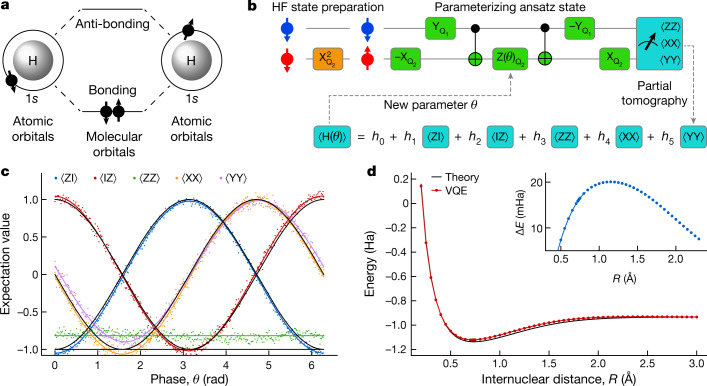
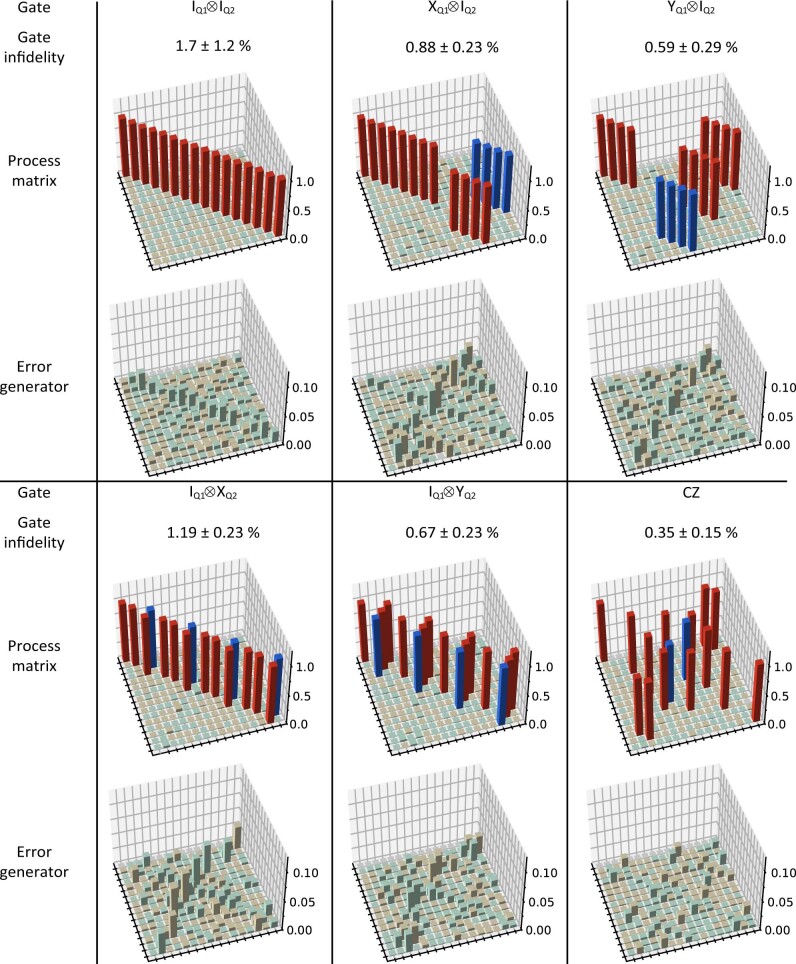
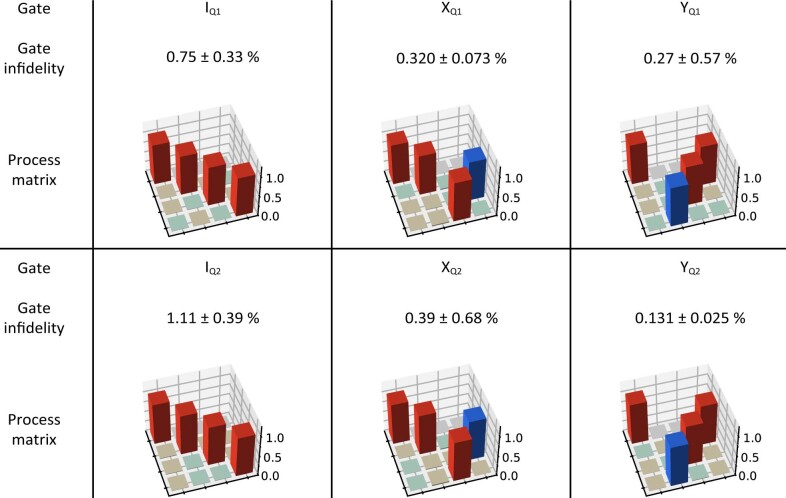
High-fidelity control of quantum bits is paramount for the reliable execution of quantum algorithms and for achieving fault tolerance—the ability to correct errors faster than they occur 1 . The central requirement for fault tolerance is expressed in terms of an error threshold. Whereas the actual threshold depends on many details, a common target is the approximately 1% error threshold of the well-known surface code 2,3 . Reaching two-qubit gate fidelities above 99% has been a long-standing major goal for semiconductor spin qubits. These qubits are promising for scaling, as they can leverage advanced semiconductor technology 4 . Here we report a spin-based quantum processor in silicon with single-qubit and two-qubit gate fidelities, all of which are above 99.5%, extracted from gate-set tomography. The average single-qubit gate fidelities remain above 99% when including crosstalk and idling errors on the neighbouring qubit. Using this high-fidelity gate set, we execute the demanding task of calculating molecular ground-state energies using a variational quantum eigensolver algorithm 5 . Having surpassed the 99% barrier for the two-qubit gate fidelity, semiconductor qubits are well positioned on the path to fault tolerance and to possible applications in the era of noisy intermediate-scale quantum devices.
Overview
The claims and statistics of this paper haven’t been checked yet.
Free: it reads the open-access text and checks the first 5 claims that cite a source we can check. Create a free account to check every claim.
Integrity signals
Registry
Cites
Statistics
Figures
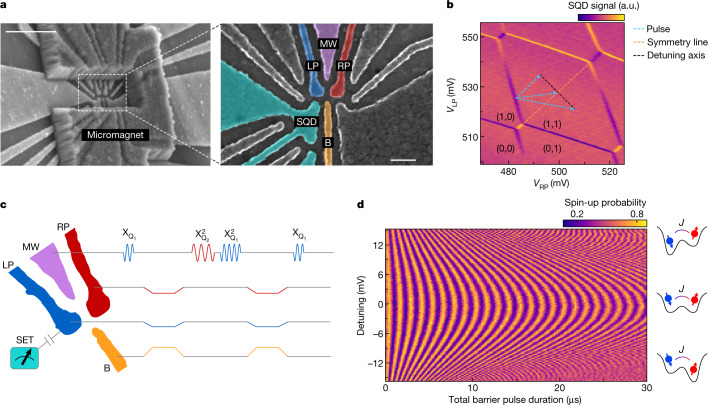
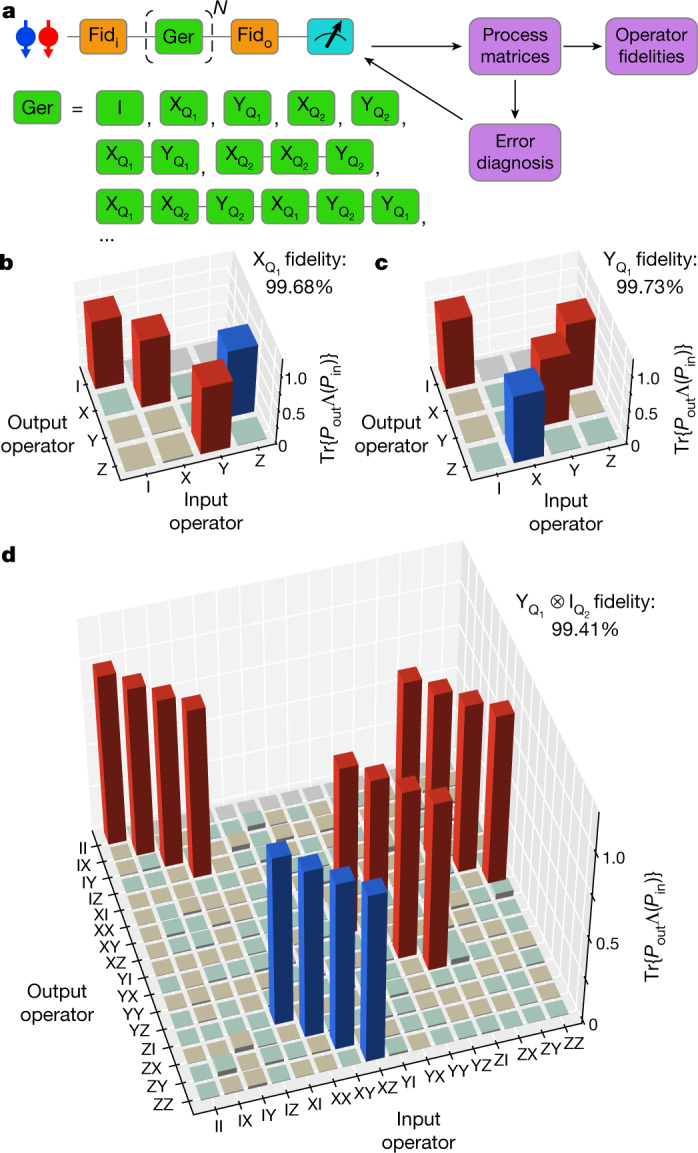
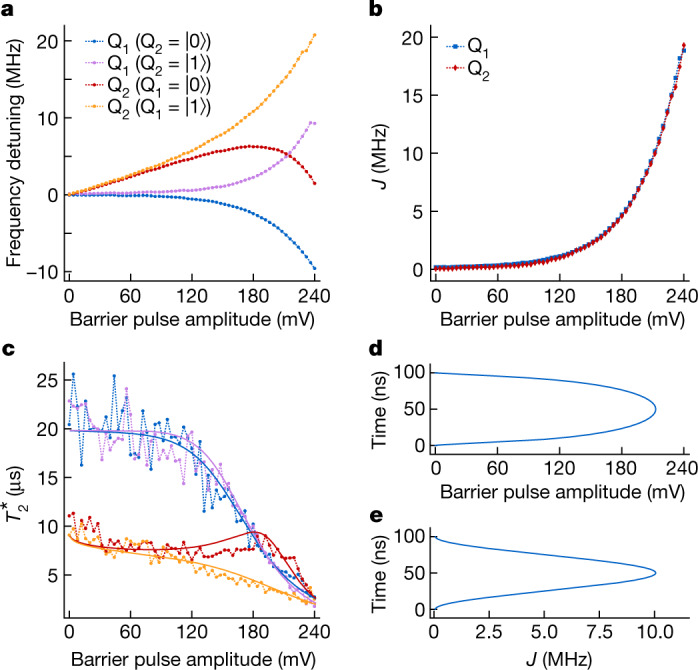
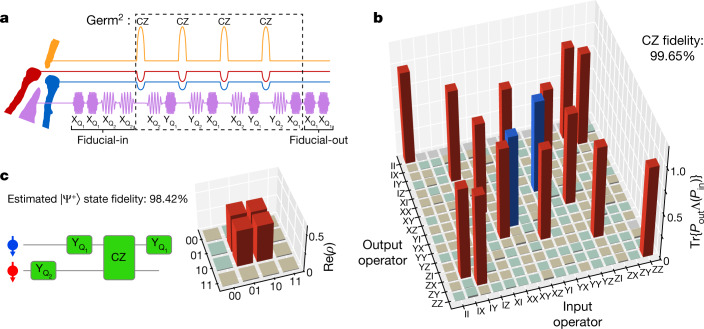
Verification
Claims the paper makes
The claims and statistics of this paper haven’t been checked yet.
Free: it reads the open-access text and checks the first 5 claims that cite a source we can check. Create a free account to check every claim.
Self-check
Percentages, sums and reported differences re-computed from the paper’s own numbers.
The self-check needs the paper’s full text.
Citations
Cites
Quantum Computation and Quantum Information
Nielsen, M. A., Chuang, I., & Grover, L. K. (2002) · American Journal of Physics · doi:10.1119/1.1463744 · Cited by 21,895
Quantum computation and quantum information
Law, J. (2001) · ACM SIGSOFT Software Engineering Notes · doi:10.1145/505482.505499 · Cited by 18,842
Quantum Computing in the NISQ era and beyond
Preskill, J. (2018) · Quantum · doi:10.22331/q-2018-08-06-79 · Cited by 8,830 · cited 1×
“The higher the accuracy, or fidelity, of the operations, the higher the likelihood that near-term applications for quantum computers come in reach [6].”
BackgroundQuantum computation with quantum dots
Loss, D., & DiVincenzo, D. P. (1998) · Physical Review A · doi:10.1103/physreva.57.120 · Cited by 6,840 · cited 2×
“The native two-qubit gate for spin qubits utilizes the exchange interaction [22, 23], originating from the wavefunction overlap of electrons in neighbouring dots.”
BackgroundCoherent Manipulation of Coupled Electron Spins in Semiconductor Quantum Dots
Petta, J. R., Johnson, A. C., Taylor, J. M., Laird, E. A., Yacoby, A., Lukin, M. D., Marcus, C. M., Hanson, M. P., & Gossard, A. C. (2005) · Science · doi:10.1126/science.1116955 · Cited by 3,183 · cited 1×
“The native two-qubit gate for spin qubits utilizes the exchange interaction [22, 23], originating from the wavefunction overlap of electrons in neighbouring dots.”
BackgroundSurface codes: Towards practical large-scale quantum computation
Fowler, A. G., Mariantoni, M., Martinis, J. M., & Cleland, A. N. (2012) · Physical Review A · doi:10.1103/physreva.86.032324 · Cited by 3,059 · cited 2×
“6% and 1%, under certain assumptions, albeit at the cost of a large redundancy in the number of physical qubits [2].”
BackgroundSingle-shot read-out of an individual electron spin in a quantum dot
Elzerman, J. M., Hanson, R., Willems van Beveren, L. H., Witkamp, B., Vandersypen, L. M. K., & Kouwenhoven, L. P. (2004) · Nature · doi:10.1038/nature02693 · Cited by 1,679
Self-citationQuantum computational chemistry
McArdle, S., Endo, S., Aspuru-Guzik, A., Benjamin, S. C., & Yuan, X. (2020) · Reviews of Modern Physics · doi:10.1103/revmodphys.92.015003 · Cited by 1,621 · cited 2×
“the Bravyi-Kitaev (BK) transformation [4].”
MethodLinear transformations which preserve trace and positive semidefiniteness of operators
Jamiołkowski, A. (1972) · Reports on Mathematical Physics · doi:10.1016/0034-4877(72)90011-0 · Cited by 1,512
NMR techniques for quantum control and computation
Vandersypen, L. M. K., & Chuang, I. L. (2005) · Reviews of Modern Physics · doi:10.1103/revmodphys.76.1037 · Cited by 1,217 · cited 1×
“Single-qubit X and Y gates are implemented by frequency-multiplexed microwave signals applied to gate MW, and virtual Z gates are implemented by a phase update of the reference frame [21].”
MethodSelf-citation
Research works printed but not linked: 1
- Xue X Benchmarking gate fidelities in a Si/SiGe two-qubit device Phys. Rev. X 2019 9 021011
Cited by
Items 501–577 of 577
Adding superconductivity to highly coherent electronic spins
Rosen, I. T. (2025) · Nature Materials · doi:10.1038/s41563-025-02139-4
Fundamental Technologies for Silicon Quantum Computers
Kodera, T. (2025) · Vacuum and Surface Science · doi:10.1380/vss.68.149
An on-chip compact Chebyshev filter for semiconductor quantum dots in cQED architecture
Wei, Z.-C., Deng, S.-Y., Huang, Z.-Q., Kang, Y., Li, Z.-H., Xu, Y.-Q., Cai, R., Wang, B., Li, H.-O., Cao, G., et al. (2025) · Applied Physics Letters · doi:10.1063/5.0256274
Research on sensing-storage-computing spintronic devices based on organic semiconductors
Gu, X., Guo, L., Li, M., Wu, M., Wang, Y., Zhang, X., Yang, Q., Yang, T., & Sun, X. (2025) · Scientia Sinica Chimica · doi:10.1360/ssc-2025-0105
An SOT-switchable micromagnet scheme of adiabatic geometric gates for silicon spin qubits
李, F.-G. 方. L., 蔡, R.-R. 冉. C., Wang, B., Li, H.-O., Cao, G., & Guo, G. (2025) · Chinese Physics B · doi:10.1088/1674-1056/addcd3
Silizium‐Halbleitertechnologie für Quantencomputer: Quantenrechnen mit Spins
Heinz, I., & Burkard, G. (2025) · Physik in unserer Zeit · doi:10.1002/piuz.202501730
Significant enhancement of Rashba spin–orbit interaction using metastable heavy metal interface
Yamazaki, T., Obinata, S., Iimori, R., Yamada, K., & Kimura, T. (2025) · APL Materials · doi:10.1063/5.0258083
Quantum algorithm compiler for architectures with semiconductor spin qubits
Tadokoro, M., Matsuoka, R., & Kodera, T. (2025) · EPJ Quantum Technology · doi:10.1140/epjqt/s40507-025-00384-9
Yoneda, J. (2022) · The Journal of The Institute of Image Information and Television Engineers · doi:10.3169/itej.76.611
Tunable spin-electric-field coupling for spin qubit control
Hu, X. (2025) · Science China Physics Mechanics and Astronomy · doi:10.1007/s11433-025-2762-7
Robust iswap gates for semiconductor spin qubits with local driving
Liu, Q.-P., & Xue, Z. (2025) · Physical Review A · doi:10.1103/68m1-mjzy
“Even with the help of the Hahn echo [7, 8, 22], the dephasing time T echo 2 can only be improved to tens of microseconds, as it is limited by low-frequency noise [23, 24].”
Epitaxial Profile Optimization for Valley Splitting Enhancement in Si/Sige Spin-Qubits
Thayil, A., Ermoneit, L., & Kantner, M. (2025) · International Conference on Simulation of Semiconductor Processes and Devices · doi:10.1109/sispad66650.2025.11185961
“Experiments have demonstrated state initialization, readout as well as one and two-qubit gate operations exceeding the fault-tolerance threshold [2].”
Jiaqi, 郭. G., Jianing, 汤. T., & Chao, 申. S. (2025) · Acta Optica Sinica · doi:10.3788/aos251296
Long-distance interaction of gate-defined quantum dots under Floquet driving
Liu, X.-F., Liu, Z.-H., Wang, T.-J., Wang, C., & Xu, H. Q. (2025) · Physical Review Applied · doi:10.1103/zbcs-jdq2
Real-Time DCZ Gate Control by Bayesian Optimization with Forgetting
Sato, Y., & Kawahara, T. (2025) · IEEE International Conference on Quantum Computing and Engineering (QCE) · doi:10.1109/qce65121.2025.00151
“Similarly, Xue et al. [4] adopted a Tukey window as a control pulse envelope, allowing for adiabatic time evolution [12].”
Anderson, D. Z., Chomaz, P., Takeuchi, S., Arakawa, Y., Baba, Y., Benson, O. J., Soderberg, K.-A., Diamanti, E., Elkouss, D., Fujii, K., et al. (2026) · Journal of Physics B Atomic Molecular and Optical Physics · doi:10.1088/1361-6455/ae271a
Designing Adaptive Ansätze in Quantum Simulation and Geometric Entangling Gates
Tang, H. L. (2024) · VTechWorks (Virginia Tech)
Erbium dopants in nanophotonic silicon waveguides and cavities
Gritsch, A., Reiserer, A., & München, T. U. (2024)
Universal tripartite entanglement in topological phases of matter
Siva, K. (2023) · eScholarship (California Digital Library)
Dynamics of entanglement of spin qubits based on semiconductor quantum dots
Bragar, I. (2023) · RCIN (Digital Repository of the Scientifics Institutes) (Institute of Archaeology and Ethnology of the Polish Academy of Sciences)
Ramette, J. (2024) · DSpace@MIT (Massachusetts Institute of Technology) · Cited by 1
Double Quantum Dots with Quenched Charging Energy in PbTe Nanowires
Byard, S. A., Gomanko, M., Raynolds, A., Tan, S., Zhang, T., Zhang, S., & Frolov, S. (2026) · Nano Letters · doi:10.1021/acs.nanolett.5c04976
Fu, Q., Liu, J., Wang, X., & Xiong, R. (2026) · Entropy · doi:10.3390/e28010089
“Semiconductor quantum dots, employing confined electrons with exchange interactions that decay rapidly with distance, exhibit more localized noise behavior dominated by charge fluctuations and nuclear spin effects [36–43].”
Active silicon interposer with integrated CMOS selector circuits for silicon qubits
Higashimomo, K., Mizokuchi, R., Taguchi, M., Miki, T., Nagata, M., & Kodera, T. (2026) · Japanese Journal of Applied Physics · doi:10.35848/1347-4065/ae3aa9 · Cited by 1
Ultrafast optical spectroscopy with quantum light and quantum control
Fan, J., Deng, X., & Zhang, Z. (2026) · Progress in Quantum Electronics · doi:10.1016/j.pquantelec.2026.100613 · Cited by 1
Robust composite two-qubit gates for silicon-based spin qubits
Yu, Y.-Y., Zhang, G.-H., He, Y.-J., Wu, J., Song, X., & Wang, D. (2026) · Physical Review Applied · doi:10.1103/t8xj-6c5m
“In the pursuit of viable quantum computer hardware, spin qubits encoded in silicon double quantum dots (DQDs) are highly promising candidates [1–5] due to its long coherence time [6, 7], potential scalability [8, 9] and combination with the modern semi-conductor technology [10, 11].”
An attenuated-sampling SAR ADC for in-situ signal monitoring in cryogenic silicon spin qubit systems
Takahashi, R., Nagata, M., & Miki, T. (2026) · Japanese Journal of Applied Physics · doi:10.35848/1347-4065/ae4033
Hyperfine Dependence of Nuclear-Spin Rabi Frequencies in Silicon Donors
Li, C., Zhang, S., Wang, H., Gao, M., Deng, Y., Zhang, Y.-N., Bai, X., Yin, C., Huan, S., Liu, J., et al. (2026) · Nano Letters · doi:10.1021/acs.nanolett.5c05023
Engineering the Quantum Future: Impact of Electrical Engineering in the Field of Quantum Mechanics
Kaza, S. V. M., & Beg, O. A. (2026) · World Journal of Engineering and Technology · doi:10.4236/wjet.2026.141012
Geometric protected quantum bus in a hybrid superconducting-spin architecture
Zhu, X., Yue, Z.-C., Guo, G., Tu, T., & Li, C.-F. (2026) · Physical Review Applied · doi:10.1103/dftf-g4kc · Cited by 1
Introduction to the application of quantum computing in quantum chemistry
Chakravarti, D., & Guidoni, L. (2026) · Elsevier eBooks · doi:10.1016/b978-0-443-26596-9.00035-1
Silicon-based light emitters towards quantum devices at telecom frequency
Khoury, M. (2022) · theses.fr (ABES) · doi:10.70675/f46421aezfb31z490dz8019zf5e9b8753876 · Cited by 1
Controlled quantum dot array segmentation and complete two-electron spin state readout
Nurizzo, M. (2023) · theses.fr (ABES) · doi:10.70675/963584c3z511az4a27zad9dz7ee33fec3306
Hybrid circuit quantum electrodynamics with a hole spin in silicon
Yu, C. X. (2022) · theses.fr (ABES) · doi:10.70675/5d372839zf41cz4f16z8834zfa670184a3f9 · Cited by 1
high fidelity readout of electron spins in silicon mos quantum dots
Niegemann, D. J. (2022) · theses.fr (ABES) · doi:10.70675/e9e7d37ez8bbcz48b2zad06z2a7254839393 · Cited by 1
Charge and spin control of electron and holes in silicon quantum dot arrays
Aprá, A. (2023) · theses.fr (ABES) · doi:10.70675/e8ff03a2z656cz4847za912z9cea6f501898
Taming noise for CMOS electron spin qubits
El-Homsy, V. (2024) · theses.fr (ABES) · doi:10.70675/1576e82fzb695z413bza0d8zf7d10a0ddcfa
Flying qubit using ultra-short single-electron charge pulses
Geffroy, C. (2023) · theses.fr (ABES) · doi:10.70675/1cff1312zbe60z4f99z8388z874573846f82 · Cited by 1
Gate‐Reconfigurable Single‐ and Double‐Dot Transport in Trilayer MoSe 2
Lee, S., Park, M., 노윤상, An, S. J., Kim, S. B., Cho, M., Kim, D., Taniguchi, T., Watanabe, K., Jung, M., et al. (2026) · Advanced Electronic Materials · doi:10.1002/aelm.70564
“In established material systems such as GaAs [ 3 ], Si [ 4 ], and Ge [ 5 ], gate-defined dots have enabled Coulomb blockade measurements [ 6–8 ], charge sensing [ 9 ], spin initialization and readout [ 10 ], exchange control [ 11 ], and high-fidelity qubit operations [ 12 ].”
Spin-qubit leapfrogging: Dynamics of shuttling electrons on top of another
Meineke, N., & Burkard, G. (2026) · Physical Review Research · doi:10.1103/l1vq-9zhr
“While this can be achieved efficiently and with high fidelity through a number of SWAP-gates [9], spin shuttling has recently distinguished itself as a scalable method for interactions between distant qubits in semiconductor devices with fidelities above the error correction threshold [3, 10–14].”
Development of Quantum Computers with Electron Spins in Silicon Quantum Dots
Nakajima, T. (2026) · IEEE Electron Devices Technology & Manufacturing Conference (EDTM) · doi:10.1109/edtm65772.2026.11496854
“Electron spin qubits hosted in silicon quantum dots have recently achieved error rates lower than 0.1% for single-qubit operations and 0.5% for two-qubit gates, which meet the above requirement [1,2].”
InfluentialQuantum information processing in modular cavity QED architecturesPreprint
McIntyre, Z. (2025) · arXiv (Cornell University) · doi:10.48550/arxiv.2505.04747
Dynamics of quantum resources in double quantum dot system under Rashba spin–orbit interaction
Chouiba, A., Elghaayda, S., & Mansour, M. (2026) · Laser Physics · doi:10.1088/1555-6611/ae68f2
Four-state discrimination for a pair of spin qubits via gate reflectometry
Sen, A., & Pályi, A. (2026) · Physical review. B./Physical review. B · doi:10.1103/737j-gmns
Cryo-CMOS Integrator-Based DAC for Scalable Biasing of Semiconductor Qubits
Enthoven, L., van Staveren, J., Gong, J., Babaie, M., & Sebastiano, F. (2026) · IEEE Transactions on Circuits and Systems I Regular Papers · doi:10.1109/tcsi.2026.3692714
“S EMICONDUCTOR spin qubits are a promising platform for quantum computing: they have demonstrated high-fidelity qubit control and readout [1], [2], and operation at temperatures above 1 K [3], [4], [5], while being compatible with CMOS processing [6], thus o ff ering the potential co-integration with…”
Matsuoka, R., Matsuda, T., Tsuchiya, R., Mine, T., Hisamoto, D., Mizuno, H., Mizokuchi, R., Kodera, T., & Yoneda, J. (2026) · Applied Physics Letters · doi:10.1063/5.0327539 · Cited by 1
Yadav, P., & Kumari, J. (2026) · Advances in computational intelligence and robotics book series · doi:10.4018/979-8-2600-0156-1.ch011
Dislocation- and crosshatch-free high-mobility silicon two-dimensional electron gases
Zhang, J., Liu, F. Y., Ming, M., Liao, L.-X., Zhou, X.-Y., & Zhang, J.-J. (2026) · APL Materials · doi:10.1063/5.0334357
Multiparticle entanglement of nuclear spins in silicon
Xu, F., Deng, Y., Hu, G., Yang, K., Li, C., Wei, C., Zhang, S., Zhang, C., Du, P., Shi, K., et al. (2026) · Nature Communications · doi:10.1038/s41467-026-74491-1
Developing a Quantum Computer with Electrically Driven Spin Qubits
Nakajima, T., Takeda, K., Noiri, A., Kobayashi, T., Camenzind, L. C., Sekiguchi, T., Kanno, Y., Wachi, Y., Norimatsu, T., Tsuchiya, R., et al. (2026) · IEEE Symposium on VLSI Technology and Circuits (VLSI Technology and Circuits) · doi:10.1109/vlsitechnologyandcir65830.2026.11577645
Cryo-CMOS Sub-1K 16nm FinFET DAC for Fast Two-Qubit Gates in Spin Qubits
Polat, İ., Overwater, R. W. J., Prabowo, B., Reale, S., Esposti, D. D., Capannelli, K., Russ, M., Vandersypen, L. M. K., Babaie, M., & Sebastiano, F. (2026) · IEEE Symposium on VLSI Technology and Circuits (VLSI Technology and Circuits) · doi:10.1109/vlsitechnologyandcir65830.2026.11577344
Self-citationContinuum benchmark of fast exchange control in a driven double quantum dot
Abdel‐Aty, A., Alharthi, N. S., Altuijri, R., Matoog, R. T., Shaaban, S. M., & Hafez, M. (2026) · Physica E Low-dimensional Systems and Nanostructures · doi:10.1016/j.physe.2026.116607
Spectroscopy of low-lying valley states in hot Si/SiGe quantum dots
Nasseraddin, C., Yoo, H. M., Janda, T. M., & Petta, J. R. (2026) · Applied Physics Letters · doi:10.1063/5.0352205
Leakage-suppressed parametric entangling gates in a spin-resonator hybrid system
Anonymous, Guo, A.-L., Zhang, B.-Y., & Zhu, X. (2026) · Physical Review A · doi:10.1103/hrcl-68g8
Multimodal deep learning for automated atomic qubits fabrication in silicon
Cui, Y.-W., Wu, K., Wu, P., Yang, L.-Y.-L., Duan, M., Wang, G.-Y., Shi, K., Lyu, Y., Huang, P.-H., Xin, T., et al. (2026) · Machine Learning: Science and Technology · doi:10.1088/2632-2153/ae8e30
Interference-protected long-range spin–valley gates in carbon-nanotube double quantum dots
Altuijri, R., Ghorashi, S. A., Shaaban, S. M., Matoog, R. T., Mahmoud, M., Alharthi, N. S., & Abdel‐Aty, A. (2026) · Physica E Low-dimensional Systems and Nanostructures · doi:10.1016/j.physe.2026.116620
Metrology for Quantum Hardware Standardization—Charting a Pathway: A Strategic Review
Kaneko, N. (2026) · IEEJ Transactions on Electrical and Electronic Engineering · doi:10.1002/tee.70379 · Cited by 1
Valley splitting and density-driven scattering in undoped Si/SiGe two-dimensional electron system
Kynshi, L. D. L., Soni, U., Sharma, C. H., Cheng, Y., Deneke, K., Zierold, R., Zhou, S., Blick, R. H., Shaji, A., & Thalakulam, M. (2026) · Journal of Physics Condensed Matter · doi:10.1088/1361-648x/ae8fae
Robust two-qubit gates for semiconductor spin qubits based on dynamical dimensionality reduction
Anonymous, Zhou, J., & Xue, Z. (2026) · Physical Review A · doi:10.1103/gkrd-lm18
Nakane, J. J., Asai, H., Hashizume, M., Horiba, T., Kutsuki, K., Iizuka, S., Chiashi, Y., Oka, H., Kato, K., Kajita, S., et al. (2026) · IEEE Journal of the Electron Devices Society · doi:10.1109/jeds.2026.3719324
“Recently, both single-and two-qubit gates in silicon have reached fidelities above 99% [6], [7], [8], [9], [10], [11], [12], exceeding typical fault-tolerant thresholds [13], [14].”
Wang, Z., Liu, Y., Hao, Y., & Han, G. (2026) · arXiv (Cornell University) · doi:10.48550/arxiv.2608.16048
Alamoudi, T. A. (2026) · International Journal of Computer Applications · doi:10.5120/ijca2b2d25a3c082
Complex-Ray Geometry and the Emergence of Projective Qubits
Menard, K. A. (2026) · International Journal of Theoretical Physics · doi:10.1007/s10773-026-06456-5
“We now show that these structures are precisely those required to reconstruct the kinematics of a qubit from continuous phase-space invariants [10, 13, 53].”
Correlated noise in spin qubits
ROJAS, A. J. S. (2022) · Institutional Repositories DataBase (IRDB) · doi:10.15083/0002010885
Electrostatically defined ZnO quantum devices
Kozuka, Y., & Otsuka, T. (2026) · Modern Physics Letters B · doi:10.1142/s0217984926502337
Electron-mediated coupling schemes between nuclear-spin qudits in silicon
Anonymous, Xu, F., Xiang, Y., Zhang, S., Song, J., Zhai, Y., Duan, M., Pan, T., Tian, Z., Wang, G., et al. (2026) · Physical Review Applied · doi:10.1103/mr2x-jt6m
Structured Hamiltonian Learning for Multiqubit Conditional Phase GatesPreprint
Deng, X.-H. (2026) · arXiv (Cornell University) · doi:10.48550/arxiv.2609.27629
“…diagonal operators and their synthesis [16, 17]; conditional Ramsey calibration, repeated-gate phase amplification, and coherent error-generator feedback are established for two-qubit phase gates [12, 18, 19]; and complete or self-consistent process characterization has a broader scope [22, 24].”
In-plane optimal qubit operation with control fidelities exceeding 99%
Anonymous, Kong, Z., Ma, R.-L., Jiang, H.-T., Li, A.-R., Zhong, Y., Wu, Z.-T., Zheng, R., Wang, G., Cao, G., et al. (2026) · Physical Review Applied · doi:10.1103/fw9y-ylsv
“This capability allows simultaneous identification of state preparation and measurement errors, Hamiltonian miscalibrations, and stochastic noise processes, making GST both a benchmarking and diagnostic tool for optimizing qubit control [50–52].”
Quantum Error Correction Survey
Mahmud, M.-E.-H., Jain, R. K., Yang, Z., Tian, C., Kompella, R. R., Nejabati, R., Kaur, E., Erbad, A., & Abdallah, M. M. (2026) · IEEE Access · doi:10.1109/access.2026.3737721
“Semiconductor spin devices benefit from isotopically enriched silicon, carefully engineered junction stacks, and micromagnets; these have yielded two-qubit fidelities above 99% [64].”
Cochrane, O. L. (2026) · Apollo (University of Cambridge) · doi:10.17863/cam.135261
Optimal Hamiltonian control for variational quantum algorithms: on spin-qubit quantum processors
Long, C. K. (2026) · Apollo (University of Cambridge) · doi:10.17863/cam.135673
Gate-defined quantum dot and charge noise analysis in a Forksheet transistorPreprint
Leclerc, D., Rohrbacher, C., Morel, A., Rivard, J., Ritzenthaler, R., Lupien, C., Mertens, H., Horiguchi, N., & Dupont-Ferrier, E. (2026) · arXiv (Cornell University) · doi:10.48550/arxiv.2610.24136
“In parallel, CMOS compatible spin-qubit devices have demonstrated excellent performance, achieving single-qubit and two-qubit gate fidelities above 99 % [5]–[8], while maintaining high performance at temperatures exceeding 1 K [9], [10].”
High-fidelity flopping-mode single-spin operation via triple-dot orbital-band engineering
Matsumoto, Y., Liu, X.-F., Ludwig, A., Wieck, A. D., Koike, K., Miyoshi, T., Fujita, T., & Oiwa, A. (2026) · npj Quantum Information · doi:10.1038/s41534-026-01400-1
Coupling single spins to superconducting circuits
Stern, M., Xue, X., Flurin, E., Andersen, C. K., Vandersypen, L. M. K., & Bertet, P. (2026) · Applied Physics Reviews · doi:10.1063/5.0342292
Self-citationTowards Optimal Routing Strategies for qLDPC codes on Silicon Spin QubitsPreprint
Incerti-Medici, M., Nguyen, M. T. P., Bosco, S., Wootton, J. R., & Bultrini, D. (2026) · arXiv (Cornell University) · doi:10.48550/arxiv.2611.02972
Advanced semiconductor materials for future electronic systems: from conventional to quantum devices
Alqudaihi, A. A., Dhasarathan, N., Rajulapati, A., Sivasundar, V., Mishra, A., Sahu, S. K., Kumar, R., V, Aman, M., & Krishnan, K. (2026) · Advances in Physics X · doi:10.1080/23746149.2026.2727992
Metadata
- Authors
- Xue, X., Russ, M., Samkharadze, N., Undseth, B., Sammak, A., Scappucci, G., & Vandersypen, L. M. K.
- Affiliations
- QuTech (NL)
- Netherlands Organisation for Applied Scientific Research (NL)
- Corresponding author
- Vandersypen, Lieven M. K.
- ORCID
- Venue
- Nature
- Published
- 2022-01-19
- Volume
- 601
- Issue
- 7893
- Pages
- 343-347
- ISSN
- 0028-0836 (ISSN-L)
- 1476-4687
- PMC
- PMC8770146
- OpenAlex
- W4206313080
- Cited by
- 524
- References
- 65
- Citations by year
- 2026: 69 · 2025: 131 · 2024: 124 · 2023: 110 · 2022: 82
- FWCI
- 45.93
- Type
- journal article
- Language
- en
- Open access
- hybrid
- doi.org
- Licence
- cc-by
- creativecommons.org/licenses/by/4.0 (tdm)
- creativecommons.org/licenses/by/4.0 (vor)
- Locations
- Nature (publishedVersion, cc-by)
- PubMed Central (publishedVersion, cc-by)
- PubMed (publishedVersion)
- arXiv (Cornell University) (submittedVersion)
- TNO Repository (submittedVersion)
- RePEc: Research Papers in Economics (submittedVersion)
- Research Repository (Delft University of Technology) (submittedVersion, cc-by)
- Data Archiving and Networked Services (DANS) (submittedVersion, other-oa)
- arXiv (Cornell University)
- Funders
- Army Research Office (W911NF‐17‐1‐0274, W911NF)
- Topics
- Physical Sciences › Physics and Astronomy › Condensed Matter Physics › Quantum and electron transport phenomena
- Physical Sciences › Computer Science › Artificial Intelligence › Quantum Computing Algorithms and Architecture
- Physical Sciences › Materials Science › Materials Chemistry › Diamond and Carbon-based Materials Research
- Keywords
- spin qubits, fault tolerance, two-qubit gate fidelity, single-qubit gate fidelity, gate set tomography, variational quantum eigensolver, crosstalk error, NISQ devices
About these checks
Registry, retraction, Cites and statistics results are computed, not judged, with one exception: a printed reference that no index lists is read once by a model before it counts as a citation error. Claims are extracted by a model and kept only when their quote appears verbatim in the text; each cited source is then checked, with a model’s help, for whether it says what the claim relies on. Those verdicts can be wrong — read the claim’s quote and the cited source before relying on one.
Statistics and arithmetic are recomputed, not judged.
Confidence bands are shown only for fields calibrated on our annotated test set. None is calibrated yet, so no band is shown.
What counts as a claim ›How we measure confidence ›How we check this ›
Are you an author, or do you see a problem with this page? Request a review
Data sources
Bibliographic data: Semantic Scholar, OpenAlex, Crossref.
Contains information from the Semantic Scholar Academic Graph Datasets, made available under the ODC Attribution License (ODC-BY 1.0).
Semantic Scholar’s data is described in: Kinney, R., et al. (2023). The Semantic Scholar Open Data Platform. arXiv:2301.10140.
