

Discovering faster matrix multiplication algorithms with reinforcement learning
Open accessThe DOI matches its Crossref record; 51 of the 51 references it cites were found in a registry or an index.
Abstract
Improving the efficiency of algorithms for fundamental computations can have a widespread impact, as it can affect the overall speed of a large amount of computations. Matrix multiplication is one such primitive task, occurring in many systems—from neural networks to scientific computing routines. The automatic discovery of algorithms using machine learning offers the prospect of reaching beyond human intuition and outperforming the current best human-designed algorithms. However, automating the algorithm discovery procedure is intricate, as the space of possible algorithms is enormous. Here we report a deep reinforcement learning approach based on AlphaZero 1 for discovering efficient and provably correct algorithms for the multiplication of arbitrary matrices. Our agent, AlphaTensor, is trained to play a single-player game where the objective is finding tensor decompositions within a finite factor space. AlphaTensor discovered algorithms that outperform the state-of-the-art complexity for many matrix sizes. Particularly relevant is the case of 4 × 4 matrices in a finite field, where AlphaTensor’s algorithm improves on Strassen’s two-level algorithm for the first time, to our knowledge, since its discovery 50 years ago 2 . We further showcase the flexibility of AlphaTensor through different use-cases: algorithms with state-of-the-art complexity for structured matrix multiplication and improved practical efficiency by optimizing matrix multiplication for runtime on specific hardware. Our results highlight AlphaTensor’s ability to accelerate the process of algorithmic discovery on a range of problems, and to optimize for different criteria.
Overview
The claims and statistics of this paper haven’t been checked yet.
Free: it reads the open-access text and checks the first 5 claims that cite a source we can check. Create a free account to check every claim.
Integrity signals
Registry
Cites
Statistics
Figures
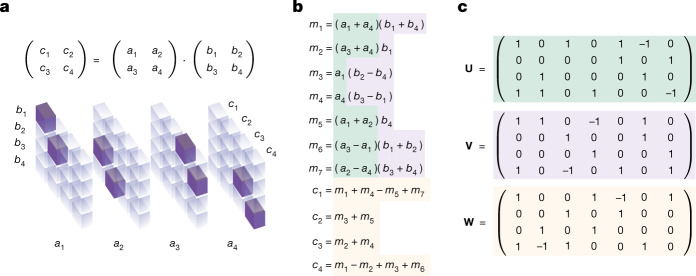
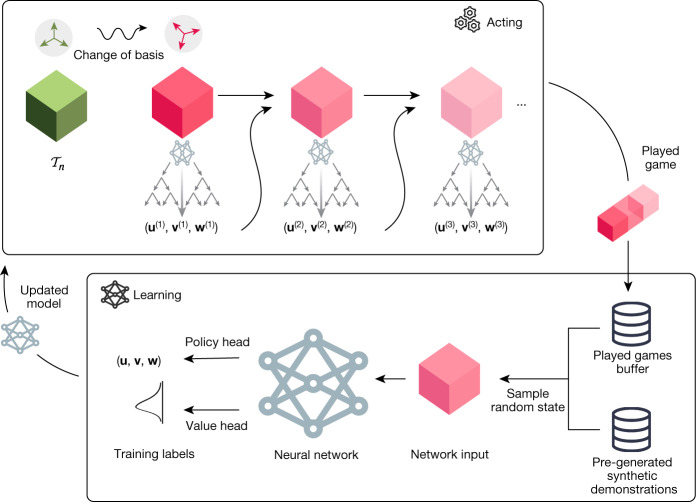
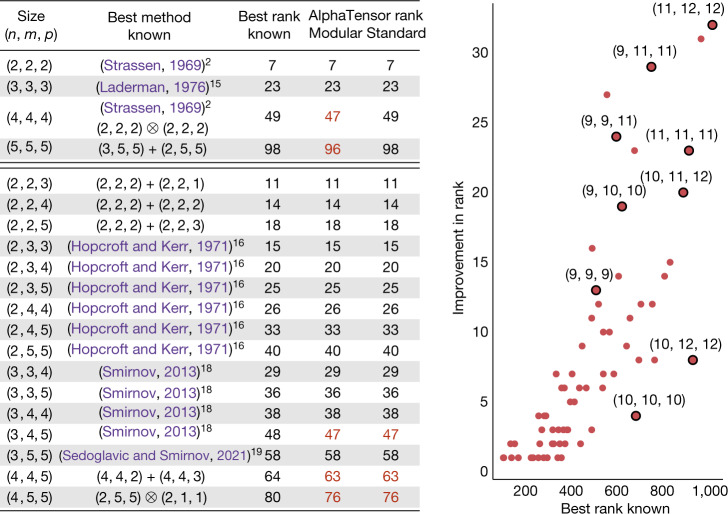
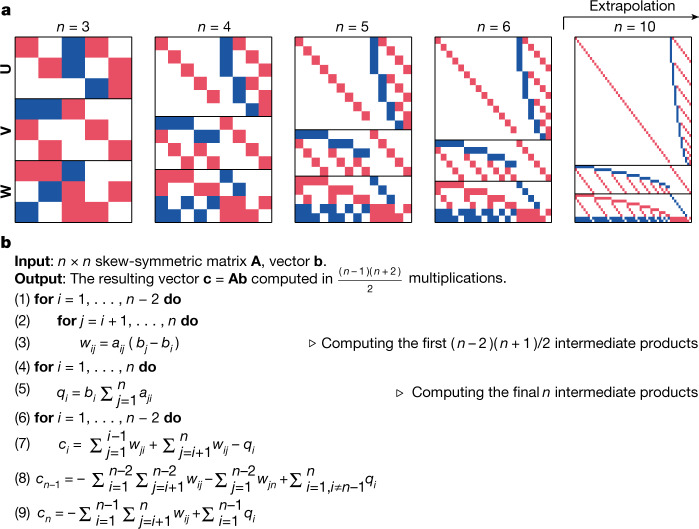
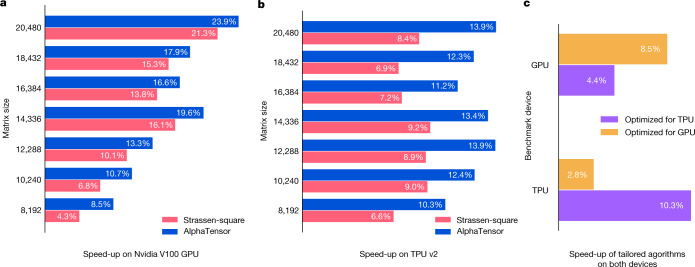
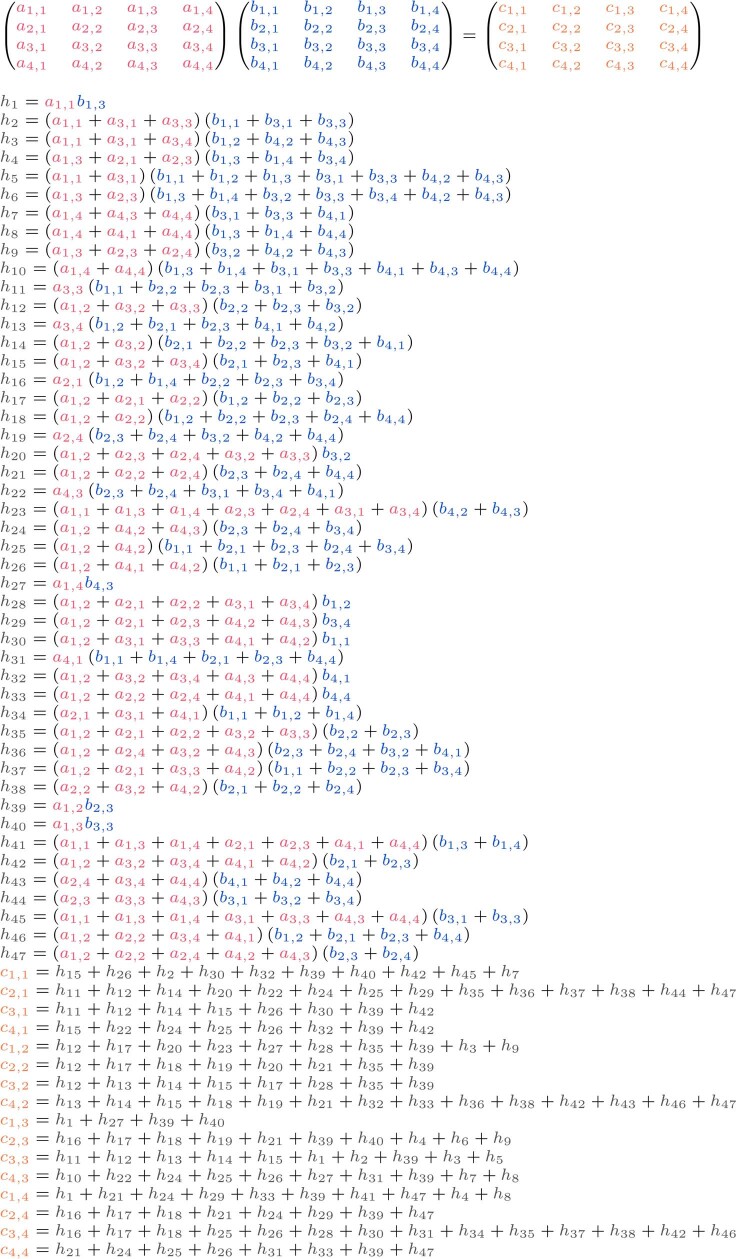
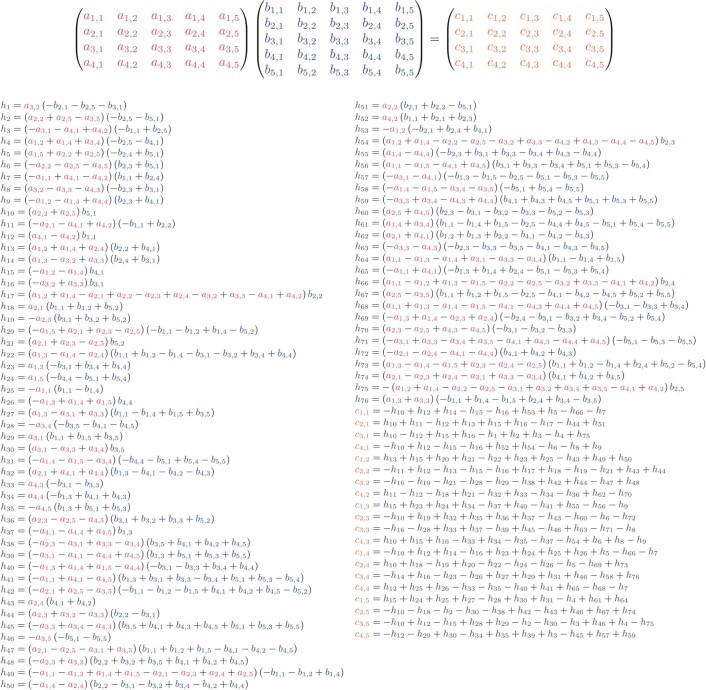
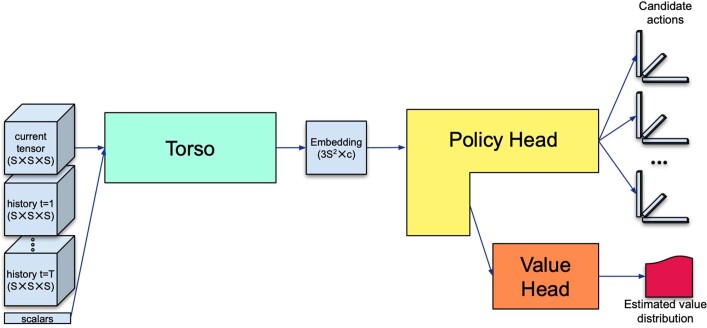
Verification
Claims the paper makes
The claims and statistics of this paper haven’t been checked yet.
Free: it reads the open-access text and checks the first 5 claims that cite a source we can check. Create a free account to check every claim.
Claims other papers make about this one
Each is checked against this paper’s own text: does it say what the citing paper says it does?
The source backs part of the claim, not all of it — or backs it for a different population, condition or comparison.
In the citing paper
“Despite being general-purpose, AlphaEvolve goes beyond [26], improving the SOTA for 14 matrix multiplication algorithms”
From AlphaEvolve: A coding agent for scientific and algorithmic discovery (2025) · cites this paper as [26]
Experimental — accuracy not yet measured
Self-check
Percentages, sums and reported differences re-computed from the paper’s own numbers.
The self-check needs the paper’s full text.
Citations
Cites
Mastering the game of Go with deep neural networks and tree search
Silver, D., Huang, A., Maddison, C. J., Guez, A., Sifre, L., van den Driessche, G., Schrittwieser, J., Antonoglou, I., Panneershelvam, V., Lanctot, M., et al. (2016) · Nature · doi:10.1038/nature16961 · Cited by 15,612
Self-citationTensorFlow: A system for large-scale machine learning
Abadi, M., Barham, P., Chen, J., Chen, Z., Davis, A., Dean, J., Devin, M., Ghemawat, S., Irving, G., Isard, M., et al. (2016) · arXiv (Cornell University) · doi:10.48550/arxiv.1605.08695 · Cited by 11,822
Tensor Decompositions and Applications
Kolda, T. G., & Bader, B. W. (2009) · SIAM Review · doi:10.1137/07070111x · Cited by 10,301
International Conference on Learning Representations (ICLR 2013)
松尾, 豊. (2013) · 人工知能学会誌 = Journal of Japanese Society for Artificial Intelligence · Cited by 6,286
A general reinforcement learning algorithm that masters chess, shogi, and Go through self-play
Silver, D., Hubert, T., Schrittwieser, J., Antonoglou, I., Lai, M., Guez, A., Lanctot, M., Sifre, L., Kumaran, D., Graepel, T., et al. (2018) · Science · doi:10.1126/science.aar6404 · Cited by 3,562 · cited 8×
“, n(2) do (4) c w m w m i R 1 i i R (1) ( ) ← + + return C”
BackgroundMethodInfluentialSelf-citationGaussian elimination is not optimal
Strassen, V. (1969) · Numerische Mathematik · doi:10.1007/bf02165411 · Cited by 2,509 · cited 5×
“, R do (2) ← + + + + m u a u a v b v b ( ) ( ) r n n 1 1 r n r r n r 1 ( ) ( ) 1 ( ) ( ) 2 2 2 2”
InfluentialPlanning chemical syntheses with deep neural networks and symbolic AI
Segler, M. H. S., Preuss, M., & Waller, M. P. (2018) · Nature · doi:10.1038/nature25978 · Cited by 1,847
Deep reinforcement learning for de novo drug design
Popova, M., Isayev, O., & Tropsha, A. (2018) · Science Advances · doi:10.1126/sciadv.aap7885 · Cited by 1,182
Most Tensor Problems Are NP-Hard
Hillar, C. J., & Lim, L.-H. (2013) · Journal of the ACM · doi:10.1145/2512329 · Cited by 1,099
Powers of tensors and fast matrix multiplication
Le Gall, F. (2014) · Proceedings of the 39th International Symposium on Symbolic and Algebraic Computation · doi:10.1145/2608628.2608664 · Cited by 856
Research works printed but not linked: 10
- Bürgisser, P., Clausen, M. & Shokrollahi, A. Algebraic Complexity Theory Vol. 315 (Springer Science & Business Media, 2013).
- Zhang, W. & Dietterich, T. G. A reinforcement learning approach to job-shop scheduling. In International Joint Conferences on Artificial Intelligence Vol. 95, 1114–1120 (Morgan Kaufmann Publishers, 1995).
- Vaswani, A. Attention is all you need. In International Conference on Neural Information Processing Systems Vol 30, 5998–6008 (Curran Associates, 2017).
- Loshchilov, I. & Hutter, F. Decoupled weight decay regularization. In International Conference on Learning Representations (ICLR) (2019).
- Elser V A network that learns Strassen multiplication J. Mach. Learn. Res. 2016 17 3964 3976
- Tschannen, M., Khanna, A. & Anandkumar, A, StrassenNets: deep learning with a multiplication budget. In International Conference on Machine Learning 4985–4994 (PMLR, 2018).
- Bunel, R., Desmaison, A., Kohli, P., Torr, P. H. & Kumar, M. P. Learning to superoptimize programs. In International Conference on Learning Representations (ICLR) (2017).
- Schmidhuber, J. Evolutionary Principles in Self-Referential Learning. On Learning now to Learn: The Meta-Meta-Meta...-Hook. Diploma thesis, Technische Univ. Munchen (1987).
- Kaliszyk, C., Urban, J., Michalewski, H. & Olšák, M. Reinforcement learning of theorem proving. In International Conference on Neural Information Processing Systems 8836–8847 (Curran Associates, 2018).
- Bansal, K., Loos, S., Rabe, M., Szegedy, C. & Wilcox, S. HOList: an environment for machine learning of higher order logic theorem proving. In International Conference on Machine Learning 454–463 (PMLR, 2019).
Cited by
Reinforcement learning algorithms: A brief survey
Shakya, A. K., Pillai, G., & Chakrabarty, S. (2023) · Expert Systems with Applications · doi:10.1016/j.eswa.2023.120495 · Cited by 656
Mathematical discoveries from program search with large language models
Romera-Paredes, B., Barekatain, M., Novikov, A., Balog, M., Kumar, M. P., Dupont, E., Ruiz, F. J. R., Ellenberg, J. S., Wang, P., Fawzi, O., et al. (2024) · Nature · doi:10.1038/s41586-023-06924-6 · Cited by 544
Self-citationCao, Y., Li, S., Liu, Y., Yan, Z., Dai, Y., Yu, P. S., & Sun, L. (2023) · arXiv · doi:10.48550/arxiv.2303.04226 · Cited by 463
“ChatBot Xiaoice Microsoft 2018 [200] Xiaoice ChatBot Meena Google 2020 [201] Meena Blog ChatBot BlenderBot Meta 2022 [202] Blenderbot ChatBot ChatGPT OpenAI 2022 [10] ChatGPT ChatBot Alexa Amazon 2014 Amazon Alexa ChatBot Lex Amazon 2017 Amazon Lex Music AIVA Aiva Tech 2016 AIVA Music Jukebox OpenAI 2020 [203] Jukebox…”
MethodMulti-Agent Deep Reinforcement Learning for Multi-Robot Applications: A Survey
Orr, J., & Dutta, A. (2023) · Sensors · doi:10.3390/s23073625 · Cited by 206
“Deep reinforcement learning has recently been used in finding a faster matrix multiplication solution [8], for drug discovery [9], to beat humans in Go [10], play Atari [6], and for routing in communication networks [11], among others.”
MethodNeurosymbolic Artificial Intelligence (Why, What, and How)
Sheth, A., Roy, K., & Gaur, M. (2023) · IEEE Intelligent Systems · doi:10.1109/mis.2023.3268724 · Cited by 297
“2,3 However, knowledge enables humans to engage in cognitive processes beyond what is explicitly stated in available data.”
BackgroundArtificial Intelligence and Biosensors in Healthcare and Its Clinical Relevance: A Review
(2023) · doi:10.1109/access.2023.3285596 · Cited by 205
“A recent example is the discovery of faster matrix multiplication using reinforcement learning [114].”
BackgroundHigher-dimensional processing using a photonic tensor core with continuous-time data
Dong, B., Aggarwal, S., Zhou, W., Ali, U. E., Farmakidis, N., Lee, J. S., He, Y., Li, X., Kwong, D.-L., Wright, C. D., et al. (2023) · Nature Photonics · doi:10.1038/s41566-023-01313-x · Cited by 169
Spatial planning of urban communities via deep reinforcement learning
Zheng, Y., Lin, Y., Zhao, L., Wu, T., Jin, D., & Li, Y. (2023) · Nature Computational Science · doi:10.1038/s43588-023-00503-5 · Cited by 209
“…in instant feedback-based decision tasks such as video games 20 , DRL 21–24 have achieved great success in similar episodic planning tasks that previously relied on human experiences and intuitions, such as the game of Go 25 , chemical synthesis 26 , solving math puzzles 27 and chip design 28 .”
MethodHolst, F., Bolger, A., Günther, C., Maß, J., Triesch, S., Kindel, F., Kiel, N., Saadat, N., Ebenhöh, O., Usadel, B., et al. (2023) · doi:10.1101/2023.02.06.527280 · Cited by 161
(2025) · doi:10.1038/s41592-025-02939-1 · Cited by 158
“16 and Supplementary Tables 8–11).”
Mathematical discovery and exploration can be done at scale
Georgiev, B., Gómez-Serrano, J., Tao, T., & Wagner, A. Z. (2026) · Proceedings of the National Academy of Sciences · doi:10.1073/pnas.2536158123 · Cited by 166
Modern applications of machine learning in quantum sciencesPreprint
Dawid, A., Arnold, J., Requena, B., Gresch, A., Płodzień, M., Donatella, K., Nicoli, K. A., Stornati, P., Koch, R., Büttner, M., et al. (2022) · arXiv (Cornell University) · doi:10.48550/arxiv.2204.04198 · Cited by 181
Top-down design of protein architectures with reinforcement learning
Lutz, I. D., Wang, S., Norn, C., Courbet, A., Borst, A. J., Zhao, Y. T., Dosey, A., Cao, L., Xu, J., Leaf, E. M., et al. (2023) · Science · doi:10.1126/science.adf6591 · Cited by 124
Faster Matrix Multiplication via Asymmetric Hashing
Duan, R., Wu, H., & Zhou, R. (2023) · Annual Symposium on Foundations of Computer Science · doi:10.1109/focs57990.2023.00130 · Cited by 141
“Very recently, DeepMind [20] used a reinforcement learning method to improve the ranks of several small matrix multiplication tensors.”
MethodBrinkmann, L., Baumann, F., Bonnefon, J.-F., Derex, M., Müller, T. F., Nussberger, A.-M., Czaplicka, A., Acerbi, A., Griffiths, T. L., Henrich, J., et al. (2023) · Nature Human Behaviour · doi:10.1038/s41562-023-01742-2 · Cited by 132
“As the methods underpinning AlphaGo have been generalized to other games and extended to scientific problems, we anticipate a continued infusion of machine-generated discoveries across diverse domains of human culture 34,35 .”
MethodTowards Data-And Knowledge-Driven AI: A Survey on Neuro-Symbolic Computing
Wang, W., Yang, Y., & Wu, F. Q. (2024) · IEEE Transactions on Pattern Analysis and Machine Intelligence · doi:10.1109/tpami.2024.3483273 · Cited by 169
A new age in protein design empowered by deep learning
Khakzad, H., Igashov, I., Schneuing, A., Goverde, C., Bronstein, M., & Correia, B. (2023) · Cell Systems · doi:10.1016/j.cels.2023.10.006 · Cited by 109
Artificial intelligence tools expand scientists' impact but contract science's focus
Hao, Q., Xu, F., Li, Y., & Evans, J. (2026) · Nature · doi:10.1038/s41586-025-09922-y · Cited by 117
“Models improved via deep reinforcement learning have sustained complex plasma configurations in fusion reactors 18 and discovered new, hardware-optimized forms of matrix multiplication that recursively accelerate deep learning itself 19 .”
Current and emerging deep-learning methods for the simulation of fluid dynamics
Lino, M., Fotiadis, S., Bharath, A. A., & Cantwell, C. D. (2023) · Proceedings of the Royal Society A Mathematical Physical and Engineering Sciences · doi:10.1098/rspa.2023.0058 · Cited by 145
“In 2022, another version of AlphaZero, named AlphaTensor [7], discovered faster algorithms for matrix multiplication, improving the efficiency of Strassen’s two-level algorithm for the first time in 50 years.”
MethodReinforcement Learning for Quantitative Trading
Sun, S., Wang, R., & An, B. (2023) · ACM Transactions on Intelligent Systems and Technology · doi:10.1145/3582560 · Cited by 150
A Survey of Generative AI Applications
Gozalo-Brizuela, R., & Merchan, E. E. G. (2024) · Journal of Computer Science · doi:10.3844/jcssp.2024.801.818 · Cited by 101
Artificial intelligence for quantum computing
Alexeev, Y., Farag, M. H., Patti, T. L., Wolf, M. E., Ares, N., Aspuru‐Guzik, A., Benjamin, S. C., Cai, Z., Cao, S., Chamberland, C., et al. (2025) · Nature Communications · doi:10.1038/s41467-025-65836-3 · Cited by 140
“266,267 as examples).”
Automated discovery of reprogrammable nonlinear dynamic metamaterials
Bordiga, G., Medina, E., Jafarzadeh, S., Bösch, C., Adams, R. P., Tournat, V., & Bertoldi, K. (2024) · Nature Materials · doi:10.1038/s41563-024-02008-6 · Cited by 109
“At the same time, the combination of large parameter spaces and gradient-based optimization has been shown to be a tremendous success in discovering underlying patterns and behaviors (26–28).”
AI-Empowered Quantum Circuit Synthesis and Compilation Optimization: Overview and Prospects
Yan, G., Wu, W., Chen, Y., Pan, K., Lü, X., Zh, Z., Wang, Y., Wang, R. L., & Yan, J. (2026) · IEEE Transactions on Pattern Analysis and Machine Intelligence · doi:10.1109/tpami.2026.3715237 · Cited by 102
A reinforcement learning approach for process parameter optimization in additive manufacturing
Dharmadhikari, S., Menon, N., & Basak, A. (2023) · Additive manufacturing · doi:10.1016/j.addma.2023.103556 · Cited by 142
Linear symmetric self-selecting 14-bit kinetic molecular memristors
Sharma, D., Rath, S. P., Kundu, B., Korkmaz, A., Harivignesh, S., Thompson, D., Bhat, N., Goswami, S., Williams, R. S., & Goswami, S. (2024) · Nature · doi:10.1038/s41586-024-07902-2 · Cited by 103
Quantum circuit optimization with AlphaTensor
Ruiz, F. J. R., Laakkonen, T., Bausch, J., Balog, M., Barekatain, M., Heras, F. J. H., Novikov, A., Fitzpatrick, N., Romera‐Paredes, B., van de Wetering, J., et al. (2025) · Nature Machine Intelligence · doi:10.1038/s42256-025-01001-1 · Cited by 132
“CNOT =”
Self-citationAre Deep Neural Networks Adequate Behavioral Models of Human Visual Perception?
Wichmann, F. A., & Geirhos, R. (2023) · Annual Review of Vision Science · doi:10.1146/annurev-vision-120522-031739 · Cited by 70
“Ever since parameter estimation [20] and in applied mathematics deep reinforcement learning was used to find faster matrix multiplication algorithms [31].”
MethodOptimizing generative AI by backpropagating language model feedback
Yuksekgonul, M., Bianchi, F., Boen, J., Liu, S., Lu, P., Huang, Z., Guestrin, C., & Zou, J. (2025) · Nature · doi:10.1038/s41586-025-08661-4 · Cited by 85
Quantifying the use and potential benefits of artificial intelligence in scientific research
Gao, J., & Wang, D. (2024) · Nature Human Behaviour · doi:10.1038/s41562-024-02020-5 · Cited by 81
“For example, by discovering faster matrix multiplication algorithms 122 , AI may have indirect impact on disciplines that would benefit from such advances.”
Harnessing deep learning for population genetic inference
Huang, X., Rymbekova, A., Dolgova, O., Lao, Ó., & Kuhlwilm, M. (2023) · Nature Reviews Genetics · doi:10.1038/s41576-023-00636-3 · Cited by 87
“Furthermore, implementing reinforcement learning would be interesting, as it may mimic evolution 147 , design novel algorithms 148,149 or optimize deep learning models with non-differentiable loss functions 150 .”
A Survey on Scheduling Techniques in Computing and Network Convergence
Tang, S., Yu, Y., Wang, H., Wang, G., Chen, W., Xu, Z., Guo, S., & Gao, W. (2023) · IEEE Communications Surveys & Tutorials · doi:10.1109/comst.2023.3329027 · Cited by 97
“The algorithms, hardware designs, and network topology optimization further support the training acceleration [238], [239].”
Structure‐Based Drug Discovery with Deep Learning**
Özçelik, R., van Tilborg, D., Jiménez-Luna, J., & Grisoni, F. (2023) · ChemBioChem · doi:10.1002/cbic.202200776 · Cited by 90
“, to advance mathematics [2,3], investigate galaxies [4], and generate realistic images [5].”
BackgroundSelf-play reinforcement learning guides protein engineering
Wang, Y., Tang, H., Huang, L., Pan, L., Yang, L., Yang, H., Mu, F., & Yang, M. (2023) · Nature Machine Intelligence · doi:10.1038/s42256-023-00691-9 · Cited by 104
“Beyond games, RL has also shown promise in solving combinatorial optimization problems in a range of domains, including chip placement 34 , nuclear fusion control 35 , flow battery design 36 , matrix multiplication acceleration 37 and autonomous driving 38 .”
BackgroundTorchRL: A data-driven decision-making library for PyTorch
Bou, A., Bettini, M., Dittert, S., Kumar, V., Sodhani, S., Yang, X., Fabritiis, G. D., & Moens, V. (2024) · International Conference on Learning Representations · doi:10.48550/arxiv.2306.00577 · Cited by 125
“Finally, two additional popular libraries are Tianshou (Weng et al., 2022) and CleanRL (Huang et al., 2022).”
Orientation and Decision-Making for Soccer Based on Sports Analytics and AI: A Systematic Review
Pu, Z., Pan, Y., Wang, S., Liu, B., Chen, M., Ma, H., & Cui, Y. (2024) · IEEE/CAA Journal of Automatica Sinica · doi:10.1109/jas.2023.123807 · Cited by 82
Neurosymbolic Reinforcement Learning and Planning: A Survey
Acharya, K., Raza, W., Dourado, C. M. J. D. M., Velasquez, A., & Song, H. (2023) · IEEE Transactions on Artificial Intelligence · doi:10.1109/tai.2023.3311428 · Cited by 94
“Alphazero has been successful in discovering faster multiplication algorithms[63] which showed that RL can also contribute in other field also as a superhuman.”
BackgroundThe alignment problem from a deep learning perspective
Ngo, R., Chan, L., & Mindermann, S. (2022) · arXiv · doi:10.48550/arxiv.2209.00626 · Cited by 68
“…addition to standard drivers of progress, AI developers are increasingly using ML systems for accelerating programming [OpenAI, 2023a], and developing new architectures [Elsken et al., 2019], algorithms [Fawzi et al., 2022], training data [Huang et al., 2022a], and chips [Mirhoseini et al., 2021].”
MethodWafer-Scale Computing: Advancements, Challenges, and Future Perspectives [Feature]
Hu, Y., Lin, X., Wang, H., He, Z., Yu, X., Zhang, J., Yang, Q., Xu, Z. G., Guan, S., Fang, J., et al. (2024) · IEEE Circuits and Systems Magazine · doi:10.1109/mcas.2024.3349669 · Cited by 71
“5% of human protein sequences with high confidence while the traditional method can only cover 17% [1], AlphaTensor discovers fast matrix multiplication algorithms and surpasses the classic algorithm discovered 50 years ago for the first time [2], DGMR beats competitive methods in 89% of the cases of two-hour-ahead hi…”
MethodFan, Y., Sun, Z., & Wang, G. (2023) · Ocean Engineering · doi:10.1016/j.oceaneng.2023.115649 · Cited by 63
Artificial Intelligence‐Driven Approaches in Semiconductor Research
Zheng, Y., Xu, H., Li, Z., Li, L., Yu, Y., Jiang, P., Shi, Y., Zhang, J., Huang, Y., Luo, Q., et al. (2025) · Advanced Materials · doi:10.1002/adma.202504378 · Cited by 67
International Scientific Report on the Safety of Advanced AI (Interim Report)Preprint
Bengio, Y., Mindermann, S., Privitera, D., Besiroglu, T., Bommasani, R., Casper, S., Choi, Y., Goldfarb, D., Heidari, H., Khalatbari, L., et al. (2024) · arXiv.org · doi:10.48550/arxiv.2412.05282 · Cited by 56
Automated Antenna Design via Domain Knowledge-Informed Reinforcement Learning and Imitation Learning
Wei, Z., Zhou, Z., Wang, P., Ren, J., Yin, Y., Pedersen, G. F., & Shen, M. (2023) · IEEE Transactions on Antennas and Propagation · doi:10.1109/tap.2023.3266051 · Cited by 55
“…human game testers [20], RL-based virtual agents AlphaZero [21] defeating world-leading Go players, RL-based graph placement for fast chip design [22], and AlphaTensor [23] which, building upon AlphaZero, discovered faster matrix multiplication algorithms than those developed by humans.”
BackgroundArtificial Intelligence for Retrosynthetic Planning Needs Both Data and Expert Knowledge
Strieth‐Kalthoff, F., Szymkuć, S., Molga, K., Aspuru‐Guzik, A., Glorius, F., & Grzybowski, B. A. (2024) · Journal of the American Chemical Society · doi:10.1021/jacs.4c00338 · Cited by 61
Cherrat, E. A., Raj, S., Kerenidis, I., Shekhar, A., Wood, B., Dee, J., Chakrabarti, S., Chen, R., Herman, D., Hu, S., et al. (2023) · Quantum · doi:10.22331/q-2023-11-29-1191 · Cited by 73
Neuromorphic Photonics Circuits: Contemporary Review
Kutluyarov, R. V., Zakoyan, A. G., Voronkov, G. S., Grakhova, E. P., & Butt, M. A. (2023) · Nanomaterials · doi:10.3390/nano13243139 · Cited by 54
“In remarkable developments from last year, deep reinforcement learning uncovered a more efficient algorithm for performing matrix multiplication [45], while fine-tuning a pre-trained language model on computer code enabled the resolution of university-level mathematical problems at a level comparable…”
BackgroundDistributed constrained combinatorial optimization leveraging hypergraph neural networks
Heydaribeni, N., Zhan, X., Zhang, R., Eliassi‐Rad, T., & Koushanfar, F. (2024) · Nature Machine Intelligence · doi:10.1038/s42256-024-00833-7 · Cited by 57
“So the main point of benchmarking HypOp on MaxCut problem is to compare its performance with the baseline algorithm PI-GNN and to further motivate the additional components that we have added to the baseline method.”
MethodA survey on deep learning-based algorithms for the traveling salesman problem
Sui, J., Ding, S., Huang, X., Yu, Y., Liu, R., Xia, B., Ding, Z., Xu, L., Zhang, H., Yu, C., et al. (2024) · Frontiers of Computer Science · doi:10.1007/s11704-024-40490-y · Cited by 54
Are Deep Neural Networks SMARTer Than Second Graders?
Cherian, A., Peng, K.-C., Lohit, S., Smith, K. A., & Tenenbaum, J. B. (2023) · 2023 IEEE/CVF Conference on Computer Vision and Pattern Recognition (CVPR) · doi:10.1109/cvpr52729.2023.01043 · Cited by 33
“, using GPT-3 [10]), solving university level math problems [17], algorithmic inference [20], and general question-answering/dialog (e.”
MethodTokenization in the Theory of Knowledge
Friedman, R. (2023) · Encyclopedia · doi:10.3390/encyclopedia3010024 · Cited by 44
“Where the algorithms of Nature are not amenable to these approaches, then other methods of reinforcement learning [30] and use of a decision transformer [31] are powerful tools for the discovery of the higher order forms from the low dimensional information in scientific data.”
Field-Programmable Gate Array Architecture for Deep Learning: Survey and Future Directions
Boutros, A., Arora, A., & Betz, V. (2025) · Proceedings of the IEEE · doi:10.1109/jproc.2025.3623023 · Cited by 57
“…a myriad of day-to-day end-user applications [7], [8], [9], facilitate software development [10], boost computer chip design productivity [11], and push the boundaries of human knowledge by discovering more efficient computational algorithms [12] and solving long-standing scientific problems [13].”
A law of data separation in deep learning
He, H., & Su, W. (2023) · Proceedings of the National Academy of Sciences · doi:10.1073/pnas.2221704120 · Cited by 66
“1 suggests that the dynamics of D l follows the relation (12).”
BackgroundScale-aware deep reinforcement learning for high resolution remote sensing imagery classification
Liu, Y., Zhong, Y., Shi, S., & Zhang, L. (2024) · ISPRS Journal of Photogrammetry and Remote Sensing · doi:10.1016/j.isprsjprs.2024.01.013 · Cited by 40
Classification using hyperdimensional computing: a review with comparative analysis
Vergés, P., Heddes, M., Nunes, I., Kleyko, D. V., Givargis, T., & Nicolau, A. E. (2025) · Artificial Intelligence Review · doi:10.1007/s10462-025-11181-2 · Cited by 49
Discovering state-of-the-art reinforcement learning algorithms
Oh, J., Farquhar, G., Kemaev, I., Calian, D. A., Hessel, M., Zintgraf, L., Singh, S. P., van Hasselt, H. P., & Silver, D. (2025) · Nature · doi:10.1038/s41586-025-09761-x · Cited by 64
Self-citationNatural behaviour is learned through dopamine-mediated reinforcement
Kasdin, J., Duffy, A., Nadler, N., Raha, A., Fairhall, A. L., Stachenfeld, K., & Gadagkar, V. (2025) · Nature · doi:10.1038/s41586-025-08729-1 · Cited by 42
Liu, Y., Shi, S., Wang, J., & Zhong, Y. (2023) · IEEE/CVF International Conference on Computer Vision (ICCV) · doi:10.1109/iccv51070.2023.01547 · Cited by 48
“RL techniques have achieved success in various areas, including board games, video games, and mathematics [27, 35, 14].”
BackgroundResidual Scheduling: A New Reinforcement Learning Approach to Solving Job Shop Scheduling Problem
Ho, K.-H., Cheng, J.-Y., Wu, J.-H., Chiang, F., Chen, Y.-C., Wu, Y.-Y., & Wu, I. (2024) · IEEE Access · doi:10.1109/access.2024.3357969 · Cited by 37
“, 2019), AlphaTensor (Fawzi et al., 2022), and thus it also attracted much attention in the CO problems, including chip design (Mirhoseini et al.”
BackgroundTang, H., Wang, Y., Wang, T., & Tian, L. (2023) · Physics of Fluids · doi:10.1063/5.0135638 · Cited by 35
Deep reinforcement learning for a multi-objective operation in a nuclear power plant
Bae, J., Kim, J. M., & Lee, S. J. (2023) · Nuclear Engineering and Technology · doi:10.1016/j.net.2023.06.009 · Cited by 39
TinyNS: Platform-aware Neurosymbolic Auto Tiny Machine Learning
Saha, S. S., Sandha, S. S., Aggarwal, M., Wang, B., Han, L., Briseno, J. D. G., & Srivastava, M. B. (2024) · ACM Transactions on Embedded Computing Systems · doi:10.1145/3603171 · Cited by 45
“Platform-aware neurosymbolic optimization is necessary to not only fit the highest-performing program within the platform resource constraints but also discover previously unknown high-utility symbolic subroutines as seen in AlphaTensor [57].”
BackgroundArtificial Intelligence for the Electron Ion Collider (AI4EIC)
Allaire, C., Ammendola, R., Aschenauer, E. C., Balandat, M., Battaglieri, M., Bernauer, J. C., Bondí, M., Branson, N., Britton, T., Butter, A., et al. (2024) · Computing and Software for Big Science · doi:10.1007/s41781-024-00113-4 · Cited by 34
“These include algorithmic improvements in linear algebra [17] and non-linear/chaotic system forecasting [18, 19], which could significantly influence accelerator surrogate models for non-linear design.”
Deguchi, S., & Asai, M. (2023) · Journal of Physics Communications · doi:10.1088/2399-6528/ace416 · Cited by 44
O’Malley, C., de Mars, P., Badesa, L., & Štrbac, G. (2023) · Applied Energy · doi:10.1016/j.apenergy.2023.121659 · Cited by 36
Zhang, Q., Krotov, D., & Karniadakis, G. E. (2025) · Journal of Computational Physics · doi:10.1016/j.jcp.2025.114148 · Cited by 35
MW-MADDPG: a meta-learning based decision-making method for collaborative UAV swarm
Zhao, M., Wang, G., Fu, Q., Guo, X., Chen, Y., Li, T., & Liu, X. (2023) · Frontiers in Neurorobotics · doi:10.3389/fnbot.2023.1243174 · Cited by 33
“…reinforcement learning has shown promising results in various fields, such as training championship-level racers in Gran Turismo (Wurman et al., 2022), achieving all-time top-three Stratego game ranking (Perolat et al., 2022), and optimizing matrix multiplication operations (Fawzi et al., 2022).”
BackgroundLearning Risk-Aware Quadrupedal Locomotion using Distributional Reinforcement Learning
Schneider, L., Frey, J., Miki, T., & Hutter, M. (2024) · Proceedings - IEEE International Conference on Robotics and Automation/Proceedings · doi:10.1109/icra57147.2024.10610137 · Cited by 41
“RL has been used for algorithm discovery [41] and as an AI racing agent in the Gran Turismo 7 game [42].”
MethodMatzko, R., & Konur, S. (2024) · Network Modeling Analysis in Health Informatics and Bioinformatics · doi:10.1007/s13721-024-00455-4 · Cited by 28
“5) can find solutions beyond human intuition (Fawzi et al. 2022).”
Scientists' Perspectives on the Potential for Generative AI in their Fields
Morris, M. R. (2023) · arXiv · doi:10.48550/arxiv.2304.01420 · Cited by 28
“The National Academy of Sciences has also recently considered the implications of modern AI for scientific discovery [38], as has the 2023 Stanford AI Index report [34], which devotes an entire chapter to reflecting on recent advances in AI for Science, including in domains such as nuclear fusion [16], matrix manipula…”
BackgroundAI-driven research in pure mathematics and theoretical physics
He, Y. (2024) · Nature Reviews Physics · doi:10.1038/s42254-024-00740-1 · Cited by 46
“These advances suggest that when and if a complete linguistic database in the precise format of, say, ‘Lean’ will exist for all contemporary mathematics, then the LLM approach to this vast data set should produce new mathematics.”
Lu, J., Xie, X., & Xiong, Y.-J. (2024) · Pattern Recognition · doi:10.1016/j.patcog.2024.110753 · Cited by 28
Meta-Black-Box optimization for evolutionary algorithms: Review and perspective
Yang, X., Wang, R., Li, K., & Ishibuchi, H. (2025) · Swarm and Evolutionary Computation · doi:10.1016/j.swevo.2024.101838 · Cited by 46
Optimal thermometers with spin networks
Abiuso, P., Erdman, P. A., Ronen, M., Noé, F., Haack, G., & Perarnau-Llobet, M. (2024) · Quantum Science and Technology · doi:10.1088/2058-9565/ad37d3 · Cited by 37
“These results add on recent applications of Machine-Learning based techniques in the field of quantum thermodynamics [55–62], as well as in other domains, including protein folding [63], many-body problems [64–66], geosciences [67], algorithm discovery [68].”
BackgroundSi, J., Li, X., Gao, L., & Li, P. (2024) · International Journal of Production Research · doi:10.1080/00207543.2024.2335663 · Cited by 27
“Recently, AlphaTensor, contributed by DeepMind, discovered a faster way to do matrix multiplication (Fawzi et al. 2022), which is a big step forward in the practice of RL.”
AlphaRouter: Quantum Circuit Routing with Reinforcement Learning and Tree Search
Tang, W., Duan, Y., Kharkov, Y., Fakoor, R., Kessler, E. M., & Shi, Y. (2024) · IEEE International Conference on Quantum Computing and Engineering (QCE) · doi:10.1109/qce60285.2024.00112 · Cited by 35
“Given the recent impressive results of Deep RL [4], [15]–[17], [19], [26], [30], [34], [37], [48], [49], adapting Deep RL frameworks to this problem offers several advantages.”
Flip Graphs for Matrix Multiplication
Kauers, M., & Moosbauer, J. (2023) · International Symposium on Symbolic and Algebraic Computation · doi:10.1145/3597066.3597120 · Cited by 25
Yao, H., Tan, P., Yang, T., & Zhou, F. (2024) · Computer-Aided Civil and Infrastructure Engineering · doi:10.1111/mice.13159 · Cited by 25
“…system (X. Chen et al., 2019; Zheng et al., 2018), computer vision (Gui et al., 2023; Pirinen & Smin-chisescu, 2018), autonomous driving (S. Chen et al., 2021; Y. Du et al., 2023), and mathematical computation and optimization (Fawzi et al., 2022; Ichnowski et al., 2021), and so forth.”
BackgroundLi, F., Lang, S., Tian, Y., Hong, B., Rolf, B., Noortwyck, R., Schulz, R., & Reggelin, T. (2024) · Journal of Intelligent Manufacturing · doi:10.1007/s10845-024-02470-8 · Cited by 40
“RL is a promising branch in the field of machine learning and has achieved remarkable development in many challenging decision-making tasks, such as controlling the tokamak plasma for nuclear fusion (Degrave et al., 2022) and discovering faster matrix multiplication algorithms (Fawzi et al., 2022).”
Testolin, A. (2024) · Applied Sciences · doi:10.3390/app14020744 · Cited by 24
“Last year, deep reinforcement learning discovered a more efficient algorithm to perform matrix multiplication (Fawzi et al., 2022), while fine-tuning a pre-trained language model on computer code allowed to solve university-level math questions at a human level (Drori et al.”
MethodFrom Triumph to Uncertainty: The Journey of Software Engineering in the AI Era
Mastropaolo, A., Escobar‐Velásquez, C., & Linares‐Vásquez, M. (2025) · ACM Transactions on Software Engineering and Methodology · doi:10.1145/3709360 · Cited by 30
Most Resource Efficient Matrix Vector Multiplication on FPGAs
Lehnert, A., Holzinger, P., Pfenning, S., Müller, R. R., & Reichenbach, M. (2023) · IEEE Access · doi:10.1109/access.2023.3234622 · Cited by 31
“From the pioneering work of Strassen [44] and improvements of the same [45], we know that matrix multiplication can be performed more efficiently than by the standard method of calculating inner products of rows and columns.”
BackgroundLearning-based adaption of robotic friction models
Scholl, P., Iskandar, M., Wolf, S., Lee, J., Bacho, A., Dietrich, A., Albu‐Schäffer, A., & Kutyniok, G. (2024) · Robotics and Computer-Integrated Manufacturing · doi:10.1016/j.rcim.2024.102780 · Cited by 29
“The success of neural networks (NN) in the last decade (Krizhevsky et al., 2012; Silver et al., 2016; Fawzi et al., 2022; Jumper et al., 2021) inspired engineers to explore their application in modeling complex dynamics, including friction.”
Yatawatta, S. (2024) · Astronomy and Computing · doi:10.1016/j.ascom.2024.100833 · Cited by 25
Encoding-independent optimization problem formulation for quantum computing
Dominguez, F., Unger, J., Traube, M., Mant, B. P., Ertler, C., & Lechner, W. (2023) · Frontiers in Quantum Science and Technology · doi:10.3389/frqst.2023.1229471 · Cited by 26
“[57] Alhussein Fawzi, Matej Balog, Aja Huang, Thomas Hubert, Bernardino Romera-Paredes, Mohammadamin Barekatain, Alexander Novikov, Francisco J R Ruiz, Julian Schrittwieser, Grzegorz Swirszcz, et al.”
BackgroundMethodInfluentialSafe reinforcement learning for industrial optimal control: A case study from metallurgical industry
Jun, Z., Jia, R., Liu, S., He, D., Li, K., & Wang, F. (2023) · Information Sciences · doi:10.1016/j.ins.2023.119684 · Cited by 24
Decentralized Monte Carlo Tree Search for Partially Observable Multi-Agent Pathfinding
Skrynnik, A., Андреевич, А. А., Yakovlev, K., & Panov, A. I. (2024) · Proceedings of the AAAI Conference on Artificial Intelligence · doi:10.1609/aaai.v38i16.29703 · Cited by 34
Göttl, Q., Pirnay, J., Burger, J., & Grimm, D. G. (2024) · Computers & Chemical Engineering · doi:10.1016/j.compchemeng.2024.108975 · Cited by 25
Connectivity conservation planning through deep reinforcement learning
Equihua, J., Beckmann, M., & Seppelt, R. (2024) · Methods in Ecology and Evolution · doi:10.1111/2041-210x.14300 · Cited by 24
“…and video games (Silver et al., 2016; Vinyals et al., 2019); it has gone on to enable the discovery of faster matrix multiplication algorithms (Fawzi et al., 2022), the design of optimal tax policies (Zheng et al., 2022) and constitutes part of ChatGPT's training process (Christiano et al.,…”
BackgroundLet's Verify Math Questions Step by Step
Shen, C. P., Wong, Z. H., He, R., Liang, H., Qiang, M., Meng, Z., Zhao, Z., Zeng, B., Zhu, Z., Cui, B., et al. (2026) · ACM SIGKDD Conference on Knowledge Discovery and Data Mining (KDD) · doi:10.1145/3770854.3785700 · Cited by 23
Yang, S., Huang, Y., Li, L., Feng, S., Na, X., Chen, H., & Khajepour, A. (2024) · IEEE Intelligent Transportation Systems Magazine · doi:10.1109/mits.2023.3345930 · Cited by 27
Jointly Training and Pruning CNNs via Learnable Agent Guidance and Alignment
Ganjdanesh, A., Gao, S., & Huang, H. (2024) · IEEE Computer Society Conference on Computer Vision and Pattern Recognition/Proceedings - IEEE Computer Society Conference on Computer Vision and Pattern Recognition/Proceedings · doi:10.1109/cvpr52733.2024.01520 · Cited by 36
“Thanks to the advances of Reinforcement Learning (RL) methods in complex decision making tasks [3, 16, 71], leveraging RL methods to determine proper sub-networks of a CNN given a desired budget has been explored in recent years [1, 36, 45, 86, 89, 92].”
BackgroundMethodGenerative AI in the Construction Industry: A State-of-the-art Analysis
Taiwo, R., Bello, I. T., Abdulai, S. F., Yussif, A.-M., Salami, B. A., Saka, A., & Zayed, T. (2024) · arXiv · doi:10.48550/arxiv.2402.09939 · Cited by 21
Fink, O., Nejjar, I., Sharma, V., Niresi, K. F., Sun, H., Dong, H., Xu, C., Wei, A., Bizzi, A. A. C., Theiler, R., et al. (2026) · Reliability Engineering & System Safety · doi:10.1016/j.ress.2026.112376 · Cited by 26
Varri, A., Taheriniya, S., Brückerhoff‐Plückelmann, F., Bente, I., Farmakidis, N., Bernhardt, D., Rösner, H., Kruth, M., Nadzeyka, A., Richter, T., et al. (2023) · Advanced Materials · doi:10.1002/adma.202310596 · Cited by 21
Cecil, R. M., & Sugden, L. A. (2023) · PLoS Computational Biology · doi:10.1371/journal.pcbi.1010979 · Cited by 21
Chen, Q., Du, Y., Jiao, Y., Lu, X., Wu, X., & Zhao, Q. (2024) · Quantum Science and Technology · doi:10.1088/2058-9565/ad420a · Cited by 12
NatureBench: Can Coding Agents Match the Published SOTA of Nature-Family Papers?Preprint
Wang, Y., Cheng, L., Zuo, Y., Zeng, S., He, B., Jiang, C., Yang, J., Wang, Y., Zhao, K., Huang, W. E. I.-X., et al. (2026) · arXiv (Cornell University) · doi:10.48550/arxiv.2606.24530 · Cited by 26
“…chemical experimentation [Boiko et al., 2023], AlphaTensor and AlphaProof extend search-based reasoning to algorithms and formal mathematics [Fawzi et al., 2022a, Hubert et al., 2025], and GraphCast, GenCast, and Aurora advance global weather and Earth-system prediction [Bodnar et al.,…”
GraphCS: Graph-based client selection for heterogeneity in federated learning
Chang, T., Li, L., Wu, M., Yu, W., Wang, X., & Xu, C. (2022) · Journal of Parallel and Distributed Computing · doi:10.1016/j.jpdc.2023.03.003 · Cited by 21
Yu, G., Wu, C., Liu, Y., Du, Z., Zhao, N., Jiao, Y., Xu, Z., & Shi, W. (2023) · Science China Earth Sciences · doi:10.1007/s11430-022-1144-7 · Cited by 20
Unitary Synthesis of Clifford+T Circuits with Reinforcement Learning
Rietsch, S., Dubey, A. Y., Ufrecht, C., Periyasamy, M., Plinge, A., Mutschler, C., & Scherer, D. D. (2024) · IEEE International Conference on Quantum Computing and Engineering (QCE) · doi:10.1109/qce60285.2024.00102 · Cited by 31
“In recent years, model-based RL utilizing Monte Carlo tree search (MCTS) [14], [15], such as AlphaGo [16] and Alp-haZero [17], have shown great promise in solving complex problems with large search spaces [18]–[20].”
Metadata
- Authors
- Fawzi, A., Balog, M., Huang, A., Hubert, T., Romera-Paredes, B., Barekatain, M., Novikov, A., R. Ruiz, F. J., Schrittwieser, J., Swirszcz, G., Silver, D., Hassabis, D., & Kohli, P.
- Affiliations
- Google DeepMind (United Kingdom) (GB)
- Corresponding author
- Fawzi, Alhussein
- ORCID
- Venue
- Nature
- Published
- 2022-10-05
- Volume
- 610
- Issue
- 7930
- Pages
- 47-53
- ISSN
- 0028-0836 (ISSN-L)
- 1476-4687
- PMC
- PMC9534758
- OpenAlex
- W4302010773
- Semantic Scholar
- 442ab95eb9cfbc03bb17a27b52313b5d25eaa738
- Cited by
- 478
- References
- 40
- Citations by year
- 2026: 69 · 2025: 115 · 2024: 136 · 2023: 148 · 2022: 7
- FWCI
- 54.92
- Type
- journal article
- Language
- en
- Open access
- hybrid
- doi.org
- Licence
- cc-by
- creativecommons.org/licenses/by/4.0 (tdm)
- creativecommons.org/licenses/by/4.0 (vor)
- Locations
- Nature (publishedVersion, cc-by)
- PubMed Central (publishedVersion, cc-by)
- PubMed (publishedVersion)
- RePEc: Research Papers in Economics (submittedVersion)
- Funders
- DeepMind
- Topics
- Physical Sciences › Computer Science › Computational Theory and Mathematics › Complexity and Algorithms in Graphs
- Physical Sciences › Computer Science › Artificial Intelligence › Artificial Intelligence Applications
- Physical Sciences › Computer Science › Computational Theory and Mathematics › Polynomial and algebraic computation
- Keywords
- matrix multiplication, algorithm discovery, AlphaZero, deep reinforcement learning, tensor decomposition, Strassen's algorithm, computational complexity
About these checks
Registry, retraction, Cites and statistics results are computed, not judged, with one exception: a printed reference that no index lists is read once by a model before it counts as a citation error. Claims are extracted by a model and kept only when their quote appears verbatim in the text; each cited source is then checked, with a model’s help, for whether it says what the claim relies on. Those verdicts can be wrong — read the claim’s quote and the cited source before relying on one.
Statistics and arithmetic are recomputed, not judged.
Confidence bands are shown only for fields calibrated on our annotated test set. None is calibrated yet, so no band is shown.
What counts as a claim ›How we measure confidence ›How we check this ›
Are you an author, or do you see a problem with this page? Request a review
Data sources
Bibliographic data: Semantic Scholar, OpenAlex, Crossref.
Contains information from the Semantic Scholar Academic Graph Datasets, made available under the ODC Attribution License (ODC-BY 1.0).
Semantic Scholar’s data is described in: Kinney, R., et al. (2023). The Semantic Scholar Open Data Platform. arXiv:2301.10140.
