

Discovering faster matrix multiplication algorithms with reinforcement learning
Open accessThe DOI matches its Crossref record; 51 of the 51 references it cites were found in a registry or an index.
Abstract
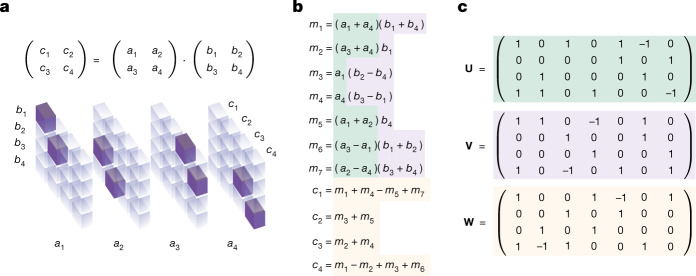
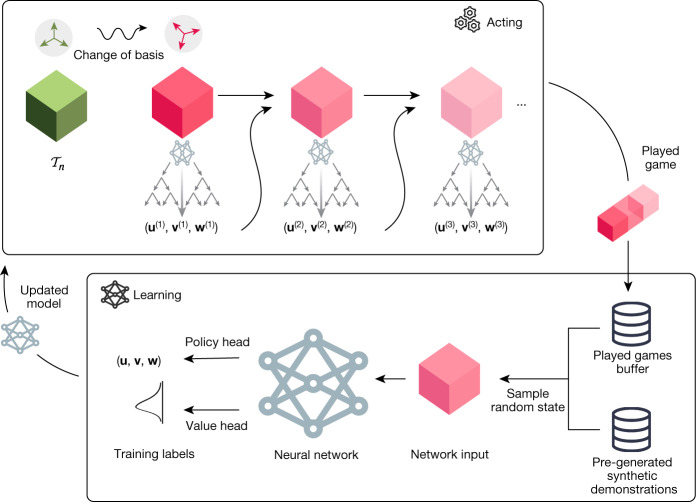
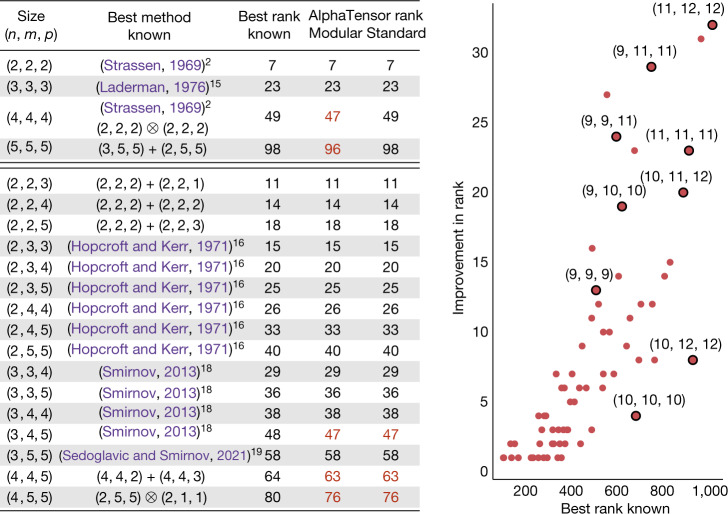
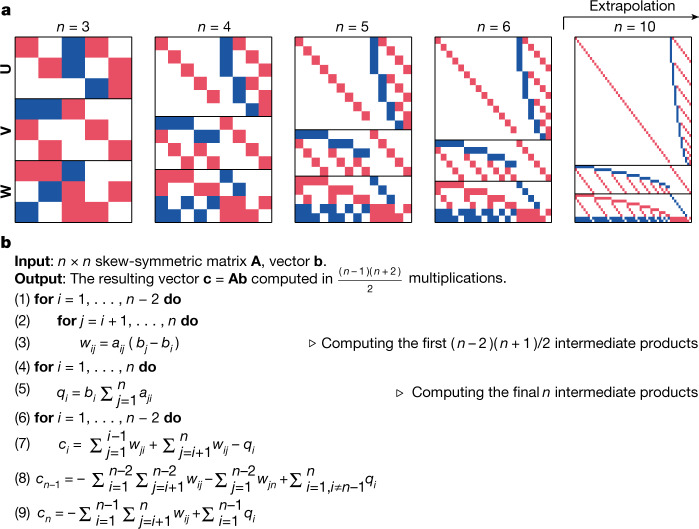
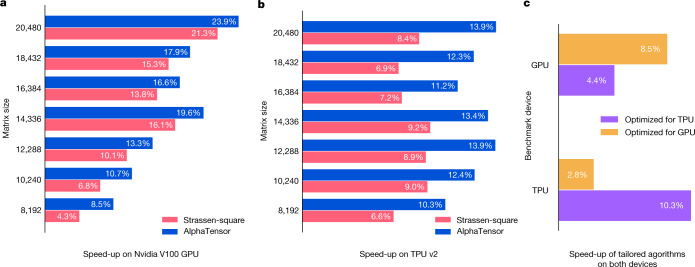
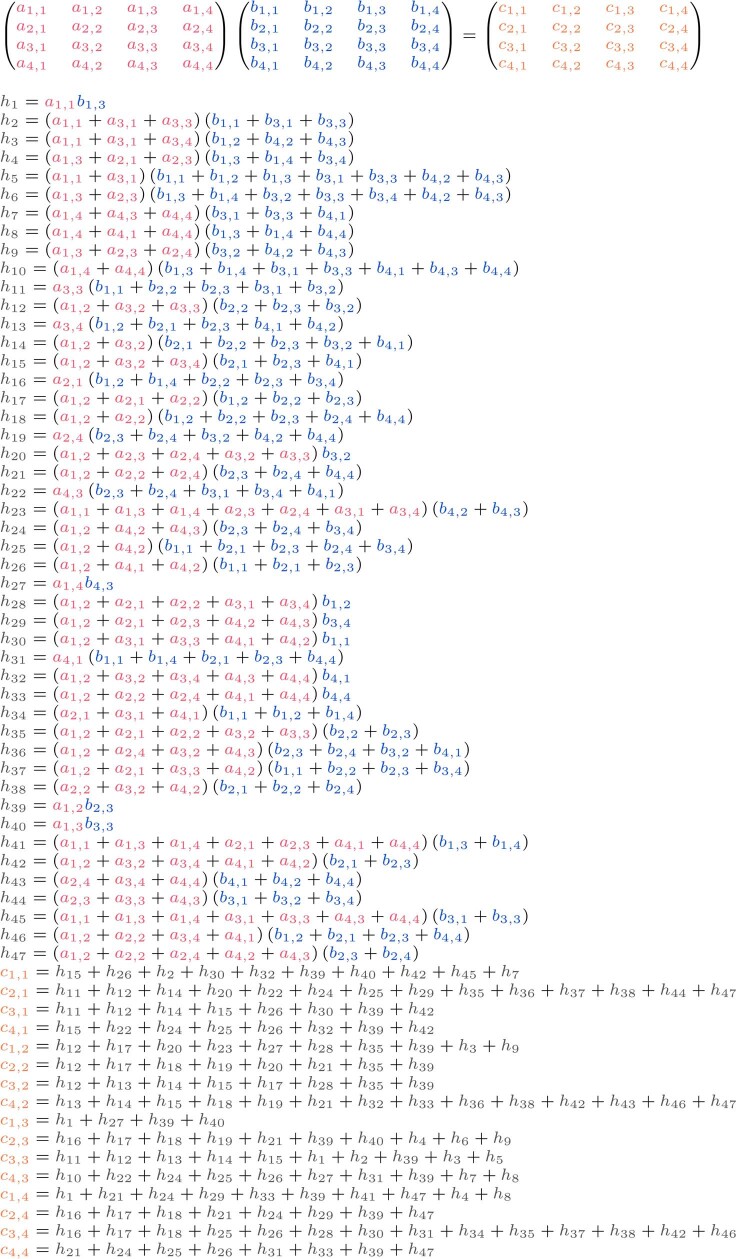
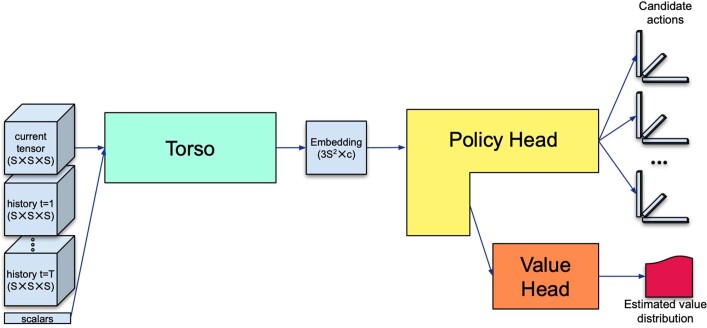
Improving the efficiency of algorithms for fundamental computations can have a widespread impact, as it can affect the overall speed of a large amount of computations. Matrix multiplication is one such primitive task, occurring in many systems—from neural networks to scientific computing routines. The automatic discovery of algorithms using machine learning offers the prospect of reaching beyond human intuition and outperforming the current best human-designed algorithms. However, automating the algorithm discovery procedure is intricate, as the space of possible algorithms is enormous. Here we report a deep reinforcement learning approach based on AlphaZero 1 for discovering efficient and provably correct algorithms for the multiplication of arbitrary matrices. Our agent, AlphaTensor, is trained to play a single-player game where the objective is finding tensor decompositions within a finite factor space. AlphaTensor discovered algorithms that outperform the state-of-the-art complexity for many matrix sizes. Particularly relevant is the case of 4 × 4 matrices in a finite field, where AlphaTensor’s algorithm improves on Strassen’s two-level algorithm for the first time, to our knowledge, since its discovery 50 years ago 2 . We further showcase the flexibility of AlphaTensor through different use-cases: algorithms with state-of-the-art complexity for structured matrix multiplication and improved practical efficiency by optimizing matrix multiplication for runtime on specific hardware. Our results highlight AlphaTensor’s ability to accelerate the process of algorithmic discovery on a range of problems, and to optimize for different criteria.
Overview
The claims and statistics of this paper haven’t been checked yet.
Free: it reads the open-access text and checks the first 5 claims that cite a source we can check. Create a free account to check every claim.
Integrity signals
Registry
Cites
Statistics
Figures
Verification
Claims the paper makes
The claims and statistics of this paper haven’t been checked yet.
Free: it reads the open-access text and checks the first 5 claims that cite a source we can check. Create a free account to check every claim.
Claims other papers make about this one
Each is checked against this paper’s own text: does it say what the citing paper says it does?
The source backs part of the claim, not all of it — or backs it for a different population, condition or comparison.
In the citing paper
“Despite being general-purpose, AlphaEvolve goes beyond [26], improving the SOTA for 14 matrix multiplication algorithms”
From AlphaEvolve: A coding agent for scientific and algorithmic discovery (2025) · cites this paper as [26]
Experimental — accuracy not yet measured
Self-check
Percentages, sums and reported differences re-computed from the paper’s own numbers.
The self-check needs the paper’s full text.
Citations
Cites
Mastering the game of Go with deep neural networks and tree search
Silver, D., Huang, A., Maddison, C. J., Guez, A., Sifre, L., van den Driessche, G., Schrittwieser, J., Antonoglou, I., Panneershelvam, V., Lanctot, M., et al. (2016) · Nature · doi:10.1038/nature16961 · Cited by 15,612
Self-citationTensorFlow: A system for large-scale machine learning
Abadi, M., Barham, P., Chen, J., Chen, Z., Davis, A., Dean, J., Devin, M., Ghemawat, S., Irving, G., Isard, M., et al. (2016) · arXiv (Cornell University) · doi:10.48550/arxiv.1605.08695 · Cited by 11,822
Tensor Decompositions and Applications
Kolda, T. G., & Bader, B. W. (2009) · SIAM Review · doi:10.1137/07070111x · Cited by 10,301
International Conference on Learning Representations (ICLR 2013)
松尾, 豊. (2013) · 人工知能学会誌 = Journal of Japanese Society for Artificial Intelligence · Cited by 6,286
A general reinforcement learning algorithm that masters chess, shogi, and Go through self-play
Silver, D., Hubert, T., Schrittwieser, J., Antonoglou, I., Lai, M., Guez, A., Lanctot, M., Sifre, L., Kumaran, D., Graepel, T., et al. (2018) · Science · doi:10.1126/science.aar6404 · Cited by 3,562 · cited 8×
“, n(2) do (4) c w m w m i R 1 i i R (1) ( ) ← + + return C”
BackgroundMethodInfluentialSelf-citationGaussian elimination is not optimal
Strassen, V. (1969) · Numerische Mathematik · doi:10.1007/bf02165411 · Cited by 2,509 · cited 5×
“, R do (2) ← + + + + m u a u a v b v b ( ) ( ) r n n 1 1 r n r r n r 1 ( ) ( ) 1 ( ) ( ) 2 2 2 2”
InfluentialPlanning chemical syntheses with deep neural networks and symbolic AI
Segler, M. H. S., Preuss, M., & Waller, M. P. (2018) · Nature · doi:10.1038/nature25978 · Cited by 1,847
Deep reinforcement learning for de novo drug design
Popova, M., Isayev, O., & Tropsha, A. (2018) · Science Advances · doi:10.1126/sciadv.aap7885 · Cited by 1,182
Most Tensor Problems Are NP-Hard
Hillar, C. J., & Lim, L.-H. (2013) · Journal of the ACM · doi:10.1145/2512329 · Cited by 1,099
Powers of tensors and fast matrix multiplication
Le Gall, F. (2014) · Proceedings of the 39th International Symposium on Symbolic and Algebraic Computation · doi:10.1145/2608628.2608664 · Cited by 856
Research works printed but not linked: 10
- Bürgisser, P., Clausen, M. & Shokrollahi, A. Algebraic Complexity Theory Vol. 315 (Springer Science & Business Media, 2013).
- Zhang, W. & Dietterich, T. G. A reinforcement learning approach to job-shop scheduling. In International Joint Conferences on Artificial Intelligence Vol. 95, 1114–1120 (Morgan Kaufmann Publishers, 1995).
- Vaswani, A. Attention is all you need. In International Conference on Neural Information Processing Systems Vol 30, 5998–6008 (Curran Associates, 2017).
- Loshchilov, I. & Hutter, F. Decoupled weight decay regularization. In International Conference on Learning Representations (ICLR) (2019).
- Elser V A network that learns Strassen multiplication J. Mach. Learn. Res. 2016 17 3964 3976
- Tschannen, M., Khanna, A. & Anandkumar, A, StrassenNets: deep learning with a multiplication budget. In International Conference on Machine Learning 4985–4994 (PMLR, 2018).
- Bunel, R., Desmaison, A., Kohli, P., Torr, P. H. & Kumar, M. P. Learning to superoptimize programs. In International Conference on Learning Representations (ICLR) (2017).
- Schmidhuber, J. Evolutionary Principles in Self-Referential Learning. On Learning now to Learn: The Meta-Meta-Meta...-Hook. Diploma thesis, Technische Univ. Munchen (1987).
- Kaliszyk, C., Urban, J., Michalewski, H. & Olšák, M. Reinforcement learning of theorem proving. In International Conference on Neural Information Processing Systems 8836–8847 (Curran Associates, 2018).
- Bansal, K., Loos, S., Rabe, M., Szegedy, C. & Wilcox, S. HOList: an environment for machine learning of higher order logic theorem proving. In International Conference on Machine Learning 454–463 (PMLR, 2019).
Cited by
Items 501–600 of 622
AI-Generated Distributed Algorithms: Paving the Way for More Dependable Distributed Systems
Vaz, D., Matos, D. R., Pardal, M. L., & Correia, M. P. (2025) · European Dependable Computing Conference · doi:10.1109/edcc-c66476.2025.00014
“The learning algorithm behind this process is the Monte Carlo Tree Search algorithm, recently used on the generation of matrix-multiplication and sorting algorithms [5], [6].”
Vermeylen, C., Vervliet, N., Lathauwer, L. D., & Barel, M. V. (2025) · Mathematics · doi:10.3390/math13193064
“This result is well known, e.g., from the Supplementary Material of [2] and in [37], and a proof can be found, e.g., in [38] (Section 2.2.3).”
InfluentialClosing the Empirical Loop: Autonomous AI Agents Conduct End‐to‐end Research With Human Participants
Wehr, G., Rideaux, R., Fox, A. J., Lightfoot, D. R., Tangen, J. M., Mattingley, J. B., & Ehrhardt, S. E. (2026) · Advanced Science · doi:10.1002/advs.76675
“Today, AI applications are transforming scientific discovery across multiple domains from chemistry [ 15 ], synthetic biology [ 16, 17 ], materials science [ 18–20 ], mathematics [ 21, 22 ], and algorithm development [ 23 ]; accelerating research productivity and discovery in these areas.”
When Structure is Silent: Opportunities for Algorithmic Dispatch in Linear Algebra
Lujan, E., & Edelman, A. S. (2025) · IEEE High Performance Extreme Computing Conference · doi:10.1109/hpec67600.2025.11196484
“For example, Google DeepMind’s AlphaEvolve [8], [9] uncovered a new matrix-multiplication method that surpasses Strassen’s 1969 breakthrough—marking the first improvement in over half a century.”
Towards Human-Centric Intelligent Treatment Planning for Radiation TherapyPreprint
Jafar, A., & Jia, X. (2025) · arXiv (Cornell University) · doi:10.48550/arxiv.2510.13062
“In recent years, Artificial Intelligence (AI) has significantly transformed medicine, including RT. Advances have shown remarkable progress in decision making [8], outperforming humans in complex tasks [9, 10].”
Energy–Bridge Transfer Law: A Quantitative Bridge Between Topology and Dynamics in Graph SystemsPreprint
Thakur, A. (2025) · Research Square · doi:10.21203/rs.3.rs-8010502/v1
Zhao, W., Tan, J., Wang, H., Han, S., Lai, M., & Yang, W. (2025) · Computer Networks · doi:10.1016/j.comnet.2025.111828
Bessant, Y. R. A., Jiji, C., & Gnanammal, J. G. J. (2025) · Research Square · doi:10.21203/rs.3.rs-7629322/v1
AI Influence: Mechanisms, Amplifiers, and ConsequencesPreprint
Qiu, T. A., He, Z., Lin, T., Glickman, M., Calcott, R., Wihbey, J., & Kleiman-Weiner, M. (2025) · SSRN Electronic Journal · doi:10.2139/ssrn.5756323
Optimal Control Theoretic Neural Optimizer: From Backpropagation to Dynamic Programming
Liu, G.-H., Chen, T., & Theodorou, E. (2025) · IEEE Transactions on Pattern Analysis and Machine Intelligence · doi:10.1109/tpami.2025.3634391
“…as dynamical system propagation and, from which, explore the variational structure of Backpropagation as solving dynamic programming. data [1], making them instrumental in addressing problems such as computer vision [2], distribution modeling [3], and even deciphering mathematical structures [4].”
LLM-Guided Evolutionary Program Synthesis for Quasi-Monte Carlo DesignPreprint
Sadikov, A. (2025) · arXiv (Cornell University) · doi:10.48550/arxiv.2510.03650
“This method has successfully discovered novel algorithms for fundamental problems, from matrix multiplication Fawzi et al. (2022) to open mathematical conjectures Romera-Paredes et al. (2024).”
Secure and efficient matrix multiplication outsourcing for traffic flow prediction in edge computing
Zhao, W., Tan, J., Wang, H., Han, S., Yang, W., & Lai, M. (2025) · Expert Systems with Applications · doi:10.1016/j.eswa.2025.130330
Trust-Region Twisted Policy ImprovementPreprint
de Vries, J. A., He, J., Oren, Y., & Spaan, M. T. J. (2025) · arXiv (Cornell University) · doi:10.48550/arxiv.2504.06048 · Cited by 5
“Monte-Carlo tree search (MCTS) with neural networks (Browne et al., 2012) has enabled many recent successes in sequential decision making problems such as board games (Silver et al., 2018), Atari (Ye et al., 2021), and algorithm discovery (Fawzi et al., 2022; Mankowitz et al., 2023).”
ReLATE: Accelerating Tensor Decomposition via Safe and Efficient Learning of Sparse EncodingsPreprint
Helal, A. E., Checconi, F., Laukemann, J., Soh, Y., Tithi, J. J., Petrini, F., & Choi, J. (2025) · arXiv (Cornell University) · doi:10.48550/arxiv.2509.00280
“DRL has recently been applied to many performance-centric problems, notably in code generation [37], [38], compiler optimization [39], [40], and job scheduling [41], [42].”
Solar Geoengineering Strategies Based on Reinforcement Learning
Quan, H., Koll, D. D. B., Lutsko, N. J., & Yuval, J. (2025) · Journal of Geophysical Research Atmospheres · doi:10.1029/2025jd044319
“This approach has already proven itself in a wide range of domains including game playing, autonomous navigation, and robotics (Annaswamy, 2023; Bellemare et al., 2020; Fawzi et al., 2022; Silver et al., 2016).”
Tensor decompositions and algorithms for efficient multidimensional signal processing
Khamidullina, L. (2024) · Common Library Network (Der Gemeinsame Bibliotheksverbund) · doi:10.22032/dbt.59389
Entwicklung und Evaluierung eines Toolkits für das maschinelle Lernen in der organischen Chemie
Kühnemund, M. (2023) · URN:NBN Resolver for Germany & Switzerland (German National Library) · doi:10.17879/87958349003
Pérez, Á. P. (2025) · Open Research Online (The Open University) · doi:10.21954/ou.ro.00102712 · Cited by 5
AnAlphaZero Agent for Just 4 Fun, a Non-Deterministic Game with Imperfect Information
Gastegger, M. (2024) · reposiTUm (TU Wien) · doi:10.34726/hss.2024.115042
Manneh, A., & Haque, K. (2025) · KTH Publication Database DiVA (KTH Royal Institute of Technology)
Tensor rank and support rank in the context of algebraic complexity theory
Andersson, P. (2023) · KTH Publication Database DiVA (KTH Royal Institute of Technology)
Beiträge zum Einsatz von Algorithmen des bestärkenden Lernens in der Echtwelt-Robotik
Gronauer, S., Diepold, K. C. 2. J., & München, T. U. (2024)
AI Based Methods for Matrix Multiplication in High Resolution Simulations of Radio Access Networks
Johnson, M., & Forslund, H. (2023) · KTH Publication Database DiVA (KTH Royal Institute of Technology)
Pérez Alonso, D. A. (2023) · UVaDOC UVaDOC University of Valladolid Documentary Repository (University of Valladolid)
Reinforcement Learning for Value Alignment
Rodríguez-Soto, M. (2023) · Dipòsit Digital de la Universitat de Barcelona (Universitat de Barcelona)
Reinforcement Learning for the Optimization of Explicit Runge-Kutta Method Parameters
Fournier, M. (2023) · Lund University Publications Student Papers (Lund University)
Distorted Distributional Policy Evaluation for Offline Reinforcement Learning
Iwaki, R., & Osogami, T. (2025) · Communications in computer and information science · doi:10.1007/978-981-95-4091-4_35
Towards Human-Centric Intelligent Treatment Planning for Radiation Therapy.Preprint
Jafar, A., & Jia, X. (2025) · PubMed Central
Hünemörder, M. (2023) · MACAU: Open Access Repository of Kiel University (University Library Kiel)
Il pensiero matematico, tra intuizione e computazione
MARCUCCI, C. (2025) · Electronic Theses and Dissertations Repository (University of Pisa)
Computational complexity perspective on graphical calculi for quantum computation
Mitosek, P. (2025) · University of Birmingham Institutional Research Archive (University of Birmingham) · Cited by 1
Abela, J., Cachia, E., & Layfield, C. (2025) · Mathematics · doi:10.3390/math14010041 · Cited by 1
Zhang, S., Liu, L., Liu, Y., Song, H., & Feng, L. (2025) · Computers & Mathematics with Applications · doi:10.1016/j.camwa.2025.12.012
Deep Learning Under Siege: Identifying Security Vulnerabilities and Risk Mitigation Strategies
Al-Karaki, J. N., Khan, M. A.-Z., Mohamad, M., & Chowdhury, D. (2026) · Smart innovation, systems and technologies · doi:10.1007/978-981-96-6859-5_14
Trust and Social Robots: How can We Prevent Social Robots from Eroding Trust?
Strasser, A. (2026) · Social and cultural studies of robots and AI · doi:10.1007/978-3-031-99290-2_9
Artificial Intelligence and Consciousness: Limits and Modern Perspectives
Slebioda, L. (2025) · Biometrical Letters · doi:10.2478/bile-2025-0010
“AlphaTensor discovered matrix multiplication algorithms that outperformed existing human and computer-designed ones [Fawzi et al., 2022].”
RL-driven Annealing Computation for QUBO on Multi-GPU System
Gakumi, R., & Yasudo, R. (2026) · International Journal of Networking and Computing · doi:10.15803/ijnc.16.1_2_19
Feldmann, J. D. M., & Osório, F. S. (2023) · doi:10.11606/003245257
Connecting quantum computing and machine learning to improve quantum simulation and optimization
Cruz, P. M. Q. (2025) · Portuguese National Funding Agency for Science, Research and Technology (RCAAP Project by FCT)
Learning-Augmented Perfectly Secure Collaborative Matrix Multiplication
He, Z., Salehi, M. R. D., Malak, D., & Stavrou, P. A. (2026) · IEEE International Symposium on Information Theory (ISIT) · doi:10.1109/isit62367.2026.11653605
“This tensor view underlies both Strassens method and modern learning-based low-rank decompositions such as AlphaTensor [31].”
InfluentialLearning to explore tree neighbourhoods for phylogenetic inference
Verdù, F. J. C., Gasparin, A., Bortolussi, L., & Castelli, L. (2026) · Briefings in Bioinformatics · doi:10.1093/bib/bbaf732 · Cited by 1
Aldridge, I. (2025) · Winter Simulation Conference · doi:10.1109/wsc68292.2025.11339108
“The result is at least in part due to fast matrix multiplication algorithms, which are themselves an active area of research in reinforcement learning (see (Fawzi et al. 2022)).”
Sensitivity of Adversarial Multi-agent Reinforcement Learning to Operational Sensing Challenges
Krometis, J., Provenzano, N., Singh, S., Vuthuri, R., Kauffman, J. A., Kyer, A., & Sobien, D. (2026) · AIAA SciTech Forum · doi:10.2514/6.2026-0826
О группе автоморфизмов предполагаемого короткого алгоритма для умножения $(3\times3)$-матриц
Burichenko, V. P. (2026) · Математические заметки · doi:10.4213/mzm14586
EvoMU: Evolutionary Machine UnlearningPreprint
Batorski, P., & Swoboda, P. (2026) · arXiv (Cornell University) · doi:10.48550/arxiv.2602.02139
“…Lu et al., 2024a; Wang et al., 2023b) and (ii) when candidates are executable and progress is measured by automatic metrics, enable efficient, auditable search loops (e.g., algorithm or reward-function discovery) (Fawzi et al., 2022; Ma et al., 2023; Richardson et al., 2024a; Cheng et al., 2025b).”
HRPF: A parallel programming framework for recursive algorithms on heterogeneous CPU–GPU systems
Wang, Y., Liu, B., Shao, S., Gao, J., Ji, W., & Xing, H. (2026) · Parallel Computing · doi:10.1016/j.parco.2026.103187
Rashmi, & Kumar, P. (2026) · Physical Communication · doi:10.1016/j.phycom.2026.103048
Marwala, T. (2026) · Elsevier eBooks · doi:10.1016/b978-0-443-36322-1.00033-x
The Computational Kosmoplex: A Principia for Engineers in the Age of AI
Macedonia, C. R. (2026) · Computer · doi:10.1109/mc.2025.3590236
λ-Return-Based Aircraft Maneuvering for Terminal Defense and Positioning Guidance Strategies
Deng, S., Kou, Y., Maolong, L., Zhanwu, L. I., & An, X. (2025) · Journal of Systems Engineering and Electronics · doi:10.23919/jsee.2025.000112
Hybrid Reinforcement Learning to Optimize for Physics-Constrained Spectral Analysis
Chu, A., & Stork, W. (2025) · IEEE International Conference on Big Data (BigData) · doi:10.1109/bigdata66926.2025.11401765
“Moreover, [36] combined RL with MCTS for algorithm discovery, using a Transformer-based policy/value network to find faster matrix multiplication algorithms with 10-20% efficiency gains.”
Context-Reinforced Random-Field Ensembles for Arbitrary-Resolution Hyperspectral Pansharpening
He, L., Xiao, H., Li, J., & Plaza, A. (2026) · IEEE Transactions on Geoscience and Remote Sensing · doi:10.1109/tgrs.2026.3672273
“Furthermore, for all the deep-learning methods, the iterations of the training stage are set to be 300, and the optimizer is AdamW with the initial learning rate 1 × 10 − 3 [61], [62].”
Gundam: A Generalized Unified Design and Analysis Model for Matrix Multiplication on Edge
Cheng, Q., Li, H., Dong, W.-K., Huang, M., Lin, L., & Hashimoto, M. (2026) · Asia and South Pacific Design Automation Conference (ASP-DAC) · doi:10.1109/asp-dac66049.2026.11420712
“Due to its regular structure and high computational density, it is often the primary target for hardware acceleration in AI systems [1], [2].”
Modeling and Optimizing the Performance of DNN Workflows in Heterogeneous Computing Systems
Zhang, Y., Wu, C. Q., & Hou, A. (2025) · Globecom · doi:10.1109/globecom59602.2025.11431965
“It has also opened the door to computationally complex problems, ranging from self-driving vehicles to the discovery of new ways to multiply matrices [1], [2].”
Wei, L., Ning, X., Lian, X., Yang, K., Ni, T., Chen, F., Tang, R., Chen, Z., & Bo, L. (2026) · Space Science & Technology · doi:10.34133/space.0501
Embracing Imperfections : Hardware-compatible Neural Networks for Neuromorphic Computing
Majumdar, A. (2023) · theses.fr (ABES) · doi:10.70675/4bf81ddbz25cfz48c6zaf34zcaedca216e17
Learning and Optimization of the Locomotion with an Exoskeleton for Paraplegic People
Duburcq, A. (2022) · theses.fr (ABES) · doi:10.70675/27daed24z2320z44acz9701z90f3046ae229 · Cited by 1
Apprentissage par renforcement pour le pilotage énergétique de l'éclairage dans un bâtiment connecté
Haddam, N. (2023) · theses.fr (ABES) · doi:10.70675/dcdfd40czb5faz445eza6b0zc68f032aabe7 · Cited by 1
Device-independent certification : quantum resources and quantum key distribution
Valcarce, X. (2023) · theses.fr (ABES) · doi:10.70675/47a9dcc2zbf3dz4453z98ffz90339ccb4186 · Cited by 2
Οn deep learning fοr cοmputatiοnal fluid dynamics
Gonzalez, F. (2023) · theses.fr (ABES) · doi:10.70675/32f3628fz21b9z474azb470z5325a642b18c
Qu, J. (2023) · theses.fr (ABES) · doi:10.70675/a6d4d155z4869z4005z8a18z1b34d543f821 · Cited by 2
Architecture Design for Analog Oscillatory Neural Networks
Delacour, C. (2023) · theses.fr (ABES) · doi:10.70675/8c16f93fz2b33z4072z9ce6zd406c45eabe0
Apports de l’Intelligence Artificielle pour les écoulements gravitaires
Delcey, M. (2023) · theses.fr (ABES) · doi:10.70675/17037fafz90dfz48dfzbc1az943723dbea11
Kamienny, P.-A. (2023) · theses.fr (ABES) · doi:10.70675/eb3ca119z46c6z44c2zb8a4z75d2bd53def8 · Cited by 1
Dynamic matrix multiplications in memory with photonics and phase-change materials
Cardoso, R. (2024) · theses.fr (ABES) · doi:10.70675/1d6092f1z2c59z4af2z8518z2c4c0a578d32
Domain agnostic techniques for scaling up program synthesis
Matricon, T. (2024) · theses.fr (ABES) · doi:10.70675/c6818c13z66a7z4489zb542za75798a64fc4
Programmation Génétique Cartésienne pour la Segmentation d'Images Biomédicales
Cortacero, K. (2023) · theses.fr (ABES) · doi:10.70675/79918042zfaa6z4f0az998az8effa75120a6
Learning from entropy-encoded data
Piau, R. (2025) · theses.fr (ABES) · doi:10.70675/f65e2c6ez5be2z4eb9zada8z3fe42f05d9d5
Concept-Cognitive Neural Network for Fairness-Aware Maximal Cliques Identification
Hao, F., Tao, M., Zhang, T., Li, L., & Chen, J. (2026) · IEEE Transactions on Emerging Topics in Computing · doi:10.1109/tetc.2026.3681615
“Due to advances in DL, many challenging scientific problems (e.g., protein folding, efficient matrix multiplication, etc.) have received impressive solutions [8], [9], which have made it possible to address some of the challenges in traditional symbolic methods.”
Uvdal, P., & Mirkhalaf, M. (2026) · Materials & Design · doi:10.2139/ssrn.6664877
Artificial Intelligence for Research (AI4R): From Success Stories to Principles
Yu, X., & Xia, J. (2025) · International Conference on Intelligent Education and Intelligent Research (IEIR) · doi:10.1109/ieir67391.2025.11491020
“Representative examples include AlphaFold-class structure prediction [3], [9], RL-discovered algorithms [1], [2], large-scale materials discovery [5], and autonomous research platforms [6].”
Koyun, A. (2026) · International Conference on Informatics Education and Computer Technology Applications (IECA) · doi:10.1145/3802133.3802134
ProdNet: A Lightweight Network for Fast Discovery of Matrix Multiplication Algorithms
Lakas, B. O., Berdjouh, C., Bounane, K., Kherfi, M. L., Aiadi, O., & Belhouari, S. B. (2026) · Communications in computer and information science · doi:10.1007/978-3-032-21585-7_7
Hamdollahzadeh, F., Khaneghah, E. M., Pavone, M. F., Alzoubaidi, A. R., Oliwi, W. F., Nguyen, H. H. C., Hajirajabi, M., Safari, R., Fathali, Z., Khamseh, A., et al. (2026) · International Conference on Distributed Computing and High Performance Computing (DCHPC) · doi:10.1109/dchpc69296.2026.11517237
“However, traditional migration methods often depend on static heuristics and limited system visibility, making them inadequate for large-scale, interactive, and rapidly evolving environments [3].”
Quantum Circuit Synthesis Using an Exact T Library
Wang, H., Yu, M., Wu, X., & Cong, J. (2026) · ACM/IEEE Design Automation Conference (DAC) · doi:10.1145/3770743.3803894 · Cited by 1
“The exact MC can be defined as the rank of this tensor S [21], i.e., the minimum 𝑟 such that we can decompose S as: where 𝑢 𝑖 ,𝑣 𝑖 ,𝑤 𝑖 are the linear combinations of inputs and outputs.”
Analysis of GEMM Implementations Using MIMD-Based Processor for Multi-Function ISAC Systems
Siddiqui, S., Dutta, A., Pham, T., & Bliss, D. W. (2026) · IEEE Aerospace Conference (AERO) · doi:10.1109/aero66936.2026.11519954
“The computational workload of ISAC systems primarily consists of complex mathematical operations like beamforming, channel estimation, eigenvalue decomposition, error correction, neural networks, etc. [14–19].”
Privacy-Preserving Online Federated Learning for Massive Infinite Streams
Shi, L., Ren, X.-B., Yang, S.-S., Zhao, C., Hao, Y.-J., & Xu, Z.-L. (2026) · IEEE Transactions on Pattern Analysis and Machine Intelligence · doi:10.1109/tpami.2026.3697332
Liu, Y., Wang, T., Zhang, X., Wang, L., Zhao, Y., Ding, C., & Song, Q. (2026) · Journal of King Saud University - Computer and Information Sciences · doi:10.1007/s44443-026-00607-8
“…a variety of compression techniques have emerged, including quantization(Zhouetal.2016;Zhuangetal.2018;Hubaraetal.2016), pruning (Liu et al. 2018; Theis et al. 2018; Yu et al. 2022; Lee et al. 2018), knowledge distillation (Huang and Wang 2017), and low-rank decomposition (Fawzi et al. 2022”
Qiu, X., Cao, H., Yang, L., Pang, J., Chang, Z., Wang, Z., Li, Y., LIU, D., Zhang, L., Tang, H., et al. (2026) · Chinese Journal of Traumatology · doi:10.1016/j.cjtee.2026.05.001
“16 Current optimization methodologies in DRL have evolved along 3 primary paradigms.”
On the Automorphism Group of a Possible Short Algorithm for Multiplying $$3\times 3$$ Matrices
Burichenko, V. P. (2026) · Mathematical Notes · doi:10.1134/s0001434626600390
“Interestingly, even arti fi cial intelligence has recently been employed in computer-aided search for fast matrix multiplication algorithms [16].”
Hierarchical Reinforcement Learning for Sparse-Reward Search in Commutative AlgebraPreprint
Butbaia, G., Orland, P., Huang, C., Passaro, D., Fagan, L., Tarquini, M., Dao, H., Eisenbud, D., Shehper, A., & Gukov, S. (2026) · arXiv (Cornell University) · doi:10.48550/arxiv.2606.22922
Wang, Y., Liu, J.-P., Li, P., & Liu, Y. (2026) · arXiv (Cornell University) · doi:10.48550/arxiv.2606.24899
“AI systems have contributed to construction search [1], algorithm discovery [2], conjecture testing [3], and formal or informal proof assistance [4–8].”
Discrete Analog Design Automation Using Reinforcement Learning
Satish, M., Gupta, D., Ramesh, C., & Aggarwal, V. (2026) · Procedia Computer Science · doi:10.1016/j.procs.2026.06.281
Bruker, N., Schwartz, O., & Vaknin, N. (2026) · ACM Symposium on Parallelism in Algorithms and Architectures (SPAA) · doi:10.1145/3816782.3819195
“Despitethe abundance of potentially fast matrix multiplication algorithms and the continuous discovery of new ones [1, 7, 9, 15, 16, 18, 20, 21, 23, 25, 27, 28, 34, 37, 38, 40–42, 45, 47–51, 53, 55–59, 61– 63], few are implemented in practice.”
Guo, Z., & Pan, Z. (2026) · arXiv (Cornell University) · doi:10.48550/arxiv.2607.07554
“Similarly, the AlphaTensor paradigm [24], [25] has demonstrated that RL can discover quantum-translatable mathematical structures; however, this approach targets tensor decompositions instead of gate-level code and omits hardware constraints.”
Generation and Evaluation of Exploration Terms for Monte Carlo Tree Search
Cazenave, T. (2026) · ICGA Journal · doi:10.1177/13896911261463788
“AlphaTensor discovered new, fast matrix multiplication algorithms while playing the tensor game (Fawzi et al., 2022).”
Visual Interpretation of Strassen’s Matrix Multiplication
Brandts, J., & Křížek, M. (2026) · The Mathematical Intelligencer · doi:10.1007/s00283-026-10547-w
Conte, S. P., Cosenza, S., Lancellotti, G., & Agosta, G. (2026) · ACM International Conference on Computing Frontiers: Workshops and Special Sessions (CF Companion) · doi:10.1145/3801488.3806071
Racing Against Automation: Dynamic Incentives When AI Can Preempt the HumanPreprint
Chen, Y., Tian, F., Xiao, Y., & Zhu, Y. (2026) · SSRN Electronic Journal · doi:10.2139/ssrn.6960301
Modeling network evolution by multi-agent reinforcement learning
Li, D., Lin, T., Bao, Z., Gu, B., Zhang, Y., Yang, F., Sun, Y. W., Du, Z., & Holme, P. (2026) · Nature Communications · doi:10.1038/s41467-026-75382-1
On the tensor approximation of Watts-Strogatz Networks
Conejero, J. A., Falcó, A., & Mora–Jiménez, M. (2026) · Uniform distribution theory · doi:10.66833/udt-2026-0002 · Cited by 1
Optical matrix-vector multiplier based on transformation materials
DONG, W.-X., Wang, Y., He, W., & Hu, J. (2026) · Optics Express · doi:10.1364/oe.600713
Chen, W., Chen, J., Lin, Z., & Vong, C. (2026) · arXiv (Cornell University) · doi:10.48550/arxiv.2608.00981
Variational algorithms in Quantum Artificial Intelligence
Kölle, M. (2026) · Electronic Theses of LMU Munich (Ludwig-Maximilians-Universität München) · doi:10.5282/edoc.37436
Reinforcement learning in dynamic pricing: a survey
Kastius, A., Hagedorn, C., & Schlößer, R. (2026) · Journal of Revenue and Pricing Management · doi:10.1057/s41272-026-00619-z
Heuristic Search in AI-Assisted Discovery: A Recursive Architecture
Sercovich, F. C. (2026) · Lecture notes in networks and systems · doi:10.1007/978-3-032-32726-0_40
ForgeStencil: Automating Per-Case Stencil Specialization from Kernels to 100+ Real ApplicationsPreprint
Chen, Y., Li, Y., Wan, W., Gan, L., Yang, G., & Liu, Z. (2026) · arXiv · doi:10.48550/arxiv.2609.06694
Discovering algorithms with computational language processing
Bourdais, T., Gnanasekaran, A., Owhadi, H., & Sahai, T. (2026) · Science Advances · doi:10.1126/sciadv.aea4216
“…theories of program discovery and inductive inference ( 1 ) to automatic code generation for numerical solvers ( 2 ) and systematic algebraic searches for faster matrix multiplication algorithms initiated by Bini et al. ( 3 ), which were continued in modern tensor-decomposition approaches ( 4 ).”
Empirical Geometry-Guided Modeling Enables Robust, High-Throughput Collagen Structure PredictionPreprint
Howard, B., Bauer, M., & Buehler, M. J. (2026) · bioRxiv (Cold Spring Harbor Laboratory) · doi:10.64898/2026.09.05.749573
“Other, related methods such as AlphaTensor and FunSearch have also demonstrated that generative AI can be used to search directly over algorithms or executable functions to discover solutions that improve upon established human-designed approaches [46, 47].”
Fast matrix multiplication via recursive $\langle$ 4x4x4:48 $\rangle$ algorithms into practicePreprint
Dumas, J., Pernet, C., Sedoglavic, A., Stapleton, J., & Tichavský, P. (2026) · arXiv (Cornell University) · doi:10.48550/arxiv.2609.12027
“Recently indeed, the number of scalar multiplications required to multiply two 4 × 4 matrices was reduced in [9] from 49 (using two recursion levels of Strassen’s algorithm [19]) to 47 in characteristic 2.”
Metadata
- Authors
- Fawzi, A., Balog, M., Huang, A., Hubert, T., Romera-Paredes, B., Barekatain, M., Novikov, A., R. Ruiz, F. J., Schrittwieser, J., Swirszcz, G., Silver, D., Hassabis, D., & Kohli, P.
- Affiliations
- Google DeepMind (United Kingdom) (GB)
- Corresponding author
- Fawzi, Alhussein
- ORCID
- Venue
- Nature
- Published
- 2022-10-05
- Volume
- 610
- Issue
- 7930
- Pages
- 47-53
- ISSN
- 0028-0836 (ISSN-L)
- 1476-4687
- PMC
- PMC9534758
- OpenAlex
- W4302010773
- Semantic Scholar
- 442ab95eb9cfbc03bb17a27b52313b5d25eaa738
- Cited by
- 478
- References
- 40
- Citations by year
- 2026: 69 · 2025: 115 · 2024: 136 · 2023: 148 · 2022: 7
- FWCI
- 54.92
- Type
- journal article
- Language
- en
- Open access
- hybrid
- doi.org
- Licence
- cc-by
- creativecommons.org/licenses/by/4.0 (tdm)
- creativecommons.org/licenses/by/4.0 (vor)
- Locations
- Nature (publishedVersion, cc-by)
- PubMed Central (publishedVersion, cc-by)
- PubMed (publishedVersion)
- RePEc: Research Papers in Economics (submittedVersion)
- Funders
- DeepMind
- Topics
- Physical Sciences › Computer Science › Computational Theory and Mathematics › Complexity and Algorithms in Graphs
- Physical Sciences › Computer Science › Artificial Intelligence › Artificial Intelligence Applications
- Physical Sciences › Computer Science › Computational Theory and Mathematics › Polynomial and algebraic computation
- Keywords
- matrix multiplication, algorithm discovery, AlphaZero, deep reinforcement learning, tensor decomposition, Strassen's algorithm, computational complexity
About these checks
Registry, retraction, Cites and statistics results are computed, not judged, with one exception: a printed reference that no index lists is read once by a model before it counts as a citation error. Claims are extracted by a model and kept only when their quote appears verbatim in the text; each cited source is then checked, with a model’s help, for whether it says what the claim relies on. Those verdicts can be wrong — read the claim’s quote and the cited source before relying on one.
Statistics and arithmetic are recomputed, not judged.
Confidence bands are shown only for fields calibrated on our annotated test set. None is calibrated yet, so no band is shown.
What counts as a claim ›How we measure confidence ›How we check this ›
Are you an author, or do you see a problem with this page? Request a review
Data sources
Bibliographic data: Semantic Scholar, OpenAlex, Crossref.
Contains information from the Semantic Scholar Academic Graph Datasets, made available under the ODC Attribution License (ODC-BY 1.0).
Semantic Scholar’s data is described in: Kinney, R., et al. (2023). The Semantic Scholar Open Data Platform. arXiv:2301.10140.
