

Discovering faster matrix multiplication algorithms with reinforcement learning
Open accessThe DOI matches its Crossref record; 51 of the 51 references it cites were found in a registry or an index.
Abstract
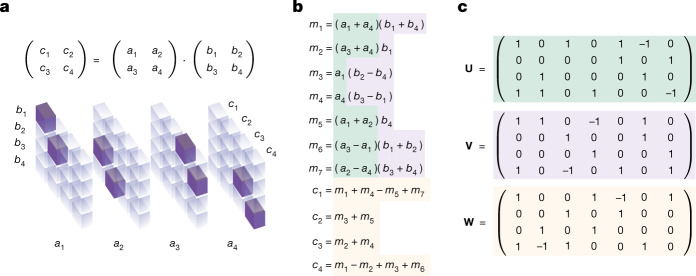
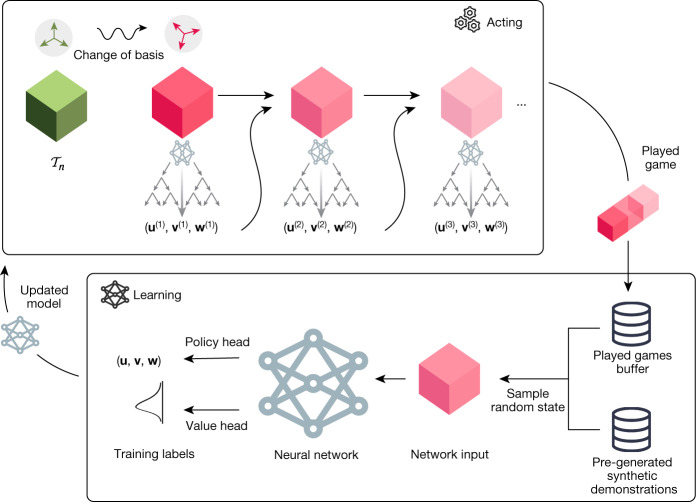
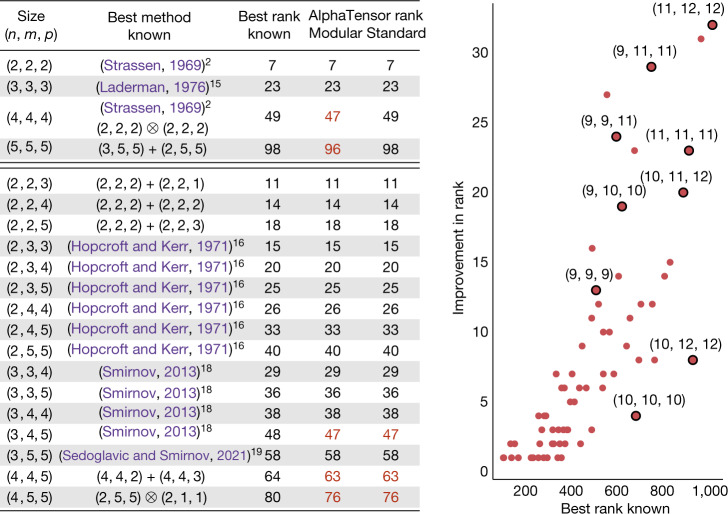
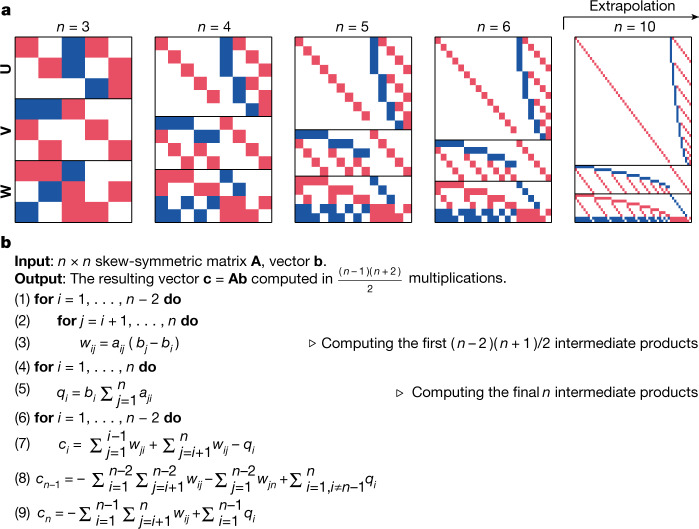
Improving the efficiency of algorithms for fundamental computations can have a widespread impact, as it can affect the overall speed of a large amount of computations. Matrix multiplication is one such primitive task, occurring in many systems—from neural networks to scientific computing routines. The automatic discovery of algorithms using machine learning offers the prospect of reaching beyond human intuition and outperforming the current best human-designed algorithms. However, automating the algorithm discovery procedure is intricate, as the space of possible algorithms is enormous. Here we report a deep reinforcement learning approach based on AlphaZero 1 for discovering efficient and provably correct algorithms for the multiplication of arbitrary matrices. Our agent, AlphaTensor, is trained to play a single-player game where the objective is finding tensor decompositions within a finite factor space. AlphaTensor discovered algorithms that outperform the state-of-the-art complexity for many matrix sizes. Particularly relevant is the case of 4 × 4 matrices in a finite field, where AlphaTensor’s algorithm improves on Strassen’s two-level algorithm for the first time, to our knowledge, since its discovery 50 years ago 2 . We further showcase the flexibility of AlphaTensor through different use-cases: algorithms with state-of-the-art complexity for structured matrix multiplication and improved practical efficiency by optimizing matrix multiplication for runtime on specific hardware. Our results highlight AlphaTensor’s ability to accelerate the process of algorithmic discovery on a range of problems, and to optimize for different criteria.
Overview
The claims and statistics of this paper haven’t been checked yet.
Free: it reads the open-access text and checks the first 5 claims that cite a source we can check. Create a free account to check every claim.
Integrity signals
Registry
Cites
Statistics
Figures
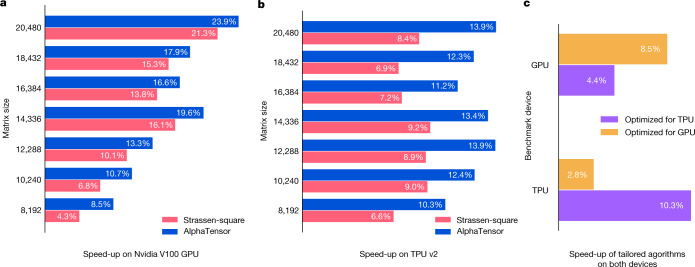
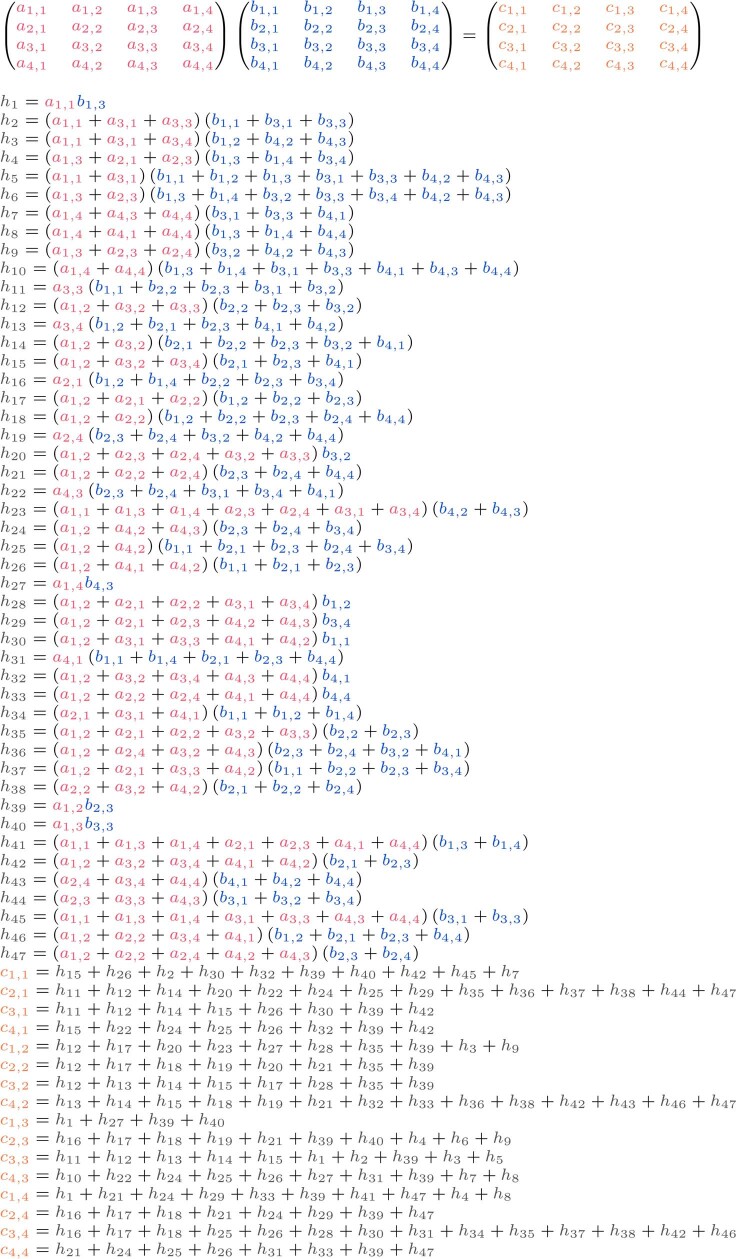
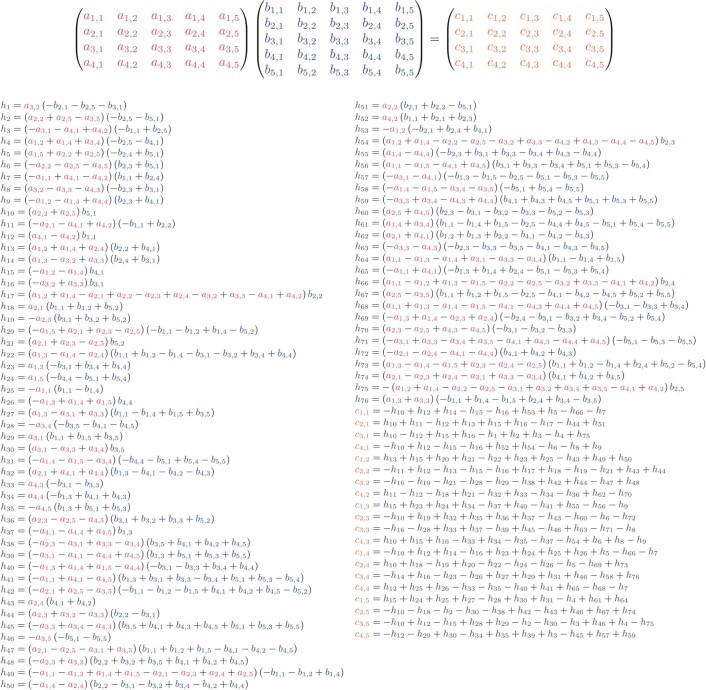
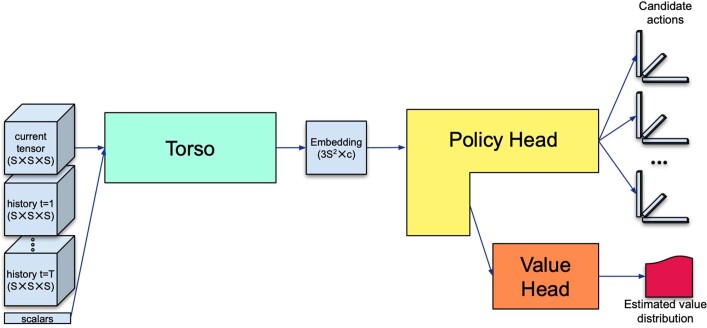
Verification
Claims the paper makes
The claims and statistics of this paper haven’t been checked yet.
Free: it reads the open-access text and checks the first 5 claims that cite a source we can check. Create a free account to check every claim.
Claims other papers make about this one
Each is checked against this paper’s own text: does it say what the citing paper says it does?
The source backs part of the claim, not all of it — or backs it for a different population, condition or comparison.
In the citing paper
“Despite being general-purpose, AlphaEvolve goes beyond [26], improving the SOTA for 14 matrix multiplication algorithms”
From AlphaEvolve: A coding agent for scientific and algorithmic discovery (2025) · cites this paper as [26]
Experimental — accuracy not yet measured
Self-check
Percentages, sums and reported differences re-computed from the paper’s own numbers.
The self-check needs the paper’s full text.
Citations
Cites
Mastering the game of Go with deep neural networks and tree search
Silver, D., Huang, A., Maddison, C. J., Guez, A., Sifre, L., van den Driessche, G., Schrittwieser, J., Antonoglou, I., Panneershelvam, V., Lanctot, M., et al. (2016) · Nature · doi:10.1038/nature16961 · Cited by 15,612
Self-citationTensorFlow: A system for large-scale machine learning
Abadi, M., Barham, P., Chen, J., Chen, Z., Davis, A., Dean, J., Devin, M., Ghemawat, S., Irving, G., Isard, M., et al. (2016) · arXiv (Cornell University) · doi:10.48550/arxiv.1605.08695 · Cited by 11,822
Tensor Decompositions and Applications
Kolda, T. G., & Bader, B. W. (2009) · SIAM Review · doi:10.1137/07070111x · Cited by 10,301
International Conference on Learning Representations (ICLR 2013)
松尾, 豊. (2013) · 人工知能学会誌 = Journal of Japanese Society for Artificial Intelligence · Cited by 6,286
A general reinforcement learning algorithm that masters chess, shogi, and Go through self-play
Silver, D., Hubert, T., Schrittwieser, J., Antonoglou, I., Lai, M., Guez, A., Lanctot, M., Sifre, L., Kumaran, D., Graepel, T., et al. (2018) · Science · doi:10.1126/science.aar6404 · Cited by 3,562 · cited 8×
“, n(2) do (4) c w m w m i R 1 i i R (1) ( ) ← + + return C”
BackgroundMethodInfluentialSelf-citationGaussian elimination is not optimal
Strassen, V. (1969) · Numerische Mathematik · doi:10.1007/bf02165411 · Cited by 2,509 · cited 5×
“, R do (2) ← + + + + m u a u a v b v b ( ) ( ) r n n 1 1 r n r r n r 1 ( ) ( ) 1 ( ) ( ) 2 2 2 2”
InfluentialPlanning chemical syntheses with deep neural networks and symbolic AI
Segler, M. H. S., Preuss, M., & Waller, M. P. (2018) · Nature · doi:10.1038/nature25978 · Cited by 1,847
Deep reinforcement learning for de novo drug design
Popova, M., Isayev, O., & Tropsha, A. (2018) · Science Advances · doi:10.1126/sciadv.aap7885 · Cited by 1,182
Most Tensor Problems Are NP-Hard
Hillar, C. J., & Lim, L.-H. (2013) · Journal of the ACM · doi:10.1145/2512329 · Cited by 1,099
Powers of tensors and fast matrix multiplication
Le Gall, F. (2014) · Proceedings of the 39th International Symposium on Symbolic and Algebraic Computation · doi:10.1145/2608628.2608664 · Cited by 856
Research works printed but not linked: 10
- Bürgisser, P., Clausen, M. & Shokrollahi, A. Algebraic Complexity Theory Vol. 315 (Springer Science & Business Media, 2013).
- Zhang, W. & Dietterich, T. G. A reinforcement learning approach to job-shop scheduling. In International Joint Conferences on Artificial Intelligence Vol. 95, 1114–1120 (Morgan Kaufmann Publishers, 1995).
- Vaswani, A. Attention is all you need. In International Conference on Neural Information Processing Systems Vol 30, 5998–6008 (Curran Associates, 2017).
- Loshchilov, I. & Hutter, F. Decoupled weight decay regularization. In International Conference on Learning Representations (ICLR) (2019).
- Elser V A network that learns Strassen multiplication J. Mach. Learn. Res. 2016 17 3964 3976
- Tschannen, M., Khanna, A. & Anandkumar, A, StrassenNets: deep learning with a multiplication budget. In International Conference on Machine Learning 4985–4994 (PMLR, 2018).
- Bunel, R., Desmaison, A., Kohli, P., Torr, P. H. & Kumar, M. P. Learning to superoptimize programs. In International Conference on Learning Representations (ICLR) (2017).
- Schmidhuber, J. Evolutionary Principles in Self-Referential Learning. On Learning now to Learn: The Meta-Meta-Meta...-Hook. Diploma thesis, Technische Univ. Munchen (1987).
- Kaliszyk, C., Urban, J., Michalewski, H. & Olšák, M. Reinforcement learning of theorem proving. In International Conference on Neural Information Processing Systems 8836–8847 (Curran Associates, 2018).
- Bansal, K., Loos, S., Rabe, M., Szegedy, C. & Wilcox, S. HOList: an environment for machine learning of higher order logic theorem proving. In International Conference on Machine Learning 454–463 (PMLR, 2019).
Cited by
Items 401–500 of 622
Sequential Learning from Noisy Data: Data-Assimilation Meets the Echo-State Network
Goswami, D. (2023) · IEEE Conference on Decision and Control (CDC) · doi:10.1109/cdc49753.2023.10383680 · Cited by 1
“The current interest in data-driven modeling and forecast of complex systems has motivated a wide array of machine-learning algorithms for different problems, e.g., classification, speech recognition [1], board games [2], and even discovering mathematical algorithms [3].”
BackgroundPierre, M., Cohen-Solal, Q., & Cazenave, T. (2024) · Lecture notes in computer science · doi:10.1007/978-3-031-54968-7_13 · Cited by 1
Deep Learning Evidence for Global Optimality of Gerver’s Sofa
Leng, K., Bi, J., Cha, J., Pinilla, S., & Thiyagalingam, J. (2024) · Symmetry · doi:10.3390/sym16101388 · Cited by 1
On the local dimensions of solutions of Brent equations
Li, X., Bao, Y., & Zhang, L. (2024) · Linear Algebra and its Applications · doi:10.1016/j.laa.2024.12.011 · Cited by 1
“By now, some efficient algorithms and criterions are raised to distinguish group orbits, such as [2, 18, 21] and the supplementary information of [15].”
An efficient heuristic search algorithm for discovering large Condorcet domains
Zhou, B., & Riis, S. K. (2025) · 4OR · doi:10.1007/s10288-025-00583-1 · Cited by 3
“…algorithms, genetic algorithms, and local search algorithms have proven their effectiveness in solving some combinatorial optimisation problems (Fawzi et al., 2022; Mankowitz et al., 2023; Radhakrishnan and Jeyakumar, 2021; El-Shorbagy and Hassanien, 2018; Lauri et al., 2023), they encounter…”
Yang, L. Y. U., Can, H. E., Jian-ming, Z. H. A. O., & Zhang, Z. J. (2025) · Bulletin of Mineralogy Petrology and Geochemistry · doi:10.3724/j.issn.1007-2802.20240161 · Cited by 1
Border Ranks of Positive and Invariant Tensor Decompositions: Applications to Correlations
Klingler, A., Netzer, T., & Cuevas, G. D. L. (2025) · Quantum · doi:10.22331/q-2025-02-26-1649 · Cited by 1
“The rank of a tensor relates to complexity measures in various descriptions [2, 22, 18].”
Summary of Fast Matrix Multiplication Algorithms
Respondek, J. S. (2025) · Studies in big data · doi:10.1007/978-3-031-76930-6_8 · Cited by 1
Vaart, P. V. D., Spaan, M. T. J., & Yorke‐Smith, N. (2025) · Proceedings of the AAAI Conference on Artificial Intelligence · doi:10.1609/aaai.v39i20.35393 · Cited by 3
“…et al. 2020), and have now also found success in real world problems such as controlling plasma in a nuclear fusion reactor (Degrave et al. 2022), video compression (Mandhane et al. 2022), large language models (Ouyang et al. 2022) and algorithm design (Fawzi et al. 2022; Mankowitz et al. 2023).”
Neural Network using Double MAC based Block Matrix Multiplication on FPGA
K, A. N. M., Sravani, B., Pillai, M. A., Nalesh, S., & Kala, S. (2024) · IEEE India Conference · doi:10.1109/indicon63790.2024.10958474 · Cited by 1
“Computational efficiency of neural networks is directly related to the speed of multiplication operations [3], [4].”
SPO: Sequential Monte Carlo Policy Optimisation
Macfarlane, M., Toledo, E., Byrne, D., Duckworth, P., & Laterre, A. (2024) · neural information processing systems · doi:10.52202/079017-0031 · Cited by 11
“They have demonstrated state of the art performance in applications ranging from chess [75] and matrix multiplication [24], to language modelling [61].”
BackgroundLearning state-action features for general game playing
Soemers, D. J. N. J. (2023) · Research Publications (Maastricht University) · doi:10.26481/dis.20230425ds · Cited by 4
UDCA May Promote COVID-19 Recovery: A Cohort Study with AI-Aided AnalysisPreprint
Yu, Y., Yu, G., Han, L., Li, J., Zhang, Z.-L., Liu, T.-S., Li, M., Zhan, D., Tang, S., Zhou, Z.-H., et al. (2023) · medRxiv · doi:10.1101/2023.05.02.23289410 · Cited by 1
“However, recent successes in applying Deep Reinforcement Learning to challenging decision-making problems in various domains 35–38 have shown great potential for modeling drug concentration transitions.”
BackgroundDiffeomorphic transformations for time series analysis: An efficient approach to nonlinear warping.
Lopez, I. (. M. (2003) · Depósito Académico Digital Universidad de Navarra (University of Navarra) · doi:10.15581/10171/67243 · Cited by 1
Beyond Average Return in Markov Decision ProcessesPreprint
Marthe, A., Garivier, A., & Vernade, C. (2023) · arXiv (Cornell University) · doi:10.48550/arxiv.2310.20266 · Cited by 2
“At the other end of the spectrum, the so-called Distributional Reinforcement Learning (DistRL) approach aims at studying and optimizing the entire return distribution, leading to impressive practical results [Bellemare et al., 2017, Hessel et al., 2018, Wurman et al., 2022, Fawzi et al., 2022].”
BackgroundMulti-Criteria Decision Making in Complex Decision Environments
Vasegaard, A. E. (2023) · VBN Forskningsportal (Aalborg Universitet) · doi:10.54337/aau561817671 · Cited by 4
Sudmann, A., Echterhölter, A., Ramsauer, M., Retkowski, F., Schröter, J., & Waibel, A. H. (2023) · AI critique · doi:10.14361/9783839467664-002 · Cited by 1
DMC4ML: Data Movement Complexity for Machine LearningPreprint
Ding, C., Kanan, C., McKellips, D., Ozawa, T., Shahmirza, A., & Smith, W. (2023) · arXiv (Cornell University) · doi:10.48550/arxiv.2312.14441 · Cited by 1
“For example, a recent study by DeepMind [10] a r X i v : 2312 .”
MethodExploring Mathematical Spaces using Generative AI and Large Language ModelsPreprint
Raeini, M. (2024) · SSRN Electronic Journal · doi:10.2139/ssrn.4761694 · Cited by 1
Friedman, R., Mamatjan, Y., Pan, C., Silveira, P. P., & Zachariou, M. (2024) · Frontiers in Genetics · doi:10.3389/fgene.2024.1520148 · Cited by 1
AlphaPortfolio: Discovery of Portfolio Optimization and Allocation Methods Using LLMsPreprint
Yüksel, K. A. (2025) · SSRN Electronic Journal · doi:10.2139/ssrn.5118317 · Cited by 2
Reengineering the antigen optimization process for superior neoantigen vaccine designPreprint
Zhang, G., Fu, Y., Buratto, D., Chan, C., Wang, H., Huang, Y., Huang, L., & Zhou, R. (2025) · bioRxiv (Cold Spring Harbor Laboratory) · doi:10.1101/2025.08.03.668363 · Cited by 1
Exact Causal Attention with 10% Fewer OperationsPreprint
Rybin, D., Zhang, Y., Tian, D., Lin, Z., & Luo, Z.-Q. T. (2025) · arXiv (Cornell University) · doi:10.48550/arxiv.2510.05175 · Cited by 1
“The design of ECA is also inspired by AlphaTensor [Fawzi et al., 2022].”
Burlachenko, K., & Richtárik, P. (2025) · arXiv (Cornell University) · doi:10.48550/arxiv.2503.13795 · Cited by 2
“Despite these complexities, there is a line of research that operates at this level (Fawzi et al., 2022; Jia et al., 2019).”
The edge of the asymptotic spectrum of tensorsPreprint
Alman, J., Li, B., & Pratt, K. (2026) · arXiv (Cornell University) · doi:10.48550/arxiv.2604.01386 · Cited by 1
Reinforcement learning for combinatorial optimization : leveraging uncertainty, structure and priors
Grinsztajn, N. (2023) · theses.fr (ABES) · doi:10.70675/596ed207zce1az43dez9b5fzb69d2c21eb2c · Cited by 2
Efficient Neural Networks : Post Training Pruning and Quantization
Yvinec, E. (2023) · theses.fr (ABES) · doi:10.70675/9f61bfc9zfda1z4803z99a4z3834d6e2212a · Cited by 6
Optimizing ground state preparation protocols with autoresearchPreprint
Calderón, L. M., Gonthier, J. F., Gustín, I., Bernales, V., & Aspuru‐Guzik, A. (2026) · arXiv (Cornell University) · doi:10.48550/arxiv.2604.25610 · Cited by 3
“This broader perspective is the same one used in resource-aware algorithm and compiler optimization, where search is organized around constrained cost rather than a single unconstrained runtime objective (1; 2; 55; 56).”
A 52-Addition, Rank-23 Scheme for Exact 3 x 3 Matrix MultiplicationPreprint
Nielsen, H. (2026) · SSRN Electronic Journal · doi:10.2139/ssrn.7553180 · Cited by 1
A Structural Proof of the Lower Bound 21 for $3\times3$ Matrix Multiplication over $\mathbb F_2$Preprint
Yang, S., Zhao, R., Wu, J., Wang, Y., Li, W., Chen, F., Deng, T., Hong, S., Li, Y., Li, Z., et al. (2026) · arXiv (Cornell University) · doi:10.48550/arxiv.2609.18722 · Cited by 1
“On the constructive side, SAT methods have produced many inequivalent 23 -term algorithms [6], while reinforcement learning has extended the search for exact decompositions across matrix formats [7].”
NeuralCert: certified computational discovery of extremal mathematical constructionsPreprint
Roeling, M. P. (2026) · arXiv (Cornell University) · doi:10.48550/arxiv.2609.30296 · Cited by 1
DeepScientist: Advancing Frontier-Pushing Scientific Findings Progressively
Weng, Y., Zhu, M., Xie, Q., Sun, Q., Lin, Z., Liu, S., & Zhang, Y. (2025) · arXiv · doi:10.48550/arxiv.2509.26603
“Similarly, systems like Al-phaTensor (Fawzi et al., 2022) and AlphaEvolve (Novikov et al., 2025) use massive trial-and-error with known engineering methods to improve the performance of codebases.”
Fault-Tolerant Strassen-Like Matrix Multiplication
Güney, O. B., Muhtasham, O., & Arslan, Ş. S. (2020) · Signal Processing and Communications Applications Conference (SIU) · doi:10.1109/siu49456.2020.9302383
“However, we are also actively looking for systematic redundancy generation schemes for recursive matrix multiplication methods as well as deep learning techniques recently fueled by DeepMind initiatives for faster matrix multiplications [18].”
MethodLiu, X., & Bohlin, L. (2014)
Fundamentos de Aprendizagem por Reforço
Jardim, R. R.-A. J. (2023) · doi:10.58976/9786500604368 · Cited by 5
Research on Teaching Modes of Mathematics Public Courses for Artificial Intelligence Major
庞, 国. (2023) · Creative Education Studies · doi:10.12677/ces.2023.115143
Editorial: Evolution in Neurogenomics
Xie, J., & Friedman, R. (2023) · Frontiers in Genetics · doi:10.3389/fgene.2023.1220750
“These recent techniques extend beyond the practice of data organization and systematic collection of knowledge, but also to application in algorithmic discovery (Fawzi et al., 2022), leading to the potential for automation of machine learning method selection—another area of common interest and applicability to diseas…”
BackgroundCatalyzing Innovation: Ai as an External Enabler in Corporate EntrepreneurshipPreprint
Boggia, B., Asady, A. A., & Groening, C. (2023) · SSRN Electronic Journal · doi:10.2139/ssrn.4507861
Efficient Algorithms for Artificial Neural Networks and Explainable AI
Eshkiki, H. (2023) · Cronfa (Swansea University) · doi:10.23889/suthesis.63943
Mackenzie, D. N. (2023) · Engineering · doi:10.1016/j.eng.2023.07.002
Recent Applications and Future Research
Jardim, R. R.-A. J. (2023) · Springer eBooks · doi:10.1007/978-3-031-37345-9_6
Standing Still Is Not an Option: Alternative Baselines for Attainable Utility Preservation
Eresheim, S., Kovac, F., & Adrowitzer, A. (2023) · Lecture notes in computer science · doi:10.1007/978-3-031-40837-3_15
Efficient Exploitation for Off-Policy Reinforcement Learning via a Novel Multi-scale Tabular Buffer
Guo, S., Xue, W., Zhao, W., Shen, Y., & Yu, G. (2023) · Asia Conference on Information Engineering (ACIE) · doi:10.1109/acie58528.2023.00007
“Reinforcement learning (RL) is an increasingly important technology in artificial intelligence and it has achieved impressive results in many domains in recent years, such as particle swarm optimization [1], nuclear fusion [2], writing code [3], computer vision [4], mathematical [5] and multitask learning [6].”
BackgroundBeyond the Fourth Paradigm — the Rise of AI
Marek, A., Rampp, M., Reuter, K., & Laure, E. (2023) · IEEE International Conference on eScience · doi:10.1109/e-science58273.2023.10254904
“for solving well-studied standard problems in computer science [8], [19], generating new images, or generating answers (may it be text, to posed questions, the famous ChatGPT (https://chat.”
BackgroundOn the Accuracy of Hotelling-Type Asymmetric Tensor Deflation: A Random Tensor Analysis
Seddik, M. E. A., Guillaud, M., Decurninge, A., & Goulart, J. H. D. M. (2023) · IEEE International Workshop on Computational Advances in Multi-Sensor Adaptive Processing · doi:10.1109/camsap58249.2023.10403508
“…procedure, first introduced by Hotelling in the context of matrix principal component analysis [13] and still used in modern applications such as the recent AlphaTensor model [14], which consists in iterated rank-one approximation followed by subtraction of the estimated rank-one component.”
MethodEfficiently-Verifiable Strong Uniquely Solvable Puzzles and Matrix Multiplication
Anderson, M., & Le, V. (2023) · Lecture notes in computer science · doi:10.1007/978-3-031-49193-1_4
Deep Reinforcement Learning for 2D Physics-Based Object Manipulation in ClutterPreprint
Renna, L. (2023) · arXiv (Cornell University) · doi:10.48550/arxiv.2312.04570 · Cited by 2
Marroquín-Cano, S. F., Escobar-Gómez, E. N., Morales, E. F., Ramírez-Álvarez, E., Chandomí-Castellanos, E., Gasga, P., & Rodríguez-Sanchez, F. J. (2023) · SSRN Electronic Journal · doi:10.2139/ssrn.4666187
Liu, Z., Cui, P., Shi, C., Zou, Y., Zhang, X., & Liu, W. (2023) · International Heat Transfer Conference (IHTC) · doi:10.1615/ihtc17.160-60
Low-Rank Tensor Decomposition over Finite FieldsPreprint
Yang, J. (2024) · arXiv (Cornell University) · doi:10.48550/arxiv.2401.06857
“With the introduction of AlphaTensor [3] and flip graphs [5] just over a year ago, several new low-rank decompositions have been discovered, especially over finite fields of characteristic 2 [1].”
MethodNumerical approximations with tensor-based techniques for high-dimensional problems
Mora–Jiménez, M. (2023) · RiuNet (Universitat Politècnica de València) · doi:10.4995/thesis/10251/202604
Integrating Neural Pathways for Learning in Deep Reinforcement Learning Models
Ananth, V. (2024) · Proceedings of the AAAI Conference on Artificial Intelligence · doi:10.1609/aaai.v38i21.30541
“AlphaGo (Silver et al. 2016), and AlphaTensor (Fawzi et al. 2022) have displayed incredible creativity in their solutions to the “games” they were presented with.”
BackgroundTask Agnostic Architecture for Algorithm Induction via Implicit CompositionPreprint
Sindhi, S. J., & Budvytis, I. (2024) · arXiv (Cornell University) · doi:10.48550/arxiv.2404.02450
“For example, Monte Carlo tree search is a vital component of the recent successes in discovering algorithms such as AlphaTensor (Fawzi et al., 2022) via Al-phaZero (Silver et al., 2018) and could be incorporated towards general algorithm learning.”
BackgroundMethodNonequilibrium dynamics of closed and open quantum systems
Donatella, K. (2022) · theses.fr (ABES) · doi:10.70675/8e4eef89z71c2z4805zb4b9zc9b580535ad7
On the Error-Propagation of Inexact Hotelling's Deflation for Principal Component AnalysisPreprint
Liao, F., Kim, J. L., Barnum, C., & Kyrillidis, A. (2023) · arXiv (Cornell University) · doi:10.48550/arxiv.2310.04283
“In particular, the sequential discovery of the eigenvectors in the deflation methods applies to scenarios where users have a dynamic necessity of the eigenvectors and require flexibility, especially in modern ML settings (Fawzi et al., 2022; Coulaud et al., 2013).”
BackgroundThe Application of Simplified Strassen Algorithm to Snow Simulation with Material Point Method
Wang, M. (2023) · International Conference on Machine Learning and Computer Application (ICMLCA) · doi:10.1145/3650215.3650378
“The Strassen algorithm is redeemed as the optimal and practical solution to the general smaller matrix multiplications [8].”
MethodModel-based Adversarial Imitation Learning with Self-adatpive Error ControlPreprint
Wang, Y., Gong, S., Du, X., Zhong, S., & Si, Y. (2024) · Research Square · doi:10.21203/rs.3.rs-4263827/v1
Generalized cyclic symmetric decompositions for the matrix multiplication tensorPreprint
Vermeylen, C., & Barel, M. V. (2024) · arXiv (Cornell University) · doi:10.48550/arxiv.2404.16699
“This result is well known, e.g., from the supplementary material of [13], and in [22], and a proof can be found, e.g., in [23, Section 2.2.3].”
MethodInfluentialCrystallization Process Design by Proximal Policy OptimizationPreprint
Tancev, G. (2024) · doi:10.36227/techrxiv.170792884.44909118/v3
Pain, J., & Wilson, B. G. (2024) · High Energy Density Physics · doi:10.1016/j.hedp.2024.101104
Fixed-parameter tractability of canonical polyadic decomposition over finite fieldsPreprint
Yang, J. (2024) · arXiv (Cornell University) · doi:10.48550/arxiv.2405.11699
“Although normally these CPDs should be over R , there has been significant progress in recent years that restricts CPDs to be over a finite field, especially F 2 [4] [6] [7] [1], with some of these CPDs having been lifted to the integers (so that they also work over R ).”
BackgroundMethodA machine learning ride in the physics theme park: from quantum to biophysics
Requena, B. (2024) · UPCommons institutional repository (Universitat Politècnica de Catalunya) · doi:10.5821/dissertation-2117-409132
DNCs Require More Planning StepsPreprint
Shamshoum, Y., Hodos, N., Sieradzki, Y., & Schuster, A. (2024) · arXiv (Cornell University) · doi:10.48550/arxiv.2406.02187
“Examples include AlphaTensor (Fawzi et al., 2022), in which the model learns to find general matrix multiplication algorithms for various matrix sizes; code generation models such as (Li et al., 2022), and Large Language Model (LLM) that are able to generate a piece of code solving a task described in free text (Shinn…”
MethodSingle Matrix Block Shift (SMBS) Dense Matrix Multiplication Algorithm
Ohene‐Kwofie, D., & Hazelhurst, S. (2024) · Communications in computer and information science · doi:10.1007/978-3-031-64881-6_11
Algorithm Development Using Artificial Intelligence: An Overview
Ivanov, A. (2024) · International Symposium on Electrical Apparatus and Technologies (SIELA) · doi:10.1109/siela61056.2024.10637807
“Utilizing MCTS, AlphaTensor iteratively selects actions to play the game, improving network parameters based on feedback from completed games [4].”
MethodInfluentialToward the confident deployment of real‐world reinforcement learning agents
Hanna, J. P. (2024) · AI Magazine · doi:10.1002/aaai.12190 · Cited by 1
Deep Reinforcement Learning for Economics: Progress and Challenges
Green, E. A., & Plunkett, E. B. (2023) · ACM SIGecom Exchanges · doi:10.1145/3699814.3699820
Semi-Analytical Solution of Brent Equations
Kaporin, I. (2024) · Doklady Mathematics · doi:10.1134/s1064562424702223
Semi-analytical solution of Brent equations
Kaporin, I. (2024) · Доклады Российской академии наук Математика информатика процессы управления · doi:10.31857/s2686954324040056
Cui, E. D. (2024) · Wiley eBooks · doi:10.1002/9781394272976.ch1
Марченко, В. Е., Nikitin, P. V., & Gorokhova, R. I. (2023) · Sovremennye informacionnye tehnologii i IT-obrazovanie. · doi:10.25559/sitito.019.202301.163-171
Scilab-RL: A software framework for efficient reinforcement learning and cognitive modeling research
Benad, J., Röder, F., & Eppe, M. (2025) · SoftwareX · doi:10.1016/j.softx.2025.102064
Formulas for determinant and characteristic polynomial of seven-like matrices
Fisunenko, A. (2024) · Bulletin of Taras Shevchenko National University of Kyiv Series Physics and Mathematics · doi:10.17721/1812-5409.2024/2.12
Dictionary Learning: The Complexity of Learning Sparse Superposed Features with FeedbackPreprint
Kumar, A. (2025) · arXiv (Cornell University) · doi:10.48550/arxiv.2502.05407
“This interpretability, in turn, could facilitate the development of simplified algorithms for complex tasks (Fawzi et al., 2022; Romera-Paredes et al., 2024).”
Enhancing Medical Image Report Generation Through Regional and Global Feature Interaction
Teng, P., Yang, H., & Zhang, Q. (2025) · Communications in computer and information science · doi:10.1007/978-981-96-1907-8_4
Xie, J., He, P., Madrigal, S. C. O., & Koç, Ç. K. (2025) · Lecture notes in computer science · doi:10.1007/978-3-031-81824-0_17
Applications of AI for water management
Intergovernmental Hydrological Programme (2025) · Dataset · doi:10.63253/abmwhekm
Power Electronics Topology Derivation: A Technical Review and Cutting-Edge Exploration
Mo, Y., Chen, Y., Chen, H., Zhu, Z., & Kang, Y. (2025) · Lecture notes in electrical engineering · doi:10.1007/978-981-96-4063-8_8
Yang, J., Gao, T., & Shengnan, S. (2025) · International Journal of High Speed Electronics and Systems · doi:10.1142/s0129156425404693
A Quest for AI KnowledgePreprint
Gans, J. S. (2025) · SSRN Electronic Journal · doi:10.2139/ssrn.5169619
Eigen Monte CarloPreprint
Aldridge, I. (2025) · SSRN Electronic Journal · doi:10.2139/ssrn.5215261
Fast Probabilistic Core IdentificationPreprint
Aldridge, I. (2025) · SSRN Electronic Journal · doi:10.2139/ssrn.5246787
Fast Probabilistic Core IdentificationPreprint
Aldridge, I. (2025) · SSRN Electronic Journal · doi:10.2139/ssrn.5249479
Yan, Y., Mao, X., Yan, J., Lu, J., Liu, S., & Liu, Y. (2024) · IEEE Conference on Energy Internet and Energy System Integration (EI2) · doi:10.1109/ei264398.2024.10991543
“These two approaches study multi-agent control and decision-making problems from different angles, each possessing its own advantages and characteristics[11].”
AlphaLoss: Evolving Portfolio Optimization Loss FunctionsPreprint
Yüksel, K. A. (2025) · SSRN Electronic Journal · doi:10.2139/ssrn.5263279 · Cited by 1
Wang, L. (2025) · Procedia Computer Science · doi:10.1016/j.procs.2025.04.411
HeteroGEMM: Searching for Faster, Heterogeneous GEMM Accelerators for DNNsPreprint
Ahmad, A., Du, L., Ge, J., Xie, Z., & Zhang, W. (2025) · doi:10.36227/techrxiv.174837483.35027154/v1
An Effective Macro Placement Framework with Reinforcement Learning and Monte Carlo Tree Search
Ding, J., Yu, W., Qi, Y., Fu, Z., Gong, M., Wey, I., & Zhou, J. (2025) · ACM Great Lakes Symposium on VLSI (GLSVLSI) · doi:10.1145/3716368.3735152
The Fundamental Theorem for Eco-Environmental Surface Modelling
Yu, G., Zhao, N., Shi, W., & Fan, Z. (2025) · Springer eBooks · doi:10.1007/978-981-96-1977-1_2
Limited-Sharing Multi-Party Computation With Reduced Recovery Threshold
Sarzaeem, M. A., Najarkolaei, S. R. H., Yassaee, M. H., & Aref, M. (2025) · Iran Workshop on Communication and Information Theory (IWCIT) · doi:10.1109/iwcit67595.2025.11072973
“For example, [13] leveraged deep reinforcement learning based on AlphaZero to improve previously known achievable ranks.”
Intelligent Materials Science for the Future
Zhang, W., Yang, L., Dong, Y., Dai, Z., Liu, Y., Qin, L., Kang, Q., Zhan, S., & Yang, J. (2025) · 中国科学基金 · doi:10.3724/bnsfc-2025.04.22.0004 · Cited by 1
Prasanth, S. G., & Anita, J. P. (2025) · IEEE International Conference on VLSI Systems, Architecture, Technology and Applications (VLSI SATA) · doi:10.1109/vlsisata65374.2025.11070161
Weng, J. (2025) · Proceedings of the 2025 International Conference on Artificial Intelligence and Computational Intelligence · doi:10.1145/3730436.3745779
Khalefa, N. A. (2025) · Sharwes Scientific Journal · doi:10.26629/ssj.2025.16
Image Transformation Sequence Retrieval with General Reinforcement Learning
Mas-Candela, E., Ríos-Vila, A., & Calvo-Zaragoza, J. (2025) · Lecture notes in computer science · doi:10.1007/978-3-031-99565-1_26
Dopamine for performance evaluation—Insights from songbirds
Gadagkar, V. (2025) · Handbook of behavioral neuroscience · doi:10.1016/b978-0-443-29867-7.00017-7
Goswami, D. (2025) · Proceedings of the ... American Control Conference/Proceedings of the American Control Conference · doi:10.23919/acc63710.2025.11107929
“Recent developments in machine-learning techniques for modeling and forecast of complex systems have become useful in a wide variety of problems, e.g., classification, speech recognition [1], board games [2], and even discovering mathematical algorithms [3].”
Temporally-Consistent Bilinearly Recurrent Autoencoders for Control Systems
Chakrabarti, A., Nayak, I., & Goswami, D. (2025) · Proceedings of the ... American Control Conference/Proceedings of the American Control Conference · doi:10.23919/acc63710.2025.11107615
“On the other hand, recent developments in machine-learning (ML) techniques for modeling complex systems from data have become useful in a wide variety of problems, e.g., classification, speech recognition [1], board games [2], and even discovering mathematical algorithms [3].”
Metadata
- Authors
- Fawzi, A., Balog, M., Huang, A., Hubert, T., Romera-Paredes, B., Barekatain, M., Novikov, A., R. Ruiz, F. J., Schrittwieser, J., Swirszcz, G., Silver, D., Hassabis, D., & Kohli, P.
- Affiliations
- Google DeepMind (United Kingdom) (GB)
- Corresponding author
- Fawzi, Alhussein
- ORCID
- Venue
- Nature
- Published
- 2022-10-05
- Volume
- 610
- Issue
- 7930
- Pages
- 47-53
- ISSN
- 0028-0836 (ISSN-L)
- 1476-4687
- PMC
- PMC9534758
- OpenAlex
- W4302010773
- Semantic Scholar
- 442ab95eb9cfbc03bb17a27b52313b5d25eaa738
- Cited by
- 478
- References
- 40
- Citations by year
- 2026: 69 · 2025: 115 · 2024: 136 · 2023: 148 · 2022: 7
- FWCI
- 54.92
- Type
- journal article
- Language
- en
- Open access
- hybrid
- doi.org
- Licence
- cc-by
- creativecommons.org/licenses/by/4.0 (tdm)
- creativecommons.org/licenses/by/4.0 (vor)
- Locations
- Nature (publishedVersion, cc-by)
- PubMed Central (publishedVersion, cc-by)
- PubMed (publishedVersion)
- RePEc: Research Papers in Economics (submittedVersion)
- Funders
- DeepMind
- Topics
- Physical Sciences › Computer Science › Computational Theory and Mathematics › Complexity and Algorithms in Graphs
- Physical Sciences › Computer Science › Artificial Intelligence › Artificial Intelligence Applications
- Physical Sciences › Computer Science › Computational Theory and Mathematics › Polynomial and algebraic computation
- Keywords
- matrix multiplication, algorithm discovery, AlphaZero, deep reinforcement learning, tensor decomposition, Strassen's algorithm, computational complexity
About these checks
Registry, retraction, Cites and statistics results are computed, not judged, with one exception: a printed reference that no index lists is read once by a model before it counts as a citation error. Claims are extracted by a model and kept only when their quote appears verbatim in the text; each cited source is then checked, with a model’s help, for whether it says what the claim relies on. Those verdicts can be wrong — read the claim’s quote and the cited source before relying on one.
Statistics and arithmetic are recomputed, not judged.
Confidence bands are shown only for fields calibrated on our annotated test set. None is calibrated yet, so no band is shown.
What counts as a claim ›How we measure confidence ›How we check this ›
Are you an author, or do you see a problem with this page? Request a review
Data sources
Bibliographic data: Semantic Scholar, OpenAlex, Crossref.
Contains information from the Semantic Scholar Academic Graph Datasets, made available under the ODC Attribution License (ODC-BY 1.0).
Semantic Scholar’s data is described in: Kinney, R., et al. (2023). The Semantic Scholar Open Data Platform. arXiv:2301.10140.
