

Cortical–hippocampal coupling during manifold exploration in motor cortex
Open accessThe DOI matches its Crossref record; 67 of the 67 references it cites were found in a registry or an index.
Abstract
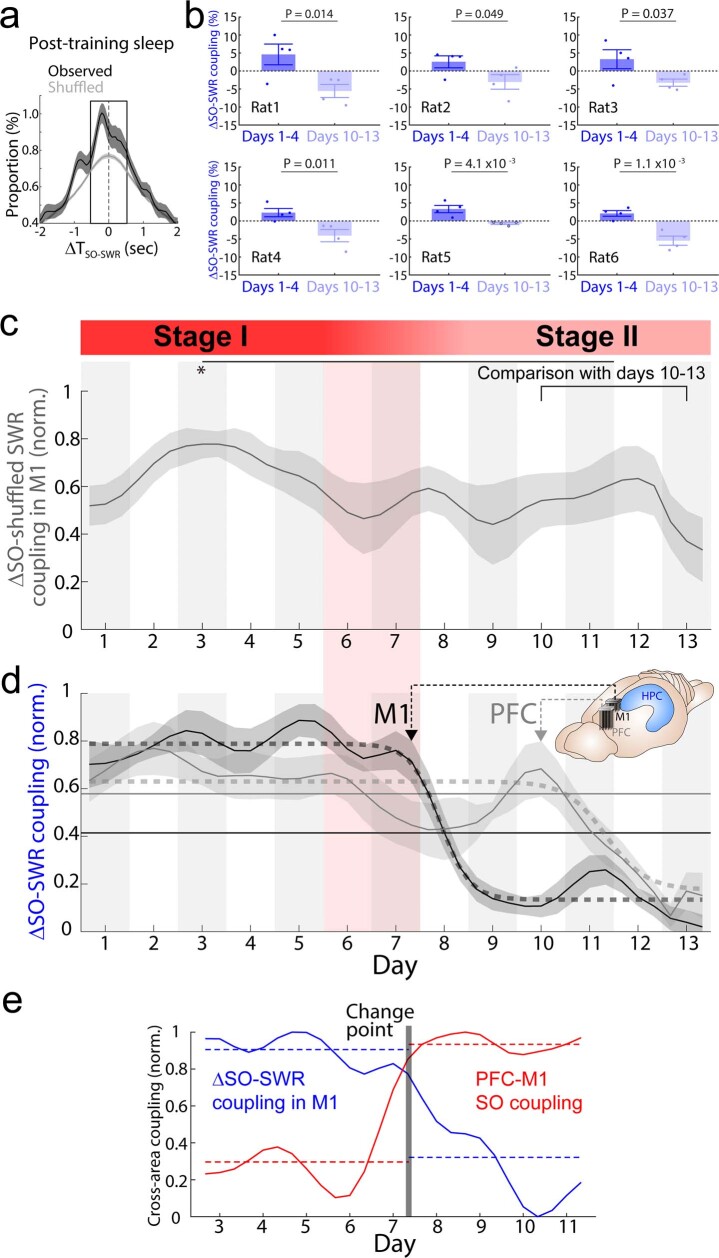
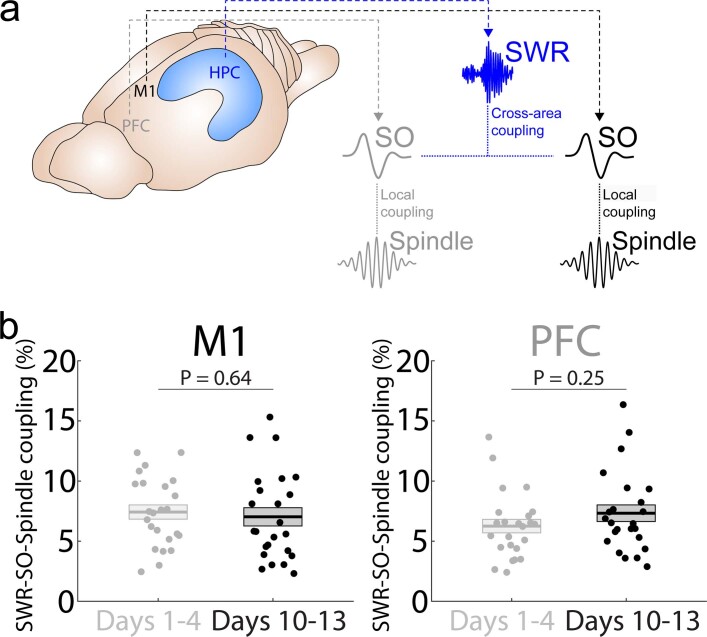
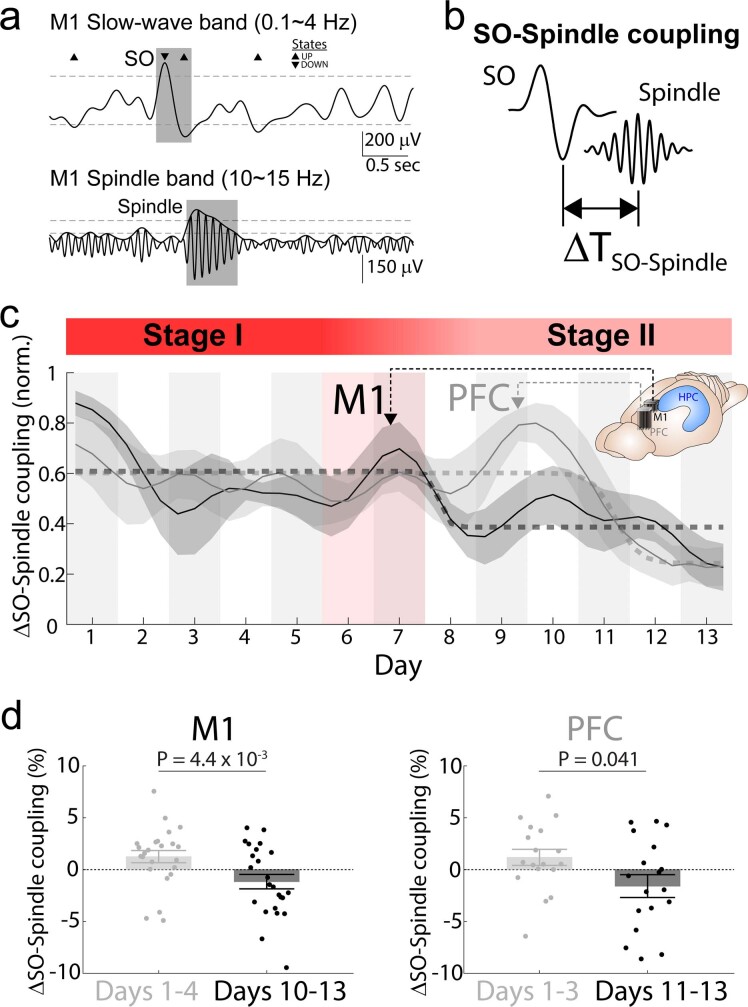
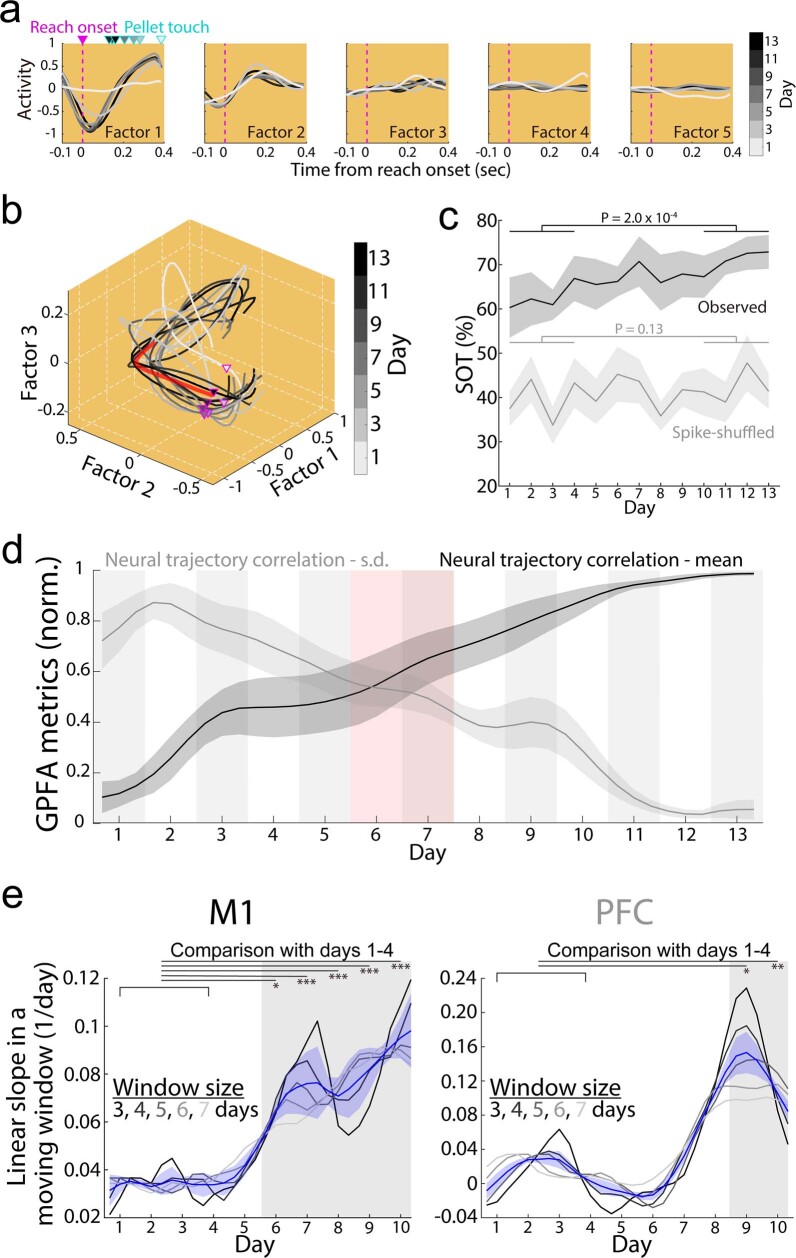
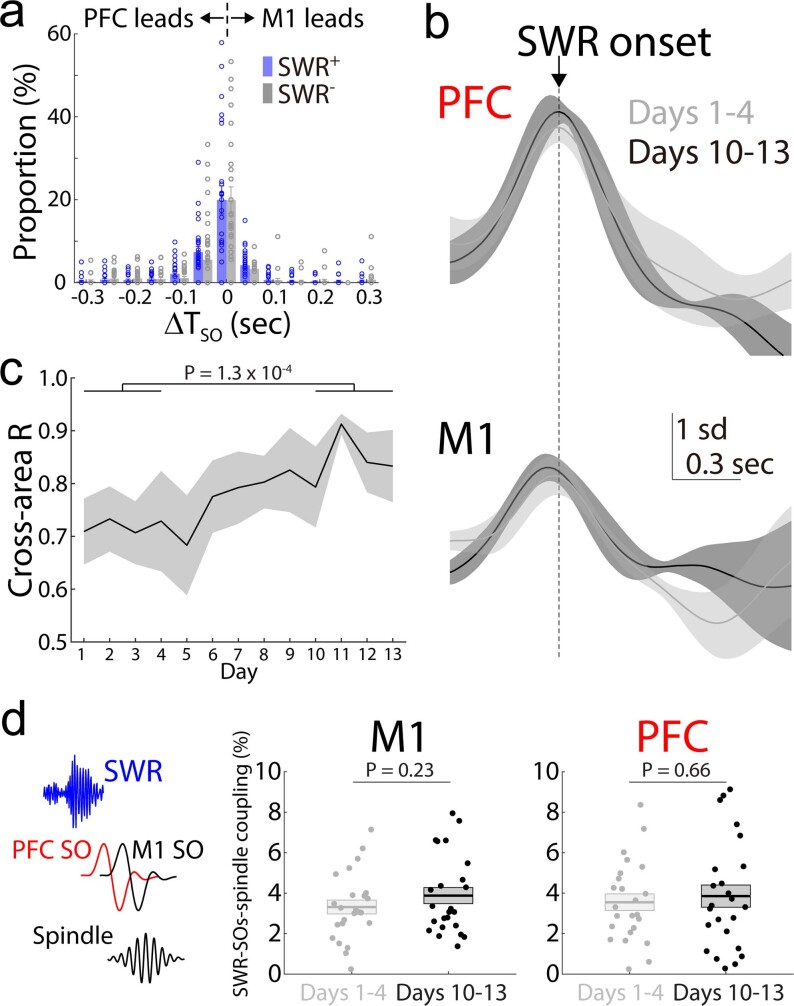
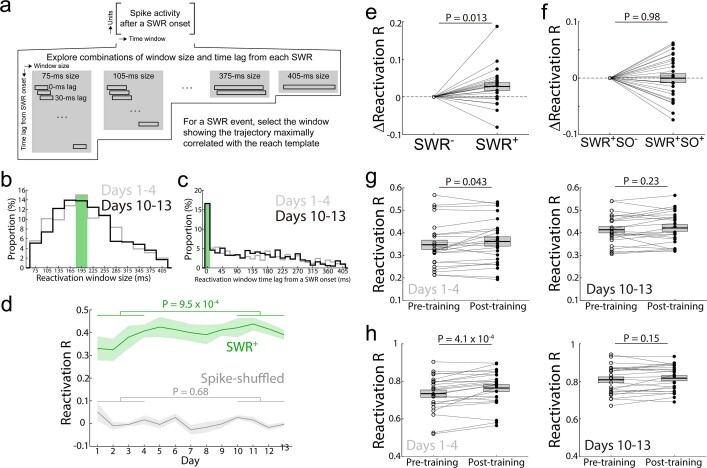
Systems consolidation—a process for long-term memory stabilization—has been hypothesized to occur in two stages 1–4 . Whereas new memories require the hippocampus 5–9 , they become integrated into cortical networks over time 10–12 , making them independent of the hippocampus. How hippocampal–cortical dialogue precisely evolves during this and how cortical representations change in concert is unknown. Here, we use a skill learning task 13,14 to monitor the dynamics of cross-area coupling during non-rapid eye movement sleep along with changes in primary motor cortex (M1) representational stability. Our results indicate that precise cross-area coupling between hippocampus, prefrontal cortex and M1 can demarcate two distinct stages of processing. We specifically find that each animal demonstrates a sharp increase in prefrontal cortex and M1 sleep slow oscillation coupling with stabilization of performance. This sharp increase then predicts a drop in hippocampal sharp-wave ripple (SWR)–M1 slow oscillation coupling—suggesting feedback to inform hippocampal disengagement and transition to a second stage. Notably, the first stage shows significant increases in hippocampal SWR–M1 slow oscillation coupling in the post-training sleep and is closely associated with rapid learning and variability of the M1 low-dimensional manifold. Strikingly, even after consolidation, inducing new manifold exploration by changing task parameters re-engages hippocampal–M1 coupling. We thus find evidence for dynamic hippocampal–cortical dialogue associated with manifold exploration during learning and adaptation.
Overview
The claims and statistics of this paper haven’t been checked yet.
Free: it reads the open-access text and checks the first 5 claims that cite a source we can check. Create a free account to check every claim.
Integrity signals
Registry
Cites
Statistics
Figures
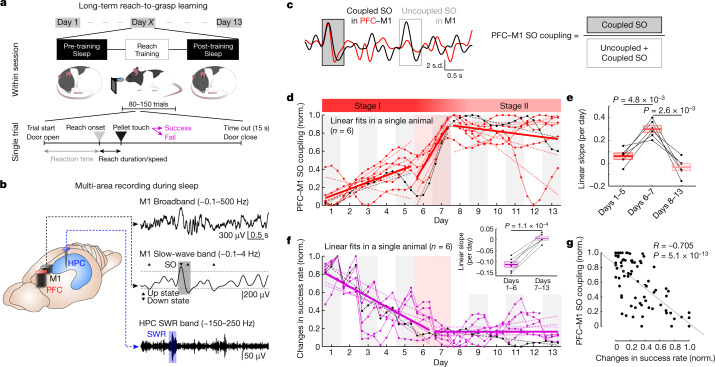
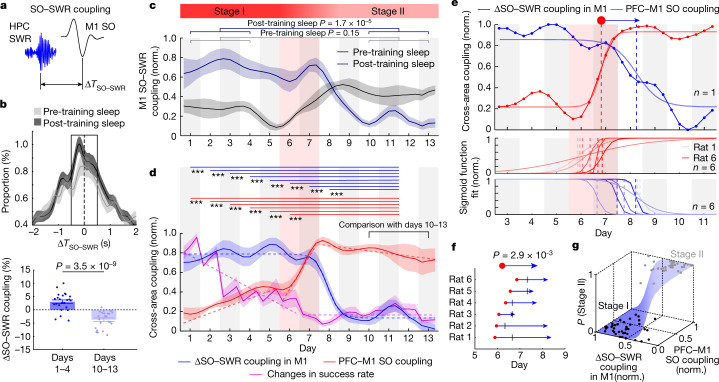
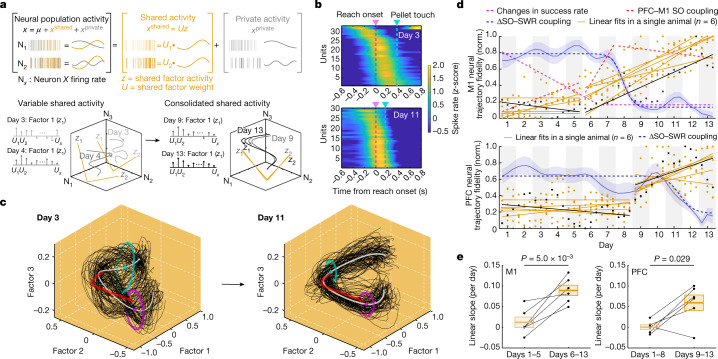
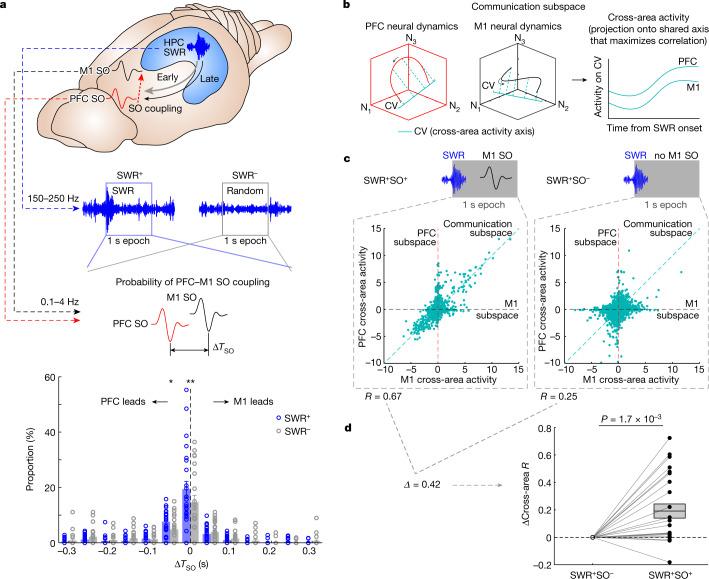
Verification
Claims the paper makes
The claims and statistics of this paper haven’t been checked yet.
Free: it reads the open-access text and checks the first 5 claims that cite a source we can check. Create a free account to check every claim.
Claims other papers make about this one
Each is checked against this paper’s own text: does it say what the citing paper says it does?
The cited source says what the claim attributes to it.
In the citing paper
“Likewise, rats training a prehension skill task initially showed increased hippocampal ripples coupled to SOs in primary motor cortex during post-training SWS.201”
From Sleep—A brain-state serving systems memory consolidation (2023) · cites this paper as [201]
The cited source says what the claim attributes to it.
In the citing paper
“Interestingly, once motor performance stabilized, the rats consistently exhibited a sharp increase in SO coupling between prefrontal and primary motor cortical areas which was accompanied by a drop in the coupling of hippocampal ripples to SOs in primary motor cortex.”
From Sleep—A brain-state serving systems memory consolidation (2023) · cites this paper as [201]
Self-check
Percentages, sums and reported differences re-computed from the paper’s own numbers.
The self-check needs the paper’s full text.
Citations
Cites
McClelland, J. L., McNaughton, B. L., & O'Reilly, R. C. (1995) · Psychological Review · doi:10.1037/0033-295x.102.3.419 · Cited by 5,256
Reactivation of hippocampal ensemble memories during sleep
Wilson, M. A., & McNaughton, B. L. (1994) · Science · doi:10.1126/science.8036517 · Cited by 3,118
Optimal Detection of Changepoints With a Linear Computational Cost
Killick, R., Fearnhead, P., & Eckley, I. A. (2012) · Journal of the American Statistical Association · doi:10.1080/01621459.2012.737745 · Cited by 2,548
The organization of recent and remote memories
Frankland, P. W., & Bontempi, B. (2005) · Nature Reviews Neuroscience · doi:10.1038/nrn1607 · Cited by 2,138
A Generalized Solution of the Orthogonal Procrustes Problem
Schönemann, P. H. (1966) · Psychometrika · doi:10.1007/bf02289451 · Cited by 2,040
Memory consolidation, retrograde amnesia and the hippocampal complex
Nadel, L., & Moscovitch, M. (1997) · Current Opinion in Neurobiology · doi:10.1016/s0959-4388(97)80010-4 · Cited by 1,924
Functional MRI evidence for adult motor cortex plasticity during motor skill learning
Kami, A., Meyer, G., Jezzard, P., Adams, M. M., Turner, R., & Ungerleider, L. G. (1995) · Nature · doi:10.1038/377155a0 · Cited by 1,883
Hippocampal sharp wave-ripple: A cognitive biomarker for episodic memory and planning
Buzsáki, G. (2015) · Hippocampus · doi:10.1002/hipo.22488 · Cited by 1,759
Two-stage model of memory trace formation: A role for “noisy” brain states
Buzsáki, G. (1989) · Neuroscience · doi:10.1016/0306-4522(89)90423-5 · Cited by 1,709
Neural population dynamics during reaching
Churchland, M. M., Cunningham, J. P., Kaufman, M. T., Foster, J. D., Nuyujukian, P., Ryu, S. I., & Shenoy, K. V. (2012) · Nature · doi:10.1038/nature11129 · Cited by 1,626
Selective suppression of hippocampal ripples impairs spatial memory
Girardeau, G., Benchenane, K., Wiener, S. I., Buzsáki, G., & Zugaro, M. B. (2009) · Nature Neuroscience · doi:10.1038/nn.2384 · Cited by 1,560
Interplay of Hippocampus and Prefrontal Cortex in Memory
Preston, A. R., & Eichenbaum, H. (2013) · Current Biology · doi:10.1016/j.cub.2013.05.041 · Cited by 1,389
Structure and function of declarative and nondeclarative memory systems
Squire, L. R., & Zola, S. M. (1996) · Proceedings of the National Academy of Sciences · doi:10.1073/pnas.93.24.13515 · Cited by 1,327
Schemas and Memory Consolidation.
Tse, D., Langston, R. F., Kakeyama, M., Bethus, I., Spooner, P. A., Wood, E. R., Witter, M. P., & Morris, R. G. M. (2007) · Science · doi:10.1126/science.1135935 · Cited by 1,244
Correlated neuronal discharge rate and its implications for psychophysical performance
Zohary, E., Shadlen, M. N., & Newsome, W. T. (1994) · Nature · doi:10.1038/370140a0 · Cited by 1,237
The sleep slow oscillation as a traveling wave
Massimini, M., Huber, R., Ferrarelli, F., Hill, S., & Tononi, G. (2004) · The Journal of Neuroscience · doi:10.1523/jneurosci.1318-04.2004 · Cited by 1,221
Mechanisms of systems memory consolidation during sleep
Klinzing, J. G., Niethard, N., & Born, J. (2019) · Nature Neuroscience · doi:10.1038/s41593-019-0467-3 · Cited by 1,176
Engrams and circuits crucial for systems consolidation of a memory
Kitamura, T., Ogawa, S. K., Roy, D. S., Okuyama, T., Morrissey, M. D., Smith, L. M., Redondo, R. L., & Tonegawa, S. (2017) · Science · doi:10.1126/science.aam6808 · Cited by 1,104
Coordinated interactions between hippocampal Ripples and Cortical Spindles during Slow-Wave Sleep
Siapas, A. G., & Wilson, M. A. (1998) · Neuron · doi:10.1016/s0896-6273(00)80629-7 · Cited by 1,052
Reorganization and plasticity in the adult brain during learning of motor skills
Doyon, J., & Benali, H. (2005) · Current Opinion in Neurobiology · doi:10.1016/j.conb.2005.03.004 · Cited by 1,028
Central mechanisms of motor skill learning
Hikosaka, O., Nakamura, K., Sakai, K., & Nakahara, H. (2002) · Current Opinion in Neurobiology · doi:10.1016/s0959-4388(02)00307-0 · Cited by 1,023
Awake hippocampal sharp-wave ripples support spatial memory
Jadhav, S. P., Kemere, C., German, P. W., & Frank, L. M. (2012) · Science · doi:10.1126/science.1217230 · Cited by 924
Self-citationReplay of rule-learning related neural patterns in the prefrontal cortex during sleep
Peyrache, A., Khamassi, M., Benchenane, K., Wiener, S. I., & Battaglia, F. P. (2009) · Nature Neuroscience · doi:10.1038/nn.2337 · Cited by 767
Neural Manifolds for the Control of Movement
Gallego, J. A., Perich, M. G., Miller, L. E., & Solla, S. A. (2017) · Neuron · doi:10.1016/j.neuron.2017.05.025 · Cited by 674
Yu, B. M., Cunningham, J. P., Santhanam, G., Ryu, S. I., Shenoy, K. V., & Sahani, M. (2009) · Journal of Neurophysiology · doi:10.1152/jn.90941.2008 · Cited by 656
Emergence of a stable cortical map for neuroprosthetic control
Ganguly, K., & Carmena, J. M. (2009) · PLoS Biology · doi:10.1371/journal.pbio.1000153 · Cited by 578
Self-citationBorn, J., Rasch, B., & Gais, S. (2006) · The Neuroscientist · doi:10.1177/1073858406292647 · Cited by 557
A Fully Automated Approach to Spike Sorting
Chung, J. E., Magland, J. F., Barnett, A. H., Tolosa, V. M., Tooker, A. C., Lee, K. Y., Shah, K. G., Felix, S. H., Frank, L. M., & Greengard, L. F. (2017) · Neuron · doi:10.1016/j.neuron.2017.08.030 · Cited by 490
Self-citationBoth the Hippocampus and Striatum Are Involved in Consolidation of Motor Sequence Memory
Albouy, G., Sterpenich, V., Balteau, E., Vandewalle, G., Desseilles, M., Dang-Vu, T., Darsaud, A., Ruby, P., Luppi, P.-H., Degueldre, C., et al. (2008) · Neuron · doi:10.1016/j.neuron.2008.02.008 · Cited by 463
WHISHAW, I. Q., O'CONNOR, W. T., & DUNNETT, S. B. (1986) · Brain · doi:10.1093/brain/109.5.805 · Cited by 449
The hippocampal sharp wave-ripple in memory retrieval for immediate use and consolidation
Joo, H. R., & Frank, L. M. (2018) · Nature Reviews Neuroscience · doi:10.1038/s41583-018-0077-1 · Cited by 430
Self-citationHippocampus leads ventral striatum in replay of place-reward information
Lansink, C. S., Goltstein, P. M., Lankelma, J. V., McNaughton, B. L., & Pennartz, C. M. A. (2009) · PLoS Biology · doi:10.1371/journal.pbio.1000173 · Cited by 400
A cortical-hippocampal-cortical loop of information processing during memory consolidation
Rothschild, G., Eban, E., & Frank, L. M. (2017) · Nature Neuroscience · doi:10.1038/nn.4457 · Cited by 387
Self-citationCortical Areas Interact through a Communication Subspace
Semedo, J. D., Zandvakili, A., Machens, C. K., Yu, B. M., & Kohn, A. (2019) · Neuron · doi:10.1016/j.neuron.2019.01.026 · Cited by 381
Learning-enhanced coupling between ripple oscillations in association cortices and hippocampus
Khodagholy, D., Gelinas, J. N., & Buzsáki, G. (2017) · Science · doi:10.1126/science.aan6203 · Cited by 357
Dopaminergic Projections from Midbrain to Primary Motor Cortex Mediate Motor Skill Learning
Hosp, J. A., Pekanovic, A., Rioult-Pedotti, M. S., & Luft, A. R. (2011) · The Journal of Neuroscience · doi:10.1523/jneurosci.5411-10.2011 · Cited by 354
Hippocampal Sharp Wave-Ripples Linked to Slow Oscillations in Rat Slow-Wave Sleep
Mölle, M., Yeshenko, O., Marshall, L., Sara, S. J., & Born, J. (2006) · Journal of Neurophysiology · doi:10.1152/jn.00014.2006 · Cited by 337
Top-Down Control of Motor Cortex Ensembles by Dorsomedial Prefrontal Cortex
Narayanan, N. S., & Laubach, M. (2006) · Neuron · doi:10.1016/j.neuron.2006.10.021 · Cited by 311
Interaction between neocortical and hippocampal networks via slow oscillations
Sirota, A., & Buzsáki, G. (2005) · Thalamus and Related Systems · doi:10.1017/s1472928807000258 · Cited by 270
Competing Roles of Slow Oscillations and Delta Waves in Memory Consolidation versus Forgetting
Kim, J., Gulati, T., & Ganguly, K. (2019) · Cell · doi:10.1016/j.cell.2019.08.040 · Cited by 254
Self-citationThree factors limiting the reliable detection of light by retinal ganglion cells of the cat
Barlow, H. B., & Levick, W. R. (1969) · The Journal of Physiology · doi:10.1113/jphysiol.1969.sp008679 · Cited by 250
Neurogenesis-mediated forgetting minimizes proactive interference
Epp, J. R., Silva Mera, R., Köhler, S., Josselyn, S. A., & Frankland, P. W. (2016) · Nature Communications · doi:10.1038/ncomms10838 · Cited by 232
Gabrieli, J. D. E., Corkin, S., Mickel, S. F., & Growdon, J. H. (1993) · Behavioral Neuroscience · doi:10.1037//0735-7044.107.6.899 · Cited by 231
Degenhart, A. D., Bishop, W. E., Oby, E. R., Tyler-Kabara, E. C., Chase, S. M., Batista, A. P., & Yu, B. M. (2020) · Nature Biomedical Engineering · doi:10.1038/s41551-020-0542-9 · Cited by 212
The hippocampus is crucial for forming non-hippocampal long-term memory during sleep
Sawangjit, A., Oyanedel, C. N., Niethard, N., Salazar, C., Born, J., & Inostroza, M. (2018) · Nature · doi:10.1038/s41586-018-0716-8 · Cited by 208
Consolidation of human skill linked to waking hippocampo-neocortical replay
Buch, E. R., Claudino, L., Quentin, R., Bönstrup, M., & Cohen, L. G. (2021) · Cell Reports · doi:10.1016/j.celrep.2021.109193 · Cited by 198
Sleep-dependent reactivation of ensembles in motor cortex promotes skill consolidation
Ramanathan, D. S., Gulati, T., & Ganguly, K. (2015) · PLOS Biology · doi:10.1371/journal.pbio.1002263 · Cited by 164
Self-citationReset of hippocampal–prefrontal circuitry facilitates learning
Park, A. J., Harris, A. Z., Martyniuk, K. M., Chang, C.-Y., Abbas, A. I., Lowes, D. C., Kellendonk, C., Gogos, J. A., & Gordon, J. A. (2021) · Nature · doi:10.1038/s41586-021-03272-1 · Cited by 158
The Role of the Hippocampus in Instrumental Conditioning
Corbit, L. H., & Balleine, B. W. (2000) · The Journal of Neuroscience · doi:10.1523/jneurosci.20-11-04233.2000 · Cited by 145
Low-frequency cortical activity is a neuromodulatory target that tracks recovery after stroke
Ramanathan, D. S., Guo, L., Gulati, T., Davidson, G., Hishinuma, A. K., Won, S.-J., Knight, R. T., Chang, E. F., Swanson, R. A., & Ganguly, K. (2018) · Nature Medicine · doi:10.1038/s41591-018-0058-y · Cited by 140
Self-citationBoutin, A., Pinsard, B., Boré, A., Carrier, J., Fogel, S. M., & Doyon, J. (2017) · NeuroImage · doi:10.1016/j.neuroimage.2017.12.066 · Cited by 136
Emergent modular neural control drives coordinated motor actions
Lemke, S. M., Ramanathan, D. S., Guo, L., Won, S. J., & Ganguly, K. (2019) · Nature Neuroscience · doi:10.1038/s41593-019-0407-2 · Cited by 127
Self-citationGulati, T., Ramanathan, D. S., Wong, C. C., & Ganguly, K. (2014) · Nature Neuroscience · doi:10.1038/nn.3759 · Cited by 123
Self-citationEmergence of Coordinated Neural Dynamics Underlies Neuroprosthetic Learning and Skillful Control
Athalye, V. R., Ganguly, K., Costa, R. M., & Carmena, J. M. (2017) · Neuron · doi:10.1016/j.neuron.2017.01.016 · Cited by 115
Self-citationNeural reactivations during sleep determine network credit assignment
Gulati, T., Guo, L., Ramanathan, D. S., Bodepudi, A., & Ganguly, K. (2017) · Nature Neuroscience · doi:10.1038/nn.4601 · Cited by 114
Self-citationSingle-trial cross-area neural population dynamics during long-term skill learning
Veuthey, T. L., Derosier, K., Kondapavulur, S., & Ganguly, K. (2020) · Nature Communications · doi:10.1038/s41467-020-17902-1 · Cited by 89
Self-citationReplay of Learned Neural Firing Sequences during Rest in Human Motor Cortex
Eichenlaub, J.-B., Jarosiewicz, B., Saab, J., Franco, B., Kelemen, J., Halgren, E., Hochberg, L. R., & Cash, S. S. (2020) · Cell Reports · doi:10.1016/j.celrep.2020.107581 · Cited by 69
An automated behavioral box to assess forelimb function in rats
Wong, C. C., Ramanathan, D., Gulati, T., Won, S. J., & Ganguly, K. (2015) · Journal of Neuroscience Methods · doi:10.1016/j.jneumeth.2015.03.008 · Cited by 62
Self-citationCoupling between motor cortex and striatum increases during sleep over long-term skill learning
Lemke, S. M., Ramanathan, D., Darevksy, D., Egert, D., Berke, J. D., & Ganguly, K. (2021) · eLife · doi:10.7554/elife.64303 · Cited by 56
Self-citationCowley, B. R., Kaufman, M. T., Butler, Z. S., Churchland, M. M., Ryu, S. I., Shenoy, K. V., & Yu, B. M. (2013) · Journal of Neural Engineering · doi:10.1088/1741-2560/10/6/066012 · Cited by 51
To Replay, Perchance to Consolidate
Genzel, L., & Robertson, E. M. (2015) · PLoS Biology · doi:10.1371/journal.pbio.1002285 · Cited by 51
Ganguly, K., Khanna, P., Morecraft, R. J., & Lin, D. J. (2022) · Neuron · doi:10.1016/j.neuron.2022.06.024 · Cited by 51
Self-citationEckert, M. J., McNaughton, B. L., & Tatsuno, M. (2020) · Philosophical Transactions of the Royal Society B: Biological Sciences · doi:10.1098/rstb.2019.0655 · Cited by 34
Guo, L. T., Kondapavulur, S., Lemke, S. M., Won, S. J., & Ganguly, K. (2021) · Cell Reports · doi:10.1016/j.celrep.2021.109370 · Cited by 34
Self-citationRecovery of consolidation after sleep following stroke—interaction of slow waves, spindles, and GABA
Kim, J., Guo, L. T., Hishinuma, A. K., Lemke, S. M., Ramanathan, D., Won, S. J., & Ganguly, K. (2022) · Cell Reports · doi:10.1016/j.celrep.2022.110426 · Cited by 32
Self-citationRevisiting the Role of the Medial Temporal Lobe in Motor Learning
McDougle, S. D., Wilterson, S. A., Turk‐Browne, N. B., & Taylor, J. A. (2022) · Journal of Cognitive Neuroscience · doi:10.1162/jocn_a_01809 · Cited by 30
The Degree of Nesting between Spindles and Slow Oscillations Modulates Neural Synchrony
Silversmith, D. B., Lemke, S. M., Egert, D., Berke, J. D., & Ganguly, K. (2020) · Journal of Neuroscience · doi:10.1523/jneurosci.2682-19.2020 · Cited by 27
Self-citation
Research works printed but not linked: 1
- Rieke, F., Warland, D., Van Steveninck, R. D. R. & Bialek, W. Spikes: Exploring the Neural Code (MIT Press, 1999).
Cited by
Sleep—A brain-state serving systems memory consolidation
Brodt, S., Inostroza, M., Niethard, N., & Born, J. (2023) · Neuron · doi:10.1016/j.neuron.2023.03.005 · Cited by 343
Coupled sleep rhythms for memory consolidation
Staresina, B. P. (2024) · Trends in Cognitive Sciences · doi:10.1016/j.tics.2024.02.002 · Cited by 113
Sleep’s contribution to memory formation
Lutz, N. D., Harkotte, M., & Born, J. (2025) · Physiological Reviews · doi:10.1152/physrev.00054.2024 · Cited by 60
Symmetry breaking organizes the brain’s resting state manifold
Fousek, J., Rabuffo, G., Gudibanda, K., Sheheitli, H., Petkoski, S., & Jirsa, V. (2024) · Scientific Reports · doi:10.1038/s41598-024-83542-w · Cited by 36
Learning leaves a memory trace in motor cortex
Losey, D. M., Hennig, J. A., Oby, E. R., Golub, M. D., Sadtler, P. T., Quick, K. M., Ryu, S. I., Tyler‐Kabara, E. C., Batista, A. P., Yu, B. M., et al. (2024) · Current Biology · doi:10.1016/j.cub.2024.03.003 · Cited by 43
“11,44,65 Our results focused on the short-term inception of a motor memory within an hour or so of the learned experience.”
Background
Metadata
- Authors
- Kim, J., Joshi, A., Frank, L., & Ganguly, K.
- Affiliations
- San Francisco VA Medical Center (US)
- Howard Hughes Medical Institute (US)
- Corresponding author
- Ganguly, Karunesh
- Venue
- Nature
- Published
- 2022-12-14
- Volume
- 613
- Issue
- 7942
- Pages
- 103-110
- ISSN
- 0028-0836 (ISSN-L)
- 1476-4687
- PMC
- PMC9812770
- OpenAlex
- W4311436954
- Semantic Scholar
- d51ee3fb345822d922267936fce685b9332d34f5
- Cited by
- 77
- References
- 67
- Citations by year
- 2026: 19 · 2025: 25 · 2024: 19 · 2023: 14
- FWCI
- 7.48
- Type
- journal article
- Language
- en
- Open access
- hybrid
- doi.org
- Licence
- cc-by
- creativecommons.org/licenses/by/4.0 (tdm)
- creativecommons.org/licenses/by/4.0 (vor)
- Locations
- Nature (publishedVersion, cc-by)
- PubMed Central (publishedVersion, cc-by)
- PubMed (publishedVersion)
- RePEc: Research Papers in Economics (submittedVersion)
- eScholarship (California Digital Library) (submittedVersion, cc-by)
- Funders
- U.S. Department of Veterans Affairs (1I01RX001640, I01 RX001640)
- American Heart Association
- National Institute of Neurological Disorders and Stroke (RF1NS132913, K02NS093014, K99NS119737)
- Topics
- Life Sciences › Neuroscience › Cognitive Neuroscience › Memory and Neural Mechanisms
- Life Sciences › Neuroscience › Cognitive Neuroscience › Sleep and Wakefulness Research
- Life Sciences › Neuroscience › Cognitive Neuroscience › Neural dynamics and brain function
- Keywords
- systems consolidation, hippocampus, primary motor cortex, prefrontal cortex, slow oscillations, sharp-wave ripples, sleep, memory stabilization, low-dimensional manifolds, skill acquisition
- MeSH terms
- Memory Consolidation, Animals, Hippocampus, Learning, Motor Cortex, Sleep Stages, Prefrontal Cortex, Memory, Long-Term
About these checks
Registry, retraction, Cites and statistics results are computed, not judged, with one exception: a printed reference that no index lists is read once by a model before it counts as a citation error. Claims are extracted by a model and kept only when their quote appears verbatim in the text; each cited source is then checked, with a model’s help, for whether it says what the claim relies on. Those verdicts can be wrong — read the claim’s quote and the cited source before relying on one.
Statistics and arithmetic are recomputed, not judged.
Confidence bands are shown only for fields calibrated on our annotated test set. None is calibrated yet, so no band is shown.
What counts as a claim ›How we measure confidence ›How we check this ›
Are you an author, or do you see a problem with this page? Request a review
Data sources
Bibliographic data: Semantic Scholar, OpenAlex, Crossref.
Contains information from the Semantic Scholar Academic Graph Datasets, made available under the ODC Attribution License (ODC-BY 1.0).
Semantic Scholar’s data is described in: Kinney, R., et al. (2023). The Semantic Scholar Open Data Platform. arXiv:2301.10140.
