

The person-to-person transmission landscape of the gut and oral microbiomes
Open accessThe DOI matches its Crossref record; 129 of the 129 references it cites were found in a registry or an index.
Abstract
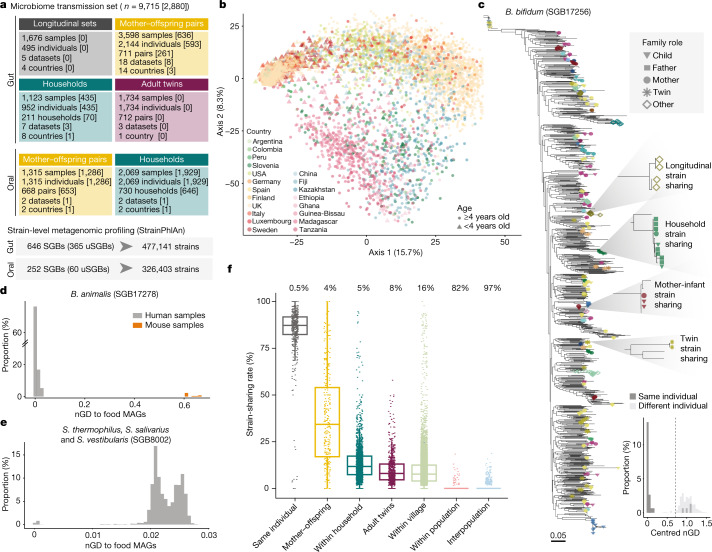
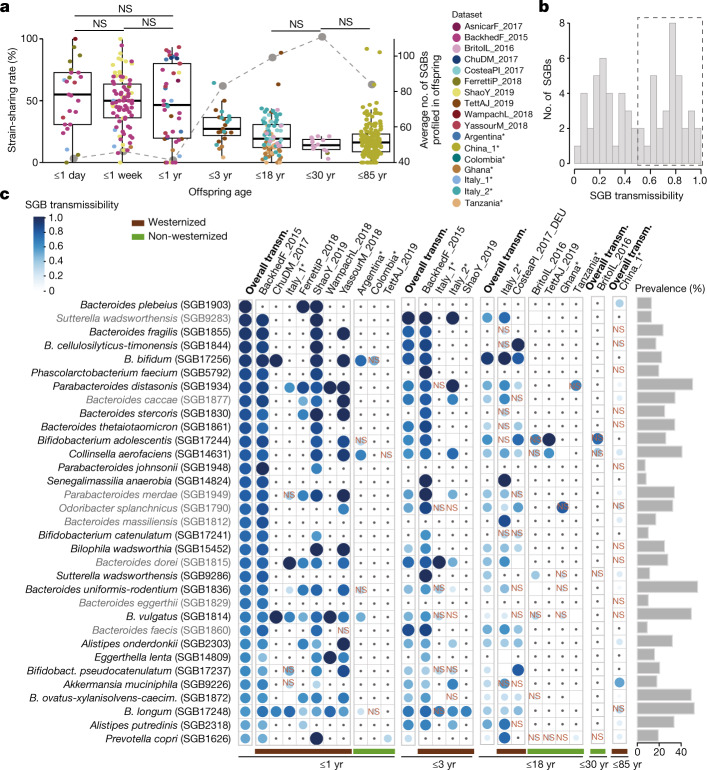
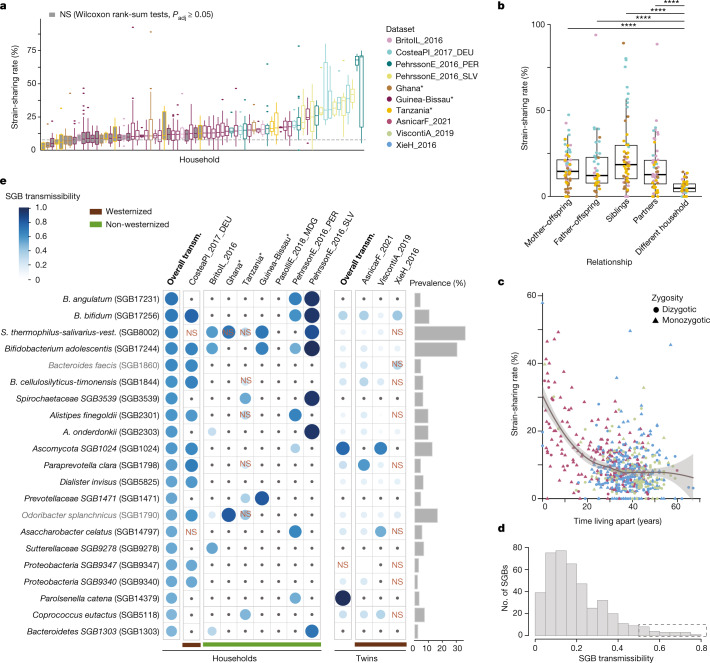
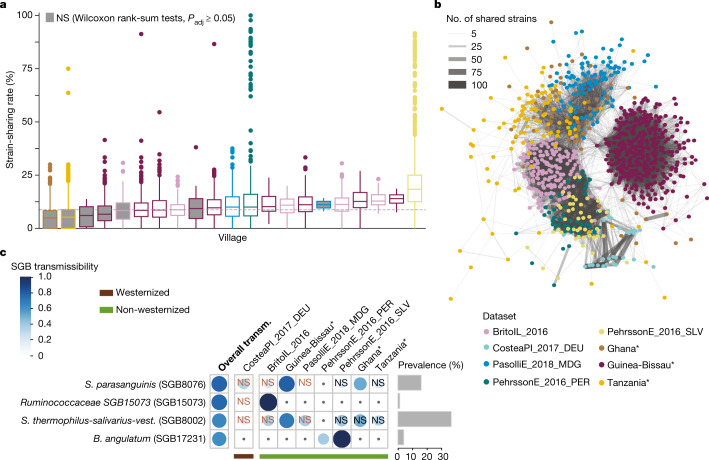
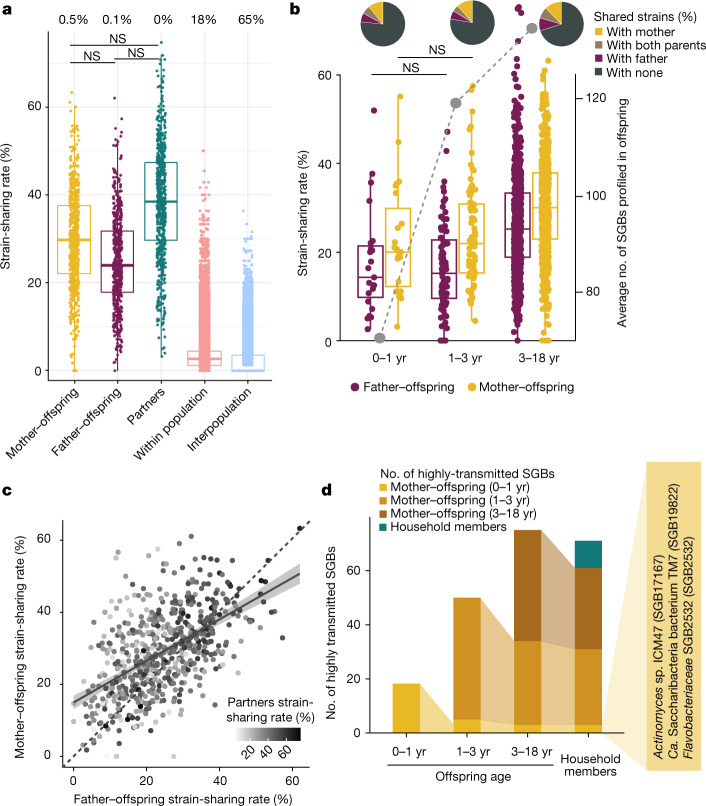
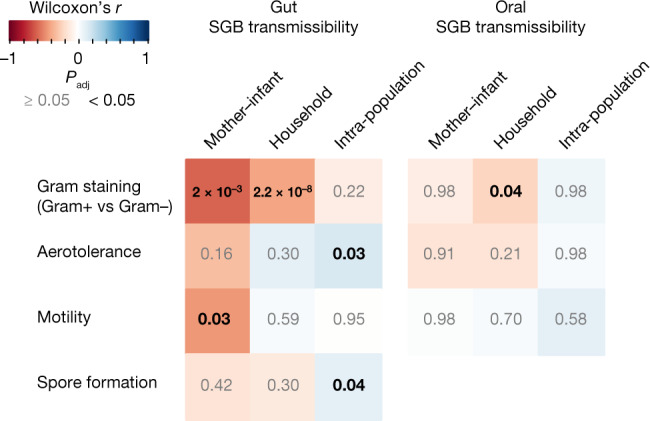
The human microbiome is an integral component of the human body and a co-determinant of several health conditions 1,2 . However, the extent to which interpersonal relations shape the individual genetic makeup of the microbiome and its transmission within and across populations remains largely unknown 3,4 . Here, capitalizing on more than 9,700 human metagenomes and computational strain-level profiling, we detected extensive bacterial strain sharing across individuals (more than 10 million instances) with distinct mother-to-infant, intra-household and intra-population transmission patterns. Mother-to-infant gut microbiome transmission was considerable and stable during infancy (around 50% of the same strains among shared species (strain-sharing rate)) and remained detectable at older ages. By contrast, the transmission of the oral microbiome occurred largely horizontally and was enhanced by the duration of cohabitation. There was substantial strain sharing among cohabiting individuals, with 12% and 32% median strain-sharing rates for the gut and oral microbiomes, and time since cohabitation affected strain sharing more than age or genetics did. Bacterial strain sharing additionally recapitulated host population structures better than species-level profiles did. Finally, distinct taxa appeared as efficient spreaders across transmission modes and were associated with different predicted bacterial phenotypes linked with out-of-host survival capabilities. The extent of microorganism transmission that we describe underscores its relevance in human microbiome studies 5 , especially those on non-infectious, microbiome-associated diseases.
Overview
The claims and statistics of this paper haven’t been checked yet.
Free: it reads the open-access text and checks the first 5 claims that cite a source we can check. Create a free account to check every claim.
Integrity signals
Registry
Cites
Statistics
Figures
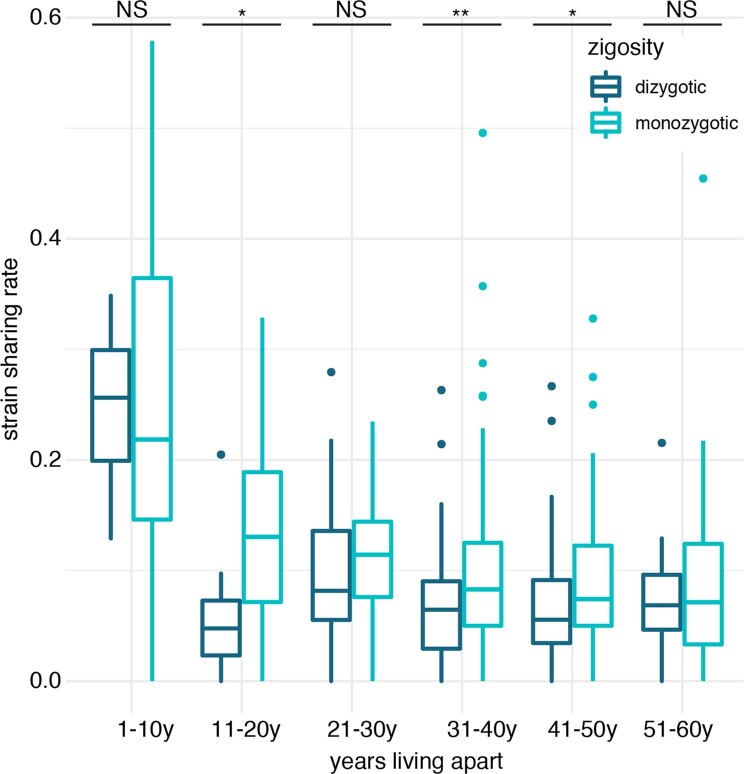
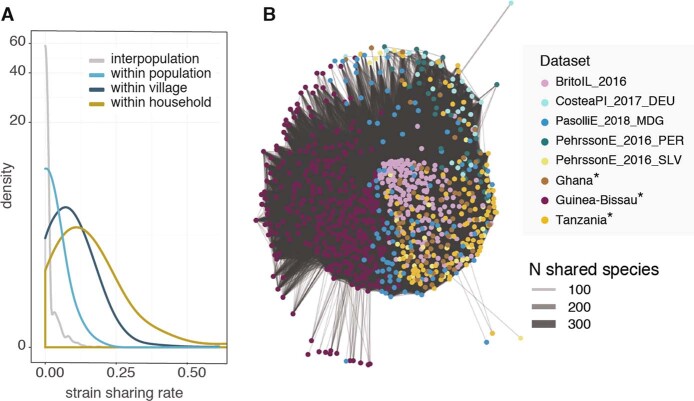
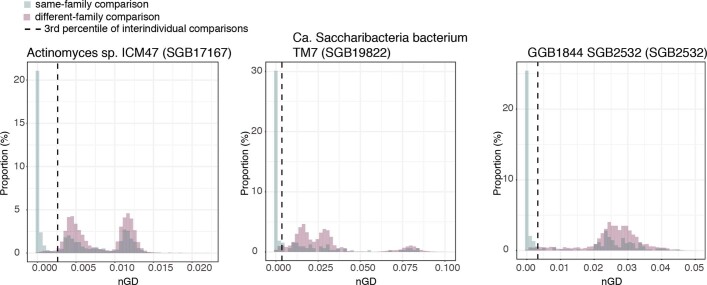
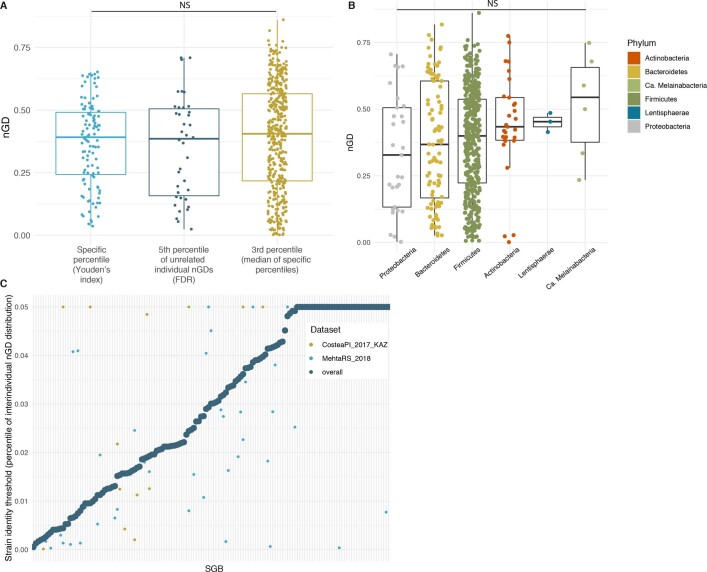
Verification
Claims the paper makes
The claims and statistics of this paper haven’t been checked yet.
Free: it reads the open-access text and checks the first 5 claims that cite a source we can check. Create a free account to check every claim.
Claims other papers make about this one
Each is checked against this paper’s own text: does it say what the citing paper says it does?
The source backs part of the claim, not all of it — or backs it for a different population, condition or comparison.
In the citing paper
“adult microbial communities seem to be predominantly shaped by prior stochastic environmental exposures, as well as multiple other factors such as diet, antibiotic therapy and host genetics, with direct 'inheritance' from the mother at birth playing a lesser role.”
From Human microbiome myths and misconceptions (2023) · cites this paper as [15]
Experimental — accuracy not yet measuredThe source backs part of the claim, not all of it — or backs it for a different population, condition or comparison.
In the citing paper
“proportionally few microbiota species are truly 'heritable' and persist through from birth to adulthood in the offspring 15,16 .”
From Human microbiome myths and misconceptions (2023) · cites this paper as [15]
Experimental — accuracy not yet measuredThe cited source says what the claim attributes to it.
In the citing paper
“Although some microbes are directly transferred from mother to baby during birth 14,15 ,”
From Human microbiome myths and misconceptions (2023) · cites this paper as [15]
The cited source says what the claim attributes to it.
In the citing paper
“However, the recently described horizontal and vertical person-to-person microbial transmission 42 is likely not the only source of microbiome diversity, 43”
From Unexplored microbial diversity from 2,500 food metagenomes and links with the human microbiome. (2024) · cites this paper as [42]
The cited source says what the claim attributes to it.
In the citing paper
“A large fraction of the infant gut microbiome contained food SGBs (mean = 56%, Figure 5C), despite direct acquisition from food being only one of the possible routes of transmission (e.g., vertical and horizontal transmission 42,44,122 ).”
From Unexplored microbial diversity from 2,500 food metagenomes and links with the human microbiome. (2024) · cites this paper as [42]
2 more claims about this paper
Create a free account to see every claim other papers make about this one.
Self-check
Percentages, sums and reported differences re-computed from the paper’s own numbers.
The self-check needs the paper’s full text.
Citations
Cites
Fast gapped-read alignment with Bowtie 2
Langmead, B., & Salzberg, S. L. (2012) · Nature Methods · doi:10.1038/nmeth.1923 · Cited by 56,400 · cited 1×
“This was done by a procedure that first divided core genes into fragments of 150 nt and then aligned the fragments against the genomes of all SGBs using Bowtie2 (version 2.3.5.1; -sensitive option) 66 .”
MethodInfluentialphyloseq: An R Package for Reproducible Interactive Analysis and Graphics of Microbiome Census Data
McMurdie, P. J., & Holmes, S. (2013) · PLoS ONE · doi:10.1371/journal.pone.0061217 · Cited by 21,322 · cited 1×
“28.0) 126 , using one randomly selected sample per individual ( n = 4,840 gut samples, n = 2,069 oral samples).”
MethodInfluentialProkka: rapid prokaryotic genome annotation
Seemann, T. (2014) · Bioinformatics · doi:10.1093/bioinformatics/btu153 · Cited by 18,818
Fast and sensitive protein alignment using DIAMOND
Buchfink, B., Xie, C., & Huson, D. H. (2015) · Nature Methods · doi:10.1038/nmeth.3176 · Cited by 14,201 · cited 1×
“Coding sequences were then assigned to a UniRef90 cluster 90 by performing a Diamond search (version 0.9.24) 91 of the coding sequences against the UniRef90 database (version 201906) and assigning a UniRef90 ID if the mean sequence identity to the centroid sequence was above 90% and covered more…”
MethodInfluentialParks, D. H., Imelfort, M., Skennerton, C. T., Hugenholtz, P., & Tyson, G. W. (2015) · Genome Research · doi:10.1101/gr.186072.114 · Cited by 12,496
Diet rapidly and reproducibly alters the human gut microbiome
David, L. A., Maurice, C. F., Carmody, R. N., Gootenberg, D. B., Button, J. E., Wolfe, B. E., Ling, A. V., Devlin, A. S., Varma, Y., Fischbach, M. A., et al. (2014) · Nature · doi:10.1038/nature12820 · Cited by 10,100 · cited 1×
“711 pairs [261] 18 datasets [8] 14 countries [3]”
Human gut microbiome viewed across age and geography
Yatsunenko, T., Rey, F. E., Manary, M. J., Trehan, I., Dominguez-Bello, M. G., Contreras, M., Magris, M., Hidalgo, G., Baldassano, R. N., Anokhin, A. P., et al. (2012) · Nature · doi:10.1038/nature11053 · Cited by 7,815 · cited 3×
“3e) in concordance with their divergent microbiome composition 30,45,50,51 .”
BackgroundInfluentialMMseqs2 enables sensitive protein sequence searching for the analysis of massive data sets
Steinegger, M., & Söding, J. (2017) · Nature Biotechnology · doi:10.1038/nbt.3988 · Cited by 4,840
metaSPAdes: a new versatile metagenomic assembler
Nurk, S., Meleshko, D., Korobeynikov, A., & Pevzner, P. A. (2017) · Genome Research · doi:10.1101/gr.213959.116 · Cited by 4,496 · cited 1×
“MAGs from the Italian mother–infant dataset, and those of non-human hosts were assembled using MEGAHIT 85 , while those of the Italian centenarian dataset and non-westernized populations were assembled with metaSPAdes 86 , using default parameters in both cases.”
MethodKang, D. D., Li, F., Kirton, E., Thomas, A., Egan, R., An, H., & Wang, Z. (2019) · PeerJ · doi:10.7717/peerj.7359 · Cited by 3,750 · cited 1×
“Assembled contigs longer than 1,500 nucleotides were binned into MAGs using MetaBAT2 87 .”
Method
Research works printed but not linked: 2
- Bergey, D. H. et al. Bergey’s Manual of Systematic Bacteriology (Lippincott Raven, 1989).
- Csardi G Nepusz T The igraph software package for complex network research InterJournal Complex Syst. 2006 1695 1 9
Cited by
Items 301–400 of 514
The Intestine Is an Important Hub for Development and Regulation of Innate and Adaptive Immunity
Conte, M. L., & Montini, F. (2025) · The microbiomes of humans, animals, plants, and the environment · doi:10.1007/978-3-031-84065-4_1 · Cited by 2
Fukuda, T., Takagaki, M., Kaimori, J., Motooka, D., Nakamura, S., Kawabata, S., Nakamura, H., Ozaki, T., Nakagawa, R., Matsumura, T., et al. (2025) · Scientific Reports · doi:10.1038/s41598-025-08942-y · Cited by 2
“However, the composition of the gut microbiome is similar in families 30 , and factors thought to be genetic may actually be influenced by the gut microbiome.”
Intestinal microbiota diversity in children from three African countries
Dauga, C., Gilbart, V., Habib, A., Tondeur, L., Randremanana, R. V., Hedible, K. G. B., Manirazika, A., Vray, M., & Jambou, R. (2025) · Infection Genetics and Evolution · doi:10.1016/j.meegid.2025.105808 · Cited by 2
Shared environments can facilitate microbial transmission and alter metabolic outcomes
Comba, I. Y., Hoops, S., Till, L. M., Vangay, P., Johnson, S. P., Yang, X. J., Louwies, T., Culhane-Pera, K., Pergament, S. L., Knights, D., et al. (2025) · Gut Microbes · doi:10.1080/19490976.2025.2562345 · Cited by 2
“11 13–15 During this process, microbes encounter host-intrinsic factors that shape their adaptation and colonization.”
Yin, C., Xu, L., Wei, Z., Zhao, Y. Y., Bai, R., Gao, G., Fan, Y., Li, Y., Sun, W., Li, X., et al. (2025) · Microbial Genomics · doi:10.1099/mgen.0.001579 · Cited by 2
Interactions between Mycoplasma hyopneumoniae strains and the resident lung microbiota in swine
Toledo, L. T., Polveiro, R. C., Silva-Júnior, A., Moreira, M. A. S., & Marks, F. S. (2025) · Veterinary Microbiology · doi:10.1016/j.vetmic.2025.110840 · Cited by 2
Kort, R. (2025) · Evolution and Human Behavior · doi:10.1016/j.evolhumbehav.2025.106777 · Cited by 2
Gut fungal landscape in colorectal cancer and its cross-kingdom interplay with gut microbial ecology
Wu, Y., Jia, X., Zheng, W., Xiaojian, Y., Shu, X., Qingjie, Z., Lu, Y., & Han, S. (2026) · iScience · doi:10.1016/j.isci.2026.114664 · Cited by 2
“6 As an emerging research frontier in human microbiome studies, gut mycobiota participate in critical physiological processes including immune modulation, metabolic regulation, and microbial community homeostasis.”
Taylor, S., Brooks, C., Pembrey, L., Manning, S. K., Elms, L., Mpairwe, H., Figueiredo, C. A., Oviedo, Y., Chico, M. E., Burmanje, J., et al. (2026) · Thorax · doi:10.1136/thorax-2025-222965 · Cited by 2
“29 Together with more well-characterised gut microbiome studies, 30 this body of research highlights region-specific microbial traits.”
Advanced computational analysis in metagenomic studies to support precision medicine
Piccinno, G., & Asnicar, F. (2026) · Clinical Microbiology and Infection · doi:10.1016/j.cmi.2026.02.018 · Cited by 2
Self-citationDou, S., Shen, J., Wang, C., Ma, G., Fu, G., Fu, L., Cong, B., & Li, S. (2026) · International Journal of Legal Medicine · doi:10.1007/s00414-026-03786-1 · Cited by 2
“Notably, recent studies further reveal that shared living environments or lifestyles may exert a greater influence on an individual’s microbial composition than genetic factors [6 ].”
Epigenome-microbiome interplay in early life associates with infants’ neurodevelopmental outcomes
Ng, S. C., Peng, Y., Zhang, L., Zhao, S., Wong, O. W., Liu, X., Li, H., Zhu, J., Liu, Y., Su, Q., et al. (2026) · Cell Press Blue · doi:10.1016/j.cpblue.2026.100009 · Cited by 2
The island biology of the host microbiome
Sarkar, A., Raulo, A., Stothart, M. R., Ibata, N. G. O., Harty, S., Metcalf, C. J. E., Bohannan, B. J. M., Bennett, G. M., & Carmody, R. N. (2026) · Trends in Microbiology · doi:10.1016/j.tim.2026.03.001 · Cited by 2
The human gut microbiome across the life course
Ponsero, A. J., Bahcivanci, B., Hayhoe, A., Acharjee, A., & Özkurt, E. (2026) · FEBS Letters · doi:10.1002/1873-3468.70361 · Cited by 2
Microbiome stewardship: definition and guiding principles for implementation
O’Doherty, K. C., Beijbom, M., Allen‐Vercoe, E., Choudoir, M. J., Silva, D. S., Bonilla, C. Y., Debelius, J. W., Elton, S., Hauptmann, A. L., Heyland, A., et al. (2026) · Sustainable Microbiology · doi:10.1093/sumbio/qvag028 · Cited by 2
“Microbiomes are shared across individuals (Turroni et al. 2017 , Valles-Colomer et al. 2023 ) and species (Song et al. 2013 ), and host organisms source their microbiomes from their social and physical environments (Kembel et al. 2014 , Trinh et al. 2018 , Sel-way et al. 2020 ).”
Mother-infant sharing of gut and vaginal microbes at the species and strain level
Mueller, N. T., Xiao, S., Liu, T., Debelius, J. W., Kress, A., Zhao, N., Moore, B. F., McKee, K. S., Jacobson, L. P., & Comstock, S. S. (2026) · Cell Reports · doi:10.1016/j.celrep.2026.117920 · Cited by 2
Species and strain sharing in the vaginal microbiome of mothers and their adult daughters
Pinedo-Bardales, M., Erreygers, I., Allonsius, C. N., Hiel, M., Eilers, T., Rillaer, T. V., Gehrmann, T., Ahannach, S., Dillen, J., Boeck, I. D., et al. (2026) · Cell Reports · doi:10.1016/j.celrep.2026.117942 · Cited by 3
Self-citationConsistent spatial patterns in microbial taxa of red squirrel gut microbiomes
Halhed, A., Petrullo, L. A., Boutin, S. A., Dantzer, B., McAdam, A. G., Wu, M., & Cottenie, K. (2023) · Environmental Microbiology Reports · doi:10.1111/1758-2229.13209 · Cited by 2
Comtet-Marre, S., Chakoory, O., Rochette, E., Gallot, D., Merlin, É., Pons, M., & Peyret, P. (2024) · Cahiers de Nutrition et de Diététique · doi:10.1016/j.cnd.2024.04.006 · Cited by 2
A new strain of thought in gut metagenomics
Gichuki, B. M., Camp, A. G. V., & Shao, Y. (2025) · Nature Reviews Microbiology · doi:10.1038/s41579-025-01176-9 · Cited by 2
“Studies on family and household microbiomes highlight substantial interpersonal microbiota transmission, which varies by species and relationship type 2,3 .”
Duan, Y., Li, Y., Xu, C., Wang, W., Wang, X., Zheng, W., Hsing, J. C., Wu, J., Myers, A., Hsing, A. W., et al. (2025) · American Journal of Clinical Nutrition · doi:10.1016/j.ajcnut.2025.06.025 · Cited by 2
Skin Microbiome alterations in heroin users revealed by full-length 16S rRNA sequencing
Tao, R., Wang, X., Zhen, X., Xia, R., Chen, K., Zhang, H., Deng, Y. H., & Zhang, S. (2025) · BMC Microbiology · doi:10.1186/s12866-025-04193-z · Cited by 2
“In the NaS, Pedobacter and Aliidiomarina also showed reduced relative abundances in heroin users, likely due to the occasional exposure to drug vapors and the interconnected nature of the oral and nasal cavities [40–42], where changes in oral microbiota can influence nasal bacterial composition.”
Beghini, F., Brito, I., Gerstein, M., & Christakis, N. A. (2025) · Cell Reports · doi:10.1016/j.celrep.2025.116724 · Cited by 2
Heidrich, V., Fackelmann, G., Ricci, L., Spadazzi, R., Baldanzi, G., Punčochář, M., Catassi, G. N., Marchi, P., Modesto, M., Piccinno, G., et al. (2026) · Cell Press Blue · doi:10.1016/j.cpblue.2026.100034 · Cited by 2
Self-citationThe human gut fungiome: Role in physiology and detoxification
Séralini, G. (2023) · Journal of Food Science and Nutrition Therapy · doi:10.17352/jfsnt.000041 · Cited by 2
Smith, D. A., Jheeta, S., López-Cortés, G. I., Street, B., Fuentes, H. V., & Palacios-Pérez, M. (2023) · Gastrointestinal Disorders · doi:10.3390/gidisord5020018 · Cited by 2
Elucidating the transmission landscape of the human microbiome
Metwaly, A., & Haller, D. (2023) · Nature Reviews Gastroenterology & Hepatology · doi:10.1038/s41575-023-00780-5 · Cited by 2
Longitudinal dynamics of ethanol-resistant microbes and sporulation in the human gutPreprint
Miklavcic, U., Mahnič, A., Shoemaker, W. R., Grilli, J., Janežič, S., & Rupnik, M. (2025) · bioRxiv (Cold Spring Harbor Laboratory) · doi:10.1101/2025.07.08.663423 · Cited by 2
“However, high within-individual strain abundance is typically not driven by transmission, but rather by its ability to adapt and grow in the human gut [3].”
Jin, S., Cenier, A., Wetzel, D., Arefaine, B., Moreno‐Gonzalez, M., Stamouli, M., Mohamad, M., Lupatsii, M., Ríos, E. G., Lee, S., et al. (2025) · bioRxiv (Cold Spring Harbor Laboratory) · doi:10.1101/2025.09.23.677032 · Cited by 2
“…was also reported for other diseases, including ulcerative colitis [24], colorectal cancer [25, 26], rheumatoid arthritis, type-1 diabetes [27] [28] and hypertension [29], suggesting that microbiome oral-gut translocation may play an important role in these disease states [30] (reviewed in [31]).”
Bañuelos, M. S., Lynn, B. K., Zünd, M., Faucher, R., Trinh, C., Rebolleda‐Gómez, M., & Wiles, T. J. (2026) · bioRxiv (Cold Spring Harbor Laboratory) · doi:10.64898/2026.03.05.709772 · Cited by 2
“…of microbiome composition show that socially connected individuals—from cohabiting family members to residents of Honduran villages—share more gut strains than those with minimal interaction, a trend we surmise reflects a reduction in colonization thresholds for socially acquired taxa [29,70–72].”
Social microbiome transmission predicts microbial specialization and host lifespan in a wild primatePreprint
Debray, R., Dickson, C. C., Webb, S. E., Ferretti, P., Meloimet, A., Gilbert, J., Alberts, S. C., Blekhman, R., Archie, E. A., & Tung, J. (2026) · bioRxiv (Cold Spring Harbor Laboratory) · doi:10.64898/2026.04.29.721577 · Cited by 2
Almadhi, M. A., Gharaei, S., Herbert, J. A., Alkhalaf, M. A., Kahlat, K., Yates, C., & Panagiotou, S. (2023) · Hygiene and Environmental Health Advances · doi:10.1016/j.heha.2023.100046 · Cited by 1
Bendová, B., Bímová, B. V., Čížková, D., Daniszová, K., Ďureje, Ľ., Hiadlovská, Z., Macholán, M., Piálek, J., Schmiedová, L., & Kreisinger, J. (2024) · FEMS Microbiology Ecology · doi:10.1093/femsec/fiae075 · Cited by 1
“T hese patterns are consistent with the results of a recent meta-analysis of human gut metagenomes (Valles-Colomer et al. 2023 ), which sho w ed a decrease in the effects of parental transmission with offspring age.”
BackgroundResultShama, S., Asbury, M. R., & O’Connor, D. L. (2024) · Cell Host & Microbe · doi:10.1016/j.chom.2024.05.012 · Cited by 1
Manus, M. B., Lucore, J. M., Kuthyar, S., Moy, M. R., Sardaro, M. L. S., & Amato, K. R. (2024) · American Journal of Biological Anthropology · doi:10.1002/ajpa.25020 · Cited by 1
Zhang, C., Duan, R., Dai, N., Chen, Y., Li, G., Li, X., Ji, X., Zhong, X., Li, Z., & Duan, L. (2025) · Journal of Zhejiang University SCIENCE B · doi:10.1631/jzus.b2400330 · Cited by 1
“This may be the result of a com‐ bined effect of long-term maternal microbial imprint‐ ing throughout pregnancy and microbial transmission driven by a shared social environment later in life (Valles-Colomer et al., 2023).”
InfluentialYin, L., Zhao, J., Zhou, Z., Zhang, J., Qu, X., Shi, J., & Yin, F. (2025) · Journal of Translational Medicine · doi:10.1186/s12967-025-07296-3 · Cited by 1
Yang, H., Zhao, S., Zhao, H., Pang, Z., Yao, H., & Wang, X. G. (2025) · European journal of medical research · doi:10.1186/s40001-025-03721-x · Cited by 1
“While biological age reflects the cumulative effects of multisystem aging, approximately 30% of microbiota changes occur during the human life-time [37], and the aging process further influences the composition of the host’s gut microbiota.”
Lee, C. Z., Worsley, S. F., Terry, B., Komdeur, J., Hildebrand, F., Dugdale, H. L., & Richardson, D. S. (2026) · Molecular Ecology · doi:10.1111/mec.70304 · Cited by 1
“This finding is consistent with that found in humans, where an individual shares gut microbial strains with their mothers and these are maintained throughout life (Valles-Colomer et al. 2023; Eikenaar et al. 2007).”
Applying microbial ecology frameworks to microbial therapies for wildlife
Bornbusch, S. L., & Muletz‐Wolz, C. R. (2026) · mSystems · doi:10.1128/msystems.00598-25 · Cited by 1
Dikareva, E., van Best, N., Bervoets, L., West, C. E., Rossel, C. A. J., Driessen, C., Mommers, M., & Penders, J. (2026) · Genome Medicine · doi:10.1186/s13073-026-01660-8 · Cited by 1
“The presence of older siblings influenced the infant microbiota from the earliest time point (1–2 weeks of age, R2: 1.9%, Q-value = 0.026) up to 9 months of age (R2: 1.9%, Q-value = 0.028), which might suggest early household microbial transmission [59, 60].”
InfluentialTawk, C., Mouali, Y. E., Huang, K. D., Valkiers, S., Heidrich, V., Gronow, A., Osbelt, L., Rapp, J., Link, H., Segata, N., et al. (2026) · Nature Microbiology · doi:10.1038/s41564-026-02500-6 · Cited by 1
Self-citationOntohackers: Radical Movement Philosophy in the Age of Extinctions and Algorithms, Part II
del Val, J. J. (2025) · Punctum Books · doi:10.53288/0544.1.00 · Cited by 1
Schroer, H. W., Beghini, F., Garay, J. A. R., Christakis, N. A., & Bosch, D. E. (2026) · mSystems · doi:10.1128/msystems.00305-26 · Cited by 1
Lee, I., Kim, S. H., Lee, M.-J., Oh, A., Lee, Y. K., Lee, K. J., & Kim, B. S. (2025) · Journal of Microbiology and Biotechnology · doi:10.4014/jmb.2509.09032 · Cited by 1
“These results underscore the importance of strain level resolution in microbiome studies [52, 53].”
The impact of environmental conditions on the gut microbiome of broiler chickens
Kers, J. G., Smidt, H., Velkers, F. C., Microbial, I. –. O. H., Agents, I. O. E. M., Epidemiologie, F. V., & Epidemiology, F. –. O. H. (2024) · Wageningen University & Research Publications · doi:10.3920/9789004695467_005 · Cited by 1
Evolution of the gut microbiome in infancy: recent advances
Enríquez-Belenguer, A., Ventura, E. F., Valls-Verdoy, A., & Collado, M. C. (2026) · Current Opinion in Clinical Nutrition & Metabolic Care · doi:10.1097/mco.0000000000001209 · Cited by 1
Self-citationLópez-Tenorio, I. I., Constantino-Jonapa, L. A., Alvarado, S. J., Reyes-Martínez, S., Escalona‐Montaño, A. R., Tavera-Alonso, C., Valdez-Gómez, R., Menicatti, M., Bartolucci, G., Niccolai, E., et al. (2026) · Experimental Gerontology · doi:10.1016/j.exger.2026.113046 · Cited by 1
Zheng, W., Wu, C., Wang, Y., Yan, X., Han, W., Liu, X., He, C., Chen, X., Zhou, X., Zhang, L., et al. (2026) · Cell Reports · doi:10.1016/j.celrep.2026.117143 · Cited by 1
Self-citationDang, C. P., Chen-Liaw, A., Xue, M., Luchak, A., Mu, K., Li, Q., Ren, M. Y., Lee, S.-H., Moayyedi, P., Griffiths, A. M., et al. (2026) · Gastroenterology · doi:10.1053/j.gastro.2026.03.023 · Cited by 2
Developing spore-forming gut bacteria as model organisms
Faherty-McGrath, L. B., van Sinderen, D., & Browne, H. P. (2026) · Trends in Microbiology · doi:10.1016/j.tim.2026.04.006 · Cited by 1
Society and the Microbiome: A Biopsychosocial Window Into Comprehensive Well‐Being: A Review
Li, J. N., Yang, Y., Wang, Y., Liu, J. S., Huang, X., Li, Z., & Li, J. (2026) · Health Science Reports · doi:10.1002/hsr2.72162 · Cited by 1
Calabrisotto, S. S., Leonardi, R., Guercio, M., Barbato, M., Carpinato, C., Mattia, C., Decembrino, N., Palano, G. M., Ruggieri, M., & Betta, P. (2026) · International Journal of Molecular Sciences · doi:10.3390/ijms27104613 · Cited by 1
The Bacteroides fragilis toxin (bft) Gene: Its Role in Virulence, Regulation, and Disease
Bekbayeva, A., Kongyr, B. S., Zholdybayeva, E. V., & Kozhakhmetova, S. (2026) · Eurasian journal of applied biotechnology · doi:10.11134/btp.2.2026.1 · Cited by 1
Su, K., Tian, S., Xia, Y., Zhao, X., Huang, J., Hu, S., & Ye, J. (2026) · Journal of Forensic and Legal Medicine · doi:10.1016/j.jflm.2026.103213 · Cited by 1
From transmission to manipulation: Ecological dynamics of the oral microbiota
Liu, X., Cai, Y., Huang, D., Xu, J. Q., Niu, C., Tu, Y., Chen, Z., Hou, L., Li, H., & Huang, Z. Z. (2026) · Microbiological Research · doi:10.1016/j.micres.2026.128633 · Cited by 1
Up-to-date, and taxonomy-curated mcrA reference databases for methanogen community profiling
Vasileiadis, S., Valmas, M. I., Pitsikoglou, D. S., Rodosthenous, J. H., Omirou, M., Kotsopoulos, T. Α., Yan, Y., Fu, D., & Fotidis, I. A. (2026) · Systematic and Applied Microbiology · doi:10.1016/j.syapm.2026.126752 · Cited by 1
Citywide metagenomics reveals microbial community and resistome dynamics in urban wastewater
Xu, Z., Xing, J., Zeng, X. Y., Wu, Y., Wang, Y., He, Y. L., Lin, X., Huang, H., Zhao, Z., Wu, H., et al. (2026) · Nature Communications · doi:10.1038/s41467-026-75771-6 · Cited by 2
Shaping the future of early-onset colorectal cancer prevention
Tian, R., Azadnajafabad, S., Waters, E. A., Balskus, E. P., Belkaid, Y., Bell, J. T., Berry, S. E., Buenrostro, J. D., Huttenhower, C., Patel, A., et al. (2026) · Nature reviews. Cancer · doi:10.1038/s41568-026-00965-5 · Cited by 1
“We will also prospectively evaluate microbial biomarkers of EOCRC and investigate their transmissibility within populations 217 .”
Self-citationvan Leeuwen, P., Thinphovong, C., Sluydts, V., Nicolas, A., Kritiyakan, A., Kriengudom, A., Soisook, P., Chaisiri, K., Morand, S., & MICHAUX, J. R. (2026) · Integrative Zoology · doi:10.1111/1749-4877.70167 · Cited by 1
Cha, H.-E., Jeon, A.-J., Cho, H.-S., Lee, J.-W., Seo, J., Lee, S., & Lim, S. (2026) · Legal Medicine · doi:10.1016/j.legalmed.2026.103038 · Cited by 1
Transmission of lactic acid bacteria: a case study of the human vaginal microbiome
Erreygers, I., Pinedo-Bardales, M., Dey, H., Segata, N., Wittouck, S., Lebeer, S., & Heidrich, V. (2026) · Current Opinion in Microbiology · doi:10.1016/j.mib.2026.102845 · Cited by 1
Self-citationFang, Q., Feng, Z., Qiu, T., Tian, X., Cao, Y., Bai, J., Zhao, I. Y., Sali, A., & Liu, Y. (2025) · Infancy · doi:10.1111/infa.70025 · Cited by 1
Association of Neonatal and Maternal Nasal Microbiome Among Neonates in the Intensive Care Unit
Xiao, S., Zhou, W. L., Caldwell, R., Decker, S., Oh, J., & Milstone, A. M. (2024) · Open Forum Infectious Diseases · doi:10.1093/ofid/ofae644 · Cited by 1
Gitton-Quent, O., Sola, M., Maziers, N., Hiol, A. N., Dechamp, N., Chatelier, E. L., Touvier, M., Galan, P., David, A., Morabito, C., et al. (2025) · Gut Microbes Reports · doi:10.1080/29933935.2025.2527766 · Cited by 1
“…characteristics, mother-to-child transmission of the intestinal microbiota at birth, but also to the standardization of ecosystems between household members, 18 further emphasized in a recent review, 19 suggesting that part of the heritability of T2D could be carried by the intestinal microbiota.”
How our microbiome is shaped by family, friends and even neighbours
Callaway, E. (2023) · Nature · doi:10.1038/d41586-023-00118-w · Cited by 1
Siddiqui, R., & Khan, N. A. (2023) · Future Science OA · doi:10.2144/fsoa-2023-0038 · Cited by 1
“In addition to playing a role of the immune system and epigenetics, it is likely that the microbial gut flora is critical in maintaining normal physiology and wellbeing of its host [5,6].”
BackgroundBugs as Features (Part II): A Perspective on Enriching Microbiome-Gut-Brain Axis AnalysesPreprint
Bastiaanssen, T. F. S., Quinn, T. P., & Loughman, A. (2023) · arXiv (Cornell University) · doi:10.48550/arxiv.2305.11703 · Cited by 1
Person-to-Person Bacterial Transmission Can Change the Sleep Pattern in Newly Married CouplesPreprint
Rastmanesh, R., & Marotta, F. (2024) · Preprints.org · doi:10.20944/preprints202409.2354.v1 · Cited by 1
A comprehensive quality control pipeline in human microbiome research for large population studiesPreprint
Li, R., Verlouw, J., Boer, C. G., Arp, P., van Meurs, J. B. J., Uitterlinden, A. G., Kraaij, R., & Medina‐Gómez, C. (2025) · bioRxiv (Cold Spring Harbor Laboratory) · doi:10.1101/2025.01.20.633643 · Cited by 1
“This method was grounded in the assumption that microbiome profiles from the same individual should exhibit the highest similarity within the cohort [39, 40].”
Segatella clades adopt distinct roles within a single individual’s gut
Xiao, X. (2024) · eCommons (Cornell University) · doi:10.7298/ah4v-4h12 · Cited by 1
ZipStrain Enables Rapid and Precise Strain-Resolved MetagenomicsPreprint
Ghadermazi, P., Emerson, J., & Olm, M. R. (2026) · bioRxiv (Cold Spring Harbor Laboratory) · doi:10.64898/2026.05.20.726564 · Cited by 1
“We next compared the accuracy of ZipStrain to StrainPhlAn (35), a widely used marker gene– based method that was applied to this dataset (Beghini et al. 2021, 2025, Valles-Colomer et al. 2023, Ricci et al. 2026).”
Lee, H., Basu, A., & Vanderpool, C. K. (2026) · bioRxiv (Cold Spring Harbor Laboratory) · doi:10.64898/2026.07.07.737135 · Cited by 1
Domestication and microbiome succession may drive pathogen spillover
Apari, P., & Földvári, G. (2023) · Frontiers in Microbiology · doi:10.3389/fmicb.2023.1102337
“A recent large-scale study using more than 9,700 human metagenomes and computational strain-level profiling showed exchange of microbiome in cohabiting humans (Valles-Colomer et al., 2023).”
BackgroundMicrobiome and Metabolomic Biomarkers for Huntington’s Disease
Masson, B. A., Qin, W., Love, C. J., Gubert, C., & Hannan, A. J. (2023) · Contemporary clinical neuroscience · doi:10.1007/978-3-031-32815-2_10
Les études familiales, un outil intéressant pour mieux comprendre la spondyloarthrite
Costantino, F., & Bréban, M. (2023) · Revue du Rhumatisme · doi:10.1016/j.rhum.2023.10.551
Pérez-Llano, B., Rodríguez, C. M., & Fraile, E. G. (2024) · Research Square · doi:10.21203/rs.3.rs-4026911/v1
Ananieva, M. M., Лобань, Г. А., Faustova, M. O., Chumak, Y. V., & Losev, S. M. (2024) · Актуальні проблеми сучасної медицини Вісник Української медичної стоматологічної академії · doi:10.31718/2077-1096.24.1.239
Immune, metabolic, and microbial aspects of human health and aging
Andreu‐Sánchez, S. (2024) · University of Groningen research database (University of Groningen / Centre for Information Technology) · doi:10.33612/diss.1012187248
2020 Grand challenge revisited: removing silos, advancing research to improve overall health
Somerman, M. J., Mouradian, W. E., & Ganesan, S. M. (2024) · Frontiers in Dental Medicine · doi:10.3389/fdmed.2024.1430828
Llano, B. P., Rodríguez, C. M., & Fraile, E. G. (2026) · BMC Nutrition · doi:10.1186/s40795-026-01366-5
“Cohabiting time affected strain sharing more than age or genetics, as it has been evidenced in a study with more than 9700 human metagenomes [50].”
Microbiome engineering to improve animal health
Wang, Y., Yao, J., & Cao, Y. (2024) · Elsevier eBooks · doi:10.1016/b978-0-443-22348-8.00015-5
SOME POTENTIAL PREREQUISITES FOR THE FORMATION OF THE GUT MICROBIOTA IN PREMATURE BABIES: PART III
Знаменська, Т. К., & Vorobiova, O. V. (2024) · Neonatology surgery and perinatal medicine · doi:10.24061/2413-4260.xiv.3.53.2024.24
Your friends shape your microbiome — and so do their friends
Sidik, S. M. (2024) · Nature · doi:10.1038/d41586-024-03804-5
Chaves-Jiménez, G., & Briceño-Chaves, M. (2024) · Revista Tecnología en Marcha · doi:10.18845/tm.v37i9.7623
“Valles-Colomer et al. [33] used a robust metagenomic dataset to detect extensive bacterial strain sharing across individuals, with distinct transmission patterns among mother-to-infant, intra-household and intra-population.”
InfluentialMensch und Bakterien – Abriss einer gemeinsamen Evolution
Maixner, F. (2024) · Springer eBooks · doi:10.1007/978-3-662-68455-9_2
Manzanares‐Leal, G. L., & Ramírez‐Durán, N. (2024) · Espacios Públicos · doi:10.36677/espaciospublicos.v25i63.25325
Знаменська, Т. К., & Vorobiova, O. V. (2024) · Neonatology surgery and perinatal medicine · doi:10.24061/2413-4260.xiv.4.54.2024.26
Association Between Oral Microbiota and Close-Range Proximity in a Primary SchoolPreprint
Dall’Amico, L., Bai, X., Weltzien, S. M., Rayner, S., Paolotti, D., Budin‐Ljøsne, I., Matussek, A., Furberg, A., Cattuto, C., & Nielsen, C. S. (2024) · bioRxiv (Cold Spring Harbor Laboratory) · doi:10.1101/2024.12.27.628096
“Figure 1A shows that each individual’s microbiota composition remained remarkably stable throughout the study period, consistent with previous evidence on similar timescales [15, 37] UMAP [34].”
InfluentialMicrobial dark matter and the future of dentistry
Sirko, J., Bor, B., & He, X. (2025) · JADA Foundational Science · doi:10.1016/j.jfscie.2024.100043
“17 It may be that this easy transmission is 1 strategy for TM7 ’ s successful evolution within humans.”
Microbial dark matter and the future of dentistry
Sirko, J., Bor, B., & He, X. (2025) · The Journal of the American Dental Association · doi:10.1016/j.adaj.2024.11.003
Eckermann, H. A. (2025) · Radboud University Press eBooks · doi:10.54195/9789465150147
Ronan, V. (2025) · Frontiers in Pediatrics · doi:10.3389/fped.2024.1499330 · Cited by 1
Internal/External Bacterial Sources of Subgingival Plaque ReconstitutionPreprint
Gibb, A., Bhagirath, A. Y., Jain, L., Gibson, M. P., Williamson, D., & Altabtbaei, K. (2025) · medRxiv · doi:10.1101/2025.01.23.25321046
Les humains ont-ils coévolué avec le microbiote intestinal ?
Mazel, F. (2025) · médecine/sciences · doi:10.1051/medsci/2024190
Mixing microbiomes in vitro reveals rules of community assembly
Mitchell, A. H., & Lieberman, T. D. (2025) · Proceedings of the National Academy of Sciences · doi:10.1073/pnas.2502663122
“This individuality persists even within households ( 2 , 3 ) and at multiple levels of genetic resolution—family members often have distinct strains of the same species ( 4 , 5 ).”
Karkosh, D. F. K., Mohammed, N. H. A., Ahmed, R. M. H., Ahmed, R. M. H., & Sada, F. A. Z. R. A. (2025) · Bright Sky Publications eBooks · doi:10.62906/bs.book.304
Wang, K., Zhai, Q., Liu, J., Li, X., Chen, J., Wang, L., Ren, F., Liu, X., Wang, J., Chen, B., et al. (2025) · SSRN Electronic Journal · doi:10.2139/ssrn.5251553
Pervasive Intraspecific Genetic Local Adaptation Within the Natural Gut MicrobiomePreprint
Jasper, R. J., Kapopoulou, A., Peischl, S., Yılmaz, B., Becker, J., & Bank, C. (2025) · bioRxiv (Cold Spring Harbor Laboratory) · doi:10.1101/2025.06.06.658271
Gut Barrier Permeability, Microbiota, and Brain Health: Oxford Handbook
Madison, A. A., Duff, A. F., & Bailey, M. T. (2025) · Oxford University Press eBooks · doi:10.1093/oxfordhb/9780190931544.013.17
Metadata
- Authors
- Valles-Colomer, M., Blanco-Míguez, A., Manghi, P., Asnicar, F., Dubois, L., Golzato, D., Armanini, F., Cumbo, F., Huang, K. D., Manara, S., Masetti, G., Pinto, F., Piperni, E., Punčochář, M., Ricci, L., Zolfo, M., Farrant, O., Goncalves, A., Selma-Royo, M., Binetti, A. G., Becerra, J. E., Han, B., Lusingu, J., Amuasi, J., Amoroso, L., Visconti, A., Steves, C. M., Falchi, M., Filosi, M., Tett, A., Last, A., Xu, Q., Qin, N., Qin, H., May, J., Eibach, D., Corrias, M. V., Ponzoni, M., Pasolli, E., Spector, T. D., Domenici, E., Collado, M. C., & Segata, N.
- Affiliations
- University of Trento (IT)
- European Institute of Oncology (IT)
- London School of Hygiene & Tropical Medicine (GB)
- Consejo Nacional de Investigaciones Científicas y Técnicas (AR)
- Universidad Metropolitana (CO)
- Xi'an Jiaotong University (CN)
- National Institute for Medical Research (TZ)
- Kwame Nkrumah University of Science and Technology (GH)
- Istituto Giannina Gaslini (IT)
- King's College London (GB)
- University of Vienna (AT)
- Tongji University (CN)
- Bernhard Nocht Institute for Tropical Medicine (DE)
- University of Naples Federico II (IT)
- Corresponding author
- Segata, Nicola
- ORCID
- Valles-Colomer, Mireia
- Blanco-Míguez, Aitor
- Manghi, Paolo
- Asnicar, Francesco
- Golzato, Davide
- Armanini, Federica
- Cumbo, Fabio
- Huang, Kun D.
- Manara, Serena
- Masetti, Giulia
- Pinto, Federica
- Piperni, Elisa
- Punčochář, Michal
- Ricci, Liviana
- Zolfo, Moreno
- Farrant, Olivia
- Binetti, Ana G.
- Becerra, Jimmy E.
- Han, Bei
- Lusingu, John
- Amuasi, John
- Amoroso, Loredana
- Visconti, Alessia
- Falchi, Mario
- Filosi, Michele
- Tett, Adrian
- Last, Anna
- Xu, Qian
- Qin, Nan
- Qin, Huanlong
- May, Jürgen
- Eibach, Daniel
- Corrias, Maria Valeria
- Ponzoni, Mirco
- Pasolli, Edoardo
- Spector, Tim D.
- Domenici, Enrico
- Segata, Nicola
- Venue
- Nature
- Published
- 2023-01-18
- Volume
- 614
- Issue
- 7946
- Pages
- 125-135
- ISSN
- 0028-0836 (ISSN-L)
- 1476-4687
- PMC
- PMC9892008
- OpenAlex
- W4317242243
- Cited by
- 449
- References
- 128
- Citations by year
- 2026: 98 · 2025: 147 · 2024: 124 · 2023: 80
- FWCI
- 40.81
- Type
- journal article
- Language
- en
- Open access
- hybrid
- doi.org
- Licence
- cc-by
- creativecommons.org/licenses/by/4.0 (tdm)
- creativecommons.org/licenses/by/4.0 (vor)
- Locations
- Nature (publishedVersion, cc-by)
- PubMed Central (publishedVersion, cc-by)
- PubMed (publishedVersion)
- LSHTM Research Online (London School of Hygiene and Tropical Medicine) (acceptedVersion)
- DIGITAL.CSIC (Spanish National Research Council (CSIC)) (submittedVersion, cc-by)
- Iris (University of Trento) (submittedVersion, cc-by)
- RePEc: Research Papers in Economics (submittedVersion)
- Institutional Research Information System University of Turin (University of Turin) (submittedVersion, cc-by)
- Research Portal (King's College London) (submittedVersion, other-oa)
- Funders
- Simons Foundation
- National Institute for Health and Care Research (ACF-2022-21-007)
- Ministero dell’Istruzione, dell’Università e della Ricerca (H2020, RBFR13EWWI_001)
- Università degli Studi di Trento
- National Institutes of Health (1u01ca230551-01a1, H2020, 1U01CA230551)
- Horizon 2020 Framework Programme (OncoBiome 825410, 818368, ONCOBIOME-825410 project, MASTER-818368 project, 964590, 825410)
- Medical Research Council (MR/S005013/1, MR/N01183X/1)
- National Cancer Institute (1U01CA230551, U01 CA230551, R01CA230551)
- H2020 European Research Council (639226, 716575)
- HORIZON EUROPE European Research Council (101045015)
- Topics
- Life Sciences › Biochemistry, Genetics and Molecular Biology › Molecular Biology › Gut microbiota and health
- Health Sciences › Dentistry › Periodontics › Oral microbiology and periodontitis research
- Physical Sciences › Environmental Science › Ecology › Microbial Community Ecology and Physiology
- Keywords
- human-to-human transmission, gut microbiota, oral microbiota, mother-to-child transmission, cohabitation, host population structure, horizontal transmission
- MeSH terms
- Gastrointestinal Microbiome, Home Environment, Aging, Bacteria, Family Characteristics, Female, Humans, Infant, Mothers, Mouth, Time Factors, Infectious Disease Transmission, Vertical, Disease Transmission, Infectious, Microbial Viability, Metagenome, Microbiota
About these checks
Registry, retraction, Cites and statistics results are computed, not judged, with one exception: a printed reference that no index lists is read once by a model before it counts as a citation error. Claims are extracted by a model and kept only when their quote appears verbatim in the text; each cited source is then checked, with a model’s help, for whether it says what the claim relies on. Those verdicts can be wrong — read the claim’s quote and the cited source before relying on one.
Statistics and arithmetic are recomputed, not judged.
Confidence bands are shown only for fields calibrated on our annotated test set. None is calibrated yet, so no band is shown.
What counts as a claim ›How we measure confidence ›How we check this ›
Are you an author, or do you see a problem with this page? Request a review
Data sources
Bibliographic data: Semantic Scholar, OpenAlex, Crossref.
Contains information from the Semantic Scholar Academic Graph Datasets, made available under the ODC Attribution License (ODC-BY 1.0).
Semantic Scholar’s data is described in: Kinney, R., et al. (2023). The Semantic Scholar Open Data Platform. arXiv:2301.10140.
