

The person-to-person transmission landscape of the gut and oral microbiomes
Open accessThe DOI matches its Crossref record; 129 of the 129 references it cites were found in a registry or an index.
Abstract
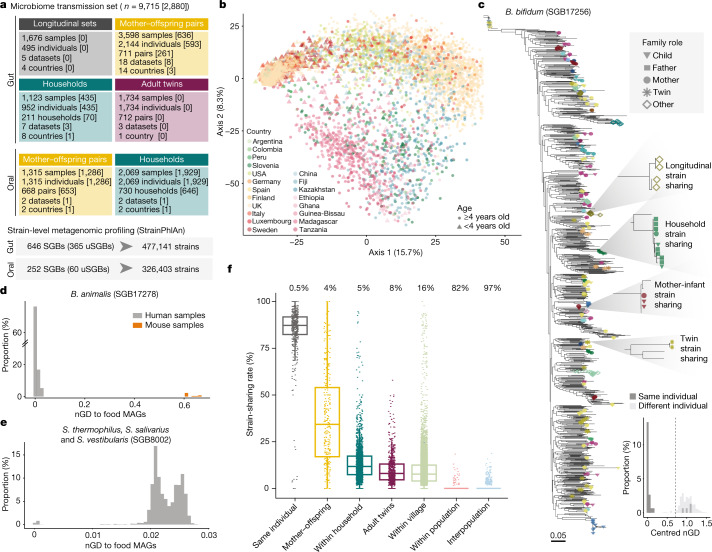
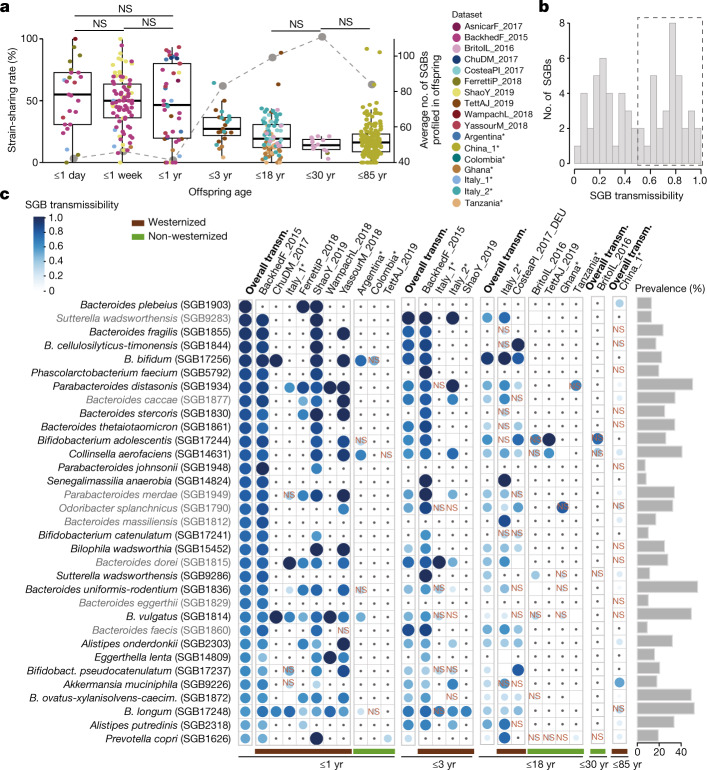
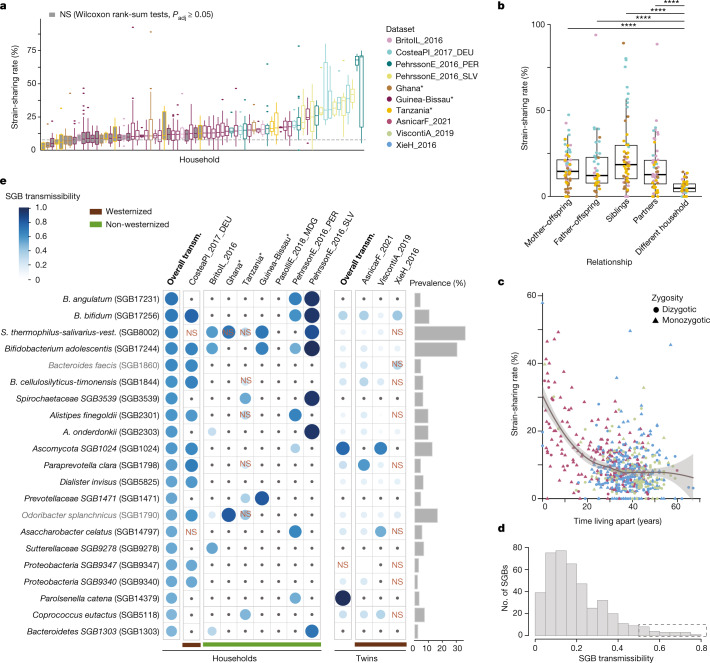
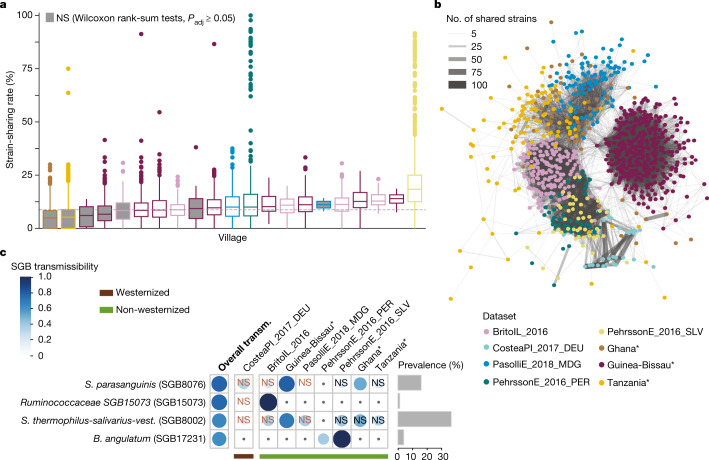
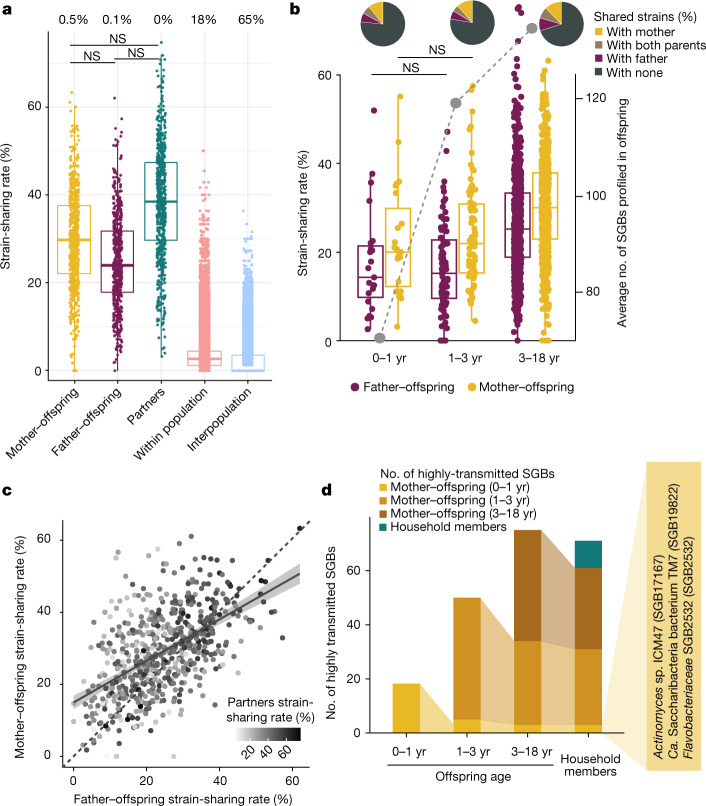
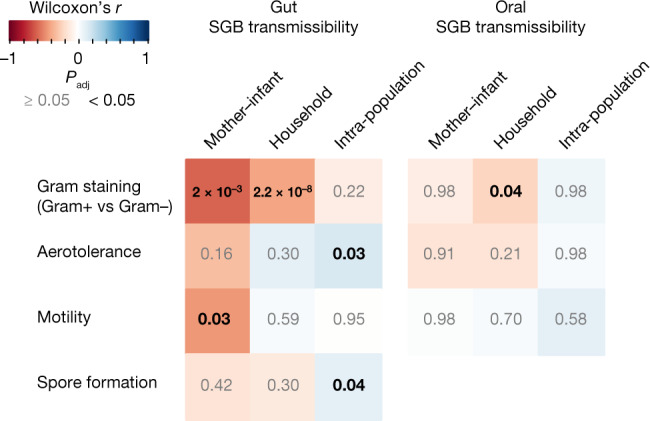
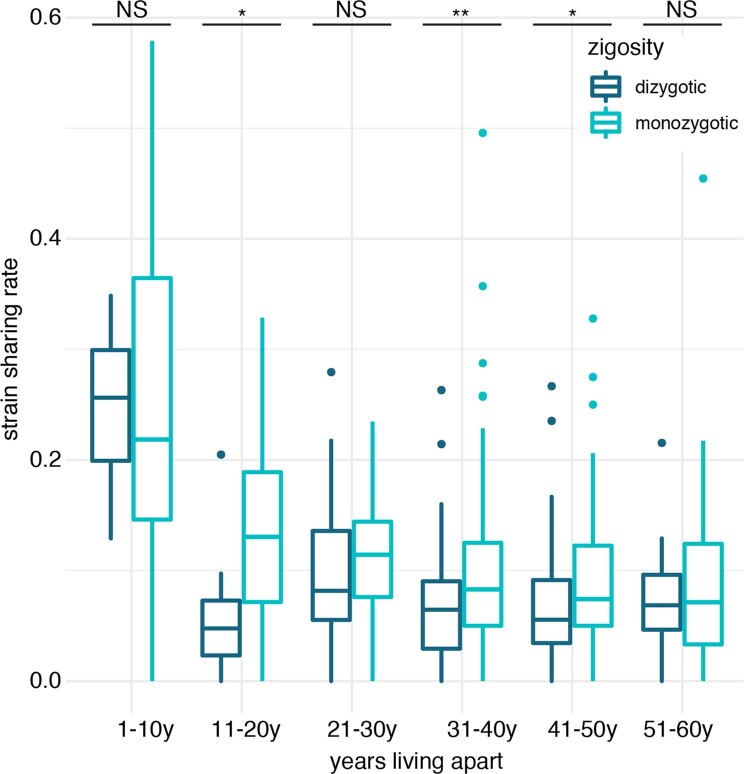
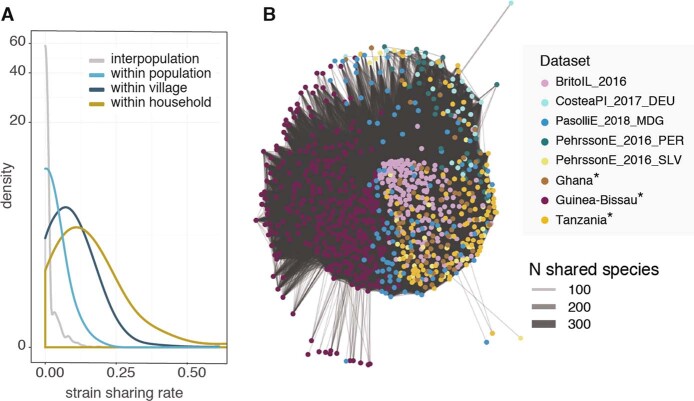
The human microbiome is an integral component of the human body and a co-determinant of several health conditions 1,2 . However, the extent to which interpersonal relations shape the individual genetic makeup of the microbiome and its transmission within and across populations remains largely unknown 3,4 . Here, capitalizing on more than 9,700 human metagenomes and computational strain-level profiling, we detected extensive bacterial strain sharing across individuals (more than 10 million instances) with distinct mother-to-infant, intra-household and intra-population transmission patterns. Mother-to-infant gut microbiome transmission was considerable and stable during infancy (around 50% of the same strains among shared species (strain-sharing rate)) and remained detectable at older ages. By contrast, the transmission of the oral microbiome occurred largely horizontally and was enhanced by the duration of cohabitation. There was substantial strain sharing among cohabiting individuals, with 12% and 32% median strain-sharing rates for the gut and oral microbiomes, and time since cohabitation affected strain sharing more than age or genetics did. Bacterial strain sharing additionally recapitulated host population structures better than species-level profiles did. Finally, distinct taxa appeared as efficient spreaders across transmission modes and were associated with different predicted bacterial phenotypes linked with out-of-host survival capabilities. The extent of microorganism transmission that we describe underscores its relevance in human microbiome studies 5 , especially those on non-infectious, microbiome-associated diseases.
Overview
The claims and statistics of this paper haven’t been checked yet.
Free: it reads the open-access text and checks the first 5 claims that cite a source we can check. Create a free account to check every claim.
Integrity signals
Registry
Cites
Statistics
Figures
Verification
Claims the paper makes
The claims and statistics of this paper haven’t been checked yet.
Free: it reads the open-access text and checks the first 5 claims that cite a source we can check. Create a free account to check every claim.
Claims other papers make about this one
Each is checked against this paper’s own text: does it say what the citing paper says it does?
The source backs part of the claim, not all of it — or backs it for a different population, condition or comparison.
In the citing paper
“adult microbial communities seem to be predominantly shaped by prior stochastic environmental exposures, as well as multiple other factors such as diet, antibiotic therapy and host genetics, with direct 'inheritance' from the mother at birth playing a lesser role.”
From Human microbiome myths and misconceptions (2023) · cites this paper as [15]
Experimental — accuracy not yet measuredThe source backs part of the claim, not all of it — or backs it for a different population, condition or comparison.
In the citing paper
“proportionally few microbiota species are truly 'heritable' and persist through from birth to adulthood in the offspring 15,16 .”
From Human microbiome myths and misconceptions (2023) · cites this paper as [15]
Experimental — accuracy not yet measuredThe cited source says what the claim attributes to it.
In the citing paper
“Although some microbes are directly transferred from mother to baby during birth 14,15 ,”
From Human microbiome myths and misconceptions (2023) · cites this paper as [15]
The cited source says what the claim attributes to it.
In the citing paper
“However, the recently described horizontal and vertical person-to-person microbial transmission 42 is likely not the only source of microbiome diversity, 43”
From Unexplored microbial diversity from 2,500 food metagenomes and links with the human microbiome. (2024) · cites this paper as [42]
The cited source says what the claim attributes to it.
In the citing paper
“A large fraction of the infant gut microbiome contained food SGBs (mean = 56%, Figure 5C), despite direct acquisition from food being only one of the possible routes of transmission (e.g., vertical and horizontal transmission 42,44,122 ).”
From Unexplored microbial diversity from 2,500 food metagenomes and links with the human microbiome. (2024) · cites this paper as [42]
2 more claims about this paper
Create a free account to see every claim other papers make about this one.
Self-check
Percentages, sums and reported differences re-computed from the paper’s own numbers.
The self-check needs the paper’s full text.
Citations
Cites
Fast gapped-read alignment with Bowtie 2
Langmead, B., & Salzberg, S. L. (2012) · Nature Methods · doi:10.1038/nmeth.1923 · Cited by 56,400 · cited 1×
“This was done by a procedure that first divided core genes into fragments of 150 nt and then aligned the fragments against the genomes of all SGBs using Bowtie2 (version 2.3.5.1; -sensitive option) 66 .”
MethodInfluentialphyloseq: An R Package for Reproducible Interactive Analysis and Graphics of Microbiome Census Data
McMurdie, P. J., & Holmes, S. (2013) · PLoS ONE · doi:10.1371/journal.pone.0061217 · Cited by 21,322 · cited 1×
“28.0) 126 , using one randomly selected sample per individual ( n = 4,840 gut samples, n = 2,069 oral samples).”
MethodInfluentialProkka: rapid prokaryotic genome annotation
Seemann, T. (2014) · Bioinformatics · doi:10.1093/bioinformatics/btu153 · Cited by 18,818
Fast and sensitive protein alignment using DIAMOND
Buchfink, B., Xie, C., & Huson, D. H. (2015) · Nature Methods · doi:10.1038/nmeth.3176 · Cited by 14,201 · cited 1×
“Coding sequences were then assigned to a UniRef90 cluster 90 by performing a Diamond search (version 0.9.24) 91 of the coding sequences against the UniRef90 database (version 201906) and assigning a UniRef90 ID if the mean sequence identity to the centroid sequence was above 90% and covered more…”
MethodInfluentialParks, D. H., Imelfort, M., Skennerton, C. T., Hugenholtz, P., & Tyson, G. W. (2015) · Genome Research · doi:10.1101/gr.186072.114 · Cited by 12,496
Diet rapidly and reproducibly alters the human gut microbiome
David, L. A., Maurice, C. F., Carmody, R. N., Gootenberg, D. B., Button, J. E., Wolfe, B. E., Ling, A. V., Devlin, A. S., Varma, Y., Fischbach, M. A., et al. (2014) · Nature · doi:10.1038/nature12820 · Cited by 10,100 · cited 1×
“711 pairs [261] 18 datasets [8] 14 countries [3]”
Human gut microbiome viewed across age and geography
Yatsunenko, T., Rey, F. E., Manary, M. J., Trehan, I., Dominguez-Bello, M. G., Contreras, M., Magris, M., Hidalgo, G., Baldassano, R. N., Anokhin, A. P., et al. (2012) · Nature · doi:10.1038/nature11053 · Cited by 7,815 · cited 3×
“3e) in concordance with their divergent microbiome composition 30,45,50,51 .”
BackgroundInfluentialMMseqs2 enables sensitive protein sequence searching for the analysis of massive data sets
Steinegger, M., & Söding, J. (2017) · Nature Biotechnology · doi:10.1038/nbt.3988 · Cited by 4,840
metaSPAdes: a new versatile metagenomic assembler
Nurk, S., Meleshko, D., Korobeynikov, A., & Pevzner, P. A. (2017) · Genome Research · doi:10.1101/gr.213959.116 · Cited by 4,496 · cited 1×
“MAGs from the Italian mother–infant dataset, and those of non-human hosts were assembled using MEGAHIT 85 , while those of the Italian centenarian dataset and non-westernized populations were assembled with metaSPAdes 86 , using default parameters in both cases.”
MethodKang, D. D., Li, F., Kirton, E., Thomas, A., Egan, R., An, H., & Wang, Z. (2019) · PeerJ · doi:10.7717/peerj.7359 · Cited by 3,750 · cited 1×
“Assembled contigs longer than 1,500 nucleotides were binned into MAGs using MetaBAT2 87 .”
Method
Research works printed but not linked: 2
- Bergey, D. H. et al. Bergey’s Manual of Systematic Bacteriology (Lippincott Raven, 1989).
- Csardi G Nepusz T The igraph software package for complex network research InterJournal Complex Syst. 2006 1695 1 9
Cited by
Items 401–500 of 514
Jans, D. S., Depovere, J., Lee, H., Abakkouy, Y., Becelaere, S., David, M., Vancamelbeke, M., Degry, J., Ferrante, M., Sabino, J., et al. (2025) · Journal of Crohn s and Colitis · doi:10.1093/ecco-jcc/jjaf165
de Castro, Í. M. S. (2025) · Digital Library of Theses and Dissertations (Universidade de São Paulo) · doi:10.11606/t.95.2025.tde-05092025-155937
Persistent pathogens in children with recurrent respiratory diseases in various living conditions
Михайлович, Л. А., Yershovа, I. B., & Rogovtsova, A. G. (2025) · Journal Infectology · doi:10.22625/2072-6732-2025-17-3-90-96
Association Between Ocular Microbiomes of Children and Their Siblings and Parents
Ling, X., Zhang, Y., Bui, C. H. T., Chan, H.-N., Tam, P. O. S., Yu, P., Zhang, X. J., Yim, C. C., Kam, K. W., Chu, W. K., et al. (2025) · Investigative Ophthalmology & Visual Science · doi:10.1167/iovs.66.12.59
Distinct trajectory of gut microbiota driven by a human oral commensal: insights from a murine study
Lin, W., Lee, S., Li, C., Chang, C.-B., Chien, H.-C., Wang, J., Hsieh, S., Wu, S., & Tseng, Y.-C. (2025) · Journal of Oral Microbiology · doi:10.1080/20002297.2025.2569524
“Environmental factors, including delivery mode and social interactions, facilitate microbiota transmission [4,5].”
Hanski, E., Ponsero, A. J., Kolho, K., de Vos, W. M., & Salonen, A. (2025) · bioRxiv (Cold Spring Harbor Laboratory) · doi:10.1101/2025.10.31.685886
Esteban-Torres, M., Blanco, I., Asensio‐Grau, A., Ruiz, N., Bernabeu, M., & Calvo‐Lerma, J. (2025) · Microorganisms · doi:10.3390/microorganisms13112523
Synergism and antagonism in intestinal microbial communities in closed organized collectives
Ermolaev, A. V., Kaiumov, K. A., Lyamin, A. V., & Gorbachev, D. O. (2025) · Russian Journal of Infection and Immunity · doi:10.15789/2220-7619-saa-17874
Environmental Risk Factors for Inflammatory Bowel Diseases in Jordan: A Matched Case–control Study
Refaei, A. H. A., Shewaikani, N., Alshurafa, A. H., Issa, M. S. A. B., Attal, M., Hejazi, O. I., Afaneh, O. B., Alaridah, N., Al‐Rshaidat, M. M. D., & Rayyan, Y. M. (2025) · JAP Academy Journal · doi:10.4103/japaj.japaj_1_25
Bacterial strains in the human gut associate with host physiologyPreprint
Shoer, S., Godneva, A., Weinberger, A., Pollard, K. S., Pilpel, Y., & Segal, E. (2025) · bioRxiv (Cold Spring Harbor Laboratory) · doi:10.1101/2025.11.30.691432
“These results indicate that gut bacterial strains are largely stable over time, with minor gradual changes, in agreement with prior findings on smaller cohorts and smaller sets of species 16,19,26 .”
Additional file 3 of A genome catalog of the early-life human skin microbiome
Shen, Z., Robert, L., Stolpman, M., Che, Y., Allen, K. J., Saffery, R., Walsh, A., Young, A., Eckert, J., Deming, C., et al. (2024) · Figshare · doi:10.6084/m9.figshare.26636187
Wanelik, K. M., Raulo, A., Troitsky, T. S., Husby, A., & Knowles, S. C. L. (2023) · Figshare · doi:10.6084/m9.figshare.23273356
Wanelik, K. M., Raulo, A., Troitsky, T. S., Husby, A., & Knowles, S. C. L. (2023) · Figshare · doi:10.6084/m9.figshare.23273353
Wanelik, K. M., Raulo, A., Troitsky, T. S., Husby, A., & Knowles, S. C. L. (2023) · Figshare · doi:10.6084/m9.figshare.23273350
Scicchitano, D., Leuzzi, D., Babbi, G., Palladino, G., Turroni, S., Laczny, C. C., Wilmes, P., Correa, F., Leekitcharoenphon, P., Savojardo, C., et al. (2024) · Figshare · doi:10.6084/m9.figshare.26699870
Martínez‐Renau, E., Martín-Platero, A. M., Bodawatta, K. H., Martín‐Vivaldi, M., Martínez-Bueno, M., Poulsen, M., & Soler, J. J. (2024) · DIGITAL.CSIC (Spanish National Research Council (CSIC)) · doi:10.6084/m9.figshare.26777599
Martínez‐Renau, E., Martín-Platero, A. M., Bodawatta, K. H., Martín‐Vivaldi, M., Martínez-Bueno, M., Poulsen, M., & Soler, J. J. (2024) · DIGITAL.CSIC (Spanish National Research Council (CSIC)) · doi:10.6084/m9.figshare.26777611
Martínez‐Renau, E., Martín-Platero, A. M., Bodawatta, K. H., Martín‐Vivaldi, M., Martínez-Bueno, M., Poulsen, M., & Soler, J. J. (2024) · DIGITAL.CSIC (Spanish National Research Council (CSIC)) · doi:10.6084/m9.figshare.26777608
Additional file 2 of A genome catalog of the early-life human skin microbiome
Shen, Z., Robert, L., Stolpman, M., Che, Y., Allen, K. J., Saffery, R., Walsh, A., Young, A., Eckert, J., Deming, C., et al. (2024) · Figshare · doi:10.6084/m9.figshare.26636184
Scicchitano, D., Leuzzi, D., Babbi, G., Palladino, G., Turroni, S., Laczny, C. C., Wilmes, P., Correa, F., Leekitcharoenphon, P., Savojardo, C., et al. (2024) · Figshare · doi:10.6084/m9.figshare.26699864
Scicchitano, D., Leuzzi, D., Babbi, G., Palladino, G., Turroni, S., Laczny, C. C., Wilmes, P., Correa, F., Leekitcharoenphon, P., Savojardo, C., et al. (2024) · Figshare · doi:10.6084/m9.figshare.26699873
Scicchitano, D., Leuzzi, D., Babbi, G., Palladino, G., Turroni, S., Laczny, C. C., Wilmes, P., Correa, F., Leekitcharoenphon, P., Savojardo, C., et al. (2024) · Figshare · doi:10.6084/m9.figshare.26699867
Martínez‐Renau, E., Martín-Platero, A. M., Bodawatta, K. H., Martín‐Vivaldi, M., Martínez-Bueno, M., Poulsen, M., & Soler, J. J. (2024) · DIGITAL.CSIC (Spanish National Research Council (CSIC)) · doi:10.6084/m9.figshare.26777602
Martínez‐Renau, E., Martín-Platero, A. M., Bodawatta, K. H., Martín‐Vivaldi, M., Martínez-Bueno, M., Poulsen, M., & Soler, J. J. (2024) · DIGITAL.CSIC (Spanish National Research Council (CSIC)) · doi:10.6084/m9.figshare.26777605
Wanelik, K. M., Raulo, A., Troitsky, T. S., Husby, A., & Knowles, S. C. L. (2023) · Figshare · doi:10.6084/m9.figshare.23273347
Martínez‐Renau, E., Martín-Platero, A. M., Bodawatta, K. H., Martín‐Vivaldi, M., Martínez-Bueno, M., Poulsen, M., & Soler, J. J. (2024) · DIGITAL.CSIC (Spanish National Research Council (CSIC)) · doi:10.6084/m9.figshare.26777614
Additional file 1 of A genome catalog of the early-life human skin microbiome
Shen, Z., Robert, L., Stolpman, M., Che, Y., Allen, K. J., Saffery, R., Walsh, A., Young, A., Eckert, J., Deming, C., et al. (2024) · Figshare · doi:10.6084/m9.figshare.26636181
Effects of the antibiotic tetracycline on the honey bee gut microbiome
Gregory, C. L. (2024) · VTechWorks (Virginia Tech)
Garcias, B. (2024) · Tesis Doctorals en Xarxa (Consorci de Serveis Universitaris de Catalunya)
Lineage-level within-species dynamics in the human facial skin microbiome
Baker, J. S. (2024) · DSpace@MIT (Massachusetts Institute of Technology)
Predicting and exploiting interactions between medicines and the microbiome
McCoubrey, L. E. (2023) · UCL Discovery (University College London)
La microbiota en la encrucijada de la obesidad
Sanz Herranz, Y. (2025) · DIGITAL.CSIC (Spanish National Research Council (CSIC))
Imprints on the gut microbiome : A study of sleep apnea, physical activity, and antibiotic use
Baldanzi, G. (2024) · Uppsala University Publications (Uppsala University)
Ling, C., Xu, L., 杜如冰, Xu, Y., & Wu, Q. (2026) · Microbiome · doi:10.1186/s40168-026-02504-8
Perlin, C. M. (2025) · Lume (Universidade Federal do Rio Grande do Sul)
Vuorinen, V. (2025) · UTUPub (University of Turku)
Raskausajan suolistomikrobisto ja kehittyvä sikiö
Fagerlund, O. (2025) · UTUPub (University of Turku)
Zhai, Q., Wang, K., Liu, J., Ren, F., Li, X., Chen, J., Wang, L., Liu, X., Wang, J., Chen, B., et al. (2026) · Research Square · doi:10.21203/rs.3.rs-8401969/v1
Barker‐Tejeda, T. C., Mamani‐Huanca, M., Macías‐Camero, A., Hernández, M. D., Horvat, T., Zubeldia‐Varela, E., Angulo, S. M., Bazire, R., Cabrera‐Freitag, P., Barber, D., et al. (2026) · Microchemical Journal · doi:10.1016/j.microc.2026.116957
Martínez‐Martínez, D., Backes, C., Zečić, A., Aprodu, A., Doherty, H. M., Widder, J., Andrew, I., Gamé, L., Kaneva, I., Roumelioti, G., et al. (2026) · bioRxiv (Cold Spring Harbor Laboratory) · doi:10.64898/2026.01.15.699719
Plećaš, D., & Polašek, O. (2026) · Journal of Molecular Pathology · doi:10.3390/jmp7010004
“However, more detailed analyses have shown a much lower degree of sharing than might be expected: between about 10% and 30% of bacterial strains are transmitted even in cases of close and intimate contact, with stronger sharing in closer spousal relationships [12–14].”
Le, N. P. K. (2025) · FreiDok plus (Universitätsbibliothek Freiburg) · doi:10.6094/unifr/272846
Kim, D. D., Worby, C. J., Wharton, H. C., Miklos, A. M., Chieng, B., Njenga, S. M., Earl, A. M., & Pickering, A. J. (2026) · medRxiv · doi:10.64898/2026.02.08.26345864
“We observed pathogenic species strain sharing patterns to be consistent with highly localized, age-structured transmission networks; 12,13 younger children were identified to be drivers of community-level spread.”
Flierl, E., Lutz, R., Heller, K. M., Schiffer, M., Wirtz, S., Backhaus, J., Weber, M., Kesting, M. R., & Moest, T. (2026) · Clinical Oral Investigations · doi:10.1007/s00784-026-06767-1
Project MEPROT: Shaping the Future of Early Onset Colorectal Cancer PreventionPreprint
Jovanović, I. (2026) · doi:10.24108/preprints-3114629
Blanco-Fuertes, M., González-Comino, G., Brotons, P., Lluansí, A., Varo, R., Henares, D., Launes, C., Cisneros, M., de Sevilla, M. F., García‐García, J. J., et al. (2026) · Journal of Oral Microbiology · doi:10.1080/20002297.2026.2635242
“…intra-household similarity in our results could be also explained by the geographical restriction of our samples to the Metropolitan Area of Barcelona, as the Valles-Colomer et al. [48] study included households from different cities, potentially increasing microbiota diversity across locations.”
InfluentialSeasonal dynamics in lettuce phyllosphere microbiota and potential transfer to the human gut
In, S.-A., Park, J.-W., Yun, Y.-E., Lee, Y.-E., Park, E., & Kim, M. (2026) · npj Science of Food · doi:10.64898/2026.03.05.709721
Ventura, E. F., Ruiz-Saavedra, S., Cabrera‐Rubio, R., Martínez‐Costa, C., González, S., & Collado, M. C. (2026) · European Journal of Nutrition · doi:10.1007/s00394-026-03909-9
Self-citationPhenome-wide genetic framework to identify mechanisms of social effectsPreprint
Tonnelé, H., Casale, F. P., & Baud, A. (2026) · bioRxiv (Cold Spring Harbor Laboratory) · doi:10.64898/2026.03.10.710784
Couples share 30% of their gut bacteria. Here’s how that may affect health
Meehan, C. J., & Mwerinde, J. (2026) · The Conversation · doi:10.64628/ab.rrn69tja3
Systematic detection of abnormal samples reveals widespread mislabeling in metagenomic studiesPreprint
Zhou, Y., Chen, J., Wanxin, L., Du, S., & Ye, W. (2026) · bioRxiv (Cold Spring Harbor Laboratory) · doi:10.64898/2026.03.22.713545
Chen, Y., Duan, R., Zhang, C., Li, G., Ji, X., Zhang, Q. D., Pei, F., Wang, K., & Duan, L. P. (2026) · Advanced Science · doi:10.1002/advs.202516931
Gitton-Quent, O. (2023) · theses.fr (ABES) · doi:10.70675/536e095fz1980z46a0za2daz41cbc1fb26b5
Delaroque, C. (2024) · theses.fr (ABES) · doi:10.70675/a6243be7z43e4z4245za0f4zc5e315cd66ef
Análisis del rol de la vitamina C como agente antioxidante en pacientes con enfermedad periodontal
Zebadua-Castellanos, H. C., Beltrán-Sarmiento, E., & Vargas-Hernández, M. A. (2025) · Revista de Sanidad Militar · doi:10.56443/zh5xr133
Duan, R., Wang, K., & Duan, L. P. (2026) · Medical Review · doi:10.1515/mr-2026-0008
“This indicates that ecological niche-adapted microbes derived from the maternal strain reservoir have a natural selection for colonization in the infant gut [15, 17].”
Overview of head & neck microbiota
Jayasinghe, R., Gunawardhana, K. S. N. D., & Senevirathna, K. (2026) · Advances in immunology · doi:10.1016/bs.ai.2026.04.003
Oral cavity dysbiosis and metabolic disorders in type 2 diabetes
Isaeva, R. A., Valeeva, F. V., Isaeva, G. S., Михайлович, З. А., & Tsarev, V. N. (2026) · Meditsinskiy sovet = Medical Council · doi:10.21518/ms2026-047
Inheritance: An Ecological Perspective
Gilbert, S. F., & Pfennig, D. W. (2026) · Oxford University Press eBooks · doi:10.1093/oso/9780197664025.003.0007
Merino, M. V., Weißenberger, S., Ermolova, A., Dhilly, E., Spadazzi, R., Levy, L., Collado, M. C., Hertz, T., Omer, H., Heidrich, V., et al. (2026) · bioRxiv (Cold Spring Harbor Laboratory) · doi:10.64898/2026.06.03.729775
Self-citationQiu, Y., Cai, W., Xie, Z., Li, C., Yang, F., Qian, Y., Song, J., & Zheng, T. (2026) · Frontiers in Medicine · doi:10.3389/fmed.2026.1845205
“Accumulating evidence links microbial communities in sites such as the gut and oral cavity to various systemic diseases (19, 20).”
Jablonska, S., Shanbhag, N., Kula, A., & Putonti, C. (2026) · Microbiology Spectrum · doi:10.1128/spectrum.00114-26
Population-based characterisation of child and adolescent oral bacterial microbiomes
Wright, R. J., DeClercq, V., Burton, C. L., Roslin, N. M., Chan, A. W. Y., Arnold, P. D., Peters, P., Schachar, R. J., Crosbie, J., & Langille, M. G. I. (2026) · Microbiome · doi:10.1186/s40168-026-02452-3
“…impact of shared household even when individuals no longer cohabit [67] and is enhanced by duration of cohabitation; while this may be through mechanisms such as shared diet and hygiene routines, Valles-Colomer et al. suggest that it is through oral contact and person-to-person transmission [68].”
Schiro, G., Placko, A., Boutin, S. A., Dantzer, B., Lane, J., McAdam, A. G., & Petrullo, L. A. (2026) · bioRxiv (Cold Spring Harbor Laboratory) · doi:10.64898/2026.07.02.736155
From Womb to World: Unravelling the Microbiota′s Impact on Health and Disease
Poterico, J. A., Babu, R. V., Jaramillo‐Valverde, L., Sánchez, C., Alayo, E. C., Valdivia‐Silva, J., & Guio, H. (2026) · International Journal of Microbiology · doi:10.1155/ijm/9228548
“Young children may have up to 50% of similar bacteria to their mothers, and unrelated cohabitants have between 12% and 32% microbiota similarity [35].”
Wright, S., Joslin, M., Kim, Y., Olson, M. J., Hall, A., Peter, B., & Whisner, C. M. (2026) · PLoS ONE · doi:10.1371/journal.pone.0353463
Sato, Y., Uda, Y., & Nagao, Y. (2026) · Microbiology Spectrum · doi:10.1128/spectrum.01677-26
Chaney, C., Ong, J., Kwak, L., Grathwohl, K., Sh, W., Betts, K., Beauregard, J. A., Nemeth, K. L., Waimon, S., Zhang, A., et al. (2026) · medRxiv · doi:10.64898/2026.07.20.26358501
Stothart, M. R., McLoughlin, P. D., Wilson, A. J., & Poissant, J. (2026) · bioRxiv (Cold Spring Harbor Laboratory) · doi:10.64898/2026.07.27.740960
“For example, in humans, co-habitation and social intimacy creates signatures of bacterial strain-sharing that can persist for decades after separation 23,24 .”
“WHAT’S SUPP” DEVELOPING AN IN VITRO MODEL FOR HEALTHY ORAL BIOFILMS
Labossiere, A. (2025) · Digital Commons - URI (University of Rhode Island) · doi:10.23860/diss-4527
Ecological succession and topological rewiring of the oral microbiome in giant panda cubs
Chen, H., Liu, J., Hou, R., Chen, F., Qi, D., Chen, Y., Bi, W., Zhou, Y., Gu, J., Lan, G., et al. (2026) · BMC Microbiology · doi:10.1186/s12866-026-05477-8
“To evaluate the chronological assembly of the dental plaque microbiome, a dynamic microbial source tracking approach based on a Non-Negative Least Squares (NNLS) optimization algorithm was developed via the scipy.optimize.nnls module [34].”
Tochitani, S., Yamamoto, Y., Saito, K., & Nagaoka, K. (2026) · Brain Behavior and Immunity · doi:10.1016/j.bbi.2026.106936
Kazimov, A. E., Vysochanskaya, S. O., Petrova, D. A., Malinovskaya, A. D., & Zhernov, Y. V. (2026) · Hygiene and Sanitation · doi:10.47470/0016-9900-2026-105-6-690-695
Zvulunov, A., Saif, R., Olmer, L., Ben-David, M. A., Benyamini, L., Dori, A., Yarom, N., Greenbaum, L., Tzur, E., & Friedlander‐Barenboim, S. (2026) · Journal of Oral Rehabilitation · doi:10.1111/joor.70285
Alaei-Shahmiri, F., Samie, S., Jarollahi, A., Esmaeilzadeh-Kashi, M., & Khamseh, M. E. (2026) · Journal of Diabetes & Metabolic Disorders · doi:10.1007/s40200-026-02045-9
“…as causative; rather, the increased diabetes risk associated with a family history likely reflects polygenic inheritance in combination with nongenetic factors, including the maternal intrauterine environment, lifestyle behaviors, socio-economic status, and the shared microbiome [ 17 –22].”
Dysbiosis of the oral-gut microbiome axis in a mouse model of depression
Lei, P., Tong, S., Xi, W., Liu, Y., Yu, J., Yu, L., Zhao, B., Jia, M., Li, Y., Ma, X., et al. (2026) · PLoS ONE · doi:10.1371/journal.pone.0355302
“Large-scale metagenomic analyses, such as the study by Valles-Colomer et al. have documented extensive oral-to-gut microbial transmission in humans [51].”
The crosstalk between gut microbiota and hypertension: Mechanisms and therapeutic prospects
Li, Z., Wang, M., Yao, Y., Yan, K., Wang, S., Li, B., & Li, J. (2026) · Microbiological Research · doi:10.1016/j.micres.2026.128684
Sketching the SRA: experiment-wide similarity search across 4.8 million metagenomesPreprint
Faure, R., Nakshi, A. H., Abrar, M. H., Chikhi, R., Lemane, T., Taheri, M. M. H., Won, S., Wu, H., Koslicki, D., & Medvedev, P. (2026) · bioRxiv (Cold Spring Harbor Laboratory) · doi:10.64898/2026.10.07.757297
“It is likely that during upload of PRJEB45799, all accessions were mistakenly labeled with the same “human gut metagenome” tag, even as some of them corresponded to an oral metagenome, a hypothesis confirmed by the corresponding article [35].”
Chen, R., Kim, H. J., Bushra, M., Dang, C. P., Li, Q., Espin‐Garcia, O., Huynh, H. Q., Jacobson, K., Bitton, A., Panaccione, R., et al. (2026) · Gut · doi:10.1136/gutjnl-2026-339257
Luo, J., Tan, L., Xiao, K., Hu, Y., Wang, Q., Qin, Y., Zhang, H., Zhou, H., Tang, X., & Fan, X. (2026) · Food Science and Human Wellness · doi:10.26599/fshw.2026.9251179
Shu, L., & Fu, F. (2026) · SSRN Electronic Journal · doi:10.2139/ssrn.7675288
Gloria, L. D., Peruzzi, M., Vasarri, M., Menicatti, M., Bartolucci, G., Annunziata, M., Bedeschi, A., Ramazzotti, M., Degl’Innocenti, D., & Nassi, N. (2026) · International Journal of Microbiology · doi:10.1155/ijm/7551500
“Although this approach helps mitigate the bias introduced by differences in household environments [30], it also led to a slightly higher average age in the control group (mean 35, range 9–51) compared with the CCHS group (mean 24, range 11–40).”
Bilinsky, L., Shamay, T., Reshef, L., Rabinowitz, K., Vider, E. D., Ben-Shachar, A., Friedenberg, A., Pauker, M. H., Barkan, R., Yanai, H., et al. (2026) · Gastroenterology · doi:10.1053/j.gastro.2026.08.031
Chen, D., Wang, Y., Portik, D. M., Nearing, J. T., Nickols, W. A., Wilkinson, J. E., Christiani, D. C., Nguyen, L. H., Franzosa, E. A., Spengler, J. D., et al. (2026) · Research Square · doi:10.21203/rs.3.rs-10207669/v1
Jagan, L., Upreti, S., MUGLIKAR, A., Patel, D., & Manor, O. (2026) · bioRxiv (Cold Spring Harbor Laboratory) · doi:10.64898/2026.09.16.751977
“This approach is particularly relevant to gut microbiome research because cohabitation itself can influence microbial community structure and transmission, with cohabiting individuals showing substantial strain-level microbial sharing (Valles-Colomer et al., 2023).”
Dominguez, J. H., Wall, C. B., Demmel, M. Y., & Shurin, J. B. (2026) · bioRxiv (Cold Spring Harbor Laboratory) · doi:10.64898/2026.09.25.754487
Cannon, M. L., Peldyak, J., & Vigerust, D. J. (2026) · Dentistry Journal · doi:10.3390/dj14100625
Odendaal, M.-L., Binkowska, J. M., 张建华, Groot, J. A., Chu, M. L. J., van der Klis, F. R. M., Bogaert, D., & van den Beld, M. J. C. (2026) · The Lancet Microbe · doi:10.1016/j.lanmic.2026.101517
Diana, M. A. (n.d.) · UnissResearch (Università degli Studi di Sassari)
Assessing the role of gut barrier integrity in the pathogenesis of autoimmune diabetes.
CONTE, M. L. (n.d.) · Archivio Istituzionale della Ricerca - Università Vita-Salute San Raffaele
Krauß, P., Breier, A., Hohlfeld, A.-L., Keller, H., Kunkel, V., Meier, M., Plettemeier, S., Thomas, W., & Debray, R. (2026) · bioRxiv (Cold Spring Harbor Laboratory) · doi:10.64898/2026.10.06.757053
Dou, S., Ma, G., & Li, S. (2026) · Legal Medicine Research · doi:10.20517/lmr.2026.06
Verhaar, B. J. H., Boulund, U., Herrema, H., Nicolaou, M., Zwinderman, A. H., van den Born, B. H., Hamdiui, N., Elinav, E., Nielsen, T., & Nieuwdorp, M. (2026) · bioRxiv (Cold Spring Harbor Laboratory) · doi:10.64898/2026.10.12.757716
Metadata
- Authors
- Valles-Colomer, M., Blanco-Míguez, A., Manghi, P., Asnicar, F., Dubois, L., Golzato, D., Armanini, F., Cumbo, F., Huang, K. D., Manara, S., Masetti, G., Pinto, F., Piperni, E., Punčochář, M., Ricci, L., Zolfo, M., Farrant, O., Goncalves, A., Selma-Royo, M., Binetti, A. G., Becerra, J. E., Han, B., Lusingu, J., Amuasi, J., Amoroso, L., Visconti, A., Steves, C. M., Falchi, M., Filosi, M., Tett, A., Last, A., Xu, Q., Qin, N., Qin, H., May, J., Eibach, D., Corrias, M. V., Ponzoni, M., Pasolli, E., Spector, T. D., Domenici, E., Collado, M. C., & Segata, N.
- Affiliations
- University of Trento (IT)
- European Institute of Oncology (IT)
- London School of Hygiene & Tropical Medicine (GB)
- Consejo Nacional de Investigaciones Científicas y Técnicas (AR)
- Universidad Metropolitana (CO)
- Xi'an Jiaotong University (CN)
- National Institute for Medical Research (TZ)
- Kwame Nkrumah University of Science and Technology (GH)
- Istituto Giannina Gaslini (IT)
- King's College London (GB)
- University of Vienna (AT)
- Tongji University (CN)
- Bernhard Nocht Institute for Tropical Medicine (DE)
- University of Naples Federico II (IT)
- Corresponding author
- Segata, Nicola
- ORCID
- Valles-Colomer, Mireia
- Blanco-Míguez, Aitor
- Manghi, Paolo
- Asnicar, Francesco
- Golzato, Davide
- Armanini, Federica
- Cumbo, Fabio
- Huang, Kun D.
- Manara, Serena
- Masetti, Giulia
- Pinto, Federica
- Piperni, Elisa
- Punčochář, Michal
- Ricci, Liviana
- Zolfo, Moreno
- Farrant, Olivia
- Binetti, Ana G.
- Becerra, Jimmy E.
- Han, Bei
- Lusingu, John
- Amuasi, John
- Amoroso, Loredana
- Visconti, Alessia
- Falchi, Mario
- Filosi, Michele
- Tett, Adrian
- Last, Anna
- Xu, Qian
- Qin, Nan
- Qin, Huanlong
- May, Jürgen
- Eibach, Daniel
- Corrias, Maria Valeria
- Ponzoni, Mirco
- Pasolli, Edoardo
- Spector, Tim D.
- Domenici, Enrico
- Segata, Nicola
- Venue
- Nature
- Published
- 2023-01-18
- Volume
- 614
- Issue
- 7946
- Pages
- 125-135
- ISSN
- 0028-0836 (ISSN-L)
- 1476-4687
- PMC
- PMC9892008
- OpenAlex
- W4317242243
- Semantic Scholar
- fc34a4d655e2ec47ece6745db96ef00dde2c8fb4
- Cited by
- 449
- References
- 128
- Citations by year
- 2026: 98 · 2025: 147 · 2024: 124 · 2023: 80
- FWCI
- 40.81
- Type
- journal article
- Language
- en
- Open access
- hybrid
- doi.org
- Licence
- cc-by
- creativecommons.org/licenses/by/4.0 (tdm)
- creativecommons.org/licenses/by/4.0 (vor)
- Locations
- Nature (publishedVersion, cc-by)
- PubMed Central (publishedVersion, cc-by)
- PubMed (publishedVersion)
- LSHTM Research Online (London School of Hygiene and Tropical Medicine) (acceptedVersion)
- DIGITAL.CSIC (Spanish National Research Council (CSIC)) (submittedVersion, cc-by)
- Iris (University of Trento) (submittedVersion, cc-by)
- RePEc: Research Papers in Economics (submittedVersion)
- Institutional Research Information System University of Turin (University of Turin) (submittedVersion, cc-by)
- Research Portal (King's College London) (submittedVersion, other-oa)
- Funders
- Simons Foundation
- National Institute for Health and Care Research (ACF-2022-21-007)
- Ministero dell’Istruzione, dell’Università e della Ricerca (H2020, RBFR13EWWI_001)
- Università degli Studi di Trento
- National Institutes of Health (1u01ca230551-01a1, H2020, 1U01CA230551)
- Horizon 2020 Framework Programme (OncoBiome 825410, 818368, ONCOBIOME-825410 project, MASTER-818368 project, 964590, 825410)
- Medical Research Council (MR/S005013/1, MR/N01183X/1)
- National Cancer Institute (1U01CA230551, U01 CA230551, R01CA230551)
- H2020 European Research Council (639226, 716575)
- HORIZON EUROPE European Research Council (101045015)
- Topics
- Life Sciences › Biochemistry, Genetics and Molecular Biology › Molecular Biology › Gut microbiota and health
- Health Sciences › Dentistry › Periodontics › Oral microbiology and periodontitis research
- Physical Sciences › Environmental Science › Ecology › Microbial Community Ecology and Physiology
- Keywords
- human-to-human transmission, gut microbiota, oral microbiota, mother-to-child transmission, cohabitation, host population structure, horizontal transmission
- MeSH terms
- Gastrointestinal Microbiome, Home Environment, Aging, Bacteria, Family Characteristics, Female, Humans, Infant, Mothers, Mouth, Time Factors, Infectious Disease Transmission, Vertical, Disease Transmission, Infectious, Microbial Viability, Metagenome, Microbiota
About these checks
Registry, retraction, Cites and statistics results are computed, not judged, with one exception: a printed reference that no index lists is read once by a model before it counts as a citation error. Claims are extracted by a model and kept only when their quote appears verbatim in the text; each cited source is then checked, with a model’s help, for whether it says what the claim relies on. Those verdicts can be wrong — read the claim’s quote and the cited source before relying on one.
Statistics and arithmetic are recomputed, not judged.
Confidence bands are shown only for fields calibrated on our annotated test set. None is calibrated yet, so no band is shown.
What counts as a claim ›How we measure confidence ›How we check this ›
Are you an author, or do you see a problem with this page? Request a review
Data sources
Bibliographic data: Semantic Scholar, OpenAlex, Crossref.
Contains information from the Semantic Scholar Academic Graph Datasets, made available under the ODC Attribution License (ODC-BY 1.0).
Semantic Scholar’s data is described in: Kinney, R., et al. (2023). The Semantic Scholar Open Data Platform. arXiv:2301.10140.
