

Accurate medium-range global weather forecasting with 3D neural networks
Open accessThe DOI matches its Crossref record; 41 of the 41 references it cites were found in a registry or an index.
Abstract
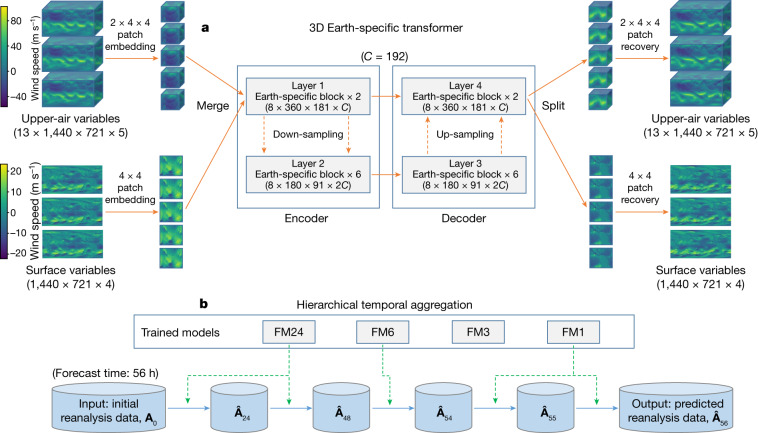
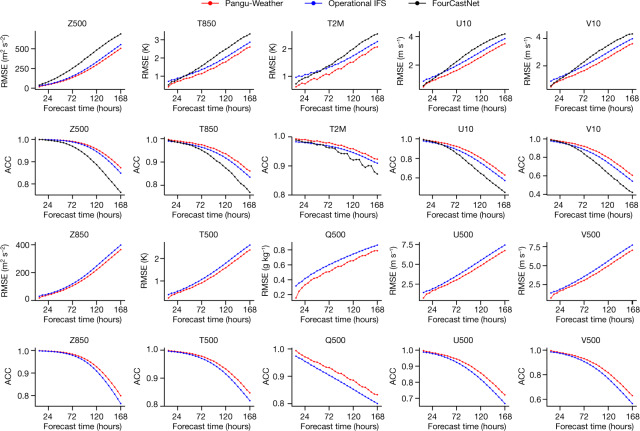
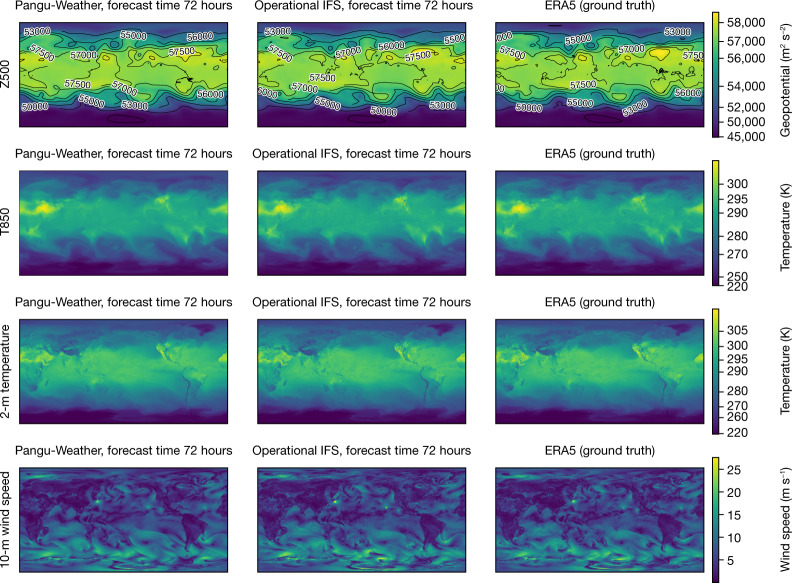
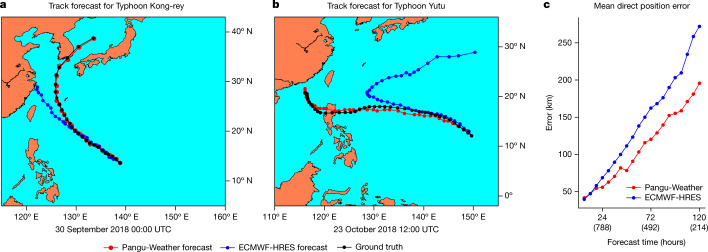
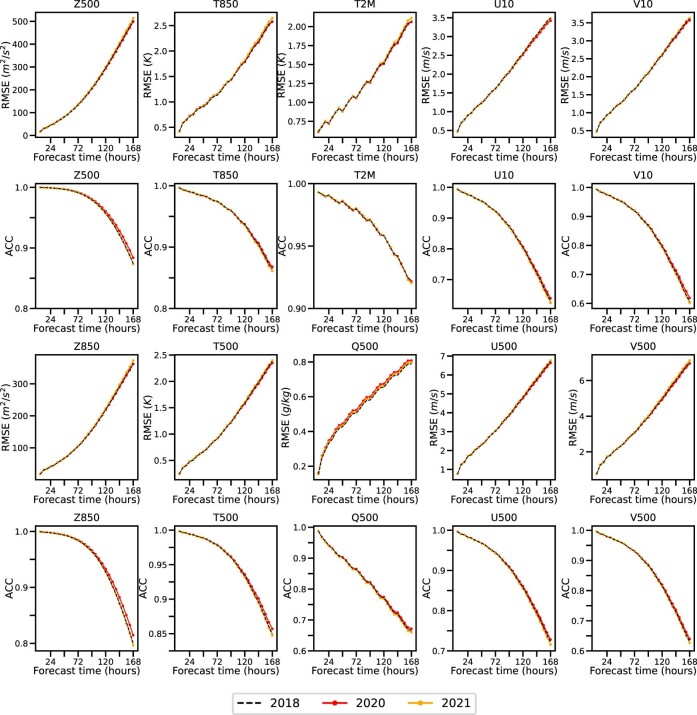
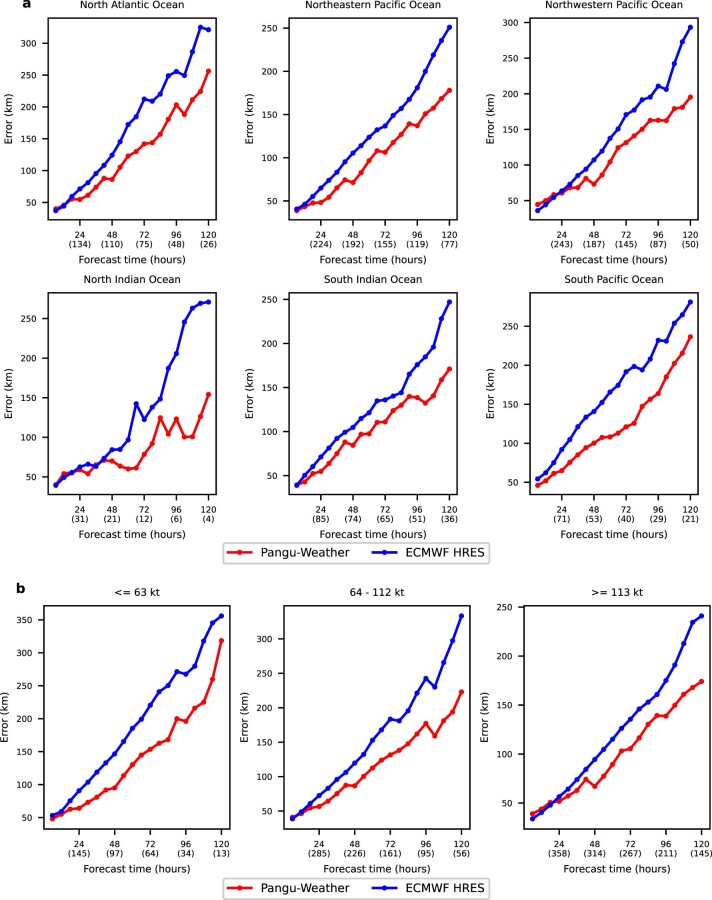
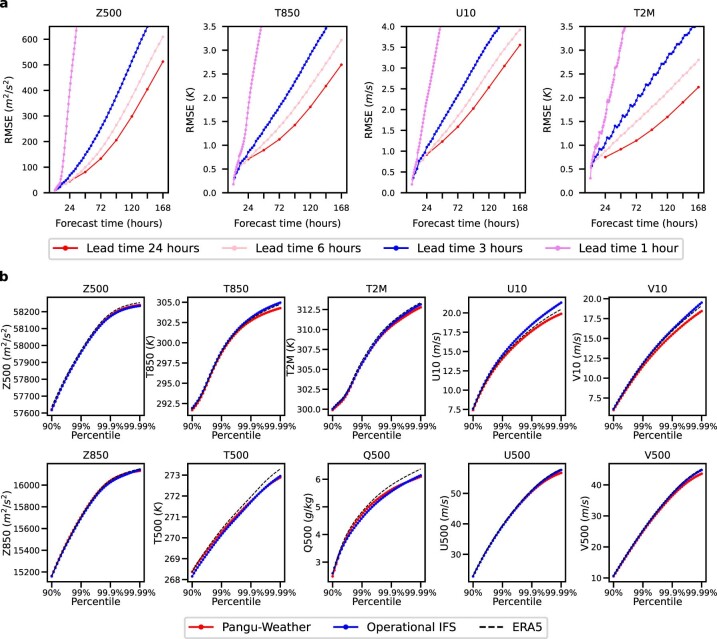
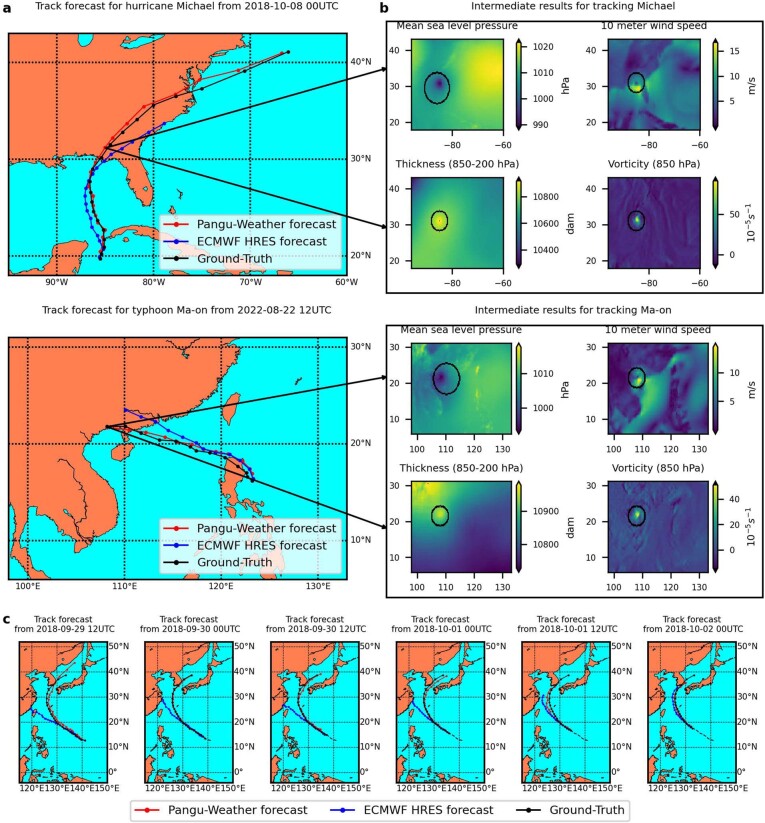
Weather forecasting is important for science and society. At present, the most accurate forecast system is the numerical weather prediction (NWP) method, which represents atmospheric states as discretized grids and numerically solves partial differential equations that describe the transition between those states 1 . However, this procedure is computationally expensive. Recently, artificial-intelligence-based methods 2 have shown potential in accelerating weather forecasting by orders of magnitude, but the forecast accuracy is still significantly lower than that of NWP methods. Here we introduce an artificial-intelligence-based method for accurate, medium-range global weather forecasting. We show that three-dimensional deep networks equipped with Earth-specific priors are effective at dealing with complex patterns in weather data, and that a hierarchical temporal aggregation strategy reduces accumulation errors in medium-range forecasting. Trained on 39 years of global data, our program, Pangu-Weather, obtains stronger deterministic forecast results on reanalysis data in all tested variables when compared with the world’s best NWP system, the operational integrated forecasting system of the European Centre for Medium-Range Weather Forecasts (ECMWF) 3 . Our method also works well with extreme weather forecasts and ensemble forecasts. When initialized with reanalysis data, the accuracy of tracking tropical cyclones is also higher than that of ECMWF-HRES.
Overview
The claims and statistics of this paper haven’t been checked yet.
Free: it reads the open-access text and checks the first 5 claims that cite a source we can check. Create a free account to check every claim.
Integrity signals
Registry
Cites
Statistics
Figures
Verification
Claims the paper makes
The claims and statistics of this paper haven’t been checked yet.
Free: it reads the open-access text and checks the first 5 claims that cite a source we can check. Create a free account to check every claim.
Claims other papers make about this one
Each is checked against this paper’s own text: does it say what the citing paper says it does?
The source backs part of the claim, not all of it — or backs it for a different population, condition or comparison.
In the citing paper
“However, they do not produce calibrated uncertainty estimates4, which is essential for useful weather forecasts1.”
From Neural general circulation models for weather and climate (2024) · cites this paper as [4]
Experimental — accuracy not yet measuredThe source backs part of the claim, not all of it — or backs it for a different population, condition or comparison.
In the citing paper
“Recently, machine-learning models trained on reanalysis data have achieved comparable or better skill than GCMs for deterministic weather forecasting3,4.”
From Neural general circulation models for weather and climate (2024) · cites this paper as [4]
Experimental — accuracy not yet measuredThe source backs part of the claim, not all of it — or backs it for a different population, condition or comparison.
In the citing paper
“Existing machine-learning models have focused on deterministic prediction, and surpass deterministic numerical weather prediction in terms of the aggregate metrics for which they are trained3,4.”
From Neural general circulation models for weather and climate (2024) · cites this paper as [4]
Experimental — accuracy not yet measuredThe source backs part of the claim, not all of it — or backs it for a different population, condition or comparison.
In the citing paper
“Most state-of-the-art machine learning models utilized in medium-range weather forecasting are built upon encoder-decoder84 architectures27–29,85.”
From A machine learning model that outperforms conventional global subseasonal forecast models (2024) · cites this paper as [28]
Experimental — accuracy not yet measuredThe source backs part of the claim, not all of it — or backs it for a different population, condition or comparison.
In the citing paper
“However, these advances have focused primarily on single, deterministic forecasts that fail to represent uncertainty and estimate risk.”
From Probabilistic weather forecasting with machine learning (2025) · cites this paper as [3]
Experimental — accuracy not yet measured
4 more claims about this paper
Create a free account to see every claim other papers make about this one.
Self-check
Percentages, sums and reported differences re-computed from the paper’s own numbers.
The self-check needs the paper’s full text.
Citations
Cites
LeCun, Y., Bengio, Y., & Hinton, G. (2015) · Nature · doi:10.1038/nature14539 · Cited by 84,126
An Image is Worth 16x16 Words: Transformers for Image Recognition at Scale
Dosovitskiy, A., Beyer, L., Kolesnikov, A., Weissenborn, D., Zhai, X., Unterthiner, T., Dehghani, M., Minderer, M., Heigold, G., Gelly, S., et al. (2020) · arXiv · doi:10.48550/arxiv.2010.11929 · Cited by 47,472
Swin Transformer: Hierarchical Vision Transformer using Shifted Windows
Liu, Z., Lin, Y., Cao, Y., Hu, H., Wei, Y., Zhang, Z., Lin, S., & Guo, B. (2021) · 2021 IEEE/CVF International Conference on Computer Vision (ICCV) · doi:10.1109/iccv48922.2021.00986 · Cited by 35,534
Hersbach, H., Bell, B., Berrisford, P., Hirahara, S., Horányi, A., Muñoz‐Sabater, J., Nicolas, J., Peubey, C., Radu, R., Schepers, D., et al. (2020) · Quarterly Journal of the Royal Meteorological Society · doi:10.1002/qj.3803 · Cited by 31,882
Language Models are Few-Shot Learners
Brown, T. B., Mann, B., Ryder, N., Subbiah, M., Kaplan, J., Dhariwal, P., Neelakantan, A., Shyam, P., Sastry, G., Askell, A., et al. (2020) · arXiv · doi:10.48550/arxiv.2005.14165 · Cited by 23,372
Learning Transferable Visual Models From Natural Language Supervision
Radford, A., Kim, J. W., Hallacy, C., Ramesh, A., Goh, G., Agarwal, S., Sastry, G., Askell, A., Mishkin, P., Clark, J., et al. (2021) · arXiv · doi:10.48550/arxiv.2103.00020 · Cited by 15,293
Momentum Contrast for Unsupervised Visual Representation Learning
He, K., Fan, H., Wu, Y., Xie, S., & Girshick, R. (2020) · 2020 IEEE/CVF Conference on Computer Vision and Pattern Recognition (CVPR) · doi:10.1109/cvpr42600.2020.00975 · Cited by 13,347
Learning Transferable Architectures for Scalable Image Recognition
Zoph, B., Vasudevan, V., Shlens, J., & Le, Q. V. (2018) · 2018 IEEE/CVF Conference on Computer Vision and Pattern Recognition · doi:10.1109/cvpr.2018.00907 · Cited by 7,831
Convolutional LSTM Network: A Machine Learning Approach for Precipitation Nowcasting
Shi, X., Chen, Z., Wang, H., Yeung, D.-Y., Wong, W.-K., & Woo, W.-C. (2015) · arXiv · doi:10.48550/arxiv.1506.04214 · Cited by 7,709
Atmospheric Modeling, Data Assimilation and Predictability
Kalnay, E. (2002) · doi:10.1017/cbo9780511802270 · Cited by 3,391
Research works printed but not linked: 2
- Devlin, J., Chang, M. W., Lee, K. & Toutanova, K. BERT: pre-training of deep bidirectional transformers for language understanding. In Proc. Conference North American Chapter of the Association of Computational Linguistics Vol. 1, 4171–4186 (NAACL, 2019).
- Stensrud, D. J. Parameterization Schemes: Keys to Understanding Numerical Weather Prediction Models (Cambridge Univ. Press 2009).
Cited by
Items 901–1,000 of 1,006
CLPNets: Coupled Lie–Poisson neural networks for multi-part Hamiltonian systems with symmetries
Eldred, C., Gay–Balmaz, F., & Putkaradze, V. (2025) · Neural Networks · doi:10.1016/j.neunet.2025.107441 · Cited by 7
Archives and Climate Science: Transforming Paper Documents into Global Climate Datasets
Wilkinson, C., Divine, D., Brohan, P., Brönnimann, S., Compo, G. P., Hawkins, E., & Slivinski, L. (2025) · Norsk arkivforum · doi:10.18261/naf.31.1.3 · Cited by 1
A Big Chill: Examining an Extremely Sharp Cold Front from Three Perspectives
Schumacher, R. S., Mazurek, A. C., Davis, C. M., Franke, M. E., & Gregg, M. (2025) · Monthly Weather Review · doi:10.1175/mwr-d-24-0132.1 · Cited by 3
A novel deep learning-based framework for five‐day regional weather forecasting
Cao, C., Sun, Z. Y., Hu, L., Liujie, P., & Zhang, Y. (2025) · Atmospheric and Oceanic Science Letters · doi:10.1016/j.aosl.2025.100653 · Cited by 1
Migallón, V., Penadés, H., & Penadés, J. (2025) · Communications on Applied Mathematics and Computation · doi:10.1007/s42967-025-00490-6 · Cited by 5
Multimodal Fusion for Optimizing Weed Control and Harvesting in Farmland
Yang, G., Chen, W., Wang, Y., Ma, H., Wang, F., & Zhang, T. (2024) · Asian Conference on Artificial Intelligence Technology (ACAIT) · doi:10.1109/acait63902.2024.11022213 · Cited by 1
“The evaluation metrics used include Global Accuracy (Glob_Acc) [10], Mean Accuracy (Mean_Acc) [14], and Intersection over Union (IoU), with experimental results shown in Figure 5.”
Bu, X., Gong, Z., Yang, K., Chen, Y., Zhang, Y., & Liu, Y. (2025) · IEEE/ION Position Location and Navigation Symposium · doi:10.1109/plans61210.2025.11028298 · Cited by 1
“For instance, several deep learning networks have been applied for weather forecasts [9,10].”
Fourier kernel-based data driven approximation of the Koopman operator
Liang, P., Feng, J., Su, J. Z., Guo, Q., & Han, Y. (2025) · Nonlinear Dynamics · doi:10.1007/s11071-025-11464-x · Cited by 1
“The dynamical systems of the natural world are complex and exhibit strong nonlinear characteristics, making them difficult to derive and analyze empirically using traditional methods or theories [1–5].”
Adaptive Weather Forecasting using Optimal Neural Network Model
Ma, W., & Gou, Z. (2025) · International Conference on Distributed Computing and Electrical Circuits and Electronics (ICDCECE) · doi:10.1109/icdcece65353.2025.11035955 · Cited by 1
“Historically, meteorologists have used numerical weather prediction (NWP) models and statistical methods to predict future weather conditions from atmospheric observations [2-4].”
GDOSphere: A spherical graph neural network framework with neural operators for weather forecasting
Xu, Z., Pan, B., Wei, X., Li, H., Tian, D., & Li, Z. (2025) · Physica A Statistical Mechanics and its Applications · doi:10.1016/j.physa.2025.130772 · Cited by 1
Zhao, J., Tan, Z., Liu, T., Guo, H., & Tian, Y. (2025) · International Journal of Remote Sensing · doi:10.1080/01431161.2025.2518508 · Cited by 2
“These include meteorological and oceanographic models that can exploit the temporal dynamics of the weather (Bi et al. 2023) and ocean (Wang, Wang et al. 2024).”
The Case Against Climate Doom: An Economist’s Guide to Climate Optimism
Jakob, M. (2025) · Springer eBooks · doi:10.1007/978-3-031-93968-6 · Cited by 1
Johncox, M., Pu, Z., & Zhe, S. (2025) · Journal of Geophysical Research Machine Learning and Computation · doi:10.1029/2024jh000531 · Cited by 2
CDFNet: Collaborative Decomposition and Forecasting Network for Time Series
Zhang, Z. Y., Han, X. J., Wu, Y., Zhang, X., & Huang, Q. (2025) · Lecture notes in computer science · doi:10.1007/978-981-96-9875-2_38 · Cited by 1
MoTiF: a self-supervised model for multi-source forecasting with application to tropical cyclones
Dauvilliers, C., & Monteleoni, C. (2025) · Environmental Data Science · doi:10.1017/eds.2025.10014 · Cited by 3
“…intelligence (AI) models have shown improvements upon IFS-HRES in extreme weather-related tasks, such as forecasting TC tracks, atmospheric rivers (Bi et al., 2023; Kochkov et al., 2023; Lam et al., 2023; Price et al., 2024), as well as heat, cold, and wind extremes (Bi et al., 2023; Lam et al.,…”
Accelerate Coastal Ocean Circulation Model with AI Surrogate
Xu, Z., Ren, J., Zhang, Y., Gonzalez-Ondina, J. M., Olabarrieta, M., Xiao, T., He, W., Liu, Z., Chen, S., Smith, K. E., et al. (2025) · IEEE International Parallel and Distributed Processing Symposium (IPDPS) · doi:10.1109/ipdps64566.2025.00028 · Cited by 8
“For example, vision transformers have been trained for global weather forecasting with promising results [20]–[22].”
Li, W., Huang, C., Yang, Y., Liu, Z., & Qing, G. (2025) · Hydrological Sciences Journal · doi:10.1080/02626667.2025.2537204 · Cited by 1
“2022, Bi et al .”
The Hidden Predictor of Multi‐Year ENSO Predictions Revealed by Deep Learning
Chen, Y., Chen, X., Jin, Y., Zhao, Y., Dong, J., Gan, Y., & Bi, H. (2025) · Journal of Geophysical Research Oceans · doi:10.1029/2025jc022394 · Cited by 4
Self-citationYu, J., Si, Y., Zhao, W. Z., Zhou, Z., Jin, J., Yan, W., Shao, X., Xu, Z., & Gan, J. (2025) · Plants · doi:10.3390/plants14152391 · Cited by 1
Yuan, L., Wang, H., & Zhang, F. (2025) · Intelligent Data Analysis · doi:10.1177/1088467x251361072 · Cited by 1
Assimilation of S‐Band Radar Echo Extrapolation Data—Based on the GAN‐rcLSTM Model
Cao, Y., Geng, L., Min, J., & Shi, B. (2025) · Journal of Geophysical Research Atmospheres · doi:10.1029/2024jd043132 · Cited by 1
MTSMNet: a multi-scale trend-seasonal mixing network for long-term time series forecasting
Feng, R., Qin, J., Sun, D., Tang, W., & Qin, X. (2025) · Multimedia Systems · doi:10.1007/s00530-025-01917-z · Cited by 1
“In this context, it has emerged as a prominent and highly researched topic in academia and industry, finding crucial applications in diverse domains such as weather forecasting [1], power distribution, and energy consumption [2].”
Niu, Z., Tan, Z., Yu, H., Gu, J., Chen, G., & Huang, W. (2025) · Tropical Cyclone Research and Review · doi:10.1016/j.tcrr.2025.08.006 · Cited by 1
Marčelja, S. (2025) · Advances in statistical climatology, meteorology and oceanography · doi:10.5194/ascmo-11-123-2025 · Cited by 2
“After extensive testing, I selected networks consisting of three to five linear layers and one tanh nonlinearity. total of 25 years of data were typically divided into 14–17 years for training, 5–7 years for validation, and 1 or more years for hindcasting and/or forecasting.”
Schartner, M. (2025) · Journal of Geodesy · doi:10.1007/s00190-025-01996-w · Cited by 3
“25 degree spatial resolution and is often seen as one of the most accurate datasets available and therefore used as a reference in weather models like GraphCast (Lam et al. 2023) and Pangu-Weather (Bi et al. 2023).”
WISTRO: Towards Efficient Weather-Aware Routing for Integrated Satellite-Terrestrial Networks
Yang, S., Chen, D., Cui, L., & Xu, M. (2025) · International Conference on Computer Communications and Networks (ICCCN) · doi:10.1109/icccn65249.2025.11133936 · Cited by 1
“The key idea of our paper is based on two observations, 1) Weather changes are predictable and become more and more accurate with newly developed AI-based [5], [6] or numerical-based forecasting systems [7], [8].”
CFPNet: Multivariate time series classification based on frequency domain reconstruction
Li, A., & Li, B. (2025) · Digital Signal Processing · doi:10.1016/j.dsp.2025.105598 · Cited by 1
Chen, S.-H., & Wang, C. (2025) · Atmospheric Research · doi:10.1016/j.atmosres.2025.108479 · Cited by 1
Xiao, S., Zhang, A., Gong, J., Chen, Y., Chen, S., & Li, W. (2025) · Journal of Geophysical Research Machine Learning and Computation · doi:10.1029/2025jh000675 · Cited by 2
Forecasting Sea Surface Temperature from Satellite Images with Graph Neural Networks
Cuervo-Londoño, G. A., Sánchez, J., & Rodríguez-Santana, Á. (2025) · Lecture notes in computer science · doi:10.1007/978-3-032-05060-1_28 · Cited by 1
Choy, C.-W., Chan, P. W., Cheung, P., Lam, C., Ho, C. K., He, Y.-H., & He, J. (2025) · Atmosphere · doi:10.3390/atmos16091099 · Cited by 1
Ou, M., Yu, S., Li, G., Gao, D., Xu, P., Luo, B., & Zhu, H. (2025) · IEEE Transactions on Geoscience and Remote Sensing · doi:10.1109/tgrs.2025.3614734 · Cited by 2
“Digital Object Identifier 10.1109 / TGRS.2025.3614734 warning, marine ecosystem protection, ocean–atmosphere interaction, and underwater target positioning [1], [2], [3], [4], [5].”
InfluentialResolving the spatiotemporal distribution of substances in fluids using a deep learning method
Zhou, Z., Kuai, Y., Huang, K., van Maren, D. S., Pang, J., Wang, Z., Zhu, Y., & Ge, J. (2025) · Engineering Applications of Computational Fluid Mechanics · doi:10.1080/19942060.2025.2564761 · Cited by 1
“Such DL models for weather forecasting include FourCastNet (Pathak et al., 2022), Pangu-Weather (Bi et al., 2023), GraphCast (Lam et al., 2023), etc.”
Monego, V. S., Anochi, J. A., & Velho, H. F. D. C. (2025) · Computational and Applied Mathematics · doi:10.1007/s40314-025-03438-x · Cited by 2
Duc, T. D., Du, D. T., Nguyen, N. T., Nguyen, N. T., Mai, K. H., Dang, D. Q., Hoang, G. N., Anh, D. T., Nguyen, T. H., Nguyen, D. N., et al. (2025) · Engineering Applications of Artificial Intelligence · doi:10.1016/j.engappai.2025.112567 · Cited by 1
SSRF-Net: A Stagewise Scheduled Rainfall Forecasting Network With an Asymmetric Architecture
Luo, W., Li, C., Ling, X., Deng, C., & Wang, Z. (2025) · IEEE Transactions on Geoscience and Remote Sensing · doi:10.1109/tgrs.2025.3621627 · Cited by 2
“Long-horizon forecasting can be approached by: 1) direct multistep prediction with fixed horizons (e.g., Pangu-Weather [35], FourCastNet [36], MetNet / MetNet-2 [37], [38], GraphCast-type [39], and [40] for longer ranges) and 2) iterative / sliding-window generation widely used in now-casting.”
Gao, X., Li, P., Chen, S., Kang, J., Huang, G., Dai, J., & Jiang, C. (2025) · Measurement Science and Technology · doi:10.1088/1361-6501/ae1aa7 · Cited by 1
“Advances in artificial intelligence (AI) have revolutionized the modeling of tropospheric parameters, with machine learning offering innovative solutions for analyzing spatiotemporal patterns and extracting valuable insights (Bi et al 2023, Ding et al 2024).”
Ma, X., Xia, W., Qiu, Z., Hu, F., Gu, M., & Zhang, Q. (2025) · APL Photonics · doi:10.1063/5.0288172 · Cited by 3
FinLSPM: Large stock predict model via numerical prior knowledge from LLM
Guo, H., Kwok, P. Y., Guo, Y., Zhao, J., & Gu, D. (2025) · Expert Systems with Applications · doi:10.1016/j.eswa.2025.130294 · Cited by 7
Xin, X., Gao, Y., Lu, C., Wang, W., Li, Y., Wan, Q., Li, C., Zhang, C., You, H., & Chen, X. (2025) · Meteorological Applications · doi:10.1002/met.70114 · Cited by 2
Self-citationLeclerc, A., Koch, E., Feldmann, M., Nerini, D., & Beucler, T. (2025) · npj natural hazards. · doi:10.1038/s44304-025-00142-y · Cited by 5
“…was initialized with ERA5 reanalysis, but previous research has shown that changing from reanalysis to operational analysis has little impact on the outcome of Pangu-Weather forecasts [18], in line with NWMs’ ensembles being underdisper-sive compared to traditional ensemble methods [14].”
InfluentialAI-enhanced subseasonal forecasting of extreme temperature risks
Xing, J., Li, S., Zheng, S., Song, G., Dong, J., Ferrada, G. A., Liu, T., & Fu, J. S. (2025) · Intelligent Climate and Eco-Environment · doi:10.1016/j.icee.2025.100002 · Cited by 1
MedFormer: a data-driven model for forecasting the Mediterranean Sea
Epicoco, I., Donno, D., Accarino, G., Norberti, S., Grandi, A., Giurato, M., McAdam, R., Elia, D., Clementi, E., Nassisi, P., et al. (2026) · Earth Science Informatics · doi:10.1007/s12145-026-02169-9 · Cited by 3
“MedFormer’s skill is evaluated against the CMCC MedFS, using both analysis data and independent observational datasets, including in-situ vertical profiles and satellite data as ground truth.”
Tuấn, Đ. A. (2025) · Acta Tropica · doi:10.1016/j.actatropica.2025.107909 · Cited by 2
Can data-driven weather models accurately forecast atmospheric rivers?
López-Martí, F., Olivetti, L., Vallejo‐Bernal, S. M., Rutgersson, A., & Messori, G. (2025) · Environmental Research Letters · doi:10.1088/1748-9326/ae1e8e · Cited by 4
“Starting from Keisler (2022), a large number of models have emerged able to compete and in some respects outperform physics-based, numerical forecasts (e.g. Bi et al 2023, Lam et al 2023, Kochkov et al 2024, Bodnar et al 2025, Price et al 2025).”
Vlasov methods in space physics and astrophysics
Palmroth, M., Ganse, U., Pfau‐Kempf, Y., Battarbee, M., Alho, M., Nättilä, J., Zaitsev, I., Cozzani, G., Papadakis, K., Kotipalo, L., et al. (2025) · Living Reviews in Computational Astrophysics · doi:10.1007/s41115-025-00024-0 · Cited by 13
Gong, F., Ge, W., Xie, K., Lou, Z., Zhang, K., & Shan, S. (2025) · International Joint Conference on Neural Networks (IJCNN) · doi:10.1109/ijcnn64981.2025.11227828 · Cited by 1
“Unlike previous approaches that preserved the temporal dimension during encoder downsampling [24], our method maintains the original group size of agents by downsampling only along the coordinate dimension.”
Tucny, J., Ganguly, A., Ansumali, S., & Succi, S. (2026) · The European Physical Journal Plus · doi:10.1140/epjp/s13360-026-07549-0 · Cited by 1
“The rapid adoption of neural computing and machine learning has transformed scientific computing, enabling major breakthroughs in fields ranging from protein folding to weather prediction [1, 2].”
Interdisciplinary innovation in ocean science and technology for sustainable development
Xu, Y. (2025) · Science China Earth Sciences · doi:10.1007/s11430-025-1747-y · Cited by 1
“…widely applied in various areas, including multi-scale ocean field reconstruction (Febvre et al., 2024; Liu et al., 2024), ocean phenomenon identification and prediction (Xia et al., 2022; Zhou and Zhang, 2023), and large-scale coupled atmosphere–ocean modeling (Bi et al., 2023; Wang et al, 2024).”
Dynamical errors in machine learning forecasts
Fang, Z., & Mengaldo, G. (2025) · Chaos Solitons & Fractals · doi:10.1016/j.chaos.2025.117376 · Cited by 9
Whose weather is it? A fairness framework for data-driven weather forecasting
Olivetti, L., & Messori, G. (2025) · Environmental Research Letters · doi:10.1088/1748-9326/ae21f5 · Cited by 3
“Several independent research groups have developed global models able to compete with, and in some respects outperform, state-of-the art physical models in medium-range forecasting (e.g Bi et al 2023, Chen et al 2023, Lam et al 2023).”
Huang, F., Du, Q., Li, R., Li, L., Sun, Y., Yin, C., Xia, J., Li, X., Bai, W., Liang, H. X., et al. (2025) · IEEE International Geoscience and Remote Sensing Symposium (IGARSS) · doi:10.1109/igarss55030.2025.11242939 · Cited by 1
“With the fast development of artificial intelligence (AI) techniques, there has been a significant influx of AI-based weather models such as Pangu-Weather, FourCastNet and GraphCast in recent years [8, 9, 10].”
Dong, P., Zhang, S., Kan, W., & Zhang, X. (2025) · IEEE International Geoscience and Remote Sensing Symposium (IGARSS) · doi:10.1109/igarss55030.2025.11242424 · Cited by 1
Improving Kuroshio forecasts with an eddy-resolving AI prediction system
Qian, J., Wang, Q., Guo, W., Mo, H., & Zhang, H. (2025) · Ocean Modelling · doi:10.1016/j.ocemod.2025.102657 · Cited by 5
Self-citationChen, T., Xie, J., Zhou, W., Hu, J., Yao, P., Liang, T., Zheng, W., & Chan, P. W. (2025) · Pattern Recognition · doi:10.1016/j.patcog.2025.112802 · Cited by 2
Geospatial and machine learning-based mapping and analysis for agricultural sustainability
Kumari, R., Chaurasia, K., Yasmin, G., Kumar, D., & Das, S. (2025) · Elsevier eBooks · doi:10.1016/b978-0-443-34113-7.00012-2 · Cited by 2
Meteorology of the Southern Hemisphere Extratropics
Risbey, J. S., Barnes, M. A., Monselesan, D. P., Osman, M., Parker, T., Pook, M. J., & Tozer, C. R. (2025) · Cambridge University Press eBooks · doi:10.1017/9781009352680.008 · Cited by 1
Cheon, M., Kim, J.-H., Choi, Y., Choi, Y.-H., Kang, S.-Y., Lee, J., Ham, Y., Kim, J. Y., & Kang, D. (2025) · Scientific Reports · doi:10.1038/s41598-025-32366-3 · Cited by 3
Jin, J., Yu, C., Lu, Y., & Gou, J. (2025) · Measurement Science and Technology · doi:10.1088/1361-6501/ae2eef · Cited by 1
“In recent years, time series models have played a crucial role in fields such as weather forecasting [8], medical symptom classification [9], and spacecraft detection [10].”
Lu, Y., Mo, X., & Li, H. (2026) · Machine Learning Science and Technology · doi:10.1088/2632-2153/ae2f8b · Cited by 4
“The prediction accuracy of models like FourCastNet (Pathak et al 2022), Pangu-Weather (Bi et al 2023), GraphCast (Lam et al 2023), FengWu (Chen et al 2023), and the ClimaX foundation model (Nguyen et al 2023) is comparable to, and sometimes exceeds, that of leading NWP systems, while also offering significantly faster…”
Li, H., Xu, Z., Fang, Z., Zhang, N., Liu, C., Zhou, R., & Wei, X. (2025) · Computers & Geosciences · doi:10.1016/j.cageo.2025.106097 · Cited by 1
Breakthrough progress and scientific value of artificial intelligence in weather forecasting
Bi, X., & Dai, K. (2025) · Chinese Science Bulletin (Chinese Version) · doi:10.1360/tb-2025-0128 · Cited by 1
Liu, L., Wang, Y., Wang, B., Xu, X., & Xu, J. (2026) · Chemometrics and Intelligent Laboratory Systems · doi:10.1016/j.chemolab.2025.105580 · Cited by 1
More realistic and accurate precipitation nowcasting with Conditional Rectified Flow Transformers
Zhou, Y., Zhao, C., Ji, F., Hang, R., Liu, Q., & Yuan, X.-T. (2025) · Engineering Applications of Artificial Intelligence · doi:10.1016/j.engappai.2025.113402 · Cited by 7
Hagen, M. (2025) · Journal of Geoscience and Environment Protection · doi:10.4236/gep.2025.1312018 · Cited by 1
Accurate Sea Level Anomaly Forecast over North Pacific with Improved AI Training Strategies
He, J., Lu, W., Liu, Y., Yang, G., Jo, Y., & Lai, Z. (2025) · Ocean-Land-Atmosphere Research · doi:10.34133/olar.0128 · Cited by 1
Construction of Natural Disaster Early Warning System
Ouyang, C., Wang, D., Gong, W., Zhou, P., Xia, G.-S., & Zhou, S. (2025) · 中国科学基金 · doi:10.3724/bnsfc-2025-0033 · Cited by 2
“…适应动态调整优化预警阈值 , 降低误报率 [ 45 ] 。 24 小时预报误差压缩至 62 千米 , 暴雨预警准确率达 93% , 强对流预警提前 43 分钟 [ 46 ] ; 华为盘古气象大模型基于创 新的 3DEST ( 3D Earth-Specific Transformer ) 架构仅用 1.4 秒即可完成全球 24 小时天气预报 , 速度较传统方法提升 10 000 倍 , 且在所有测试变量上的均方根误差 ( Root Mean Squared Error , RMSE ) 均低于 ECMWF 等业务系统 [ 47 ] 。 在地质灾害预警领域 , 滑坡智能监测自然资源部 V1.”
InfluentialLi, Y., Yang, Y., Li, M., Zhao, M., & Yang, X. (2025) · Atmosphere · doi:10.3390/atmos17010023 · Cited by 1
Challenges and Strategies for Flood Forecasting in a Changing Environment
Zhang, J., Jin, J., Zhu, L., Shu, Z., Xie, K., & Li, Z. (2025) · 中国科学基金 · doi:10.3724/bnsfc-2025-0076 · Cited by 3
“…通过多模式集合预报 外推与强度演变模拟 [ 31 ] , 生成的对抗网络和扩散模型 被用于降水场的时空超分辨率重建 [ 32 ] 。近年来 , 深度 学习与数值模式的融合 ( AI-augmented NWP ) 开始兴起 , 国内外机构已经发布多个气象大模型 , 如伏羲和盘古气 象大模型 [ 33 ] 。这些模型实现物理机理与数据驱动的优 乏区。例如 , 河海大学赵人俊 [ 34 ] 在 20 世纪 60 至 70 年代 提出的新安江模型 ( XAJ ) 以 “ 蓄满产流 ” 理论为核心 , 采 用指数型张力水与自由水蓄水容量曲线刻画流域蓄水 空间异质性 , 在全球得到广泛应用。北欧…”
Unlocking the benefits of transparent and reusable science for climate risk management
Pollack, A. B., Auermuller, L., Burleyson, C., Campbell, J., Condon, M., Cooper, C. M., Coronese, M., Dangendorf, S., Doss‐Gollin, J., Hegde, P., et al. (2026) · Proceedings of the National Academy of Sciences · doi:10.1073/pnas.2422157123 · Cited by 5
A Review of Multimodal Sentiment Analysis in Online Public Opinion Monitoring
Liu, S., & Li, T. (2026) · Informatics · doi:10.3390/informatics13010010 · Cited by 6
Data-driven seasonal climate predictions via variational inference and transformers
Palma, L., Peraza, A., Civantos, D., Duarte, A., Materia, S., Muñoz, Á. G., Peña‐Izquierdo, J., Romero, L., Soret, A., & Donat, M. G. (2026) · npj Climate and Atmospheric Science · doi:10.1038/s41612-026-01320-z · Cited by 10
“This limitation partly explains the explosion in studies applying large deep learning models to weather forecasting 22 – 26 , contrasting with the few works tackling seasonal climate predictions.”
FANO: Fourier Advection Neural Operator for Weather Prediction
Lin, K., Lin, H., Zhang, B., Ge, Y., Liu, D., Li, X., Ye, Y., & Luo, C. (2026) · IEEE Transactions on Geoscience and Remote Sensing · doi:10.1109/tgrs.2026.3655726 · Cited by 7
“Pangu [31] used 3-”
From quantum computing to mRNA therapeutics: seven technologies to watch in 2026
Eisenstein, M. S. (2026) · Nature · doi:10.1038/d41586-026-00188-6 · Cited by 2
Intra-city scale graph neural networks enhance short-term air temperature forecasting
Wang, H., Tang, J., Zhang, J., & Yang, J. (2026) · Atmospheric chemistry and physics · doi:10.5194/acp-26-947-2026 · Cited by 2
A Transformer-based neural network for global short-range dust forecasting
Du, S., Chen, S., He, J., Fu, Y., & Lian, L. (2026) · Environmental Modelling & Software · doi:10.1016/j.envsoft.2026.106898 · Cited by 2
Zhu, M., Wu, L., Qi, L., Wang, Z., Cao, W., Zhang, S., Pan, X., Li, J., Xin, J., Sun, Y., et al. (2026) · Journal of Environmental Sciences · doi:10.1016/j.jes.2026.01.080 · Cited by 1
A data-efficient foundation model for porous materials based on expert-guided supervised learning
Zou, J., Lv, Z., Tan, W., Wang, T., Lin, R., Wang, Z., Yang, Y., Li, Q., Li, X., Yan, B., et al. (2026) · Nature Communications · doi:10.1038/s41467-026-69245-y · Cited by 5
SolarFM: Spatio-temporal solar irradiance forecasting based on time series foundation model
Shan, S., Dou, W., Sreeram, V., Li, C., Wang, K., Zhang, K., & Wei, H. (2026) · Applied Energy · doi:10.1016/j.apenergy.2026.127532 · Cited by 4
Land surface information from satellites boost near-surface temperature forecast skill
Ruiz‐Vásquez, M., Sungmin, O., Brenning, A., Reichstein, M., Balsamo, G., & Orth, R. (2026) · Communications Earth & Environment · doi:10.1038/s43247-026-03298-1 · Cited by 2
Applying machine learning for precipitation forecasting in uneven rainfall regions of Taiwan
Chiu, F.-M., Liu, L. J.-Y., Hasanah, U., & Liu, C.-M. (2026) · Journal of Hydrology Regional Studies · doi:10.1016/j.ejrh.2026.103243 · Cited by 2
Chen, J. (2025) · International Conference on Robotics, Intelligent Control and Artificial Intelligence (RICAI) · doi:10.1109/ricai68060.2025.11385305 · Cited by 1
“Accurate short-term weather forecasting remains critical for disaster mitigation, agricultural planning, and renewable energy management [1,2] .”
Interpretable machine learning for ambient air pollution modeling: A systemic review
Shao, Y., Liu, R., Huang, S., Fang, W., Yang, J., Liu, M., Bi, J., & Ma, Z. (2026) · Atmospheric Research · doi:10.1016/j.atmosres.2026.108869 · Cited by 3
Tsai, H., Lin, F.-Y., Lin, Y.-L., Hsu, N.-N., Huang, T.-S., & Elsberry, R. L. (2026) · Natural Hazards · doi:10.1007/s11069-026-08023-x · Cited by 1
“Several AI Weather Predic - tion (AIWP) models are now available (Pathak et al. 2022; Chen et al. 2023; Lam et al. 2023 ; Bi et al. 2023; Lang et al. 2024 ; Bi et al. 2025; Chen et al. 2025; Price et al. 2025).”
Xu, C., Zhang, H., Luo, K., Liu, J., Shen, Y., Qin, H., Qu, Y., Zhu, C., & Han, Z. (2026) · Scientific Reports · doi:10.1038/s41598-026-39766-z · Cited by 2
“…extremes in records with very uneven categories; (2) vulnerability to spatial migration and out-of-distribution samples; (3) decaying skill in long-latency extrapolations; (4) insufficient confidence and interpretability in threshold-level decision-making due to their “black-box” nature 15,16 .”
Self-citationA systematic approach to developing an effective AI-based bias correction model
Zhou, X., Sun, Y.-Z., Wu, J., & Huang, X. (2026) · Atmospheric and Oceanic Science Letters · doi:10.1016/j.aosl.2026.100794 · Cited by 4
Comprehensive Survey of Big Data Analytics with Generative AI for Climate Change
Subbapurmath, N. R., Misra, R. N., & Verma, P. (2025) · IEEE International Conference on Big Data (BigData) · doi:10.1109/bigdata66926.2025.11401987 · Cited by 2
“2) Foundation Models for Climate: Some recent large pre-trained models that look out of the questions related to weather consisting, along with some others, are [24], [27], [29]: • ClimaX: A foundation model for weather and climate science trained on diverse datasets.”
InfluentialLatent Space Transformer for High-Resolution Particulate Matter Nowcasting From LiDAR Observations
Tao, R., Wang, C., Chen, H., Jia, M., Shang, X., Qu, L., Shentu, G., Li, Y., Bai, L., Xue, X., et al. (2026) · IEEE Transactions on Geoscience and Remote Sensing · doi:10.1109/tgrs.2026.3672172 · Cited by 3
“Numerous foundation models have been established for global medium-range weather forecasting, including Pangu-Weather [42], GraphCast [43], FengWu [44], and FuXi [45], many of which have outperformed conventional numerical weather prediction (NWP) models.”
Zhang, F., Yang, X., & He, G. (2026) · Journal of Computational Physics · doi:10.1016/j.jcp.2026.114835 · Cited by 7
Wanniarachchi, S., Sarukkalige, R., Hapuarachchi, H. A. P., Gomes, P. I. A., & Rathnayake, U. (2026) · Water Resources Management · doi:10.1007/s11269-026-04568-5 · Cited by 1
Alabbad, Y., Alnahit, A. O., & Alhathloul, S. H. (2026) · Earth Systems and Environment · doi:10.1007/s41748-026-01094-7 · Cited by 2
“Future work could benchmark whether transition belts and regime cores identified by the network align with spatial structures learned by recent AI-based global forecasting models (Bi et al. 2023 ).”
Breaking the computational barrier in high-resolution weather forecasting with decoupled training
Chen, K., Ling, F., Fei, B., Chen, H., Wang, S., Liu, L., Li, B., & Bai, L. (2026) · Atmospheric and Oceanic Science Letters · doi:10.1016/j.aosl.2026.100821 · Cited by 1
Yifan, H. U., Yin, F., Zhang, W., Ren, K., Song, J., & Deng, K. (2026) · npj Climate and Atmospheric Science · doi:10.1038/s41612-026-01374-z · Cited by 6
“However, in recent years, arti fi cial intelligence (AI)-based forecasting methods have brought new possibilities to overcome these limitations 3,5 – 9 .”
Zarei, A. R. (2026) · Environmental Challenges · doi:10.1016/j.envc.2026.101474 · Cited by 2
Kim, D. H., & Suk, H. (2026) · npj Climate and Atmospheric Science · doi:10.1038/s41612-026-01385-w · Cited by 3
“TianXing 35 reduces computational complexity through linear attention mechanisms tailored for global-scale forecasting, and Pangu-Weather 36 integrates Earth-speci fi c transformer designs with hierarchical temporal aggregation to outperform conventional NWP systems.”
van Essen, S., Bernardino, M., Polach, R. U. F. V. B. U., Campos, R. M., de Hauteclocque, G., Dong, S., Johannessen, T. B., Lataire, E., Moon, J. S., Polojärvi, A., et al. (2026) · Lecture notes in mechanical engineering · doi:10.1007/978-981-95-2668-0_1 · Cited by 1
Prediction of Hurricane Helene Using Aurora Machine Learning Model
Lou, K. J., & Ballard, T. C. (2025) · IEEE International Conference on Future Machine Learning and Data Science (FMLDS) · doi:10.1109/fmlds67896.2025.00079 · Cited by 1
Bochow, N., Hess, P., & Robinson, A. (2026) · The Cryosphere · doi:10.5194/tc-20-1841-2026 · Cited by 4
Kong, F., Hong, X., Zhang, B., Li, Y., Wu, L., & Guo, B. (2026) · Lecture notes in electrical engineering · doi:10.1007/978-981-95-6934-2_14 · Cited by 1
South China Sea “神针(Trident)”: Solution for ocean forecast foundation models
Zhao, W., Lin, X., Jin, Y., Huang, W., Liang, Y. E., & Guan, S. (2026) · The Innovation · doi:10.1016/j.xinn.2026.101364 · Cited by 1
Metadata
- Authors
- Bi, K., Xie, L., Zhang, H., Chen, X., Gu, X., & Tian, Q.
- Affiliations
- Huawei Technologies (China) (CN)
- Corresponding author
- Tian, Qi
- Venue
- Nature
- Published
- 2023-07-05
- Volume
- 619
- Issue
- 7970
- Pages
- 533-538
- ISSN
- 0028-0836 (ISSN-L)
- 1476-4687
- PMC
- PMC10356604
- OpenAlex
- W4383218913
- Semantic Scholar
- 6a78c73c92d5e5d9759b46eff892baf1d6e83754
- Cited by
- 1,670
- References
- 36
- Citations by year
- 2026: 565 · 2025: 594 · 2024: 444 · 2023: 67
- FWCI
- 184.37
- Type
- journal article
- Language
- en
- Update notices
- correction (2023-09-14)
- Open access
- hybrid
- doi.org
- Licence
- cc-by
- creativecommons.org/licenses/by/4.0 (tdm)
- creativecommons.org/licenses/by/4.0 (vor)
- Locations
- Nature (publishedVersion, cc-by)
- PubMed Central (publishedVersion, cc-by)
- PubMed (publishedVersion)
- RePEc: Research Papers in Economics (submittedVersion)
- Funders
- National Oceanic and Atmospheric Administration
- Topics
- Physical Sciences › Earth and Planetary Sciences › Atmospheric Science › Meteorological Phenomena and Simulations
- Physical Sciences › Environmental Science › Environmental Engineering › Hydrological Forecasting Using AI
- Social Sciences › Transportation › Traffic Prediction and Management Techniques
- Keywords
- medium-range weather forecasting, global weather forecasting, 3D neural networks, Pangu-Weather, deterministic forecasting, tropical cyclone tracking, extreme weather prediction, ensemble forecasting, reanalysis data, ECMWF comparison
About these checks
Registry, retraction, Cites and statistics results are computed, not judged, with one exception: a printed reference that no index lists is read once by a model before it counts as a citation error. Claims are extracted by a model and kept only when their quote appears verbatim in the text; each cited source is then checked, with a model’s help, for whether it says what the claim relies on. Those verdicts can be wrong — read the claim’s quote and the cited source before relying on one.
Statistics and arithmetic are recomputed, not judged.
Confidence bands are shown only for fields calibrated on our annotated test set. None is calibrated yet, so no band is shown.
What counts as a claim ›How we measure confidence ›How we check this ›
Are you an author, or do you see a problem with this page? Request a review
Data sources
Bibliographic data: Semantic Scholar, OpenAlex, Crossref.
Contains information from the Semantic Scholar Academic Graph Datasets, made available under the ODC Attribution License (ODC-BY 1.0).
Semantic Scholar’s data is described in: Kinney, R., et al. (2023). The Semantic Scholar Open Data Platform. arXiv:2301.10140.
