

Accurate medium-range global weather forecasting with 3D neural networks
Open accessThe DOI matches its Crossref record; 41 of the 41 references it cites were found in a registry or an index.
Abstract
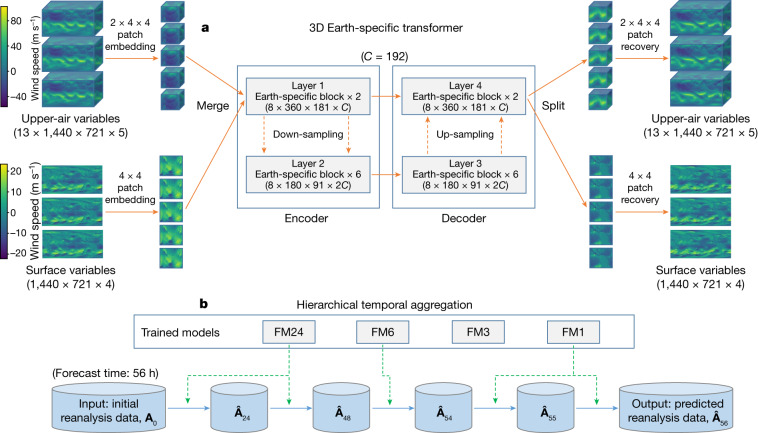
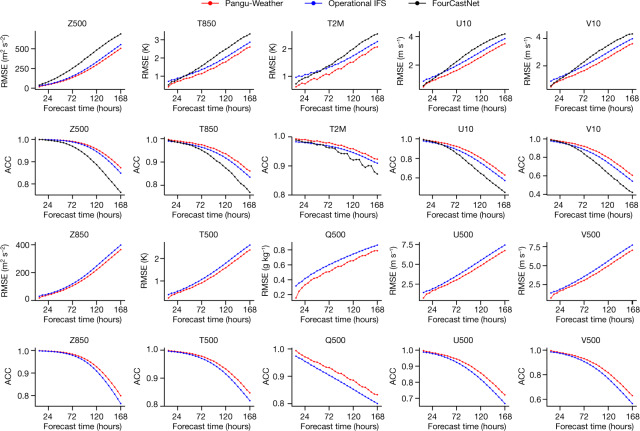
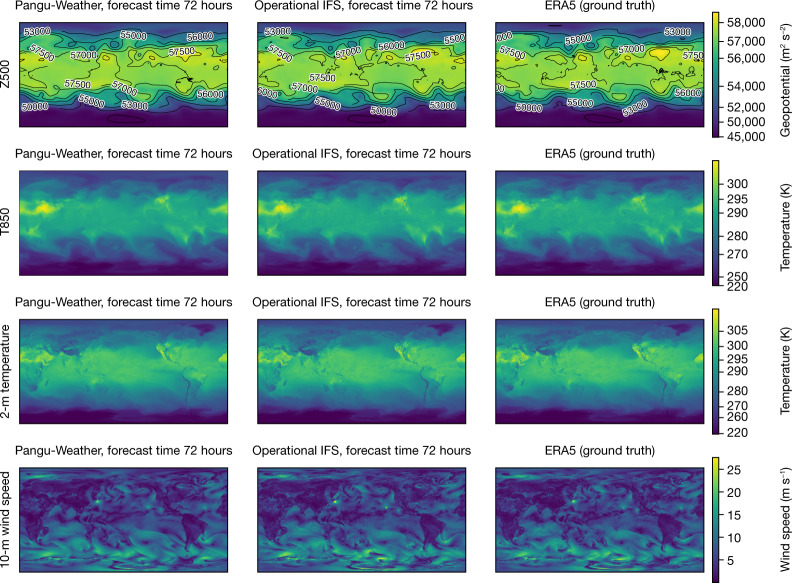
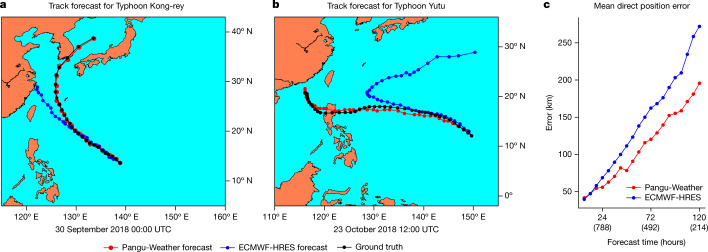
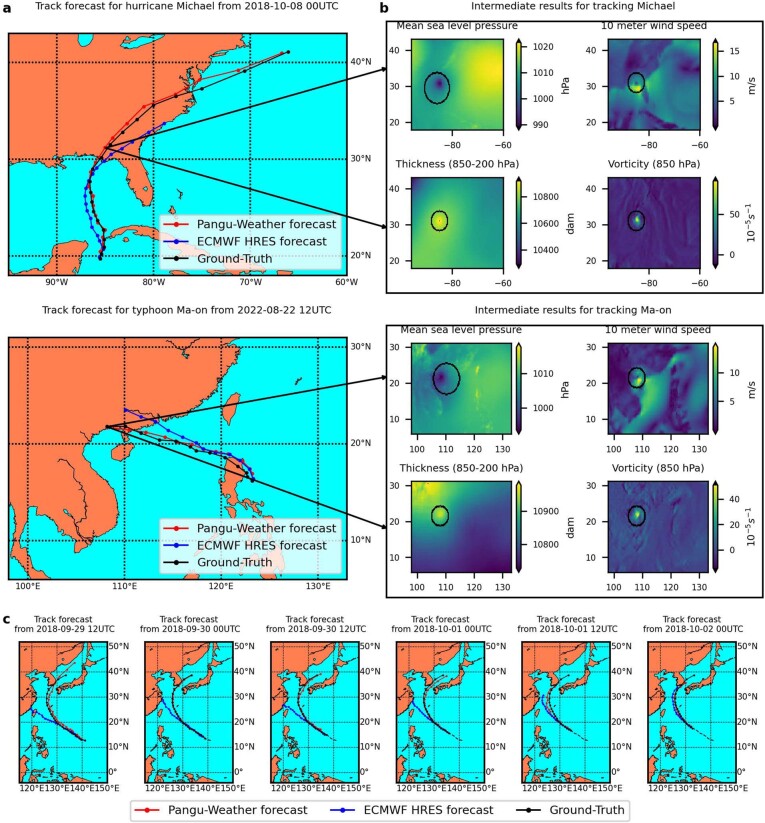
Weather forecasting is important for science and society. At present, the most accurate forecast system is the numerical weather prediction (NWP) method, which represents atmospheric states as discretized grids and numerically solves partial differential equations that describe the transition between those states 1 . However, this procedure is computationally expensive. Recently, artificial-intelligence-based methods 2 have shown potential in accelerating weather forecasting by orders of magnitude, but the forecast accuracy is still significantly lower than that of NWP methods. Here we introduce an artificial-intelligence-based method for accurate, medium-range global weather forecasting. We show that three-dimensional deep networks equipped with Earth-specific priors are effective at dealing with complex patterns in weather data, and that a hierarchical temporal aggregation strategy reduces accumulation errors in medium-range forecasting. Trained on 39 years of global data, our program, Pangu-Weather, obtains stronger deterministic forecast results on reanalysis data in all tested variables when compared with the world’s best NWP system, the operational integrated forecasting system of the European Centre for Medium-Range Weather Forecasts (ECMWF) 3 . Our method also works well with extreme weather forecasts and ensemble forecasts. When initialized with reanalysis data, the accuracy of tracking tropical cyclones is also higher than that of ECMWF-HRES.
Overview
The claims and statistics of this paper haven’t been checked yet.
Free: it reads the open-access text and checks the first 5 claims that cite a source we can check. Create a free account to check every claim.
Integrity signals
Registry
Cites
Statistics
Figures
Verification
Claims the paper makes
The claims and statistics of this paper haven’t been checked yet.
Free: it reads the open-access text and checks the first 5 claims that cite a source we can check. Create a free account to check every claim.
Claims other papers make about this one
Each is checked against this paper’s own text: does it say what the citing paper says it does?
The source backs part of the claim, not all of it — or backs it for a different population, condition or comparison.
In the citing paper
“However, they do not produce calibrated uncertainty estimates4, which is essential for useful weather forecasts1.”
From Neural general circulation models for weather and climate (2024) · cites this paper as [4]
Experimental — accuracy not yet measuredThe source backs part of the claim, not all of it — or backs it for a different population, condition or comparison.
In the citing paper
“Recently, machine-learning models trained on reanalysis data have achieved comparable or better skill than GCMs for deterministic weather forecasting3,4.”
From Neural general circulation models for weather and climate (2024) · cites this paper as [4]
Experimental — accuracy not yet measuredThe source backs part of the claim, not all of it — or backs it for a different population, condition or comparison.
In the citing paper
“Existing machine-learning models have focused on deterministic prediction, and surpass deterministic numerical weather prediction in terms of the aggregate metrics for which they are trained3,4.”
From Neural general circulation models for weather and climate (2024) · cites this paper as [4]
Experimental — accuracy not yet measuredThe source backs part of the claim, not all of it — or backs it for a different population, condition or comparison.
In the citing paper
“Most state-of-the-art machine learning models utilized in medium-range weather forecasting are built upon encoder-decoder84 architectures27–29,85.”
From A machine learning model that outperforms conventional global subseasonal forecast models (2024) · cites this paper as [28]
Experimental — accuracy not yet measuredThe source backs part of the claim, not all of it — or backs it for a different population, condition or comparison.
In the citing paper
“However, these advances have focused primarily on single, deterministic forecasts that fail to represent uncertainty and estimate risk.”
From Probabilistic weather forecasting with machine learning (2025) · cites this paper as [3]
Experimental — accuracy not yet measured
4 more claims about this paper
Create a free account to see every claim other papers make about this one.
Self-check
Percentages, sums and reported differences re-computed from the paper’s own numbers.
The self-check needs the paper’s full text.
Citations
Cites
LeCun, Y., Bengio, Y., & Hinton, G. (2015) · Nature · doi:10.1038/nature14539 · Cited by 84,126
An Image is Worth 16x16 Words: Transformers for Image Recognition at Scale
Dosovitskiy, A., Beyer, L., Kolesnikov, A., Weissenborn, D., Zhai, X., Unterthiner, T., Dehghani, M., Minderer, M., Heigold, G., Gelly, S., et al. (2020) · arXiv · doi:10.48550/arxiv.2010.11929 · Cited by 47,472
Swin Transformer: Hierarchical Vision Transformer using Shifted Windows
Liu, Z., Lin, Y., Cao, Y., Hu, H., Wei, Y., Zhang, Z., Lin, S., & Guo, B. (2021) · 2021 IEEE/CVF International Conference on Computer Vision (ICCV) · doi:10.1109/iccv48922.2021.00986 · Cited by 35,534
Hersbach, H., Bell, B., Berrisford, P., Hirahara, S., Horányi, A., Muñoz‐Sabater, J., Nicolas, J., Peubey, C., Radu, R., Schepers, D., et al. (2020) · Quarterly Journal of the Royal Meteorological Society · doi:10.1002/qj.3803 · Cited by 31,882
Language Models are Few-Shot Learners
Brown, T. B., Mann, B., Ryder, N., Subbiah, M., Kaplan, J., Dhariwal, P., Neelakantan, A., Shyam, P., Sastry, G., Askell, A., et al. (2020) · arXiv · doi:10.48550/arxiv.2005.14165 · Cited by 23,372
Learning Transferable Visual Models From Natural Language Supervision
Radford, A., Kim, J. W., Hallacy, C., Ramesh, A., Goh, G., Agarwal, S., Sastry, G., Askell, A., Mishkin, P., Clark, J., et al. (2021) · arXiv · doi:10.48550/arxiv.2103.00020 · Cited by 15,293
Momentum Contrast for Unsupervised Visual Representation Learning
He, K., Fan, H., Wu, Y., Xie, S., & Girshick, R. (2020) · 2020 IEEE/CVF Conference on Computer Vision and Pattern Recognition (CVPR) · doi:10.1109/cvpr42600.2020.00975 · Cited by 13,347
Learning Transferable Architectures for Scalable Image Recognition
Zoph, B., Vasudevan, V., Shlens, J., & Le, Q. V. (2018) · 2018 IEEE/CVF Conference on Computer Vision and Pattern Recognition · doi:10.1109/cvpr.2018.00907 · Cited by 7,831
Convolutional LSTM Network: A Machine Learning Approach for Precipitation Nowcasting
Shi, X., Chen, Z., Wang, H., Yeung, D.-Y., Wong, W.-K., & Woo, W.-C. (2015) · arXiv · doi:10.48550/arxiv.1506.04214 · Cited by 7,709
Atmospheric Modeling, Data Assimilation and Predictability
Kalnay, E. (2002) · doi:10.1017/cbo9780511802270 · Cited by 3,391
Research works printed but not linked: 2
- Devlin, J., Chang, M. W., Lee, K. & Toutanova, K. BERT: pre-training of deep bidirectional transformers for language understanding. In Proc. Conference North American Chapter of the Association of Computational Linguistics Vol. 1, 4171–4186 (NAACL, 2019).
- Stensrud, D. J. Parameterization Schemes: Keys to Understanding Numerical Weather Prediction Models (Cambridge Univ. Press 2009).
Cited by
Items 301–400 of 1,006
Liujie, P., Zhang, H., Liang, M., Li, P., Cao, C., Du, L., & Liu, J. (2025) · Weather and Forecasting · doi:10.1175/waf-d-24-0227.1 · Cited by 18
Self-citationDing, J., Chen, W., Chen, J., Wang, J., Zhang, Y., & Bai, L. (2025) · IEEE Journal of Selected Topics in Applied Earth Observations and Remote Sensing · doi:10.1109/jstars.2025.3580782 · Cited by 16
“The foundation model Pangu-Weatherisavailableathttps://github.com/198808xc/Pangu-Weather [38].”
Fan, J., Yu, G.-A., Zhao, M., & Zong, H. (2026) · Expert Systems with Applications · doi:10.1016/j.eswa.2025.131081 · Cited by 18
Kilometer-scale convection-allowing model emulation using generative diffusion modeling
Pathak, J., Cohen, Y., Garg, P., Harrington, P., Brenowitz, N., Durran, D. R., Mardani, M., Vahdat, A., Xu, S., Kashinath, K., et al. (2026) · Science Advances · doi:10.1126/sciadv.adv0423 · Cited by 77
“These ML models, with a spatial resolution of about 30km and a typical temporal resolution of 6 hours, have obtained up to four orders of magnitude speedups while maintaining comparable skill [13, 14, 15, 16, 17, 18].”
Digital disaster prevention for ocean engineering: Current progress and future directions
Hu, Z.-Z., Li, Y., Gao, F.-P., & Zhang, J.-M. (2026) · Ocean Engineering · doi:10.1016/j.oceaneng.2026.125101 · Cited by 15
Water quality analysis based on LSTM and BP optimization with a transfer learning model
Luo, Q., Peng, D., Shang, W., Gu, Y., Luo, X., Zhu, Z., & Pang, B. (2023) · Environmental Science and Pollution Research · doi:10.1007/s11356-023-31068-5 · Cited by 12
“In this paper, the integration of models obtained based on similar dataset, similar to integration learning, and differentiated from the integration of similar models obtained based on the same dataset, such as the ensemble weather forecast (Bi et al. 2023).”
Cheng, Y., Yan, P., Cao, L., Huang, X., & He, L. (2024) · The Science of The Total Environment · doi:10.1016/j.scitotenv.2024.172763 · Cited by 12
AI optimization framework using digital layouts of array structures: A case study for fuel cells
Su, X., Liu, M., Fan, W., Cui, H., Lu, D., Zheng, T., Luan, Y., Lu, G., & Liu, Z. (2024) · Fuel · doi:10.1016/j.fuel.2024.132333 · Cited by 11
Spatiotemporal Feature Fusion Transformer for Precipitation Nowcasting via Feature Crossing
Xiong, T., Wang, W., He, J., Su, R., Wang, H., & Hu, J. (2024) · Remote Sensing · doi:10.3390/rs16142685 · Cited by 14
“A three-dimensional (3D) Earth-specific transformer [37] was proposed for medium-range global weather forecasting.”
MUSE-Net: Disentangling Multi-Periodicity for Traffic Flow Forecasting
Qin, J., Jia, Y. D., Tong, Y., Chai, H., Ding, Y., Wang, X., Fang, B., & Liao, Q. (2024) · IEEE International Conference on Data Engineering (ICDE) · doi:10.1109/icde60146.2024.00103 · Cited by 14
Yuan, J., Li, J., & Hao, J. (2024) · Computers & Operations Research · doi:10.1016/j.cor.2024.106831 · Cited by 14
Ascenso, G., Ficchì, A., Giuliani, M., Scoccimarro, E., & Castelletti, A. F. (2024) · Weather and Climate Extremes · doi:10.1016/j.wace.2024.100724 · Cited by 15
Toward interdisciplinary integration of architecture and climatology
Liu, Y., Liu, Y., & Cao, Q. (2024) · The Innovation Energy · doi:10.59717/j.xinn-energy.2024.100054 · Cited by 11
UniOcean: A Unified Framework for Predicting Multiple Ocean Factors of Varying Temporal Scales
Yang, H., Chen, Y., Cao, J., Li, W., Yang, Y., Wang, S., Guan, J., Qin, R., & Zhou, S. (2024) · IEEE Transactions on Geoscience and Remote Sensing · doi:10.1109/tgrs.2024.3506058 · Cited by 13
Zhao, Y., Gan, W., Yan, M., Wen, J., & Zhou, Y. (2024) · Applied Energy · doi:10.1016/j.apenergy.2024.125119 · Cited by 11
“With some extreme events, such as typhoons, cyber-attacks and floods, only predictable a few days in advance [24], it is necessary to determine defensive strategies as quickly as possible to provide planners with more time to deploy defensive resources.”
Xu, S., Zhang, Y., Chen, J., & Zhang, Y. (2025) · Remote Sensing · doi:10.3390/rs17020191 · Cited by 13
Intraseasonal synchronization of extreme rainfall between North India and the Sahel
Strnad, F., Hunt, K. M. R., Boers, N., & Goswami, B. (2025) · Quarterly Journal of the Royal Meteorological Society · doi:10.1002/qj.4946 · Cited by 13
“Of particular interest will be the representation of these synchronizations in deep learning global forecasts (for example Lam et al. , 2023; Bi et al. , 2023; Lessig et al. , 2023), which are more capable of capturing complex nonlinear relationships in the data.”
Li, X., & Liu, F. (2025) · Information Geography · doi:10.1016/j.infgeo.2025.100001 · Cited by 16
Analyzing and Exploring Training Recipes for Large-Scale Transformer-Based Weather Prediction
Willard, J., Harrington, P., Subramanian, S., Mahesh, A., O'Brien, T. A., & Collins, W. D. (2025) · Artificial Intelligence for the Earth Systems · doi:10.1175/aies-d-24-0061.1 · Cited by 25
Resifi, S., Aawar, E. A., Dasari, H. P., Jebari, H., & Hoteit, I. (2025) · Energy · doi:10.1016/j.energy.2025.136356 · Cited by 17
A Survey of Foundation Models for Environmental Science
Yu, R., Chen, S., Xie, Y., & Jia, X. (2025) · Lecture notes in computer science · doi:10.1007/978-981-96-8295-9_3 · Cited by 22
Duan, S., Zhang, J., Bonfils, C., & Pallotta, G. (2025) · npj Climate and Atmospheric Science · doi:10.1038/s41612-025-01137-2 · Cited by 11
“It is notable that NeuralGCM operates at a much coarser spatial resolution compared to other AI-based weather models, such as Pangu and FourcastNet 24,25 , which achieve resolutions as fi ne as 0.25 ∘ .”
InfluentialHu, S., Jin, Q., Gao, C., Zhang, X., Lu, M., He, Y., Chu, D., & Bai, W. (2025) · Physics of Fluids · doi:10.1063/5.0280743 · Cited by 19
Deep learning prediction of noise-driven nonlinear instabilities in fibre optics
Boussafa, Y., Sader, L., Hoang, V. T., Chaves, B. P., Bougaud, A., Fabert, M., Tonello, A., Dudley, J. M., Kues, M., & Wetzel, B. (2025) · Nature Communications · doi:10.1038/s41467-025-62713-x · Cited by 22
TLS-MWP: A Tensor-Based Long- and Short-Range Convolution for Multiple Weather Prediction
Xu, G., Ng, M. K., Ye, Y., Li, X., Song, G., Zhang, B., & Huang, Z. (2024) · IEEE Transactions on Circuits and Systems for Video Technology · doi:10.1109/tcsvt.2024.3379291 · Cited by 12
KAN-Enhanced Transformer for Wind Profile Retrieval From Lidar Spectra
Tao, R., Wang, C., Chen, H., Jia, M., Shang, X., Qu, L., Shentu, G.-L., Lu, Y., Huo, Y., Bai, L., et al. (2025) · IEEE Transactions on Geoscience and Remote Sensing · doi:10.1109/tgrs.2025.3586114 · Cited by 14
“For example, Bi et al. [61] and Chen et al. [62] employed ERA5 reanalysis data to assess the forecasting performance of their proposed deep learning models, while using HRES-fc0 for ECMWF HRES evaluation to avoid potential biases and inconsistencies between HRES analysis and ERA5.”
Short term wind prediction with an ARIMA model
Shrivastava, R., Iyer, I. S., & Batra, A. (2025) · Wind energy and engineering research. · doi:10.1016/j.weer.2025.100020 · Cited by 10
Farag, A. A. (2025) · Scientific Reports · doi:10.1038/s41598-025-23166-w · Cited by 10
“These concerns were also raised by other research, which suggests that AI-based methods may produce smoother forecast results, potentially underestimating the magnitude of extreme weather events 49 .”
Yao, J., & Han, T. (2025) · Renewable and Sustainable Energy Reviews · doi:10.1016/j.rser.2025.116527 · Cited by 13
Zhong, W.-M., Zhang, W., Zeng, Y.-X., Zhao, J., Jia, Z., Ding, G., Han, S., Roy, V. A. L., & Zhou, Y. (2026) · Nature Communications · doi:10.1038/s41467-026-70171-2 · Cited by 12
Advancing operational global aerosol forecasting with machine learning
Gui, K., Zhang, X., Che, H., Li, L., Zheng, Y., An, L., Miao, Y., Zhao, H., Dubovik, О., Holben, B., et al. (2026) · Nature · doi:10.1038/s41586-026-10234-y · Cited by 28
“Inspired by the temporal aggregation method from Pangu-Weather 22 , we adopted a relay forecasting strategy that reduces the number of model iterations without compromising the forecast time resolution.”
Multiple Knowledge-Enhanced Meteorological Social Briefing Generation
Shi, K., Peng, X., Lü, H., Zhu, Y., & Niu, Z. (2023) · IEEE Transactions on Computational Social Systems · doi:10.1109/tcss.2023.3298252 · Cited by 11
Smith, T. A., Penny, S. G., Platt, J. A., & Chen, T. (2023) · Journal of Advances in Modeling Earth Systems · doi:10.1029/2023ms003792 · Cited by 15
Eddin, M. H. S., & Gall, J. (2024) · Geoscientific model development · doi:10.5194/gmd-17-2987-2024 · Cited by 14
“Our results indicate that a direct prediction of vegetation products from a TSMP simulation with DL is an effective way for scenario-based assessments of vegetation response to climate change.”
ResultApplying Machine Learning in Numerical Weather and Climate Modeling Systems
Krasnopolsky, V. M. (2024) · Climate · doi:10.3390/cli12060078 · Cited by 15
Nie, Y., & Sun, J. (2024) · Environmental Research Letters · doi:10.1088/1748-9326/ad5370 · Cited by 15
Wu, J., Luo, M., Xiao, D., Pain, C. C., & Khoo, B. C. (2024) · Computer Methods in Applied Mechanics and Engineering · doi:10.1016/j.cma.2024.117071 · Cited by 10
Global 4-D Ionospheric STEC Prediction Based on DeepONet for GNSS Rays
Cai, D., Shi, Z., Fu, H., Liu, H., Qian, H., Sui, Y., Xu, F., & Jin, Y. Q. (2024) · IEEE Transactions on Geoscience and Remote Sensing · doi:10.1109/tgrs.2024.3422150 · Cited by 14
Evaluation of precipitation forecasting methods and an advanced lightweight model
Yang, N., Wang, C., & Li, X. (2024) · Environmental Research Letters · doi:10.1088/1748-9326/ad661f · Cited by 15
“Large models such as Pan-Gu (Bi et al 2023) and Fu-Xi (Chen et al 2023) have unique advantages and disadvantages in precipitation forecasting.”
Liao, Q., Zhu, M., Wu, L., Wang, D., Wang, Z., Zhang, S., Cao, W., Pan, X., Li, J., Tang, X., et al. (2024) · The Science of The Total Environment · doi:10.1016/j.scitotenv.2024.175233 · Cited by 11
Quaini, A., San, O., Veneziani, A., & Iliescu, T. (2024) · Fluids · doi:10.3390/fluids9080178 · Cited by 22
Ma, Z., Wang, W., Zhou, T., Chen, C., Peng, B., Sun, L., & Jin, R. (2024) · ACM SIGKDD Conference on Knowledge Discovery and Data Mining (KDD) · doi:10.1145/3637528.3671509 · Cited by 22
Duncan, J., Wu, E., Golaz, J., Caldwell, P., Watt‐Meyer, O., Clark, S. K., McGibbon, J., Dresdner, G., Kashinath, K., Bonev, B., et al. (2024) · Journal of Geophysical Research Machine Learning and Computation · doi:10.1029/2024jh000136 · Cited by 25
Wang, W., Zhang, J., Su, Q., Chai, X., Lu, J., Ni, W., Duan, B., & Ren, K. (2024) · npj Climate and Atmospheric Science · doi:10.1038/s41612-024-00776-1 · Cited by 20
“Fortunately, the conceptual similarity between DA and DL 20,21 , as well as the increasing use of DL techniques in the atmospheric and oceanic domains 3,22 – 25 , has prompted exploration of the application of DL methods for DA 26 .”
Zhang, L., Zhao, Y., Cen, Y., & Lu, M. (2024) · Journal of Geophysical Research Atmospheres · doi:10.1029/2024jd041914 · Cited by 12
“This finding aligns well with the current trend of training models using increasingly larger data sets, aiming to enhance the overall power and performance of the models (Bi et al., 2022; L. Chen et al., 2023).”
InfluentialXu, H., Chen, Y., Zeng, Z., Li, N., Li, J., & Zhang, D. (2024) · Nexus · doi:10.1016/j.ynexs.2024.100045 · Cited by 19
“Some studies have successfully utilized emerging AI methods to directly forecast precipitation by leveraging physical measurements, such as radar echoes( 8 ) and climate data( 21 ).”
Multi-Time Knowledge Distillation
Chen, G., Fan, Z., Zhu, Y., & Zhang, T. (2025) · Neurocomputing · doi:10.1016/j.neucom.2025.129377 · Cited by 12
Shao, G., Zhou, T., Yan, T., Guo, Y., Yun, Z., Huang, R., & Fang, L. (2025) · Nanophotonics · doi:10.1515/nanoph-2024-0504 · Cited by 15
“In recent years, AI has been extensively applied in scientific and engineering domains, such as protein structure prediction [54]–[56], weather forecasting [57], [58], etc.”
Yasuda, Y., & Onishi, R. (2025) · Urban Climate · doi:10.1016/j.uclim.2025.102300 · Cited by 10
Learning to Infer Weather States Using Partial Observations
Chao, J., Pan, B., Chen, Q., Yang, S., Wang, J., Nai, C., Zheng, Y., Li, X., Yuan, H., Chen, X., et al. (2025) · Journal of Geophysical Research Machine Learning and Computation · doi:10.1029/2024jh000260 · Cited by 17
Self-citationWeingram, A., Cui, C., Lin, S., Munoz, S., Jacob, T., Viers, J. H., & Lu, X. (2025) · Frontiers in High Performance Computing · doi:10.3389/fhpcp.2025.1536501 · Cited by 15
One‐kilometer resolution forecasts of hourly precipitation over China using machine learning models
Li, B., Zhu, Z., Zhong, X., Tan, R., Wang, Y., Lan, W., & Li, H. (2025) · Atmospheric Science Letters · doi:10.1002/asl.1297 · Cited by 13
“State-of-the-art ML weather forecasting models (Bi et al., 2023; Bouallegue, 2024; L. Chen et al., 2023; Lam et al., 2023; Pathak et al., 2022; Price et al., 2025) achieve forecast performance comparable to or surpassing that of ECMWF HRES.”
Diffusion Models and Generative Artificial Intelligence: Frameworks, Applications and Challenges
Kumar, P. (2025) · Archives of Computational Methods in Engineering · doi:10.1007/s11831-025-10266-z · Cited by 14
Data Assimilation with Machine Learning Surrogate Models: A Case Study with FourCastNet
Adrian, M., Sanz-Alonso, D., & Willett, R. M. (2025) · Artificial Intelligence for the Earth Systems · doi:10.1175/aies-d-24-0050.1 · Cited by 31
Wu, Y., Wang, N., Huang, X., & Wang, Z. (2025) · Reliability Engineering & System Safety · doi:10.1016/j.ress.2025.111284 · Cited by 12
Hu, A., Richter, I., Okumura, Y., Burls, N., Keenlyside, N. S., Parfitt, R., Bellomo, K., Bellucci, A., Farneti, R., Fedorov, A. V., et al. (2025) · Ocean-Land-Atmosphere Research · doi:10.34133/olar.0096 · Cited by 14
Hu, Z., Xu, Z., Sun, X., Ruan, J., Yang, X., Qian, T., & Shi, W. (2025) · IEEE Transactions on Smart Grid · doi:10.1109/tsg.2025.3585277 · Cited by 15
“The typhoon nowcasting data can be initially obtained from a meteorological model (e.g., WRF and Pangu-Weather), typically with a spatial resolution of 0.25 ◦ × 0.25 ◦ (latitude and longitude) and a temporal resolution of 6 hours or 1 hour [20].”
InfluentialSpatial-Temporal Data Mining for Ocean Science: Data, Methodologies and Opportunities
Yang, H., Cao, J., Li, W., Wang, S., Li, H., Guan, J., & Zhou, S. (2025) · ACM Transactions on Knowledge Discovery from Data · doi:10.1145/3748259 · Cited by 22
“, PanguWeather [26]) is trained on 39-year global weather datasets and achieves great performance on various downstream tasks such as medium-range weather forecasting, extreme weather forecasting, and ensemble weather forecasting.”
GLONET: Mercator's End‐to‐End Neural Global Ocean Forecasting System
Aouni, A. E., Gaudel, Q., Régnier, C., van Gennip, S. J., Galloudec, O. L., Drévillon, M., Drillet, Y., & Lellouche, J. (2025) · Journal of Geophysical Research Machine Learning and Computation · doi:10.1029/2025jh000686 · Cited by 57
“Weather forecasting models such as FourCastNet (Pathak et al., 2022), GraphCast (Lam et al., 2022), Pangu-Weather (Bi et al., 2023) and recently AIFS (Lang et al., 2024) have demonstrated remarkable improvements in prediction performance and speed, often outperforming traditional numerical weather prediction (NWP) met…”
Towards deployment-centric multimodal AI beyond vision and language
Liu, X., Zhang, J., Zhou, S., van der Plas, T. L., Vijayaraghavan, A., Grishina, A., Zhuang, M., Schofield, D., Tomlinson, C., Wang, Y., et al. (2025) · Nature Machine Intelligence · doi:10.1038/s42256-025-01116-5 · Cited by 27
“• Multimodal fusion and modality selection Challenge : Managing diverse properties and patterns across modalities, including avoiding unnecessary modality redundancy, to maintain integrity and utility while enhancing integration.”
A survey of physics-informed AI for complex urban systems
Xu, E., Wang, H., Zhang, Y., Li, S., Tang, Y., Zhou, Z., Lin, Y., Yuan, Y., Fan, X., Ding, J., et al. (2025) · Information Fusion · doi:10.1016/j.inffus.2025.104012 · Cited by 38
Lai, S. K., He, Y., Chan, P. W., Kerns, B. W., Chen, S. S., & Su, H. (2025) · Meteorological Applications · doi:10.1002/met.70109 · Cited by 15
AIFS Single 1.1.0: an update to ECMWF's machine-learned weather forecast model AIFS
Moldovan, G. I., Pinnington, E., Nemesio, A. P., Lang, S. T. K., Bouallègue, Z. B., Dramsch, J. S., Alexe, M., Cruz, M. S., Hahner, S., Cook, H., et al. (2026) · Geoscientific model development · doi:10.5194/gmd-19-4703-2026 · Cited by 38
Kuglitsch, M. M., Albayrak, A. R., Luterbacher, J., Craddock, A., Toreti, A., Ma, J., Vilela, P. P., Xoplaki, E., Kotani, R., Bérod, D. D., et al. (2023) · Environmental Research Letters · doi:10.1088/1748-9326/acf601 · Cited by 29
A comparison of data-driven reduced order models for the simulation of mesoscale atmospheric flow
Hajisharifi, A., Girfoglio, M., Quaini, A., & Rozza, G. (2023) · Finite Elements in Analysis and Design · doi:10.1016/j.finel.2023.104050 · Cited by 17
Walz, E., Henzi, A., Ziegel, J. F., & Gneiting, T. (2024) · SIAM Review · doi:10.1137/22m1541915 · Cited by 39
Shen, B., Pielke, R. A., Zeng, X., & Zeng, X. (2024) · Atmosphere · doi:10.3390/atmos15070837 · Cited by 12
Physics-informed shape optimization using coordinate projection
Zhang, Z., Lin, C., & Wang, B. (2024) · Scientific Reports · doi:10.1038/s41598-024-57137-4 · Cited by 16
An Explainable Deep Learning Model for Daily Sea Ice Concentration Forecast
Li, Y., Qiu, Y., Jia, G., Yu, S., Zhang, Y., Huang, L., & Leppäranta, M. (2024) · IEEE Transactions on Geoscience and Remote Sensing · doi:10.1109/tgrs.2024.3386930 · Cited by 24
Deep Learning Improves GFS Sea Surface Wind Field Forecast Accuracy in the Northwest Pacific Ocean
Fu, S., Huang, W., Luo, J., Liu, D., Sun, D., Fu, H., Luo, Y. M., & Wang, B. (2024) · Journal of Geophysical Research Atmospheres · doi:10.1029/2024jd041188 · Cited by 10
“…of AI‐based meteorological models, all current AI‐based meteorological models for training and forecasting still rely on the input of reanalysis data (Bi et al., 2023; J. Chen et al., 2011; Y. Zhang et al., 2023), that is, European Center for Medium‐Range Weather Forecasts (ECMWF) Reanalysis v5…”
InfluentialAn improved deep learning model for sparse reconstruction of cavitation flow fields
Xu, Y., Sha, Y., Wang, C., & Wei, Y. (2024) · Physics of Fluids · doi:10.1063/5.0216945 · Cited by 11
Facilitating and Determining Turing Patterns in 3-D Memristor Cellular Neural Networks
He, J., Xiao, M., He, H., Wang, Z., Zheng, W. X., & Rutkowski, L. (2024) · IEEE Transactions on Circuits and Systems I Regular Papers · doi:10.1109/tcsi.2024.3427759 · Cited by 13
“D counterparts [14].”
TorchClim v1.0: a deep-learning plugin for climate model physics
Fuchs, D., Sherwood, S. C., Prasad, A. A., Trapeznikov, K., & Gimlett, J. (2024) · Geoscientific model development · doi:10.5194/gmd-17-5459-2024 · Cited by 16
A case study of spatiotemporal forecasting techniques for weather forecasting
Sofi, S. S., & Oseledets, I. V. (2024) · GeoInformatica · doi:10.1007/s10707-024-00530-y · Cited by 15
“Recently, a novel model based on vision transformers was proposed that utilizes 3D deep networks with earth-specific priors to handle complex patterns in weather data effectively [43].”
LLMDiff: Diffusion Model Using Frozen LLM Transformers for Precipitation Nowcasting
She, L., Zhang, C., Man, X., & Shao, J. (2024) · Sensors · doi:10.3390/s24186049 · Cited by 16
“We formulate precipitation nowcasting as a spatiotemporal forecasting problem, similar to the methodologies in [1,13,40,41].”
MethodHao, P., Zhao, Y., Li, S., Song, J., & Gao, Y. (2024) · Ocean Modelling · doi:10.1016/j.ocemod.2024.102444 · Cited by 13
HEAL-SWIN: A Vision Transformer on the Sphere
Carlsson, O., Gerken, J. E., Linander, H., Spieß, H., Ohlsson, F., Petersson, C., & Persson, D. (2024) · IEEE Computer Society Conference on Computer Vision and Pattern Recognition/Proceedings - IEEE Computer Society Conference on Computer Vision and Pattern Recognition/Proceedings · doi:10.1109/cvpr52733.2024.00580 · Cited by 33
“In particular, deep spherical models (and in particular trans-formers) were recently shown to outperform physical models for weather prediction tasks [3, 32, 35, 40], opening another important application domain for our model.”
Enhancing climate forecasting with AI: Current state and future prospect
Kumar, R., Goel, R., Sidana, N., Sharma, A. P., Ghai, S., Singh, T., singh, R., Priyadarshi, N., Twala, B., & Ahmad, V. (2024) · F1000Research · doi:10.12688/f1000research.154498.1 · Cited by 15
Yousefi, K. P., Belleflamme, A., Goergen, K., & Kollet, S. J. (2024) · Frontiers in Water · doi:10.3389/frwa.2024.1439906 · Cited by 9
The Decoupling Concept Bottleneck Model
Zhang, R., Du, X., Yan, J., & Zhang, S. (2024) · IEEE Transactions on Pattern Analysis and Machine Intelligence · doi:10.1109/tpami.2024.3489597 · Cited by 19
“T HE field of deep learning has achieved remarkable progress, leading to significant advancements in various applications, such as computer vision [1], [2], natural language processing [3], [4], and even scientific computing [5], [6].”
Rethinking Urban Mobility Prediction: A Multivariate Time Series Forecasting Approach
Cheng, J., Li, K., Liang, Y., Sun, L., Yan, J., & Wu, Y. (2024) · IEEE Transactions on Intelligent Transportation Systems · doi:10.1109/tits.2024.3498054 · Cited by 18
He, Y., & Chan, P. W. (2024) · Weather · doi:10.1002/wea.7648 · Cited by 12
One‐Fit‐All Transformer for Multimodal Geophysical Inversion: Method and Application
Jiang, Y., Ma, J., Jie-Yuan, N. I. N. G., Li, J., Wu, H., & Bao, T. (2025) · Journal of Geophysical Research Machine Learning and Computation · doi:10.1029/2024jh000432 · Cited by 14
Opinion: Why all emergent constraints are wrong but some are useful – a machine learning perspective
Nowack, P. J., & Watson‐Parris, D. (2025) · Atmospheric chemistry and physics · doi:10.5194/acp-25-2365-2025 · Cited by 23
“…superimposed onto any scenario-driven trends (for example, any given year might be colder or warmer than the climate-dependent expected average value for temperature); 3. model uncertainty arising from varying scientific design choices for climate models developed by different institutions…”
Jiang, F., Zheng, Z., Coe, H., Healy, R. M., Poulain, L., Gros, V., Zhang, H., Li, W., Liu, D., West, M., et al. (2025) · ACS ES&T Air · doi:10.1021/acsestair.4c00329 · Cited by 11
Self-citationBrasseur, G. P., Stammer, D. B., Friedlingstein, P., Hegerl, G. C., Shaw, T. A., Trenberth, K. E., Richter, J. H., Vera, C. S., Berger, A., Cleugh, H., et al. (2025) · Frontiers in Climate · doi:10.3389/fclim.2025.1554685 · Cited by 12
“Existing machine learning models are already beating conventional physically based weather forecast models in deterministic scores, for some variables but not others, and are much faster by several orders of magnitudes than physics-based models (Lam et al., 2023; Bi et al., 2023).”
Zanchi, M., Zapperi, S., Bocchi, S., Drofa, O., Davolio, S., & Porta, C. A. M. L. (2025) · Environmental Modelling & Software · doi:10.1016/j.envsoft.2025.106509 · Cited by 13
Yan, J., Han, X. Y., Wang, H., Ge, C., & Liu, Y. (2025) · Energy · doi:10.1016/j.energy.2025.136740 · Cited by 13
Embracing large language model (LLM) technologies in hydrology research
Ma, Z., Peng, B., Yue, Z., Zeng, H., Pan, M., Wu, X., Yang, J., Mai, L., & Guan, K. (2025) · Environmental Research Water · doi:10.1088/3033-4942/addd43 · Cited by 18
“Meanwhile, the design and methods in designing LLMs could inform the development of domain-specific large models with improved machine learning modelsâ ˘A´Z ability (Bi et al., 2023).”
A new approach for deep prediction of urban complex system risk process during natural disasters
Tian, Y., Ding, S., Huang, L., Su, G., & Chen, J. (2025) · Reliability Engineering & System Safety · doi:10.1016/j.ress.2025.111339 · Cited by 10
Shi, Y., Liu, C., Song, X., & Yan, S. (2025) · Geothermics · doi:10.1016/j.geothermics.2025.103404 · Cited by 13
Utility of Graph Neural Networks in Short-to Medium-Range Weather Forecasting
Sun, X., Li, J., Zhao, Z., Jing, G., Chen, B., Hu, J., Wang, F., & Zhang, Y. (2025) · Computers, materials & continua/Computers, materials & continua (Print) · doi:10.32604/cmc.2025.063373 · Cited by 15
Stratospheric airship trajectory planning via temporal perception and dual-source learning
Wei, Y., Liu, D., Zheng, B., Guo, X., Ou, J., & Gao, L. (2025) · Aerospace Science and Technology · doi:10.1016/j.ast.2025.110671 · Cited by 10
Boosting weather forecast via generative superensemble
Nai, C., Chen, X., Yang, S., Xiao, Z., & Pan, B. (2025) · npj Climate and Atmospheric Science · doi:10.1038/s41612-025-01255-x · Cited by 27
Self-citationReview on deep learning quantitative precipitation nowcasting: Advances and challenges
Li, D., Wang, J., Deng, K., Zhang, D., Zhao, C., Leng, H., Wen, Y., Liu, Y., Ren, K., & Song, J. (2025) · Expert Systems with Applications · doi:10.1016/j.eswa.2025.130775 · Cited by 13
Challenges in the Forecasting of Severe Typhoon Koinu in 2023
Chan, P. W., & He, Y. H. (2023) · Atmosphere · doi:10.3390/atmos15010031 · Cited by 9
Developing trustworthy AI for weather and climate
McGovern, A., Tissot, P. E., & Bostrom, A. (2024) · Physics Today · doi:10.1063/pt.3.5379 · Cited by 9
Growing Importance of Micro-Meteorology in the New Power System: Review, Analysis and Case Study
Zhang, H., Zhang, M., Yi, R., Liu, Y., Wen, Q. H., & Meng, X. (2024) · Energies · doi:10.3390/en17061365 · Cited by 10
Self-citationAn Animal Migration Forecast Model With Weather Radar and Meteorological Data
Hu, C., Liu, X., Cui, K., Mao, H., Wang, R., & Wu, D. (2024) · IEEE Transactions on Geoscience and Remote Sensing · doi:10.1109/tgrs.2024.3415057 · Cited by 9
Spatiotemporal Enhanced Adversarial Network for Precipitation Nowcasting
Zhou, Y., Hang, R., Ji, F., Pan, Z., Liu, Q., & Yuan, X. (2024) · IEEE Journal of Selected Topics in Applied Earth Observations and Remote Sensing · doi:10.1109/jstars.2024.3381822 · Cited by 10
Metadata
- Authors
- Bi, K., Xie, L., Zhang, H., Chen, X., Gu, X., & Tian, Q.
- Affiliations
- Huawei Technologies (China) (CN)
- Corresponding author
- Tian, Qi
- Venue
- Nature
- Published
- 2023-07-05
- Volume
- 619
- Issue
- 7970
- Pages
- 533-538
- ISSN
- 0028-0836 (ISSN-L)
- 1476-4687
- PMC
- PMC10356604
- OpenAlex
- W4383218913
- Semantic Scholar
- 6a78c73c92d5e5d9759b46eff892baf1d6e83754
- Cited by
- 1,670
- References
- 36
- Citations by year
- 2026: 565 · 2025: 594 · 2024: 444 · 2023: 67
- FWCI
- 184.37
- Type
- journal article
- Language
- en
- Update notices
- correction (2023-09-14)
- Open access
- hybrid
- doi.org
- Licence
- cc-by
- creativecommons.org/licenses/by/4.0 (tdm)
- creativecommons.org/licenses/by/4.0 (vor)
- Locations
- Nature (publishedVersion, cc-by)
- PubMed Central (publishedVersion, cc-by)
- PubMed (publishedVersion)
- RePEc: Research Papers in Economics (submittedVersion)
- Funders
- National Oceanic and Atmospheric Administration
- Topics
- Physical Sciences › Earth and Planetary Sciences › Atmospheric Science › Meteorological Phenomena and Simulations
- Physical Sciences › Environmental Science › Environmental Engineering › Hydrological Forecasting Using AI
- Social Sciences › Transportation › Traffic Prediction and Management Techniques
- Keywords
- medium-range weather forecasting, global weather forecasting, 3D neural networks, Pangu-Weather, deterministic forecasting, tropical cyclone tracking, extreme weather prediction, ensemble forecasting, reanalysis data, ECMWF comparison
About these checks
Registry, retraction, Cites and statistics results are computed, not judged, with one exception: a printed reference that no index lists is read once by a model before it counts as a citation error. Claims are extracted by a model and kept only when their quote appears verbatim in the text; each cited source is then checked, with a model’s help, for whether it says what the claim relies on. Those verdicts can be wrong — read the claim’s quote and the cited source before relying on one.
Statistics and arithmetic are recomputed, not judged.
Confidence bands are shown only for fields calibrated on our annotated test set. None is calibrated yet, so no band is shown.
What counts as a claim ›How we measure confidence ›How we check this ›
Are you an author, or do you see a problem with this page? Request a review
Data sources
Bibliographic data: Semantic Scholar, OpenAlex, Crossref.
Contains information from the Semantic Scholar Academic Graph Datasets, made available under the ODC Attribution License (ODC-BY 1.0).
Semantic Scholar’s data is described in: Kinney, R., et al. (2023). The Semantic Scholar Open Data Platform. arXiv:2301.10140.
