

Accurate medium-range global weather forecasting with 3D neural networks
Open accessThe DOI matches its Crossref record; 41 of the 41 references it cites were found in a registry or an index.
Abstract
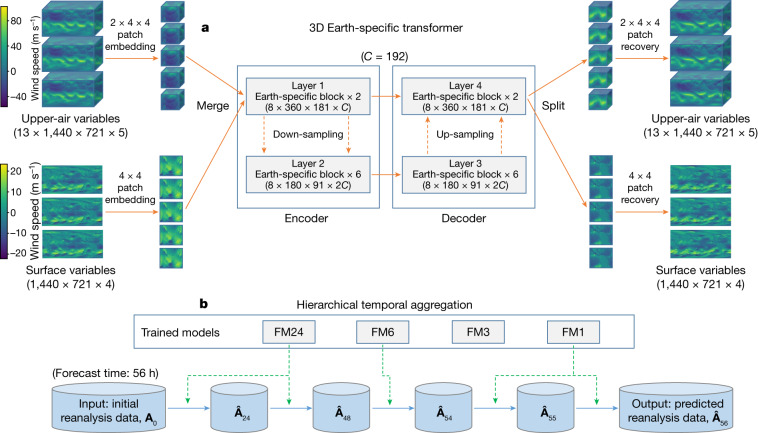
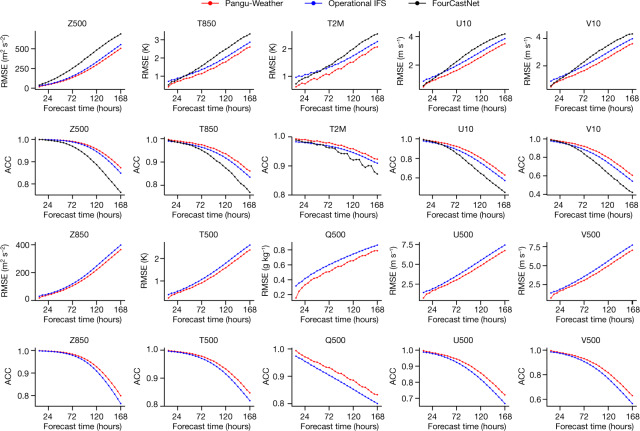
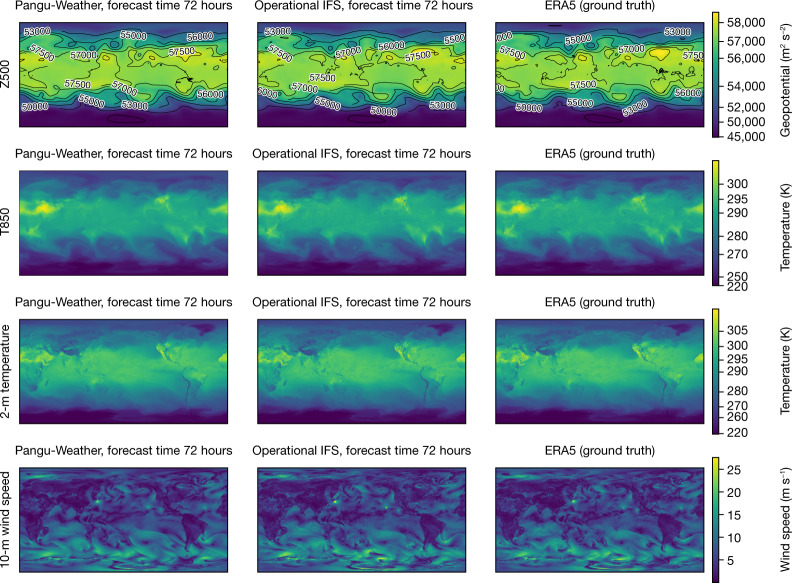
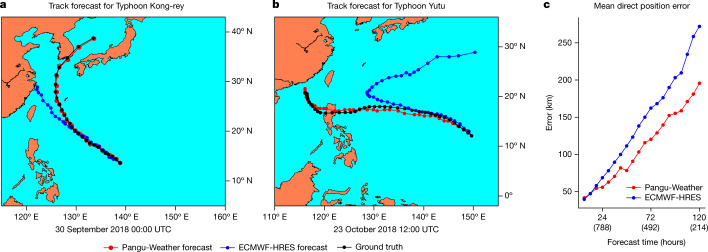
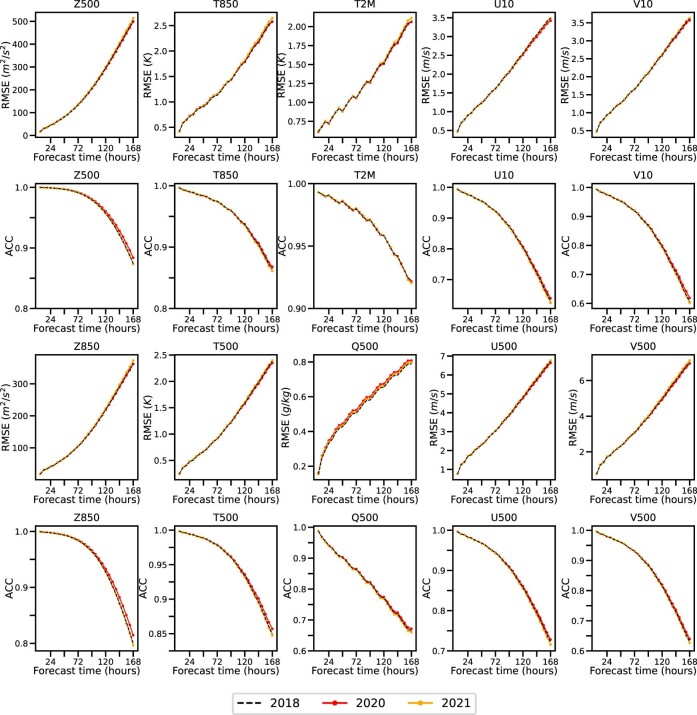
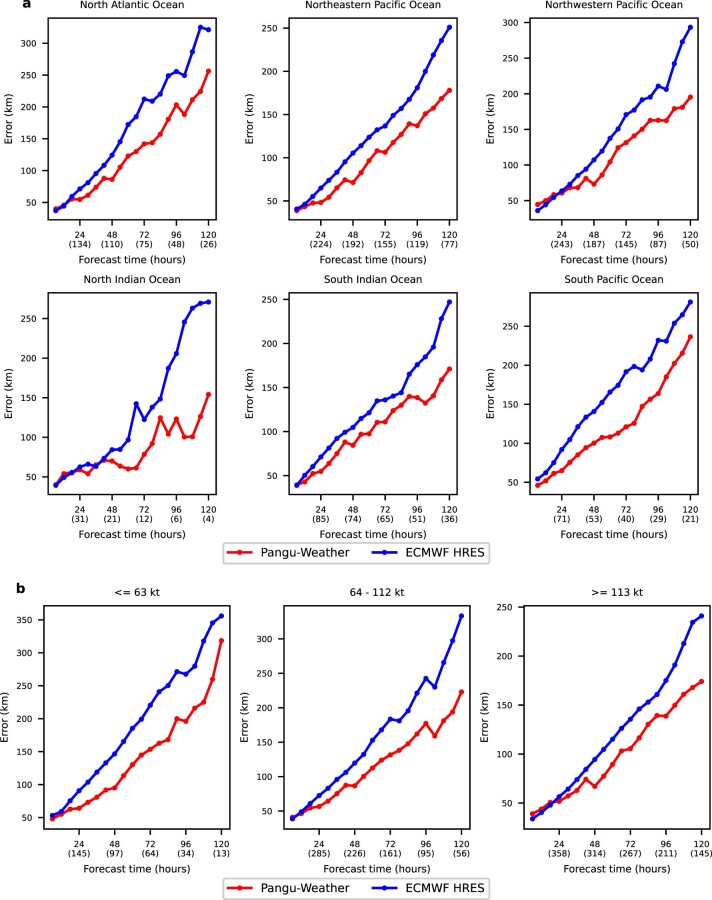
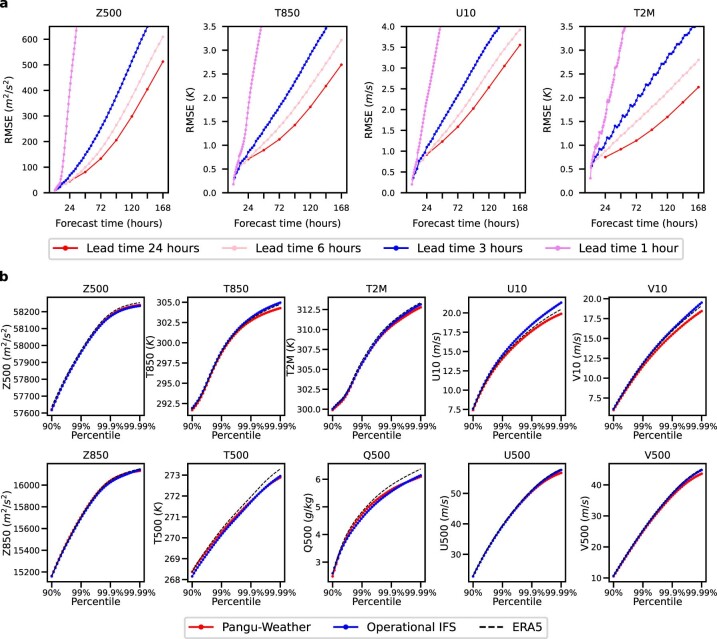
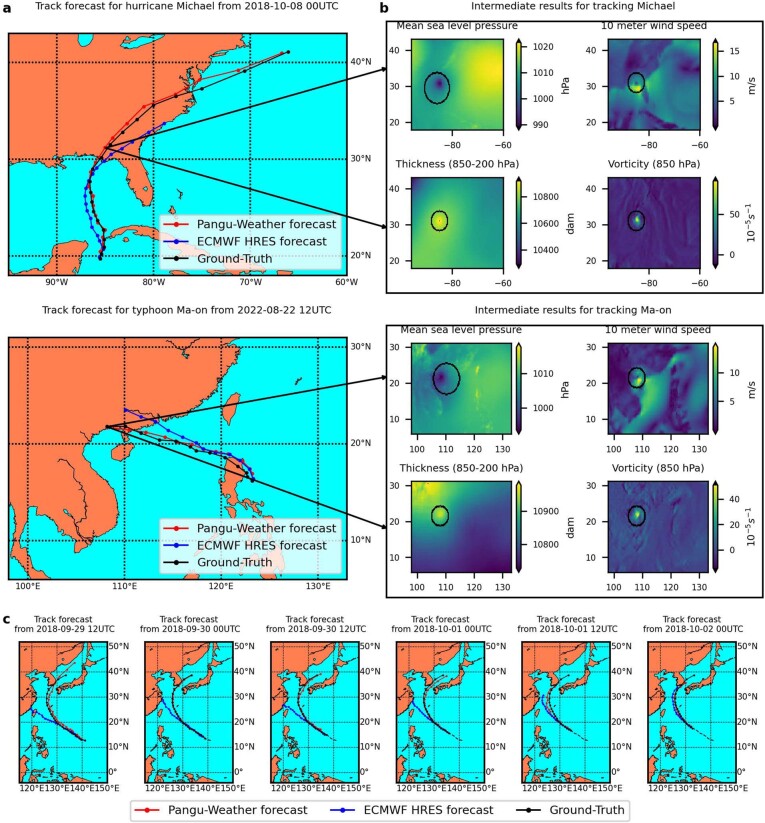
Weather forecasting is important for science and society. At present, the most accurate forecast system is the numerical weather prediction (NWP) method, which represents atmospheric states as discretized grids and numerically solves partial differential equations that describe the transition between those states 1 . However, this procedure is computationally expensive. Recently, artificial-intelligence-based methods 2 have shown potential in accelerating weather forecasting by orders of magnitude, but the forecast accuracy is still significantly lower than that of NWP methods. Here we introduce an artificial-intelligence-based method for accurate, medium-range global weather forecasting. We show that three-dimensional deep networks equipped with Earth-specific priors are effective at dealing with complex patterns in weather data, and that a hierarchical temporal aggregation strategy reduces accumulation errors in medium-range forecasting. Trained on 39 years of global data, our program, Pangu-Weather, obtains stronger deterministic forecast results on reanalysis data in all tested variables when compared with the world’s best NWP system, the operational integrated forecasting system of the European Centre for Medium-Range Weather Forecasts (ECMWF) 3 . Our method also works well with extreme weather forecasts and ensemble forecasts. When initialized with reanalysis data, the accuracy of tracking tropical cyclones is also higher than that of ECMWF-HRES.
Overview
The claims and statistics of this paper haven’t been checked yet.
Free: it reads the open-access text and checks the first 5 claims that cite a source we can check. Create a free account to check every claim.
Integrity signals
Registry
Cites
Statistics
Figures
Verification
Claims the paper makes
The claims and statistics of this paper haven’t been checked yet.
Free: it reads the open-access text and checks the first 5 claims that cite a source we can check. Create a free account to check every claim.
Claims other papers make about this one
Each is checked against this paper’s own text: does it say what the citing paper says it does?
The source backs part of the claim, not all of it — or backs it for a different population, condition or comparison.
In the citing paper
“However, they do not produce calibrated uncertainty estimates4, which is essential for useful weather forecasts1.”
From Neural general circulation models for weather and climate (2024) · cites this paper as [4]
Experimental — accuracy not yet measuredThe source backs part of the claim, not all of it — or backs it for a different population, condition or comparison.
In the citing paper
“Recently, machine-learning models trained on reanalysis data have achieved comparable or better skill than GCMs for deterministic weather forecasting3,4.”
From Neural general circulation models for weather and climate (2024) · cites this paper as [4]
Experimental — accuracy not yet measuredThe source backs part of the claim, not all of it — or backs it for a different population, condition or comparison.
In the citing paper
“Existing machine-learning models have focused on deterministic prediction, and surpass deterministic numerical weather prediction in terms of the aggregate metrics for which they are trained3,4.”
From Neural general circulation models for weather and climate (2024) · cites this paper as [4]
Experimental — accuracy not yet measuredThe source backs part of the claim, not all of it — or backs it for a different population, condition or comparison.
In the citing paper
“Most state-of-the-art machine learning models utilized in medium-range weather forecasting are built upon encoder-decoder84 architectures27–29,85.”
From A machine learning model that outperforms conventional global subseasonal forecast models (2024) · cites this paper as [28]
Experimental — accuracy not yet measuredThe source backs part of the claim, not all of it — or backs it for a different population, condition or comparison.
In the citing paper
“However, these advances have focused primarily on single, deterministic forecasts that fail to represent uncertainty and estimate risk.”
From Probabilistic weather forecasting with machine learning (2025) · cites this paper as [3]
Experimental — accuracy not yet measured
4 more claims about this paper
Create a free account to see every claim other papers make about this one.
Self-check
Percentages, sums and reported differences re-computed from the paper’s own numbers.
The self-check needs the paper’s full text.
Citations
Cites
LeCun, Y., Bengio, Y., & Hinton, G. (2015) · Nature · doi:10.1038/nature14539 · Cited by 84,126
An Image is Worth 16x16 Words: Transformers for Image Recognition at Scale
Dosovitskiy, A., Beyer, L., Kolesnikov, A., Weissenborn, D., Zhai, X., Unterthiner, T., Dehghani, M., Minderer, M., Heigold, G., Gelly, S., et al. (2020) · arXiv · doi:10.48550/arxiv.2010.11929 · Cited by 47,472
Swin Transformer: Hierarchical Vision Transformer using Shifted Windows
Liu, Z., Lin, Y., Cao, Y., Hu, H., Wei, Y., Zhang, Z., Lin, S., & Guo, B. (2021) · 2021 IEEE/CVF International Conference on Computer Vision (ICCV) · doi:10.1109/iccv48922.2021.00986 · Cited by 35,534
Hersbach, H., Bell, B., Berrisford, P., Hirahara, S., Horányi, A., Muñoz‐Sabater, J., Nicolas, J., Peubey, C., Radu, R., Schepers, D., et al. (2020) · Quarterly Journal of the Royal Meteorological Society · doi:10.1002/qj.3803 · Cited by 31,882
Language Models are Few-Shot Learners
Brown, T. B., Mann, B., Ryder, N., Subbiah, M., Kaplan, J., Dhariwal, P., Neelakantan, A., Shyam, P., Sastry, G., Askell, A., et al. (2020) · arXiv · doi:10.48550/arxiv.2005.14165 · Cited by 23,372
Learning Transferable Visual Models From Natural Language Supervision
Radford, A., Kim, J. W., Hallacy, C., Ramesh, A., Goh, G., Agarwal, S., Sastry, G., Askell, A., Mishkin, P., Clark, J., et al. (2021) · arXiv · doi:10.48550/arxiv.2103.00020 · Cited by 15,293
Momentum Contrast for Unsupervised Visual Representation Learning
He, K., Fan, H., Wu, Y., Xie, S., & Girshick, R. (2020) · 2020 IEEE/CVF Conference on Computer Vision and Pattern Recognition (CVPR) · doi:10.1109/cvpr42600.2020.00975 · Cited by 13,347
Learning Transferable Architectures for Scalable Image Recognition
Zoph, B., Vasudevan, V., Shlens, J., & Le, Q. V. (2018) · 2018 IEEE/CVF Conference on Computer Vision and Pattern Recognition · doi:10.1109/cvpr.2018.00907 · Cited by 7,831
Convolutional LSTM Network: A Machine Learning Approach for Precipitation Nowcasting
Shi, X., Chen, Z., Wang, H., Yeung, D.-Y., Wong, W.-K., & Woo, W.-C. (2015) · arXiv · doi:10.48550/arxiv.1506.04214 · Cited by 7,709
Atmospheric Modeling, Data Assimilation and Predictability
Kalnay, E. (2002) · doi:10.1017/cbo9780511802270 · Cited by 3,391
Research works printed but not linked: 2
- Devlin, J., Chang, M. W., Lee, K. & Toutanova, K. BERT: pre-training of deep bidirectional transformers for language understanding. In Proc. Conference North American Chapter of the Association of Computational Linguistics Vol. 1, 4171–4186 (NAACL, 2019).
- Stensrud, D. J. Parameterization Schemes: Keys to Understanding Numerical Weather Prediction Models (Cambridge Univ. Press 2009).
Cited by
Items 101–200 of 1,006
Machine Learning for Climate Physics and Simulations
Lai, C., Hassanzadeh, P., Sheshadri, A., Sonnewald, M., Ferrari, R., & Balaji, V. (2024) · Annual Review of Condensed Matter Physics · doi:10.1146/annurev-conmatphys-043024-114758 · Cited by 90
Xu, X., Sun, X., Han, W., Zhong, X., Chen, L., Gao, Z., & Li, H. (2025) · npj Climate and Atmospheric Science · doi:10.1038/s41612-025-01039-3 · Cited by 66
“Published in partnership with CECCR at King Abdulaziz University https://doi.org/10.1038/s41612-025-01039-3 FuXi-DA: a generalized deep learning data assimilation framework for assimilating satellite observations”
InfluentialACE2: accurately learning subseasonal to decadal atmospheric variability and forced responses
Watt‐Meyer, O., Henn, B., McGibbon, J., Clark, S. K., Kwa, A., Perkins, W. A., Wu, E., Harris, L., & Bretherton, C. S. (2025) · npj Climate and Atmospheric Science · doi:10.1038/s41612-025-01090-0 · Cited by 106
“While machine learning has demonstrated an ability to improve weather prediction accuracy (e.g. Bi et al., 2023a; Lam et al., 2023; Price et al., 2023; Chen et al., 2024; Kochkov et al., 2024), the typical goal of climate prediction is to forecast previously unseen conditions, for example the…”
Multivariate time series classification with crucial timestamps guidance
Zhang, D., Gao, J., & Li, X. (2024) · Expert Systems with Applications · doi:10.1016/j.eswa.2024.124591 · Cited by 37
On the Training and Generalization of Deep Operator Networks
Lee, S., & Shin, Y. (2024) · SIAM Journal on Scientific Computing · doi:10.1137/23m1598751 · Cited by 61
Wang, J., Chen, J., Shen, P., Guan, X., Liu, X., Massari, C., Wang, Z., Feng, M., Wang, Q., Lu, Y., et al. (2025) · Communications Earth & Environment · doi:10.1038/s43247-025-02624-3 · Cited by 44
Sun, E., Cui, Y., Liu, P., & Yan, J. (2025) · Information Fusion · doi:10.1016/j.inffus.2025.103675 · Cited by 51
Lang, S. T. K., Alexe, M., Clare, M., Roberts, C. D., Adewoyin, R. A., Bouallègue, Z. B., Chantry, M., Dramsch, J. S., Dueben, P. D., Hahner, S., et al. (2026) · npj Artificial Intelligence · doi:10.1038/s44387-026-00073-7 · Cited by 228
“Forthe fi rstgenerationofmachine-learnedweatherpredictionmodels, ensemble forecasts were mainly based on an ensemble of MSE trained forecast models 1,2,20 – 23 .”
Deep learning and a changing economy in weather and climate prediction
Bauer, P., Dueben, P. D., Chantry, M., Doblas-Reyes, F. J., Hoefler, T., McGovern, A., & Stevens, B. (2023) · Nature Reviews Earth & Environment · doi:10.1038/s43017-023-00468-z · Cited by 45
Accelerated optimization in deep learning with a proportional-integral-derivative controller
Chen, S., Liu, J., Wang, P., Xu, C., Cai, S., & Chu, J. (2024) · Nature Communications · doi:10.1038/s41467-024-54451-3 · Cited by 64
A Practical Probabilistic Benchmark for AI Weather Models
Brenowitz, N., Cohen, Y., Pathak, J., Mahesh, A., Bonev, B., Kurth, T., Durran, D. R., Harrington, P., & Pritchard, M. S. (2025) · Geophysical Research Letters · doi:10.1029/2024gl113656 · Cited by 69
“…(Bonevetal.,2023;Lametal.,2023)ormeanabsoluteerror (Bietal.,2023;L.Chenetal.,2023)asakeypartofthe loss function, and correspondingly their performance has often been compared to state‐of‐the‐art deterministic forecasts (Bi et al., 2023; Bonev et al., 2023; L. Chen et al., 2023; Lam et al., 2023).”
InfluentialA data-to-forecast machine learning system for global weather
Sun, X., Zhong, X., Xu, X., Huang, Y., Li, H., Neelin, J. D., Chen, D., Feng, J., Han, W., Wu, L., et al. (2025) · Nature Communications · doi:10.1038/s41467-025-62024-1 · Cited by 89
“Further details are provided in Supplementary Information Sections 1.2 and 2.1.”
InfluentialAdvances in Triboelectric Nanogenerators With Rotating Structure
Zhang, C., Xue, C., Chen, Y., Qiang, Y., & Ramakrishna, S. (2025) · Carbon Energy · doi:10.1002/cey2.70113 · Cited by 50
Attention enhanced dual stream network with advanced feature selection for power forecasting
Khan, T., & Choi, C. (2024) · Applied Energy · doi:10.1016/j.apenergy.2024.124564 · Cited by 33
Wang, Q., Ti, Z., Yang, S., Yang, K., Wang, J., & Deng, X. (2024) · Applied Energy · doi:10.1016/j.apenergy.2024.124812 · Cited by 31
Probabilistic photonic computing with chaotic light
Brückerhoff‐Plückelmann, F., Borras, H., Klein, B., Varri, A., Becker, M., Dijkstra, J., Brückerhoff, M., Wright, C. D., Salinga, M., Bhaskaran, H., et al. (2024) · Nature Communications · doi:10.1038/s41467-024-54931-6 · Cited by 59
“To date, ANNs have been very successfully implemented on deterministic conventional hardware and have led to breakthrough results in areas including weather forecasting 4 , medical diagnostic 5 , autonomous driving 6 and natural language processing 7–10 .”
Horat, N., Klerings, S., & Lerch, S. (2024) · Advances in Atmospheric Sciences · doi:10.1007/s00376-024-4219-2 · Cited by 37
“Finally, over the past few years, there have been rapid developments in AI-based data-driven weather models such as Pangu-Weather (Bi et al., 2023), GraphCast (Lam et al., 2023) or AIFS (Lang et al., 2024).”
Huang, L., Wang, Y., Bi, H., Zhu, G., Liu, L., & Jiang, W. (2025) · GPS Solutions · doi:10.1007/s10291-024-01807-3 · Cited by 32
“Pangu-Weather is a novel high-resolution global AI-based weather forecasting system proposed by researchers affiliated with Huawei Cloud (Bi et al. 2023).”
Zhou, B., Ji, B., Shen, C., Zhang, X., Xue, Y., Huang, P., Ru, Y., Zhang, H., Dou, X., Chen, Q., et al. (2023) · Nucleic Acids Research · doi:10.1093/nar/gkad1057 · Cited by 37
Self-citationLuo, Z., Lu, P., Chen, Z., & Liu, R. (2024) · Earth and Space Science · doi:10.1029/2023ea003346 · Cited by 32
3D‐Var data assimilation using a variational autoencoder
Melinc, B., & Zaplotnik, Ž. (2024) · Quarterly Journal of the Royal Meteorological Society · doi:10.1002/qj.4708 · Cited by 61
Machine learning for membrane bioreactor research: principles, methods, applications, and a tutorial
Lai, Y., Xiao, K., He, Y., Liu, X., Tan, J., Xue, W., Zhang, A., & Huang, X. (2024) · Frontiers of Environmental Science & Engineering · doi:10.1007/s11783-025-1954-2 · Cited by 37
“At present, large models are employed primarily for addressing large-scale or long-term environment problems, like weather forecasting (Bi et al., 2023) and global methane emissions (Rouet-Leduc and Hulbert, 2024), given the necessity for a substantial number of samples to serve as a foundation for…”
Zhu, H.-C., Ren, C., Wang, J., Feng, Z., Haghighat, F., & Cao, S. (2024) · Sustainable Cities and Society · doi:10.1016/j.scs.2024.105249 · Cited by 29
Achermann, F., Stastny, T., Danciu, B. A., Kolobov, A., Chung, J. J., Siegwart, R., & Lawrance, N. (2024) · Nature Communications · doi:10.1038/s41467-024-47778-4 · Cited by 41
Tian, Y., Zhao, Y., Li, J., Xu, H., Zhang, C., Deng, L., Wang, Y., & Peng, M. (2024) · Journal of Geophysical Research Atmospheres · doi:10.1029/2023jd040698 · Cited by 29
“Recently, advanced deep learning techniques have significantly impacted various domains of climate change research, including weather forecasting (Bi et al., 2023; Lam et al., 2023), post‐processing (Chapman et al., 2019, 2022), and bias correction, owing to their capacity to learn spatiotemporal…”
Hu, S., Liu, M., Zhang, S., Dong, S., & Zheng, R. (2023) · Engineering Applications of Artificial Intelligence · doi:10.1016/j.engappai.2023.107453 · Cited by 29
DeepWind: a heterogeneous spatio-temporal model for wind forecasting
Wang, B., Shi, J., Tan, B., Ma, M., Hong, F., Yu, Y., & Li, T. (2024) · Knowledge-Based Systems · doi:10.1016/j.knosys.2024.111385 · Cited by 28
Hybrid AI-enhanced lightning flash prediction in the medium-range forecast horizon
Cavaiola, M., Cassola, F., Sacchetti, D., Ferrari, F., & Mazzino, A. (2024) · Nature Communications · doi:10.1038/s41467-024-44697-2 · Cited by 39
Predictability Limit of the 2021 Pacific Northwest Heatwave From Deep‐Learning Sensitivity Analysis
Vonich, P. T., & Hakim, G. J. (2024) · Geophysical Research Letters · doi:10.1029/2024gl110651 · Cited by 54
“Results are presented in section 4, for both GraphCast and the Pangu-Weather model [Bi et al., 2023] to test for the importance of model error in the optimal initial conditions.”
MethodNiu, Z., Huang, W., Zhang, L., Deng, L., Wang, H., Yang, Y., Wang, D., & Li, H. (2025) · Earth and Space Science · doi:10.1029/2024ea003952 · Cited by 40
“Meanwhile, other innovative meteorological models such as GraphCast (Lam et al., 2023), FourCastNet (Pathak et al., 2022), Fengwu (K. Chen et al., 2023), Fuxi (L. Chen et al., 2023) and the Artificial Intelligence/Integrated Forecasting System (AIFS) (Lang et al., 2024) have also been introduced, leading a new wave of…”
Skillful subseasonal soil moisture drought forecasts with deep learning-dynamic models
Lesinger, K., & Tian, D. (2025) · Nature Communications · doi:10.1038/s41467-025-62761-3 · Cited by 42
“By directly learning from historical reanalysis data, DL has achieved notable successes in ten-day medium-range weather predictions 32,33 , fi ve-day extreme fl ood predictions 34 , and seasonal predictions of El Nino South Oscillation 35 (ENSO), all showing improved performance compared to…”
Benchmark dataset and deep learning method for global tropical cyclone forecasting
Huang, C., Mu, P., Zhang, J., Chan, S., Zhang, S., Yan, H., Chen, S., & Bai, C. (2025) · Nature Communications · doi:10.1038/s41467-025-61087-4 · Cited by 57
Deep learning model based on multi-scale feature fusion for precipitation nowcasting
Tan, J., Huang, Q., & Chen, S. (2024) · Geoscientific model development · doi:10.5194/gmd-17-53-2024 · Cited by 33
On the foundations of Earth foundation models
Zhu, X. X., Xiong, Z., Wang, Y., Stewart, A. J., Heidler, K., Wang, Y., Yuan, Z., Dujardin, T., Xu, Q., & Shi, Y. (2026) · Communications Earth & Environment · doi:10.1038/s43247-025-03127-x · Cited by 26
“However, it is worth noting that the majority of weather FMs are pre-trained on reanalysis products like ERA5, which itself required years of compute time on multiple high-performance computing clusters to produce 23 .”
InfluentialKong, L., Zhang, H., Xie, D., & Dai, N. (2024) · IEEE Transactions on Transportation Electrification · doi:10.1109/tte.2024.3400289 · Cited by 32
Self-citationRauf, F., Khan, M. A., Albarakati, H. M., Jabeen, K., Alsenan, S. A., Hamza, A., Teng, S., & Nam, Y. (2024) · Frontiers in Medicine · doi:10.3389/fmed.2024.1486995 · Cited by 30
Deep Learning for Ocean Forecasting: A Comprehensive Review of Methods, Applications, and Datasets
Hao, R., Zhao, Y., Zhang, S., & Deng, X. (2025) · IEEE Transactions on Cybernetics · doi:10.1109/tcyb.2025.3539990 · Cited by 35
“As the first high-resolution global AI weather forecasting system in the world with forecast accuracy exceeding that of traditional NOP methods, Pangu-Weather from Huawei significantly outperforms the state-of-the-art international Earth system models in short-and medium-term forecasts [22].”
Sweet, L., Athanasiadis, I. N., van Bree, R., Castellano, A., Martre, P., Paudel, D., Ruane, A. C., & Zscheischler, J. (2025) · One Earth · doi:10.1016/j.oneear.2025.101233 · Cited by 41
Dong, N., Hao, H., Yang, M., Wei, J., Xu, S., & Kunstmann, H. G. (2025) · Hydrology and earth system sciences · doi:10.5194/hess-29-2023-2025 · Cited by 47
“How effectively can CNN architectures with recent extensions”
Ding, N., Yuan, Z., Ma, Z., Wu, Y., & Yin, L. (2024) · Molecules · doi:10.3390/molecules29153512 · Cited by 30
Abdulah, S., Baker, A. H., Bosilca, G., Cao, Q., Castruccio, S., Genton, M. G., Keyes, D. E., Khalid, Z., Ltaief, H., Song, Y., et al. (2024) · International Conference for High Performance Computing, Networking, Storage and Analysis (SC) · doi:10.1109/sc41406.2024.00008 · Cited by 42
“This requires additional support within PaRSEC and will be addressed in future work.”
Wikner, A., Harvey, J., Girvan, M., Hunt, B. R., Pomerance, A., Antonsen, T. M., & Ott, E. (2023) · Neural Networks · doi:10.1016/j.neunet.2023.10.054 · Cited by 49
Dong, Z., Hu, H., Liu, H., Baoligao, B., Mu, X., Wen, J., Liu, D., Chen, L., Ming, G., Chen, X., et al. (2024) · Journal of Hydrology · doi:10.1016/j.jhydrol.2024.130941 · Cited by 30
Self-citationAlphaFold3 — why did Nature publish it without its code?
(2024) · Nature · doi:10.1038/d41586-024-01463-0 · Cited by 25
Identifying and Categorizing Bias in AI/ML for Earth Sciences
McGovern, A., Bostrom, A., McGraw, M. C., Chase, R. J., Gagne, D. J., Ebert‐Uphoff, I., Musgrave, K. D., & Schumacher, A. (2024) · Bulletin of the American Meteorological Society · doi:10.1175/bams-d-23-0196.1 · Cited by 33
Govett, M., Bah, B., Bauer, P., Bérod, D. D., Bouchet, V. S., Corti, S., Davis, C. A., Duan, Y., Graham, T. R., Honda, Y., et al. (2024) · Bulletin of the American Meteorological Society · doi:10.1175/bams-d-23-0220.1 · Cited by 42
The crucial representation of deep convection for the cyclogenesis of Medicane Ianos
Pantillon, F., Davolio, S., Avolio, E., Calvo‐Sancho, C., Carrió, D. S., Dafis, S., Flaounas, E., González‐Alemán, J. J., Gray, S. L., Miglietta, M. M., et al. (2024) · Weather and Climate Dynamics · doi:10.5194/wcd-5-1187-2024 · Cited by 30
Predictability Study of Weather and Climate Events Related to Artificial Intelligence Models
Mu, M., Qin, B., & Dai, G. (2024) · Advances in Atmospheric Sciences · doi:10.1007/s00376-024-4372-7 · Cited by 40
Cai, Y., Yang, J., Hou, Y., Wang, F., Yin, L., Li, S., Wang, Y., Yan, T., Yan, S., Zhan, X., et al. (2025) · Nature Communications · doi:10.1038/s41467-025-58005-z · Cited by 37
Learning dense gas-solids flows with physics-encoded neural network model
Guo, X., Hu, C., Dai, Y., Xu, H.-B., & Zeng, L. (2024) · Chemical Engineering Journal · doi:10.1016/j.cej.2024.150072 · Cited by 27
He, X., Liu, S., Bateni, S. M., Xu, T., Jun, C., Kim, D., Li, X., Song, L., Zhao, L., Xu, Z., et al. (2024) · Agricultural and Forest Meteorology · doi:10.1016/j.agrformet.2024.110136 · Cited by 26
Yu, Q., Shen, X., Yi, L., Liang, M., Li, G., Guan, Z., Wu, X., Castel, H., Hu, B., Yin, P., et al. (2024) · ACS Sensors · doi:10.1021/acssensors.4c00149 · Cited by 27
Urban mobility foundation model: A literature review and hierarchical perspective
Zhou, Z., Gu, Z., Qu, X., Liu, P., Liu, Z.-Y., & Yu, W. (2024) · Transportation Research Part E: Logistics and Transportation Review · doi:10.1016/j.tre.2024.103795 · Cited by 27
Global Prediction of Flash Drought Using Machine Learning
Xu, L., Zhang, X., Wu, T., Yu, H., Du, W., Zhang, C., & Chen, N. (2024) · Geophysical Research Letters · doi:10.1029/2024gl111134 · Cited by 31
“…relatively accurate forecasts of precipitation, temperature, winds and other influential factors at least days to weeks in advance, which still faces difficulties in current weather models (Bi et al., 2023; Espeholt et al., 2022; Lam et al., 2023; Lesinger et al., 2024; Mouatadid et al., 2023).”
Feng, Z., Sun, Y., Ning, J., Tang, S., Liu, G., Liu, F., Li, Y., & Shi, L. (2025) · Applied Energy · doi:10.1016/j.apenergy.2025.125372 · Cited by 26
Yu, Q., Li, P., Ni, X. L., Li, Y., & Wang, L. (2025) · Chemical Science · doi:10.1039/d4sc06422d · Cited by 26
“In 15 – 17 Particularly, machine learning force elds (MLFF) have shown great promise in predicting complex catalytic systems and enabling large-scale and long-time dynamics simulations with rst-principles accuracy, 18 which has been applied to the rapid identi cation of transition states for…”
Niu, Z., Wang, D., Mu, M., Huang, W., Fan, X., Yang, M., & Qin, B. (2025) · Geophysical Research Letters · doi:10.1029/2025gl115926 · Cited by 29
“With the rapid development of data‐driven machine‐learning (ML) models such as PanGu, GraphCast, FuXi, and ECMWF Artificial Intelligence/Integrated Forecasting System (Bi et al., 2023; Chen et al., 2023; Lam et al., 2023; Lang et al., 2024), these models have demonstrated a clear advantage over traditional global/regi…”
Estimation of Tropical Cyclone Intensity via Deep Learning Techniques from Satellite Cloud Images
Tong, B., Fu, J., Deng, Y., Huang, Y., Chan, P. W., & He, Y. (2023) · Remote Sensing · doi:10.3390/rs15174188 · Cited by 27
“In fact, Bi et al. [29] demonstrated that training ViT models with large amounts of reanalysis data can generate be tt er results than those from numerical weather prediction (NWP).”
Wang, Y., Zhao, X., Li, Z., Zhu, W., & Gui, R. (2024) · Energy · doi:10.1016/j.energy.2024.133515 · Cited by 25
Adomako, A. B., Jamshidi, E. J., Yusup, Y., Elsebakhi, E., Jaafar, M. H., Ishak, M. I. S., Lim, H. S., & Ahmad, M. I. (2024) · Ecological Informatics · doi:10.1016/j.ecoinf.2024.102898 · Cited by 30
Machine learning to assess and support safe drinking water supply: a systematic review
Feng, F., Zhang, Y., Chen, Z., Ni, J., Feng, Y., Xie, Y., & Zhang, C. (2024) · Journal of environmental chemical engineering · doi:10.1016/j.jece.2024.114481 · Cited by 37
Jia, X., & Chen, X. D. (2023) · Engineering Applications of Artificial Intelligence · doi:10.1016/j.engappai.2023.107325 · Cited by 27
Self-citationLive Power Generation Predictions via AI-Driven Resilient Systems in Smart Microgrids
Wang, X., Li, S., & Iqbal, M. (2024) · IEEE Transactions on Consumer Electronics · doi:10.1109/tce.2024.3371256 · Cited by 31
Improved Diagnosis of Precipitation Type with LightGBM Machine Learning
Zhuang, H. (., Lehner, F., & DeGaetano, A. T. (2024) · Journal of Applied Meteorology and Climatology · doi:10.1175/jamc-d-23-0117.1 · Cited by 29
Prediction and control of two-dimensional decaying turbulence using generative adversarial networks
Kim, J., Kim, J., & Lee, C. (2024) · Journal of Fluid Mechanics · doi:10.1017/jfm.2024.77 · Cited by 26
Pu, J., Mu, M., Feng, J., Zhong, X., & Li, H. (2025) · npj Climate and Atmospheric Science · doi:10.1038/s41612-025-01009-9 · Cited by 36
“This improvement in TC track forecast accuracy in FuXi aligns with fi ndings in previous studies 27,28 , laying a solid foundation for subsequent TC track ensemble forecasting efforts.”
InfluentialSamudra: An AI Global Ocean Emulator for Climate
Dheeshjith, S., Subel, A., Adcroft, A., Busecke, J. J. M., Fernandez‐Granda, C., Gupta, S., & Zanna, L. (2025) · Geophysical Research Letters · doi:10.1029/2024gl114318 · Cited by 72
“The recent success of emulators for components of the climate system, primarily the atmosphere, continues to produce remarkable outcomes, achieving state‐of‐the‐art performance for weather prediction tasks (Bi et al., 2023; Kochkov et al., 2024; Price et al., 2023) and promising results reproducing climate models over…”
A Review of Atmospheric Micro/Nanoplastics: Insights into Source and Fate for Modelling Studies
Jiang, F., Gao, C., Chan, A. W. H., Topping, D. O., Zhang, H., Li, W., Coe, H., Liu, X., Ching, J., & Zheng, Z. (2025) · Current Pollution Reports · doi:10.1007/s40726-025-00375-5 · Cited by 24
“…in aerosol research [384], satellite remote sensing [385–387], and meteorology and climate science (such as ClimateX [388], FengWu [389], PanGu [390], FuXi [391], GraphCast [392], FourCastNet [393], W-MAE [394], and CliMed-Bert [395]), their potential applications in AMNP research warrant…”
Self-citationTian, Y., Zhao, Y., Li, J., Shen, C., Zhang, Y., Wen, D., Qi, X., Liu, Y., & Chen, D. (2026) · Atmospheric Research · doi:10.1016/j.atmosres.2026.108809 · Cited by 26
Knowledge‐Guided Machine Learning for Global Change Ecology Research
Jin, Z., Liu, L., Yang, Q. L., Jia, X., Tao, S., Guo, Y., Ghosh, R., Wang, S., Zhu, Q., Jung, M., et al. (2026) · Global Change Biology · doi:10.1111/gcb.70742 · Cited by 30
Generalized spatial–temporal regression graph convolutional transformer for traffic forecasting
Xiong, L., Su, L., Zeng, S., Li, X., Wang, T., & Zhao, F. (2024) · Complex & Intelligent Systems · doi:10.1007/s40747-024-01578-x · Cited by 22
Photonic Neuromorphic Processing with On‐Chip Electrically‐Driven Microring Spiking Neuron
Xiang, J., Zhao, Y., He, A., Xiao, J., Su, Y., & Guo, X. (2024) · Laser & Photonics Review · doi:10.1002/lpor.202400604 · Cited by 23
Li, Y., Han, W., Li, H., Duan, W., Chen, L., Zhong, X., Wang, J., Liu, Y., & Sun, X. (2024) · Geophysical Research Letters · doi:10.1029/2024gl111136 · Cited by 35
“The FuXi Model (L. Chen et al., 2023), developed by the Artificial Intelligence Innovation and Incubation Institute at Fudan University, implements a cascaded model architecture to provide a 15 day global forecast with a temporal resolution of 6 hr and a spatial resolution of 0 .”
Physics-informed neural networks for tsunami inundation modeling
Brecht, R., Cardoso‐Bihlo, E. D. S., & Bihlo, A. (2025) · Journal of Computational Physics · doi:10.1016/j.jcp.2025.114066 · Cited by 35
“Data-driven DeepONets are behind some of the most impressive state-of-the-art results in numerical meteorology today [6, 31].”
A spatial-temporal trend-aware neural network model for accurate water quality prediction in river
Zheng, Y., Zhang, Q., Zhang, X., Zhou, Y., Zhang, Y., & Zhang, T. (2025) · Water Research · doi:10.1016/j.watres.2025.124389 · Cited by 32
ResoNet: Robust and Explainable ENSO Forecasts with Hybrid Convolution and Transformer Networks
Lyu, P., Tang, T., Ling, F., Luo, J., Boers, N., Ouyang, W., & Bai, L. (2024) · Advances in Atmospheric Sciences · doi:10.1007/s00376-024-3316-6 · Cited by 26
Luo, L., Zhang, J., Wang, H., Chen, M., Jiang, Q., Yang, W., Wang, F., Zhang, J., Swain, R. B., Meadows, M. E., et al. (2024) · The Innovation Geoscience · doi:10.59717/j.xinn-geo.2024.100087 · Cited by 31
Liu, L., Liang, X., Xu, Y., Guo, Y., Wang, Q. J., & Gu, H. (2024) · Journal of Hydrology · doi:10.1016/j.jhydrol.2024.131993 · Cited by 24
Prediction of freak waves from buoy measurements
Breunung, T., & Balachandran, B. (2024) · Scientific Reports · doi:10.1038/s41598-024-66315-3 · Cited by 22
A Method Based on Deep Learning for Severe Convective Weather Forecast: CNN-BiLSTM-AM (Version 1.0)
Zhang, J., Yin, M., Wang, P. P., & Gao, Z. (2024) · Atmosphere · doi:10.3390/atmos15101229 · Cited by 22
Data-driven models for forecasting algal biomass in a large and deep reservoir
Li, Y., Shi, K., Zhu, M., Li, H., Guo, Y., Song, M., Ou, W., & Zheng, Z. (2024) · Water Research · doi:10.1016/j.watres.2024.122832 · Cited by 22
Zhang, T., Yu, H., Wang, X., Wang, J., & Ren, B. (2025) · Automation in Construction · doi:10.1016/j.autcon.2025.106036 · Cited by 18
Are AI weather models learning atmospheric physics? A sensitivity analysis of cyclone Xynthia
Baño‐Medina, J., Sengupta, A., Doyle, J. D., Reynolds, C. A., Watson‐Parris, D., & Monache, L. D. (2025) · npj Climate and Atmospheric Science · doi:10.1038/s41612-025-00949-6 · Cited by 51
Xie, C., Gao, H., Huang, Y., Xue, Z., Xu, C. B., & Dai, K. (2025) · Earthquake research advances · doi:10.1016/j.eqrea.2025.100378 · Cited by 29
Yang, Y., Dong, X., & Qiang, Y. (2025) · Proceedings of the AAAI Conference on Artificial Intelligence · doi:10.1609/aaai.v39i24.34755 · Cited by 51
Morante-Carballo, F., Arcentales-Rosado, M., Caicedo‐Potosí, J., & Carrión-Mero, P. (2025) · Watershed Ecology and the Environment · doi:10.1016/j.wsee.2025.05.004 · Cited by 24
Zhang, Y., Yuan, X., Zhang, X., Wang, H., He, P., Luo, L., & Xu, C. (2025) · Engineering Applications of Artificial Intelligence · doi:10.1016/j.engappai.2025.110828 · Cited by 25
A Deep Learning Earth System Model for Efficient Simulation of the Observed Climate
Cresswell‐Clay, N., Liu, B., Durran, D. R., Liu, Z., Espinosa, Z. I., Moreno, R. A., & Karlbauer, M. (2025) · AGU Advances · doi:10.1029/2025av001706 · Cited by 93
“Recently developed atmosphere‐only deep learning (DL) models provide good deterministic global weather forecasts out to about 10 days, but generally become unstable or exhibit low skill during multi‐month simulations (Bi et al., 2023; Karlbauer et al., 2024; Lam et al., 2023).”
Skilful global seasonal predictions from a machine learning weather model trained on reanalysis data
Kent, C., Scaife, A. A., Dunstone, N., Smith, D. M., Hardiman, S. C., Dunstan, T., & Watt‐Meyer, O. (2025) · npj Climate and Atmospheric Science · doi:10.1038/s41612-025-01198-3 · Cited by 37
AtmoRep: A stochastic model of atmosphere dynamics using large scale representation learning
Lessig, C., Luise, I., Gong, B., Langguth, M., Stadtler, S., & Schultz, M. (2023) · arXiv · doi:10.48550/arxiv.2308.13280 · Cited by 19
Forest structural and microclimatic patterns along an elevational gradient in Mount Kenya
Jia, J., Hughes, A. C., Nunes, M. H., Santos, E. G., Pellikka, P., Kalliovirta, L., Mwamodenyi, J. M., & Maeda, E. E. (2024) · Agricultural and Forest Meteorology · doi:10.1016/j.agrformet.2024.110188 · Cited by 24
Machine-learning-accelerated multi-objective design of fractured geothermal systems
Chen, G., Jiao, J. J., Liu, Q., Wang, Z., & Jin, Y. (2024) · Nexus · doi:10.1016/j.ynexs.2024.100044 · Cited by 26
On the use of deep learning for computer-generated holography
Yu, X., Zhang, H., Zhao, Z., Fan, X., Hu, S., Li, Z., Chen, W., Li, D., Shi, S., Xiong, W., et al. (2025) · iScience · doi:10.1016/j.isci.2025.112507 · Cited by 25
“The remarkable progress in deep learning has not only permeated diverse practical domains including large language models, 8 computer vision 9,10 and meteorological forecasting, 11 but also sparked a paradigm shift across scientific disciplines through the ‘‘AI for Science’’ movement.”
Self-citationXu, P., Zheng, X., Gao, T., Wang, Y., Yin, J., Zhang, J., Zhang, X., San, L., Wang, Z., Zhang, Z., et al. (2025) · Communications Earth & Environment · doi:10.1038/s43247-025-02347-5 · Cited by 48
“To run a LAM requires an LBC ^ Y t , which is normally obtained from AI-based global forecast or coarse resolution NWP,given by Pangu-weather or coarsen HRRR to 24 km (i.e. HRRR.F24) depending on the purpose for forecast or research application.”
InfluentialSelf-citationA multivariate time series prediction model based on the KAN network
Long, Y., & Qin, X. (2025) · Scientific Reports · doi:10.1038/s41598-025-07654-7 · Cited by 20
Zhao, Y., Carmeliet, J., Hamdi, R., Yuan, C., Ding, X., Derome, D., YifanFan, Jiang, S., & Peng, J. (2025) · Annual Review of Environment and Resources · doi:10.1146/annurev-environ-111523-102159 · Cited by 25
Zhou, G., Qian, L., & Gamba, P. E. (2025) · Remote Sensing · doi:10.3390/rs17213532 · Cited by 35
“The resulting industry foundation models have been successfully applied in vertical fields such as industry [120], agriculture [121], meteorology [122], geographic information [123], finance [124], medicine [125], education [126], and law [127].”
Temporal Chain Network With Intuitive Attention Mechanism for Long-Term Series Forecasting
Zhang, Z., Han, Y. M., Ma, B., Liu, M., & Geng, Z. (2023) · IEEE Transactions on Instrumentation and Measurement · doi:10.1109/tim.2023.3322508 · Cited by 27
Reservoir computing-based advance warning of extreme events
Wang, T., Zhou, H., Fang, Q., Han, Y., Guo, X., Zhang, Y., Qian, C., Chen, H., Barland, S., Xiang, S., et al. (2024) · Chaos Solitons & Fractals · doi:10.1016/j.chaos.2024.114673 · Cited by 23
A Deep Learning Approach for Forecasting Thunderstorm Gusts in the Beijing-Tianjin-Hebei Region
Liu, Y., Yang, L., Chen, M., Song, L., Han, L., & Xu, J. (2024) · Advances in Atmospheric Sciences · doi:10.1007/s00376-023-3255-7 · Cited by 24
Metadata
- Authors
- Bi, K., Xie, L., Zhang, H., Chen, X., Gu, X., & Tian, Q.
- Affiliations
- Huawei Technologies (China) (CN)
- Corresponding author
- Tian, Qi
- Venue
- Nature
- Published
- 2023-07-05
- Volume
- 619
- Issue
- 7970
- Pages
- 533-538
- ISSN
- 0028-0836 (ISSN-L)
- 1476-4687
- PMC
- PMC10356604
- OpenAlex
- W4383218913
- Semantic Scholar
- 6a78c73c92d5e5d9759b46eff892baf1d6e83754
- Cited by
- 1,670
- References
- 36
- Citations by year
- 2026: 565 · 2025: 594 · 2024: 444 · 2023: 67
- FWCI
- 184.37
- Type
- journal article
- Language
- en
- Update notices
- correction (2023-09-14)
- Open access
- hybrid
- doi.org
- Licence
- cc-by
- creativecommons.org/licenses/by/4.0 (tdm)
- creativecommons.org/licenses/by/4.0 (vor)
- Locations
- Nature (publishedVersion, cc-by)
- PubMed Central (publishedVersion, cc-by)
- PubMed (publishedVersion)
- RePEc: Research Papers in Economics (submittedVersion)
- Funders
- National Oceanic and Atmospheric Administration
- Topics
- Physical Sciences › Earth and Planetary Sciences › Atmospheric Science › Meteorological Phenomena and Simulations
- Physical Sciences › Environmental Science › Environmental Engineering › Hydrological Forecasting Using AI
- Social Sciences › Transportation › Traffic Prediction and Management Techniques
- Keywords
- medium-range weather forecasting, global weather forecasting, 3D neural networks, Pangu-Weather, deterministic forecasting, tropical cyclone tracking, extreme weather prediction, ensemble forecasting, reanalysis data, ECMWF comparison
About these checks
Registry, retraction, Cites and statistics results are computed, not judged, with one exception: a printed reference that no index lists is read once by a model before it counts as a citation error. Claims are extracted by a model and kept only when their quote appears verbatim in the text; each cited source is then checked, with a model’s help, for whether it says what the claim relies on. Those verdicts can be wrong — read the claim’s quote and the cited source before relying on one.
Statistics and arithmetic are recomputed, not judged.
Confidence bands are shown only for fields calibrated on our annotated test set. None is calibrated yet, so no band is shown.
What counts as a claim ›How we measure confidence ›How we check this ›
Are you an author, or do you see a problem with this page? Request a review
Data sources
Bibliographic data: Semantic Scholar, OpenAlex, Crossref.
Contains information from the Semantic Scholar Academic Graph Datasets, made available under the ODC Attribution License (ODC-BY 1.0).
Semantic Scholar’s data is described in: Kinney, R., et al. (2023). The Semantic Scholar Open Data Platform. arXiv:2301.10140.
