

Accurate medium-range global weather forecasting with 3D neural networks
Open accessThe DOI matches its Crossref record; 41 of the 41 references it cites were found in a registry or an index.
Abstract
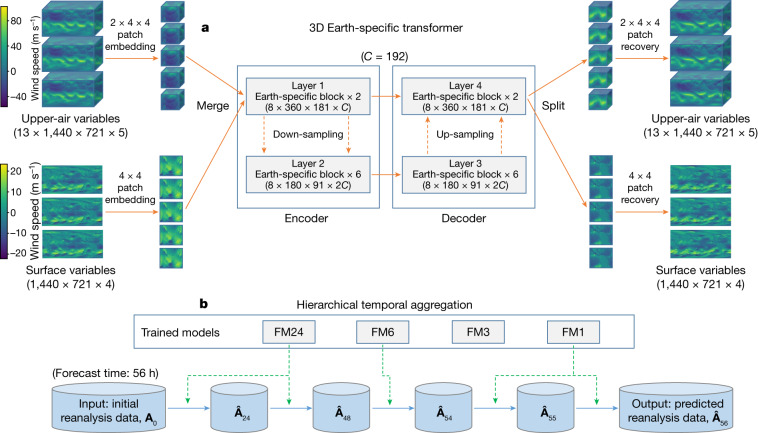
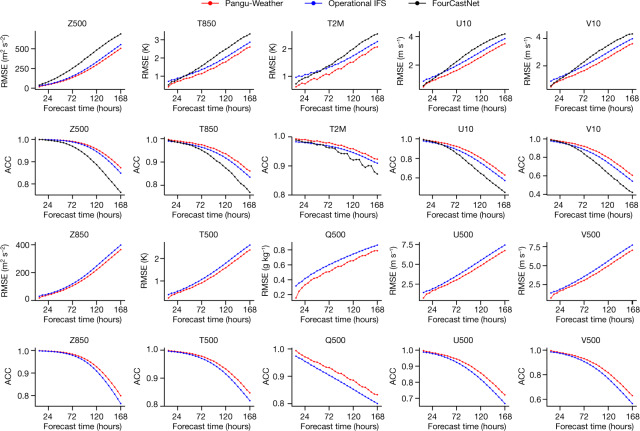
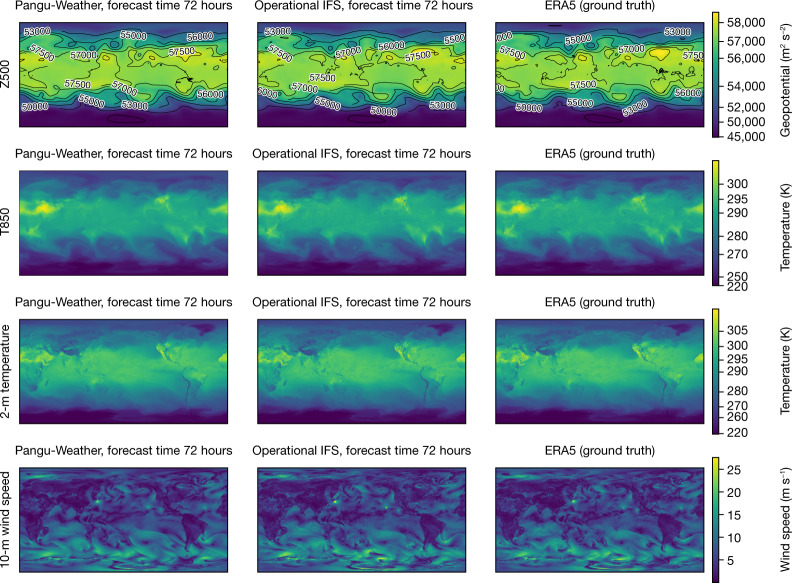
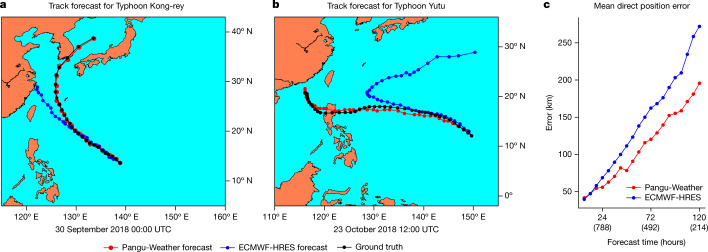
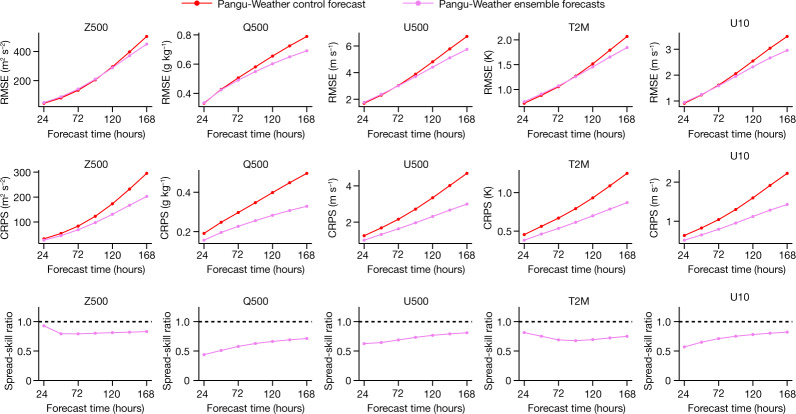
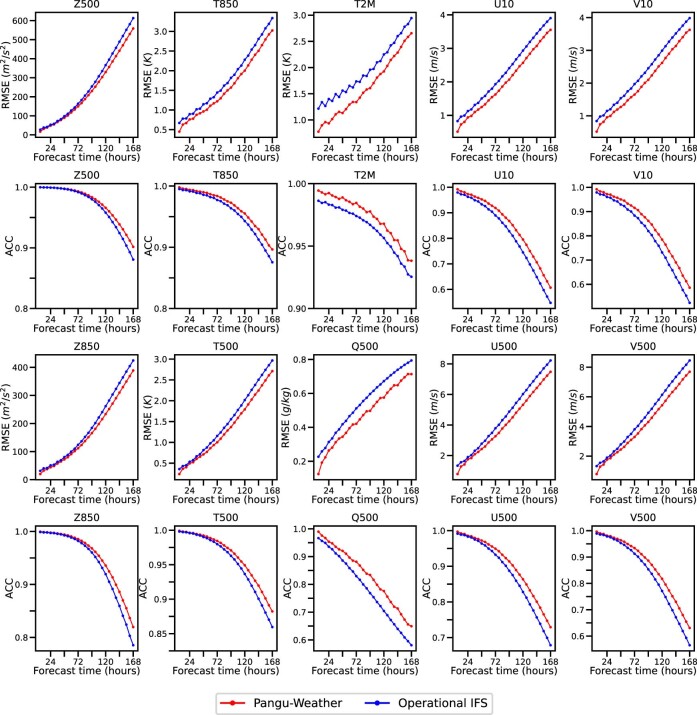
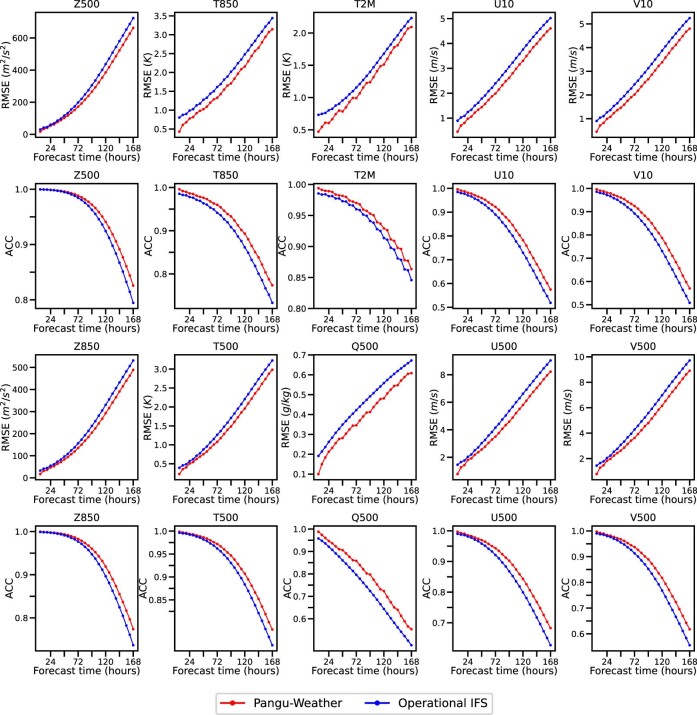
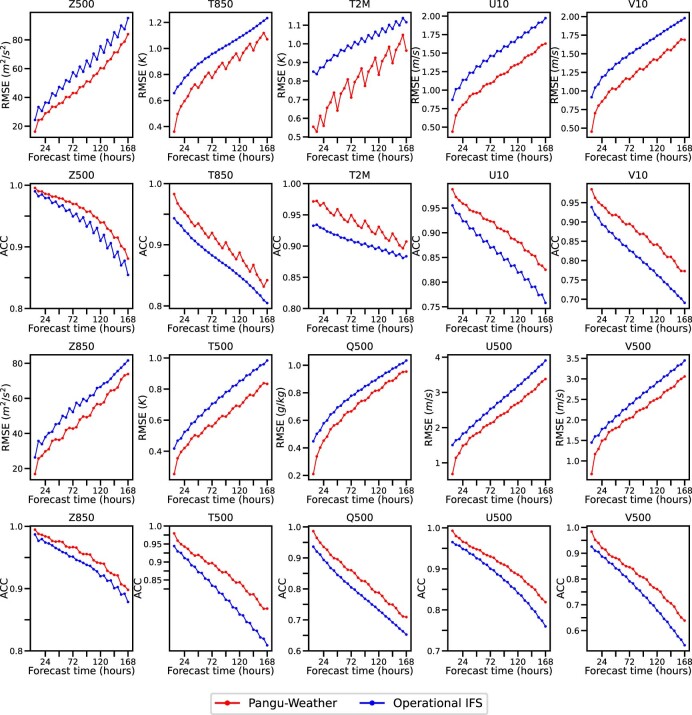
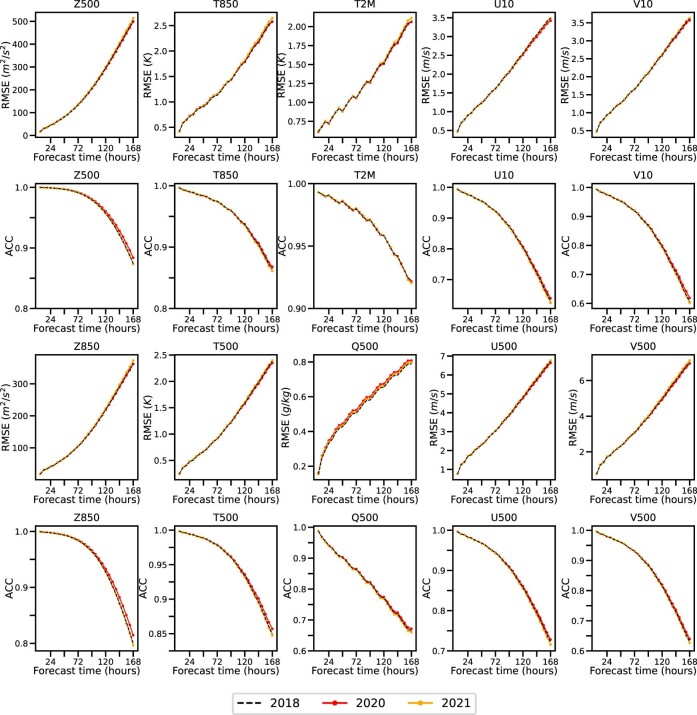
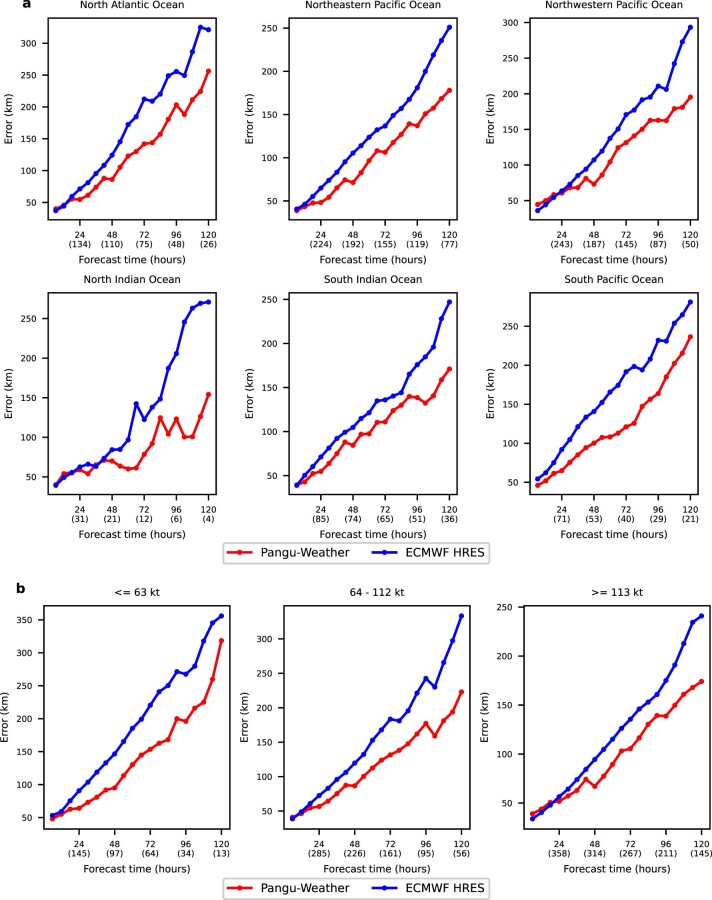
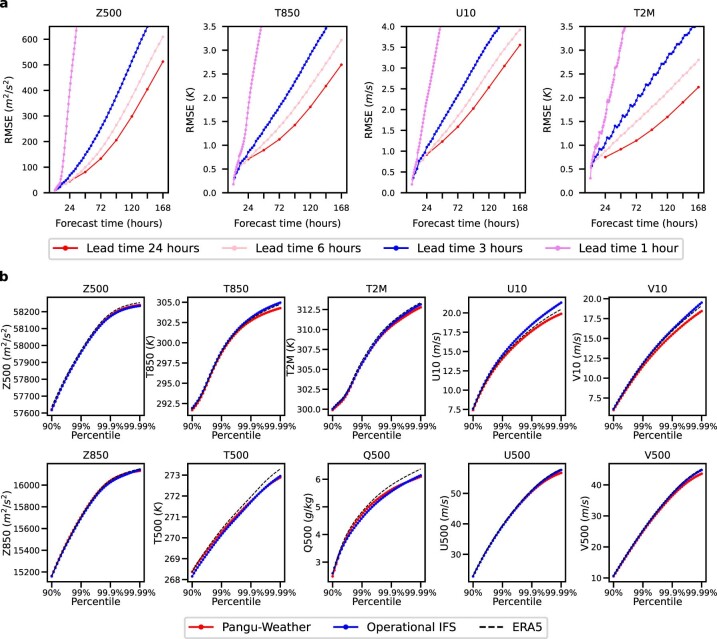
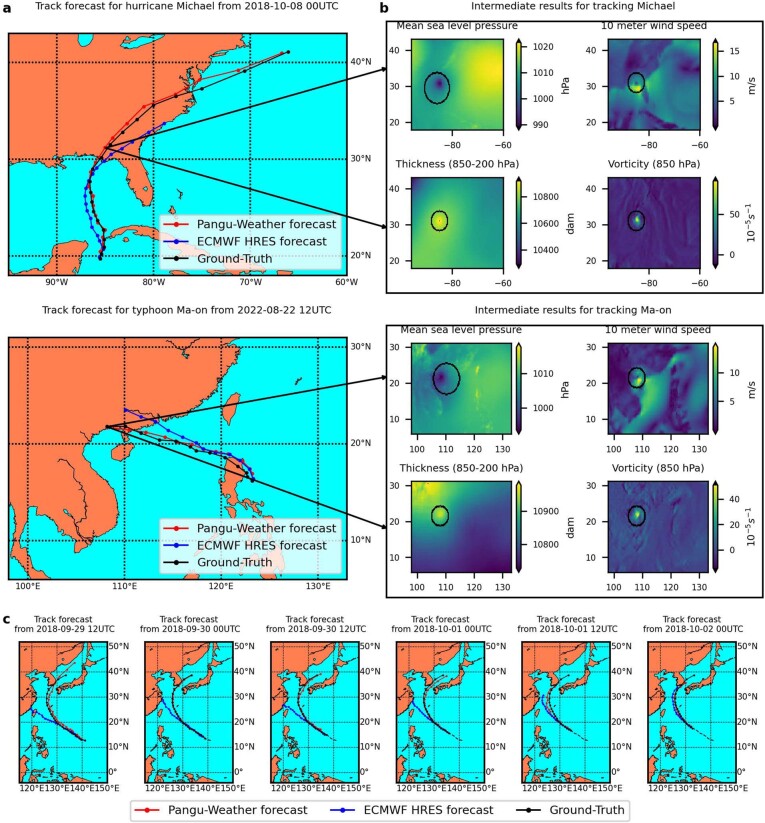
Weather forecasting is important for science and society. At present, the most accurate forecast system is the numerical weather prediction (NWP) method, which represents atmospheric states as discretized grids and numerically solves partial differential equations that describe the transition between those states 1 . However, this procedure is computationally expensive. Recently, artificial-intelligence-based methods 2 have shown potential in accelerating weather forecasting by orders of magnitude, but the forecast accuracy is still significantly lower than that of NWP methods. Here we introduce an artificial-intelligence-based method for accurate, medium-range global weather forecasting. We show that three-dimensional deep networks equipped with Earth-specific priors are effective at dealing with complex patterns in weather data, and that a hierarchical temporal aggregation strategy reduces accumulation errors in medium-range forecasting. Trained on 39 years of global data, our program, Pangu-Weather, obtains stronger deterministic forecast results on reanalysis data in all tested variables when compared with the world’s best NWP system, the operational integrated forecasting system of the European Centre for Medium-Range Weather Forecasts (ECMWF) 3 . Our method also works well with extreme weather forecasts and ensemble forecasts. When initialized with reanalysis data, the accuracy of tracking tropical cyclones is also higher than that of ECMWF-HRES.
Overview
The claims and statistics of this paper haven’t been checked yet.
Free: it reads the open-access text and checks the first 5 claims that cite a source we can check. Create a free account to check every claim.
Integrity signals
Registry
Cites
Statistics
Figures
Verification
Claims the paper makes
The claims and statistics of this paper haven’t been checked yet.
Free: it reads the open-access text and checks the first 5 claims that cite a source we can check. Create a free account to check every claim.
Claims other papers make about this one
Each is checked against this paper’s own text: does it say what the citing paper says it does?
The source backs part of the claim, not all of it — or backs it for a different population, condition or comparison.
In the citing paper
“However, they do not produce calibrated uncertainty estimates4, which is essential for useful weather forecasts1.”
From Neural general circulation models for weather and climate (2024) · cites this paper as [4]
Experimental — accuracy not yet measuredThe source backs part of the claim, not all of it — or backs it for a different population, condition or comparison.
In the citing paper
“Recently, machine-learning models trained on reanalysis data have achieved comparable or better skill than GCMs for deterministic weather forecasting3,4.”
From Neural general circulation models for weather and climate (2024) · cites this paper as [4]
Experimental — accuracy not yet measuredThe source backs part of the claim, not all of it — or backs it for a different population, condition or comparison.
In the citing paper
“Existing machine-learning models have focused on deterministic prediction, and surpass deterministic numerical weather prediction in terms of the aggregate metrics for which they are trained3,4.”
From Neural general circulation models for weather and climate (2024) · cites this paper as [4]
Experimental — accuracy not yet measuredThe source backs part of the claim, not all of it — or backs it for a different population, condition or comparison.
In the citing paper
“Most state-of-the-art machine learning models utilized in medium-range weather forecasting are built upon encoder-decoder84 architectures27–29,85.”
From A machine learning model that outperforms conventional global subseasonal forecast models (2024) · cites this paper as [28]
Experimental — accuracy not yet measuredThe source backs part of the claim, not all of it — or backs it for a different population, condition or comparison.
In the citing paper
“However, these advances have focused primarily on single, deterministic forecasts that fail to represent uncertainty and estimate risk.”
From Probabilistic weather forecasting with machine learning (2025) · cites this paper as [3]
Experimental — accuracy not yet measured
4 more claims about this paper
Create a free account to see every claim other papers make about this one.
Self-check
Percentages, sums and reported differences re-computed from the paper’s own numbers.
The self-check needs the paper’s full text.
Citations
Cites
LeCun, Y., Bengio, Y., & Hinton, G. (2015) · Nature · doi:10.1038/nature14539 · Cited by 84,126
An Image is Worth 16x16 Words: Transformers for Image Recognition at Scale
Dosovitskiy, A., Beyer, L., Kolesnikov, A., Weissenborn, D., Zhai, X., Unterthiner, T., Dehghani, M., Minderer, M., Heigold, G., Gelly, S., et al. (2020) · arXiv · doi:10.48550/arxiv.2010.11929 · Cited by 47,472
Swin Transformer: Hierarchical Vision Transformer using Shifted Windows
Liu, Z., Lin, Y., Cao, Y., Hu, H., Wei, Y., Zhang, Z., Lin, S., & Guo, B. (2021) · 2021 IEEE/CVF International Conference on Computer Vision (ICCV) · doi:10.1109/iccv48922.2021.00986 · Cited by 35,534
Hersbach, H., Bell, B., Berrisford, P., Hirahara, S., Horányi, A., Muñoz‐Sabater, J., Nicolas, J., Peubey, C., Radu, R., Schepers, D., et al. (2020) · Quarterly Journal of the Royal Meteorological Society · doi:10.1002/qj.3803 · Cited by 31,882
Language Models are Few-Shot Learners
Brown, T. B., Mann, B., Ryder, N., Subbiah, M., Kaplan, J., Dhariwal, P., Neelakantan, A., Shyam, P., Sastry, G., Askell, A., et al. (2020) · arXiv · doi:10.48550/arxiv.2005.14165 · Cited by 23,372
Learning Transferable Visual Models From Natural Language Supervision
Radford, A., Kim, J. W., Hallacy, C., Ramesh, A., Goh, G., Agarwal, S., Sastry, G., Askell, A., Mishkin, P., Clark, J., et al. (2021) · arXiv · doi:10.48550/arxiv.2103.00020 · Cited by 15,293
Momentum Contrast for Unsupervised Visual Representation Learning
He, K., Fan, H., Wu, Y., Xie, S., & Girshick, R. (2020) · 2020 IEEE/CVF Conference on Computer Vision and Pattern Recognition (CVPR) · doi:10.1109/cvpr42600.2020.00975 · Cited by 13,347
Learning Transferable Architectures for Scalable Image Recognition
Zoph, B., Vasudevan, V., Shlens, J., & Le, Q. V. (2018) · 2018 IEEE/CVF Conference on Computer Vision and Pattern Recognition · doi:10.1109/cvpr.2018.00907 · Cited by 7,831
Convolutional LSTM Network: A Machine Learning Approach for Precipitation Nowcasting
Shi, X., Chen, Z., Wang, H., Yeung, D.-Y., Wong, W.-K., & Woo, W.-C. (2015) · arXiv · doi:10.48550/arxiv.1506.04214 · Cited by 7,709
Atmospheric Modeling, Data Assimilation and Predictability
Kalnay, E. (2002) · doi:10.1017/cbo9780511802270 · Cited by 3,391
Research works printed but not linked: 2
- Devlin, J., Chang, M. W., Lee, K. & Toutanova, K. BERT: pre-training of deep bidirectional transformers for language understanding. In Proc. Conference North American Chapter of the Association of Computational Linguistics Vol. 1, 4171–4186 (NAACL, 2019).
- Stensrud, D. J. Parameterization Schemes: Keys to Understanding Numerical Weather Prediction Models (Cambridge Univ. Press 2009).
Cited by
Items 801–900 of 1,006
Ultrafast 24-h solar irradiance forecasts outperform numerical weather predictions across the USA
Bai, M., Fang, Z., Tao, S., Xiang, S., Bian, J., Xiang, Y., Zhao, P., Jin, W., Weyn, J. A., Dong, H., et al. (2025) · Cell Reports Physical Science · doi:10.1016/j.xcrp.2025.102996 · Cited by 8
A mechanism-learning deeply coupled model for single-channel land surface temperature retrieval
Xie, T., Shen, H., Jiang, M., Li, H., Zeng, C., Jiménez-Muñoz, J. C., Sobrino, J. A., Ma, J., Zhang, G., & Zhang, L. (2026) · Remote Sensing of Environment · doi:10.1016/j.rse.2026.115350 · Cited by 4
Falasca, F. (2025) · Physical Review Research · doi:10.1103/2f4r-k8lr · Cited by 16
Yuan, S., Wang, X., Mu, B., Wang, G., Niu, Z., & Li, H. (2025) · Advances in Atmospheric Sciences · doi:10.1007/s00376-025-4520-8 · Cited by 3
Xu, G., Shi, Y., Zhu, X., Jing, Z., Zhou, S., Xu, J., Xu, H., Wang, G., Fu, D., & Dong, C. (2025) · Ocean Modelling · doi:10.1016/j.ocemod.2025.102674 · Cited by 6
Global weather forecasting through deep learning: applications and challenges
Wang, B., Zhu, S., Wu, L., Liu, Y., Lu, X., He, K., Liu, Y., & Liu, W. (2025) · Technology Review for Carbon Neutrality · doi:10.26599/trcn.2025.9550021 · Cited by 3
Chen, S., Chen, X., Zheng, Z., Wang, S., Zhou, M., Huang, L., & Liu, L. (2025) · Advances in Space Research · doi:10.1016/j.asr.2025.12.099 · Cited by 2
Self-citationWang, Z., Chai, H., Ye, Y., Wang, M., & Chen, P. (2026) · Atmospheric Research · doi:10.1016/j.atmosres.2026.108771 · Cited by 2
The spatiotemporal evolution and driving factors of global surface temperature from 1940 to 2022
Liang, Y., Mao, K., Cai, P., Yuan, Z., Shi, J., & Bateni, S. M. (2026) · Geoscience Frontiers · doi:10.1016/j.gsf.2026.102266 · Cited by 2
Li, D., Chen, Z., Huang, G., Xu, J., & Zhang, Y. (2026) · Geoscience Letters · doi:10.1186/s40562-026-00460-7 · Cited by 2
“The ERA5 reanalysis data, which are produced with the ECMWF IFS global numerical model, are well-suited for mid-range forecasting but are likely to underrepresent small-scale extremes (Potisomporn et al. 2023).”
InfluentialNonlinear optical extreme learner via data reverberation with incoherent light
Liu, B., Mei, X., Shafi, S., Xia, T., Khoo, I. C., Liu, Z., & Ni, X. (2026) · Science Advances · doi:10.1126/sciadv.aeb4237 · Cited by 8
ARFNet: Scale-aware adaptive receptive field network for time series forecasting
Qin, C., Wu, Z., Shi, Y., & Gao, J. (2026) · Neurocomputing · doi:10.1016/j.neucom.2026.133044 · Cited by 2
An artificial intelligence model for sand and dust storm forecast driven by AI weather forecasts
Wang, J., & Hua, C. (2026) · npj Clean Air · doi:10.1038/s44407-025-00048-z · Cited by 2
“With the rapid advancement of arti fi cial intelligence (AI), its applications in weather forecasting have become increasingly widespread 8,9 .”
FreIE: Low-Frequency Spectral Bias in Neural Networks for Time-Series Tasks
Sun, J., Ling, X., Zou, J., Kang, J., & Zhang, K. (2025) · Proceedings · doi:10.1109/icdm65498.2025.00164 · Cited by 2
Data-driven forecasts of extreme weather in East Asia: feasibility of operational use
Oh, S.-G., Bae, Y.-J., Son, S., Hong, D., Kim, J.-Y., Kim, Y., Yoon, H., Yoon, J., Jeong, J., Kim, H., et al. (2026) · Weather and Climate Extremes · doi:10.1016/j.wace.2026.100875 · Cited by 5
Ding, K., Li, S., Ding, A., Lü, H., Zhang, J., Xi, D., Huang, X., Lou, S., Tang, X., Qiu, X. F., et al. (2026) · Science Advances · doi:10.1126/sciadv.aeb1598 · Cited by 5
“Considering the varying impacts of individual typhoons on rainfall in inland regions, this study further combined the AI-based Pangu-Weather model ( 16 ) with physics-based models [Community Earth System Model version 2 (CESM2) and WRF] to conduct an idealized experiment involving a large number of…”
InfluentialImproving global ocean wave forecasting with an adaptive ensemble of AI models
Lv, T., Yu, H., Zhu, Y., Lu, L., Wang, H., Xing, Q., Yu, H., Li, J., Li, S., & Li, Q. (2026) · Ocean Engineering · doi:10.1016/j.oceaneng.2026.124962 · Cited by 2
Reconstructing fine-scale 3D wind fields with terrain-informed machine learning
Lin, C., Tie, R., Yi, S., Liu, D., Zhong, X., Hu, Z., & Li, H. (2026) · Nature Communications · doi:10.1038/s41467-026-70562-5 · Cited by 10
Ye, Y., Fei, J., & Gao, F. (2026) · Scientific Reports · doi:10.1038/s41598-026-42553-5 · Cited by 2
Improving renewable energy forecasting with FuXi-Energy
Zhong, X., Chen, L., Li, H., Fan, X., Qian, W., Liu, J., Luo, E., & Wu, L. (2026) · Applied Energy · doi:10.1016/j.apenergy.2026.127657 · Cited by 4
Kim, H., Ryu, J., Son, S., Jeong, J., Kim, H., & Yoon, J. (2026) · npj Climate and Atmospheric Science · doi:10.1038/s41612-026-01380-1 · Cited by 9
“Moreover, DLWPs have offered notable reductions in computational expense, while increasing accessibility of advanced forecasting tools 4 – 9 .”
InfluentialData-driven regional weather forecasting: A comparison of stretched-grid and limited-area modelling
Wijnands, J. S., Ginderachter, M. V., François, B., Buurman, S., Termonia, P., & den Bleeken, D. V. (2026) · Machine Learning with Applications · doi:10.1016/j.mlwa.2026.100887 · Cited by 13
Geng, Z., Fan, X., Lu, X., Zhang, Y., Yu, G., Huang, C., Wang, Q., Li, Y., Ma, W., Yu, Q., et al. (2026) · npj Clean Air · doi:10.1038/s44407-026-00061-w · Cited by 19
Cao, Z., Shang, Y., Zhang, L., Huang, Y., & Sivertsen, G. (2026) · Scientometrics · doi:10.1007/s11192-026-05620-2 · Cited by 4
Three-dimensional primitive prediction with building embedded Swin Transformer for urban turbulence
Park, J. S., Kim, H., Tsiotras, P., & Lee, S. (2026) · Physics of Fluids · doi:10.1063/5.0324405 · Cited by 2
S 3 NN: Exploring Stochastic Modeling in Precipitation Nowcasting Domain
Ma, Z., Zhang, W., Li, Y., Li, Y., Feng, L., Feng, L., Xu, B., ZHANG, H., & Liu, J. (2026) · IEEE Transactions on Geoscience and Remote Sensing · doi:10.1109/tgrs.2026.3684546 · Cited by 1
“Although DL models lack interpretability and are often treated as black boxes, recent studies have demonstrated the superiority of such data-driven models over physics-based models in both short-term [15], [28], [29] and long-term [30], [31], [32], [33] prediction tasks.”
Self-citationYi, J., Li, X., Wang, J., Zhang, Y., Yang, R., & Nie, Y. (2026) · Journal of Marine Systems · doi:10.1016/j.jmarsys.2026.104224 · Cited by 2
Sim-Weather: Efficient Similar Weather Retrieval with Physically Aligned Fingerprints
Wang, Y., Li, X., Ren, X., Shao, C., Zhu, X., Chen, S., Tan, J., & Ren, K. (2026) · IEEE International Conference on Acoustics Speech and Signal Processing · doi:10.1109/icassp55912.2026.11464231 · Cited by 2
Progress and prospects in paleoclimate modeling
Zhang, Z., Hu, Y. M., Jiang, D., Tian, J., Zhou, T., Liu, J., & Liu, X. H. (2026) · Science China Earth Sciences · doi:10.1007/s11430-025-1919-6 · Cited by 2
“In addition, Graph Neural Networks (GNNs) and Long Short-Term Memory Networks (LSTMs), along with other deep learning approaches (Keisler, 2022; Bi et al., 2023), to some extent, can compensate for the spatiotemporal non-uniformity of paleoclimate data.”
Artificial intelligence to support cross-disciplinary climate change research
Ou, Y., Rodriguez-Pardo, C., Khourdajie, A. A., Rogelj, J., Zhou, P., Mukkavilli, S. K., Tavoni, M., Clarke, L., Liu, Y., Wang, T., et al. (2026) · Nature Climate Change · doi:10.1038/s41558-026-02624-x · Cited by 2
VA-MoE: Variables-Adaptive Mixture of Experts for Incremental Weather Forecasting
Chen, H., Tao, H., Guo, S., Zhang, J., Dong, Y., Yu, Y., & Bai, L. (2025) · IEEE/CVF International Conference on Computer Vision (ICCV) · doi:10.1109/iccv51701.2025.00742 · Cited by 12
“For example, Pangu [3] required 64 days and 192 V100 GPUs for a full retraining cycle.”
InfluentialArtificial intelligence-driven design of inorganic materials for biomedical applications
Zhao, D., Yu, D., Wan, J., & Wang, D. (2026) · Science Bulletin · doi:10.1016/j.scib.2026.04.069 · Cited by 4
Li, S., Yang, H., Chen, M., & Qin, X. (2025) · IEEE/CVF International Conference on Computer Vision (ICCV) · doi:10.1109/iccv51701.2025.00518 · Cited by 4
“Models such as Pangu [1], FuXi [7], and Fengwu [5] incorporate a wide range of meteorological variables, achieving near-perfect predictions of typhoon paths and highlighting their capability for medium-range forecasting.”
Hu, W., Yang, Z., Baño‐Medina, J., Sengupta, A., Gorooh, V. A., & Monache, L. D. (2026) · Big Earth Data · doi:10.1080/20964471.2026.2665935 · Cited by 2
“For instance, Pangu-Weather (Bi et al., 2023) and MetNet (Sønderby et al., 2020) have demonstrated the ability to match or outperform state-of-the-art numerical weather systems in both short-and medium-range forecasts, including extreme events and tropical cyclones, while requiring significantly…”
Tropical basin interactions reduce spring predictability barrier of ENSO in a deep learning model
Zhou, L., & Zhang, R. (2026) · Science Advances · doi:10.1126/sciadv.aeb0901 · Cited by 3
“Despite remarkable advances in DL for weather forecasting in me-teorology ( 35 – 38 ), few DL models have been specifically designed for climate systems in terms of 3D multivariate predictions in the global tropics.”
Peng, B. W. L., Hong, Z., & Wang, G. (2026) · Journal of Marine Science and Engineering · doi:10.3390/jmse14100898 · Cited by 2
Bridging the gap: Explainable AI for advancing Earth System Science
Huang, F., Jiang, S., Shangguan, W., Li, L., Zhang, Y., Zhang, R., Li, Q., Li, D., & Dai, Y. (2026) · Science China Earth Sciences · doi:10.1007/s11430-025-1898-3 · Cited by 2
“Cutting-edge models such as Pangu-Weather (Bi et al., 2023), FuXi (Chen L et al., 2023) and GraphCast (Lam et al., 2023) have set new performance benchmarks in the ESS community.”
Meng, A., Zhang, W., & Qi, M. (2026) · Engineering Applications of Artificial Intelligence · doi:10.1016/j.engappai.2026.115250 · Cited by 4
A Synergistic Approach: Dynamics–AI Ensemble in Tropical Cyclone Forecasting
Li, Y., Duan, W., Li, H., Han, W., (110653), H. Z., & Li, Y. (2026) · Advances in Atmospheric Sciences · doi:10.1007/s00376-026-5784-3 · Cited by 3
Enhancing Multi-Step Photovoltaic Forecasting With Large-Scale Meteorological Data
Zhang, Z., Li, Y., Li, Y., Qie, Z., Chung, C. Y., & Zeng, Z. (2026) · IEEE Transactions on Smart Grid · doi:10.1109/tsg.2026.3707286 · Cited by 2
“They tend to employ more globally oriented architectures to obtain representations of global meteorological conditions, such as Transformers [28], [29] and pure Fourier-based mixers [27].”
Construction of Road Traffic Accident Dataset Associated with Meteorological Data
Ito, T., & Suimon, Y. (2026) · IEEE International Conference on Smart Information Systems and Technologies (SIST) · doi:10.1109/sist61674.2026.11596464 · Cited by 2
Shahvandi, M. K. (2026) · Geodesy and Geodynamics · doi:10.1016/j.geog.2026.07.002 · Cited by 4
A deep learning model for predicting daily PM 2.5 concentration in response to emission reduction
Liu, S., Geng, G., Xiang, Y., Hu, H., Liu, X., Huang, X., & Zhang, Q. (2026) · Science Advances · doi:10.1126/sciadv.aef5759 · Cited by 3
Abbasi, A. Z., Aiyaz, M., Aamir, M., & Garalleh, H. A. (2026) · Next Nanotechnology · doi:10.1016/j.nxnano.2026.100647 · Cited by 2
AI for science: Progress, challenges, and perspectives
Xu, Y., Shao, Z., Liu, X., Li, Y., An, Z., Fu, C., Huang, C., Zhang, L., Gao, F., Li, J., et al. (2026) · The Innovation · doi:10.1016/j.xinn.2026.101530 · Cited by 16
Self-citationBansal, A. S., Lee, Y., Hilburn, K., & Ebert‐Uphoff, I. (2023) · Environmental Data Science · doi:10.1017/eds.2023.26 · Cited by 16
Sea Surface Temperature Error Correction Method Based on Transformer
Zhang, G., Luo, Y., Kang, X., Wang, X., & Shen, J. (2023) · International Conference on Machine Learning, Cloud Computing and Intelligent Mining (MLCCIM) · doi:10.1109/mlccim60412.2023.00061 · Cited by 4
Artificial intelligence to predict climate and weather change
Jeon, S., & Kim, J.-H. (2024) · JMST Advances · doi:10.1007/s42791-024-00068-y · Cited by 4
“Huawei, on the other hand, has released an AI-based weather forecasting model called Pangu-Weather for free on the ECMWF website [29].”
Frolov, S., Garrett, K., Jankov, I., Kleist, D. T., Stewart, J. Q., & Hoeve, J. E. T. (2024) · Bulletin of the American Meteorological Society · doi:10.1175/bams-d-24-0062.1 · Cited by 6
Time series analysis for financial indices using optical reservoir computing
Qu, Y., Lian, H., Shao, R., Liu, J., Liu, L., & Yang, J. (2024) · Optical Engineering · doi:10.1117/1.oe.63.5.054108 · Cited by 5
Liu, Z., & Dai, Y. (2024) · Chinese Science Bulletin (Chinese Version) · doi:10.1360/tb-2024-0290 · Cited by 2
An empirical study on prediction of seismic activity using stochastic configuration networks
Qiu, Y., & Wang, D. (2024) · Neural Computing and Applications · doi:10.1007/s00521-024-10244-9 · Cited by 2
“The emergence of data-driven artificial intelligence (AI) rekindles enthusiasm to actualize the prediction of extreme events [3, 4].”
Machado-Guillén, G. D. J., Cruz‐Duarte, J. M., Conant-Pablos, S. E., & Filus, K. (2024) · IEEE Congress on Evolutionary Computation (CEC) · doi:10.1109/cec60901.2024.10611993 · Cited by 3
GrINd: Grid Interpolation Network for Scattered Observations
Dulny, A., Heinisch, P., Hotho, A., & Krause, A. (2024) · Lecture notes in computer science · doi:10.1007/978-3-031-70368-3_11 · Cited by 2
Efficient Subseasonal Weather Forecast Using Teleconnection-Informed Transformers
Shan, Z., Xiong, Z., & Zhu, X. X. (2024) · IEEE International Geoscience and Remote Sensing Symposium (IGARSS) · doi:10.1109/igarss53475.2024.10641568 · Cited by 2
“• AR-Pangu [8].”
BackgroundYu, W., Fu, D., Zhang, C., Chen, Y., Liu, A. X., & An, J. (2024) · Remote Sensing · doi:10.3390/rs16203757 · Cited by 2
A New Framework for Integrating DNN-Based Geographic Simulation Models within GISystems
Zhang, P., Wu, W., Xue, C., Shi, S., & Su, F. (2024) · ISPRS International Journal of Geo-Information · doi:10.3390/ijgi13100361 · Cited by 2
ML-Based Weather Forecasting Models: A Comparative Study
Djouama, I., Kadache, N., & Seghir, R. (2024) · Lecture notes in networks and systems · doi:10.1007/978-3-031-73344-4_33 · Cited by 4
Carlucci, F., & Fiorito, F. (2024) · Energies · doi:10.3390/en17215270 · Cited by 2
Few shot learning for Korean winter temperature forecasts
Oh, S.-H., & Ham, Y. (2024) · npj Climate and Atmospheric Science · doi:10.1038/s41612-024-00813-z · Cited by 2
“Recently, deep learning (DL), which iscapable of capturing and modeling various complex and nonlinear relationships within data, has emerged as a powerful data-driven tool for weather and climate prediction systems 9,10 .”
Methods and Evaluation of AI-Based Meteorological Models for Zenith Tropospheric Delay Prediction
Xiong, S., Mei, J., Xu, X., Shen, Z., & Huang, L. (2024) · Remote Sensing · doi:10.3390/rs16224231 · Cited by 2
Tan, M., Si, X., Teng, S., Wu, X., & Tao, X. (2024) · Space Weather · doi:10.1029/2024sw004119 · Cited by 2
“We built the forecast model using a technique similar to that proposed by Bi et al. (2023) to improve long‐term forecast accuracy.”
InfluentialSoldatenko, S. A., & Angudovich, Y. (2024) · Climate · doi:10.3390/cli12110189 · Cited by 5
Chen, L., Lin, Y., Guo, M., Lu, W., Li, X., & Zhang, Z. (2025) · Ocean & Coastal Management · doi:10.1016/j.ocecoaman.2025.107628 · Cited by 2
Cheng, X., Kong, X., Fei, J., & Huang, X. (2025) · IEEE Journal of Selected Topics in Applied Earth Observations and Remote Sensing · doi:10.1109/jstars.2025.3556475 · Cited by 2
“With the rapid development of deep learning (DL) in the past decade, an increasing number of researchers have attempted to apply DL techniques to the field of meteorology to address various problems [9], [10], [11].”
Li, Z., Peng, J., Zhang, L., Wu, H., Zhang, W., & Zhu, J. (2025) · Scientific Reports · doi:10.1038/s41598-025-99815-x · Cited by 6
“This study uses “Pangu-Weather” 2 , a data-driven AI-based model as a representative, which produces slightly better forecasts than the leading operational weather prediction model (Integrated Forecast System, IFS).”
Runoff Prediction Method Based on Pangu-Weather
Yang, W., Qin, H., Jie, Y., Qu, Y., Zhang, T., Li, C., & Tan, L. (2025) · Water · doi:10.3390/w17091405 · Cited by 2
Wang, G., Hou, M., Qin, M., Wu, X., Gao, Z., Chao, G., & Zhang, X. (2025) · Journal of Marine Science and Engineering · doi:10.3390/jmse13050966 · Cited by 5
Example-Based Concept Analysis Framework for Deep Weather Forecast Models
Kim, S., Choi, J., Lee, S., & Choi, J. (2025) · Artificial Intelligence for the Earth Systems · doi:10.1175/aies-d-24-0079.1 · Cited by 3
A cognitive agriculture framework for crop temperature prediction with semantic communication
Liu, H., Pan, X., Long, W., Wu, Y., Liu, L., Panneerselvam, J., & Zhu, R. (2025) · Digital Communications and Networks · doi:10.1016/j.dcan.2025.07.013 · Cited by 5
Unsupervised concept discovery for deep weather forecast models with high-resolution radar data
Kim, S., Choi, J., Lee, S., & Choi, J. (2025) · PLOS Climate · doi:10.1371/journal.pclm.0000633 · Cited by 1
“For instance, the deep neural network (DNN) model from [5] predicts hundreds of weather variables globally for the next 10 days in one minute, while the model from [6] makes hourly predictions in 1.5 seconds.”
InfluentialPower Spectra of Physics‐Based and Data‐Driven Ensembles
Rodwell, M. J., Clare, M., Lock, S., Lonitz, K., & Chevallier, M. (2025) · Meteorological Applications · doi:10.1002/met.70071 · Cited by 7
Soltani, M., Mahjouri, N., & Mahmoudian, S. A. (2025) · Journal of Hydroinformatics · doi:10.2166/hydro.2025.022 · Cited by 3
Enhancing tropical cyclone track and intensity predictions with the OWZP-Transformer model
Lin, Z., Chu, J.-E., & Ham, Y. (2025) · npj Artificial Intelligence · doi:10.1038/s44387-025-00037-3 · Cited by 10
“DL models that were built on extensive reanalysis datasets 15 exceeded those of traditional numerical weather prediction models.”
He, Y., & Yang, X. (2025) · Geoscientific model development · doi:10.5194/gmd-18-9257-2025 · Cited by 1
Zhao, H., Zhang, G., Du, M., & Wang, X. (2023) · IEEE International Conference on High Performance Computing and Communications; IEEE International Conference on Smart City; IEEE International Conference on Data Science and Systems (HPCC/SmartCity/DSS) · doi:10.1109/hpcc-dss-smartcity-dependsys60770.2023.00053 · Cited by 4
Kavitha, S. N., Nagamani, H. S., Sumanth, S., Pareek, P. K., & Mageswari, P. U. (2024) · International Conference on Distributed Computing and Optimization Techniques (ICDCOT) · doi:10.1109/icdcot61034.2024.10515917 · Cited by 2
Promising Results Predict Role for Artificial Intelligence in Weather Forecasting
Leslie, M. (2024) · Engineering · doi:10.1016/j.eng.2024.07.003 · Cited by 2
Koh, J., Steinfeld, D., & Martius, O. (2025) · Proceedings of the Royal Society A Mathematical Physical and Engineering Sciences · doi:10.1098/rspa.2024.0763 · Cited by 11
“However, these methods are trained to minimise the root mean squared error, which inherently assumes the target of interest is the conditional mean.”
Tan, Z. (2024) · Advances in Atmospheric Sciences · doi:10.1007/s00376-024-4006-0 · Cited by 2
Morcrette, C. J., Cave, T., Reid, H., Rodrigues, J., Deveney, T., Kreußer, L. M., Weverberg, K. V., & Budd, C. J. (2024) · doi:10.22541/essoar.172462453.32373495/v1 · Cited by 2
Data-Driven Global Subseasonal Forecast for Intraseasonal Oscillation Components
Shen, Y., Lu, C., Wang, Y., Huang, D., & Xin, F. (2023) · Atmosphere · doi:10.3390/atmos14111682 · Cited by 1
Research and Design of Beachcombing Service System Based on Marine Ecotourism Concept
Cai, X., Jin, K., Shi, S. L., Wang, Y., Huang, S., Dong, H., Li, X., An, X., & Yao, C. (2023) · International Symposium on Computational Intelligence and Design · doi:10.1109/iscid59865.2023.00059 · Cited by 1
Strategic Feature Augmentation in TabNet for Unified Regional Wind Power Forecasting
Che, J., Wang, B., Yan, S., Zhu, Y., & Qi, F. (2023) · IEEE Conference on Energy Internet and Energy System Integration (EI2) · doi:10.1109/ei259745.2023.10512835 · Cited by 1
L2R-Nav: A Large Language Model-Enhanced Framework for Robotic Navigation
Wu, X., Li, Q., Chen, C., Zhang, X., Zhao, H., & Niu, J. (2024) · Lecture notes in computer science · doi:10.1007/978-981-97-5501-1_6 · Cited by 3
Multi-Interval-Aggregation Failure Point Approximation for Remaining Useful Life Prediction
Fan, L., Chen, X., Li, S., & Chai, Y. (2024) · IEEE/CAA Journal of Automatica Sinica · doi:10.1109/jas.2024.124593 · Cited by 1
Self-citationLarge AI models: Pioneering innovations in accurate weather forecasting
Zhang, F., Huang, X., Mu, M., Qin, B., & Li, J. (2024) · Chinese Science Bulletin (Chinese Version) · doi:10.1360/tb-2024-0543 · Cited by 3
Exploring Downscaling in High-Dimensional Lorenz Models Using the Transformer Decoder
Shen, B. (2024) · Machine Learning and Knowledge Extraction · doi:10.3390/make6040107 · Cited by 2
FuXi-Extreme: 利用扩散模型改进极端降雨和风速预报
仲, 晓., 陈, 磊., 刘, 俊., 林, 晨., 漆, 远., & 李, 昊. (2024) · SCIENTIA SINICA Terrae · doi:10.1360/n072023-0274 · Cited by 18
Research on the Characteristics, Limitations, and Future Directions of Artificial Intelligence
Liu, S. (2024) · Applied and Computational Engineering · doi:10.54254/2755-2721/97/20241398 · Cited by 1
Liu, Q., Grassotti, C., Zhou, Y., Lee, Y., Liu, S., & Yang, J. X. (2024) · Scientific Reports · doi:10.1038/s41598-024-80685-8 · Cited by 3
“The ERA5 datasets contain accurate long-term records of the past global weather and have also served as a unique training dataset for the development of Artificial Intelligence (AI) weather forecast models: NVIDIA FourCastNet 15 , Pan-gu 16 , and Google DeepMind GraphCast 17 .”
The History of Climate Services in IMD
Mukhopadhyay, B., Chattopadhyay, R., Sreejith, O. P., & Ghosh, K. (2025) · MAUSAM · doi:10.54302/mausam.v76i1.6523 · Cited by 2
“The recent machine learning models like Google GraphCast (Lam et al ., 2023), Pangu-Weather model (Bi et al ., 2023) in the medium to extended range shows great potential.”
Learning Propagators for Sea Surface Height Forecasts Using Koopman Autoencoders
Brettin, A., Zanna, L., & Barnes, E. A. (2025) · Geophysical Research Letters · doi:10.1029/2024gl112835 · Cited by 6
“…makes the linear propagator potentially appealing for interpretation, yielding possible advantages in applications like predictability (Tziperman et al., 2008; Vimont et al., 2014), emulation (Beucler et al., 2021; Bi et al., 2023), and inference (Baldovin et al., 2020; Falasca et al., 2024).”
Hu, M., Li, J., Yao, C., Li, F., Liu, L., Huang, L., & Wang, Y. (2025) · All Earth · doi:10.1080/27669645.2025.2472559 · Cited by 1
“The numerical weather prediction (NWP) model regularly updates the modelling data to simulate the lat-est weather conditions and forecasts (Bi et al., 2023; Dousa & Elias, 2014; Yuan et al., 2019).”
Li, H., Zhang, Z., Kang, J., Jiang, X., Gong, X., Zhang, J., Sun, Z., & Cichocki, A. S. (2025) · IEEE International Conference on Acoustics Speech and Signal Processing · doi:10.1109/icassp49660.2025.10889129 · Cited by 2
“Time series data, fundamental in domains such as biology [1], [2], meteorology [3], [4], and finance [5], [6], facilitates tasks like classification and prediction [7], [8].”
Robust prediction of chaotic systems with random errors using dynamical system deep learning
Wu, Z., Li, J., Li, H., Wang, M., Wang, N., & Liu, G. (2025) · Machine Learning Science and Technology · doi:10.1088/2632-2153/adc873 · Cited by 3
“In the era of big data, deep learning has flourished in different fields [25], such as stock prediction [2, 26], weather forecast [27, 28], video encryption [29].”
Learning to simulate quasi-steady-state fuel rod performance with hybrid Fourier neural operator
Zhang, T., Jiao, Y., Liu, Z., Li, Y., & Wang, H. (2025) · Progress in Nuclear Energy · doi:10.1016/j.pnucene.2025.105769 · Cited by 2
Ma, D., Ma, Z., Wu, C.-Y., & Lin, J. (2025) · IEEE Transactions on Artificial Intelligence · doi:10.1109/tai.2025.3564911 · Cited by 1
“Recently, artificial-intelligence-based global medium-range weather forecast models, such as the Pangu [52] and Fengwu [53] models, have gradually gained attention from scholars.”
VegeDiff: Latent Diffusion Model for Geospatial Vegetation Forecasting
Zhao, S., Chen, H., Zhang, X., Xiao, P., & Bai, L. (2025) · IEEE Transactions on Geoscience and Remote Sensing · doi:10.1109/tgrs.2025.3564317 · Cited by 7
“The rapid growth of Earth observation data has made it feasible to apply deep learning for geospatial forecasting [13], [14], [15].”
An Empirical Analysis of Deep Learning Models for Temperature Prediction
Sarkar, A., Bhattacharjee, V., & Pandey, P. (2025) · International Journal of experimental research and review · doi:10.52756/ijerr.2025.v47.002 · Cited by 1
“Numerical Weather Prediction (NWP) models have been the standard for weather forecasting, but initialisation data often limits their accuracy (Dudhia, 2008; Bi et al., 2023; Waqas et al., 2024).”
Metadata
- Authors
- Bi, K., Xie, L., Zhang, H., Chen, X., Gu, X., & Tian, Q.
- Affiliations
- Huawei Technologies (China) (CN)
- Corresponding author
- Tian, Qi
- Venue
- Nature
- Published
- 2023-07-05
- Volume
- 619
- Issue
- 7970
- Pages
- 533-538
- ISSN
- 0028-0836 (ISSN-L)
- 1476-4687
- PMC
- PMC10356604
- OpenAlex
- W4383218913
- Semantic Scholar
- 6a78c73c92d5e5d9759b46eff892baf1d6e83754
- Cited by
- 1,670
- References
- 36
- Citations by year
- 2026: 565 · 2025: 594 · 2024: 444 · 2023: 67
- FWCI
- 184.37
- Type
- journal article
- Language
- en
- Update notices
- correction (2023-09-14)
- Open access
- hybrid
- doi.org
- Licence
- cc-by
- creativecommons.org/licenses/by/4.0 (tdm)
- creativecommons.org/licenses/by/4.0 (vor)
- Locations
- Nature (publishedVersion, cc-by)
- PubMed Central (publishedVersion, cc-by)
- PubMed (publishedVersion)
- RePEc: Research Papers in Economics (submittedVersion)
- Funders
- National Oceanic and Atmospheric Administration
- Topics
- Physical Sciences › Earth and Planetary Sciences › Atmospheric Science › Meteorological Phenomena and Simulations
- Physical Sciences › Environmental Science › Environmental Engineering › Hydrological Forecasting Using AI
- Social Sciences › Transportation › Traffic Prediction and Management Techniques
- Keywords
- medium-range weather forecasting, global weather forecasting, 3D neural networks, Pangu-Weather, deterministic forecasting, tropical cyclone tracking, extreme weather prediction, ensemble forecasting, reanalysis data, ECMWF comparison
About these checks
Registry, retraction, Cites and statistics results are computed, not judged, with one exception: a printed reference that no index lists is read once by a model before it counts as a citation error. Claims are extracted by a model and kept only when their quote appears verbatim in the text; each cited source is then checked, with a model’s help, for whether it says what the claim relies on. Those verdicts can be wrong — read the claim’s quote and the cited source before relying on one.
Statistics and arithmetic are recomputed, not judged.
Confidence bands are shown only for fields calibrated on our annotated test set. None is calibrated yet, so no band is shown.
What counts as a claim ›How we measure confidence ›How we check this ›
Are you an author, or do you see a problem with this page? Request a review
Data sources
Bibliographic data: Semantic Scholar, OpenAlex, Crossref.
Contains information from the Semantic Scholar Academic Graph Datasets, made available under the ODC Attribution License (ODC-BY 1.0).
Semantic Scholar’s data is described in: Kinney, R., et al. (2023). The Semantic Scholar Open Data Platform. arXiv:2301.10140.
