

Accurate medium-range global weather forecasting with 3D neural networks
Open accessThe DOI matches its Crossref record; 41 of the 41 references it cites were found in a registry or an index.
Abstract
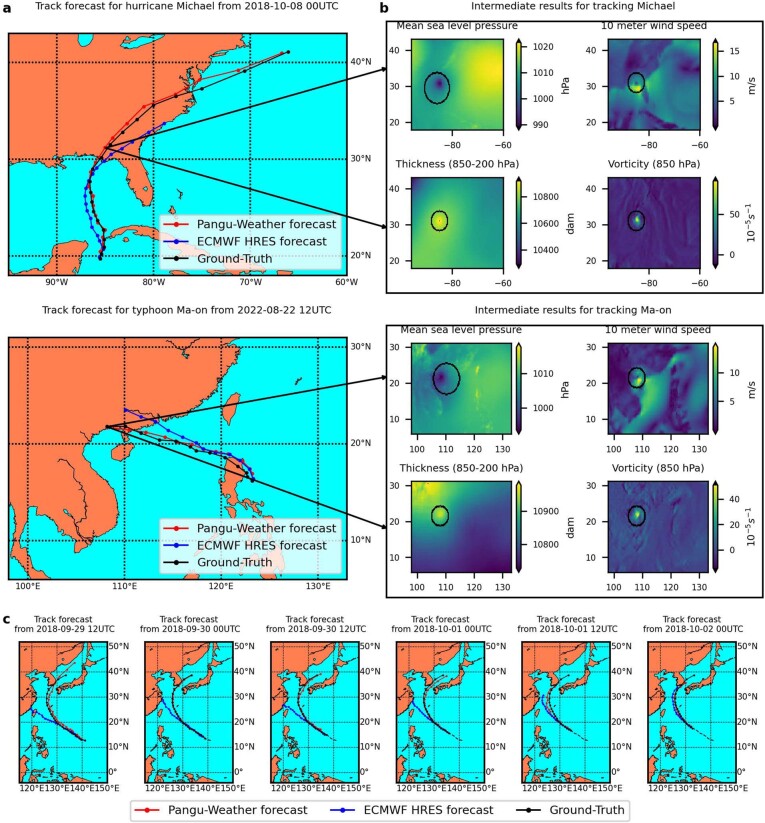
Weather forecasting is important for science and society. At present, the most accurate forecast system is the numerical weather prediction (NWP) method, which represents atmospheric states as discretized grids and numerically solves partial differential equations that describe the transition between those states 1 . However, this procedure is computationally expensive. Recently, artificial-intelligence-based methods 2 have shown potential in accelerating weather forecasting by orders of magnitude, but the forecast accuracy is still significantly lower than that of NWP methods. Here we introduce an artificial-intelligence-based method for accurate, medium-range global weather forecasting. We show that three-dimensional deep networks equipped with Earth-specific priors are effective at dealing with complex patterns in weather data, and that a hierarchical temporal aggregation strategy reduces accumulation errors in medium-range forecasting. Trained on 39 years of global data, our program, Pangu-Weather, obtains stronger deterministic forecast results on reanalysis data in all tested variables when compared with the world’s best NWP system, the operational integrated forecasting system of the European Centre for Medium-Range Weather Forecasts (ECMWF) 3 . Our method also works well with extreme weather forecasts and ensemble forecasts. When initialized with reanalysis data, the accuracy of tracking tropical cyclones is also higher than that of ECMWF-HRES.
Overview
The claims and statistics of this paper haven’t been checked yet.
Free: it reads the open-access text and checks the first 5 claims that cite a source we can check. Create a free account to check every claim.
Integrity signals
Registry
Cites
Statistics
Figures
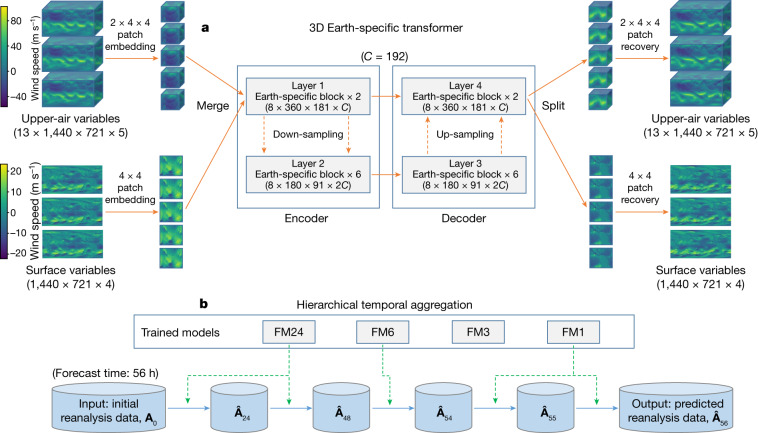
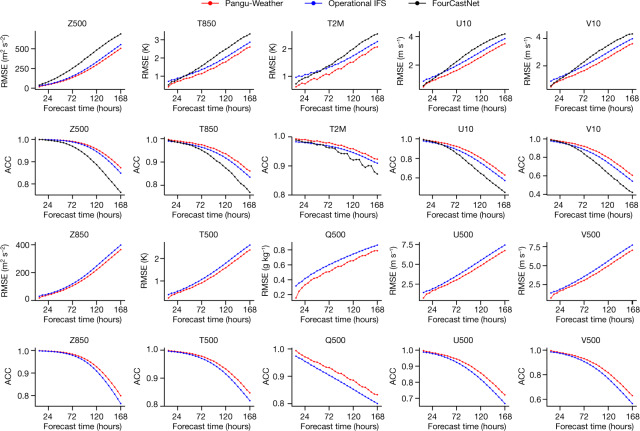
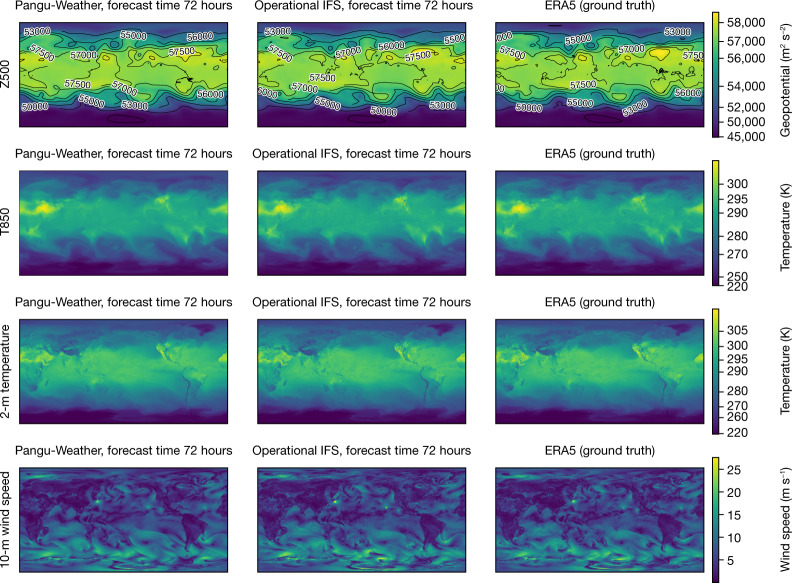
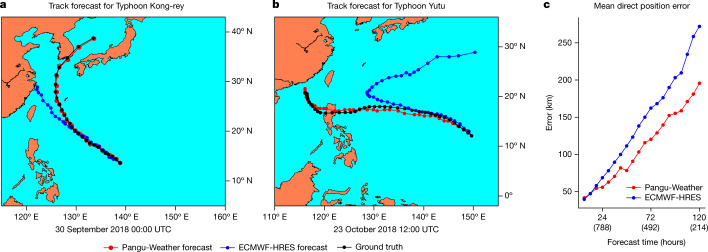
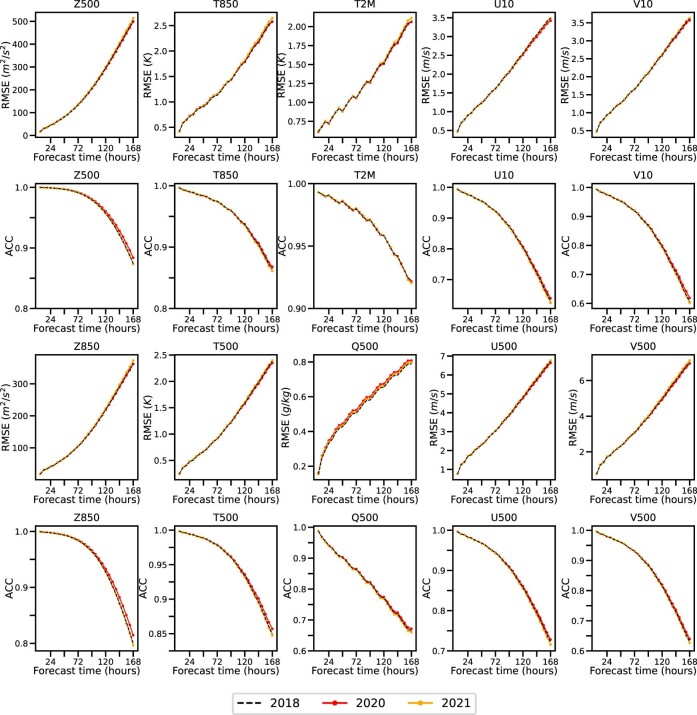
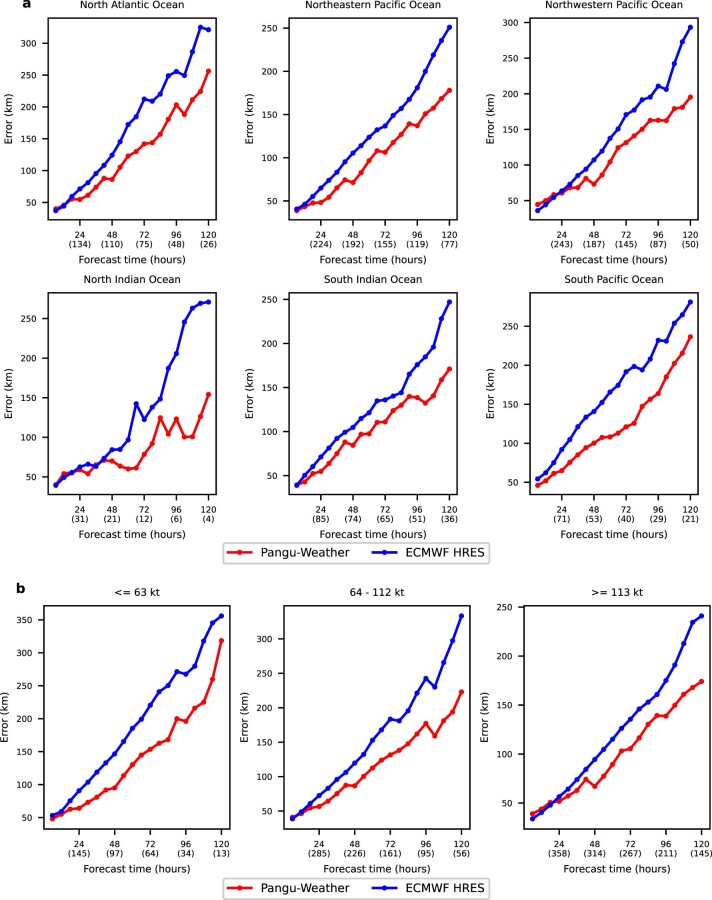
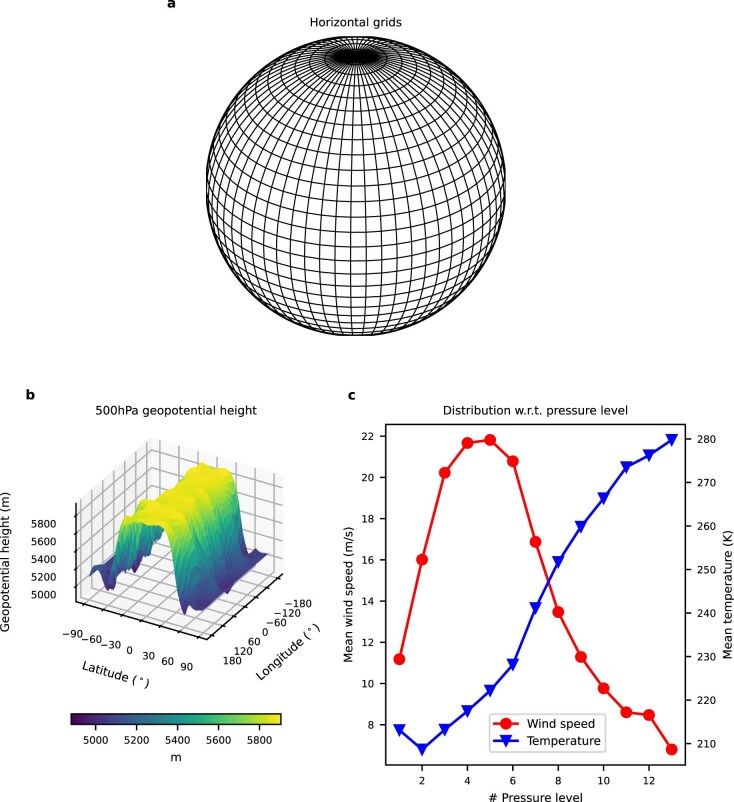
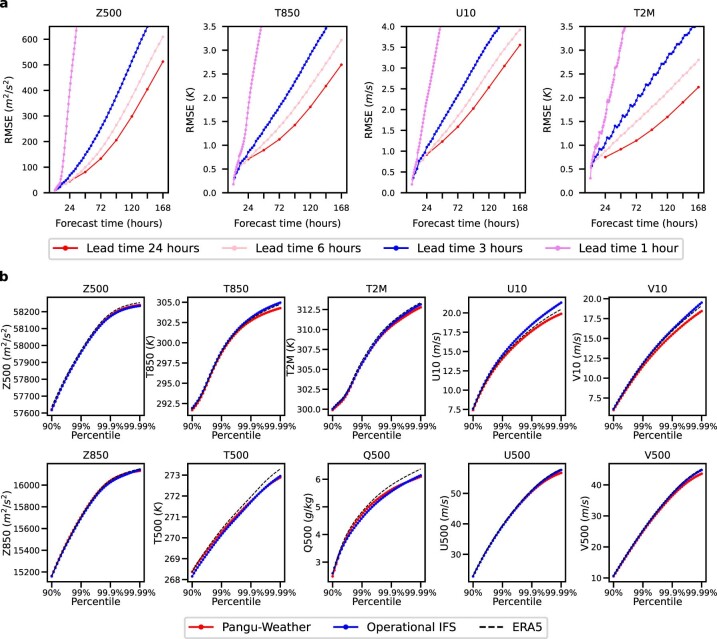
Verification
Claims the paper makes
The claims and statistics of this paper haven’t been checked yet.
Free: it reads the open-access text and checks the first 5 claims that cite a source we can check. Create a free account to check every claim.
Claims other papers make about this one
Each is checked against this paper’s own text: does it say what the citing paper says it does?
The source backs part of the claim, not all of it — or backs it for a different population, condition or comparison.
In the citing paper
“However, they do not produce calibrated uncertainty estimates4, which is essential for useful weather forecasts1.”
From Neural general circulation models for weather and climate (2024) · cites this paper as [4]
Experimental — accuracy not yet measuredThe source backs part of the claim, not all of it — or backs it for a different population, condition or comparison.
In the citing paper
“Recently, machine-learning models trained on reanalysis data have achieved comparable or better skill than GCMs for deterministic weather forecasting3,4.”
From Neural general circulation models for weather and climate (2024) · cites this paper as [4]
Experimental — accuracy not yet measuredThe source backs part of the claim, not all of it — or backs it for a different population, condition or comparison.
In the citing paper
“Existing machine-learning models have focused on deterministic prediction, and surpass deterministic numerical weather prediction in terms of the aggregate metrics for which they are trained3,4.”
From Neural general circulation models for weather and climate (2024) · cites this paper as [4]
Experimental — accuracy not yet measuredThe source backs part of the claim, not all of it — or backs it for a different population, condition or comparison.
In the citing paper
“Most state-of-the-art machine learning models utilized in medium-range weather forecasting are built upon encoder-decoder84 architectures27–29,85.”
From A machine learning model that outperforms conventional global subseasonal forecast models (2024) · cites this paper as [28]
Experimental — accuracy not yet measuredThe source backs part of the claim, not all of it — or backs it for a different population, condition or comparison.
In the citing paper
“However, these advances have focused primarily on single, deterministic forecasts that fail to represent uncertainty and estimate risk.”
From Probabilistic weather forecasting with machine learning (2025) · cites this paper as [3]
Experimental — accuracy not yet measured
4 more claims about this paper
Create a free account to see every claim other papers make about this one.
Self-check
Percentages, sums and reported differences re-computed from the paper’s own numbers.
The self-check needs the paper’s full text.
Citations
Cites
LeCun, Y., Bengio, Y., & Hinton, G. (2015) · Nature · doi:10.1038/nature14539 · Cited by 84,126
An Image is Worth 16x16 Words: Transformers for Image Recognition at Scale
Dosovitskiy, A., Beyer, L., Kolesnikov, A., Weissenborn, D., Zhai, X., Unterthiner, T., Dehghani, M., Minderer, M., Heigold, G., Gelly, S., et al. (2020) · arXiv · doi:10.48550/arxiv.2010.11929 · Cited by 47,472
Swin Transformer: Hierarchical Vision Transformer using Shifted Windows
Liu, Z., Lin, Y., Cao, Y., Hu, H., Wei, Y., Zhang, Z., Lin, S., & Guo, B. (2021) · 2021 IEEE/CVF International Conference on Computer Vision (ICCV) · doi:10.1109/iccv48922.2021.00986 · Cited by 35,534
Hersbach, H., Bell, B., Berrisford, P., Hirahara, S., Horányi, A., Muñoz‐Sabater, J., Nicolas, J., Peubey, C., Radu, R., Schepers, D., et al. (2020) · Quarterly Journal of the Royal Meteorological Society · doi:10.1002/qj.3803 · Cited by 31,882
Language Models are Few-Shot Learners
Brown, T. B., Mann, B., Ryder, N., Subbiah, M., Kaplan, J., Dhariwal, P., Neelakantan, A., Shyam, P., Sastry, G., Askell, A., et al. (2020) · arXiv · doi:10.48550/arxiv.2005.14165 · Cited by 23,372
Learning Transferable Visual Models From Natural Language Supervision
Radford, A., Kim, J. W., Hallacy, C., Ramesh, A., Goh, G., Agarwal, S., Sastry, G., Askell, A., Mishkin, P., Clark, J., et al. (2021) · arXiv · doi:10.48550/arxiv.2103.00020 · Cited by 15,293
Momentum Contrast for Unsupervised Visual Representation Learning
He, K., Fan, H., Wu, Y., Xie, S., & Girshick, R. (2020) · 2020 IEEE/CVF Conference on Computer Vision and Pattern Recognition (CVPR) · doi:10.1109/cvpr42600.2020.00975 · Cited by 13,347
Learning Transferable Architectures for Scalable Image Recognition
Zoph, B., Vasudevan, V., Shlens, J., & Le, Q. V. (2018) · 2018 IEEE/CVF Conference on Computer Vision and Pattern Recognition · doi:10.1109/cvpr.2018.00907 · Cited by 7,831
Convolutional LSTM Network: A Machine Learning Approach for Precipitation Nowcasting
Shi, X., Chen, Z., Wang, H., Yeung, D.-Y., Wong, W.-K., & Woo, W.-C. (2015) · arXiv · doi:10.48550/arxiv.1506.04214 · Cited by 7,709
Atmospheric Modeling, Data Assimilation and Predictability
Kalnay, E. (2002) · doi:10.1017/cbo9780511802270 · Cited by 3,391
Research works printed but not linked: 2
- Devlin, J., Chang, M. W., Lee, K. & Toutanova, K. BERT: pre-training of deep bidirectional transformers for language understanding. In Proc. Conference North American Chapter of the Association of Computational Linguistics Vol. 1, 4171–4186 (NAACL, 2019).
- Stensrud, D. J. Parameterization Schemes: Keys to Understanding Numerical Weather Prediction Models (Cambridge Univ. Press 2009).
Cited by
Items 401–500 of 1,006
Xu, T., Zhang, Y., Zhang, C., Abodoukayimu, A., & Ma, D. (2024) · Theoretical and Applied Climatology · doi:10.1007/s00704-024-04945-3 · Cited by 9
“The Pangu model proposed by Huawei team can accurately and quickly predict the global climate by learning global meteorological monitoring data of past four decades (Bi et al. 2023).”
Zhang, R., Zhao, M., Wang, H., Wang, H., Kong, H., Wang, K., Koutrakis, P., Huang, S., & Xiong, J. (2024) · PNAS Nexus · doi:10.1093/pnasnexus/pgae243 · Cited by 10
The CUISINES Framework for Conducting Exoplanet Model Intercomparison Projects, Version 1.0
Sohl, L. E., Fauchez, T. J., Domagal-Goldman, S. D., Christie, D., Deitrick, R., Haqq-Misra, J. D., Harman, C. E., Iro, N., Mayne, N. J., Tsigaridis, K., et al. (2024) · The Planetary Science Journal · doi:10.3847/psj/ad5830 · Cited by 11
“This is especially true if the machine learning techniques currently being developed for modern Earth climate model parameterizations (Bi et al. 2023; Kuma et al. 2023) and analyses are transferable to the planetary science realm.”
BackgroundXu, H., Duan, Y., & Xu, X. (2024) · Environmental Research Letters · doi:10.1088/1748-9326/ad6fbb · Cited by 14
Cao, Q., Chen, Y., Wang, D., Xu, Z., Ma, C., Yang, X., & Chen, S. (2024) · Physics of Fluids · doi:10.1063/5.0221568 · Cited by 11
Wirz, C. D., Demuth, J. L., Cains, M. G., White, M. C., Radford, J. T., & Bostrom, A. (2024) · Bulletin of the American Meteorological Society · doi:10.1175/bams-d-24-0044.1 · Cited by 13
Machine-learning-based probabilistic forecasting of solar irradiance in Chile
Baran, S., Marín, J. C., Cuevas, O., Díaz, M., Szabó, M., Nicolis, O., & Lakatos, M. (2025) · Advances in statistical climatology, meteorology and oceanography · doi:10.5194/ascmo-11-89-2025 · Cited by 13
“Nevertheless, in the last few years, NWP models gained strong competitors in the form of machine-learning-based, fully data-driven forecasts such as Pangu-Weather (Bi et al., 2023) or the more recent ECMWF Ar-tificial Intelligence Forecasting System (AIFS; Lang et al., 2024), which was the first to issue AI-based ensemb…”
Xiaolin, L. I. U., Pu, X., Lu, C., Zhang, H., Li, T., Grieneisen, M. L., Li, J., Ma, N., Yan, C., Zhan, Y., et al. (2024) · Journal of Cleaner Production · doi:10.1016/j.jclepro.2024.144287 · Cited by 10
Self-citationResearch on precipitation nowcasting based on spatiotemporal cooperative attention
Zheng, X., Qin, H., Wang, W., Lei, W., & Shi, P. (2025) · Journal of Earth System Science · doi:10.1007/s12040-024-02508-8 · Cited by 9
“Therefore, timely and accurate weather forecasting is urgently needed to reduce the impact of severe weather (Bi et al .”
Liang, L., Lu, L., Huang, L., Xie, Y., Yang, S., Ling, H., & Huang, Z. (2025) · International Communications in Heat and Mass Transfer · doi:10.1016/j.icheatmasstransfer.2025.108757 · Cited by 8
Leveraging state‐of‐the‐art AI models to forecast wind power generation using deep learning
Hardy, L., & Finney, I. (2025) · Meteorological Applications · doi:10.1002/met.70038 · Cited by 12
“Previously, machine learning models have been created to produce 100-m wind speed forecasts using historical data; however, these tend to perform poorly at longer lead times and are often limited to lower-resolution data due to computational constraints (Xie et al., 2023).”
A Swin-Transformer-based deep-learning model for rolled-out predictions of regional wind waves
Tan, W., Yuan, C., Xu, S., Xu, Y., & Stocchino, A. (2025) · Physics of Fluids · doi:10.1063/5.0256654 · Cited by 10
Achondo, M. A., Chaudhry, J. H., & Cooper, C. D. (2025) · Journal of Chemical Theory and Computation · doi:10.1021/acs.jctc.4c01747 · Cited by 8
“Currently, PINN is usually slower than standard numerical schemes in most applications, 66,67 however, they have great potential to improve their performance, as it has happened in complex problems like weather modeling 68,69 where a 10,000 × speedup is observed.”
Performance of the Pangu‐Weather Deep Learning Model in Forecasting Tornadic Environments
Hua, Z., Hakim, G. J., & Anderson-Frey, A. K. (2025) · Geophysical Research Letters · doi:10.1029/2024gl109611 · Cited by 18
“…in developing DL models that match or exceed the skill of global NWP models for medium‐range forecasting based on selected verification metrics (Bi et al., 2023; K. Chen et al., 2023; L. Chen et al., 2023; Keisler, 2022; Lam et al., 2023; Nai et al., 2024; Nguyen et al., 2023; Pathak et al.,…”
InfluentialMachine learning-based forecasting of daily acute ischemic stroke admissions using weather data
Santhanam, N., Hee, K. E., Rügamer, D., Bender, A., Muthers, S., Cho, C. G., Alonso, A., Szabo, K., Centner, F.-S., Wenz, H., et al. (2025) · npj Digital Medicine · doi:10.1038/s41746-025-01619-w · Cited by 8
“…forward-facing predictions from established numerical weather prediction (NWP) models 24 or novel deep learning-based weather forecasting systems 25 – 27 , which would provide weather feature inputs for the here proposed downstream ML models to predict upcoming clinical capacity requirements…”
Evaluation of precipitation forecasting base on GraphCast over mainland China
Yan, Z., Lu, X., Wu, L., Fa, L., Qiu, R., Cui, Y., & Ma, X. (2025) · Scientific Reports · doi:10.1038/s41598-025-98944-7 · Cited by 18
Evaluating Global Machine Learning Models for Tropical Cyclone Dynamics and Thermodynamics
Sahu, P. L., Sandeep, S., & Kodamana, H. (2025) · Journal of Geophysical Research Machine Learning and Computation · doi:10.1029/2025jh000594 · Cited by 23
Tan, G., Wang, Y., Xiao, Z., He, D., & Sa, G. (2025) · Pattern Recognition · doi:10.1016/j.patcog.2025.111760 · Cited by 13
Shi, Y., Hu, R., Wu, N., Zhang, H., Liu, X., Zeng, Z., Zhu, J., Han, P., Luo, C., Zhang, H., et al. (2025) · Journal of Geophysical Research Machine Learning and Computation · doi:10.1029/2024jh000481 · Cited by 24
Self-citationCrafting the Future: Machine learning for ocean forecasting
Heimbach, P., O’Donncha, F., Smith, T. A., García-Valdecasas, J. M., Arnaud, A., & Wan, L. (2025) · State of the Planet · doi:10.5194/sp-5-opsr-22-2025 · Cited by 30
Huang, Y., Zhang, Z., Zhao, W., & Hu, H. (2025) · Engineering Applications of Artificial Intelligence · doi:10.1016/j.engappai.2025.111477 · Cited by 8
Li, S., & Xing, J. (2025) · Environment International · doi:10.1016/j.envint.2025.109689 · Cited by 8
Zeng, Y., Ni, Y., Chen, Z., Zeng, G.-Z., Wang, J.-Y., & Chan, P. W. (2025) · Engineering Applications of Computational Fluid Mechanics · doi:10.1080/19942060.2025.2538180 · Cited by 13
“The fast inference speed of these Transformer-based models offers a significant advantage over traditional numerical forecasting (Bi et al., 2023; Kim et al., 2023; Liu, Tan, et al., 2024), making them a valuable supplement for real-time forecasting systems or operational centres such as CMA or…”
Michibata, T., Wall, C. J., Hirota, N., Duran, B. M., & Nozawa, T. (2025) · Current Pollution Reports · doi:10.1007/s40726-025-00382-6 · Cited by 15
Improved modelling of biogenic emissions in human-disturbed forest edges and urban areas
Zhang, Y. L., Ran, H., Guenther, A., Zhang, Q., George, C., Mellouki, A., Sheng, G., Peng, P., & Wang, X. (2025) · Nature Communications · doi:10.1038/s41467-025-63437-8 · Cited by 13
“Nevertheless, incorporating high-resolution meteorological reanalysis products or AI-driven weather prediction models 65,66 could further enhance GEE-MEGAN ’ s capacity to simulate urban-scale processes, offering deeper insights into BVOC-related dynamics in air quality and climate change.”
AI for scientific discovery is a social problem
Channing, G., & Ghosh, A. (2026) · Patterns · doi:10.1016/j.patter.2026.101497 · Cited by 23
“8,15,21 The inverse problem of recovering structures from desired properties is central to materials science, drug discovery, and astrophysics, yet current approaches solve only special cases without providing general probabilistic frameworks.”
Deep learning predicts real-world electric vehicle direct current charging profiles and durations
Li, S., Zhang, M., Doel, R., Ross, B., & Piggott, M. D. (2025) · Nature Communications · doi:10.1038/s41467-025-65970-y · Cited by 24
“…domains, such as computer vision 30 , natural language processing 31 , drug discovery 32,33 , wind energy 34 – 36 or climate and weather forecasting 37,38 , underscores the potential of these techniques to address complex predictive tasks when supported by large-scale, high-quality datasets.”
Rui, J., Shabrina, Z., & Gong, W. (2026) · Environmental Impact Assessment Review · doi:10.1016/j.eiar.2026.108363 · Cited by 15
Wang, X., Ke, J., Yang, H., Gong, K., Zhang, K., Shahidehpour, M., Jiang, C., & Huang, W. (2026) · IEEE Transactions on Industry Applications · doi:10.1109/tia.2026.3661945 · Cited by 8
“In addition, numerical models have been developed to analyze typhoon effects on DERs [16], providing a reasonable balance between capturing complex meteorological correlations and avoiding excessive computational burden [17].”
Modeling and prediction of the ionosphere with deep learning: a review
Liu, Y., Yang, K., Sun, L., Wang, J., Smirnov, A., & Xiong, C. (2026) · Intelligence & Robotics · doi:10.20517/ir.2026.04 · Cited by 10
Lightweight AI-powered precipitation nowcasting
Yang, N., & Li, X. (2024) · The Innovation Geoscience · doi:10.59717/j.xinn-geo.2024.100066 · Cited by 11
Improving subseasonal forecasting of East Asian monsoon precipitation with deep learning
Zhou, J., & Liu, F. (2024) · Atmospheric and Oceanic Science Letters · doi:10.1016/j.aosl.2024.100520 · Cited by 9
PN-HGNN: Precipitation Nowcasting Network Via Hypergraph Neural Networks
Sun, X., Zhang, Y., Piao, X., Wu, J., Jing, G., & Yin, B. (2024) · IEEE Transactions on Geoscience and Remote Sensing · doi:10.1109/tgrs.2024.3407157 · Cited by 14
Synoptic controls on warm-season O3 pollution in eastern China: A focus on O3-NOx-VOC chemistry
Liao, Z., Jia, X. C., Qiu, Y. L., Quan, J., Pan, Y., Ma, P. K., Cheng, Z. G., & Wang, Q. (2024) · Atmospheric Research · doi:10.1016/j.atmosres.2024.107660 · Cited by 8
Research on an adaptive prediction method for restaurant air quality based on occupancy detection
Zhao, Y., Xiong, C., Rong, L., Luo, Z., Hussein, T., & Zhao, T. (2024) · Building and Environment · doi:10.1016/j.buildenv.2024.112145 · Cited by 12
Robust Lidar-Radar Composite Cloud Boundary Detection Method With Rainfall Pixels Removal
Zou, W., Yin, Z., Dai, Y., Chen, Y., Bu, Z., Li, S., He, Y., Hu, X., Müller, D., Lü, T., et al. (2024) · IEEE Transactions on Geoscience and Remote Sensing · doi:10.1109/tgrs.2024.3476127 · Cited by 9
“These days, the performance of deep learning models has greatly improved by incorporating vertical descriptions of meteorological factors, even surpassing traditional numerical prediction models [9], [10].”
BackgroundModeling and observations of North Atlantic cyclones: Implications for U.S. Offshore wind energy
Wang, J., Hendricks, E. A., Rozoff, C. M., Churchfield, M., Zhu, L., Feng, S., Pringle, W., Biswas, M., Haupt, S. E., Deskos, G., et al. (2024) · Journal of Renewable and Sustainable Energy · doi:10.1063/5.0214806 · Cited by 12
AI-aided simulation of tropical cyclone genesis under climate change
Tong, B., He, Y., Hu, G., Duan, Z., & Chan, P. W. (2025) · Global and Planetary Change · doi:10.1016/j.gloplacha.2025.104809 · Cited by 8
Extreme impacts on electric power systems from non-catastrophic meteorological conditions
Cheng, Y., Li, C., Xu, Y., Liu, J., & Deng, X. (2024) · The Innovation Energy · doi:10.59717/j.xinn-energy.2024.100008 · Cited by 8
EDARA: An ERA5-based Dataset for Atmospheric River Analysis
Mo, R. (2024) · Scientific Data · doi:10.1038/s41597-024-03679-1 · Cited by 14
“It has been widely used in various meteorological and climatological studies, including recent applications in machine learning-based weather prediction 57,58 .”
MethodKim, J.-H., Ham, Y., Kim, D., Li, T., & Ma, C. (2024) · Artificial Intelligence for the Earth Systems · doi:10.1175/aies-d-23-0052.1 · Cited by 12
Shi, Z., Zheng, H., & Dong, J. (2024) · Ocean Engineering · doi:10.1016/j.oceaneng.2024.117748 · Cited by 11
Mapping Network-Coordinated Stacked Gated Recurrent Units for Turbulence Prediction
Zhang, Z., Gao, S., Zhou, M., Yan, M., & Cao, S. (2024) · IEEE/CAA Journal of Automatica Sinica · doi:10.1109/jas.2024.124335 · Cited by 7
Bremnes, J. B., Nipen, T. N., & Seierstad, I. A. (2024) · Nonlinear processes in geophysics · doi:10.5194/npg-31-247-2024 · Cited by 20
Chen, Y. (2024) · Springer eBooks · doi:10.1007/978-3-031-66205-8_2 · Cited by 13
Mohammed, M., & Munir, M. (2024) · Elsevier eBooks · doi:10.1016/b978-0-443-24139-0.00003-5 · Cited by 12
Forecasting high-dimensional spatio-temporal systems from sparse measurements
Song, J., Song, Z., Ren, P., Erichson, N. B., Mahoney, M. W., & Li, X. S. (2024) · Machine Learning Science and Technology · doi:10.1088/2632-2153/ad9883 · Cited by 17
Han, M., & Zhou, Y. (2024) · npj Ocean Sustainability · doi:10.1038/s44183-024-00097-z · Cited by 9
“The application of AI models represented by neural networks in oceanography has made signi fi cant breakthroughs, such as the El Niño Southern Oscillation(ENSO)forecasts 55 andtrackforecastfortyphoon 56 .”
Dynamical system simulation with attention and recurrent neural networks
Fañanás-Anaya, J., Nicolás, G. L., & Sagüés, C. (2024) · Neural Computing and Applications · doi:10.1007/s00521-024-10732-y · Cited by 9
“Simulation of dynamical systems in real-time is necessary for various applications across different domains such as robotics [1, 2], control systems [3, 4], finance [5, 6], weather forecasting [7, 8], traffic forecasting [9, 10] and health [11, 12].”
Shao, Z., Qian, T., Sun, T., Wang, F., & Xu, Y. (2024) · The Innovation · doi:10.1016/j.xinn.2024.100763 · Cited by 7
“3 Given their generality, scalability, andpotentialemergentcapabilities,spatial-temporallargemodelsarepositioned to become super hubs in interdisciplinary research (Figure 1, right).”
ZWDX: a global zenith wet delay forecasting model using XGBoost
Crocetti, L., Schartner, M., Glaner, M. F., Konrad Schindler, B., & Soja, B. S. (2024) · Earth Planets and Space · doi:10.1186/s40623-024-02104-6 · Cited by 12
“Recently, it has been used as reference data to train AI-based global weather models that, for the first time, outperformed traditional forecasting models, including GraphCast (Lam et al. 2023) and Pangu-Weather (Bi et al. 2023).”
A Scalable Real-Time Data Assimilation Framework for Predicting Turbulent Atmosphere Dynamics
Yin, J., Liang, S., Liu, S., Bao, F., Chipilski, H. G., Lu, D., & Zhang, G. (2024) · International Conference for High Performance Computing, Networking, Storage and Analysis (SC) · doi:10.1109/scw63240.2024.00009 · Cited by 8
“While existing AI-based foundation models such as FourCastNet [2], GraphCast [3], ClimaX [4] and Pangu-Weather [5] show considerable potential, they are not ready yet for a fully operational implementation since they are decoupled from operational data assimilation (DA) algorithms.”
Identifying practical adaptations to health risks from extreme weather events for multi-actors
Zhao, M., Zhang, C., Cai, W., Zhao, Z.-P., Lu, B., Li, T., Hong, C.-K., Liao, W.-Y., Chen, J.-F., Zhang, S., et al. (2025) · Advances in Climate Change Research · doi:10.1016/j.accre.2025.01.010 · Cited by 8
Physically consistent global atmospheric data assimilation with machine learning in latent space
Fan, H., Bai, L., Fei, B., Xiao, Y., Chen, K., Liu, Y., Qu, Y., Ling, F., & Gentine, P. (2026) · Science Advances · doi:10.1126/sciadv.aea4248 · Cited by 35
“However, as physics-informed neural models and end- to-end forecasting frameworks continue to advance and increasingly demonstrate potential to replace traditional forecasting systems ( 47 , 48 , 61 ), this constraint is expected to diminish.”
Li, F., Xie, Z., Zhang, L., Yu, X., & Shi, B. (2025) · Journal of Building Engineering · doi:10.1016/j.jobe.2025.112144 · Cited by 12
Enhancing sub-seasonal soil moisture forecasts through land initialization
Duan, Y., Kumar, S., Maruf, M., Kavoo, T., Rangwala, I., Richter, J. H., Glanville, A. A., King, T., Eşit, M., Raczka, B., et al. (2025) · npj Climate and Atmospheric Science · doi:10.1038/s41612-025-00987-0 · Cited by 21
Predicting Sudden Stratospheric Warmings Using Video Prediction Methods
Du, Y., Zhang, J., Cheng, X., Lu, Y., Li, D., & Tian, W. (2025) · Geophysical Research Letters · doi:10.1029/2024gl113993 · Cited by 10
“…neural networks (GNN) to build an autoregressive model for medium‐range weather forecasting, capable of generating a 10‐day forecast within 60 s. Bi et al. (2023) introduced a three‐dimensional variant of the Transformer model, surpassing traditional numerical approaches in medium‐to‐long‐range…”
Model discovery on the fly using continuous data assimilation
Newey, J., Whitehead, J. P., & Carlson, E. (2025) · Journal of Computational Physics · doi:10.1016/j.jcp.2025.114121 · Cited by 19
RaDiT: A Differential Transformer-Based Hybrid Deep Learning Model for Radar Echo Extrapolation
Zhu, W., Lu, Z., Zhang, Y., Zhao, Z., Lu, B., & Li, R. (2025) · Remote Sensing · doi:10.3390/rs17121976 · Cited by 7
Bridging the critical gaps of radiative sky cooling: From lab to applications
Liang, Y., Zhang, W., Yang, H., Liu, J., Zhou, Y., Cui, H., & Yan, J. (2025) · Renewable and Sustainable Energy Reviews · doi:10.1016/j.rser.2025.115981 · Cited by 7
STVMamba: precipitation nowcasting with spatiotemporal prediction model
Zou, M., Wen, L., Huang, Y., He, Y., & Xiao, J. (2025) · Scientific Reports · doi:10.1038/s41598-025-05902-4 · Cited by 7
Learning dynamical systems with hit-and-run random feature maps
Mandal, P., & Gottwald, G. A. (2025) · Nature Communications · doi:10.1038/s41467-025-61195-1 · Cited by 16
A self-supervised deep learning model for enhanced generalization in soil moisture prediction
Wang, L., Shi, L., Reimers, C., Wang, Y., He, L., Wang, Y., Reichstein, M., & Jiang, S. (2025) · Journal of Hydrology · doi:10.1016/j.jhydrol.2025.133974 · Cited by 21
Improving Indian summer monsoon rainfall prediction using deep learning up to two years in advance
Sharma, D., Das, S., Chakraborty, D., Mitra, A., & Goswami, B. N. (2025) · Quarterly Journal of the Royal Meteorological Society · doi:10.1002/qj.70023 · Cited by 10
“…that deep-learning models can overcome the traditional ‘error-growth’ problem in medium-range weather forecasting, thereby extending the useful weather prediction skill beyond the limits of even the best NWP models (Bi et al., 2023; Kochkov et al., 2024; Lam et al., 2023; Price et al., 2024).”
ICL Characterization of Climate Foundation Models: When Can Transformers Learn Weather and Climate?
Hawarey, M. (2026) · AIR Journal of Mathematics & Computational Sciences · doi:10.65737/airmcs2026405 · Cited by 7
Artificial Intelligence for Materials Science: Transforming Research Paradigms
Li, Y., Wang, S., Wang, J., Liu, Q., & Zhang, J. (2026) · Chemical Reviews · doi:10.1021/acs.chemrev.6c00012 · Cited by 14
Tang, J.-H., Pan, S.-R., Li, L., & Chan, P. W. (2023) · Atmospheric Environment · doi:10.1016/j.atmosenv.2023.120047 · Cited by 7
A Hierarchical Spatial Transformer for Massive Point Samples in Continuous Space
He, W., Jiang, Z., Xiao, T., Xu, Z., Chen, S., Fick, R., Medina, M. D., & Angelini, C. (2023) · PubMed · doi:10.48550/arxiv.2311.04434 · Cited by 12
Application of data-driven mixing parameterization scheme in a regional ocean model
Feng, Q., Han, G., Liu, Y., Lin, X., Li, B., Gao, X., Dong, C., He, Y., & Wang, H. (2024) · Ocean Modelling · doi:10.1016/j.ocemod.2024.102325 · Cited by 7
Li, H., Li, L., Zhao, L., & Liu, F. (2024) · Electronics · doi:10.3390/electronics13020436 · Cited by 9
On the ambiguity removal of wind direction derived from space-borne SAR imagery using deep learning
Yang, H., Fang, C., Wang, S., Shao, J., & Yang, X. (2024) · Remote Sensing of Environment · doi:10.1016/j.rse.2024.114202 · Cited by 8
Understanding the Low Predictability of the 2015/16 El Niño Event Based on a Deep Learning Model
Wang, T., Huang, P., & Yang, X. (2024) · Advances in Atmospheric Sciences · doi:10.1007/s00376-024-3238-3 · Cited by 9
Wang, H. E., Yin, S., Yue, T., Chen, X., & Chen, D. (2024) · Climate Dynamics · doi:10.1007/s00382-024-07282-3 · Cited by 12
Self-citationYang, N., & Li, X. (2024) · IEEE Transactions on Geoscience and Remote Sensing · doi:10.1109/tgrs.2024.3439871 · Cited by 13
“Large models such as Pan-Gu [66] and Fu-Xi [67] have unique advantages and disadvantages in precipitation forecasting.”
MethodFCNet: Fully Complex Network for Time Series Forecasting
Zhu, X., Shen, D., Wang, H., & Hao, Y. (2024) · IEEE Internet of Things Journal · doi:10.1109/jiot.2024.3449903 · Cited by 8
Research on the Adaptability of Generative Algorithm in Generative Landscape Design
Chen, R., Luo, X., He, Y., & Zhao, J. (2024) · Landscape Architecture · doi:10.3724/j.fjyl.202404120207 · Cited by 11
Probabilistic Approximation of Stochastic Time Series Using Bayesian Recurrent Neural Network
Wang, Y., Cai, K., & Meng, D. (2025) · IEEE Transactions on Neural Networks and Learning Systems · doi:10.1109/tnnls.2025.3529995 · Cited by 8
“Time series forecasting (TSF) is an important task in industry and academia and is widely applied in various areas such as equipment maintenance [1], traffic management [2], [3], autonomous unmanned system [4], finance [5], and meteorology [6].”
Zhou, L., & Zhang, R. (2025) · Journal of Oceanology and Limnology · doi:10.1007/s00343-025-4330-y · Cited by 12
“In recent years, the Transformer architecture (Vaswani et al., 2017) has been continuously revolutionizing artificial intelligence (AI) applications, with its widespread implementation in large AI-driven models for meteorology (Bi et al., 2023; Chen et al., 2023a, b; Mu et al., 2025).”
Save It for the “Hot” Day: An LLM-Empowered Visual Analytics System for Heat Risk Management
Li, H., Kam-Kwai, W., Luo, Y., Chen, J., Liu, C., Zhang, Y., Lau, A. K. H., Qu, H., & Liu, D. (2025) · IEEE Transactions on Visualization and Computer Graphics · doi:10.1109/tvcg.2025.3586689 · Cited by 14
“Moreover, we adopted the Pangu-Weather [57] model with ERA5 temperature estimates to obtain temperature forecasts up to 14 days (Fig.”
Enhancing hydrofoil velocity estimation through residual learning
Xu, Y., Sha, Y., Wang, C., & Wei, Y. (2024) · Physics of Fluids · doi:10.1063/5.0191629 · Cited by 7
Early warning of complex climate risk with integrated artificial intelligencePreprint
Reichstein, M., Frank, D., Benson, V., Camps‐Valls, G., Denzler, J., Kornhuber, K., Schölkopf, B., Vinuesa, R., Han, B., Fearnley, C. J., et al. (2024) · Research Square · doi:10.21203/rs.3.rs-4248340/v1 · Cited by 7
Beyond the Horizon: A Critical Analysis of AI-based Weather Forecasting ModelsPreprint
Haji-Aghajany, S., Rohm, W., Lipiński, P., & Kryza, M. (2024) · doi:10.22541/essoar.171632600.06154714/v1 · Cited by 7
Feng, R., Li, Z., Liu, B., & Ding, Y. (2024) · IEEE Transactions on Intelligent Transportation Systems · doi:10.1109/tits.2024.3373774 · Cited by 6
“In numerical calculations and predictions, the Transformer has consistently demonstrated state-of-the-art performance in previous applications [44], [45].”
BackgroundChina's “coal-to-gas” policy had large impact on PM1.0 distribution during 2016–2019
Shi, T., Peng, Y., Ma, X., Han, G., Zhang, H., Pei, Z., Li, S., Mao, H., Zhang, X., & Gong, W. Y. (2024) · Journal of Environmental Management · doi:10.1016/j.jenvman.2024.121071 · Cited by 7
Self-citationOnline calibration of deep learning sub-models for hybrid numerical modeling systems
Ouala, S., Chapron, B., Collard, F., Gaultier, L., & Fablet, R. (2024) · Communications Physics · doi:10.1038/s42005-024-01880-7 · Cited by 16
“We study the performance of both the EGA formulations de fi ned in equation (17) (with a fi rst order Jacobian) and the Static EGA de fi ned in equation (19).”
DFMM-Precip: Deep Fusion of Multi-Modal Data for Accurate Precipitation Forecasting
Li, J., Li, W., Liu, J., Wang, X., & Xue, W. (2024) · Water · doi:10.3390/w16243702 · Cited by 6
Agarwal, N., Amrhein, D. E., & Grooms, I. G. (2025) · Geophysical Research Letters · doi:10.1029/2024gl110472 · Cited by 7
“Additional recent emulators developed for atmospheric prediction, (e.g., Graphcast (Lam et al., 2022), Pangu‐Weather (Bi et al., 2023), and AIFS (Lang et al., 2024)) use an encoder‐processor‐decoder architecture that similarly transforms input states to a latent space, produces a forecast, and then…”
InfluentialDu, Y., & Yi, S. (2025) · 气象学报:英文版 · doi:10.1007/s13351-025-4138-x · Cited by 6
Ding, J., Chen, W., Chen, J., Wang, J., Zhang, Y., Bai, L., Wang, Y., Mi, X., Liu, T., & Weng, D. (2025) · International Journal of Applied Earth Observation and Geoinformation · doi:10.1016/j.jag.2025.104473 · Cited by 15
A Four‐Dimensional Variational Informed Generative Adversarial Network for Data Assimilation
Wang, W., Duan, B., Ni, W., Lu, J., Yuan, T., Li, D., Zhao, J., & Ren, K. (2025) · Journal of Advances in Modeling Earth Systems · doi:10.1029/2024ms004437 · Cited by 9
“…numerical weather prediction (NWP) models, while achieving forecast performance comparable with the European Center for Medium‐Range Weather Forecasting (ECMWF) Integrated Forecasting System (IFS) model (Bi et al., 2023; Keisler, 2022; Lam et al., 2023; Nguyen et al., 2023; Pathak et al., 2022).”
Peng, K., Xin, J., Zhu, X., Cao, X., Wang, Z., Ma, Y., Zhao, D., & Ren, X. (2025) · Geophysical Research Letters · doi:10.1029/2025gl115246 · Cited by 7
“The 3D‐PST leverages the strengths of Swin‐Transformer, particularly its self‐attention mechanism variant (Bi et al., 2023; Zhou & Zhang, 2023), to integrate three‐dimensional, multi‐source features from horizontal positions and varying altitudes, as shown in Figure 1.”
Review of artificial intelligence application in typhoon forecasting
Bi, X., Liu, J., & Duan, Y. (2025) · Tropical Cyclone Research and Review · doi:10.1016/j.tcrr.2025.07.005 · Cited by 8
Advancing Radar Echo Extrapolation With Hypergraph-Enhanced Latent Diffusion Model
Sun, X., Zhang, Y., Di, X., Piao, X., Wang, F., Jing, G., Lin, D., & Yin, B. (2025) · IEEE Transactions on Geoscience and Remote Sensing · doi:10.1109/tgrs.2025.3596232 · Cited by 7
“Pangu-Weather [51] employs a 3-”
Foundation models for exploration geophysics
Liu, Q., Chen, Z., & Ma, J. (2025) · Geophysics · doi:10.1190/geo2024-0916.1 · Cited by 11
Wang, Q., Qian, J., Mu, M., Liang, P., & Qin, B. (2025) · Ocean Modelling · doi:10.1016/j.ocemod.2025.102622 · Cited by 8
Deep Learning for Enhanced Ocean Color Remote Sensing: A Foundation Model Approach
Yang, Y., Wang, H., & Li, X. (2025) · IEEE Transactions on Geoscience and Remote Sensing · doi:10.1109/tgrs.2025.3600411 · Cited by 9
“For the satellite sequence with input length seq, the attention matrix B captures the relative positions [62], [63].”
Fu, Z., & Chen, L. (2025) · Ocean Engineering · doi:10.1016/j.oceaneng.2025.122655 · Cited by 7
Lian, Y., Ling, H., Song, G., Yang, J., Wang, H., Zhang, Z., Mao, S., & He, B. (2025) · eTransportation · doi:10.1016/j.etran.2025.100463 · Cited by 6
Air Quality Prediction With a Meteorology-Guided Modality-Decoupled Spatiotemporal Network
Yin, H., Zhang, Y., Xu, J., Chang, J., Li, Y., & Liu, C. (2025) · IEEE Transactions on Artificial Intelligence · doi:10.1109/tai.2025.3610393 · Cited by 9
“This design decision is based on the technical considerations that the operational ECMWF NWP system [7] and AI weather prediction model [8], [9], [10] achieves high short-term forecasting accuracy [mean absolute error (MAE) 2% for temperature and wind speed within 48-hour horizon], making…”
Latent diffusion model for quantitative precipitation estimation and forecast at km scale
Li, W., Pan, B., Li, T., Nai, C., Li, Z., Chao, J., Lü, B., Duan, Q., & Pan, M. (2025) · Environmental Modelling & Software · doi:10.1016/j.envsoft.2025.106701 · Cited by 14
Metadata
- Authors
- Bi, K., Xie, L., Zhang, H., Chen, X., Gu, X., & Tian, Q.
- Affiliations
- Huawei Technologies (China) (CN)
- Corresponding author
- Tian, Qi
- Venue
- Nature
- Published
- 2023-07-05
- Volume
- 619
- Issue
- 7970
- Pages
- 533-538
- ISSN
- 0028-0836 (ISSN-L)
- 1476-4687
- PMC
- PMC10356604
- OpenAlex
- W4383218913
- Semantic Scholar
- 6a78c73c92d5e5d9759b46eff892baf1d6e83754
- Cited by
- 1,670
- References
- 36
- Citations by year
- 2026: 565 · 2025: 594 · 2024: 444 · 2023: 67
- FWCI
- 184.37
- Type
- journal article
- Language
- en
- Update notices
- correction (2023-09-14)
- Open access
- hybrid
- doi.org
- Licence
- cc-by
- creativecommons.org/licenses/by/4.0 (tdm)
- creativecommons.org/licenses/by/4.0 (vor)
- Locations
- Nature (publishedVersion, cc-by)
- PubMed Central (publishedVersion, cc-by)
- PubMed (publishedVersion)
- RePEc: Research Papers in Economics (submittedVersion)
- Funders
- National Oceanic and Atmospheric Administration
- Topics
- Physical Sciences › Earth and Planetary Sciences › Atmospheric Science › Meteorological Phenomena and Simulations
- Physical Sciences › Environmental Science › Environmental Engineering › Hydrological Forecasting Using AI
- Social Sciences › Transportation › Traffic Prediction and Management Techniques
- Keywords
- medium-range weather forecasting, global weather forecasting, 3D neural networks, Pangu-Weather, deterministic forecasting, tropical cyclone tracking, extreme weather prediction, ensemble forecasting, reanalysis data, ECMWF comparison
About these checks
Registry, retraction, Cites and statistics results are computed, not judged, with one exception: a printed reference that no index lists is read once by a model before it counts as a citation error. Claims are extracted by a model and kept only when their quote appears verbatim in the text; each cited source is then checked, with a model’s help, for whether it says what the claim relies on. Those verdicts can be wrong — read the claim’s quote and the cited source before relying on one.
Statistics and arithmetic are recomputed, not judged.
Confidence bands are shown only for fields calibrated on our annotated test set. None is calibrated yet, so no band is shown.
What counts as a claim ›How we measure confidence ›How we check this ›
Are you an author, or do you see a problem with this page? Request a review
Data sources
Bibliographic data: Semantic Scholar, OpenAlex, Crossref.
Contains information from the Semantic Scholar Academic Graph Datasets, made available under the ODC Attribution License (ODC-BY 1.0).
Semantic Scholar’s data is described in: Kinney, R., et al. (2023). The Semantic Scholar Open Data Platform. arXiv:2301.10140.
