

De novo design of protein structure and function with RFdiffusion
Open accessPublished version of a preprint
The DOI matches its Crossref record; 70 of the 70 references it cites were found in a registry or an index; 34 of the 40 sources its claims cite were checked for support.
Abstract
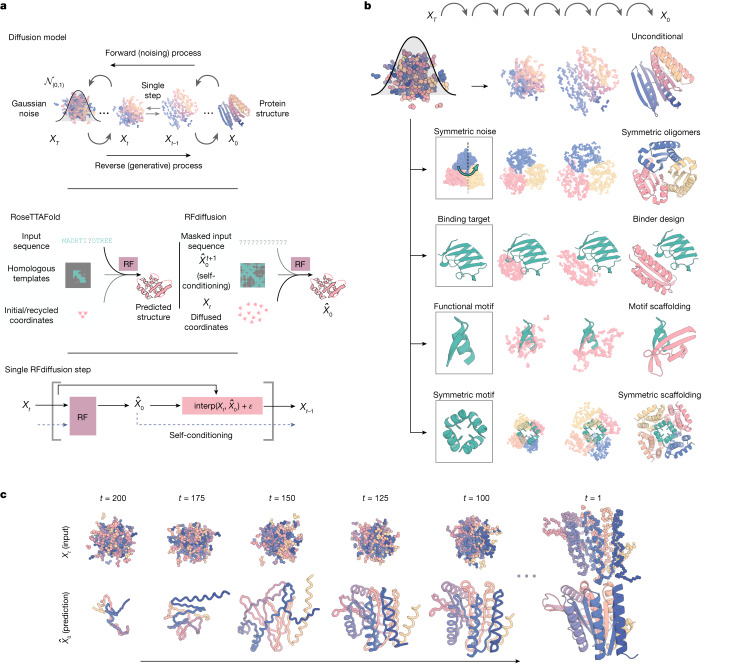
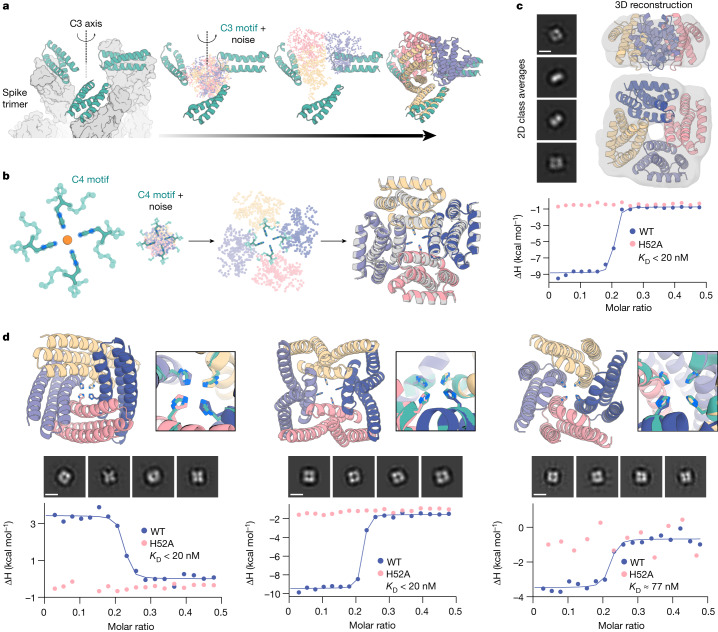
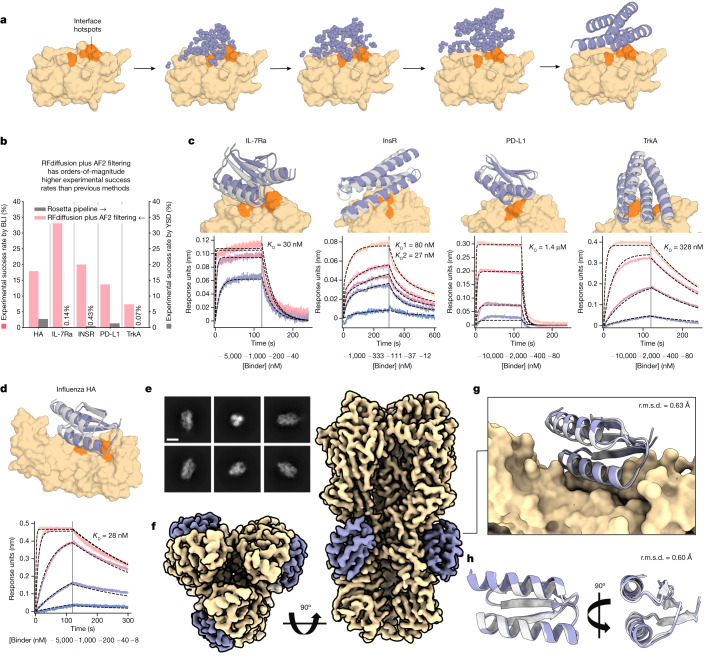
There has been considerable recent progress in designing new proteins using deep-learning methods 1–9 . Despite this progress, a general deep-learning framework for protein design that enables solution of a wide range of design challenges, including de novo binder design and design of higher-order symmetric architectures, has yet to be described. Diffusion models 10,11 have had considerable success in image and language generative modelling but limited success when applied to protein modelling, probably due to the complexity of protein backbone geometry and sequence–structure relationships. Here we show that by fine-tuning the RoseTTAFold structure prediction network on protein structure denoising tasks, we obtain a generative model of protein backbones that achieves outstanding performance on unconditional and topology-constrained protein monomer design, protein binder design, symmetric oligomer design, enzyme active site scaffolding and symmetric motif scaffolding for therapeutic and metal-binding protein design. We demonstrate the power and generality of the method, called RoseTTAFold diffusion (RFdiffusion), by experimentally characterizing the structures and functions of hundreds of designed symmetric assemblies, metal-binding proteins and protein binders. The accuracy of RFdiffusion is confirmed by the cryogenic electron microscopy structure of a designed binder in complex with influenza haemagglutinin that is nearly identical to the design model. In a manner analogous to networks that produce images from user-specified inputs, RFdiffusion enables the design of diverse functional proteins from simple molecular specifications.
Overview
CoChat Summary
TL;DR
RFdiffusion fine-tunes the RoseTTAFold structure-prediction network as a denoising diffusion model to generate protein backbones for unconditional monomers, symmetric oligomers, functional-motif scaffolds, and de novo binders. The method solves 23 of 25 motif-scaffolding benchmark problems and yields experimentally validated binders, metal-binding assemblies, and a cryo-EM structure matching its design model at 0.63 Å.
Key findings
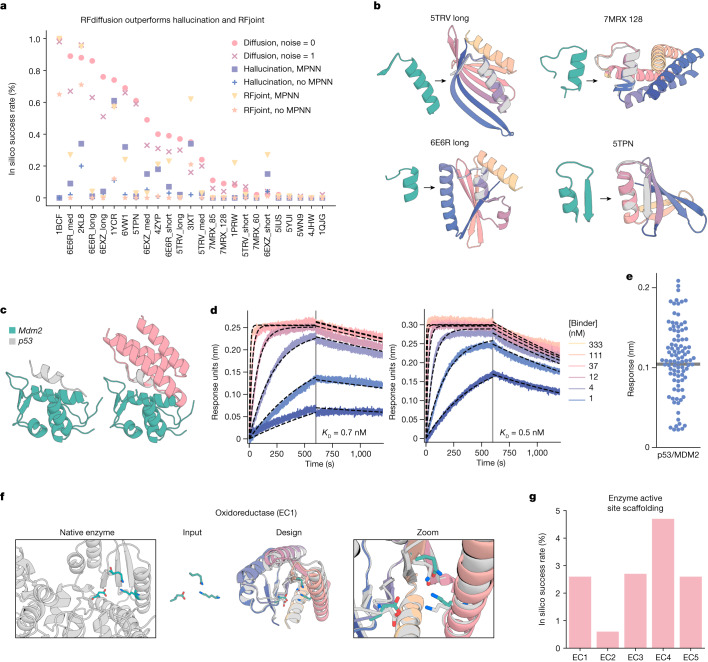
- RFdiffusion solves 23 of 25 motif-scaffolding benchmark problems, compared with 15 for Hallucination and 19 for RFjoint Inpainting; for 19 of 23 solved problems, its success fraction exceeds both baselines.
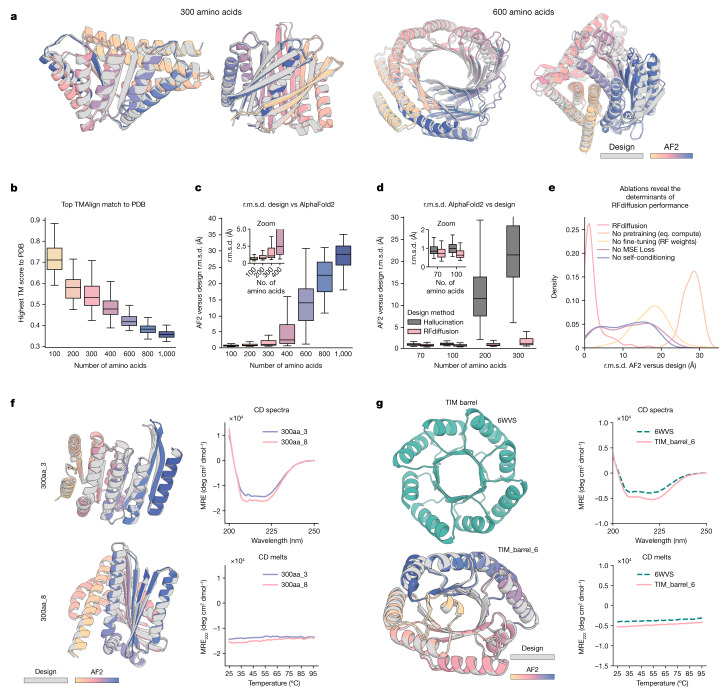
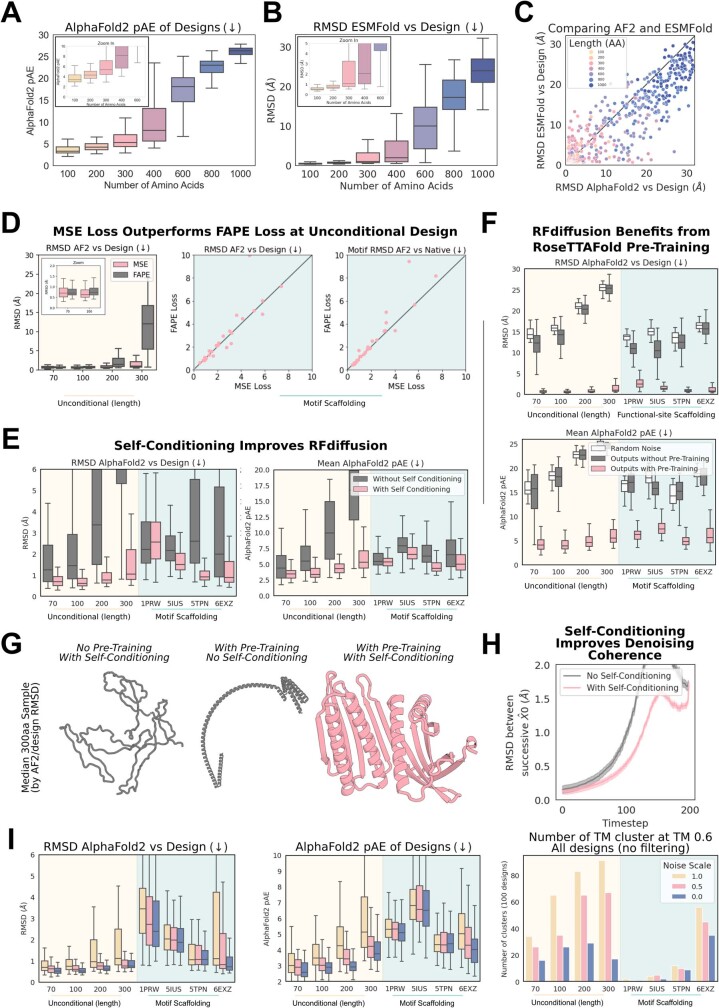
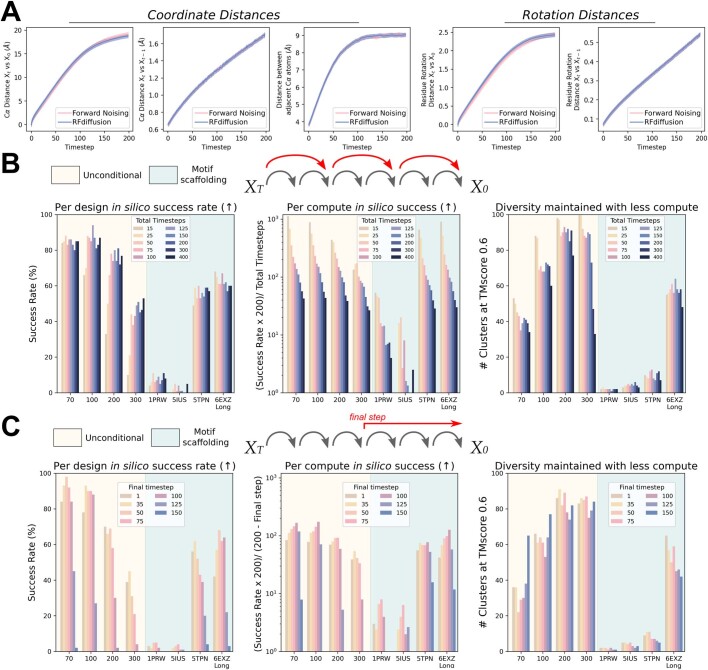
- It generates unconditional monomers up to 600 residues and outperforms RF Hallucination on in silico success (n = 400 designs per condition, z = 9.5, P = 1.6 × 10⁻²¹); a 100-residue protein can be generated in as little as 11 s versus about 8.5 min for RF Hallucination.
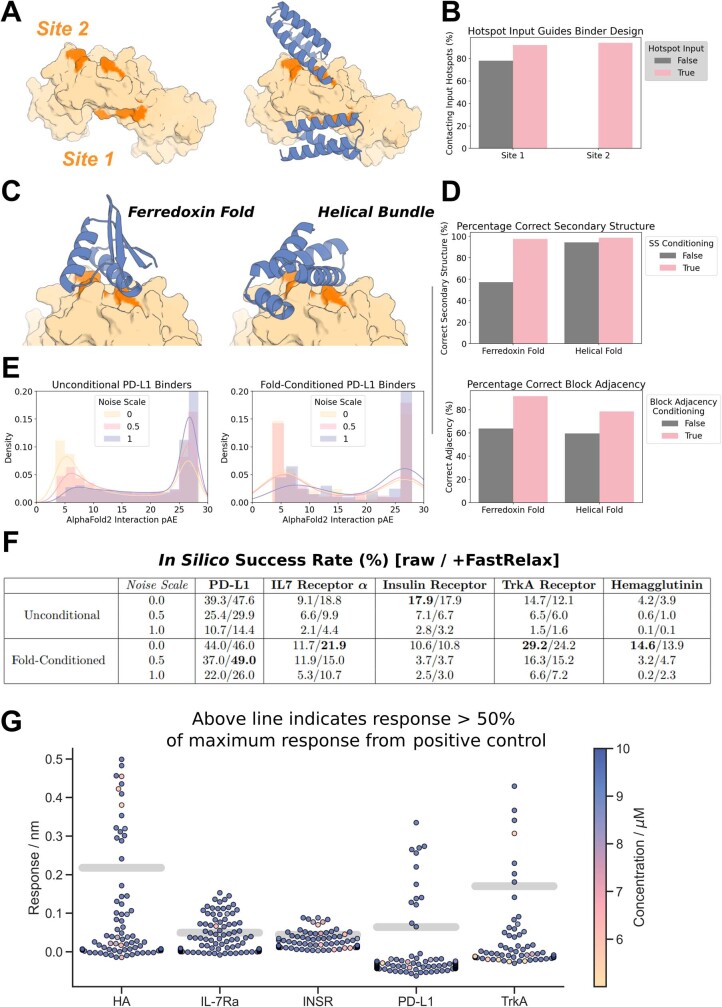
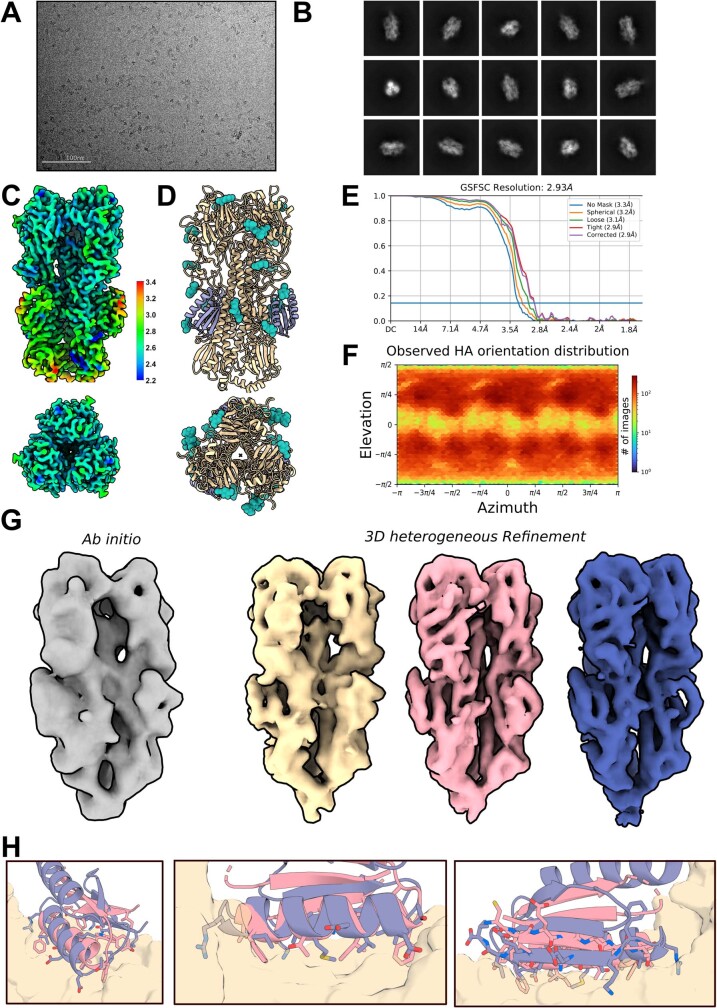
- For binder design against five targets, the overall experimental success rate was 19%, roughly two orders of magnitude above the previous Rosetta-based method; the highest-affinity HA binder, HA_20, bound with KD = 28 nM, and its cryo-EM complex structure matched the design model at 0.63 Å.
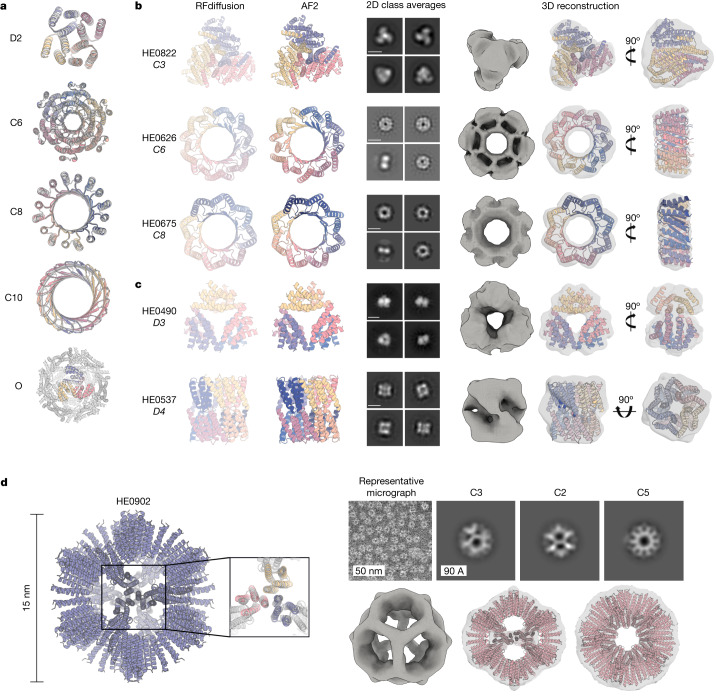
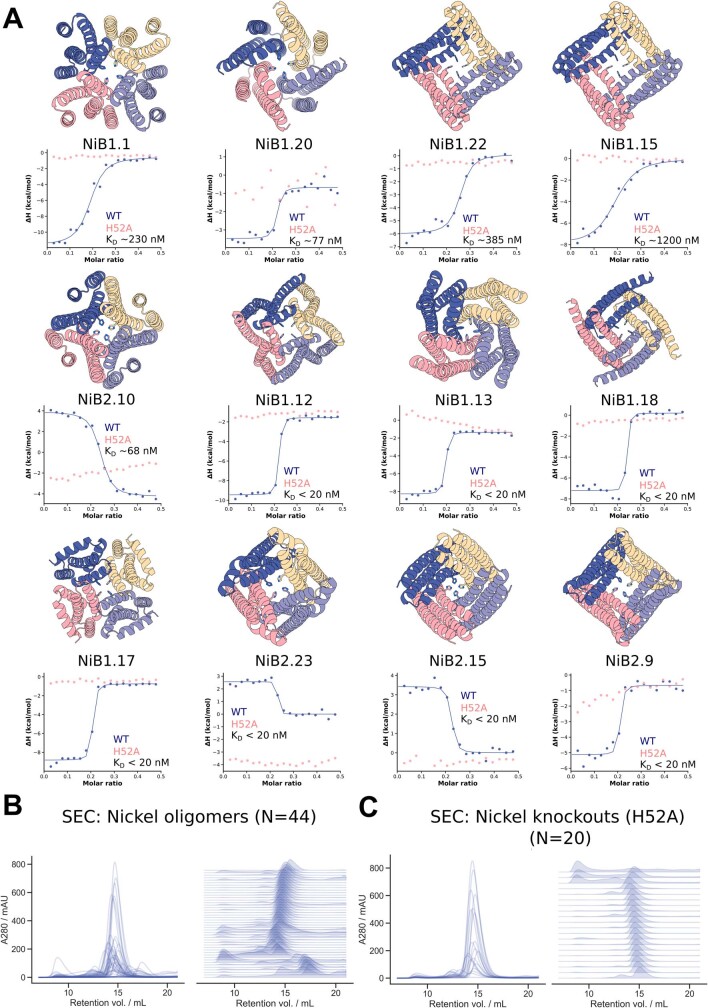
- Symmetric and functional designs were experimentally validated: at least 87 of 608 oligomer designs had SEC oligomerization states closely consistent with design models; 18 of 36 tested Ni²⁺-binding designs bound with dissociation constants from low nanomolar to low micromolar; MDM2 binders reached 0.5 and 0.7 nM versus 600 nM for the native p53 peptide.
Methods
- RFdiffusion uses the RoseTTAFold frame representation (Cα coordinate plus N-Cα-C rigid orientation per residue), trains by noising PDB structures for up to 200 steps, and minimizes mean-squared error between frame predictions and true structures; self-conditioning and fine-tuning from pretrained RF weights improved performance.
- For sequence design, ProteinMPNN was used to design sequences encoding RFdiffusion backbones, typically sampling eight sequences per design; in silico success was validated with AlphaFold2 using mean pAE < 5, global backbone r.m.s.d. < 2 Å, and scaffolded-site backbone r.m.s.d. < 1 Å.
- Experimental characterization included circular dichroism, size-exclusion chromatography, negative-stain EM, cryo-EM, biolayer interferometry, and isothermal titration calorimetry across designed monomers, oligomers, metal-binding proteins, and binders.
Limitations
- The paper states that RFdiffusion cannot explicitly model bound small molecules at present, though it can implicitly model substrates with an external potential; it also states that further studies are required to assess success rates on more polar target sites and sites without native binding partners, and that proteome-wide specificity remains to be fully characterized.
- The paper notes that very large proteins are difficult to validate in silico because they are probably beyond single-sequence prediction capabilities of AF2 and ESMFold, and that some binder designs had insufficient material to permit screening at 10 μM.
- Evident from the text: many conclusions rely on the AF2-based in silico success metric, experimental validation was performed on subsets of designs rather than all generated designs, and the authors did not extensively explore simultaneous structure-and-sequence design within RFdiffusion.
Model-written summary. Check it against the paper before relying on it.
Integrity signals
Registry
Cites
Statistics
Figures
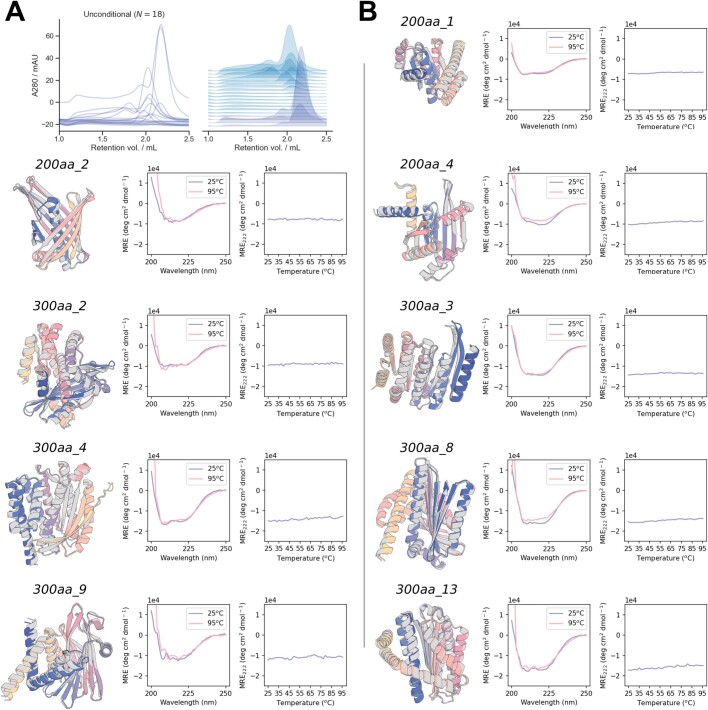
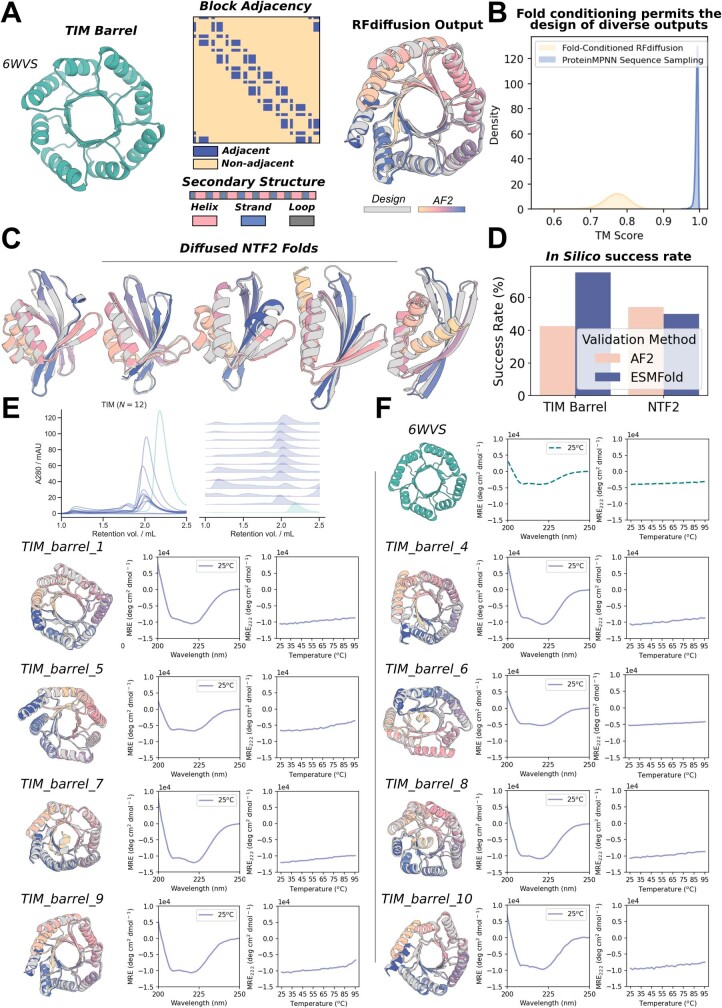
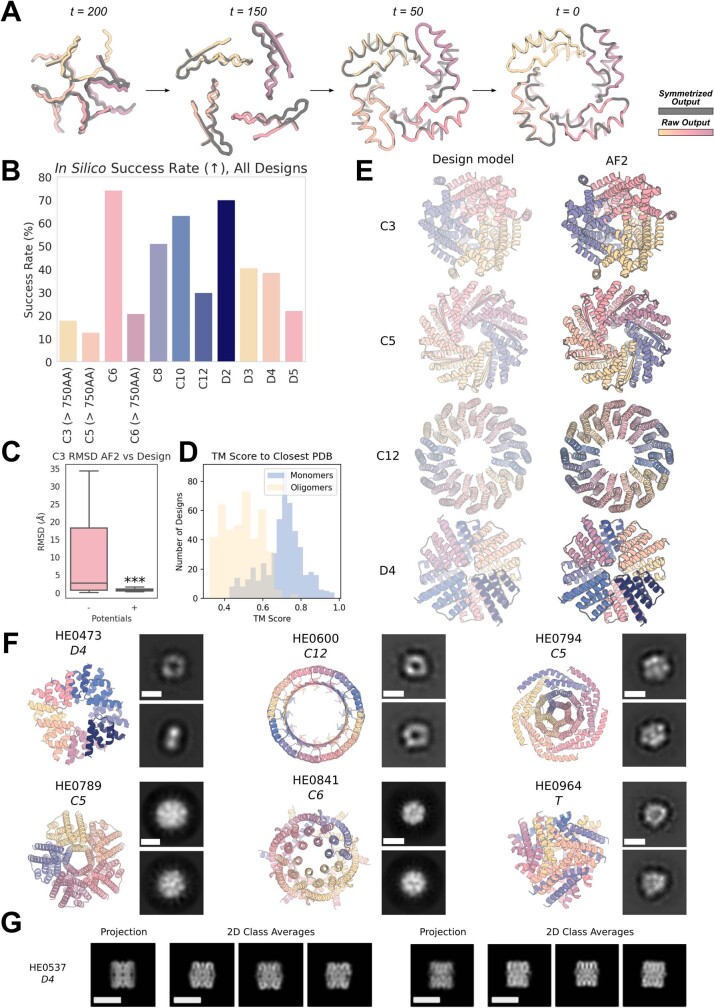
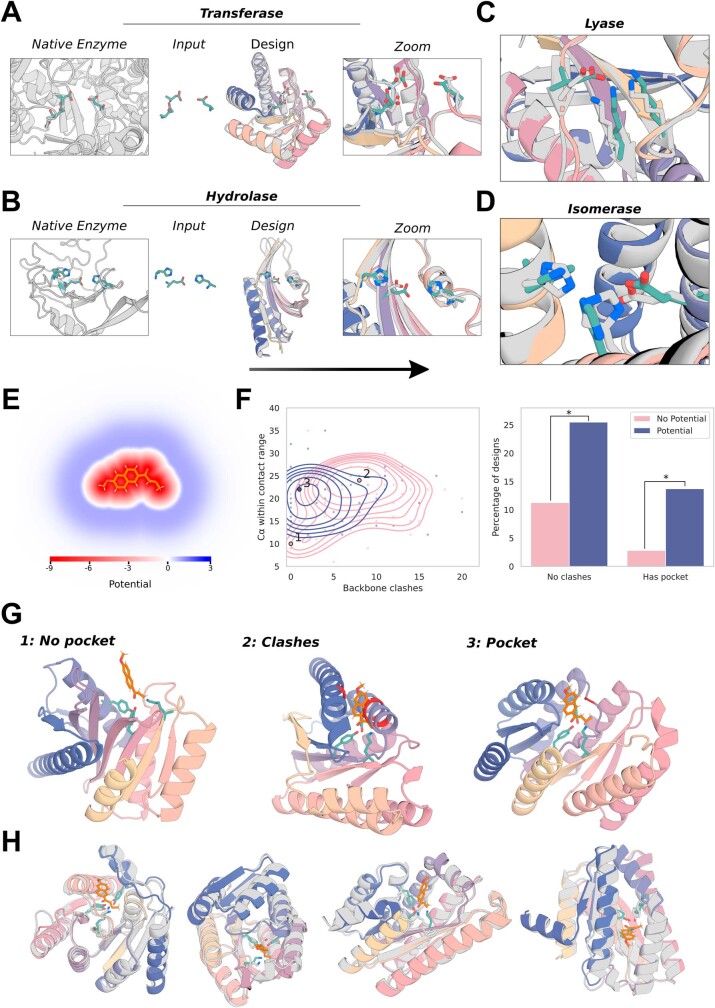
Verification
Claims the paper makes
17 Valid · 4 Not valid · 3 Not checked · 113 Own results and interpretations
Some cited sources support this claim and some don’t — read each source’s verdict below.
In the paper
“Recent work has adapted DDPMs for protein monomer design by conditioning on small protein ‘motifs’5,9 or on secondary structure and block-adjacency (‘fold’) information8.”
§ De novo design of protein structure and function with RFdiffusion > Main
What the sources say
- Supportedcites [5] Trippe, B. L. et al. Diffusion probabilistic modeling of protein backbones in 3D for the motif-scaffolding problem. in The EleventhInternational Conference on Learning Representations (2023). source
The Introduction (p. 1) describes ProtDiff as a diffusion probabilistic model for protein backbones and SMCDiff as its motif-conditioned sampling procedure. The Discussion (p. 9) confirms that the procedure generates scaffolds conditioned on a motif. The secondary-structure and block-adjacency clause is attached to a different citation, so it is not attributed to this source. (LLM, conf=0.93)
- Disputedcites [9] Luo, S. et al. Antigen-specific antibody design and optimization with diffusion-based generative models. in Adv. Neural Information Processing Systems Vol. 35 (eds Koyejo, S. et al) 9754–9767 (Curran Associates, 2022). sourceExperimental — accuracy not yet measured
Section 3.1 (page unavailable) says the paper designs antibody CDRs given an antigen structure and antibody framework, not protein monomers conditioned on small motifs. The Generative Model section likewise describes a diffusion model conditioned on the antigen and antibody framework; it does not describe secondary-structure or block-adjacency conditioning. (LLM, conf=0.87)
Checked by a reasoning model — may be wrong.
- Supportedcites [8] Anand, N. & Achim, T. Protein structure and sequence generation with equivariant denoising diffusion probabilistic models. Preprint at 10.48550/arXiv.2205.15019 (2022). source
Citation 8 is attached to the secondary-structure and block-adjacency (‘fold’) conditioning, not to the motif examples cited separately. Section 2.4 (p. 5) defines those constraints, and Section 3 (p. 6) states that the diffusion model conditions on their encoded output to generate protein structures. (LLM, conf=0.94)
plain- Asserted: passes — The authors put it forward as true.
- Checkable: passes — It can be checked against evidence.
- Load-bearing: unclear — It is unclear whether the paper’s conclusions depend on it.
- Based: passes — The paper gives a reason why it holds.
- Supported
The cited sources support only part of this claim — read each source’s verdict below.
In the paper
“Self-conditioning within RFdiffusion notably improved performance on in silico benchmarks encompassing both conditional and unconditional protein design tasks (Fig. 2e and Extended Data Fig. 1e).”
§ De novo design of protein structure and function with RFdiffusion > Main
What the sources say
- Partly supportedcites [25] Chen, T., Zhang, R. & Hinton, G. Analog bits: generating discrete data using diffusion models with self-conditioning. in The Eleventh International Conference on Learning Representations (2023). sourceExperimental — accuracy not yet measured
The Discrete Image Generation section (pp. 6–7) reports that self-conditioning improved results for image diffusion models. It does not report RFdiffusion results or in silico benchmarks for conditional and unconditional protein design, so the claimed improvement in that setting is not supported by this source. (LLM, conf=0.86)
plainstates a cause- Asserted: passes — The authors put it forward as true.
- Checkable: passes — It can be checked against evidence.
- Load-bearing: passes — The paper’s conclusions depend on it.
- Based: passes — The paper gives a reason why it holds.
- Partly supported
The cited sources support only part of this claim — read each source’s verdict below.
In the paper
“Experimental characterization showed that the method can scaffold a wide range of protein functional motifs with atomic accuracy19”
§ De novo design of protein structure and function with RFdiffusion > Main
What the sources say
- Partly supportedcites [4] Wang J Scaffolding protein functional sites using deep learning Science 2022 377 387 394 10.1126/science.abn2100 35862514 PMC9621694 sourceExperimental — accuracy not yet measured
The 'Generalized functional motif scaffolding' section reports designs spanning a wide range of motifs and says their activities were assessed experimentally. But its sub-angstrom motif accuracy is based on AlphaFold predictions, not experimental structural measurements; the sentence overstates what the experimental characterization established. (LLM, conf=0.88)
- Partly supportedcites [19] Watson, J. L., Bera, A., Juergens, D., Wang, J. & Baker, D. X-ray crystallographic validation of design from this paper. Science377, 387–394 (2022). sourceExperimental — accuracy not yet measured
The section “Generalized functional motif scaffolding by missing information recovery” (page unavailable) reports designs spanning a wide range of motifs, with motif RMSD typically below 1 Å in AlphaFold predictions. It separately reports experimental tests of the designs’ activities; those tests do not establish atomic structural accuracy. The paper also attributes the broad set of designs to both inpainting and constrained hallucination, rather than RFjoint inpainting alone. (LLM, conf=0.87)
plainstates a cause- Asserted: passes — The authors put it forward as true.
- Checkable: passes — It can be checked against evidence.
- Load-bearing: passes — The paper’s conclusions depend on it.
- Based: passes — The paper gives a reason why it holds.
- Partly supported
The cited sources support only part of this claim — read each source’s verdict below.
In the paper
“we established an in silico benchmark test (Supplementary Table 9) comprising 25 motif-scaffolding design problems addressed in six recent publications encompassing several design methodologies4,5,29,38–40”
§ De novo design of protein structure and function with RFdiffusion > Functional-motif scaffolding
What the sources say
- Could not verifycites [4] Wang J Scaffolding protein functional sites using deep learning Science 2022 377 387 394 10.1126/science.abn2100 35862514 PMC9621694 sourceExperimental — accuracy not yet measured
The 'Generalized functional motif scaffolding by missing information recovery' section describes in silico evaluation of the paper’s own designs, but does not describe establishing a benchmark of 25 problems drawn from six publications. Searches for the benchmark, the numbers, and Supplementary Table 9 found no passage in our copy that verifies those details. (LLM, conf=0.74)
- Supportedcites [5] Trippe, B. L. et al. Diffusion probabilistic modeling of protein backbones in 3D for the motif-scaffolding problem. in The EleventhInternational Conference on Learning Representations (2023). source
Section 5.2 (p. 7) reports motif-scaffolding tests using motifs from proteins 6exz and 5trv; Appendix H.1 (p. 24) describes another target, 5tpn. This supports citing the paper as one of the publications that addressed motif-scaffolding design problems. The citing authors describe the 25-problem benchmark as their own, not as something established by this source. (LLM, conf=0.88)
- Supportedcites [29] Lee, J. S. & Kim, P. M. ProteinSGM: Score-based generative modeling for de novo protein design. Preprint at bioRxiv10.1101/2022.07.13.499967 (2022). source
The citation identifies one of the publications whose design methodology informed the citing authors’ benchmark; it does not attribute the establishment of the 25-problem benchmark to ProteinSGM. In “Conditional generation” (page unavailable), ProteinSGM presents scaffold-inpainting design cases, including generation of scaffolds around the barstar functional site. (LLM, conf=0.88)
- Supportedcites [38] Sesterhenn F De novo protein design enables the precise induction of RSV-neutralizing antibodies Science 2020 368 eaay5051 10.1126/science.aay5051 32409444 PMC7391827 source
The citation identifies this paper as one of the motif-scaffolding publications used to assemble the citing authors’ benchmark; the benchmark’s size and establishment are the citing authors’ own statements. The Results section (page unavailable) describes TopoBuilder as a protocol for designing protein topologies around functional motifs, so the paper fits that role. (LLM, conf=0.88)
- Not checked — no full text of the sourcecites [39] Yang C Bottom-up de novo design of functional proteins with complex structural features Nat. Chem. Biol. 2021 17 492 500 10.1038/s41589-020-00699-x 33398169 source
- Partly supportedcites [40] Glasgow A Engineered ACE2 receptor traps potently neutralize SARS-CoV-2 Proc. Natl Acad. Sci. USA 2020 117 28046 28055 10.1073/pnas.2016093117 33093202 PMC7668070 sourceExperimental — accuracy not yet measured
The Results and Materials and Methods describe computational redesign of the ACE2–spike binding interface, so this is a publication addressing a protein-design problem. Our copy does not describe that work as motif scaffolding. The benchmark of 25 problems is the citing authors’ own work, not a finding attributed to this source. (LLM, conf=0.78)
plain- Asserted: passes — The authors put it forward as true.
- Checkable: passes — It can be checked against evidence.
- Load-bearing: passes — The paper’s conclusions depend on it.
- Based: passes — The paper gives a reason why it holds.
- Could not verify
Every source the paper cites for this claim was checked and supports it.
In the paper
“Vázquez Torres et al. demonstrate the ability of RFdiffusion to design picomolar affinity binders to flexible helical peptides54”
§ De novo design of protein structure and function with RFdiffusion > Discussion
What the sources say
- Supportedcites [54] Torres, S. V. et al. De novo design of high-affinity protein binders to bioactive helical peptides. Preprint at bioRxiv10.1101/2022.12.10.519862 (2022). source
The Peptide binder design with RFdiffusion section reports de novo RFdiffusion binders to the helical peptides Bim and PTH, with an estimated affinity of ~100 pM for Bim and an upper bound of 500 pM for PTH. The Main section explains that peptide targets are often partially or entirely unstructured in isolation, supporting the description of them as flexible. (LLM, conf=0.94)
boostedstates a cause- Asserted: passes — The authors put it forward as true.
- Checkable: passes — It can be checked against evidence.
- Load-bearing: unclear — It is unclear whether the paper’s conclusions depend on it.
- Based: passes — The paper gives a reason why it holds.
- Supported
82 more claims · 7 with their cited sources checked
Create a free account to see all 137 claims and every source verdict.
- It may state two separate claims as one. 48
- Probably not a substantial claim. 3
- The quote only partly states this claim. 1
Claims other papers make about this one
Each is checked against this paper’s own text: does it say what the citing paper says it does?
The source backs part of the claim, not all of it — or backs it for a different population, condition or comparison.
In the citing paper
“We also use Evo to generate genome-scale sequences with plausible high-level architecture more than1 megabase (Mb) in length, a scale that is orders of magnitude greater than previous methods (10, 13, 14).”
From Sequence modeling and design from molecular to genome scale with Evo (2024) · cites this paper as [10]
Experimental — accuracy not yet measured
Self-check
Percentages, sums and reported differences re-computed from the paper’s own numbers.
Each contradiction between two passages listed here was confirmed by an independent check.
Rated minor: it would not touch a result — a value no result rests on, a p-value that stays on the same side of the significance level, or a conflict that is clerical, resolved elsewhere in the paper, or outside its own findings.
In the paper
§ De novo design of protein structure and function with RFdiffusion > Functional-motif scaffolding
“e, Out of 95 designs, 55 showed binding to MDM2 (more than 50% of maximum response).”
§ De novo design of protein structure and function with RFdiffusion > Functional-motif scaffolding
“The overall success rate was quite high: out of the 96 designs, 55 showed some detectable binding at 10 μM (Fig. 4e and Supplementary Fig. 10h).”
Citations
Cites
Highly accurate protein structure prediction with AlphaFold
Jumper, J., Evans, R., Pritzel, A., Green, T., Figurnov, M., Ronneberger, O., Tunyasuvunakool, K., Bates, R., Žídek, A., Potapenko, A., et al. (2021) · Nature · doi:10.1038/s41586-021-03819-2 · Cited by 43,764
Berman, H. M. (2000) · Nucleic Acids Research · doi:10.1093/nar/28.1.235 · Cited by 40,196
Denoising Diffusion Probabilistic Models
Ho, J., Jain, A., & Abbeel, P. (2020) · arXiv · doi:10.48550/arxiv.2006.11239 · Cited by 8,712
Evolutionary-scale prediction of atomic level protein structure with a language model
Lin, Z., Akin, H., Rao, R., Hie, B., Zhu, Z., Lu, W., Smetanin, N., Verkuil, R., Kabeli, O., Shmueli, Y., et al. (2022) · doi:10.1101/2022.07.20.500902 · Cited by 5,990
Accurate prediction of protein structures and interactions using a 3-track network
Baek, M., DiMaio, F., Anishchenko, I., Dauparas, J., Ovchinnikov, S., Lee, G. R., Wang, J., Cong, Q., Kinch, L. N., Schaeffer, R. D., et al. (2021) · doi:10.1101/2021.06.14.448402 · Cited by 5,549
Self-citationDeep Unsupervised Learning using Nonequilibrium Thermodynamics
Sohl-Dickstein, J., Weiss, E. A., Maheswaranathan, N., & Ganguli, S. (2015) · arXiv · doi:10.48550/arxiv.1503.03585 · Cited by 2,637
Zero-shot text-to-image generation
Ramesh, A., Pavlov, M., Goh, G., Gray, S., Voss, C., Radford, A., Chen, M., & Sutskever, I. (2021) · arXiv · doi:10.48550/arxiv.2102.12092 · Cited by 2,417
THEORY OF PROTEIN FOLDING: The Energy Landscape Perspective
Onuchic, J. N., Luthey-Schulten, Z., & Wolynes, P. G. (1997) · Annual Review of Physical Chemistry · doi:10.1146/annurev.physchem.48.1.545 · Cited by 2,210
Robust deep learning–based protein sequence design using ProteinMPNN
Dauparas, J., Anishchenko, I., Bennett, N., Bai, H., Ragotte, R. J., Milles, L. F., Wicky, B. I. M., Courbet, A., de Haas, R. J., Bethel, N., et al. (2022) · Science · doi:10.1126/science.add2187 · Cited by 2,210 · cited 6×
“We explored two different strategies for training RFdiffusion: (1) in a manner akin to ‘canonical’ diffusion models, with predictions at each timestep independent of predictions at previous timesteps (as in previous work(5,8,9,16)), and (2) with self-conditioning(25), in which the model can condition on previous predi…”
InfluentialSelf-citationStructure of the MDM2 Oncoprotein Bound to the p53 Tumor Suppressor Transactivation Domain
Kussie, P. H., Gorina, S., Marechal, V., Elenbaas, B., Moreau, J., Levine, A. J., & Pavletich, N. P. (1996) · Science · doi:10.1126/science.274.5289.948 · Cited by 2,206
Research works printed but not linked: 1
- Watson, J. L., Bera, A., Juergens, D., Wang, J. & Baker, D. X-ray crystallographic validation of design from this paper. Science377, 387–394 (2022). · DOI · Paper page
Cited by
Items 301–400 of 2,479
Protein Language Models: Is Scaling Necessary?
Fournier, Q., Vernon, R. M., van der Sloot, A., Schulz, B., Chandar, S., & Langmead, C. J. (2024) · bioRxiv (Cold Spring Harbor Laboratory) · doi:10.1101/2024.09.23.614603 · Cited by 26
“…in using machine learning approaches to address protein structure prediction and design have emerged as a direct consequence of this shift (Senior et al., 2020; Jumper et al., 2021; Dauparas et al., 2022; Wang et al., 2022; Ingraham et al., 2023; Watson et al., 2023; Abramson et al., 2024).”
Cho, Y., Pačesa, M., Zhang, Z., Correia, B. E., & Ovchinnikov, S. (2025) · bioRxiv (Cold Spring Harbor Laboratory) · doi:10.1101/2025.04.06.647261 · Cited by 65
Self-citationPeptide design through binding interface mimicry with PepMimic
(2025) · doi:10.1038/s41551-025-01507-4 · Cited by 30
Accurate and robust protein sequence design with CarbonDesign
Ren, M., Yu, C., Bu, D., & Zhang, H. (2024) · Nature Machine Intelligence · doi:10.1038/s42256-024-00838-2 · Cited by 30
“…methods in practical applications, where the true sequences are unknown, the scTM score acts as a proxy measure, assessing the deviation between the provided backbone structures and the predicted structures of the Article https://doi.org/10.1038/s42256-024-00838-2 designed sequences 8,15,48 .”
InfluentialComputational Design of Peptide Assemblies
Min, J., Rong, X., Zhang, J., Su, R., Wang, Y., & Qi, W. D. (2024) · Journal of Chemical Theory and Computation · doi:10.1021/acs.jctc.3c01054 · Cited by 33
Engineered Antibodies as Cancer Radiotheranostics
Wei, Z., Li, B., Wen, X., Jakobsson, V., Liu, P., Chen, X. S., & Zhang, J. (2024) · Advanced Science · doi:10.1002/advs.202402361 · Cited by 30
Yin, Y., Ren, H. L., Wu, H., & Lü, Z. (2024) · Environmental Science & Technology · doi:10.1021/acs.est.4c02845 · Cited by 30
Seven critical challenges in synthetic one-carbon assimilation and their potential solutions
Puiggené, Ò., Favoino, G., Federici, F., Partipilo, M., Orsi, E., Alván-Vargas, M. V. G., Hernández-Sancho, J. M., Dekker, N. J., Ørsted, E. C., Bozkurt, E. U., et al. (2025) · FEMS Microbiology Reviews · doi:10.1093/femsre/fuaf011 · Cited by 32
AI.zymes: A Modular Platform for Evolutionary Enzyme Design
Merlicek, L. P., Neumann, J., Lear, A., Degiorgi, V., de Waal, M. M., Cotet, T., Mulholland, A. J., & Bunzel, H. A. (2025) · Angewandte Chemie International Edition · doi:10.1002/anie.202507031 · Cited by 34
Matsunaga, R., & Tsumoto, K. (2025) · Journal of Biomedical Science · doi:10.1186/s12929-025-01141-x · Cited by 36
gRNAde: Geometric Deep Learning for 3D RNA inverse designPreprint
Joshi, C. K., Jamasb, A. R., Viñas, R., Harris, C., Mathis, S. V., Morehead, A., Anand, R., & Lió, P. (2024) · bioRxiv (Cold Spring Harbor Laboratory) · doi:10.1101/2024.03.31.587283 · Cited by 56
Generative latent diffusion language modeling yields anti-infective synthetic peptides
Torres, M. D. T., Chen, L. T., Wan, F., Chatterjee, P., & de la Fuente-Nunez, C. (2025) · Cell Biomaterials · doi:10.1016/j.celbio.2025.100183 · Cited by 29
Integrating Computational Design and Experimental Approaches for Next-Generation Biologics
Son, A., Park, J., Kim, W., Lee, W., Yoon, Y., Ji, J., & Kim, H. (2024) · Biomolecules · doi:10.3390/biom14091073 · Cited by 29
Jones, M. S., Shmilovich, K., & Ferguson, A. L. (2023) · Journal of Chemical Theory and Computation · doi:10.1021/acs.jctc.3c00840 · Cited by 45
AI enhances drug discovery and development
Bai, F., Li, S., & Li, H. (2023) · National Science Review · doi:10.1093/nsr/nwad303 · Cited by 36
Opportunities and challenges of graph neural networks in electrical engineering
Chien, E., Li, M., Aportela, A., Ding, K., Jia, S., Maji, S., Zhao, Z., Duarte, J. M., Fung, V., Hao, C., et al. (2024) · Nature Reviews Electrical Engineering · doi:10.1038/s44287-024-00076-z · Cited by 37
“For example, GNNs are used as structure encoders and decoders in other generative machine learning frameworks, such as diffusion models 173 , to design novel protein structures with a specified property 174 or generate binding structure 175 .”
Engineering a New Generation of Gene Editors: Integrating Synthetic Biology and AI Innovations
Chia, B. S., Seah, S., Wang, B., Shen, K., Srivastava, D., & Chew, W. L. (2025) · ACS Synthetic Biology · doi:10.1021/acssynbio.4c00686 · Cited by 33
Artificial Intelligence Technology Assists Enzyme Prediction and Rational Design
Wang, Y., Han, S., Wang, Y., Liang, Q., & Luo, W. (2025) · Journal of Agricultural and Food Chemistry · doi:10.1021/acs.jafc.4c13201 · Cited by 58
Harnessing hyperaccumulator plants to recover technology‐critical metals: where are we at?
Rylott, E. L., & van der Ent, A. (2025) · New Phytologist · doi:10.1111/nph.20449 · Cited by 35
Lin, K., Zhang, C., Bai, R., & Duan, H. (2025) · Journal of Medicinal Chemistry · doi:10.1021/acs.jmedchem.5c00712 · Cited by 35
Design of facilitated dissociation enables timing of cytokine signalling
Broerman, A. J., Pollmann, C., Zhao, Y., Lichtenstein, M. A., Jackson, M. D., Tessmer, M. H., Ryu, W. H., Ogishi, M., Abedi, M. H., Sahtoe, D. D., et al. (2025) · Nature · doi:10.1038/s41586-025-09549-z · Cited by 38
“…and placeholder helices while keeping the region of the state X switch that clashes in state Y fixed relative to the target, then used RFDiffusion 7 (conditioned on the secondary structure and block adjacency of the sketches) to build structure between the sampled switch and binder positions.”
Self-citationRecent advances in the pharmacology of voltage-gated ion channels
Mateos, D. L., Harris, B. J., Hernández-González, A., Yarov-Yarovoy, V. M., & Wulff, H. (2025) · Pharmacological Reviews · doi:10.1016/j.pharmr.2025.100090 · Cited by 31
“241,242 With deep learning methods like RFdiffusion 243 or BindCraft, 244 atomic-precision design of de novo (ie, built from first principles, without templates or homologous sequences) protein binders tailored to specific targets has become feasible, 243,245 bypassing the need for existing natural binder scaffolds, s…”
InfluentialArtificial intelligence-driven computational methods for antibody design and optimization
Vecchietti, L. F., Wijaya, B. N., Armanuly, A., Hangeldiyev, B., Jung, H., Lee, S., Cha, M., & Kim, H. M. (2025) · mAbs · doi:10.1080/19420862.2025.2528902 · Cited by 38
Yu, B., Liu, J., Cui, Z., Wang, C., Chen, P., Wang, C., Zhang, Y., Zhu, X., Zhang, Z., Li, S., et al. (2025) · Nature Chemistry · doi:10.1038/s41557-025-01929-2 · Cited by 35
“De novo protein interface design, using either traditional physical docking or the latest deep learning methods, has enabled the creation of high-affinity binding reagents and protein complexes with diverse architectures for various applications 17,37,53–55 .”
Artificial Intelligence-Driven de Novo Design of Robust Enzymes to Enhance Their Performance
Tang, M., Ge, F., Li, A., Hu, L., Wang, C., Tang, J., Song, X., Liu, X., Shi, H. S., & Tan, Z. (2025) · ACS Synthetic Biology · doi:10.1021/acssynbio.5c00452 · Cited by 31
Computational design of superstable proteins through maximized hydrogen bonding
Zheng, B., Lu, Z., Wang, S., Liu, L., Ao, M., Zhou, Y., Tang, G., Wang, R., Liu, Y., Zhang, H., et al. (2025) · Nature Chemistry · doi:10.1038/s41557-025-01998-3 · Cited by 35
“1c, left) 31 .”
From traditional to AI-driven: The evolution of intelligent enzyme engineering for biocatalysis
Lv, F., Zhang, J., You, S., & Qi, W. (2025) · Biotechnology Advances · doi:10.1016/j.biotechadv.2025.108788 · Cited by 36
Old Moats for New Models: Openness, Control, and Competition in Generative AI
Azoulay, P., Krieger, J., & Nagaraj, A. (2024) · National Bureau of Economic Research · doi:10.3386/w32474 · Cited by 64
Crowdsourced Protein Design: Lessons From the Adaptyv EGFR Binder CompetitionPreprint
Cotet, T., Krawczuk, I., Stocco, F., Ferruz, N., Gitter, A., Kurumida, Y., Machado, L. D. A., Paesani, F., Calia, C. N., Challacombe, C. A., et al. (2025) · bioRxiv (Cold Spring Harbor Laboratory) · doi:10.1101/2025.04.17.648362 · Cited by 46
ProtMamba: a homology-aware but alignment-free protein state space model
Sgarbossa, D., Malbranke, C., & Bitbol, A.-F. (2025) · Bioinformatics · doi:10.1093/bioinformatics/btaf348 · Cited by 27
Vaccine design and development: Exploring the interface with computational biology and AI
Ananya, A., Panchariya, D. C., Karthic, A., Singh, S. P., Mani, A., Chawade, A., & Kushwaha, S. K. (2024) · International Reviews of Immunology · doi:10.1080/08830185.2024.2374546 · Cited by 31
Beyond 25 years of biomedical innovation in nano-bioelectronics
Li, P., Kim, S., & Tian, B. (2024) · Device · doi:10.1016/j.device.2024.100401 · Cited by 28
Ding, N., Yuan, Z., Ma, Z., Wu, Y., & Yin, L. (2024) · Molecules · doi:10.3390/molecules29153512 · Cited by 30
Emerging frontiers in protein structure prediction following the AlphaFold revolution
Rennie, M. L., & Oliver, M. R. (2025) · Journal of The Royal Society Interface · doi:10.1098/rsif.2024.0886 · Cited by 40
Artificial intelligence methods for protein folding and design
Zhang, Z., Ou, C., Cho, Y., Akiyama, Y., & Ovchinnikov, S. (2025) · Current Opinion in Structural Biology · doi:10.1016/j.sbi.2025.103066 · Cited by 31
Self-citationReprogramming resistance: phage-antibiotic synergy targets efflux systems in ESKAPEE pathogens
Tarasenko, A. B., Papudeshi, B. N., Grigson, S. R., Mallawaarachchi, V., Hutton, A. L. K., Warner, M. S., Barr, J. J., Iredell, J. R., Eijkelkamp, B. A., & Edwards, R. A. (2025) · mBio · doi:10.1128/mbio.01822-25 · Cited by 37
“One of the most transformative advances supporting this future is the rise of protein structure prediction technologies, such as AlphaFold, which now enable accurate modeling of phage receptor-binding proteins at atomic resolution (91–93).”
Generative AI for the Design of Molecules: Advances and Challenges
Sun, Y., Chen, L., Jing, Z., Li, Y. Y., Kim, D., Gao, J.-Y., Noroozi, R., Yi, G. Y., Feugmo, C. G. T., Klinkova, A., et al. (2025) · Journal of Chemical Information and Modeling · doi:10.1021/acs.jcim.5c02234 · Cited by 39
Lee, J.-W., Won, J.-H., Jeon, S., Choo, Y., Yeon, Y., Oh, J.-S., Kim, M., Kim, S., Joung, I., Jang, C., et al. (2023) · Bioinformatics · doi:10.1093/bioinformatics/btad712 · Cited by 31
“With the recent success of diffusion models (Ho et al. 2020, Song et al. 2021), various efforts have been made toward predicting protein structures using generative models (Liu et al. 2022, Trippe et al. 2023, Watson et al. 2023).”
Shanehsazzadeh, A., Alverio, J., Kasun, G. W., Levine, S., Calman, I., Khan, J. A., Chung, C., Diaz, N., Luton, B. K., Tarter, Y., et al. (2023) · bioRxiv (Cold Spring Harbor Laboratory) · doi:10.1101/2023.12.08.570889 · Cited by 40
Chen, T., Vure, P., Pulugurta, R., & Chatterjee, P. (2024) · bioRxiv (Cold Spring Harbor Laboratory) · doi:10.1101/2024.03.03.583201 · Cited by 48
AlphaFold3, a secret sauce for predicting mutational effects on protein-protein interactionsPreprint
Lu, W., Zhang, J., Rao, J., Zhang, Z., & Zheng, S. (2024) · bioRxiv (Cold Spring Harbor Laboratory) · doi:10.1101/2024.05.25.595871 · Cited by 35
ProtMamba: a homology-aware but alignment-free protein state space model
(2024) · doi:10.1101/2024.05.24.595730 · Cited by 27
Advances in the Synthesis and Physiological Metabolic Regulation of Nicotinamide Mononucleotide
Zheng, C., Li, Y., Wu, X., Gao, L., & Chen, X. (2024) · Nutrients · doi:10.3390/nu16142354 · Cited by 28
Design of a Soluble Multivalent Notch Agonist
Mout, R., Jing, R., Tanaka-Yano, M., Egan, E. D., Eisenach, H. E., Kononov, M., Windisch, R., Najia, M. A. T., Tompkins, A., Hensch, L. T., et al. (2024) · Cell · doi:10.1016/j.cell.2025.07.009 · Cited by 29
Self-citationAtomically Accurate Design of Metalloproteins with Predefined Coordination Geometries
Hoffnagle, A. M., & Tezcan, F. A. (2023) · Journal of the American Chemical Society · doi:10.1021/jacs.3c04047 · Cited by 27
Guide to serial synchrotron crystallography
Nam, K. H. (2024) · Current Research in Structural Biology · doi:10.1016/j.crstbi.2024.100131 · Cited by 26
Ryu, H., Kim, J., An, H., Chang, J., Seo, J., Kim, T.-H., Kim, Y., Hwang, C., Choi, J., & Horowitz, R. (2024) · IEEE Computer Society Conference on Computer Vision and Pattern Recognition/Proceedings - IEEE Computer Society Conference on Computer Vision and Pattern Recognition/Proceedings · doi:10.1109/cvpr52733.2024.01705 · Cited by 84
IgGM: A Generative Model for Functional Antibody and Nanobody DesignPreprint
Wang, R., Wu, F., Gao, X., Wu, J., Zhao, P., & Yao, J. (2024) · bioRxiv (Cold Spring Harbor Laboratory) · doi:10.1101/2024.09.19.613838 · Cited by 29
Li, B., & Ming, D. (2024) · BMC Bioinformatics · doi:10.1186/s12859-024-05820-8 · Cited by 29
ChromoGen: Diffusion model predicts single-cell chromatin conformations
Schuette, G., Lao, Z., & Zhang, B. (2025) · Science Advances · doi:10.1126/sciadv.adr8265 · Cited by 36
“ChromoGen is a diffusion model ( 27 – 29 ), an artificial intelligence technique that has proven highly capable in text- to-image applications ( 30 – 32 ) and in predicting the 3D coordinates of ligands ( 33 ) and protein molecules ( 34 – 36 ).”
Machine learning to predict de novo protein–protein interactions
Gaínza, P., Bunker, R. D., Townson, S. A., & Castle, J. C. (2025) · Trends in biotechnology · doi:10.1016/j.tibtech.2025.04.013 · Cited by 27
Progress in Pseudotyping Lentiviral Vectors Towards Cell-Specific Gene Delivery In Vivo
Arduini, A., Katiyar, H., & Liang, C. (2025) · Viruses · doi:10.3390/v17060802 · Cited by 33
AI-driven innovation in antibody-drug conjugate design
Noriega, H. A., & Wang, X. S. (2025) · Frontiers in Drug Discovery · doi:10.3389/fddsv.2025.1628789 · Cited by 31
CryoDRGN-AI: neural ab initio reconstruction of challenging cryo-EM and cryo-ET datasets
Levy, A., Raghu, R., Feathers, J. R., Grzadkowski, M., Poitevin, F., Johnston, J. D., Vallese, F., Clarke, O. B., Wetzstein, G., & Zhong, E. D. (2025) · Nature Methods · doi:10.1038/s41592-025-02720-4 · Cited by 25
“…have transformed our ability to computationally predict protein structure from sequence [1, 24] and design protein structures de novo [22, 55], these tools propose structures purely in silico , and therefore require experimental validation for many downstream applications or scientific…”
Digital Alchemy: The Rise of Machine and Deep Learning in Small-Molecule Drug Discovery
Manan, A., Baek, E., Ilyas, S., & Lee, D. (2025) · International Journal of Molecular Sciences · doi:10.3390/ijms26146807 · Cited by 32
Recent advances in engineering microbial lipases for industrial applications
Wang, G., Abdella, A., Fakhari, M. A., Dong, J. N., Yang, K., & Yang, S. (2025) · Biotechnology Advances · doi:10.1016/j.biotechadv.2025.108658 · Cited by 25
Designing synthetic regulatory elements using the generative AI framework DNA-Diffusion
daSilva, L. F., Senan, S., Kribelbauer, J. F., Patel, Z., Louis, L. K., Reddy, A. J., Gabbita, S., Rosen, J. D., Nussbaum, Z., Cordova, C. M. V., et al. (2025) · Nature Genetics · doi:10.1038/s41588-025-02441-6 · Cited by 50
“13 and Supplementary Table 3; Methods).”
Garcia, M., Dixit, S. M., & Rocklin, G. J. (2026) · Protein Science · doi:10.1002/pro.70453 · Cited by 36
“…language models such as ESMFold have been integrated in design strategies as final validation steps to remove poor designs from experimental characterization (Abramson et al. 2024; Dauparas et al. 2022; Jumper et al. 2021; Lin et al. 2023; Sumida et al. 2024; Wang et al. 2022; Watson et al. 2023).”
Yao, Y.-Y., Yuan, Y., Xiong, K., Mao, S., Jiang, J.-W., Chen, Y., Li, X., Liu, H., Liu, L.-C., Cai, B., et al. (2026) · Foods · doi:10.3390/foods15020402 · Cited by 32
“More advanced generative AI models can even design entirely novel enzymes de novo, creating functional proteins that do not exist in nature and enabling on-demand, tailor-made biocatalysts [245].”
Engineering is evolution: a perspective on design processes to engineer biology
Castle, S. D., Stock, M., & Gorochowski, T. E. (2024) · Nature Communications · doi:10.1038/s41467-024-48000-1 · Cited by 31
Rationally seeded computational protein design of ɑ-helical barrels
Albanese, K. I., Petrenas, R., Pirro, F., Naudin, E. A., Borucu, U., Dawson, W., Scott, D. A., Leggett, G. J., Weiner, O. D., Oliver, T. A. A., et al. (2024) · Nature Chemical Biology · doi:10.1038/s41589-024-01642-0 · Cited by 33
“These methods have the potential to democratize protein design 11,19 and to promote its application in biotechnology 20,21 , cell biology 22 , materials science 23,24 and medicine 25–27 .”
InfluentialAI-driven antibody design with generative diffusion models: current insights and future directions
He, X., Li, J.-R., Xu, J., Shan, H., Shen, S.-Y., Gao, S.-H., & Xu, H. E. (2024) · Acta Pharmacologica Sinica · doi:10.1038/s41401-024-01380-y · Cited by 35
“Considering their success in protein design [27, 37], diffusion models represent a cutting-edge technology in generative modeling with the potential to revolutionize antibody design.”
InfluentialNIS-Seq enables cell-type-agnostic optical perturbation screening
Fandrey, C. I., Jentzsch, M., Konopka, P., Hoch, A., Blumenstock, K., Zackria, A. A., Maasewerd, S., Lovotti, M., Lapp, D. J., Gohr, F. N., et al. (2024) · Nature Biotechnology · doi:10.1038/s41587-024-02516-5 · Cited by 30
Tuning insulin receptor signaling using de novo-designed agonists
Wang, X., Cardoso, S., Cai, K., Venkatesh, P., Hung, A., Ng, M., Hall, C., Coventry, B., Lee, D. S., Chowhan, R., et al. (2025) · Molecular Cell · doi:10.1016/j.molcel.2025.09.020 · Cited by 24
Self-citationLighting the way: recent developments and applications in molecular optogenetics
Armbruster, A., Mohamed, A. M., Phan, H. T., & Weber, W. (2024) · Current Opinion in Biotechnology · doi:10.1016/j.copbio.2024.103126 · Cited by 29
Learning peptide properties with positive examples only
Ansari, M., & White, A. D. (2024) · Digital Discovery · doi:10.1039/d3dd00218g · Cited by 31
Developing BioNavi for Hybrid Retrosynthesis Planning
Zeng, T., Jin, Z., Zheng, S., Yu, T., & Wu, R. (2024) · JACS Au · doi:10.1021/jacsau.4c00228 · Cited by 31
Zheng, Y., Li, Z., & Song, Z. (2024) · Computer Methods in Applied Mechanics and Engineering · doi:10.1016/j.cma.2024.117224 · Cited by 28
AIntibody: an experimentally validated in silico antibody discovery design challenge
Erasmus, M. F., Spector, L. P., Ferrara, F., Niro, R. D., Pohl, T. J., Perea-Schmittle, K., Wang, W., Tessier, P. M., Richardson, C. M., Turner, L., et al. (2024) · Nature Biotechnology · doi:10.1038/s41587-024-02469-9 · Cited by 26
Villena, F., Véliz, C., García-Huidobro, R., & Aguayo, S. D. (2025) · Dentistry Review · doi:10.1016/j.dentre.2025.100160 · Cited by 31
Artificial intelligence in bioinformatics: a survey
Jiang, J., Li, Y., Cao, S., Shan, Y., Liu, Y., Fei, T., Yu, Y., Feng, Y., Li, Y., Li, Y., et al. (2025) · Briefings in Bioinformatics · doi:10.1093/bib/bbaf576 · Cited by 35
“Meanwhile, RFdiffusion [69] leverages a DDPM to support monomer generation, symmetric oligomer design, and functional motif backbone construction.”
InfluentialDeep generative modeling of temperature-dependent structural ensembles of proteins
Janson, G., Jussupow, A., & Feig, M. (2025) · Communications Chemistry · doi:10.1038/s42004-025-01737-2 · Cited by 42
“ThenineRFdiffusionthermostablemonomersof200and300residues were originally described in the article of the method 50 (Supplementary Fig.”
Artificial intelligence drives the digital transformation of pharma
Harrer, S., Menard, J., Rivers, M., Green, D. V. S., Karpiak, J. D., Jeliazkov, J. R., Shapovalov, M. V., del Alamo, D., & Sternke, M. C. (2023) · Elsevier eBooks · doi:10.1016/b978-0-443-15688-5.00049-8 · Cited by 46
Generative AI for graph-based drug design: Recent advances and the way forward
Garg, V. (2024) · Current Opinion in Structural Biology · doi:10.1016/j.sbi.2023.102769 · Cited by 30
Efficient and scalable de novo protein design using a relaxed sequence space
Frank, C., Khoshouei, A., de Stigter, Y., Schiewitz, D., Feng, S., Ovchinnikov, S., & Dietz, H. (2023) · bioRxiv (Cold Spring Harbor Laboratory) · doi:10.1101/2023.02.24.529906 · Cited by 26
Self-citationKim, H., Hillson, N. J., Cho, B., Sung, B. H., Lee, D., Kim, D., Oh, M., Chang, M. W., Jin, Y., Rosser, S. J., et al. (2025) · Nature Communications · doi:10.1038/s41467-025-61263-6 · Cited by 24
Diffusing protein binders to intrinsically disordered proteins
Liu, C., Wu, K., Choi, H., Han, H., Zhang, X., Watson, J. L., Shijo, S., Bera, A. K., Kang, A., Brackenbrough, E., et al. (2024) · doi:10.1101/2024.07.16.603789 · Cited by 24
Self-citationTuning Insulin Receptor Signaling Using De Novo Designed Agonists
Wang, X., Cardoso, S., Cai, K., Venkatesh, P., Hung, A., Ng, M., Hall, C., Coventry, B., Lee, D., Chowhan, R., et al. (2024) · doi:10.1101/2024.10.07.617068 · Cited by 24
Self-citationRapid and accurate prediction of protein homo-oligomer symmetry using Seq2Symm
Kshirsagar, M., Meller, A., Humphreys, I. R., Sledzieski, S., Xu, Y., Dodhia, R., Horvitz, E., Berger, B., Bowman, G. R., Ferres, J. L., et al. (2025) · Nature Communications · doi:10.1038/s41467-025-57148-3 · Cited by 23
Self-citationBeyond Biosecurity by Taxonomic Lists: Lessons, Challenges, and Opportunities
Millett, P. D., Alexanian, T., Brink, K. R., Carter, S. R., Diggans, J., Palmer, M. J., Ritterson, R. S., Sandbrink, J. B., & Wheeler, N. E. (2023) · Health Security · doi:10.1089/hs.2022.0109 · Cited by 25
Degron-Based bioPROTACs for Controlling Signaling in CAR T Cells
Kim, M. S., Bhargava, H. K., Shavey, G. E., Lim, W. A., El‐Samad, H., & Ng, A. H. (2024) · ACS Synthetic Biology · doi:10.1021/acssynbio.4c00109 · Cited by 25
Design of microbial catalysts for two-stage processes
Shabestary, K., Klamt, S., Link, H., Mahadevan, R., Steuer, R., & Hudson, E. P. (2024) · Nature Reviews Bioengineering · doi:10.1038/s44222-024-00225-x · Cited by 25
“The emerging integration of physics-based models and generative artificial intelligence may also boost the creation of de novo enzymes to catalyse reaction steps for which no enzyme is currently known 173–176 .”
Next Frontiers of Aviation Safety: System-of-Systems Safety
Li, D., Yao, A. L., Feng, K., Zhou, H., Wang, R., Cheng, M., Li, H., Wang, D., & Ding, S. (2025) · Engineering · doi:10.1016/j.eng.2025.01.002 · Cited by 24
Generative Artificial Intelligence for Advancing Discovery and Design in Biomateriomics
Pugliese, R., Badini, S., Frontoni, E., & Regondi, S. (2025) · Intelligent Computing · doi:10.34133/icomputing.0117 · Cited by 28
Talluri, Y. N., Sankaranarayanan, S. K. R. S., Fry, H. C., & Batra, R. (2025) · Science Advances · doi:10.1126/sciadv.adt9466 · Cited by 23
Mahling, R. W., Hegyi, B., Cullen, E. R., Cho, T. M., Rodriques, A., Fossier, L., Yehya, M., Yang, L., Chen, B.-X., Katchman, A. N., et al. (2025) · Cell · doi:10.1016/j.cell.2025.07.038 · Cited by 29
Self-citationCheng, X., Jiang, S., Peng, X., Pan, Y., Zhang, S., Xu, C., Gao, X., Fan, S., Liu, H., Zhuang, J., et al. (2025) · Journal of the American Chemical Society · doi:10.1021/jacs.5c11292 · Cited by 23
Machine learning in biological research: key algorithms, applications, and future directions
Alam, M. N. U., Basava, K., Chitransh, A., Fattah, H. M. A., Garcia‐Verdugo, H. D., Lo, S.-H., Lohchab, T., Martinet, K. M., Román‐Palacios, C., Salazar, J. C., et al. (2025) · BMC Biology · doi:10.1186/s12915-025-02424-3 · Cited by 31
“Looking ahead, the future of ML in biology will likely leverage deep learning techniques, including transformers and large language models, which have already shown promise in predicting [111] and designing [112] protein structures and understanding single-cell interactions [113], among others.”
Size-Selective Capturing of Exosomes Using DNA Tripods
Iinuma, R., Chen, X., Masubuchi, T., Ueda, T., & Tadakuma, H. (2024) · Journal of the American Chemical Society · doi:10.1021/jacs.3c11067 · Cited by 23
De novo design of buttressed loops for sculpting protein functions
Jiang, H., Jude, K. M., Wu, K., Fallas, J. A., Ueda, G., Brunette, T., Hicks, D. R., Pyles, H., Yang, A., Carter, L. P., et al. (2024) · Nature Chemical Biology · doi:10.1038/s41589-024-01632-2 · Cited by 27
Self-citationBond-centric modular design of protein assemblies
Wang, S., Favor, A., Kibler, R. D., Lubner, J. M., Borst, A. J., Coudray, N., Redler, R. L., Chiang, H. T., Sheffler, W., Hsia, Y., et al. (2025) · Nature Materials · doi:10.1038/s41563-025-02297-5 · Cited by 22
“New oligomeric binding partners were then isolated and created through symmetric RFdiffusion.”
InfluentialSelf-citationUnified modeling of 3D molecular generation via atomic interactions with PocketXMol
Peng, X., Guo, R., Guo, F., Wang, Z., Sun, J., Guan, J., Jia, Y., Xu, Y., Huang, Y., Zhang, M., et al. (2026) · Cell · doi:10.1016/j.cell.2026.01.003 · Cited by 22
Exploring the conformational landscape of protein kinases
Gough, N. R., & Kalodimos, C. G. (2024) · Current Opinion in Structural Biology · doi:10.1016/j.sbi.2024.102890 · Cited by 25
Lin, Y., Dong, Y., Li, X., Cai, J., Cai, L., & Zhang, G. (2024) · International Journal of Biological Macromolecules · doi:10.1016/j.ijbiomac.2024.134014 · Cited by 26
Xu, S., Huo, C., & Chu, X. (2024) · Journal of Chemical Information and Modeling · doi:10.1021/acs.jcim.4c00877 · Cited by 24
Reading the repertoire: Progress in adaptive immune receptor analysis using machine learning
O’Donnell, T. J., Kanduri, C., Isacchini, G., Limenitakis, J. P., Brachman, R. A., Alvarez, R. A., Haff, I. H., Sandve, G. K., & Greiff, V. (2024) · Cell Systems · doi:10.1016/j.cels.2024.11.006 · Cited by 30
Leveraging large language models for peptide antibiotic design
Guan, C., Fernandes, F. C., Franco, O. L., & de la Fuente‐Núñez, C. (2024) · Cell Reports Physical Science · doi:10.1016/j.xcrp.2024.102359 · Cited by 35
Zhang, D., He, T., Shi, T., Huang, K., & Peng, A. (2025) · Frontiers in Pharmacology · doi:10.3389/fphar.2025.1553853 · Cited by 33
Hendricks, G. G., Grigoryan, L., Navarro, M. J., Catanzaro, N., Hubbard, M. L., Powers, J. M., Mattocks, M. D., Treichel, C., Walls, A. C., Lee, J., et al. (2025) · Science Translational Medicine · doi:10.1126/scitranslmed.adu2085 · Cited by 28
Self-citationArtificial intelligence in drug discovery — what it is, where we stand and the path forward
Bender, A., Thomas, M. C., Scannell, J. W., Shaywitz, D. A., Ghiandoni, G. M., Greener, J. G., Pruteanu, L.-L., Jacobson, R. D., Handa, K., Hirano, M., et al. (2026) · Nature Reviews Drug Discovery · doi:10.1038/s41573-026-01496-2 · Cited by 48
“Major progress has been made with methods such as RFDiffusion 177 and ProteinMPNN 178 , leading to experimentally validated aims such as designing functional membrane protein analogues 179 , peptide binder design from sequence 180 , enzyme design 181 and antibody design 182 .”
Metadata
- Authors
- Watson, J. L., Juergens, D., Bennett, N. R., Trippe, B. L., Yim, J., Eisenach, H. E., Ahern, W., Borst, A. J., Ragotte, R. J., Milles, L. F., Wicky, B. I. M., Hanikel, N., Pellock, S. J., Courbet, A., Sheffler, W., Wang, J., Venkatesh, P., Sappington, I., Torres, S. V., Lauko, A., De Bortoli, V., Mathieu, E., Ovchinnikov, S., Barzilay, R., Jaakkola, T. S., DiMaio, F., Baek, M., & Baker, D.
- Affiliations
- University of Washington (US)
- Centre National de la Recherche Scientifique (FR)
- Harvard University (US)
- Massachusetts Institute of Technology (US)
- Seoul National University (KR)
- Howard Hughes Medical Institute (US)
- Corresponding author
- Baker, David
- ORCID
- Watson, Joseph L.
- Juergens, David
- Bennett, Nathaniel R.
- Trippe, Brian L.
- Yim, Jason
- Eisenach, Helen E.
- Ahern, Woody
- Borst, Andrew J.
- Ragotte, Robert J.
- Milles, Lukas F.
- Wicky, Basile I. M.
- Hanikel, Nikita
- Pellock, Samuel J.
- Courbet, Alexis
- Sheffler, William
- Wang, Jue
- Venkatesh, Preetham
- Sappington, Isaac
- Torres, Susana Vázquez
- Lauko, Anna
- Ovchinnikov, Sergey
- Barzilay, Regina
- Jaakkola, Tommi S.
- DiMaio, Frank
- Baek, Minkyung
- Baker, David
- Venue
- Nature
- Published
- 2023-07-11
- Volume
- 620
- Issue
- 7976
- Pages
- 1089-1100
- ISSN
- 0028-0836 (ISSN-L)
- 1476-4687
- PMC
- PMC10468394
- OpenAlex
- W4383957026
- Semantic Scholar
- eb8c0df75993c1c19c51cde9345e45fc260f661c
- Cited by
- 3,506
- References
- 57
- Citations by year
- 2026: 1710 · 2025: 1040 · 2024: 591 · 2023: 160
- FWCI
- 234.58
- Type
- journal article
- Language
- en
- Open access
- hybrid
- doi.org
- Licence
- cc-by
- creativecommons.org/licenses/by/4.0 (tdm)
- creativecommons.org/licenses/by/4.0 (vor)
- Locations
- Nature (publishedVersion, cc-by)
- bioRxiv (Cold Spring Harbor Laboratory) (submittedVersion, cc-by-nd)
- PubMed Central (publishedVersion, cc-by)
- PubMed (publishedVersion)
- RePEc: Research Papers in Economics (submittedVersion)
- Apollo (University of Cambridge) (submittedVersion, cc-by)
- Funders
- National Science Foundation (HDTRA1-19-1-0003, 1918839)
- Howard Hughes Medical Institute
- U.S. Department of Energy (DESC0018940)
- Bill and Melinda Gates Foundation (INV-010680)
- Washington Research Foundation
- Amgen
- Sanofi
- Washington State University
- Open Philanthropy Project
- Defense Advanced Research Projects Agency
- Defense Threat Reduction Agency (HDTRA1-19-1-0003)
- Office of Science (DE-SC0018940 MOD03, DESC0018940)
- Engineering and Physical Sciences Research Council (EP/T005386/1)
- National Institute on Aging (U19AG065156)
- National Institute of General Medical Sciences (T32GM007250, T32GM008268, T32GM152319)
- Topics
- Life Sciences › Biochemistry, Genetics and Molecular Biology › Molecular Biology › Protein Structure and Dynamics
- Life Sciences › Biochemistry, Genetics and Molecular Biology › Molecular Biology › Machine Learning in Bioinformatics
- Life Sciences › Biochemistry, Genetics and Molecular Biology › Structural Biology › Enzyme Structure and Function
- Keywords
- protein design, de novo protein design, diffusion models, RoseTTAFold, protein binder design, metal-binding proteins, protein backbone, influenza haemagglutinin, therapeutic proteins
- MeSH terms
- Deep Learning, Protein Binding, Proteins, Hemagglutinin Glycoproteins, Influenza Virus, Catalytic Domain, Cryoelectron Microscopy
About these checks
Registry, retraction, Cites and statistics results are computed, not judged, with one exception: a printed reference that no index lists is read once by a model before it counts as a citation error. Claims are extracted by a model and kept only when their quote appears verbatim in the text; each cited source is then checked, with a model’s help, for whether it says what the claim relies on. Those verdicts can be wrong — read the claim’s quote and the cited source before relying on one.
The claim verdicts this report counts are experimental: their accuracy is not yet measured.
A language model drew the claims from the paper on 2026-10-05, under version 3 of the claim definition (model deepseek-v4.1-flash, prompt extract-v3).
A second model labelled each claim on 2026-10-05 (model jev-1.13-20260917, definition revision gold-guideline-v0.2).
Cited sources are checked with a language model’s help (gpt-6-sol).
Statistics and arithmetic are recomputed, not judged.
Confidence bands are shown only for fields calibrated on our annotated test set. None is calibrated yet, so no band is shown.
What counts as a claim ›How we measure confidence ›How we check this ›
Are you an author, or do you see a problem with this page? Request a review
Data sources
Bibliographic data: Semantic Scholar, OpenAlex, Crossref.
Contains information from the Semantic Scholar Academic Graph Datasets, made available under the ODC Attribution License (ODC-BY 1.0).
Semantic Scholar’s data is described in: Kinney, R., et al. (2023). The Semantic Scholar Open Data Platform. arXiv:2301.10140.
