

De novo design of protein structure and function with RFdiffusion
Open accessPublished version of a preprint
The DOI matches its Crossref record; 70 of the 70 references it cites were found in a registry or an index; 34 of the 40 sources its claims cite were checked for support.
Abstract
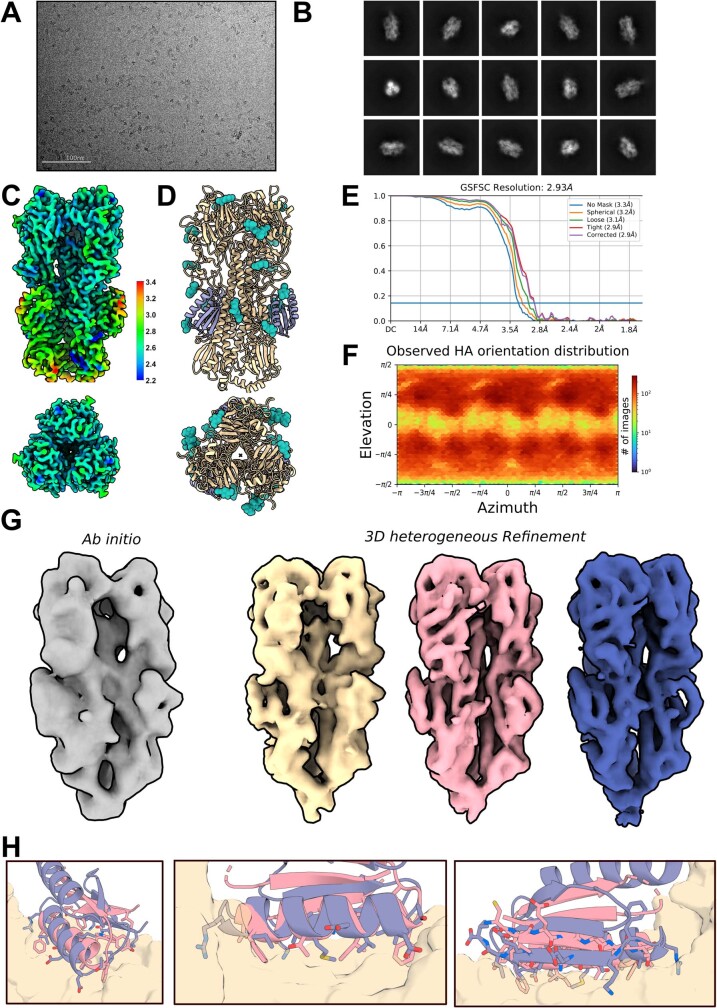
There has been considerable recent progress in designing new proteins using deep-learning methods 1–9 . Despite this progress, a general deep-learning framework for protein design that enables solution of a wide range of design challenges, including de novo binder design and design of higher-order symmetric architectures, has yet to be described. Diffusion models 10,11 have had considerable success in image and language generative modelling but limited success when applied to protein modelling, probably due to the complexity of protein backbone geometry and sequence–structure relationships. Here we show that by fine-tuning the RoseTTAFold structure prediction network on protein structure denoising tasks, we obtain a generative model of protein backbones that achieves outstanding performance on unconditional and topology-constrained protein monomer design, protein binder design, symmetric oligomer design, enzyme active site scaffolding and symmetric motif scaffolding for therapeutic and metal-binding protein design. We demonstrate the power and generality of the method, called RoseTTAFold diffusion (RFdiffusion), by experimentally characterizing the structures and functions of hundreds of designed symmetric assemblies, metal-binding proteins and protein binders. The accuracy of RFdiffusion is confirmed by the cryogenic electron microscopy structure of a designed binder in complex with influenza haemagglutinin that is nearly identical to the design model. In a manner analogous to networks that produce images from user-specified inputs, RFdiffusion enables the design of diverse functional proteins from simple molecular specifications.
Overview
CoChat Summary
TL;DR
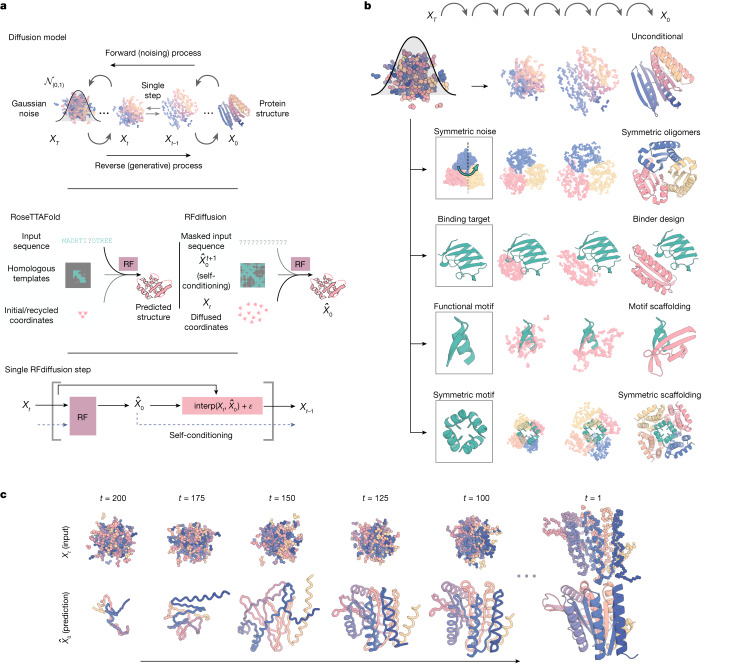
RFdiffusion fine-tunes the RoseTTAFold structure-prediction network as a denoising diffusion model to generate protein backbones for unconditional monomers, symmetric oligomers, functional-motif scaffolds, and de novo binders. The method solves 23 of 25 motif-scaffolding benchmark problems and yields experimentally validated binders, metal-binding assemblies, and a cryo-EM structure matching its design model at 0.63 Å.
Key findings
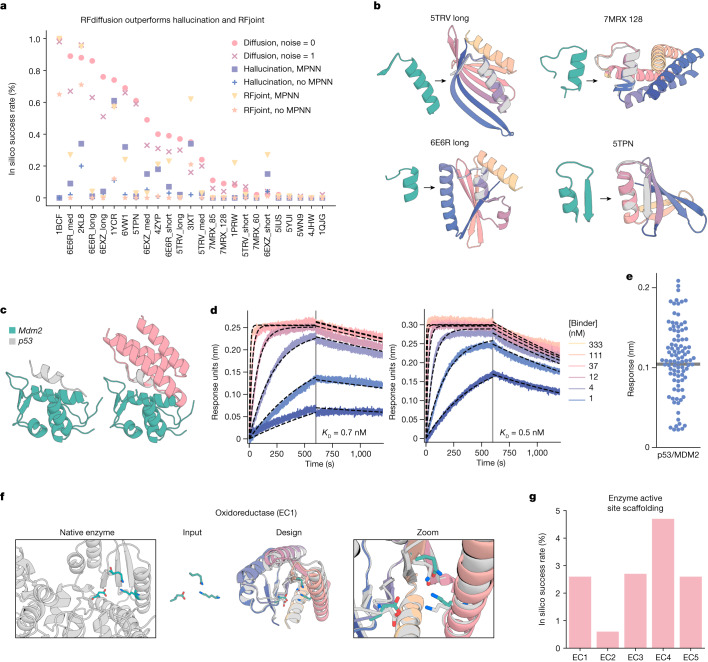
- RFdiffusion solves 23 of 25 motif-scaffolding benchmark problems, compared with 15 for Hallucination and 19 for RFjoint Inpainting; for 19 of 23 solved problems, its success fraction exceeds both baselines.
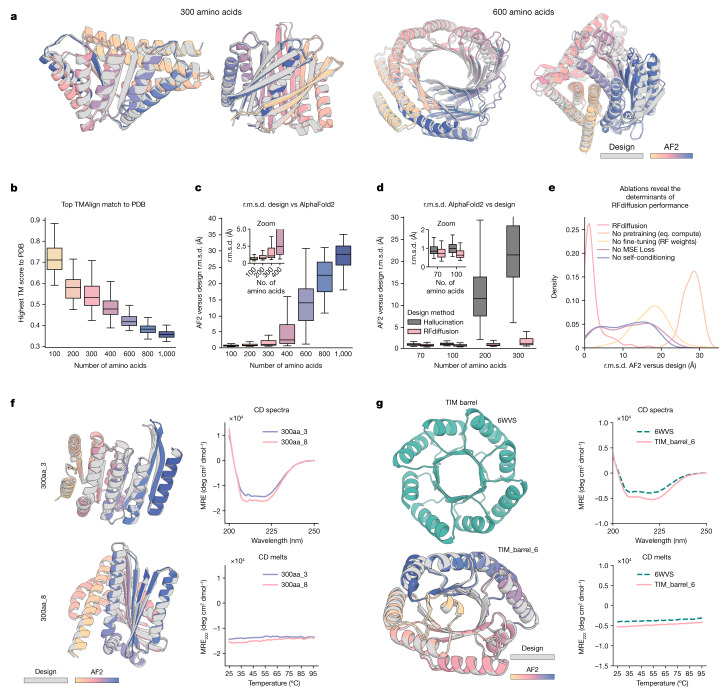
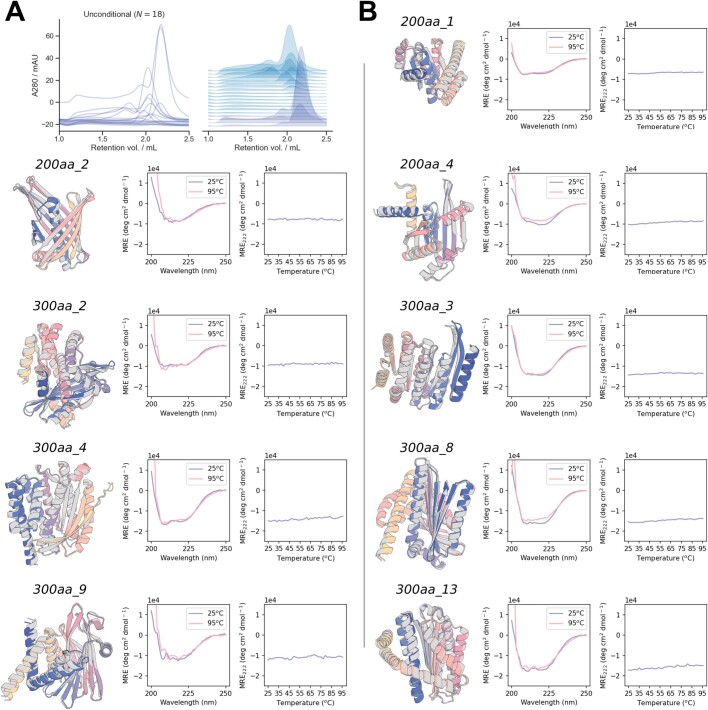
- It generates unconditional monomers up to 600 residues and outperforms RF Hallucination on in silico success (n = 400 designs per condition, z = 9.5, P = 1.6 × 10⁻²¹); a 100-residue protein can be generated in as little as 11 s versus about 8.5 min for RF Hallucination.
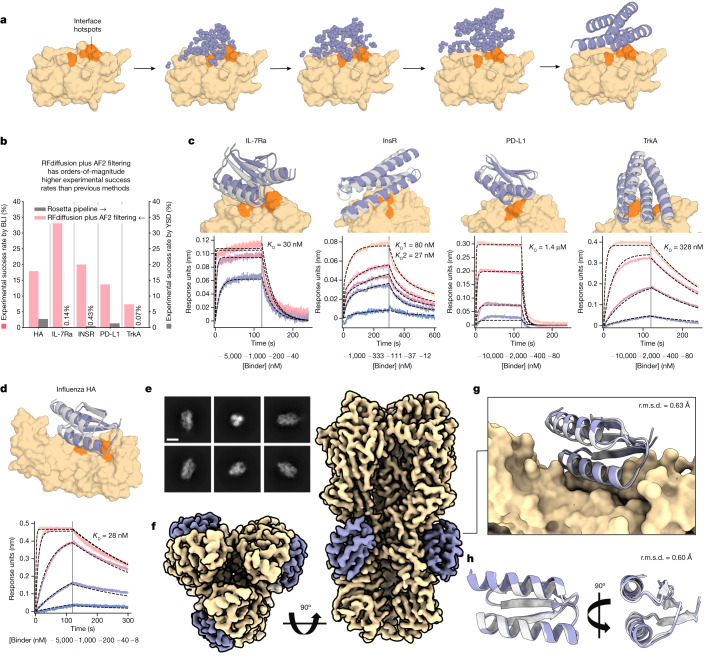
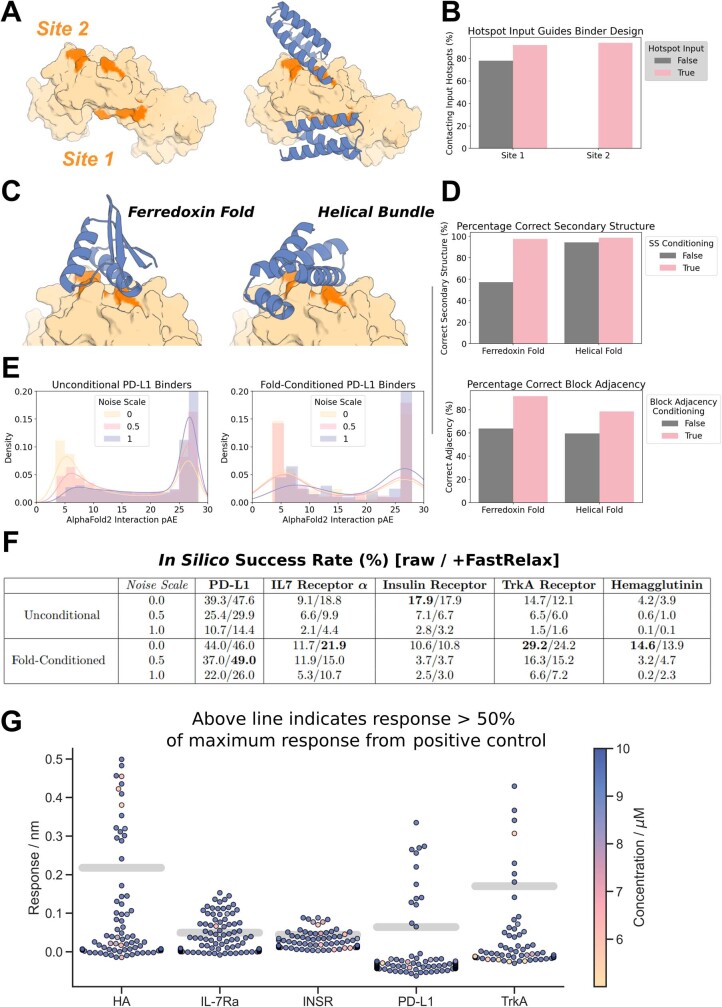
- For binder design against five targets, the overall experimental success rate was 19%, roughly two orders of magnitude above the previous Rosetta-based method; the highest-affinity HA binder, HA_20, bound with KD = 28 nM, and its cryo-EM complex structure matched the design model at 0.63 Å.
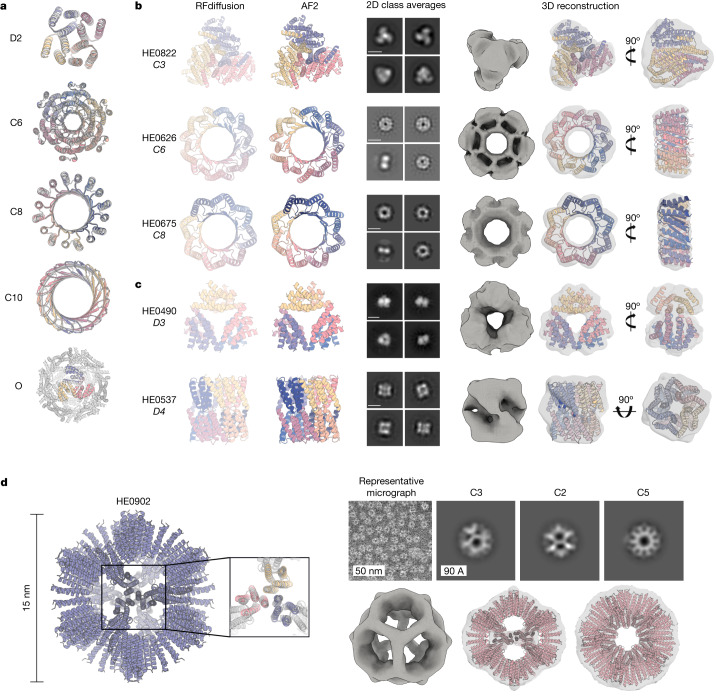
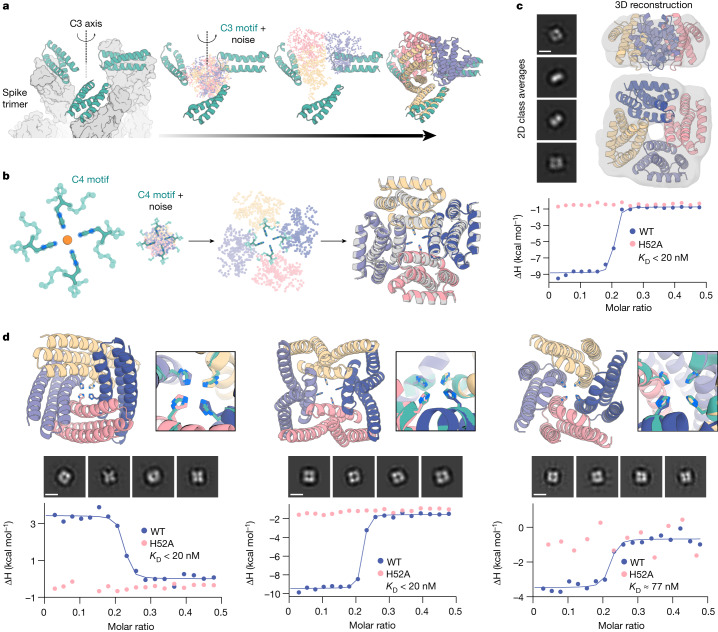
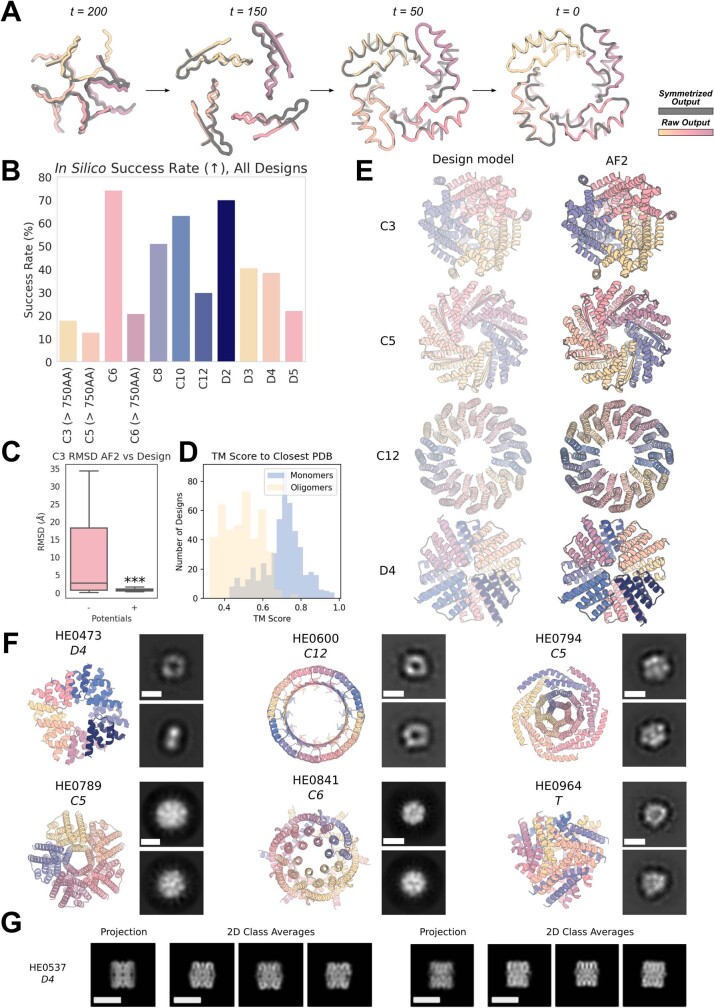
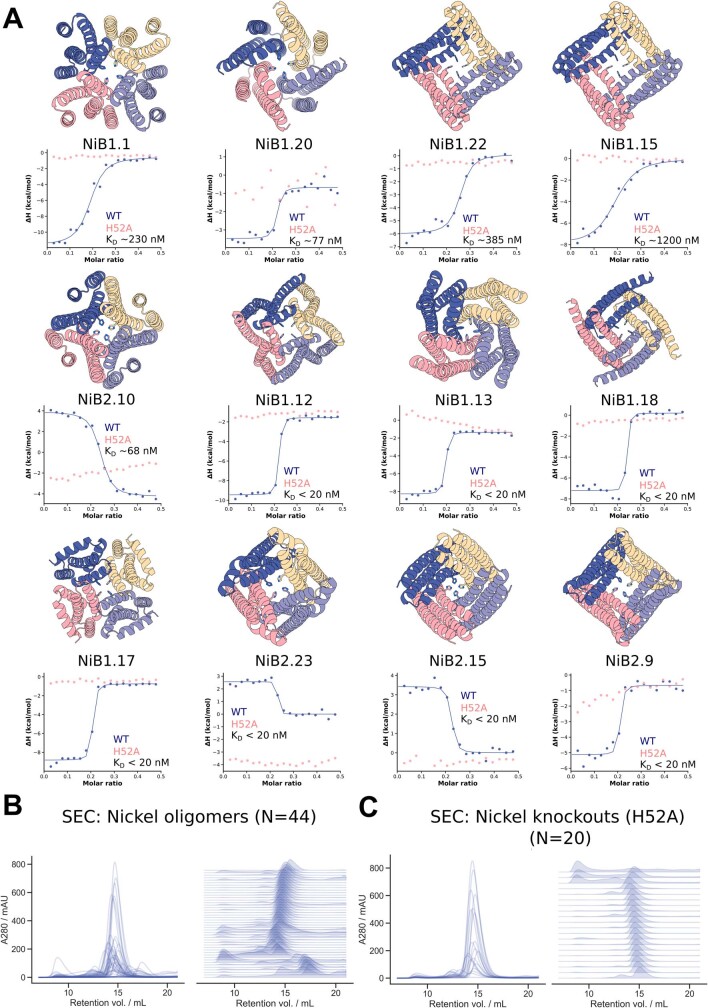
- Symmetric and functional designs were experimentally validated: at least 87 of 608 oligomer designs had SEC oligomerization states closely consistent with design models; 18 of 36 tested Ni²⁺-binding designs bound with dissociation constants from low nanomolar to low micromolar; MDM2 binders reached 0.5 and 0.7 nM versus 600 nM for the native p53 peptide.
Methods
- RFdiffusion uses the RoseTTAFold frame representation (Cα coordinate plus N-Cα-C rigid orientation per residue), trains by noising PDB structures for up to 200 steps, and minimizes mean-squared error between frame predictions and true structures; self-conditioning and fine-tuning from pretrained RF weights improved performance.
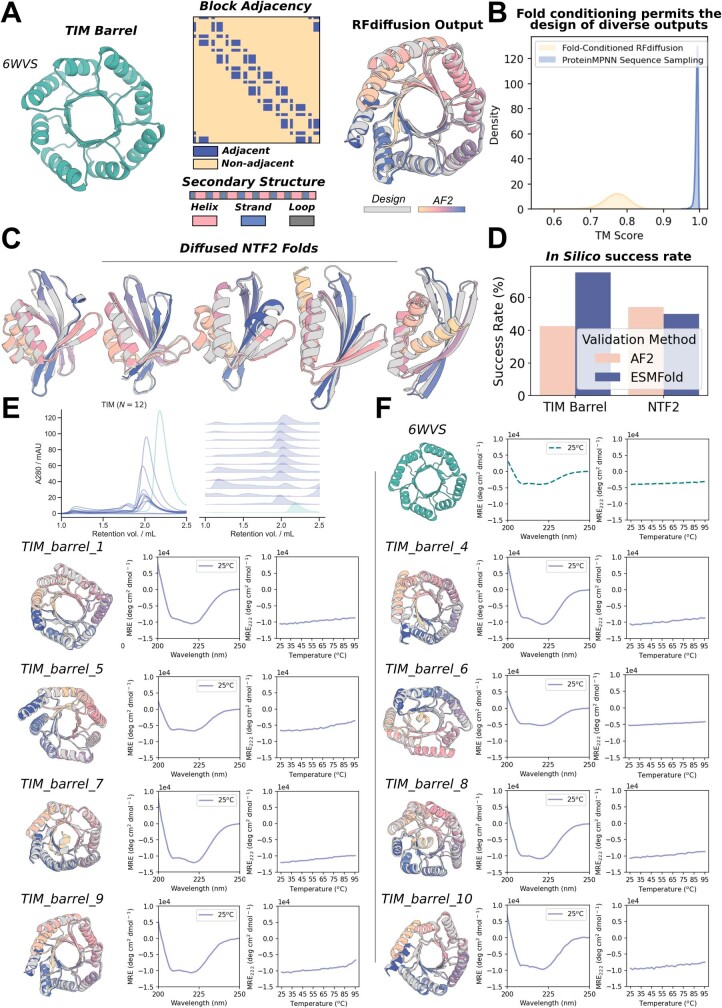
- For sequence design, ProteinMPNN was used to design sequences encoding RFdiffusion backbones, typically sampling eight sequences per design; in silico success was validated with AlphaFold2 using mean pAE < 5, global backbone r.m.s.d. < 2 Å, and scaffolded-site backbone r.m.s.d. < 1 Å.
- Experimental characterization included circular dichroism, size-exclusion chromatography, negative-stain EM, cryo-EM, biolayer interferometry, and isothermal titration calorimetry across designed monomers, oligomers, metal-binding proteins, and binders.
Limitations
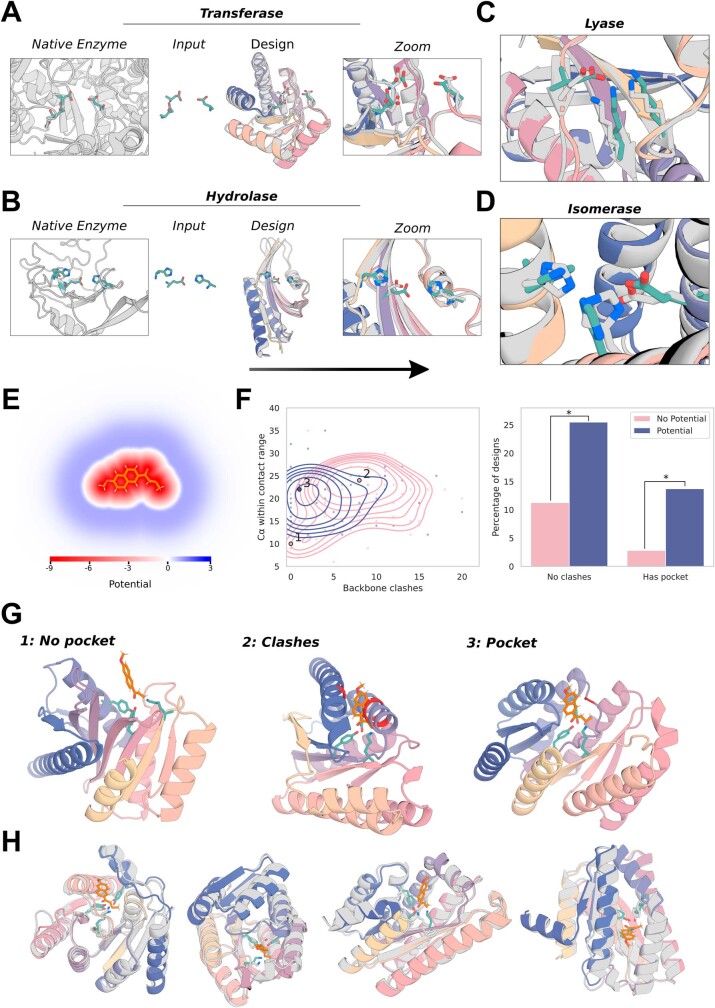
- The paper states that RFdiffusion cannot explicitly model bound small molecules at present, though it can implicitly model substrates with an external potential; it also states that further studies are required to assess success rates on more polar target sites and sites without native binding partners, and that proteome-wide specificity remains to be fully characterized.
- The paper notes that very large proteins are difficult to validate in silico because they are probably beyond single-sequence prediction capabilities of AF2 and ESMFold, and that some binder designs had insufficient material to permit screening at 10 μM.
- Evident from the text: many conclusions rely on the AF2-based in silico success metric, experimental validation was performed on subsets of designs rather than all generated designs, and the authors did not extensively explore simultaneous structure-and-sequence design within RFdiffusion.
Model-written summary. Check it against the paper before relying on it.
Integrity signals
Registry
Cites
Statistics
Figures
Verification
Claims the paper makes
17 Valid · 4 Not valid · 3 Not checked · 113 Own results and interpretations
Some cited sources support this claim and some don’t — read each source’s verdict below.
In the paper
“Recent work has adapted DDPMs for protein monomer design by conditioning on small protein ‘motifs’5,9 or on secondary structure and block-adjacency (‘fold’) information8.”
§ De novo design of protein structure and function with RFdiffusion > Main
What the sources say
- Supportedcites [5] Trippe, B. L. et al. Diffusion probabilistic modeling of protein backbones in 3D for the motif-scaffolding problem. in The EleventhInternational Conference on Learning Representations (2023). source
The Introduction (p. 1) describes ProtDiff as a diffusion probabilistic model for protein backbones and SMCDiff as its motif-conditioned sampling procedure. The Discussion (p. 9) confirms that the procedure generates scaffolds conditioned on a motif. The secondary-structure and block-adjacency clause is attached to a different citation, so it is not attributed to this source. (LLM, conf=0.93)
- Disputedcites [9] Luo, S. et al. Antigen-specific antibody design and optimization with diffusion-based generative models. in Adv. Neural Information Processing Systems Vol. 35 (eds Koyejo, S. et al) 9754–9767 (Curran Associates, 2022). sourceExperimental — accuracy not yet measured
Section 3.1 (page unavailable) says the paper designs antibody CDRs given an antigen structure and antibody framework, not protein monomers conditioned on small motifs. The Generative Model section likewise describes a diffusion model conditioned on the antigen and antibody framework; it does not describe secondary-structure or block-adjacency conditioning. (LLM, conf=0.87)
Checked by a reasoning model — may be wrong.
- Supportedcites [8] Anand, N. & Achim, T. Protein structure and sequence generation with equivariant denoising diffusion probabilistic models. Preprint at 10.48550/arXiv.2205.15019 (2022). source
Citation 8 is attached to the secondary-structure and block-adjacency (‘fold’) conditioning, not to the motif examples cited separately. Section 2.4 (p. 5) defines those constraints, and Section 3 (p. 6) states that the diffusion model conditions on their encoded output to generate protein structures. (LLM, conf=0.94)
plain- Asserted: passes — The authors put it forward as true.
- Checkable: passes — It can be checked against evidence.
- Load-bearing: unclear — It is unclear whether the paper’s conclusions depend on it.
- Based: passes — The paper gives a reason why it holds.
- Supported
The cited sources support only part of this claim — read each source’s verdict below.
In the paper
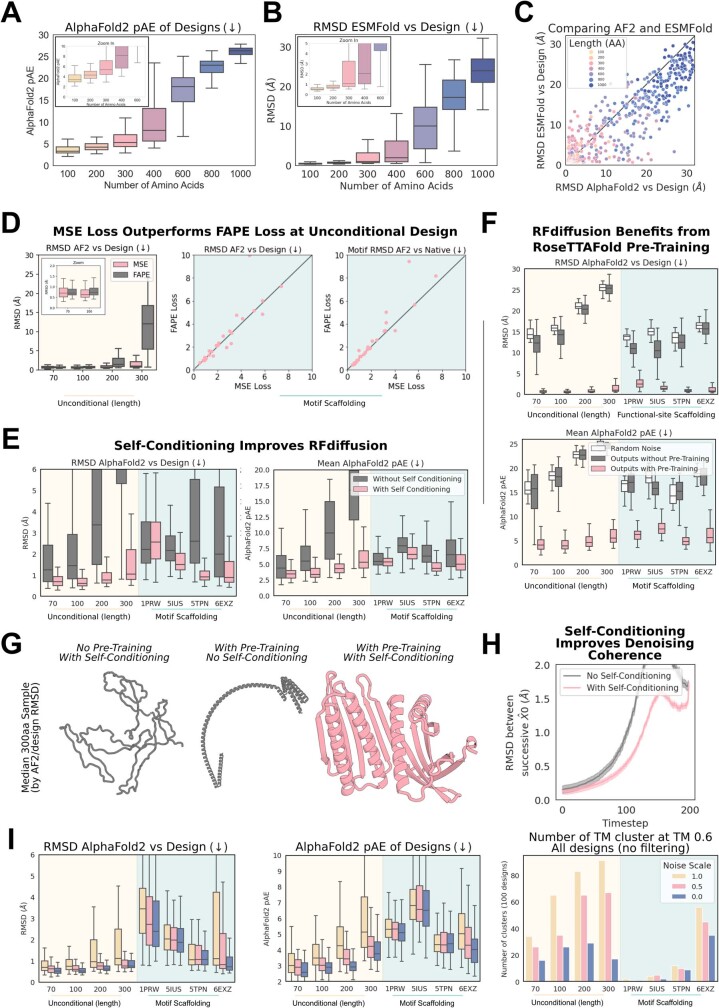
“Self-conditioning within RFdiffusion notably improved performance on in silico benchmarks encompassing both conditional and unconditional protein design tasks (Fig. 2e and Extended Data Fig. 1e).”
§ De novo design of protein structure and function with RFdiffusion > Main
What the sources say
- Partly supportedcites [25] Chen, T., Zhang, R. & Hinton, G. Analog bits: generating discrete data using diffusion models with self-conditioning. in The Eleventh International Conference on Learning Representations (2023). sourceExperimental — accuracy not yet measured
The Discrete Image Generation section (pp. 6–7) reports that self-conditioning improved results for image diffusion models. It does not report RFdiffusion results or in silico benchmarks for conditional and unconditional protein design, so the claimed improvement in that setting is not supported by this source. (LLM, conf=0.86)
plainstates a cause- Asserted: passes — The authors put it forward as true.
- Checkable: passes — It can be checked against evidence.
- Load-bearing: passes — The paper’s conclusions depend on it.
- Based: passes — The paper gives a reason why it holds.
- Partly supported
The cited sources support only part of this claim — read each source’s verdict below.
In the paper
“Experimental characterization showed that the method can scaffold a wide range of protein functional motifs with atomic accuracy19”
§ De novo design of protein structure and function with RFdiffusion > Main
What the sources say
- Partly supportedcites [4] Wang J Scaffolding protein functional sites using deep learning Science 2022 377 387 394 10.1126/science.abn2100 35862514 PMC9621694 sourceExperimental — accuracy not yet measured
The 'Generalized functional motif scaffolding' section reports designs spanning a wide range of motifs and says their activities were assessed experimentally. But its sub-angstrom motif accuracy is based on AlphaFold predictions, not experimental structural measurements; the sentence overstates what the experimental characterization established. (LLM, conf=0.88)
- Partly supportedcites [19] Watson, J. L., Bera, A., Juergens, D., Wang, J. & Baker, D. X-ray crystallographic validation of design from this paper. Science377, 387–394 (2022). sourceExperimental — accuracy not yet measured
The section “Generalized functional motif scaffolding by missing information recovery” (page unavailable) reports designs spanning a wide range of motifs, with motif RMSD typically below 1 Å in AlphaFold predictions. It separately reports experimental tests of the designs’ activities; those tests do not establish atomic structural accuracy. The paper also attributes the broad set of designs to both inpainting and constrained hallucination, rather than RFjoint inpainting alone. (LLM, conf=0.87)
plainstates a cause- Asserted: passes — The authors put it forward as true.
- Checkable: passes — It can be checked against evidence.
- Load-bearing: passes — The paper’s conclusions depend on it.
- Based: passes — The paper gives a reason why it holds.
- Partly supported
The cited sources support only part of this claim — read each source’s verdict below.
In the paper
“we established an in silico benchmark test (Supplementary Table 9) comprising 25 motif-scaffolding design problems addressed in six recent publications encompassing several design methodologies4,5,29,38–40”
§ De novo design of protein structure and function with RFdiffusion > Functional-motif scaffolding
What the sources say
- Could not verifycites [4] Wang J Scaffolding protein functional sites using deep learning Science 2022 377 387 394 10.1126/science.abn2100 35862514 PMC9621694 sourceExperimental — accuracy not yet measured
The 'Generalized functional motif scaffolding by missing information recovery' section describes in silico evaluation of the paper’s own designs, but does not describe establishing a benchmark of 25 problems drawn from six publications. Searches for the benchmark, the numbers, and Supplementary Table 9 found no passage in our copy that verifies those details. (LLM, conf=0.74)
- Supportedcites [5] Trippe, B. L. et al. Diffusion probabilistic modeling of protein backbones in 3D for the motif-scaffolding problem. in The EleventhInternational Conference on Learning Representations (2023). source
Section 5.2 (p. 7) reports motif-scaffolding tests using motifs from proteins 6exz and 5trv; Appendix H.1 (p. 24) describes another target, 5tpn. This supports citing the paper as one of the publications that addressed motif-scaffolding design problems. The citing authors describe the 25-problem benchmark as their own, not as something established by this source. (LLM, conf=0.88)
- Supportedcites [29] Lee, J. S. & Kim, P. M. ProteinSGM: Score-based generative modeling for de novo protein design. Preprint at bioRxiv10.1101/2022.07.13.499967 (2022). source
The citation identifies one of the publications whose design methodology informed the citing authors’ benchmark; it does not attribute the establishment of the 25-problem benchmark to ProteinSGM. In “Conditional generation” (page unavailable), ProteinSGM presents scaffold-inpainting design cases, including generation of scaffolds around the barstar functional site. (LLM, conf=0.88)
- Supportedcites [38] Sesterhenn F De novo protein design enables the precise induction of RSV-neutralizing antibodies Science 2020 368 eaay5051 10.1126/science.aay5051 32409444 PMC7391827 source
The citation identifies this paper as one of the motif-scaffolding publications used to assemble the citing authors’ benchmark; the benchmark’s size and establishment are the citing authors’ own statements. The Results section (page unavailable) describes TopoBuilder as a protocol for designing protein topologies around functional motifs, so the paper fits that role. (LLM, conf=0.88)
- Not checked — no full text of the sourcecites [39] Yang C Bottom-up de novo design of functional proteins with complex structural features Nat. Chem. Biol. 2021 17 492 500 10.1038/s41589-020-00699-x 33398169 source
- Partly supportedcites [40] Glasgow A Engineered ACE2 receptor traps potently neutralize SARS-CoV-2 Proc. Natl Acad. Sci. USA 2020 117 28046 28055 10.1073/pnas.2016093117 33093202 PMC7668070 sourceExperimental — accuracy not yet measured
The Results and Materials and Methods describe computational redesign of the ACE2–spike binding interface, so this is a publication addressing a protein-design problem. Our copy does not describe that work as motif scaffolding. The benchmark of 25 problems is the citing authors’ own work, not a finding attributed to this source. (LLM, conf=0.78)
plain- Asserted: passes — The authors put it forward as true.
- Checkable: passes — It can be checked against evidence.
- Load-bearing: passes — The paper’s conclusions depend on it.
- Based: passes — The paper gives a reason why it holds.
- Could not verify
Every source the paper cites for this claim was checked and supports it.
In the paper
“Vázquez Torres et al. demonstrate the ability of RFdiffusion to design picomolar affinity binders to flexible helical peptides54”
§ De novo design of protein structure and function with RFdiffusion > Discussion
What the sources say
- Supportedcites [54] Torres, S. V. et al. De novo design of high-affinity protein binders to bioactive helical peptides. Preprint at bioRxiv10.1101/2022.12.10.519862 (2022). source
The Peptide binder design with RFdiffusion section reports de novo RFdiffusion binders to the helical peptides Bim and PTH, with an estimated affinity of ~100 pM for Bim and an upper bound of 500 pM for PTH. The Main section explains that peptide targets are often partially or entirely unstructured in isolation, supporting the description of them as flexible. (LLM, conf=0.94)
boostedstates a cause- Asserted: passes — The authors put it forward as true.
- Checkable: passes — It can be checked against evidence.
- Load-bearing: unclear — It is unclear whether the paper’s conclusions depend on it.
- Based: passes — The paper gives a reason why it holds.
- Supported
82 more claims · 7 with their cited sources checked
Create a free account to see all 137 claims and every source verdict.
- It may state two separate claims as one. 48
- Probably not a substantial claim. 3
- The quote only partly states this claim. 1
Claims other papers make about this one
Each is checked against this paper’s own text: does it say what the citing paper says it does?
The source backs part of the claim, not all of it — or backs it for a different population, condition or comparison.
In the citing paper
“We also use Evo to generate genome-scale sequences with plausible high-level architecture more than1 megabase (Mb) in length, a scale that is orders of magnitude greater than previous methods (10, 13, 14).”
From Sequence modeling and design from molecular to genome scale with Evo (2024) · cites this paper as [10]
Experimental — accuracy not yet measured
Self-check
Percentages, sums and reported differences re-computed from the paper’s own numbers.
Each contradiction between two passages listed here was confirmed by an independent check.
Rated minor: it would not touch a result — a value no result rests on, a p-value that stays on the same side of the significance level, or a conflict that is clerical, resolved elsewhere in the paper, or outside its own findings.
In the paper
§ De novo design of protein structure and function with RFdiffusion > Functional-motif scaffolding
“e, Out of 95 designs, 55 showed binding to MDM2 (more than 50% of maximum response).”
§ De novo design of protein structure and function with RFdiffusion > Functional-motif scaffolding
“The overall success rate was quite high: out of the 96 designs, 55 showed some detectable binding at 10 μM (Fig. 4e and Supplementary Fig. 10h).”
Citations
Cites
Highly accurate protein structure prediction with AlphaFold
Jumper, J., Evans, R., Pritzel, A., Green, T., Figurnov, M., Ronneberger, O., Tunyasuvunakool, K., Bates, R., Žídek, A., Potapenko, A., et al. (2021) · Nature · doi:10.1038/s41586-021-03819-2 · Cited by 43,764
Berman, H. M. (2000) · Nucleic Acids Research · doi:10.1093/nar/28.1.235 · Cited by 40,196
Denoising Diffusion Probabilistic Models
Ho, J., Jain, A., & Abbeel, P. (2020) · arXiv · doi:10.48550/arxiv.2006.11239 · Cited by 8,712
Evolutionary-scale prediction of atomic level protein structure with a language model
Lin, Z., Akin, H., Rao, R., Hie, B., Zhu, Z., Lu, W., Smetanin, N., Verkuil, R., Kabeli, O., Shmueli, Y., et al. (2022) · doi:10.1101/2022.07.20.500902 · Cited by 5,990
Accurate prediction of protein structures and interactions using a 3-track network
Baek, M., DiMaio, F., Anishchenko, I., Dauparas, J., Ovchinnikov, S., Lee, G. R., Wang, J., Cong, Q., Kinch, L. N., Schaeffer, R. D., et al. (2021) · doi:10.1101/2021.06.14.448402 · Cited by 5,549
Self-citationDeep Unsupervised Learning using Nonequilibrium Thermodynamics
Sohl-Dickstein, J., Weiss, E. A., Maheswaranathan, N., & Ganguli, S. (2015) · arXiv · doi:10.48550/arxiv.1503.03585 · Cited by 2,637
Zero-shot text-to-image generation
Ramesh, A., Pavlov, M., Goh, G., Gray, S., Voss, C., Radford, A., Chen, M., & Sutskever, I. (2021) · arXiv · doi:10.48550/arxiv.2102.12092 · Cited by 2,417
THEORY OF PROTEIN FOLDING: The Energy Landscape Perspective
Onuchic, J. N., Luthey-Schulten, Z., & Wolynes, P. G. (1997) · Annual Review of Physical Chemistry · doi:10.1146/annurev.physchem.48.1.545 · Cited by 2,210
Robust deep learning–based protein sequence design using ProteinMPNN
Dauparas, J., Anishchenko, I., Bennett, N., Bai, H., Ragotte, R. J., Milles, L. F., Wicky, B. I. M., Courbet, A., de Haas, R. J., Bethel, N., et al. (2022) · Science · doi:10.1126/science.add2187 · Cited by 2,210 · cited 6×
“We explored two different strategies for training RFdiffusion: (1) in a manner akin to ‘canonical’ diffusion models, with predictions at each timestep independent of predictions at previous timesteps (as in previous work(5,8,9,16)), and (2) with self-conditioning(25), in which the model can condition on previous predi…”
InfluentialSelf-citationStructure of the MDM2 Oncoprotein Bound to the p53 Tumor Suppressor Transactivation Domain
Kussie, P. H., Gorina, S., Marechal, V., Elenbaas, B., Moreau, J., Levine, A. J., & Pavletich, N. P. (1996) · Science · doi:10.1126/science.274.5289.948 · Cited by 2,206
Research works printed but not linked: 1
- Watson, J. L., Bera, A., Juergens, D., Wang, J. & Baker, D. X-ray crystallographic validation of design from this paper. Science377, 387–394 (2022). · DOI · Paper page
Cited by
Items 401–500 of 2,479
Zhu, J.-J., Li, Z.-X., Tong, H., Lu, Z., Zhang, N., Wei, T., & Chen, H.-F. (2023) · Briefings Bioinform. · doi:10.1093/bib/bbad429 · Cited by 23
Extracellular vesicles for developing targeted hearing loss therapy
Pan, X., Li, Y., Huang, P., Staecker, H., & He, M. (2024) · Journal of Controlled Release · doi:10.1016/j.jconrel.2023.12.050 · Cited by 25
Machine learning-aided design and screening of an emergent protein function in synthetic cells
Kohyama, S., Frohn, B. P., Babl, L., & Schwille, P. (2024) · Nature Communications · doi:10.1038/s41467-024-46203-0 · Cited by 23
Atom-level generative foundation model for molecular interaction with pockets
Peng, X., Guo, F., Guo, R., Sun, J., Guan, J., Jia, Y., Xu, Y., Huang, Y., Zhang, M., Peng, J., et al. (2024) · doi:10.1101/2024.10.17.618827 · Cited by 22
Reengineering of a flavin‐binding fluorescent protein using ProteinMPNN
Nikolaev, A., Kuzmin, A., Markeeva, E., Kuznetsova, E., Ryzhykau, Y. L., Semenov, O., Anuchina, A. A., Remeeva, A., & Gushchin, I. (2024) · Protein Science · doi:10.1002/pro.4958 · Cited by 22
An integrative approach to protein sequence design through multiobjective optimization
Hong, L., & Kortemme, T. (2024) · PLoS Computational Biology · doi:10.1371/journal.pcbi.1011953 · Cited by 29
“This setup is closely related to protein design via hal-lucination [60,61], and, in a sense, inverts the learned sequence-to-structure mapping of AlphaFold2; similar methods have been explored in the literature, typically with unsatisfactory results [20,21,43].”
Structure, function, and immunomodulation of the CD8 co-receptor
Srinivasan, S., Zhu, C., & McShan, A. C. (2024) · Frontiers in Immunology · doi:10.3389/fimmu.2024.1412513 · Cited by 24
Cheng, A., Ser, C. T., Skreta, M., Guzmán-Cordero, A., Thiede, L., Burger, A., Aldossary, A., Leong, S. X., Pablo‐García, S., Strieth‐Kalthoff, F., et al. (2025) · Faraday Discussions · doi:10.1039/d4fd00153b · Cited by 29
Capin, J., Chabert, E., Zúñiga, A., & Bonnet, J. (2024) · Microbial Biotechnology · doi:10.1111/1751-7915.70047 · Cited by 22
Engineered enzymes for enantioselective nucleophilic aromatic substitutions
Lister, T. M., Roberts, G. W., Hossack, E. J., Zhao, F., Burke, A. J., Johannissen, L. O., Hardy, F. J., Millman, A. A. V., Leys, D., Larrosa, I., et al. (2025) · Nature · doi:10.1038/s41586-025-08611-0 · Cited by 21
Quantifying antibody binding: techniques and therapeutic implications
Lodge, J., Kajtar, L., Duxbury, R., Hall, D., Burley, G. A., Cordy, J. M., Yates, J. W. T., & Rattray, Z. (2025) · mAbs · doi:10.1080/19420862.2025.2459795 · Cited by 27
Protein-based materials: Applications, modification and molecular design
Tunuhe, A., Zheng, Z., Rao, X., Yu, H., Ma, F., Zhou, Y., & Xie, S. (2025) · BioDesign Research · doi:10.1016/j.bidere.2025.100004 · Cited by 24
“It enables the design of protein-ligand interactions and can create different functional proteins from simple molecular speci fi cations, similar to generating images from user-speci fi ed inputs [78].”
Mieres‐Pérez, J., Almeida‐Hernández, Y., Sander, W., & Sánchez‐García, E. (2025) · Chemical Reviews · doi:10.1021/acs.chemrev.4c00807 · Cited by 23
Evers, A., Guarnera, E., Pekar, L., & Zielonka, S. (2025) · mAbs · doi:10.1080/19420862.2025.2583210 · Cited by 26
“In a preprint, Bennett et al. 63 tailored RFdiffusion 108 for VHH and antibody design by training predominantly on antibody – antigen complexes, constraining frameworks while focusing sampling on CDR loops, incorporating epitope-targeting features to drive loop-mediated interactions.”
Periodicity-aware deep learning for polymers
Wu, Y., Wang, C., Shen, X., Zhang, T., Zhang, P., & Ji, J. (2025) · Nature Computational Science · doi:10.1038/s43588-025-00903-9 · Cited by 29
“For RF, the ‘n_estimators’ parameter searched in [50, 60, 70, 80, 90, 100, 200], and the ‘max_ depth’ parameter searched in [None, 2, 4, 6, 8, 10].”
Kao, H.-W., Lu, W.-L., Ho, M., Lin, Y., Hsieh, Y.-J., Ko, T., Hsu, S. D., & Wu, K. (2023) · ACS Synthetic Biology · doi:10.1021/acssynbio.3c00042 · Cited by 22
Enzyme engineering for functional lipids synthesis: recent advance and perspective
Guan, A., Hou, Y., Yang, R., & Qin, J. (2024) · Bioresources and Bioprocessing · doi:10.1186/s40643-023-00723-7 · Cited by 23
Recent advances in biocatalytic C–N bond-forming reactions
Yin, H.-N., Wang, P., & Liu, Z. (2024) · Bioorganic Chemistry · doi:10.1016/j.bioorg.2024.107108 · Cited by 21
HelixDiff, a Score-Based Diffusion Model for Generating All-Atom α‑Helical Structures
Xie, X., Valiente, P. A., Kim, J., & Kim, P. M. (2024) · ACS Central Science · doi:10.1021/acscentsci.3c01488 · Cited by 24
Structure‐based computational design of antibody mimetics: challenges and perspectives
Chaves, E. J. F., Coêlho, D. F., da Cruz, C. H. B., Moreira, E. G., Simões, J., Nascimento‐Filho, M. J., & Lins, R. D. (2024) · FEBS Open Bio · doi:10.1002/2211-5463.13855 · Cited by 26
De Novo Antibody Design with SE(3) Diffusion
Cutting, D., Dreyer, F. A., Errington, D., Schneider, C., & Deane, C. M. (2025) · Journal of Computational Biology · doi:10.1089/cmb.2024.0768 · Cited by 26
Chen, T., Dumas, M., Watson, R., Vincoff, S., Peng, C., Zhao, L., Hong, L., Pertsemlidis, S., Shaepers-Cheu, M., Wang, T. Z., et al. (2023) · PubMed Central · doi:10.48550/arxiv.2310.03842 · Cited by 43
“…sequence pairs in the test dataset, outperform the state-of-the-art RFDiffusion model for peptide generation on structured targets in silico , 9 and experimentally exhibit degradation of difficult-to-drug drivers of Huntington’s disease and emergent viral phosphoproteins when incorporated…”
Microdroplet screening rapidly profiles a biocatalyst to enable its AI-assisted engineeringPreprint
Gantz, M., Mathis, S. V., Nintzel, F. E. H., Penner, M., Zurek, P. J., Knaus, T., Tseliou, V., Patel, E., Boros, D., Weberling, F.-M., et al. (2024) · bioRxiv (Cold Spring Harbor Laboratory) · doi:10.1101/2024.04.08.588565 · Cited by 27
Parametrically guided design of beta barrels and transmembrane nanopores using deep learning
Kim, D. E., Watson, J. L., Juergens, D., Majumder, S., Sonigra, R., Gerben, S. R., Kang, A., Bera, A. K., Li, X., & Baker, D. (2025) · Proceedings of the National Academy of Sciences · doi:10.1073/pnas.2425459122 · Cited by 21
“While, after training, RFdiffusion is generally used to design completely novel protein backbones (18), Vázquez Torres et al. introduced the concept of “partial diffusion” with RFdiffusion, whereby a specific protein backbone is “resampled” through the addition of just a few forward noising steps…”
InfluentialSelf-citationParametrically guided design of beta barrels and transmembrane nanopores using deep learning
Kim, D. E., Watson, J. L., Juergens, D., Majumder, S., Sonigra, R., Gerben, S. R., Kang, A., Bera, A. K., Li, X., & Baker, D. (2024) · doi:10.1101/2024.07.22.604663 · Cited by 21
Self-citationRecent advances in generative biology for biotherapeutic discovery
Mock, M. L., LANGMEAD, C. J., Grandsard, P. J., Edavettal, S. C., & Russell, A. J. (2024) · Trends in Pharmacological Sciences · doi:10.1016/j.tips.2024.01.003 · Cited by 23
Artificial intelligence-guided strategies for next-generation biological sequence design
Zhang, P., Wei, L., Li, J., & Wang, X. (2024) · National Science Review · doi:10.1093/nsr/nwae343 · Cited by 23
Tan, L., Wang, L., Ren, X., Zou, Q., Yao, X., Zeng, X., & Fu, X. (2025) · Information Fusion · doi:10.1016/j.inffus.2025.103119 · Cited by 23
Recent progress and future challenges in structure-based protein-protein interaction prediction
Yuan, R., Zhang, J., Zhou, J., & Cong, Q. (2025) · Molecular Therapy · doi:10.1016/j.ymthe.2025.04.003 · Cited by 31
Sutherland, C. A., Stevens, D. M., Seong, K., Wei, W., & Krasileva, K. V. (2025) · The Plant Cell · doi:10.1093/plcell/koaf109 · Cited by 21
Multimeric protein interaction and complex prediction: Structure, dynamics and function
Lu, D., Yu, S., Huang, Y., & Gong, X. (2025) · Computational and Structural Biotechnology Journal · doi:10.1016/j.csbj.2025.05.009 · Cited by 26
Accelerating protein design by scaling experimental characterization
Qian, J., Milles, L. F., Wicky, B. I. M., Ragotte, R. J., Motmaen, A., Borst, A. J., Skotheim, R., Ols, S., Coventry, B., Li, X., et al. (2026) · Nature Communications · doi:10.1038/s41467-026-76740-9 · Cited by 31
“We reasoned that a simple assay-agnostic work fl ow for the production and initial characterization of hundreds of proteins per day in a standardized and cost-effective manner could signi fi cantly accelerate protein design efforts.”
Self-citationPhage therapy against Klebsiella pneumoniae: An evolving perspective
Xing, J., Zhang, H., Zheng, L., Zhao, J., Zhang, Y., Xu, Z., Zhai, Y., Hu, G., Li, J., & Wu, H. (2025) · Biotechnology Advances · doi:10.1016/j.biotechadv.2025.108689 · Cited by 23
The Role of AI-Driven De Novo Protein Design in the Exploration of the Protein Functional Universe
Zhang, G., Liu, C., Lu, J., Zhang, S., & Zhu, L. (2025) · Biology · doi:10.3390/biology14091268 · Cited by 25
“The Baker laboratory’s RFdiffusion [88] (a denoising diffusion probabilistic model fine-tuned from RoseTTAFold) has emerged as a benchmark for de novo backbone generation, supporting both unconditional scaffold generation and topology-constrained design across diverse applications.”
Discovery and protein language model-guided design of hyperactive transposases
Ivančić, D., Agudelo, A., Lindstrom-Vautrin, J., Jaraba-Wallace, J., Gallo, M., Das, R., Ragel, A., Herrero-Vicente, J., Higueras, I., Billeci, F., et al. (2025) · Nature Biotechnology · doi:10.1038/s41587-025-02816-4 · Cited by 28
“For instance, a combination of RFdiffusion 13 and methodologies to design catalytic sites created active synthetic serine hydrolases with new folds 14 .”
Bottom-up design of Ca2+ channels from defined selectivity filter geometry
Liu, Y., Weidle, C., Mihaljević, L., Watson, J. L., Li, Z., Yu, L. T., Majumder, S., Borst, A. J., Carr, K. D., Kibler, R. D., et al. (2025) · Nature · doi:10.1038/s41586-025-09646-z · Cited by 25
“RFdiffusion was subsequently used to generate straight helices to fuse DHRs to the CalC6_3 monomer.”
InfluentialSelf-citationA Review of Current Computational Tools for Peptide–Protein Docking
Martins, F. G., Santos, H. A., & Sousa, S. F. (2026) · Journal of Computational Chemistry · doi:10.1002/jcc.70328 · Cited by 24
“Diffusion-based programs, such as RFdiffusion [150] and DiffPepBuilder [151], have emerged as powerful tools in peptide-protein docking by using generative diffusion models to design peptide binders with high specificity and structural accuracy.”
Therapeutic peptides and proteins: Status and developments in drug delivery
Hornsby, B. D., Lee, C. H., Steele, C. A., Tuekpe, J. K. K., & Lim, C. S. (2026) · Journal of Controlled Release · doi:10.1016/j.jconrel.2026.114895 · Cited by 25
Zero-shot design of drug-binding proteins via neural iterative selection−expansion
Fry, B. N., Slaw, K., & Polizzi, N. F. (2026) · Nature · doi:10.1038/s41586-026-10670-w · Cited by 31
“This parameter is highly correlated with other metrics, such as protein Cα pLDDT and interfacial predicted aligned error (iPAE), which are commonly used for protein-binder design 15,23 (Extended Data Fig.”
Structural insights into membrane adenylyl cyclases, initiators of cAMP signaling
Schuster, D., Khanppnavar, B., Kantarci, I., Mehta, V., & Korkhov, V. M. (2023) · Trends in Biochemical Sciences · doi:10.1016/j.tibs.2023.12.002 · Cited by 25
Chloroplast ATP synthase: From structure to engineering
Rühle, T., Leister, D., & Pasch, V. (2024) · The Plant Cell · doi:10.1093/plcell/koae081 · Cited by 24
Graphusion: Latent Diffusion for Graph Generation
Yang, L. Q., Huang, Z., Zhang, Z., Liu, Z., Hong, S., Zhang, W., Yang, W., Cui, B., & Zhang, L. (2024) · IEEE Transactions on Knowledge and Data Engineering · doi:10.1109/tkde.2024.3389783 · Cited by 44
Accelerating Genetic Sensor Development, Scale-up, and Deployment Using Synthetic Biology
Joshi, S. H.-N., Jenkins, C., Ulaeto, D., & Gorochowski, T. E. (2024) · BioDesign Research · doi:10.34133/bdr.0037 · Cited by 26
Protein Design by Directed Evolution Guided by Large Language Models
Tran, T. V. T., & Hy, T. (2024) · bioRxiv · doi:10.1109/tevc.2024.3439690 · Cited by 28
Unlocking the Gates: Therapeutic Agents for Noninvasive Drug Delivery Across the Blood-Brain Barrier
Culkins, C., Adomanis, R., Phan, N., Robinson, B., Slaton, E. W., Lothrop, E., Chen, Y., & Kimmel, B. R. (2024) · Molecular Pharmaceutics · doi:10.1021/acs.molpharmaceut.4c00604 · Cited by 25
Innovative approaches in the discovery of terpenoid natural products
Cheng, S., Wang, X., Deng, Z., & Liu, T. (2024) · Current Opinion in Microbiology · doi:10.1016/j.mib.2024.102575 · Cited by 20
FusOn-pLM: a fusion oncoprotein-specific language model via adjusted rate masking
Vincoff, S., Goel, S., Kholina, K., Pulugurta, R., Vure, P., & Chatterjee, P. (2025) · Nature Communications · doi:10.1038/s41467-025-56745-6 · Cited by 28
“For "... AlphaFold3 structures of four well-studied fusion oncoproteins ..." And "... oncoproteins based on pLDDT scores from AlphaFold2 ..." ~ Can you clarify which software were used and which versions were used.”
Improving Stereochemical Limitations in Protein–Ligand Complex Structure Prediction
Ishitani, R., & Moriwaki, Y. (2025) · ACS Omega · doi:10.1021/acsomega.5c07675 · Cited by 19
Protein A-like Peptide Design Based on Diffusion and ESM2 Models
Zhao, L., He, Q., Song, H., Zhou, T., Luo, A., Wen, Z., Wang, T., & Lin, X. (2024) · Molecules · doi:10.3390/molecules29204965 · Cited by 20
Yamada, S., Malkmus, C., Aasebø, E., Mustafa, K., Egusa, H., & Volponi, A. A. (2025) · Journal of Dentistry · doi:10.1016/j.jdent.2025.105934 · Cited by 25
Of Revolutions and Roadblocks: The Emerging Role of Machine Learning in Biocatalysis
Vornholt, T., Stockinger, P., Mutný, M., Jeschek, M., Nestl, B. M., Oberdorfer, G., Osuna, S., Pleiss, J., Welner, D. H., Krause, A., et al. (2025) · ACS Central Science · doi:10.1021/acscentsci.5c00949 · Cited by 25
Wang, H., Chen, J., Liu, W., Wang, D., Song, Y., Hong, H., Wang, T., Anastas, P. T., & Zimmerman, J. B. (2026) · Chemical Reviews · doi:10.1021/acs.chemrev.5c00828 · Cited by 20
Allosteric crosstalk in modular proteins: Function fine-tuning and drug design
Abhishek, S., Deeksha, W., Nethravathi, K. R., Davari, M. D., & Rajakumara, E. (2023) · Computational and Structural Biotechnology Journal · doi:10.1016/j.csbj.2023.10.013 · Cited by 21
Designing Multivalent and Multispecific Biologics
Kang, J. J., Ohoka, A., & Sarkar, C. A. (2023) · Annual Review of Chemical and Biomolecular Engineering · doi:10.1146/annurev-chembioeng-100722-112440 · Cited by 23
A suite of designed protein cages using machine learning and protein fragment-based protocols
Meador, K., Castells-Graells, R., Aguirre, R., Sawaya, M. R., Arbing, M. A., Sherman, T., Senarathne, C., & Yeates, T. O. (2024) · Structure · doi:10.1016/j.str.2024.02.017 · Cited by 19
Virus-like particles derived from bacteriophage MS2 as antigen scaffolds and RNA protective shells
Naskalska, A., & Heddle, J. G. (2024) · Nanomedicine · doi:10.2217/nnm-2023-0362 · Cited by 20
A de novo designed coiled coil-based switch regulates the microtubule motor kinesin-1
Cross, J. A., Dawson, W., Shukla, S., Weijman, J. F., Mantell, J., Dodding, M. P., & Woolfson, D. N. (2024) · Nature Chemical Biology · doi:10.1038/s41589-024-01640-2 · Cited by 21
Hermosilla, A. M., Berner, C., Ovchinnikov, S., & Vorobieva, A. A. (2024) · Protein Science · doi:10.1002/pro.5033 · Cited by 17
Self-citationDeep learning in template-free de novo biosynthetic pathway design of natural products
Xie, X., Gui, L., Qiao, B., Wang, G., Huang, S., Zhao, Y., & Sun, S. (2024) · Briefings in Bioinformatics · doi:10.1093/bib/bbae495 · Cited by 21
DrugDiff: small molecule diffusion model with flexible guidance towards molecular properties
Oestreich, M., Merdivan, E., Lee, M., Schultze, J. L., Piraud, M., & Becker, M. (2025) · Journal of Cheminformatics · doi:10.1186/s13321-025-00965-x · Cited by 28
A system capable of verifiably and privately screening global DNA synthesis
Baum, C., Berlips, J., Chen, W. Q., Cozzarini, H., Cui, H., Damgård, I., Dong, J., Esvelt, K. M., Foner, L. N., Gao, M., et al. (2026) · National Science Review · doi:10.1093/nsr/nwag103 · Cited by 32
“While DNA synthesis screening may prevent widespread access to credible pandemic agents for many years, advances in de novo protein design [29 –31 ] will gradually undermine its effectiveness.”
Fannjiang, C., & Listgarten, J. (2023) · Cold Spring Harbor Perspectives in Biology · doi:10.1101/cshperspect.a041469 · Cited by 25
Improving Stereochemical Limitations in Protein-Ligand Complex Structure Prediction
Ishitani, R., & Moriwaki, Y. (2025) · doi:10.1101/2025.03.25.645362 · Cited by 19
Accurate de novo design of high-affinity protein binding macrocycles using deep learning
Rettie, S. A., Juergens, D., Adebomi, V., Bueso, Y. F., Zhao, Q., Leveille, A. N., Liu, A., Bera, A. K., Wilms, J. A., Üffing, A., et al. (2024) · doi:10.1101/2024.11.18.622547 · Cited by 19
Self-citationMeador, K., Castells-Graells, R., Aguirre, R., Sawaya, M. R., Arbing, M. A., Sherman, T., Senarathne, C., & Yeates, T. O. (2023) · doi:10.1101/2023.10.09.561468 · Cited by 19
Local structural flexibility drives oligomorphism in computationally designed protein assemblies
Khmelinskaia, A., Bethel, N. P., Fatehi, F., Mallik, B. B., Antanasijevic, A., Borst, A. J., Lai, S.-H., Chim, H. Y., Wang, J. Y. ‘., Miranda, M. C., et al. (2025) · Nature Structural & Molecular Biology · doi:10.1038/s41594-025-01490-z · Cited by 18
“Powerful new machine learning-based methods for protein backbone 13–15 and sequence 16–19 generation promise to make the design of custom self-assembling proteins faster and easier, enabling the generation of protein-based https://doi.org/10.1038/s41594-025-01490-z block.”
InfluentialSelf-citationAI In Action: Redefining Drug Discovery and Development
Kanakia, A., Sale, M., Zhao, L. Y., & Zhou, Z. (2025) · Clinical and Translational Science · doi:10.1111/cts.70149 · Cited by 18
Evolving concepts of the protein universe
Kulkarni, P., Porter, L. L., Chou, T., Chong, S., Chiti, F., Schafer, J. W., Mohanty, A. R., Ramisetty, S. K., Onuchic, J. N., Tuite, M. F., et al. (2025) · iScience · doi:10.1016/j.isci.2025.112012 · Cited by 21
Vaccinology in the artificial intelligence era
Gasperini, G., Baylor, N. W., BLACK, S. B., Bloom, D. E., Cramer, J. P., de Lannoy, G., Denoël, P., Feinberg, M. B., Helleputte, T., Kang, G., et al. (2025) · Science Translational Medicine · doi:10.1126/scitranslmed.adu3791 · Cited by 19
Fighting Alzheimer's naturally: Peptides as multitarget drug leads
Spinelli, R., Sanchís, I., & Siano, Á. (2025) · Bioorganic & Medicinal Chemistry Letters · doi:10.1016/j.bmcl.2025.130305 · Cited by 19
Inhibiting heme piracy by pathogenic Escherichia coli using de novo-designed proteins
Fox, D., Asadollahi, K., Samuels, I., Spicer, B. A., Kropp, A., Lupton, C. J., Lim, K., Wang, C., Venugopal, H., Dramićanin, M., et al. (2025) · Nature Communications · doi:10.1038/s41467-025-60612-9 · Cited by 19
Designing Protein-Based Nanoparticles for Therapeutic Applications
Cui, J., Wang, K., Wu, Z., Sun, W., Gao, T., Shen, X., Wang, W., Cao, Y., & Xue, B. (2025) · ACS Applied Materials & Interfaces · doi:10.1021/acsami.5c10918 · Cited by 19
From machine learning to multimodal models: The AI revolution in enzyme engineering
Shi, Z., Xu, S., Xue, S., Chen, K., Lu, Y., Wang, F., Long, S., Tian, Y., Zhang, P., Wang, J., et al. (2025) · BioDesign Research · doi:10.1016/j.bidere.2025.100044 · Cited by 22
“RF-Diffusion [118] uses an SE(3)-equivariant score-based diffusion process on backbone C α coordinates: the forward step adds Gaussian noise in 3-”
Self-citationAccurate Generation of Conformational Ensembles for Intrinsically Disordered Proteins with IDPFold
Zhu, J., Li, Z., Zheng, Z., Zhang, B., Zhong, B., Bai, J., Hong, X., Wang, T., Wei, T., Yang, J., et al. (2025) · Advanced Science · doi:10.1002/advs.202511636 · Cited by 43
Singh, R., Zhou, K., & Auclair, J. R. (2025) · Frontiers in Medicine · doi:10.3389/fmed.2025.1679611 · Cited by 18
“Consider a hypothetical, yet increasingly plausible scenario: an Investigational New Drug (IND) application is submitted to the FDA for a synthetic protein therapeutic that is fully designed using advanced AI models, drawing on innovations that were awarded the 2024 Nobel Prize in Medicine (17).”
InfluentialDe novo design of epitope-specific antibodies via a structure-driven computational workflow
Wu, F., Zhao, Y. S., Wu, J., Jiang, B., He, B., Huang, L.-K., Qin, C., Xiao, Y., Yang, F., Wang, R., et al. (2025) · Nature Communications · doi:10.1038/s41467-025-67361-9 · Cited by 27
“While recent de novo protein binder design methods, such as RFDiffusion 24 , BindCraft 25 , and AlphaProteo 26 , have demonstrated high success rates, they are supported by robust protein structure prediction techniques like RoseTTAFold 27 , AlphaFold-Multimer 28 , and AlphaFold-3 29 .”
Machine-learning-based methods to generate conformational ensembles of disordered proteins
Taneja, I., & Lasker, K. (2023) · Biophysical Journal · doi:10.1016/j.bpj.2023.12.001 · Cited by 19
Rotskoff, G. M. (2024) · Current Opinion in Solid State and Materials Science · doi:10.1016/j.cossms.2024.101158 · Cited by 25
Enhanced Thermostability of Nattokinase by Computation-Based Rational Redesign of Flexible Regions
Chen, L., Yu, K., Ma, A., Zhu, W., Wang, H., Tang, X., Tang, Y., Li, Y., & Li, J. (2024) · Journal of Agricultural and Food Chemistry · doi:10.1021/acs.jafc.4c02335 · Cited by 21
An outlook on structural biology after A lpha F old: tools, limits and perspectives
Rosignoli, S., Pacelli, M., Manganiello, F., & Paiardini, A. (2024) · FEBS Open Bio · doi:10.1002/2211-5463.13902 · Cited by 26
Hashem, S., Dougha, A., & Tufféry, P. (2025) · Molecules · doi:10.3390/molecules30051047 · Cited by 20
Deep Generative Design of Epitope-Specific Binding Proteins by Latent Conformation OptimizationPreprint
Eguchi, R. R., Choe, C. A., Parekh, U., Khalek, I. S., Ward, M. D., Vithani, N., Bowman, G. R., Jardine, J. G., & Huang, P. (2022) · bioRxiv (Cold Spring Harbor Laboratory) · doi:10.1101/2022.12.22.521698 · Cited by 21
Fortuna, K. L., Lebby, S., Geiger, P., Johnson, D., MacDonald, S., Chefetz, I., Ferron, J. C., St George, L., Rossom, R., Kalisa, J., et al. (2023) · JAMA Network Open · doi:10.1001/jamanetworkopen.2023.15479 · Cited by 18
LAB-Bench: Measuring Capabilities of Language Models for Biology Research
Laurent, J. M., Janizek, J. D., Ruzo, M., Hinks, M. M., Hammerling, M. J., Narayanan, S., Ponnapati, M., White, A. D., & Rodriques, S. G. (2024) · arXiv · doi:10.48550/arxiv.2407.10362 · Cited by 21
Accurate Conformation Sampling via Protein Structural Diffusion
Fan, J., Li, Z., Alcaide, E., Ke, G., Huang, H., & E, W. (2024) · Journal of Chemical Information and Modeling · doi:10.1021/acs.jcim.4c00928 · Cited by 17
CARE-SST: context-aware reconstruction diffusion model for sea surface temperature
Choo, M., Jung, S., Im, J., & Han, D. (2025) · ISPRS Journal of Photogrammetry and Remote Sensing · doi:10.1016/j.isprsjprs.2025.01.001 · Cited by 18
How is the Amyloid Fold Built? Polymorphism and the Microscopic Mechanisms of Fibril Assembly
Aubrey, L. D., & Radford, S. E. (2025) · Journal of Molecular Biology · doi:10.1016/j.jmb.2025.169008 · Cited by 21
Estimating Absolute Protein–Protein Binding Free Energies by a Super Learner Model
Chaves, E. J. F., Sartori, J., Santos, W. M., da Cruz, C. H. B., Mhrous, E. N., Nacimento-Filho, M. F., Ferraz, M. V. F., & Lins, R. D. (2025) · Journal of Chemical Information and Modeling · doi:10.1021/acs.jcim.4c01641 · Cited by 18
Enzyme functional classification using artificial intelligence
Kim, H. R., Ji, H., Kim, G. B., & Lee, S. Y. (2025) · Trends in biotechnology · doi:10.1016/j.tibtech.2025.03.003 · Cited by 21
Engineering catalytically promiscuous enzymes to serve new functions
Diao, H., Lin, L., Xu, L.-Y., Yao, J., Zheng, R., & Zheng, Y. (2025) · Biotechnology Advances · doi:10.1016/j.biotechadv.2025.108601 · Cited by 21
De novo designed protein guiding targeted protein degradation
Li, Q., Qiao, G., Wang, X., Wang, M., Cheng, J., Hu, G., Li, X., Wu, J., Liu, J., Gao, C., et al. (2025) · Nature Communications · doi:10.1038/s41467-025-62050-z · Cited by 23
Computational design of bifaceted protein nanomaterials
Rankovic, S., Carr, K. D., Decarreau, J., Skotheim, R., Kibler, R. D., Ols, S., Lee, S., Chun, J.-H., Tooley, M. R., Dauparas, J., et al. (2025) · Nature Materials · doi:10.1038/s41563-025-02295-7 · Cited by 17
“Specifically, we used block adjacency matrices in RFdiffusion, which enable the precise definition of target topologies and contacts 45 to (1) change the order of the first three helices, (2) insert a new α-helix to effect the desired change in directionality and (3) construct new loops between the redesigned helices…”
InfluentialSelf-citationAdvances and Applications of Plant Base Editing Technologies
Peng, H. F., Li, J., Sun, K., Tang, H., Huang, W., Li, X., Wang, S., Ding, K., Han, Z., Li, Z., et al. (2025) · International Journal of Molecular Sciences · doi:10.3390/ijms26199452 · Cited by 22
Artificial intelligence in antibody–drug conjugate development
Wang, Y., Guo, C., & Li, W. (2025) · Trends in Pharmacological Sciences · doi:10.1016/j.tips.2025.10.005 · Cited by 20
Artificial intelligence driven protein design and sustainable nanomedicine for advanced theranostics
Esmaeilpour, D., Hamblin, M. R., Cheng, J., Khosravi, A., Liu, J., Zarepour, A., Zarrabi, A., Sillanpaa, M., Zare, E. N., Shen, J., et al. (2026) · Bioactive Materials · doi:10.1016/j.bioactmat.2026.01.036 · Cited by 41
“These AI-engineered protein platforms improve the precision, adaptability, and therapeutic effectiveness of next-generation theranostic nanoformulations, thereby enabling more personalized and efficient biomedical interventions [149].”
Tumor Targeting with Peptide-Drug Conjugates: Showcasing Key Progress and Hurdles
Parang, K., Do, T., Dinh, C., Davani-Davari, D., Foroughi, M., Khong, T., Moazen, M., & Shirazi, A. N. (2026) · Drug Design Development and Therapy · doi:10.2147/dddt.s562135 · Cited by 17
“AI-driven approaches, 119,120 including deep learning, generative modeling, and molecular simulations, are transforming every stage of PDC design by overcoming traditional limitations like narrow peptide libraries, unoptimized linkers, and trial-and-error payload choices.”
How artificial intelligence is reengineering protein engineering
Listgarten, J., & Jiang, H. (2026) · Science · doi:10.1126/science.aec8444 · Cited by 32
Generative design of therapeutics that bind and modulate protein states
Chen, T., Hong, L., Yudistyra, V., Vincoff, S., & Chatterjee, P. (2023) · Current Opinion in Biomedical Engineering · doi:10.1016/j.cobme.2023.100496 · Cited by 20
Raisinghani, N., Alshahrani, M., Gupta, G., Tian, H., Xiao, S., Tao, P., & Verkhivker, G. M. (2024) · Journal of Chemical Theory and Computation · doi:10.1021/acs.jctc.4c00222 · Cited by 18
A comprehensive overview of recent advances in generative models for antibodies
Meng, F., Zhou, N., Guangchun, H., Liu, R., Zhang, Y., Jing, M., & Hou, Q. (2024) · Computational and Structural Biotechnology Journal · doi:10.1016/j.csbj.2024.06.016 · Cited by 19
Metadata
- Authors
- Watson, J. L., Juergens, D., Bennett, N. R., Trippe, B. L., Yim, J., Eisenach, H. E., Ahern, W., Borst, A. J., Ragotte, R. J., Milles, L. F., Wicky, B. I. M., Hanikel, N., Pellock, S. J., Courbet, A., Sheffler, W., Wang, J., Venkatesh, P., Sappington, I., Torres, S. V., Lauko, A., De Bortoli, V., Mathieu, E., Ovchinnikov, S., Barzilay, R., Jaakkola, T. S., DiMaio, F., Baek, M., & Baker, D.
- Affiliations
- University of Washington (US)
- Centre National de la Recherche Scientifique (FR)
- Harvard University (US)
- Massachusetts Institute of Technology (US)
- Seoul National University (KR)
- Howard Hughes Medical Institute (US)
- Corresponding author
- Baker, David
- ORCID
- Watson, Joseph L.
- Juergens, David
- Bennett, Nathaniel R.
- Trippe, Brian L.
- Yim, Jason
- Eisenach, Helen E.
- Ahern, Woody
- Borst, Andrew J.
- Ragotte, Robert J.
- Milles, Lukas F.
- Wicky, Basile I. M.
- Hanikel, Nikita
- Pellock, Samuel J.
- Courbet, Alexis
- Sheffler, William
- Wang, Jue
- Venkatesh, Preetham
- Sappington, Isaac
- Torres, Susana Vázquez
- Lauko, Anna
- Ovchinnikov, Sergey
- Barzilay, Regina
- Jaakkola, Tommi S.
- DiMaio, Frank
- Baek, Minkyung
- Baker, David
- Venue
- Nature
- Published
- 2023-07-11
- Volume
- 620
- Issue
- 7976
- Pages
- 1089-1100
- ISSN
- 0028-0836 (ISSN-L)
- 1476-4687
- PMC
- PMC10468394
- OpenAlex
- W4383957026
- Semantic Scholar
- eb8c0df75993c1c19c51cde9345e45fc260f661c
- Cited by
- 3,506
- References
- 57
- Citations by year
- 2026: 1710 · 2025: 1040 · 2024: 591 · 2023: 160
- FWCI
- 234.58
- Type
- journal article
- Language
- en
- Open access
- hybrid
- doi.org
- Licence
- cc-by
- creativecommons.org/licenses/by/4.0 (tdm)
- creativecommons.org/licenses/by/4.0 (vor)
- Locations
- Nature (publishedVersion, cc-by)
- bioRxiv (Cold Spring Harbor Laboratory) (submittedVersion, cc-by-nd)
- PubMed Central (publishedVersion, cc-by)
- PubMed (publishedVersion)
- RePEc: Research Papers in Economics (submittedVersion)
- Apollo (University of Cambridge) (submittedVersion, cc-by)
- Funders
- National Science Foundation (HDTRA1-19-1-0003, 1918839)
- Howard Hughes Medical Institute
- U.S. Department of Energy (DESC0018940)
- Bill and Melinda Gates Foundation (INV-010680)
- Washington Research Foundation
- Amgen
- Sanofi
- Washington State University
- Open Philanthropy Project
- Defense Advanced Research Projects Agency
- Defense Threat Reduction Agency (HDTRA1-19-1-0003)
- Office of Science (DE-SC0018940 MOD03, DESC0018940)
- Engineering and Physical Sciences Research Council (EP/T005386/1)
- National Institute on Aging (U19AG065156)
- National Institute of General Medical Sciences (T32GM007250, T32GM008268, T32GM152319)
- Topics
- Life Sciences › Biochemistry, Genetics and Molecular Biology › Molecular Biology › Protein Structure and Dynamics
- Life Sciences › Biochemistry, Genetics and Molecular Biology › Molecular Biology › Machine Learning in Bioinformatics
- Life Sciences › Biochemistry, Genetics and Molecular Biology › Structural Biology › Enzyme Structure and Function
- Keywords
- protein design, de novo protein design, diffusion models, RoseTTAFold, protein binder design, metal-binding proteins, protein backbone, influenza haemagglutinin, therapeutic proteins
- MeSH terms
- Deep Learning, Protein Binding, Proteins, Hemagglutinin Glycoproteins, Influenza Virus, Catalytic Domain, Cryoelectron Microscopy
About these checks
Registry, retraction, Cites and statistics results are computed, not judged, with one exception: a printed reference that no index lists is read once by a model before it counts as a citation error. Claims are extracted by a model and kept only when their quote appears verbatim in the text; each cited source is then checked, with a model’s help, for whether it says what the claim relies on. Those verdicts can be wrong — read the claim’s quote and the cited source before relying on one.
The claim verdicts this report counts are experimental: their accuracy is not yet measured.
A language model drew the claims from the paper on 2026-10-05, under version 3 of the claim definition (model deepseek-v4.1-flash, prompt extract-v3).
A second model labelled each claim on 2026-10-05 (model jev-1.13-20260917, definition revision gold-guideline-v0.2).
Cited sources are checked with a language model’s help (gpt-6-sol).
Statistics and arithmetic are recomputed, not judged.
Confidence bands are shown only for fields calibrated on our annotated test set. None is calibrated yet, so no band is shown.
What counts as a claim ›How we measure confidence ›How we check this ›
Are you an author, or do you see a problem with this page? Request a review
Data sources
Bibliographic data: Semantic Scholar, OpenAlex, Crossref.
Contains information from the Semantic Scholar Academic Graph Datasets, made available under the ODC Attribution License (ODC-BY 1.0).
Semantic Scholar’s data is described in: Kinney, R., et al. (2023). The Semantic Scholar Open Data Platform. arXiv:2301.10140.
