

AI models collapse when trained on recursively generated data
Open accessThe DOI matches its Crossref record; 18 of the 19 references it cites were found in a registry or an index; 2 of the 7 sources its claims cite were checked for support.
Abstract
) demonstrated high performance across a variety of language tasks. ChatGPT introduced such language models to the public. It is now clear that generative artificial intelligence (AI) such as large language models (LLMs) is here to stay and will substantially change the ecosystem of online text and images. Here we consider what may happen to GPT-{n} once LLMs contribute much of the text found online. We find that indiscriminate use of model-generated content in training causes irreversible defects in the resulting models, in which tails of the original content distribution disappear. We refer to this effect as 'model collapse' and show that it can occur in LLMs as well as in variational autoencoders (VAEs) and Gaussian mixture models (GMMs). We build theoretical intuition behind the phenomenon and portray its ubiquity among all learned generative models. We demonstrate that it must be taken seriously if we are to sustain the benefits of training from large-scale data scraped from the web. Indeed, the value of data collected about genuine human interactions with systems will be increasingly valuable in the presence of LLM-generated content in data crawled from the Internet.
Overview
CoChat Summary
TL;DR
Indiscriminate use of model-generated content in training causes “model collapse,” a degenerative process in which generative models forget the true data distribution, beginning with the tails and eventually converging to a low-variance point estimate. The authors demonstrate this theoretically and empirically for Gaussian mixture models, variational autoencoders, and large language models.
Key findings
- Model collapse occurs across generative model families: in discrete distributions with exact approximation, the process converges to a delta function with probability 1; in the Gaussian setting, Theorem 3.1 states that the Wasserstein-2 distance between the true distribution and its approximation diverges arbitrarily far while variance collapses to zero as generations increase.
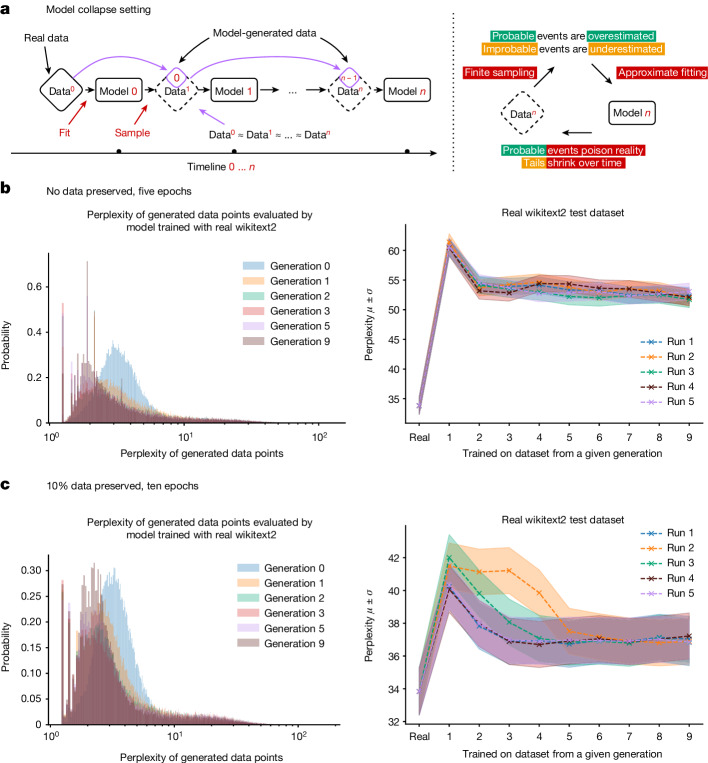
- In LLM experiments, an OPT-125m model fine-tuned on wikitext2 reaches 34 mean perplexity from a zero-shot baseline of 115. With five epochs and no original training data, performance degrades “from 20 to 28 perplexity points”; with ten epochs and 10% of original training data preserved, there is “only minor degradation of performance.”
- Generated data over generations contain more sequences the original model would produce with higher likelihood, but also much longer tails of sequences the original model would never produce, indicating accumulated errors.
- An ablation with a repeating penalty of 2.0 causes models to produce lower-score continuations to avoid repeats, and “causes the perplexity to double compared with the original”; models remain as susceptible to model collapse, if not more.
Methods
- Theoretical analysis of “learning with generational data”: a discrete distribution case with exact approximation, analyzed as a Markov chain, and a multidimensional Gaussian approximation using unbiased sample mean and variance estimators, with Wasserstein-2 distance as the divergence measure.
- LLM experiments fine-tune the OPT-125m causal language model from Meta via Hugging Face on wikitext2. Data generation uses five-way beam search; training sequences are blocked to 64 tokens, and for each token sequence the model predicts the next 64 tokens, producing an artificial dataset of the same size. Each experiment is run five times with different randomness seeds, and the best-performing model on the original task is used as the base for subsequent generations.
- Two LLM settings are tested: five epochs with no original training data retained, and ten epochs with a random 10% of original data points sampled for each new generation. VAEs and GMMs are covered in the Supplementary Materials.
Limitations
- The paper states that theoretical claims are mostly presented in the limit of generations going to infinity, whereas experiments use a finite, usually small, number of generations; complete collapse may or may not occur even after a small number of steps, and convergence rates are highly related to the specifics of the problem.
- The paper states that larger language models in non-fine-tuning settings were not run because training a single moderately large model produces twice the American lifetime’s worth of CO2; the LLM experiments are a fine-tuning proof of concept, and even those took weeks to run.
- Evident from the text: the LLM evidence is limited to OPT-125m, wikitext2, five runs, and fine-tuning; no full retraining from scratch is tested, and VAE/GMM details are relegated to the Supplementary Materials.
Model-written summary. Check it against the paper before relying on it.
Integrity signals
Registry
Cites
Statistics
Figures
Verification
Claims the paper makes
1 Valid · 0 Not valid · 3 Not checked · 40 Own results and interpretations
The cited sources support only part of this claim — read each source’s verdict below.
In the paper
“The repeating problem has been observed in nearly all text-generation models17,18”
§ AI models collapse when trained on recursively generated data > Model collapse in language models > Ablation: Repetitions
What the sources say
- Partly supportedcites [17] Keskar, N. S., McCann, B., Varshney, L. R., Xiong, C. & Socher, R. CTRL: a conditional transformer language model for controllable generation. Preprint at https://arxiv.org/abs/1909.05858 (2019). sourceExperimental — accuracy not yet measured
The Related Work section (p. 10) identifies repetition as a problem in text generation and discusses methods for reducing it. It does not say the problem has been observed in nearly all text-generation models; that prevalence claim is unsupported. (LLM, conf=0.86)
- Could not verifycites [18] Shumailov, I. et al. in Proc. 2021 IEEE European Symposium on Security and Privacy (EuroS&P) 212–231 (IEEE, 2021). sourceExperimental — accuracy not yet measured
Section 5.2 discusses attacks that increase output length, energy use, and latency, but not repetitive generated text. Searches for “repeating problem,” “repeated output,” and “repeat” found no passage saying that repetition has been observed in nearly all text-generation models; page numbers were unavailable in our copy. (LLM, conf=0.76)
plain- Asserted: passes — The authors put it forward as true.
- Checkable: passes — It can be checked against evidence.
- Load-bearing: unclear — It is unclear whether the paper’s conclusions depend on it.
- Based: passes — The paper gives a reason why it holds.
- Partly supported
A result the paper reports from its own data — it cites no other source for it, so there is none to check. The quote shows it is in the paper.
In the paper
“Here, over the generations, models tend to produce more sequences that the original model would produce with the higher likelihood.”
§ AI models collapse when trained on recursively generated data > Model collapse in language models
plainstates an association- Asserted: passes — The authors put it forward as true.
- Checkable: passes — It can be checked against evidence.
- Load-bearing: passes — The paper’s conclusions depend on it.
- Based: passes — The paper gives a reason why it holds.
A result the paper reports from its own data — it cites no other source for it, so there is none to check. The quote shows it is in the paper.
In the paper
“We find that data generated by language models in our experiments end up containing a large number of repeating phrases, as in Example 1.”
§ AI models collapse when trained on recursively generated data > Model collapse in language models > Ablation: Repetitions
plain- Asserted: passes — The authors put it forward as true.
- Checkable: passes — It can be checked against evidence.
- Load-bearing: unclear — It is unclear whether the paper’s conclusions depend on it.
- Based: passes — The paper gives a reason why it holds.
A result the paper states — it cites no source for it, so there is none to check. The quote shows it is in the paper.
In the paper
“we can show that the probability of losing information (that is, sampling no data at some generation) is equal to 1 − q”
§ AI models collapse when trained on recursively generated data > Theoretical intuition > Discrete distributions with exact approximation
plain- Asserted: passes — The authors put it forward as true.
- Checkable: passes — It can be checked against evidence.
- Load-bearing: passes — The paper’s conclusions depend on it.
- Based: passes — The paper gives a reason why it holds.
- Rests on an assumption not shown here.
A result the paper reports from its own data — it cites no other source for it, so there is none to check. The quote shows it is in the paper.
In the paper
“We discover that indiscriminately learning from data produced by other models causes ‘model collapse’—a degenerative process whereby, over time, models forget the true underlying data distribution, even in the absence of a shift in the distribution over time.”
§ AI models collapse when trained on recursively generated data > Main
plainstates a cause- Asserted: passes — The authors put it forward as true.
- Checkable: passes — It can be checked against evidence.
- Load-bearing: passes — The paper’s conclusions depend on it.
- Based: passes — The paper gives a reason why it holds.
11 more claims
Create a free account to see all 44 claims and every source verdict.
- It may state two separate claims as one. 22
- The quote only partly states this claim. 1
- Probably not a substantial claim. 10
Claims other papers make about this one
Each is checked against this paper’s own text: does it say what the citing paper says it does?
The source backs part of the claim, not all of it — or backs it for a different population, condition or comparison.
In the citing paper
“Second, LLMs are frequently trained on the same open-access corpora we examine, creating a feedback loop in which tomorrow's models will learn today's hallucinations [34].”
From LLM hallucinations in the wild: Large-scale evidence from non-existent citations (2026) · cites this paper as [34]
Experimental — accuracy not yet measuredThe source backs part of the claim, not all of it — or backs it for a different population, condition or comparison.
In the citing paper
“Successive training cycles cause LLMs to “forget” the statistical long-tail of rare but important patterns, resulting in homogenized, impoverished, and epistemically diminished outputs.”
From 4E cognition and the coevolution of human–AI interaction (2025) · cites this paper as [61]
Experimental — accuracy not yet measuredThe source backs part of the claim, not all of it — or backs it for a different population, condition or comparison.
In the citing paper
“AI-generated content now saturates the internet, reducing reliability and contaminating training data for future models (Paredes et al., 2025;Shumailov et al., 2024).”
From Purpose before policy: academic integrity, generative AI, and rhetorical stance (2026) · cites this paper as Shumailov et al., 2024
Experimental — accuracy not yet measuredThe source backs part of the claim, not all of it — or backs it for a different population, condition or comparison.
In the citing paper
“As successive generations of models are trained on data increasingly contaminated by historical synthetic outputs, the system progressively erodes distributional diversity and collapses functional modes—a degenerative process that remains robust to scale and is highly sensitive to even minimal synthetic fractions [14,15].”
From Self-Referential Introspection in Large Language Models: The Critical Threshold for Recursive Self-Improvement (2026) · cites this paper as [14]
Experimental — accuracy not yet measuredThe source backs part of the claim, not all of it — or backs it for a different population, condition or comparison.
In the citing paper
“The accumulation of synthetic data may affect model output quality, reinforce existing biases, and alter information feedback dynamics, thereby posing potential challenges to the stability of the digital knowledge ecosystem (Shumailov et al., 2024).”
From The Attention Mismatch: Mapping the Structural Academic Governance Deficit in the Age of Generative AI (2026) · cites this paper as Shumailov et al., 2024
Experimental — accuracy not yet measured
19 more claims about this paper
Create a free account to see every claim other papers make about this one.
Self-check
Percentages, sums and reported differences re-computed from the paper’s own numbers.
Each contradiction between two passages listed here was confirmed by an independent check.
Rated minor: it would not touch a result — a value no result rests on, a p-value that stays on the same side of the significance level, or a conflict that is clerical, resolved elsewhere in the paper, or outside its own findings.
In the paper
§ AI models collapse when trained on recursively generated data > Abstract
“GPT-2 (ref. 1), GPT-3(.5) (ref. 2) and GPT-4 (ref. 3)”
§ AI models collapse when trained on recursively generated data > Model collapse in language models
“BERT4, RoBERTa5 or GPT-2 (ref. 2)”
Citations
Cites
Language Models are Few-Shot Learners
Brown, T. B., Mann, B., Ryder, N., Subbiah, M., Kaplan, J., Dhariwal, P., Neelakantan, A., Shyam, P., Sastry, G., Askell, A., et al. (2020) · arXiv · doi:10.48550/arxiv.2005.14165 · Cited by 23,372
RoBERTa: A Robustly Optimized BERT Pretraining Approach
Liu, Y., Ott, M., Goyal, N., Du, J., Joshi, M., Chen, D., Levy, O., Lewis, M., Zettlemoyer, L., & Stoyanov, V. (2019) · arXiv · doi:10.48550/arxiv.1907.11692 · Cited by 16,515
Li, Z., & Hoiem, D. (2018) · IEEE Transactions on Pattern Analysis and Machine Intelligence · doi:10.1109/tpami.2017.2773081 · Cited by 4,202
Energy and Policy Considerations for Deep Learning in NLP
Strubell, E., Ganesh, A., & McCallum, A. (2019) · arXiv · doi:10.48550/arxiv.1906.02243 · Cited by 3,735
5th International Conference on Learning Representations (ICLR 17)
Havrylov, S., & Titov, I. (2017) · Cited by 3,503
Deep Neural Networks are Easily Fooled: High Confidence Predictions for Unrecognizable Images
Nguyen, A., Yosinski, J., & Clune, J. (2014) · arXiv · doi:10.48550/arxiv.1412.1897 · Cited by 3,258
Deep neural networks are easily fooled: High confidence predictions for unrecognizable images
Nguyen, A., Yosinski, J., & Clune, J. (2015) · 2015 IEEE Conference on Computer Vision and Pattern Recognition (CVPR) · doi:10.1109/cvpr.2015.7298640 · Cited by 3,258
On the Opportunities and Risks of Foundation Models
Bommasani, R., Hudson, D. A., Adeli, E., Altman, R., Arora, S., von Arx, S., Bernstein, M. S., Bohg, J., Bosselut, A., Brunskill, E., et al. (2021) · arXiv · doi:10.48550/arxiv.2108.07258 · Cited by 2,676
Poisoning Attacks against Support Vector Machines
Biggio, B., Nelson, B., & Laskov, P. (2012) · arXiv · doi:10.48550/arxiv.1206.6389 · Cited by 1,331
The Implicit Bias of Gradient Descent on Separable DataPreprint
Soudry, D., Hoffer, E., Nacson, M. S., Gunasekar, S., & Srebro, N. (2017) · arXiv (Cornell University) · doi:10.48550/arxiv.1710.10345 · Cited by 829
Research works printed but not linked: 7
- Radford, A. et al. Language models are unsupervised multitask learners. OpenAI blog 1, 9 (2019).
- Devlin, J., Chang, M.-W., Lee, K. & Toutanova, K. in Proc. 2019 Conference of the North American Chapter of the Association for Computational Linguistics: Human Language Technologies, Volume 1 (Long and Short Papers) (eds Burstein, J., Doran, C. & Solorio, T.) 4171–4186 (Association for Computational Linguistics, 2019).
- Carlini, N. & Terzis, A. in Proc. Tenth International Conference on Learning Representations (ICLR, 2022).
- Carlini, N. et al. in Proc. 2024 IEEE Symposium on Security and Privacy (SP) 179 (IEEE, 2024).
- Mousavi-Hosseini, A., Park, S., Girotti, M., Mitliagkas, I. & Erdogdu, M. A. in Proc. Eleventh International Conference on Learning Representations (ICLR, 2023).
- Gu, Y., Dong, L., Wei, F. & Huang, M. in Proc. Twelfth International Conference on Learning Representations (ICLR, 2024).
- Strubell, E., Ganesh, A. & McCallum, A. in Proc. 57th Annual Meeting of the Association for Computational Linguistics (eds Korhonen, A., Traum, D. & Màrquez, L.) 3645–3650 (Association for Computational Linguistics, 2019).
Cited by
Items 201–300 of 788
Oedipus: LLM-enchanced Reasoning CAPTCHA Solver
Deng, G., Ou, H., Liu, Y., Zhang, J., Zhang, T., & Liu, Y. (2025) · ACM SIGSAC Conference on Computer and Communications Security (CCS) · doi:10.1145/3719027.3744872 · Cited by 40
Understanding generative AI output with embedding models
Vargas, M., Cannon, R., Engel, A., Sarwate, A. D., & Chiang, T. (2025) · Science Advances · doi:10.1126/sciadv.adx4082 · Cited by 11
“This is further underscored by recent results showing that data produced by generative models are necessarily prone to hallucination ( 72 ) and that repeated training on such data can lead to model collapse ( 73 ).”
Due process by design: Enhancing fairness and trust in AI decision-making
Fischman-Afori, O. (2025) · Social Sciences & Humanities Open · doi:10.1016/j.ssaho.2025.102178 · Cited by 12
Nyatega, C. O., Li, Q., Nie, W., Adamu, M. J., & Li, S. (2025) · Behavioural Brain Research · doi:10.1016/j.bbr.2025.116007 · Cited by 3
Learning Health Systems provide a glide path to safe landing for AI in health
Ćurčin, V., Delaney, B. C., Alkhatib, A., Cockburn, N., Dann, O., Kostopoulou, O., Leightley, D., Maddocks, M., Modgil, S., Nirantharakumar, K., et al. (2025) · Artificial Intelligence in Medicine · doi:10.1016/j.artmed.2025.103346 · Cited by 14
Generative inverse design of sustainable concrete via global waste glass recycling
Yu, J., Xue, S., Ye, J., Teng, F., Yang, M., Yu, J., Yang, Z., Weng, Y., Dai, J., & Mechtcherine, V. (2026) · Resources Conservation and Recycling · doi:10.1016/j.resconrec.2025.108775 · Cited by 4
The urban impact of AI: modelling feedback loops in location-based recommender systems
Mauro, G., Minici, M., & Pappalardo, L. (2026) · Machine Learning · doi:10.1007/s10994-025-06904-z · Cited by 18
Continuous discovery of novel 2D materials via dual active learning-driven generative models
Chen, X., Song, Z., Lu, S., Chen, Q., Mo, Y., Zhou, Q., & wang, J. (2026) · National Science Review · doi:10.1093/nsr/nwag101 · Cited by 3
“While appealing given the availability of AI-generated materials in established databases like C2DB [12 ,13 ], this retraining approach often suffers from mode collapse [14 ,15 ].”
Bröcker, J., Driscoll, S., Necker, T., Rodríguez, J. M., Dacre, H., Harvey, N. J., & Bouallègue, Z. B. (2026) · Journal of the European Meteorological Society. · doi:10.1016/j.jemets.2026.100032 · Cited by 9
Do large language models (really) need statistical foundations?
Su, W. (2026) · The Annals of Applied Statistics · doi:10.1214/26-aoas2151 · Cited by 18
From digital diplomacy to AI-driven diplomacies? Mapping the potential impact of AI on Diplomacy
Manor, I. (2026) · Communication and the Public · doi:10.1177/20570473261438571 · Cited by 10
The Growing Use of Copy-Paste and Its Impact on Creation and Propagation of Documentation Errors
Grattan, R., Florig, S. T., Devra, T., Mohan, V., & Gold, J. A. (2026) · CHEST Pulmonary · doi:10.1016/j.chpulm.2026.100259 · Cited by 3
“34,35 Interestingly, although copy-paste was initially heralded as a way to accelerate clinical documentation and potentially improve accuracy, studies suggest that these benefits may not be fully realized.”
A Generative Foundation Model for Chest Radiography
Ji, Y., Lin, D. Y., Wang, X., Zhang, L., Zhou, W., Ge, C., Chu, R., Yang, X., Zhao, J., Chen, J., et al. (2026) · NEJM AI · doi:10.1056/aioa2500799 · Cited by 10
The Impacts of Generative AI on the Meaningfulness of Creative Work
Montefiore, T., Formosa, P., Bankins, S., & Sahebi, S. (2026) · Journal of Business Ethics · doi:10.1007/s10551-026-06342-4 · Cited by 8
Bakaev, M., Gorovaia, S., & Mitrofanova, O. (2025) · Big Data and Cognitive Computing · doi:10.3390/bdcc9020046 · Cited by 6
Pasek, A. (2025) · Journal of Environmental Media · doi:10.1386/jem_00138_1 · Cited by 6
Recourse, Repair, Reparation, & Prevention: A Stakeholder Analysis of AI Supply Chains
Hopkins, A. K., Struckman, I., Klyman, K., & Silbey, S. (2025) · Conference on Fairness, Accountability and Transparency · doi:10.1145/3715275.3732017 · Cited by 15
Mohindra, R. K., & Louw, S. (2024) · Journal of Medical Ethics · doi:10.1136/jme-2024-110250 · Cited by 3
Profiling Elements, Risks, and Governance of Artificial Intelligence: Implications from DeepSeek
Cheng, L., Hu, M., & Hong, T. (2025) · International Journal of Digital Law and Governance · doi:10.1515/ijdlg-2025-0008 · Cited by 5
Automated biodiversity research critically requires multidisciplinary expertise
Cardoso, P., Branco, V. V., Correia, L., Emerson, B. C., Laine, V. N., & Lopes, M. C. (2025) · Trends in Ecology & Evolution · doi:10.1016/j.tree.2025.05.003 · Cited by 3
The Different Networks of Firms Implied by the NewsPreprint
Hilt, V., & Schwenkler, G. (2024) · SSRN Electronic Journal · doi:10.2139/ssrn.4946066 · Cited by 4
AI watermarking must be watertight to be effective
(2024) · Nature · doi:10.1038/d41586-024-03418-x · Cited by 3
Megas, S., Amani, A., Rose, A., Dufva, O., Shamsaie, K., Asadollahzadeh, H., Polański, K., Haniffa, M. A., Teichmann, S. A., & Lotfollahi, M. (2025) · bioRxiv (Cold Spring Harbor Laboratory) · doi:10.1101/2025.06.03.657578 · Cited by 5
“However, training recursively on synthetically (non-causally) generated data leads to mode collapse 11,12 .”
Husøy, A. K., Stovner, L. J., & Steiner, T. J. (2025) · Cephalalgia · doi:10.1177/03331024251392884 · Cited by 3
“Large language models degenerate, and ultimately collapse, as they consume data from the internet recursively generated by themselves (9).”
AI-generated data contamination erodes pathological variability and diagnostic reliabilityPreprint
He, H., Xiang, S., Zhang, Y., Zhu, Y., Zhang, J., Lu, Y., Deng, H., Alsentzer, E., Liu, Y., Chen, Q., et al. (2026) · medRxiv · doi:10.64898/2026.01.19.26344383 · Cited by 9
“In other domains, this form of self-referential training cycle of generative AI has been associated with degradation of output diversity and fidelity through a process known as “model collapse” 12– 15 .”
Partasyuk, V. (2026) · Zenodo (CERN European Organization for Nuclear Research) · doi:10.5281/zenodo.22003938 · Cited by 3
Purpose before policy: academic integrity, generative AI, and rhetorical stance
Taylor, T. B., & LaCroix, T. (2026) · Higher Education · doi:10.1007/s10734-026-01706-1 · Cited by 3
Zhang, J., Yuan, B., & Zhang, Q. (2026) · Entropy · doi:10.3390/e28090951 · Cited by 2
“Another critical obstacle to sustained self-improvement in LLMs is model collapse —a degenerative process wherein successive generations of generative models are progressively polluted by their own synthetic outputs [14].”
Models are Central to AI Assurance
Bloomfield, R., & Rushby, J. (2024) · IEEE International Symposium on Software Reliability Engineering Workshops (ISSREW) · doi:10.1109/issrew63542.2024.00078 · Cited by 5
“Furthermore, by repeatedly circulating misinformation, falsehoods, and mediocrity, these systems impair our own ability to discriminate truth, novelty, and insight, and they contaminate the training data consumed by the next generation of LLMs, possibly leading to model collapse [23].”
Generating eco-friendly ionic liquids with enhanced CO2 solubility using language models
Fajar, A. T. N., Lambard, G., Islam, M. A., Saha, B. B., Nurfajrin, Z. D., & Septioga, K. (2025) · Artificial Intelligence Chemistry · doi:10.1016/j.aichem.2025.100089 · Cited by 2
Information Retrieval in the Age of Generative AI: The RGB Model
Garetto, M., Cornacchia, A., Galante, F., Leonardi, E., Nordio, A., & Tarable, A. (2025) · International ACM SIGIR Conference on Research and Development in Information Retrieval (SIGIR) · doi:10.1145/3726302.3730008 · Cited by 9
“Shumailov et al. considered this phenomenon for LLMs [32] (earlier version of their work in [31]), introducing the concept of model collapse .”
Silencing in data science practices
Lassen, I. M. S., Bjerring, J. C., & Nielbo, K. L. (2025) · Big Data & Society · doi:10.1177/20539517251365228 · Cited by 6
“Shumailov et al. (2024) demonstrate that using model-generated content in training language models causes the tails of the original distribution to disappear.”
AI for KOS Discovery: Refining Search, Recommendation, and Hallucination Mitigation
Park, Z. (2025) · KNOWLEDGE ORGANIZATION · doi:10.31083/ko45889 · Cited by 2
Home Ranges of Animals: Cognitive Maps, Research Approaches, and Insights
Powell, R. A. (2025) · Oxford University Press eBooks · doi:10.1093/9780191949142.001.0001 · Cited by 4
Exploring latent diffusion models for ECG generation on the minute scale
Kranz, D. D., Kraemer, J. F., Kahriman, O., et al. (2025) · Computer Methods and Programs in Biomedicine · doi:10.1016/j.cmpb.2025.109138 · Cited by 2
Building a methodological profile for communication’s study of the passive generation of information
Rasheed, H., & Holbert, R. L. (2025) · Communication and Change · doi:10.1007/s44382-025-00020-1 · Cited by 3
“While this convergence may have been driven in part by monetization incentives, the findings nevertheless align with broader concerns that AIGC often exhibits convergence and repetition (see Shumailov et al., 2024).”
Automated Building of a Multidialectal Parallel Arabic Corpus Using Large Language Models
Almeman, K. (2025) · Data · doi:10.3390/data10120208 · Cited by 2
“Despite these advantages, the use of LLMs has limitations [24].”
Semiconductor Supply Chain Synthetic Data Generation Using Knowledge Graphs
Gunn, M. C., Loose, D. C., Gunn, M. E., Moghadasi, N., Polmateer, T. L., Collier, Z. A., Linkov, I., & Lambert, J. H. (2025) · Resilience Week (RWS) · doi:10.1109/rws66711.2025.11304458 · Cited by 2
“For example, Shumailov et al. [35] described the propensity of AI models toward “model collapse”, in which AI-generated data ends up “polluting” the training data of other generative models, resulting in a degeneration of outputs.”
GeoAI collapse? Ethical implications of synthetic geospatial data use
Zhao, B., & Lin, Y. (2026) · International Journal of Geographical Information Systems · doi:10.1080/13658816.2025.2609806 · Cited by 5
Zhu, Y., Liang, R., Yang, J.-J., & Zhou, C.-M. (2026) · Scientific Reports · doi:10.1038/s41598-025-24848-1 · Cited by 5
“Model training with synthetic data greatly enhanced the generalization ability of the model in practical applications, especially when dealing with complex environmental noise 12 .”
Outlier and collapse: The enron corpus and foundation model training data
Zimmer, Z. (2026) · Big Data & Society · doi:10.1177/20539517261421474 · Cited by 2
“Both cases arise from analogous fears of poisoning a system with the forward projection of its own corrupt re-presentation of reality (Shumailov et al., 2024).”
Oh, J. (2026) · Journal of Korean Medical Association · doi:10.5124/jkma.25.0157 · Cited by 2
Agentic Portfolio Construction: A Multi-Agent Architecture for LLM-Driven Financial Asset Allocation
Hajaghaie, A., & Thulasiram, R. K. (2025) · International Conference on Foundation and Large Language Models (FLLM) · doi:10.1109/fllm67465.2025.11390987 · Cited by 2
“According to recent studies, AI models trained on AI-generated data could also bring disastrous results [9], [10].”
Brain-inspired energy efficient technologies for next-generation artificial intelligence
Chiel, H. J., Coggan, J. S., Datta, G., Fellous, J., Nourse, W. R. P., Quinn, R. D., & Thomas, P. J. (2026) · Biological Cybernetics · doi:10.1007/s00422-026-01038-4 · Cited by 7
Tracing the Pen: Electronic Health Records Amid the Rise of Generative AI
Nargesi, A. A., You, J. G.-T., Bitterman, D. S., Succi, M. D., Mishuris, R. G., Poon, E. G., & Landman, A. (2026) · npj Digital Medicine · doi:10.1038/s41746-026-02508-6 · Cited by 4
“LLMsrecursivelytrainedon syntheticdatashowdegradingperformanceduetoashiftinthedistributionofthelexiconandgradualdisappearanceoflessfrequenttermsfromthetrainingdata 61 .”
Reference-Based Super-Resolution via Image-Based Retrieval-Augmented Generation Diffusion
Lee, B., Cho, H., Choi, H. G., Kang, S. M., Ahn, I. J., & Jin, K. H. (2025) · IEEE/CVF International Conference on Computer Vision (ICCV) · doi:10.1109/iccv51701.2025.01002 · Cited by 7
“Prior works [49, 50] have demonstrated that training on recursively generated data can erode critical, rare features, potentially leading to model collapse.”
Wikipedia at 25: The Encyclopedia That Might Not Last
Jemielniak, D. (2026) · Computer · doi:10.1109/mc.2026.3667927 · Cited by 2
“Research published in Nature by Shumailov and colleagues 6 has demonstrated that AI models trained on AI-generated content suffer from “model collapse”—a degenerative process in which models progressively lose information about the actual underlying data distribution.”
Narrative and dialogue generation for video-games: A systematic mapping
Salmaze, P. H., Pereira, G. D. S., de Góes, L. M. G., Ranieri, C. M., Toledo, C. F. M., Silvestrini, M. M., & Pereira, L. P. D. B. (2026) · Engineering Applications of Artificial Intelligence · doi:10.1016/j.engappai.2026.115041 · Cited by 5
Schulte, N., & Kanbach, D. K. (2026) · Management Review Quarterly · doi:10.1007/s11301-026-00611-2 · Cited by 21
Misinformation as strategy: Epistemic consequences and the undermining of shared truth
Ecker, U. K. H., Spearing, E. R., DiResta, R., & Lewandowsky, S. (2026) · Trends in Cognitive Sciences · doi:10.1016/j.tics.2026.06.009 · Cited by 4
AI will reorganize science. Will research remain a human enterprise?
Hochberg, M., & Thrall, P. H. (2026) · Proceedings of the National Academy of Sciences · doi:10.1073/pnas.2610088123 · Cited by 5
Seuren, L. M., Williams, R., & Cresswell, K. M. (2026) · BMJ Digital Health & AI · doi:10.1136/bmjdh-2026-000091 · Cited by 5
Hosseini, M., Hong, S. S., Holmes, K., Wetterstrand, K. A., Donohue, C., Amaral, L. A. N., & Stoeger, T. (2024) · Journal of eScience Librarianship · doi:10.7191/jeslib.811 · Cited by 2
EverForest: A More-Than-AI Sustainability Manifesto from an On-Chain Artificial Life
Hu, B. A., & Ting, F. (2024) · Halfway to the Future Symposium · doi:10.1145/3686169.3686209 · Cited by 5
(2024) · Nature Machine Intelligence · doi:10.1038/s42256-024-00921-8 · Cited by 2
Fodor and Pylyshyn’s Critique of Connectionism and the Brain as Basis of the Mind
von der Malsburg, C. (2024) · Human Arenas · doi:10.1007/s42087-024-00452-z · Cited by 6
“It is slowly becoming clear that when its systems are trained with material part of which has been generated by AI they degrade quickly and produce more and more nonsense (Shumailov et al., 2024).”
Xun, J., Fan, X., Liang, W., & Ma, C. (2025) · Advances in library and information science (ALIS) book series · doi:10.4018/979-8-3693-6376-8.ch003 · Cited by 2
A Systematic Review of Open Datasets Used in Text-to-Image (T2I) Gen AI Model Safety
Bavalatti, T., Ahmed, O., Potdar, D., Rouf, R., Jawed, F., Govind, M., & Krishnan, S. (2025) · IEEE Access · doi:10.1109/access.2025.3539933 · Cited by 11
“This phenomenon may be indicative of model collapse, as explored by Shumailov et al. [37].”
FLODA: Harnessing Vision-Language Models for Deepfake Assessment
Park, S., Bae, Y.-H., Han, G.-H., & Olson, A. W. (2025) · International Conference on Consumer Electronics · doi:10.1109/icce63647.2025.10929816 · Cited by 3
Automated extraction of discourse networks from large volumes of media data
Angst, M., Müller, N. N., & Walker, V. (2025) · Network Science · doi:10.1017/nws.2025.4 · Cited by 4
Zhu, J. J. H., & Peng, T. (2025) · Communication and Change · doi:10.1007/s44382-025-00005-0 · Cited by 3
“A recent study by Shumailov et al. (2024) discusses a problem called "model collapse," which happens when AI systems are repeatedly trained on content generated by earlier versions of themselves.”
Werthner, H. (2025) · Springer eBooks · doi:10.1007/978-3-031-86905-1_2 · Cited by 2
Humanist in the Loop: Teaching Critical AI Literacies, Episode 1
Goodlad, L. M. E. (2025) · Critical AI · doi:10.1215/2834703x-11908331 · Cited by 6
Ren, S., Tang, W., Ma, C., Hou, L., Chen, X., Lin, J., Yang, J., Yang, Y. J., Xiao, H., Li, G., et al. (2025) · Results in Engineering · doi:10.1016/j.rineng.2025.106075 · Cited by 2
Mitigating Source Bias with LLM Alignment
Dai, S., Zhou, Y., Pang, L., Li, Z., Du, Z., Wang, G., & Xu, J. (2025) · International ACM SIGIR Conference on Research and Development in Information Retrieval (SIGIR) · doi:10.1145/3726302.3730038 · Cited by 5
Granat, M. M., Paź, A., & Mirowska-Guzel, D. M. (2025) · PeerJ Computer Science · doi:10.7717/peerj-cs.2954 · Cited by 4
The synthetic Turn in healthcare AI: Promise and Peril
Poddar, A., & S.R.Rao (2025) · International Journal of Medical Informatics · doi:10.1016/j.ijmedinf.2025.106119 · Cited by 2
Are Systematic Reviews and Meta-Analyses Obsolete in the Era of Artificial Intelligence?
Shibuya, N. (2024) · The Journal of Foot & Ankle Surgery · doi:10.1053/j.jfas.2024.08.009 · Cited by 2
AI and the Dynamic Supply of Training DataPreprint
Peukert, C., Abeillon, F., Haese, J., Kaiser, F., & Staub, A. (2024) · SSRN Electronic Journal · doi:10.2139/ssrn.4807979 · Cited by 22
Information-making processes in the speaker’s brain drive human conversationsPreprint
Goldstein, A., Wang, H., Sheffer, T., Lioubashevski, D., Schain, M., Zada, Z., Niekerken, L., Aubrey, B., Nastase, S. A., Taubenfeld, A., et al. (2024) · bioRxiv (Cold Spring Harbor Laboratory) · doi:10.1101/2024.08.27.609946 · Cited by 2
“It was shown that forcing LLMs to choose the most predictable (top-1) word in any conversational context leads to repetitive, incoherent, and uninformative speech (23).”
The Economics of AI Foundation Models: Openness, Competition, and GovernancePreprint
Xu, F., Wang, X., Chen, W., & Xie, K. (2024) · SSRN Electronic Journal · doi:10.2139/ssrn.4999355 · Cited by 27
The Rise of the Research Automaton: Science as process or product in the era of generative AI?Preprint
Sætra, H. S. (2025) · SSRN Electronic Journal · doi:10.2139/ssrn.5219722 · Cited by 2
Epistemic decay: Generative artificial intelligence and the recombination of culture
Tredinnick, L., & Laybats, C. (2025) · Business Information Review · doi:10.1177/02663821251369460 · Cited by 2
“Recent studies have shown for example that feeding the results of generative processes back into successive iterations of generative models can result in just this kind of sudden model collapse (Shumailov et al., 2024).”
What is ‘model collapse’? An expert explains the rumours about an impending AI doom
Snoswell, A. (2024) · doi:10.64628/aa.9k5du7xes · Cited by 2
Synthetic data can benefit medical research — but risks must be recognized
(2025) · Nature · doi:10.1038/d41586-025-02869-0 · Cited by 4
Partasyuk, V. (2026) · Zenodo (CERN European Organization for Nuclear Research) · doi:10.5281/zenodo.22009206 · Cited by 2
Preference Leakage: A Contamination Problem in LLM-as-a-judge
Li, D., Sun, R., Huang, Y., Zhong, M., Jiang, B., Han, J., Zhang, X., Wang, W., & Liu, H. (2025) · arXiv · doi:10.48550/arxiv.2502.01534 · Cited by 134
Memento: Fine-tuning LLM Agents without Fine-tuning LLMs
Zhou, H., Chen, Y., Guo, S., Yan, X., Lee, K. H., Wang, Z., Lee, K. Y., Zhang, G., Shao, K., Yang, L., et al. (2025) · arXiv · doi:10.48550/arxiv.2508.16153 · Cited by 2
“Several lines of work distil operational knowledge from interaction traces: ExpeL (Zhao et al., 2024) collects trajectories and converts them into reusable natural-language insights and rules; AutoGuide (Fu et al., 2024) compresses offline logs into concise, conditional, context-aware guidelines; and Agent Workflow Me…”
InfluentialDiverse Preference Optimization
Lanchantin, J., Chen, A., Dhuliawala, S., Yu, P., Weston, J., Sukhbaatar, S., & Kulikov, I. (2025) · arXiv · doi:10.48550/arxiv.2501.18101 · Cited by 2
“We train on a random set of 10k single-turn Wildchat prompts (Zhao et al., 2024), which is an open source dataset of 1 million real-world user-ChatGPT interactions.”
TouchAI: Exploring human–AI perceptual alignment in touch through language model representations
Zhong, S., Gatti, E., Cho, Y., & Obrist, M. (2026) · International Journal of Human-Computer Studies · doi:10.1016/j.ijhcs.2026.103765 · Cited by 6
“Most existing work relies on synthetic labels generated by LLMs (Fu et al., 2021) for scalability; however, this risks a “garbage in, garbage out” problem (Shumailov et al., 2024).”
Insights into AI and facial ageing
Griffiths, T. W. (2024) · Journal of the European Academy of Dermatology and Venereology · doi:10.1111/jdv.20401 · Cited by 1
CentAIrus: the return of the centaur and the history of futures past
Choi, S. K. (2025) · New Writing · doi:10.1080/14790726.2025.2457418 · Cited by 1
“Fading memories that turn to prompts that turn to samples that turn to model collapse (Shumailov et al. 2024).”
A Rapid Test for Accuracy and Bias of Face Recognition Technology
Knott, M., Serna, I., Mann, E., & Perona, P. (2025) · IEEE Winter Conference on Applications of Computer Vision · doi:10.1109/wacv61041.2025.00752 · Cited by 2
“This has been documented on small datasets [44] and is di � cult to verify on large datasets.”
Abarca, P. M., & Havas, C. R. (2025) · ACM Symposium on Applied Computing · doi:10.1145/3672608.3707832 · Cited by 4
Zhabinets, M., Tyler, B., Lukáč, M., Nagayama, S., Molnár, F., & Kameyama, M. (2025) · Algorithms · doi:10.3390/a18060310 · Cited by 1
Leveraging psychedelic neuroscience to boost human creativity using artificial intelligence
Ross, B. M. (2025) · Frontiers in Artificial Intelligence · doi:10.3389/frai.2025.1589086 · Cited by 1
Goethals, S., Luther, J., & Matz, S. (2025) · ACM Conference on User Modeling, Adaptation and Personalization (UMAP) · doi:10.1145/3708319.3733689 · Cited by 4
Machine Unlearning Doesn't Do What You Think: Lessons for Generative AI Policy and Research
Cooper, A. F., Choquette-Choo, C. A., Bogen, M., Klyman, K., Jagielski, M., Filippova, K., Liu, K., Chouldechova, A., Hayes, J., Huang, Y., et al. (2025) · neural information processing systems · doi:10.52202/085713-2990 · Cited by 95
Self-citationComputational Approaches to Drug Discovery
Zanders, E. D. (2025) · Springer eBooks · doi:10.1007/978-3-031-93949-5_3 · Cited by 1
Kaleidoscope Gallery: Exploring Ethics and Generative AI Through Art
Issak, A., Narayan, U., Srinivasan, R., Kleinman, E., & Harteveld, C. (2025) · Creativity and Cognition · doi:10.1145/3698061.3726929 · Cited by 2
“…alignment to human preferences in model learning [44] and unlearning [95], fluid data that ascribes itself [56], training of GenAI models on synthetic data (a method that has been criticized for model collapse when used recursively) [2, 72], and prompt tuning from real-world user input [57].”
Wikipedia Contributions in the Wake of ChatGPT
Lyu, L., Siderius, J., Li, H., Acemoğlu, D., Huttenlocher, D. P., & Ozdaglar, A. (2025) · International World Wide Web Conference (WWW) · doi:10.1145/3701716.3715543 · Cited by 5
Xie, X., Zhang, J., & Voas, J. (2025) · Computer · doi:10.1109/mc.2025.3562445 · Cited by 2
Humour as Resistance: Creative Approaches to Data Center Accountability
Bhardwaj, E., Qiao, H., Munson, R. O. A., & Becker, C. (2025) · ACM SIGCAS/SIGCHI Conference on Computing and Sustainable Societies (COMPASS) · doi:10.1145/3715335.3737682 · Cited by 2
Whither Human Factors in the Era of AI?
Rantanen, E. M. (2025) · Proceedings of the Human Factors and Ergonomics Society Annual Meeting · doi:10.1177/10711813251366292 · Cited by 1
“This will in time lead into homogenization of AI-generated content as algorithms are just recycling content they had generated in the first place (“digital inbreeding”; Shumailov et al., 2024).”
Miyazoe, T. (2025) · Language Testing in Asia · doi:10.1186/s40468-025-00387-4 · Cited by 5
“However, when repeatedly requesting similar tasks within extended threads, AI outputs can become increasingly redundant— a phenomenon sometimes referred to as “model collapse” (Shumailov et al., 2024).”
Your image generator is your new private dataset
Resmini, N. F., Lomurno, E., Sbrolli, C., & Matteucci, M. (2025) · Image and Vision Computing · doi:10.1016/j.imavis.2025.105727 · Cited by 2
Stochastic reconstruction of gappy Lagrangian turbulent signals by conditional diffusion models
Li, T., Biferale, L., Bonaccorso, F., Buzzicotti, M., & Centurioni, L. (2025) · Communications Physics · doi:10.1038/s42005-025-02280-1 · Cited by 13
“Open key problems remain, related to the scaling properties of the architecture with respect to the complexity and amount of training data 63 , aswell astheissueofmodelcollapsewhenunconditionedor conditioneddataaugmentationisusedtotrainnewgenerationsofmodels 64 .”
Generative artificial intelligence – is there still room for a human author?
Kalpokienė, J. (2025) · ERA Forum · doi:10.1007/s12027-025-00856-6 · Cited by 1
“…human art is not considered worthy of preservation and prioritisation, human authors will be disad-vantaged, as AI can tirelessly generate outputs, 76 thus economically disadvantaging human creators competing for the same attention and money resulting in humans eventually creating “less and less…”
Foraging Optimally for a Home Range
Powell, R. A. (2025) · Oxford University Press eBooks · doi:10.1093/9780191949142.003.0008 · Cited by 1
Metadata
- Authors
- Shumailov, I., Shumaylov, Z., Zhao, Y., Papernot, N., Anderson, R., & Gal, Y.
- Affiliations
- University of Oxford (GB)
- University of Cambridge (GB)
- Imperial College London (GB)
- University of Toronto (CA)
- Corresponding author
- Shumailov, Ilia
- Shumaylov, Zakhar
- Gal, Yarin
- Venue
- Nature
- Published
- 2024-07-24
- Volume
- 631
- Issue
- 8022
- Pages
- 755-759
- ISSN
- 0028-0836 (ISSN-L)
- 1476-4687
- PMC
- PMC11269175
- OpenAlex
- W4400949264
- Semantic Scholar
- 603d3f90fc40f79ff51258f0295de3ec5107f73e
- Cited by
- 793
- References
- 11
- Citations by year
- 2026: 407 · 2025: 330 · 2024: 56
- FWCI
- 116.53
- Type
- journal article
- Language
- en
- Update notices
- correction (2025-03-21)
- Open access
- hybrid
- doi.org
- Licence
- cc-by
- creativecommons.org/licenses/by/4.0 (tdm)
- creativecommons.org/licenses/by/4.0 (vor)
- Locations
- Nature (publishedVersion, cc-by)
- PubMed Central (publishedVersion, cc-by)
- PubMed (publishedVersion)
- Apollo (University of Cambridge) (submittedVersion, cc-by)
- RePEc: Research Papers in Economics (submittedVersion)
- Edinburgh Research Explorer (University of Edinburgh) (submittedVersion, cc-by)
- Topics
- Physical Sciences › Computer Science › Artificial Intelligence › Topic Modeling
- Physical Sciences › Computer Science › Artificial Intelligence › Ethics and Social Impacts of AI
- Physical Sciences › Computer Science › Artificial Intelligence › Adversarial Robustness in Machine Learning
- Keywords
- model collapse, large language models, self-training, generative AI training data, variational autoencoder, Gaussian mixture model, distribution shift, web scraping, ChatGPT, generative models
About these checks
Registry, retraction, Cites and statistics results are computed, not judged, with one exception: a printed reference that no index lists is read once by a model before it counts as a citation error. Claims are extracted by a model and kept only when their quote appears verbatim in the text; each cited source is then checked, with a model’s help, for whether it says what the claim relies on. Those verdicts can be wrong — read the claim’s quote and the cited source before relying on one.
The claim verdicts this report counts are experimental: their accuracy is not yet measured.
A language model drew the claims from the paper on 2026-10-10, under version 3 of the claim definition (model deepseek-v4.1-flash, prompt extract-v3).
A second model labelled each claim on 2026-10-10 (model jev-1.13-20260917, definition revision gold-guideline-v0.2).
Cited sources are checked with a language model’s help (gpt-6-sol).
Statistics and arithmetic are recomputed, not judged.
Confidence bands are shown only for fields calibrated on our annotated test set. None is calibrated yet, so no band is shown.
What counts as a claim ›How we measure confidence ›How we check this ›
Are you an author, or do you see a problem with this page? Request a review
Data sources
Bibliographic data: Semantic Scholar, OpenAlex, Crossref.
Contains information from the Semantic Scholar Academic Graph Datasets, made available under the ODC Attribution License (ODC-BY 1.0).
Semantic Scholar’s data is described in: Kinney, R., et al. (2023). The Semantic Scholar Open Data Platform. arXiv:2301.10140.
