

AI models collapse when trained on recursively generated data
Open accessThe DOI matches its Crossref record; 18 of the 19 references it cites were found in a registry or an index; 2 of the 7 sources its claims cite were checked for support.
Abstract
) demonstrated high performance across a variety of language tasks. ChatGPT introduced such language models to the public. It is now clear that generative artificial intelligence (AI) such as large language models (LLMs) is here to stay and will substantially change the ecosystem of online text and images. Here we consider what may happen to GPT-{n} once LLMs contribute much of the text found online. We find that indiscriminate use of model-generated content in training causes irreversible defects in the resulting models, in which tails of the original content distribution disappear. We refer to this effect as 'model collapse' and show that it can occur in LLMs as well as in variational autoencoders (VAEs) and Gaussian mixture models (GMMs). We build theoretical intuition behind the phenomenon and portray its ubiquity among all learned generative models. We demonstrate that it must be taken seriously if we are to sustain the benefits of training from large-scale data scraped from the web. Indeed, the value of data collected about genuine human interactions with systems will be increasingly valuable in the presence of LLM-generated content in data crawled from the Internet.
Overview
CoChat Summary
TL;DR
Indiscriminate use of model-generated content in training causes “model collapse,” a degenerative process in which generative models forget the true data distribution, beginning with the tails and eventually converging to a low-variance point estimate. The authors demonstrate this theoretically and empirically for Gaussian mixture models, variational autoencoders, and large language models.
Key findings
- Model collapse occurs across generative model families: in discrete distributions with exact approximation, the process converges to a delta function with probability 1; in the Gaussian setting, Theorem 3.1 states that the Wasserstein-2 distance between the true distribution and its approximation diverges arbitrarily far while variance collapses to zero as generations increase.
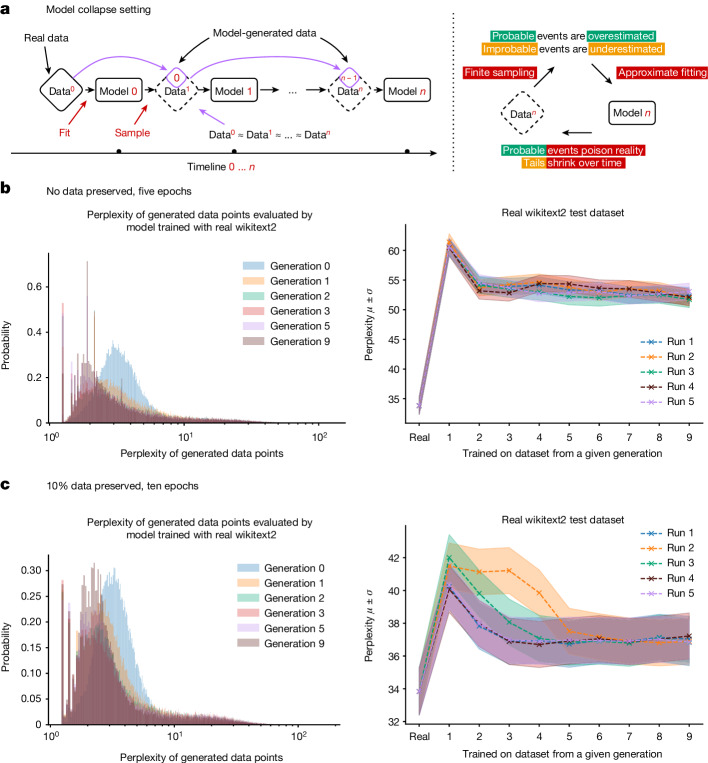
- In LLM experiments, an OPT-125m model fine-tuned on wikitext2 reaches 34 mean perplexity from a zero-shot baseline of 115. With five epochs and no original training data, performance degrades “from 20 to 28 perplexity points”; with ten epochs and 10% of original training data preserved, there is “only minor degradation of performance.”
- Generated data over generations contain more sequences the original model would produce with higher likelihood, but also much longer tails of sequences the original model would never produce, indicating accumulated errors.
- An ablation with a repeating penalty of 2.0 causes models to produce lower-score continuations to avoid repeats, and “causes the perplexity to double compared with the original”; models remain as susceptible to model collapse, if not more.
Methods
- Theoretical analysis of “learning with generational data”: a discrete distribution case with exact approximation, analyzed as a Markov chain, and a multidimensional Gaussian approximation using unbiased sample mean and variance estimators, with Wasserstein-2 distance as the divergence measure.
- LLM experiments fine-tune the OPT-125m causal language model from Meta via Hugging Face on wikitext2. Data generation uses five-way beam search; training sequences are blocked to 64 tokens, and for each token sequence the model predicts the next 64 tokens, producing an artificial dataset of the same size. Each experiment is run five times with different randomness seeds, and the best-performing model on the original task is used as the base for subsequent generations.
- Two LLM settings are tested: five epochs with no original training data retained, and ten epochs with a random 10% of original data points sampled for each new generation. VAEs and GMMs are covered in the Supplementary Materials.
Limitations
- The paper states that theoretical claims are mostly presented in the limit of generations going to infinity, whereas experiments use a finite, usually small, number of generations; complete collapse may or may not occur even after a small number of steps, and convergence rates are highly related to the specifics of the problem.
- The paper states that larger language models in non-fine-tuning settings were not run because training a single moderately large model produces twice the American lifetime’s worth of CO2; the LLM experiments are a fine-tuning proof of concept, and even those took weeks to run.
- Evident from the text: the LLM evidence is limited to OPT-125m, wikitext2, five runs, and fine-tuning; no full retraining from scratch is tested, and VAE/GMM details are relegated to the Supplementary Materials.
Model-written summary. Check it against the paper before relying on it.
Integrity signals
Registry
Cites
Statistics
Figures
Verification
Claims the paper makes
1 Valid · 0 Not valid · 3 Not checked · 40 Own results and interpretations
The cited sources support only part of this claim — read each source’s verdict below.
In the paper
“The repeating problem has been observed in nearly all text-generation models17,18”
§ AI models collapse when trained on recursively generated data > Model collapse in language models > Ablation: Repetitions
What the sources say
- Partly supportedcites [17] Keskar, N. S., McCann, B., Varshney, L. R., Xiong, C. & Socher, R. CTRL: a conditional transformer language model for controllable generation. Preprint at https://arxiv.org/abs/1909.05858 (2019). sourceExperimental — accuracy not yet measured
The Related Work section (p. 10) identifies repetition as a problem in text generation and discusses methods for reducing it. It does not say the problem has been observed in nearly all text-generation models; that prevalence claim is unsupported. (LLM, conf=0.86)
- Could not verifycites [18] Shumailov, I. et al. in Proc. 2021 IEEE European Symposium on Security and Privacy (EuroS&P) 212–231 (IEEE, 2021). sourceExperimental — accuracy not yet measured
Section 5.2 discusses attacks that increase output length, energy use, and latency, but not repetitive generated text. Searches for “repeating problem,” “repeated output,” and “repeat” found no passage saying that repetition has been observed in nearly all text-generation models; page numbers were unavailable in our copy. (LLM, conf=0.76)
plain- Asserted: passes — The authors put it forward as true.
- Checkable: passes — It can be checked against evidence.
- Load-bearing: unclear — It is unclear whether the paper’s conclusions depend on it.
- Based: passes — The paper gives a reason why it holds.
- Partly supported
A result the paper reports from its own data — it cites no other source for it, so there is none to check. The quote shows it is in the paper.
In the paper
“Here, over the generations, models tend to produce more sequences that the original model would produce with the higher likelihood.”
§ AI models collapse when trained on recursively generated data > Model collapse in language models
plainstates an association- Asserted: passes — The authors put it forward as true.
- Checkable: passes — It can be checked against evidence.
- Load-bearing: passes — The paper’s conclusions depend on it.
- Based: passes — The paper gives a reason why it holds.
A result the paper reports from its own data — it cites no other source for it, so there is none to check. The quote shows it is in the paper.
In the paper
“We find that data generated by language models in our experiments end up containing a large number of repeating phrases, as in Example 1.”
§ AI models collapse when trained on recursively generated data > Model collapse in language models > Ablation: Repetitions
plain- Asserted: passes — The authors put it forward as true.
- Checkable: passes — It can be checked against evidence.
- Load-bearing: unclear — It is unclear whether the paper’s conclusions depend on it.
- Based: passes — The paper gives a reason why it holds.
A result the paper states — it cites no source for it, so there is none to check. The quote shows it is in the paper.
In the paper
“we can show that the probability of losing information (that is, sampling no data at some generation) is equal to 1 − q”
§ AI models collapse when trained on recursively generated data > Theoretical intuition > Discrete distributions with exact approximation
plain- Asserted: passes — The authors put it forward as true.
- Checkable: passes — It can be checked against evidence.
- Load-bearing: passes — The paper’s conclusions depend on it.
- Based: passes — The paper gives a reason why it holds.
- Rests on an assumption not shown here.
A result the paper reports from its own data — it cites no other source for it, so there is none to check. The quote shows it is in the paper.
In the paper
“We discover that indiscriminately learning from data produced by other models causes ‘model collapse’—a degenerative process whereby, over time, models forget the true underlying data distribution, even in the absence of a shift in the distribution over time.”
§ AI models collapse when trained on recursively generated data > Main
plainstates a cause- Asserted: passes — The authors put it forward as true.
- Checkable: passes — It can be checked against evidence.
- Load-bearing: passes — The paper’s conclusions depend on it.
- Based: passes — The paper gives a reason why it holds.
11 more claims
Create a free account to see all 44 claims and every source verdict.
- It may state two separate claims as one. 22
- The quote only partly states this claim. 1
- Probably not a substantial claim. 10
Claims other papers make about this one
Each is checked against this paper’s own text: does it say what the citing paper says it does?
The source backs part of the claim, not all of it — or backs it for a different population, condition or comparison.
In the citing paper
“Second, LLMs are frequently trained on the same open-access corpora we examine, creating a feedback loop in which tomorrow's models will learn today's hallucinations [34].”
From LLM hallucinations in the wild: Large-scale evidence from non-existent citations (2026) · cites this paper as [34]
Experimental — accuracy not yet measuredThe source backs part of the claim, not all of it — or backs it for a different population, condition or comparison.
In the citing paper
“Successive training cycles cause LLMs to “forget” the statistical long-tail of rare but important patterns, resulting in homogenized, impoverished, and epistemically diminished outputs.”
From 4E cognition and the coevolution of human–AI interaction (2025) · cites this paper as [61]
Experimental — accuracy not yet measuredThe source backs part of the claim, not all of it — or backs it for a different population, condition or comparison.
In the citing paper
“AI-generated content now saturates the internet, reducing reliability and contaminating training data for future models (Paredes et al., 2025;Shumailov et al., 2024).”
From Purpose before policy: academic integrity, generative AI, and rhetorical stance (2026) · cites this paper as Shumailov et al., 2024
Experimental — accuracy not yet measuredThe source backs part of the claim, not all of it — or backs it for a different population, condition or comparison.
In the citing paper
“As successive generations of models are trained on data increasingly contaminated by historical synthetic outputs, the system progressively erodes distributional diversity and collapses functional modes—a degenerative process that remains robust to scale and is highly sensitive to even minimal synthetic fractions [14,15].”
From Self-Referential Introspection in Large Language Models: The Critical Threshold for Recursive Self-Improvement (2026) · cites this paper as [14]
Experimental — accuracy not yet measuredThe source backs part of the claim, not all of it — or backs it for a different population, condition or comparison.
In the citing paper
“The accumulation of synthetic data may affect model output quality, reinforce existing biases, and alter information feedback dynamics, thereby posing potential challenges to the stability of the digital knowledge ecosystem (Shumailov et al., 2024).”
From The Attention Mismatch: Mapping the Structural Academic Governance Deficit in the Age of Generative AI (2026) · cites this paper as Shumailov et al., 2024
Experimental — accuracy not yet measured
19 more claims about this paper
Create a free account to see every claim other papers make about this one.
Self-check
Percentages, sums and reported differences re-computed from the paper’s own numbers.
Each contradiction between two passages listed here was confirmed by an independent check.
Rated minor: it would not touch a result — a value no result rests on, a p-value that stays on the same side of the significance level, or a conflict that is clerical, resolved elsewhere in the paper, or outside its own findings.
In the paper
§ AI models collapse when trained on recursively generated data > Abstract
“GPT-2 (ref. 1), GPT-3(.5) (ref. 2) and GPT-4 (ref. 3)”
§ AI models collapse when trained on recursively generated data > Model collapse in language models
“BERT4, RoBERTa5 or GPT-2 (ref. 2)”
Citations
Cites
Language Models are Few-Shot Learners
Brown, T. B., Mann, B., Ryder, N., Subbiah, M., Kaplan, J., Dhariwal, P., Neelakantan, A., Shyam, P., Sastry, G., Askell, A., et al. (2020) · arXiv · doi:10.48550/arxiv.2005.14165 · Cited by 23,372
RoBERTa: A Robustly Optimized BERT Pretraining Approach
Liu, Y., Ott, M., Goyal, N., Du, J., Joshi, M., Chen, D., Levy, O., Lewis, M., Zettlemoyer, L., & Stoyanov, V. (2019) · arXiv · doi:10.48550/arxiv.1907.11692 · Cited by 16,515
Li, Z., & Hoiem, D. (2018) · IEEE Transactions on Pattern Analysis and Machine Intelligence · doi:10.1109/tpami.2017.2773081 · Cited by 4,202
Energy and Policy Considerations for Deep Learning in NLP
Strubell, E., Ganesh, A., & McCallum, A. (2019) · arXiv · doi:10.48550/arxiv.1906.02243 · Cited by 3,735
5th International Conference on Learning Representations (ICLR 17)
Havrylov, S., & Titov, I. (2017) · Cited by 3,503
Deep Neural Networks are Easily Fooled: High Confidence Predictions for Unrecognizable Images
Nguyen, A., Yosinski, J., & Clune, J. (2014) · arXiv · doi:10.48550/arxiv.1412.1897 · Cited by 3,258
Deep neural networks are easily fooled: High confidence predictions for unrecognizable images
Nguyen, A., Yosinski, J., & Clune, J. (2015) · 2015 IEEE Conference on Computer Vision and Pattern Recognition (CVPR) · doi:10.1109/cvpr.2015.7298640 · Cited by 3,258
On the Opportunities and Risks of Foundation Models
Bommasani, R., Hudson, D. A., Adeli, E., Altman, R., Arora, S., von Arx, S., Bernstein, M. S., Bohg, J., Bosselut, A., Brunskill, E., et al. (2021) · arXiv · doi:10.48550/arxiv.2108.07258 · Cited by 2,676
Poisoning Attacks against Support Vector Machines
Biggio, B., Nelson, B., & Laskov, P. (2012) · arXiv · doi:10.48550/arxiv.1206.6389 · Cited by 1,331
The Implicit Bias of Gradient Descent on Separable DataPreprint
Soudry, D., Hoffer, E., Nacson, M. S., Gunasekar, S., & Srebro, N. (2017) · arXiv (Cornell University) · doi:10.48550/arxiv.1710.10345 · Cited by 829
Research works printed but not linked: 7
- Radford, A. et al. Language models are unsupervised multitask learners. OpenAI blog 1, 9 (2019).
- Devlin, J., Chang, M.-W., Lee, K. & Toutanova, K. in Proc. 2019 Conference of the North American Chapter of the Association for Computational Linguistics: Human Language Technologies, Volume 1 (Long and Short Papers) (eds Burstein, J., Doran, C. & Solorio, T.) 4171–4186 (Association for Computational Linguistics, 2019).
- Carlini, N. & Terzis, A. in Proc. Tenth International Conference on Learning Representations (ICLR, 2022).
- Carlini, N. et al. in Proc. 2024 IEEE Symposium on Security and Privacy (SP) 179 (IEEE, 2024).
- Mousavi-Hosseini, A., Park, S., Girotti, M., Mitliagkas, I. & Erdogdu, M. A. in Proc. Eleventh International Conference on Learning Representations (ICLR, 2023).
- Gu, Y., Dong, L., Wei, F. & Huang, M. in Proc. Twelfth International Conference on Learning Representations (ICLR, 2024).
- Strubell, E., Ganesh, A. & McCallum, A. in Proc. 57th Annual Meeting of the Association for Computational Linguistics (eds Korhonen, A., Traum, D. & Màrquez, L.) 3645–3650 (Association for Computational Linguistics, 2019).
Cited by
Items 401–500 of 789
R-CoT: Reinforcement Chain of Thought Prompting for Task Specific Training
Chiu, H.-C., Fang, I.-K., & Lee, C. (2025) · Communications in computer and information science · doi:10.1007/978-981-96-4589-3_11
Generative AI Robs Students of the Joy of Learning: A Practical Guide to Social Science Research
Fellows, I. (2025) · GiLE Journal of Skills Development · doi:10.52398/gjsd.2025.v5.i1.pp165-170
The Machine Penalty in the Future
Shank, D. B. (2025) · Springer eBooks · doi:10.1007/978-3-031-86061-4_14
Leonowicz-Bukała, I., Struck-Peregończyk, M., Birek, M., & Dudzińska, K. (2025) · Acta Universitatis Lodziensis Folia Sociologica · doi:10.18778/0208-600x.92.03
Systems Thinking: How Systems Work
Mämmelä, A. (2025) · Springer eBooks · doi:10.1007/978-3-031-85012-7_5
Pour un développement de l’IA au service du bien commun
Raudière, L. D. L. (2025) · Enjeux numériques. · doi:10.3917/ennu.029.0050
Imbalanced Data Clustering via Targeted Data Augmentation Using GMM and LLM
Khalal, N., Djamai, A. A.-E., Keraghel, I., & Nadif, M. (2025) · Lecture notes in computer science · doi:10.1007/978-3-031-91398-3_19 · Cited by 1
Large Language Models and the Problem of Rhetorical DebtPreprint
MacArthur, M. J. (2025) · SSRN Electronic Journal · doi:10.2139/ssrn.5208174
An information theoretic limit to data amplification
Watts, S. J., & Crow, L. (2025) · Machine Learning Science and Technology · doi:10.1088/2632-2153/add78d · Cited by 4
Savage, N. (2025) · Communications of the ACM · doi:10.1145/3722476
Transparency and Urban Life with AI: Complexities and Possibilities
McKenna, H. P. (2025) · Springer eBooks · doi:10.1007/978-3-031-88765-9_6
Workshop on Sustainable AI for the Future Web
Xu, C., Wang, Y., Guo, J., Liu, D., Dong, M., George, Y., Barthélemy, J., Liu, Y., & Chen, L. (2025) · International World Wide Web Conference (WWW) · doi:10.1145/3701716.3717658
“AsAI models continue to be trained on increasingly noisy web data, their robustness and trustworthiness are at greater risk, raising significant challenges in maintaining the security and reliability of these models in web applications [3].”
LLMs as Historical Actors: How AI Systems Influence the Web's Evolution
Naseem, U., Rashid, J., Kim, J., Beheshti, A., Yang, J. Y., & Dras, M. (2025) · International World Wide Web Conference (WWW) · doi:10.1145/3701716.3716842
Reviving Forgotten Languages Through Self Learning AI and Unsupervised Linguistic Modelling
Muzaffarovna, J. P., Madraimov, A., Odilov, B., Boltaeva, M., Jumaniyozova, M., & Madaminjonovna, G. S. (2025) · International Conference on Computational Innovations and Engineering Sustainability (ICCIES) · doi:10.1109/iccies63851.2025.11032655
“Most current artificial intelligence techniques, regrettably, depend on supervised learning, and these typically lacks the large annotated datasets needed by extinct languages [8].”
A Review of Data Models and Frameworks in Urban Environments in the Context of AI
McKenna, H. P. (2025) · Urban Science · doi:10.3390/urbansci9070239
Simulation Without Ground: Epistemic Collapse and Reflexive Ethics in Generative AIPreprint
Kadel, A. (2025) · SocArXiv (OSF Preprints) · doi:10.31235/osf.io/42fth_v2
THE ROLE AND EXAMPLES OF THE IMPLEMENTATION OF LARGE LANGUAGE MODELS IN MODERN MEDIA COMMUNICATIONS
Александрович, К. М. (2025) · Science and School · doi:10.31862/1819-463x-2025-2-42-52 · Cited by 2
Nota Introdutória: Comunicação e Inteligência Artificial
Sá, A., & Esteban, L. M. P. (2025) · Comunicação e Sociedade · doi:10.17231/comsoc.47(2025).6668 · Cited by 1
Enhancing reinforcement learning controllers with GAN-generated data and transfer learning
Xu, C., Hayashi, N., & Inuiguchi, M. (2025) · SICE Journal of Control Measurement and System Integration · doi:10.1080/18824889.2025.2527471
“(1) Mode Collapse: During training, the Generator may fall into a state where it only produces a limited variety of samples, failing to capture the full distribution of real data [17].”
Error in the Loop: How Human Mistakes Can Improve Algorithmic Learning
Copus, R. W., Spackman, C., & Laqueur, H. S. (2025) · Journal of law & empirical analysis. · doi:10.1177/2755323x251357643 · Cited by 2
“Researchers have documented the phenomenon of “ model collapse, ” whereby large language models degrade in quality when trained on text and images that they generate (Shumailov et al., 2023, 2024).”
Identifying Highly Relevant Entries in Datasets: A Relevance-Based Classification
Delbianco, F., & Tohmé, F. (2025) · Journal of Classification · doi:10.1007/s00357-025-09513-6
IA et développement logiciel : où va-t-on ?
Mermet, B. (2025) · Bulletin 1024 · doi:10.48556/sif.1024.25.189 · Cited by 1
The Carbon Code: Decoding AI’s Role in Climate Mitigation
Vrana, V. G., & Mondal, S. R. (2025) · Springer eBooks · doi:10.1007/978-981-96-8015-3_1 · Cited by 1
Simulation Without Ground: Epistemic Collapse and Reflexive Ethics in Generative AIPreprint
Kadel, A. (2025) · SocArXiv (OSF Preprints) · doi:10.31235/osf.io/42fth_v3
de la Garza, L. M. G. (2025) · Revista Derecho y Economía de la Integración · doi:10.69592/2530-5093-n14-junio-2025-art-4
Zhang, B., Wang, S., Jiang, Y., Sui, D., Tu, Z., & Chu, D. (2025) · International ACM SIGIR Conference on Research and Development in Information Retrieval (SIGIR) · doi:10.1145/3726302.3729898 · Cited by 44
Shen, J., Huang, R., Min, D., Che, H., Li, B., Liu, L., Zhang, Z., Cheng, J., & Wang, S. (2025) · Chinese Science Bulletin (Chinese Version) · doi:10.1360/tb-2025-0185 · Cited by 2
Is AI-assisted paraphrase the new tool for fake review creation? Challenges and remedies
Xylogiannopoulos, K. F., Xanthopoulos, P., Karampelas, P., & Bakamitsos, G. A. (2025) · Knowledge-Based Systems · doi:10.1016/j.knosys.2025.114151 · Cited by 7
Do “AI” Avatars Generate Our Past? Hacking into Transformations of Temporality by Synthetic Media
Gerner, A. (2025) · Springer series on cultural computing · doi:10.1007/978-3-031-89037-6_4
Monitoring morphometric drift in lifelong learning segmentation of the spinal cordPreprint
Karthik, E. N., Bédard, S., Valošek, J., Aigner, C. S., Bannier, É., Bednařík, J., Callot, V., Combes, A. J. E., Curt, A. E. P., Dávid, G., et al. (2025) · arXiv (Cornell University) · doi:10.48550/arxiv.2505.01364 · Cited by 6
Emergent Motif Convergence in Iterated Language-Image Generation LoopsPreprint
Hintze, A., Astrom, F. P., & Schossau, J. (2025) · SSRN Electronic Journal · doi:10.2139/ssrn.5356130
Think, Prune, Train: Can Small Models Teach Themselves to Reason?
Costello, C., Guo, S., Goldie, A., & Mirhoseini, A. (2025) · IEEE International Conference on LLM-Aided Design (ICLAD) · doi:10.1109/iclad65226.2025.00012
“Prior attempts at recursive fine-tuning on unfiltered text data [5] have observed model collapse : model degradation, including knowledge forgetting [6] and hallucination.”
Bridging the AI Divide | Policy BriefPreprint
Stephens, M. (2025) · SSRN Electronic Journal · doi:10.2139/ssrn.5366188
Feldman, R. (2025) · Cambridge University Press eBooks · doi:10.1017/9781009646833.017
Eine Künstliche Intelligenz und ihre Definition von Leben
Domainko, W. F. (2025) · Springer eBooks · doi:10.1007/978-3-662-71577-2_3
Exposing the Molecular Reaction Blind Spots of LLMs with PathwayQAPreprint
Nayar, G., Carpenter, K. A., Smith, D. A., Xiong, B., & Altman, R. B. (2025) · bioRxiv (Cold Spring Harbor Laboratory) · doi:10.1101/2025.08.12.669911
“This can impact an LLM's performance, as it has seen more instances of the promiscuous proteins in training 29 .”
3DBubbles : An experimental dataset for model training and benchmarking
Yu, B., Chen, Q., Qin, Y., et al. (2025) · AIChE Journal · doi:10.1002/aic.70029
Amell, T. (2025) · Business guides on the go · doi:10.1007/978-3-031-92174-2_7
Generative Adversarial DiscriminationPreprint
Fairfield, J. A. T. (2025) · SSRN Electronic Journal · doi:10.2139/ssrn.5417795
The virtue of artificiality: Islamic ethics and the reconceptualization of AI caregivers
AbuMusab, S. (2025) · AI and Ethics · doi:10.1007/s43681-025-00747-z · Cited by 2
“While recent research by Shu-mailov et al. [71 ] has identified that exclusive reliance on synthetic data may lead to model collapse and performance degradation, this concern can be addressed through a balanced approach.”
GenAI: Our Tool Or Our Future Master?
Petković, D. (2025) · IEEE Transactions on Technology and Society · doi:10.1109/tts.2025.3603643 · Cited by 1
“This can have a negative effect on quality and accuracy of LLMs, documented in, e.g., [17], and often called “LLM collapse” .”
Gene-Family Encoding Boosts Domain-Adapted Single-Cell Language ModelsPreprint
Ma, H., Xu, C., Ho, S. W. T., Zhao, J. J., Chu, Y., Tan, A. L. K., Sundar, R., & Tan, P. B. O. (2025) · bioRxiv (Cold Spring Harbor Laboratory) · doi:10.1101/2025.09.16.676672
Li, S., Liu, M., Cheng, X., Xiao, J., & Chen, S. (2025) · IEEE Transactions on Cybernetics · doi:10.1109/tcyb.2025.3610416 · Cited by 3
“To ensure stable evaluation results, we limit the average number of samples per class to at least 30, thereby avoiding model collapse due to insufficient AI-generated labeled data [45].”
Quality of Experience Based Trustworthiness for LLMs : New Approach and Use Case
Heroucha, A., Derradji, R., Abreu, T. W. M., Labiod, M. A., & Mellouk, A. (2025) · International Conference on Communications · doi:10.1109/icc52391.2025.11161285
“A lower perplexity indicates a better model fit, meaning the model is more confident in its predictions [12].”
Modelling discrete states and long-term dynamics in functional brain networks
Cho, S., Huang, R., Gohil, C., Jones, Ō. P., & Woolrich, M. W. (2026) · Imaging Neuroscience · doi:10.1162/imag.a.1237 · Cited by 1
Powell, R. A. (2025) · Oxford University Press eBooks · doi:10.1093/9780191949142.002.0004
Ionescu, V. M., Enescu, M. C., & Bizon, C. C. (2025) · Springer eBooks · doi:10.1007/978-3-031-97007-8_7
Multi-scale Swarm of Large Language Models for Python Code Generation
Tan, Y., Duan, Q., Sun, L., & Shi, Y. (2025) · Lecture notes in computer science · doi:10.1007/978-981-95-0982-9_14
Information, Movements, and Home Ranges
Powell, R. A. (2025) · Oxford University Press eBooks · doi:10.1093/9780191949142.003.0005
Powell, R. A. (2025) · Oxford University Press eBooks · doi:10.1093/9780191949142.003.0009
Powell, R. A. (2025) · Oxford University Press eBooks · doi:10.1093/9780191949142.003.0004
Cognitive Maps and the Definition of a Home Range
Powell, R. A. (2025) · Oxford University Press eBooks · doi:10.1093/9780191949142.003.0003
An Introduction to Home Ranges
Powell, R. A. (2025) · Oxford University Press eBooks · doi:10.1093/9780191949142.003.0001
Familiarity Distributions III: Overlap, Cores, Activity and Sensory Kernels, Areas
Powell, R. A. (2025) · Oxford University Press eBooks · doi:10.1093/9780191949142.003.0012
A Doorway to New Cogitations on Home Ranges
Powell, R. A. (2025) · Oxford University Press eBooks · doi:10.1093/9780191949142.003.0013
Powell, R. A. (2025) · Oxford University Press eBooks · doi:10.1093/9780191949142.002.0005
Familiarity Distributions I: Infrequently Asked Questions
Powell, R. A. (2025) · Oxford University Press eBooks · doi:10.1093/9780191949142.003.0010
Building Familiarity Distributions
Powell, R. A. (2025) · Oxford University Press eBooks · doi:10.1093/9780191949142.003.0011
Powell, R. A. (2025) · Oxford University Press eBooks · doi:10.1093/9780191949142.003.0015
Mechanistic Familiarity Distributions
Powell, R. A. (2025) · Oxford University Press eBooks · doi:10.1093/9780191949142.003.0006
Economic and Cost–Benefit Models and Home Ranges
Powell, R. A. (2025) · Oxford University Press eBooks · doi:10.1093/9780191949142.003.0007
Distorted representations of age and gender are reflected in AI models
Macanovic, A. (2025) · Nature · doi:10.1038/d41586-025-02974-0
Gauguin, Descartes, Bayes: A Diurnal Golem’s Brain
Chandra, K., Liu, A., Ragan‐Kelley, J., & Tenenbaum, J. B. (2025) · ACM SIGPLAN International Symposium on New Ideas, New Paradigms, and Reflections on Programming and Software (Onward!) · doi:10.1145/3759429.3762631 · Cited by 2
“When large language models are trained on their own output, they do not gain in wisdom, as we might hope—instead, they “model collapse” into gibber-ish [Shumailov et al. 2024].”
Tokenised kitsch: OpenSea’s top 50 NFT collections and MoMA’s first two NFTs
Smethurst, R., Papageorgiou, O., & Egliston, B. (2025) · Convergence The International Journal of Research into New Media Technologies · doi:10.1177/13548565251372817 · Cited by 1
“GenAI learns from historical training data and then feeds off its own outputs (Shumailov et al., 2024) – an ouroboros machine.”
Large Language Models as Search Engines: Societal Challenges
Sadeddine, Z., Maxwell, W., Varoquaux, G. P., & Suchanek, F. M. (2025) · ACM SIGIR Forum · doi:10.1145/3769733.3769746 · Cited by 7
“This phenomenon is called Model Collapse and it has indeed been observed in practice [Guo et al., 2024; Shumailov et al., 2024].”
Uncovering magnetic phases with synthetic data and physics-informed training
Valera-Medina, A., Arlego, M., & Lamas, C. A. (2025) · Computational Materials Science · doi:10.1016/j.commatsci.2025.114271
“Recent work has shown that over-reliance on model-generated data, especially in generative tasks, can lead to model collapse and degraded performance [19].”
Executable Science: Research Software Engineering Practices for Replicating Neuroscience Findings
Palacios, G. K., Li, Z., & Armeni, K. (2025) · ACM Conference on Reproducibility and Replicability (ACM REP) · doi:10.1145/3736731.3746147 · Cited by 1
Chen, J., Wang, S., Yunqiang, Z., Duan, F., & Dai, X. (2025) · IEEE Transactions on Geoscience and Remote Sensing · doi:10.1109/tgrs.2025.3624018 · Cited by 1
Synthesizing AI Failure Research: A Scoping Review
Li, C., Lin, Y., Tu, X., Chen, J. E., & Zhao, Z. (2025) · Business & Information Systems Engineering · doi:10.1007/s12599-025-00970-2 · Cited by 3
“• Scalability failure reflects a system’s decline in performance across different platforms, environments, or user populations, evident when models fail outside controlled settings or struggle with large-scale deployment (Gao et al. 2024b; Shumailov et al. 2024; Du et al. 2024).”
Automating Visual Abstracts in Radiology with Vision-Language Models: Practical Insights
Chu, L. C. H., & Syailendra, E. A. (2025) · Radiology · doi:10.1148/radiol.252731
Beyond Pattern Recognition: Teaching AI to Think Critically Before It Learns
Xie, X., Zhang, J., & Voas, J. (2025) · Computer · doi:10.1109/mc.2025.3599970 · Cited by 2
Gulati, M., Groß, B., & Wunder, G. (2025) · International Conference on Cyber-Enabled Distributed Computing and Knowledge Discovery (CyberC) · doi:10.1109/cyberc66434.2025.00025 · Cited by 1
Wang, X., & Deng, W. (2025) · 中国科学基金 · doi:10.3724/bnsfc-2025-0012 · Cited by 2
S2N: A Synthetic Data-Driven Approach for Speaker-To-Dialogue Attribution in Novels
Huang, Y., Zhang, Y., Funakoshi, K., Okumura, M., & Cao, Y. (2025) · International Joint Conference on Neural Networks (IJCNN) · doi:10.1109/ijcnn64981.2025.11228946
Zhang, X., Wang, S., & Guo, S. (2025) · International Joint Conference on Neural Networks (IJCNN) · doi:10.1109/ijcnn64981.2025.11227635
“As can be seen, when we use 10%, 20%, and 50% dataset sizes for model training, our method achieves improvements of 11.2%, 6.5%, and 2.5% over the second-best methods. methods require careful selection of positive and negative pairs and are prone to issues like model collapse [3] during training.”
InfluentialEmployee Handbooks Featuring Explainable Artificial Intelligence
Hyman, M. R. (2025) · Cureus Journal of Business and Economics. · doi:10.7759/s44404-025-09527-8
Punnen, T. G., Shan, K., Patel, M. A., McCreary, M., Tran, D. H., Santoyo, J. R., Burgess, K. W., Moog, T. M., Smith, A. D., & Okuda, D. T. (2025) · Intelligence-Based Medicine · doi:10.1016/j.ibmed.2025.100314
231 The emerging impact of artificial intelligence
Miller, H. E., & Engemann, K. J. (2025) · De Gruyter eBooks · doi:10.1515/9783111595306-001
The paradox of creativity in the age of generative artificial intelligence
Cropley, D. H., & Cropley, A. J. (2025) · Elsevier eBooks · doi:10.1016/b978-0-443-34073-4.00019-8 · Cited by 1
Parenti, S. I., Maglioni, A., Evangelisti, E., Gracco, A. L. T., Badiali, G., Bonetti, G. A., & Bartolucci, M. L. (2025) · Applied Sciences · doi:10.3390/app152312441 · Cited by 1
Four Ps for Building Massive Collective Knowledge Systems
Madhavapeddy, A. (2025) · doi:10.59350/50z3a-93838
Kaleidoscopic AI: Hallucinations on the Verge of Creativity
Georgieva, I., & Georgiev, G. V. (2025) · Lecture notes in computer science · doi:10.1007/978-3-032-12408-1_21
Zhou, F., Norton-Steele, A., Marsh, L., Byrne, H. M., Harrington, H. A., & Lü, X. (2025) · bioRxiv (Cold Spring Harbor Laboratory) · doi:10.1101/2025.11.28.691105
Ali, L. M., Yim, A. K., Gerbi, E., Nguyen, T., Tu, N., Ikede, F., Sampaleanu, R., Grigore, D., Waligorski, J. E., Kremitzki, C. L., et al. (2025) · npj Systems Biology and Applications · doi:10.1038/s41540-025-00627-6
“It does not use a GAN (generative adversarial network) or diffusion approach to create the training set, avoiding recursive-generated collapse 104 .”
Kwon, O., Yoon, H., Chin, H., & Park, J. (2025) · Applied Sciences · doi:10.3390/app152413185 · Cited by 1
May AI be sustainable? An outlook on sustainability and technology
Kondratenko, A., Kondratenko, A. A., & Kamberov, K. H. (2025) · AI & Society · doi:10.1007/s00146-025-02804-x
“Studies show that AI models rapidly collapse when trained on data with a high proportion of AI-generated content (Gibney 2024; Shumailov et al. 2024).”
Digitally-Representing Flavours and AI-Recipe Creation: Possibilities and Pitfalls
Spence, C., & Velasco, C. (2025) · Springer eBooks · doi:10.1007/978-3-031-91050-0_3
Richtiges Handeln vs. statistische Maschinen
Milkau, U. (2025) · Springer eBooks · doi:10.1007/978-3-658-48335-7_3
Fake papers abound in the literature
Madhavapeddy, A. (2025) · doi:10.59350/k52ay-eb880
Early Language Model Output Note – Historical Record Archive
Archive, W. N. (2025) · Figshare · doi:10.6084/m9.figshare.30396445
Playing to Train: Rethinking Monetization in Games through Gameplay Data as Currency for AIPreprint
Ortiz, R. D., da Fonseca, A. L. A., & Chimenti, P. C. P. D. S. (2025) · SSRN Electronic Journal · doi:10.2139/ssrn.5648747
Skin-R1: Clinical Knowledge-Guided Dermatological Diagnosis Using Vision-Language Models
Liu, Z., Ren, W., Zhang, J., Zhao, T., Zhu, J., Li, X., & Honavar, V. G. (2026) · Lecture notes in computer science · doi:10.1007/978-3-032-37314-4_1 · Cited by 4
Zukunftsblick: Warum es immer Menschen brauchen wird
Offergelt, F., Hofreiter, S., & Steiner, T. (2025) · Essentials · doi:10.1007/978-3-662-72565-8_7
Menuge, A. J. L. (2025) · Religions · doi:10.3390/rel17010008
Yukish, H. Y., Singh, S., Yurchenko, N. B., & Fedoryka, N. Z. (2025) · Art of Medicine · doi:10.21802/artm.2025.4.36.94 · Cited by 1
“At the same time, AI is prone to misinformation: it does not answer the question directly asked, the information is often inaccurate and unverified, it fabricates very plausible evidence with references to non-existent sources, and the answers lack detail [17-19].”
Исследование раннего и позднего коллапса языковых моделей в медицинских приложениях
Боброва, Е. В., Сергеевич, З. К., Константинович, С. Д., Витальевич, Х. Д., & Владимирович, Д. Е. (2025) · International journal of open information technologies · doi:10.25559/injoit.2307-8162.13.202508.51-59
Shvarts, Y. G., Akimova, N. S., Евгеньевна, К. Л., Евгеньевна, Р. А., Parkhoniuk, E. V., & Kiselev, A. R. (2025) · Russian Open Medical Journal · doi:10.15275/rusomj.2025.0410
On the Dangers of Bootstrapping Generation for Continual Learning and Beyond
Zverev, D., Koepke, A. S., & Henriques, J. F. (2026) · Lecture notes in computer science · doi:10.1007/978-3-032-12840-9_16 · Cited by 1
Metadata
- Authors
- Shumailov, I., Shumaylov, Z., Zhao, Y., Papernot, N., Anderson, R., & Gal, Y.
- Affiliations
- University of Oxford (GB)
- University of Cambridge (GB)
- Imperial College London (GB)
- University of Toronto (CA)
- Corresponding author
- Shumailov, Ilia
- Shumaylov, Zakhar
- Gal, Yarin
- Venue
- Nature
- Published
- 2024-07-24
- Volume
- 631
- Issue
- 8022
- Pages
- 755-759
- ISSN
- 0028-0836 (ISSN-L)
- 1476-4687
- PMC
- PMC11269175
- OpenAlex
- W4400949264
- Semantic Scholar
- 603d3f90fc40f79ff51258f0295de3ec5107f73e
- Cited by
- 793
- References
- 11
- Citations by year
- 2026: 407 · 2025: 330 · 2024: 56
- FWCI
- 116.53
- Type
- journal article
- Language
- en
- Update notices
- correction (2025-03-21)
- Open access
- hybrid
- doi.org
- Licence
- cc-by
- creativecommons.org/licenses/by/4.0 (tdm)
- creativecommons.org/licenses/by/4.0 (vor)
- Locations
- Nature (publishedVersion, cc-by)
- PubMed Central (publishedVersion, cc-by)
- PubMed (publishedVersion)
- Apollo (University of Cambridge) (submittedVersion, cc-by)
- RePEc: Research Papers in Economics (submittedVersion)
- Edinburgh Research Explorer (University of Edinburgh) (submittedVersion, cc-by)
- Topics
- Physical Sciences › Computer Science › Artificial Intelligence › Topic Modeling
- Physical Sciences › Computer Science › Artificial Intelligence › Ethics and Social Impacts of AI
- Physical Sciences › Computer Science › Artificial Intelligence › Adversarial Robustness in Machine Learning
- Keywords
- model collapse, large language models, self-training, generative AI training data, variational autoencoder, Gaussian mixture model, distribution shift, web scraping, ChatGPT, generative models
About these checks
Registry, retraction, Cites and statistics results are computed, not judged, with one exception: a printed reference that no index lists is read once by a model before it counts as a citation error. Claims are extracted by a model and kept only when their quote appears verbatim in the text; each cited source is then checked, with a model’s help, for whether it says what the claim relies on. Those verdicts can be wrong — read the claim’s quote and the cited source before relying on one.
The claim verdicts this report counts are experimental: their accuracy is not yet measured.
A language model drew the claims from the paper on 2026-10-10, under version 3 of the claim definition (model deepseek-v4.1-flash, prompt extract-v3).
A second model labelled each claim on 2026-10-10 (model jev-1.13-20260917, definition revision gold-guideline-v0.2).
Cited sources are checked with a language model’s help (gpt-6-sol).
Statistics and arithmetic are recomputed, not judged.
Confidence bands are shown only for fields calibrated on our annotated test set. None is calibrated yet, so no band is shown.
What counts as a claim ›How we measure confidence ›How we check this ›
Are you an author, or do you see a problem with this page? Request a review
Data sources
Bibliographic data: Semantic Scholar, OpenAlex, Crossref.
Contains information from the Semantic Scholar Academic Graph Datasets, made available under the ODC Attribution License (ODC-BY 1.0).
Semantic Scholar’s data is described in: Kinney, R., et al. (2023). The Semantic Scholar Open Data Platform. arXiv:2301.10140.
