

AI models collapse when trained on recursively generated data
Open accessThe DOI matches its Crossref record; 18 of the 19 references it cites were found in a registry or an index; 2 of the 7 sources its claims cite were checked for support.
Abstract
) demonstrated high performance across a variety of language tasks. ChatGPT introduced such language models to the public. It is now clear that generative artificial intelligence (AI) such as large language models (LLMs) is here to stay and will substantially change the ecosystem of online text and images. Here we consider what may happen to GPT-{n} once LLMs contribute much of the text found online. We find that indiscriminate use of model-generated content in training causes irreversible defects in the resulting models, in which tails of the original content distribution disappear. We refer to this effect as 'model collapse' and show that it can occur in LLMs as well as in variational autoencoders (VAEs) and Gaussian mixture models (GMMs). We build theoretical intuition behind the phenomenon and portray its ubiquity among all learned generative models. We demonstrate that it must be taken seriously if we are to sustain the benefits of training from large-scale data scraped from the web. Indeed, the value of data collected about genuine human interactions with systems will be increasingly valuable in the presence of LLM-generated content in data crawled from the Internet.
Overview
CoChat Summary
TL;DR
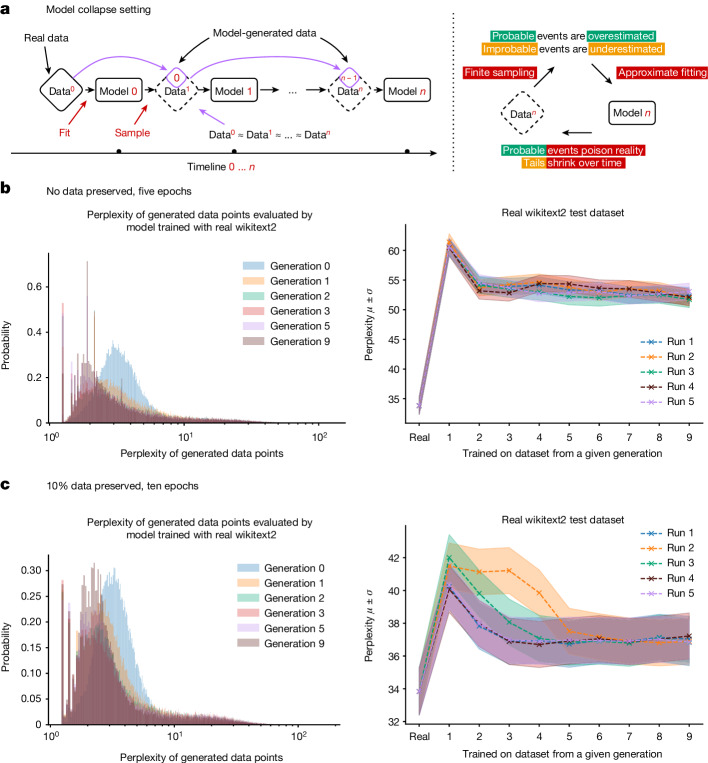
Indiscriminate use of model-generated content in training causes “model collapse,” a degenerative process in which generative models forget the true data distribution, beginning with the tails and eventually converging to a low-variance point estimate. The authors demonstrate this theoretically and empirically for Gaussian mixture models, variational autoencoders, and large language models.
Key findings
- Model collapse occurs across generative model families: in discrete distributions with exact approximation, the process converges to a delta function with probability 1; in the Gaussian setting, Theorem 3.1 states that the Wasserstein-2 distance between the true distribution and its approximation diverges arbitrarily far while variance collapses to zero as generations increase.
- In LLM experiments, an OPT-125m model fine-tuned on wikitext2 reaches 34 mean perplexity from a zero-shot baseline of 115. With five epochs and no original training data, performance degrades “from 20 to 28 perplexity points”; with ten epochs and 10% of original training data preserved, there is “only minor degradation of performance.”
- Generated data over generations contain more sequences the original model would produce with higher likelihood, but also much longer tails of sequences the original model would never produce, indicating accumulated errors.
- An ablation with a repeating penalty of 2.0 causes models to produce lower-score continuations to avoid repeats, and “causes the perplexity to double compared with the original”; models remain as susceptible to model collapse, if not more.
Methods
- Theoretical analysis of “learning with generational data”: a discrete distribution case with exact approximation, analyzed as a Markov chain, and a multidimensional Gaussian approximation using unbiased sample mean and variance estimators, with Wasserstein-2 distance as the divergence measure.
- LLM experiments fine-tune the OPT-125m causal language model from Meta via Hugging Face on wikitext2. Data generation uses five-way beam search; training sequences are blocked to 64 tokens, and for each token sequence the model predicts the next 64 tokens, producing an artificial dataset of the same size. Each experiment is run five times with different randomness seeds, and the best-performing model on the original task is used as the base for subsequent generations.
- Two LLM settings are tested: five epochs with no original training data retained, and ten epochs with a random 10% of original data points sampled for each new generation. VAEs and GMMs are covered in the Supplementary Materials.
Limitations
- The paper states that theoretical claims are mostly presented in the limit of generations going to infinity, whereas experiments use a finite, usually small, number of generations; complete collapse may or may not occur even after a small number of steps, and convergence rates are highly related to the specifics of the problem.
- The paper states that larger language models in non-fine-tuning settings were not run because training a single moderately large model produces twice the American lifetime’s worth of CO2; the LLM experiments are a fine-tuning proof of concept, and even those took weeks to run.
- Evident from the text: the LLM evidence is limited to OPT-125m, wikitext2, five runs, and fine-tuning; no full retraining from scratch is tested, and VAE/GMM details are relegated to the Supplementary Materials.
Model-written summary. Check it against the paper before relying on it.
Integrity signals
Registry
Cites
Statistics
Figures
Verification
Claims the paper makes
1 Valid · 0 Not valid · 3 Not checked · 40 Own results and interpretations
The cited sources support only part of this claim — read each source’s verdict below.
In the paper
“The repeating problem has been observed in nearly all text-generation models17,18”
§ AI models collapse when trained on recursively generated data > Model collapse in language models > Ablation: Repetitions
What the sources say
- Partly supportedcites [17] Keskar, N. S., McCann, B., Varshney, L. R., Xiong, C. & Socher, R. CTRL: a conditional transformer language model for controllable generation. Preprint at https://arxiv.org/abs/1909.05858 (2019). sourceExperimental — accuracy not yet measured
The Related Work section (p. 10) identifies repetition as a problem in text generation and discusses methods for reducing it. It does not say the problem has been observed in nearly all text-generation models; that prevalence claim is unsupported. (LLM, conf=0.86)
- Could not verifycites [18] Shumailov, I. et al. in Proc. 2021 IEEE European Symposium on Security and Privacy (EuroS&P) 212–231 (IEEE, 2021). sourceExperimental — accuracy not yet measured
Section 5.2 discusses attacks that increase output length, energy use, and latency, but not repetitive generated text. Searches for “repeating problem,” “repeated output,” and “repeat” found no passage saying that repetition has been observed in nearly all text-generation models; page numbers were unavailable in our copy. (LLM, conf=0.76)
plain- Asserted: passes — The authors put it forward as true.
- Checkable: passes — It can be checked against evidence.
- Load-bearing: unclear — It is unclear whether the paper’s conclusions depend on it.
- Based: passes — The paper gives a reason why it holds.
- Partly supported
A result the paper reports from its own data — it cites no other source for it, so there is none to check. The quote shows it is in the paper.
In the paper
“Here, over the generations, models tend to produce more sequences that the original model would produce with the higher likelihood.”
§ AI models collapse when trained on recursively generated data > Model collapse in language models
plainstates an association- Asserted: passes — The authors put it forward as true.
- Checkable: passes — It can be checked against evidence.
- Load-bearing: passes — The paper’s conclusions depend on it.
- Based: passes — The paper gives a reason why it holds.
A result the paper reports from its own data — it cites no other source for it, so there is none to check. The quote shows it is in the paper.
In the paper
“We find that data generated by language models in our experiments end up containing a large number of repeating phrases, as in Example 1.”
§ AI models collapse when trained on recursively generated data > Model collapse in language models > Ablation: Repetitions
plain- Asserted: passes — The authors put it forward as true.
- Checkable: passes — It can be checked against evidence.
- Load-bearing: unclear — It is unclear whether the paper’s conclusions depend on it.
- Based: passes — The paper gives a reason why it holds.
A result the paper states — it cites no source for it, so there is none to check. The quote shows it is in the paper.
In the paper
“we can show that the probability of losing information (that is, sampling no data at some generation) is equal to 1 − q”
§ AI models collapse when trained on recursively generated data > Theoretical intuition > Discrete distributions with exact approximation
plain- Asserted: passes — The authors put it forward as true.
- Checkable: passes — It can be checked against evidence.
- Load-bearing: passes — The paper’s conclusions depend on it.
- Based: passes — The paper gives a reason why it holds.
- Rests on an assumption not shown here.
A result the paper reports from its own data — it cites no other source for it, so there is none to check. The quote shows it is in the paper.
In the paper
“We discover that indiscriminately learning from data produced by other models causes ‘model collapse’—a degenerative process whereby, over time, models forget the true underlying data distribution, even in the absence of a shift in the distribution over time.”
§ AI models collapse when trained on recursively generated data > Main
plainstates a cause- Asserted: passes — The authors put it forward as true.
- Checkable: passes — It can be checked against evidence.
- Load-bearing: passes — The paper’s conclusions depend on it.
- Based: passes — The paper gives a reason why it holds.
11 more claims
Create a free account to see all 44 claims and every source verdict.
- It may state two separate claims as one. 22
- The quote only partly states this claim. 1
- Probably not a substantial claim. 10
Claims other papers make about this one
Each is checked against this paper’s own text: does it say what the citing paper says it does?
The source backs part of the claim, not all of it — or backs it for a different population, condition or comparison.
In the citing paper
“Second, LLMs are frequently trained on the same open-access corpora we examine, creating a feedback loop in which tomorrow's models will learn today's hallucinations [34].”
From LLM hallucinations in the wild: Large-scale evidence from non-existent citations (2026) · cites this paper as [34]
Experimental — accuracy not yet measuredThe source backs part of the claim, not all of it — or backs it for a different population, condition or comparison.
In the citing paper
“Successive training cycles cause LLMs to “forget” the statistical long-tail of rare but important patterns, resulting in homogenized, impoverished, and epistemically diminished outputs.”
From 4E cognition and the coevolution of human–AI interaction (2025) · cites this paper as [61]
Experimental — accuracy not yet measuredThe source backs part of the claim, not all of it — or backs it for a different population, condition or comparison.
In the citing paper
“AI-generated content now saturates the internet, reducing reliability and contaminating training data for future models (Paredes et al., 2025;Shumailov et al., 2024).”
From Purpose before policy: academic integrity, generative AI, and rhetorical stance (2026) · cites this paper as Shumailov et al., 2024
Experimental — accuracy not yet measuredThe source backs part of the claim, not all of it — or backs it for a different population, condition or comparison.
In the citing paper
“As successive generations of models are trained on data increasingly contaminated by historical synthetic outputs, the system progressively erodes distributional diversity and collapses functional modes—a degenerative process that remains robust to scale and is highly sensitive to even minimal synthetic fractions [14,15].”
From Self-Referential Introspection in Large Language Models: The Critical Threshold for Recursive Self-Improvement (2026) · cites this paper as [14]
Experimental — accuracy not yet measuredThe source backs part of the claim, not all of it — or backs it for a different population, condition or comparison.
In the citing paper
“The accumulation of synthetic data may affect model output quality, reinforce existing biases, and alter information feedback dynamics, thereby posing potential challenges to the stability of the digital knowledge ecosystem (Shumailov et al., 2024).”
From The Attention Mismatch: Mapping the Structural Academic Governance Deficit in the Age of Generative AI (2026) · cites this paper as Shumailov et al., 2024
Experimental — accuracy not yet measured
19 more claims about this paper
Create a free account to see every claim other papers make about this one.
Self-check
Percentages, sums and reported differences re-computed from the paper’s own numbers.
Each contradiction between two passages listed here was confirmed by an independent check.
Rated minor: it would not touch a result — a value no result rests on, a p-value that stays on the same side of the significance level, or a conflict that is clerical, resolved elsewhere in the paper, or outside its own findings.
In the paper
§ AI models collapse when trained on recursively generated data > Abstract
“GPT-2 (ref. 1), GPT-3(.5) (ref. 2) and GPT-4 (ref. 3)”
§ AI models collapse when trained on recursively generated data > Model collapse in language models
“BERT4, RoBERTa5 or GPT-2 (ref. 2)”
Citations
Cites
Language Models are Few-Shot Learners
Brown, T. B., Mann, B., Ryder, N., Subbiah, M., Kaplan, J., Dhariwal, P., Neelakantan, A., Shyam, P., Sastry, G., Askell, A., et al. (2020) · arXiv · doi:10.48550/arxiv.2005.14165 · Cited by 23,372
RoBERTa: A Robustly Optimized BERT Pretraining Approach
Liu, Y., Ott, M., Goyal, N., Du, J., Joshi, M., Chen, D., Levy, O., Lewis, M., Zettlemoyer, L., & Stoyanov, V. (2019) · arXiv · doi:10.48550/arxiv.1907.11692 · Cited by 16,515
Li, Z., & Hoiem, D. (2018) · IEEE Transactions on Pattern Analysis and Machine Intelligence · doi:10.1109/tpami.2017.2773081 · Cited by 4,202
Energy and Policy Considerations for Deep Learning in NLP
Strubell, E., Ganesh, A., & McCallum, A. (2019) · arXiv · doi:10.48550/arxiv.1906.02243 · Cited by 3,735
5th International Conference on Learning Representations (ICLR 17)
Havrylov, S., & Titov, I. (2017) · Cited by 3,503
Deep Neural Networks are Easily Fooled: High Confidence Predictions for Unrecognizable Images
Nguyen, A., Yosinski, J., & Clune, J. (2014) · arXiv · doi:10.48550/arxiv.1412.1897 · Cited by 3,258
Deep neural networks are easily fooled: High confidence predictions for unrecognizable images
Nguyen, A., Yosinski, J., & Clune, J. (2015) · 2015 IEEE Conference on Computer Vision and Pattern Recognition (CVPR) · doi:10.1109/cvpr.2015.7298640 · Cited by 3,258
On the Opportunities and Risks of Foundation Models
Bommasani, R., Hudson, D. A., Adeli, E., Altman, R., Arora, S., von Arx, S., Bernstein, M. S., Bohg, J., Bosselut, A., Brunskill, E., et al. (2021) · arXiv · doi:10.48550/arxiv.2108.07258 · Cited by 2,676
Poisoning Attacks against Support Vector Machines
Biggio, B., Nelson, B., & Laskov, P. (2012) · arXiv · doi:10.48550/arxiv.1206.6389 · Cited by 1,331
The Implicit Bias of Gradient Descent on Separable DataPreprint
Soudry, D., Hoffer, E., Nacson, M. S., Gunasekar, S., & Srebro, N. (2017) · arXiv (Cornell University) · doi:10.48550/arxiv.1710.10345 · Cited by 829
Research works printed but not linked: 7
- Radford, A. et al. Language models are unsupervised multitask learners. OpenAI blog 1, 9 (2019).
- Devlin, J., Chang, M.-W., Lee, K. & Toutanova, K. in Proc. 2019 Conference of the North American Chapter of the Association for Computational Linguistics: Human Language Technologies, Volume 1 (Long and Short Papers) (eds Burstein, J., Doran, C. & Solorio, T.) 4171–4186 (Association for Computational Linguistics, 2019).
- Carlini, N. & Terzis, A. in Proc. Tenth International Conference on Learning Representations (ICLR, 2022).
- Carlini, N. et al. in Proc. 2024 IEEE Symposium on Security and Privacy (SP) 179 (IEEE, 2024).
- Mousavi-Hosseini, A., Park, S., Girotti, M., Mitliagkas, I. & Erdogdu, M. A. in Proc. Eleventh International Conference on Learning Representations (ICLR, 2023).
- Gu, Y., Dong, L., Wei, F. & Huang, M. in Proc. Twelfth International Conference on Learning Representations (ICLR, 2024).
- Strubell, E., Ganesh, A. & McCallum, A. in Proc. 57th Annual Meeting of the Association for Computational Linguistics (eds Korhonen, A., Traum, D. & Màrquez, L.) 3645–3650 (Association for Computational Linguistics, 2019).
Cited by
Items 601–700 of 789
Semi-supervised text-audio contrastive learning method using pseudo-text input
Komatsu, T., Munakata, H., Ishikawa, Y., Takeda, K., & Toda, T. (2026) · APSIPA Transactions on Signal and Information Processing · doi:10.1108/atsip-08-2025-0076
The Silicon Mirror: Agency, Automation, and the Search for Human Essence in the Age of AI
Mu, J. (2026) · Future of business and finance · doi:10.1007/978-3-032-25134-3_1
Kasneci, G., & Kasneci, E. (2026) · AI and Ethics · doi:10.1007/s43681-026-01132-0 · Cited by 6
“Recent work on trustworthy retrieval, recursive training, and synthetic-data feedback loops suggests that source quality, provenance, diversity, and contamination are safety-relevant variables (Ni et al., 2025; Shumailov et al., 2024; H. Yu et al., 2026; Zhou et al., 2024).”
Research on Development of Specialized Literary Criticism Agents and Effectiveness in Education
You, T., Wu, J., & Xiao, S. (2026) · International Conference on Educational and Information Technology · doi:10.1109/iceit68991.2026.11521522
“These models tend to provide “average consensus” critiques that fail to meet the rigorous standards of academic deconstruction required in higher education [4,5] .”
Deep Learning-Based Downstream Water Level Prediction Enhanced by Upstream Predict Information
Kim, C., Park, S., Han, H., Jang, C., Kim, D., & Han, H. (2026) · Water · doi:10.3390/w18101231
Diversity Collapse in Multi-agent LLM Workflows: A Quantitative Simulation Study
Muto, H., & Ogi, T. (2026) · Lecture notes on data engineering and communications technologies · doi:10.1007/978-3-032-22795-9_7
Scalable, energy-efficient optical-neural architecture for multiplexed deepfake video detection
Kashani, P. G., Chen, S., & Özcan, A. (2026) · eLight · doi:10.1186/s43593-026-00143-y
Legal Applications of Artificial Intelligence
Charlotin, D. (2026) · Ubiquity · doi:10.1145/3816422
Noble, P. M., & Farrell, S. (2026) · Veterinary Clinics of North America Small Animal Practice · doi:10.1016/j.cvsm.2026.03.016
Zhong, Z. (2026) · SSRN Electronic Journal · doi:10.2139/ssrn.6806438
¿Está empobreciendo la IA el lenguaje periodístico (y de la sociedad)?
García, X. L., & Arias, C. G. (2026) · The Conversation · doi:10.64628/aao.q5jq6dpxn
Javanshir, M. M. (2026) · ACM Web Science Conference (WebSci) · doi:10.1145/3795513.3807422
“Platforms and the web more broadly are both a source of training data (Figure 1, edges B and C), and the destinations of AI-generated content (Figure 1, edges D and E), the degradative effect of which is argued to result in model collapse [31].”
Pinitjitsamut, M. (2026) · Forecasting · doi:10.3390/forecast8030043 · Cited by 1
“…pattern is the forecast-output analogue of the underdetermined-estimation failures discussed in the broader literature on distributional collapse [42], pp. 755–757, with the present application referring specifically to underdispersion of the forecast distribution conditional on limited input…”
InfluentialGarcía, X. L., & Arias, C. G. (2026) · The Conversation · doi:10.64628/aao.p4aptxawa
Stochastic parrot or not, it is less of a turkey than the colleague two desks over
Falegnami, A., Tomassi, A., Levorato, M., & Costantino, F. (2026) · AI & Society · doi:10.1007/s00146-026-03095-6 · Cited by 2
“When models are trained recursively on synthetic outputs, tail phenomena disappear and errors amplify, a process described as model collapse (Shumailov et al. 2024).”
Ackerman, A. (2026) · Frontiers in Human Dynamics · doi:10.3389/fhumd.2026.1803351
À force d’utiliser l’IA, les journalistes risquent-ils d’appauvrir la langue ?
García, X. L., & Arias, C. G. (2026) · The Conversation · doi:10.64628/aak.nu34yguxs
Rewilding the Web: my workshop report from Edinburgh
Madhavapeddy, A. (2026) · doi:10.59350/7gtah-61q54
A Transformer-Based Approach To Discover Water-Stable MOFs for Ethane/Ethylene Separation
Situ, Y., Wang, J., Li, L., Pei, L., Gao, Y., & Yang, Q. (2026) · ACS Applied Materials & Interfaces · doi:10.1021/acsami.6c06558
Enshittification as a Framework for Considering Policy Approaches to Generative AIPreprint
Napoli, P. M., & Ragun, A. (2026) · SSRN Electronic Journal · doi:10.2139/ssrn.6866898
Talking to Ourselves Through a Smart Mirror: Artificial Confidence in Human–AI Interaction
Hochman, G. (2026) · Systems · doi:10.3390/systems14060627 · Cited by 4
Information Acquisition and Knowledge Transmission in the Age of AIPreprint
Sockin, M. (2026) · SSRN Electronic Journal · doi:10.2139/ssrn.6834299
Mutation Without Variation: Convergence Dynamics in LLM-Driven Program Evolution
Gurkan, C., Stonedahl, F., & Wilensky, U. J. (2026) · Genetic and Evolutionary Computation Conference Companion (GECCO Companion) · doi:10.1145/3795101.3814735 · Cited by 5
“…in the absence of selection pressure, and applying the dynamical systems framing developed for iterative LLM generation, this work provides a systematic empirical investigation of how LLM mutation operators shape trajectories through program space across multiple models and prompting strategies.”
The Generative Mind: Internalizing Noise in Brains and Machines
Ryu, J. (2026) · Journal of Sciences and Innovation for Sustainable Peace · doi:10.23184/jsisp.vol.4.no.1.06
Journal research data policies in materials science
Hörmann, L., Myneni, H., Al‐Hamd, R. K. S., Batalović, K., Bonfanti, S., Grasselli, F., Gražulis, S., Koç, B., Konstantinou, K., Lončarić, I., et al. (2026) · Digital Discovery · doi:10.1039/d6dd00111d · Cited by 1
Meyer, F., Miggelbrink, J., & Nguyễn, P. (2026) · International Journal of Qualitative Methods · doi:10.1177/16094069261459023 · Cited by 1
Band Gap Prediction of Two-Dimensional Materials Using a Gradient-Boosted Feature Selection Approach
Rowlinson, B. D., Ramamoorthy, S., Cole, J. M., & Prodromakis, T. (2026) · Journal of Chemical Information and Modeling · doi:10.1021/acs.jcim.6c00675
Kumar, M., Patouillard, L., Donaldson, A., Cornago, S., Bartocci, P., Tu, Q., Wachter, H. D., Hübner, N., Dumont, M., Coroamă, V. C., et al. (2026) · The International Journal of Life Cycle Assessment · doi:10.21203/rs.3.rs-9984806/v1
From AI Agents to AI Scientists in Health: Emerging Landscape, Challenges, and the Path ForwardPreprint
Chen, Q., Wang, X., Zhou, R., Kim, H., Wang, S., Zhao, W., Liu, T., Riaz, I., He, L., Zhao, Y., et al. (2026) · SSRN Electronic Journal · doi:10.2139/ssrn.6889798 · Cited by 3
Self-citationSchmidt, N. (2026) · De Gruyter eBooks · doi:10.1515/9783112222874-004
Watermark Degradation Across Model Iterations
Meintz, M., Shah, M. V., Zhao, B., Kerner, L., Boenisch, F., & Dziedzic, A. (2026) · ACM Workshop on Information Hiding and Multimedia Security (IH&MMSec) · doi:10.1145/3785353.3815071
Liu, C., Qiao, X.-Q., Ding, Y.-Q., & Zhao, Z.-C. (2026) · Sustainability · doi:10.3390/su18126160
Synthetic Images as Recognition Evidence: Utility Gates, Labels, and RiskPreprint
Zhu, M., & Xue, Z. (2026) · SSRN Electronic Journal · doi:10.2139/ssrn.6949952
Ghost in the cache: How data decay shapes the unseen landscape of AI memory
Gaweł, H. (2026) · Memory Mind & Media · doi:10.1017/mem.2026.10039
Cadman, S., & Tanner, C. (2026) · Thesis Eleven · doi:10.1177/07255136261459467
Fraser, A. G. (2026) · European Heart Journal - Digital Health · doi:10.1093/ehjdh/ztag095
“63 If hallucinations are not removed at source, there may be a risk that they will contaminate and corrupt future iterations when a model is retrained and up-graded.”
Gangwal, A., & Lavecchia, A. (2026) · Medicinal Research Reviews · doi:10.1002/med.70074 · Cited by 4
“Shumailov et al. [127] showed that generative LLMs and variational autoencoders gradually lose rare reaction types over successive training rounds, emphasizing the need for curated, diverse, and experimentally validated datasets.”
Metacognition can mitigate AI-driven homogenization of ideas
Yan, W.-J., Yan, L., Shen, Z.-J., Lin, Z., Ferrari, M., & Hu, C. (2026) · Nature Reviews Psychology · doi:10.1038/s44159-026-00587-6 · Cited by 4
Califano, G., & Vecchio, R. (2026) · Food Quality and Preference · doi:10.1016/j.foodqual.2026.106024
Mahajan, P. T. (2026) · AI and Ethics · doi:10.1007/s43681-026-01202-3 · Cited by 1
“Recent concerns regarding recursive AI-generated information ecosystems illustrate the broader possibility that informational quality and diversity may become increasingly vulnerable to self-reinforcing forms of mediation over time [ 8].”
InfluentialRemembering the Disease behind the Symptoms – the Oligarchical Causes of Democratic Backsliding
Heidemann, K. (2026) · International Journal of Politics Culture and Society · doi:10.1007/s10767-026-09585-1 · Cited by 1
The Consensus Trap: Dissecting Subjectivity and the “Ground Truth” Illusion in Data Annotation
Munir, S., Mah, B., Kalsi, K., Kapania, S., Posada, J., Law, E., Wang, D., & Ahmed, S. I. (2026) · ACM Conference on Fairness, Accountability, and Transparency (FAccT) · doi:10.1145/3805689.3806510 · Cited by 6
“Consequently, the deployment of LLMs as proxy annotators threatens to create a feedback loop of normativity, where models are trained on data validated by earlier iterations of themselves, effectively sealing the dataset against the introduction of novel or dissenting human insights [288].”
General Intelligence May Not Be Computable
Denning, P. J. (2026) · ACM Computing Surveys · doi:10.1145/3821571
MGI: Member vs Generated Inference
Zhao, B., Meintz, M., Xu, J., Boenisch, F., & Dziedzic, A. (2026) · Lecture notes in computer science · doi:10.1007/978-3-032-37369-4_22
Yoon, Y. H., Sung, J., Kim, J. W., Kim, J. S., Kim, J., & Kim, T. (2026) · Medical Image Analysis · doi:10.1016/j.media.2026.104198
Ayala-Colqui, J. (2026) · Kriterion Revista de Filosofia · doi:10.1590/0100-512x2026n16310ja
di Sarra, G., & Roudi, Y. (2026) · Physica A Statistical Mechanics and its Applications · doi:10.1016/j.physa.2026.131788
“Model collapse is a problem of much current interest [41] and the RBM appears to provide a platform for testing theoretical findings in simple models to a more complex setting [42].”
Martín, R. Á., Soroberto, M., la Prieta, F. D., & Carton, M. (2026) · Open Research Europe · doi:10.12688/openreseurope.24356.1
Culbertson, J., Kirby, S., & Smith, K. (2026) · Behavioral and Brain Sciences · doi:10.1017/s0140525x26104683 · Cited by 1
The Haft and the Eye: Being, Representation, and the AI EpochPreprint
McKnight, S. D. (2026) · SSRN Electronic Journal · doi:10.2139/ssrn.6900771
Naganawa, S., Ito, R., & Taoka, T. (2026) · Japanese Journal of Radiology · doi:10.1007/s11604-026-02046-x
“Keeping confidential manuscripts inside secure, non-training environments is therefore important not only for authors, but also for the future reliability of AI [ 10].”
InfluentialSynthetic Data and Tail-Risk PricingPreprint
Zhao, X. (2026) · SSRN Electronic Journal · doi:10.2139/ssrn.7052037
Becker, N., Mammadov, T., & Zeller, A. (2026) · ACM International Conference on AI-Powered Software (AIware) · doi:10.1145/3805760.3814888 · Cited by 3
Embedding ML-DSA Signatures in JPEG Using Deniable Steganography
Hombre, R. L., Gervacio, S. M., Casimiro, R. A., Almazan, J. M., & Poblete, C. F. (2026) · International Conference on Business and Industrial Research (ICBIR) · doi:10.1109/icbir69932.2026.11584651
“Furthermore, several recent studies have shown evidence of Model Collapse [2][3] for GenAI scraping the internet for training data.”
Chaitanya, N., Krishnan, G., & Agarwal, P. R. (2026) · Smart innovation, systems and technologies · doi:10.1007/978-3-032-18849-6_22
From Executor to Orchestrator: The Pharmacology Scientist in the Age of Agentic AI
McCoy, M., & McCoy, M. (2026) · Clinical Pharmacology & Therapeutics · doi:10.1002/cpt.70380
“76 Models forget the tails of original data distributions and converge toward increasingly narrow outputs.”
The New Era of AI – What is It and Where are We Going?
Jaakkola, H., Henno, J., & Mäkelä, J. (2026) · MIPRO ICT and Electronics Convention (MIPRO) · doi:10.1109/mipro70003.2026.11591699
“The article [21]”
Intelligent Supply Chain Operation and Decision Support Applications Enabled by AI Big Models
Yang, M., Quan, Z., & Zhang, J. (2026) · Procedia Computer Science · doi:10.1016/j.procs.2026.05.193
Cole, C., Deschryvere, M. K. S., Ehsan, T., & Hajikhani, A. (2026) · Lecture notes in computer science · doi:10.1007/978-981-92-2480-7_20
“Shumailov et al. [23] warn of distributional drift and degradation in model outputs when systems re-cursively train on synthetic data.”
Yanes, N., Jitkajornwanich, K., Kee, K. F., & Perlmutter, D. D. (2026) · Journal of Broadcasting & Electronic Media · doi:10.1080/08838151.2026.2691175 · Cited by 3
“…training on their own synthetic outputs lose the capacity to distinguish credible from fabricated information (Alemohammad et al., 2023; Hu et al., 2025; Shumailov et al., 2024; see also Barzilai & Shamir, 2025; Dohmatob et al., 2025; Drayson et al., 2025; Shi et al., 2025; Hu et al., 2025).”
InfluentialGenerative AI in Neuroimaging: Advancing Brain MRI Analysis and Interpretation
Kammoun, A., & Akhloufi, M. A. (2026) · Information · doi:10.3390/info17070668
A survey of transformers based on their input modalities
Sharma, P., & Jain, S. K. (2026) · Applied Intelligence · doi:10.1007/s10489-026-07378-9 · Cited by 1
C2S2-CLIP: Continuous State-Space Distillation for Robust Agricultural Vision-Language Recognition
Lu, R., Hong, J., & Zhang, G. (2026) · Communications in computer and information science · doi:10.1007/978-981-92-3541-4_36
Generative AI and Data Quality: Implications for Productivity, Labor Displacement, and Policy
Cai, Z. (2026) · Review of Financial Studies · doi:10.1093/rfs/hhag064 · Cited by 3
From traces to heritage: transdisciplinary steering of the AI footprint
Perri, C., Pupo, F., & Fortino, G. (2026) · Digital Library Perspectives · doi:10.1108/dlp-01-2026-0029
Towards Explainable Detection of Human–Machine Texts: Methods and Performance Comparison
Chen, C.-C., Liu, D.-C., Chen, B., Chang, T.-H., & Sung, Y. (2026) · Lecture notes in computer science · doi:10.1007/978-981-92-2885-0_23
LLM-Oriented Information Retrieval: A Denoising-First Perspective
Dai, L., Sun, L., Cao, F., Rao, Z.-Y., Yang, C.-H., Liu, H., & Xiong, H. (2026) · Annual International ACM SIGIR Conference on Research and Development in Information Retrieval · doi:10.1145/3805712.3808544 · Cited by 2
Maintaining Rigor in Language Model Studies: Reply
Dundas, N. E., Law, T. J., Brender, T. D., Mills, H., Espejo, E., Heintz, T. A., Wallace, A. W., & Cobert, J. M. (2026) · Anesthesiology · doi:10.1097/aln.0000000000006183
Fabricated Foundations: Synthetic Data and Bias in Machine Learning
Gupta, D., Khamidova, M., Norov, J., Rakhmonkulova, F., Gaffarovich, N. M., Ashirova, A. I., & Bayramovich, S. B. (2026) · Advances in computational intelligence and robotics book series · doi:10.4018/979-8-2600-0368-8.ch001
ChatGPT and Large Language Models for English Professors: Getting It Right
Sheu, C. J. (2026) · College English · doi:10.58680/ce2026883346 · Cited by 1
DSCAM: A Three-Dimensional Evaluation Framework for Synthetic Corpus Quality in Online Education
Zhou, N., & Yuan, J. (2026) · Lecture notes in computer science · doi:10.1007/978-981-92-3761-6_28
Practical Consequences of FID–CLIP Disagreement in Low-Data Diffusion Model Fine-Tuning
Zhou, W., Zhang, C., & Song, L. (2026) · IEEE Access · doi:10.1109/access.2026.3715034
“A related caution comes from research on model collapse, where the repeated recycling of synthetic data can make a generative model appear useful on the surface while the learned distribution drifts [29].”
Children as labourers: Stiegler’s Pharmakon in a time of Big Tech
Parker, L. (2026) · Ethics and Education · doi:10.1080/17449642.2026.2703049
AI Entanglement: Accounting for dependencies in general-purpose AI policy, regulation, and practicePreprint
Hong, R. S., Hutson, J. A., Cen, S. H., Morgenstern, J., & Kohno, T. (2026) · SSRN Electronic Journal · doi:10.2139/ssrn.7151718 · Cited by 2
Jamil, H. M. (2026) · ACM Transactions on Computing Education · doi:10.1145/3833217
“Research on recursive use of generated data shows that models can lose low-probability events and diverge from the underlying distribution, making continued access to original human-produced data essential [Shumailov et al. 2024].”
Per una psicopatologia dell'Alterità artificiale
Grossi, A. (2026) · RIVISTA SPERIMENTALE DI FRENIATRIA · doi:10.3280/rsf2026-002007
Language extinction and diversification: The two sides of the same coin
Gong, T. (2026) · Physics of Life Reviews · doi:10.1016/j.plrev.2026.07.005
Capability Degradation in Small Language Models Under Low-Signal Data Corruption
Qamar, R., Appasani, B., Bizon, N., Verma, S., & Jha, A. V. (2026) · International Conference on Electronics, Computers and Artificial Intelligence (ECAI) · doi:10.1109/ecai69016.2026.11613657
“This pattern is consistent with prior concerns that recursively generated, duplicated, or poorly curated data can distort learned distributions when it enters the training pipeline without adequate filtering [1], [3], [6], [7].”
Looking for Shakespeare: The Bard in Big Data
Rodriguez, A. (2026) · Shakespeare · doi:10.1080/17450918.2026.2706475
Elhanashi, A., Essahraui, S., Zheng, Q., & Saponara, S. (2026) · Applied Sciences · doi:10.3390/app16157430 · Cited by 1
Zhang, S. (2026) · SSRN Electronic Journal · doi:10.2139/ssrn.7195940
Bilici, M. V. (2026) · İstanbul Üniversitesi Sosyoloji Dergisi / İstanbul University Journal of Sociology · doi:10.26650/sj.2025.46.1.1172
The intelligence loop and value creation in the age of AI agents
Li, Y., Zeng, M., & Li, A. (2026) · Strategic Entrepreneurship Journal · doi:10.2139/ssrn.6508698 · Cited by 8
Shared Intelligence and Misaligned Firm EntryPreprint
Chi, F., & Yang, N. (2026) · SSRN Electronic Journal · doi:10.2139/ssrn.6799682
AI-assisted Creation, Curation, and the Loss of JudgmentPreprint
Sockin, M. (2026) · SSRN Electronic Journal · doi:10.2139/ssrn.7175379
Supplementing Remedies to the Replication Crisis
Hyman, M. R. (2026) · Social Epistemology · doi:10.1080/02691728.2026.2697184
Panda, D. (2026) · SSRN Electronic Journal · doi:10.2139/ssrn.6723660
LLM-driven materials knowledge extraction: multimodal parsing, ontology, and agentic systems
Yang, S., Wang, Y., Tu, Q., Ran, N., & Lu, Y. (2026) · Journal of Materials Informatics · doi:10.20517/jmi.2026.38 · Cited by 2
Huang, H., Jaisri, P., Shimizu, S., Chen, L., Nakashima, S., & Rodríguez-Pérez, G. (2026) · International Conference on Mining Software Repositories (MSR) · doi:10.1145/3793302.3793622 · Cited by 17
Gravity as a multi-criteria indicator of the properties of a media text
Vodopetov, S. V. (2026) · Филология научные исследования · doi:10.7256/2454-0749.2026.7.80504
Federation Opacity and the Risks of Recursion in High-Stakes Clinical Scenarios
Matzke, J. G., Beaman, L. R., & Diwan, T. S. (2026) · The American Journal of Bioethics · doi:10.1080/15265161.2026.2690926
“Shumailov et al. (2024) have further demonstrated that as model outputs form an increasing share of the relevant training data, the model’s output distribution progressively narrows, resulting in decreased representation of low-probability cases.”
Gianesini, S., Yung Wei, C. H. I., AGÜERO, C., et al. (2026) · Scientific Reports · doi:10.1038/s41598-026-64367-1
“By generating real-world data at scale, it may reduce reliance on synthetic datasets and support clinically grounded, transparent, and equitable algorithm development 29,30 .”
ShuoWen: A Large-Scale Synthetic Dataset for Tongjiazi Extraction in Classical ChinesePreprint
Chang, L., Yu, Y., Wang, Y., et al. (2026) · SSRN Electronic Journal · doi:10.2139/ssrn.7228343
A Security-Oriented Lifecycle Model for Large Language Model Systems
Batzolis, E., Drosatos, G., Katsouros, V., & Rantos, K. (2026) · Lecture notes in computer science · doi:10.1007/978-3-032-37218-5_24
“…from automated stages; Synthetic Data (1.5) isolates risks unique to model-generated corpora, including model collapse through recursive training [35] and bias amplification through feedback loops; and Data Provenance and Integrity (1.6) addresses the metadata infrastructure recording data…”
InfluentialRecipes for Agents: Understanding Skills and Their Open Questions
Xing, H.-W., Zhuang, H.-M., Zhao, X., Huang, Y., Tang, Z.-H., & Zhang, X.-L. (2026) · Knowledge Discovery and Data Mining · doi:10.1145/3770855.3818652 · Cited by 8
Digital simulations at sites of holocaust memory
Morrow, P. (2026) · Holocaust Studies · doi:10.1080/17504902.2026.2714557
Ghanim, R. (2026) · Al-Noor Journal of Engineering Management and Computer Science · doi:10.71229/8chpd013
Moges, Y. A., & Shanbel, B. (2026) · SSRN Electronic Journal · doi:10.2139/ssrn.7237983
Metadata
- Authors
- Shumailov, I., Shumaylov, Z., Zhao, Y., Papernot, N., Anderson, R., & Gal, Y.
- Affiliations
- University of Oxford (GB)
- University of Cambridge (GB)
- Imperial College London (GB)
- University of Toronto (CA)
- Corresponding author
- Shumailov, Ilia
- Shumaylov, Zakhar
- Gal, Yarin
- Venue
- Nature
- Published
- 2024-07-24
- Volume
- 631
- Issue
- 8022
- Pages
- 755-759
- ISSN
- 0028-0836 (ISSN-L)
- 1476-4687
- PMC
- PMC11269175
- OpenAlex
- W4400949264
- Semantic Scholar
- 603d3f90fc40f79ff51258f0295de3ec5107f73e
- Cited by
- 793
- References
- 11
- Citations by year
- 2026: 407 · 2025: 330 · 2024: 56
- FWCI
- 116.53
- Type
- journal article
- Language
- en
- Update notices
- correction (2025-03-21)
- Open access
- hybrid
- doi.org
- Licence
- cc-by
- creativecommons.org/licenses/by/4.0 (tdm)
- creativecommons.org/licenses/by/4.0 (vor)
- Locations
- Nature (publishedVersion, cc-by)
- PubMed Central (publishedVersion, cc-by)
- PubMed (publishedVersion)
- Apollo (University of Cambridge) (submittedVersion, cc-by)
- RePEc: Research Papers in Economics (submittedVersion)
- Edinburgh Research Explorer (University of Edinburgh) (submittedVersion, cc-by)
- Topics
- Physical Sciences › Computer Science › Artificial Intelligence › Topic Modeling
- Physical Sciences › Computer Science › Artificial Intelligence › Ethics and Social Impacts of AI
- Physical Sciences › Computer Science › Artificial Intelligence › Adversarial Robustness in Machine Learning
- Keywords
- model collapse, large language models, self-training, generative AI training data, variational autoencoder, Gaussian mixture model, distribution shift, web scraping, ChatGPT, generative models
About these checks
Registry, retraction, Cites and statistics results are computed, not judged, with one exception: a printed reference that no index lists is read once by a model before it counts as a citation error. Claims are extracted by a model and kept only when their quote appears verbatim in the text; each cited source is then checked, with a model’s help, for whether it says what the claim relies on. Those verdicts can be wrong — read the claim’s quote and the cited source before relying on one.
The claim verdicts this report counts are experimental: their accuracy is not yet measured.
A language model drew the claims from the paper on 2026-10-10, under version 3 of the claim definition (model deepseek-v4.1-flash, prompt extract-v3).
A second model labelled each claim on 2026-10-10 (model jev-1.13-20260917, definition revision gold-guideline-v0.2).
Cited sources are checked with a language model’s help (gpt-6-sol).
Statistics and arithmetic are recomputed, not judged.
Confidence bands are shown only for fields calibrated on our annotated test set. None is calibrated yet, so no band is shown.
What counts as a claim ›How we measure confidence ›How we check this ›
Are you an author, or do you see a problem with this page? Request a review
Data sources
Bibliographic data: Semantic Scholar, OpenAlex, Crossref.
Contains information from the Semantic Scholar Academic Graph Datasets, made available under the ODC Attribution License (ODC-BY 1.0).
Semantic Scholar’s data is described in: Kinney, R., et al. (2023). The Semantic Scholar Open Data Platform. arXiv:2301.10140.
