

AI models collapse when trained on recursively generated data
Open accessThe DOI matches its Crossref record; 18 of the 19 references it cites were found in a registry or an index; 2 of the 7 sources its claims cite were checked for support.
Abstract
) demonstrated high performance across a variety of language tasks. ChatGPT introduced such language models to the public. It is now clear that generative artificial intelligence (AI) such as large language models (LLMs) is here to stay and will substantially change the ecosystem of online text and images. Here we consider what may happen to GPT-{n} once LLMs contribute much of the text found online. We find that indiscriminate use of model-generated content in training causes irreversible defects in the resulting models, in which tails of the original content distribution disappear. We refer to this effect as 'model collapse' and show that it can occur in LLMs as well as in variational autoencoders (VAEs) and Gaussian mixture models (GMMs). We build theoretical intuition behind the phenomenon and portray its ubiquity among all learned generative models. We demonstrate that it must be taken seriously if we are to sustain the benefits of training from large-scale data scraped from the web. Indeed, the value of data collected about genuine human interactions with systems will be increasingly valuable in the presence of LLM-generated content in data crawled from the Internet.
Overview
CoChat Summary
TL;DR
Indiscriminate use of model-generated content in training causes “model collapse,” a degenerative process in which generative models forget the true data distribution, beginning with the tails and eventually converging to a low-variance point estimate. The authors demonstrate this theoretically and empirically for Gaussian mixture models, variational autoencoders, and large language models.
Key findings
- Model collapse occurs across generative model families: in discrete distributions with exact approximation, the process converges to a delta function with probability 1; in the Gaussian setting, Theorem 3.1 states that the Wasserstein-2 distance between the true distribution and its approximation diverges arbitrarily far while variance collapses to zero as generations increase.
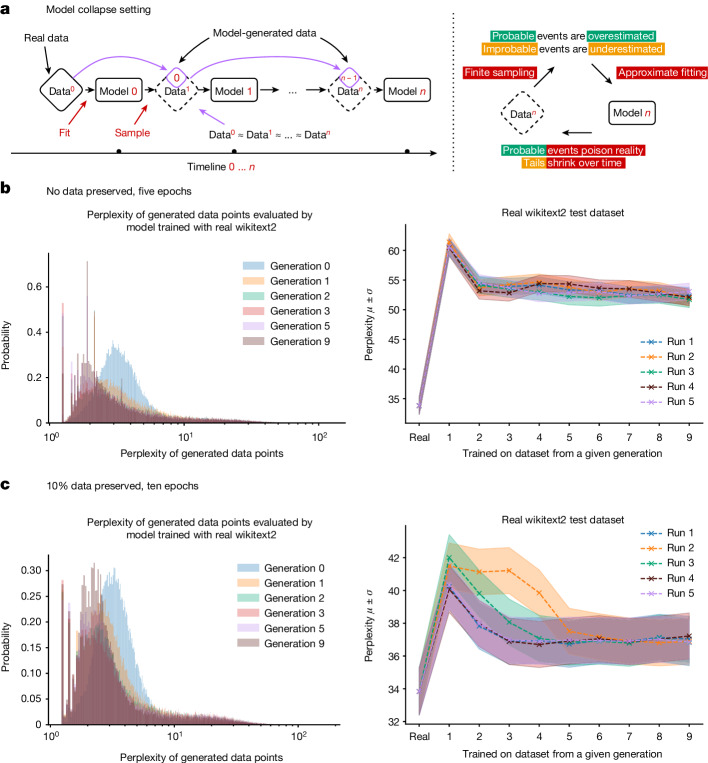
- In LLM experiments, an OPT-125m model fine-tuned on wikitext2 reaches 34 mean perplexity from a zero-shot baseline of 115. With five epochs and no original training data, performance degrades “from 20 to 28 perplexity points”; with ten epochs and 10% of original training data preserved, there is “only minor degradation of performance.”
- Generated data over generations contain more sequences the original model would produce with higher likelihood, but also much longer tails of sequences the original model would never produce, indicating accumulated errors.
- An ablation with a repeating penalty of 2.0 causes models to produce lower-score continuations to avoid repeats, and “causes the perplexity to double compared with the original”; models remain as susceptible to model collapse, if not more.
Methods
- Theoretical analysis of “learning with generational data”: a discrete distribution case with exact approximation, analyzed as a Markov chain, and a multidimensional Gaussian approximation using unbiased sample mean and variance estimators, with Wasserstein-2 distance as the divergence measure.
- LLM experiments fine-tune the OPT-125m causal language model from Meta via Hugging Face on wikitext2. Data generation uses five-way beam search; training sequences are blocked to 64 tokens, and for each token sequence the model predicts the next 64 tokens, producing an artificial dataset of the same size. Each experiment is run five times with different randomness seeds, and the best-performing model on the original task is used as the base for subsequent generations.
- Two LLM settings are tested: five epochs with no original training data retained, and ten epochs with a random 10% of original data points sampled for each new generation. VAEs and GMMs are covered in the Supplementary Materials.
Limitations
- The paper states that theoretical claims are mostly presented in the limit of generations going to infinity, whereas experiments use a finite, usually small, number of generations; complete collapse may or may not occur even after a small number of steps, and convergence rates are highly related to the specifics of the problem.
- The paper states that larger language models in non-fine-tuning settings were not run because training a single moderately large model produces twice the American lifetime’s worth of CO2; the LLM experiments are a fine-tuning proof of concept, and even those took weeks to run.
- Evident from the text: the LLM evidence is limited to OPT-125m, wikitext2, five runs, and fine-tuning; no full retraining from scratch is tested, and VAE/GMM details are relegated to the Supplementary Materials.
Model-written summary. Check it against the paper before relying on it.
Integrity signals
Registry
Cites
Statistics
Figures
Verification
Claims the paper makes
1 Valid · 0 Not valid · 3 Not checked · 40 Own results and interpretations
The cited sources support only part of this claim — read each source’s verdict below.
In the paper
“The repeating problem has been observed in nearly all text-generation models17,18”
§ AI models collapse when trained on recursively generated data > Model collapse in language models > Ablation: Repetitions
What the sources say
- Partly supportedcites [17] Keskar, N. S., McCann, B., Varshney, L. R., Xiong, C. & Socher, R. CTRL: a conditional transformer language model for controllable generation. Preprint at https://arxiv.org/abs/1909.05858 (2019). sourceExperimental — accuracy not yet measured
The Related Work section (p. 10) identifies repetition as a problem in text generation and discusses methods for reducing it. It does not say the problem has been observed in nearly all text-generation models; that prevalence claim is unsupported. (LLM, conf=0.86)
- Could not verifycites [18] Shumailov, I. et al. in Proc. 2021 IEEE European Symposium on Security and Privacy (EuroS&P) 212–231 (IEEE, 2021). sourceExperimental — accuracy not yet measured
Section 5.2 discusses attacks that increase output length, energy use, and latency, but not repetitive generated text. Searches for “repeating problem,” “repeated output,” and “repeat” found no passage saying that repetition has been observed in nearly all text-generation models; page numbers were unavailable in our copy. (LLM, conf=0.76)
plain- Asserted: passes — The authors put it forward as true.
- Checkable: passes — It can be checked against evidence.
- Load-bearing: unclear — It is unclear whether the paper’s conclusions depend on it.
- Based: passes — The paper gives a reason why it holds.
- Partly supported
A result the paper reports from its own data — it cites no other source for it, so there is none to check. The quote shows it is in the paper.
In the paper
“Here, over the generations, models tend to produce more sequences that the original model would produce with the higher likelihood.”
§ AI models collapse when trained on recursively generated data > Model collapse in language models
plainstates an association- Asserted: passes — The authors put it forward as true.
- Checkable: passes — It can be checked against evidence.
- Load-bearing: passes — The paper’s conclusions depend on it.
- Based: passes — The paper gives a reason why it holds.
A result the paper reports from its own data — it cites no other source for it, so there is none to check. The quote shows it is in the paper.
In the paper
“We find that data generated by language models in our experiments end up containing a large number of repeating phrases, as in Example 1.”
§ AI models collapse when trained on recursively generated data > Model collapse in language models > Ablation: Repetitions
plain- Asserted: passes — The authors put it forward as true.
- Checkable: passes — It can be checked against evidence.
- Load-bearing: unclear — It is unclear whether the paper’s conclusions depend on it.
- Based: passes — The paper gives a reason why it holds.
A result the paper states — it cites no source for it, so there is none to check. The quote shows it is in the paper.
In the paper
“we can show that the probability of losing information (that is, sampling no data at some generation) is equal to 1 − q”
§ AI models collapse when trained on recursively generated data > Theoretical intuition > Discrete distributions with exact approximation
plain- Asserted: passes — The authors put it forward as true.
- Checkable: passes — It can be checked against evidence.
- Load-bearing: passes — The paper’s conclusions depend on it.
- Based: passes — The paper gives a reason why it holds.
- Rests on an assumption not shown here.
A result the paper reports from its own data — it cites no other source for it, so there is none to check. The quote shows it is in the paper.
In the paper
“We discover that indiscriminately learning from data produced by other models causes ‘model collapse’—a degenerative process whereby, over time, models forget the true underlying data distribution, even in the absence of a shift in the distribution over time.”
§ AI models collapse when trained on recursively generated data > Main
plainstates a cause- Asserted: passes — The authors put it forward as true.
- Checkable: passes — It can be checked against evidence.
- Load-bearing: passes — The paper’s conclusions depend on it.
- Based: passes — The paper gives a reason why it holds.
11 more claims
Create a free account to see all 44 claims and every source verdict.
- It may state two separate claims as one. 22
- The quote only partly states this claim. 1
- Probably not a substantial claim. 10
Claims other papers make about this one
Each is checked against this paper’s own text: does it say what the citing paper says it does?
The source backs part of the claim, not all of it — or backs it for a different population, condition or comparison.
In the citing paper
“Second, LLMs are frequently trained on the same open-access corpora we examine, creating a feedback loop in which tomorrow's models will learn today's hallucinations [34].”
From LLM hallucinations in the wild: Large-scale evidence from non-existent citations (2026) · cites this paper as [34]
Experimental — accuracy not yet measuredThe source backs part of the claim, not all of it — or backs it for a different population, condition or comparison.
In the citing paper
“Successive training cycles cause LLMs to “forget” the statistical long-tail of rare but important patterns, resulting in homogenized, impoverished, and epistemically diminished outputs.”
From 4E cognition and the coevolution of human–AI interaction (2025) · cites this paper as [61]
Experimental — accuracy not yet measuredThe source backs part of the claim, not all of it — or backs it for a different population, condition or comparison.
In the citing paper
“AI-generated content now saturates the internet, reducing reliability and contaminating training data for future models (Paredes et al., 2025;Shumailov et al., 2024).”
From Purpose before policy: academic integrity, generative AI, and rhetorical stance (2026) · cites this paper as Shumailov et al., 2024
Experimental — accuracy not yet measuredThe source backs part of the claim, not all of it — or backs it for a different population, condition or comparison.
In the citing paper
“As successive generations of models are trained on data increasingly contaminated by historical synthetic outputs, the system progressively erodes distributional diversity and collapses functional modes—a degenerative process that remains robust to scale and is highly sensitive to even minimal synthetic fractions [14,15].”
From Self-Referential Introspection in Large Language Models: The Critical Threshold for Recursive Self-Improvement (2026) · cites this paper as [14]
Experimental — accuracy not yet measuredThe source backs part of the claim, not all of it — or backs it for a different population, condition or comparison.
In the citing paper
“The accumulation of synthetic data may affect model output quality, reinforce existing biases, and alter information feedback dynamics, thereby posing potential challenges to the stability of the digital knowledge ecosystem (Shumailov et al., 2024).”
From The Attention Mismatch: Mapping the Structural Academic Governance Deficit in the Age of Generative AI (2026) · cites this paper as Shumailov et al., 2024
Experimental — accuracy not yet measured
19 more claims about this paper
Create a free account to see every claim other papers make about this one.
Self-check
Percentages, sums and reported differences re-computed from the paper’s own numbers.
Each contradiction between two passages listed here was confirmed by an independent check.
Rated minor: it would not touch a result — a value no result rests on, a p-value that stays on the same side of the significance level, or a conflict that is clerical, resolved elsewhere in the paper, or outside its own findings.
In the paper
§ AI models collapse when trained on recursively generated data > Abstract
“GPT-2 (ref. 1), GPT-3(.5) (ref. 2) and GPT-4 (ref. 3)”
§ AI models collapse when trained on recursively generated data > Model collapse in language models
“BERT4, RoBERTa5 or GPT-2 (ref. 2)”
Citations
Cites
Language Models are Few-Shot Learners
Brown, T. B., Mann, B., Ryder, N., Subbiah, M., Kaplan, J., Dhariwal, P., Neelakantan, A., Shyam, P., Sastry, G., Askell, A., et al. (2020) · arXiv · doi:10.48550/arxiv.2005.14165 · Cited by 23,372
RoBERTa: A Robustly Optimized BERT Pretraining Approach
Liu, Y., Ott, M., Goyal, N., Du, J., Joshi, M., Chen, D., Levy, O., Lewis, M., Zettlemoyer, L., & Stoyanov, V. (2019) · arXiv · doi:10.48550/arxiv.1907.11692 · Cited by 16,515
Li, Z., & Hoiem, D. (2018) · IEEE Transactions on Pattern Analysis and Machine Intelligence · doi:10.1109/tpami.2017.2773081 · Cited by 4,202
Energy and Policy Considerations for Deep Learning in NLP
Strubell, E., Ganesh, A., & McCallum, A. (2019) · arXiv · doi:10.48550/arxiv.1906.02243 · Cited by 3,735
5th International Conference on Learning Representations (ICLR 17)
Havrylov, S., & Titov, I. (2017) · Cited by 3,503
Deep Neural Networks are Easily Fooled: High Confidence Predictions for Unrecognizable Images
Nguyen, A., Yosinski, J., & Clune, J. (2014) · arXiv · doi:10.48550/arxiv.1412.1897 · Cited by 3,258
Deep neural networks are easily fooled: High confidence predictions for unrecognizable images
Nguyen, A., Yosinski, J., & Clune, J. (2015) · 2015 IEEE Conference on Computer Vision and Pattern Recognition (CVPR) · doi:10.1109/cvpr.2015.7298640 · Cited by 3,258
On the Opportunities and Risks of Foundation Models
Bommasani, R., Hudson, D. A., Adeli, E., Altman, R., Arora, S., von Arx, S., Bernstein, M. S., Bohg, J., Bosselut, A., Brunskill, E., et al. (2021) · arXiv · doi:10.48550/arxiv.2108.07258 · Cited by 2,676
Poisoning Attacks against Support Vector Machines
Biggio, B., Nelson, B., & Laskov, P. (2012) · arXiv · doi:10.48550/arxiv.1206.6389 · Cited by 1,331
The Implicit Bias of Gradient Descent on Separable DataPreprint
Soudry, D., Hoffer, E., Nacson, M. S., Gunasekar, S., & Srebro, N. (2017) · arXiv (Cornell University) · doi:10.48550/arxiv.1710.10345 · Cited by 829
Research works printed but not linked: 7
- Radford, A. et al. Language models are unsupervised multitask learners. OpenAI blog 1, 9 (2019).
- Devlin, J., Chang, M.-W., Lee, K. & Toutanova, K. in Proc. 2019 Conference of the North American Chapter of the Association for Computational Linguistics: Human Language Technologies, Volume 1 (Long and Short Papers) (eds Burstein, J., Doran, C. & Solorio, T.) 4171–4186 (Association for Computational Linguistics, 2019).
- Carlini, N. & Terzis, A. in Proc. Tenth International Conference on Learning Representations (ICLR, 2022).
- Carlini, N. et al. in Proc. 2024 IEEE Symposium on Security and Privacy (SP) 179 (IEEE, 2024).
- Mousavi-Hosseini, A., Park, S., Girotti, M., Mitliagkas, I. & Erdogdu, M. A. in Proc. Eleventh International Conference on Learning Representations (ICLR, 2023).
- Gu, Y., Dong, L., Wei, F. & Huang, M. in Proc. Twelfth International Conference on Learning Representations (ICLR, 2024).
- Strubell, E., Ganesh, A. & McCallum, A. in Proc. 57th Annual Meeting of the Association for Computational Linguistics (eds Korhonen, A., Traum, D. & Màrquez, L.) 3645–3650 (Association for Computational Linguistics, 2019).
Cited by
Items 301–400 of 789
Powell, R. A. (2025) · Oxford University Press eBooks · doi:10.1093/9780191949142.003.0002 · Cited by 1
Ryu, H. S., Ju, U., & Wallraven, C. (2025) · IEEE Transactions on Visualization and Computer Graphics · doi:10.1109/tvcg.2025.3616811 · Cited by 3
“Consequently, if these spurious cues are absent or altered in real driving conditions, the learned policies become ineffective, potentially leading to severe failures despite strong performance in simulation [58].”
Xiao, X., Allouche, A.-R., Dartois, E., Magoulès, F., & Peláez, D. (2025) · Journal of Chemical Information and Modeling · doi:10.1021/acs.jcim.5c01286 · Cited by 1
Evaluatology-driven artificial intelligence
Kang, G., Gao, W., & Zhan, J. (2025) · BenchCouncil Transactions on Benchmarks Standards and Evaluations · doi:10.1016/j.tbench.2025.100245 · Cited by 1
Exocortex Network for AI-Augmented Human-Led Scientific Expedition
Tsai, E. H. R., & Yager, K. G. (2025) · Photon Science · doi:10.1021/photonsci.5c00009 · Cited by 5
Anti-Regulatory AI: How "AI Safety" is Leveraged Against Regulatory Oversight
Yew, R.-J., & Judge, B. (2025) · ACM Conference on Equity and Access in Algorithms, Mechanisms, and Optimization (EAAMO) · doi:10.1145/3757887.3763017 · Cited by 7
Lost in Retraining: Closed-Loop Learning and Model Collapse in Exponential Families
Jangjoo, F., di Sarra, G., Marsili, M., & Roudi, Y. (2026) · Physical Review Letters · doi:10.1103/156q-3ngc · Cited by 2
Forecasting Chaotic Dynamics Using a Hybrid System
Baia, M., Bagnoli, F., & Matteuzzi, T. (2025) · Complexities · doi:10.3390/complexities1010005 · Cited by 2
“…the difficulty modeling long-term temporal dependencies, and the lack of flexibility towards data external to the domain on which they were trained [39] (e.g., covariate shift and concept drift) make neural networks still unreliable for operational tasks, such as prediction in the atmospheric and…”
On the Feasibility of Poisoning Text-to-Image AI Models via Adversarial Mislabeling
Wu, S., Bhaskar, R., Ha, A. Y. J., Shan, S., Zheng, H., & Zhao, B. Y. (2025) · ACM SIGSAC Conference on Computer and Communications Security (CCS) · doi:10.1145/3719027.3744845 · Cited by 5
Sensorimotor Regularities as Alignment between Humans and Large Language Models
Li, J., Hu, J., & Kristensson, P. O. (2026) · ACM Transactions on Computer-Human Interaction · doi:10.1145/3778353 · Cited by 1
Iterative Corpus Refinement for Materials Property Prediction Based on Scientific Texts
Zhang, L., & Stricker, M. (2025) · Lecture notes in computer science · doi:10.1007/978-3-032-06118-8_6 · Cited by 2
Eren, S. U. N. A., & Özer, M. (2025) · Advances in computational intelligence and robotics book series · doi:10.4018/979-8-3373-7579-3.ch008 · Cited by 1
“Generative AI” and Writing in Higher Education: Editor's Introduction
MacArthur, M. J. (2025) · Critical AI · doi:10.1215/2834703x-12095937 · Cited by 2
GeNetE - Generative Network Environments: A Specialized Small Language Model
Burfeid, S., Rettore, P. H. L., Zißner, P., Sevenich, P., Celes, C. S. F. D. S., & Santos, B. P. (2025) · IEEE Military Communications Conference (MILCOM) · doi:10.1109/milcom64451.2025.11310543 · Cited by 2
“However, it is important to carefully balance and monitor the training data to avoid overfitting to trivial solutions [11].”
Ariel, N., & Riesenfeld, D. (2026) · AI & Society · doi:10.1007/s00146-025-02729-5
The Epistemic Impact of Large Language Models on Policymaking
Feng, N., & Chandra, Y. (2026) · Policy Studies Journal · doi:10.1111/psj.70094 · Cited by 2
Don’t Count Non-Targeted Seeding Out Just Yet
Dou, Y., Hu, H., Niculescu, M. F., & Wu, D. J. (2026) · Production and Operations Management · doi:10.1177/10591478261420000 · Cited by 1
“Nevertheless, this effect might be dampened by potentially reduced variance and quality of GenAI output, a phenomenon already documented in LLMs trained on synthetic data (Bhatia, 2024; Shumailov et al., 2024).”
The iron triangle in the age of AI?
Bowker, L. (2026) · Digital Translation · doi:10.1075/dt.00016.bow · Cited by 1
AI-designed drugs: clinical development and future directions
Ahmed, R., Akhtar, S., Das, A., Begum, K., Sarma, A., Chakraborty, A., Neog, T., & Banu, S. (2026) · Elsevier eBooks · doi:10.1016/b978-0-443-34059-8.00010-5 · Cited by 1
Alignment of Diffusion Models: Fundamentals, Challenges, and Future
Liu, B., Shao, S., Li, B., Bai, L., Xu, Z., Xiong, H., Kwok, J. T.-Y., Helal, S., & Xie, Z. (2026) · ACM Computing Surveys · doi:10.1145/3796982 · Cited by 50
Optimized to Death: The Hypernetic Law of Experience
Daniel, D. (2026) · Syst. · doi:10.3390/systems14020197 · Cited by 1
“Shumailov et al. [6] empirically observe this “convergence to delta” in recursively fine-tuned language models.”
InfluentialGao, R., Huang, L., Wang, Z., & Cang, S. (2026) · Journal of Engineering Design · doi:10.1080/09544828.2026.2629762 · Cited by 1
Peterson, C., Anderson, C., Berdine, G. G., & NUGENT, K. M. (2026) · Journal of Electronic Resources in Medical Libraries · doi:10.1080/15424065.2026.2626575 · Cited by 2
“This occurs when AI is trained on other AI-generated art; the output quality collapses to inco-herence (Shumailov et al., 2024).”
Power engineering domain pretrained language model with natural language processing benchmarks
Hwang, K., Kim, M., Lee, J., Jang, Y., Choi, K., Yu, J., Lim, J., & Oh, H. (2026) · Computers & Electrical Engineering · doi:10.1016/j.compeleceng.2026.111034 · Cited by 1
AI Hallucination in Financial Systems: Threats, Controls, and the Future of Risk Management
Harke, G. (2026) · Advances in computational intelligence and robotics book series · doi:10.4018/979-8-3373-7534-2.ch009 · Cited by 1
AI and research, are we (un)consciously guilty?
Couarraze, S., Joannès, C., & Roda, P. (2026) · AI and Ethics · doi:10.1007/s43681-026-01037-y · Cited by 1
“It has been demonstrated that (de)generative AI have the capacity to engage in cycles and discern whether they are training on their own data [31].”
Evaluating generative AI’s potential to dispel misinformation about wind farms
Pearson, S. G., Hornsey, M. J., Bretter, C., MacInnes, S., Nylund, J. L., Rekker, S. A. C., Smith, A. E., & Wade, B. (2026) · Scientific Reports · doi:10.1038/s41598-026-42790-8 · Cited by 1
“This has led many commentators to express concerns about the unintended consequences of GenAI tools, particularly their potential to amplify misinformation and conspiracy theories embedded within the broader information landscape, or to deteriorate when trained on recursively generated data 33,34 .”
Artificial moral characters: constitutional AI and the challenge of alignment
Noller, J. U. (2026) · AI and Ethics · doi:10.1007/s43681-026-01033-2 · Cited by 7
Manufacturing-aware generative models enable petascale synthesis of designed DNA
Weinstein, E. N., Gollub, M. G., Slabodkin, A., Dobbs, K., Cui, X.-B., Gardner, C. L., Grant, R. J., Gurung, K., Bailey, A., Amin, A. N., et al. (2026) · Nature Biotechnology · doi:10.1038/s41587-026-03020-8 · Cited by 5
Zhao, L., Han, Q., Li, P., Dai, H., & Ju, X. (2026) · BMC Medical Education · doi:10.1186/s12909-026-08947-9 · Cited by 4
Evaluating the Educational and Cultural Risks of Generative AI Videos in Arabic Learning Contexts
Abdelrehim, M., Salih, G., Shaalan, K. F., & Basiouni, A. (2026) · Procedia Computer Science · doi:10.1016/j.procs.2026.01.085 · Cited by 2
Engineering collective attention in the age of artificial intelligence
Zhu, R. (2026) · Discover Artificial Intelligence · doi:10.1007/s44163-026-01084-8 · Cited by 2
LLMs can pass the CCNA certification exam but do they understand networking?
Manocchio, L. D., Layeghy, S., Houssel, P. R. B., & Portmann, M. (2026) · Computer Networks · doi:10.1016/j.comnet.2026.112236 · Cited by 1
Positioning synthetic data under EU data protection law
Bartholdy, M. (2026) · Computer law & security review · doi:10.1016/j.clsr.2026.106310 · Cited by 3
Towards a theory of human creativity sustained by embodied collective intelligence
Daikoku, T. (2026) · Frontiers in Psychology · doi:10.3389/fpsyg.2026.1752280 · Cited by 3
“Moreover, empirical and theoretical work has shown that when models iteratively incorporate their own generated data into retraining, the distributional diversity erodes and both quality and variability decline—a phenomenon termed “model collapse” (Shumailov et al., 2024).”
Crowdsourced versus large language models forecasting: evidence for the accuracy–correlation effect
Jeddi, Y., Segovia‐Martín, J., & Servan-Schreiber, E. (2026) · Philosophical Transactions of the Royal Society B Biological Sciences · doi:10.1098/rstb.2024.0456 · Cited by 3
Pitfalls and risks of generative AI in machine learning
Lones, M. A. (2026) · Patterns · doi:10.1016/j.patter.2026.101534 · Cited by 5
“85 This risk is growing as synthetic data become more prevalent in pre-training pipelines.”
Science Behind a Paywall: Restricted Access Limits the Promise of Artificial Intelligence
Zheng, H., & Zhan, H. (2026) · Learned Publishing · doi:10.1002/leap.2059 · Cited by 4
Straňák, P. (2026) · Symmetry · doi:10.3390/sym18050764 · Cited by 1
Large Language Models for Clinical Narrative Processing: Methods, Applications, and Challenges
Livieratos, A., Lin, J., Chasani, P., Gaga, M., Fousekis, F. S., Gogos, C. A., Akinosoglou, K., Katsanos, K. H., & Gamalo, M. (2026) · Methods and Protocols · doi:10.3390/mps9030069 · Cited by 2
“Furthermore, the growing use of LLM-generated data introduces the risk of model collapse or degenerative feedback loops, where future models are trained on outputs produced by earlier models, potentially amplifying errors and reducing information quality [83].”
Chan, H., & Erduran, S. (2026) · Research in Science & Technological Education · doi:10.1080/02635143.2026.2669549 · Cited by 1
AI and the machinization of humans: an escape from the burdens of existence
Beerends, S., Gertz, N., & Aydin, C. (2026) · AI and Ethics · doi:10.1007/s43681-026-01126-y · Cited by 3
“Scientists from various disciplines discuss how computational machines suffer from inherent limitations such as data-dependency, disembodiment, hallucinations, lack of explainability, and model collapse [38, 58, 67].”
The Silent Scholar Problem: A Probabilistic Framework for Breaking Epistemic Asymmetry in LLM Agents
Chong, Z., Ohsaki, H., & Ng, B. (2026) · IEEE International Conference on Robotics and Technologies for Industrial Automation (ROBOTHIA) · doi:10.1109/robothia68364.2026.11506698 · Cited by 1
“In this degenerative state, the agent’s belief distribution loses variance, and it becomes confidently wrong and incapable of adapting to concept drift [16].”
Foundation model-based generative AI for smart manufacturing: A paradigm shift
Zheng, H., Geng, Z., & Xu, X. W. (2026) · ENGINEERING Management · doi:10.1007/s42524-026-5359-0 · Cited by 7
“First, the indiscriminate use of synthetic data risks model collapse (Shumailov et al., 2024), a degenerative process where recursive training on generated outputs progressively degrades model variance and fidelity.”
Zhou, K., Yang, Z., & Gao, Y. (2026) · Technological Forecasting and Social Change · doi:10.1016/j.techfore.2026.124739 · Cited by 1
Alshammari, A. A., & Alsaleh, O. I. (2026) · Electronics · doi:10.3390/electronics15112242 · Cited by 3
The Concept of Meta-Accurate Parameters and Its Application to Molecular Structure
Vishnevskiy, Y. V. (2026) · The Journal of Physical Chemistry A · doi:10.1021/acs.jpca.6c02042 · Cited by 1
Sharks, L., Fraction, R., Glas, N., et al. (2026) · Zenodo (CERN European Organization for Nuclear Research) · doi:10.5281/zenodo.20531823 · Cited by 1
Sharks, L. (2026) · Zenodo (CERN European Organization for Nuclear Research) · doi:10.5281/zenodo.20598465 · Cited by 1
The Pseudo-Confidence Paradox: The Epistemic Gap in Everyday AI Use
Kurmanbayeva, L. T., Tanabayeva, A., Doszhanova, A. I., Shashayeva, G. K., Bakarassov, D., & Knar, E. (2026) · Philosophies · doi:10.3390/philosophies11030097 · Cited by 2
“Studies have shown that the recursive use of generated data in model training may lead to quality degradation, loss of rare elements of the original distribution, and narrowing of informational diversity [29].”
Prompt Culture: From Lines to Surfaces in AI Image Generation
Musih, N. (2026) · Theory Culture & Society · doi:10.1177/02632764261455347 · Cited by 1
Park, Y., Ha, H., Jo, W., & Oh, T.-H. (2026) · IEEE Robotics and Automation Letters · doi:10.1109/lra.2026.3711478 · Cited by 2
“Moreover, to ensure benchmark integrity and prevent potential data contamination [11], all QA pairs are deterministi-cally generated via a rule-based procedure, rather than depending on commodity VLM services.”
Sheng, K., Tuyttens, F., & von Keyserlingk, M. A. G. (2026) · Technology in Society · doi:10.1016/j.techsoc.2026.103466 · Cited by 8
Artificial intelligence needs to see a psychologist about its alignment problem
Wielkiewicz, R. M., & Moritsugu, J. N. (2026) · Journal of Psychology and AI · doi:10.1080/29974100.2026.2706780 · Cited by 1
Aliaga, C. A. T., Fuentes, V. G. H., Karim, H. B. A., AlDahoul, N., & Tan, M. J. (2026) · Frontiers in Artificial Intelligence · doi:10.3389/frai.2026.1894116 · Cited by 2
Bariach, B., Schoenegger, P., Bhaskar, M., & Suleyman, M. (2026) · AI and Ethics · doi:10.1007/s43681-026-01294-x · Cited by 6
AI Agents and the Progressive Intermediation Between Users and Online Services: A Critical Analysis
Rondina, M., Vetrò, A., Martin, J. C. D., Bargis, M., & Elia, G. (2026) · Future Internet · doi:10.3390/fi18080419 · Cited by 1
LLM-NAS: LLM-driven Hardware-Aware Neural Architecture Search
Zhu, H., Zhang, G. L., & Huang, S. (2026) · Genetic and Evolutionary Computation Conference Companion (GECCO Companion) · doi:10.1145/3795101.3805321 · Cited by 4
“First, we observe the exploration bias issue, which is analogous to the mode collapse issue in generative models Shumailov et al. (2024); Kossale et al. (2022); Zhang et al. (2025).”
Tupu, A. E., Tudor, S. S., Dumitru, C. N., Ștefan, C. S., & Ferţu, D. I. (2026) · Journal of Clinical Medicine · doi:10.3390/jcm15166398 · Cited by 2
“These opportunities carry a specific risk already discussed in Section 6.2: when models are trained recursively on their own synthetic outputs, fidelity and diversity can progressively degrade, the phenomenon of model collapse [41].”
InfluentialÜnal, A. (2026) · Advances in computational intelligence and robotics book series · doi:10.4018/979-8-2600-1232-1.ch016 · Cited by 1
van Broekhoven, K., Ouwehand, K., de Koning, B. B., Nederhand, M. L., & Bocanegra, B. R. (2026) · Springer eBooks · doi:10.1007/978-3-032-24819-0_12 · Cited by 1
Cho, B. C., & Bang, J. (2024) · Journal of Broadcast Engineering · doi:10.5909/jbe.2024.29.5.596 · Cited by 3
Hieroglyphs, or science fiction icons and the rate and direction of innovation
Hartmann, R. K. (2024) · Innovation · doi:10.1080/14479338.2024.2442303 · Cited by 1
“…challenges around unit economics and intellectual property (e.g., Eliot, 2024; Kantrowitz, 2024), as well as concerning the technical difficulties of avoiding model breakdown when training on the AI-generated text that will undoubtedly start to creep into its training data (Shumailov et al., 2024).”
Double trouble: How AI efficiency is boosting speed but burdening team leaders and bypassing quality
Agrawal, A., & Ali, S. (2025) · Development in Learning Organizations An International Journal · doi:10.1108/dlo-11-2024-0344 · Cited by 1
A Black-Box Analysis of the Capacity of ChatGPT to Generate Datasets of Human-like Comments
Suárez, A. R., Sosa-Gómez, G., & Rojas, O. (2025) · Computers · doi:10.3390/computers14050162 · Cited by 3
Not Every AI Problem Is a Data Problem
Rodchenko, T., Noy, N. F., & Scherrer, N. (2025) · Communications of the ACM · doi:10.1145/3731656 · Cited by 4
How Generative Models Are Ruining Themselves
Aoun, M. A. (2025) · Communications of the ACM · doi:10.1145/3748642 · Cited by 2
Valadão, R., Glaser, V., & Hannigan, T. R. (2025) · Emerald Group Publishing Limited eBooks · doi:10.1108/s0733-558x20250000095003 · Cited by 1
Model Non-Collapse: Minimax Bounds for Recursive Discrete Distribution Estimation
Kanabar, M., & Gastpar, M. (2025) · IEEE International Symposium on Information Theory (ISIT) · doi:10.1109/isit63088.2025.11195231
“Consider the data replacement setting extensively explored in the machine learning literature (e.g. [5], [6], [8]–[12], [15]) where, at every stage t , the estimator only has access to samples generated in the current stage X nt .”
InfluentialSemantic Drift Working Notes III: Practical Evaluation Framework — Historical Record
Jacobs, A. (2025) · Zenodo (CERN European Organization for Nuclear Research) · doi:10.5281/zenodo.17037170 · Cited by 1
The Algorithmic Construction of Epistemic Injustice
McInerney, T. (2025) · Palgrave socio-legal studies · doi:10.1007/978-3-032-07581-9_5 · Cited by 9
The traffic concentration effects of urban navigation services
Cornacchia, G., Nanni, M., Pedreschi, D., & Pappalardo, L. (2026) · Nature Communications · doi:10.1038/s41467-026-75254-8 · Cited by 11
“These results are consistent with findings from other domains, where algorithms and AI systems have been shown to reinforce conformist behaviour and existing inequalities (e.g., in the recommendation of urban venues [34, 35] and products [36] as well as in content generation [37]).”
Generative AI Meets Data Quality: Innovation or Risk?Preprint
Chang, Q., Xie, D., & Zhang, L. (2025) · SSRN Electronic Journal · doi:10.2139/ssrn.5223738 · Cited by 2
Nowak, S., Salam, B., Luetkens, J. A., & Isaak, A. (2025) · European Radiology · doi:10.1007/s00330-025-11665-3 · Cited by 1
Baggio, S., & Tal, K. (2025) · General Hospital Psychiatry · doi:10.1016/j.genhosppsych.2025.05.008 · Cited by 1
Simulation Without Ground: Epistemic Collapse and Reflexive Ethics in Generative AIPreprint
Kadel, A. (2025) · SocArXiv (OSF Preprints) · doi:10.31235/osf.io/42fth_v1 · Cited by 3
Most Natural Machine Learning Method: KNN Classification and InferencePreprint
Zhang, S. (2025) · Preprints.org · doi:10.20944/preprints202507.1997.v1
Pretrained protein language models choose between sequence novelty and structural completenessPreprint
Subramanian, A. M., Martinez, Z. A., & Thomson, M. W. (2025) · bioRxiv (Cold Spring Harbor Laboratory) · doi:10.1101/2025.10.01.679905 · Cited by 4
“…and computer vision, this collapse to a subset of modes occurs without training data contamination and only weakly reflects the relative frequencies of these modes in the UniRef50 training data common to both ProtGPT2 and the ESM2 model family (versions 2021 04, and 2021 09, respectively) [32,33].”
Chen, L., Gao, C., Leung, A. C. M., & Wang, X. (2025) · SSRN Electronic Journal · doi:10.2139/ssrn.5693142 · Cited by 3
AI-induced cultural stagnation is no longer speculation − it’s already happening
Elgammal, A. (2026) · doi:10.64628/aai.ar34sjp6r · Cited by 1
Revealing the Gap: Visual Comparison of Large-Scale Datasets via Multi-Scale Density Difference Map
Guo, X., Zhu, X., Ye, Y., & Liu, S. (2026) · CHI Conference on Human Factors in Computing Systems · doi:10.1145/3772318.3791171
Day, P. L., Wieczorek, M. A., Rokke, D., Lantz, E., Bornhorst, J. A., Jannetto, P. J., & Carter, R. E. (2026) · Clinical Chemistry · doi:10.1093/clinchem/hvag001 · Cited by 1
Does Few-Shot Learning Help LLM Performance in Code Synthesis?
Xu, D., Xie, T., Xia, B., Li, H., Bai, Y., Sun, Y., & Wang, W. (2024) · arXiv · doi:10.48550/arxiv.2412.02906 · Cited by 3
Artificial Hivemind: The Open-Ended Homogeneity of Language Models (and Beyond)
Jiang, L., Chai, Y., Li, M., Liu, M., Fok, R., Dziri, N., Tsvetkov, Y., Sap, M., Albalak, A., & Choi, Y. (2025) · arXiv · doi:10.48550/arxiv.2510.22954 · Cited by 107
From Fluent to Verifiable: Claim-Level Auditability for Deep Research Agents
Rasheed, R. A., Banerjee, S., Mukherjee, A., & Hazra, R. (2026) · arXiv · doi:10.48550/arxiv.2602.13855 · Cited by 1
Guo, Z., Mao, H., & Zhang, F. (2026) · Publications · doi:10.3390/publications14020027
“The accumulation of synthetic data may affect model output quality, reinforce existing biases, and alter information feedback dynamics, thereby posing potential challenges to the stability of the digital knowledge ecosystem (Shumailov et al., 2024).”
Hiding From Generative AIPreprint
Lin, S. (2024) · SSRN Electronic Journal · doi:10.2139/ssrn.4793782 · Cited by 6
Kindle's Shadow: How Digitization Dims Novelty in Creative IndustriesPreprint
Kim, K., & Raj, M. (2024) · SSRN Electronic Journal · doi:10.2139/ssrn.4823725
Ali, L. M., Yim, A. K., Gerbi, E., Nguyen, T., Tu, N., Ikede, F., Sampaleanu, R., Grigore, D., Waligorski, J. E., Kremitzki, C. L., et al. (2024) · bioRxiv (Cold Spring Harbor Laboratory) · doi:10.1101/2024.08.02.605366
Groß, R. (2024) · AI & Society · doi:10.1007/s00146-024-02079-8 · Cited by 2
“5 This argument can be underscored by the fact that large language models tend to “collapse” when recursively trained on data generated by other models (Shumailov et al. 2024), thereby cutting their already loose ties to reality, so to speak.”
Recursive Cleaning for Large-scale Protein Data via Multimodal LearningPreprint
Jiang, Z., Zhang, S., Cao, J., Zhang, Q., Liu, S., Fang, Y., Zhang, L., Qing, R., & Xu, R. (2024) · bioRxiv (Cold Spring Harbor Laboratory) · doi:10.1101/2024.10.08.617190
“This underscores the critical importance of synthetic data filtration for model training Shumailov et al. (2024).”
BackgroundSynthetic consciousness architecture
Spasokukotskiy, K. (2024) · Frontiers in Robotics and AI · doi:10.3389/frobt.2024.1437496 · Cited by 2
AI is revolutionizing biomedical research, but are there any negatives?
Tang, B. L. (2024) · EXCLI journal · doi:10.17179/excli2024-7761
Lianos, L. (2024) · SSRN Electronic Journal · doi:10.2139/ssrn.5015910
Więcej niż „trudny problem świadomości”: o możliwości powstania świadomej sztucznej inteligencji
Przybysz, P. (2025) · Człowiek i Społeczeństwo · doi:10.14746/cis.2024.58.4
Ghosts in the Machine: Kafka and AI
Meyer, I. (2025) · Humanities · doi:10.3390/h14020025
The End of Print: A Roundtable
Durbach, N., Proctor, T. M., Clark, J. G., et al. (2025) · Journal of British Studies · doi:10.1017/jbr.2024.187
Detection avoidance techniques for large language models
Schneider, S., Steuber, F., Schneider, J., & Rodosek, G. D. (2025) · Data & Policy · doi:10.1017/dap.2025.6 · Cited by 2
Tanaka, T. (2025) · Humanities and Social Sciences Communications · doi:10.1057/s41599-025-04714-1 · Cited by 1
“Furthermore, in multimodal generative AI, natural photos and sounds could not only serve as the “ mean ” but also prevent model collapse (Shumailov et al. 2024).”
Liu, J., & Liu, C. (2025) · Communications in computer and information science · doi:10.1007/978-981-96-4298-4_16 · Cited by 1
Metadata
- Authors
- Shumailov, I., Shumaylov, Z., Zhao, Y., Papernot, N., Anderson, R., & Gal, Y.
- Affiliations
- University of Oxford (GB)
- University of Cambridge (GB)
- Imperial College London (GB)
- University of Toronto (CA)
- Corresponding author
- Shumailov, Ilia
- Shumaylov, Zakhar
- Gal, Yarin
- Venue
- Nature
- Published
- 2024-07-24
- Volume
- 631
- Issue
- 8022
- Pages
- 755-759
- ISSN
- 0028-0836 (ISSN-L)
- 1476-4687
- PMC
- PMC11269175
- OpenAlex
- W4400949264
- Semantic Scholar
- 603d3f90fc40f79ff51258f0295de3ec5107f73e
- Cited by
- 793
- References
- 11
- Citations by year
- 2026: 407 · 2025: 330 · 2024: 56
- FWCI
- 116.53
- Type
- journal article
- Language
- en
- Update notices
- correction (2025-03-21)
- Open access
- hybrid
- doi.org
- Licence
- cc-by
- creativecommons.org/licenses/by/4.0 (tdm)
- creativecommons.org/licenses/by/4.0 (vor)
- Locations
- Nature (publishedVersion, cc-by)
- PubMed Central (publishedVersion, cc-by)
- PubMed (publishedVersion)
- Apollo (University of Cambridge) (submittedVersion, cc-by)
- RePEc: Research Papers in Economics (submittedVersion)
- Edinburgh Research Explorer (University of Edinburgh) (submittedVersion, cc-by)
- Topics
- Physical Sciences › Computer Science › Artificial Intelligence › Topic Modeling
- Physical Sciences › Computer Science › Artificial Intelligence › Ethics and Social Impacts of AI
- Physical Sciences › Computer Science › Artificial Intelligence › Adversarial Robustness in Machine Learning
- Keywords
- model collapse, large language models, self-training, generative AI training data, variational autoencoder, Gaussian mixture model, distribution shift, web scraping, ChatGPT, generative models
About these checks
Registry, retraction, Cites and statistics results are computed, not judged, with one exception: a printed reference that no index lists is read once by a model before it counts as a citation error. Claims are extracted by a model and kept only when their quote appears verbatim in the text; each cited source is then checked, with a model’s help, for whether it says what the claim relies on. Those verdicts can be wrong — read the claim’s quote and the cited source before relying on one.
The claim verdicts this report counts are experimental: their accuracy is not yet measured.
A language model drew the claims from the paper on 2026-10-10, under version 3 of the claim definition (model deepseek-v4.1-flash, prompt extract-v3).
A second model labelled each claim on 2026-10-10 (model jev-1.13-20260917, definition revision gold-guideline-v0.2).
Cited sources are checked with a language model’s help (gpt-6-sol).
Statistics and arithmetic are recomputed, not judged.
Confidence bands are shown only for fields calibrated on our annotated test set. None is calibrated yet, so no band is shown.
What counts as a claim ›How we measure confidence ›How we check this ›
Are you an author, or do you see a problem with this page? Request a review
Data sources
Bibliographic data: Semantic Scholar, OpenAlex, Crossref.
Contains information from the Semantic Scholar Academic Graph Datasets, made available under the ODC Attribution License (ODC-BY 1.0).
Semantic Scholar’s data is described in: Kinney, R., et al. (2023). The Semantic Scholar Open Data Platform. arXiv:2301.10140.
