

AI models collapse when trained on recursively generated data
Open accessThe DOI matches its Crossref record; 18 of the 19 references it cites were found in a registry or an index; 2 of the 7 sources its claims cite were checked for support.
Abstract
) demonstrated high performance across a variety of language tasks. ChatGPT introduced such language models to the public. It is now clear that generative artificial intelligence (AI) such as large language models (LLMs) is here to stay and will substantially change the ecosystem of online text and images. Here we consider what may happen to GPT-{n} once LLMs contribute much of the text found online. We find that indiscriminate use of model-generated content in training causes irreversible defects in the resulting models, in which tails of the original content distribution disappear. We refer to this effect as 'model collapse' and show that it can occur in LLMs as well as in variational autoencoders (VAEs) and Gaussian mixture models (GMMs). We build theoretical intuition behind the phenomenon and portray its ubiquity among all learned generative models. We demonstrate that it must be taken seriously if we are to sustain the benefits of training from large-scale data scraped from the web. Indeed, the value of data collected about genuine human interactions with systems will be increasingly valuable in the presence of LLM-generated content in data crawled from the Internet.
Overview
CoChat Summary
TL;DR
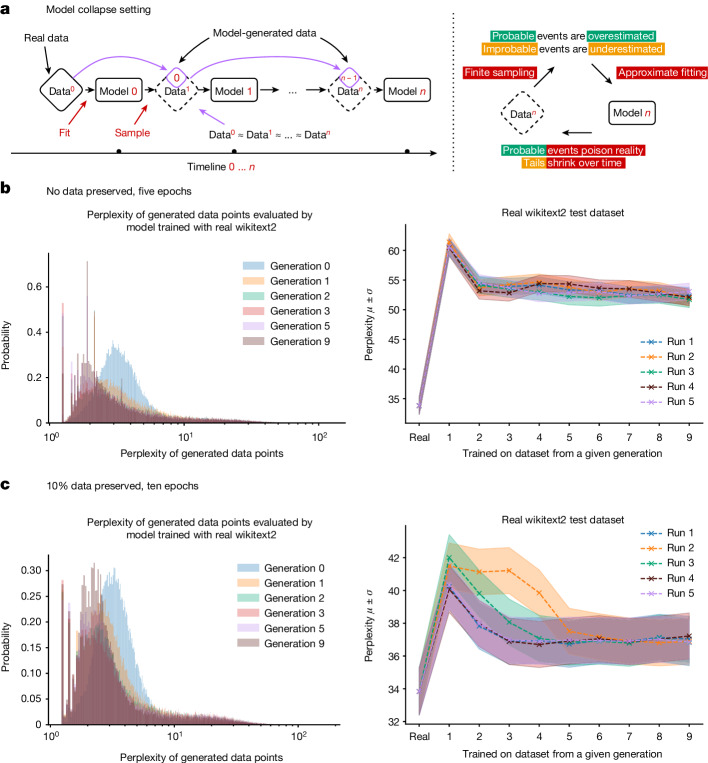
Indiscriminate use of model-generated content in training causes “model collapse,” a degenerative process in which generative models forget the true data distribution, beginning with the tails and eventually converging to a low-variance point estimate. The authors demonstrate this theoretically and empirically for Gaussian mixture models, variational autoencoders, and large language models.
Key findings
- Model collapse occurs across generative model families: in discrete distributions with exact approximation, the process converges to a delta function with probability 1; in the Gaussian setting, Theorem 3.1 states that the Wasserstein-2 distance between the true distribution and its approximation diverges arbitrarily far while variance collapses to zero as generations increase.
- In LLM experiments, an OPT-125m model fine-tuned on wikitext2 reaches 34 mean perplexity from a zero-shot baseline of 115. With five epochs and no original training data, performance degrades “from 20 to 28 perplexity points”; with ten epochs and 10% of original training data preserved, there is “only minor degradation of performance.”
- Generated data over generations contain more sequences the original model would produce with higher likelihood, but also much longer tails of sequences the original model would never produce, indicating accumulated errors.
- An ablation with a repeating penalty of 2.0 causes models to produce lower-score continuations to avoid repeats, and “causes the perplexity to double compared with the original”; models remain as susceptible to model collapse, if not more.
Methods
- Theoretical analysis of “learning with generational data”: a discrete distribution case with exact approximation, analyzed as a Markov chain, and a multidimensional Gaussian approximation using unbiased sample mean and variance estimators, with Wasserstein-2 distance as the divergence measure.
- LLM experiments fine-tune the OPT-125m causal language model from Meta via Hugging Face on wikitext2. Data generation uses five-way beam search; training sequences are blocked to 64 tokens, and for each token sequence the model predicts the next 64 tokens, producing an artificial dataset of the same size. Each experiment is run five times with different randomness seeds, and the best-performing model on the original task is used as the base for subsequent generations.
- Two LLM settings are tested: five epochs with no original training data retained, and ten epochs with a random 10% of original data points sampled for each new generation. VAEs and GMMs are covered in the Supplementary Materials.
Limitations
- The paper states that theoretical claims are mostly presented in the limit of generations going to infinity, whereas experiments use a finite, usually small, number of generations; complete collapse may or may not occur even after a small number of steps, and convergence rates are highly related to the specifics of the problem.
- The paper states that larger language models in non-fine-tuning settings were not run because training a single moderately large model produces twice the American lifetime’s worth of CO2; the LLM experiments are a fine-tuning proof of concept, and even those took weeks to run.
- Evident from the text: the LLM evidence is limited to OPT-125m, wikitext2, five runs, and fine-tuning; no full retraining from scratch is tested, and VAE/GMM details are relegated to the Supplementary Materials.
Model-written summary. Check it against the paper before relying on it.
Integrity signals
Registry
Cites
Statistics
Figures
Verification
Claims the paper makes
1 Valid · 0 Not valid · 3 Not checked · 40 Own results and interpretations
The cited sources support only part of this claim — read each source’s verdict below.
In the paper
“The repeating problem has been observed in nearly all text-generation models17,18”
§ AI models collapse when trained on recursively generated data > Model collapse in language models > Ablation: Repetitions
What the sources say
- Partly supportedcites [17] Keskar, N. S., McCann, B., Varshney, L. R., Xiong, C. & Socher, R. CTRL: a conditional transformer language model for controllable generation. Preprint at https://arxiv.org/abs/1909.05858 (2019). sourceExperimental — accuracy not yet measured
The Related Work section (p. 10) identifies repetition as a problem in text generation and discusses methods for reducing it. It does not say the problem has been observed in nearly all text-generation models; that prevalence claim is unsupported. (LLM, conf=0.86)
- Could not verifycites [18] Shumailov, I. et al. in Proc. 2021 IEEE European Symposium on Security and Privacy (EuroS&P) 212–231 (IEEE, 2021). sourceExperimental — accuracy not yet measured
Section 5.2 discusses attacks that increase output length, energy use, and latency, but not repetitive generated text. Searches for “repeating problem,” “repeated output,” and “repeat” found no passage saying that repetition has been observed in nearly all text-generation models; page numbers were unavailable in our copy. (LLM, conf=0.76)
plain- Asserted: passes — The authors put it forward as true.
- Checkable: passes — It can be checked against evidence.
- Load-bearing: unclear — It is unclear whether the paper’s conclusions depend on it.
- Based: passes — The paper gives a reason why it holds.
- Partly supported
A result the paper reports from its own data — it cites no other source for it, so there is none to check. The quote shows it is in the paper.
In the paper
“Here, over the generations, models tend to produce more sequences that the original model would produce with the higher likelihood.”
§ AI models collapse when trained on recursively generated data > Model collapse in language models
plainstates an association- Asserted: passes — The authors put it forward as true.
- Checkable: passes — It can be checked against evidence.
- Load-bearing: passes — The paper’s conclusions depend on it.
- Based: passes — The paper gives a reason why it holds.
A result the paper reports from its own data — it cites no other source for it, so there is none to check. The quote shows it is in the paper.
In the paper
“We find that data generated by language models in our experiments end up containing a large number of repeating phrases, as in Example 1.”
§ AI models collapse when trained on recursively generated data > Model collapse in language models > Ablation: Repetitions
plain- Asserted: passes — The authors put it forward as true.
- Checkable: passes — It can be checked against evidence.
- Load-bearing: unclear — It is unclear whether the paper’s conclusions depend on it.
- Based: passes — The paper gives a reason why it holds.
A result the paper states — it cites no source for it, so there is none to check. The quote shows it is in the paper.
In the paper
“we can show that the probability of losing information (that is, sampling no data at some generation) is equal to 1 − q”
§ AI models collapse when trained on recursively generated data > Theoretical intuition > Discrete distributions with exact approximation
plain- Asserted: passes — The authors put it forward as true.
- Checkable: passes — It can be checked against evidence.
- Load-bearing: passes — The paper’s conclusions depend on it.
- Based: passes — The paper gives a reason why it holds.
- Rests on an assumption not shown here.
A result the paper reports from its own data — it cites no other source for it, so there is none to check. The quote shows it is in the paper.
In the paper
“We discover that indiscriminately learning from data produced by other models causes ‘model collapse’—a degenerative process whereby, over time, models forget the true underlying data distribution, even in the absence of a shift in the distribution over time.”
§ AI models collapse when trained on recursively generated data > Main
plainstates a cause- Asserted: passes — The authors put it forward as true.
- Checkable: passes — It can be checked against evidence.
- Load-bearing: passes — The paper’s conclusions depend on it.
- Based: passes — The paper gives a reason why it holds.
11 more claims
Create a free account to see all 44 claims and every source verdict.
- It may state two separate claims as one. 22
- The quote only partly states this claim. 1
- Probably not a substantial claim. 10
Claims other papers make about this one
Each is checked against this paper’s own text: does it say what the citing paper says it does?
The source backs part of the claim, not all of it — or backs it for a different population, condition or comparison.
In the citing paper
“Second, LLMs are frequently trained on the same open-access corpora we examine, creating a feedback loop in which tomorrow's models will learn today's hallucinations [34].”
From LLM hallucinations in the wild: Large-scale evidence from non-existent citations (2026) · cites this paper as [34]
Experimental — accuracy not yet measuredThe source backs part of the claim, not all of it — or backs it for a different population, condition or comparison.
In the citing paper
“Successive training cycles cause LLMs to “forget” the statistical long-tail of rare but important patterns, resulting in homogenized, impoverished, and epistemically diminished outputs.”
From 4E cognition and the coevolution of human–AI interaction (2025) · cites this paper as [61]
Experimental — accuracy not yet measuredThe source backs part of the claim, not all of it — or backs it for a different population, condition or comparison.
In the citing paper
“AI-generated content now saturates the internet, reducing reliability and contaminating training data for future models (Paredes et al., 2025;Shumailov et al., 2024).”
From Purpose before policy: academic integrity, generative AI, and rhetorical stance (2026) · cites this paper as Shumailov et al., 2024
Experimental — accuracy not yet measuredThe source backs part of the claim, not all of it — or backs it for a different population, condition or comparison.
In the citing paper
“As successive generations of models are trained on data increasingly contaminated by historical synthetic outputs, the system progressively erodes distributional diversity and collapses functional modes—a degenerative process that remains robust to scale and is highly sensitive to even minimal synthetic fractions [14,15].”
From Self-Referential Introspection in Large Language Models: The Critical Threshold for Recursive Self-Improvement (2026) · cites this paper as [14]
Experimental — accuracy not yet measuredThe source backs part of the claim, not all of it — or backs it for a different population, condition or comparison.
In the citing paper
“The accumulation of synthetic data may affect model output quality, reinforce existing biases, and alter information feedback dynamics, thereby posing potential challenges to the stability of the digital knowledge ecosystem (Shumailov et al., 2024).”
From The Attention Mismatch: Mapping the Structural Academic Governance Deficit in the Age of Generative AI (2026) · cites this paper as Shumailov et al., 2024
Experimental — accuracy not yet measured
19 more claims about this paper
Create a free account to see every claim other papers make about this one.
Self-check
Percentages, sums and reported differences re-computed from the paper’s own numbers.
Each contradiction between two passages listed here was confirmed by an independent check.
Rated minor: it would not touch a result — a value no result rests on, a p-value that stays on the same side of the significance level, or a conflict that is clerical, resolved elsewhere in the paper, or outside its own findings.
In the paper
§ AI models collapse when trained on recursively generated data > Abstract
“GPT-2 (ref. 1), GPT-3(.5) (ref. 2) and GPT-4 (ref. 3)”
§ AI models collapse when trained on recursively generated data > Model collapse in language models
“BERT4, RoBERTa5 or GPT-2 (ref. 2)”
Citations
Cites
Language Models are Few-Shot Learners
Brown, T. B., Mann, B., Ryder, N., Subbiah, M., Kaplan, J., Dhariwal, P., Neelakantan, A., Shyam, P., Sastry, G., Askell, A., et al. (2020) · arXiv · doi:10.48550/arxiv.2005.14165 · Cited by 23,372
RoBERTa: A Robustly Optimized BERT Pretraining Approach
Liu, Y., Ott, M., Goyal, N., Du, J., Joshi, M., Chen, D., Levy, O., Lewis, M., Zettlemoyer, L., & Stoyanov, V. (2019) · arXiv · doi:10.48550/arxiv.1907.11692 · Cited by 16,515
Li, Z., & Hoiem, D. (2018) · IEEE Transactions on Pattern Analysis and Machine Intelligence · doi:10.1109/tpami.2017.2773081 · Cited by 4,202
Energy and Policy Considerations for Deep Learning in NLP
Strubell, E., Ganesh, A., & McCallum, A. (2019) · arXiv · doi:10.48550/arxiv.1906.02243 · Cited by 3,735
5th International Conference on Learning Representations (ICLR 17)
Havrylov, S., & Titov, I. (2017) · Cited by 3,503
Deep Neural Networks are Easily Fooled: High Confidence Predictions for Unrecognizable Images
Nguyen, A., Yosinski, J., & Clune, J. (2014) · arXiv · doi:10.48550/arxiv.1412.1897 · Cited by 3,258
Deep neural networks are easily fooled: High confidence predictions for unrecognizable images
Nguyen, A., Yosinski, J., & Clune, J. (2015) · 2015 IEEE Conference on Computer Vision and Pattern Recognition (CVPR) · doi:10.1109/cvpr.2015.7298640 · Cited by 3,258
On the Opportunities and Risks of Foundation Models
Bommasani, R., Hudson, D. A., Adeli, E., Altman, R., Arora, S., von Arx, S., Bernstein, M. S., Bohg, J., Bosselut, A., Brunskill, E., et al. (2021) · arXiv · doi:10.48550/arxiv.2108.07258 · Cited by 2,676
Poisoning Attacks against Support Vector Machines
Biggio, B., Nelson, B., & Laskov, P. (2012) · arXiv · doi:10.48550/arxiv.1206.6389 · Cited by 1,331
The Implicit Bias of Gradient Descent on Separable DataPreprint
Soudry, D., Hoffer, E., Nacson, M. S., Gunasekar, S., & Srebro, N. (2017) · arXiv (Cornell University) · doi:10.48550/arxiv.1710.10345 · Cited by 829
Research works printed but not linked: 7
- Radford, A. et al. Language models are unsupervised multitask learners. OpenAI blog 1, 9 (2019).
- Devlin, J., Chang, M.-W., Lee, K. & Toutanova, K. in Proc. 2019 Conference of the North American Chapter of the Association for Computational Linguistics: Human Language Technologies, Volume 1 (Long and Short Papers) (eds Burstein, J., Doran, C. & Solorio, T.) 4171–4186 (Association for Computational Linguistics, 2019).
- Carlini, N. & Terzis, A. in Proc. Tenth International Conference on Learning Representations (ICLR, 2022).
- Carlini, N. et al. in Proc. 2024 IEEE Symposium on Security and Privacy (SP) 179 (IEEE, 2024).
- Mousavi-Hosseini, A., Park, S., Girotti, M., Mitliagkas, I. & Erdogdu, M. A. in Proc. Eleventh International Conference on Learning Representations (ICLR, 2023).
- Gu, Y., Dong, L., Wei, F. & Huang, M. in Proc. Twelfth International Conference on Learning Representations (ICLR, 2024).
- Strubell, E., Ganesh, A. & McCallum, A. in Proc. 57th Annual Meeting of the Association for Computational Linguistics (eds Korhonen, A., Traum, D. & Màrquez, L.) 3645–3650 (Association for Computational Linguistics, 2019).
Cited by
Items 501–600 of 789
Harper, G. (2025) · Springer eBooks · doi:10.1007/978-3-031-99101-1_7
When Competition Consumes Diversity: A Theoretical Framework for Generative Collapse
Wang, T. (2025) · International Conference on Mathematics and Machine Learning (ICMML) · doi:10.1145/3783779.3783839
“Recent work on “self-consuming” training loops substantiates this pattern—recursive self-training causes information loss and model collapse [8], while Alemohammad et al. [1] formalized this as Model Autophagy Disorder (MAD) and proposed mitigation approaches [7].”
Data augmentation in pedigreed forest tree population improves genomic prediction accuracy
Klápště, J., Suontama, M., Telfer, E., Graham, N. J., Stovold, G. T., McKinley, R. B., Low, C. B., & Dungey, H. S. (2026) · Genetic Resources and Crop Evolution · doi:10.1007/s10722-025-02713-4
“This concern echoes findings in other domains, such as the degradation of large language models trained on synthetic or recycled data (Shumailov et al. 2024), highlighting the broader implications of data fidelity.”
Computer Mediated Creative Writing (CMCW): A Process-Oriented Framework for Human–AI CollaborationPreprint
Bugiolacchi, M. (2026) · SSRN Electronic Journal · doi:10.2139/ssrn.6052219
Minding the gap between artificial and biological computing paradigms for biologically loyal AI
Kirkpatrick, K. (2026) · Frontiers in Systems Neuroscience · doi:10.3389/fnsys.2025.1695493
“A secret of the AI world is that there are legions of humans supporting each AI model, and yet the models often get worse over time, as in the examples of ChatGPT (Chen et al., 2024; Shumailov et al., 2024).”
Boiling Frogs: Generative Models, Synthetic Data, and the Opinions of their Users
Marchi, M., Silvestre, J. P., Soatto, S., et al. (2025) · Proceedings of the IEEE Conference on Decision & Control, including the Symposium on Adaptive Processes · doi:10.1109/cdc57313.2025.11312527
“…studies warn that models trained on data produced by other generative models can suffer from model collapse, a degenerative feedback loop whereby the model gradually forgets the true underlying data distribution and amplifies its own errors over time [3], possibly leading to repetitive outputs [4].”
Lloyd, S. A. M., Swift, C.-L., Pritchard, A. G., Nehring, G. I., Stubbs, T., & Nichol, A. (2026) · Medical dosimetry · doi:10.1016/j.meddos.2025.12.001
Garrido-Merchán, E. C. (2026) · Razón y fe: Revista hispanoamericana de cultura · doi:10.14422/ryf.vol289.i1467.y2025.001
The U.S. Is Betting the Economy on ‘Scaling’ AI: Where Is the Intelligence When One Needs It?
Storm, S. (2025) · International Journal of Political Economy · doi:10.1080/08911916.2026.2616133 · Cited by 8
“In an ironic twist, the supply of AI-slop will only increase in the future, because due to the lack of ‘authentic training data’ (Al-Sibai 2024), LLMs will increase their input of ‘synthetic’ AI-generated artificial data—an incredible act of self-poisoning (Shumailov et al. 2024; Al-Sibai 2025b).”
Diaz, M. (2026) · SSRN Electronic Journal · doi:10.2139/ssrn.6001374
The Authoritative Synthesis Trap: Human-AI Collaboration and the Quality of SciencePreprint
Leippold, M. (2026) · SSRN Electronic Journal · doi:10.2139/ssrn.6080627 · Cited by 1
Motamarri, S. S., Chaitanya, N., Krishnan, G., & Agarwal, P. R. (2026) · Smart innovation, systems and technologies · doi:10.1007/978-3-032-12830-0_24
Teikari, P. (2026) · SSRN Electronic Journal · doi:10.2139/ssrn.6109087
Phase Transition in AI Assertion Behavior: Structural Resistance to Entropic AveragingPreprint
Takagi, T. (2026) · Research Square · doi:10.21203/rs.3.rs-8738395/v1
Intelligence artificielle / intelligence humaine : qui contrôle qui ?
Jacquemot, C. (2026) · Archives de philosophie du droit · doi:10.3917/apd.661.0038
Talking to Our Students About Generative AI
Rebelsky, W. (2026) · ACM Technical Symposium on Computer Science Education (SIGCSE) · doi:10.1145/3770762.3772642 · Cited by 1
Unforgeable Watermarks for Language Models via Robust Signatures
Lin, H., Shahabi, K., & Song, M. J. (2026) · Lecture notes in computer science · doi:10.1007/978-3-032-35415-0_4 · Cited by 4
Countering Model Collapse in Iterative Self-Training via Dynamic Center-Edge Sampling
Zhu, B., & Xie, Y. (2026) · Electronics · doi:10.3390/electronics15040869
Watching the Well Run Dry: Digital Settler Colonialism*
Jernigan, H. (2026) · Springer eBooks · doi:10.1007/978-3-032-05155-4_7
Pluralism as Architecture: The Philosophy of Multi-Agent Design
Hines, J. (2026) · Springer eBooks · doi:10.1007/978-3-032-06558-2_2
Hidden Good-to-Bad Tipping in ChatGPT-Like AI
Restrepo, N. J., Restrepo, D. J., Huo, F. Y., & Johnson, N. F. (2026) · AI Computer Science and Robotics Technology · doi:10.5772/acrt20250142
Ariel, N., & Riesenfeld, D. (2026) · Oxford University Press eBooks · doi:10.1093/9780197809563.003.0002
Stating the Obvious: An Introduction to Clichés
Ariel, N., & Riesenfeld, D. (2026) · Oxford University Press eBooks · doi:10.1093/9780197809563.003.0001
How We Learned to Stop Worrying and Start Exploring Clichés: A Dialogical Afterword
Ariel, N., & Riesenfeld, D. (2026) · Oxford University Press eBooks · doi:10.1093/9780197809563.003.0007
Ariel, N., & Riesenfeld, D. (2026) · Oxford University Press eBooks · doi:10.1093/9780197809563.003.0005
Clichés Between Convention and Event
Ariel, N., & Riesenfeld, D. (2026) · Oxford University Press eBooks · doi:10.1093/9780197809563.003.0004
Ariel, N., & Riesenfeld, D. (2026) · Oxford University Press eBooks · doi:10.1093/9780197809563.003.0003
Clichés and Artificial Intelligence
Ariel, N., & Riesenfeld, D. (2026) · Oxford University Press eBooks · doi:10.1093/9780197809563.003.0006
Clichés We Live By: From Modernity to AI
Ariel, N., & Riesenfeld, D. (2026) · doi:10.1093/9780197809563.001.0001 · Cited by 1
Will AI accelerate or undermine the way humans have always innovated?
Bentley, R. A. (2026) · The Conversation · doi:10.64628/aai.mjsrjrqw3
Park, K. H. (2026) · Korean Medical Education Review · doi:10.17496/kmer.26.002
Large Language Models Readability Classification: A Variability Analysis of Sources and MetricsPreprint
de Matos, H. G. C., Wasmann, J.-W. A., Morata, T. C., Alvarenga, K. D. F., & JACOB, L. C. B. (2026) · medRxiv · doi:10.64898/2026.02.20.26346638 · Cited by 1
Chen, Y., Lei, M., Liu, Z., Tang, M., & She, J. (2026) · Computers in Human Behavior · doi:10.1016/j.chb.2026.108967 · Cited by 1
Ramachandran, R. A., Navabi, P., Jaberi‐Douraki, M., Diwekar, U. M., Sukotjo, C., & Takoudis, C. G. (2026) · Surface and Coatings Technology · doi:10.1016/j.surfcoat.2026.133341 · Cited by 1
Wesen und Risiken synthetischer KI-Interaktionen
Mainz, M. M., & Wanderwitz, M. (2026) · Springer eBooks · doi:10.1007/978-3-662-72661-7_6
Generative Artificial Intelligence to Tackle Visual Data Accessibility Challenges
Goetschalckx, L., Wang, K., Willems, S., & Schepper, T. D. (2026) · Springer eBooks · doi:10.1007/978-3-032-10561-5_6 · Cited by 1
Large Language Models as Search Engines: Societal Challenges
Sadeddine, Z., Maxwell, W., Varoquaux, G. P., & Suchanek, F. M. (2025) · HAL · doi:10.1145/3769733.376974
Human writing and machine patterns: analyzing a decade of convergence
Chang, E. (2026) · Scientometrics · doi:10.1007/s11192-026-05589-y
Oscar, S., & Fahd, C. (2026) · Photographies · doi:10.1080/17540763.2025.2543870 · Cited by 1
Simple Beats Complex: Self-Monitoring Data Mining Pipelines for Robust AI Text Detection
Sicard-Noel, L., & Wu, C. (2025) · IEEE ... International Conference on Data Mining workshops · doi:10.1109/icdmw69685.2025.00050
“The recursive training prob-lem—where AI-generated content inadvertently becomes part of future training data—threatens to create feedback loops that amplify biases and degrade model quality over time [1] [2].”
The Decalogy on Artificial Intelligence: Ten Papers in Four MovementsPreprint
Ahn, K. (2026) · SSRN Electronic Journal · doi:10.2139/ssrn.6399740
New parameters of power: On LLM-based manipulation and control and the spectre of strategic AI
Chaudhary, Y., & Penn, J. (2026) · Big Data & Society · doi:10.1177/20539517261426450 · Cited by 19
“Since ‘ AI models collapse when trained on recursively generated data ’ , it is unclear what such obfuscation will mean for future AI development (Shumailov et al., 2024).”
AI as Political Infrastructure: A Diamond Model of Political AI Ethics
Bozdağ, A. A. (2026) · Philosophy & Technology · doi:10.1007/s13347-026-01058-9 · Cited by 1
“…especially when synthetic datasets inherit structural biases or when model-generated outputs are recursively reused in training pipelines (Shumailov et al., 2024; Long et al., 2025), reinforcing broader concerns that technical fixes in AI often leave underlying power asymmetries intact…”
Distribution shifts in trustworthy machine learning
Wu, J. (2026) · AI Magazine · doi:10.1002/aaai.70057 · Cited by 3
LLMs Unplugged: Teaching Resources for a ChatGPT World
Swift, B. (2026) · Australasian Computing Education Conference · doi:10.1145/3786228.3786237
Boosting Extrapolation Capabilities in Model-Free Offline Reinforcement Learning
Wang, Z., Jiang, W., Liu, Z., & Lan, X. (2026) · IEEE Transactions on Cognitive and Developmental Systems · doi:10.1109/tcds.2026.3674737
“This stylized approximation is standard in theoretical analyses [57], [58], [59] and does not impose any restriction on the EBORL algorithm.”
IA et recherche en intervention sociale
interdisci, L. D. R., de l’inte, H. É. D. T. E., Fofana, P., & Scheepers, J. (2026) · Vie sociale · doi:10.3917/vsoc.052.0045
Automated Construction of a Multi-Dialectal Saudi Corpus Using Generative Language Models
Almeman, K. (2026) · Electronics · doi:10.3390/electronics15061241 · Cited by 1
Audreylius, K., Fontana, J. L., & Cenggoro, T. W. (2025) · International Conference on Computer and Applications (ICCA) · doi:10.1109/icca66035.2025.11430797
“Research conducted by Shumailov et al. [6] discusses how model collapse appears when generative models such as LLMs, VAEs, and Gaussian Mixture Models are repeatedly trained using data generated by the models themselves.”
Sgantzos, K., & Ferrara, M. (2026) · WSEAS TRANSACTIONS ON BUSINESS AND ECONOMICS · doi:10.37394/23207.2026.23.11 · Cited by 1
Lockhart, E. N. S. (2026) · Symmetry · doi:10.3390/sym18030518
AI Adoption in Financial Markets and Information QualityPreprint
Wang, K. (2026) · SSRN Electronic Journal · doi:10.2139/ssrn.6417018
Optimal Human AI Coordination in Decision Workflows: Collaboration Paradox and Automation CliffsPreprint
Gu, W., Li, M. L., & Zhu, S. (2026) · SSRN Electronic Journal · doi:10.2139/ssrn.6417798 · Cited by 2
The Changing Landscape of Medical Research: Learning to Think in the Age of Artificial Intelligence
Verma, H. (2026) · Indian Journal of Vascular and Endovascular Surgery · doi:10.4103/ijves.ijves_20_26
Cardes, F., Bürgel, S. C., Yuan, X., Yu, Q., Rubino, A., Lee, J., Bounik, R., Viswam, V., Hierlemann, A. R., & Franke, F. (2026) · Nature Electronics · doi:10.1038/s41928-026-01593-5
“Once databases used to train AI systems are significantly contaminated with AI-generated data, models may collapse and training may become inefficient 4 .”
Signaling Without Signals: Arena Choice Under AI HomogenizationPreprint
Ishida, A. (2026) · SSRN Electronic Journal · doi:10.2139/ssrn.6339538
Sihare, C. (2026) · Research Square · doi:10.21203/rs.3.rs-9196766/v1
Правовая концепция перформативного авторства
Будник, Р. А. (2026) · Law Journal of the Higher School of Economics · doi:10.17323/2072-8166.2026.1.81.111 · Cited by 2
Impact, art, and ennui: Toward a (neural)phenomenology of generative AI art
Choi, S. K. (2026) · Convergence The International Journal of Research into New Media Technologies · doi:10.1177/13548565261437873 · Cited by 1
“Just as AI systems can degrade through training on their own outputs, producing increasingly homogenized and degraded results (Shumailov et al., 2023, 2024), human creativity risks a parallel collapse when it becomes habituated to AI-mediated expression.”
Clinical Model Autophagy: The Risk of Interpretative Drift in Recursive Medical AI
Shih, P. F. (2026) · JMIR Medical Informatics · doi:10.2196/94813
“In computer science, recent foundational proofs have definitively established that training generative artificial intelligence (AI) on synthetic, AI-generated data inevitably leads to an irreversible statistical degradation known as “model collapse” [2].”
Zhu, L., Zhong, H., Bai, J., Wang, X., Huang, P., & Xu, Z. (2026) · Digital Health · doi:10.1177/20552076261438675
Towards the Segmentation-Guided Generation of 3D MRA Dataset for Aneurysm Detection
Jiang, R., Christopher, L., & Salama, P. (2026) · Lecture notes in computer science · doi:10.1007/978-3-032-18474-0_33
Embodied Autonomous Intelligence: A Historical Perspective
Yoshida, N. (2026) · IOP Conference Series Materials Science and Engineering · doi:10.1088/1757-899x/1343/1/012011
Representativeness and Corpus Sampling
Wiegand, V. (2026) · Elsevier eBooks · doi:10.1016/b978-0-323-95504-1.01324-7
From policy to practice: editorial leadership in the age of AI-assisted science
Stone, W. J., Garver, M. J., Johnson, S. L., Caputo, J., Ibrahim, A. H., Davis, D. W., & Navalta, J. W. (2026) · Sport Education and Society · doi:10.1080/13573322.2026.2640182
Danyk, Y., Shestakov, V., & Shyrshov, R. (2026) · IEEE International Conference on Advanced Trends in Radioelectronics, Telecommunications and Computer Engineering (TCSET) · doi:10.1109/tcset65181.2026.11461098
“The level of generation errors 𝑒 is comparable to or exceeds double the value of classification errors 𝑒 𝑐 [7]: In [8], it is shown that the use of content generated by models during training causes irreversible defects in the resulting models, as a result of which the “tails” of the original…”
The Replacement FallacyPreprint
Gilly, T. (2026) · SSRN Electronic Journal · doi:10.2139/ssrn.6246560
Preserve, Don’t Prune? Strategic Dormancy as a Governance Design Question for Clinical AI
Stummer, F. O. (2026) · Data Research and Applications · doi:10.21203/rs.3.rs-9321746/v1
Distribution-Aligned Synthetic Text Generation via Tail-Aware Enhancement
Fan, Y., Liu, X., Liu, B., Wang, W., Sun, J., Chen, W., Fang, H., Tao, L., & Mo, F. (2026) · International World Wide Web Conference (WWW) · doi:10.1145/3774904.3792520
Peuplement semi-automatisé de bases de connaissances à partir de documents non structurés.
Prieur, M. (2025) · theses.fr (ABES) · doi:10.70675/6c995326zb3b9z422dz9e5azbbabf8c75862
Younas, A., & Zeng, Y. (2026) · Journal of Cultural Cognitive Science · doi:10.1007/s41809-026-00204-1 · Cited by 1
“This creates a feed-back loop that reinforces biases and contributes to ‘‘model collapse,’’ where outputs become increasingly redundant or detached from real-world variability (Shumailov et al., 2024).”
Low-Resource Single-Pass Paraphrasing Attacks on AI-Generated Text DetectionPreprint
Rydell, F., Öberg, S., Kanestad, L., et al. (2026) · SSRN Electronic Journal · doi:10.2139/ssrn.6568454
Vaidhyanathan, N. (2026) · SSRN Electronic Journal · doi:10.2139/ssrn.6576142
Beyond the Black Box: Equipping Users to Recognize and Challenge AI Bias in Hiring
Volini, E., Lemmon, G., & Hwang, Y. (2026) · International Journal of Human-Computer Interaction · doi:10.1080/10447318.2026.2650563 · Cited by 1
Keller, T., Wohlgemuth, C., & Permin, E. (2026) · Journal of Machine Engineering · doi:10.36897/jme/218709
Budnik, O., & Kleisner, K. (2026) · SSRN Electronic Journal · doi:10.2139/ssrn.6588989
Budnik, O., & Kleisner, K. (2026) · SSRN Electronic Journal · doi:10.2139/ssrn.6588988
Karl, J. A., & Fischer, R. D. (2026) · Measurement Instruments for the Social Sciences · doi:10.5964/miss.16869
Rohde, W. (2026) · SSRN Electronic Journal · doi:10.2139/ssrn.6577818
The Private Pareto Trap Working Paper v 1.3Preprint
Postnieks, E. (2026) · SSRN Electronic Journal · doi:10.2139/ssrn.6491718
Overview of Artificial Intelligence in Industrial-Organizational Psychology
Campion, E. D., & Campion, M. A. (2026) · Oxford University Press eBooks · doi:10.1093/9780197807309.003.0004
Live4D: Decoupled Object and Scene Modeling via Double-Branch 4D Diffusion
Zhang, Z., Chen, H., Xu, M., & Deng, J. (2026) · IEEE International Conference on Acoustics Speech and Signal Processing · doi:10.1109/icassp55912.2026.11461859
Zhu, Y., Huang, H., Yi, J., et al. (2026) · Engineering Applications of Artificial Intelligence · doi:10.1016/j.engappai.2026.114797
Handke, C. W. (2026) · SSRN Electronic Journal · doi:10.2139/ssrn.6637845 · Cited by 1
From Completion to Creation: Observing Synthesis in a Large Language ModelPreprint
Hedberg, A. (2026) · Research Square · doi:10.21203/rs.3.rs-8768251/v1
Culture in the code: Anthropological Concepts Decoding AI’s Hidden Assumptions
Schmer-Galunder, S. (2026) · AI and Ethics · doi:10.1007/s43681-026-01122-2 · Cited by 2
“…is technically documented: Shumailov et al. demonstrated that recursive training on AI-generated data causes “model collapse” - a degenerative spiral where models progressively lose their ability to capture the complexity of the original distribution, producing ever more of the same [28].”
Rautenberg, N. (2026) · AI & Society · doi:10.1007/s00146-026-02987-x · Cited by 1
Data-Centric AI Manifesto: How Data Quality Drives Modern AI
Malerba, D., Poggi, A., Alviano, M., Boccali, T., Camerlingo, M. T., Delfino, R. M., Diacono, D., Elia, D., Pasquadibisceglie, V., Sangiovanni, M., et al. (2026) · Electronics · doi:10.3390/electronics15091913 · Cited by 1
Epistemic laundering: generative AI and the naturalization of misrecognition
Kalaitzidis, T. J. (2026) · AI & Society · doi:10.1007/s00146-026-03068-9 · Cited by 2
“Scaling laws promise smooth progress; recursive user participation generates the opposite, a cycle empirically demonstrated to produce systemic collapse (Shumailov et al. 2024) (Fig.”
Vibe Econometrics and the Analysis ContractPreprint
Ashton, L. (2026) · SSRN Electronic Journal · doi:10.2139/ssrn.6699999 · Cited by 2
Wong, J. M. S., & Li, K.-C. (2026) · Digital · doi:10.3390/digital6020036 · Cited by 1
“We acknowledge the risk of an echo chamber effect where the models might simply reflect generalized IT complaints found in their training corpora [43].”
Compositionality and systematicity emerge from iterated learning in deep linear networks
Jarvis, D., Klein, R., Rosman, B., & Saxe, A. (2026) · Proceedings of the National Academy of Sciences · doi:10.1073/pnas.2509739123
“This is in contrast to recent findings on generative models which find that the recursive training of the models on previously generated data eventually leads to the degradation of model performance (85) (which has been termed “model collapse”).”
Zhang, X. (2026) · Journal of Innovation & Knowledge · doi:10.1016/j.jik.2026.101050 · Cited by 1
Improving Thematic Balance in Press Release Generation with GMMs and Dimensionality Reduction
Keraghel, I., & Nadif, M. (2026) · International Conference on Advances in Artificial Intelligence and Machine Learning (AAIML) · doi:10.1109/aaiml67890.2026.11498105
“However, the quality of the content generated is highly dependent on the thematic distribution and diversity of the pre-training data [3], [14].”
Spadea, F., & Seneviratne, O. W. (2026) · Lecture notes in computer science · doi:10.1007/978-3-032-25156-5_8 · Cited by 4
Xu, Y., Yu, J., Feng, H., et al. (2026) · Food Control · doi:10.1016/j.foodcont.2026.112273
Harshberger, A. (2026) · SSRN Electronic Journal · doi:10.2139/ssrn.6639918
Technology Terrain: How Systems Inherit Their Own ConstraintsPreprint
Robinson, J. (2026) · SSRN Electronic Journal · doi:10.2139/ssrn.6696898
Reviewing Model Collapse and Countermeasures
Xie, X., & Hu, B. (2026) · International Conference on Advances in Artificial Intelligence and Machine Learning (AAIML) · doi:10.1109/aaiml67890.2026.11498213 · Cited by 2
“Overall robustness declines on long-tail and out-of-distribution cases, and scaling curves tend to flatten or bend [10], [18], [20].”
InfluentialLee, H., & Baek, K. (2026) · Neurocomputing · doi:10.1016/j.neucom.2026.133851
Metadata
- Authors
- Shumailov, I., Shumaylov, Z., Zhao, Y., Papernot, N., Anderson, R., & Gal, Y.
- Affiliations
- University of Oxford (GB)
- University of Cambridge (GB)
- Imperial College London (GB)
- University of Toronto (CA)
- Corresponding author
- Shumailov, Ilia
- Shumaylov, Zakhar
- Gal, Yarin
- Venue
- Nature
- Published
- 2024-07-24
- Volume
- 631
- Issue
- 8022
- Pages
- 755-759
- ISSN
- 0028-0836 (ISSN-L)
- 1476-4687
- PMC
- PMC11269175
- OpenAlex
- W4400949264
- Semantic Scholar
- 603d3f90fc40f79ff51258f0295de3ec5107f73e
- Cited by
- 793
- References
- 11
- Citations by year
- 2026: 407 · 2025: 330 · 2024: 56
- FWCI
- 116.53
- Type
- journal article
- Language
- en
- Update notices
- correction (2025-03-21)
- Open access
- hybrid
- doi.org
- Licence
- cc-by
- creativecommons.org/licenses/by/4.0 (tdm)
- creativecommons.org/licenses/by/4.0 (vor)
- Locations
- Nature (publishedVersion, cc-by)
- PubMed Central (publishedVersion, cc-by)
- PubMed (publishedVersion)
- Apollo (University of Cambridge) (submittedVersion, cc-by)
- RePEc: Research Papers in Economics (submittedVersion)
- Edinburgh Research Explorer (University of Edinburgh) (submittedVersion, cc-by)
- Topics
- Physical Sciences › Computer Science › Artificial Intelligence › Topic Modeling
- Physical Sciences › Computer Science › Artificial Intelligence › Ethics and Social Impacts of AI
- Physical Sciences › Computer Science › Artificial Intelligence › Adversarial Robustness in Machine Learning
- Keywords
- model collapse, large language models, self-training, generative AI training data, variational autoencoder, Gaussian mixture model, distribution shift, web scraping, ChatGPT, generative models
About these checks
Registry, retraction, Cites and statistics results are computed, not judged, with one exception: a printed reference that no index lists is read once by a model before it counts as a citation error. Claims are extracted by a model and kept only when their quote appears verbatim in the text; each cited source is then checked, with a model’s help, for whether it says what the claim relies on. Those verdicts can be wrong — read the claim’s quote and the cited source before relying on one.
The claim verdicts this report counts are experimental: their accuracy is not yet measured.
A language model drew the claims from the paper on 2026-10-10, under version 3 of the claim definition (model deepseek-v4.1-flash, prompt extract-v3).
A second model labelled each claim on 2026-10-10 (model jev-1.13-20260917, definition revision gold-guideline-v0.2).
Cited sources are checked with a language model’s help (gpt-6-sol).
Statistics and arithmetic are recomputed, not judged.
Confidence bands are shown only for fields calibrated on our annotated test set. None is calibrated yet, so no band is shown.
What counts as a claim ›How we measure confidence ›How we check this ›
Are you an author, or do you see a problem with this page? Request a review
Data sources
Bibliographic data: Semantic Scholar, OpenAlex, Crossref.
Contains information from the Semantic Scholar Academic Graph Datasets, made available under the ODC Attribution License (ODC-BY 1.0).
Semantic Scholar’s data is described in: Kinney, R., et al. (2023). The Semantic Scholar Open Data Platform. arXiv:2301.10140.
