

AI models collapse when trained on recursively generated data
Open accessThe DOI matches its Crossref record; 18 of the 19 references it cites were found in a registry or an index; 2 of the 7 sources its claims cite were checked for support.
Abstract
) demonstrated high performance across a variety of language tasks. ChatGPT introduced such language models to the public. It is now clear that generative artificial intelligence (AI) such as large language models (LLMs) is here to stay and will substantially change the ecosystem of online text and images. Here we consider what may happen to GPT-{n} once LLMs contribute much of the text found online. We find that indiscriminate use of model-generated content in training causes irreversible defects in the resulting models, in which tails of the original content distribution disappear. We refer to this effect as 'model collapse' and show that it can occur in LLMs as well as in variational autoencoders (VAEs) and Gaussian mixture models (GMMs). We build theoretical intuition behind the phenomenon and portray its ubiquity among all learned generative models. We demonstrate that it must be taken seriously if we are to sustain the benefits of training from large-scale data scraped from the web. Indeed, the value of data collected about genuine human interactions with systems will be increasingly valuable in the presence of LLM-generated content in data crawled from the Internet.
Overview
CoChat Summary
TL;DR
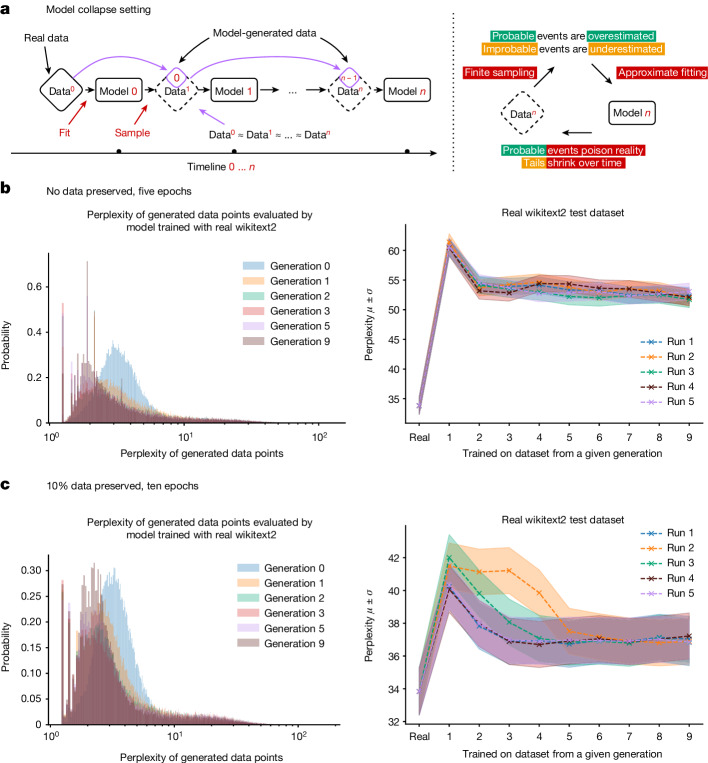
Indiscriminate use of model-generated content in training causes “model collapse,” a degenerative process in which generative models forget the true data distribution, beginning with the tails and eventually converging to a low-variance point estimate. The authors demonstrate this theoretically and empirically for Gaussian mixture models, variational autoencoders, and large language models.
Key findings
- Model collapse occurs across generative model families: in discrete distributions with exact approximation, the process converges to a delta function with probability 1; in the Gaussian setting, Theorem 3.1 states that the Wasserstein-2 distance between the true distribution and its approximation diverges arbitrarily far while variance collapses to zero as generations increase.
- In LLM experiments, an OPT-125m model fine-tuned on wikitext2 reaches 34 mean perplexity from a zero-shot baseline of 115. With five epochs and no original training data, performance degrades “from 20 to 28 perplexity points”; with ten epochs and 10% of original training data preserved, there is “only minor degradation of performance.”
- Generated data over generations contain more sequences the original model would produce with higher likelihood, but also much longer tails of sequences the original model would never produce, indicating accumulated errors.
- An ablation with a repeating penalty of 2.0 causes models to produce lower-score continuations to avoid repeats, and “causes the perplexity to double compared with the original”; models remain as susceptible to model collapse, if not more.
Methods
- Theoretical analysis of “learning with generational data”: a discrete distribution case with exact approximation, analyzed as a Markov chain, and a multidimensional Gaussian approximation using unbiased sample mean and variance estimators, with Wasserstein-2 distance as the divergence measure.
- LLM experiments fine-tune the OPT-125m causal language model from Meta via Hugging Face on wikitext2. Data generation uses five-way beam search; training sequences are blocked to 64 tokens, and for each token sequence the model predicts the next 64 tokens, producing an artificial dataset of the same size. Each experiment is run five times with different randomness seeds, and the best-performing model on the original task is used as the base for subsequent generations.
- Two LLM settings are tested: five epochs with no original training data retained, and ten epochs with a random 10% of original data points sampled for each new generation. VAEs and GMMs are covered in the Supplementary Materials.
Limitations
- The paper states that theoretical claims are mostly presented in the limit of generations going to infinity, whereas experiments use a finite, usually small, number of generations; complete collapse may or may not occur even after a small number of steps, and convergence rates are highly related to the specifics of the problem.
- The paper states that larger language models in non-fine-tuning settings were not run because training a single moderately large model produces twice the American lifetime’s worth of CO2; the LLM experiments are a fine-tuning proof of concept, and even those took weeks to run.
- Evident from the text: the LLM evidence is limited to OPT-125m, wikitext2, five runs, and fine-tuning; no full retraining from scratch is tested, and VAE/GMM details are relegated to the Supplementary Materials.
Model-written summary. Check it against the paper before relying on it.
Integrity signals
Registry
Cites
Statistics
Figures
Verification
Claims the paper makes
1 Valid · 0 Not valid · 3 Not checked · 40 Own results and interpretations
The cited sources support only part of this claim — read each source’s verdict below.
In the paper
“The repeating problem has been observed in nearly all text-generation models17,18”
§ AI models collapse when trained on recursively generated data > Model collapse in language models > Ablation: Repetitions
What the sources say
- Partly supportedcites [17] Keskar, N. S., McCann, B., Varshney, L. R., Xiong, C. & Socher, R. CTRL: a conditional transformer language model for controllable generation. Preprint at https://arxiv.org/abs/1909.05858 (2019). sourceExperimental — accuracy not yet measured
The Related Work section (p. 10) identifies repetition as a problem in text generation and discusses methods for reducing it. It does not say the problem has been observed in nearly all text-generation models; that prevalence claim is unsupported. (LLM, conf=0.86)
- Could not verifycites [18] Shumailov, I. et al. in Proc. 2021 IEEE European Symposium on Security and Privacy (EuroS&P) 212–231 (IEEE, 2021). sourceExperimental — accuracy not yet measured
Section 5.2 discusses attacks that increase output length, energy use, and latency, but not repetitive generated text. Searches for “repeating problem,” “repeated output,” and “repeat” found no passage saying that repetition has been observed in nearly all text-generation models; page numbers were unavailable in our copy. (LLM, conf=0.76)
plain- Asserted: passes — The authors put it forward as true.
- Checkable: passes — It can be checked against evidence.
- Load-bearing: unclear — It is unclear whether the paper’s conclusions depend on it.
- Based: passes — The paper gives a reason why it holds.
- Partly supported
A result the paper reports from its own data — it cites no other source for it, so there is none to check. The quote shows it is in the paper.
In the paper
“Here, over the generations, models tend to produce more sequences that the original model would produce with the higher likelihood.”
§ AI models collapse when trained on recursively generated data > Model collapse in language models
plainstates an association- Asserted: passes — The authors put it forward as true.
- Checkable: passes — It can be checked against evidence.
- Load-bearing: passes — The paper’s conclusions depend on it.
- Based: passes — The paper gives a reason why it holds.
A result the paper reports from its own data — it cites no other source for it, so there is none to check. The quote shows it is in the paper.
In the paper
“We find that data generated by language models in our experiments end up containing a large number of repeating phrases, as in Example 1.”
§ AI models collapse when trained on recursively generated data > Model collapse in language models > Ablation: Repetitions
plain- Asserted: passes — The authors put it forward as true.
- Checkable: passes — It can be checked against evidence.
- Load-bearing: unclear — It is unclear whether the paper’s conclusions depend on it.
- Based: passes — The paper gives a reason why it holds.
A result the paper states — it cites no source for it, so there is none to check. The quote shows it is in the paper.
In the paper
“we can show that the probability of losing information (that is, sampling no data at some generation) is equal to 1 − q”
§ AI models collapse when trained on recursively generated data > Theoretical intuition > Discrete distributions with exact approximation
plain- Asserted: passes — The authors put it forward as true.
- Checkable: passes — It can be checked against evidence.
- Load-bearing: passes — The paper’s conclusions depend on it.
- Based: passes — The paper gives a reason why it holds.
- Rests on an assumption not shown here.
A result the paper reports from its own data — it cites no other source for it, so there is none to check. The quote shows it is in the paper.
In the paper
“We discover that indiscriminately learning from data produced by other models causes ‘model collapse’—a degenerative process whereby, over time, models forget the true underlying data distribution, even in the absence of a shift in the distribution over time.”
§ AI models collapse when trained on recursively generated data > Main
plainstates a cause- Asserted: passes — The authors put it forward as true.
- Checkable: passes — It can be checked against evidence.
- Load-bearing: passes — The paper’s conclusions depend on it.
- Based: passes — The paper gives a reason why it holds.
11 more claims
Create a free account to see all 44 claims and every source verdict.
- It may state two separate claims as one. 22
- The quote only partly states this claim. 1
- Probably not a substantial claim. 10
Claims other papers make about this one
Each is checked against this paper’s own text: does it say what the citing paper says it does?
The source backs part of the claim, not all of it — or backs it for a different population, condition or comparison.
In the citing paper
“Second, LLMs are frequently trained on the same open-access corpora we examine, creating a feedback loop in which tomorrow's models will learn today's hallucinations [34].”
From LLM hallucinations in the wild: Large-scale evidence from non-existent citations (2026) · cites this paper as [34]
Experimental — accuracy not yet measuredThe source backs part of the claim, not all of it — or backs it for a different population, condition or comparison.
In the citing paper
“Successive training cycles cause LLMs to “forget” the statistical long-tail of rare but important patterns, resulting in homogenized, impoverished, and epistemically diminished outputs.”
From 4E cognition and the coevolution of human–AI interaction (2025) · cites this paper as [61]
Experimental — accuracy not yet measuredThe source backs part of the claim, not all of it — or backs it for a different population, condition or comparison.
In the citing paper
“AI-generated content now saturates the internet, reducing reliability and contaminating training data for future models (Paredes et al., 2025;Shumailov et al., 2024).”
From Purpose before policy: academic integrity, generative AI, and rhetorical stance (2026) · cites this paper as Shumailov et al., 2024
Experimental — accuracy not yet measuredThe source backs part of the claim, not all of it — or backs it for a different population, condition or comparison.
In the citing paper
“As successive generations of models are trained on data increasingly contaminated by historical synthetic outputs, the system progressively erodes distributional diversity and collapses functional modes—a degenerative process that remains robust to scale and is highly sensitive to even minimal synthetic fractions [14,15].”
From Self-Referential Introspection in Large Language Models: The Critical Threshold for Recursive Self-Improvement (2026) · cites this paper as [14]
Experimental — accuracy not yet measuredThe source backs part of the claim, not all of it — or backs it for a different population, condition or comparison.
In the citing paper
“The accumulation of synthetic data may affect model output quality, reinforce existing biases, and alter information feedback dynamics, thereby posing potential challenges to the stability of the digital knowledge ecosystem (Shumailov et al., 2024).”
From The Attention Mismatch: Mapping the Structural Academic Governance Deficit in the Age of Generative AI (2026) · cites this paper as Shumailov et al., 2024
Experimental — accuracy not yet measured
19 more claims about this paper
Create a free account to see every claim other papers make about this one.
Self-check
Percentages, sums and reported differences re-computed from the paper’s own numbers.
Each contradiction between two passages listed here was confirmed by an independent check.
Rated minor: it would not touch a result — a value no result rests on, a p-value that stays on the same side of the significance level, or a conflict that is clerical, resolved elsewhere in the paper, or outside its own findings.
In the paper
§ AI models collapse when trained on recursively generated data > Abstract
“GPT-2 (ref. 1), GPT-3(.5) (ref. 2) and GPT-4 (ref. 3)”
§ AI models collapse when trained on recursively generated data > Model collapse in language models
“BERT4, RoBERTa5 or GPT-2 (ref. 2)”
Citations
Cites
Language Models are Few-Shot Learners
Brown, T. B., Mann, B., Ryder, N., Subbiah, M., Kaplan, J., Dhariwal, P., Neelakantan, A., Shyam, P., Sastry, G., Askell, A., et al. (2020) · arXiv · doi:10.48550/arxiv.2005.14165 · Cited by 23,372
RoBERTa: A Robustly Optimized BERT Pretraining Approach
Liu, Y., Ott, M., Goyal, N., Du, J., Joshi, M., Chen, D., Levy, O., Lewis, M., Zettlemoyer, L., & Stoyanov, V. (2019) · arXiv · doi:10.48550/arxiv.1907.11692 · Cited by 16,515
Li, Z., & Hoiem, D. (2018) · IEEE Transactions on Pattern Analysis and Machine Intelligence · doi:10.1109/tpami.2017.2773081 · Cited by 4,202
Energy and Policy Considerations for Deep Learning in NLP
Strubell, E., Ganesh, A., & McCallum, A. (2019) · arXiv · doi:10.48550/arxiv.1906.02243 · Cited by 3,735
5th International Conference on Learning Representations (ICLR 17)
Havrylov, S., & Titov, I. (2017) · Cited by 3,503
Deep Neural Networks are Easily Fooled: High Confidence Predictions for Unrecognizable Images
Nguyen, A., Yosinski, J., & Clune, J. (2014) · arXiv · doi:10.48550/arxiv.1412.1897 · Cited by 3,258
Deep neural networks are easily fooled: High confidence predictions for unrecognizable images
Nguyen, A., Yosinski, J., & Clune, J. (2015) · 2015 IEEE Conference on Computer Vision and Pattern Recognition (CVPR) · doi:10.1109/cvpr.2015.7298640 · Cited by 3,258
On the Opportunities and Risks of Foundation Models
Bommasani, R., Hudson, D. A., Adeli, E., Altman, R., Arora, S., von Arx, S., Bernstein, M. S., Bohg, J., Bosselut, A., Brunskill, E., et al. (2021) · arXiv · doi:10.48550/arxiv.2108.07258 · Cited by 2,676
Poisoning Attacks against Support Vector Machines
Biggio, B., Nelson, B., & Laskov, P. (2012) · arXiv · doi:10.48550/arxiv.1206.6389 · Cited by 1,331
The Implicit Bias of Gradient Descent on Separable DataPreprint
Soudry, D., Hoffer, E., Nacson, M. S., Gunasekar, S., & Srebro, N. (2017) · arXiv (Cornell University) · doi:10.48550/arxiv.1710.10345 · Cited by 829
Research works printed but not linked: 7
- Radford, A. et al. Language models are unsupervised multitask learners. OpenAI blog 1, 9 (2019).
- Devlin, J., Chang, M.-W., Lee, K. & Toutanova, K. in Proc. 2019 Conference of the North American Chapter of the Association for Computational Linguistics: Human Language Technologies, Volume 1 (Long and Short Papers) (eds Burstein, J., Doran, C. & Solorio, T.) 4171–4186 (Association for Computational Linguistics, 2019).
- Carlini, N. & Terzis, A. in Proc. Tenth International Conference on Learning Representations (ICLR, 2022).
- Carlini, N. et al. in Proc. 2024 IEEE Symposium on Security and Privacy (SP) 179 (IEEE, 2024).
- Mousavi-Hosseini, A., Park, S., Girotti, M., Mitliagkas, I. & Erdogdu, M. A. in Proc. Eleventh International Conference on Learning Representations (ICLR, 2023).
- Gu, Y., Dong, L., Wei, F. & Huang, M. in Proc. Twelfth International Conference on Learning Representations (ICLR, 2024).
- Strubell, E., Ganesh, A. & McCallum, A. in Proc. 57th Annual Meeting of the Association for Computational Linguistics (eds Korhonen, A., Traum, D. & Màrquez, L.) 3645–3650 (Association for Computational Linguistics, 2019).
Cited by
A Survey of Large Language Models in Medicine: Progress, Application, and Challenge
Zhou, H., Liu, F., Gu, B., Zou, X., Huang, J., Wu, J., Li, Y., Chen, S. S., Zhou, P., Liu, J., et al. (2023) · arXiv · doi:10.48550/arxiv.2311.05112 · Cited by 240
A Survey on LLM-Generated Text Detection: Necessity, Methods, and Future Directions
Wu, J., Yang, S., Zhan, R., Yuan, Y., Wong, D. F., & Chao, L. S. (2023) · arXiv · doi:10.48550/arxiv.2310.14724 · Cited by 212
Taeihagh, A. (2025) · Policy and Society · doi:10.1093/polsoc/puaf001 · Cited by 190
“Moreover, recent research shows that indiscriminate use of synthetic content from the models in training can eventually cause model collapse (Shumailov et al., 2024).”
A Survey on LLM-Generated Text Detection: Necessity, Methods, and Future Directions
Wu, J., Yang, S., Zhan, R., Yuan, Y., Chao, L. S., & Wong, D. F. (2025) · Computational Linguistics · doi:10.1162/coli_a_00549 · Cited by 212
Artificial Intelligence for Materials Discovery, Development, and Optimization
Madika, B., Saha, A., Kang, C., Buyantogtokh, B., Agar, J., Wolverton, C. M., Voorhees, P., Littlewood, P., Kalinin, S., & Hong, S. (2025) · ACS Nano · doi:10.1021/acsnano.5c04200 · Cited by 171
Human-AI agency in the age of generative AI
Krakowski, S. (2025) · Information and Organization · doi:10.1016/j.infoandorg.2025.100560 · Cited by 162
Theory Is All You Need: AI, Human Cognition, and Causal Reasoning
Felin, T., & Holweg, M. (2024) · doi:10.2139/ssrn.4737265 · Cited by 152
Brinkmann, L., Baumann, F., Bonnefon, J.-F., Derex, M., Müller, T. F., Nussberger, A.-M., Czaplicka, A., Acerbi, A., Griffiths, T. L., Henrich, J., et al. (2023) · Nature Human Behaviour · doi:10.1038/s41562-023-01742-2 · Cited by 132
Scalable watermarking for identifying large language model outputs
Dathathri, S., See, A., Ghaisas, S., Huang, P.-S., McAdam, R., Welbl, J., Bachani, V., Kaskasoli, A., Stanforth, R., Matejovicova, T., et al. (2024) · Nature · doi:10.1038/s41586-024-08025-4 · Cited by 132
“Given the widespread use of LLMs in education, software development and web content generation, identification and attribution of LLM text is critical to ensure safe and responsible use of the technology 8–11 .”
MethodSelf-citationTheory Is All You Need: AI, Human Cognition, and Causal Reasoning
(2024) · doi:10.1287/stsc.2024.0189 · Cited by 151
Pedreschi, D., Pappalardo, L., Ferragina, E., Baeza-Yates, R., Barabási, A.-L., Dignum, F., Dignum, V., Eliassi-Rad, T., Giannotti, F., Kertész, J., et al. (2025) · Artificial Intelligence · doi:10.1016/j.artint.2024.104244 · Cited by 102
Ovek, D., Rauluševičiūtė, I., Aronsen, D. R., Blanc‐Mathieu, R., Bonthuis, I., Beukelaer, H. D., Ferenc, K., Jegou, A., Kumar, V., Lemma, R. B., et al. (2025) · Nucleic Acids Research · doi:10.1093/nar/gkaf1209 · Cited by 203
“…PFMs, thereby strengthening the importance of establishing high-quality resources that store TF binding profiles as PFMs. In-deed, high-quality, manually curated resources play a key role in training large models and should be maintained alongside more expressive representations [ 41 , 42 ].”
Application of large language models in medicine
Liu, F., Zhou, H., Gu, B., Zou, X., Huang, J., Wu, J., Li, Y., Chen, S. S., Hua, Y., Zhou, P., et al. (2025) · Nature Reviews Bioengineering · doi:10.1038/s44222-025-00279-5 · Cited by 94
Duan, S., Liu, C., Rong, T., Zhao, Y., & Liu, B. (2025) · BMC Medical Education · doi:10.1186/s12909-025-07177-9 · Cited by 85
“AI-generated content could exhibit mistakes, nonsensical elements, insufficient sourcing, or references to non-existent sources [25, 26].”
Self-citationSuchikova, Y., Tsybuliak, N., Teixeira da Silva, J. A., & Nazarovets, S. (2026) · Accountability in Research · doi:10.1080/08989621.2025.2544331 · Cited by 70
“Using data generated by AI models to train new models can lead to a gradual decline in the quality of the models (Shumailov et al. 2024).”
Do large language models have a legal duty to tell the truth?
Wachter, S., Mittelstadt, B., & Russell, C. (2024) · Royal Society Open Science · doi:10.1098/rsos.240197 · Cited by 66
Are Large Language Models a Threat to Digital Public Goods? Evidence from Activity on Stack Overflow
del Rio-Chanona, M., Laurentsyeva, N., & Wachs, J. (2023) · arXiv · doi:10.48550/arxiv.2307.07367 · Cited by 62
Large Language Models and the Degradation of the Medical Record
McCoy, L. G., Manrai, A. K., & Rodman, A. M. (2024) · New England Journal of Medicine · doi:10.1056/nejmp2405999 · Cited by 61
A Perspective on Foundation Models in Chemistry
Choi, J., Nam, G., Choi, J., & Jung, Y. (2025) · JACS Au · doi:10.1021/jacsau.4c01160 · Cited by 107
Generative Artificial Intelligence in Qualitative Data Analysis: Analyzing—Or Just Chatting?
Nguyen, D. C., & Welch, C. (2025) · Organizational Research Methods · doi:10.1177/10944281251377154 · Cited by 124
“Moreover, while continuous fi ne-tuning and data updates can enhance model performance, they introduce risks such as model drift (Shumailov et al., 2024) and a reduction in response diversity (Peterson, 2025; Zhang et al., 2023).”
Technological folie à deux: feedback loops between AI chatbots and mental health
Dohnány, S., Kurth-Nelson, Z., Spens, E., Luettgau, L., Reid, A., Gabriel, I., Summerfield, C., Shanahan, M., & Nour, M. M. (2026) · Nature Mental Health · doi:10.1038/s44220-026-00595-8 · Cited by 51
“Post-training procedures designed to shape chatbot responses, such as RLHF, carry an inherent risk of proxy failure and suffer from inadequate data coverage (reduced sample diversity 106,107 ).”
Can AI weather models predict out-of-distribution gray swan tropical cyclones?
Sun, Y. Q., Hassanzadeh, P., Zand, M., Chattopadhyay, A., Weare, J., & Abbot, D. S. (2025) · Proceedings of the National Academy of Sciences · doi:10.1073/pnas.2420914122 · Cited by 126
“In fact, iterative training of generative models on their own output has been shown to lead to model collapse [48].”
The GenAI Future of Consumer Research
Huang, M., & Rust, R. T. (2025) · Journal of Consumer Research · doi:10.1093/jcr/ucaf013 · Cited by 71
Tran, M., Balasooriya, C. D., Jonnagaddala, J., Leung, G., Mahboobani, N. R., Ramani, S., Rhee, J., Schuwirth, L., Najafzadeh-Tabrizi, N. S., Semmler, C., et al. (2025) · npj Digital Medicine · doi:10.1038/s41746-025-01721-z · Cited by 72
“JustaslearnerswilluseGenAItoanincreasingdegree,itwillcontinuetorely onhigh-qualityinputfromusers 74 , including students and clinicians.”
Generative AI Meets Open-Ended Survey Responses: Research Participant Use of AI and Homogenization
Zhang, S., Xu, J., & Alvero, A. (2025) · Sociological Methods & Research · doi:10.1177/00491241251327130 · Cited by 102
Survey of Cultural Awareness in Language Models: Text and Beyond
Pawar, S., Park, J., Jin, J., Arora, A., Myung, J., Yadav, S., Haznitrama, F. G., Song, I., Oh, A. H., & Augenstein, I. (2025) · Computational Linguistics · doi:10.1162/coli.a.14 · Cited by 219
False authorship: an explorative case study around an AI-generated article published under my name
Spinellis, D. (2025) · Research Integrity and Peer Review · doi:10.1186/s41073-025-00165-z · Cited by 37
“This term refers to the finding [20] that haphazardly training LLMs (large language models) with LLM-generated content is an irreversible process that results in faulty models lacking the tails of the original content distribution.”
Playing with words: Comparing the vocabulary and lexical diversity of ChatGPT and humans
Reviriego, P., Conde, J., Merino-Gómez, E., Martínez, G., & Hernández, J. A. (2024) · Machine Learning with Applications · doi:10.1016/j.mlwa.2024.100602 · Cited by 37
Large language models reduce public knowledge sharing on online Q&A platforms
del Rio-Chanona, R. M., Laurentsyeva, N., & Wachs, J. (2024) · PNAS Nexus · doi:10.1093/pnasnexus/pgae400 · Cited by 52
A data-efficient strategy for building high-performing medical foundation models
Sun, Y., Tan, W., Gu, Z., He, R., Chen, S., Pang, M., & Yan, B. (2025) · Nature Biomedical Engineering · doi:10.1038/s41551-025-01365-0 · Cited by 67
“The recent findings 58 on AI model collapse when trained on recursively generated data highlight the potential dangers of over-reliance on synthetic content.”
Future Shock: Generative AI and the International AI Policy and Governance Crisis
Leslie, D., & Perini, A. M. (2024) · Harvard Data Science Review · doi:10.1162/99608f92.88b4cc98 · Cited by 33
How to intelligently embrace generative AI: the first guardrails for the use of GenAI in IB research
Delios, A., Tung, R. L., & van Witteloostuijn, A. C. (2024) · Journal of International Business Studies · doi:10.1057/s41267-024-00736-0 · Cited by 42
“In fact, Shumailov et al. (2024) show that training on regurgita-tive data increases the likelihood of model collapse or distortions of reality.”
Fontoura, L., Nascimento, D. L. D. M., Neto, J. V., & Caiado, R. G. G. (2025) · Technology in Society · doi:10.1016/j.techsoc.2025.102847 · Cited by 48
“(Shumailov et al., 2024; Sætra, 2023).”
Human innovation and the creative agency of the world in the age of generative AI
Peschl, M. F. (2024) · Possibility Studies & Society · doi:10.1177/27538699241238049 · Cited by 30
Innovating robot-assisted surgery through large vision models
Min, Z., Lai, J., & Ren, H. (2025) · Nature Reviews Electrical Engineering · doi:10.1038/s44287-025-00166-6 · Cited by 45
“However, it has also been found that training on recursively generated data leads to the collapse of the AI model 78 .”
Artificial intelligence-powered nanomedicine
Luo, G., 蒋显超, Hu, C., Li, L., Yan, L., Xiao, G., Duo, Y., & Zhang, X. (2026) · Chemical Society Reviews · doi:10.1039/d5cs01406a · Cited by 40
Principles and Guidelines for the Use of LLM Judges
Dietz, L., Zendel, O., Bailey, P., Clarke, C. L. A., Cotterill, E., Dalton, J., Hasibi, F., Sanderson, M., & Craswell, N. (2025) · ACM SIGIR International Conference on Theory of Information Retrieval (ICTIR) · doi:10.1145/3731120.3744588 · Cited by 73
Large Language Models for Health Care Text Classification: Systematic Review
Sakai, H., & Lam, S. S. (2026) · JMIR AI · doi:10.2196/79202 · Cited by 72
“Moreover, recursively training an LLM on synthetically generated data is likely to lead to model collapse [109], causing performance degradation primarily due to the model’s gradual loss of information about the distribution’s tails (ie, minority classes) and a shift toward a distribution with…”
Prevalence and Prevention of Large Language Model Use in Crowd Work
Veselovsky, V., Ribeiro, M. H., Cozzolino, P. J., Gordon, A., Rothschild, D. M., & West, R. (2025) · Communications of the ACM · doi:10.1145/3685527 · Cited by 95
Saracini, C., Cornejo-Plaza, I., & Cippitani, R. (2025) · Frontiers in Psychology · doi:10.3389/fpsyg.2025.1662206 · Cited by 55
“With the increasing use of synthetic data (data generated by the models themselves to improve scalability) there is a growing risk of feedback bias loops (Shumailov et al., 2024a; Shumailov et al., 2024b).”
Technological folie à deux: Feedback Loops Between AI Chatbots and Mental Illness
Dohnány, S., Kurth-Nelson, Z., Spens, E., Luettgau, L., Reid, A., Gabriel, I., Summerfield, C., Shanahan, M., & Nour, M. M. (2025) · arXiv · doi:10.48550/arxiv.2507.19218 · Cited by 26
“As discussed, post-training procedures guided by both human (RLHF) and LLM responses suffer from inadequate data coverage (reduced sample diversity 88,89 ) and carry an inherent risk of proxy failure.”
McKee, M., Rosenbacke, R., & Stückler, D. (2024) · The International Journal of Health Planning and Management · doi:10.1002/hpm.3864 · Cited by 36
The Evolution of Generative AI: Trends and Applications
Τρίγκα, Μ., & Dritsas, E. (2025) · IEEE Access · doi:10.1109/access.2025.3574660 · Cited by 65
“Addressing this challenge requires the implementation of data provenance tracking, synthetic content filtering, and active efforts to maintain access to high-quality human-authored datasets [243].”
Identity and investment in the age of generative AI
Darvin, R. (2025) · Annual Review of Applied Linguistics · doi:10.1017/s0267190525100135 · Cited by 34
“…content feeds back into its own training data, it also creates a self-referential loop where models are increasingly trained on their own prior outputs and the diversity of responses degrade over time (Shumailov et al., 2024), creating “a pre-carious echo chamber of artificiality” (Nosta, 2023).”
Colour/shape-taste correspondences across three languages in ChatGPT
Motoki, K., Spence, C. J., & Velasco, C. (2024) · Cognition · doi:10.1016/j.cognition.2024.105936 · Cited by 29
“The training process involves the model reading large amounts of text to learn word associations and predict the next word in a sentence, updating its internal parameters to improve its accuracy over time (see also Shumailov et al., 2024).”
Balog, K., Metzler, D., & Qin, Z. (2025) · International ACM SIGIR Conference on Research and Development in Information Retrieval (SIGIR) · doi:10.1145/3726302.3730348 · Cited by 57
Commentary on “AI is Changing the World: For Better or for Worse?”
Kopalle, P. K., Gangwar, M., & Uppal, A. (2024) · Journal of Macromarketing · doi:10.1177/02761467241290813 · Cited by 23
“Some scholars argue that when AI consumes AI-generated data, it can lead to “ model collapse ” – irreversible defects in the AI models, in which the nuanced patterns of the original content disappear (Shumailov et al. 2024).”
SoK: Watermarking for AI-Generated Content
Zhao, X., Gunn, S., Christ, M., Fairoze, J., Fábrega, A., Carlini, N., Garg, S., Hong, S., Nasr, M., Tramèr, F., et al. (2025) · IEEE Symposium on Security and Privacy (S&P) · doi:10.1109/sp61157.2025.00178 · Cited by 134
“If models are inadvertently trained on their own generated outputs, it can lead to “model collapse,” where iterative cycles of training on degraded data degrade the overall quality of generated content [44].”
ChatGPT is incredible (at being average)
Rudko, I., & Bonab, A. B. (2025) · Ethics and Information Technology · doi:10.1007/s10676-025-09845-2 · Cited by 32
“As a recent Nature article shows, training each successive generation of a language model on synthetic data produced by the previous generations has dire cumulative effects over time (Shumailov et al., 2024).”
InfluentialBond, A., Retief, F., Alberts, R. C., Roos, C., Cilliers, D., & Moolman, J. (2024) · Impact Assessment and Project Appraisal · doi:10.1080/14615517.2024.2426117 · Cited by 28
“It would help to prevent concerns over the proliferation of data self-generated by AI becoming part of the evidence then considered when assessing environmental impacts – leading to ‘model collapse’ where AI increasingly analyses data that has been generated only by AI (Shumailov et al. 2024).”
Toward Visual Grounding: A Survey
Xiao, L., Yang, X., Lan, X., Wang, Y., & Xu, C. (2025) · IEEE Transactions on Pattern Analysis and Machine Intelligence · doi:10.1109/tpami.2025.3630635 · Cited by 115
“Research has demonstrated that training models on model-generated pseudo-labels may lead to model poisoning [286].”
GenAI synthetic data create ethical challenges for scientists. Here’s how to address them.
Resnik, D. B., Hosseini, M., Kim, J. J. H., Epiphaniou, G., & Maple, C. R. (2025) · Proceedings of the National Academy of Sciences · doi:10.1073/pnas.2409182122 · Cited by 37
New sources of inaccuracy? A conceptual framework for studying AI hallucinations
Shao, A. (2025) · Harvard Kennedy School Misinformation Review · doi:10.37016/mr-2020-182 · Cited by 41
“There is also a possibly degenerative “AI-on-AI” feedback loop where AI-generated inaccuracies will pollute future training data, leading to a phenomenon known as “model collapse” from a scarcity of fresh, human-generated content (Shumailov et al., 2024).”
Scorecard for synthetic medical data evaluation
Zamzmi, G., Subbaswamy, A., Sizikova, E., Margerrison, E., Delfino, J. G., & Badano, A. G. (2025) · Communications Engineering · doi:10.1038/s44172-025-00450-1 · Cited by 22
Synthetic data, synthetic trust: navigating data challenges in the digital revolution
Koul, A., Duran, D. G., & Hernandez‐Boussard, T. (2025) · The Lancet Digital Health · doi:10.1016/j.landig.2025.100924 · Cited by 47
“47 Maintaining data hygiene is essential for ensuring reliable and fair AI performance especially in health care.”
AI produces gibberish when trained on too much AI-generated data
Wenger, E. (2024) · Nature · doi:10.1038/d41586-024-02355-z · Cited by 34
Generative AI in Fashion: Overview
Shi, W.-P., Wong, W. K., & Zou, X. (2025) · ACM Transactions on Intelligent Systems and Technology · doi:10.1145/3718098 · Cited by 45
A review of ChatGPT in medical education: exploring advantages and limitations
Cheng, Y., & Zhu, L. (2025) · International Journal of Surgery · doi:10.1097/js9.0000000000002505 · Cited by 29
AI models fed AI-generated data quickly spew nonsense
Gibney, E. (2024) · Nature · doi:10.1038/d41586-024-02420-7 · Cited by 18
Four Ps for Building Massive Collective Knowledge Systems
Madhavapeddy, A. (2025) · doi:10.59350/418q4-gng78 · Cited by 18
Application of Deep Learning Techniques for Air Quality Prediction: A Case Study in Macau
Lei, T. M. T., Cai, J., Cheng, W.-H., Kurniawan, T. A., Molla, A. H., Nadzir, M. S. M., Kong, S. S.-K., & Chen, L. ‐. A. (2025) · Processes · doi:10.3390/pr13051507 · Cited by 20
On the caveats of AI autophagy
Xing, X., Shi, F., Huang, J., Wu, Y., Yang, N., Zhang, S., Fang, Y., Roberts, M., Schönlieb, C., Ser, J. D., et al. (2025) · Nature Machine Intelligence · doi:10.1038/s42256-025-00984-1 · Cited by 54
“By contrast, Shumailov et al. 3 introduced a penalty to reduce repetition, which helped mitigate model collapse.”
InfluentialGenerative midtended cognition and Artificial Intelligence: thinging with thinging things
Barandiaran, X. E., & Pérez-Verdugo, M. (2025) · Synthese · doi:10.1007/s11229-025-04961-4 · Cited by 19
“Generative AI can also collapse when recursively trained and tuned to cannibalised content [Shumailov et al., 2024].”
Toward an integrated omics approach for plant biosynthetic pathway discovery in the age of AI
Reinhardt, J. K., Craft, D., & Weng, J. (2025) · Trends in Biochemical Sciences · doi:10.1016/j.tibs.2025.01.010 · Cited by 22
From revolution to evolution: What generative AI really means for language learning
Pegrum, M. A. (2025) · Language Teaching · doi:10.1017/s0261444825000151 · Cited by 33
“…increasingly comes to be trained on the outputs of other generative AI, this may lead over time to degraded results – and if this phenomenon becomes widespread enough, it could result in model collapse, effectively, the collapse of generative AI as we know it (Marr, 2024; Shumailov et al., 2024).”
A responsible artificial intelligence framework for forensic science
Stacey, J., Fleming, R. I., Sheppard, D., Sheppard, J., Dobbie, G., & Karunakaran, D. (2025) · Forensic Science International · doi:10.1016/j.forsciint.2025.112548 · Cited by 28
Open-AI Driven Open-source Open-access Sustainable ICs Design Flow
Teo, T. H., Xiang, M., Goh, E., & Hsu, H.-K. (2024) · IEEE International Symposium on Embedded Multicore/Many-core Systems-on-Chip (MCSoC) · doi:10.1109/mcsoc64144.2024.00066 · Cited by 17
AI image generation technology in ophthalmology: Use, misuse and future applications
Phipps, B., Hadoux, X., Sheng, B., Campbell, J. P., Liu, T. Y. A., Keane, P. A., Cheung, C. Y.-L., Chung, T. Y., Wong, T. Y., & van Wijngaarden, P. (2025) · Progress in Retinal and Eye Research · doi:10.1016/j.preteyeres.2025.101353 · Cited by 22
“When generative models are recursively trained on their own output, there is a progressive loss of variance in the models approximated data distribution and therefore a rapid deterioration in model output quality (Shumailov et al., 2024).”
InfluentialFarrell, H. J. (2025) · Annual Review of Political Science · doi:10.1146/annurev-polisci-040723-013245 · Cited by 31
Monks, T., Harper, A. L., & Heather, A. (2025) · Journal of the Operational Research Society · doi:10.1080/01605682.2025.2554751 · Cited by 21
“This occurs because models recursively learn from outputs that may contain errors or biases, leading to a decline in quality over successive training iterations (Shumailov et al., 2024; Wenger, 2024).”
Chakrabarty, T., Laban, P., & Wu, C.-S. (2024) · International Conference on Human Factors in Computing Systems · doi:10.1145/3706598.3713559 · Cited by 82
Bielska, W., Jaszczyszyn, I., Dudzic, P., Janusz, B., Chomicz, D., Wrobel, S., Greiff, V., Feehan, R., Adolf‐Bryfogle, J., & Krawczyk, K. (2025) · Frontiers in Immunology · doi:10.3389/fimmu.2025.1571371 · Cited by 22
“Though it is plausible to re-use such experimentally generated data, care needs to be exercised as it has been raised that such data might in fact be biasing the models in the undesirable direction (133).”
Large Language Models (LLMs) for Materials Design
Zhang, L., Liu, Z., Ni, B., & Wang, Q. (2025) · Advanced Functional Materials · doi:10.1002/adfm.202525897 · Cited by 36
Danchin, A. (2024) · Microbial Biotechnology · doi:10.1111/1751-7915.70014 · Cited by 18
“This hurdle becomes even more dangerous as generative AI feeds itself with its own generated data, leading to sheer nonsense (Shumailov et al., 2024).”
BackgroundLarge language models transform biological research: from architecture to utilization
Wang, T., & Luo, Z. (2025) · Science China Information Sciences · doi:10.1007/s11432-024-4466-3 · Cited by 14
“However, recent research has raised concerns about the risks associated with “generated” data in LLMs [115].”
Examining the Expanding Role of Synthetic Data Throughout the AI Development Pipeline
Kapania, S., Ballard, S. A., Kessler, A., & Vaughan, J. W. (2025) · ACM Conference on Fairness, Accountability, and Transparency (FAccT) · doi:10.1145/3715275.3732005 · Cited by 31
Learning against the machine: the double edged sword of (Gen)AI in STEM education
Wulff, P., & Kubsch, M. (2025) · International Journal of STEM Education · doi:10.1186/s40594-025-00588-6 · Cited by 23
“…this also might turn into a vicious cycle of regressing to the mean, e.g., when GenAI-generated data is fed back into the training data, hence poisoning the well for good (Qiu et al., 2025; Shumailov et al., 2024), and possibly even intercepting with human evolution itself (Pedreschi et al., 2025).”
Capturing a moving target: Developing research on and with AI for Human Relations
Stollberger, J., Anand, S., & Dick, P. (2025) · Human Relations · doi:10.1177/00187267251332075 · Cited by 19
“Further complicating the utility of silicon samples, recent research (Shumailov et al., 2024; Xing et al., 2025) showed that synthetic data generation might not be a panacea in the way more optimistic accounts suggest.”
Bhardwaj, V. P. (2026) · arXiv · doi:10.48550/arxiv.2603.02240 · Cited by 13
Dill, R., Stumpe, L., Saynisch‐Wagner, J., et al. (2025) · Journal of Geodesy · doi:10.1007/s00190-025-01941-x · Cited by 12
“However, users have to take care that applying their own ML techniques in sequence might lead to meaning-less results in the end (model collapse problem; Shumailov et al. 2024).”
Kebaili, A., Lapuyade‐Lahorgue, J., Véra, P., & Ruan, S. (2025) · Computerized Medical Imaging and Graphics · doi:10.1016/j.compmedimag.2025.102532 · Cited by 27
Humanism strikes back? A posthumanist reckoning with ‘self-development’ and generative AI
Cadman, S., Tanner, C., & Pang, P. C. (2025) · AI & Society · doi:10.1007/s00146-025-02339-1 · Cited by 22
Lessons from complex systems science for AI governance
Kolt, N., Shur‐Ofry, M., & Cohen, R. (2025) · Patterns · doi:10.1016/j.patter.2025.101341 · Cited by 44
“84 89–94 This may be exacerbated by the fact that detecting AI-generated content (e.g., by using watermarks) 95 and excluding it from training datasets remain difficult.”
Learning Universal Human Mobility Patterns with a Foundation Model for Cross-Domain Data Fusion
Ma, H., Liao, X., Liu, Y., Jiang, Q., Stanford, C., Cao, S., & Ma, J. (2025) · Transportation Research Part C Emerging Technologies · doi:10.1016/j.trc.2025.105311 · Cited by 16
“This decline aligns with findings that AI models collapse when trained on recursively generated data (Shumailov et al., 2024), as over-reliance on synthetic data erodes nuanced or rare activities in the original data.”
Overloaded minds and machines: a cognitive load framework for human-AI symbiosis
Wang, P., Liu, H., Zou, L., & PAAS, F. G. W. C. (2026) · Artificial Intelligence Review · doi:10.1007/s10462-026-11510-z · Cited by 25
“They cannot prevent training-time model col-lapse—which demands rigorous curation of human-generated data to preserve distributional integrity (Shumailov et al. 2024 ).”
Goodbye human annotators? Content analysis of social policy debates using ChatGPT
Gielens, E., Sowula, J., & Leifeld, P. (2025) · Journal of Social Policy · doi:10.1017/s0047279424000382 · Cited by 20
“However, the realisation of such improvements will depend on the model ’ s future ability to prevent collapse when trained on recursively trained data (Shumailov et al., 2024).”
The ontological politics of synthetic data: Normalities, outliers, and intersectional hallucinations
Lee, F., Hajisharif, S., & Johnson, E. (2025) · Big Data & Society · doi:10.1177/20539517251318289 · Cited by 20
“Given the use of truncated Guassian distributions, it is expected that this would happen and other researchers are also noting this phenomenon (see Shumailov et al., 2024; Wenger, 2024; Xu et al., 2019).”
Generative AI: ensuring transparency and emphasising human intelligence and accountability
Bagenal, J., Biamis, C., Boillot, M., Brierley, R., Chew, M., Dehnel, T., Frankish, H., Grainger, E., Pope, J., Prowse, J., et al. (2024) · The Lancet · doi:10.1016/s0140-6736(24)02615-1 · Cited by 11
Generative AI and empirical research methods in operations management
Shalpegin, T., Browning, T. R., Kumar, A., Shang, G., Thatcher, J. B., Fransoo, J. C., Holweg, M., & Lawson, B. (2025) · Oxford University Research Archive (ORA) (University of Oxford) · doi:10.1002/joom.1371
Artificial Intelligence in migrant health: a critical perspective on opportunities and risks
Matlin, S. A., Claron, I. M. M., Merone, J., Netto, G., Takian, A., Zaman, M. H., & Saso, L. (2025) · The Lancet Regional Health - Europe · doi:10.1016/j.lanepe.2025.101421 · Cited by 19
Messner, R., Smith, S., & Richards, C. (2025) · International Journal of Qualitative Methods · doi:10.1177/16094069251371481 · Cited by 46
“…that Large Language Models that rely on recursively fed AI generated data have shown signi fi cant decline of coherence and intelligibility, potentially resulting in an AI collapse or, at least, a vastly diminished usefulness for scienti fi c research (Shumailov et al., 2024; Snoswell, 2024).”
Generative artificial intelligence (AI) and its performance at indexing tasks
Izzard, T. (2024) · The Indexer · doi:10.3828/index.2024.24 · Cited by 12
Takata, R., Masumori, A., & Ikegami, T. (2024) · Entropy · doi:10.3390/e26121092 · Cited by 37
Bergonzo, C., & Grishaev, A. (2025) · Journal of Chemical Information and Modeling · doi:10.1021/acs.jcim.5c00245 · Cited by 15
“This departure from ground truth appears consistent with recent observations of collapses of AI models upon recursive training (46) and is also consistent with recent analysis via X-ray crystallography (47).”
What Does a Software Engineer Look Like? Exploring Societal Stereotypes in LLMs
Bano, M., Gunatilake, H., & Hoda, R. (2025) · IEEE/ACM International Conference on Software Engineering: Software Engineering in Society (ICSE-SEIS) · doi:10.1109/icse-seis66351.2025.00023 · Cited by 29
“AI model collapse is an emerging concept [61] that can occur when outputs from current AI (LLM) models are used as training data for future AI systems, risking recursive bias propagation.”
The promise and limitations of using GenAI to reduce climate scepticism
Hornsey, M. J., Pearson, S. G., Bretter, C., MacInnes, S., Nylund, J. L., & Rekker, S. A. C. (2025) · Nature Climate Change · doi:10.1038/s41558-025-02425-8 · Cited by 15
“These include the non-transparency of the algorithms 33 , the lack of robust governance or oversight 34 , the potential for bias or factual inaccuracy over time 35,36 , the possibility of misuse by bad-faith actors 37”
Yao, J., & Han, T. (2025) · Renewable and Sustainable Energy Reviews · doi:10.1016/j.rser.2025.116527 · Cited by 13
Autonomous language-image generation loops converge to generic visual motifs
Hintze, A., Astrom, F. P., & Schossau, J. (2025) · Patterns · doi:10.1016/j.patter.2025.101451 · Cited by 21
Data Optimization in Deep Learning: A Survey
Wu, O., & Yao, R. (2025) · IEEE Transactions on Knowledge and Data Engineering · doi:10.1109/tkde.2025.3530916 · Cited by 23
“However, not all augmented data are beneficial for large model training [180].”
Narrative Creativity: An Introduction to How and Why
Fletcher, A., & Benveniste, M. (2025) · Cambridge University Press eBooks · doi:10.1017/9781009614801 · Cited by 17
Metadata
- Authors
- Shumailov, I., Shumaylov, Z., Zhao, Y., Papernot, N., Anderson, R., & Gal, Y.
- Affiliations
- University of Oxford (GB)
- University of Cambridge (GB)
- Imperial College London (GB)
- University of Toronto (CA)
- Corresponding author
- Shumailov, Ilia
- Shumaylov, Zakhar
- Gal, Yarin
- Venue
- Nature
- Published
- 2024-07-24
- Volume
- 631
- Issue
- 8022
- Pages
- 755-759
- ISSN
- 0028-0836 (ISSN-L)
- 1476-4687
- PMC
- PMC11269175
- OpenAlex
- W4400949264
- Semantic Scholar
- 603d3f90fc40f79ff51258f0295de3ec5107f73e
- Cited by
- 793
- References
- 11
- Citations by year
- 2026: 407 · 2025: 330 · 2024: 56
- FWCI
- 116.53
- Type
- journal article
- Language
- en
- Update notices
- correction (2025-03-21)
- Open access
- hybrid
- doi.org
- Licence
- cc-by
- creativecommons.org/licenses/by/4.0 (tdm)
- creativecommons.org/licenses/by/4.0 (vor)
- Locations
- Nature (publishedVersion, cc-by)
- PubMed Central (publishedVersion, cc-by)
- PubMed (publishedVersion)
- Apollo (University of Cambridge) (submittedVersion, cc-by)
- RePEc: Research Papers in Economics (submittedVersion)
- Edinburgh Research Explorer (University of Edinburgh) (submittedVersion, cc-by)
- Topics
- Physical Sciences › Computer Science › Artificial Intelligence › Topic Modeling
- Physical Sciences › Computer Science › Artificial Intelligence › Ethics and Social Impacts of AI
- Physical Sciences › Computer Science › Artificial Intelligence › Adversarial Robustness in Machine Learning
- Keywords
- model collapse, large language models, self-training, generative AI training data, variational autoencoder, Gaussian mixture model, distribution shift, web scraping, ChatGPT, generative models
About these checks
Registry, retraction, Cites and statistics results are computed, not judged, with one exception: a printed reference that no index lists is read once by a model before it counts as a citation error. Claims are extracted by a model and kept only when their quote appears verbatim in the text; each cited source is then checked, with a model’s help, for whether it says what the claim relies on. Those verdicts can be wrong — read the claim’s quote and the cited source before relying on one.
The claim verdicts this report counts are experimental: their accuracy is not yet measured.
A language model drew the claims from the paper on 2026-10-10, under version 3 of the claim definition (model deepseek-v4.1-flash, prompt extract-v3).
A second model labelled each claim on 2026-10-10 (model jev-1.13-20260917, definition revision gold-guideline-v0.2).
Cited sources are checked with a language model’s help (gpt-6-sol).
Statistics and arithmetic are recomputed, not judged.
Confidence bands are shown only for fields calibrated on our annotated test set. None is calibrated yet, so no band is shown.
What counts as a claim ›How we measure confidence ›How we check this ›
Are you an author, or do you see a problem with this page? Request a review
Data sources
Bibliographic data: Semantic Scholar, OpenAlex, Crossref.
Contains information from the Semantic Scholar Academic Graph Datasets, made available under the ODC Attribution License (ODC-BY 1.0).
Semantic Scholar’s data is described in: Kinney, R., et al. (2023). The Semantic Scholar Open Data Platform. arXiv:2301.10140.
