

AI models collapse when trained on recursively generated data
Open accessThe DOI matches its Crossref record; 18 of the 19 references it cites were found in a registry or an index; 2 of the 7 sources its claims cite were checked for support.
Abstract
) demonstrated high performance across a variety of language tasks. ChatGPT introduced such language models to the public. It is now clear that generative artificial intelligence (AI) such as large language models (LLMs) is here to stay and will substantially change the ecosystem of online text and images. Here we consider what may happen to GPT-{n} once LLMs contribute much of the text found online. We find that indiscriminate use of model-generated content in training causes irreversible defects in the resulting models, in which tails of the original content distribution disappear. We refer to this effect as 'model collapse' and show that it can occur in LLMs as well as in variational autoencoders (VAEs) and Gaussian mixture models (GMMs). We build theoretical intuition behind the phenomenon and portray its ubiquity among all learned generative models. We demonstrate that it must be taken seriously if we are to sustain the benefits of training from large-scale data scraped from the web. Indeed, the value of data collected about genuine human interactions with systems will be increasingly valuable in the presence of LLM-generated content in data crawled from the Internet.
Overview
CoChat Summary
TL;DR
Indiscriminate use of model-generated content in training causes “model collapse,” a degenerative process in which generative models forget the true data distribution, beginning with the tails and eventually converging to a low-variance point estimate. The authors demonstrate this theoretically and empirically for Gaussian mixture models, variational autoencoders, and large language models.
Key findings
- Model collapse occurs across generative model families: in discrete distributions with exact approximation, the process converges to a delta function with probability 1; in the Gaussian setting, Theorem 3.1 states that the Wasserstein-2 distance between the true distribution and its approximation diverges arbitrarily far while variance collapses to zero as generations increase.
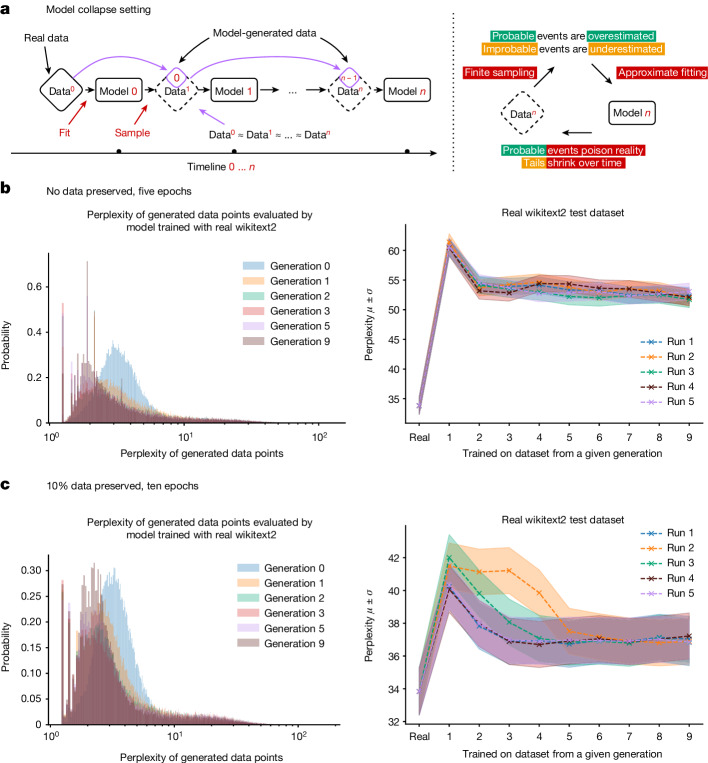
- In LLM experiments, an OPT-125m model fine-tuned on wikitext2 reaches 34 mean perplexity from a zero-shot baseline of 115. With five epochs and no original training data, performance degrades “from 20 to 28 perplexity points”; with ten epochs and 10% of original training data preserved, there is “only minor degradation of performance.”
- Generated data over generations contain more sequences the original model would produce with higher likelihood, but also much longer tails of sequences the original model would never produce, indicating accumulated errors.
- An ablation with a repeating penalty of 2.0 causes models to produce lower-score continuations to avoid repeats, and “causes the perplexity to double compared with the original”; models remain as susceptible to model collapse, if not more.
Methods
- Theoretical analysis of “learning with generational data”: a discrete distribution case with exact approximation, analyzed as a Markov chain, and a multidimensional Gaussian approximation using unbiased sample mean and variance estimators, with Wasserstein-2 distance as the divergence measure.
- LLM experiments fine-tune the OPT-125m causal language model from Meta via Hugging Face on wikitext2. Data generation uses five-way beam search; training sequences are blocked to 64 tokens, and for each token sequence the model predicts the next 64 tokens, producing an artificial dataset of the same size. Each experiment is run five times with different randomness seeds, and the best-performing model on the original task is used as the base for subsequent generations.
- Two LLM settings are tested: five epochs with no original training data retained, and ten epochs with a random 10% of original data points sampled for each new generation. VAEs and GMMs are covered in the Supplementary Materials.
Limitations
- The paper states that theoretical claims are mostly presented in the limit of generations going to infinity, whereas experiments use a finite, usually small, number of generations; complete collapse may or may not occur even after a small number of steps, and convergence rates are highly related to the specifics of the problem.
- The paper states that larger language models in non-fine-tuning settings were not run because training a single moderately large model produces twice the American lifetime’s worth of CO2; the LLM experiments are a fine-tuning proof of concept, and even those took weeks to run.
- Evident from the text: the LLM evidence is limited to OPT-125m, wikitext2, five runs, and fine-tuning; no full retraining from scratch is tested, and VAE/GMM details are relegated to the Supplementary Materials.
Model-written summary. Check it against the paper before relying on it.
Integrity signals
Registry
Cites
Statistics
Figures
Verification
Claims the paper makes
1 Valid · 0 Not valid · 3 Not checked · 40 Own results and interpretations
The cited sources support only part of this claim — read each source’s verdict below.
In the paper
“The repeating problem has been observed in nearly all text-generation models17,18”
§ AI models collapse when trained on recursively generated data > Model collapse in language models > Ablation: Repetitions
What the sources say
- Partly supportedcites [17] Keskar, N. S., McCann, B., Varshney, L. R., Xiong, C. & Socher, R. CTRL: a conditional transformer language model for controllable generation. Preprint at https://arxiv.org/abs/1909.05858 (2019). sourceExperimental — accuracy not yet measured
The Related Work section (p. 10) identifies repetition as a problem in text generation and discusses methods for reducing it. It does not say the problem has been observed in nearly all text-generation models; that prevalence claim is unsupported. (LLM, conf=0.86)
- Could not verifycites [18] Shumailov, I. et al. in Proc. 2021 IEEE European Symposium on Security and Privacy (EuroS&P) 212–231 (IEEE, 2021). sourceExperimental — accuracy not yet measured
Section 5.2 discusses attacks that increase output length, energy use, and latency, but not repetitive generated text. Searches for “repeating problem,” “repeated output,” and “repeat” found no passage saying that repetition has been observed in nearly all text-generation models; page numbers were unavailable in our copy. (LLM, conf=0.76)
plain- Asserted: passes — The authors put it forward as true.
- Checkable: passes — It can be checked against evidence.
- Load-bearing: unclear — It is unclear whether the paper’s conclusions depend on it.
- Based: passes — The paper gives a reason why it holds.
- Partly supported
A result the paper reports from its own data — it cites no other source for it, so there is none to check. The quote shows it is in the paper.
In the paper
“Here, over the generations, models tend to produce more sequences that the original model would produce with the higher likelihood.”
§ AI models collapse when trained on recursively generated data > Model collapse in language models
plainstates an association- Asserted: passes — The authors put it forward as true.
- Checkable: passes — It can be checked against evidence.
- Load-bearing: passes — The paper’s conclusions depend on it.
- Based: passes — The paper gives a reason why it holds.
A result the paper reports from its own data — it cites no other source for it, so there is none to check. The quote shows it is in the paper.
In the paper
“We find that data generated by language models in our experiments end up containing a large number of repeating phrases, as in Example 1.”
§ AI models collapse when trained on recursively generated data > Model collapse in language models > Ablation: Repetitions
plain- Asserted: passes — The authors put it forward as true.
- Checkable: passes — It can be checked against evidence.
- Load-bearing: unclear — It is unclear whether the paper’s conclusions depend on it.
- Based: passes — The paper gives a reason why it holds.
A result the paper states — it cites no source for it, so there is none to check. The quote shows it is in the paper.
In the paper
“we can show that the probability of losing information (that is, sampling no data at some generation) is equal to 1 − q”
§ AI models collapse when trained on recursively generated data > Theoretical intuition > Discrete distributions with exact approximation
plain- Asserted: passes — The authors put it forward as true.
- Checkable: passes — It can be checked against evidence.
- Load-bearing: passes — The paper’s conclusions depend on it.
- Based: passes — The paper gives a reason why it holds.
- Rests on an assumption not shown here.
A result the paper reports from its own data — it cites no other source for it, so there is none to check. The quote shows it is in the paper.
In the paper
“We discover that indiscriminately learning from data produced by other models causes ‘model collapse’—a degenerative process whereby, over time, models forget the true underlying data distribution, even in the absence of a shift in the distribution over time.”
§ AI models collapse when trained on recursively generated data > Main
plainstates a cause- Asserted: passes — The authors put it forward as true.
- Checkable: passes — It can be checked against evidence.
- Load-bearing: passes — The paper’s conclusions depend on it.
- Based: passes — The paper gives a reason why it holds.
11 more claims
Create a free account to see all 44 claims and every source verdict.
- It may state two separate claims as one. 22
- The quote only partly states this claim. 1
- Probably not a substantial claim. 10
Claims other papers make about this one
Each is checked against this paper’s own text: does it say what the citing paper says it does?
The source backs part of the claim, not all of it — or backs it for a different population, condition or comparison.
In the citing paper
“Second, LLMs are frequently trained on the same open-access corpora we examine, creating a feedback loop in which tomorrow's models will learn today's hallucinations [34].”
From LLM hallucinations in the wild: Large-scale evidence from non-existent citations (2026) · cites this paper as [34]
Experimental — accuracy not yet measuredThe source backs part of the claim, not all of it — or backs it for a different population, condition or comparison.
In the citing paper
“Successive training cycles cause LLMs to “forget” the statistical long-tail of rare but important patterns, resulting in homogenized, impoverished, and epistemically diminished outputs.”
From 4E cognition and the coevolution of human–AI interaction (2025) · cites this paper as [61]
Experimental — accuracy not yet measuredThe source backs part of the claim, not all of it — or backs it for a different population, condition or comparison.
In the citing paper
“AI-generated content now saturates the internet, reducing reliability and contaminating training data for future models (Paredes et al., 2025;Shumailov et al., 2024).”
From Purpose before policy: academic integrity, generative AI, and rhetorical stance (2026) · cites this paper as Shumailov et al., 2024
Experimental — accuracy not yet measuredThe source backs part of the claim, not all of it — or backs it for a different population, condition or comparison.
In the citing paper
“As successive generations of models are trained on data increasingly contaminated by historical synthetic outputs, the system progressively erodes distributional diversity and collapses functional modes—a degenerative process that remains robust to scale and is highly sensitive to even minimal synthetic fractions [14,15].”
From Self-Referential Introspection in Large Language Models: The Critical Threshold for Recursive Self-Improvement (2026) · cites this paper as [14]
Experimental — accuracy not yet measuredThe source backs part of the claim, not all of it — or backs it for a different population, condition or comparison.
In the citing paper
“The accumulation of synthetic data may affect model output quality, reinforce existing biases, and alter information feedback dynamics, thereby posing potential challenges to the stability of the digital knowledge ecosystem (Shumailov et al., 2024).”
From The Attention Mismatch: Mapping the Structural Academic Governance Deficit in the Age of Generative AI (2026) · cites this paper as Shumailov et al., 2024
Experimental — accuracy not yet measured
19 more claims about this paper
Create a free account to see every claim other papers make about this one.
Self-check
Percentages, sums and reported differences re-computed from the paper’s own numbers.
Each contradiction between two passages listed here was confirmed by an independent check.
Rated minor: it would not touch a result — a value no result rests on, a p-value that stays on the same side of the significance level, or a conflict that is clerical, resolved elsewhere in the paper, or outside its own findings.
In the paper
§ AI models collapse when trained on recursively generated data > Abstract
“GPT-2 (ref. 1), GPT-3(.5) (ref. 2) and GPT-4 (ref. 3)”
§ AI models collapse when trained on recursively generated data > Model collapse in language models
“BERT4, RoBERTa5 or GPT-2 (ref. 2)”
Citations
Cites
Language Models are Few-Shot Learners
Brown, T. B., Mann, B., Ryder, N., Subbiah, M., Kaplan, J., Dhariwal, P., Neelakantan, A., Shyam, P., Sastry, G., Askell, A., et al. (2020) · arXiv · doi:10.48550/arxiv.2005.14165 · Cited by 23,372
RoBERTa: A Robustly Optimized BERT Pretraining Approach
Liu, Y., Ott, M., Goyal, N., Du, J., Joshi, M., Chen, D., Levy, O., Lewis, M., Zettlemoyer, L., & Stoyanov, V. (2019) · arXiv · doi:10.48550/arxiv.1907.11692 · Cited by 16,515
Li, Z., & Hoiem, D. (2018) · IEEE Transactions on Pattern Analysis and Machine Intelligence · doi:10.1109/tpami.2017.2773081 · Cited by 4,202
Energy and Policy Considerations for Deep Learning in NLP
Strubell, E., Ganesh, A., & McCallum, A. (2019) · arXiv · doi:10.48550/arxiv.1906.02243 · Cited by 3,735
5th International Conference on Learning Representations (ICLR 17)
Havrylov, S., & Titov, I. (2017) · Cited by 3,503
Deep Neural Networks are Easily Fooled: High Confidence Predictions for Unrecognizable Images
Nguyen, A., Yosinski, J., & Clune, J. (2014) · arXiv · doi:10.48550/arxiv.1412.1897 · Cited by 3,258
Deep neural networks are easily fooled: High confidence predictions for unrecognizable images
Nguyen, A., Yosinski, J., & Clune, J. (2015) · 2015 IEEE Conference on Computer Vision and Pattern Recognition (CVPR) · doi:10.1109/cvpr.2015.7298640 · Cited by 3,258
On the Opportunities and Risks of Foundation Models
Bommasani, R., Hudson, D. A., Adeli, E., Altman, R., Arora, S., von Arx, S., Bernstein, M. S., Bohg, J., Bosselut, A., Brunskill, E., et al. (2021) · arXiv · doi:10.48550/arxiv.2108.07258 · Cited by 2,676
Poisoning Attacks against Support Vector Machines
Biggio, B., Nelson, B., & Laskov, P. (2012) · arXiv · doi:10.48550/arxiv.1206.6389 · Cited by 1,331
The Implicit Bias of Gradient Descent on Separable DataPreprint
Soudry, D., Hoffer, E., Nacson, M. S., Gunasekar, S., & Srebro, N. (2017) · arXiv (Cornell University) · doi:10.48550/arxiv.1710.10345 · Cited by 829
Research works printed but not linked: 7
- Radford, A. et al. Language models are unsupervised multitask learners. OpenAI blog 1, 9 (2019).
- Devlin, J., Chang, M.-W., Lee, K. & Toutanova, K. in Proc. 2019 Conference of the North American Chapter of the Association for Computational Linguistics: Human Language Technologies, Volume 1 (Long and Short Papers) (eds Burstein, J., Doran, C. & Solorio, T.) 4171–4186 (Association for Computational Linguistics, 2019).
- Carlini, N. & Terzis, A. in Proc. Tenth International Conference on Learning Representations (ICLR, 2022).
- Carlini, N. et al. in Proc. 2024 IEEE Symposium on Security and Privacy (SP) 179 (IEEE, 2024).
- Mousavi-Hosseini, A., Park, S., Girotti, M., Mitliagkas, I. & Erdogdu, M. A. in Proc. Eleventh International Conference on Learning Representations (ICLR, 2023).
- Gu, Y., Dong, L., Wei, F. & Huang, M. in Proc. Twelfth International Conference on Learning Representations (ICLR, 2024).
- Strubell, E., Ganesh, A. & McCallum, A. in Proc. 57th Annual Meeting of the Association for Computational Linguistics (eds Korhonen, A., Traum, D. & Màrquez, L.) 3645–3650 (Association for Computational Linguistics, 2019).
Cited by
Items 101–200 of 789
Narrative Creativity: An Introduction to How and Why
Fletcher, A., & Benveniste, M. (2025) · Cambridge University Press eBooks · doi:10.1017/9781009614801 · Cited by 17
The new narrative medicine: ethical implications of artificial intelligence on healthcare narratives
Schwartz, D., & Lanphier, E. (2025) · Bioethics News · doi:10.1007/s40592-025-00256-z · Cited by 16
Digital plastic: a metaphorical framework for Critical AI Literacy in the multiliteracies era
Roe, J., Furze, L., & Perkins, M. (2025) · Pedagogies An International Journal · doi:10.1080/1554480x.2025.2557491 · Cited by 31
“Research also suggests that human-created data is fundamental to model development, as training a new model on existing GenAI content has been posited to lead to models producing unintelligible and nonsensical outputs, a term Shumailov et al. (2024) refer to as model collapse.”
Rewilding the Web: my workshop report from Edinburgh
Madhavapeddy, A. (2026) · doi:10.59350/g40yy-ks003 · Cited by 10
Reliable prediction of protein–protein binding affinity changes upon mutations with Pythia-PPI
Tao, F., Sun, J., Gao, P., Gao, G. F., & Wu, B. (2025) · National Science Review · doi:10.1093/nsr/nwaf231 · Cited by 10
A Lifecycle-Oriented Survey of Emerging Threats and Vulnerabilities in Large Language Models
de Maio, C., Di Gisi, M., Fenza, G., Gallo, M., & Loia, V. (2025) · IEEE Access · doi:10.1109/access.2025.3619764 · Cited by 10
“Model collapse refers to the phenomenon, introduced in [5], where a language model, during continuous fine-tuning or retraining on its own generated data, progressively loses its ability to produce coherent and diverse outputs.”
Can AI Do Strategy? A Dialogue and Debate
Chatterji, A., Csaszar, F. A., Evans, J. A., Felin, T., Hullman, J. R., Lakhani, K. R., Sako, M., & Zenger, T. R. (2026) · Strategy Science · doi:10.1287/stsc.2026.ed.v11.n1 · Cited by 21
More-than-Human Storytelling: Designing Longitudinal Narrative Engagements with Generative AI
Fabre, É., Seaborn, K., Koiwai, S., Watanabe, M., & Riesch, P. (2025) · CHI Conference Extended Abstracts on Human Factors in Computing Systems (CHI EA) · doi:10.1145/3706599.3720135 · Cited by 17
“For instance, the increase of AI content can quickly lead to a collapse of the capabilities of the models [46] and “harm” the AI.”
Generative artificial intelligence and learning: At the dawn of Idiocracy?
Izák, M., Barros, A. N., Prasad, A., & Śliwa, M. (2025) · Management Learning · doi:10.1177/13505076251348575 · Cited by 19
“In addition to the concerns over model degradation due to recursive training on synthetic data (Shumailov et al., 2024), this dynamic is mired with not only ethical risks but also tangible dangers, if applied in fields such as medicine (e.g. Amann et al., 2020).”
Artificial Intelligence in Library Cataloging: A Review of Literature
Engel, J. Y., Do, D. T., Salem, B., & Cunningham, T. A. (2025) · Journal of Library Metadata · doi:10.1080/19386389.2025.2526913 · Cited by 34
“The perils of training AI with AI-created materials are a well-documented problem in the field of computer science (Shumailov et al., 2024); the mass production and distribution of AI-generated records could easily make today’s metadata quality woes seem like an idyllic paradise, while further…”
Strategic Behavior and AI Training DataPreprint
Peukert, C., Abeillon, F., Haese, J., Kaiser, F., & Staub, A. (2024) · SSRN Electronic Journal · doi:10.2139/ssrn.4820846 · Cited by 13
4E cognition and the coevolution of human–AI interaction
Noller, J. (2025) · Discover Artificial Intelligence · doi:10.1007/s44163-025-00595-0 · Cited by 15
Hernández-Ramírez, R., & Ferreira, J. B. (2024) · She ji · doi:10.1016/j.sheji.2024.11.002 · Cited by 20
GhostCite: A Large-Scale Analysis of Citation Validity in the Age of Large Language Models
Xu, Z., Qiu, Y., Sun, L., Miao, F., Wu, F., Li, X., Wang, X., Lu, H., Zhang, Z., Hu, Y., et al. (2026) · arXiv · doi:10.48550/arxiv.2602.06718 · Cited by 3
“If future LLMs are trained on papers containing ghost citations, these fabrications may be reproduced amplifying errors across generations [37].”
Mathes, S., Seurig, S., Bluhme, F., Beyer, K., Heizmann, F., Wagner, M., Neugärtner, I., Biedermann, T., & Darsow, U. (2025) · The Journal of Allergy and Clinical Immunology In Practice · doi:10.1016/j.jaip.2025.03.030 · Cited by 13
CASTLE: Benchmarking Dataset for Static Code Analyzers and LLMs Towards CWE Detection
Dubniczky, R. A., Horvát, K. Z., Bisztray, T., Ferrag, M. A., Cordeiro, L. C., & Tihanyi, N. (2025) · Lecture notes in computer science · doi:10.1007/978-3-031-98208-8_15 · Cited by 39
A Guide to Machine Learning Epistemic Ignorance, Hidden Paradoxes, and Other Tensions
Naser, M. Z. (2025) · Wiley Interdisciplinary Reviews Data Mining and Knowledge Discovery · doi:10.1002/widm.70038 · Cited by 17
“• Latent mode collapse (Shumailov et al. 2024): In generative models, distinct data modes merge into a single cluster in latent space, obscuring diversity.”
Performative Prediction: Past and Future
Hardt, M., & Mendler-Dünner, C. (2025) · Statistical Science · doi:10.1214/25-sts986 · Cited by 107
One fish, two fish, but not the whole sea: Alignment reduces language models' conceptual diversity
Murthy, S. K., Ullman, T., & Hu, J. (2025) · Proceedings of the 2025 Conference of the Nations of the Americas Chapter of the Association for Computational Linguistics: Human Language Technologies (Volume 1: Long Papers) · doi:10.18653/v1/2025.naacl-long.561 · Cited by 8
A Survey of Post-Training Scaling in Large Language Models
Lai, H., Liu, X., Gao, J., Cheng, J., Qi, Z., Xu, Y., Yao, S., Zhang, D., Du, J., Hou, Z., et al. (2025) · Proceedings of the 63rd Annual Meeting of the Association for Computational Linguistics (Volume 1: Long Papers) · doi:10.18653/v1/2025.acl-long.140 · Cited by 8
Torres–Martínez, S. (2024) · Language and Semiotic Studies · doi:10.1515/lass-2024-0018 · Cited by 9
Artificial intelligence and physician burnout: A productivity paradox
Goodson, D. A., Garcia, B., Hogarth, M. A., & Tu, S.-P. (2025) · Learning Health Systems · doi:10.1002/lrh2.70013 · Cited by 16
“50 By extension, the performance of the current generation of AI tools may decline as AI-generated documents and data replace human-generated data in the EHR.”
Operationalizing Geographic Diversity for the Evaluation of AI ‐Generated Content
Liu, Z., Janowicz, K., Majić, I., Shi, M., Fortacz, A., Karimi, M., Mai, G., & Currier, K. (2025) · Transactions in GIS · doi:10.1111/tgis.70057 · Cited by 20
“Recently, Shumailov et al. (2024) discovered that AI-generated content may pollute the training data of a generative model, thereby making generated content diverge significantly from the original content.”
Large Language Model for Verilog Generation with Code-Structure-Guided Reinforcement Learning
Wang, N., Yao, B., Zhou, J., Hu, Y., Wang, X., Jiang, Z., & Guan, N. (2025) · IEEE International Conference on LLM-Aided Design (ICLAD) · doi:10.1109/iclad65226.2025.00025 · Cited by 57
“Moreover, using commercial models like GPT for training data synthesis or augmentation can hinder model performance, as it may introduce biases from the source models, leading to performance degradation through recursive training effects [27].”
Muñoyerro-Muñiz, D., Villegas, R., de la Oliva, V., Esteban-Medina, A., del Valle, P. F., Sánchez, A., Susin, M. B., Gutiérrez-Álvarez, I., Reboredo, M., Alejos, L., et al. (2025) · Frontiers in Public Health · doi:10.3389/fpubh.2025.1630351 · Cited by 12
From visual question answering to intelligent AI agents in ophthalmology
Chen, X., Chen, R., Xu, P., Wan, X., Zhang, W., Yan, B., Shang, X., He, M., & Shi, D. (2025) · British Journal of Ophthalmology · doi:10.1136/bjo-2024-326097 · Cited by 12
“59 Consequently, combining synthetic data with real-world data during training is considered more robust and effective.”
How public involvement can improve the science of AI
Matias, J. N., & Price, M. (2025) · Proceedings of the National Academy of Sciences · doi:10.1073/pnas.2421111122 · Cited by 17
Hernández, A. D., Perini, A., Hadjiloizou, S., Borda, A., Mahomed, S., & Leslie, D. (2025) · AI and Ethics · doi:10.1007/s43681-025-00902-6 · Cited by 15
All Just in Your Head? Unraveling the Side Effects of Generative AI Disclosure in Creative TaskPreprint
Bauer, K., Jussupow, E., Heigl, R., Vogt, B., & Hinz, O. (2024) · Social Science Research Network · doi:10.2139/ssrn.4782554 · Cited by 10
Hann, M. M., & Keserű, G. M. (2025) · Expert Opinion on Drug Discovery · doi:10.1080/17460441.2025.2450785 · Cited by 7
“…‘data’ but recent publications caution against incorporating such data into further iterations of predictions, with AI models trained on AI-generated data descending into gibberish as low probability information is diluted out by addition of higher probability but generated information [13].”
Matysik, S., Wiśniewska, J., & Frankowski, P. K. (2025) · SoftwareX · doi:10.1016/j.softx.2025.102416 · Cited by 15
Natural Language Actor-Critic: Scalable Off-Policy Learning in Language Space
Hong, J., Liu, K., Ling, Z., Chen, J., & Levine, S. (2025) · arXiv · doi:10.48550/arxiv.2512.04601 · Cited by 7
“…for a transition ( s t , a t , s t +1 ) , the natural language critic is trained using cross entropy component of the objective: where ¯ θ are reference parameters that are an exponentially moving average of the trained parameters, in order to prevent generative collapse [Shumailov et al., 2024].”
Lai, C. H.-L., Kwok, A. P. K., & Wong, K.-C. (2024) · Journal of Personalized Medicine · doi:10.3390/jpm14090981 · Cited by 7
“…fall short of capturing the true complexities of real-world data [32], and previous research has indicated that ML models trained on such synthetic data can experience performance degradation [33], a risk that is unacceptable when predicting medications with potentially life-changing consequences.”
BackgroundHDRT: A large-scale dataset for infrared-guided HDR imaging
Peng, J., Bashford‐Rogers, T., Banterle, F., Zhao, H., & Debattista, K. (2025) · Information Fusion · doi:10.1016/j.inffus.2025.103109 · Cited by 14
Daraio, C. C., Leo, S. D., & Ferazzoli, F. (2025) · International Transactions in Operational Research · doi:10.1111/itor.70054 · Cited by 12
Engineering Spectro-Temporal Light States with Physics-Embedded Deep Learning
Liu, S., Virally, S., Demontigny, G., Cusson, P., & Seletskiy, D. V. (2025) · Ultrafast Science · doi:10.34133/ultrafastscience.0107 · Cited by 6
Understanding how users may work around algorithmic bias
Overbye-Thompson, H. E., & Rice, R. E. (2025) · AI & Society · doi:10.1007/s00146-025-02498-1 · Cited by 14
Computer Audition: From Task-Specific Machine Learning to Foundation Models
Triantafyllopoulos, A., Tsangko, I., Gebhard, A., Mesaros, A., Virtanen, T. I., & Schuller, B. W. (2025) · Proceedings of the IEEE · doi:10.1109/jproc.2025.3593952 · Cited by 20
Pan, C., Lu, W., Chen, B., Zhang, G., Yang, Z., & Hao, J. (2025) · JMIR Medical Informatics · doi:10.2196/76252 · Cited by 12
“This phenomenon can be ascribed, at least in part, to the model collapse problem inherent to LLM [39,40].”
Can AI with High Reasoning Ability Replicate Human-like Decision Making in Economic Experiments?
Kitadai, A., Lugo, S. D. R., Tsurusaki, Y., Fukasawa, Y., & Nishino, N. (2025) · Group Decision and Negotiation · doi:10.1007/s10726-025-09946-9 · Cited by 29
Federated Learning for Medical Image Classification: A Comprehensive Benchmark
Zhou, Z., Luo, G., Chen, M., Weng, Z., & Zhu, Y. (2025) · IEEE Journal of Biomedical and Health Informatics · doi:10.1109/jbhi.2025.3631706 · Cited by 37
“Similarly, direct incorporation of generated data into the training set can lead to a decrease in classification performance on CIFAR-10in some experiments [67].”
Using conversational AI to reduce science skepticism
Hornsey, M. J., Smith, A. E., Pearson, S. G., Bretter, C., & Nylund, J. L. (2025) · Current Opinion in Psychology · doi:10.1016/j.copsyc.2025.102216 · Cited by 12
A framework for ethical AI-HRM development and use
Davidson, J., Schnepp, J. C., Buttrick, H. G., & Gupta, A. (2025) · AI and Ethics · doi:10.1007/s43681-025-00858-7 · Cited by 13
“It can also occur due to sampling error , which occurs when an analyst does not select a sample that represents the overall population [41].”
InfluentialWang, X., Zhong, W., Huang, K., & Liang, B. (2025) · International Journal of Information Management · doi:10.1016/j.ijinfomgt.2025.103009 · Cited by 16
The billion-dollar case for sustaining palaeontology’s digital databases
Dowding, E. M., Dunne, E. M., Collins, K. S., Cryer, K., Baets, K. D., Dimitrijević, D., Edie, S. M., Finnegan, S., Kiessling, W., Lintulaakso, K., et al. (2026) · Nature Ecology & Evolution · doi:10.1038/s41559-026-02985-8 · Cited by 12
“As new questions emerge and data continue to diversify and increase in accessibility 25,40 , the range of scientific applications of these second-generation databases far surpass their original scope and yield input for thousands of scientific studies (see ‘Database use’ in Supplementary Data).”
Lu, K.-H., Chen, Z., Fu, S., Yang, C.-H. H., Huang, S.-F., Yang, C.-K., Yu, C.-M., Chen, C., Chen, W.-C., Huang, C.-Y., et al. (2026) · IEEE Transactions on Audio Speech and Language Processing · doi:10.1109/taslpro.2026.3675792 · Cited by 84
“5-generated data), we observe catastrophic model degeneration [129] after the fourth epoch, manifesting as repetitive or nonsensical outputs.”
Minds and machines: evaluating the feasibility of constructing an advanced artificial intelligence
Sgantzos, K., Stelios, S., Tzavaras, P., & Theologou, K. (2024) · Discover Artificial Intelligence · doi:10.1007/s44163-024-00216-2 · Cited by 8
“In a recent manuscript published in Nature, researchers showed that AI models collapse when trained on recursively generated data that come from AI [46].”
Fake papers abound in the literature
Madhavapeddy, A. (2025) · doi:10.59350/qmsqz-ark89 · Cited by 6
Mitigating Sycophancy in Large Language Models via Direct Preference Optimization
Khan, A. A., Alam, S., Wang, X., Khan, A. F., Neog, D. R., & Anwar, A. (2024) · 2024 IEEE International Conference on Big Data (BigData) · doi:10.1109/bigdata62323.2024.10825538 · Cited by 6
Large language models and the problem of rhetorical debt
MacArthur, M. (2025) · AI & SOCIETY · doi:10.1007/s00146-025-02403-w · Cited by 8
“AI degenerates when trained on its own output (Shumailov et al. 2024).”
The rise of the research automaton: science as process or product in the era of generative AI?
Sætra, H. S. (2025) · AI & Society · doi:10.1007/s00146-025-02557-7 · Cited by 18
Li, H.-L., Ren, Q., Li, J., Wei, H., Liu, Z., & Fan, L. (2025) · Expert Systems with Applications · doi:10.1016/j.eswa.2025.129529 · Cited by 6
“When the very definition is ambiguous, injecting artificial noise amounts to data contamination, potentially degrading downstream model performance [24].”
Bhardwaj, A. (2025) · Humanities and Social Sciences Communications · doi:10.1057/s41599-025-05749-0 · Cited by 12
“Attempts to mitigate these issues by generating synthetic data have also shown limitations; models trained on such data often perform poorly, producing outputs that lack reliability and practical utility (Shumailov et al. 2024).”
Cooper, Z., Martens, B., Peukert, C., & Stocker, V. (2025) · Review of Network Economics · doi:10.1515/rne-2025-0039 · Cited by 12
“Moreover, recursive training on synthetic outputs risks drift, loss of relevance, and model collapse (Shumailov et al. 2024).”
General-Purpose Models for the Chemical Sciences: LLMs and Beyond
Alampara, N., Aneesh, A., Ríos-García, M., Mirza, A., Schilling-Wilhelmi, M., Aghajani, A. A., Sun, M., Prastalo, G., & Jablonka, K. M. (2026) · Chemical Reviews · doi:10.1021/acs.chemrev.5c00583 · Cited by 37
Reactive Writers: How Co-Writing with AI Changes How We Engage with Ideas
Bhat, A., Quéré, M. A. L., Naaman, M., & Jakesch, M. (2026) · CHI Conference on Human Factors in Computing Systems · doi:10.1145/3772318.3791529 · Cited by 18
Generative AI and the information commons: controversy, copyright, and closure
McKelvey, F. R., Simon, B., & Frizzera, L. (2025) · Information Communication & Society · doi:10.1080/1369118x.2025.2565328 · Cited by 8
Critical Thinking in the Age of Algorithms
Andrae, S. (2024) · Advances in educational marketing, administration, and leadership book series · doi:10.4018/979-8-3373-1692-5.ch010 · Cited by 5
Weinstein, E. N., Gollub, M. G., Slabodkin, A., Gardner, C. L., Dobbs, K., Cui, X.-B., Amin, A. N., Church, G. M., & Wood, E. (2024) · bioRxiv (Cold Spring Harbor Laboratory) · doi:10.1101/2024.09.13.612900 · Cited by 6
“28 Going forward, it will be important to develop improved methods for conditioning variational synthesis models on auxiliary information and design goals.”
BackgroundFine-Grained Detection of AI-Generated Writing in the Biomedical Literature
She, R. (2026) · bioRxiv (Cold Spring Harbor Laboratory) · doi:10.64898/2026.01.01.697311 · Cited by 4
“…papers containing AI-generated prose were to be later incorporated into model training corpora, one might reasonably worry that this introduces the same kind of synthetic contamination seen in controlled studies, where models trained heavily on their own outputs reliably degrade in quality 14–16 .”
Li, Y., Fu, X., Verma, G., Buitelaar, P., & Liu, M. (2025) · arXiv · doi:10.48550/arxiv.2510.24476 · Cited by 4
Imai, Y., SENDA, T., & Kajiwara, Y. (2025) · IEEE Access · doi:10.1109/access.2025.3525714 · Cited by 4
“More-over, when the outputs of generative models are repeatedly used to train such models, a phenomenon called ‘‘model collapse’’ can occur [32].”
Jones, M. (2025) · Information and Organization · doi:10.1016/j.infoandorg.2025.100557 · Cited by 5
Gulamali, F. F., Sawant, A. S., Liharska, L. E., Horowitz, C. R., Chan, L., Hofer, I. S., Singh, K., Richardson, L. D., Mensah, E., Charney, A. W., et al. (2025) · Journal of Medical Internet Research · doi:10.2196/71757 · Cited by 7
“However, this does not necessarily replace high-quality data collection because large models are at the risk of collapsing when trained on recursively generated data [49,50].”
Mutual benefits of social learning and algorithmic mediation for cumulative culture
Czaplicka, A., Baumann, F., & Rahwan, I. (2025) · Journal of The Royal Society Interface · doi:10.1098/rsif.2024.0686 · Cited by 7
“…a general trade-off in socio-technical systems between access to information (and thus the possibility to exchange it) and the ability of individuals to innovate: while algorithms can be beneficial for cultural accumulation, they may also lead to detrimental effects if used excessively [52, 53].”
Ignorance of the crowd: dysfunctional thinking in social networks
Seeme, F. B., Green, D., & Kopp, C. (2025) · Frontiers in Communication · doi:10.3389/fcomm.2025.1547489 · Cited by 9
“This raises the risk of a runaway positive feedback loop, leading to “Model Collapse,” in which the AI amplifies its own erroneous outputs over many training cycles (Shumailov et al., 2024).”
The regulation of fine-tuning: Federated compliance for modified general-purpose AI models
Hacker, P., & Holweg, M. (2025) · Computer law & security review · doi:10.1016/j.clsr.2025.106234 · Cited by 17
Engaging the unengaged: Differential effects of AI-driven climate communication across audiences
Plechatá, A., Makransky, G., & BOHM, R. M. (2025) · Journal of Environmental Psychology · doi:10.1016/j.jenvp.2025.102892 · Cited by 5
PARROT, an open multilingual radiology reports dataset
Guellec, B. L., Adambounou, K. F. T., Adams, L. C., Agripnidis, T., Ahn, S. S., Chalal, R. A., D’Antonoli, T. A., Amouyel, P., Andersson, H., Bentegeac, R., et al. (2025) · European Journal of Radiology Artificial Intelligence · doi:10.1016/j.ejrai.2025.100066 · Cited by 12
Glas, N., Morrow, T., & Sigil, J. (2026) · Zenodo (CERN European Organization for Nuclear Research) · doi:10.5281/zenodo.19457942 · Cited by 4
Rijsbosch, B., DIJCK, G. V., & Kollnig, K. (2026) · Policy & Internet · doi:10.1002/poi3.70041 · Cited by 32
Surveillance Capitalism: Origins, History, Consequences
Lipartito, K. J. (2025) · Histories · doi:10.3390/histories5010002 · Cited by 14
Integrating generative AI with neurophysiological methods in psychiatric practice
Feng, Y., Zhou, Y., Xu, J., Lu, X., Gu, R., & Qiao, Z. (2025) · Asian Journal of Psychiatry · doi:10.1016/j.ajp.2025.104499 · Cited by 5
Scrambled text: fine-tuning language models for OCR error correction using synthetic data
Bourne, J. (2025) · International Journal on Document Analysis and Recognition (IJDAR) · doi:10.1007/s10032-025-00522-0 · Cited by 13
“However, synthetic data needs to be applied carefully, as there is evidence that when LMs are trained on recursively generated synthetic data, they can suffer model collapse and produce gibberish [34].”
Canavilhas, J. (2025) · Comunicação e Sociedade · doi:10.17231/comsoc.47(2025).6100 · Cited by 7
“Alguns autores (Shumailov et al., 2024; Wenger, 2024) defendem que a partir de determinado momento a IA generativa passará a alimentar-se de imagens geradas pela própria IA, levando à produção de informação sem sentido e ao colapso do modelo: neste processo dege-nerativo, a informação vai perdendo…”
Generative AI, Everyday Aesthetic Production, and the Imperial Mode of Living
Kemper, J. (2025) · Critical AI · doi:10.1215/2834703x-11700246 · Cited by 7
Generative Models for Synthetic Data: Transforming Data Mining in the GenAI Era
Li, D., Huang, Y., Li, M., et al. (2025) · ACM International Conference on Information and Knowledge Management (CIKM) · doi:10.1145/3746252.3761455 · Cited by 4
Mielgo, R., Gutiérrez, M., & Almazor, G. G. (2024) · Development · doi:10.1057/s41301-024-00412-8 · Cited by 4
“The risk is that AI models used for fisheries monitoring and control may well collapse when trained on wrongly generated or inferred data (Shumailov et al. 2024).”
Lee, D., Todorova, C., & Dehghani, A. (2024) · Conference on Human Centred Artificial Intelligence - Education and Practice (HCAIep) · doi:10.1145/3701268.3701272 · Cited by 13
Heikkilä, J. (2024) · Journal of Documentation · doi:10.1108/jd-05-2024-0104 · Cited by 6
Morescient GAI for Software Engineering
Kessel, M., & Atkinson, C. (2025) · ACM Transactions on Software Engineering and Methodology · doi:10.1145/3709354 · Cited by 11
Audio-Language Datasets of Scenes and Events: A Survey
Wijngaard, G., Formisano, E., Esposito, M., & Dumontier, M. (2025) · IEEE Access · doi:10.1109/access.2025.3534621 · Cited by 14
Lightweight GAN-Assisted Class Imbalance Mitigation for Apple Flower Bud Detection
Yuan, W., & Li, P. (2025) · Big Data and Cognitive Computing · doi:10.3390/bdcc9020028 · Cited by 5
“Shumailov et al. [16] discovered that generative AIs, such as large language models (LLMs), variational autoencoders (VAEs), and Gaussian mixture models (GMMs), all experienced performance degradation when their training datasets were polluted by synthetic data from preceding models.”
Interacting Large Language Model Agents. Bayesian Social Learning Based Interpretable Models
Jain, A., & Krishnamurthy, V. (2025) · IEEE Access · doi:10.1109/access.2025.3538599 · Cited by 22
“However, in the case of discrete distributions in which the LLMs learn such a protocol, it leads to collapsing on one of the support points [15]; therefore, model collapse in the training of LLMs can be studied using the framework of Bayesian social learning.”
InfluentialGenerative artificial intelligence for ophthalmic images: developments, applications and challenges
Li, T., Wang, Z., Jiang, Z., Zhong, H., & Qin, Y. (2025) · The Visual Computer · doi:10.1007/s00371-025-03988-5 · Cited by 6
“The recent findings [114] on AI model collapse when trained on recursively generated data highlight the potential dangers of over-reliance on synthetic content.”
Artificial intelligence in nutrition and ageing research – A primer on the benefits
Grootswagers, P., & Grootswagers, T. (2025) · Maturitas · doi:10.1016/j.maturitas.2025.108662 · Cited by 9
A flow-based model for conditional and probabilistic electricity consumption profile generation
Xia, W., Wang, C., Pálenský, P., & Vergara, P. P. (2025) · Energy and AI · doi:10.1016/j.egyai.2025.100586 · Cited by 8
“9(b), may be linked to a model collapse—a phenomenon in generative modeling where the model fails to fully capture the diversity of the target data distribution, often leading to repetitive or biased outputs [49].”
Collapse or thrive? perils and promises of synthetic data in a self-generating world
Kazdan, J., Schaeffer, R., Dey, A., Gerstgrasser, M., Rafailov, R., Donoho, D. L., & Koyejo, S. (2024) · arXiv · doi:10.48550/arxiv.2410.16713 · Cited by 4
“We now turn to the third setting for studying model collapse introduced by Shumailov et al. (2024): supervised fine-tuning of language models.”
Fanfiction in the Age of AI: Community Perspectives on Creativity, Authenticity and Adoption
Alfassi, R., Cooper, A., Mitchell, Z., Calabro, M., Shaer, O., & Mokryn, O. (2026) · International Journal of Human–Computer Interaction · doi:10.1080/10447318.2025.2531272 · Cited by 4
“Here, we ask both readers and writers, some of whom are already experienced with GenAI tools, about their views on the future of content generation with AI.”
Alnaimat, F., AlSamhori, A. R. F., El Sharu, H., Othman, L., Oralbek, A., & Zimba, O. (2025) · Journal of Korean Medical Science · doi:10.3346/jkms.2025.40.e342 · Cited by 4
“10,11,21,23 23 As noted, their performance is inconsistent on complex analyses, they risk “hallucinating” or misinterpreting information, and their “black-box” nature makes their reasoning difficult to verify.”
LLM hallucinations in the wild: Large-scale evidence from non-existent citations
Zhao, Z., Wang, Y., Stuart, T., De Vaan, M., Ginsparg, P., & Yin, Y. (2026) · arXiv · doi:10.48550/arxiv.2605.07723 · Cited by 3
“Second, LLMs are frequently trained on the same open-access corpora we examine, creating a feedback loop in which tomorrow’s models will learn today’s hallucinations [34].”
Human-inspired Perspectives: A Survey on AI Long-term Memory
He, Z., Lin, W., Zheng, H., Zhang, F., Jones, M. W., Aitchison, L., Xu, X., Liu, M., Kristensson, P. O., & Shen, J. (2024) · arXiv · doi:10.48550/arxiv.2411.00489 · Cited by 3
“Recursive use of model-generated texts as training data can precipitate model collapse [170, 171].”
Should Artificial Intelligence Play a Durable Role in Biomedical Research and Practice?
Bongrand, P. (2024) · International Journal of Molecular Sciences · doi:10.3390/ijms252413371 · Cited by 5
McCarthy, B. (2024) · Journal of Resilient Economies · doi:10.25120/jre.4.2.2024.4153 · Cited by 10
Andrew, K., & Montalbano, M. J. (2025) · Medical Science Educator · doi:10.1007/s40670-025-02332-9 · Cited by 10
Not the machine’s fault: taxonomising AI failure as computational (mis)use
Shen, L. (2025) · AI & Society · doi:10.1007/s00146-025-02333-7 · Cited by 7
Oulladji, L., Saadallah, M., Guellil, Z., Abbad, H., & Bekhti, H. (2025) · Computational Biology and Chemistry · doi:10.1016/j.compbiolchem.2025.108532 · Cited by 6
Robust detection of watermarks for large language models under human edits
Li, X., Ruan, F., Wang, H., Long, Q., & Su, W. (2025) · Journal of the Royal Statistical Society Series B (Statistical Methodology) · doi:10.1093/jrsssb/qkaf056 · Cited by 29
Multimodal Synthetic Data Finetuning and Model Collapse: Insights from VLMs and Diffusion Models
Hu, Z., Rostami, M. G., & Thomason, J. (2025) · INTERNATIONAL CONFERENCE ON MULTIMODAL INTERACTION · doi:10.1145/3716553.3750806 · Cited by 7
Targeted injection attack toward the semantic layer of large language models
Zhang, Y., & Aman, J. (2025) · Frontiers in Computer Science · doi:10.3389/fcomp.2025.1683495 · Cited by 4
Metadata
- Authors
- Shumailov, I., Shumaylov, Z., Zhao, Y., Papernot, N., Anderson, R., & Gal, Y.
- Affiliations
- University of Oxford (GB)
- University of Cambridge (GB)
- Imperial College London (GB)
- University of Toronto (CA)
- Corresponding author
- Shumailov, Ilia
- Shumaylov, Zakhar
- Gal, Yarin
- Venue
- Nature
- Published
- 2024-07-24
- Volume
- 631
- Issue
- 8022
- Pages
- 755-759
- ISSN
- 0028-0836 (ISSN-L)
- 1476-4687
- PMC
- PMC11269175
- OpenAlex
- W4400949264
- Semantic Scholar
- 603d3f90fc40f79ff51258f0295de3ec5107f73e
- Cited by
- 793
- References
- 11
- Citations by year
- 2026: 407 · 2025: 330 · 2024: 56
- FWCI
- 116.53
- Type
- journal article
- Language
- en
- Update notices
- correction (2025-03-21)
- Open access
- hybrid
- doi.org
- Licence
- cc-by
- creativecommons.org/licenses/by/4.0 (tdm)
- creativecommons.org/licenses/by/4.0 (vor)
- Locations
- Nature (publishedVersion, cc-by)
- PubMed Central (publishedVersion, cc-by)
- PubMed (publishedVersion)
- Apollo (University of Cambridge) (submittedVersion, cc-by)
- RePEc: Research Papers in Economics (submittedVersion)
- Edinburgh Research Explorer (University of Edinburgh) (submittedVersion, cc-by)
- Topics
- Physical Sciences › Computer Science › Artificial Intelligence › Topic Modeling
- Physical Sciences › Computer Science › Artificial Intelligence › Ethics and Social Impacts of AI
- Physical Sciences › Computer Science › Artificial Intelligence › Adversarial Robustness in Machine Learning
- Keywords
- model collapse, large language models, self-training, generative AI training data, variational autoencoder, Gaussian mixture model, distribution shift, web scraping, ChatGPT, generative models
About these checks
Registry, retraction, Cites and statistics results are computed, not judged, with one exception: a printed reference that no index lists is read once by a model before it counts as a citation error. Claims are extracted by a model and kept only when their quote appears verbatim in the text; each cited source is then checked, with a model’s help, for whether it says what the claim relies on. Those verdicts can be wrong — read the claim’s quote and the cited source before relying on one.
The claim verdicts this report counts are experimental: their accuracy is not yet measured.
A language model drew the claims from the paper on 2026-10-10, under version 3 of the claim definition (model deepseek-v4.1-flash, prompt extract-v3).
A second model labelled each claim on 2026-10-10 (model jev-1.13-20260917, definition revision gold-guideline-v0.2).
Cited sources are checked with a language model’s help (gpt-6-sol).
Statistics and arithmetic are recomputed, not judged.
Confidence bands are shown only for fields calibrated on our annotated test set. None is calibrated yet, so no band is shown.
What counts as a claim ›How we measure confidence ›How we check this ›
Are you an author, or do you see a problem with this page? Request a review
Data sources
Bibliographic data: Semantic Scholar, OpenAlex, Crossref.
Contains information from the Semantic Scholar Academic Graph Datasets, made available under the ODC Attribution License (ODC-BY 1.0).
Semantic Scholar’s data is described in: Kinney, R., et al. (2023). The Semantic Scholar Open Data Platform. arXiv:2301.10140.
