

Whole-brain annotation and multi-connectome cell typing of Drosophila
Open accessThe DOI matches its Crossref record; 148 of the 148 references it cites were found in a registry or an index; 24 of the 36 sources its claims cite were checked for support.
Abstract
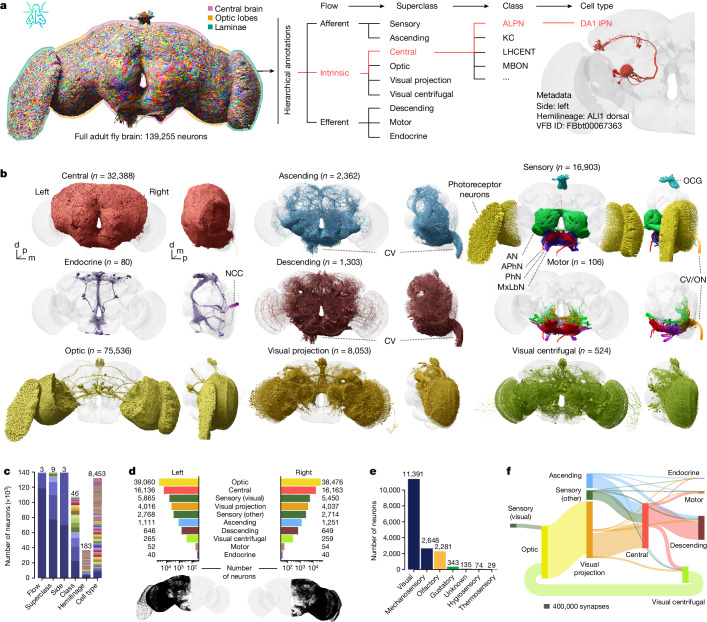
A consensus cell type atlas for the fly brain provides both an intellectual framework and open-source toolchains for brain-scale comparative connectomics, mapping 140,000 neurons into 8,453 annotated cell types.
Overview
CoChat Summary
## TL;DR
This paper builds a hierarchical, whole-brain cell-type atlas for the adult female Drosophila FlyWire connectome and uses it to compare cell types and connections across three hemispheres and two connectomes. It argues that most fly cell types are highly stereotyped, but some hemibrain-proposed types are not reproducible across datasets, motivating a new cross-connectome definition of cell type.
## Key findings
- The authors annotated 8,453 terminal cell types across the FlyWire brain, covering 96.4% of all neurons; they report 3,643 previously proposed hemibrain types and 4,581 new types.
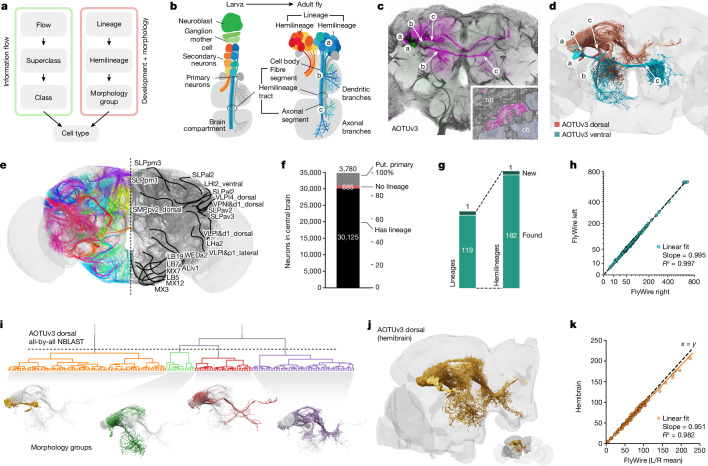
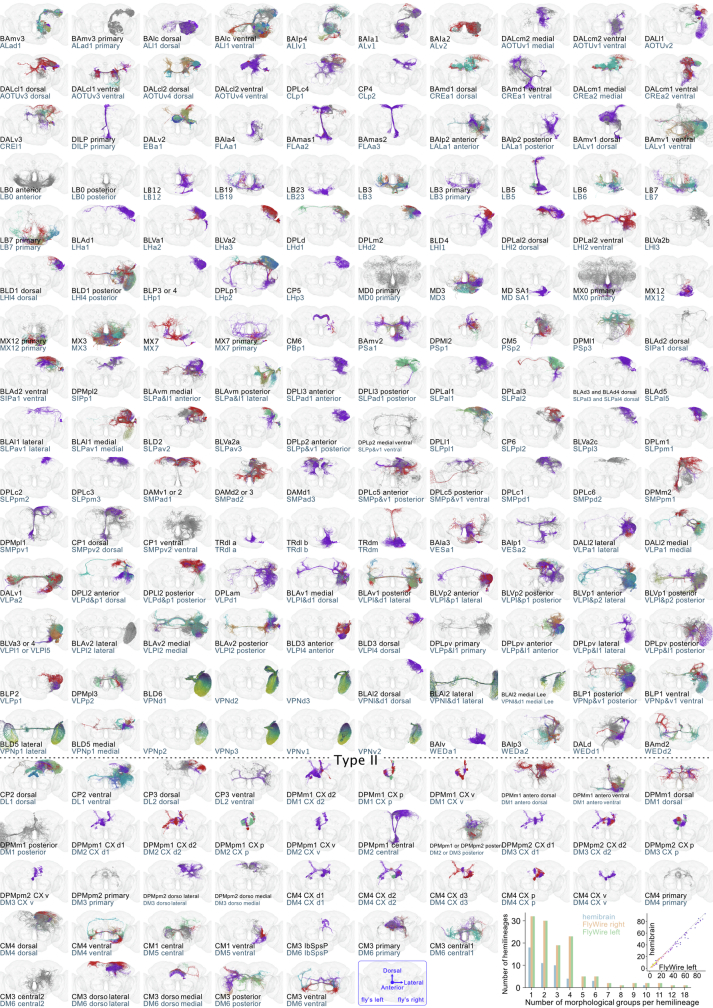
- They identified 120 neuroblast lineages and 183 hemilineages for 88% (30,233 total) of central brain neurons; the number of neurons per hemilineage correlated strongly across brains (R² = 0.98) and differed by about 3% (±4%) between left and right hemispheres.
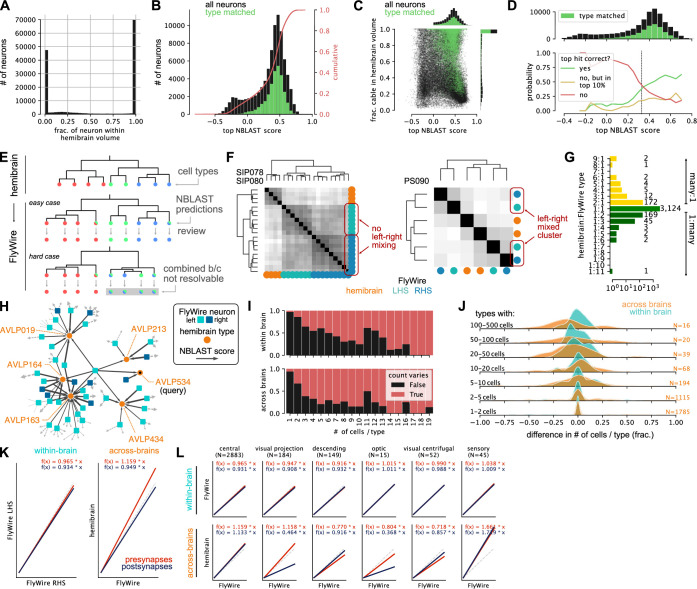
- Across three hemispheres, cell counts per type were highly similar: mean difference was 0.3 (±1.8) within brains and 0.8 (±10) across brains; 59% of cell types were “singleton” types.
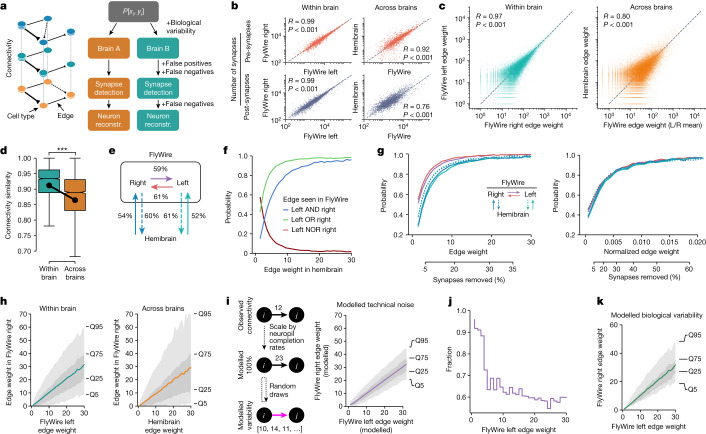
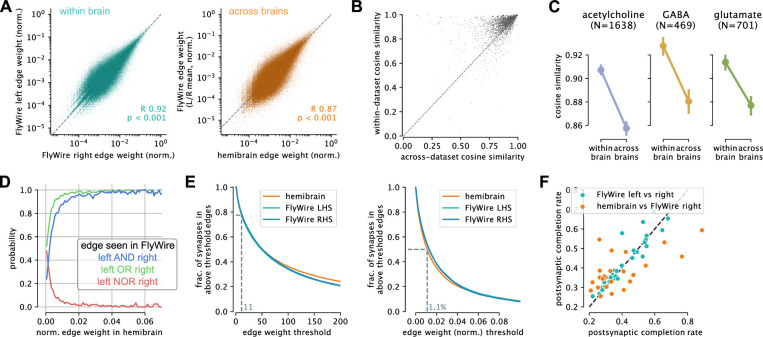
- Connectivity was also stereotyped: edge weights correlated within brains (Pearson R = 0.97) and across brains (Pearson R = 0.8); edges with >10 synapses or ≥0.9% of a target’s inputs had >90% chance of being preserved, and such strong edges comprised about 79% of all synapses.
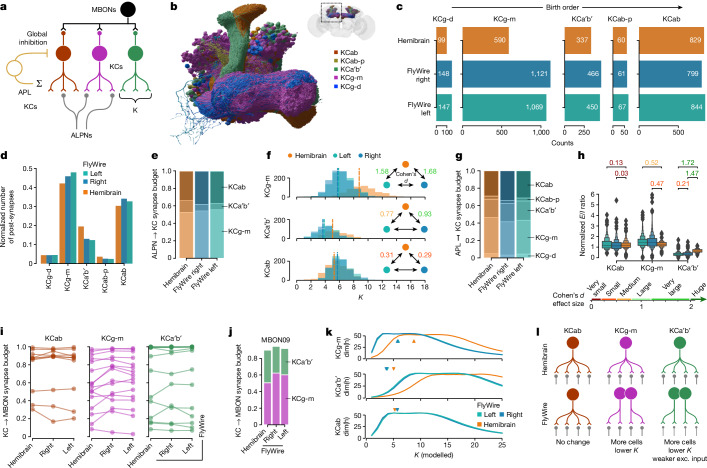
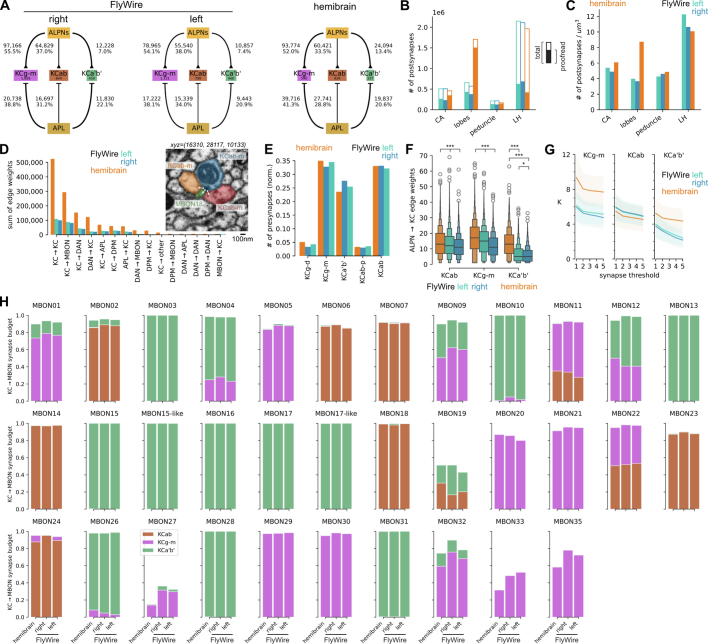
- In the mushroom body, FlyWire had 30% more Kenyon cells per hemisphere than the hemibrain (2,597 right; 2,580 left; 1,917 hemibrain). For KCg-m cells, the paper reports 5.74, 5.89, and 8.76 ALPN types per KCg-m neuron in FlyWire left, FlyWire right, and hemibrain, respectively, and concludes this preserves the excitation/inhibition ratio despite altered cell counts.
## Methods
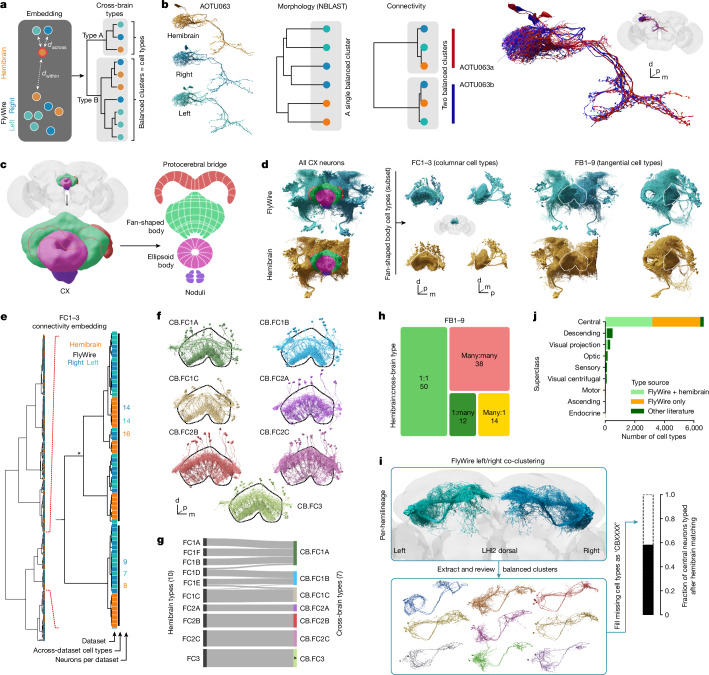
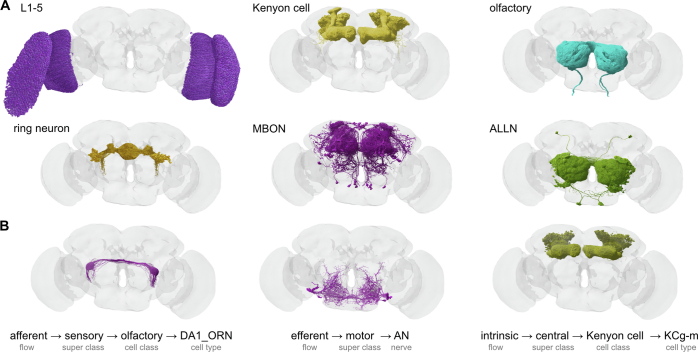
- Built a hierarchical annotation scheme for the full FlyWire connectome with levels including flow, superclass, class, hemilineage, morphology group, and cell type, using extensive manual curation plus NBLAST-based morphology comparisons and connectivity clustering.
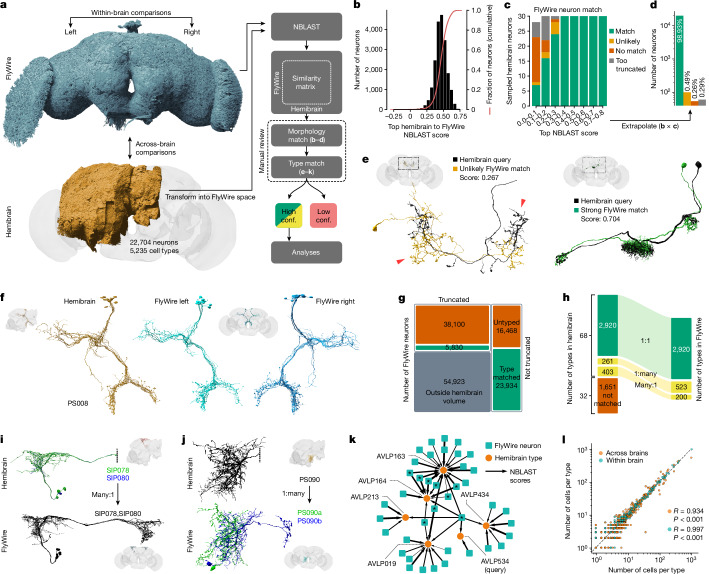
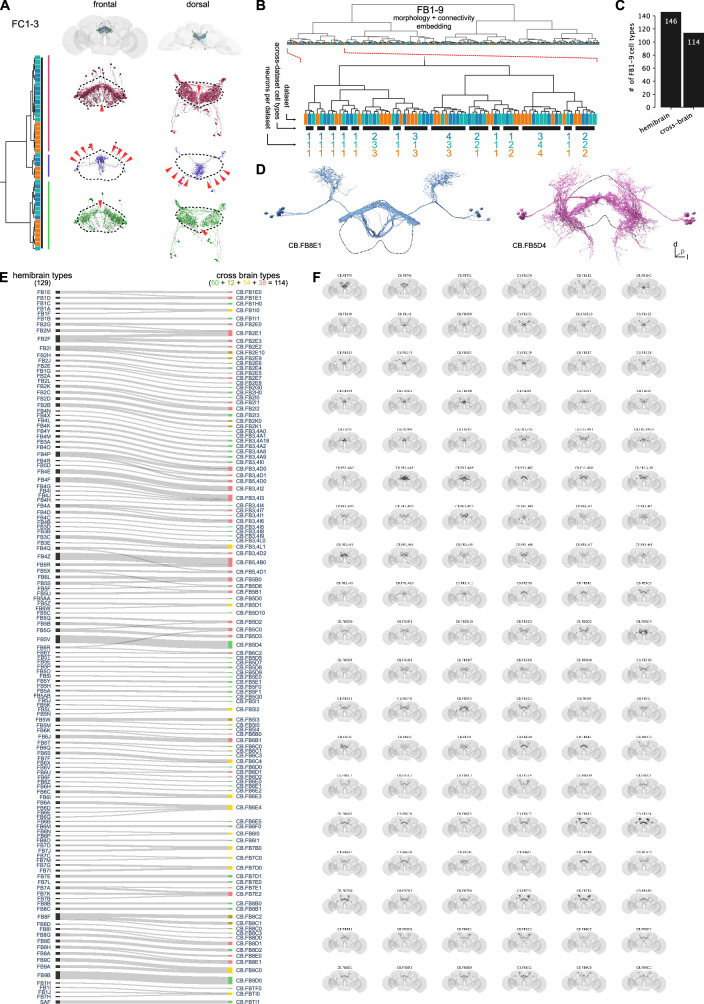
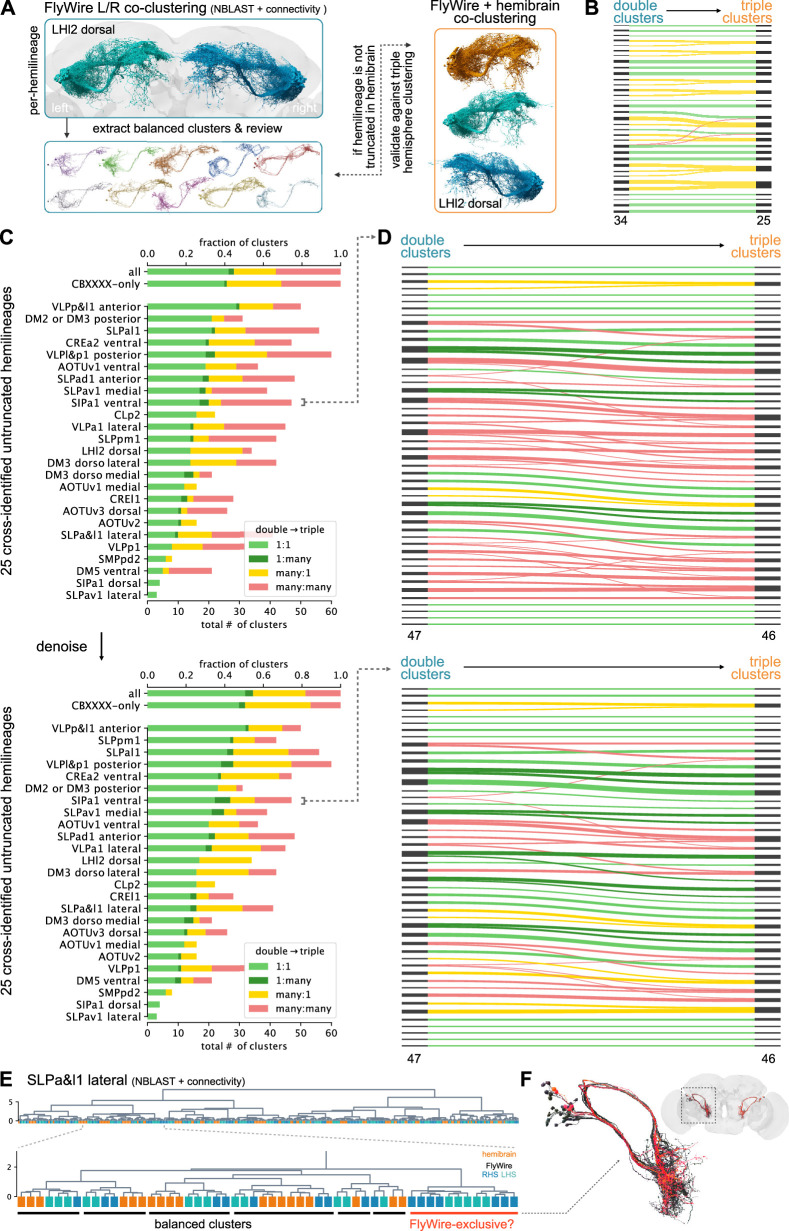
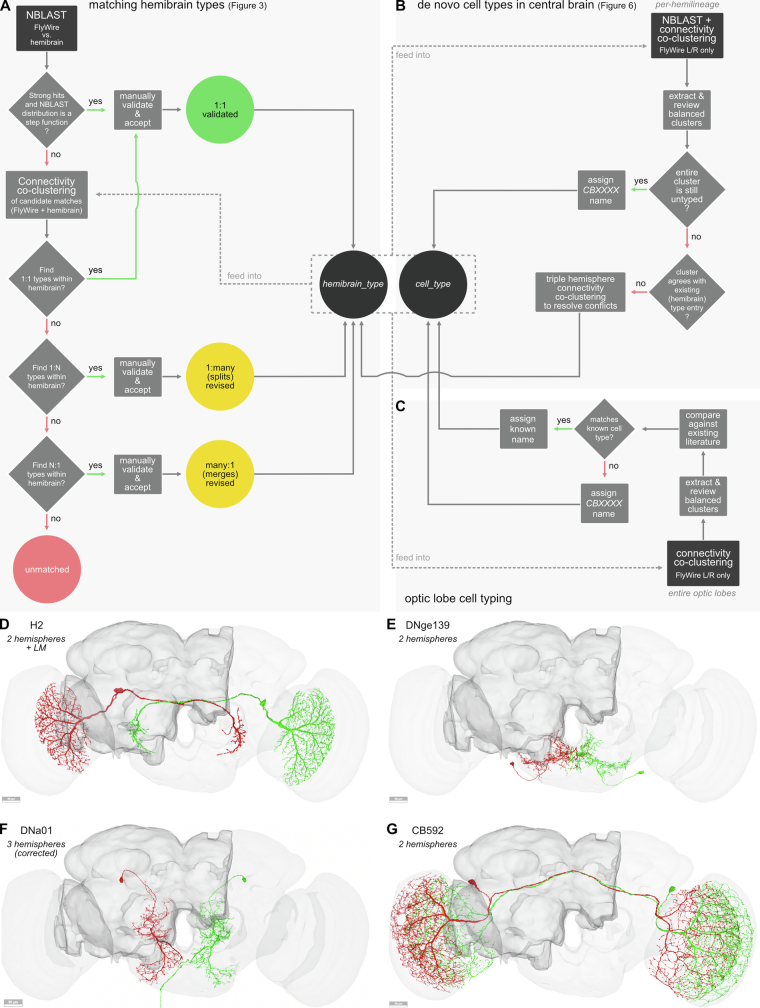
- Compared FlyWire (two hemispheres) with the hemibrain by non-rigid registration, morphology matching, and across-dataset connectivity clustering; validation was based on shared labels and “balanced” clusters present across all three hemispheres.
- The paper analyzes the complete FlyWire adult female brain connectome of 139,255 neurons and about 15.1 million weighted edges; it uses synapse counts, normalized connection weights, and statistical comparisons including Pearson correlation and cosine distance.
## Limitations
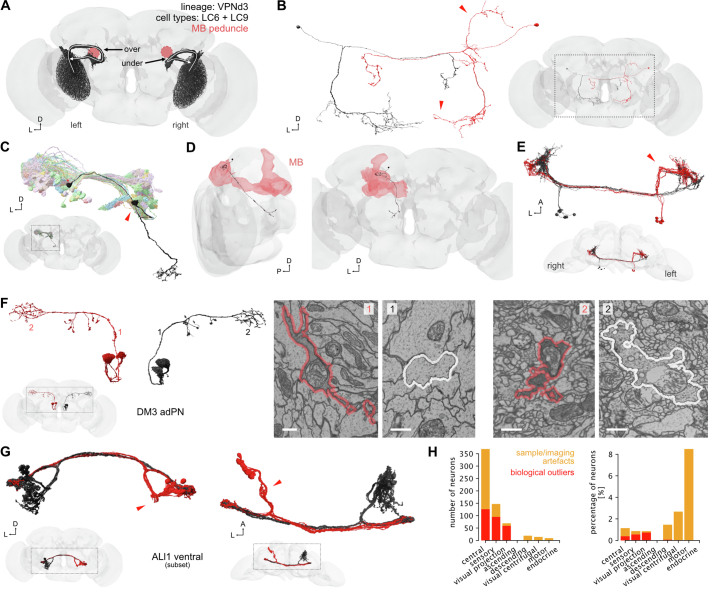
- The paper states that some hemibrain types could not be cleanly matched because of truncation in the hemibrain, and that some comparisons are affected by technical noise from segmentation, proofreading status, synapse detection, and completion rates.
- It notes that connectivity clustering depends on shared labels from prior morphological matching, so connectivity-based matching cannot function without an initial corpus of shared labels.
- Evident from the text: the study uses three hemispheres and compares mainly one species/dataset pairing, so some conclusions about stereotypy and variability are limited to the sampled brains and connectomes (stated by the cross-brain comparison design).
Model-written summary of a shortened version of the paper’s full text (it is longer than we read). Check it against the paper before relying on it.
Integrity signals
Registry
Cites
Statistics
Figures
Verification
Claims the paper makes
14 Valid · 4 Not valid · 4 Not checked · 102 Own results and interpretations
The cited sources support only part of this claim — read each source’s verdict below.
In the paper
“the majority of hemilineage tracts visible in the EM dataset occur in pairs or small groups (3–5).”
§ Whole-brain annotation and multi-connectome cell typing of Drosophila > Methods > Annotations
What the sources say
- Partly supportedcites [31] Lovick, J. K. et al. Postembryonic lineages of the Drosophila brain: I. Development of the lineage-associated fiber tracts. Dev. Biol. 384, 228–257 (2013). sourceExperimental — accuracy not yet measured
The Discussion section, “Hemilineages and sub-lineages form separate tracts” (page unavailable), says that two hemilineage tracts from one lineage enter close together and remain close in the majority of lineages possessing two hemilineages. It does not establish that a majority of tracts visible in an EM dataset occur in pairs or groups of 3–5; the Methods describe confocal microscopy instead. (LLM, conf=0.83)
plain- Asserted: passes — The authors put it forward as true.
- Checkable: passes — It can be checked against evidence.
- Load-bearing: unclear — It is unclear whether the paper’s conclusions depend on it.
- Based: passes — The paper gives a reason why it holds.
- Partly supported
The cited sources that could be checked couldn’t confirm or dispute this claim.
In the paper
“In cases in which experimental evidence exists27, primary neurons have significantly larger cell bodies and cell body fibres.”
§ Whole-brain annotation and multi-connectome cell typing of Drosophila > Methods > Annotations
What the sources say
- Could not verifycites [27] Yu, H.-H. et al. A complete developmental sequence of a Drosophila neuronal lineage as revealed by twin-spot MARCM. PLoS Biol. 8, e1000461 (2010). sourceExperimental — accuracy not yet measured
The Discussion says that embryonic-born primary neurons elaborate extensively, but it does not compare their cell-body or fibre size with secondary neurons. The Results passage on cell bodies counts neurons rather than measuring their size. Searches for larger cell bodies and fibre diameter found no passage establishing the claimed significant difference. (LLM, conf=0.73)
hedgedstates an association- Asserted: passes — The authors put it forward as true.
- Checkable: passes — It can be checked against evidence.
- Load-bearing: unclear — It is unclear whether the paper’s conclusions depend on it.
- Based: passes — The paper gives a reason why it holds.
- Could not verify
Every source the paper cites for this claim was checked and supports it.
In the paper
“by comparison of morphology (NBLAST38), as well as connectivity (assuming that homologous neurons share synaptic partners), we were able to assign the large majority of neurons to specific HATs that matched in all three hemispheres.”
§ Whole-brain annotation and multi-connectome cell typing of Drosophila > Methods > Annotations
What the sources say
- Supportedcites [38] Costa, M., Manton, J. D., Ostrovsky, A. D., Prohaska, S. & Jefferis, G. S. X. E. NBLAST: rapid, sensitive comparison of neuronal structure and construction of neuron family databases. Neuron 91, 293–311 (2016). source
The Results (Algorithm) describe NBLAST as a method for comparing aligned neurons using segment positions and orientations. The citation is attached to “NBLAST” and identifies the morphology-comparison method; the HAT assignments are presented as the citing authors’ own result. (LLM, conf=0.94)
plainstates a cause- Asserted: passes — The authors put it forward as true.
- Checkable: passes — It can be checked against evidence.
- Load-bearing: passes — The paper’s conclusions depend on it.
- Based: passes — The paper gives a reason why it holds.
- Rests on an assumption not shown here.
- Supported
The cited sources support only part of this claim — read each source’s verdict below.
In the paper
“The vast majority of these types are based on previous literature42,93–99.”
§ Whole-brain annotation and multi-connectome cell typing of Drosophila > Methods > Cell typing
What the sources say
- Partly supportedcites [42] Wu, M. et al. Visual projection neurons in the Drosophila lobula link feature detection to distinct behavioral programs. eLife 5, e21022 (2016). sourceExperimental — accuracy not yet measured
The Results section (‘Characterization of visual projection neurons’; page unavailable) describes 22 LC neuron types, so this paper can serve as prior literature for types in the citing document. It does not establish that the vast majority of the citing document’s optic-lobe cell types are based on previous literature. (LLM, conf=0.83)
- Not checked — no full text of the sourcecites [93] Fischbach, K.-F. & Dittrich, A. P. M. The optic lobe of Drosophila melanogaster. I. A Golgi analysis of wild-type structure. Cell Tissue Res. 258, 441–475 (1989). source
- Partly supportedcites [94] Davis, F. P. et al. A genetic, genomic, and computational resource for exploring neural circuit function. eLife https://doi.org/10.7554/eLife.50901 (2020). sourceExperimental — accuracy not yet measured
The Introduction (page unavailable) says many optic-lobe cell types had been described in earlier studies, and the Results section ‘Reference bulk transcriptomes help interpret single cell transcriptomes’ (page unavailable) says previous literature described over 100 anatomically distinct neuronal types. These passages support reliance on previous literature, but do not establish that the vast majority of the types meant by the citing sentence came from it. (LLM, conf=0.82)
- Not checked — no full text of the sourcecites [95] Nern, A., Pfeiffer, B. D. & Rubin, G. M. Optimized tools for multicolor stochastic labeling reveal diverse stereotyped cell arrangements in the fly visual system. Proc. Natl Acad. Sci. USA 112, E2967–E2976 (2015). source
- Not checked — no full text of the sourcecites [96] Shinomiya, K., Nern, A., Meinertzhagen, I. A., Plaza, S. M. & Reiser, M. B. Neuronal circuits integrating visual motion information in Drosophila. Curr. Biol. https://doi.org/10.1016/j.cub.2022.06.061 (2022). source
- Supportedcites [97] Takemura, S.-Y. et al. A visual motion detection circuit suggested by Drosophila connectomics. Nature 500, 175–181 (2013). source
In “Semi-automated connectome reconstruction,” the authors say they assigned reconstructed cells to previously proposed types by comparison with earlier microscopy reports. They identify only six newly named types among the 56 types classified, supporting the claim that the vast majority were based on previous literature. (LLM, conf=0.91)
- Supportedcites [98] Takemura, S.-Y., Lu, Z. & Meinertzhagen, I. A. Synaptic circuits of the Drosophila optic lobe: the input terminals to the medulla. J. Comp. Neurol. 509, 493–513 (2008). source
The Introduction describes previously reported optic-lobe neuron classes and cites earlier morphological studies, including an account of approximately 59 medulla types. The Results section, “Summary of cell types in the distal medulla of Drosophila,” likewise draws its list of types from prior Golgi-impregnation work. This paper therefore supports its use as one of several previous-literature sources for the types. (LLM, conf=0.88)
- Supportedcites [99] Gao, S. et al. The neural substrate of spectral preference in Drosophila. Neuron 60, 328–342 (2008). source
The Introduction states that previous Golgi studies had identified about 60 morphologically distinct types of medulla neurons. This paper also describes specific optic-lobe neuron types in its Results, so it supports its use as one of the cited works on which the citing document bases its types; it need not independently establish the citing document’s ‘vast majority’ count. (LLM, conf=0.85)
plain- Asserted: passes — The authors put it forward as true.
- Checkable: passes — It can be checked against evidence.
- Load-bearing: unclear — It is unclear whether the paper’s conclusions depend on it.
- Based: passes — The paper gives a reason why it holds.
- Partly supported
The sources with a verdict support this claim; the rest weren’t checked yet, have no full text we could read, or their verdicts aren’t rated yet.
In the paper
“although light-level clones from refs. 33,34 match very well the great majority of the time”
§ Whole-brain annotation and multi-connectome cell typing of Drosophila > Methods > Annotations
What the sources say
- Not checked — no full text of the sourcecites [33] Ito, M., Masuda, N., Shinomiya, K., Endo, K. & Ito, K. Systematic analysis of neural projections reveals clonal composition of the Drosophila brain. Curr. Biol. 23, 644–655 (2013). source
- Supportedcites [34] Yu, H.-H. et al. Clonal development and organization of the adult Drosophila central brain. Curr. Biol. 23, 633–643 (2013). source
The Discussion section, “Likely coverage of the 106 NBs of the procephalic origin” (page unavailable), reports that a 3-D comparison found 77 clones in both independent collections, with 19 Tokyo and 18 Janelia clones unmatched. That supports the paraphrase that the light-level clone collections matched the great majority of the time. (LLM, conf=0.88)
plainstates an association- Asserted: passes — The authors put it forward as true.
- Checkable: passes — It can be checked against evidence.
- Load-bearing: unclear — It is unclear whether the paper’s conclusions depend on it.
- Based: passes — The paper gives a reason why it holds.
55 more claims · 6 with their cited sources checked
Create a free account to see all 124 claims and to verify the 1 reference still open.
- It may state two separate claims as one. 28
- Probably not a substantial claim. 38
- The quote only partly states this claim. 2
Claims other papers make about this one
Each is checked against this paper’s own text: does it say what the citing paper says it does?
The source backs part of the claim, not all of it — or backs it for a different population, condition or comparison.
In the citing paper
“In addition, principal neurons of the mushroom body, a brain structure required for olfactory learning and memory, show high variability12.”
From Neuronal wiring diagram of an adult brain (2024) · cites this paper as [12]
Experimental — accuracy not yet measuredThe source backs part of the claim, not all of it — or backs it for a different population, condition or comparison.
In the citing paper
“Although afferents are truncated in our reconstruction, Schlegel et al.12 and other community members35,57 were able to determine the sensory organs corresponding to the 5,375 non-visual sensory neurons (Fig. 2e,f) on the basis of morphology and nerve assignments.”
From Neuronal wiring diagram of an adult brain (2024) · cites this paper as Schlegel et al.12
Experimental — accuracy not yet measuredThe source backs part of the claim, not all of it — or backs it for a different population, condition or comparison.
In the citing paper
“The optic lobes and ocellar ganglia also contain 8,053 neurons—the visual projection neurons12 (VPNs)—that project into the central brain.”
From Neuronal wiring diagram of an adult brain (2024) · cites this paper as [12]
Experimental — accuracy not yet measuredThe source backs part of the claim, not all of it — or backs it for a different population, condition or comparison.
In the citing paper
“Schlegel et al.12 show quantitatively using FlyWire brain and hemibrain data that these two types of stereotypy are similar in degree.”
From Neuronal wiring diagram of an adult brain (2024) · cites this paper as [12]
Experimental — accuracy not yet measuredThe source backs part of the claim, not all of it — or backs it for a different population, condition or comparison.
In the citing paper
“Our companion paper12 provides annotations for more than 8,400 unique cell types via such matching.”
From Neuronal wiring diagram of an adult brain (2024) · cites this paper as [12]
Experimental — accuracy not yet measured
10 more claims about this paper
Create a free account to see every claim other papers make about this one.
Citations
Cites
SciPy 1.0: fundamental algorithms for scientific computing in Python
Virtanen, P., Gommers, R., Oliphant, T. E., Haberland, M., Reddy, T., Cournapeau, D., Burovski, E., Peterson, P., Weckesser, W., Bright, J., et al. (2020) · Nature Methods · doi:10.1038/s41592-019-0686-2 · Cited by 38,430
Statistical Power Analysis for the Behavioral Sciences
Cohen, J. (2013) · doi:10.4324/9780203771587 · Cited by 25,373
SciPy 1.0: fundamental algorithms for scientific computing in Python
Virtanen, P., Gommers, R., Oliphant, T. E., Haberland, M., Reddy, T., Cournapeau, D., Burovski, E., Peterson, P., Weckesser, W., Bright, J., et al. (2019) · Apollo - University of Cambridge Repository · doi:10.17863/cam.64134 · Cited by 10,460
The structure of the nervous system of the nematode Caenorhabditis elegans
White, J. G., Southgate, E., Thomson, J. N., & Brenner, S. (1986) · Philosophical Transactions of the Royal Society of London. B, Biological Sciences · doi:10.1098/rstb.1986.0056 · Cited by 5,589
A Genomic Perspective on Protein Families
Tatusov, R. L., Koonin, E. V., & Lipman, D. J. (1997) · Science · doi:10.1126/science.278.5338.631 · Cited by 3,590 · cited 1×
“This advantage of completeness is familiar from analogous problems such as the ability to identify orthologous genes when whole genomes are available 57 .”
Backgroundhdbscan: Hierarchical density based clustering
McInnes, L., Healy, J., & Astels, S. (2017) · The Journal of Open Source Software · doi:10.21105/joss.00205 · Cited by 2,833 · cited 1×
“Intrahemilineage NBLAST scores were then clustered using HDBSCAN 92 , an adaptive algorithm that does not require a uniform threshold across all clusters, and that does not assume spherical distribution of data points in a cluster, compared to other clustering algorithms such as k -means clustering.”
MethodA connectome and analysis of the adult Drosophila central brain
Scheffer, L. K., Xu, C. S., Januszewski, M., Lu, Z., Takemura, S.-Y., Hayworth, K. J., Huang, G. B., Shinomiya, K., Maitlin-Shepard, J., Berg, S., et al. (2020) · eLife · doi:10.7554/elife.57443 · Cited by 1,128
Self-citationA Complete Electron Microscopy Volume of the Brain of Adult Drosophila melanogaster
Zheng, Z., Lauritzen, J. S., Perlman, E., Robinson, C. G., Nichols, M., Milkie, D., Torrens, O., Price, J., Fisher, C. B., Sharifi, N., et al. (2018) · Cell · doi:10.1016/j.cell.2018.06.019 · Cited by 1,050 · cited 3×
“The full connectome, derived from the approximately 100 teravoxel FAFB whole-brain electron microscopy (EM) volume 17 , can be represented as a graph with 139,255 nodes and around 15.1 million weighted edges.”
BackgroundMethodInfluentialSelf-citationMosaic analysis with a repressible cell marker (MARCM) for Drosophila neural development
Lee, T., & Luo, L. (2001) · Trends in Neurosciences · doi:10.1016/s0166-2236(00)01791-4 · Cited by 926 · cited 1×
“Genetic tools that allow stochastic clonal analysis 85 have enabled researchers to visualize individual lineages as GFP-marked ‘clones’.”
BackgroundStructural Properties of the Caenorhabditis elegans Neuronal Network
Varshney, L. R., Chen, B. L., Paniagua, E., Hall, D. H., & Chklovskii, D. B. (2011) · PLoS Computational Biology · doi:10.1371/journal.pcbi.1001066 · Cited by 867 · cited 2×
“With 139,255 neurons, the newly completed full adult female brain (FAFB) connectome is intermediate in log scale between the first connectome of Caenorhabditis elegans (302 neurons 3,4 ) and the mouse (10 8 neurons), a desirable but currently intractable target 5 .”
Background
Research works printed but not linked: 1
- Litwin-Kumar, A., Harris, K. D., Axel, R., Sompolinsky, H. & Abbott, L. F. Optimal degrees of synaptic connectivity. Neuron 93, 1153–1164 (2017). · DOI · Paper page
Cited by
Neuronal wiring diagram of an adult brain
Dorkenwald, S., Matsliah, A., Sterling, A. R., Schlegel, P., Yu, S.-C., McKellar, C. E., Lin, A., Costa, M., Eichler, K., Yin, Y., et al. (2024) · Nature · doi:10.1038/s41586-024-07558-y · Cited by 570
“Our companion paper 12 exhaustively identifies all afferent and efferent neurons contained in cross sections of nerves and the neck connective running between the brain and ventral nerve cord (VNC) (Fig.”
BackgroundMethodInfluentialFunctional connectomics spanning multiple areas of mouse visual cortex
The MICrONS Consortium, Bae, J. A., Baptiste, M., Baptiste, M. R., Bishop, C. A., Bodor, A. L., Brittain, D., Brooks, V., Buchanan, J., Bumbarger, D. J., et al. (2025) · Nature · doi:10.1038/s41586-025-08790-w · Cited by 190
Network Statistics of the Whole-Brain Connectome of Drosophila
Lin, A., Yang, R., Dorkenwald, S., Matsliah, A., Sterling, A. R., Schlegel, P., Yu, S.-C., McKellar, C. E., Costa, M., Eichler, K., et al. (2023) · doi:10.1101/2023.07.29.551086 · Cited by 147
Self-citationNetwork statistics of the whole-brain connectome of Drosophila
Lin, A., Yang, R., Dorkenwald, S., Matsliah, A., Sterling, A. R., Schlegel, P., Yu, S.-C., McKellar, C. E., Costa, M., Eichler, K., et al. (2024) · Nature · doi:10.1038/s41586-024-07968-y · Cited by 147
“The simplest null model we employed was a directed version of the Erd˝os–Rényi model (ER) G ( V,p ) , where all edges are drawn independently at random, and the connection probability p is set such that the expected number of edges in the ER model equals that observed in the wiring diagram (47).”
InfluentialConverting an allocentric goal into an egocentric steering signal
Mussells Pires, P., Zhang, L., Parache, V., Abbott, L. F., & Maimon, G. (2024) · Nature · doi:10.1038/s41586-023-07006-3 · Cited by 110
Synaptic connectome of the Drosophila circadian clock
Reinhard, N., Fukuda, A., Manoli, G., Derksen, E., Saito, A., Möller, G., Sekiguchi, M., Rieger, D., Helfrich-Förster, C., Yoshii, T., et al. (2023) · doi:10.1101/2023.09.11.557222 · Cited by 110
Synaptic connectome of the Drosophila circadian clock
Reinhard, N., Fukuda, A., Manoli, G., Derksen, E., Saito, A., Möller, G., Sekiguchi, M., Rieger, D., Helfrich-Förster, C., Yoshii, T., et al. (2024) · Nature Communications · doi:10.1038/s41467-024-54694-0 · Cited by 103
“By de fi nition, a cell type is a uniquelyidenti fi able neuron in the dataset 9 .”
InfluentialA Drosophila computational brain model reveals sensorimotor processing
Shiu, P. K., Sterne, G. R., Spiller, N., Franconville, R., Sandoval, A., Zhou, J., Simha, N., Kang, C. H., Yu, S., Kim, J. S., et al. (2024) · Nature · doi:10.1038/s41586-024-07763-9 · Cited by 97
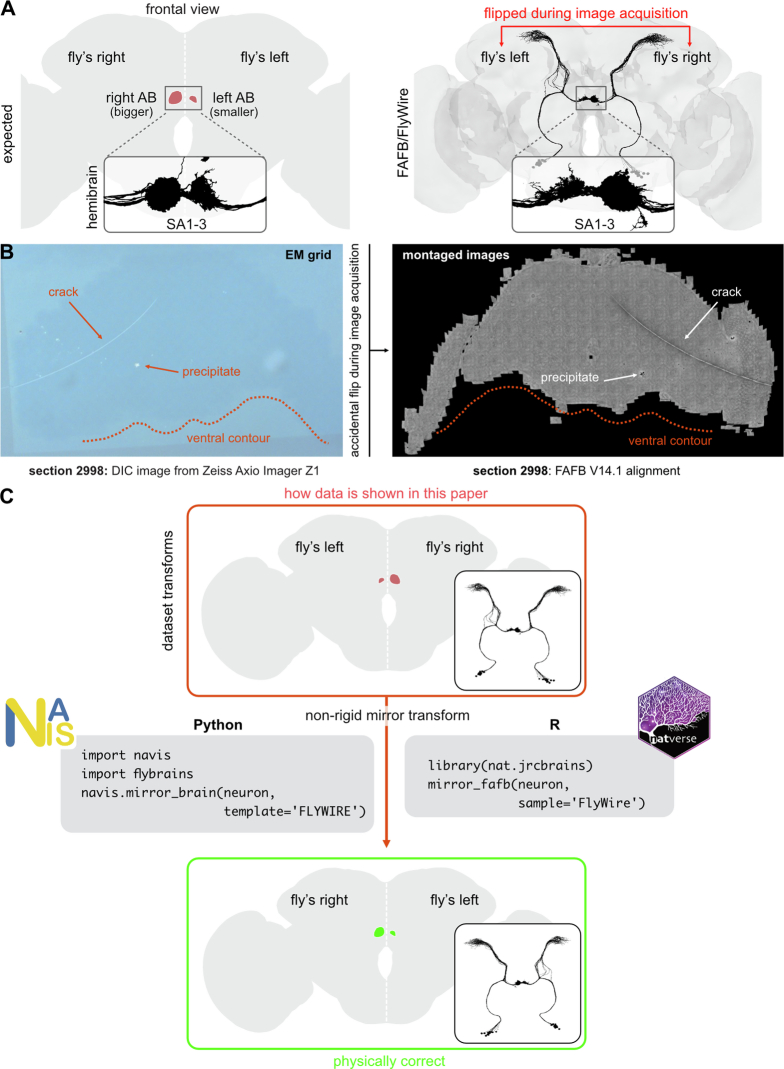
“Recently, the FlyWire brain (FAFB) dataset (on the basis of which the Flywire dataset was prepared) was found to be left–right inverted 1,2 .”
BackgroundMethodInfluentialNeuronal parts list and wiring diagram for a visual system
Matsliah, A., Yu, S.-C., Kruk, K., Bland, D., Burke, A. T., Gager, J., Hebditch, J., Silverman, B., Willie, K. P., Willie, R., et al. (2024) · Nature · doi:10.1038/s41586-024-07981-1 · Cited by 85
Self-citationConnectome-driven neural inventory of a complete visual system
Nern, A., Loesche, F., Takemura, S.-Y., Burnett, L. E., Dreher, M., Gruntman, E., Hoeller, J., Huang, G. B., Januszewski, M., Klapoetke, N. C., et al. (2025) · Nature · doi:10.1038/s41586-025-08746-0 · Cited by 93
Neural circuit mechanisms for steering control in walking Drosophila
Rayshubskiy, A., Holtz, S. L., Bates, A. S., Vanderbeck, Q. X., Capdevila, L. S., Rockwell, V., & Wilson, R. I. (2020) · doi:10.1101/2020.04.04.024703 · Cited by 64
Self-citationNested neural circuits generate distinct acoustic signals during Drosophila courtship
Lillvis, J. L., Wang, K., Shiozaki, H. M., Xu, M., Stern, D. L., & Dickson, B. J. (2024) · Current Biology · doi:10.1016/j.cub.2024.01.015 · Cited by 59
Self-citationMapping model units to visual neurons reveals population code for social behaviour
Cowley, B. R., Calhoun, A. J., Rangarajan, N., Ireland, E., Turner, M. H., Pillow, J. W., & Murthy, M. (2024) · Nature · doi:10.1038/s41586-024-07451-8 · Cited by 55
Self-citationNeural circuit mechanisms underlying context-specific halting in Drosophila
Sapkal, N., Mancini, N., Kumar, D. S., Spiller, N., Murakami, K., Vitelli, G., Bargeron, B., Maier, K., Eichler, K., Jefferis, G. S. X. E., et al. (2024) · Nature · doi:10.1038/s41586-024-07854-7 · Cited by 54
“Even though MDN and P9 are descending neurons (DNs) that project from the brain to the VNC, (also Supplementary Video 1).”
InfluentialSelf-citationNeural circuit mechanisms underlying context-specific halting in Drosophila
Sapkal, N., Mancini, N., Kumar, D. S., Spiller, N., Murakami, K., Vitelli, G., Bargeron, B., Maier, K., Eichler, K., Jefferis, G. S. X. E., et al. (2023) · doi:10.1101/2023.09.25.559438 · Cited by 54
Self-citationCAVE: Connectome Annotation Versioning Engine
Dorkenwald, S., Schneider-Mizell, C. M., Brittain, D., Halageri, A., Jordan, C., Kemnitz, N., Castro, M. A., Silversmith, W., Maitin-Shephard, J., Troidl, J., et al. (2025) · Nature Methods · doi:10.1038/s41592-024-02426-z · Cited by 78
Marin, E. C., Morris, B. J., Stürner, T., Champion, A. S., Krzeminski, D., Badalamente, G., Gkantia, M., Dunne, C. R., Eichler, K., Takemura, S.-Y., et al. (2024) · doi:10.7554/elife.97766.1 · Cited by 44
Self-citationComparative connectomics of Drosophila descending and ascending neurons
Stürner, T., Brooks, P., Serratosa Capdevila, L., Morris, B. J., Javier, A., Fang, S., Gkantia, M., Cachero, S., Beckett, I. R., Marin, E. C., et al. (2025) · Nature · doi:10.1038/s41586-025-08925-z · Cited by 43
The fly connectome reveals a path to the effectome
Pospisil, D. A., Aragon, M. J., Dorkenwald, S., Matsliah, A., Sterling, A. R., Schlegel, P., Yu, S.-C., McKellar, C. E., Costa, M., Eichler, K., et al. (2024) · Nature · doi:10.1038/s41586-024-07982-0 · Cited by 36
“Here we show that the Flywire connectome 1–3 provides a feasible path to surmounting both barriers in the fly.”
Self-citationWhole-body physics simulation of fruit fly locomotion
Vaxenburg, R., Siwanowicz, I., Merel, J., Robie, A. A., Morrow, C. M., Novati, G., Stefanidi, Z., Both, G., Card, G. M., Reiser, M. B., et al. (2025) · Nature · doi:10.1038/s41586-025-09029-4 · Cited by 110
Predicting visual function by interpreting a neuronal wiring diagram
Seung, H. S. (2024) · Nature · doi:10.1038/s41586-024-07953-5 · Cited by 49
“This work is based on v783 of the proofread reconstruction of an adult female Drosophila brain 15–17 .”
InfluentialConnectomic reconstruction predicts visual features used for navigation
Garner, D., Kind, E., Lai, J. Y. H., Nern, A., Zhao, A., Houghton, L., Sancer, G., Wolff, T., Rubin, G. M., Wernet, M. F., et al. (2024) · Nature · doi:10.1038/s41586-024-07967-z · Cited by 56
“2e,m,n; on average, 36 Dm2 neurons make 311 synapses per MeTu1 neuron), followed by Sm16 (serpentine layer neurons in medulla; following the FlyWire nomenclature 45,46 ; see ref.”
Social state alters vision using three circuit mechanisms in Drosophila
Schretter, C. E., Hindmarsh Sten, T., Klapoetke, N., Shao, M., Nern, A., Dreher, M., Bushey, D., Robie, A. A., Taylor, A. L., Branson, K., et al. (2025) · Nature · doi:10.1038/s41586-024-08255-6 · Cited by 29
“Cell type annotations for FlyWire neurons 59,60 were as down-loaded from Codex on 24 April 2024 from https://codex.flywire.ai/ api/download?data_product=visual_neuron_types&data_version=783.”
Distributed control circuits across a brain-and-cord connectome
Bates, A. S., Phelps, J. S., Kim, M., Yang, H. H., Matsliah, A., Ajabi, Z., Perlman, E., Delgado, K. M., Osman, M. A. M., Salmon, C. K., et al. (2026) · Nature · doi:10.1038/s41586-026-10735-w · Cited by 98
“Previous studies have invested substantial effort in cell typing in both the brain 6,7,16,19,32 and VNC 8,9,11 using a combination of manual anno tation and computational methods.”
InfluentialPresynaptic inhibition selectively suppresses leg proprioception in behaving DrosophilaPreprint
Dallmann, C. J., Luo, Y., Agrawal, S., et al. (2023) · bioRxiv · doi:10.1101/2023.10.20.563322 · Cited by 15
Neural circuit mechanisms for steering control in walking Drosophila
Rayshubskiy, A., Holtz, S. L., Bates, A. S., Vanderbeck, Q. X., Serratosa Capdevila, L., Rockwell, V., & Wilson, R. (2025) · eLife · doi:10.7554/elife.102230 · Cited by 27
Self-citationOrganization of an ascending circuit that conveys flight motor state in Drosophila
Cheong, H. S. J., Boone, K. N., Bennett, M. M., Salman, F., Ralston, J. D., Hatch, K., Allen, R. F., Phelps, A. M., Cook, A. P., Phelps, J. S., et al. (2024) · Current Biology · doi:10.1016/j.cub.2024.01.071 · Cited by 26
Evolution of temperature preference in flies of the genus Drosophila
Capek, M., Arenas, O. M., Alpert, M. H., Zaharieva, E. E., Méndez‐González, I. D., Simões, J. M., Gil, H., Acosta, A., Su, Y., Para, A., et al. (2025) · Nature · doi:10.1038/s41586-025-08682-z · Cited by 26
An integrated anatomical, functional and evolutionary view of the Drosophila olfactory system
Benton, R., Mermet, J., Jang, A., Endo, K., Cruchet, S., & Menuz, K. (2025) · EMBO Reports · doi:10.1038/s44319-025-00476-8 · Cited by 37
Experimental modeling of Alzheimer's disease: Translational lessons from cross‐taxon analyses
Yenkoyan, K. B., Kotova, M. M., Apukhtin, K. V., Galstyan, D. S., Amstislavskaya, T. G., Strekalova, T. V., de Abreu, M. S., Chavushyan, V. A., Lim, L. W., Yang, L., et al. (2025) · Alzheimer s & Dementia · doi:10.1002/alz.70273 · Cited by 34
“166,167 Representing the only animals for which all neuronal connections have been fully characterized, this greatly increases their value for the study of the pathogenesis of neurological diseases and the development of neurobiology in general.”
Mutual coupling of neurons in the circadian master clock: What we can learn from fruit flies
Helfrich‐Förster, C., & Reinhard, N. (2025) · Neurobiology of Sleep and Circadian Rhythms · doi:10.1016/j.nbscr.2025.100112 · Cited by 22
A split-GAL4 driver line resource for Drosophila neuron types
Meissner, G. W., Vannan, A., Jeter, J., Close, K., DePasquale, G. M., Dorman, Z., Forster, K., Beringer, J. A., Gibney, T. V., Hausenfluck, J. H., et al. (2025) · eLife · doi:10.7554/elife.98405.3 · Cited by 65
Molecular gradients shape synaptic specificity of a visuomotor transformation
Dombrovski, M., Zang, Y., Frighetto, G., Vaccari, A., Jang, H., Mirshahidi, P., Xie, F., Sanfilippo, P., Hina, B. W., Rehan, A., et al. (2025) · Nature · doi:10.1038/s41586-025-09037-4 · Cited by 24
Distinct systemic impacts of Aβ42 and Tau revealed by whole-organism snRNA-seq
Park, Y.-J., Lu, T., Jackson, T., Goodman, L. D., Ran, L., Chen, J., Liang, C., Harrison, E. M., Ko, C., Chen, X. X., et al. (2024) · Neuron · doi:10.1016/j.neuron.2025.04.017 · Cited by 27
Divergent neural circuits for proprioceptive and exteroceptive sensing of the Drosophila leg
Lee, S.-Y. J., Dallmann, C. J., Cook, A., Tuthill, J. C., & Agrawal, S. (2025) · Nature Communications · doi:10.1038/s41467-025-59302-3 · Cited by 26
“Here, we take advantage of two separate connectome datasets that together span the CNS of a fruit fl y, the Female Adult Nerve Cord (FANC) 8,14 and the FullAdultFly Brain (FAFB),which was reconstructed as part of FlyWire 7,15 .”
InfluentialFeng (2024) · doi:10.1101/2024.06.27.601106 · Cited by 18
Connectomic analysis of taste circuits in Drosophila
Walker, S. R., Peña-Garcia, M., & Devineni, A. V. (2025) · Scientific Reports · doi:10.1038/s41598-025-89088-9 · Cited by 24
Soffers, J. H., Beck, E., Sytkowski, D. J., Maughan, M. E., Devarakonda, D., Zhu, Y., Wilson, B. A., Chen, Y., Erclik, T., Truman, J. W., et al. (2025) · eLife · doi:10.7554/elife.106042 · Cited by 20
A half-center oscillator encodes sleep pressurePreprint
Hasenhuetl, P. S., Sarnataro, R., Vrontou, E., Rorsman, H. O., Talbot, C. B., Brain, R., & Miesenböck, G. (2024) · bioRxiv (Cold Spring Harbor Laboratory) · doi:10.1101/2024.02.23.581780 · Cited by 14
Zhao, A., Nern, A., Koskela, S., Dreher, M., Erginkaya, M., Laughland, C. W., Ludwigh, H., Thomson, A., Hoeller, J., Parekh, R., et al. (2023) · doi:10.1101/2023.10.16.562634 · Cited by 15
A connectomic resource for neural cataloguing and circuit dissection of the larval zebrafish brainPreprint
Petkova, M. D., Januszewski, M., Blakely, T. M., Herrera, K. J., Schuhknecht, G. F. P., Tiller, R., Choi, J., Schalek, R. L., Boulanger-Weill, J., Peleg, A., et al. (2025) · bioRxiv (Cold Spring Harbor Laboratory) · doi:10.1101/2025.06.10.658982 · Cited by 32
A competitive disinhibitory network for robust optic flow processing in Drosophila
Erginkaya, M., Cruz, T. L., Brotas, M., Marques, A., Steck, K., Nern, A., Torrão, F., Varela, N., Bock, D. D., Reiser, M. B., et al. (2025) · Nature Neuroscience · doi:10.1038/s41593-025-01948-9 · Cited by 29
“A recent connectome analysis found that the FAFB dataset is left–right inverted 71 .”
InfluentialLi, J., Dhaliwal, R., Stanley, M., Junca, P., & Gordon, M. D. (2025) · Current Biology · doi:10.1016/j.cub.2025.04.035 · Cited by 15
The coming wave of confluent biosynthetic, bioinformational and bioengineering technologies
Pretorius, I. S., Dixon, T. A., Boers, M., Paulsen, I. T., & Johnson, D. L. (2025) · Nature Communications · doi:10.1038/s41467-025-58030-y · Cited by 21
Wolff, T., Eddison, M., Chen, N., Nern, A., Sundaramurthi, P., Sitaraman, D., & Rubin, G. M. (2025) · eLife · doi:10.1101/2024.10.21.619448 · Cited by 25
A split-GAL4 driver line resource for Drosophila neuron typesPreprint
Meissner, G., Vannan, A., Jeter, J., Close, K., Depasquale, G. M., Dorman, Z., Forster, K., Beringer, J. A., Gibney, T. V., Hausenfluck, J. H., et al. (2024) · bioRxiv · doi:10.1101/2024.01.09.574419 · Cited by 35
Dimensionality reduction simplifies synaptic partner matching in an olfactory circuit
Lyu, C., Li, Z., Xu, C., Wong, K. K. L., Luginbuhl, D. J., McLaughlin, C. N., Xie, Q., Li, T., Li, H., & Luo, L. (2025) · Science · doi:10.1126/science.ads7633 · Cited by 11
Physical Network Constraints Define the Multiplicative Architecture of the Brain’s ConnectomePreprint
Piazza, B., Barabási, D. L., Menichetti, G., Castro, A. F., & Barabási, A.-Ĺ. (2025) · bioRxiv (Cold Spring Harbor Laboratory) · doi:10.1101/2025.02.27.640551 · Cited by 23
Play-like behavior exhibited by the vinegar fly Drosophila melanogaster
Triphan, T., Ferreira, C. H., & Huetteroth, W. (2025) · Current Biology · doi:10.1016/j.cub.2025.01.025 · Cited by 22
“51 The sustained boost in connectomic data availability for both the whole brain 52,53 and premotor circuits of the fly 54–57 will allow us to pinpoint these computational principles to identi-fied cellular components 58 and to assess how internal models are neuronally implemented.”
Salova, A., & Kovács, I. A. (2024) · Network Neuroscience · doi:10.1162/netn_a_00428 · Cited by 17
“All the edges representing pairs of neurons at a distance under this distance threshold are assigned to the contact network.”
Synaptic-resolution connectomics: towards large brains and connectomic screening
Helmstaedter, M. N. (2025) · Nature reviews. Neuroscience · doi:10.1038/s41583-025-00998-z · Cited by 30
“For more difficult longer-range connectomic analyses, error requirements are much stronger, but recently proposed automated proofreading approaches are beginning to allow the full automation of a larger range of connectomic analysis targets 8,16,17,113 (Fig.”
Infrequent strong connections constrain connectomic predictions of neuronal function
Currier, T. A., & Clandinin, T. R. (2025) · Cell · doi:10.1016/j.cell.2025.05.007 · Cited by 20
Tian, X., Lin, T., Lin, P.-T., Tsai, M.-J., Chen, H., Chen, W., Lee, C.-M., Tu, C.-H., Hsu, J.-C., Hsieh, T., et al. (2024) · Nature Communications · doi:10.1038/s41467-024-55305-8 · Cited by 16
BIFROST: A method for registering diverse imaging datasets of the Drosophila brain
Brezovec, B. E., Berger, A. B., Hao, Y. A., Lin, A., Ahmed, O. M., Pacheco, D. A., Thiberge, S. Y., Murthy, M., & Clandinin, T. R. (2024) · Proceedings of the National Academy of Sciences · doi:10.1073/pnas.2322687121 · Cited by 17
Synaptic connectome of a neurosecretory network in the Drosophila brain
McKim, T. H., Gera, J., Gayban, A. J. B., Christie, K., Shin, J., Reinhard, N., Manoli, G., Hilpert, S., Callaerts, P., van Breugel, F., et al. (2026) · eLife · doi:10.1101/2024.08.28.609616 · Cited by 22
The emergence of NeuroAI: bridging neuroscience and artificial intelligence
Sadeh, S., & Clopath, C. (2025) · Nature reviews. Neuroscience · doi:10.1038/s41583-025-00954-x · Cited by 22
“The remarkable achievement of mapping the complete fruit fly connectome 3 would have been impossible using traditional manual neuron tracing methods.”
Wolff, T., Eddison, M., Chen, N., Nern, A., Sundaramurthi, P., Sitaraman, D., & Rubin, G. M. (2025) · eLife · doi:10.7554/elife.104764 · Cited by 33
“Even when assigning correspondence between cells in two different connectomes, where information on connectivity can also be employed, the process is not always straightforward (see Schlegel et al., 2024 ).”
The new frontier in understanding human and mammalian brain development
Nowakowski, T. J., Nano, P. R., Matho, K. S., Chen, X., Corrigan, E. K., Ding, W., Gao, Y., Heffel, M. G., Jayakumar, J., Kaplan, H. S., et al. (2025) · Nature · doi:10.1038/s41586-025-09652-1 · Cited by 19
Boulanger-Weill, J., Kämpf, F., Schuhknecht, G. F. P., Schalek, R. L., Garza, R., Petkova, M. D., Vohra, S. K., Wu, Y., Savaliya, J. H., Tiller, R., et al. (2025) · bioRxiv (Cold Spring Harbor Laboratory) · doi:10.1101/2025.03.14.643363 · Cited by 10
“…microscopy techniques have made it possible to map synaptic connectivity with remarkable resolution in several invertebrate and vertebrate species (Witvliet et al. , 2021; Svara et al. , 2022; Turner et al. , 2022; Dorkenwald et al. , 2024; Schlegel et al. , 2024; Shapson-Coe et al. , 2024).”
Francés, R., Rabah, Y., Préat, T., & Plaçais, P.-Y. (2024) · Nature Communications · doi:10.1038/s41467-024-54778-x · Cited by 12
A complete wiring diagram of the fruit-fly brain
Devineni, A. V. (2024) · Nature · doi:10.1038/d41586-024-03029-6 · Cited by 13
Spatial transcriptomics in the adult Drosophila brain and bodyPreprint
Janssens, J., Mangeol, P. J. J., Hecker, N., Partel, G., Spanier, K. I., Ismail, J. N., Hulselmans, G. J., Aerts, S., & Schnorrer, F. (2025) · eLife · doi:10.7554/elife.92618 · Cited by 15
New dimensions in the molecular genetics of insect chemoreception
Talross, G. J. S., & Carlson, J. R. (2025) · Trends in Genetics · doi:10.1016/j.tig.2025.04.003 · Cited by 9
Mapping and decoding neuropeptide signaling networks in nervous system function
Beets, I., & Watteyne, J. (2025) · Current Opinion in Neurobiology · doi:10.1016/j.conb.2025.103027 · Cited by 17
“The structure of synaptic connectomes has been comprehensively mapped by huge efforts in the field of connectomics that have generated complete wiring diagrams of nervous systems through anatomical reconstruction of synaptic contacts [1 e 4].”
Venkatesh, K., Ripoll-Sánchez, L., Beets, I., & Schafer, W. R. (2025) · Journal of Biosciences · doi:10.1007/s12038-025-00513-7 · Cited by 12
“2024; Schlegel et al .”
Divergent neural circuits for proprioceptive and exteroceptive sensing of the Drosophila legPreprint
Lee, S.-Y. J., Dallmann, C. J., Cook, A., et al. (2024) · bioRxiv (Cold Spring Harbor Laboratory) · doi:10.1101/2024.04.23.590808 · Cited by 9
A high-resolution atlas of the brain predicts lineage and birth order underlying neuronal identity
Allen, A. M., Neville, M. C., Nojima, T., Alejevski, F., Agarwal, D., Sims, D., & Goodwin, S. F. (2025) · Cell Genomics · doi:10.1016/j.xgen.2025.101103 · Cited by 17
“10,11 These ranged from scarce populations of four neurons per brain (e.g., Hug-RG or ExR1) to all ∼ 34,000 neurons of the central brain and achieved a depth of coverage of 9.8 × with perfect correlation (Figure 1D).”
InfluentialCentralized brain networks underlie body part coordination during groomingPreprint
Özdil, P. G., Arreguit, J., Scherrer, C., Ijspeert, A. J., & Ramdya, P. P. (2024) · bioRxiv (Cold Spring Harbor Laboratory) · doi:10.1101/2024.12.17.628844 · Cited by 8
Hiramatsu, S., Saito, K., Kondo, S., Katow, H., Yamagata, N., Wu, C., & Tanimoto, H. (2024) · eLife · doi:10.7554/elife.98358 · Cited by 13
“…( also known as MB-170 MVP2, MBON-11; Aso, Hattori, et al., 2014; Tanaka et al., 2008) has most of its postsynaptic sites on the γ1 compartment and the peduncle of the α / β neurons and send axonal projections to the α and β lobes (Figure 6; Dorkenwald et al., 2024; Schlegel et al., 2024).”
Epiney, D., Chaya, G. N. M., Dillon, N. R., Lai, S.-L., & Doe, C. Q. (2025) · eLife · doi:10.1101/2023.12.10.571022 · Cited by 23
“T2 NBs have been estimated to produced ~5000 neurons/glia in the central brain (Ito et al., 2013; Yang et al., 2013), with ~1,800 neurons in the central complex (Hulse et al., 2020; Schlegel et al., 2024), giving our atlas ~12x coverage.”
Sleep regulation in Drosophila: a review of neural circuits and genetics
Zhao, Y., Zhang, K., Bian, H., Ma, X., Wang, S., Wang, Y., Yu, S., & Huang, L. (2026) · Frontiers in Neuroscience · doi:10.3389/fnins.2026.1750211 · Cited by 8
Differential neuronal survival defines a novel axis of sexual dimorphism in the Drosophila brain
Allen, A. M., Neville, M. C., Nojima, T., Alejevski, F., & Goodwin, S. F. (2026) · Cell Genomics · doi:10.1016/j.xgen.2025.101125 · Cited by 16
“77 and Rajan et al. 78”
The role of insulin and octopamine in regulating energy homeostasis and locomotion in insects
Bisen, R. S., Liessem, S., Held, M., & Ache, J. M. (2025) · Current Opinion in Insect Science · doi:10.1016/j.cois.2025.101457 · Cited by 13
Song, Y., Zhang, T., Zhang, X., Ryu, T. H., Wong, K., Wu, Z., Wei, Y., Schweizer, J., Nguyen, K.-N. H., Kwan, A., et al. (2025) · PLoS Biology · doi:10.1371/journal.pbio.3003345 · Cited by 23
“This finding aligns with predictions from Flywire data, which indicate that SIFa neurons include dopaminergic neurons [62,63].”
Cachero, S., Mitletton, M., Beckett, I. R., Marin, E. C., Capdevila, L. S., Gkantia, M., Soffers, J. H., Lacin, H., Jefferis, G. S. X. E., & Doná, E. (2025) · bioRxiv (Cold Spring Harbor Laboratory) · doi:10.1101/2025.07.16.664682 · Cited by 7
Scaling up X-ray holographic nanotomography for neuronal tissue imaging
Livingstone, J., Bosch, C., Kuan, A. T., Benoit, L., Busca, P., Martin, T., Mazri, M., Wu, X. X., Lee, W.-C. A., Schaefer, A. T., et al. (2025) · Biomedical Optics Express · doi:10.1364/boe.559263 · Cited by 10
“EM has been applied to entire brain mapping of the nematode C. elegans (10 2 neurons) [14], fruit fly larvae (10 3 neurons) [15,16], the adult fruit fly (10 5 neurons) [17–19] and larval zebrafish (10 5 neurons) [20,21].”
Activity of a descending neuron associated with visually elicited flight saccades in Drosophila
Buchsbaum, E., & Schnell, B. (2025) · Current Biology · doi:10.1016/j.cub.2024.12.001 · Cited by 10
Robinson, J. W., Bechard, A. T., Frame, A. K., Evans, M. R., Atheby, A., Sharma, S., Alaka, W., Lawal, H. O., & Simon, A. F. (2025) · Current Research in Insect Science · doi:10.1016/j.cris.2025.100113 · Cited by 16
Selective presynaptic inhibition of leg proprioception in behaving Drosophila
Dallmann, C. J., Luo, Y., Agrawal, S., Mamiya, A., Chou, G. M., Cook, A., Sustar, A., Brunton, B. W., & Tuthill, J. C. (2025) · Nature · doi:10.1038/s41586-025-09554-2 · Cited by 35
“To explore which brain regions provide input to DNg74, we turned to a brain connectome of a female fly (FAFB/FlyWire 38–40 ; Methods).”
MaBouDi, H., Roper, M. G., Guiraud, M., Juusola, M., Chıttka, L., & Marshall, J. A. R. (2025) · eLife · doi:10.7554/elife.89929 · Cited by 9
The fruit fly, Drosophila melanogaster , as a microrobotics platform
Iwasaki, K., Neuhauser, C., Stokes, C., & Rayshubskiy, A. (2025) · Proceedings of the National Academy of Sciences · doi:10.1073/pnas.2426180122 · Cited by 9
A remote synchronization model of community networks with homogeneous frequencies
Lu, Z., Chen, D., Gao, R., Boccaletti, S., Minati, L., & Liu, Z. (2025) · Chaos Solitons & Fractals · doi:10.1016/j.chaos.2025.116134 · Cited by 6
Deluca, A., Bascom, B., Planas, D. A. K., Kocher, M. A., Torres, M., & Arbeitman, M. N. (2025) · iScience · doi:10.1016/j.isci.2025.112037 · Cited by 8
“18,25,26 All the connectome neurons shown in Figure 1 are labeled as fru+ , except the DN1pAs, providing further confidence in our assignments.”
Transcription factor codes patterning neuronal groundplans of the cerebrum
Elkahlah, N. A., Lin, Y., Pan, Y., Carter, J. A., Shirangi, T. R., & Clowney, E. J. (2026) · Nature · doi:10.1038/s41586-026-10526-3 · Cited by 10
“Hemilineage tract morphology is derived from neuronal origins and is recognizable in connectomes and across individuals and species 8–10 , 15– 17 .”
InfluentialMace, K. D., Zimmerman, A. J., Chesi, A., Doldur-Balli, F., Kim, H., Valle, E. A. D., Rosa, J. B., Pack, A. I., Grant, S. F. A., & Kayser, M. S. (2026) · Nature Communications · doi:10.1038/s41467-026-68343-1 · Cited by 6
“Using FlyWire, a publicly available Drosophila connectome dataset 60,61 , we identi fi ed 22 candidate cells that receive input from either of the descending NPF neurons (SLP.AVLP.4 and SLP.AVLP.5, in FlyWire) and have input regions in the SEZ ( “ gnathal ganglion ” in the FlyWire dataset) (Fig.”
Long-range axon branching: contributions to brain network plasticity and repair
Richards, L. J., Huang, C., Bauer, A. Q., & Lee, J. (2026) · Nature reviews. Neuroscience · doi:10.1038/s41583-025-01008-y · Cited by 15
A cell type in the visual system that receives feedback about limb movement
Hartman, A. K., Collie, M. F., Kellogg, E. J., Jin, C., Holtz, S. L., & Wilson, R. I. (2025) · Current Biology · doi:10.1016/j.cub.2025.06.055 · Cited by 6
Neurons exploit stochastic growth to rapidly and economically build dense dendritic arbors
Ouyang, X., Sutradhar, S., Trottier, O., Shree, S., Yu, Q., Tu, Y., & Howard, J. (2025) · Nature Communications · doi:10.1038/s41467-025-60800-7 · Cited by 10
Aggression across sexes from a contextual- and circuit-based perspective
Schretter, C. E. (2025) · Current Opinion in Neurobiology · doi:10.1016/j.conb.2025.103071 · Cited by 4
Cross-species comparative connectomics reveals the evolution of an olfactory circuitPreprint
Roberts, R. J. V., Giez, C., Dhawan, S., Pang, S., Randel, N., Lu, Z., Gong, H., Dekens, L., DiFrisco, J., Xu, C. S., et al. (2025) · bioRxiv (Cold Spring Harbor Laboratory) · doi:10.1101/2025.06.11.659158 · Cited by 16
“Common to both volumes (the D. melanogaster and the D. erecta ), and indeed a characteristic of all Drosophilid connectomes 12,31,33,35,63 , is the presence of traced neurites that can not be connected to any neuron.”
InfluentialLau, F., Binacchi, R., Brugnara, S., Cumplido-Mayoral, A., Savino, S. D., Khan, I., Orso, A., Sartori, S., Bellosta, P., Carl, M., et al. (2025) · Neuroscience · doi:10.1016/j.neuroscience.2025.03.042 · Cited by 6
Wolff, T., Eddison, M., Chen, N., Nern, A., Sundaramurthi, P., Sitaraman, D., & Rubin, G. M. (2025) · eLife · doi:10.7554/elife.104764.2 · Cited by 7
Columnar cholinergic neurotransmission onto T5 cells of Drosophila
Samara, E., Schilling, T., Ribeiro, I., Haag, J., Leonte, M.-B., & Borst, A. (2025) · Current Biology · doi:10.1016/j.cub.2025.02.004 · Cited by 6
Neuronal circuit mechanisms of competitive interaction between action-based and coincidence learning
Rozenfeld, E., & Parnas, M. (2024) · Science Advances · doi:10.1126/sciadv.adq3016 · Cited by 8
Neural circuit mechanisms for steering control in walking Drosophila
Rayshubskiy, A., Holtz, S. L., Bates, A., Vanderbeck, Q. X., Capdevila, L. S., & Wilson, R. I. (2024) · doi:10.7554/elife.102230.1 · Cited by 5
Self-citationSexual dimorphism in the complete Drosophila male central nervous system connectome
Berg, S., Beckett, I. R., Costa, M., Schlegel, P., Januszewski, M., Marin, E. C., Nern, A., Preibisch, S., Qiu, W., Takemura, S.-Y., et al. (2026) · Cell · doi:10.1016/j.cell.2026.08.015 · Cited by 141
Reyes, M., Lee, Y. S., Ali, M. M., Sundaramurthi, P., Dhungana, N., Nguyen, A., Zimmerman, T., Capponi, S., & Sitaraman, D. (2026) · iScience · doi:10.1016/j.isci.2026.115564 · Cited by 7
Chen, D., Isakova, A., Wan, Z., Wagner, M. J., Wu, Y., & Zhao, B. S. (2026) · Nature Methods · doi:10.1038/s41592-026-03026-9 · Cited by 8
Retinal processing of natural scenes: challenges ahead
Virgili, S., & Marre, O. (2026) · Vision Research · doi:10.1016/j.visres.2026.108763 · Cited by 6
Spatial and morphological organization of mitochondria in neurons across a connectome
Sager, G., Pfeiffer, P., Wu, H., Pallasdies, F., Gowers, R. P., Ravikumar, S., Wu, E., Colón‐Ramos, D. A., Schreiber, S., & Clark, D. A. (2025) · Science · doi:10.1126/science.ads6674 · Cited by 21
Metadata
- Authors
- Schlegel, P., Yin, Y., Bates, A. S., Dorkenwald, S., Eichler, K., Brooks, P., Han, D. S., Gkantia, M., dos Santos, M., Munnelly, E. J., Badalamente, G., Serratosa Capdevila, L., Sane, V. A., Fragniere, A. M. C., Kiassat, L., Pleijzier, M. W., Stürner, T., Tamimi, I. F. M., Dunne, C. R., Salgarella, I., Javier, A., Fang, S., Perlman, E., Kazimiers, T., Jagannathan, S. R., Matsliah, A., Sterling, A. R., Yu, S.-C., McKellar, C. E., FlyWire Consortium, Kruk, K., Bland, D., Lenizo, Z., Burke, A. T., Willie, K. P., Bates, A. S., Serafetinidis, N., Hadjerol, N., Willie, R., Silverman, B., Ocho, J. A., Bañez, J., Candilada, R. A., Gager, J., Kristiansen, A., Panes, N., Yadav, A., Tancontian, R., Serona, S., Dolorosa, J. I., Vinson, K. J., Garner, D., Salem, R., Dagohoy, A., Skelton, J., Lopez, M., Stocks, T., Pandey, A., Akiatan, D. J., Hebditch, J., David, C., Sapkal, D., Monungolh, S. M., Sane, V., Pielago, M. L., Albero, M., Laude, J., dos Santos, M., Deutsch, D., Vohra, Z., Wang, K., Gogo, A. M., Kind, E., Mandahay, A. J., Martinez, C., Asis, J. D., Nair, C., Patel, D., Manaytay, M., Lim, C. A., Ampo, P. L., Pantujan, M. D., Bautista, D., Rana, R., Seguido, J., Parmar, B., Saguimpa, J. C., Moore, M., Pleijzier, M. W., Larson, M., Hsu, J., Joshi, I., Kakadiya, D., Braun, A., Pilapil, C., Parmar, K., Vanderbeck, Q., Dunne, C., Munnelly, E., Kang, C. H., Lörsch, L., Lee, J., Kmecova, L., Sancer, G., Baker, C., Joroff, J., Calle, S., Patel, Y., Sato, O., Salocot, J., Salman, F., Molina-Obando, S., Bui, M., Lichtenberger, M., Tamboboy, E., Molloy, K., Santana-Cruz, A. E., Hernandez, A., Yu, S., Sorek, M., Diwan, A., Patel, M., Aiken, T. R., Morejohn, S., Koskela, S., Yang, T., Lehmann, D., Chojetzki, J., Sisodiya, S., Koolman, S., Shiu, P. K., Cho, S., Bast, A., Reicher, B., Blanquart, M., Houghton, L., Choi, H., Ioannidou, M., Collie, M., Eckhardt, J., Gorko, B., Guo, L., Zheng, Z., Poh, A., Lin, M., Taisz, I., Murfin, W., Díez, Á. S., Reinhard, N., Gibb, P., Patel, N., Kumar, S., Yun, M., Wang, M., Jones, D., Encarnacion-Rivera, L., Oswald, A., Jadia, A., Erginkaya, M., Drummond, N., Walter, L., Tastekin, I., Zhong, X., Mabuchi, Y., Figueroa Santiago, F. J., Verma, U., Byrne, N., Kunze, E., Crahan, T., Margossian, R., Kim, H., Georgiev, I., Szorenyi, F., Adachi, A., Bargeron, B., Stürner, T., Demarest, D., Gür, B., Becker, A. N., Turnbull, R., Morren, A., Sandoval, A., Moreno-Sanchez, A., Pacheco, D. A., Samara, E., Croke, H., Thomson, A., Laughland, C., Dutta, S. B., de Antón, P. G. A., Huang, B., Pujols, P., Haber, I., González-Segarra, A., Lin, A., Choe, D. T., Lukyanova, V., Mancini, N., Liu, Z., Okubo, T., Flynn, M. A., Vitelli, G., Laturney, M., Li, F., Cao, S., Manyari-Diaz, C., Yim, H., Duc Le, A., Maier, K., Yu, S., Nam, Y., Bąba, D., Abusaif, A., Francis, A., Gayk, J., Huntress, S. S., Barajas, R., Kim, M., Cui, X., Sterling, A. R., Sterne, G. R., Li, A., Park, K., Dempsey, G., Mathew, A., Kim, J., Kim, T., Wu, G.-T., Dhawan, S., Brotas, M., Zhang, C.-H., Bailey, S., Del Toro, A., Lee, K., Macrina, T., Schneider-Mizell, C., Popovych, S., Ogedengbe, O., Yang, R., Halageri, A., Silversmith, W., Gerhard, S., Champion, A., Eckstein, N., Ih, D., Kemnitz, N., Castro, M., Jia, Z., Wu, J., Mitchell, E., Nehoran, B., Mu, S., Bae, J. A., Lu, R., Morey, R., Kuehner, K., Brittain, D., Jordan, C. S., Anderson, D. J., Behnia, R., Bidaye, S. S., Borst, A., Chiappe, E., Collman, F., Colodner, K. J., Dacks, A., Dickson, B., Funke, J., Garcia, D., Hampel, S., Hartenstein, V., Hassan, B., Helfrich-Forster, C., Huetteroth, W., Kim, J., Kim, S. S., Kim, Y.-J., Kwon, J. Y., Lee, W.-C., Linneweber, G. A., Maimon, G., Mann, R., Noselli, S., Pankratz, M., Prieto-Godino, L., Read, J., Reiser, M., von Reyn, K., Ribeiro, C., Scott, K., Seeds, A. M., Selcho, M., Silies, M., Simpson, J., Waddell, S., Wernet, M. F., Wilson, R. I., Wolf, F. W., Yao, Z., Yapici, N., Zandawala, M., Costa, M., Seung, H. S., Murthy, M., Hartenstein, V., Bock, D. D., & Jefferis, G. S. X. E.
- Affiliations
- MRC Laboratory of Molecular Biology (GB)
- University of Cambridge (GB)
- Princeton University (US)
- University of California, Los Angeles (US)
- University of Vermont (US)
- University of California, Santa Barbara (US)
- Howard Hughes Medical Institute (US)
- Freie Universität Berlin (DE)
- Harvard University (US)
- Max Planck Society (DE)
- Sungkyunkwan University (KR)
- Johannes Gutenberg University Mainz (DE)
- University of Puerto Rico, Medical Sciences Campus (PR)
- Yale University (US)
- West Virginia University (US)
- Mount Holyoke College (US)
- University of California, Berkeley (US)
- The University of Queensland (AU)
- University of Würzburg (DE)
- Gwangju Institute of Science and Technology (KR)
- Stanford Medicine (US)
- Champalimaud Foundation (PT)
- Cornell University (US)
- Mortimer B. Zuckerman Mind Brain Behavior Institute (US)
- Max Planck Florida Institute for Neuroscience (US)
- University of Bonn (DE)
- Drexel University (US)
- Seoul National University (KR)
- Newcastle University (GB)
- RWTH Aachen University (DE)
- California Institute of Technology (US)
- Rockefeller University (US)
- The Francis Crick Institute (GB)
- Allen Institute for Brain Science (US)
- Leipzig University (DE)
- Centre National de la Recherche Scientifique (FR)
- University of Oxford (GB)
- University of California, Merced (US)
- University of Florida (US)
- Corresponding author
- Bock, Davi D.
- Jefferis, Gregory S. X. E.
- ORCID
- Schlegel, Philipp
- Yin, Yijie
- Dorkenwald, Sven
- Eichler, Katharina
- Brooks, Paul
- Han, Daniel S.
- Gkantia, Marina
- Badalamente, Griffin
- Sane, Varun A.
- Fragniere, Alexandra M. C.
- Kiassat, Ladann
- Tamimi, Imaan F. M.
- Salgarella, Irene
- Javier, Alexandre
- Fang, Siqi
- Perlman, Eric
- Kazimiers, Tom
- Jagannathan, Sridhar R.
- Matsliah, Arie
- Yu, Szi-chieh
- McKellar, Claire E.
- Hsu, Joseph
- Molina-Obando, Sebastian
- Sorek, Marissa
- Koskela, Sanna
- Yang, Tansy
- Ioannidou, Maria
- Zheng, Zhihao
- Wang, Megan
- Erginkaya, Mert
- Adachi, Atsuko
- Gür, Burak
- Samara, Eleni
- Thomson, Alexander
- Laughland, Connor
- Dutta, Suchetana B.
- Flynn, Miriam A.
- Li, Feng
- Francis, Audrey
- Sterne, Gabriella R.
- Brotas, Margarida
- Bailey, Shanice
- Lee, Kisuk
- Macrina, Thomas
- Schneider-Mizell, Casey
- Gerhard, Stephan
- Champion, Andrew
- Eckstein, Nils
- Mitchell, Eric
- Nehoran, Barak
- Anderson, David J.
- Collman, Forrest
- Colodner, Kenneth J.
- Dacks, Andrew
- Dickson, Barry
- Funke, Jan
- Hampel, Stefanie
- Huetteroth, Wolf
- Kim, Sung Soo
- Lee, Wei-Chung
- Linneweber, Gerit A.
- Maimon, Gaby
- Noselli, Stéphane
- Reiser, Michael
- Scott, Kristin
- Seeds, Andrew M.
- Selcho, Mareike
- Silies, Marion
- Simpson, Julie
- Waddell, Scott
- Wernet, Mathias F.
- Wilson, Rachel I.
- Costa, Marta
- Seung, H. Sebastian
- Murthy, Mala
- Bock, Davi D.
- Jefferis, Gregory S. X. E.
- Venue
- Nature
- Published
- 2024-10-02
- Volume
- 634
- Issue
- 8032
- Pages
- 139-152
- ISSN
- 0028-0836 (ISSN-L)
- 1476-4687
- PMC
- PMC11446831
- OpenAlex
- W4403062913
- Cited by
- 413
- References
- 142
- Citations by year
- 2026: 172 · 2025: 195 · 2024: 43
- FWCI
- 71.45
- Type
- journal article
- Language
- en
- Open access
- hybrid
- doi.org
- Licence
- cc-by
- creativecommons.org/licenses/by/4.0 (tdm)
- creativecommons.org/licenses/by/4.0 (vor)
- Locations
- Nature (publishedVersion, cc-by)
- PubMed Central (publishedVersion, cc-by)
- PubMed (publishedVersion)
- HAL (submittedVersion)
- RePEc: Research Papers in Economics (submittedVersion)
- eScholarship (California Digital Library) (submittedVersion, cc-by)
- Figshare (submittedVersion, cc-by)
- Apollo (University of Cambridge) (submittedVersion, cc-by)
- The Francis Crick Institute (cc-by)
- Funders
- Wellcome Trust (221300/Z/20/Z, 221300, 220343/Z/20/Z, 225192/Z/22/Z, 225192, 220343, 203261/Z/16/Z, 200846/Z/16/Z)
- Francis Crick Institute (CC2067)
- National Institute of Mental Health (RF1MH120679, RF1MH123400)
- National Eye Institute (DP2EY032737)
- National Institute of General Medical Sciences (R35GM133698)
- National Institute of Neurological Disorders and Stroke (U24NS126935, R01NS054814)
- Topics
- Life Sciences › Neuroscience › Cellular and Molecular Neuroscience › Neurobiology and Insect Physiology Research
- Life Sciences › Biochemistry, Genetics and Molecular Biology › Biophysics › Cell Image Analysis Techniques
- Life Sciences › Neuroscience › Cellular and Molecular Neuroscience › Neuroscience and Neuropharmacology Research
- Keywords
- Drosophila melanogaster, whole-brain connectome, neuronal cell types, cell type annotation, FlyWire, mushroom body, excitation-inhibition balance, cell type atlas
- MeSH terms
- Heuristics, Animals, Atlases as Topic, Brain, Drosophila melanogaster, Female, Male, Neural Inhibition, Neurons, Reproducibility of Results, Mushroom Bodies, Connectome, Data Curation
About these checks
Registry, retraction, Cites and statistics results are computed, not judged, with one exception: a printed reference that no index lists is read once by a model before it counts as a citation error. Claims are extracted by a model and kept only when their quote appears verbatim in the text; each cited source is then checked, with a model’s help, for whether it says what the claim relies on. Those verdicts can be wrong — read the claim’s quote and the cited source before relying on one.
The claim verdicts this report counts are experimental: their accuracy is not yet measured.
A language model drew the claims from the paper on 2026-10-10, under version 3 of the claim definition (model deepseek-v4.1-flash, prompt extract-v3).
A second model labelled each claim on 2026-10-10 (model jev-1.13-20260917, definition revision gold-guideline-v0.2).
Cited sources are checked with a language model’s help (gpt-6-sol).
Statistics and arithmetic are recomputed, not judged.
Confidence bands are shown only for fields calibrated on our annotated test set. None is calibrated yet, so no band is shown.
What counts as a claim ›How we measure confidence ›How we check this ›
Are you an author, or do you see a problem with this page? Request a review
Data sources
Bibliographic data: Semantic Scholar, OpenAlex, Crossref.
Contains information from the Semantic Scholar Academic Graph Datasets, made available under the ODC Attribution License (ODC-BY 1.0).
Semantic Scholar’s data is described in: Kinney, R., et al. (2023). The Semantic Scholar Open Data Platform. arXiv:2301.10140.
