

Punic people were genetically diverse with almost no Levantine ancestors
Open accessThe DOI matches its Crossref record; 61 of the 62 references it cites were found in a registry or an index; 4 of the 35 sources its claims cite were checked for support.
Abstract
The maritime Phoenician civilization from the Levant transformed the entire Mediterranean during the first millennium BCE 1-3. However, the extent of human movement between the Levantine Phoenician homeland and Phoenician-Punic settlements in the central and western Mediterranean has been unclear in the absence of comprehensive ancient DNA studies. Here, we generated genome-wide data for 210 individuals, including 196 from 14 sites traditionally identified as Phoenician and Punic in the Levant, North Africa, Iberia, Sicily, Sardinia and Ibiza, and an early Iron Age individual from Algeria. Levantine Phoenicians made little genetic contribution to Punic settlements in the central and western Mediterranean between the sixth and second centuries BCE, despite abundant archaeological evidence of cultural, historical, linguistic and religious links 4. Instead, these inheritors of Levantine Phoenician culture derived most of their ancestry from a genetic profile similar to that of Sicily and the Aegean. Much of the remaining ancestry originated from North Africa, reflecting the growing influence of Carthage 5. However, this was a minority contributor of ancestry in all of the sampled sites, including in Carthage itself. Different Punic sites across the central and western Mediterranean show similar patterns of high genetic diversity. We also detect genetic relationships across the Mediterranean, reflecting shared demographic processes that shaped the Punic world.
Overview
CoChat Summary
TL;DR
Genome-wide ancient DNA from 210 individuals, including 196 from Phoenician/Punic contexts, shows that Punic people in the central and western Mediterranean were genetically diverse and derived most ancestry from Sicily/Aegean-like and North African sources, with almost no Levantine ancestry. Levantine Phoenicians at Akhziv remained >80% Levantine Bronze Age-related, while Punic sites from the 6th–2nd centuries BCE had little detectable Levantine contribution.
Key findings
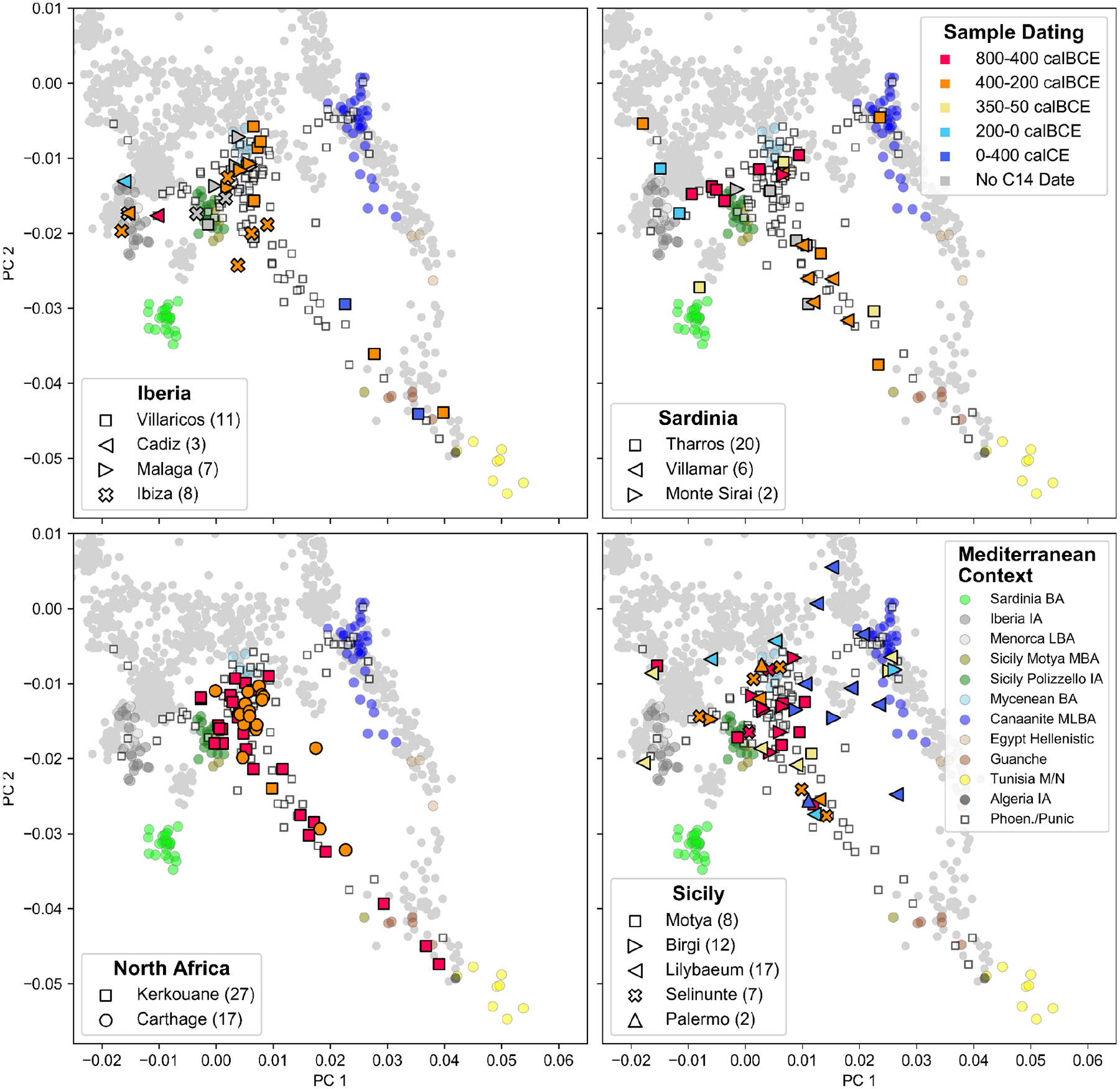
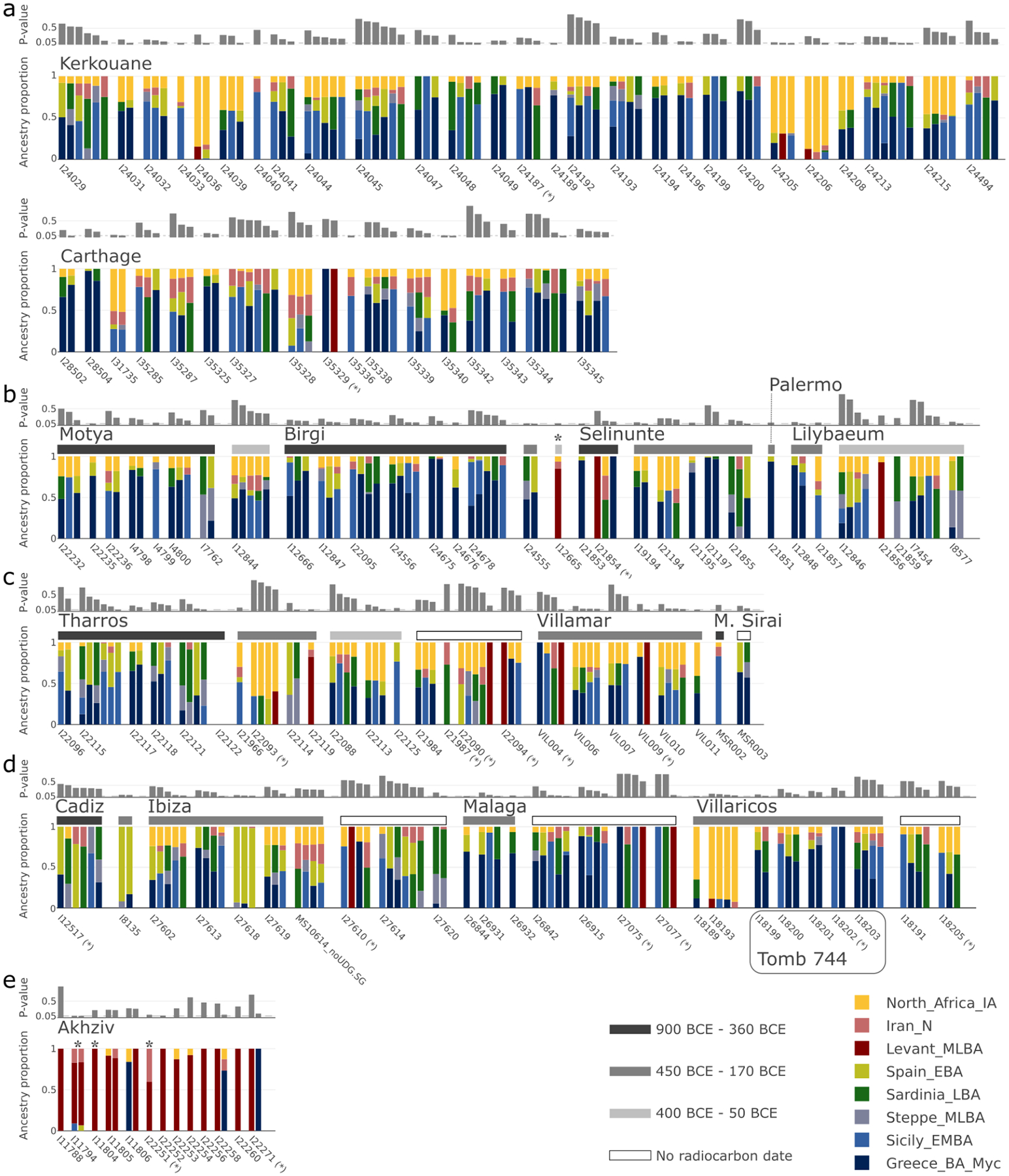
- Levantine Phoenicians made little genetic contribution to Punic settlements in the central and western Mediterranean. All Akhziv individuals derived >80% ancestry from a Levantine Bronze Age population, but only three individuals from Punic sites had substantial Levantine ancestry: two from Sicily whose radiocarbon dates overlap Roman control and one from Sardinia.
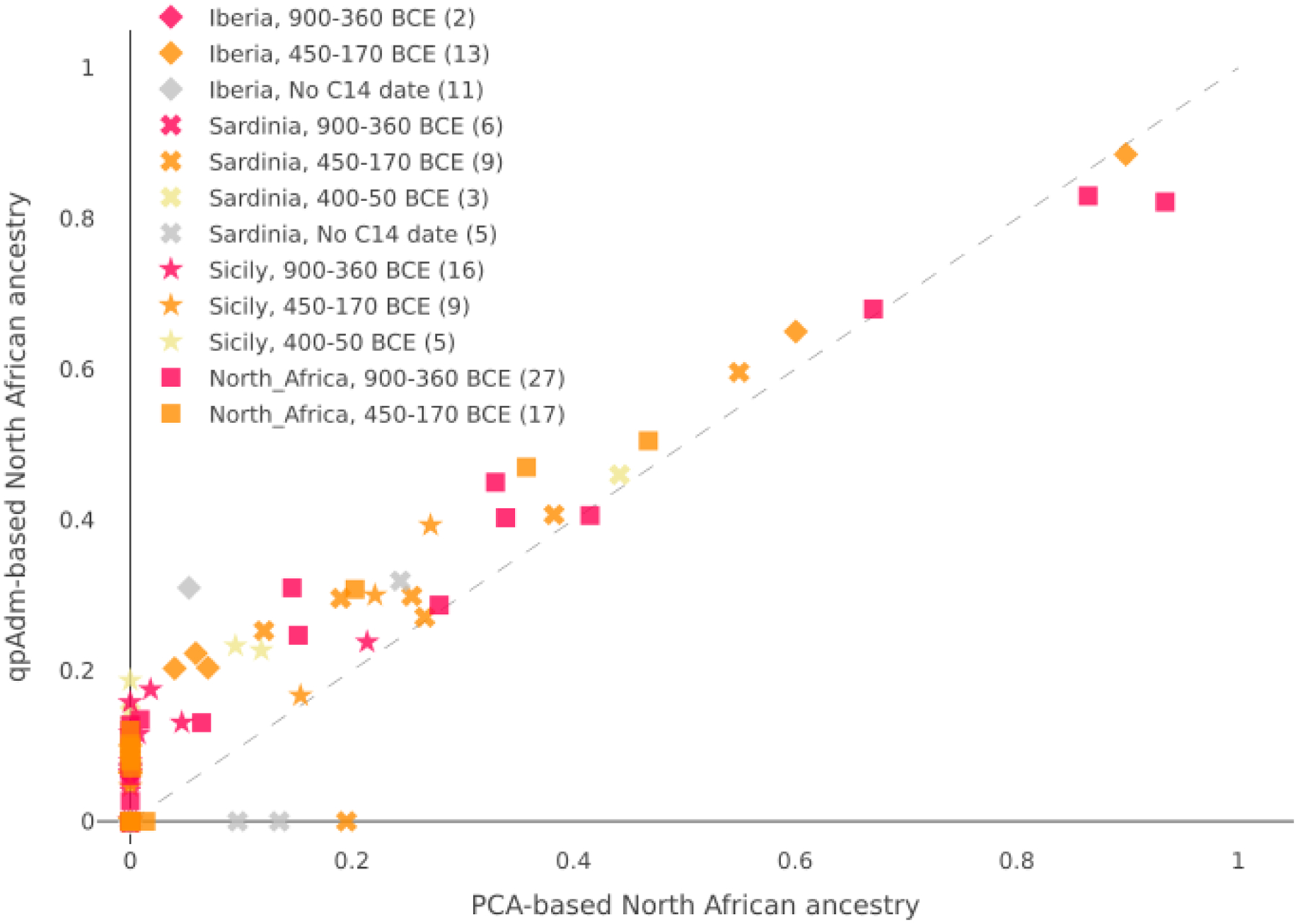
- The primary ancestry source in most Punic individuals was best proxied by Bronze Age Sicily and Greece. North African ancestry was the second most common source, appearing as early as the 6th–5th centuries BCE at Kerkouane and spreading after 400 BCE to Sardinia and Iberia, but it remained below 50% in all individuals except three from Kerkouane, two from Villaricos, and one from Tharros; even in North Africa, 84% of individuals from Kerkouane and Carthage had more than 50% Sicilian-Aegean ancestry.
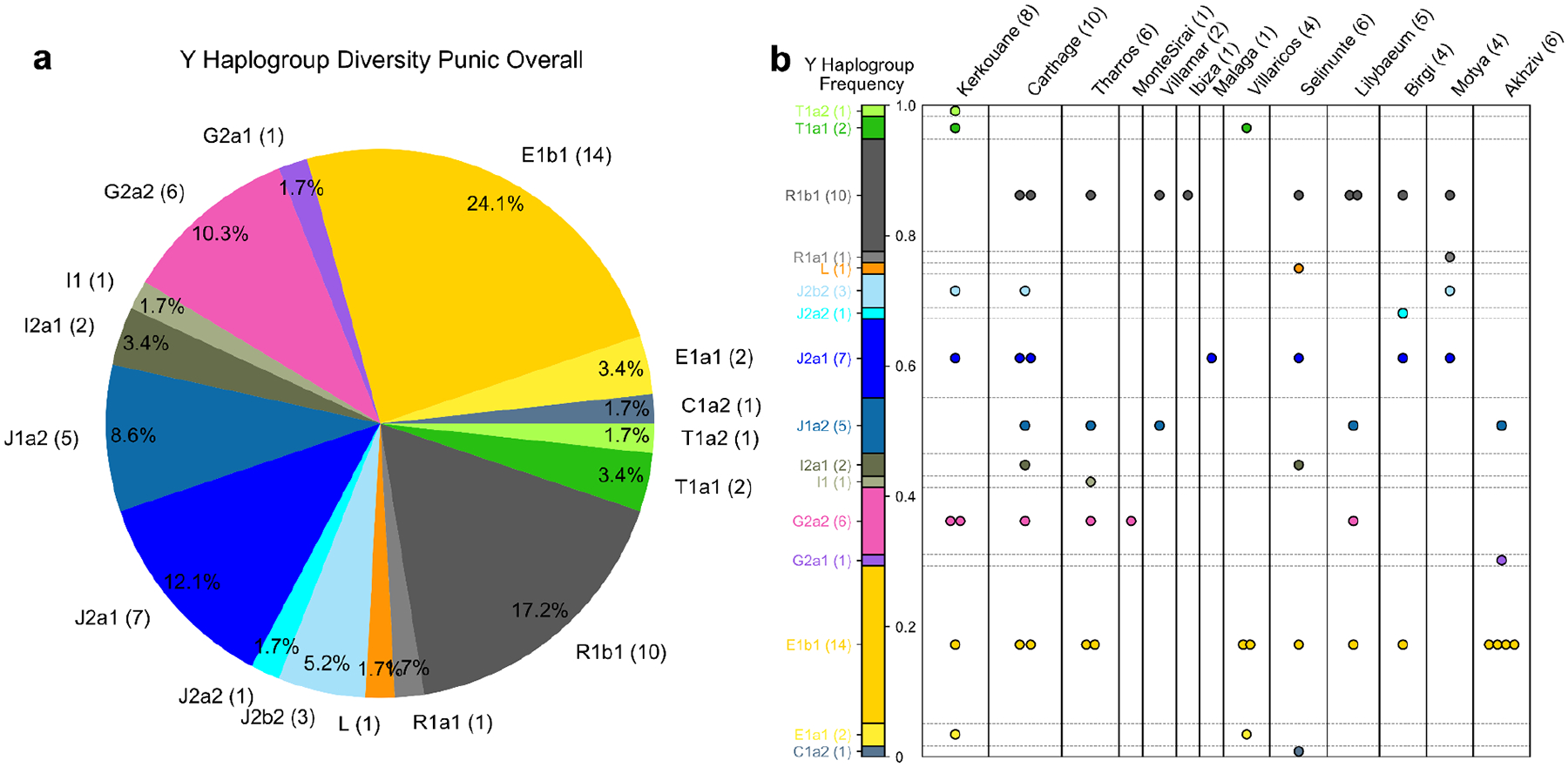
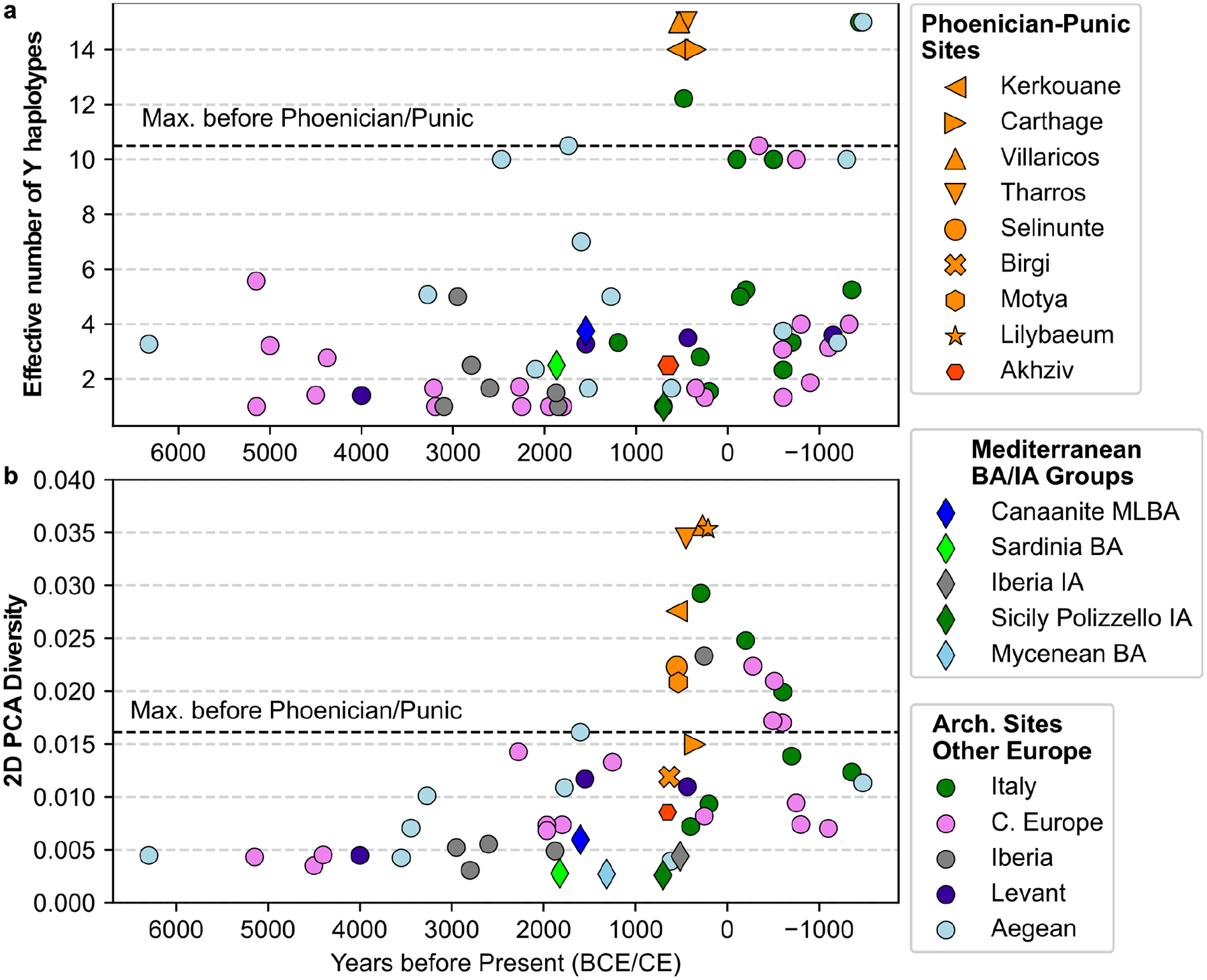
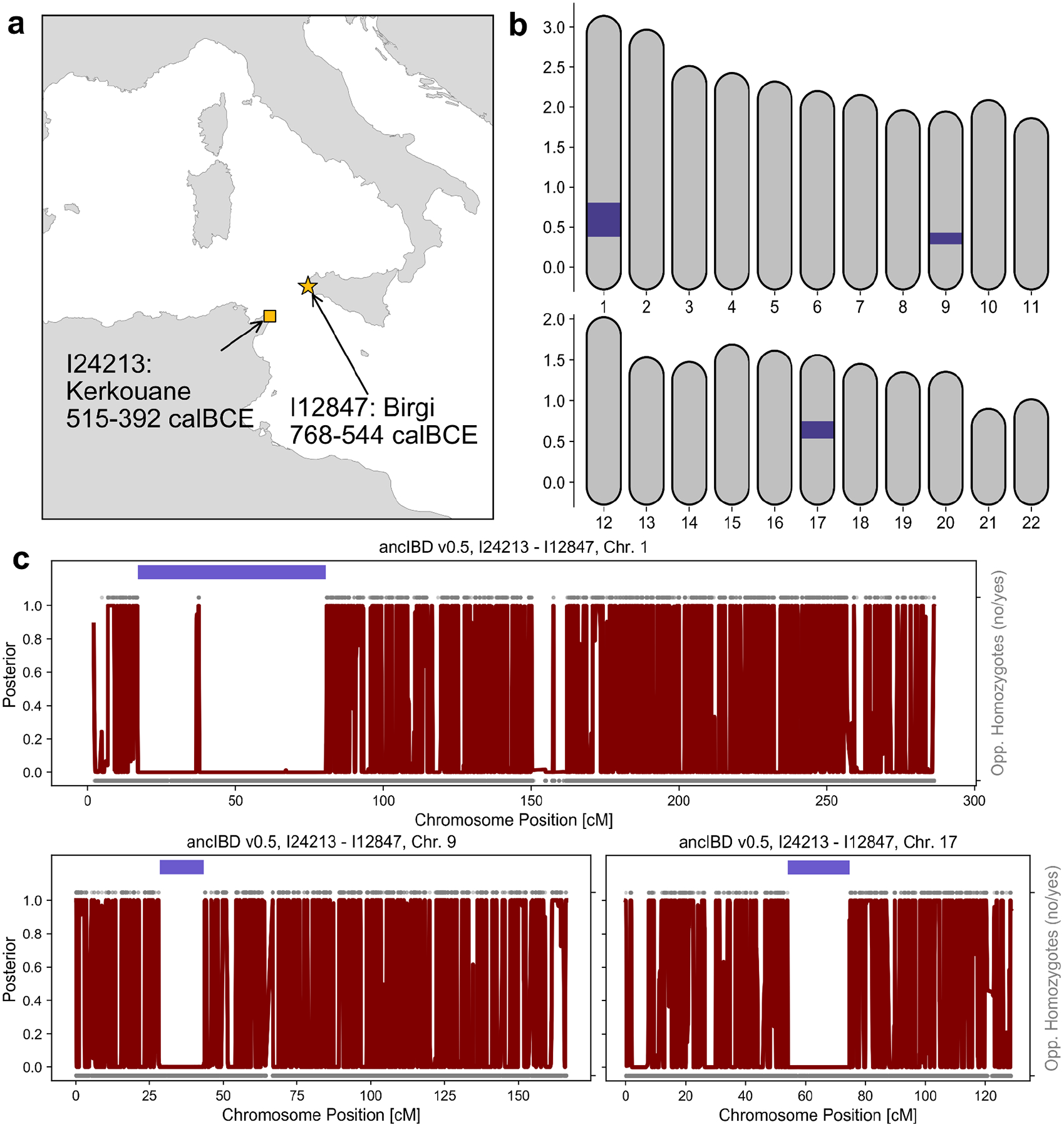
- Punic sites were genetically heterogeneous and interconnected. Y haplogroup diversity was high per site, with no single lineage dominating (E1b 14/58, R1b 10, J2a 8, G2a 7, J1a 5), and J2 appeared in only 20% of Punic males. The study identified 31 pairs sharing an IBD segment >16 cM: 21 within the same or adjacent sites, 10 between distinct sites, and six across the Mediterranean.
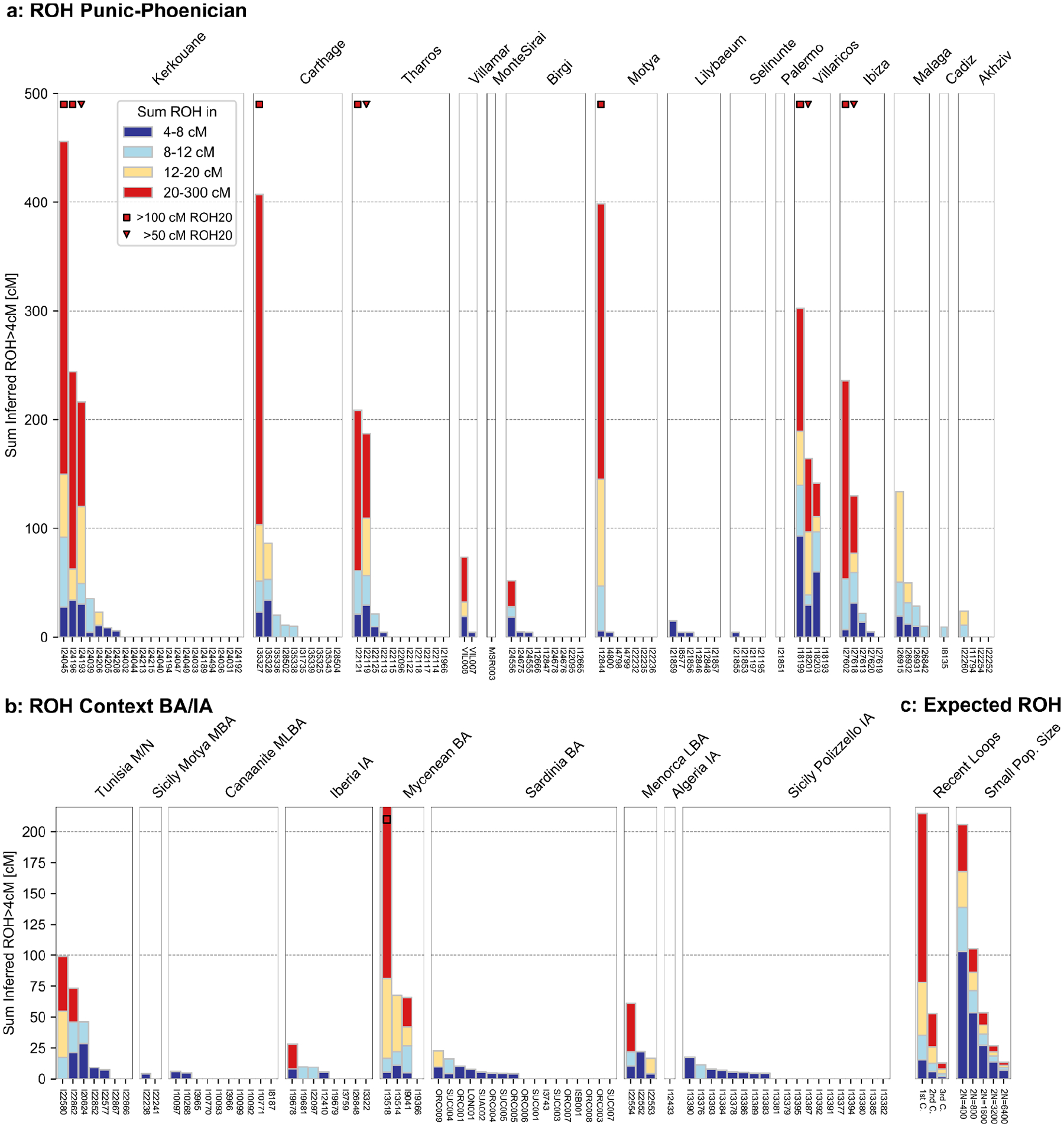
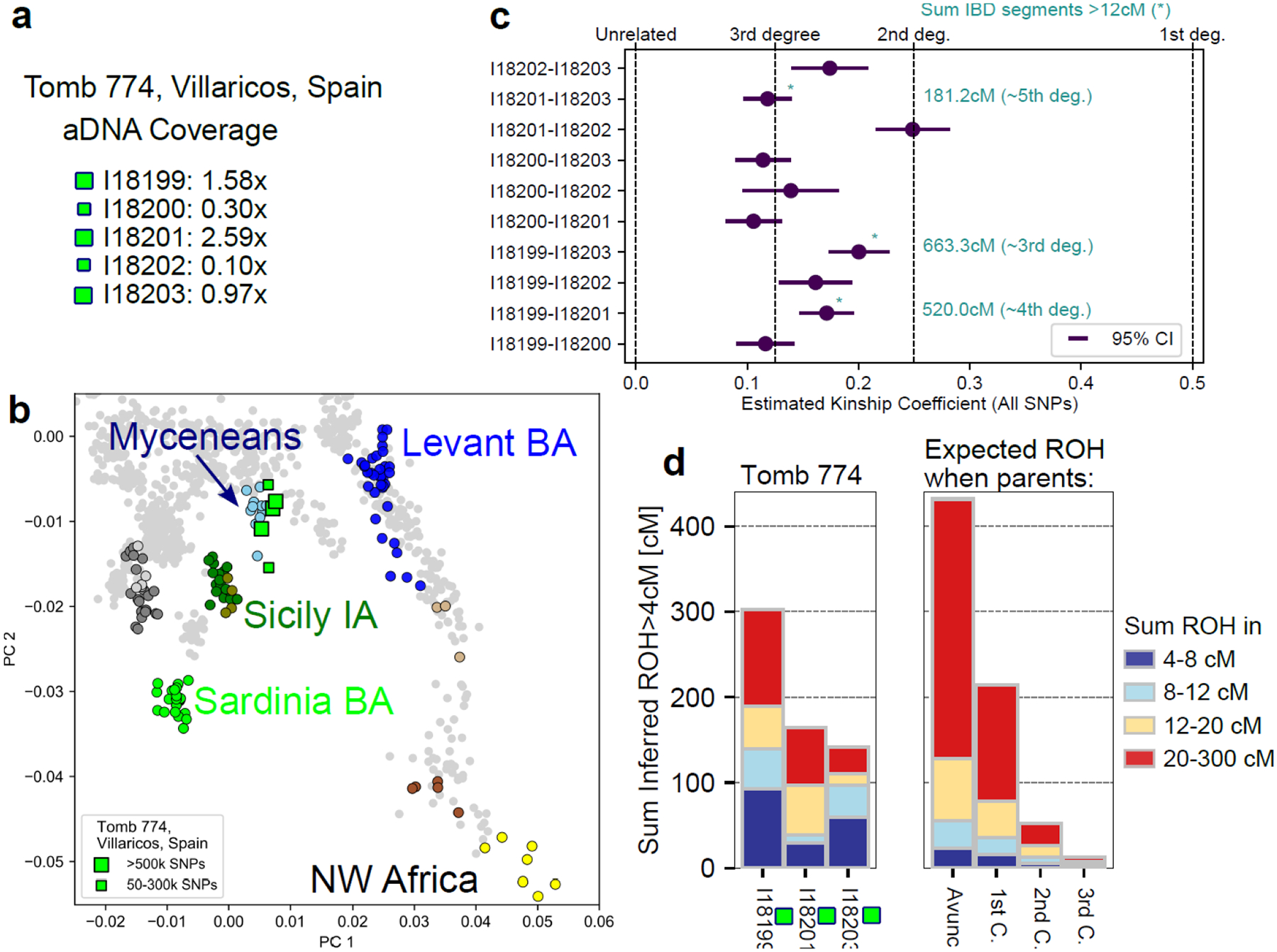
- Close parental relatedness was sporadic but geographically widespread. Among 90 individuals with adequate data, 11 had >50 cM of their genome covered by ROHs >20 cM, and three individuals from Kerkouane, Carthage, and Motya had >350 cM, suggesting parents were second-degree relatives.
Methods
- The authors generated genome-wide data for 210 unique individuals, including 196 from 14 sites traditionally identified as Phoenician and Punic in the Levant, North Africa, Iberia, Sicily, Sardinia, and Ibiza, plus an early Iron Age individual from Algeria. They used in-solution enrichment for more than 1.2 million SNPs and the mitochondrial genome, and obtained 111 accelerator mass spectrometry radiocarbon dates on 99 individuals.
- Population genetic analyses focused on 157 individuals with sufficient data, including 131 with Phoenician or Punic context and 108 with firm archaeological context. Analyses included PCA projection onto present-day West Eurasian and North African variation, ADMIXTURE with K=2–5, qpAdm ancestry modeling with 78 ancient individuals in eight proxy source groups and 14 right populations, Y and mitochondrial haplogroup calling, IBD detection with ancIBD, ROH inference with hapROH, and pairwise kinship estimation.
Limitations
- The paper states that no sampled individuals predate 600 BCE because cremation was the dominant burial practice in Phoenician settlements in the central and western Mediterranean before that time. Radiocarbon calibration plateaus limited dating resolution to roughly 800–400 BCE or 400–200 BCE, and the authors could not confidently distinguish Bronze Age Sicilian from Aegean ancestry sources due to low differentiation (FST~0.01) and sparse Bronze and Iron Age eastern Mediterranean aDNA sampling.
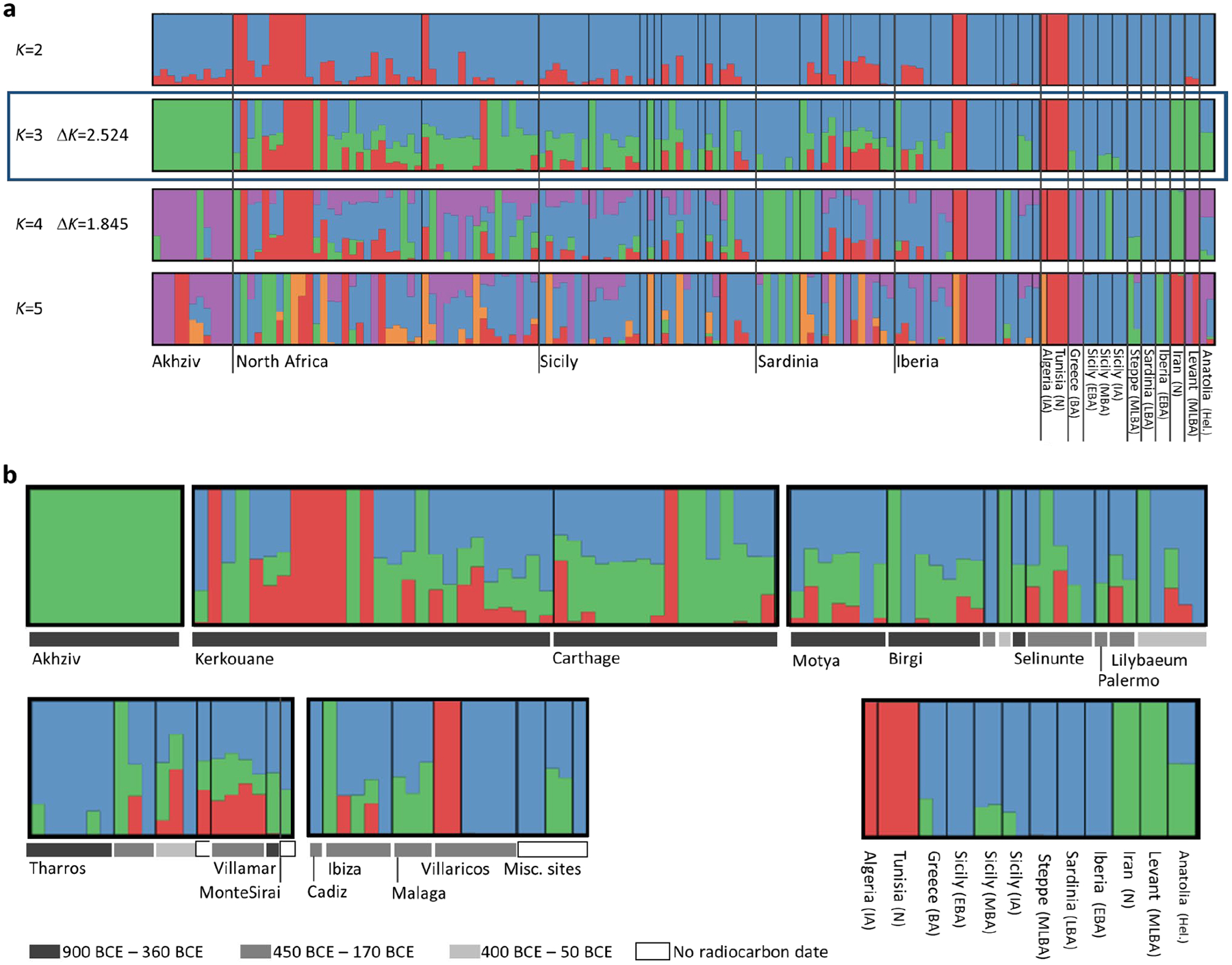
- The paper states that qpAdm often produced multiple valid ancestry models, so the authors selected parsimonious and representative models and did not correct P-values for multiple testing, though they describe this as conservative. They also note that ADMIXTURE did not adequately differentiate Levantine ancestry from ancestry found in other Mediterranean locations.
- Evident from the text: sampling is uneven across sites and periods, with some sites represented by small numbers and Roman-era individuals analyzed separately because they may post-date the Punic period. The authors also state they lack early samples from key Phoenician foundations such as Carthage and Cádiz needed to address the ancestry of their founders.
Model-written summary. Check it against the paper before relying on it.
Integrity signals
Registry
Cites
Statistics
Figures
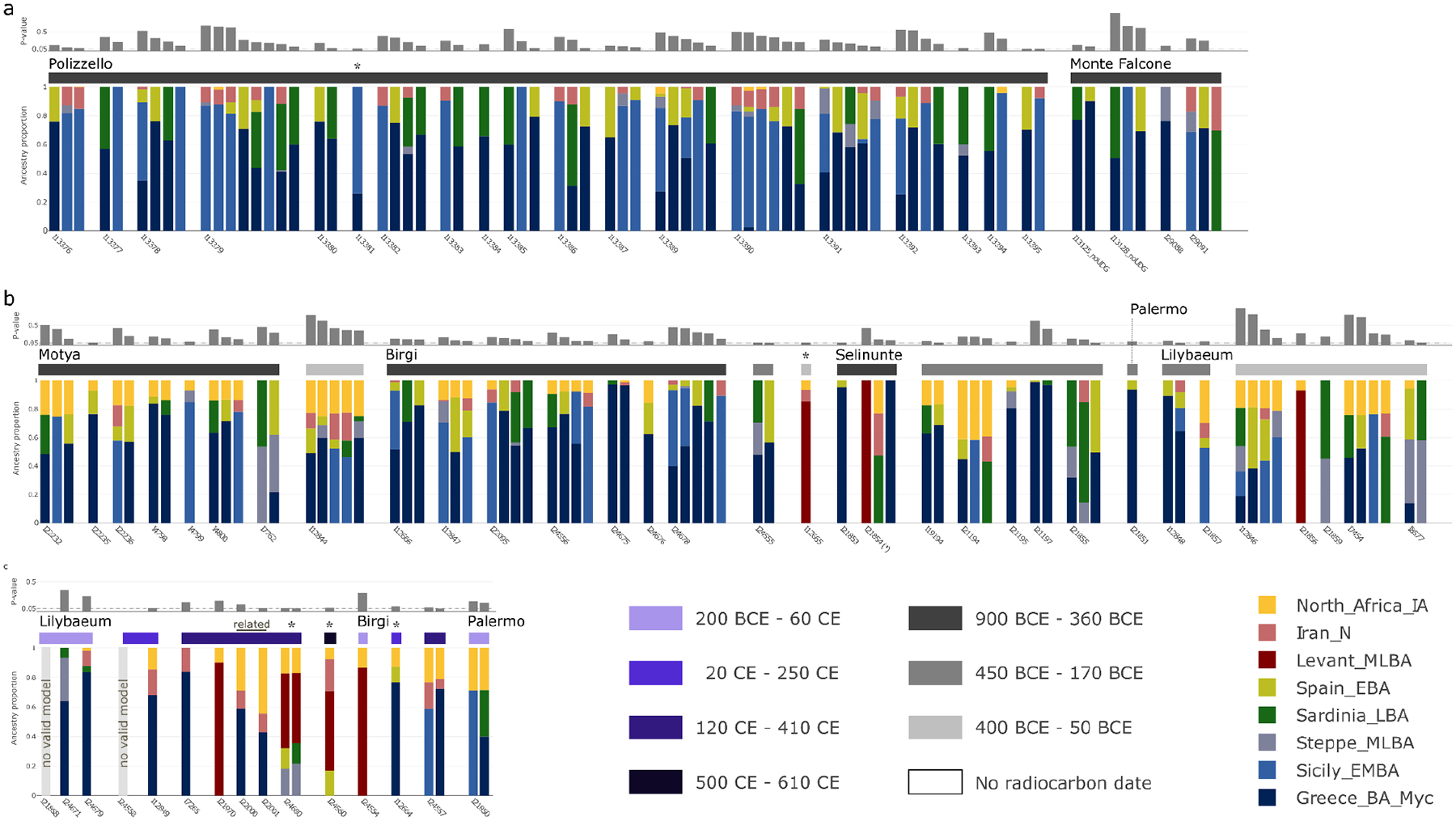
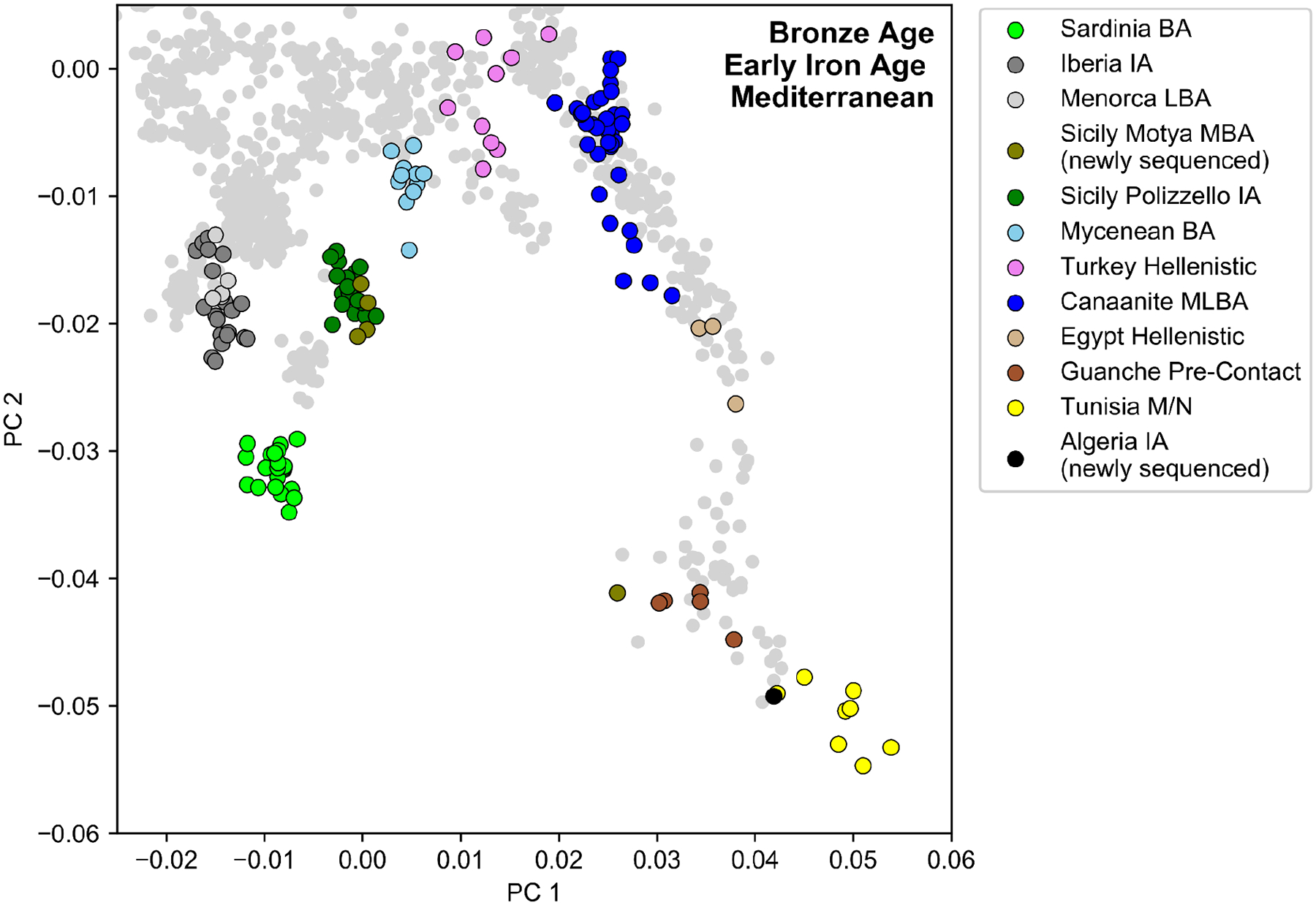
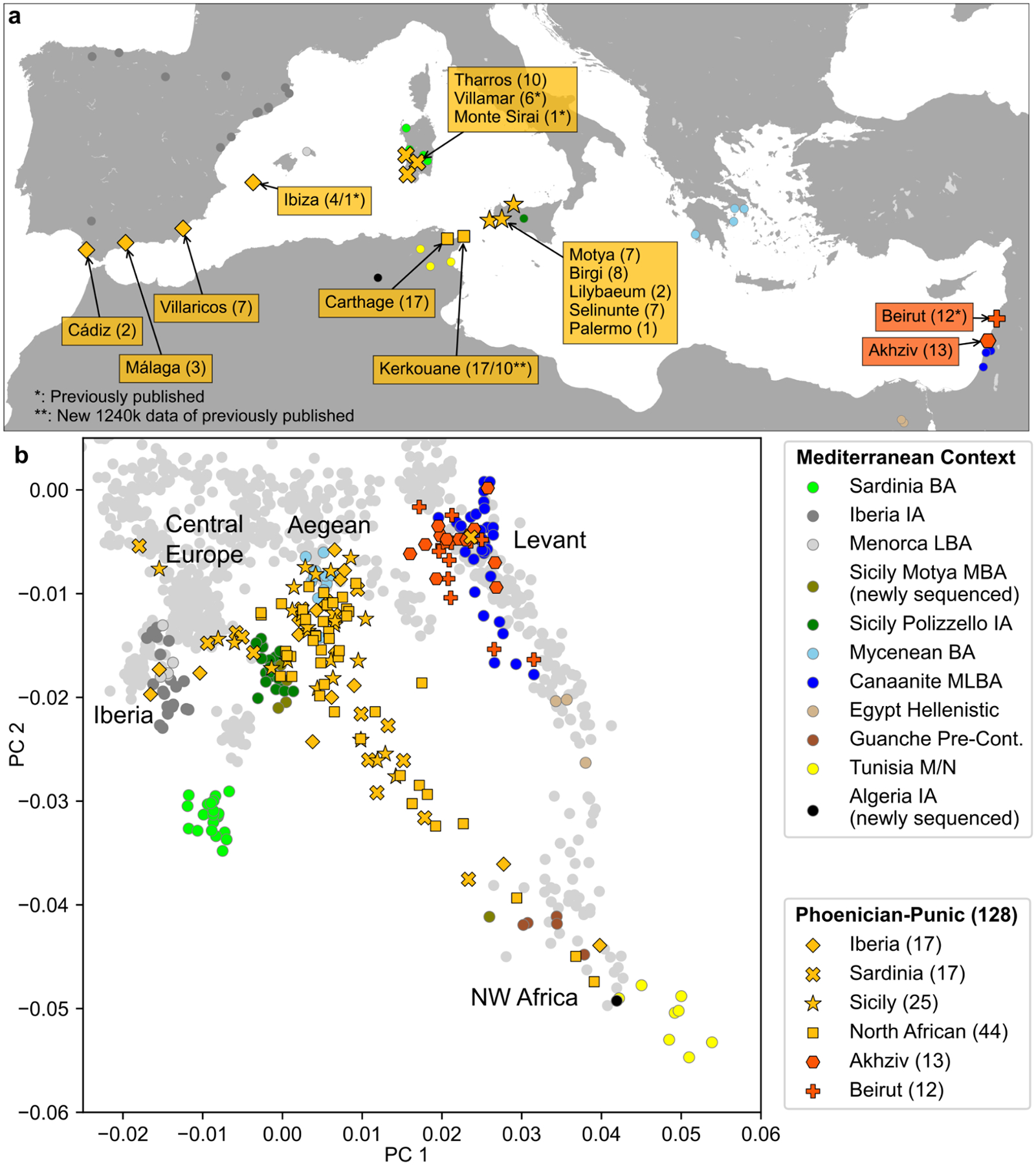
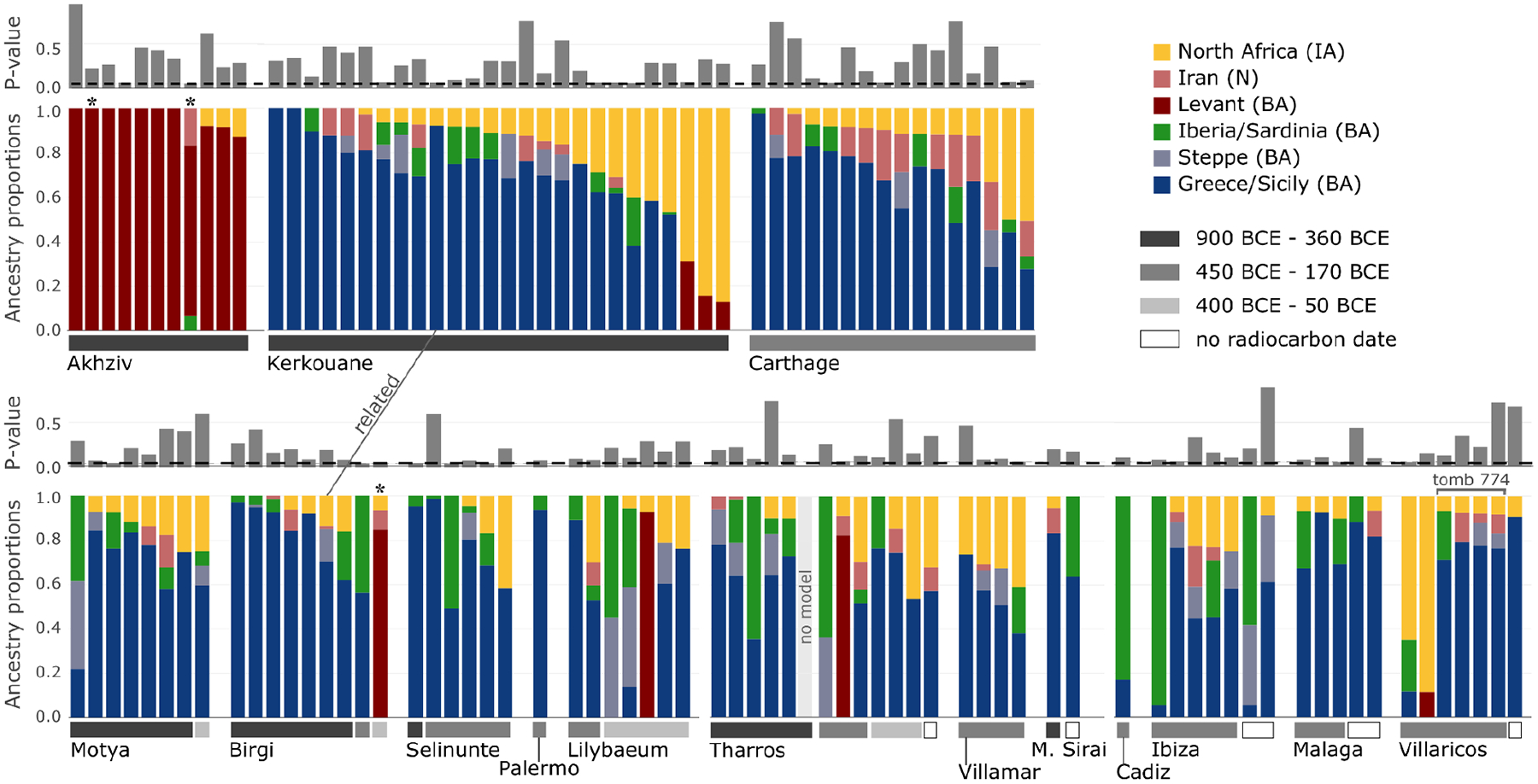
Verification
Claims the paper makes
2 Valid · 0 Not valid · 19 Not checked · 111 Own results and interpretations
The cited sources support only part of this claim — read each source’s verdict below.
In the paper
“We find that individuals from the Levantine Phoenician site of Akhziv cluster together with previously published Bronze and Iron Age Levantine individuals, including from Megiddo in present-day Israel25 and the Phoenician cities of Sidon and Beirut in present-day Lebanon17,18.”
§ Punic people were genetically diverse with almost no Levantine ancestors > Genetic ancestry and admixture modeling
What the sources say
- Supportedcites [25] Agranat-Tamir L The Genomic History of the Bronze Age Southern Levant. Cell 181, 1146– 1157.e11 (2020). 32470400 PMC10212583 source
The citation (ref 25) is attached to the identification of the Megiddo Bronze and Iron Age Levantine genomes, and our copy is exactly that source: the Results ('High degree of genetic affinities between multiple sites') divide '26 high-coverage individuals from Tel Megiddo' into Intermediate Bronze Age, Middle-to-Late Bronze Age and an Iron Age group (Megiddo_IA), and the Discussion adds 'two new samples from the Iron Age – one from Megiddo and the other from Abel Beth Maacah'; STAR Methods places these sites in Israel and Jordan. The paper also includes Sidon in present-day Lebanon among its 93-individual Levantine dataset and reports that the Sidon individuals 'roughly cluster with the other Southern Levant Bronze Age groups in PCA and ADMIXTURE', consistent with the cited clustering context. Beirut is not in our copy, but that site is credited to the citing paper's other references (17,18), not to this source, and the Akhziv clustering result itself is the citing authors' own finding rather than something attributed here. (LLM, conf=0.85)
- Partly supportedcites [17] Haber M Continuity and Admixture in the Last Five Millennia of Levantine History from Ancient Canaanite and Present-Day Lebanese Genome Sequences. Am. J. Hum. Genet 101, 274– 282 (2017). 28757201 PMC5544389 sourceExperimental — accuracy not yet measured
Haber et al. (2017) does supply the Sidon half of what is attributed to it: the Main Text (Introduction and Methods/Results) reports genome sequences from five Bronze Age individuals (3,750–3,650 ya) from Sidon, 'a major Canaanite city-state', and the PCA passage (Main Text, Results) shows Sidon_BA clustering with Early Bronze Age Jordan (Jordan_BA) and overlapping present-day Lebanese. However, our copy contains no Iron Age Levantine individuals and no ancient Beirut samples — the only new ancient material is Sidon_BA, and the comparative ancient Levantine groups it discusses are Natufians, Levant_N, Jordan_BA and present-day Lebanese. So the 'Bronze and Iron Age ... Sidon and Beirut' scope of the citation overreaches this source: the Iron Age and Beirut components must come from elsewhere (the sentence carries a second reference, 17,18). (LLM, conf=0.78)
- Supportedcites [18] Haber M A Genetic History of the Near East from an aDNA Time Course Sampling Eight Points in the Past 4,000 Years. Am. J. Hum. Genet 107, 149– 157 (2020). 32470374 PMC7332655 source
The superscripts 17,18 attach to 'the Phoenician cities of Sidon and Beirut in present-day Lebanon', so what is attributed to this source is the existence of previously published Bronze and Iron Age Levantine individuals from Sidon and Beirut. Our copy supplies exactly that: Table 1 lists newly generated Iron Age II and Iron Age III individuals excavated at Beirut (SFI-415, SFI-1075), and the PCA section (Main Text) states that the new Beirut samples 'clustered between the Bronze Age population (Sidon_BA) and modern Lebanese', i.e. Bronze Age Sidon and Iron Age Beirut Levantine genomes analysed together. The Akhziv clustering itself is the citing authors' own result and the Megiddo material is credited to a different reference (25), so neither is judged against this source; our copy contains no mention of Akhziv or Megiddo. (LLM, conf=0.82)
plainstates an association- Asserted: passes — The authors put it forward as true.
- Checkable: passes — It can be checked against evidence.
- Load-bearing: passes — The paper’s conclusions depend on it.
- Based: passes — The paper gives a reason why it holds.
- Supported
The sources with a verdict support this claim; the rest weren’t checked yet, have no full text we could read, or their verdicts aren’t rated yet.
In the paper
“Our data from Roman-era individuals from Sicily (Extended Data Figure 9c) suggests that ancestry patterns shifted toward the eastern Mediterranean, as previously observed elsewhere in the Roman Mediterranean37–39.”
§ Punic people were genetically diverse with almost no Levantine ancestors > Discussion
What the sources say
- Supportedcites [37] Antonio ML Ancient Rome: A genetic crossroads of Europe and the Mediterranean. Science 366, 708– 714 (2019). 31699931 PMC7093155 source
The citation is attached only to the clause 'as previously observed elsewhere in the Roman Mediterranean'; the Sicily data (Extended Data Figure 9c) are the citing authors' own and are not attributed to this source. Our copy of Antonio et al. states exactly that prior observation for Imperial Rome: the Results section 'Imperial Rome and the expanding empire' (p. ~4) reports 'the most prominent trend is an ancestry shift toward the eastern Mediterranean,' backed by PCA overlap with Greek, Maltese, Cypriot and Syrian populations, f4 Z = 4.2 with Early Bronze Age Jordanians, and qpAdm fits favouring Cyprus, Anatolia and the Levant. The Summary and the same Results section likewise attribute Imperial-period ancestry to 'genetic contributions from the Near East' and note more eastern Mediterranean than western influence, so the cited work is a valid instance of the shift being previously observed elsewhere in the Roman Mediterranean. (LLM, conf=0.85)
- Not checked yetcites [38] Lazaridis I The genetic history of the Southern Arc: A bridge between West Asia and Europe. Science 377, eabm4247 (2022). 36007055 PMC10064553 source
- Not checked yetcites [39] Olalde I A genetic history of the Balkans from Roman frontier to Slavic migrations. Cell 186, 5472– 5485.e9 (2023). 38065079 PMC10752003 source
hedgedstates an association- Asserted: passes — The authors put it forward as true.
- Checkable: passes — It can be checked against evidence.
- Load-bearing: unclear — It is unclear whether the paper’s conclusions depend on it.
- Based: passes — The paper gives a reason why it holds.
- Supported
A result the paper reports from its own data — it cites no other source for it, so there is none to check. The quote shows it is in the paper.
In the paper
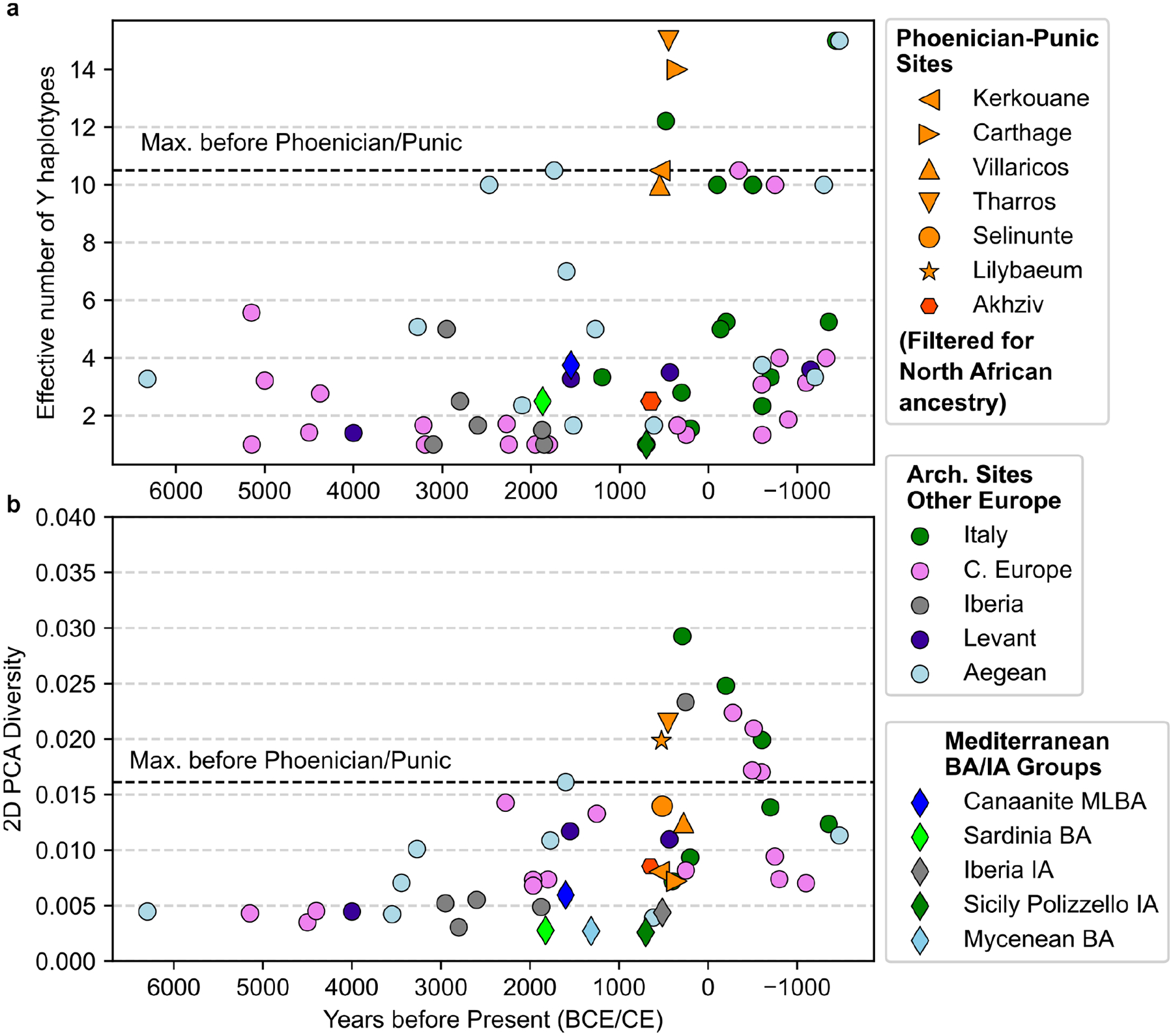
“First, we observe a substantially higher Y haplogroup diversity per archaeological site compared to earlier people (Figure 3a; Extended Data Figure 5).”
§ Punic people were genetically diverse with almost no Levantine ancestors > Genetic heterogeneity and connectedness
plainstates an association- Asserted: passes — The authors put it forward as true.
- Checkable: passes — It can be checked against evidence.
- Load-bearing: passes — The paper’s conclusions depend on it.
- Based: passes — The paper gives a reason why it holds.
A result the paper reports from its own data — it cites no other source for it, so there is none to check. The quote shows it is in the paper.
In the paper
“Only two Iberian individuals, from Ibiza and Cádiz, had confidently high proportions of Bronze Age Iberian ancestry (Figure 2, Extended Data Figure 3).”
§ Punic people were genetically diverse with almost no Levantine ancestors > Genetic ancestry and admixture modeling
plainn = 2- Asserted: passes — The authors put it forward as true.
- Checkable: passes — It can be checked against evidence.
- Load-bearing: unclear — It is unclear whether the paper’s conclusions depend on it.
- Based: passes — The paper gives a reason why it holds.
- Rests on an assumption not shown here.
A result the paper reports from its own data — it cites no other source for it, so there is none to check. The quote shows it is in the paper.
In the paper
“Using ADMIXTURE, we inferred a three-component model with clusters maximized in North Africans, eastern populations (Levant/Iran), and central and western Mediterranean groups (Extended Data Figure 2).”
§ Punic people were genetically diverse with almost no Levantine ancestors > Genetic ancestry and admixture modeling
plain- Asserted: passes — The authors put it forward as true.
- Checkable: passes — It can be checked against evidence.
- Load-bearing: passes — The paper’s conclusions depend on it.
- Based: passes — The paper gives a reason why it holds.
67 more claims
Create a free account to see all 132 claims and to verify the 27 references still open.
- It may state two separate claims as one. 35
- Probably not a substantial claim. 30
- The quote only partly states this claim. 1
Self-check
Percentages, sums and reported differences re-computed from the paper’s own numbers.
Each contradiction between two passages listed here was confirmed by an independent check.
Rated minor: it would not touch a result — a value no result rests on, a p-value that stays on the same side of the significance level, or a conflict that is clerical, resolved elsewhere in the paper, or outside its own findings.
In the paper
§ Punic people were genetically diverse with almost no Levantine ancestors > Extended Data
“In contrast, western ancestry models are indicated by contributions from either Greece BA (Myc), Sicily EBA, Sardinia LBA, Iberia LBA, or Steppe MLBA.”
§ Punic people were genetically diverse with almost no Levantine ancestors > Methods > General setup for qpAdm analysis
“Considering the main clusters observed in the PCA, we determined eight groups of ancient individuals to use as proxies for potential sources of ancestry (Supplementary Table 7): Greece BA (Myc), Sicily EMBA, Sardinia LBA, Iberia EBA, Steppe MLBA, Iran N, Levant MLBA, and North Africa IA.”
Rated minor: it would not touch a result — a value no result rests on, a p-value that stays on the same side of the significance level, or a conflict that is clerical, resolved elsewhere in the paper, or outside its own findings.
In the paper
§ Punic people were genetically diverse with almost no Levantine ancestors > Genetic heterogeneity and connectedness
“In each sampled Punic site, most males have differing Y haplogroups (using the first four letters of the ISOGG classification, see Methods).”
§ Punic people were genetically diverse with almost no Levantine ancestors > Methods > Calculating autosomal and Y haplogroup diversity per site
“To quantify Y haplogroup diversity per archaeological site, we considered the first three characters of the ISOGG classification for each inferred haplogroup.”
Citations
Cites
The Sequence Alignment/Map format and SAMtools
Li, H., Handsaker, B., Wysoker, A., Fennell, T., Ruan, J., Homer, N., Marth, G., Abecasis, G., Durbin, R., & 1000 Genome Project Data Processing Subgroup (2009) · Bioinformatics · doi:10.1093/bioinformatics/btp352 · Cited by 62,041
Fast and accurate short read alignment with Burrows-Wheeler transform
Li, H., & Durbin, R. (2009) · Bioinformatics · doi:10.1093/bioinformatics/btp324 · Cited by 58,607
PLINK: a tool set for whole-genome association and population-based linkage analyses.
Purcell, S., Neale, B., Todd-Brown, K., Thomas, L., Ferreira, M. A. R., Bender, D., Maller, J., Sklar, P., de Bakker, P. I. W., Daly, M. J., et al. (2007) · The American Journal of Human Genetics · doi:10.1086/519795 · Cited by 34,089
Detecting the number of clusters of individuals using the software structure: a simulation study
EVANNO, G., REGNAUT, S., & GOUDET, J. (2005) · Molecular Ecology · doi:10.1111/j.1365-294x.2005.02553.x · Cited by 21,895
Fast and accurate long-read alignment with Burrows-Wheeler transform.
Li, H., & Durbin, R. (2010) · Bioinformatics · doi:10.1093/bioinformatics/btp698 · Cited by 12,063 · cited 1×
“…of at least 30 bp in length, which aligned with a minimum mapping quality of least 10 to either the inferred ancestral mitochondrial genome sequence 47,48 or the human reference genome sequence (hg19) (https://www.internationalgenome. org/category/grch37/), using the ‘samse’ command from BWA 47 .”
Fast model-based estimation of ancestry in unrelated individuals
Alexander, D. H., Novembre, J., & Lange, K. (2009) · Genome Research · doi:10.1101/gr.094052.109 · Cited by 9,898
The IntCal20 Northern Hemisphere Radiocarbon Age Calibration Curve (0–55 cal kBP)
Reimer, P. J., Austin, W. E. N., Bard, E., Bayliss, A., Blackwell, P. G., Bronk Ramsey, C., Butzin, M., Cheng, H., Edwards, R. L., Friedrich, M., et al. (2020) · Radiocarbon · doi:10.1017/rdc.2020.41 · Cited by 7,900
Kopelman, N. M., Mayzel, J., Jakobsson, M., Rosenberg, N. A., & Mayrose, I. (2015) · Molecular Ecology Resources · doi:10.1111/1755-0998.12387 · Cited by 3,246
Massive migration from the steppe was a source for Indo-European languages in Europe
Haak, W., Lazaridis, I., Patterson, N., Rohland, N., Mallick, S., Llamas, B., Brandt, G., Nordenfelt, S., Harney, E., Stewardson, K., et al. (2015) · Nature · doi:10.1038/nature14317 · Cited by 1,940 · cited 2×
“We estimated proportions of ancestry with qpAdm 27,28 , using the R package admixr 61 and qpAdm v.1201 (from ADMIXTOOLS) with the allsnps flag turned on.”
Self-citationDabney, J., Knapp, M., Glocke, I., Gansauge, M.-T., Weihmann, A., Nickel, B., Valdiosera, C., García, N., Pääbo, S., Arsuaga, J.-L., et al. (2013) · Proceedings of the National Academy of Sciences · doi:10.1073/pnas.1314445110 · Cited by 1,443 · cited 1×
“We extracted DNA using a methodology optimized to retain smaller DNA fragments 41,42 .”
Runs of homozygosity: windows into population history and trait architecture
Ceballos, F. C., Joshi, P. K., Clark, D. W., Ramsay, M., & Wilson, J. F. (2018) · Nature Reviews Genetics · doi:10.1038/nrg.2017.109 · Cited by 1,006
HaploGrep 2: mitochondrial haplogroup classification in the era of high-throughput sequencing
Weissensteiner, H., Pacher, D., Kloss-Brandstätter, A., Forer, L., Specht, G., Bandelt, H.-J., Kronenberg, F., Salas, A., & Schönherr, S. (2016) · Nucleic Acids Research · doi:10.1093/nar/gkw233 · Cited by 944
An early modern human from Romania with a recent Neanderthal ancestor
Fu, Q., Hajdinjak, M., Moldovan, O. T., Constantin, S., Mallick, S., Skoglund, P., Patterson, N., Rohland, N., Lazaridis, I., Nickel, B., et al. (2015) · Nature · doi:10.1038/nature14558 · Cited by 802 · cited 2×
“…human skeletal remains from 398 individuals excavated from 14 sites in Iberia, Sardinia, Sicily, North Africa and the Levant, using in-solution enrichment for more than 1.2 million single-nucleotide polymorphisms (SNPs) 22 and the mitochondrial genome 23 (Methods and Supplementary Tables 1 and 2).”
InfluentialSelf-citationAn aboriginal Australian genome reveals separate human dispersals into Asia
Rasmussen, M., Guo, X., Wang, Y., Lohmueller, K. E., Rasmussen, S., Albrechtsen, A., Skotte, L., Lindgreen, S., Metspalu, M., Jombart, T., et al. (2011) · Science · doi:10.1126/science.1211177 · Cited by 787
A Revised Timescale for Human Evolution Based on Ancient Mitochondrial Genomes
Fu, Q., Mittnik, A., Johnson, P. L. F., Bos, K., Lari, M., Bollongino, R., Sun, C., Giemsch, L., Schmitz, R., Burger, J., et al. (2013) · Current Biology · doi:10.1016/j.cub.2013.02.044 · Cited by 709 · cited 3×
“0.1051 23 .”
InfluentialSelf-citationPartial uracil–DNA–glycosylase treatment for screening of ancient DNA
Rohland, N., Harney, E., Mallick, S., Nordenfelt, S., & Reich, D. (2015) · Philosophical Transactions of the Royal Society B: Biological Sciences · doi:10.1098/rstb.2013.0624 · Cited by 572 · cited 1×
“We applied uracil-DNA-glycosylase (UDG) treatment to reduce characteristic aDNA errors 43,44 and then built double-and single-stranded libraries 45 .”
Self-citationThe genomic history of the Iberian Peninsula over the past 8000 years
Olalde, I., Mallick, S., Patterson, N., Rohland, N., Villalba-Mouco, V., Silva, M., Dulias, K., Edwards, C. J., Gandini, F., Pala, M., et al. (2019) · Science · doi:10.1126/science.aav4040 · Cited by 552 · cited 2×
“…(v.18150) using the default settings, combining data from a standard set of West Eura-sians (HO data, widely used in human aDNA analysis) with present-day North-African individuals in AADR v.54.1 (the list of 1,196 individuals is provided in Supplementary Table 6) as described previously 54 .”
InfluentialSelf-citationRemoval of deaminated cytosines and detection of in vivo methylation in ancient DNA
Briggs, A. W., Stenzel, U., Meyer, M., Krause, J., Kircher, M., & Pääbo, S. (2010) · Nucleic Acids Research · doi:10.1093/nar/gkp1163 · Cited by 491
Optimal ancient DNA yields from the inner ear part of the human petrous bone
Pinhasi, R., Fernandes, D., Sirak, K., Novak, M., Connell, S., Alpaslan-Roodenberg, S., Gerritsen, F., Moiseyev, V., Gromov, A., Raczky, P., et al. (2015) · PLoS ONE · doi:10.1371/journal.pone.0129102 · Cited by 487 · cited 1×
“In clean rooms where the goal was to protect the analysed samples from contamination by environmental DNA, we sampled bones (especially petrous bones 40 ) and teeth, typically aiming for 37 mg of powder per sample.”
Self-citationA “Copernican” Reassessment of the Human Mitochondrial DNA Tree from its Root
Behar, D. M., van Oven, M., Rosset, S., Metspalu, M., Loogväli, E.-L., Silva, N. M., Kivisild, T., Torroni, A., & Villems, R. (2012) · The American Journal of Human Genetics · doi:10.1016/j.ajhg.2012.03.002 · Cited by 471
pong: fast analysis and visualization of latent clusters in population genetic data
Behr, A. A., Liu, K. Z., Liu-Fang, G., Nakka, P., & Ramachandran, S. (2016) · Bioinformatics · doi:10.1093/bioinformatics/btw327 · Cited by 381
Rohland, N., Glocke, I., Aximu-Petri, A., & Meyer, M. (2018) · Nature Protocols · doi:10.1038/s41596-018-0050-5 · Cited by 369
Self-citationThe Allen Ancient DNA Resource (AADR) a curated compendium of ancient human genomes
Mallick, S., Micco, A., Mah, M., Ringbauer, H., Lazaridis, I., Olalde, I., Patterson, N., & Reich, D. (2024) · Scientific Data · doi:10.1038/s41597-024-03031-7 · Cited by 368
Self-citationArchaeogenomic evidence reveals prehistoric matrilineal dynasty
Kennett, D. J., Plog, S., George, R. J., Culleton, B. J., Watson, A. S., Skoglund, P., Rohland, N., Mallick, S., Stewardson, K., Kistler, L., et al. (2017) · Nature Communications · doi:10.1038/ncomms14115 · Cited by 301
Self-citationGenetic origins of the Minoans and Mycenaeans
Lazaridis, I., Mittnik, A., Patterson, N., Mallick, S., Rohland, N., Pfrengle, S., Furtwängler, A., Peltzer, A., Posth, C., Vasilakis, A., et al. (2017) · Nature · doi:10.1038/nature23310 · Cited by 281
Self-citationAncient Rome: A genetic crossroads of Europe and the Mediterranean
Antonio, M. L., Gao, Z., Moots, H. M., Lucci, M., Candilio, F., Sawyer, S., Oberreiter, V., Calderon, D., Devitofranceschi, K., Aikens, R. C., et al. (2019) · Science · doi:10.1126/science.aay6826 · Cited by 257
Self-citationParental relatedness through time revealed by runs of homozygosity in ancient DNA
Ringbauer, H., Novembre, J., & Steinrücken, M. (2021) · Nature Communications · doi:10.1038/s41467-021-25289-w · Cited by 245
Self-citationPhoenicians and the Making of the Mediterranean
López‐Ruiz, C. (2021) · Harvard University Press eBooks · doi:10.4159/9780674269965 · Cited by 235
Gansauge, M.-T., Aximu-Petri, A., Nagel, S., & Meyer, M. (2020) · Nature Protocols · doi:10.1038/s41596-020-0338-0 · Cited by 228
Quinn, J. C. (2017) · Princeton University Press eBooks · doi:10.2307/j.ctvc77kkd · Cited by 218
Assessing the performance of qpAdm: a statistical tool for studying population admixture
Harney, É., Patterson, N., Reich, D., & Wakeley, J. (2021) · Genetics · doi:10.1093/genetics/iyaa045 · Cited by 218
Self-citationThe genetic history of the Southern Arc: A bridge between West Asia and Europe
Lazaridis, I., Alpaslan-Roodenberg, S., Acar, A., Açıkkol, A., Agelarakis, A., Aghikyan, L., Akyüz, U., Andreeva, D., Andrijašević, G., Antonović, D., et al. (2022) · Science · doi:10.1126/science.abm4247 · Cited by 190
Self-citationThree assays for in-solution enrichment of ancient human DNA at more than a million SNPs
Rohland, N., Mallick, S., Mah, M., Maier, R., Patterson, N., & Reich, D. (2022) · Genome Research · doi:10.1101/gr.276728.122 · Cited by 163
Self-citationThe Oxford Handbook of the Phoenician and Punic Mediterranean
López-Ruiz, C., & Doak, B. (2019) · Oxford University Press eBooks · doi:10.1093/oxfordhb/9780190499341.001.0001 · Cited by 162
Accurate detection of identity-by-descent segments in human ancient DNA
Ringbauer, H., Huang, Y., Akbari, A., Mallick, S., Olalde, I., Patterson, N., & Reich, D. (2024) · Nature Genetics · doi:10.1038/s41588-023-01582-w · Cited by 155 · cited 1×
“To infer degrees of relatedness, we compared inferred IBD segments >12 cM long to IBD observed in simulated genomes with various degrees of relatedness when using the same filtering as when running ancIBD, as described previously 62 .”
Self-citationThe spread of steppe and Iranian-related ancestry in the islands of the western Mediterranean
Fernandes, D. M., Mittnik, A., Olalde, I., Lazaridis, I., Cheronet, O., Rohland, N., Mallick, S., Bernardos, R., Broomandkhoshbacht, N., Carlsson, J., et al. (2020) · Nature Ecology & Evolution · doi:10.1038/s41559-020-1102-0 · Cited by 153
Self-citationThe Allen Ancient DNA Resource (AADR): A curated compendium of ancient human genomes
Mallick, S., Micco, A., Mah, M., Ringbauer, H., Lazaridis, I., Olalde, I., Patterson, N., & Reich, D. (2023) · bioRxiv (Cold Spring Harbor Laboratory) · doi:10.1101/2023.04.06.535797 · Cited by 153
Self-citationGenetic history from the Middle Neolithic to present on the Mediterranean island of Sardinia
Marcus, J. H., Posth, C., Ringbauer, H., Lai, L., Skeates, R., Sidore, C., Beckett, J., Furtwängler, A., Olivieri, A., Chiang, C. W. K., et al. (2020) · Nature Communications · doi:10.1038/s41467-020-14523-6 · Cited by 152
Self-citationadmixr—R package for reproducible analyses using ADMIXTOOLS
Petr, M., Vernot, B., & Kelso, J. (2019) · Bioinformatics · doi:10.1093/bioinformatics/btz030 · Cited by 144
Ancient DNA sheds light on the genetic origins of early Iron Age Philistines
Feldman, M., Master, D. M., Bianco, R. A., Burri, M., Stockhammer, P. W., Mittnik, A., Aja, A. J., Jeong, C., & Krause, J. (2019) · Science Advances · doi:10.1126/sciadv.aax0061 · Cited by 120
Self-citationHaber, M., Doumet-Serhal, C., Scheib, C., Xue, Y., Danecek, P., Mezzavilla, M., Youhanna, S., Martiniano, R., Prado-Martinez, J., Szpak, M., et al. (2017) · The American Journal of Human Genetics · doi:10.1016/j.ajhg.2017.06.013 · Cited by 117 · cited 3×
“We find that individuals from the Levantine Phoenician site of Akhziv in present-day Israel cluster together with previously published Bronze and Iron Age Levantine individuals, including from Megiddo in present-day Israel 25 and the Phoenician cities of Sidon and Beirut in present-day Lebanon 17,18 .”
Identifying Genetic Traces of Historical Expansions: Phoenician Footprints in the Mediterranean
Zalloua, P. A., Platt, D. E., El Sibai, M., Khalife, J., Makhoul, N., Haber, M., Xue, Y., Izaabel, H., Bosch, E., Adams, S. M., et al. (2008) · The American Journal of Human Genetics · doi:10.1016/j.ajhg.2008.10.012 · Cited by 108
Rodríguez-Varela, R., Günther, T., Krzewińska, M., Storå, J., Gillingwater, T. H., MacCallum, M., Arsuaga, J. L., Dobney, K., Valdiosera, C., Jakobsson, M., et al. (2017) · Current Biology · doi:10.1016/j.cub.2017.09.059 · Cited by 93
Phoinix and Poenus : usage in antiquity
PRAG, J. R. W. (2014) · Cambridge University Press eBooks · doi:10.1017/cbo9781107295193.003 · Cited by 85
The Genomic History of the Bronze Age Southern Levant
Agranat-Tamir, L., Waldman, S., Martin, M. A. S., Gokhman, D., Mishol, N., Eshel, T., Cheronet, O., Rohland, N., Mallick, S., Adamski, N., et al. (2020) · Cell · doi:10.1016/j.cell.2020.04.024 · Cited by 80 · cited 2×
“We find that individuals from the Levantine Phoenician site of Akhziv in present-day Israel cluster together with previously published Bronze and Iron Age Levantine individuals, including from Megiddo in present-day Israel 25 and the Phoenician cities of Sidon and Beirut in present-day Lebanon 17,18 .”
Self-citationAncient DNA reveals admixture history and endogamy in the prehistoric Aegean
Skourtanioti, E., Ringbauer, H., Gnecchi Ruscone, G. A., Bianco, R. A., Burri, M., Freund, C., Furtwängler, A., Gomes Martins, N. F., Knolle, F., Neumann, G. U., et al. (2023) · Nature Ecology & Evolution · doi:10.1038/s41559-022-01952-3 · Cited by 72
Self-citationA genetic history of the Balkans from Roman frontier to Slavic migrations
Olalde, I., Carrión, P., Mikić, I., Rohland, N., Mallick, S., Lazaridis, I., Mah, M., Korać, M., Golubović, S., Petković, S., et al. (2023) · Cell · doi:10.1016/j.cell.2023.10.018 · Cited by 61
Self-citationHaber, M., Nassar, J., Almarri, M. A., Saupe, T., Saag, L., Griffith, S. J., Doumet-Serhal, C., Chanteau, J., Saghieh-Beydoun, M., Xue, Y., et al. (2020) · The American Journal of Human Genetics · doi:10.1016/j.ajhg.2020.05.008 · Cited by 47
Rural Landscapes of the Punic World
(2008) · Equinox Publishing eBooks · doi:10.1558/isbn.9781845538583 · Cited by 47
A genetic history of continuity and mobility in the Iron Age central Mediterranean
Moots, H. M., Antonio, M., Sawyer, S., Spence, J. P., Oberreiter, V., Weiß, C. L., Lucci, M., Cherifi, Y. M. S., La Pastina, F., Genchi, F., et al. (2023) · Nature Ecology & Evolution · doi:10.1038/s41559-023-02143-4 · Cited by 44
Self-citationWaldman, S., Backenroth, D., Harney, É., Flohr, S., Neff, N. C., Buckley, G. M., Fridman, H., Akbari, A., Rohland, N., Mallick, S., et al. (2022) · Cell · doi:10.1016/j.cell.2022.11.002 · Cited by 43
Self-citationMatisoo-Smith, E., Gosling, A. L., Platt, D., Kardailsky, O., Prost, S., Cameron-Christie, S., Collins, C. J., Boocock, J., Kurumilian, Y., Guirguis, M., et al. (2018) · PLOS ONE · doi:10.1371/journal.pone.0190169 · Cited by 41
Ancient DNA of Phoenician remains indicates discontinuity in the settlement history of Ibiza
Zalloua, P., Collins, C. J., Gosling, A., Biagini, S. A., Costa, B., Kardailsky, O., Nigro, L., Khalil, W., Calafell, F., & Matisoo-Smith, E. (2018) · Scientific Reports · doi:10.1038/s41598-018-35667-y · Cited by 41
Self-citationvan den Brink, E. C. M., Beeri, R., Kirzner, D., Bron, E., Cohen-Weinberger, A., Kamaisky, E., Gonen, T., Gershuny, L., Nagar, Y., Ben-Tor, D., et al. (2017) · Levant · doi:10.1080/00758914.2017.1368204 · Cited by 36
Self-citationMatisoo-Smith, E. A., Gosling, A. L., Boocock, J., Kardailsky, O., Kurumilian, Y., Roudesli-Chebbi, S., Badre, L., Morel, J.-P., Sebaï, L. L., & Zalloua, P. A. (2016) · PLOS ONE · doi:10.1371/journal.pone.0155046 · Cited by 29
Painting the Mediterranean Phoenician: On Canaanite-Phoenician Trade-nets
Regev, D. (2021) · Equinox Publishing eBooks · doi:10.1558/isbn.9781781798270 · Cited by 20
Self-citationFenicio o punico o cartaginese
Moscati, S. (1988) · Rivista di studi fenici · Cited by 17
Ryan, S. E., Reynard, L. M., Pompianu, E., van Dommelen, P., Murgia, C., Subirà, M. E., & Tuross, N. (2020) · PLOS ONE · doi:10.1371/journal.pone.0235080 · Cited by 8
Rodríguez-Varela, R., Günther, T., Krzewińska, M., Storå, J., Gillingwater, T. H., MacCallum, M., Arsuaga, J. L., Dobney, K., Valdiosera, C., Jakobsson, M., et al. (2018) · Current Biology · doi:10.1016/j.cub.2018.04.083 · Cited by 6
Insights into Punic genetic signatures in the southern necropolis of Tharros (Sardinia)
Sarno, S., Cilli, E., Serventi, P., De Fanti, S., Corona, A., Fontani, F., Traversari, M., Ferri, G., Fariselli, A. C., & Luiselli, D. (2021) · Annals of Human Biology · doi:10.1080/03014460.2021.1937699 · Cited by 4
Self-citationDoak, B. R., & López‐Ruiz, C. (2019) · Oxford University Press eBooks · doi:10.1093/oxfordhb/9780190499341.013.1 · Cited by 2
Quinn, J. (2018) · doi:10.1515/9781400889112
Research works printed but not linked: 3
- Aubet ME The Phoenicians and the West: Politics, Colonies and Trade. (Cambridge University Press, 2001).
- Hoyos D Hannibal’s Dynasty: Power and Politics in the Western Mediterranean, 247–183 BC. (Psychology Press, 2005).
- López-Bertran M Funerary Ritual. in The Oxford Handbook of the Phoenician and Punic Mediterranean (Oxford University Press, 2019).
Cited by
Ancient DNA reveals pervasive directional selection across West Eurasia
Akbari, A., Perry, A., Barton, A. R., Kariminejad, M., Gazal, S., Li, Z., Zeng, Y., Mittnik, A., Patterson, N. J., Mah, M., et al. (2026) · Nature · doi:10.1038/s41586-026-10358-1 · Cited by 62
Self-citationRavasini, F., Barbaro, C. C., Scheib, C. L., Tambets, K., Metspalu, M., Cruciani, F., Trombetta, B., & D’Atanasio, E. (2025) · Genome Biology and Evolution · doi:10.1093/gbe/evaf149 · Cited by 4
Uniparental analysis of Deep Maniot Greeks reveals genetic continuity from the pre-Medieval era
Davranoglou, L., Kofinakos, A. P., Mariolis, A., Runfeldt, G., Maier, P. A., Sager, M., Soulioti, P., Sapsakos, T. M., & Heraclides, A. (2026) · Communications Biology · doi:10.1038/s42003-026-09597-9 · Cited by 2
Discrepancies between radiocarbon dates and dated finds among Phoenician tombs in Sicily
Regev, D., Boaretto, E., & Gronau, I. (2025) · Radiocarbon · doi:10.1017/rdc.2025.17 · Cited by 1
Self-citationAguado, S., & Hernández, C. L. (2026) · Evolutionary Anthropology Issues News and Reviews · doi:10.1002/evan.70025 · Cited by 1
Metadata
- Authors
- Ringbauer, H., Salman-Minkov, A., Regev, D., Olalde, I., Peled, T., Sineo, L., Falsone, G., van Dommelen, P., Mittnik, A., Lazaridis, I., Pettener, D., Bofill, M., Mezquida, A., Costa, B., Jiménez, H., Smith, P., Vai, S., Modi, A., Shaus, A., Callan, K., Curtis, E., Kearns, A., Lawson, A. M., Mah, M., Micco, A., Oppenheimer, J., Qiu, L., Stewardson, K., Workman, J. N., Márquez-Grant, N., Sáez Romero, A. M., Lavado Florido, M. L., Jiménez-Arenas, J. M., Toro Moyano, I. J., Viguera, E., Padilla, J. S., Chamizo, S. L., Marques-Bonet, T., Lizano, E., Riaza, A. R., Olivieri, F., Toti, P., Giuliana, V., Barash, A., Carmel, L., Boaretto, E., Faerman, M., Lucci, M., La Pastina, F., Nava, A., Genchi, F., Del Vais, C., Lauria, G., Meli, F., Sconzo, P., Catalano, G., Cilli, E., Fariselli, A. C., Fontani, F., Luiselli, D., Culleton, B. J., Mallick, S., Rohland, N., Nigro, L., Coppa, A., Caramelli, D., Pinhasi, R., Lalueza-Fox, C., Gronau, I., & Reich, D.
- Affiliations
- Harvard University (US)
- Israel Antiquities Authority (IL)
- Reichman University (IL)
- University of Palermo (IT)
- University of Bologna (IT)
- Hebrew University of Jerusalem (IL)
- University of Florence (IT)
- Howard Hughes Medical Institute (US)
- Broad Institute (US)
- Universidad de Málaga (ES)
- Universitat Autònoma de Barcelona (ES)
- National Archaeological Museum of Spain (ES)
- Bar-Ilan University (IL)
- Weizmann Institute of Science (IL)
- Sapienza University of Rome (IT)
- Pennsylvania State University (US)
- University of Vienna (AT)
- Corresponding author
- Ringbauer, Harald
- Gronau, Ilan
- Reich, David
- ORCID
- Ringbauer, Harald
- Salman-Minkov, Ayelet
- Regev, Dalit
- Olalde, Iñigo
- Sineo, Luca
- van Dommelen, Peter
- Mittnik, Alissa
- Lazaridis, Iosif
- Pettener, Davide
- Vai, Stefania
- Modi, Alessandra
- Shaus, Arie
- Callan, Kim
- Curtis, Elizabeth
- Kearns, Aisling
- Lawson, Ann Marie
- Mah, Matthew
- Micco, Adam
- Oppenheimer, Jonas
- Qiu, Lijun
- Workman, J. Noah
- Márquez-Grant, Nicholas
- Sáez Romero, Antonio M.
- Jiménez-Arenas, Juan Manuel
- Viguera, Enrique
- Padilla, José Suárez
- Chamizo, Sonia López
- Marques-Bonet, Tomas
- Lizano, Esther
- Barash, Alon
- Carmel, Liran
- Boaretto, Elisabetta
- Faerman, Marina
- Lucci, Michaela
- Nava, Alessia
- Genchi, Francesco
- Del Vais, Carla
- Lauria, Gabriele
- Meli, Francesca
- Sconzo, Paola
- Catalano, Giulio
- Cilli, Elisabetta
- Fariselli, Anna Chiara
- Fontani, Francesco
- Luiselli, Donata
- Culleton, Brendan J.
- Mallick, Swapan
- Rohland, Nadin
- Nigro, Lorenzo
- Coppa, Alfredo
- Caramelli, David
- Pinhasi, Ron
- Lalueza-Fox, Carles
- Gronau, Ilan
- Reich, David
- Venue
- Nature
- Published
- 2025-04-23
- Volume
- 643
- Issue
- 8070
- Pages
- 139-147
- ISSN
- 0028-0836 (ISSN-L)
- 1476-4687
- PMC
- PMC12226237
- OpenAlex
- W4409728320
- Cited by
- 19
- References
- 60
- Citations by year
- 2026: 14 · 2025: 5
- FWCI
- 6.48
- Type
- journal article
- Language
- en
- Open access
- green
- pmc.ncbi.nlm.nih.gov
- Licence
- cc-by
- www.springernature.com/gp/researchers/text-and-data-mining (tdm)
- www.springernature.com/gp/researchers/text-and-data-mining (vor)
- Locations
- Nature (publishedVersion)
- PubMed (publishedVersion)
- PubMed Central (acceptedVersion, cc-by)
- Archivio istituzionale della ricerca (Alma Mater Studiorum Università di Bologna) (submittedVersion, other-oa)
- DIGITAL.CSIC (Spanish National Research Council (CSIC)) (submittedVersion)
- CERES (Cranfield University) (submittedVersion, cc-by)
- Florence Research (University of Florence) (submittedVersion, cc-by)
- UNICA IRIS Institutional Research Information System (University of Cagliari) (submittedVersion)
- Nova Science Publishers (Nova Science Publishers, Inc.) (submittedVersion)
- IRIS Research product catalog (Sapienza University of Rome) (submittedVersion)
- MPG.PuRe (Max Planck Society) (submittedVersion)
- Funders
- Howard Hughes Medical Institute
- National Human Genome Research Institute (R01HG012287)
- Topics
- Life Sciences › Biochemistry, Genetics and Molecular Biology › Genetics › Forensic and Genetic Research
- Life Sciences › Biochemistry, Genetics and Molecular Biology › Genetics › Genetic diversity and population structure
- Social Sciences › Anthropology › Race, Genetics, and Society
- Keywords
- Phoenician, ancient DNA, genetic ancestry, Carthage, genetic diversity, Iron Age, Sicily, North Africa, Iberia, Sardinia, Ibiza
- MeSH terms
- DNA, Ancient, European People, Africa, Northern, Haplotypes, Humans, Male, Genetic Variation, Genome, Human, Mediterranean Region, Human Migration
About these checks
Registry, retraction, Cites and statistics results are computed, not judged, with one exception: a printed reference that no index lists is read once by a model before it counts as a citation error. Claims are extracted by a model and kept only when their quote appears verbatim in the text; each cited source is then checked, with a model’s help, for whether it says what the claim relies on. Those verdicts can be wrong — read the claim’s quote and the cited source before relying on one.
The claim verdicts this report counts are experimental: their accuracy is not yet measured.
A language model drew the claims from the paper on 2026-11-18, under version 3 of the claim definition (model deepseek-v4.1-flash, prompt extract-v3).
A second model labelled each claim on 2026-11-18 (model jev-1.13-20260917, definition revision gold-guideline-v0.2).
Cited sources are checked with a language model’s help (qwen3.8-omni-flash).
Statistics and arithmetic are recomputed, not judged.
Confidence bands are shown only for fields calibrated on our annotated test set. None is calibrated yet, so no band is shown.
What counts as a claim ›How we measure confidence ›How we check this ›
Are you an author, or do you see a problem with this page? Request a review
Data sources
Bibliographic data: Semantic Scholar, OpenAlex, Crossref.
Contains information from the Semantic Scholar Academic Graph Datasets, made available under the ODC Attribution License (ODC-BY 1.0).
Semantic Scholar’s data is described in: Kinney, R., et al. (2023). The Semantic Scholar Open Data Platform. arXiv:2301.10140.
