

The DOI matches its Crossref record; 48 of the 48 references it cites were found in a registry or an index; none of the 22 sources its claims cite is checked for support yet.
Fast and accurate protein structure search with Foldseek
Open accessPublished version of a preprint
Abstract
As structure prediction methods are generating millions of publicly available protein structures, searching these databases is becoming a bottleneck. Foldseek aligns the structure of a query protein against a database by describing tertiary amino acid interactions within proteins as sequences over a structural alphabet. Foldseek decreases computation times by four to five orders of magnitude with 86%, 88% and 133% of the sensitivities of Dali, TM-align and CE, respectively.
Overview
AI snapshot
Written from the paper’s full text.
TL;DR
Foldseek encodes protein tertiary interactions as sequences over a 20-state 3Di structural alphabet and searches them with MMseqs2-derived prefilters and alignment modules. It reduces structure-search computation times by four to five orders of magnitude while retaining 86%, 88% and 133% of the sensitivities of Dali, TM-align and CE, respectively.
Key findings
- Foldseek decreases computation times by four to five orders of magnitude with 86%, 88% and 133% of the sensitivities of Dali, TM-align and CE, respectively.
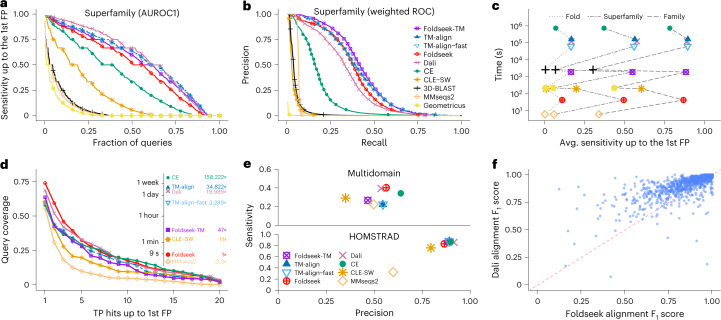
- On SCOPe40 all-versus-all searches, Foldseek is more than 4,000 times faster than TM-align and Dali and over 21,000 times faster than CE; on AlphaFoldDB (version 1), it is around 184,600 and 23,000 times faster than Dali and TM-align, respectively.
- In precision-recall analysis, Foldseek-TM and Foldseek have the highest and third-highest area under the precision-recall curve on family, superfamily and fold levels; Foldseek-TM improves over TM-align because its prefilter suppresses high-scoring false positives.
- For SARS-CoV-2 RdRp (PDB: 6M71, chain A; 942 residues) searched in AlphaFoldDB (version 1), search times were 10 d for Dali, 33 h for TM-align and 6 s for Foldseek, making it 180,000 and 23,000 times faster; all top 10 hits were known RdRp homologs.
Methods
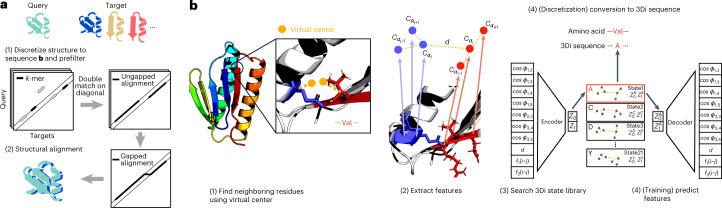
- Foldseek discretizes structures into 3Di sequences describing each residue’s geometric conformation with its spatially closest residue, then uses MMseqs2’s double-diagonal k-mer and gapless alignment prefilters followed by SIMD-accelerated Smith–Waterman local alignment combining 3Di and amino acid substitution scores; an optional global TM-align mode is also provided.
- Benchmarks include SCOPe40 (11,211 non-redundant single-domain structures) all-versus-all, AlphaFoldDB (version 1) clustered to 34,270 structures with 100 randomly selected queries for reference-free multi-domain tests, and HOMSTRAD (1,032 protein families); runtime evaluations used an AMD EPYC 7702P 64-core CPU.
- Sensitivity was measured as the fraction of true positives before the first false positive, with AUROC/ROC1 and precision-recall analyses; multi-domain benchmarks used LDDT thresholds of at least 0.6 for true positives and below 0.25 for false positives, ignoring matches in between.
Limitations
- The paper states that the SCOPe benchmark uses only single-domain proteins as queries and targets, so it cannot assess local similarities such as homologous domains shared between multi-domain proteins; the HOMSTRAD alignment benchmark has the same limitation, as most HOMSTRAD proteins are single-domain (median length 182 residues).
- The paper states that the reference-free multi-domain benchmark requires choosing thresholds for true and false positives.
- The text makes evident that the 3Di alphabet and substitution matrix were trained and cross-validated on SCOPe40, and that methods likely overfitted on SCOPe due to data leakage were excluded from benchmark comparison; the paper reports no overfitting despite training 492 parameters.
Model-written summary. Check it against the paper before relying on it.
Integrity signals
Registry
Cites
Statistics
Figures
Verification
Claims the paper makes
26 Own result · 18 Not checked yet · 13 Own interpretation · 8 No basis given · 2 Own method
A result the paper reports from its own data — it cites no other source for it, so there is none to check. The quote shows it is in the paper.
In the paper
“We inspected the 1,675 (of 133,813) high-scoring FPs (score per aligned column ≥ 1.0, TM-score < 0.5), revealing queries with multiple structured segments but with incorrect relative orientations (Supplementary Table 3 and Supplementary Fig. 9).”
§ Fast and accurate protein structure search with Foldseek > Main
plain- Asserted: passes — The authors put it forward as true.
- Checkable: passes — It can be checked against evidence.
- Load-bearing: passes — The paper’s conclusions depend on it.
- Based: passes — The paper gives a reason why it holds.
In the paper
“In the reference-based HOMSTRAD alignment quality benchmark24, Foldseek performs slightly below CE, Dali and TM-align (Fig. 2e).”
§ Fast and accurate protein structure search with Foldseek > Main
What the sources say
- Not checked yetcites [24] Mizuguchi, K., Deane, C. M., Blundell, T. L. & Overington, J. P. HOMSTRAD: a database of protein structure alignments for homologous families. Protein Sci. 7, 2469–2471 (1998). source
plain- Asserted: passes — The authors put it forward as true.
- Checkable: passes — It can be checked against evidence.
- Load-bearing: unclear — It is unclear whether the paper’s conclusions depend on it.
- Based: passes — The paper gives a reason why it holds.
A result the paper reports from its own data — it cites no other source for it, so there is none to check. The quote shows it is in the paper.
In the paper
“(1) Weaker dependency between consecutive letters and (2) more evenly distributed state frequencies, both enhancing information density and reducing false positives (FPs) (Supplementary Table 1).”
§ Fast and accurate protein structure search with Foldseek > Main
plaincorrelational- Asserted: passes — The authors put it forward as true.
- Checkable: passes — It can be checked against evidence.
- Load-bearing: passes — The paper’s conclusions depend on it.
- Based: passes — The paper gives a reason why it holds.
A result the paper reports from its own data — it cites no other source for it, so there is none to check. The quote shows it is in the paper.
In the paper
“Foldseek’s performance is similar across all six secondary structure classes in SCOPe (Supplementary Fig. 5).”
§ Fast and accurate protein structure search with Foldseek > Main
plain- Asserted: passes — The authors put it forward as true.
- Checkable: passes — It can be checked against evidence.
- Load-bearing: unclear — It is unclear whether the paper’s conclusions depend on it.
- Based: passes — The paper gives a reason why it holds.
A result the paper reports from its own data — it cites no other source for it, so there is none to check. The quote shows it is in the paper.
In the paper
“(1) Weaker dependency between consecutive letters and (2) more evenly distributed state frequencies, both enhancing information density and reducing false positives (FPs) (Supplementary Table 1).”
§ Fast and accurate protein structure search with Foldseek > Main
plaincorrelational- Asserted: passes — The authors put it forward as true.
- Checkable: passes — It can be checked against evidence.
- Load-bearing: passes — The paper’s conclusions depend on it.
- Based: passes — The paper gives a reason why it holds.
A result the paper reports from its own data — it cites no other source for it, so there is none to check. The quote shows it is in the paper.
In the paper
“The folded segments were correctly aligned by Foldseek.”
§ Fast and accurate protein structure search with Foldseek > Main
plaindirect- Asserted: passes — The authors put it forward as true.
- Checkable: passes — It can be checked against evidence.
- Load-bearing: passes — The paper’s conclusions depend on it.
- Based: passes — The paper gives a reason why it holds.
A result the paper reports from its own data — it cites no other source for it, so there is none to check. The quote shows it is in the paper.
In the paper
“We noticed that the 3D-BLAST matrix with Smith–Waterman resulted in a similar performance to CLE: 0.717, 0.230 and 0.011 for family classification, superfamily classification and fold classification, respectively.”
§ Fast and accurate protein structure search with Foldseek > Methods > 3D-BLAST
plain- Asserted: passes — The authors put it forward as true.
- Checkable: passes — It can be checked against evidence.
- Load-bearing: unclear — It is unclear whether the paper’s conclusions depend on it.
- Based: passes — The paper gives a reason why it holds.
A result the paper reports from its own data — it cites no other source for it, so there is none to check. The quote shows it is in the paper.
In the paper
“All top 10 hits were known RdRp homologs (Supplementary Table 4).”
§ Fast and accurate protein structure search with Foldseek > Main
plainSingle case- Asserted: passes — The authors put it forward as true.
- Checkable: passes — It can be checked against evidence.
- Load-bearing: passes — The paper’s conclusions depend on it.
- Based: passes — The paper gives a reason why it holds.
A result the paper reports from its own data — it cites no other source for it, so there is none to check. The quote shows it is in the paper.
In the paper
“No overfitting was observed, despite training 492 parameters (282 neural network and 210 substitution matrix entries).”
§ Fast and accurate protein structure search with Foldseek > Methods > 3Di alphabet cross-validation
plain- Asserted: passes — The authors put it forward as true.
- Checkable: passes — It can be checked against evidence.
- Load-bearing: unclear — It is unclear whether the paper’s conclusions depend on it.
- Based: passes — The paper gives a reason why it holds.
A result the paper reports from its own data — it cites no other source for it, so there is none to check. The quote shows it is in the paper.
In the paper
“Dali, CE and CLE-Smith–Waterman failed to produce an alignment for 35, 1 and 1 out of 1,032 pairs, respectively, which were rated with a sensitivity of 0.”
§ Fast and accurate protein structure search with Foldseek > Methods > HOMSTRAD alignment benchmark
plain- Asserted: passes — The authors put it forward as true.
- Checkable: passes — It can be checked against evidence.
- Load-bearing: unclear — It is unclear whether the paper’s conclusions depend on it.
- Based: passes — The paper gives a reason why it holds.
- It may state two separate claims as one. 22
- Probably not a substantial claim. 17
The paper states this without a source or data behind it here, so there is nothing to check it against. The quote shows it is in the paper.
In the paper
“Foldseek decreases computation times by four to five orders of magnitude with 86%, 88% and 133% of the sensitivities of Dali, TM-align and CE, respectively.”
§ Fast and accurate protein structure search with Foldseek > Abstract
plaindirect- Asserted: passes — The authors put it forward as true.
- Checkable: passes — It can be checked against evidence.
- Load-bearing: passes — The paper’s conclusions depend on it.
- Based: passes — The paper gives a reason why it holds.
It may state two separate claims as one.
A result the paper reports from its own data — it cites no other source for it, so there is none to check. The quote shows it is in the paper.
In the paper
“On this small SCOPe40 benchmark set, Foldseek is more than 4,000 times faster than TM-align and Dali and over 21,000 times faster than CE (Fig. 2c).”
§ Fast and accurate protein structure search with Foldseek > Main
plain- Asserted: passes — The authors put it forward as true.
- Checkable: passes — It can be checked against evidence.
- Load-bearing: passes — The paper’s conclusions depend on it.
- Based: passes — The paper gives a reason why it holds.
It may state two separate claims as one.
A result the paper reports from its own data — it cites no other source for it, so there is none to check. The quote shows it is in the paper.
In the paper
“Foldseek alignments are more accurate and sensitive than MMseqs2, CLE-SW and TM-align, similarly accurate as Dali and 13% less precise but 15% more sensitive than CE.”
§ Fast and accurate protein structure search with Foldseek > Main
plain- Asserted: passes — The authors put it forward as true.
- Checkable: passes — It can be checked against evidence.
- Load-bearing: passes — The paper’s conclusions depend on it.
- Based: passes — The paper gives a reason why it holds.
It may state two separate claims as one.
A result the paper reports from its own data — it cites no other source for it, so there is none to check. The quote shows it is in the paper.
In the paper
“On the much larger AlphaFoldDB (version 1), where Foldseek approaches its full speed, it is around 184,600 and 23,000 times faster than Dali and TM-align, respectively (see below).”
§ Fast and accurate protein structure search with Foldseek > Main
plain- Asserted: passes — The authors put it forward as true.
- Checkable: passes — It can be checked against evidence.
- Load-bearing: passes — The paper’s conclusions depend on it.
- Based: passes — The paper gives a reason why it holds.
It may state two separate claims as one.
A result the paper reports from its own data — it cites no other source for it, so there is none to check. The quote shows it is in the paper.
In the paper
“Again, Foldseek has similar sensitivity as Dali, CE and TM-align and much higher sensitivity than CLE-SW and MMseqs2.”
§ Fast and accurate protein structure search with Foldseek > Main
plain- Asserted: passes — The authors put it forward as true.
- Checkable: passes — It can be checked against evidence.
- Load-bearing: passes — The paper’s conclusions depend on it.
- Based: passes — The paper gives a reason why it holds.
It may state two separate claims as one.
A result the paper reports from its own data — it cites no other source for it, so there is none to check. The quote shows it is in the paper.
In the paper
“In a precision-recall analysis, Foldseek-TM and Foldseek have the highest and third-highest area under the precision-recall curve on each of the three levels (Fig. 2b and Supplementary Fig. 4).”
§ Fast and accurate protein structure search with Foldseek > Main
plaincorrelational- Asserted: passes — The authors put it forward as true.
- Checkable: passes — It can be checked against evidence.
- Load-bearing: passes — The paper’s conclusions depend on it.
- Based: passes — The paper gives a reason why it holds.
It may state two separate claims as one.
A result the paper reports from its own data — it cites no other source for it, so there is none to check. The quote shows it is in the paper.
In the paper
“Foldseek’s sensitivity is below Dali and TM-align, higher than the structural aligner CE and much above the structural alphabet-based search tools 3D-BLAST and CLE-SW (Fig. 2a).”
§ Fast and accurate protein structure search with Foldseek > Main
plain- Asserted: passes — The authors put it forward as true.
- Checkable: passes — It can be checked against evidence.
- Load-bearing: passes — The paper’s conclusions depend on it.
- Based: passes — The paper gives a reason why it holds.
It may state two separate claims as one.
The paper states this without a source or data behind it here, so there is nothing to check it against. The quote shows it is in the paper.
In the paper
“(3) The highest information density is encoded in conserved protein cores and the lowest in non-conserved coil/loop regions, whereas the opposite is true for backbone structural alphabets.”
§ Fast and accurate protein structure search with Foldseek > Main
plaincorrelational- Asserted: passes — The authors put it forward as true.
- Checkable: passes — It can be checked against evidence.
- Load-bearing: passes — The paper’s conclusions depend on it.
- Based: unclear — It is unclear why the paper says it holds.
It may state two separate claims as one.
A result the paper reports from its own data — it cites no other source for it, so there is none to check. The quote shows it is in the paper.
In the paper
“The conversion to DAT format produced 11,137 valid structures out of the 11,211 initial structures for the SCOPe benchmark and 34,252 structures out of 34,270 SPICi clusters.”
§ Fast and accurate protein structure search with Foldseek > Methods > Dali
plaindirect- Asserted: passes — The authors put it forward as true.
- Checkable: passes — It can be checked against evidence.
- Load-bearing: fails — The paper’s conclusions may not depend on it.
- Based: passes — The paper gives a reason why it holds.
Probably not a substantial claim. The paper’s conclusions may not depend on it. It may state two separate claims as one.
A result the paper reports from its own data — it cites no other source for it, so there is none to check. The quote shows it is in the paper.
In the paper
“We excluded 3D-BLAST’s measurement from the multi-domain benchmark because it produced occasionally high scores (>107) for single residue alignments.”
§ Fast and accurate protein structure search with Foldseek > Methods > 3D-BLAST
plaindirect- Asserted: passes — The authors put it forward as true.
- Checkable: passes — It can be checked against evidence.
- Load-bearing: unclear — It is unclear whether the paper’s conclusions depend on it.
- Based: passes — The paper gives a reason why it holds.
It may state two separate claims as one.
The paper states this without a source or data behind it here, so there is nothing to check it against. The quote shows it is in the paper.
In the paper
“Currently, we include the four variants of the AlphaFoldDB (version 4): UniProt (214 million structures), UniProt50, a clustered database to 50% sequence identity and 90% bi-directional coverage using MMseqs2 (parameters -c 0.9 --min-seq-id 0.5 --cluster-reassign; 54 million structures), Proteome (564,000 structures) and Swiss-Prot (542,000 structures).”
§ Fast and accurate protein structure search with Foldseek > Methods > Pre-built and ready-to-download databases
plain- Asserted: passes — The authors put it forward as true.
- Checkable: passes — It can be checked against evidence.
- Load-bearing: fails — The paper’s conclusions may not depend on it.
- Based: passes — The paper gives a reason why it holds.
Probably not a substantial claim. The paper’s conclusions may not depend on it. It may state two separate claims as one.
The paper states this without a source or data behind it here, so there is nothing to check it against. The quote shows it is in the paper.
In the paper
“During batch searches, Foldseek adapts its memory use to the available RAM of the machine.”
§ Fast and accurate protein structure search with Foldseek > Methods > Webserver
plaindirect- Asserted: passes — The authors put it forward as true.
- Checkable: passes — It can be checked against evidence.
- Load-bearing: fails — The paper’s conclusions may not depend on it.
- Based: passes — The paper gives a reason why it holds.
Probably not a substantial claim. The paper’s conclusions may not depend on it.
A result the paper reports from its own data — it cites no other source for it, so there is none to check. The quote shows it is in the paper.
In the paper
“For example, Foldseek finds around the same number of FPs and TPs with a score of 51 in SCOPe40. The probability for a hit with score 51 is, therefore, 50%.”
§ Fast and accurate protein structure search with Foldseek > Methods > Probability of TP match
hedgedcorrelational- Asserted: passes — The authors put it forward as true.
- Checkable: passes — It can be checked against evidence.
- Load-bearing: unclear — It is unclear whether the paper’s conclusions depend on it.
- Based: passes — The paper gives a reason why it holds.
It may state two separate claims as one.
A result the paper reports from its own data — it cites no other source for it, so there is none to check. The quote shows it is in the paper.
In the paper
“We downloaded the latest HOMSTRAD version (https://mizuguchilab.org/homstrad/data/homstrad_with_PDB_2022_Aug_1.tar.gz) and picked the pairwise alignments between the first and last members of each family, which resulted in structures of a median length of 182 residues.”
§ Fast and accurate protein structure search with Foldseek > Methods > HOMSTRAD alignment benchmark
plain- Asserted: passes — The authors put it forward as true.
- Checkable: passes — It can be checked against evidence.
- Load-bearing: fails — The paper’s conclusions may not depend on it.
- Based: passes — The paper gives a reason why it holds.
Probably not a substantial claim. The paper’s conclusions may not depend on it.
A result the paper reports from its own data — it cites no other source for it, so there is none to check. The quote shows it is in the paper.
In the paper
“Search times were 10 d for Dali, 33 h for TM-align and 6 s for Foldseek, making it 180,000 and 23,000 times faster.”
§ Fast and accurate protein structure search with Foldseek > Main
plaindirectSingle case- Asserted: passes — The authors put it forward as true.
- Checkable: passes — It can be checked against evidence.
- Load-bearing: passes — The paper’s conclusions depend on it.
- Based: passes — The paper gives a reason why it holds.
It may state two separate claims as one.
The paper states this without a source or data behind it here, so there is nothing to check it against. The quote shows it is in the paper.
In the paper
“The 3Di alphabet developed for Foldseek describes tertiary residue–residue interactions instead of backbone conformations and proved critical for reaching high sensitivities.”
§ Fast and accurate protein structure search with Foldseek > Methods > Overview
plaindirect- Asserted: passes — The authors put it forward as true.
- Checkable: passes — It can be checked against evidence.
- Load-bearing: passes — The paper’s conclusions depend on it.
- Based: unclear — It is unclear why the paper says it holds.
It may state two separate claims as one.
A result the paper reports from its own data — it cites no other source for it, so there is none to check. The quote shows it is in the paper.
In the paper
“For the multi-domain benchmark, we excluded one query that was running over 16 d.”
§ Fast and accurate protein structure search with Foldseek > Methods > CE
plainSingle case- Asserted: passes — The authors put it forward as true.
- Checkable: passes — It can be checked against evidence.
- Load-bearing: fails — The paper’s conclusions may not depend on it.
- Based: passes — The paper gives a reason why it holds.
Probably not a substantial claim. The paper’s conclusions may not depend on it.
A result the paper reports from its own data — it cites no other source for it, so there is none to check. The quote shows it is in the paper.
In the paper
“The SCOPe benchmark set consists of single domains with an average length of 174 residues.”
§ Fast and accurate protein structure search with Foldseek > Methods > SCOPe benchmark
plain- Asserted: passes — The authors put it forward as true.
- Checkable: passes — It can be checked against evidence.
- Load-bearing: fails — The paper’s conclusions may not depend on it.
- Based: passes — The paper gives a reason why it holds.
Probably not a substantial claim. The paper’s conclusions may not depend on it.
The paper states this without a source or data behind it here, so there is nothing to check it against. The quote shows it is in the paper.
In the paper
“The AlpaFoldDB/UniProt50 (version 4), AlphaFoldDB/Proteome (version 4), AlphaFoldDB/Swiss-Prot (version 4), CATH50, ESM Atlas High-Quality Clu30 and PDB100 require 191 GB, 3.8 GB, 3.4 GB, 1.4 GB, 110 GB and 2.0 GB RAM, respectively.”
§ Fast and accurate protein structure search with Foldseek > Methods > Webserver
plain- Asserted: passes — The authors put it forward as true.
- Checkable: passes — It can be checked against evidence.
- Load-bearing: fails — The paper’s conclusions may not depend on it.
- Based: passes — The paper gives a reason why it holds.
Probably not a substantial claim. The paper’s conclusions may not depend on it. It may state two separate claims as one.
A result the paper reports from its own data — it cites no other source for it, so there is none to check. The quote shows it is in the paper.
In the paper
“Our NW implementation does not compute exactly the same alignment because we apply affine gap costs, whereas TM-align does not (Supplementary Fig. 12).”
§ Fast and accurate protein structure search with Foldseek > Methods > Pairwise global structural alignments using TM-align
plaindirect- Asserted: passes — The authors put it forward as true.
- Checkable: passes — It can be checked against evidence.
- Load-bearing: fails — The paper’s conclusions may not depend on it.
- Based: passes — The paper gives a reason why it holds.
Probably not a substantial claim. The paper’s conclusions may not depend on it.
The paper states this without a source or data behind it here, so there is nothing to check it against. The quote shows it is in the paper.
In the paper
“By not restricting itself to exact matches, the prefilter achieves high sensitivity while reducing the number of sequences for which full alignments are computed by several orders of magnitude.”
§ Fast and accurate protein structure search with Foldseek > Methods > Overview
plaindirect- Asserted: passes — The authors put it forward as true.
- Checkable: passes — It can be checked against evidence.
- Load-bearing: passes — The paper’s conclusions depend on it.
- Based: passes — The paper gives a reason why it holds.
It may state two separate claims as one.
A result the paper reports from its own data — it cites no other source for it, so there is none to check. The quote shows it is in the paper.
In the paper
“SPICi produced 34,270 clusters from the search result.”
§ Fast and accurate protein structure search with Foldseek > Methods > Reference-free multi-domain benchmarks
plaindirect- Asserted: passes — The authors put it forward as true.
- Checkable: passes — It can be checked against evidence.
- Load-bearing: fails — The paper’s conclusions may not depend on it.
- Based: passes — The paper gives a reason why it holds.
Probably not a substantial claim. The paper’s conclusions may not depend on it.
In the paper
“The European Bioinformatics Institute already holds over 214 million structures predicted by AlphaFold2 (ref. 3)”
§ Fast and accurate protein structure search with Foldseek > Main
What the sources say
- Not checked yetcites [3] Varadi, M. et al. AlphaFold Protein Structure Database: massively expanding the structural coverage of protein–sequence space with high-accuracy models. Nucleic Acids Res. 50, D439–D444 (2022). source
plain- Asserted: passes — The authors put it forward as true.
- Checkable: passes — It can be checked against evidence.
- Load-bearing: passes — The paper’s conclusions depend on it.
- Based: passes — The paper gives a reason why it holds.
Probably not a substantial claim.
In the paper
“Sequence searching is four to five orders of magnitude faster: an all-versus-all comparison of 100 million sequences would take MMseqs2 (ref. 6) only around a week on the same cluster.”
§ Fast and accurate protein structure search with Foldseek > Main
What the sources say
- Not checked yetcites [6] Steinegger, M. & Söding, J. MMseqs2 enables sensitive protein sequence searching for the analysis of massive data sets. Nat. Biotechnol. 35, 1026–1028 (2017). source
plaindirect- Asserted: passes — The authors put it forward as true.
- Checkable: passes — It can be checked against evidence.
- Load-bearing: passes — The paper’s conclusions depend on it.
- Based: passes — The paper gives a reason why it holds.
It may state two separate claims as one.
In the paper
“Searching with a single query structure through a database with 100 million protein structures would take the popular TM-align11 tool a month on one CPU core, and an all-versus-all comparison would take 10 millennia on a 1,000-core cluster.”
§ Fast and accurate protein structure search with Foldseek > Main
What the sources say
- Not checked yetcites [11] Zhang, Y. & Skolnick, J. TM-align: a protein structure alignment algorithm based on the TM-score. Nucleic Acids Res. 33, 2302–2309 (2005). source
hedgeddirect- Asserted: passes — The authors put it forward as true.
- Checkable: passes — It can be checked against evidence.
- Load-bearing: passes — The paper’s conclusions depend on it.
- Based: passes — The paper gives a reason why it holds.
It may state two separate claims as one.
In the paper
“the ESM Atlas contains over 617 million metagenomic structures predicted by ESMFold4.”
§ Fast and accurate protein structure search with Foldseek > Main
What the sources say
- Not checked yetcites [4] Lin, Z. et al. Evolutionary-scale prediction of atomic-level protein structure with a language model. Science 379, 1123–1130 (2023). source
plain- Asserted: passes — The authors put it forward as true.
- Checkable: passes — It can be checked against evidence.
- Load-bearing: fails — The paper’s conclusions may not depend on it.
- Based: passes — The paper gives a reason why it holds.
Probably not a substantial claim. The paper’s conclusions may not depend on it.
A conclusion the paper draws from its own results — it cites no other source for it, so there is none to check. The quote shows it is in the paper.
In the paper
“(1) Weaker dependency between consecutive letters and (2) more evenly distributed state frequencies, both enhancing information density and reducing false positives (FPs) (Supplementary Table 1).”
§ Fast and accurate protein structure search with Foldseek > Main
plaindirect- Asserted: passes — The authors put it forward as true.
- Checkable: passes — It can be checked against evidence.
- Load-bearing: passes — The paper’s conclusions depend on it.
- Based: passes — The paper gives a reason why it holds.
It may state two separate claims as one.
None of the sources cited for this claim have been checked yet.
In the paper
“Most, such as CLE, 3D-BLAST and Protein Blocks, discretize the conformations of short stretches of usually 3–5 Cα atoms17–19.”
§ Fast and accurate protein structure search with Foldseek > Main
What the sources say
- Not checked yetcites [17] Wang, S. & Zheng, W.-M. CLePAPS: fast pair alignment of protein structures based on conformational letters. J. Bioinform. Comput. Biol. 6, 347–366 (2008). source
- Not checked yetcites [18] Yang, J.-M. & Tung, C.-H. Protein structure database search and evolutionary classification. Nucleic Acids Res. 34, 3646–3659 (2006). source
- Not checked yetcites [19] de Brevern, A. G., Etchebest, C. & Hazout, S. Bayesian probabilistic approach for predicting backbone structures in terms of protein blocks. Proteins 41, 271–287 (2000). source
plain- Asserted: passes — The authors put it forward as true.
- Checkable: passes — It can be checked against evidence.
- Load-bearing: fails — The paper’s conclusions may not depend on it.
- Based: passes — The paper gives a reason why it holds.
Probably not a substantial claim. The paper’s conclusions may not depend on it.
A conclusion the paper draws from its own results — it cites no other source for it, so there is none to check. The quote shows it is in the paper.
In the paper
“Databases are only required to remain resident in RAM if Foldseek is used as a webserver.”
§ Fast and accurate protein structure search with Foldseek > Methods > Webserver
plainconditional- Asserted: passes — The authors put it forward as true.
- Checkable: passes — It can be checked against evidence.
- Load-bearing: fails — The paper’s conclusions may not depend on it.
- Based: passes — The paper gives a reason why it holds.
Probably not a substantial claim. The paper’s conclusions may not depend on it.
In the paper
“This illustrates that 3D aligners such as TM-align may overlook homologous structures that are not globally superposable, whereas Foldseek (as well as the two-dimensional (2D) aligner Dali) is independent of relative domain orientations and excels at detecting homologous multi-domain structures12.”
§ Fast and accurate protein structure search with Foldseek > Main
What the sources say
- Not checked yetcites [12] Hasegawa, H. & Holm, L. Advances and pitfalls of protein structural alignment. Curr. Opin. Struct. Biol. 19, 341–348 (2009). source
hedgedconditional- Asserted: passes — The authors put it forward as true.
- Checkable: passes — It can be checked against evidence.
- Load-bearing: passes — The paper’s conclusions depend on it.
- Based: passes — The paper gives a reason why it holds.
It may state two separate claims as one.
A conclusion the paper draws from its own results — it cites no other source for it, so there is none to check. The quote shows it is in the paper.
In the paper
“A drawback of our reference-free multi-domain benchmark is the need to choose thresholds for TPs and FPs (Supplementary Fig. 6).”
§ Fast and accurate protein structure search with Foldseek > Methods > Limitations of benchmarks
plaindirect- Asserted: passes — The authors put it forward as true.
- Checkable: passes — It can be checked against evidence.
- Load-bearing: fails — The paper’s conclusions may not depend on it.
- Based: passes — The paper gives a reason why it holds.
Probably not a substantial claim. The paper’s conclusions may not depend on it.
In the paper
“We included Geometricus20 in the SCOPe benchmark as a representative of alignment-free tools, which are fast but can find only globally similar structures.”
§ Fast and accurate protein structure search with Foldseek > Methods > Geometricus
What the sources say
- Not checked yetcites [20] Durairaj, J., Akdel, M., de Ridder, D. & van Dijk, A. D. J. Geometricus represents protein structures as shape-mers derived from moment invariants. Bioinformatics 36, i718–i725 (2020). source
plaindirect- Asserted: passes — The authors put it forward as true.
- Checkable: passes — It can be checked against evidence.
- Load-bearing: unclear — It is unclear whether the paper’s conclusions depend on it.
- Based: passes — The paper gives a reason why it holds.
It may state two separate claims as one.
A conclusion the paper draws from its own results — it cites no other source for it, so there is none to check. The quote shows it is in the paper.
In the paper
“This virtual center preferably selects long-range, tertiary interactions and only falls back to selecting interactions to i + 1 or i − 1 when no other residues are nearby.”
§ Fast and accurate protein structure search with Foldseek > Methods > Nearest-neighbor selection
plaindirect- Asserted: passes — The authors put it forward as true.
- Checkable: passes — It can be checked against evidence.
- Load-bearing: passes — The paper’s conclusions depend on it.
- Based: passes — The paper gives a reason why it holds.
It may state two separate claims as one.
A conclusion the paper draws from its own results — it cites no other source for it, so there is none to check. The quote shows it is in the paper.
In the paper
“We measure the sensitivity up to the 1st FP (ROC1) instead, for example, up to the 5th FP, because ROC1 better reflects the requirements for low false discovery rates in automatic searches.”
§ Fast and accurate protein structure search with Foldseek > Methods > Evaluation SCOPe benchmark
plaindirect- Asserted: passes — The authors put it forward as true.
- Checkable: passes — It can be checked against evidence.
- Load-bearing: passes — The paper’s conclusions depend on it.
- Based: fails — The paper may give no reason why it holds.
Probably not a substantial claim. The paper may give no reason why it holds.
In the paper
“All counts (TP, FP and FN) were weighted by the reciprocal of their family, superfamily or fold size. In this way, folds, superfamilies and families contribute linearly with their size instead of quadratically36.”
§ Fast and accurate protein structure search with Foldseek > Methods > Evaluation SCOPe benchmark
What the sources say
- Not checked yetcites [36] Eddy, S. R. Accelerated profile HMM searches. PLoS Comput. Biol. 7, e1002195 (2011). source
plaindirect- Asserted: passes — The authors put it forward as true.
- Checkable: passes — It can be checked against evidence.
- Load-bearing: fails — The paper’s conclusions may not depend on it.
- Based: passes — The paper gives a reason why it holds.
Probably not a substantial claim. The paper’s conclusions may not depend on it.
In the paper
“The Foldseek webserver is based on the MMseqs2 webserver43.”
§ Fast and accurate protein structure search with Foldseek > Methods > Webserver
What the sources say
- Not checked yetcites [43] Mirdita, M., Steinegger, M. & Söding, J. MMseqs2 desktop and local web server app for fast, interactive sequence searches. Bioinformatics 35, 2856–2858 (2019). source
plaindirect- Asserted: passes — The authors put it forward as true.
- Checkable: passes — It can be checked against evidence.
- Load-bearing: fails — The paper’s conclusions may not depend on it.
- Based: passes — The paper gives a reason why it holds.
Probably not a substantial claim. The paper’s conclusions may not depend on it.
The paper relies on this without support.
The SCOPe40 dataset is a suitable benchmark for evaluating protein structure search sensitivity.
“The SCOPe benchmark set consists of single domains with an average length of 174 residues.”
The paper relies on this without support.
The HOMSTRAD pairwise alignments are accurate reference alignments for measuring alignment quality.
“With the HOMSTRAD alignments as reference, we measured for each pairwise alignment the sensitivity (fraction of residue pairs of the HOMSTRAD alignment that were correctly aligned) and the precision (fraction of correctly aligned residue pairs in the predicted alignment).”
The paper relies on this without support.
The ESM Atlas API can accurately predict structures of user-supplied sequences up to 400 residues.
“We use the ESM Atlas API to predict structures of user-supplied sequences that are, at most, 400 residues long.”
The paper relies on this without support.
The virtual center parameters optimized on SCOPe generalize to other datasets.
“The virtual center defined by θ = 270∘, τ = 0∘ and l = 2 performed best in the SCOPe benchmark.”
Claims other papers make about this one
Each is checked against this paper’s own text: does it say what the citing paper says it does?
In the citing paper
“Foldseek can increase the speed of comparisons of structures by four to five orders of magnitudes relative to previous approaches while maintaining sensitivity15”
From Clustering predicted structures at the scale of the known protein universe (2023) · cites this paper as [15]
Self-check
Percentages, sums and reported differences re-computed from the paper’s own numbers.
Each contradiction between two passages listed here was confirmed by an independent check.
Rated minor: it would not touch a result — a value no result rests on, a p-value that stays on the same side of the significance level, or a conflict that is clerical, resolved elsewhere in the paper, or outside its own findings.
In the paper
§ Fast and accurate protein structure search with Foldseek > Methods > Probability of TP match
“Here, hits within the same superfamily are TP;”
§ Fast and accurate protein structure search with Foldseek > Methods > Probability of TP match
“hits to the same family or to another superfamily are ignored.”
Rated minor: it would not touch a result — a value no result rests on, a p-value that stays on the same side of the significance level, or a conflict that is clerical, resolved elsewhere in the paper, or outside its own findings.
In the paper
§ Fast and accurate protein structure search with Foldseek > Main
“E values are calculated using an extreme-value score distribution, with parameters predicted by a neural network based on 3Di sequence composition and query length”
§ Fast and accurate protein structure search with Foldseek > Methods > E values
“We trained a neural network to predict μ and λ from the amino acid composition of the query and its length (so a scrambled version of the query sequence would produce the same μ and λ).”
Citations
Cites
Basic local alignment search tool
Altschul, S. F., Gish, W., Miller, W., Myers, E. W., & Lipman, D. J. (1990) · Journal of Molecular Biology · doi:10.1006/jmbi.1990.9999 · Cited by 98,669
Highly accurate protein structure prediction with AlphaFold
Jumper, J., Evans, R., Pritzel, A., Green, T., Figurnov, M., Ronneberger, O., Tunyasuvunakool, K., Bates, R., Žídek, A., Potapenko, A., et al. (2021) · Nature · doi:10.1038/s41586-021-03819-2 · Cited by 43,764
Self-citationVaradi, M., Anyango, S., Deshpande, M., Nair, S., Natassia, C., Yordanova, G., Yuan, D., Stroe, O., Wood, G., Laydon, A., et al. (2022) · Nucleic Acids Research · doi:10.1093/nar/gkab1061 · Cited by 7,850
Accelerated Profile HMM Searches
Eddy, S. R. (2011) · PLoS Computational Biology · doi:10.1371/journal.pcbi.1002195 · Cited by 6,975
Evolutionary-scale prediction of atomic level protein structure with a language model
Lin, Z., Akin, H., Rao, R., Hie, B., Zhu, Z., Lu, W., Smetanin, N., Verkuil, R., Kabeli, O., Shmueli, Y., et al. (2022) · doi:10.1101/2022.07.20.500902 · Cited by 5,990
Accurate prediction of protein structures and interactions using a 3-track network
Baek, M., DiMaio, F., Anishchenko, I., Dauparas, J., Ovchinnikov, S., Lee, G. R., Wang, J., Cong, Q., Kinch, L. N., Schaeffer, R. D., et al. (2021) · doi:10.1101/2021.06.14.448402 · Cited by 5,549
Sensitive protein alignments at tree-of-life scale using DIAMOND
Buchfink, B., Reuter, K., & Drost, H.-G. (2021) · Nature Methods · doi:10.1038/s41592-021-01101-x · Cited by 5,097
MMseqs2 enables sensitive protein sequence searching for the analysis of massive data sets
Steinegger, M., & Söding, J. (2017) · Nature Biotechnology · doi:10.1038/nbt.3988 · Cited by 4,840
Self-citationTM-align: a protein structure alignment algorithm based on the TM-score
Zhang, Y. (2005) · Nucleic Acids Research · doi:10.1093/nar/gki524 · Cited by 3,774
Protein structure alignment by incremental combinatorial extension (CE) of the optimal path.
Shindyalov, I., & Bourne, P. (1998) · Protein Engineering · doi:10.1093/protein/11.9.739 · Cited by 2,199
Research works printed but not linked: 1
- Van den Oord, A., Vinyals, O. & Kavukcuoglu, K. Neural discrete representation learning. Proc. of the 31st Conference on Neural Information Processing Systems. https://proceedings.neurips.cc/paper_files/paper/2017/file/7a98af17e63a0ac09ce2e96d03992fbc-Paper.pdf (NIPS, 2017).
Cited by
Sorted by citations
Items 401–500 of 1,015
The protein structurome of Orthornavirae and its dark matter
Mutz, P., Camargo, A. P., Sahakyan, H., Neri, U., Butković, A., Wolf, Y. I., Krupovìč, M., Dolja, V. V., & Koonin, E. V. (2024) · mBio · doi:10.1128/mbio.03200-24 · Cited by 18
ProtSpace: A Tool for Visualizing Protein Space
Senoner, T., Olenyi, T., Heinzinger, M., Spannagl, A., Bouras, G. S., Rost, B., & Koludarov, I. (2025) · Journal of Molecular Biology · doi:10.1016/j.jmb.2025.168940 · Cited by 17
Phytopathogen Effector Biology in the Burgeoning AI Era
Jones, D., & Raffaele, S. (2025) · Annual Review of Phytopathology · doi:10.1146/annurev-phyto-121823-081033 · Cited by 17
Tan, Y., Wang, R.-L., Wu, B., Hong, L., & Zhou, B. (2025) · Bioinform. · doi:10.1093/bioinformatics/btaf189 · Cited by 25
Training bias and sequence alignments shape protein–peptide docking by AlphaFold and related methods
Guan, L., & Keating, A. E. (2025) · Protein Science · doi:10.1002/pro.70331 · Cited by 18
Phenogenomics reveals the ecology and evolution of Trichoderma fungi for sustainable agriculture
Steindorff, A. S., Cai, F. M., Ding, M., Jiang, S., Atanasova, L., Baker, S., Barbosa-Filho, J. R., Akçapınar, G. B., Brown, D. W., Chaverri, P., et al. (2026) · Nature Microbiology · doi:10.1038/s41564-026-02260-3 · Cited by 17
How artificial intelligence is reengineering protein engineering
Listgarten, J., & Jiang, H. (2026) · Science · doi:10.1126/science.aec8444 · Cited by 20
Ki, N., Kim, J., Jo, I., Hyun, Y., Ryu, S., & Ha, N. (2022) · Journal of Biological Chemistry · doi:10.1016/j.jbc.2022.102562 · Cited by 17
Liu, D., & Steinegger, M. (2023) · Bioinformatics · doi:10.1093/bioinformatics/btad487 · Cited by 17
Self-citationJohnson, S. R., Peshwa, M., & Sun, Z. (2024) · eLife · doi:10.7554/elife.91415 · Cited by 17
Novel Secreted Effectors Conserved Among Smut Fungi Contribute to the Virulence of Ustilago maydis
Schuster, M., Schweizer, G., Reißmann, S., Happel, P., Daniela, A., Rössel, N., Güldener, U., Mannhaupt, G., Ludwig, N., Winterberg, S., et al. (2024) · Molecular Plant-Microbe Interactions · doi:10.1094/mpmi-09-23-0139-fi · Cited by 17
Manfredi, M., Savojardo, C., Iardukhin, G., Salomoni, D., Costantini, A., Martelli, P. L., & Casadio, R. (2024) · Journal of Molecular Biology · doi:10.1016/j.jmb.2024.168593 · Cited by 17
Raisinghani, N., Alshahrani, M., Gupta, G., Tian, H., Xiao, S., Tao, P., & Verkhivker, G. M. (2024) · Journal of Chemical Theory and Computation · doi:10.1021/acs.jctc.4c00222 · Cited by 17
AlphaFold2's training set powers its predictions of some fold‐switched conformations
Schafer, J. W., & Porter, L. L. (2025) · Protein Science · doi:10.1002/pro.70105 · Cited by 12
Liu, J., Neupane, P., & Cheng, J. (2025) · Proteins Structure Function and Bioinformatics · doi:10.1002/prot.26850 · Cited by 18
Assessing Generative Model Coverage of Protein Structures with SHAPES
Lu, T., Liu, M., Chen, Y., Kim, J., & Huang, P. (2025) · Cell Systems · doi:10.1016/j.cels.2025.101347 · Cited by 18
Novel regulators of heparan sulfate proteoglycans modulate cellular uptake of α-synuclein fibrils
Vanderperre, B., Muraleedharan, A., Dorion, M., Larroquette, F., del Cid‐Pellitero, E., Rajakulendran, N., Chen, C. X. ‐., Larivière, R., Michaud-Tardif, C., Goiran, T., et al. (2025) · Communications Biology · doi:10.1038/s42003-025-08786-2 · Cited by 18
Persistent mirusvirus infection in the marine protist Aurantiochytrium
Chung, D., Brask, N., Matar, S., Gallot-Lavallée, L., Pringle, E. S., Duguay, B. A., Blais, C., Latimer, J., Haro, R. E., Slamovits, C. H., et al. (2025) · Nature Communications · doi:10.1038/s41467-025-65172-6 · Cited by 17
Kahveci-Türköz, S., Bläsius, K., Wozniak, J., Rinkens, C., Seifert, A., Kasparek, P., Ohm, H., Oltzen, S., Nieszporek, M., Schwarz, N., et al. (2023) · Cellular and Molecular Life Sciences · doi:10.1007/s00018-023-04783-y · Cited by 17
Odai, R., Leemann, M., Al-Murad, T., Abdullah, M., Shyrokova, L., Tenson, T., Hauryliuk, V., Durairaj, J., Pereira, J., & Atkinson, G. C. (2025) · Science Advances · doi:10.1126/sciadv.adz8560 · Cited by 16
Li, J., Nie, M., Ma, H., Tao, X., Sun, Y., Tu, X., Zhang, P., Zhang, L., Jia, R. L., He, Y., et al. (2025) · Advanced Science · doi:10.1002/advs.202412224 · Cited by 16
Comparison of cable bacteria genera reveals details of their conduction machinery
Digel, L., Justesen, M. L., Madsen, N. S., Fransaert, N., Wouters, K., Bonné, R., Plum-Jensen, L. E., Marshall, I. P. G., Jensen, P. B., Nicolas-Asselineau, L., et al. (2025) · EMBO Reports · doi:10.1038/s44319-025-00387-8 · Cited by 16
Foundation models of protein sequences: A brief overview
Bjerregaard, A., Groth, P. M., Hauberg, S., Krogh, A., & Boomsma, W. (2025) · Current Opinion in Structural Biology · doi:10.1016/j.sbi.2025.103004 · Cited by 16
Conserved genetic basis for microbial colonization of the gut
Liu, M., Blattman, S. B., Takahashi, M., Nandan, M. O., Jiang, W., Oikonomou, P., Tavazoie, S. F., & Tavazoie, S. (2025) · Cell · doi:10.1016/j.cell.2025.03.010 · Cited by 16
Role of the LuxR solo, SdiA, in eavesdropping on foreign bacteria
Schwieters, A., & Ahmer, B. M. M. (2025) · FEMS Microbiology Reviews · doi:10.1093/femsre/fuaf015 · Cited by 17
Zhang, C., Freddolino, L., & Zhang, Y. (2025) · Nature Protocols · doi:10.1038/s41596-025-01189-x · Cited by 17
Computational function prediction of bacteria and phage proteins
Grigson, S. R., Bouras, G. S., Dutilh, B. E., Olson, R., & Edwards, R. A. (2025) · Microbiology and Molecular Biology Reviews · doi:10.1128/mmbr.00022-25 · Cited by 18
Multi-dimensional metagenomics
Peng, H., Ruiz-Moreno, A. J., & Fu, J. (2025) · Nature Reviews Bioengineering · doi:10.1038/s44222-025-00346-x · Cited by 19
Yue, J., Heydari, S., Park, D., Chetrit, D., Tachiyama, S., Guo, W., Botting, J. M., Wu, S., Roy, C. R., & Liu, J. (2025) · Proceedings of the National Academy of Sciences · doi:10.1073/pnas.2516300122 · Cited by 20
Jin, S., Zhu, Z., Li, Y., Zhang, S., Liu, Y., Li, D., Li, Y., Luo, Y., Cheng, Z., Zhao, K. T., et al. (2025) · Cell · doi:10.1016/j.cell.2025.09.004 · Cited by 16
RNA-triggered Cas12a3 cleaves tRNA tails to execute bacterial immunity
Dmytrenko, O., Yuan, B., Crosby, K. T., Krebel, M., Chen, X., Nowak, J. S., Chramiec‐Głąbik, A., Filani, B., Gribling-Burrer, A.-S., van der Toorn, W., et al. (2026) · Nature · doi:10.1038/s41586-025-09852-9 · Cited by 18
Foldseek gives AlphaFold protein database a rapid search tool
Hutson, M. (2023) · Nature · doi:10.1038/d41586-023-02205-4 · Cited by 16
Dai, J., Ma, M., Niu, Q., Eisert, R. J., Wang, X., Das, P., Lechtreck, K. F., Dutcher, S. K., Zhang, R., & Brown, A. (2024) · Cell · doi:10.1016/j.cell.2024.03.005 · Cited by 16
A ~40-kb flavi-like virus does not encode a known error-correcting mechanism
Petrone, M. E., Grove, J., Mélade, J., Mifsud, J. C. O., Parry, R. H., Marzinelli, E. M., & Holmes, E. C. (2024) · Proceedings of the National Academy of Sciences · doi:10.1073/pnas.2403805121 · Cited by 18
Protein engineering in the deep learning era
Zhou, B., Tan, Y., Hu, Y., Zheng, L., Zhong, B., & Hong, L. (2024) · mLife · doi:10.1002/mlf2.12157 · Cited by 18
Zhai, S., Zhao, H., Wang, J., Lin, S., Liu, T., Gu, S., Jiang, D., Liu, H., Kang, Y., Yao, X., et al. (2025) · Journal of Chemical Information and Modeling · doi:10.1021/acs.jcim.5c01084 · Cited by 21
Programmable design of functional proteins from natural language
Dai, F., You, S., Zhu, Y., Gao, Y., Fu, L., Zhou, X., Su, J., Wang, C., Fan, Y., Tan, Q., et al. (2026) · Nature · doi:10.1038/s41586-026-11205-z · Cited by 21
Mining folded proteomes in the era of accurate structure prediction
Bayly-Jones, C., & Whisstock, J. C. (2022) · PLOS Computational Biology · doi:10.1371/journal.pcbi.1009930 · Cited by 16
The parasitic lifestyle of an archaeal symbiont
Hamm, J. N., Liao, Y., von Kügelgen, A., Dombrowski, N., Landers, E., Brownlee, C., Johansson, E. M. V., Whan, R. M., Baker, M. A. B., Baum, B., et al. (2024) · Nature Communications · doi:10.1038/s41467-024-49962-y · Cited by 16
Giant genes are rare but implicated in cell wall degradation by predatory bacteriaPreprint
West-Roberts, J. A., Valentin-Alvarado, L. E., Mullen, S., Sachdeva, R., Smith, J., Hug, L. A., Grégoire, D. S., Liu, W., Lin, T., Husain, G., et al. (2023) · bioRxiv (Cold Spring Harbor Laboratory) · doi:10.1101/2023.11.21.568195 · Cited by 16
Metagenomic-Scale Analysis of the Predicted Protein Structure UniversePreprint
Yeo, J., Han, Y., Bordin, N., Lau, A. M., Kandathil, S. M., Kim, H., Karin, E. L., Mirdita, M., Jones, D. T., Orengo, C. A., et al. (2025) · SSRN Electronic Journal · doi:10.1101/2025.04.23.650224 · Cited by 16
Self-citationSystematic discovery of TIR-based immune signaling systems in bacteriaPreprint
Yirmiya, E., Leavitt, A., Hurieva, B., Falkovich, A. H., Béchon, N., Rousset, F., Osterman, I. А., & Sorek, R. (2025) · bioRxiv (Cold Spring Harbor Laboratory) · doi:10.64898/2025.12.03.692087 · Cited by 16
Arikawa, K., & Hosokawa, M. (2023) · Computational and Structural Biotechnology Journal · doi:10.1016/j.csbj.2023.09.010 · Cited by 13
Hayes, B. K., Harper, M., Venugopal, H., Lewis, J. M., Wright, A., Lee, H.-C., Steele, J. R., Steer, D. L., Schittenhelm, R. B., Boyce, J. D., et al. (2024) · Nature Communications · doi:10.1038/s41467-024-52950-x · Cited by 15
In silico evolution of globular protein folds from random sequences
Sahakyan, H., Babajanyan, S. G., Wolf, Y. I., & Koonin, E. V. (2025) · Proceedings of the National Academy of Sciences · doi:10.1073/pnas.2509015122 · Cited by 15
Yauk, Y., Dare, A. P., Cooney, J. M., Wang, Y., Hamiaux, C., McGhie, T. K., Wang, M., Li, P., & Atkinson, R. G. (2024) · PLANT PHYSIOLOGY · doi:10.1093/plphys/kiae515 · Cited by 15
Ramon-Mateu, J., Ferraioli, A., Teixidó, N., Domart-Coulon, I. J., Houliston, E., & Copley, R. R. (2025) · Science Advances · doi:10.1126/sciadv.adv1159 · Cited by 15
Fast and Flexible Search for Homologous Biological Sequences with DECIPHER v3
Wright, E. S. (2025) · The R Journal · doi:10.32614/rj-2024-022 · Cited by 15
Ren, M., Li, D., Addison, H., Noteborn, W. E. M., Andeweg, E. H., Glatter, T., de Winde, J. H., Rebelein, J. G., Lamers, M. H., & von Borzyskowski, L. S. (2025) · Nature Communications · doi:10.1038/s41467-025-61056-x · Cited by 15
Transposons and accessory genes drive adaptation in a clonally evolving fungal pathogen
López‐Díaz, C., Ayhan, D. H., López, A. R., Gómez-Gil, L., Ma, L., & Pietro, A. D. (2025) · Nature Communications · doi:10.1038/s41467-025-62213-y · Cited by 18
Illuminating the universe of enzyme catalysis in the era of artificial intelligence
Yang, J., Li, F.-Z., Long, Y., & Arnold, F. H. (2025) · Cell Systems · doi:10.1016/j.cels.2025.101372 · Cited by 18
Microbially-mediated halogenation and dehalogenation cycling of organohalides in the ocean
Zhou, N., Li, Q., Liang, Z., Yu, K., Zhang, C., Wang, H., Li, P., He, Z., & Wang, S. (2025) · Nature Communications · doi:10.1038/s41467-025-65696-x · Cited by 15
Fiamenghi, M. B., Camargo, A. P., Chasapi, I. N., Baltoumas, F. A., Roux, S., Egorov, A. A., Aplakidou, E., Ndela, É. O., Vasquez, Y. M., Chen, I.-M. A., et al. (2025) · Nucleic Acids Research · doi:10.1093/nar/gkaf1283 · Cited by 16
Emergence and evolution of protein-coding de novo genes
Bornberg‐Bauer, E., & Eicholt, L. A. (2026) · Nature Reviews Genetics · doi:10.1038/s41576-025-00929-9 · Cited by 15
Moving toward a better understanding of the model bacterial predator Bdellovibrio bacteriovorus
Caulton, S. G., & Lovering, A. L. (2023) · Microbiology · doi:10.1099/mic.0.001380 · Cited by 15
Garin, T., Brin, C., Préveaux, A., Brault, A., Briand, M., Simonin, M., Barret, M., Journet, L., & Sarniguet, A. (2024) · Molecular Plant Pathology · doi:10.1111/mpp.13412 · Cited by 15
Protein engineering using circular permutation – structure, function, stability, and applications
Das, D., & Ainavarapu, S. R. K. (2024) · FEBS Journal · doi:10.1111/febs.17146 · Cited by 16
Tran, N. T., & Le, T. B. K. (2024) · Nature Communications · doi:10.1038/s41467-024-49114-2 · Cited by 15
Bridging the Gap between Sequence and Structure Classifications of Proteins with AlphaFold Models
Pei, J., Andreeva, A. E., Chuguransky, S., Pinto, B. L., Paysan‐Lafosse, T., Schaeffer, R. D., Bateman, A. G., Cong, Q., & Grishin, N. V. (2024) · Journal of Molecular Biology · doi:10.1016/j.jmb.2024.168764 · Cited by 15
Sequence, Structure, and Functional Space of Drosophila De Novo Proteins
Middendorf, L., Iyengar, B. R., & Eicholt, L. A. (2024) · Genome Biology and Evolution · doi:10.1093/gbe/evae176 · Cited by 15
Toward deep learning sequence–structure co-generation for protein design
Wang, C., Alamdari, S., Domingo-Enrich, C., Amini, A. P., & Yang, K. (2025) · Current Opinion in Structural Biology · doi:10.1016/j.sbi.2025.103018 · Cited by 18
Kandathil, S. M., Lau, A. M. C., Buchan, D. W. A., & Jones, D. T. (2025) · Bioinformatics · doi:10.1093/bioinformatics/btaf277 · Cited by 15
Predicting the structural impact of human alternative splicing
Song, Y., Zhang, C., Omenn, G. S., O’Meara, M. J., & Welch, J. D. (2025) · Genome biology · doi:10.1186/s13059-025-03744-x · Cited by 16
Improved motif-scaffolding with SE(3) flow matchingPreprint
Yim, J., Campbell, A., Mathieu, É., Foong, A. Y. K., Gastegger, M., Jiménez-Luna, J., Lewis, S., Satorras, V. G., Veeling, B. S., Noé, F., et al. (2024) · PubMed · doi:10.48550/arxiv.2401.04082 · Cited by 34
Tools and Resources at the Maize Genetics and Genomics Database (MaizeGDB)Preprint
Woodhouse, M. R., Cannon, E. K. S., Portwood, J. L., Gardiner, J. M., Hayford, R. K., Haley, O. C., & Andorf, C. M. (2024) · Cold Spring Harbor Protocols · doi:10.1101/pdb.over108430 · Cited by 15
AlphaFold3 for Structure-guided Ligand DiscoveryPreprint
Menon, K. M., Davasam, A., Chen, G., Bryant, C., Deng, Z., Lam, B., Yang, C., Barcelos, D., Liu, F., Alon, A., et al. (2025) · bioRxiv (Cold Spring Harbor Laboratory) · doi:10.64898/2025.12.04.692352 · Cited by 15
Schoelmerich, M. C., Ly, L., West-Roberts, J., Shi, L.-D., Shen, C., Malvankar, N. S., Taib, N., Gribaldo, S., Woodcroft, B. J., Schadt, C. W., et al. (2024) · Nature Communications · doi:10.1038/s41467-024-49548-8 · Cited by 14
Diverse genetic contexts of HicA toxin domains propose a role in anti-phage defense
Gerdes, K. (2024) · mBio · doi:10.1128/mbio.03293-23 · Cited by 14
Large language models transform biological research: from architecture to utilization
Wang, T., & Luo, Z. (2025) · Science China Information Sciences · doi:10.1007/s11432-024-4466-3 · Cited by 14
Tokenized and continuous embedding compressions of protein sequence and structure
Lu, A. X., Yan, W., Yang, K. K., Gligorijević, V., Cho, K., Abbeel, P., Bonneau, R., & Frey, N. C. (2025) · Patterns · doi:10.1016/j.patter.2025.101289 · Cited by 17
Mapping of endosomal proximity proteomes reveals Retromer as a hub for RAB GTPase regulation
Antón-Plágaro, C., Chen, K.-E., Guo, Q., Liu, M., Evans, A. J., Lewis, P. A., Heesom, K. J., Wilkinson, K. A., Collins, B. M., & Cullen, P. J. (2025) · Nature Communications · doi:10.1038/s41467-025-61802-1 · Cited by 14
AI sheds new light on genome editing
Qin, Z. S., Deng, Z., Li, C., Wang, D., Ji, X., & Chen, Z. (2025) · Trends in biotechnology · doi:10.1016/j.tibtech.2025.07.011 · Cited by 15
Predicting functions of uncharacterized gene products from microbial communities
Zhang, Y., Bhosle, A., Bae, S., Eckenrode, K. B., Huang, X., Tang, J., Lavrentovich, D. O., Awad, L., Ji, H., Wang, Y., et al. (2025) · Nature Biotechnology · doi:10.1038/s41587-025-02813-7 · Cited by 15
De novo designed voltage-gated anion channels suppress neuron firing
Zhou, C. X., Li, H., Wang, J., Qian, C., Xiong, H., Chu, Z., Shao, Q., Li, X., Sun, S., Sun, K., et al. (2025) · Cell · doi:10.1016/j.cell.2025.09.023 · Cited by 14
Sandholm, R. M., Boehlich, G. J., Dahl, Ø., Chowreddy, R. R., Stepnov, A. A., Vaaje‐Kolstad, G., & Rosa, S. L. L. (2025) · The ISME Journal · doi:10.1093/ismejo/wraf276 · Cited by 14
Structure of the lysosomal KICSTOR-GATOR1-SAMTOR nutrient-sensing supercomplex
Lupton, C. J., Bayly-Jones, C., Dong, S., Lam, T., Luo, W., Jones, G. D., Mastos, C., Frescher, N. J., Lim, S. S., Keen, A. C., et al. (2026) · Cell · doi:10.1016/j.cell.2025.12.005 · Cited by 15
Nicastro, G. G., Burroughs, A. M., Iyer, L. M., & Aravind, L. (2023) · Nucleic Acids Research · doi:10.1093/nar/gkad879 · Cited by 16
Specificity of DNA ADP-Ribosylation Reversal by NADARs
Cihlova, B., Lu, Y., Mikoč, A., Schuller, M., & Ahel, I. (2024) · Toxins · doi:10.3390/toxins16050208 · Cited by 14
Structure and mechanism of the K+/H+ exchanger KefC
Gulati, A., Kokane, S., Perez-Boerema, A., Alleva, C., Meier, P. F., Matsuoka, R., & Drew, D. (2024) · Nature Communications · doi:10.1038/s41467-024-49082-7 · Cited by 14
New insights into RNA mycoviruses of fungal pathogens causing Fusarium head blight
Buivydaitė, Ž., Winding, A., Jørgensen, L. N., Zervas, A., & Sapkota, R. (2024) · Virus Research · doi:10.1016/j.virusres.2024.199462 · Cited by 14
Kielkopf, C. S., Shneider, M. M., Leiman, P. G., & Taylor, N. M. I. (2024) · Structure · doi:10.1016/j.str.2024.10.008 · Cited by 15
The biosynthesis of the odorant 2-methylisoborneol is compartmentalized inside a protein shell
Andreas, M. P., & Giessen, T. W. (2024) · Nature Communications · doi:10.1038/s41467-024-54175-4 · Cited by 14
Dare, A. P., Wu, C., Carvajal, J. I., Nguyen, H. M., Günther, C. S., Hamiaux, C., Bailey, S., Deng, C. H., Mengist, M. F., Iorizzo, M., et al. (2024) · Journal of Experimental Botany · doi:10.1093/jxb/erae489 · Cited by 14
Lake salinization on the Qinghai–Tibetan Plateau alters viral community composition and lifestyles
Xie, Y.-G., Qi, Y.-L., Luo, Z., Qu, Y.-N., Yang, J., Liu, S., Yang, H., Xie, D.-W., Wang, Z., Jiang, H., et al. (2025) · Communications Earth & Environment · doi:10.1038/s43247-025-02037-2 · Cited by 14
Kilinc, M., Jia, K., & Jernigan, R. L. (2025) · Current Opinion in Structural Biology · doi:10.1016/j.sbi.2025.102984 · Cited by 15
Palur, D. S. K., Taylor, J. E., Luu, B., Anderson, I. C., Arredondo, A., Gannalo, T., Skorka, B. A., Denish, P. R., Didzbalis, J., Siegel, J. B., et al. (2025) · Journal of Agricultural and Food Chemistry · doi:10.1021/acs.jafc.4c12842 · Cited by 14
Extensive and diverse lanthanide-dependent metabolism in the ocean
Voutsinos, M. Y., Banfield, J. F., & McClelland, H. L. O. (2025) · The ISME Journal · doi:10.1093/ismejo/wraf057 · Cited by 14
Alseth, E., Roush, C., Irby, I., Kopylov, M., Bobe, D., Diggs, M. W., Nguyen, K., Xu, H., Schmidt‐Krey, I., Bryksin, A. V., et al. (2025) · PLoS Pathogens · doi:10.1371/journal.ppat.1012986 · Cited by 14
Structural basis of antiphage defence by an ATPase-associated reverse transcriptase
George, J. T., Burman, N., Wilkinson, R. A., de Silva, S., McKelvey-Pham, Q., Buyukyoruk, M., Dale, A., Landman, H., Graham, A. B., DeLuca, S. Z., et al. (2025) · Nature Communications · doi:10.1038/s41467-025-63285-6 · Cited by 14
Gunkel, P., Iino, H., Krull, S., & Cordes, V. C. (2023) · Molecular Biology of the Cell · doi:10.1091/mbc.e22-09-0402 · Cited by 14
Unanticipated broad phylogeny of BEN DNA-binding domains revealed by structural homology searches
Pan, A., Zeng, Y., Liu, J., Zhou, M., Lai, E. C., & Yu, Y. (2023) · Current Biology · doi:10.1016/j.cub.2023.05.011 · Cited by 14
Waksman, T., Astin, E., Fisher, S. R., Hunter, W. N., & Bos, J. I. B. (2024) · Molecular Plant-Microbe Interactions · doi:10.1094/mpmi-10-23-0154-fi · Cited by 15
Emergence of an Orphan Nitrogenase Protein Following Atmospheric Oxygenation
Cuevas-Zuviría, B., Garcia, A. K., Rivier, A. J., Rucker, H. R., Carruthers, B. M., & Kaçar, B. (2024) · Molecular Biology and Evolution · doi:10.1093/molbev/msae067 · Cited by 14
AlphaFind: discover structure similarity across the proteome in AlphaFold DB
Procházka, D., Slanináková, T., Oľha, J., Rošinec, A., Grešová, K., Jánošová, M., Čillík, J., Porubská, J., Vařeková, R. S., Dohnal, V., et al. (2024) · Nucleic Acids Research · doi:10.1093/nar/gkae397 · Cited by 14
Protein and genomic language models chart a vast landscape of antiphage defensesPreprint
Mordret, E., Hervé, A., Vaysset, H., Clabby, T., Tesson, F., Shomar, H., Lavenir, R., Cury, J., & Bernheim, A. G. (2025) · bioRxiv (Cold Spring Harbor Laboratory) · doi:10.1101/2025.01.08.631966 · Cited by 14
Synteny-aware functional annotation of bacteriophage genomes with PhyntenyPreprint
Grigson, S., Bouras, G., Papudeshi, B., Mallawaarachchi, V., Roach, M., Decewicz, P., & Edwards, R. (2025) · bioRxiv · doi:10.1101/2025.07.28.667340 · Cited by 13
PXDesign: Fast, Modular, and Accurate De Novo Design of Protein BindersPreprint
Protenix Team, Ren, M., Sun, J., Guan, J., Liu, C., Gong, C., Wang, Y. X., Wang, L., Cai, Q., Ma, W., et al. (2025) · bioRxiv (Cold Spring Harbor Laboratory) · doi:10.1101/2025.08.15.670450 · Cited by 14
CoCoNuTs are a diverse subclass of Type IV restriction systems predicted to target RNA
Bell, R. T., Sahakyan, H., Makarova, K. S., Wolf, Y. I., & Koonin, E. V. (2024) · eLife · doi:10.7554/elife.94800.3 · Cited by 3
Li, W., Huang, B., Guo, M., Zeng, Z., Cai, T., Feng, L., Zhang, X., Guo, L., Jiang, X., Yin, Y., et al. (2025) · Cell Reports · doi:10.1016/j.celrep.2025.115773 · Cited by 13
Metadata
- Authors
- van Kempen, M., Kim, S. S., Tumescheit, C., Mirdita, M., Lee, J., Gilchrist, C. L. M., Söding, J., & Steinegger, M.
- Affiliations
- Seoul National University (KR)
- Max Planck Institute for Multidisciplinary Sciences (DE)
- Corresponding author
- Söding, Johannes
- Steinegger, Martin
- ORCID
- Venue
- Nature Biotechnology
- Published
- 2023-05-08
- Volume
- 42
- Issue
- 2
- Pages
- 243-246
- ISSN
- 0733-222X (ISSN-L)
- 1087-0156
- 1546-1696
- PMC
- PMC10869269
- OpenAlex
- W4375858802
- Semantic Scholar
- 655fa18c26267f33084647b30fb0964ec199cd97
- Cited by
- 2,596
- References
- 48
- Citations by year
- 2026: 828 · 2025: 917 · 2024: 592 · 2023: 211
- FWCI
- 227.22
- Type
- journal article
- Language
- en
- Open access
- hybrid
- doi.org
- Locations
- Nature Biotechnology (publishedVersion, cc-by)
- bioRxiv (Cold Spring Harbor Laboratory) (acceptedVersion, cc-by)
- PubMed Central (publishedVersion, cc-by)
- PubMed (publishedVersion)
- MPG.PuRe (Max Planck Society) (submittedVersion, other-oa)
- GoeScholar The Publication Server of the Georg-August-Universität Göttingen (Georg-August-Universität Göttingen) (submittedVersion, cc-by)
- Seoul National University Open Repository (Seoul National University) (submittedVersion)
- Funders
- National Research Foundation of Korea (2019R1-A6A1-A10073437, 2019R1A6A1A10073437, 2020M3A9G7103933, 2021R1C1C102065, 2021M3A9I4021220)
- German ministry for education and research (BMBF)
- Samsung DS research fund, Creative-Pioneering Researchers Program through Seoul National University
- Topics
- Life Sciences › Biochemistry, Genetics and Molecular Biology › Molecular Biology › Protein Structure and Dynamics
- Life Sciences › Biochemistry, Genetics and Molecular Biology › Structural Biology › Enzyme Structure and Function
- Life Sciences › Biochemistry, Genetics and Molecular Biology › Molecular Biology › Machine Learning in Bioinformatics
- Keywords
- protein structure search, Foldseek, structural alignment, structural alphabet, protein structure database, computational efficiency
- MeSH terms
- Algorithms, Amino Acids, Proteins, Software, Databases, Protein
About these checks
Registry, retraction, Cites and statistics results are computed, not judged, with one exception: a printed reference that no index lists is read once by a model before it counts as a citation error. Claims are extracted by a model and kept only when their quote appears verbatim in the text; each cited source is then checked, with a model’s help, for whether it says what the claim relies on. Those verdicts can be wrong — read the claim’s quote and the cited source before relying on one.
A language model drew the claims from the paper on 2026-10-10, under version 3 of the claim definition (model deepseek-v4.1-flash, prompt extract-v3).
A second model labelled each claim on 2026-10-10 (model jev-1.13-20260917, definition revision gold-guideline-v0.2).
Statistics and arithmetic are recomputed, not judged.
Confidence bands are shown only for fields calibrated on our annotated test set. None is calibrated yet, so no band is shown.
What counts as a claim ›How we measure confidence ›How we check this ›
Are you an author, or do you see a problem with this page? Request a review
