

The DOI matches its Crossref record; 48 of the 48 references it cites were found in a registry or an index; none of the 22 sources its claims cite is checked for support yet.
Fast and accurate protein structure search with Foldseek
Open accessPublished version of a preprint
Abstract
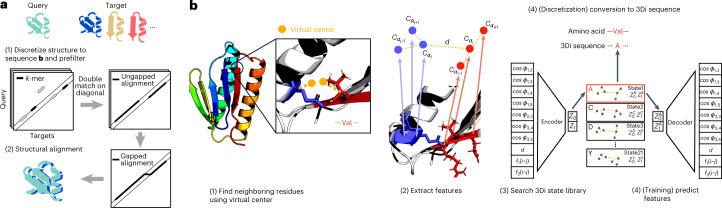
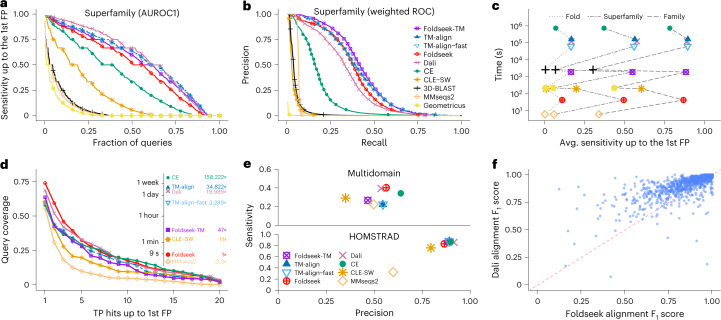
As structure prediction methods are generating millions of publicly available protein structures, searching these databases is becoming a bottleneck. Foldseek aligns the structure of a query protein against a database by describing tertiary amino acid interactions within proteins as sequences over a structural alphabet. Foldseek decreases computation times by four to five orders of magnitude with 86%, 88% and 133% of the sensitivities of Dali, TM-align and CE, respectively.
Overview
AI snapshot
Written from the paper’s full text.
TL;DR
Foldseek encodes protein tertiary interactions as sequences over a 20-state 3Di structural alphabet and searches them with MMseqs2-derived prefilters and alignment modules. It reduces structure-search computation times by four to five orders of magnitude while retaining 86%, 88% and 133% of the sensitivities of Dali, TM-align and CE, respectively.
Key findings
- Foldseek decreases computation times by four to five orders of magnitude with 86%, 88% and 133% of the sensitivities of Dali, TM-align and CE, respectively.
- On SCOPe40 all-versus-all searches, Foldseek is more than 4,000 times faster than TM-align and Dali and over 21,000 times faster than CE; on AlphaFoldDB (version 1), it is around 184,600 and 23,000 times faster than Dali and TM-align, respectively.
- In precision-recall analysis, Foldseek-TM and Foldseek have the highest and third-highest area under the precision-recall curve on family, superfamily and fold levels; Foldseek-TM improves over TM-align because its prefilter suppresses high-scoring false positives.
- For SARS-CoV-2 RdRp (PDB: 6M71, chain A; 942 residues) searched in AlphaFoldDB (version 1), search times were 10 d for Dali, 33 h for TM-align and 6 s for Foldseek, making it 180,000 and 23,000 times faster; all top 10 hits were known RdRp homologs.
Methods
- Foldseek discretizes structures into 3Di sequences describing each residue’s geometric conformation with its spatially closest residue, then uses MMseqs2’s double-diagonal k-mer and gapless alignment prefilters followed by SIMD-accelerated Smith–Waterman local alignment combining 3Di and amino acid substitution scores; an optional global TM-align mode is also provided.
- Benchmarks include SCOPe40 (11,211 non-redundant single-domain structures) all-versus-all, AlphaFoldDB (version 1) clustered to 34,270 structures with 100 randomly selected queries for reference-free multi-domain tests, and HOMSTRAD (1,032 protein families); runtime evaluations used an AMD EPYC 7702P 64-core CPU.
- Sensitivity was measured as the fraction of true positives before the first false positive, with AUROC/ROC1 and precision-recall analyses; multi-domain benchmarks used LDDT thresholds of at least 0.6 for true positives and below 0.25 for false positives, ignoring matches in between.
Limitations
- The paper states that the SCOPe benchmark uses only single-domain proteins as queries and targets, so it cannot assess local similarities such as homologous domains shared between multi-domain proteins; the HOMSTRAD alignment benchmark has the same limitation, as most HOMSTRAD proteins are single-domain (median length 182 residues).
- The paper states that the reference-free multi-domain benchmark requires choosing thresholds for true and false positives.
- The text makes evident that the 3Di alphabet and substitution matrix were trained and cross-validated on SCOPe40, and that methods likely overfitted on SCOPe due to data leakage were excluded from benchmark comparison; the paper reports no overfitting despite training 492 parameters.
Model-written summary. Check it against the paper before relying on it.
Integrity signals
Registry
Cites
Statistics
Figures
Verification
Claims the paper makes
26 Own result · 18 Not checked yet · 13 Own interpretation · 8 No basis given · 2 Own method
A result the paper reports from its own data — it cites no other source for it, so there is none to check. The quote shows it is in the paper.
In the paper
“We inspected the 1,675 (of 133,813) high-scoring FPs (score per aligned column ≥ 1.0, TM-score < 0.5), revealing queries with multiple structured segments but with incorrect relative orientations (Supplementary Table 3 and Supplementary Fig. 9).”
§ Fast and accurate protein structure search with Foldseek > Main
plain- Asserted: passes — The authors put it forward as true.
- Checkable: passes — It can be checked against evidence.
- Load-bearing: passes — The paper’s conclusions depend on it.
- Based: passes — The paper gives a reason why it holds.
In the paper
“In the reference-based HOMSTRAD alignment quality benchmark24, Foldseek performs slightly below CE, Dali and TM-align (Fig. 2e).”
§ Fast and accurate protein structure search with Foldseek > Main
What the sources say
- Not checked yetcites [24] Mizuguchi, K., Deane, C. M., Blundell, T. L. & Overington, J. P. HOMSTRAD: a database of protein structure alignments for homologous families. Protein Sci. 7, 2469–2471 (1998). source
plain- Asserted: passes — The authors put it forward as true.
- Checkable: passes — It can be checked against evidence.
- Load-bearing: unclear — It is unclear whether the paper’s conclusions depend on it.
- Based: passes — The paper gives a reason why it holds.
A result the paper reports from its own data — it cites no other source for it, so there is none to check. The quote shows it is in the paper.
In the paper
“(1) Weaker dependency between consecutive letters and (2) more evenly distributed state frequencies, both enhancing information density and reducing false positives (FPs) (Supplementary Table 1).”
§ Fast and accurate protein structure search with Foldseek > Main
plaincorrelational- Asserted: passes — The authors put it forward as true.
- Checkable: passes — It can be checked against evidence.
- Load-bearing: passes — The paper’s conclusions depend on it.
- Based: passes — The paper gives a reason why it holds.
A result the paper reports from its own data — it cites no other source for it, so there is none to check. The quote shows it is in the paper.
In the paper
“Foldseek’s performance is similar across all six secondary structure classes in SCOPe (Supplementary Fig. 5).”
§ Fast and accurate protein structure search with Foldseek > Main
plain- Asserted: passes — The authors put it forward as true.
- Checkable: passes — It can be checked against evidence.
- Load-bearing: unclear — It is unclear whether the paper’s conclusions depend on it.
- Based: passes — The paper gives a reason why it holds.
A result the paper reports from its own data — it cites no other source for it, so there is none to check. The quote shows it is in the paper.
In the paper
“(1) Weaker dependency between consecutive letters and (2) more evenly distributed state frequencies, both enhancing information density and reducing false positives (FPs) (Supplementary Table 1).”
§ Fast and accurate protein structure search with Foldseek > Main
plaincorrelational- Asserted: passes — The authors put it forward as true.
- Checkable: passes — It can be checked against evidence.
- Load-bearing: passes — The paper’s conclusions depend on it.
- Based: passes — The paper gives a reason why it holds.
A result the paper reports from its own data — it cites no other source for it, so there is none to check. The quote shows it is in the paper.
In the paper
“The folded segments were correctly aligned by Foldseek.”
§ Fast and accurate protein structure search with Foldseek > Main
plaindirect- Asserted: passes — The authors put it forward as true.
- Checkable: passes — It can be checked against evidence.
- Load-bearing: passes — The paper’s conclusions depend on it.
- Based: passes — The paper gives a reason why it holds.
A result the paper reports from its own data — it cites no other source for it, so there is none to check. The quote shows it is in the paper.
In the paper
“We noticed that the 3D-BLAST matrix with Smith–Waterman resulted in a similar performance to CLE: 0.717, 0.230 and 0.011 for family classification, superfamily classification and fold classification, respectively.”
§ Fast and accurate protein structure search with Foldseek > Methods > 3D-BLAST
plain- Asserted: passes — The authors put it forward as true.
- Checkable: passes — It can be checked against evidence.
- Load-bearing: unclear — It is unclear whether the paper’s conclusions depend on it.
- Based: passes — The paper gives a reason why it holds.
A result the paper reports from its own data — it cites no other source for it, so there is none to check. The quote shows it is in the paper.
In the paper
“All top 10 hits were known RdRp homologs (Supplementary Table 4).”
§ Fast and accurate protein structure search with Foldseek > Main
plainSingle case- Asserted: passes — The authors put it forward as true.
- Checkable: passes — It can be checked against evidence.
- Load-bearing: passes — The paper’s conclusions depend on it.
- Based: passes — The paper gives a reason why it holds.
A result the paper reports from its own data — it cites no other source for it, so there is none to check. The quote shows it is in the paper.
In the paper
“No overfitting was observed, despite training 492 parameters (282 neural network and 210 substitution matrix entries).”
§ Fast and accurate protein structure search with Foldseek > Methods > 3Di alphabet cross-validation
plain- Asserted: passes — The authors put it forward as true.
- Checkable: passes — It can be checked against evidence.
- Load-bearing: unclear — It is unclear whether the paper’s conclusions depend on it.
- Based: passes — The paper gives a reason why it holds.
A result the paper reports from its own data — it cites no other source for it, so there is none to check. The quote shows it is in the paper.
In the paper
“Dali, CE and CLE-Smith–Waterman failed to produce an alignment for 35, 1 and 1 out of 1,032 pairs, respectively, which were rated with a sensitivity of 0.”
§ Fast and accurate protein structure search with Foldseek > Methods > HOMSTRAD alignment benchmark
plain- Asserted: passes — The authors put it forward as true.
- Checkable: passes — It can be checked against evidence.
- Load-bearing: unclear — It is unclear whether the paper’s conclusions depend on it.
- Based: passes — The paper gives a reason why it holds.
- It may state two separate claims as one. 22
- Probably not a substantial claim. 17
The paper states this without a source or data behind it here, so there is nothing to check it against. The quote shows it is in the paper.
In the paper
“Foldseek decreases computation times by four to five orders of magnitude with 86%, 88% and 133% of the sensitivities of Dali, TM-align and CE, respectively.”
§ Fast and accurate protein structure search with Foldseek > Abstract
plaindirect- Asserted: passes — The authors put it forward as true.
- Checkable: passes — It can be checked against evidence.
- Load-bearing: passes — The paper’s conclusions depend on it.
- Based: passes — The paper gives a reason why it holds.
It may state two separate claims as one.
A result the paper reports from its own data — it cites no other source for it, so there is none to check. The quote shows it is in the paper.
In the paper
“On this small SCOPe40 benchmark set, Foldseek is more than 4,000 times faster than TM-align and Dali and over 21,000 times faster than CE (Fig. 2c).”
§ Fast and accurate protein structure search with Foldseek > Main
plain- Asserted: passes — The authors put it forward as true.
- Checkable: passes — It can be checked against evidence.
- Load-bearing: passes — The paper’s conclusions depend on it.
- Based: passes — The paper gives a reason why it holds.
It may state two separate claims as one.
A result the paper reports from its own data — it cites no other source for it, so there is none to check. The quote shows it is in the paper.
In the paper
“Foldseek alignments are more accurate and sensitive than MMseqs2, CLE-SW and TM-align, similarly accurate as Dali and 13% less precise but 15% more sensitive than CE.”
§ Fast and accurate protein structure search with Foldseek > Main
plain- Asserted: passes — The authors put it forward as true.
- Checkable: passes — It can be checked against evidence.
- Load-bearing: passes — The paper’s conclusions depend on it.
- Based: passes — The paper gives a reason why it holds.
It may state two separate claims as one.
A result the paper reports from its own data — it cites no other source for it, so there is none to check. The quote shows it is in the paper.
In the paper
“On the much larger AlphaFoldDB (version 1), where Foldseek approaches its full speed, it is around 184,600 and 23,000 times faster than Dali and TM-align, respectively (see below).”
§ Fast and accurate protein structure search with Foldseek > Main
plain- Asserted: passes — The authors put it forward as true.
- Checkable: passes — It can be checked against evidence.
- Load-bearing: passes — The paper’s conclusions depend on it.
- Based: passes — The paper gives a reason why it holds.
It may state two separate claims as one.
A result the paper reports from its own data — it cites no other source for it, so there is none to check. The quote shows it is in the paper.
In the paper
“Again, Foldseek has similar sensitivity as Dali, CE and TM-align and much higher sensitivity than CLE-SW and MMseqs2.”
§ Fast and accurate protein structure search with Foldseek > Main
plain- Asserted: passes — The authors put it forward as true.
- Checkable: passes — It can be checked against evidence.
- Load-bearing: passes — The paper’s conclusions depend on it.
- Based: passes — The paper gives a reason why it holds.
It may state two separate claims as one.
A result the paper reports from its own data — it cites no other source for it, so there is none to check. The quote shows it is in the paper.
In the paper
“In a precision-recall analysis, Foldseek-TM and Foldseek have the highest and third-highest area under the precision-recall curve on each of the three levels (Fig. 2b and Supplementary Fig. 4).”
§ Fast and accurate protein structure search with Foldseek > Main
plaincorrelational- Asserted: passes — The authors put it forward as true.
- Checkable: passes — It can be checked against evidence.
- Load-bearing: passes — The paper’s conclusions depend on it.
- Based: passes — The paper gives a reason why it holds.
It may state two separate claims as one.
A result the paper reports from its own data — it cites no other source for it, so there is none to check. The quote shows it is in the paper.
In the paper
“Foldseek’s sensitivity is below Dali and TM-align, higher than the structural aligner CE and much above the structural alphabet-based search tools 3D-BLAST and CLE-SW (Fig. 2a).”
§ Fast and accurate protein structure search with Foldseek > Main
plain- Asserted: passes — The authors put it forward as true.
- Checkable: passes — It can be checked against evidence.
- Load-bearing: passes — The paper’s conclusions depend on it.
- Based: passes — The paper gives a reason why it holds.
It may state two separate claims as one.
The paper states this without a source or data behind it here, so there is nothing to check it against. The quote shows it is in the paper.
In the paper
“(3) The highest information density is encoded in conserved protein cores and the lowest in non-conserved coil/loop regions, whereas the opposite is true for backbone structural alphabets.”
§ Fast and accurate protein structure search with Foldseek > Main
plaincorrelational- Asserted: passes — The authors put it forward as true.
- Checkable: passes — It can be checked against evidence.
- Load-bearing: passes — The paper’s conclusions depend on it.
- Based: unclear — It is unclear why the paper says it holds.
It may state two separate claims as one.
A result the paper reports from its own data — it cites no other source for it, so there is none to check. The quote shows it is in the paper.
In the paper
“The conversion to DAT format produced 11,137 valid structures out of the 11,211 initial structures for the SCOPe benchmark and 34,252 structures out of 34,270 SPICi clusters.”
§ Fast and accurate protein structure search with Foldseek > Methods > Dali
plaindirect- Asserted: passes — The authors put it forward as true.
- Checkable: passes — It can be checked against evidence.
- Load-bearing: fails — The paper’s conclusions may not depend on it.
- Based: passes — The paper gives a reason why it holds.
Probably not a substantial claim. The paper’s conclusions may not depend on it. It may state two separate claims as one.
A result the paper reports from its own data — it cites no other source for it, so there is none to check. The quote shows it is in the paper.
In the paper
“We excluded 3D-BLAST’s measurement from the multi-domain benchmark because it produced occasionally high scores (>107) for single residue alignments.”
§ Fast and accurate protein structure search with Foldseek > Methods > 3D-BLAST
plaindirect- Asserted: passes — The authors put it forward as true.
- Checkable: passes — It can be checked against evidence.
- Load-bearing: unclear — It is unclear whether the paper’s conclusions depend on it.
- Based: passes — The paper gives a reason why it holds.
It may state two separate claims as one.
The paper states this without a source or data behind it here, so there is nothing to check it against. The quote shows it is in the paper.
In the paper
“Currently, we include the four variants of the AlphaFoldDB (version 4): UniProt (214 million structures), UniProt50, a clustered database to 50% sequence identity and 90% bi-directional coverage using MMseqs2 (parameters -c 0.9 --min-seq-id 0.5 --cluster-reassign; 54 million structures), Proteome (564,000 structures) and Swiss-Prot (542,000 structures).”
§ Fast and accurate protein structure search with Foldseek > Methods > Pre-built and ready-to-download databases
plain- Asserted: passes — The authors put it forward as true.
- Checkable: passes — It can be checked against evidence.
- Load-bearing: fails — The paper’s conclusions may not depend on it.
- Based: passes — The paper gives a reason why it holds.
Probably not a substantial claim. The paper’s conclusions may not depend on it. It may state two separate claims as one.
The paper states this without a source or data behind it here, so there is nothing to check it against. The quote shows it is in the paper.
In the paper
“During batch searches, Foldseek adapts its memory use to the available RAM of the machine.”
§ Fast and accurate protein structure search with Foldseek > Methods > Webserver
plaindirect- Asserted: passes — The authors put it forward as true.
- Checkable: passes — It can be checked against evidence.
- Load-bearing: fails — The paper’s conclusions may not depend on it.
- Based: passes — The paper gives a reason why it holds.
Probably not a substantial claim. The paper’s conclusions may not depend on it.
A result the paper reports from its own data — it cites no other source for it, so there is none to check. The quote shows it is in the paper.
In the paper
“For example, Foldseek finds around the same number of FPs and TPs with a score of 51 in SCOPe40. The probability for a hit with score 51 is, therefore, 50%.”
§ Fast and accurate protein structure search with Foldseek > Methods > Probability of TP match
hedgedcorrelational- Asserted: passes — The authors put it forward as true.
- Checkable: passes — It can be checked against evidence.
- Load-bearing: unclear — It is unclear whether the paper’s conclusions depend on it.
- Based: passes — The paper gives a reason why it holds.
It may state two separate claims as one.
A result the paper reports from its own data — it cites no other source for it, so there is none to check. The quote shows it is in the paper.
In the paper
“We downloaded the latest HOMSTRAD version (https://mizuguchilab.org/homstrad/data/homstrad_with_PDB_2022_Aug_1.tar.gz) and picked the pairwise alignments between the first and last members of each family, which resulted in structures of a median length of 182 residues.”
§ Fast and accurate protein structure search with Foldseek > Methods > HOMSTRAD alignment benchmark
plain- Asserted: passes — The authors put it forward as true.
- Checkable: passes — It can be checked against evidence.
- Load-bearing: fails — The paper’s conclusions may not depend on it.
- Based: passes — The paper gives a reason why it holds.
Probably not a substantial claim. The paper’s conclusions may not depend on it.
A result the paper reports from its own data — it cites no other source for it, so there is none to check. The quote shows it is in the paper.
In the paper
“Search times were 10 d for Dali, 33 h for TM-align and 6 s for Foldseek, making it 180,000 and 23,000 times faster.”
§ Fast and accurate protein structure search with Foldseek > Main
plaindirectSingle case- Asserted: passes — The authors put it forward as true.
- Checkable: passes — It can be checked against evidence.
- Load-bearing: passes — The paper’s conclusions depend on it.
- Based: passes — The paper gives a reason why it holds.
It may state two separate claims as one.
The paper states this without a source or data behind it here, so there is nothing to check it against. The quote shows it is in the paper.
In the paper
“The 3Di alphabet developed for Foldseek describes tertiary residue–residue interactions instead of backbone conformations and proved critical for reaching high sensitivities.”
§ Fast and accurate protein structure search with Foldseek > Methods > Overview
plaindirect- Asserted: passes — The authors put it forward as true.
- Checkable: passes — It can be checked against evidence.
- Load-bearing: passes — The paper’s conclusions depend on it.
- Based: unclear — It is unclear why the paper says it holds.
It may state two separate claims as one.
A result the paper reports from its own data — it cites no other source for it, so there is none to check. The quote shows it is in the paper.
In the paper
“For the multi-domain benchmark, we excluded one query that was running over 16 d.”
§ Fast and accurate protein structure search with Foldseek > Methods > CE
plainSingle case- Asserted: passes — The authors put it forward as true.
- Checkable: passes — It can be checked against evidence.
- Load-bearing: fails — The paper’s conclusions may not depend on it.
- Based: passes — The paper gives a reason why it holds.
Probably not a substantial claim. The paper’s conclusions may not depend on it.
A result the paper reports from its own data — it cites no other source for it, so there is none to check. The quote shows it is in the paper.
In the paper
“The SCOPe benchmark set consists of single domains with an average length of 174 residues.”
§ Fast and accurate protein structure search with Foldseek > Methods > SCOPe benchmark
plain- Asserted: passes — The authors put it forward as true.
- Checkable: passes — It can be checked against evidence.
- Load-bearing: fails — The paper’s conclusions may not depend on it.
- Based: passes — The paper gives a reason why it holds.
Probably not a substantial claim. The paper’s conclusions may not depend on it.
The paper states this without a source or data behind it here, so there is nothing to check it against. The quote shows it is in the paper.
In the paper
“The AlpaFoldDB/UniProt50 (version 4), AlphaFoldDB/Proteome (version 4), AlphaFoldDB/Swiss-Prot (version 4), CATH50, ESM Atlas High-Quality Clu30 and PDB100 require 191 GB, 3.8 GB, 3.4 GB, 1.4 GB, 110 GB and 2.0 GB RAM, respectively.”
§ Fast and accurate protein structure search with Foldseek > Methods > Webserver
plain- Asserted: passes — The authors put it forward as true.
- Checkable: passes — It can be checked against evidence.
- Load-bearing: fails — The paper’s conclusions may not depend on it.
- Based: passes — The paper gives a reason why it holds.
Probably not a substantial claim. The paper’s conclusions may not depend on it. It may state two separate claims as one.
A result the paper reports from its own data — it cites no other source for it, so there is none to check. The quote shows it is in the paper.
In the paper
“Our NW implementation does not compute exactly the same alignment because we apply affine gap costs, whereas TM-align does not (Supplementary Fig. 12).”
§ Fast and accurate protein structure search with Foldseek > Methods > Pairwise global structural alignments using TM-align
plaindirect- Asserted: passes — The authors put it forward as true.
- Checkable: passes — It can be checked against evidence.
- Load-bearing: fails — The paper’s conclusions may not depend on it.
- Based: passes — The paper gives a reason why it holds.
Probably not a substantial claim. The paper’s conclusions may not depend on it.
The paper states this without a source or data behind it here, so there is nothing to check it against. The quote shows it is in the paper.
In the paper
“By not restricting itself to exact matches, the prefilter achieves high sensitivity while reducing the number of sequences for which full alignments are computed by several orders of magnitude.”
§ Fast and accurate protein structure search with Foldseek > Methods > Overview
plaindirect- Asserted: passes — The authors put it forward as true.
- Checkable: passes — It can be checked against evidence.
- Load-bearing: passes — The paper’s conclusions depend on it.
- Based: passes — The paper gives a reason why it holds.
It may state two separate claims as one.
A result the paper reports from its own data — it cites no other source for it, so there is none to check. The quote shows it is in the paper.
In the paper
“SPICi produced 34,270 clusters from the search result.”
§ Fast and accurate protein structure search with Foldseek > Methods > Reference-free multi-domain benchmarks
plaindirect- Asserted: passes — The authors put it forward as true.
- Checkable: passes — It can be checked against evidence.
- Load-bearing: fails — The paper’s conclusions may not depend on it.
- Based: passes — The paper gives a reason why it holds.
Probably not a substantial claim. The paper’s conclusions may not depend on it.
In the paper
“The European Bioinformatics Institute already holds over 214 million structures predicted by AlphaFold2 (ref. 3)”
§ Fast and accurate protein structure search with Foldseek > Main
What the sources say
- Not checked yetcites [3] Varadi, M. et al. AlphaFold Protein Structure Database: massively expanding the structural coverage of protein–sequence space with high-accuracy models. Nucleic Acids Res. 50, D439–D444 (2022). source
plain- Asserted: passes — The authors put it forward as true.
- Checkable: passes — It can be checked against evidence.
- Load-bearing: passes — The paper’s conclusions depend on it.
- Based: passes — The paper gives a reason why it holds.
Probably not a substantial claim.
In the paper
“Sequence searching is four to five orders of magnitude faster: an all-versus-all comparison of 100 million sequences would take MMseqs2 (ref. 6) only around a week on the same cluster.”
§ Fast and accurate protein structure search with Foldseek > Main
What the sources say
- Not checked yetcites [6] Steinegger, M. & Söding, J. MMseqs2 enables sensitive protein sequence searching for the analysis of massive data sets. Nat. Biotechnol. 35, 1026–1028 (2017). source
plaindirect- Asserted: passes — The authors put it forward as true.
- Checkable: passes — It can be checked against evidence.
- Load-bearing: passes — The paper’s conclusions depend on it.
- Based: passes — The paper gives a reason why it holds.
It may state two separate claims as one.
In the paper
“Searching with a single query structure through a database with 100 million protein structures would take the popular TM-align11 tool a month on one CPU core, and an all-versus-all comparison would take 10 millennia on a 1,000-core cluster.”
§ Fast and accurate protein structure search with Foldseek > Main
What the sources say
- Not checked yetcites [11] Zhang, Y. & Skolnick, J. TM-align: a protein structure alignment algorithm based on the TM-score. Nucleic Acids Res. 33, 2302–2309 (2005). source
hedgeddirect- Asserted: passes — The authors put it forward as true.
- Checkable: passes — It can be checked against evidence.
- Load-bearing: passes — The paper’s conclusions depend on it.
- Based: passes — The paper gives a reason why it holds.
It may state two separate claims as one.
In the paper
“the ESM Atlas contains over 617 million metagenomic structures predicted by ESMFold4.”
§ Fast and accurate protein structure search with Foldseek > Main
What the sources say
- Not checked yetcites [4] Lin, Z. et al. Evolutionary-scale prediction of atomic-level protein structure with a language model. Science 379, 1123–1130 (2023). source
plain- Asserted: passes — The authors put it forward as true.
- Checkable: passes — It can be checked against evidence.
- Load-bearing: fails — The paper’s conclusions may not depend on it.
- Based: passes — The paper gives a reason why it holds.
Probably not a substantial claim. The paper’s conclusions may not depend on it.
A conclusion the paper draws from its own results — it cites no other source for it, so there is none to check. The quote shows it is in the paper.
In the paper
“(1) Weaker dependency between consecutive letters and (2) more evenly distributed state frequencies, both enhancing information density and reducing false positives (FPs) (Supplementary Table 1).”
§ Fast and accurate protein structure search with Foldseek > Main
plaindirect- Asserted: passes — The authors put it forward as true.
- Checkable: passes — It can be checked against evidence.
- Load-bearing: passes — The paper’s conclusions depend on it.
- Based: passes — The paper gives a reason why it holds.
It may state two separate claims as one.
None of the sources cited for this claim have been checked yet.
In the paper
“Most, such as CLE, 3D-BLAST and Protein Blocks, discretize the conformations of short stretches of usually 3–5 Cα atoms17–19.”
§ Fast and accurate protein structure search with Foldseek > Main
What the sources say
- Not checked yetcites [17] Wang, S. & Zheng, W.-M. CLePAPS: fast pair alignment of protein structures based on conformational letters. J. Bioinform. Comput. Biol. 6, 347–366 (2008). source
- Not checked yetcites [18] Yang, J.-M. & Tung, C.-H. Protein structure database search and evolutionary classification. Nucleic Acids Res. 34, 3646–3659 (2006). source
- Not checked yetcites [19] de Brevern, A. G., Etchebest, C. & Hazout, S. Bayesian probabilistic approach for predicting backbone structures in terms of protein blocks. Proteins 41, 271–287 (2000). source
plain- Asserted: passes — The authors put it forward as true.
- Checkable: passes — It can be checked against evidence.
- Load-bearing: fails — The paper’s conclusions may not depend on it.
- Based: passes — The paper gives a reason why it holds.
Probably not a substantial claim. The paper’s conclusions may not depend on it.
A conclusion the paper draws from its own results — it cites no other source for it, so there is none to check. The quote shows it is in the paper.
In the paper
“Databases are only required to remain resident in RAM if Foldseek is used as a webserver.”
§ Fast and accurate protein structure search with Foldseek > Methods > Webserver
plainconditional- Asserted: passes — The authors put it forward as true.
- Checkable: passes — It can be checked against evidence.
- Load-bearing: fails — The paper’s conclusions may not depend on it.
- Based: passes — The paper gives a reason why it holds.
Probably not a substantial claim. The paper’s conclusions may not depend on it.
In the paper
“This illustrates that 3D aligners such as TM-align may overlook homologous structures that are not globally superposable, whereas Foldseek (as well as the two-dimensional (2D) aligner Dali) is independent of relative domain orientations and excels at detecting homologous multi-domain structures12.”
§ Fast and accurate protein structure search with Foldseek > Main
What the sources say
- Not checked yetcites [12] Hasegawa, H. & Holm, L. Advances and pitfalls of protein structural alignment. Curr. Opin. Struct. Biol. 19, 341–348 (2009). source
hedgedconditional- Asserted: passes — The authors put it forward as true.
- Checkable: passes — It can be checked against evidence.
- Load-bearing: passes — The paper’s conclusions depend on it.
- Based: passes — The paper gives a reason why it holds.
It may state two separate claims as one.
A conclusion the paper draws from its own results — it cites no other source for it, so there is none to check. The quote shows it is in the paper.
In the paper
“A drawback of our reference-free multi-domain benchmark is the need to choose thresholds for TPs and FPs (Supplementary Fig. 6).”
§ Fast and accurate protein structure search with Foldseek > Methods > Limitations of benchmarks
plaindirect- Asserted: passes — The authors put it forward as true.
- Checkable: passes — It can be checked against evidence.
- Load-bearing: fails — The paper’s conclusions may not depend on it.
- Based: passes — The paper gives a reason why it holds.
Probably not a substantial claim. The paper’s conclusions may not depend on it.
In the paper
“We included Geometricus20 in the SCOPe benchmark as a representative of alignment-free tools, which are fast but can find only globally similar structures.”
§ Fast and accurate protein structure search with Foldseek > Methods > Geometricus
What the sources say
- Not checked yetcites [20] Durairaj, J., Akdel, M., de Ridder, D. & van Dijk, A. D. J. Geometricus represents protein structures as shape-mers derived from moment invariants. Bioinformatics 36, i718–i725 (2020). source
plaindirect- Asserted: passes — The authors put it forward as true.
- Checkable: passes — It can be checked against evidence.
- Load-bearing: unclear — It is unclear whether the paper’s conclusions depend on it.
- Based: passes — The paper gives a reason why it holds.
It may state two separate claims as one.
A conclusion the paper draws from its own results — it cites no other source for it, so there is none to check. The quote shows it is in the paper.
In the paper
“This virtual center preferably selects long-range, tertiary interactions and only falls back to selecting interactions to i + 1 or i − 1 when no other residues are nearby.”
§ Fast and accurate protein structure search with Foldseek > Methods > Nearest-neighbor selection
plaindirect- Asserted: passes — The authors put it forward as true.
- Checkable: passes — It can be checked against evidence.
- Load-bearing: passes — The paper’s conclusions depend on it.
- Based: passes — The paper gives a reason why it holds.
It may state two separate claims as one.
A conclusion the paper draws from its own results — it cites no other source for it, so there is none to check. The quote shows it is in the paper.
In the paper
“We measure the sensitivity up to the 1st FP (ROC1) instead, for example, up to the 5th FP, because ROC1 better reflects the requirements for low false discovery rates in automatic searches.”
§ Fast and accurate protein structure search with Foldseek > Methods > Evaluation SCOPe benchmark
plaindirect- Asserted: passes — The authors put it forward as true.
- Checkable: passes — It can be checked against evidence.
- Load-bearing: passes — The paper’s conclusions depend on it.
- Based: fails — The paper may give no reason why it holds.
Probably not a substantial claim. The paper may give no reason why it holds.
In the paper
“All counts (TP, FP and FN) were weighted by the reciprocal of their family, superfamily or fold size. In this way, folds, superfamilies and families contribute linearly with their size instead of quadratically36.”
§ Fast and accurate protein structure search with Foldseek > Methods > Evaluation SCOPe benchmark
What the sources say
- Not checked yetcites [36] Eddy, S. R. Accelerated profile HMM searches. PLoS Comput. Biol. 7, e1002195 (2011). source
plaindirect- Asserted: passes — The authors put it forward as true.
- Checkable: passes — It can be checked against evidence.
- Load-bearing: fails — The paper’s conclusions may not depend on it.
- Based: passes — The paper gives a reason why it holds.
Probably not a substantial claim. The paper’s conclusions may not depend on it.
In the paper
“The Foldseek webserver is based on the MMseqs2 webserver43.”
§ Fast and accurate protein structure search with Foldseek > Methods > Webserver
What the sources say
- Not checked yetcites [43] Mirdita, M., Steinegger, M. & Söding, J. MMseqs2 desktop and local web server app for fast, interactive sequence searches. Bioinformatics 35, 2856–2858 (2019). source
plaindirect- Asserted: passes — The authors put it forward as true.
- Checkable: passes — It can be checked against evidence.
- Load-bearing: fails — The paper’s conclusions may not depend on it.
- Based: passes — The paper gives a reason why it holds.
Probably not a substantial claim. The paper’s conclusions may not depend on it.
The paper relies on this without support.
The SCOPe40 dataset is a suitable benchmark for evaluating protein structure search sensitivity.
“The SCOPe benchmark set consists of single domains with an average length of 174 residues.”
The paper relies on this without support.
The HOMSTRAD pairwise alignments are accurate reference alignments for measuring alignment quality.
“With the HOMSTRAD alignments as reference, we measured for each pairwise alignment the sensitivity (fraction of residue pairs of the HOMSTRAD alignment that were correctly aligned) and the precision (fraction of correctly aligned residue pairs in the predicted alignment).”
The paper relies on this without support.
The ESM Atlas API can accurately predict structures of user-supplied sequences up to 400 residues.
“We use the ESM Atlas API to predict structures of user-supplied sequences that are, at most, 400 residues long.”
The paper relies on this without support.
The virtual center parameters optimized on SCOPe generalize to other datasets.
“The virtual center defined by θ = 270∘, τ = 0∘ and l = 2 performed best in the SCOPe benchmark.”
Claims other papers make about this one
Each is checked against this paper’s own text: does it say what the citing paper says it does?
In the citing paper
“Foldseek can increase the speed of comparisons of structures by four to five orders of magnitudes relative to previous approaches while maintaining sensitivity15”
From Clustering predicted structures at the scale of the known protein universe (2023) · cites this paper as [15]
Self-check
Percentages, sums and reported differences re-computed from the paper’s own numbers.
Each contradiction between two passages listed here was confirmed by an independent check.
Rated minor: it would not touch a result — a value no result rests on, a p-value that stays on the same side of the significance level, or a conflict that is clerical, resolved elsewhere in the paper, or outside its own findings.
In the paper
§ Fast and accurate protein structure search with Foldseek > Methods > Probability of TP match
“Here, hits within the same superfamily are TP;”
§ Fast and accurate protein structure search with Foldseek > Methods > Probability of TP match
“hits to the same family or to another superfamily are ignored.”
Rated minor: it would not touch a result — a value no result rests on, a p-value that stays on the same side of the significance level, or a conflict that is clerical, resolved elsewhere in the paper, or outside its own findings.
In the paper
§ Fast and accurate protein structure search with Foldseek > Main
“E values are calculated using an extreme-value score distribution, with parameters predicted by a neural network based on 3Di sequence composition and query length”
§ Fast and accurate protein structure search with Foldseek > Methods > E values
“We trained a neural network to predict μ and λ from the amino acid composition of the query and its length (so a scrambled version of the query sequence would produce the same μ and λ).”
Citations
Cites
Basic local alignment search tool
Altschul, S. F., Gish, W., Miller, W., Myers, E. W., & Lipman, D. J. (1990) · Journal of Molecular Biology · doi:10.1006/jmbi.1990.9999 · Cited by 98,669
Highly accurate protein structure prediction with AlphaFold
Jumper, J., Evans, R., Pritzel, A., Green, T., Figurnov, M., Ronneberger, O., Tunyasuvunakool, K., Bates, R., Žídek, A., Potapenko, A., et al. (2021) · Nature · doi:10.1038/s41586-021-03819-2 · Cited by 43,764
Self-citationVaradi, M., Anyango, S., Deshpande, M., Nair, S., Natassia, C., Yordanova, G., Yuan, D., Stroe, O., Wood, G., Laydon, A., et al. (2022) · Nucleic Acids Research · doi:10.1093/nar/gkab1061 · Cited by 7,850
Accelerated Profile HMM Searches
Eddy, S. R. (2011) · PLoS Computational Biology · doi:10.1371/journal.pcbi.1002195 · Cited by 6,975
Evolutionary-scale prediction of atomic level protein structure with a language model
Lin, Z., Akin, H., Rao, R., Hie, B., Zhu, Z., Lu, W., Smetanin, N., Verkuil, R., Kabeli, O., Shmueli, Y., et al. (2022) · doi:10.1101/2022.07.20.500902 · Cited by 5,990
Accurate prediction of protein structures and interactions using a 3-track network
Baek, M., DiMaio, F., Anishchenko, I., Dauparas, J., Ovchinnikov, S., Lee, G. R., Wang, J., Cong, Q., Kinch, L. N., Schaeffer, R. D., et al. (2021) · doi:10.1101/2021.06.14.448402 · Cited by 5,549
Sensitive protein alignments at tree-of-life scale using DIAMOND
Buchfink, B., Reuter, K., & Drost, H.-G. (2021) · Nature Methods · doi:10.1038/s41592-021-01101-x · Cited by 5,097
MMseqs2 enables sensitive protein sequence searching for the analysis of massive data sets
Steinegger, M., & Söding, J. (2017) · Nature Biotechnology · doi:10.1038/nbt.3988 · Cited by 4,840
Self-citationTM-align: a protein structure alignment algorithm based on the TM-score
Zhang, Y. (2005) · Nucleic Acids Research · doi:10.1093/nar/gki524 · Cited by 3,774
Protein structure alignment by incremental combinatorial extension (CE) of the optimal path.
Shindyalov, I., & Bourne, P. (1998) · Protein Engineering · doi:10.1093/protein/11.9.739 · Cited by 2,199
Research works printed but not linked: 1
- Van den Oord, A., Vinyals, O. & Kavukcuoglu, K. Neural discrete representation learning. Proc. of the 31st Conference on Neural Information Processing Systems. https://proceedings.neurips.cc/paper_files/paper/2017/file/7a98af17e63a0ac09ce2e96d03992fbc-Paper.pdf (NIPS, 2017).
Cited by
Sorted by citations
Evolutionary-scale prediction of atomic level protein structure with a language model
Lin, Z., Akin, H., Rao, R., Hie, B., Zhu, Z., Lu, W., Smetanin, N., Verkuil, R., Kabeli, O., Shmueli, Y., et al. (2022) · doi:10.1101/2022.07.20.500902 · Cited by 5,990
InterPro: the protein sequence classification resource in 2025
Blum, M., Andreeva, A. E., Florentino, L. C., Chuguransky, S., Grego, T., Hobbs, E., Pinto, B. L., Orr, A., Paysan‐Lafosse, T., Ponamareva, I., et al. (2024) · Nucleic Acids Research · doi:10.1093/nar/gkae1082 · Cited by 1,240
Simulating 500 million years of evolution with a language model
Hayes, T., Rao, R., Akin, H., Sofroniew, N. J., Oktay, D., Lin, Z., Verkuil, R., Tran, V. Q., Deaton, J., Wiggert, M., et al. (2025) · Science · doi:10.1126/science.ads0018 · Cited by 937
Dali server: structural unification of protein families
Holm, L. (2022) · Nucleic Acids Research · doi:10.1093/nar/gkac387 · Cited by 934
ProtGPT2 is a deep unsupervised language model for protein design
Ferruz, N., Schmidt, S., & Höcker, B. (2022) · Nature Communications · doi:10.1038/s41467-022-32007-7 · Cited by 795
DALI shines a light on remote homologs: One hundred discoveries
Holm, L., Laiho, A., Törönen, P., & Salgado, M. G. (2022) · Protein Science · doi:10.1002/pro.4519 · Cited by 723
ProGen2: Exploring the boundaries of protein language models
Nijkamp, E., Ruffolo, J. A., Weinstein, E. N., Naik, N., & Madani, A. (2023) · Cell Systems · doi:10.1016/j.cels.2023.10.002 · Cited by 480
Database resources of the National Center for Biotechnology Information in 2023
Sayers, E. W., Bolton, E., Brister, J. R., Canese, K., Chan, J., Comeau, D. C., Farrell, C. M., Feldgarden, M., Fine, A. M., Funk, K., et al. (2022) · Nucleic Acids Research · doi:10.1093/nar/gkac1032 · Cited by 452
Self-citationLearning inverse folding from millions of predicted structuresPreprint
Hsu, C., Verkuil, R., Liu, J. J., Lin, Z., Hie, B., Sercu, T., Lerer, A. K., & Rives, A. W. (2022) · bioRxiv (Cold Spring Harbor Laboratory) · doi:10.1101/2022.04.10.487779 · Cited by 492
The Pfam protein families database: embracing AI/ML
Paysan-Lafosse, T., Andreeva, A., Blum, M., Chuguransky, S., Grego, T., Pinto, B. L., Salazar, G. A., Bileschi, M. L., Llinares-López, F., Meng-Papaxanthos, L., et al. (2024) · Nucleic Acids Research · doi:10.1093/nar/gkae997 · Cited by 382
One-shot design of functional protein binders with BindCraft
Pačesa, M., Nickel, L., Schellhaas, C., Schmidt, J. H., Pyatova, E., Kissling, L., Barendse, P., Choudhury, J., Kapoor, S., Alcaraz‐Serna, A., et al. (2025) · Nature · doi:10.1038/s41586-025-09429-6 · Cited by 440
Clustering predicted structures at the scale of the known protein universe
Barrio-Hernandez, I., Yeo, J., Jänes, J., Mirdita, M., Gilchrist, C. L. M., Wein, T., Varadi, M., Velankar, S., Beltrao, P., & Steinegger, M. (2023) · Nature · doi:10.1038/s41586-023-06510-w · Cited by 362
Self-citationScalable emulation of protein equilibrium ensembles with generative deep learning
Lewis, S., Hempel, T., Jiménez-Luna, J., Gastegger, M., Xie, Y., Foong, A. Y. K., Satorras, V. G., Abdin, O., Veeling, B. S., Zaporozhets, I., et al. (2025) · Science · doi:10.1126/science.adv9817 · Cited by 390
Empowering biomedical discovery with AI agents
Gao, S., Fang, A., Huang, Y., Giunchiglia, V., Noori, A., Schwarz, J. R., Ektefaie, Y., Kondic, J., & Zitnik, M. (2024) · Cell · doi:10.1016/j.cell.2024.09.022 · Cited by 315
Bilingual language model for protein sequence and structure
Heinzinger, M., Weissenow, K., Sanchez, J. G., Henkel, A., Mirdita, M., Steinegger, M., & Rost, B. (2024) · NAR Genomics and Bioinformatics · doi:10.1093/nargab/lqae150 · Cited by 311
Self-citationAlphaFold Protein Structure Database and 3D-Beacons: New Data and Capabilities
Fleming, J., Magaña, P., Nair, S. S., Tsenkov, M. I., Bertoni, D., Pidruchna, I., Afonso, M. Q. L., Midlik, A., Paramval, U., Žídek, A., et al. (2025) · Journal of Molecular Biology · doi:10.1016/j.jmb.2025.168967 · Cited by 326
Self-citationSaProt: Protein Language Modeling with Structure-aware VocabularyPreprint
Su, J., Han, C., Zhou, Y., Shan, J., Zhou, X., & Yuan, F. (2023) · bioRxiv (Cold Spring Harbor Laboratory) · doi:10.1101/2023.10.01.560349 · Cited by 264
Computational design of serine hydrolases
Lauko, A., Pellock, S. J., Sumida, K. H., Anishchenko, I., Juergens, D., Ahern, W., Jeung, J., Shida, A. F., Hunt, A., Kalvet, I., et al. (2025) · Science · doi:10.1126/science.adu2454 · Cited by 235
Fine-tuning protein language models boosts predictions across diverse tasks
Schmirler, R., Heinzinger, M., & Rost, B. (2024) · Nature Communications · doi:10.1038/s41467-024-51844-2 · Cited by 229
PADLOC: a web server for the identification of antiviral defence systems in microbial genomes
Payne, L. J., Meaden, S., Mestre, M. R., Palmer, C., Toro, N., Fineran, P. C., & Jackson, S. A. (2022) · Nucleic Acids Research · doi:10.1093/nar/gkac400 · Cited by 227
Machine Learning-Guided Protein Engineering
Kouba, P., Kohout, P., Haddadi, F., Bushuiev, A., Samusevich, R., Sedlář, J., Damborský, J., Pluskal, T., Šivic, J., & Mazurenko, S. (2023) · ACS Catalysis · doi:10.1021/acscatal.3c02743 · Cited by 218
RCSB protein Data Bank: exploring protein 3D similarities via comprehensive structural alignments
Bittrich, S., Segura, J., Duarte, J. M., Burley, S. K., & Rose, Y. (2024) · Bioinformatics · doi:10.1093/bioinformatics/btae370 · Cited by 212
Design of highly functional genome editors by modelling CRISPR–Cas sequences
Ruffolo, J. A., Nayfach, S., Gallagher, J. P., Bhatnagar, A., Beazer, J., Hussain, R., Russ, J., Yip, J., Hill, E., Pačesa, M., et al. (2025) · Nature · doi:10.1038/s41586-025-09298-z · Cited by 233
Evaluation of AlphaFold-Multimer prediction on multi-chain protein complexes
Zhu, W., Shenoy, A., Kundrotas, P., & Elofsson, A. (2023) · Bioinformatics · doi:10.1093/bioinformatics/btad424 · Cited by 202
AlphaFold2 structures guide prospective ligand discovery
Lyu, J., Kapolka, N. J., Gumpper, R. H., Alon, A., Wang, L., Jain, M. K., Barros-Álvarez, X., Sakamoto, K., Kim, Y., DiBerto, J. F., et al. (2024) · Science · doi:10.1126/science.adn6354 · Cited by 192
Language models generalize beyond natural proteins
Verkuil, R., Kabeli, O., Du, Y., Wicky, B. I. M., Milles, L. F., Dauparas, J., Baker, D., Ovchinnikov, S., Sercu, T., & Rives, A. (2022) · doi:10.1101/2022.12.21.521521 · Cited by 181
CASTpFold: Computed Atlas of Surface Topography of the universe of protein Folds
Ye, B., Tian, W., Wang, B., & Liang, J. (2024) · Nucleic Acids Research · doi:10.1093/nar/gkae415 · Cited by 180
Computational design of soluble and functional membrane protein analogues
Goverde, C. A., Pačesa, M., Goldbach, N. M., Dornfeld, L., Balbi, P. E. M., Georgeon, S., Rosset, S., Kapoor, S., Choudhury, J., Dauparas, J., et al. (2024) · Nature · doi:10.1038/s41586-024-07601-y · Cited by 182
Uncovering new families and folds in the natural protein universe
Durairaj, J., Waterhouse, A. M., Mets, T., Brodiazhenko, T., Abdullah, M., Studer, G., Tauriello, G., Akdel, M., Andreeva, A. E., Bateman, A. G., et al. (2023) · Nature · doi:10.1038/s41586-023-06622-3 · Cited by 159
Critical assessment of methods of protein structure prediction ( CASP )—Round XV
Kryshtafovych, A., Schwede, T., Topf, M., Fidelis, K., & Moult, J. (2023) · Proteins: Structure, Function, and Bioinformatics · doi:10.1002/prot.26617 · Cited by 148
Template-assisted covalent modification underlies activity of covalent molecular glues
Li, Y.-D., Ma, M. W., Hassan, M. M., Hunkeler, M., Teng, M., Puvar, K., Rutter, J. C., Lumpkin, R. J., Sandoval, B., Jin, C. Y., et al. (2024) · Nature Chemical Biology · doi:10.1038/s41589-024-01668-4 · Cited by 153
What's next for AlphaFold and the AI protein-folding revolution
Callaway, E. (2022) · Nature · doi:10.1038/d41586-022-00997-5 · Cited by 152
Protein remote homology detection and structural alignment using deep learning
Hamamsy, T., Morton, J. T., Blackwell, R., Berenberg, D., Carriero, N. J., Gligorijević, V., Strauss, C. E. M., Leman, J. K., Cho, K., & Bonneau, R. (2023) · Nature Biotechnology · doi:10.1038/s41587-023-01917-2 · Cited by 157
An atlas of protein homo-oligomerization across domains of life
Schweke, H., Pacesa, M., Levin, T., Goverde, C. A., Kumar, P., Duhoo, Y., Dornfeld, L. J., Dubreuil, B., Georgeon, S., Ovchinnikov, S., et al. (2024) · Cell · doi:10.1016/j.cell.2024.01.022 · Cited by 144
A Candida auris –specific adhesin, Scf1 , governs surface association, colonization, and virulence
Santana, D. J., Anku, J. A. E., Zhao, G., Zarnowski, R., Johnson, C. J., Hautau, H., Visser, N. D., Ibrahim, A. S., Andes, D., Nett, J. E., et al. (2023) · Science · doi:10.1126/science.adf8972 · Cited by 142
BioLiP2: an updated structure database for biologically relevant ligand–protein interactions
Zhang, C., Zhang, X., Freddolino, L., & Zhang, Y. (2023) · Nucleic Acids Research · doi:10.1093/nar/gkad630 · Cited by 152
Gaborieau, B., Vaysset, H., Tesson, F., Charachon, I., Dib, N., Bernier, J., Dequidt, T., Georjon, H., Clermont, O., Hersen, P., et al. (2024) · Nature Microbiology · doi:10.1038/s41564-024-01832-5 · Cited by 141
Data splitting to avoid information leakage with DataSAIL
Joeres, R., Blumenthal, D. B., & Kalinina, O. V. (2025) · Nature Communications · doi:10.1038/s41467-025-58606-8 · Cited by 159
Exploring structural diversity across the protein universe with The Encyclopedia of Domains
Lau, A. M., Bordin, N., Kandathil, S. M., Sillitoe, I., Waman, V. P., Wells, J., Orengo, C. A., & Jones, D. T. (2024) · Science · doi:10.1126/science.adq4946 · Cited by 140
AlphaFold2 protein structure prediction: Implications for drug discovery
Borkakoti, N., & Thornton, J. M. (2023) · Current Opinion in Structural Biology · doi:10.1016/j.sbi.2022.102526 · Cited by 140
Unifying the known and unknown microbial coding sequence space
Vanni, C., Schechter, M. S., Acinas, S. G., Barberán, A., Buttigieg, P. L., Casamayor, E. O., Delmont, T. O., Duarte, C. M., Eren, A. M., Finn, R. D., et al. (2022) · eLife · doi:10.7554/elife.67667 · Cited by 134
Self-citationThe impact of AlphaFold Protein Structure Database on the fields of life sciences
Váradi, M., & Velankar, S. S. (2022) · PROTEOMICS · doi:10.1002/pmic.202200128 · Cited by 139
A survey of k-mer methods and applications in bioinformatics
Moeckel, C., Mareboina, M., Konnaris, M. A., Chan, C. S. Y., Mouratidis, I., Montgomery, A., Chantzi, N., Pavlopoulos, G. A., & Georgakopoulos-Soares, I. (2024) · Computational and Structural Biotechnology Journal · doi:10.1016/j.csbj.2024.05.025 · Cited by 131
“K-mers prove effective in capturing and predicting information about protein folding patterns [153], secondary structure elements [153], and tertiary structures [154].”
BackgroundProtein function prediction as approximate semantic entailment
Kulmanov, M., Guzmán-Vega, F. J., Duek Roggli, P., Lane, L., Arold, S. T., & Hoehndorf, R. (2024) · Nature Machine Intelligence · doi:10.1038/s42256-024-00795-w · Cited by 131
Atom-level enzyme active site scaffolding using RFdiffusion2
Ahern, W., Yim, J., Tischer, D., Salike, S., Woodbury, S. M., Kim, D., Kalvet, I., Kipnis, Y., Coventry, B., Altae-Tran, H., et al. (2025) · Nature Methods · doi:10.1038/s41592-025-02975-x · Cited by 157
Site-saturation mutagenesis of 500 human protein domains
Beltran, A., Jiang, X., Shen, Y., & Lehner, B. (2025) · Nature · doi:10.1038/s41586-024-08370-4 · Cited by 126
Tesson, F., Planel, R., Egorov, A. A., Georjon, H., Vaysset, H., Brancotte, B., Néron, B., Mordret, E., Atkinson, G. C., Bernheim, A., et al. (2024) · Peer Community Journal · doi:10.24072/pcjournal.470 · Cited by 120
Multiple protein structure alignment at scale with FoldMason
Gilchrist, C. L. M., Mirdita, M., & Steinegger, M. (2026) · Science · doi:10.1126/science.ads6733 · Cited by 117
Self-citationBirth of protein folds and functions in the virome
Nomburg, J., Doherty, E. E., Price, N., Rabelo, D. B., Zhu, Y. K., & Doudna, J. A. (2024) · Nature · doi:10.1038/s41586-024-07809-y · Cited by 123
Functional and evolutionary significance of unknown genes from uncultivated taxa
del Río, Á. R., Giner‐Lamia, J., Cantalapiedra, C. P., Botas, J., Deng, Z., Hernández-Plaza, A., Palmer, M. M., Santamaría‐Hernando, S., Rodríguez‐Herva, J. J., Ruscheweyh, H., et al. (2023) · Nature · doi:10.1038/s41586-023-06955-z · Cited by 110
McCafferty, C. L., Klumpe, S., Amaro, R. E., Kukulski, W., Collinson, L., & Engel, B. D. (2024) · Cell · doi:10.1016/j.cell.2024.01.005 · Cited by 113
Wang, Y., Gallagher, L. A., Andrade, P. A., Liu, A., Humphreys, I. R., Turkarslan, S., Cutler, K. J., Arrieta-Ortiz, M. L., Li, Y., Radey, M. C., et al. (2023) · Cell · doi:10.1016/j.cell.2023.08.017 · Cited by 108
Mirusviruses link herpesviruses to giant viruses
Gaïa, M., Meng, L., Pelletier, E., Forterre, P., Vanni, C., Fernandez-Guerra, A., Jaillon, O., Wincker, P., Ogata, H., Krupovic, M., et al. (2023) · Nature · doi:10.1038/s41586-023-05962-4 · Cited by 108
Computational Approaches to Predict Protein–Protein Interactions in Crowded Cellular Environments
Grassmann, G., Miotto, M., Desantis, F., Rienzo, L. D., Tartaglia, G. G., Pastore, A., Ruocco, G., Monti, M. M., & Milanetti, E. (2024) · Chemical Reviews · doi:10.1021/acs.chemrev.3c00550 · Cited by 109
Discovery of FoTO1 and Taxol genes enables biosynthesis of baccatin III
McClune, C. J., Liu, C., Wick, C., Peña, R. D. L., Lange, B. M., Fordyce, P. M., & Sattely, E. S. (2025) · Nature · doi:10.1038/s41586-025-09090-z · Cited by 106
Moi, D., Bernard, C., Steinegger, M., Nevers, Y., Langleib, M., & Dessimoz, C. (2025) · Nature Structural & Molecular Biology · doi:10.1038/s41594-025-01649-8 · Cited by 110
Self-citationAlphaFold2 reveals commonalities and novelties in protein structure space for 21 model organisms
Bordin, N., Sillitoe, I., Nallapareddy, V., Rauer, C., Lam, S. D., Waman, V. P., Sen, N., Heinzinger, M., Littmann, M., Kim, S., et al. (2023) · Communications Biology · doi:10.1038/s42003-023-04488-9 · Cited by 103
Self-citationSequencing-based analysis of microbiomes
Pinto, Y., & Bhatt, A. S. (2024) · Nature Reviews Genetics · doi:10.1038/s41576-024-00746-6 · Cited by 109
Genomic language model predicts protein co-regulation and function
Hwang, Y., Cornman, A. L., Kellogg, E. H., Ovchinnikov, S., & Girguis, P. R. (2024) · Nature Communications · doi:10.1038/s41467-024-46947-9 · Cited by 99
The growing repertoire of phage anti-defence systems
Murtazalieva, K., Mu, A., Petrovskaya, A. V., & Finn, R. D. (2024) · Trends in Microbiology · doi:10.1016/j.tim.2024.05.005 · Cited by 104
PLMSearch: Protein language model powers accurate and fast sequence search for remote homology
Liu, W., Wang, Z., You, R., Xie, C., Wei, H., Xiong, Y., Yang, J., & Zhu, S. (2024) · Nature Communications · doi:10.1038/s41467-024-46808-5 · Cited by 96
Albanese, K. I., Barbe, S., Tagami, S., Woolfson, D. N., & Schiex, T. (2025) · Nature Reviews Methods Primers · doi:10.1038/s43586-025-00383-1 · Cited by 104
An all-atom protein generative model
Chu, A. E., Kim, J., Cheng, L., Nesr, G. E., Xu, M., Shuai, R. W., & Huang, P. (2024) · Proceedings of the National Academy of Sciences · doi:10.1073/pnas.2311500121 · Cited by 104
Koh, H. Y., Zheng, Y., Yang, M., Arora, R., Webb, G. I., Pan, S., Li, L., & Church, G. M. (2025) · Nature Reviews Bioengineering · doi:10.1038/s44222-025-00349-8 · Cited by 117
Evolutionary genomics of the emergence of brown algae as key components of coastal ecosystems
Denœud, F., Godfroy, O., Cruaud, C., Heesch, S., Nehr, Z., Tadrent, N., Couloux, A., Brillet-Guéguen, L., Delage, L., Mckeown, D., et al. (2024) · Cell · doi:10.1016/j.cell.2024.10.049 · Cited by 98
Logan: Planetary-Scale Genome Assembly Surveys Life’s DiversityPreprint
Chikhi, R., Lemane, T., Loll‐Krippleber, R., Montoliu-Nerin, M., Raffestin, B., Camargo, A. P., Miller, C. J., Fiamenghi, M. B., Agustinho, D. P., Majidian, S., et al. (2024) · bioRxiv (Cold Spring Harbor Laboratory) · doi:10.1101/2024.07.30.605881 · Cited by 111
Self-citationLarge language models improve annotation of prokaryotic viral proteins
Flamholz, Z. N., Biller, S. J., & Kelly, L. (2024) · Nature Microbiology · doi:10.1038/s41564-023-01584-8 · Cited by 92
Generative artificial intelligence for de novo protein design
Winnifrith, A., Outeiral, C., & Hie, B. (2024) · Current Opinion in Structural Biology · doi:10.1016/j.sbi.2024.102794 · Cited by 103
Design of highly functional genome editors by modeling the universe of CRISPR-Cas sequences
Ruffolo, J. A., Nayfach, S., Gallagher, J., Bhatnagar, A., Beazer, J., Hussain, R., Russ, J., Yip, J., Hill, E., Pacesa, M., et al. (2024) · doi:10.1101/2024.04.22.590591 · Cited by 90
Extracellular cytochrome nanowires appear to be ubiquitous in prokaryotes
Baquero, D. P., Cvirkaitė‐Krupovič, V., Hu, S. S., Fields, J. L., Liu, X., Rensing, C., Egelman, E. H., Krupovìč, M., & Wang, F. (2023) · Cell · doi:10.1016/j.cell.2023.05.012 · Cited by 90
Diverse anti-defence systems are encoded in the leading region of plasmids
Samuel, B., Mittelman, K., Croitoru, S. Y., Haim, M. B., & Burstein, D. (2024) · Nature · doi:10.1038/s41586-024-07994-w · Cited by 97
Enhancing efficiency of protein language models with minimal wet-lab data through few-shot learning
Zhou, Z., Zhang, L., Yu, Y., Wu, B., Li, M., Hong, L., & Tan, P. (2024) · Nature Communications · doi:10.1038/s41467-024-49798-6 · Cited by 93
Predicting protein-protein interactions in the human proteome
Zhang, J., Humphreys, I. R., Pei, J., Kim, J., Choi, C., Yuan, R., Durham, J., Liu, S., Choi, H.-J., Baek, M., et al. (2025) · Science · doi:10.1126/science.adt1630 · Cited by 87
A single NLR gene confers resistance to leaf and stripe rust in wheat
Sharma, D., Avni, R., Gutierrez-Gonzalez, J. J., Kumar, R., Sela, H., Prusty, M. R., Shatil‐Cohen, A., Molnár, I., Holušová, K., Said, M., et al. (2024) · Nature Communications · doi:10.1038/s41467-024-54068-6 · Cited by 87
BFVD—a large repository of predicted viral protein structures
Kim, R. S., Levy Karin, E., Mirdita, M., Chikhi, R., & Steinegger, M. (2025) · Nucleic Acids Research · doi:10.1093/nar/gkae1119 · Cited by 86
Self-citationEnhancing alphafold-multimer-based protein complex structure prediction with MULTICOM in CASP15
Liu, J., Guo, Z., Wu, T., Roy, R. S., Quadir, F., Chen, C., & Cheng, J. (2023) · Communications Biology · doi:10.1038/s42003-023-05525-3 · Cited by 86
Song, Y., Yuan, Q., Chen, S., Zeng, Y., Zhao, H., & Yang, Y. (2024) · Nature Communications · doi:10.1038/s41467-024-52533-w · Cited by 89
Bittrich, S., Bhikadiya, C., Bi, C., Chao, H., Duarte, J. M., Dutta, S., Fayazi, M., Henry, J., Khokhriakov, I., Lowe, R., et al. (2023) · Journal of Molecular Biology · doi:10.1016/j.jmb.2023.167994 · Cited by 85
Herrera, L. P. T., Andreassen, S. N., Caroli, J., Rodríguez‐Espigares, I., Kermani, A. A., Keserű, G. M., Kooistra, A. J., Pándy‐Szekeres, G., & Gloriam, D. E. I. (2024) · Nucleic Acids Research · doi:10.1093/nar/gkae1065 · Cited by 88
PLINDER: The protein-ligand interactions dataset and evaluation resourcePreprint
Durairaj, J., Adeshina, Y. O., Cao, Z., Zhang, X., Oleinikovas, V., Duignan, T. J., McClure, Z. D., Robin, X., Studer, G., Kovtun, D., et al. (2024) · bioRxiv (Cold Spring Harbor Laboratory) · doi:10.1101/2024.07.17.603955 · Cited by 99
AlphaFold two years on: Validation and impact
Kovalevskiy, O. V., Mateos-Garcia, J. C., & Tunyasuvunakool, K. (2024) · Proceedings of the National Academy of Sciences · doi:10.1073/pnas.2315002121 · Cited by 92
Structural diversity of axonemes across mammalian motile cilia
Leung, M. R., Sun, C., Zeng, J., Anderson, J. R., Niu, Q., Huang, W., Noteborn, W. E. M., Brown, A., Zeev‐Ben‐Mordehai, T., & Zhang, R. (2025) · Nature · doi:10.1038/s41586-024-08337-5 · Cited by 80
Scalable protein design using optimization in a relaxed sequence space
Frank, C., Khoshouei, A., Fuβ, L., Schiwietz, D., Putz, D., Weber, L., Zhao, Z., Hattori, M., Feng, S., de Stigter, Y., et al. (2024) · Science · doi:10.1126/science.adq1741 · Cited by 88
Revolutionizing CRISPR technology with artificial intelligence
Kim, M., Go, M.-J., Kang, S.-H., Jeong, S.-H., & Lim, K. (2025) · Experimental & Molecular Medicine · doi:10.1038/s12276-025-01462-9 · Cited by 87
Enzymatic polyethylene biorecycling: Confronting challenges and shaping the future
Jin, J., Arciszewski, J., Auclair, K., & Jia, Z. (2023) · Journal of Hazardous Materials · doi:10.1016/j.jhazmat.2023.132449 · Cited by 84
Wang, R., Zhang, A., Sun, S., Yin, G., Wu, X., Ding, Q., Wang, Q., Chen, F., Wang, S., van Dorp, L., et al. (2024) · Nature Communications · doi:10.1038/s41467-023-44351-3 · Cited by 79
Tesson, F., Huiting, E. D., Wei, L., Ren, J., Johnson, M., Planel, R., Cury, J., Feng, Y., Bondy‐Denomy, J., & Bernheim, A. G. (2024) · Nucleic Acids Research · doi:10.1093/nar/gkae1171 · Cited by 78
Cheng, P., Mao, C., Tang, J., Yang, S., Cheng, Y., Wang, W., Gu, Q., Han, W., Chen, H., Li, S., et al. (2024) · Cell Research · doi:10.1038/s41422-024-00989-2 · Cited by 76
Diffusion models in protein structure and docking
Yim, J., Stärk, H., Corso, G., Jing, B., Barzilay, R., & Jaakkola, T. (2024) · Wiley Interdisciplinary Reviews Computational Molecular Science · doi:10.1002/wcms.1711 · Cited by 87
Rapid and sensitive protein complex alignment with Foldseek-Multimer
Kim, W., Mirdita, M., Karin, E. L., Gilchrist, C. L. M., Schweke, H., Söding, J., Levy, E. D., & Steinegger, M. (2025) · Nature Methods · doi:10.1038/s41592-025-02593-7 · Cited by 75
Self-citationViroid-like colonists of human microbiomes
Zheludev, I. N., Edgar, R. C., Lopez-Galiano, M. J., de la Peña, M., Babaian, A., Bhatt, A. S., & Fire, A. Z. (2024) · Cell · doi:10.1016/j.cell.2024.09.033 · Cited by 73
Updated protein domain annotation of the PARP protein family sheds new light on biological function
Suskiewicz, M. J., Munnur, D., Strømland, Ø., Yang, J.-C., Easton, L. E., Chatrin, C., Zhu, K., Baretić, D., Goffinont, S., Schuller, M., et al. (2023) · Nucleic Acids Research · doi:10.1093/nar/gkad514 · Cited by 80
Computational enzyme design by catalytic motif scaffolding
Braun, M., Tripp, A., Chakatok, M., Kaltenbrunner, S., Fischer, C., Stoll, D., Bijelic, A., Elaily, W., Totaro, M. G., Moser, M., et al. (2026) · Nature · doi:10.1038/s41586-025-09747-9 · Cited by 73
Viroid-like colonists of human microbiomes
Zheludev, I. N., Edgar, R. C., Lopez-Galiano, M. J., de la Peña, M., Babaian, A., Bhatt, A. S., & Fire, A. Z. (2024) · doi:10.1101/2024.01.20.576352 · Cited by 73
Novel machine learning approaches revolutionize protein knowledge
Bordin, N., Dallago, C., Heinzinger, M., Kim, S., Littmann, M., Rauer, C., Steinegger, M., Rost, B., & Orengo, C. (2023) · Trends in Biochemical Sciences · doi:10.1016/j.tibs.2022.11.001 · Cited by 72
Self-citationBiophysics-based protein language models for protein engineering
Gelman, S., Johnson, B., Freschlin, C. R., Sharma, A., D’Costa, S., Peters, J., Gitter, A., & Romero, P. A. (2025) · Nature Methods · doi:10.1038/s41592-025-02776-2 · Cited by 77
Protein structure-informed bacteriophage genome annotation with Phold
Bouras, G., Grigson, S. R., Mirdita, M., Heinzinger, M., Papudeshi, B., Mallawaarachchi, V., Green, R., Kim, R. S., Mihalia, V., Psaltis, A. J., et al. (2026) · Nucleic Acids Research · doi:10.1093/nar/gkaf1448 · Cited by 71
Self-citationGPU-accelerated homology search with MMseqs2
(2025) · doi:10.1038/s41592-025-02819-8 · Cited by 71
Self-citationDeep learning for protein structure prediction and design—progress and applications
Jänes, J., & Beltrão, P. (2024) · Molecular Systems Biology · doi:10.1038/s44320-024-00016-x · Cited by 76
Metadata
- Authors
- van Kempen, M., Kim, S. S., Tumescheit, C., Mirdita, M., Lee, J., Gilchrist, C. L. M., Söding, J., & Steinegger, M.
- Affiliations
- Seoul National University (KR)
- Max Planck Institute for Multidisciplinary Sciences (DE)
- Corresponding author
- Söding, Johannes
- Steinegger, Martin
- ORCID
- Venue
- Nature Biotechnology
- Published
- 2023-05-08
- Volume
- 42
- Issue
- 2
- Pages
- 243-246
- ISSN
- 0733-222X (ISSN-L)
- 1087-0156
- 1546-1696
- PMC
- PMC10869269
- OpenAlex
- W4375858802
- Semantic Scholar
- 655fa18c26267f33084647b30fb0964ec199cd97
- Cited by
- 2,596
- References
- 48
- Citations by year
- 2026: 828 · 2025: 917 · 2024: 592 · 2023: 211
- FWCI
- 227.22
- Type
- journal article
- Language
- en
- Open access
- hybrid
- doi.org
- Locations
- Nature Biotechnology (publishedVersion, cc-by)
- bioRxiv (Cold Spring Harbor Laboratory) (acceptedVersion, cc-by)
- PubMed Central (publishedVersion, cc-by)
- PubMed (publishedVersion)
- MPG.PuRe (Max Planck Society) (submittedVersion, other-oa)
- GoeScholar The Publication Server of the Georg-August-Universität Göttingen (Georg-August-Universität Göttingen) (submittedVersion, cc-by)
- Seoul National University Open Repository (Seoul National University) (submittedVersion)
- Funders
- National Research Foundation of Korea (2019R1-A6A1-A10073437, 2019R1A6A1A10073437, 2020M3A9G7103933, 2021R1C1C102065, 2021M3A9I4021220)
- German ministry for education and research (BMBF)
- Samsung DS research fund, Creative-Pioneering Researchers Program through Seoul National University
- Topics
- Life Sciences › Biochemistry, Genetics and Molecular Biology › Molecular Biology › Protein Structure and Dynamics
- Life Sciences › Biochemistry, Genetics and Molecular Biology › Structural Biology › Enzyme Structure and Function
- Life Sciences › Biochemistry, Genetics and Molecular Biology › Molecular Biology › Machine Learning in Bioinformatics
- Keywords
- protein structure search, Foldseek, structural alignment, structural alphabet, protein structure database, computational efficiency
- MeSH terms
- Algorithms, Amino Acids, Proteins, Software, Databases, Protein
About these checks
Registry, retraction, Cites and statistics results are computed, not judged, with one exception: a printed reference that no index lists is read once by a model before it counts as a citation error. Claims are extracted by a model and kept only when their quote appears verbatim in the text; each cited source is then checked, with a model’s help, for whether it says what the claim relies on. Those verdicts can be wrong — read the claim’s quote and the cited source before relying on one.
A language model drew the claims from the paper on 2026-10-10, under version 3 of the claim definition (model deepseek-v4.1-flash, prompt extract-v3).
A second model labelled each claim on 2026-10-10 (model jev-1.13-20260917, definition revision gold-guideline-v0.2).
Statistics and arithmetic are recomputed, not judged.
Confidence bands are shown only for fields calibrated on our annotated test set. None is calibrated yet, so no band is shown.
What counts as a claim ›How we measure confidence ›How we check this ›
Are you an author, or do you see a problem with this page? Request a review
