

The DOI matches its Crossref record; 65 of the 65 references it cites were found in a registry or an index.
Accurate detection of identity-by-descent segments in human ancient DNA
Open accessPublished version of a preprint
Abstract
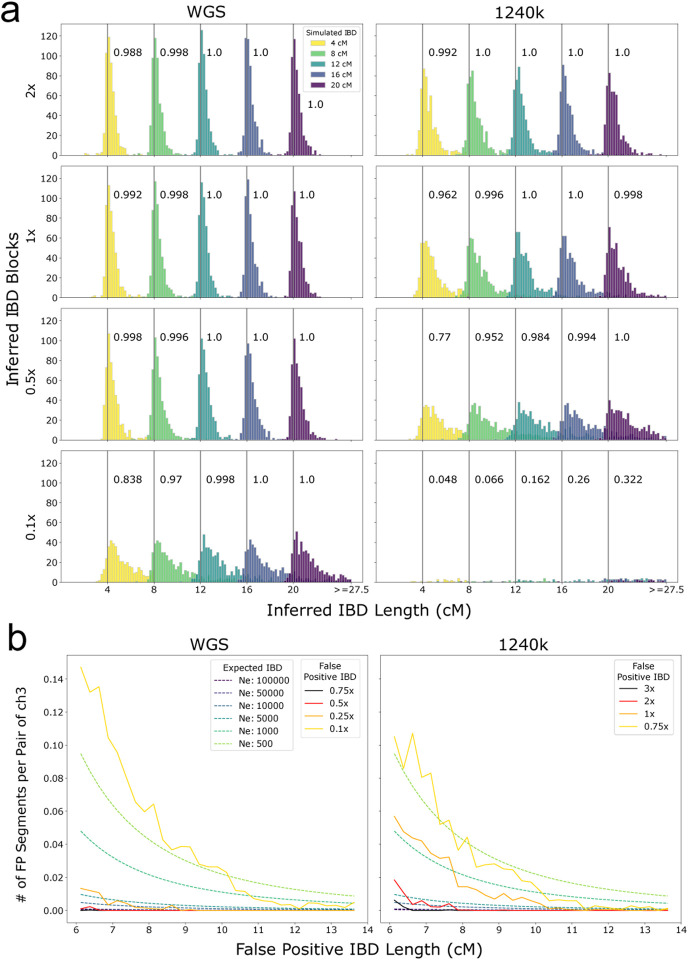
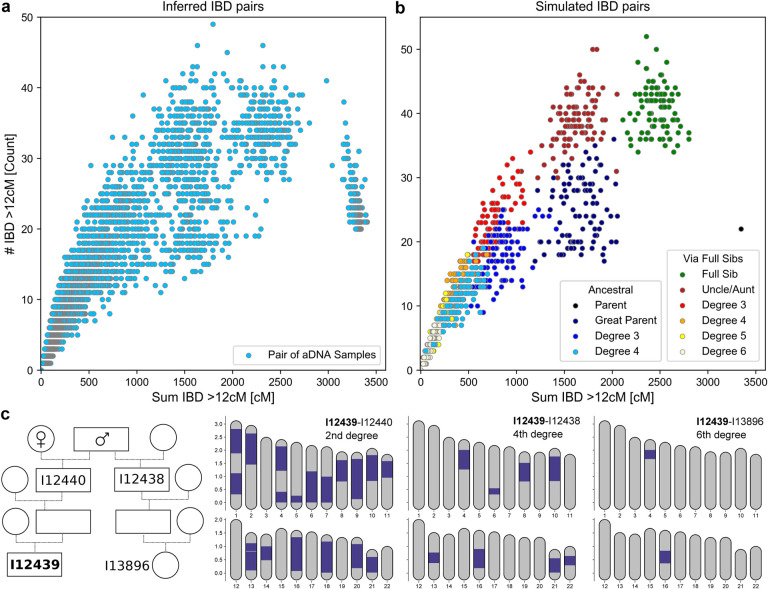
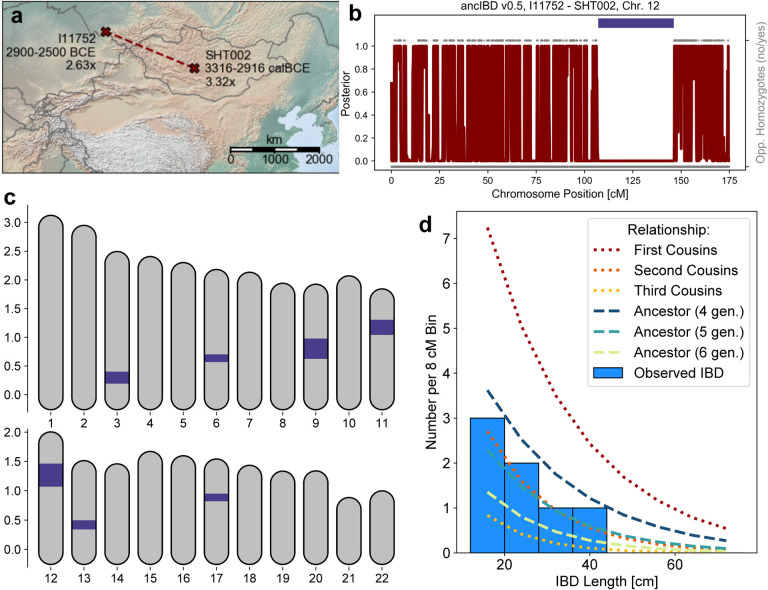
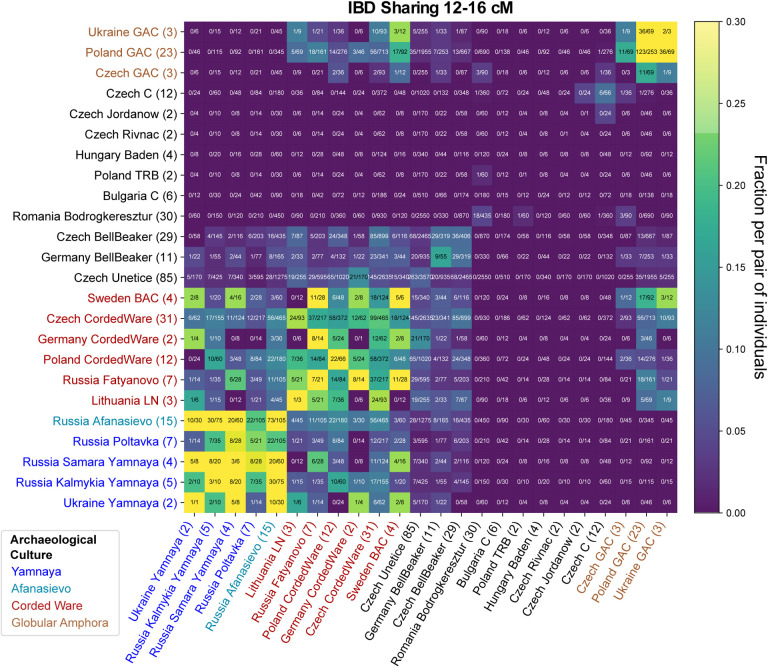
Long DNA segments shared between two individuals, known as identity-by-descent (IBD), reveal recent genealogical connections. Here we introduce ancIBD, a method for identifying IBD segments in ancient human DNA (aDNA) using a hidden Markov model and imputed genotype probabilities. We demonstrate that ancIBD accurately identifies IBD segments >8 cM for aDNA data with an average depth of >0.25× for whole-genome sequencing or >1× for 1240k single nucleotide polymorphism capture data. Applying ancIBD to 4,248 ancient Eurasian individuals, we identify relatives up to the sixth degree and genealogical connections between archaeological groups. Notably, we reveal long IBD sharing between Corded Ware and Yamnaya groups, indicating that the Yamnaya herders of the Pontic-Caspian Steppe and the Steppe-related ancestry in various European Corded Ware groups share substantial co-ancestry within only a few hundred years. These results show that detecting IBD segments can generate powerful insights into the growing aDNA record, both on a small scale relevant to life stories and on a large scale relevant to major cultural-historical events.
Overview
The claims and statistics of this paper haven’t been checked yet.
Run the check — free, no account needed. It reads the open-access text and checks the sources it cites.
Integrity signals
Registry
Cites
Statistics
Figures
Verification
Claims the paper makes
The claims and statistics of this paper haven’t been checked yet.
Run the check — free, no account needed. It reads the open-access text and checks the sources it cites.
Self-check
Percentages, sums and reported differences re-computed from the paper’s own numbers.
The self-check needs the paper’s full text.
Citations
Cites
A global reference for human genetic variation
The 1000 Genomes Project Consortium, authors, C., Auton, A., Abecasis, G. R., Steering committee, Altshuler, D. M., Durbin, R. M., Abecasis, G. R., Bentley, D. R., Chakravarti, A., et al. (2015) · Nature · doi:10.1038/nature15393 · Cited by 18,247
Durbin, R. M., Eddy, S. R., Krogh, A., & Mitchison, G. (1998) · Cambridge University Press eBooks · doi:10.1017/cbo9780511790492 · Cited by 3,255
Massive migration from the steppe was a source for Indo-European languages in Europe
Haak, W., Lazaridis, I., Patterson, N., Rohland, N., Mallick, S., Llamas, B., Brandt, G., Nordenfelt, S., Harney, E., Stewardson, K., et al. (2015) · Nature · doi:10.1038/nature14317 · Cited by 1,940
Self-citationPopulation genomics of Bronze Age Eurasia
Allentoft, M. E., Sikora, M., Sjögren, K.-G., Rasmussen, S., Rasmussen, M., Stenderup, J., Damgaard, P. B., Schroeder, H., Ahlström, T., Vinner, L., et al. (2015) · Nature · doi:10.1038/nature14507 · Cited by 1,550
Genome sequence of a 45,000-year-old modern human from western Siberia
Fu, Q., Li, H., Moorjani, P., Jay, F., Slepchenko, S. M., Bondarev, A. A., Johnson, P. L. F., Aximu-Petri, A., Prüfer, K., de Filippo, C., et al. (2014) · Nature · doi:10.1038/nature13810 · Cited by 1,023
Self-citationThe formation of human populations in South and Central Asia
Narasimhan, V. M., Patterson, N. J., Moorjani, P., Rohland, N., Bernardos, R. L., Mallick, S., Lazaridis, I., Nakatsuka, N. J., Olalde, Í., Lipson, M., et al. (2019) · Science · doi:10.1126/science.aat7487 · Cited by 819
Self-citationAn early modern human from Romania with a recent Neanderthal ancestor
Fu, Q., Hajdinjak, M., Moldovan, O. T., Constantin, S., Mallick, S., Skoglund, P., Patterson, N., Rohland, N., Lazaridis, I., Nickel, B., et al. (2015) · Nature · doi:10.1038/nature14558 · Cited by 802
Self-citationThe genomic history of southeastern Europe
Mathieson, I., Alpaslan-Roodenberg, S., Posth, C., Szécsényi‐Nagy, A., Rohland, N., Mallick, S., Olalde, Í., Broomandkhoshbacht, N., Candilio, F., Cheronet, O., et al. (2018) · Nature · doi:10.1038/nature25778 · Cited by 759
Self-citationImproving the Accuracy and Efficiency of Identity-by-Descent Detection in Population Data
Browning, B. L., & Browning, S. R. (2013) · Genetics · doi:10.1534/genetics.113.150029 · Cited by 649
Accurate, scalable and integrative haplotype estimation
Delaneau, O., Zagury, J., Robinson, M. R., Marchini, J., & Dermitzakis, E. T. (2019) · Nature Communications · doi:10.1038/s41467-019-13225-y · Cited by 604
The Beaker phenomenon and the genomic transformation of northwest Europe
Olalde, I., Brace, S., Allentoft, M. E., Armit, I., Kristiansen, K., Booth, T., Rohland, N., Mallick, S., Szécsényi-Nagy, A., Mittnik, A., et al. (2018) · Nature · doi:10.1038/nature25738 · Cited by 593
Self-citationThe genomic history of the Iberian Peninsula over the past 8000 years
Olalde, I., Mallick, S., Patterson, N., Rohland, N., Villalba-Mouco, V., Silva, M., Dulias, K., Edwards, C. J., Gandini, F., Pala, M., et al. (2019) · Science · doi:10.1126/science.aav4040 · Cited by 552
Self-citationThe Allen Ancient DNA Resource (AADR) a curated compendium of ancient human genomes
Mallick, S., Micco, A., Mah, M., Ringbauer, H., Lazaridis, I., Olalde, Í., Patterson, N. J., & Reich, D. (2024) · Scientific Data · doi:10.1038/s41597-024-03031-7 · Cited by 480
Self-citationEfficient phasing and imputation of low-coverage sequencing data using large reference panels
Rubinacci, S., Ribeiro, D. M., Hofmeister, R. J., & Delaneau, O. (2021) · Nature Genetics · doi:10.1038/s41588-020-00756-0 · Cited by 465
Whole population, genome-wide mapping of hidden relatedness
Gusev, A., Lowe, J. K., Stoffel, M., Daly, M. J., Altshuler, D., Breslow, J. L., Friedman, J. M., & Pe'er, I. (2009) · Genome Research · doi:10.1101/gr.081398.108 · Cited by 450
The Geography of Recent Genetic Ancestry across Europe
Ralph, P. L., & Coop, G. (2013) · PLoS Biology · doi:10.1371/journal.pbio.1001555 · Cited by 384
A Fast, Powerful Method for Detecting Identity by Descent
Browning, B. L., & Browning, S. R. (2011) · The American Journal of Human Genetics · doi:10.1016/j.ajhg.2011.01.010 · Cited by 372
Browning, S. R., & Browning, B. L. (2015) · The American Journal of Human Genetics · doi:10.1016/j.ajhg.2015.07.012 · Cited by 340
Cuomo, A. S. E., Seaton, D. D., McCarthy, D. J., Martinez, I., Bonder, M. J., Garcia-Bernardo, J., Amatya, S., Madrigal, P., Isaacson, A., Buettner, F., et al. (2020) · Nature Communications · doi:10.1038/s41467-020-14457-z · Cited by 331
Estimating genetic kin relationships in prehistoric populations
Monroy Kuhn, J. M., Jakobsson, M., & Günther, T. (2018) · PLOS ONE · doi:10.1371/journal.pone.0195491 · Cited by 330
A Dynamic 6,000-Year Genetic History of Eurasia’s Eastern Steppe
Jeong, C., Wang, K., Wilkin, S., Taylor, W. T. T., Miller, B. K., Bemmann, J., Stahl, R., Chiovelli, C., Knolle, F., Ulziibayar, S., et al. (2020) · Cell · doi:10.1016/j.cell.2020.10.015 · Cited by 326
Ancient genomes show social and reproductive behavior of early Upper Paleolithic foragers
Sikora, M., Seguin-Orlando, A., Sousa, V. C., Albrechtsen, A., Korneliussen, T., Ko, A., Rasmussen, S., Dupanloup, I., Nigst, P. R., Bosch, M. D., et al. (2017) · Science · doi:10.1126/science.aao1807 · Cited by 312
Combining archaeological and radiocarbon information: a Bayesian approach to calibration.
Buck, C. E., Kenworthy, J. B., Litton, C. D., & Smith, A. F. M. (1991) · Antiquity · doi:10.1017/s0003598x00080534 · Cited by 296
Parental relatedness through time revealed by runs of homozygosity in ancient DNA
Ringbauer, H., Novembre, J., & Steinrücken, M. (2021) · Nature Communications · doi:10.1038/s41467-021-25289-w · Cited by 263
Self-citationLength Distributions of Identity by Descent Reveal Fine-Scale Demographic History
Palamara, P. F., Lencz, T., Darvasi, A., & Pe’er, I. (2012) · The American Journal of Human Genetics · doi:10.1016/j.ajhg.2012.08.030 · Cited by 247
Kristiansen, K., Allentoft, M. E., Frei, K. M., Iversen, R., Johannsen, N. N., Kroonen, G., Pospieszny, Ł., Price, T. D., Rasmussen, S., Sjögren, K.-G., et al. (2017) · Antiquity · doi:10.15184/aqy.2017.17 · Cited by 247
The Horse, the Wheel, and Language
Anthony, D. W. (2010) · Princeton University Press eBooks · doi:10.2307/j.ctt7sjpn · Cited by 214
A unified genealogy of modern and ancient genomes
Wohns, A. W., Wong, Y., Jeffery, B., Akbari, A., Mallick, S., Pinhasi, R., Patterson, N. J., Reich, D., Kelleher, J., & McVean, G. (2022) · Science · doi:10.1126/science.abi8264 · Cited by 199
Self-citationUnraveling ancestry, kinship, and violence in a Late Neolithic mass grave
Schroeder, H., Margaryan, A., Szmyt, M., Theulot, B., Włodarczak, P., Rasmussen, S., Gopalakrishnan, S., Szczepanek, A., Konopka, T., Jensen, T. Z. T., et al. (2019) · Proceedings of the National Academy of Sciences · doi:10.1073/pnas.1820210116 · Cited by 195
Detecting Identity by Descent and Estimating Genotype Error Rates in Sequence Data
Browning, B. L., & Browning, S. R. (2013) · The American Journal of Human Genetics · doi:10.1016/j.ajhg.2013.09.014 · Cited by 187
A Fast and Simple Method for Detecting Identity-by-Descent Segments in Large-Scale Data
Zhou, Y., Browning, S. R., & Browning, B. L. (2020) · The American Journal of Human Genetics · doi:10.1016/j.ajhg.2020.02.010 · Cited by 175
A high-resolution picture of kinship practices in an Early Neolithic tomb
Fowler, C., Olalde, Í., Cummings, V., Armit, I., Büster, L., Cuthbert, S., Rohland, N., Cheronet, O., Pinhasi, R., & Reich, D. (2021) · Nature · doi:10.1038/s41586-021-04241-4 · Cited by 174
Self-citationDynamic changes in genomic and social structures in third millennium BCE central Europe
Papac, L., Ernée, M., Dobeš, M., Langová, M., Rohrlach, A. B., Aron, F., Neumann, G. U., Spyrou, M. A., Rohland, N., Velemínský, P., et al. (2021) · Science Advances · doi:10.1126/sciadv.abi6941 · Cited by 170
Self-citationA genetic history of the pre-contact Caribbean
Fernandes, D., Sirak, K. A., Ringbauer, H., Sedig, J. W., Rohland, N., Cheronet, O., Mah, M., Mallick, S., Olalde, Í., Culleton, B. J., et al. (2020) · Nature · doi:10.1038/s41586-020-03053-2 · Cited by 166
Self-citationThe Allen Ancient DNA Resource (AADR): A curated compendium of ancient human genomesPreprint
Mallick, S., Micco, A., Mah, M., Ringbauer, H., Lazaridis, I., Olalde, Í., Patterson, N. J., & Reich, D. (2023) · bioRxiv (Cold Spring Harbor Laboratory) · doi:10.1101/2023.04.06.535797 · Cited by 153
Self-citationThree assays for in-solution enrichment of ancient human DNA at more than a million SNPsPreprint
Rohland, N., Mallick, S., Mah, M., Maier, R., Patterson, N. J., & Reich, D. (2022) · Genome Research · doi:10.1101/gr.276728.122 · Cited by 152
Self-citationSaada, J. N., Kalantzis, G., Shyr, D., Cooper, F., Robinson, M. J., Gusev, A., & Palamara, P. F. (2020) · Nature Communications · doi:10.1038/s41467-020-19588-x · Cited by 124
Estimating recent migration and population-size surfaces
Al-Asadi, H., Petkova, D., Stephens, M., & Novembre, J. (2019) · PLoS Genetics · doi:10.1371/journal.pgen.1007908 · Cited by 111
KIN: a method to infer relatedness from low-coverage ancient DNA
Popli, D., Peyrégne, S., & Peter, B. M. (2023) · Genome biology · doi:10.1186/s13059-023-02847-7 · Cited by 111
Evaluating genotype imputation pipeline for ultra-low coverage ancient genomes
Hui, R., D’Atanasio, E., Cassidy, L. M., Scheib, C. L., & Kivisild, T. (2020) · Scientific Reports · doi:10.1038/s41598-020-75387-w · Cited by 109
Maximum Likelihood Estimation of Biological Relatedness from Low Coverage Sequencing Data
Lipatov, M., Sanjeev, K., Patro, R., & Veeramah, K. R. (2015) · doi:10.1101/023374 · Cited by 108
Clustering of 770,000 genomes reveals post-colonial population structure of North America
Han, E., Carbonetto, P. S., Curtis, R. E., Wang, Y., Granka, J. M., Byrnes, J., Noto, K., Kermany, A. R., Myres, N. M., Barber, M., et al. (2017) · Nature Communications · doi:10.1038/ncomms14238 · Cited by 107
Imputation of ancient human genomes
da Mota, B. S., Rubinacci, S., Dávalos, D. I. C., Amorim, C. E. G., Sikora, M., Johannsen, N. N., Szmyt, M., Włodarczak, P., Szczepanek, A., Przybyła, M. M., et al. (2023) · Nature Communications · doi:10.1038/s41467-023-39202-0 · Cited by 107
Population genomics of postglacial western eurasiaPreprint
Allentoft, M. E., Sikora, M., Refoyo-Martínez, A., Irving-Pease, E. K., Fischer, A., Barrie, W., Ingason, A., Stenderup, J. T., Sjögren, K.-G., Pearson, A., et al. (2022) · bioRxiv (Cold Spring Harbor Laboratory) · doi:10.1101/2022.05.04.490594 · Cited by 103
Caballero, M., Seidman, D. N., Qiao, Y., Sannerud, J., Dyer, T. D., Lehman, D. M., Curran, J. E., Duggirala, R., Blangero, J., Carmi, S., et al. (2019) · PLoS Genetics · doi:10.1371/journal.pgen.1007979 · Cited by 92
Seidman, D. N., Shenoy, S. A., Kim, M., Babu, R. K., Woods, I. G., Dyer, T. D., Lehman, D. M., Curran, J. E., Duggirala, R., Blangero, J., et al. (2020) · The American Journal of Human Genetics · doi:10.1016/j.ajhg.2020.02.012 · Cited by 85
Beyond broad strokes: sociocultural insights from the study of ancient genomes
Racimo, F., Sikora, M., Linden, M. V., Schroeder, H., & Lalueza‐Fox, C. (2020) · Nature Reviews Genetics · doi:10.1038/s41576-020-0218-z · Cited by 80
Inferring Recent Demography from Isolation by Distance of Long Shared Sequence Blocks
Ringbauer, H., Coop, G., & Barton, N. (2017) · Genetics · doi:10.1534/genetics.116.196220 · Cited by 71
Self-citationInference of historical migration rates via haplotype sharing
Palamara, P. F., & Pe’er, I. (2013) · Bioinformatics · doi:10.1093/bioinformatics/btt239 · Cited by 68
Rbpj expression in regulatory T cells is critical for restraining TH2 responses
Delacher, M., Schmidl, C., Herzig, Y., Breloer, M., Hartmann, W., Brunk, F., Kägebein, D., Träger, U., Hofer, A.-C., Bittner, S., et al. (2019) · Nature Communications · doi:10.1038/s41467-019-09276-w · Cited by 63
Ancient and modern genomics of the Ohlone Indigenous population of California
Severson, A. L., Byrd, B. F., Mallott, E. K., Owings, A. C., DeGiorgio, M., de Flamingh, A., Nijmeh, C., Arellano, M. V., Leventhal, A. M., Rosenberg, N. A., et al. (2022) · Proceedings of the National Academy of Sciences · doi:10.1073/pnas.2111533119 · Cited by 47
Estimating IBD tracts from low coverage NGS data
Vieira, F. G., Albrechtsen, A., & Nielsen, R. (2016) · Bioinformatics · doi:10.1093/bioinformatics/btw212 · Cited by 44
The Variance of Identity-by-Descent Sharing in the Wright–Fisher Model
Carmi, S., Palamara, P. F., Vacic, V., Lencz, T., Darvasi, A., & Pe’er, I. (2012) · Genetics · doi:10.1534/genetics.112.147215 · Cited by 39
Conflation of Short Identity-by-Descent Segments Bias Their Inferred Length Distribution
Chiang, C. W. K., Ralph, P. L., & Novembre, J. (2016) · G3 Genes Genomes Genetics · doi:10.1534/g3.116.027581 · Cited by 33
Kivisild, T., Saag, L., Hui, R., Biagini, S. A., Pankratov, V., D’Atanasio, E., Pagani, L., Saag, L., Rootsi, S., Mägi, R., et al. (2021) · The American Journal of Human Genetics · doi:10.1016/j.ajhg.2021.07.012 · Cited by 26
Bercovici, S., Meek, C., Wexler, Y., & Geiger, D. (2010) · Bioinformatics · doi:10.1093/bioinformatics/btq204 · Cited by 25
Ancient Maltese genomes and the genetic geography of Neolithic Europe
Ariano, B., Mattiangeli, V., Breslin, E. M., Parkinson, E. W., McLaughlin, R., Thompson, J. E., Power, R. K., Stock, J. T., Mercieca‐Spiteri, B., Stoddart, S., et al. (2022) · Current Biology · doi:10.1016/j.cub.2022.04.069 · Cited by 24
Combining ancient DNA and radiocarbon dating data to increase chronological accuracy
Sedig, J. W., Olalde, Í., Patterson, N. J., Harney, É., & Reich, D. (2021) · Journal of Archaeological Science · doi:10.1016/j.jas.2021.105452 · Cited by 21
Self-citationMapping co-ancestry connections between the genome of a Medieval individual and modern Europeans
Ferrando-Bernal, M., Morcillo-Suárez, C., de-Dios, T., Gelabert, P., Civit, S., Díaz-Carvajal, A., Ollich-Castanyer, I., Allentoft, M. E., Valverde, S., & Lalueza‐Fox, C. (2020) · Scientific Reports · doi:10.1038/s41598-020-64007-2 · Cited by 13
A Genealogical Look at Shared Ancestry on the X Chromosome
Buffalo, V., Mount, S. M., & Coop, G. (2016) · Genetics · doi:10.1534/genetics.116.190041 · Cited by 10
Severson, A. L., Korneliussen, T. S., & Moltke, I. (2021) · Bioinformatics · doi:10.1093/bioinformatics/btab732 · Cited by 10
Properties of 2-locus genealogies and linkage disequilibrium in temporally structured samples
Biddanda, A., Steinrücken, M., & Novembre, J. (2022) · Genetics · doi:10.1093/genetics/iyac038 · Cited by 10
Pedigree-based Bayesian modelling of radiocarbon dates
Massy, K., Friedrich, R., Mittnik, A., & Stockhammer, P. W. (2022) · PLoS ONE · doi:10.1371/journal.pone.0270374 · Cited by 9
KIN: A method to infer relatedness from low-coverage ancient DNAPreprint
Popli, D., Peyrégne, S., & Peter, B. M. (2022) · bioRxiv (Cold Spring Harbor Laboratory) · doi:10.1101/2022.10.21.513172 · Cited by 7
Imputation of ancient genomesPreprint
da Mota, B. S., Rubinacci, S., Dávalos, D. I. C., Amorim, C. E. G., Sikora, M., Johannsen, N. N., Szmyt, M., Włodarczak, P., Szczepanek, A., Przybyła, M. M., et al. (2022) · bioRxiv (Cold Spring Harbor Laboratory) · doi:10.1101/2022.07.19.500636 · Cited by 4
Research works printed but not linked: 1
- Bishop, C. M. Pattern Recognition and Machine Learning (Information Science and Statistics) 627–628 (Springer, 2006).
Cited by
Sorted by citations
Extensive pedigrees reveal the social organization of a Neolithic community
Rivollat, M., Rohrlach, A. B., Ringbauer, H., Childebayeva, A., Mendisco, F., Barquera, R., Szolek, A., Roy, M. L., Colleran, H., Tuke, J., et al. (2023) · Nature · doi:10.1038/s41586-023-06350-8 · Cited by 118
Self-citationThe genetic origin of the Indo-Europeans
Lazaridis, I., Patterson, N. J., Anthony, D. W., Vyazov, L. A., Fournier, R., Ringbauer, H., Olalde, Í., Khokhlov, A. A., Kitov, E. P., Shishlina, N., et al. (2025) · Nature · doi:10.1038/s41586-024-08531-5 · Cited by 118
Self-citationREADv2: advanced and user-friendly detection of biological relatedness in archaeogenomics
Alaçamlı, E., Naidoo, T., Güler, M. N., Sağlıcan, E., Aktürk, Ş., Mapelli, I., Vural, K. B., Somel, M., Malmström, H., & Günther, T. (2024) · Genome biology · doi:10.1186/s13059-024-03350-3 · Cited by 89
Network of large pedigrees reveals social practices of Avar communities
Gnecchi‐Ruscone, G. A., Rácz, Z., Samu, L., Szeniczey, T., Faragó, N., Knipper, C., Friedrich, R., Zlámalová, D., Traverso, L., Liccardo, S., et al. (2024) · Nature · doi:10.1038/s41586-024-07312-4 · Cited by 75
Earliest modern human genomes constrain timing of Neanderthal admixture
Sümer, A. P., Rougier, H., Villalba-Mouco, V., Huang, Y., Iasi, L. N. M., Essel, E., Bossoms Mesa, A., Furtwaengler, A., Peyrégne, S., de Filippo, C., et al. (2025) · Nature · doi:10.1038/s41586-024-08420-x · Cited by 58
Self-citation
Metadata
- Authors
- Ringbauer, H., Huang, Y., Akbari, A., Mallick, S., Olalde, I., Patterson, N., & Reich, D.
- Affiliations
- Harvard University (US)
- Max Planck Institute for Evolutionary Anthropology (DE)
- Broad Institute (US)
- Corresponding author
- Ringbauer, Harald
- Reich, David
- ORCID
- Venue
- Nature Genetics
- Published
- 2023-12-20
- Volume
- 56
- Issue
- 1
- Pages
- 143-151
- ISSN
- 1061-4036 (ISSN-L)
- 1546-1718
- PMC
- PMC10028887
- OpenAlex
- W4390070832
- Cited by
- 155
- References
- 65
- Citations by year
- 2026: 62 · 2025: 49 · 2024: 32 · 2023: 12
- FWCI
- 25.73
- Type
- journal article
- Language
- en
- Open access
- hybrid
- doi.org
- Locations
- Nature Genetics (publishedVersion, cc-by)
- bioRxiv (Cold Spring Harbor Laboratory) (acceptedVersion, cc-by-nc-nd)
- PubMed Central (publishedVersion, cc-by)
- PubMed (publishedVersion)
- PubMed Central (submittedVersion, cc-by-nc-nd)
- Funders
- Max-Planck-Gesellschaft
- U.S. Department of Health & Human Services | National Institutes of Health (HG012287)
- John Templeton Foundation (61220)
- Topics
- Life Sciences › Biochemistry, Genetics and Molecular Biology › Genetics › Forensic and Genetic Research
- Life Sciences › Biochemistry, Genetics and Molecular Biology › Genetics › Genetic diversity and population structure
- Life Sciences › Biochemistry, Genetics and Molecular Biology › Genetics › Genetic Associations and Epidemiology
- Keywords
- identity by descent, ancient DNA, hidden Markov models, genotype imputation, coancestry, Corded Ware, Yamnaya, Steppe ancestry
About these checks
Registry, retraction, Cites and statistics results are computed, not judged, with one exception: a printed reference that no index lists is read once by a model before it counts as a citation error. Claims are extracted by a model and kept only when their quote appears verbatim in the text; each cited source is then checked, with a model’s help, for whether it says what the claim relies on. Those verdicts can be wrong — read the claim’s quote and the cited source before relying on one.
Statistics and arithmetic are recomputed, not judged.
Confidence bands are shown only for fields calibrated on our annotated test set. None is calibrated yet, so no band is shown.
What counts as a claim ›How we measure confidence ›How we check this ›
Are you an author, or do you see a problem with this page? Request a review
