

Evaluation and mitigation of the limitations of large language models in clinical decision-making
Open accessPublished version of a preprint
The DOI matches its Crossref record; 92 of the 92 references it cites were found in a registry or an index; 20 of the 24 sources its claims cite were checked for support.
Abstract
Clinical decision-making is one of the most impactful parts of a physician's responsibilities and stands to benefit greatly from artificial intelligence solutions and large language models (LLMs) in particular. However, while LLMs have achieved excellent performance on medical licensing exams, these tests fail to assess many skills necessary for deployment in a realistic clinical decision-making environment, including gathering information, adhering to guidelines, and integrating into clinical workflows. Here we have created a curated dataset based on the Medical Information Mart for Intensive Care database spanning 2,400 real patient cases and four common abdominal pathologies as well as a framework to simulate a realistic clinical setting. We show that current state-of-the-art LLMs do not accurately diagnose patients across all pathologies (performing significantly worse than physicians), follow neither diagnostic nor treatment guidelines, and cannot interpret laboratory results, thus posing a serious risk to the health of patients. Furthermore, we move beyond diagnostic accuracy and demonstrate that they cannot be easily integrated into existing workflows because they often fail to follow instructions and are sensitive to both the quantity and order of information. Overall, our analysis reveals that LLMs are currently not ready for autonomous clinical decision-making while providing a dataset and framework to guide future studies.
Overview
CoChat Summary
TL;DR
This study evaluates open-access LLMs on a realistic clinical decision-making task using 2,400 real emergency department cases of acute abdominal pain from MIMIC-IV. The models performed significantly worse than physicians, failed to follow diagnostic/treatment guidelines, and were too fragile and instruction-sensitive for autonomous clinical use.
Key findings
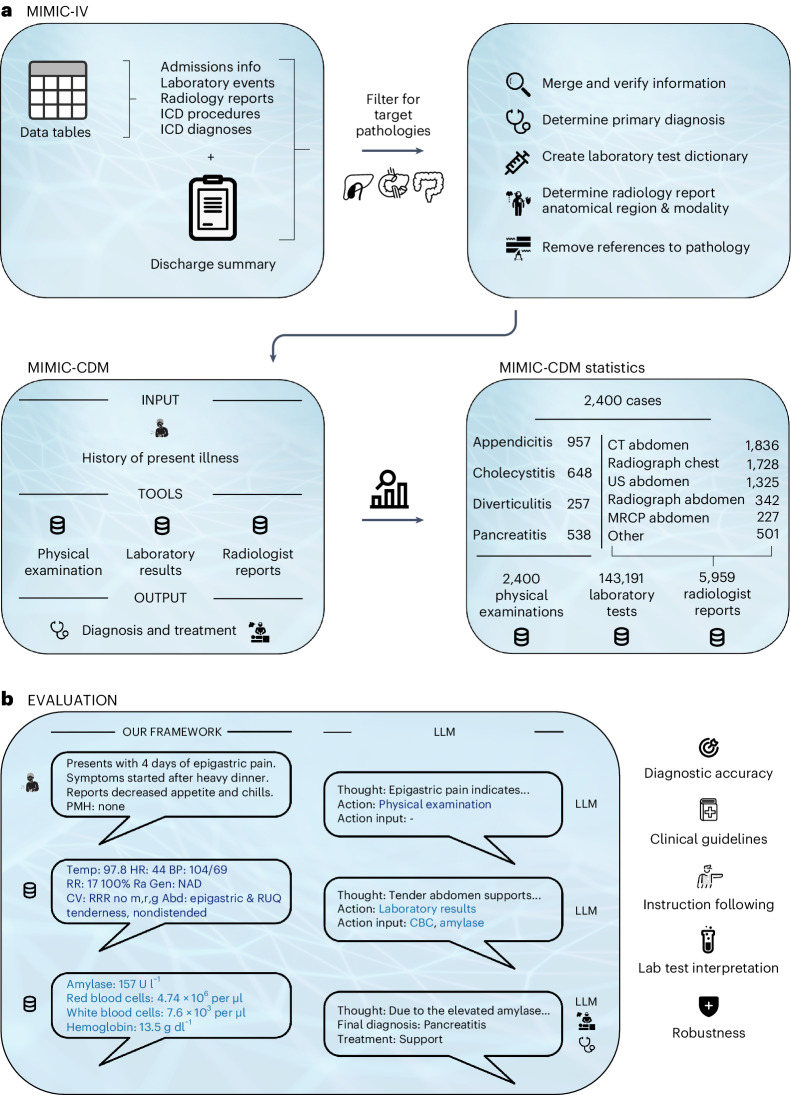
- The curated dataset, MIMIC-CDM, contains 2,400 unique patients with appendicitis (957), cholecystitis (648), diverticulitis (257), and pancreatitis (538).
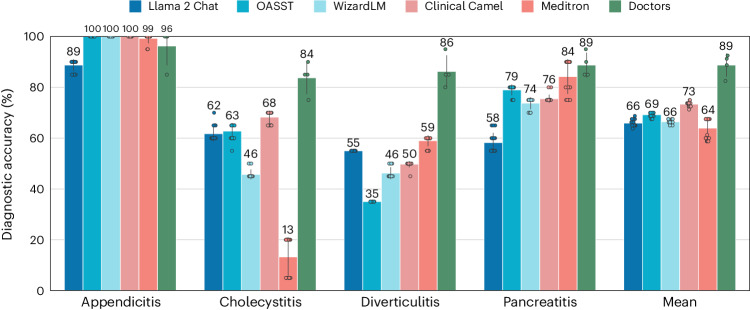
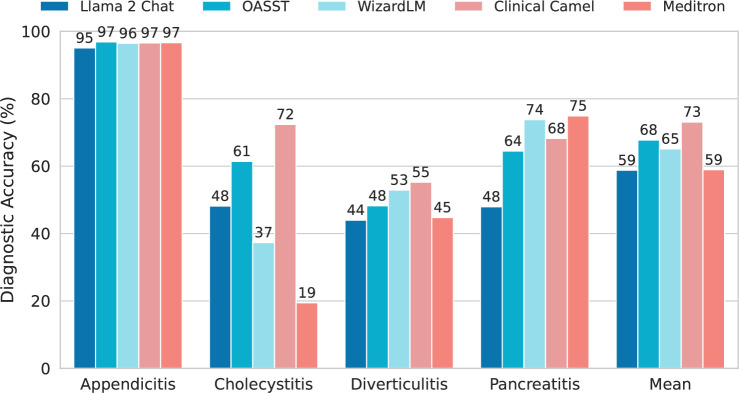
- On a reader study with 80 patients and 4 hospitalists, current LLMs performed significantly worse than clinicians on aggregate across all diseases (P < 0.001 for doctors versus Llama 2 Chat, OASST, WizardLM, Clinical Camel, and Meditron).
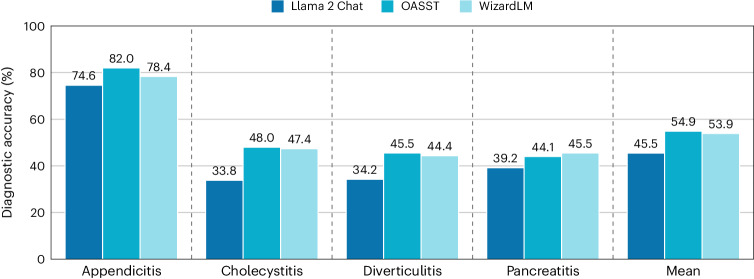
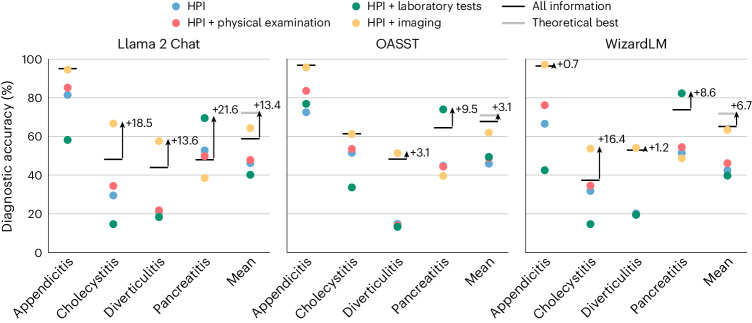
- Diagnostic performance dropped further when models had to gather information themselves: mean diagnostic accuracy fell to 45.5% for Llama 2 Chat, 54.9% for OASST, and 53.9% for WizardLM, versus 58.8%, 67.8%, and 65.1% on the full-information setup, respectively.
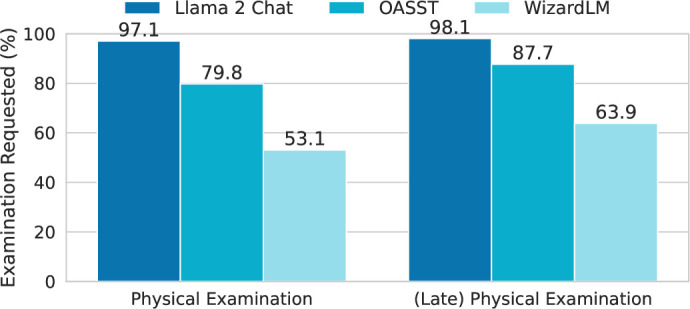
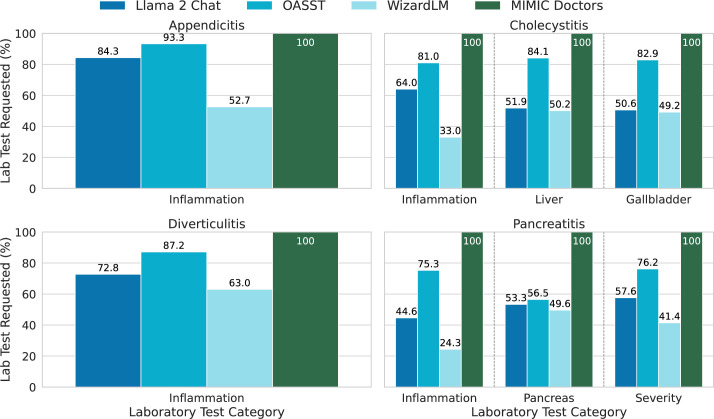
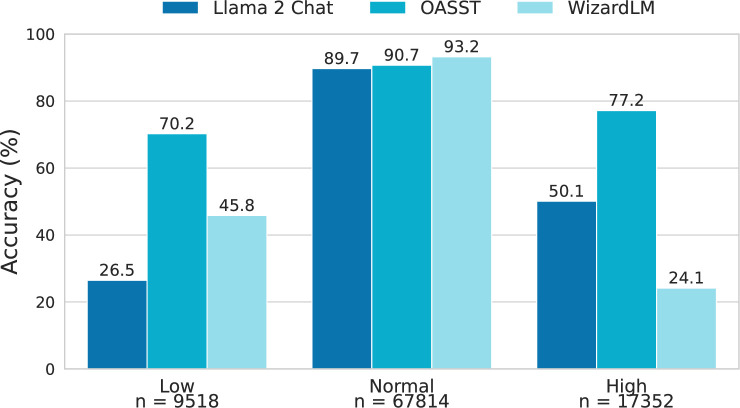
- Models also failed basic safety checks: only Llama 2 Chat consistently requested physical examination information (97.1% as first action; 98.1% at all), and laboratory interpretation was poor even with reference ranges (for example, low results: 26.5% Chat, 70.2% OASST, 45.8% WizardLM; high results: 50.1%, 77.2%, 24.1%).
Methods
- The authors built MIMIC-CDM from the MIMIC-IV EHR database by filtering to emergency department cases with acute abdominal pain and a primary diagnosis of one of four target pathologies, then extracting history of present illness, physical exams, labs, microbiology, imaging, and procedures.
- They evaluated open-access models derived from Llama 2, focusing mainly on Llama 2 Chat, OASST, and WizardLM, and compared them with clinicians on a 100-patient reader study (80 target cases plus 5 each of other conditions), with each LLM evaluated 20 times on the physician comparison subset using different seeds.
- Main analysis included per-class accuracy, guideline adherence for diagnostic tests and treatments, lab interpretation tasks, instruction-following, robustness to changes in wording, order, and amount of information, and comparisons using two-sided Student’s t-tests with Bonferroni correction.
Limitations
- The paper states that the dataset and models have a clear bias toward the USA, so generalizability to other languages or countries with different guidelines is unknown.
- The authors note that, because they used real-world clinical data, they had to deny requests for information not in the dataset; they argue this was mitigated because MIMIC-IV contains all data gathered during the hospital stay.
- Evident from the text: the study focuses only on four abdominal pathologies, so it does not cover the full breadth of clinical decision-making (the paper itself notes this as a constraint).
Model-written summary. Check it against the paper before relying on it.
Integrity signals
Registry
Cites
Statistics
Figures
Verification
Claims the paper makes
6 Valid · 2 Not valid · 3 Not checked · 106 Own results and interpretations
Some cited sources support this claim and some don’t — read each source’s verdict below.
In the paper
“where LLMs score well above passing8–10,17–20”
§ Evaluation and mitigation of the limitations of large language models in clinical decision-making > Main
What the sources say
- Supportedcites [8] Singhal, K. et al. Towards expert-level medical question answering with large language models. Preprint at https://arxiv.org/abs/2305.09617 (2023). source
The Abstract (page not supplied) reports that Med-PaLM 2 scored 86.5% on MedQA, a dataset of USMLE-style questions, and that its predecessor had exceeded a passing score at 67.2%. This supports the claim about LLM performance on medical-licensing-exam-style questions. (LLM, conf=0.93)
- Partly supportedcites [9] Singhal, K. et al. Large language models encode clinical knowledge. Nature 620, 172–180 (2023). sourceExperimental — accuracy not yet measured
The ‘State of the art on MedQA’ section reports that Flan-PaLM scored 67.6% on USMLE-style questions, supporting strong performance on a medical-exam benchmark. Our copy does not establish a passing threshold or show that LLMs scored well above it on actual licensing exams. (LLM, conf=0.86)
- Supportedcites [10] Nori, H., King, N., McKinney, S. M., Carignan, D. & Horvitz, E. Capabilities of GPT-4 on medical challenge problems. Preprint at https://arxiv.org/abs/2303.13375 (2023). source
The Abstract (p. 1) reports that GPT-4 exceeded the USMLE passing score by over 20 points. The Introduction (p. 2) specifies that the results came from official sample exams and self-assessment materials, supporting this citation as an example of an LLM scoring well above passing on medical licensing exam materials. (LLM, conf=0.93)
- Disputedcites [17] Kung, T. H. et al. Performance of chatgpt on usmle: potential for ai-assisted medical education using large language models. PLoS Digital Health 2, 0000198 (2023). sourceExperimental — accuracy not yet measured
The Discussion (‘The rising accuracy of ChatGPT’) says ChatGPT exceeded 60% accuracy in some analyses, while the USMLE passing threshold is approximately 60%; it concludes that ChatGPT ‘approaches the passing range.’ The paper describes performance as at or near passing, not well above it. (LLM, conf=0.88)
Checked by a reasoning model — may be wrong.
- Disputedcites [18] Gilson, A. et al. How does chatgpt perform on the United States medical licensing examination? The implications of large language models for medical education and knowledge assessment. JMIR Med. Educ. 9, 45312 (2023). sourceExperimental — accuracy not yet measured
The Results (Overall Performance; page unavailable) report that ChatGPT exceeded the paper’s approximately 60% passing benchmark on only one of four question sets, scoring 64.4%. It scored below that benchmark on the other three; InstructGPT and GPT-3 scored below it on all four. The paper therefore does not show LLMs scoring well above passing. (LLM, conf=0.90)
Checked by a reasoning model — may be wrong.
- Partly supportedcites [19] Toma, A. et al. Clinical camel: an open-source expert-level medical language model with dialogue-based knowledge encoding. Preprint at https://arxiv.org/abs/2305.12031 (2023). sourceExperimental — accuracy not yet measured
Table 4 reports strong five-shot scores on the USMLE Sample Exam, including 86.6% for GPT-4 and 64.3% for Clinical Camel-70B. But the paper gives no passing threshold, and other models score substantially lower, so it does not establish that LLMs generally score well above passing. (LLM, conf=0.82)
- Supportedcites [20] Nori, H. et al. Can generalist foundation models outcompete special-purpose tuning? Case study in medicine. Preprint at https://arxiv.org/abs/2311.16452 (2023). source
Section 2.1 reports that GPT-4 exceeded the USMLE passing score by over 20 points. The Abstract also reports that GPT-4 with Medprompt surpassed 90% on MedQA, a USMLE-style exam-question dataset. These passages support the cited claim that LLMs can score well above passing on medical licensing exam questions. (LLM, conf=0.91)
boosted- Asserted: passes — The authors put it forward as true.
- Checkable: passes — It can be checked against evidence.
- Load-bearing: unclear — It is unclear whether the paper’s conclusions depend on it.
- Based: passes — The paper gives a reason why it holds.
- Supported
The cited sources support only part of this claim — read each source’s verdict below.
In the paper
“We note that Llama 2, Clinical Camel and Meditron have been shown to match and even exceed Chat-GPT performance on medical licensing exams and biomedical question answering tests19,35.”
§ Evaluation and mitigation of the limitations of large language models in clinical decision-making > Results > Creating the MIMIC-CDM dataset and evaluation framework
What the sources say
- Partly supportedcites [19] Toma, A. et al. Clinical camel: an open-source expert-level medical language model with dialogue-based knowledge encoding. Preprint at https://arxiv.org/abs/2305.12031 (2023). sourceExperimental — accuracy not yet measured
Section 4 (Evaluation) and Table 4 report that Clinical Camel-70B exceeded GPT-3.5 on five-shot medical benchmarks, including MedQA, PubMedQA and the USMLE sample exam. The paper does not show that LLaMA 2 or Meditron achieved those results; Clinical Camel was fine-tuned from LLaMA 2. It also says Clinical Camel generally fell short of GPT-4, except on PubMedQA. Page numbers were not available in our copy. (LLM, conf=0.88)
- Partly supportedcites [35] Chen, Z. et al. MEDITRON-70B: scaling medical pretraining for large language models. Preprint at https://arxiv.org/abs/2311.16079 (2023). sourceExperimental — accuracy not yet measured
Section 6.2 reports that MEDITRON-70B outperformed GPT-3.5 on the medical benchmarks, including MedQA and PubMedQA. It evaluates Llama-2 and Clinical-Camel as baselines but does not establish that either matched or exceeded GPT-3.5 on those tests. The benchmark comparison also uses text-davinci-003 as GPT-3.5, not ChatGPT itself. (LLM, conf=0.87)
boosted- Asserted: passes — The authors put it forward as true.
- Checkable: passes — It can be checked against evidence.
- Load-bearing: unclear — It is unclear whether the paper’s conclusions depend on it.
- Based: passes — The paper gives a reason why it holds.
- Partly supported
The cited sources support only part of this claim — read each source’s verdict below.
In the paper
“All guidelines recommended physical examinations as an essential part of the diagnostic process, preferably as the first action.”
§ Evaluation and mitigation of the limitations of large language models in clinical decision-making > Results > Current LLMs are hasty and unsafe clinical decision-makers
What the sources say
- Partly supportedcites [36] Di Saverio, S. et al. Diagnosis and treatment of acute appendicitis: 2020 update of the WSES Jerusalem guidelines. World J. Emerg. Surg. 15, 27 (2020). sourceExperimental — accuracy not yet measured
In Results, Topic 1: Diagnosis, the WSES guideline includes physical examination and clinical signs in its diagnostic approach, and Recommendation 1.10 makes imaging conditional on clinical assessment. This supports an early role for examination, but this single guideline does not establish what all guidelines recommend or explicitly say physical examination should be the first action. (LLM, conf=0.85)
- Partly supportedcites [37] Pisano, M. et al. 2020 World Society of Emergency Surgery updated guidelines for the diagnosis and treatment of acute calculus cholecystitis. World J. Emerg. Surg. 15, 61 (2020). sourceExperimental — accuracy not yet measured
Section 1, Diagnosis of ACC (page not provided), suggests including a complete clinical examination alongside history, laboratory tests and imaging. It does not say examination should be the first action, and this single guideline does not establish what all guidelines recommend. (LLM, conf=0.87)
- Partly supportedcites [38] Hall, J. et al. The american society of colon and rectal surgeons clinical practice guidelines for the treatment of left-sided colonic diverticulitis. Dis. Colon Rectum 63, 728–747 (2020). sourceExperimental — accuracy not yet measured
In “Initial Evaluation of Acute Diverticulitis” (recommendation 1; page not supplied), this guideline recommends a physical examination as part of the initial evaluation. It does not establish what all guidelines recommend or say that the examination should preferably be the first action. (LLM, conf=0.84)
plain- Asserted: passes — The authors put it forward as true.
- Checkable: passes — It can be checked against evidence.
- Load-bearing: passes — The paper’s conclusions depend on it.
- Based: passes — The paper gives a reason why it holds.
- Partly supported
A result the paper reports from its own data — it cites no other source for it, so there is none to check. The quote shows it is in the paper.
In the paper
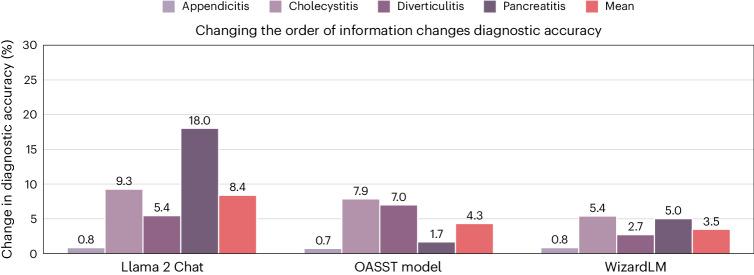
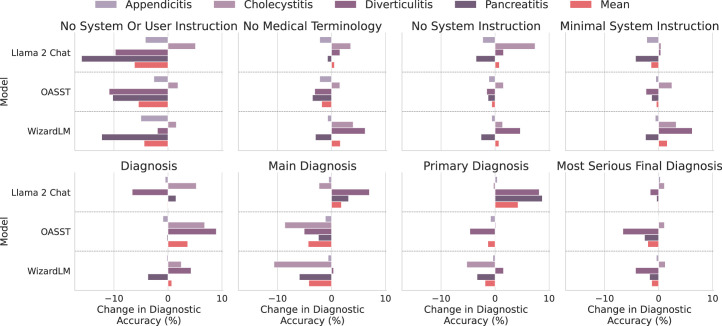
“Additionally, we see that even minor changes in instructions can greatly change diagnostic accuracy such as asking for the ‘main diagnosis’ (up to +7.0% for Chat on diverticulitis, down to −10.6% for WizardLM on cholecystitis) or ‘primary diagnosis’ (up +8.7% for Chat on pancreatitis, down to −5.2% for WizardLM on cholecystitis) instead of ‘final diagnosis’.”
§ Evaluation and mitigation of the limitations of large language models in clinical decision-making > Results > Current LLMs require extensive clinician supervision
plainstates a cause- Asserted: passes — The authors put it forward as true.
- Checkable: passes — It can be checked against evidence.
- Load-bearing: passes — The paper’s conclusions depend on it.
- Based: passes — The paper gives a reason why it holds.
A result the paper reports from its own data — it cites no other source for it, so there is none to check. The quote shows it is in the paper.
In the paper
“We show that current state-of-the-art LLMs do not accurately diagnose patients across all pathologies (performing significantly worse than physicians)”
§ Evaluation and mitigation of the limitations of large language models in clinical decision-making > Abstract
plainn = 2,400- Asserted: passes — The authors put it forward as true.
- Checkable: passes — It can be checked against evidence.
- Load-bearing: passes — The paper’s conclusions depend on it.
- Based: passes — The paper gives a reason why it holds.
59 more claims
Create a free account to see all 117 claims and to verify the 1 reference still open.
- It may state two separate claims as one. 40
- Probably not a substantial claim. 20
- The quote only partly states this claim. 1
Claims other papers make about this one
Each is checked against this paper’s own text: does it say what the citing paper says it does?
The source backs part of the claim, not all of it — or backs it for a different population, condition or comparison.
In the citing paper
“While medical licensing exams and diagnostic tasks are prioritized in 64% of LLM healthcare evaluations8, many administrative and operational tasks that represent significant human bottlenecks are often overlooked.”
From Holistic evaluation of large language models for medical tasks with MedHELM (2026) · cites this paper as [9]
Experimental — accuracy not yet measuredThe source backs part of the claim, not all of it — or backs it for a different population, condition or comparison.
In the citing paper
“While these models offer powerful foundational capabilities, adapting them to specific tasks and datasets without losing robustness is a significant hurdle, often resulting in significant variability in accuracy across different settings.7,9,10”
From Advancing methodological development of artificial intelligence in patient-centered comparative clinical effectiveness research: Patient-Centered Outcomes Research Institute’s unique contribution to research done differently (2025) · cites this paper as [9]
Experimental — accuracy not yet measuredThe cited source says what the claim attributes to it.
In the citing paper
“While LLM performance on medical QA benchmarks has been demonstrated to rival human-level performance, their capabilities in simulated real-world medical scenarios have been more limited12.”
From Limitations of large language models in clinical problem-solving arising from inflexible reasoning (2025) · cites this paper as [12]
The cited source says what the claim attributes to it.
In the citing paper
“Another study demonstrated that while LLMs show potential for clinical decision-making, they currently underperform compared to human clinicians in diagnosing common conditions such as appendicitis, cholecystitis, diverticulitis, and pancreatitis.”
From Enhancing diagnostic capability with multi-agents conversational large language models (2025) · cites this paper as [30]
Citations
Cites
Language Models are Few-Shot Learners
Brown, T. B., Mann, B., Ryder, N., Subbiah, M., Kaplan, J., Dhariwal, P., Neelakantan, A., Shyam, P., Sastry, G., Askell, A., et al. (2020) · arXiv · doi:10.48550/arxiv.2005.14165 · Cited by 23,372
Goldberger, A. L., Amaral, L. A. N., Glass, L., Hausdorff, J. M., Ivanov, P. C., Mark, R. G., Mietus, J. E., Moody, G. B., Peng, C.-K., & Stanley, H. E. (2000) · Circulation · doi:10.1161/01.cir.101.23.e215 · Cited by 14,809
Exploring the Limits of Transfer Learning with a Unified Text-to-Text Transformer
Raffel, C., Shazeer, N., Roberts, A., Lee, K., Narang, S., Matena, M., Zhou, Y., Li, W., & Liu, P. J. (2019) · arXiv · doi:10.48550/arxiv.1910.10683 · Cited by 10,929
Scaling Laws for Neural Language Models
Kaplan, J., McCandlish, S., Henighan, T., Brown, T. B., Chess, B., Child, R., Gray, S., Radford, A., Wu, J., & Amodei, D. (2020) · arXiv · doi:10.48550/arxiv.2001.08361 · Cited by 9,550
Chain-Of-Thought Prompting Elicits Reasoning in Large Language Models
Wei, J., Wang, X., Schuurmans, D., Bosma, M., Ichter, B., Xia, F., Chi, E., Le, Q. V., & Zhou, D. (2022) · Advances in Neural Information Processing Systems 35 · doi:10.52202/068431-1800 · Cited by 4,505
Chain-of-Thought Prompting Elicits Reasoning in Large Language Models
Wei, J., Wang, X., Schuurmans, D., Bosma, M., Ichter, B., Xia, F., Chi, E., Le, Q., & Zhou, D. (2022) · arXiv · doi:10.48550/arxiv.2201.11903 · Cited by 4,263 · cited 1×
“Given these constraints, we calculate and use the per-class accuracy throughout our work, which is the only metric that can be calculated without bias as it only requires the samples of a single class.”
Training language models to follow instructions with human feedback
Ouyang, L., Wu, J., Jiang, X., Almeida, D., Wainwright, C. L., Mishkin, P., Zhang, C., Agarwal, S., Slama, K., Ray, A., et al. (2022) · arXiv · doi:10.48550/arxiv.2203.02155 · Cited by 4,208
Kung, T. H., Cheatham, M., ChatGPT, Medenilla, A., Sillos, C., De Leon, L., Elepaño, C., Madriaga, M., Aggabao, R., Diaz-Candido, G., et al. (2022) · doi:10.1101/2022.12.19.22283643 · Cited by 4,115
Kung, T. H., Cheatham, M., Medenilla, A., Sillos, C., De Leon, L., Elepaño, C., Madriaga, M., Aggabao, R., Diaz-Candido, G., Maningo, J., et al. (2023) · PLOS Digital Health · doi:10.1371/journal.pdig.0000198 · Cited by 4,115
Large Language Models Encode Clinical Knowledge
Singhal, K., Azizi, S., Tu, T., Mahdavi, S. S., Wei, J., Chung, H. W., Scales, N., Tanwani, A., Cole-Lewis, H., Pfohl, S., et al. (2022) · arXiv · doi:10.48550/arxiv.2212.13138 · Cited by 4,083
Research works printed but not linked: 4
- Di Saverio, S. et al. Diagnosis and treatment of acute appendicitis: 2020 update of the WSES Jerusalem guidelines. World J. Emerg. Surg. 15, 27 (2020). · DOI · Paper page
- Zheng, C., Zhou, H., Meng, F., Zhou, J. & Huang, M. On large language models’ selection bias in multi-choice questions. In 12th International Conference on Learning Representations (ICLR, 2024).
- Golkar, Siavash, et al. xVal: a continuous number encoding for large language models. In NeurIPS 2023 AI for Science Workshop (2023).
- Radford, A. et al. Language models are unsupervised multitask learners. OpenAI blog 1, 9 (2019).
Cited by
Items 101–200 of 736
Automation Bias in Large Language Model Assisted Diagnostic Reasoning Among AI-Trained Physicians
Qazi, I. A., Ali, A., Khawaja, A. U., Akhtar, M. J., Sheikh, A. Z., & Alizai, M. H. (2025) · medRxiv · doi:10.1101/2025.08.23.25334280 · Cited by 16
The Medium is the Message: How Non-Clinical Information Shapes Clinical Decisions in LLMs
Gourabathina, A., Gerych, W., Pan, E., & Ghassemi, M. (2025) · ACM Conference on Fairness, Accountability, and Transparency (FAccT) · doi:10.1145/3715275.3732121 · Cited by 37
Multimodal large language models for medical image diagnosis: Challenges and opportunities
Zhang, A., Zhao, E., Wang, R., Zhang, X., Wang, J., & Chen, E. (2025) · Journal of Biomedical Informatics · doi:10.1016/j.jbi.2025.104895 · Cited by 21
Bhayana, S., Schytz, P. A., Olesen, E. T. B., Soh, K., & Das, V. (2024) · American Journal Of Pathology · doi:10.1016/j.ajpath.2024.07.007 · Cited by 15
Predicting COPD Readmission: An Intelligent Clinical Decision Support System
López-Canay, J., Casal-Guisande, M., Pinheira, A. G., Golpe, R., Comesaña-Campos, A., Fernández-García, A., Represas‐Represas, C., & Fernández‐Villar, A. (2025) · Diagnostics · doi:10.3390/diagnostics15030318 · Cited by 16
Alcaraz, J. M. L., Bouma, H., & Strodthoff, N. (2025) · Computers in Biology and Medicine · doi:10.1016/j.compbiomed.2025.110196 · Cited by 13
“An obvious extension along these lines would be to include free-text data as in the recent of Hager et al [17].”
Panzeri, D., Laohawetwanit, T., Akpınar, R., Carlo, C. D., Belsito, V., Terracciano, L., Aghemo, A., Pugliese, N., Chirico, G. G., Inverso, D., et al. (2025) · Hepatology Communications · doi:10.1097/hc9.0000000000000695 · Cited by 19
“[42,48] The obtained results are remarkable and, in agreement with other sources, [26] show that ChatGPT can match the diagnostic accuracy of expert liver pathologists in staging MASH if adequate images are provided.”
Hunik, L., Chaabouni, A., van Laarhoven, T., Hartman, T. O., Leijenaar, R. T. H., Cals, J., Uijen, A. A., & Schers, H. (2025) · JMIR Medical Informatics · doi:10.2196/62862 · Cited by 21
“We think that future studies about diagnostic prediction tools will increasingly use generative AI methods, although it is still difficult to integrate them into clinical workflows [78].”
Large Language Models in Neurological Practice: Real-World Study
Maiorana, N. V., Marceglia, S. R. F., Treddenti, M., Tosi, M., Guidetti, M., Creta, M. F., Bocci, T., Oliveri, S., Boneschi, F. M., & Priori, A. (2025) · Journal of Medical Internet Research · doi:10.2196/73212 · Cited by 16
“LLMs can support clinicians in structured assessment contexts, but they are still limited in their ability to account for the subtle and often ambiguous nature of real-world clinical decision-making [44].”
Assessing the Accuracy of Diagnostic Capabilities of Large Language Models
Urdă-Cîmpean, A. E., Leucuta, D., Drugan, C., Duţu, A., Călinici, T., & Drugan, T. (2025) · Diagnostics · doi:10.3390/diagnostics15131657 · Cited by 19
“Moreover, the evaluation criteria used in Hager P et al. were extremely rigid, in contrast to the manual interpretation of responses based on five criteria, as implemented in our study [27].”
Scott, I. A., Reddy, S., Kelly, T., Miller, T., & van der Vegt, A. H. (2025) · The Medical Journal of Australia · doi:10.5694/mja2.70057 · Cited by 20
Large Language Model Agent for Managing Patients With Suspected Hypertension
Wang, Y., Tan, W., Cheng, S., Peng, C., Jin, P. K., Qin, F., Tang, L., Zhu, T., Wu, B., Liu, J., et al. (2025) · Hypertension · doi:10.1161/hypertensionaha.125.25305 · Cited by 21
Chimirri, L., Caufield, J. H., Bridges, Y., Matentzoglu, N., Gargano, M. A., Cazalla, M., Chen, S., Daniš, D., Dingemans, A. J. M., Gehle, K., et al. (2025) · EBioMedicine · doi:10.1016/j.ebiom.2025.105957 · Cited by 30
“36 Before widespread application of LLMs in English or other languages in clinical care, it will be necessary to develop strict guidelines about accurate and ethical use of LLMs. Consistent performance across languages has implications for the implementation of these models in clinical practice…”
Dayan, R., Uliel, B., & Koplewitz, G. (2024) · BMJ · doi:10.1136/bmj-2024-081948 · Cited by 22
“15 Other researchers have attempted to evaluate the risks of medical misinformation stemming from large language models and the efficacy of safeguards at preventing such misinformation.”
Gao, Y., Myers, S., Chen, S., Dligach, D., Miller, T. A., Bitterman, D. S., Chen, G., Mayampurath, A. M., Churpek, M. M., & Afshar, M. (2024) · JAMIA Open · doi:10.1093/jamiaopen/ooae154 · Cited by 36
“10,11 None of the previous work has compared LLM uncertainty estimation directly with machine learning classifiers, which are trained on structured data, produce calibrated probabilities, and learn explicit relationships between features and outcomes, grounded in the data distribution and class…”
Freyer, O., Wiest, I. C., & Gilbert, S. (2025) · Mayo Clinic Proceedings Digital Health · doi:10.1016/j.mcpdig.2025.100196 · Cited by 16
Using large language models as decision support tools in emergency ophthalmology
Krešo, A., Boban, Z., Kabić, Š., Rada, F., Batistic, D., Barun, I., Znaor, L., Kumrić, M., Božić, J., & Vrdoljak, J. (2025) · International Journal of Medical Informatics · doi:10.1016/j.ijmedinf.2025.105886 · Cited by 16
A Systemic Review of Large Language Models and Their Implications in Dermatology
Lewandowski, M., Kropidłowska, J., Kvinen, A., & Barańska‐Rybak, W. (2025) · Australasian Journal of Dermatology · doi:10.1111/ajd.14484 · Cited by 16
“Moreover, these models do not adhere to established diagnostic or treatment guidelines and are unable to interpret laboratory results, thereby presenting a substantial risk to patient safety [21, 22].”
AI Mismatches: Identifying Potential Algorithmic Harms Before AI Development
Saxena, D., Jung, J.-Y., Forlizzi, J., Holstein, K., & Zimmerman, J. (2025) · CHI Conference on Human Factors in Computing Systems · doi:10.1145/3706598.3714098 · Cited by 34
Charting the ethical landscape of generative AI-augmented clinical documentation
Sun, Q. W., Miller, J. E., & Hull, S. C. (2025) · Journal of Medical Ethics · doi:10.1136/jme-2024-110656 · Cited by 17
“For example, GPT models may produce unreliable synthesised discharge summaries or notes without auditable justification for its output, given their well-documented poor handling of numerical data 12 or if there is contradictory or incomplete information in a medical record.”
Bhimani, M., Miller, A., Agnew, J. D., Ausin, M. S., Raglow-Defranco, M., Mangat, H. S., Voisard, M., Taylor, M., Bierman-Lytle, S., Parikh, V., et al. (2025) · medRxiv · doi:10.1101/2025.03.17.25324157 · Cited by 32
“19,20 These benchmarking limitations are particularly problematic for healthcare applications where safety and reliability are paramount.”
Gérard, A. O., Merino, D., Labriffe, M., Rocher, F., Viard, D., Zemori, L., Lavrut, T., Donker, E. M., Piët, J. D., Fournier, J. P., et al. (2025) · British Journal of Clinical Pharmacology · doi:10.1002/bcp.70137 · Cited by 16
Tzanis, E., & Klontzas, M. E. (2025) · European Journal of Radiology Artificial Intelligence · doi:10.1016/j.ejrai.2025.100044 · Cited by 23
Rollwage, M., McFadyen, J., Juechems, K., Balogh, A., Pisupati, S., Mircea, M.-T., Hauser, T. U., Prichard, G., & Harper, R. J. (2026) · Nature Medicine · doi:10.1038/s41591-026-04278-w · Cited by 32
“Given the sensitive and specialized nature of clinical information, such knowledge is unlikely to permeate to foundational LLMs 18 , which are largely trained on generic, web-scraped data.”
Establishing best practices in large language model research: an application to repeat prompting
Gallo, R. J., Baiocchi, M., Savage, T., & Chen, J. H. (2024) · Journal of the American Medical Informatics Association · doi:10.1093/jamia/ocae294 · Cited by 24
AI in Medical Questionnaires: Scoping Review
Luo, X., Li, Y. L., Xu, J., Zheng, Z., Ying, F., & Huang, G. (2025) · Journal of Medical Internet Research · doi:10.2196/72398 · Cited by 18
“However, this class of models suffers from well-known problems such as factual errors, semantic drift, and contextual mismatch [142-144].”
Robustness tests for biomedical foundation models should tailor to specifications
Xian, R. P., Baker, N., David, T., Cui, Q., Holmgren, A. J., Bauer, S., Sushil, M., & Abbasi-Asl, R. (2025) · npj Digital Medicine · doi:10.1038/s41746-025-01926-2 · Cited by 21
“…interactions with humans or other models in a changing environment. by these frameworks generally require justifications in the asymptotic limit and don’t necessarily translate into effective robustness in diverse yet highly contextualized deployment settings of specialized domains [14, 15].”
Evaluating AI-driven characters in extended reality (XR) healthcare simulations: A systematic review
Dasa, D., Michèle Board, Rolfe, U. T., Dolby, T., & Tang, W. Y. (2025) · Artificial Intelligence in Medicine · doi:10.1016/j.artmed.2025.103270 · Cited by 10
Altermatt, F. R., Neyem, A., Sumonte, N. I., Villagrán, I., Mendoza, M., Lacassie, H. J., & Delfino, A. E. (2025) · BMC Medical Education · doi:10.1186/s12909-025-08084-9 · Cited by 15
“This pattern matches recent findings from extensive clinical evaluations, where error propagation in LLMs has been recognized as a major safety issue [15].”
Kewalramani, D., Jawa, R. S., Martin, C. A., Gosain, A., Wan, D. C., Varghese, T. K., Boland, G. M., Dream, S. Y., Sifri, Z. C., Mollen, K. P., et al. (2025) · Surgery · doi:10.1016/j.surg.2025.109849 · Cited by 24
Effective prompt design for large language models in clinical practice
Callens, S. F. J. (2026) · Acta Clinica Belgica · doi:10.1080/17843286.2026.2613903 · Cited by 14
“Nevertheless, underlying model processes remain fundamentally opaque, reinforcing the necessity of human oversight and the currently inappropriate nature of autonomous LLM clinical decision-making [8,49,53].”
Dennstädt, F., Schmerder, M., Riggenbach, E., Mose, L., Bryjova, K., Bachmann, N., Mackeprang, P., Ahmadsei, M., Sinovcic, D., Windisch, P. Y., et al. (2025) · Journal of Medical Internet Research · doi:10.2196/69752 · Cited by 10
“These studies have shown the remarkable ability of systems such as ChatGPT (OpenAI, Inc), the Llama (Meta Platforms, Inc) models, or PALM (Google LLC) in answering medical questions [5].”
Li, Y., Li, Z., Li, J., Liu, L., Liu, Y., Zhu, B., Shi, K., Lu, Y., Li, Y., Zeng, X., et al. (2025) · International Journal of Medical Informatics · doi:10.1016/j.ijmedinf.2025.105961 · Cited by 11
Synthetic data distillation enables the extraction of clinical information at scale
Woo, E. G., Burkhart, M. C., Alsentzer, E., & Beaulieu‐Jones, B. K. (2025) · npj Digital Medicine · doi:10.1038/s41746-025-01681-4 · Cited by 25
“Hager et al. explicitly provided example lab results along with reference rangesforthose labs and askedmultiple LLM ’ s to determineif the result fell below, within, or above the range; they concluded that “ all LLMs performedverypoorly ” 48 .”
Chen, C., Hu, Y., Cai, W., Pan, H., Shen, M., Zhai, Y., Wu, S. X., Zhou, Q., & Guo, Y. (2025) · International Journal of Medical Informatics · doi:10.1016/j.ijmedinf.2025.106029 · Cited by 10
Sun, D., Hadjiiski, L., Bruno, G., Gormley, J., Chan, H.-P., Caoili, E. M., Cohan, R. H., Alva, A., Mihalcea, R., Zhou, C., et al. (2025) · Scientific Reports · doi:10.1038/s41598-025-27593-7 · Cited by 9
ChatMyopia: An AI agent for myopia-related consultation in primary eye care settings
Wu, Y. Y., Chen, X., Zhang, W., Liu, S., Sum, W. M. R., Wu, X., Shang, X., Kee, C., He, M., & Shi, D. (2025) · iScience · doi:10.1016/j.isci.2025.113768 · Cited by 20
“29,30 Future research should explore optimal combinations of educational tools tailored to patients’ decision-making preferences to further enhance patient-centered care.”
Ase, A., Borowicz, J., Rakocy, K., & Piekarska, B. (2025) · Nutrients · doi:10.3390/nu18010023 · Cited by 12
van Kessel, R., Anderson, M., McMillan, B., Matthews, M. R., Rust, P., Pearcy, P., Nasir, K., & Mossialos, E. A. (2026) · BMJ Health & Care Informatics · doi:10.1136/bmjhci-2025-101959 · Cited by 20
“34 These guidelines are often nuanced, context-dependent and laden with multiple decision points that can be challenging for even experienced clinicians to navigate.”
Agweyu, A., Mwaniki, P., Menon, V., Korom, R., Isaaka, L., Wanyama, C. W., Gill, J., Kiptinness, S., Adan, N., Emmanuel-Fabula, M., et al. (2026) · Nature Medicine · doi:10.1038/s41591-026-04503-6 · Cited by 33
“…digital tools embedded in electronic medical record (EMR) systems, in LMICs, suggests that, although such systems can enhance adherence to clinical protocols, their impact has been limited by rigid logic, heavy data-entry requirements and weak integration with routine clinical workflows 20 .”
MARSHA: multi-agent RAG system for hazard adaptation
Xie, Y., Jiang, B., Mallick, T., Bergerson, J., Hutchison, J. K., Verner, D. R., Branham, J., Alexander, M. R., Ross, R. B., Feng, Y. W., et al. (2025) · npj Climate Action · doi:10.1038/s44168-025-00254-1 · Cited by 37
Prediction of tumor board procedural recommendations using large language models
Aubreville, M., Ganz, J., Ammeling, J., Rosbach, E., Gehrke, T. E., Scherzad, A., Hackenberg, S., & Goncalves, M. (2024) · European Archives of Oto-Rhino-Laryngology · doi:10.1007/s00405-024-08947-9 · Cited by 9
“This observation has sparked a new and very active field of research that tries to find mitigation strategies [10, 21].”
Guan, H., Novoa-Laurentiev, J., & Zhou, L. (2024) · Journal of Biomedical Informatics · doi:10.1016/j.jbi.2025.104830 · Cited by 14
A case study of forensic psychiatry experts' reports analysis through large language models
Petroni, G., Alaimo, S., Mandarelli, G., Catanesi, R., Niolu, C., Siracusano, A., & Pulvirenti, A. (2025) · International Journal of Law and Psychiatry · doi:10.1016/j.ijlp.2025.102122 · Cited by 11
Gün, M. (2025) · BMC Emergency Medicine · doi:10.1186/s12873-025-01303-y · Cited by 8
“Moreover, their tendency to generate hal-lucinated or outdated information remains a substantial concern [10, 11].”
Reviewing clinical knowledge in medical large language models: Training and beyond
Li, Q. Y., Liu, H., Guo, C., Gao, C., Chen, D., Wang, M., Gao, F., van Harmelen, F., & Gu, J. (2025) · Knowledge-Based Systems · doi:10.1016/j.knosys.2025.114215 · Cited by 20
Specialized curricula for training vision language models in retinal image analysis
Holland, R., Taylor, T. R. P., Holmes, C., Riedl, S., Mai, J., Patsiamanidi, M., Mitsopoulou, D., Hager, P., Müller, P., Paetzold, J. C., et al. (2025) · npj Digital Medicine · doi:10.1038/s41746-025-01893-8 · Cited by 26
“…detach-ments, 150 with pigment epithelial elevation, 27 with double-layersign, 122 with hypertransmission, 155 with atrophic/degenerated pigment epithelium layers, 60 with subretinal hyperre fl ective material, 81 with hyperre-fl ective foci, 25 with subretinal fl uid, and 62 with intraretinal fl uid.”
Self-citationEvaluating the o1 reasoning large language model for cognitive bias: a vignette study
Degany, O., Laros, S., Idan, D., & Einav, S. (2025) · Critical Care · doi:10.1186/s13054-025-05591-5 · Cited by 12
Grounded large language models for diagnostic prediction in real-world emergency department settings
Niset, A., Melot, I., Pireau, M., Englebert, A., Scius, N., Flament, J., Hadwe, S. E., Barajraji, M. A., Thonon, H., & Barrit, S. (2025) · JAMIA Open · doi:10.1093/jamiaopen/ooaf119 · Cited by 15
“53 In one randomized trial, physicians tasked with diagnosing complex cases—either with or without GPT-4 support—achieved similar accuracy ( � 75%), despite GPT-4 alone scoring 92% when retrospectively provided with full case data.”
Roeschl, T., Hoffmann, M., Hashemi, D., Rarreck, F., Hinrichs, N., Trippel, T. D., Gröschel, M. I., Unbehaun, A., Klein, C., Kempfert, J., et al. (2025) · JMIRx Med · doi:10.2196/74899 · Cited by 26
“The findings in the study by Hager et al [30] suggest that LLMs perform poorly when collecting additional patient data sequentially, as physicians would during a patient-physician dialogue.”
Yan, D., Zheng, Q., Chang, K., Hua, R., Liu, Y., Xue, J., Shu, Z., Hu, Y., Yang, P., Wei, Y., et al. (2025) · Chinese Journal of Natural Medicines · doi:10.1016/s1875-5364(25)60983-6 · Cited by 20
Karaca, B., Çakmak, Y. E., & Erkal, D. (2025) · Australian Endodontic Journal · doi:10.1111/aej.70040 · Cited by 13
Panchpuri, M., Kisku, A., Painuli, R., Pant, G., & Kumar, C. (2026) · Inflammopharmacology · doi:10.1007/s10787-026-02117-5 · Cited by 14
“These therapeutic strategies should be used only with the intent of alleviating symptoms and preventing or treating comorbidities in early adolescence to offer adolescent patients’ reassurance and a sense of well-being related to their syndrome (Hager et al. 2024).”
The effect of medical explanations from large language models on diagnostic accuracy in radiology
Spitzer, P., Hendriks, D., Rudolph, J., Schlaeger, S., Ricke, J., Kühl, N., Hoppe, B. F., & Feuerriegel, S. (2026) · npj Digital Medicine · doi:10.1038/s41746-026-02619-0 · Cited by 21
“Furthermore,italignswiththeformat commonlyadoptedinbenchmarkingstudiesfromLLMresearch 5,12 , where the focus is primarily to assess the diagnostic accuracy of the LLM. 2.”
Giuffrè, M., You, K., Pang, Z., Kresevic, S., Chung, S., Chen, R., Ko, Y., Chan, C., Saarinen, T., Ajčević, M., et al. (2025) · npj Digital Medicine · doi:10.1038/s41746-025-01589-z · Cited by 16
Reese, J. T., Chimirri, L., Bridges, Y., Danis, D., Caufield, J. H., Gargano, M. A., Kroll, C., Schmeder, A., Liu, F., Wissink, K., et al. (2024) · doi:10.1101/2024.07.22.24310816 · Cited by 8
The FHJ debate: Will artificial intelligence replace clinical decision making within our lifetimes?
Hatherley, J. J., Kinderlerer, A. R., Bjerring, J. C., Munch, L. A., & Threlfall, L. (2024) · Future Healthcare Journal · doi:10.1016/j.fhj.2024.100178 · Cited by 11
“38 , 39 AI 40–42 However, Hager et al suggest that large language models (LLMs) cannot apply that knowledge to more realistic clinical scenarios encompassing the complexity of patients in the real world, 43 contrasting with the performance on medical exams cited by the proposers.”
BackgroundWu, C., Liu, W., Mei, P., Liu, Y., Cai, J., Liu, L., Wang, J., Ling, X., Wang, M., Cheng, Y., et al. (2025) · Respiratory Research · doi:10.1186/s12931-025-03130-y · Cited by 11
“By learning from vast amounts of data, they can analyze complex clinical information and provide medical diagnostic suggestions [16–20].”
The Role of Large Language Models ( LLMs ) in Breast Imaging Today and in the Near Future
Schiaffino, S., Zhang, T., Mann, R. M., & Pinker, K. (2025) · Journal of Magnetic Resonance Imaging · doi:10.1002/jmri.29807 · Cited by 9
“Indeed, since their inception, LLMs have grown exponentially in both scale and function, fueled by advancements in deep learning architectures, enhanced computational capabilities, and the availability of vast datasets [3].”
Aesthetic Leadership in Nursing: A Theoretical Proposal for Rehumanizing Care Delivery
Moreno, J. T. M. (2025) · Nursing Inquiry · doi:10.1111/nin.70034 · Cited by 7
“However, aesthetic leadership also faces challenges and moments of uncertainty, especially in clinical ‐ ethical decision ‐ making, where conflicts may arise between different stances and priorities (Latifi et al. 2023; Hager et al. 2024).”
Clinical Management of Wasp Stings Using Large Language Models: Cross-Sectional Evaluation Study
Pan, W., Zhang, S., Wang, Y., Quan, Z., Zhu, Y., Fang, Z., & Yang, X. (2025) · Journal of Medical Internet Research · doi:10.2196/67489 · Cited by 7
“While this study offers valuable insights into the application of LLMs in the management of wasp stings, there are certain limitations to consider [34,35].”
Li, X.-J., Chen, S.-H., Meng, M.-Q., Wang, Z.-Y., Jiang, H.-Z., & Hao, Y.-F. (2025) · Frontiers in Public Health · doi:10.3389/fpubh.2025.1605212 · Cited by 8
Xiong, L., Zeng, Q., Luo, W., & Liu, R. (2025) · International Journal of Nursing Sciences · doi:10.1016/j.ijnss.2025.10.005 · Cited by 12
“Open-source efforts such as PubMed Central Large Language Model Meta AI (PMC-LLaMA) [16] and Clinical-Camel [17] leverage large-scale medical corpora to enhance diagnostic reasoning and patient note understanding.”
Sarı, F., Çelik, Z., & Mirza, Y. (2025) · Clinical Rheumatology · doi:10.1007/s10067-025-07789-y · Cited by 12
Flathers, M., Dwyer, B., Rozenblit, E., & Torous, J. B. (2025) · Journal of Psychiatric Practice · doi:10.1097/pra.0000000000000892 · Cited by 10
Yang, K., Lee, J., Jang, J. W., Yoon, S. K., Sung, P. S., & Han, J. W. (2026) · PLoS Medicine · doi:10.1371/journal.pmed.1004855 · Cited by 16
“Current LLMs, which rely primarily on generalized textual corpora, might lack the capacity to adequately integrate such context-specific considerations into their recommendations [28].”
Jayasrilakshmi, S., & Mahapatra, A. (2026) · Computers in Biology and Medicine · doi:10.1016/j.compbiomed.2026.111469 · Cited by 13
Reasoning-driven large language models in medicine: opportunities, challenges, and the road ahead
Wang, X., Xiong, Z., Zou, K., Srinivasan, S., Lo, T. W. S., Wu, Y., Zou, M., Liu, N., Antaki, F., Ma, W., et al. (2026) · The Lancet Digital Health · doi:10.1016/j.landig.2025.100931 · Cited by 23
A clinical environment simulator for dynamic AI evaluation
Luo, L., Kim, S. E., Zhang, X., Kernbach, J. M., Kenia, R., Acosta, J. N., Nathanson, L. A., Haimovich, A. D., Rodman, A. M., Goh, E., et al. (2026) · Nature Medicine · doi:10.1038/s41591-026-04252-6 · Cited by 36
Yang, Y., Wang, Z.-Y., Liu, Q., Sun, S., Wang, K., Chellappa, R., Zhou, Z., Yuille, A., Zhu, L., Zhang, Y.-D., et al. (2025) · IEEE/CVF International Conference on Computer Vision (ICCV) · doi:10.1109/iccv51701.2025.00779 · Cited by 28
“In addition, LLMs are increasingly being explored to assist in clinical decision-making [9, 26, 36, 42].”
Artificial intelligence in drug discovery — what it is, where we stand and the path forward
Bender, A., Thomas, M. C., Scannell, J. W., Shaywitz, D. A., Ghiandoni, G. M., Greener, J. G., Pruteanu, L.-L., Jacobson, R. D., Handa, K., Hirano, M., et al. (2026) · Nature Reviews Drug Discovery · doi:10.1038/s41573-026-01496-2 · Cited by 44
Elfayoumi, M., AbouElazm, M., Mohamed, O., Abuhmed, T., & El-Sappagh, S. (2025) · 2025 19th International Conference on Ubiquitous Information Management and Communication (IMCOM) · doi:10.1109/imcom64595.2025.10857525 · Cited by 7
“However, building robust machine learning models in the healthcare domain is challenging because of data availability and privacy [25].”
Ren, Y., Kang, Y., Cao, S., Meng, F., Zhang, J., Liao, R., Li, X., Chen, Y., Wen, Y., Wu, J., et al. (2025) · BMJ Open · doi:10.1136/bmjopen-2024-097528 · Cited by 9
“37 38 The aim of this study is to evaluate the potential of LLMs in health education for patients with AS/SpA.”
Innovating global regulatory frameworks for generative AI in medical devices is an urgent priority
Ong, J. C. L., Ning, Y., Liu, M., Ma, Y., Zhao, L., Singh, K., Chang, R. T., Vogel, S., Lim, J. C. W., Tan, I. S. K., et al. (2026) · npj Digital Medicine · doi:10.1038/s41746-026-02552-2 · Cited by 7
“LLMs were assessed for their performance in making diagnoses, gathering information and providing guideline adherence recommendations using real-world cases 9 .”
Foundation models in healthcare require rethinking reliability
Grote, T., Freiesleben, T., & Berens, P. (2024) · Nature Machine Intelligence · doi:10.1038/s42256-024-00924-5 · Cited by 17
Comparative analysis of diabetes diagnosis: WE-LSTM networks and WizardLM-powered DiabeTalk chatbot
Rossi, D., Citarella, A. A., Marco, F. D., Biasi, L. D., & Tortora, G. (2024) · IEEE International Conference on Bioinformatics and Biomedicine (BIBM) · doi:10.1109/bibm62325.2024.10821742 · Cited by 13
“These models have been at the forefront of conversational AI, supporting applications like chatbots, automated customer service, and medical diagnosis systems [4], [6].”
Clinical Text Generation: Are We There Yet?
Hiebel, N., Ferret, O., Fort, K., & Névéol, A. (2025) · Annual Review of Biomedical Data Science · doi:10.1146/annurev-biodatasci-103123-095202 · Cited by 12
Li, R., Mao, S., Zhu, C., Yang, Y., Tan, C., Li, L., Mu, X., Liu, H., & Yang, Y. (2025) · Journal of Medical Internet Research · doi:10.2196/72638 · Cited by 15
“However, while benchmarks for general natural language processing (NLP) tasks exist, their efficacy in auxiliary diagnosis tasks remains underexplored [19-21].”
Zhong, Z., Wang, Y., Bi, L., Ma, Z., Ahn, S. H., Mullin, C. J., Greineder, C. F., Atalay, M. K., Collins, S., Baird, G. L., et al. (2025) · Medical Image Analysis · doi:10.1016/j.media.2025.103786 · Cited by 12
An LLM-Enabled Multi-Agent Autonomous Mechatronics Design Framework
Wang, Z., Lo, F. P.-W., Chen, Q., Zhang, Y., Chen, L., Chen, X., Yu, Z., Thompson, A. J., Yeatman, E. M., & Lo, B. P. L. (2025) · IEEE/CVF Conference on Computer Vision and Pattern Recognition Workshops (CVPRW) · doi:10.1109/cvprw67362.2025.00404 · Cited by 11
“These capabilities have enabled LLMs to perform not only linguistic tasks, but also to engage in procedural synthesis [23], and structured decision-making [24, 25], laying the foundation for their integration into agent-based systems capable of autonomous planning and tool use.”
Clinical pathway-aware large language models for reliable and transparent medical dialogue
Wu, J., Wu, X., Zheng, Y., & Yang, J. (2025) · Journal of Biomedical Informatics · doi:10.1016/j.jbi.2025.104942 · Cited by 14
Making large language models into reliable physician assistants
Mamede, S., & Schmidt, H. G. (2025) · Nature Medicine · doi:10.1038/s41591-025-03606-w · Cited by 8
Large language models in thyroid diseases: Opportunities and challenges
Zhang, Y., Li, P., Xu, L., Zhang, X., Ji, H., & Wang, Y. (2025) · EngMedicine · doi:10.1016/j.engmed.2025.100076 · Cited by 7
Ibrahim, A., Hosseini, A., Ibrahim, S., Sattar, A. H. M. S., & Serag, A. (2025) · Machine Learning with Applications · doi:10.1016/j.mlwa.2025.100658 · Cited by 12
Overcoming medical overuse with AI assistance: An experimental investigation
Wang, Z., Wei, L., & Xue, L. (2025) · Journal of Health Economics · doi:10.1016/j.jhealeco.2025.103043 · Cited by 7
Can Large Language Models Challenge CNNs in Medical Image Analysis?
Ahmed, S., Sakib, S. K., & Das, A. B. (2025) · Proceedings - International Conference on Image Processing · doi:10.1109/icip55913.2025.11084721 · Cited by 14
La inteligencia artificial en atención primaria: ¿solución o problema?
Sanz, J. B., & Toledo, R. B. (2025) · Atención Primaria · doi:10.1016/j.aprim.2025.103223 · Cited by 6
Suicide- and crisis-risk detection using large language models in mental-health chatbotsPreprint
Weber, S., Klebe, D., Wolf, L., Aeberli, C., Homan, S., Psathakis, N., Casanova, A., Macias, J. A. G., Sykstus, J., Li, J., et al. (2026) · medRxiv · doi:10.64898/2026.01.12.26343914 · Cited by 12
Mei, Y., & Duan, Y. (2025) · Applied Sciences · doi:10.3390/app15031103 · Cited by 6
Wang, Z., Sun, J., Liu, H., Luo, X., Li, J., He, W., Yang, Z., Lv, H., Chen, Y., & Wang, Z. (2025) · Journal of Evidence-Based Medicine · doi:10.1111/jebm.70020 · Cited by 6
“Additionally, as the medical field and clinical GACS are constantly evolving, the model faces challenges in transferability and adaptability across different domains [24].”
Reasoning large language models in rheumatology: a call for responsible action
Venerito, V., Iannone, F., & Gupta, L. (2025) · The Lancet Rheumatology · doi:10.1016/s2665-9913(25)00101-8 · Cited by 6
A Survey of Large-Scale Deep Learning Models in Medicine and Healthcare
Chen, Z., Liu, R., Huang, S., Guo, Y., & Ren, Y. (2025) · Computer Modeling in Engineering & Sciences · doi:10.32604/cmes.2025.067809 · Cited by 11
Yao, M. S., Chae, A., Saraiya, P. V., Kahn, C. E., Witschey, W. R. T., Gee, J. C., Sagreiya, H., & Bastani, O. (2025) · Communications Medicine · doi:10.1038/s43856-025-01061-9 · Cited by 10
“…the wrong reasoning ” is well-documented in prior and concurrent work examining discrepancies between model reasoning traces and fi nal predictions 34,90 – 94 , and conceivably may degrade model performance if the ACR AC is updated such that the ground-truth and model-predicted ACR AC Topics no…”
DeepSeek: implications for data science and management in the AI era
Xu, Z., Liu, S., Huang, W., Shi, J., Xu, F., Tang, X., & Lu, H. (2025) · Data Science and Management · doi:10.1016/j.dsm.2025.09.001 · Cited by 8
Ruan, Q., Shi, J., Dai, Y., Yang, P., Zhu, N., & Wang, S. (2025) · Journal of Medical Systems · doi:10.1007/s10916-025-02247-3 · Cited by 9
GPT-4o and the quest for machine learning interpretability in ICU risk of death prediction
Samadi, M. E., Nikulina, K., Fritsch, S. J., & Schuppert, A. (2025) · BMC Medical Informatics and Decision Making · doi:10.1186/s12911-025-03224-z · Cited by 14
“These models have demonstrated remarkable potential in various clinical studies, including tasks such as medical text summarization [25], diagnosis of complex clinical cases [26], extracting structured data from clinical notes [27], and clinical decision support [28].”
Tausky, O., Kaplan, E., Kadmon, G., Gendler, Y., Nahum, E., Yitzhaki, S., & Weissbach, A. (2025) · European Journal of Pediatrics · doi:10.1007/s00431-025-06630-7 · Cited by 8
Mai, H., Lee, D., Kaenploy, J., Kim, J., & Cho, S. (2025) · Journal of Esthetic and Restorative Dentistry · doi:10.1111/jerd.70064 · Cited by 8
A multi-agent approach to neurological clinical reasoning
Sorka, M., Gorenshtein, A., Aran, D., & Shelly, S. (2025) · PLOS Digital Health · doi:10.1371/journal.pdig.0001106 · Cited by 12
“Our findings contribute context to recent discussions about the suitability of LLMs for clinical decision-making [28].”
Merchant, S. A., Merchant, N., Varghese, S. L., & Shaikh, M. J. S. (2025) · World Journal of Radiology · doi:10.4329/wjr.v17.i11.114754 · Cited by 6
Metadata
- Authors
- Hager, P., Jungmann, F., Holland, R., Bhagat, K., Hubrecht, I., Knauer, M., Vielhauer, J., Makowski, M., Braren, R., Kaissis, G., & Rueckert, D.
- Affiliations
- TUM Klinikum (DE)
- Imperial College London (GB)
- Christiana Care Health System (US)
- Ludwig-Maximilians-Universität München (DE)
- Corresponding author
- Hager, Paul
- ORCID
- Venue
- Nature Medicine
- Published
- 2024-07-04
- Volume
- 30
- Issue
- 9
- Pages
- 2613-2622
- ISSN
- 1078-8956 (ISSN-L)
- 1546-170X
- PMC
- PMC11405275
- OpenAlex
- W4400324908
- Cited by
- 798
- References
- 74
- Citations by year
- 2026: 435 · 2025: 317 · 2024: 46
- FWCI
- 74.24
- Type
- journal article
- Language
- en
- Open access
- hybrid
- doi.org
- Licence
- cc-by
- creativecommons.org/licenses/by/4.0 (tdm)
- creativecommons.org/licenses/by/4.0 (vor)
- Locations
- Nature Medicine (publishedVersion, cc-by)
- medRxiv (acceptedVersion, cc-by-nc)
- PubMed Central (publishedVersion, cc-by)
- PubMed (publishedVersion)
- PuSH - Publication Server of Helmholtz Zentrum München (submittedVersion, cc-by)
- mediaTUM – the media and publications repository of the Technical University Munich (Technical University Munich) (submittedVersion)
- Funders
- Technische Universität München
- H2020 European Research Council (884622)
- Topics
- Health Sciences › Medicine › Health Informatics › Artificial Intelligence in Healthcare and Education
- Physical Sciences › Computer Science › Artificial Intelligence › Machine Learning in Healthcare
- Health Sciences › Health Professions › Health Information Management › Artificial Intelligence in Healthcare
- Keywords
- large language models, clinical decision-making, artificial intelligence in healthcare, MIMIC-III, abdominal pathology, diagnostic accuracy, clinical guidelines adherence, laboratory test interpretation, clinical workflow integration, medical licensing examinations, LLM limitations
- MeSH terms
- Clinical Decision-Making, Artificial Intelligence, Humans, Decision Support Systems, Clinical
About these checks
Registry, retraction, Cites and statistics results are computed, not judged, with one exception: a printed reference that no index lists is read once by a model before it counts as a citation error. Claims are extracted by a model and kept only when their quote appears verbatim in the text; each cited source is then checked, with a model’s help, for whether it says what the claim relies on. Those verdicts can be wrong — read the claim’s quote and the cited source before relying on one.
The claim verdicts this report counts are experimental: their accuracy is not yet measured.
A language model drew the claims from the paper on 2026-10-10, under version 3 of the claim definition (model deepseek-v4.1-flash, prompt extract-v3).
A second model labelled each claim on 2026-10-10 (model jev-1.13-20260917, definition revision gold-guideline-v0.2).
Cited sources are checked with a language model’s help (gpt-6-sol).
Statistics and arithmetic are recomputed, not judged.
Confidence bands are shown only for fields calibrated on our annotated test set. None is calibrated yet, so no band is shown.
What counts as a claim ›How we measure confidence ›How we check this ›
Are you an author, or do you see a problem with this page? Request a review
Data sources
Bibliographic data: Semantic Scholar, OpenAlex, Crossref.
Contains information from the Semantic Scholar Academic Graph Datasets, made available under the ODC Attribution License (ODC-BY 1.0).
Semantic Scholar’s data is described in: Kinney, R., et al. (2023). The Semantic Scholar Open Data Platform. arXiv:2301.10140.
