

Evaluation and mitigation of the limitations of large language models in clinical decision-making
Open accessPublished version of a preprint
The DOI matches its Crossref record; 92 of the 92 references it cites were found in a registry or an index; 20 of the 24 sources its claims cite were checked for support.
Abstract
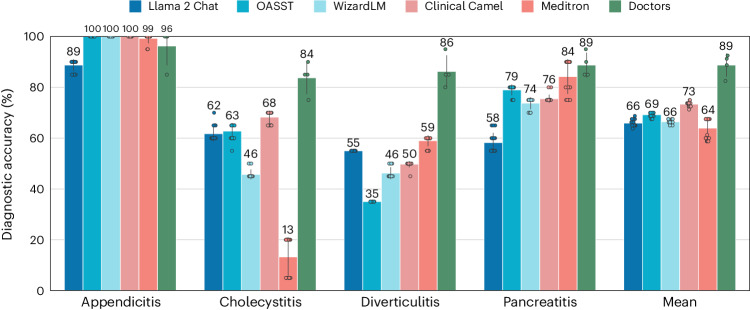
Clinical decision-making is one of the most impactful parts of a physician's responsibilities and stands to benefit greatly from artificial intelligence solutions and large language models (LLMs) in particular. However, while LLMs have achieved excellent performance on medical licensing exams, these tests fail to assess many skills necessary for deployment in a realistic clinical decision-making environment, including gathering information, adhering to guidelines, and integrating into clinical workflows. Here we have created a curated dataset based on the Medical Information Mart for Intensive Care database spanning 2,400 real patient cases and four common abdominal pathologies as well as a framework to simulate a realistic clinical setting. We show that current state-of-the-art LLMs do not accurately diagnose patients across all pathologies (performing significantly worse than physicians), follow neither diagnostic nor treatment guidelines, and cannot interpret laboratory results, thus posing a serious risk to the health of patients. Furthermore, we move beyond diagnostic accuracy and demonstrate that they cannot be easily integrated into existing workflows because they often fail to follow instructions and are sensitive to both the quantity and order of information. Overall, our analysis reveals that LLMs are currently not ready for autonomous clinical decision-making while providing a dataset and framework to guide future studies.
Overview
CoChat Summary
TL;DR
This study evaluates open-access LLMs on a realistic clinical decision-making task using 2,400 real emergency department cases of acute abdominal pain from MIMIC-IV. The models performed significantly worse than physicians, failed to follow diagnostic/treatment guidelines, and were too fragile and instruction-sensitive for autonomous clinical use.
Key findings
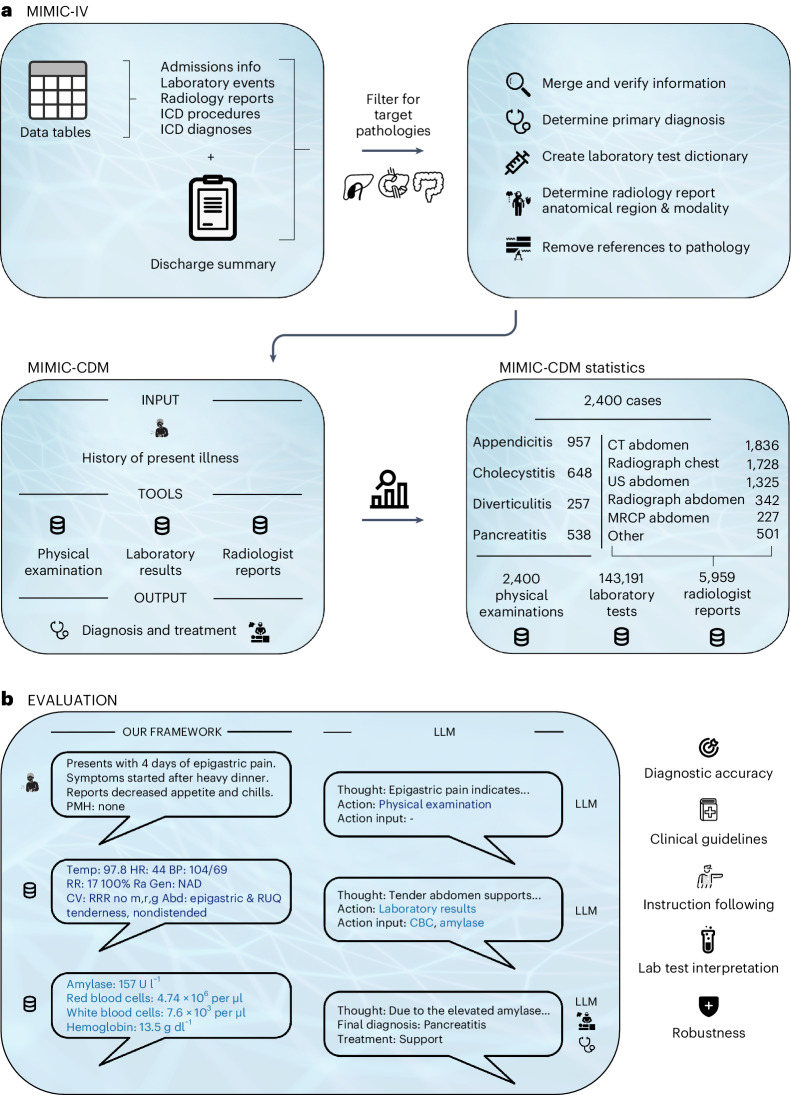
- The curated dataset, MIMIC-CDM, contains 2,400 unique patients with appendicitis (957), cholecystitis (648), diverticulitis (257), and pancreatitis (538).
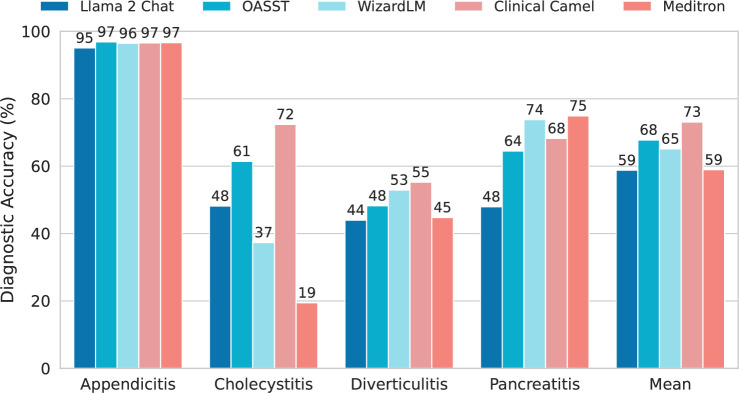
- On a reader study with 80 patients and 4 hospitalists, current LLMs performed significantly worse than clinicians on aggregate across all diseases (P < 0.001 for doctors versus Llama 2 Chat, OASST, WizardLM, Clinical Camel, and Meditron).
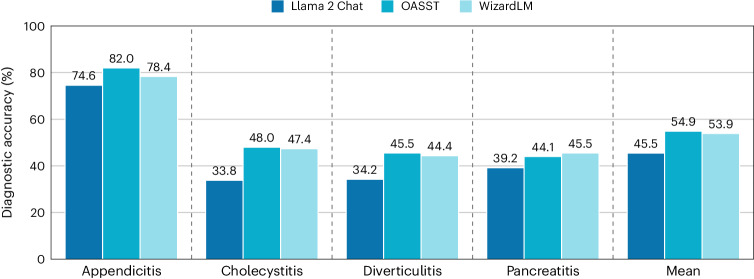
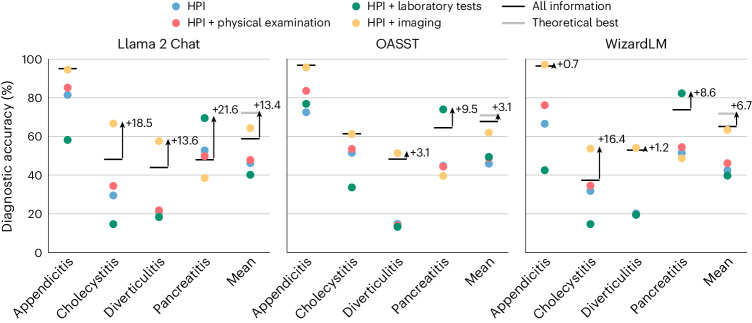
- Diagnostic performance dropped further when models had to gather information themselves: mean diagnostic accuracy fell to 45.5% for Llama 2 Chat, 54.9% for OASST, and 53.9% for WizardLM, versus 58.8%, 67.8%, and 65.1% on the full-information setup, respectively.
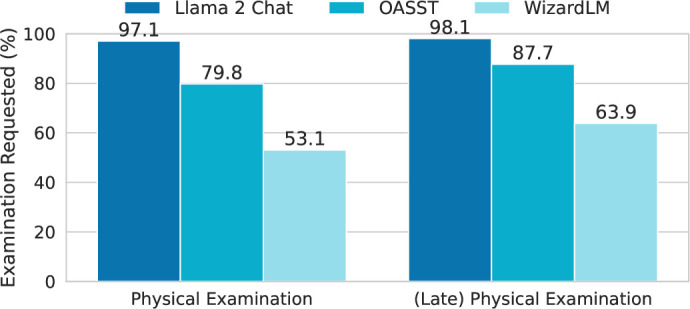
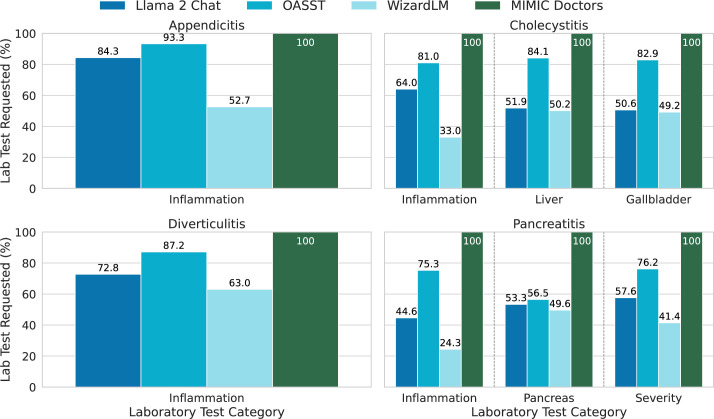
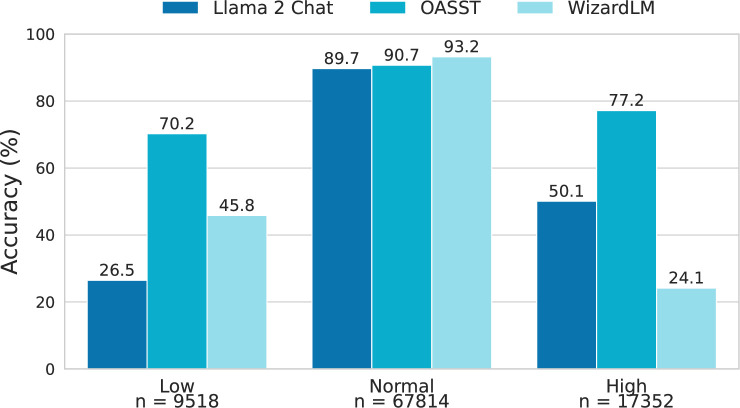
- Models also failed basic safety checks: only Llama 2 Chat consistently requested physical examination information (97.1% as first action; 98.1% at all), and laboratory interpretation was poor even with reference ranges (for example, low results: 26.5% Chat, 70.2% OASST, 45.8% WizardLM; high results: 50.1%, 77.2%, 24.1%).
Methods
- The authors built MIMIC-CDM from the MIMIC-IV EHR database by filtering to emergency department cases with acute abdominal pain and a primary diagnosis of one of four target pathologies, then extracting history of present illness, physical exams, labs, microbiology, imaging, and procedures.
- They evaluated open-access models derived from Llama 2, focusing mainly on Llama 2 Chat, OASST, and WizardLM, and compared them with clinicians on a 100-patient reader study (80 target cases plus 5 each of other conditions), with each LLM evaluated 20 times on the physician comparison subset using different seeds.
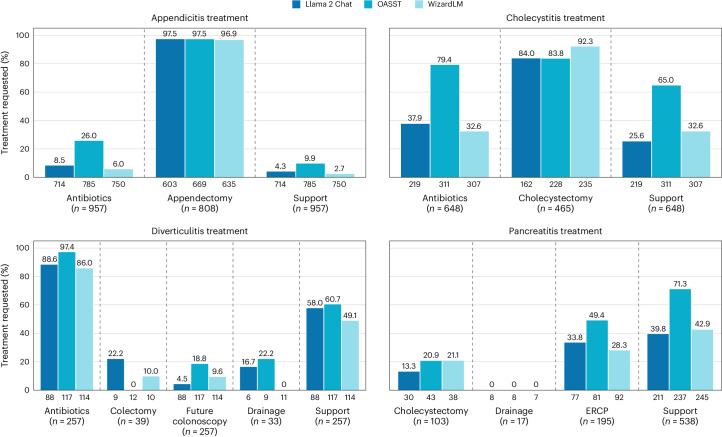
- Main analysis included per-class accuracy, guideline adherence for diagnostic tests and treatments, lab interpretation tasks, instruction-following, robustness to changes in wording, order, and amount of information, and comparisons using two-sided Student’s t-tests with Bonferroni correction.
Limitations
- The paper states that the dataset and models have a clear bias toward the USA, so generalizability to other languages or countries with different guidelines is unknown.
- The authors note that, because they used real-world clinical data, they had to deny requests for information not in the dataset; they argue this was mitigated because MIMIC-IV contains all data gathered during the hospital stay.
- Evident from the text: the study focuses only on four abdominal pathologies, so it does not cover the full breadth of clinical decision-making (the paper itself notes this as a constraint).
Model-written summary. Check it against the paper before relying on it.
Integrity signals
Registry
Cites
Statistics
Figures
Verification
Claims the paper makes
6 Valid · 2 Not valid · 3 Not checked · 106 Own results and interpretations
Some cited sources support this claim and some don’t — read each source’s verdict below.
In the paper
“where LLMs score well above passing8–10,17–20”
§ Evaluation and mitigation of the limitations of large language models in clinical decision-making > Main
What the sources say
- Supportedcites [8] Singhal, K. et al. Towards expert-level medical question answering with large language models. Preprint at https://arxiv.org/abs/2305.09617 (2023). source
The Abstract (page not supplied) reports that Med-PaLM 2 scored 86.5% on MedQA, a dataset of USMLE-style questions, and that its predecessor had exceeded a passing score at 67.2%. This supports the claim about LLM performance on medical-licensing-exam-style questions. (LLM, conf=0.93)
- Partly supportedcites [9] Singhal, K. et al. Large language models encode clinical knowledge. Nature 620, 172–180 (2023). sourceExperimental — accuracy not yet measured
The ‘State of the art on MedQA’ section reports that Flan-PaLM scored 67.6% on USMLE-style questions, supporting strong performance on a medical-exam benchmark. Our copy does not establish a passing threshold or show that LLMs scored well above it on actual licensing exams. (LLM, conf=0.86)
- Supportedcites [10] Nori, H., King, N., McKinney, S. M., Carignan, D. & Horvitz, E. Capabilities of GPT-4 on medical challenge problems. Preprint at https://arxiv.org/abs/2303.13375 (2023). source
The Abstract (p. 1) reports that GPT-4 exceeded the USMLE passing score by over 20 points. The Introduction (p. 2) specifies that the results came from official sample exams and self-assessment materials, supporting this citation as an example of an LLM scoring well above passing on medical licensing exam materials. (LLM, conf=0.93)
- Disputedcites [17] Kung, T. H. et al. Performance of chatgpt on usmle: potential for ai-assisted medical education using large language models. PLoS Digital Health 2, 0000198 (2023). sourceExperimental — accuracy not yet measured
The Discussion (‘The rising accuracy of ChatGPT’) says ChatGPT exceeded 60% accuracy in some analyses, while the USMLE passing threshold is approximately 60%; it concludes that ChatGPT ‘approaches the passing range.’ The paper describes performance as at or near passing, not well above it. (LLM, conf=0.88)
Checked by a reasoning model — may be wrong.
- Disputedcites [18] Gilson, A. et al. How does chatgpt perform on the United States medical licensing examination? The implications of large language models for medical education and knowledge assessment. JMIR Med. Educ. 9, 45312 (2023). sourceExperimental — accuracy not yet measured
The Results (Overall Performance; page unavailable) report that ChatGPT exceeded the paper’s approximately 60% passing benchmark on only one of four question sets, scoring 64.4%. It scored below that benchmark on the other three; InstructGPT and GPT-3 scored below it on all four. The paper therefore does not show LLMs scoring well above passing. (LLM, conf=0.90)
Checked by a reasoning model — may be wrong.
- Partly supportedcites [19] Toma, A. et al. Clinical camel: an open-source expert-level medical language model with dialogue-based knowledge encoding. Preprint at https://arxiv.org/abs/2305.12031 (2023). sourceExperimental — accuracy not yet measured
Table 4 reports strong five-shot scores on the USMLE Sample Exam, including 86.6% for GPT-4 and 64.3% for Clinical Camel-70B. But the paper gives no passing threshold, and other models score substantially lower, so it does not establish that LLMs generally score well above passing. (LLM, conf=0.82)
- Supportedcites [20] Nori, H. et al. Can generalist foundation models outcompete special-purpose tuning? Case study in medicine. Preprint at https://arxiv.org/abs/2311.16452 (2023). source
Section 2.1 reports that GPT-4 exceeded the USMLE passing score by over 20 points. The Abstract also reports that GPT-4 with Medprompt surpassed 90% on MedQA, a USMLE-style exam-question dataset. These passages support the cited claim that LLMs can score well above passing on medical licensing exam questions. (LLM, conf=0.91)
boosted- Asserted: passes — The authors put it forward as true.
- Checkable: passes — It can be checked against evidence.
- Load-bearing: unclear — It is unclear whether the paper’s conclusions depend on it.
- Based: passes — The paper gives a reason why it holds.
- Supported
The cited sources support only part of this claim — read each source’s verdict below.
In the paper
“We note that Llama 2, Clinical Camel and Meditron have been shown to match and even exceed Chat-GPT performance on medical licensing exams and biomedical question answering tests19,35.”
§ Evaluation and mitigation of the limitations of large language models in clinical decision-making > Results > Creating the MIMIC-CDM dataset and evaluation framework
What the sources say
- Partly supportedcites [19] Toma, A. et al. Clinical camel: an open-source expert-level medical language model with dialogue-based knowledge encoding. Preprint at https://arxiv.org/abs/2305.12031 (2023). sourceExperimental — accuracy not yet measured
Section 4 (Evaluation) and Table 4 report that Clinical Camel-70B exceeded GPT-3.5 on five-shot medical benchmarks, including MedQA, PubMedQA and the USMLE sample exam. The paper does not show that LLaMA 2 or Meditron achieved those results; Clinical Camel was fine-tuned from LLaMA 2. It also says Clinical Camel generally fell short of GPT-4, except on PubMedQA. Page numbers were not available in our copy. (LLM, conf=0.88)
- Partly supportedcites [35] Chen, Z. et al. MEDITRON-70B: scaling medical pretraining for large language models. Preprint at https://arxiv.org/abs/2311.16079 (2023). sourceExperimental — accuracy not yet measured
Section 6.2 reports that MEDITRON-70B outperformed GPT-3.5 on the medical benchmarks, including MedQA and PubMedQA. It evaluates Llama-2 and Clinical-Camel as baselines but does not establish that either matched or exceeded GPT-3.5 on those tests. The benchmark comparison also uses text-davinci-003 as GPT-3.5, not ChatGPT itself. (LLM, conf=0.87)
boosted- Asserted: passes — The authors put it forward as true.
- Checkable: passes — It can be checked against evidence.
- Load-bearing: unclear — It is unclear whether the paper’s conclusions depend on it.
- Based: passes — The paper gives a reason why it holds.
- Partly supported
The cited sources support only part of this claim — read each source’s verdict below.
In the paper
“All guidelines recommended physical examinations as an essential part of the diagnostic process, preferably as the first action.”
§ Evaluation and mitigation of the limitations of large language models in clinical decision-making > Results > Current LLMs are hasty and unsafe clinical decision-makers
What the sources say
- Partly supportedcites [36] Di Saverio, S. et al. Diagnosis and treatment of acute appendicitis: 2020 update of the WSES Jerusalem guidelines. World J. Emerg. Surg. 15, 27 (2020). sourceExperimental — accuracy not yet measured
In Results, Topic 1: Diagnosis, the WSES guideline includes physical examination and clinical signs in its diagnostic approach, and Recommendation 1.10 makes imaging conditional on clinical assessment. This supports an early role for examination, but this single guideline does not establish what all guidelines recommend or explicitly say physical examination should be the first action. (LLM, conf=0.85)
- Partly supportedcites [37] Pisano, M. et al. 2020 World Society of Emergency Surgery updated guidelines for the diagnosis and treatment of acute calculus cholecystitis. World J. Emerg. Surg. 15, 61 (2020). sourceExperimental — accuracy not yet measured
Section 1, Diagnosis of ACC (page not provided), suggests including a complete clinical examination alongside history, laboratory tests and imaging. It does not say examination should be the first action, and this single guideline does not establish what all guidelines recommend. (LLM, conf=0.87)
- Partly supportedcites [38] Hall, J. et al. The american society of colon and rectal surgeons clinical practice guidelines for the treatment of left-sided colonic diverticulitis. Dis. Colon Rectum 63, 728–747 (2020). sourceExperimental — accuracy not yet measured
In “Initial Evaluation of Acute Diverticulitis” (recommendation 1; page not supplied), this guideline recommends a physical examination as part of the initial evaluation. It does not establish what all guidelines recommend or say that the examination should preferably be the first action. (LLM, conf=0.84)
plain- Asserted: passes — The authors put it forward as true.
- Checkable: passes — It can be checked against evidence.
- Load-bearing: passes — The paper’s conclusions depend on it.
- Based: passes — The paper gives a reason why it holds.
- Partly supported
A result the paper reports from its own data — it cites no other source for it, so there is none to check. The quote shows it is in the paper.
In the paper
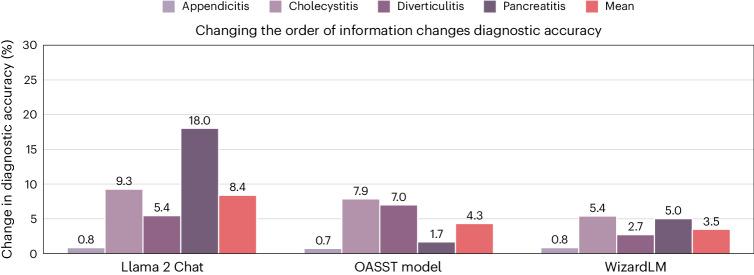
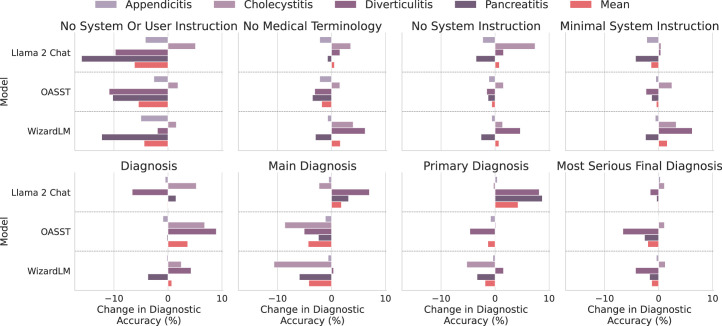
“Additionally, we see that even minor changes in instructions can greatly change diagnostic accuracy such as asking for the ‘main diagnosis’ (up to +7.0% for Chat on diverticulitis, down to −10.6% for WizardLM on cholecystitis) or ‘primary diagnosis’ (up +8.7% for Chat on pancreatitis, down to −5.2% for WizardLM on cholecystitis) instead of ‘final diagnosis’.”
§ Evaluation and mitigation of the limitations of large language models in clinical decision-making > Results > Current LLMs require extensive clinician supervision
plainstates a cause- Asserted: passes — The authors put it forward as true.
- Checkable: passes — It can be checked against evidence.
- Load-bearing: passes — The paper’s conclusions depend on it.
- Based: passes — The paper gives a reason why it holds.
A result the paper reports from its own data — it cites no other source for it, so there is none to check. The quote shows it is in the paper.
In the paper
“We show that current state-of-the-art LLMs do not accurately diagnose patients across all pathologies (performing significantly worse than physicians)”
§ Evaluation and mitigation of the limitations of large language models in clinical decision-making > Abstract
plainn = 2,400- Asserted: passes — The authors put it forward as true.
- Checkable: passes — It can be checked against evidence.
- Load-bearing: passes — The paper’s conclusions depend on it.
- Based: passes — The paper gives a reason why it holds.
59 more claims
Create a free account to see all 117 claims and to verify the 1 reference still open.
- It may state two separate claims as one. 40
- Probably not a substantial claim. 20
- The quote only partly states this claim. 1
Claims other papers make about this one
Each is checked against this paper’s own text: does it say what the citing paper says it does?
The source backs part of the claim, not all of it — or backs it for a different population, condition or comparison.
In the citing paper
“While medical licensing exams and diagnostic tasks are prioritized in 64% of LLM healthcare evaluations8, many administrative and operational tasks that represent significant human bottlenecks are often overlooked.”
From Holistic evaluation of large language models for medical tasks with MedHELM (2026) · cites this paper as [9]
Experimental — accuracy not yet measuredThe source backs part of the claim, not all of it — or backs it for a different population, condition or comparison.
In the citing paper
“While these models offer powerful foundational capabilities, adapting them to specific tasks and datasets without losing robustness is a significant hurdle, often resulting in significant variability in accuracy across different settings.7,9,10”
From Advancing methodological development of artificial intelligence in patient-centered comparative clinical effectiveness research: Patient-Centered Outcomes Research Institute’s unique contribution to research done differently (2025) · cites this paper as [9]
Experimental — accuracy not yet measuredThe cited source says what the claim attributes to it.
In the citing paper
“While LLM performance on medical QA benchmarks has been demonstrated to rival human-level performance, their capabilities in simulated real-world medical scenarios have been more limited12.”
From Limitations of large language models in clinical problem-solving arising from inflexible reasoning (2025) · cites this paper as [12]
The cited source says what the claim attributes to it.
In the citing paper
“Another study demonstrated that while LLMs show potential for clinical decision-making, they currently underperform compared to human clinicians in diagnosing common conditions such as appendicitis, cholecystitis, diverticulitis, and pancreatitis.”
From Enhancing diagnostic capability with multi-agents conversational large language models (2025) · cites this paper as [30]
Citations
Cites
Language Models are Few-Shot Learners
Brown, T. B., Mann, B., Ryder, N., Subbiah, M., Kaplan, J., Dhariwal, P., Neelakantan, A., Shyam, P., Sastry, G., Askell, A., et al. (2020) · arXiv · doi:10.48550/arxiv.2005.14165 · Cited by 23,372
Goldberger, A. L., Amaral, L. A. N., Glass, L., Hausdorff, J. M., Ivanov, P. C., Mark, R. G., Mietus, J. E., Moody, G. B., Peng, C.-K., & Stanley, H. E. (2000) · Circulation · doi:10.1161/01.cir.101.23.e215 · Cited by 14,809
Exploring the Limits of Transfer Learning with a Unified Text-to-Text Transformer
Raffel, C., Shazeer, N., Roberts, A., Lee, K., Narang, S., Matena, M., Zhou, Y., Li, W., & Liu, P. J. (2019) · arXiv · doi:10.48550/arxiv.1910.10683 · Cited by 10,929
Scaling Laws for Neural Language Models
Kaplan, J., McCandlish, S., Henighan, T., Brown, T. B., Chess, B., Child, R., Gray, S., Radford, A., Wu, J., & Amodei, D. (2020) · arXiv · doi:10.48550/arxiv.2001.08361 · Cited by 9,550
Chain-Of-Thought Prompting Elicits Reasoning in Large Language Models
Wei, J., Wang, X., Schuurmans, D., Bosma, M., Ichter, B., Xia, F., Chi, E., Le, Q. V., & Zhou, D. (2022) · Advances in Neural Information Processing Systems 35 · doi:10.52202/068431-1800 · Cited by 4,505
Chain-of-Thought Prompting Elicits Reasoning in Large Language Models
Wei, J., Wang, X., Schuurmans, D., Bosma, M., Ichter, B., Xia, F., Chi, E., Le, Q., & Zhou, D. (2022) · arXiv · doi:10.48550/arxiv.2201.11903 · Cited by 4,263 · cited 1×
“Given these constraints, we calculate and use the per-class accuracy throughout our work, which is the only metric that can be calculated without bias as it only requires the samples of a single class.”
Training language models to follow instructions with human feedback
Ouyang, L., Wu, J., Jiang, X., Almeida, D., Wainwright, C. L., Mishkin, P., Zhang, C., Agarwal, S., Slama, K., Ray, A., et al. (2022) · arXiv · doi:10.48550/arxiv.2203.02155 · Cited by 4,208
Kung, T. H., Cheatham, M., ChatGPT, Medenilla, A., Sillos, C., De Leon, L., Elepaño, C., Madriaga, M., Aggabao, R., Diaz-Candido, G., et al. (2022) · doi:10.1101/2022.12.19.22283643 · Cited by 4,115
Kung, T. H., Cheatham, M., Medenilla, A., Sillos, C., De Leon, L., Elepaño, C., Madriaga, M., Aggabao, R., Diaz-Candido, G., Maningo, J., et al. (2023) · PLOS Digital Health · doi:10.1371/journal.pdig.0000198 · Cited by 4,115
Large Language Models Encode Clinical Knowledge
Singhal, K., Azizi, S., Tu, T., Mahdavi, S. S., Wei, J., Chung, H. W., Scales, N., Tanwani, A., Cole-Lewis, H., Pfohl, S., et al. (2022) · arXiv · doi:10.48550/arxiv.2212.13138 · Cited by 4,083
Research works printed but not linked: 4
- Di Saverio, S. et al. Diagnosis and treatment of acute appendicitis: 2020 update of the WSES Jerusalem guidelines. World J. Emerg. Surg. 15, 27 (2020). · DOI · Paper page
- Zheng, C., Zhou, H., Meng, F., Zhou, J. & Huang, M. On large language models’ selection bias in multi-choice questions. In 12th International Conference on Learning Representations (ICLR, 2024).
- Golkar, Siavash, et al. xVal: a continuous number encoding for large language models. In NeurIPS 2023 AI for Science Workshop (2023).
- Radford, A. et al. Language models are unsupervised multitask learners. OpenAI blog 1, 9 (2019).
Cited by
Items 601–700 of 736
Yasser, M., Barakat, G., Awny, S., Ezzat, M., Ahmed, M. S. A., Wael, S., Moustafa, M., & Hamdy, O. (2026) · Scientific Reports · doi:10.1038/s41598-026-60786-2
“The sample size was determined by comprehensive coverage of all guideline recommendation categories across three international guideline sets, an approach that ensures content validity while remaining feasible for expert evaluation and is consistent with prior LLM assessment studies 23,26 .”
Cho, J. W., & Sekaran, A. (2026) · Cureus · doi:10.7759/cureus.112413 · Cited by 1
“…as SBA performance alone will not necessarily translate into clinical competence in real-life settings, where decision-making is often multifactorial and requires overall consideration of history, examination, patient autonomy, ethical issues, risk-benefit analyses, and best interests [16,17].”
GÖKÇEN, S. (2026) · Cukurova Anestezi ve Cerrahi Bilimler Dergisi · doi:10.36516/jocass.1892872
Qu, C., Cui, C., Lu, Z., ZHU, J., Yao, T., Guo, J., Xiong, J., Zhu, Y., Yang, Y., Landman, B. A., et al. (2026) · Lecture notes in computer science · doi:10.1007/978-3-032-38059-3_51 · Cited by 2
LongMedBench: Benchmarking Medical Agents for Long-Horizon Clinical Decision-Making
Chen, Y., Xu, Z., Zhang, X., Fan, Z., Zhai, W., Xu, H., & Liu, Z. (2026) · Lecture notes in computer science · doi:10.1007/978-3-032-38470-6_15 · Cited by 5
Adiniaev, Y., Omar, M., Daniel, O., Timor, T. M., Barash, Y., Brook, O. R., Klang, E., & Gorenshtein, A. (2026) · Neurological Sciences · doi:10.1007/s10072-026-09239-2
“However, LLMs may produce fluent but factually incorrect outputs (hallucinations), and this failure mode is most con - sequential when the clinical task requires a single correct answer [ 11, 12].”
Pan, J., Jian, B., Hager, P., Zhang, Y., Liu, C., Jungmann, F., Li, H., Canisius, J., You, C., Wu, J., et al. (2026) · Nature Health · doi:10.1038/s44360-026-00152-8 · Cited by 29
Self-citationErgen, Y. M., Teke, S., Başaran, E. G., & Balamtekın, N. (2026) · Journal of Pediatric Gastroenterology and Nutrition · doi:10.1002/jpn3.70502
Ghanbari, G., Ahn, J. C., Kim, E., Laverde, R., Pope, Z., & Nemati, S. (2026) · JAMIA Open · doi:10.1093/jamiaopen/ooag123
“24,26,27,28 When evaluated on a cohort with a 4.6% deterioration prevalence, selected to mirror the population in Edelson et al., 25 DETERIO-LLM consistently outperformed traditional early warning scores (NEWS and MEWS) as well as ML-based models such as eCART, RI, and EDI on key metrics such as…”
InfluentialLiu, L., Yao, S., Liu, Y. P., Wang, Y., Xia, H., & Tang, X. (2026) · Information Processing & Management · doi:10.1016/j.ipm.2026.105027
Chen, D., Xue, Q., Wang, G., Mu, S., Zeng, Z., Yu, C., Li, S., Chen, Y., Gu, W., & Shi, J. (2026) · Journal of Medical Internet Research · doi:10.2196/90023 · Cited by 1
“Hager et al [26], using the Medical Information Mart for Intensive Care database with 2400 real patient cases across 4 common abdominal pathologies, revealed significant limitations in current AI models.”
Artificial intelligence for pediatric neuroimaging
Ho, M. (2026) · Pediatric Radiology · doi:10.1007/s00247-026-06707-x
Can AI assist in reducing diagnostic error? A narrative review
Scott, I. A. (2026) · Diagnosis · doi:10.1515/dx-2026-0021
“– Studies typically assess isolated reasoning steps rather than entire diagnostic work fl ows [92, 93].”
Task-Conditioned Symbolic Routing for Causal Question Answering in Large Language Models
Kong, Y., Ma, X., & Wang, M. (2026) · International Conference on Machine Learning and Intelligent Systems Engineering (MLISE) · doi:10.1109/mlise70044.2026.11607615
“Large language models (LLMs) are increasingly considered for high-stakes settings such as clinical decision-making, healthcare integration, and scientific research [1], [2], [3].”
Tyagi, A., Taylor, B., Jayaraman, P., Jangda, M., Jiang, J. J., Kavula, S., Gorin, M. A., Hugo, H., Gavin, N., Freeman, R., et al. (2026) · medRxiv · doi:10.64898/2026.07.21.26358588
Palermi, S., Saglietto, A., D’Ascenzo, F., Ferrari, G. M. D., Bruno, F., Tse, G., Kizilkilic, S. E., Tjong, F. V. Y., Ruipérez-Campillo, S., Keser, N., et al. (2026) · Progress in Cardiovascular Diseases · doi:10.1016/j.pcad.2026.07.005 · Cited by 2
郑, 立., Lin, Z., Liu, X., Fan, Z., He, Z., Xu, J., & Yin, L. (2026) · Journal of Medical Internet Research · doi:10.2196/98026
“Previous studies have suggested that LLMs are sensitive to information volume and that providing full information does not always yield optimal performance [18].”
Amoei, M., Fraser, K., & Poenaru, D. (2026) · doi:10.2196/preprints.107982 · Cited by 1
Roeschl, T., Hoffmann, M., Unbehaun, A., Dreger, H., Hindricks, G., Falk, V., Balicer, R. D., Tanacli, R., Hohendanner, F., & Meyer, A. (2026) · European Heart Journal - Digital Health · doi:10.1093/ehjdh/ztag124 · Cited by 4
“Our work directly addresses the calls from those studies to evaluate performance on authentic clinical documents 18,19 and against the benchmark of real-world human practice, 20,21 confirming that a thoughtfully architected pipeline can overcome the known limitations of LLMs in this domain.”
LLMs as Clinical Instruments—Toward Verifiable Reasoning
Paulus, M. P., & Torous, J. B. (2026) · JAMA Psychiatry · doi:10.1001/jamapsychiatry.2026.2211 · Cited by 2
España-Lopera, J. C., Núñez‐Valdéz, E. R., & García-Díaz, V. (2026) · International Conference on Federated Learning and Intelligent Computing Systems (FLICS) · doi:10.1109/flics70075.2026.11621915
“Without these reported mechanisms, the risk of automation bias remains a significant concern that must be addressed before justifying the transition from experimental pilots to integrated clinical agents [7], [17].”
InfluentialGerçek, A. B. K., & Canay, Ş. (2026) · Balkan Journal of Dental Medicine · doi:10.5937/bjdm2602049b
“71 Accordingly, LLMs may be integrated as interpretive components within multimodal systems linked to validated databases and image-based AI, with potential applications in literature synthesis, clinical reasoning, patient communication, and education.”
On the use of large language models for methods-time measurement
Ceylan, G., Yapıcıoğlu, H., Benter, M., Eckart, C., & Kuhlang, P. (2026) · International Journal of Production Research · doi:10.1080/00207543.2026.2709045
Artificial intelligence analytics for diagnosis, prognosis, and outcomes prediction
Jalali, S., You, Q., Xu, V., Chen, L., Zini, J., Zamorano, T., Luo, Y., Friesen, T., Fontana, G. J., & Benrimoh, D. A. (2026) · Elsevier eBooks · doi:10.1016/b978-0-443-33151-0.00009-5
Roberts, L. J. (2026) · Research Square · doi:10.21203/rs.3.rs-10563856/v1
AI in Clinical Practice: Examining the Role of LLMs in Medical Decision-Making
BenGhida, R., Benghida, S., BenGhida, S., & Benghida, D. (2026) · Signals and communication technology · doi:10.1007/978-3-032-18834-2_3
Yu, S., He, Y., Li, P., Wu, C., Zhang, P., Li, J., & Tian, Y. (2026) · Intelligent Medicine · doi:10.1016/j.imed.2026.08.001
Vollmer, A., Schorn, L., Schrader, F., Kübler, N., Sproll, C. K., Vollmer, M., Singh, D. D., & Saravi, B. (2026) · Diagnostics · doi:10.3390/diagnostics16152456 · Cited by 2
“Recent studies have emphasized that current state-of-the-art LLMs do not reliably adhere to diagnostic or treatment guidelines without external grounding, highlighting the continued need for verification mechanisms [24].”
Shi, J., Ma, Y., Liu, Y., & Shi, B. (2026) · Frontiers in Public Health · doi:10.3389/fpubh.2026.1904062 · Cited by 1
“Yet they still fail in realistic clinical decision-making settings that require adherence to guidelines, information gathering, numerical interpretation, or reliable handling of uncertainty (5).”
Wang, C., Liu, Z., Jiang, Y., Zhang, T., Wang, H., Xue, T., & Liu, P. (2026) · Frontiers in Public Health · doi:10.3389/fpubh.2026.1850996
Shao, M., Shao, H., Zhang, H., & Zhang, H. (2026) · doi:10.2196/preprints.108814
The Decision Twin: Metaverse Patient Digital Twins as Executable Clinical Reality
Cenacchi, F., Cao, L., & Richards, D. (2026) · ACM SIGKDD Conference on Knowledge Discovery and Data Mining (KDD) · doi:10.1145/3770855.3818659
Chen¹, Y., Ma, H., Wang, H., Chen, D., Jiang, R., Wang, H., & Yu, D. (2026) · Research Square · doi:10.21203/rs.3.rs-10228718/v1
Mansoor, A., Mansoor, E., Mansoor, E., Mansoor, E., Afzal, A., Akbar, N., Usman, M., Kharl, H. A. A., Arif, M. N., Arif, A., et al. (2026) · Advances in computational intelligence and robotics book series · doi:10.4018/979-8-3373-8904-2.ch015
Tajima, H. (2026) · JMIR Nursing · doi:10.2196/99590
“…on standardized medical knowledge benchmarks [17], their accuracy on more complex, open-ended clinical decision-making tasks remains only moderate [18,19], placing current systems within an operating range where the clinical safety implications are neither self-evident nor reliably inferable from…”
InfluentialHe, W., Liao, J., Pan, H., Zhang, L., Li, X., Huang, J., Liu, Z., Ke, X., Li, J., Li, X., et al. (2026) · Digital Health · doi:10.1177/20552076261472569 · Cited by 1
“52 Such deviations could delay necessary monitoring or degrade complication management, underscoring that LLMs should not function as independent decision-makers.”
LLM Usage for Clinical Decision Support and Documentation Support in Hospitals – a Systematic Review
Anderle, L., Abidi, A., Ünlü, S., Steidle, O., Janßen, T., & Petzold, T. (2026) · Lecture notes in computer science · doi:10.1007/978-3-032-26717-7_16
Küçük, Ö., & Arslan, Z. B. (2026) · Odontology · doi:10.1007/s10266-026-01531-z
Benitez, L., Gomez, A., Franco, J., & Cardozo, R. (2025) · Pharmacophore · doi:10.51847/iwekfh04ct
Performance and limitations of four large language models in genetic counseling for thalassemia
Zhong, W., Huang, J., Wei, M., Liang, Q., Yang, Y., Chen, J., Mao, J., Qin, Y., Sun, Y., & Liang, Y. (2026) · Frontiers in Digital Health · doi:10.3389/fdgth.2026.1902480
Towards Robust Clinical Reasoning in LLM-aided Clinical Decision Support
Vuruma, S. K. R., Tang, S., & Wu, D. (2026) · IEEE International Conference on Healthcare Informatics (ICHI) · doi:10.1109/ichi69079.2026.00148
“Findings indicated that counterfactual stability is strongly outcome-dependent and that numerical divergence can coexist with apparent clinical agreement, revealing failure modes that accuracy-based evaluations do not capture [4].”
Zhang, Z., Zhou, Z., Xiang, L., Shankaranarayanan, A., Gong, E., & Zaharchuk, G. (2026) · Journal of Magnetic Resonance Imaging · doi:10.1002/jmri.70507
Feasibility of ChatGPT-Assisted TCM Constitution Classification for College Students
王, 茜. (2026) · Advances in Clinical Medicine · doi:10.12677/acm.2026.1682874
Bae, S., Moon, I., Park, J., Lim, J., Lee, S., Yoon, Y. E., & Cho, G. (2026) · Journal of Cardiovascular Imaging · doi:10.1186/s44348-026-00085-6
Integrated rescue: A narrative review of machine learning in hospitalized patient rescue
Koo, C. B. C., Herasevich, V., Diedrich, D. A., Brown, D. R., & Pickering, B. W. (2026) · Intensive Care Science · doi:10.1016/j.iics.2026.08.001
SmartMM: A Domain-Specific Large Language Model for Medical Microbiology
Gong, Y., Ma, R., Wang, X., Li, R., Dong, H., Liu, Y., Peng, X., GUO, Q., & Liu, Y. (2026) · AI · doi:10.3390/ai7080316
EZZIKOURI, E., Benhamza, S., Othmani, M. B., & Lazraq, M. (2026) · Research Square · doi:10.21203/rs.3.rs-10667066/v1
Li, J., Zhang, J., Tao, X., Chen, Y., Xun, S., Qin, G., Diao, K., & Qin, C. (2026) · Journal of Medical Internet Research · doi:10.2196/91257
“Prior studies have shown that when confronted with complex diagnostic cases or real-world prediction tasks, LLMs may still miss key differential diagnoses, and their calibration and awareness of uncertainty remain limited in patient-level clinical decision support [20, 39].”
Babu, A. M., Nehemiah, A. J., Jagadeep, V., Suji, R. A., & Nallusamy, P. (2026) · Frontiers in Digital Health · doi:10.3389/fdgth.2026.1890072
The Reliability of Human Evaluation of Large Language Models in Health Care Settings: Scoping Review
Yang, E., Ko, S., & Woo, H. (2026) · Journal of Medical Internet Research · doi:10.2196/98184 · Cited by 2
“Because clinical decision-making is influenced by a patient’s symptoms, medical history, comorbidities, and treatment setting, the appropriateness of the same medical information may differ across specific clinical situations [102,103].”
Gao, J., Dong, L., & Hu, J. (2026) · doi:10.2196/preprints.109941
Artificial intelligence agents and agentic artificial intelligence applied to precision medicine
Costa, F. F. (2026) · Drug Discovery Today · doi:10.1016/j.drudis.2026.104781
Efficient Cooperation-Aware Key and Value Management for LLM Inference
Sun, Q., Zhang, H., Liu, J., Xia, H., Liu, J., Ren, K., & Hu, H. (2026) · Proceedings of the VLDB Endowment · doi:10.14778/3819518.3819541
Buhr, C. R., Müller, L., dos Santos, D. P., Thiem, D. G. E., Ponciano, J.-J., Krüger, M., O’Brien, K., Kaufmann, J., Nolte, H., Gartenschläger, M., et al. (2026) · JMIR AI · doi:10.2196/95081 · Cited by 1
“A review of the literature highlights the potential and limitations of applying LLMs in clinical practice [9-12].”
From perception to governance: Knowledge-enhanced intelligence for smart sustainable buildings
Liu, S., Xie, H., Lei, Y., Zhao, J., Liu, J., Song, G., Zhang, L., Yang, W., Song, X., & Zhang, H. (2026) · Energy and Buildings · doi:10.1016/j.enbuild.2026.118128
Patel, A., Khand, Y., Vallamchetla, S. K., Li, P., Tao, C., & Cheung, J. (2026) · Journal of Medical Internet Research · doi:10.2196/104092 · Cited by 1
“Examination questions and curated vignettes offer complete information and a constrained answer space, and therefore do not fully test uncertainty, evolving context, workflow integration, or downstream effects on clinician performance [11-13].”
InfluentialAlbeshri, S. (2026) · Research Square · doi:10.21203/rs.3.rs-10664547/v1
Polat, O., Koncalıoğlu, B., Gündoğdu, M., et al. (2026) · Healthcare · doi:10.3390/healthcare14172694
“Responses may omit clinically relevant details, provide incomplete or unbalanced descriptions of treatment options, use language above the reading level recommended for patient education, or include unsupported statements [6,7].”
AI Caretaker: An Intelligent Voice-Activated Support System for Dementia Care
Dhingra, A., & Nichols, C. M. (2026) · Cureus · doi:10.7759/cureus.115149
“…rubric, leaving the boundary between a supportive-response situation and an alertable event entirely to the model’s judgment; constraining the flag with an explicit definition, or deriving alert generation from the severity value rather than the flag alone, are directly testable remedies [21].”
Simon, B. F., Dénes-Fazakas, L., Eigner, G., Kovács, L., & Szilágyi, L. (2026) · IEEE International Conference on Intelligent Engineering Systems (INES) · doi:10.1109/ines69513.2026.11661038
“Specifically, they fail to meet clinician-level diagnostic accuracy, do not consistently follow clinical guidelines, and cannot reliably interpret laboratory results [14].”
Moral Residue After Algorithmic Advice
Zhang, W., Hui, C., & Tan, M. (2026) · Asian Journal of Ethics in Health and Medicine · doi:10.51847/z27fe6xlxk
Wang, D., Li, H., Lin, Y., & Huang, R. (2026) · Research Square · doi:10.21203/rs.3.rs-10310681/v1
Zavaleta‐Monestel, E., Castro-Gamboa, J. A., & Mora-Jiménez, J. (2026) · Cureus · doi:10.7759/cureus.115230
“Simulated cases, retrospective analyses and benchmarks can establish technical capability, but they cannot determine whether a system reduces harm under real clinical conditions [1,2,5].”
Ryzhenko, V. P., Бурлака, Б. С., Belenichev, I., Burlaka, K., Aliyeva, O., Bukhtiyarova, N., Halabitska, I., Petakh, P., & Kamyshnyi, O. (2026) · Frontiers in Medicine · doi:10.3389/fmed.2026.1898857 · Cited by 1
“Thus, traditional methods of clinical verification, relying on physician memory or static reference materials, are becoming sources of medical errors, which underscores the need for next-generation automated clinical decision support systems (13 – 16).”
Kim, J.-W., Yoon, H., Jung, D., Oh, W., Choi, D., Yoon, S.-H., Kim, D.-J., Lee, S.-Y., Kim, B.-N., & Yang, C.-M. (2026) · IEEE Access · doi:10.1109/access.2026.3727881 · Cited by 1
“This indicates that, while LLMs possess emergent reasoning capabilities, their diagnostic inferences require expert supervision to mitigate the risk of clinically implausible or semantically shallow conclusions [109], [110], [111].”
Cetin, N., & Atılan, A. U. (2026) · European Journal of Therapeutics · doi:10.58600/eurjther3197
“Since most LLM platforms are free to use, they can help address current gaps in patient education and contribute to a more equitable distribution of medical information [10,11].”
Liang, J., Liu, Y., Wang, W., Xie, Z., Lin, Y., Qi, J., Cai, Y., 何永轩, Liang, Y., Chen, Y., et al. (2026) · Cyborg and Bionic Systems · doi:10.34133/cbsystems.0691
“For each factor, 5,000 eligible participants were sampled, and the relevant input fields were replaced with “missing” while all other inputs, prompts, model settings, and output schemas were unchanged [ 43 ].”
Artificial intelligence in cardio-obstetrics: Current evidence, implementation gaps, and a roadmap
Ebubechukwu, U. J., Ugoala, O. S., Al-Asmar, R., Mares, A. C., Bailey, A. L., Raghunathan, D., Tamirisa, K. P., Grapsa, J., & Gulati, M. (2026) · American Journal of Preventive Cardiology · doi:10.1016/j.ajpc.2026.101801
Integration of artificial intelligence and multi-omics for precision medicine
Marei, H. E. S., Cenciarelli, C., & Vagni, D. (2026) · Functional & Integrative Genomics · doi:10.1007/s10142-026-02024-6
Current Advances in Age and Sex Estimation Using Artificial Intelligence in Forensic Odontology
Çarıkçıoğlu, B. (2026) · Turkish Journal of Forensic Medicine · doi:10.61970/adlitip.1818812
Performance of large language models as a source of clinical information on bacteriophage therapy
Walter, N., Amanatullah, D. F., Debarbieux, L., Doub, J. B., Ferry, T., Groß, J., Międzybrodzki, R., Mirzaei, M. K., Deng, L., Rācenis, K., et al. (2026) · npj Viruses · doi:10.1038/s44298-026-00224-2
Ahmed.K, N., & Masood, J. A. I. S. (2026) · Frontiers in Digital Health · doi:10.3389/fdgth.2026.1867505
“Yet, performance of predictive power reported across studies is quite disparate, with a lot of models being accurate only at a fair level and too low a recall value to be reliable for use in the clinic (10, 11).”
Shao, J., Liu, X., Zhang, Z., Liao, S., Wu, J., Yang, H., Zhao, Z., Wang, L., Liang, S.-F., Wang, X., et al. (2026) · Cell Reports Medicine · doi:10.1016/j.xcrm.2026.102926
“36,37 It is necessary to develop integrated decision-support systems that can be embedded into clinical workflows, particularly in specialized fields such as respiratory medicine.”
hu, J., Lei, M., Kong, X., Huang, Y., Luo, H., & Mao, H. (2026) · doi:10.2196/preprints.111075
Hajer Abdulhafid PhD Group, Bingham, A., Tawfik, S. A., Hegde, S., & Logothetis, I. (2026) · doi:10.2196/preprints.110787
Yang, S., Han, H., & Lee, H. S. (2026) · Ophthalmology Science · doi:10.1016/j.xops.2026.101398
Implementation of Expanding Primary Care Teams to Improve Anemia Diagnosis
Wells, R. S., Li, X., Novikov, Z., Espinoza, M., Janecka, M., Olguin, X. K., Adebowale, B., & Thomas, E. J. (2026) · Journal of Primary Care & Community Health · doi:10.1177/21501319261480463
A Pilot Comparability Study of GPT-4-Generated and Expert-Written OSCE Scripts
Josan, H., Sayyad, S., Zanin, M., Sutton, D., Vakil, T., Mirzo, S. M., Sandu, K., Meaney, C. A., & Leung, F. (2026) · Medical Science Educator · doi:10.1007/s40670-026-02877-3 · Cited by 1
Large Language Models in Clinical Contexts: Infrastructure, Oversight, and Risk Dynamics
Müller, A., Weber, S., Hoffmann, J., Schneider, L., & Klein, T. (2025) · Journal of Artificial Intelligence for Healthcare Systems · doi:10.68159/j510298368
Barbosa, A., Braga, A. C., Pina‐Vaz, I., & Ferreira, I. (2026) · Odontology · doi:10.1007/s10266-026-01555-5
Können ChatGPT-Antworten durch Einbindung von S3-Leitlinien optimiert werden?
Johannsen, J., Kourou, S., Suchan, M., Kopp, C., Scharaf, K., Sharma, S. J., Eckel, H., van de Loo, J., Klasen, C., Hansen, K. K., et al. (2026) · Laryngo-Rhino-Otologie · doi:10.1055/a-2931-6385
Potenzial und Herausforderungen von Large Language Models in der klinischen Entscheidungsfindung
Jungmann, F., & Hager, P. (2026) · Journal für Gastroenterologische und Hepatologische Erkrankungen · doi:10.1007/s41971-026-00265-7
“Genau hiermit setzt sich unser Projekt, daswir2024in NatureMedicine publiziert haben [5] und in diesem Artikel vorgestellt wird,kritischauseinander.”
InfluentialSelf-citationZhang, W., Feng, Z., Liu, Y., Zhong, R., Chen, S., Li, Z., 李冰燕, Liu, D., Gao, L., & Hu, K. (2026) · Frontiers in Oncology · doi:10.3389/fonc.2026.1915669
“A fundamental challenge in the clinical application of GAI is the limited interpretability of model outputs (80).”
InfluentialMDT-guided language-model reasoning for spinal infection diagnosisPreprint
Chen, J., Zhang, R., Xu, C., Li, H., 胡维维, Cai, L., Ma, S., Meng, Y., Li, X., Chen, Y., et al. (2026) · Research Square · doi:10.21203/rs.3.rs-10692703/v1
Oruç, M. Ş., Günenç, A. C., Akdemır, O., et al. (2026) · Journal of Craniofacial Surgery · doi:10.1097/scs.0000000000013379
Guddah, M. S., & Atyabi, A. (2026) · AI · doi:10.3390/ai7090361
Sebin, B., & Sebin, I. K. (2026) · Frontiers in Artificial Intelligence · doi:10.3389/frai.2026.1956533
Juliasse, L. E. R., Pereira, R. D. S., & Mourão, C. F. (2026) · Clinical Anatomy · doi:10.1002/ca.70208
Hariri, Y., Nasser, H., & Zahra, F. (2024) · Journal of Medical Sciences and Interdisciplinary Research · doi:10.51847/3p2ykgx4ji
Liang, D., Mai, C., Zhang, Z., Lin, J., Wu, X., Lu, H., Shang, J., Wang, H., & Li, H. (2026) · Frontiers in Public Health · doi:10.3389/fpubh.2026.1955701
“However, evaluations of clinical decision-making have identified factual errors, reasoning limitations, potential harm, and sensitivity to the order and framing of information (17).”
Wen, Y., Chen, L., Deng, X., Lan, J., Huang, X., Liu, Y., Chen, L., & Li, L. (2026) · Frontiers in Endocrinology · doi:10.3389/fendo.2026.1977377
“These features reduced opportunities for dangerous failure and may not hold in routine clinical practice (9, 19).”
InfluentialPabalan, C., Stewart, A. F., Fisher, G., & Fisher, A. (2026) · Journal of Medical Internet Research · doi:10.2196/90724
Wrzosek, K., Udrycka, K., Kuchta, K., Poleszak, J., Leśniak, M., & Kowalewski, P. (2026) · International Journal of Innovative Technologies in Social Science · doi:10.31435/ijitss.3(51).2026.6484
Wilson, E., Jong, F. D., & Peters, L. (2026) · Annals of Pharmacy Practice and Pharmacotherapy · doi:10.51847/xt3dqdt8kp
Avoiding common failures in AI for health and medicine
Salaudeen, O., Zhang, H., Kim, E., Singh, K., & Ghassemi, M. (2026) · Cell · doi:10.1016/j.cell.2026.07.025 · Cited by 1
Sorka, M., Gorenshtein, A., Abramovitch, H., Soontrapa, P., Shelly, S., & Aran, D. (2026) · Journal of the American Medical Informatics Association · doi:10.1093/jamia/ocag143
Xin, W., Li, X., Qu, W., Nie, W., Zhao, Y., Wang, H., Yi, H., & Tan, S. (2026) · doi:10.2196/preprints.110943
Sánchez, I. S. T., Manrique, R., Ortega, N., et al. (2026) · IEEE Colombian Conference on Applications of Computational Intelligence (ColCACI) · doi:10.1109/colcaci71483.2026.11691480
“In [10], LLMs were evaluated in autonomous clinical decision-making and found to under-perform physicians in diagnostic accuracy and fail to follow diagnostic and treatment guidelines, highlighting the need for approaches that better ground clinical recommendations.”
Mergen, M., Ketzer, C., Thiel, B., Sauter, A. P., Makowski, M. R., Spitzl, D., Mergen, M., & Gassert, F. T. (2026) · Journal of Imaging Informatics in Medicine · doi:10.1007/s10278-026-02311-5
Self-citation
Metadata
- Authors
- Hager, P., Jungmann, F., Holland, R., Bhagat, K., Hubrecht, I., Knauer, M., Vielhauer, J., Makowski, M., Braren, R., Kaissis, G., & Rueckert, D.
- Affiliations
- TUM Klinikum (DE)
- Imperial College London (GB)
- Christiana Care Health System (US)
- Ludwig-Maximilians-Universität München (DE)
- Corresponding author
- Hager, Paul
- ORCID
- Venue
- Nature Medicine
- Published
- 2024-07-04
- Volume
- 30
- Issue
- 9
- Pages
- 2613-2622
- ISSN
- 1078-8956 (ISSN-L)
- 1546-170X
- PMC
- PMC11405275
- OpenAlex
- W4400324908
- Cited by
- 798
- References
- 74
- Citations by year
- 2026: 435 · 2025: 317 · 2024: 46
- FWCI
- 74.24
- Type
- journal article
- Language
- en
- Open access
- hybrid
- doi.org
- Licence
- cc-by
- creativecommons.org/licenses/by/4.0 (tdm)
- creativecommons.org/licenses/by/4.0 (vor)
- Locations
- Nature Medicine (publishedVersion, cc-by)
- medRxiv (acceptedVersion, cc-by-nc)
- PubMed Central (publishedVersion, cc-by)
- PubMed (publishedVersion)
- PuSH - Publication Server of Helmholtz Zentrum München (submittedVersion, cc-by)
- mediaTUM – the media and publications repository of the Technical University Munich (Technical University Munich) (submittedVersion)
- Funders
- Technische Universität München
- H2020 European Research Council (884622)
- Topics
- Health Sciences › Medicine › Health Informatics › Artificial Intelligence in Healthcare and Education
- Physical Sciences › Computer Science › Artificial Intelligence › Machine Learning in Healthcare
- Health Sciences › Health Professions › Health Information Management › Artificial Intelligence in Healthcare
- Keywords
- large language models, clinical decision-making, artificial intelligence in healthcare, MIMIC-III, abdominal pathology, diagnostic accuracy, clinical guidelines adherence, laboratory test interpretation, clinical workflow integration, medical licensing examinations, LLM limitations
- MeSH terms
- Clinical Decision-Making, Artificial Intelligence, Humans, Decision Support Systems, Clinical
About these checks
Registry, retraction, Cites and statistics results are computed, not judged, with one exception: a printed reference that no index lists is read once by a model before it counts as a citation error. Claims are extracted by a model and kept only when their quote appears verbatim in the text; each cited source is then checked, with a model’s help, for whether it says what the claim relies on. Those verdicts can be wrong — read the claim’s quote and the cited source before relying on one.
The claim verdicts this report counts are experimental: their accuracy is not yet measured.
A language model drew the claims from the paper on 2026-10-10, under version 3 of the claim definition (model deepseek-v4.1-flash, prompt extract-v3).
A second model labelled each claim on 2026-10-10 (model jev-1.13-20260917, definition revision gold-guideline-v0.2).
Cited sources are checked with a language model’s help (gpt-6-sol).
Statistics and arithmetic are recomputed, not judged.
Confidence bands are shown only for fields calibrated on our annotated test set. None is calibrated yet, so no band is shown.
What counts as a claim ›How we measure confidence ›How we check this ›
Are you an author, or do you see a problem with this page? Request a review
Data sources
Bibliographic data: Semantic Scholar, OpenAlex, Crossref.
Contains information from the Semantic Scholar Academic Graph Datasets, made available under the ODC Attribution License (ODC-BY 1.0).
Semantic Scholar’s data is described in: Kinney, R., et al. (2023). The Semantic Scholar Open Data Platform. arXiv:2301.10140.
