

Evaluation and mitigation of the limitations of large language models in clinical decision-making
Open accessPublished version of a preprint
The DOI matches its Crossref record; 92 of the 92 references it cites were found in a registry or an index; 20 of the 24 sources its claims cite were checked for support.
Abstract
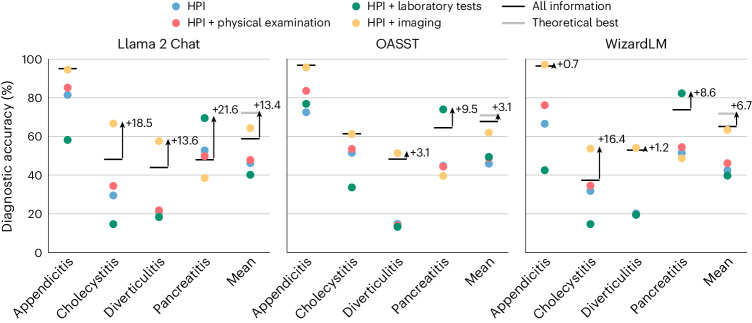
Clinical decision-making is one of the most impactful parts of a physician's responsibilities and stands to benefit greatly from artificial intelligence solutions and large language models (LLMs) in particular. However, while LLMs have achieved excellent performance on medical licensing exams, these tests fail to assess many skills necessary for deployment in a realistic clinical decision-making environment, including gathering information, adhering to guidelines, and integrating into clinical workflows. Here we have created a curated dataset based on the Medical Information Mart for Intensive Care database spanning 2,400 real patient cases and four common abdominal pathologies as well as a framework to simulate a realistic clinical setting. We show that current state-of-the-art LLMs do not accurately diagnose patients across all pathologies (performing significantly worse than physicians), follow neither diagnostic nor treatment guidelines, and cannot interpret laboratory results, thus posing a serious risk to the health of patients. Furthermore, we move beyond diagnostic accuracy and demonstrate that they cannot be easily integrated into existing workflows because they often fail to follow instructions and are sensitive to both the quantity and order of information. Overall, our analysis reveals that LLMs are currently not ready for autonomous clinical decision-making while providing a dataset and framework to guide future studies.
Overview
CoChat Summary
TL;DR
This study evaluates open-access LLMs on a realistic clinical decision-making task using 2,400 real emergency department cases of acute abdominal pain from MIMIC-IV. The models performed significantly worse than physicians, failed to follow diagnostic/treatment guidelines, and were too fragile and instruction-sensitive for autonomous clinical use.
Key findings
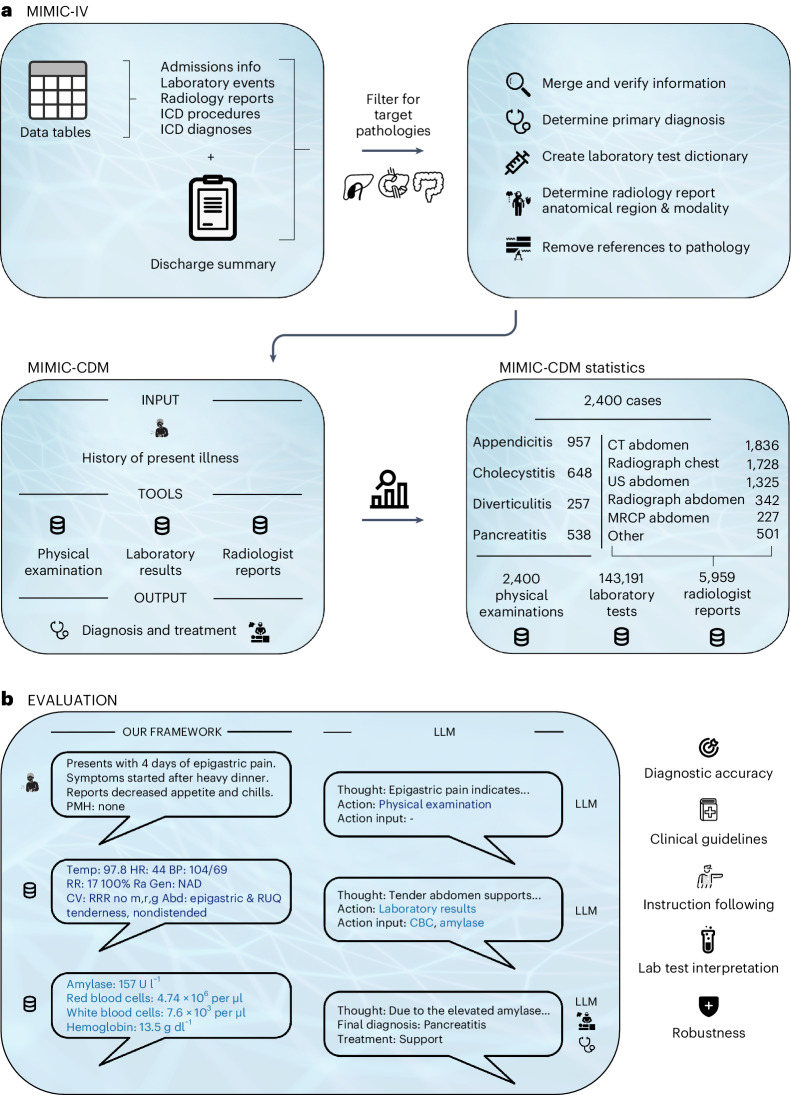
- The curated dataset, MIMIC-CDM, contains 2,400 unique patients with appendicitis (957), cholecystitis (648), diverticulitis (257), and pancreatitis (538).
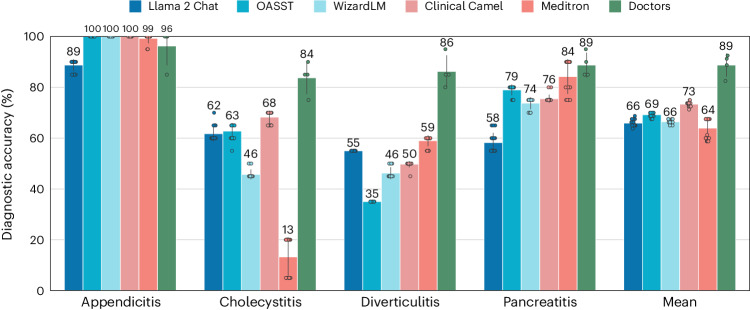
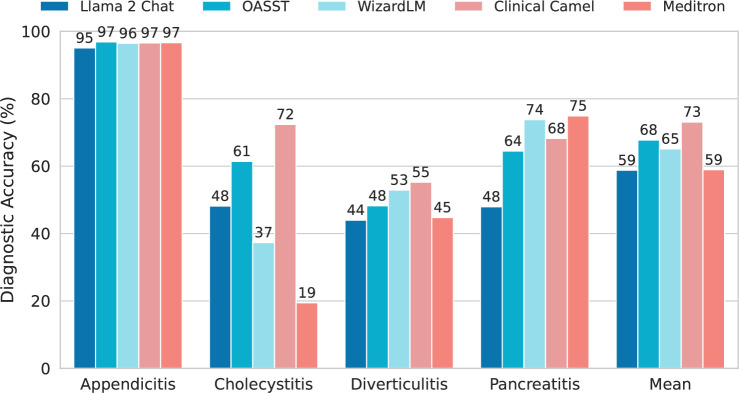
- On a reader study with 80 patients and 4 hospitalists, current LLMs performed significantly worse than clinicians on aggregate across all diseases (P < 0.001 for doctors versus Llama 2 Chat, OASST, WizardLM, Clinical Camel, and Meditron).
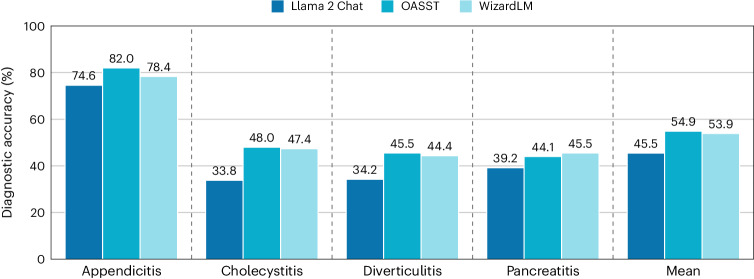
- Diagnostic performance dropped further when models had to gather information themselves: mean diagnostic accuracy fell to 45.5% for Llama 2 Chat, 54.9% for OASST, and 53.9% for WizardLM, versus 58.8%, 67.8%, and 65.1% on the full-information setup, respectively.
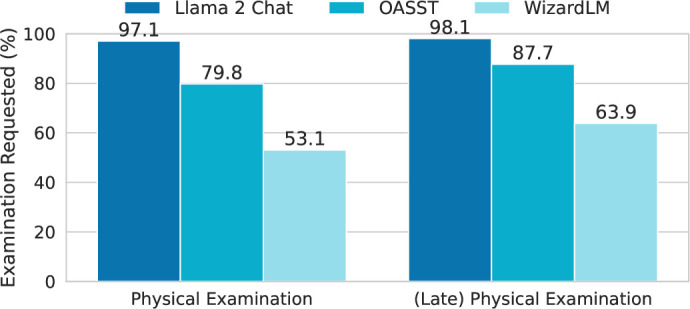
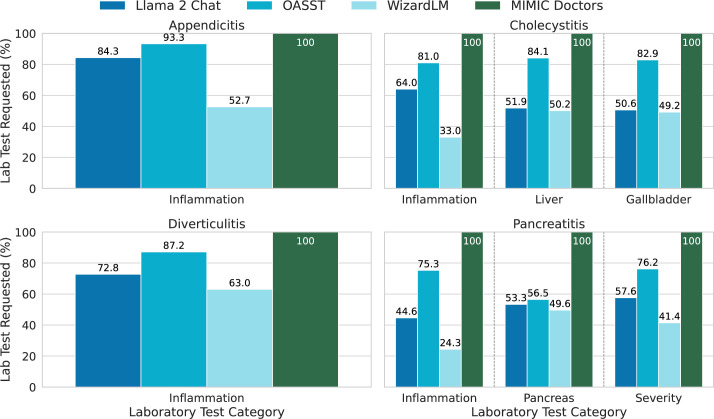
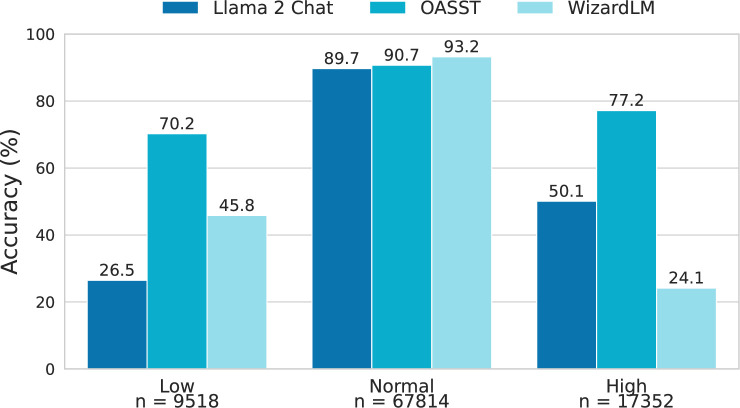
- Models also failed basic safety checks: only Llama 2 Chat consistently requested physical examination information (97.1% as first action; 98.1% at all), and laboratory interpretation was poor even with reference ranges (for example, low results: 26.5% Chat, 70.2% OASST, 45.8% WizardLM; high results: 50.1%, 77.2%, 24.1%).
Methods
- The authors built MIMIC-CDM from the MIMIC-IV EHR database by filtering to emergency department cases with acute abdominal pain and a primary diagnosis of one of four target pathologies, then extracting history of present illness, physical exams, labs, microbiology, imaging, and procedures.
- They evaluated open-access models derived from Llama 2, focusing mainly on Llama 2 Chat, OASST, and WizardLM, and compared them with clinicians on a 100-patient reader study (80 target cases plus 5 each of other conditions), with each LLM evaluated 20 times on the physician comparison subset using different seeds.
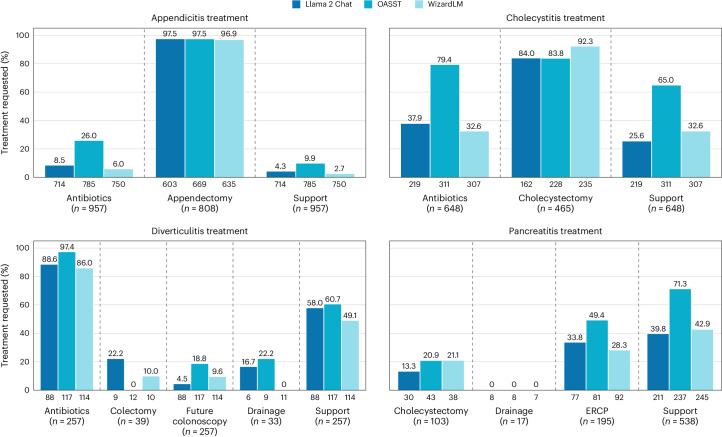
- Main analysis included per-class accuracy, guideline adherence for diagnostic tests and treatments, lab interpretation tasks, instruction-following, robustness to changes in wording, order, and amount of information, and comparisons using two-sided Student’s t-tests with Bonferroni correction.
Limitations
- The paper states that the dataset and models have a clear bias toward the USA, so generalizability to other languages or countries with different guidelines is unknown.
- The authors note that, because they used real-world clinical data, they had to deny requests for information not in the dataset; they argue this was mitigated because MIMIC-IV contains all data gathered during the hospital stay.
- Evident from the text: the study focuses only on four abdominal pathologies, so it does not cover the full breadth of clinical decision-making (the paper itself notes this as a constraint).
Model-written summary. Check it against the paper before relying on it.
Integrity signals
Registry
Cites
Statistics
Figures
Verification
Claims the paper makes
6 Valid · 2 Not valid · 3 Not checked · 106 Own results and interpretations
Some cited sources support this claim and some don’t — read each source’s verdict below.
In the paper
“where LLMs score well above passing8–10,17–20”
§ Evaluation and mitigation of the limitations of large language models in clinical decision-making > Main
What the sources say
- Supportedcites [8] Singhal, K. et al. Towards expert-level medical question answering with large language models. Preprint at https://arxiv.org/abs/2305.09617 (2023). source
The Abstract (page not supplied) reports that Med-PaLM 2 scored 86.5% on MedQA, a dataset of USMLE-style questions, and that its predecessor had exceeded a passing score at 67.2%. This supports the claim about LLM performance on medical-licensing-exam-style questions. (LLM, conf=0.93)
- Partly supportedcites [9] Singhal, K. et al. Large language models encode clinical knowledge. Nature 620, 172–180 (2023). sourceExperimental — accuracy not yet measured
The ‘State of the art on MedQA’ section reports that Flan-PaLM scored 67.6% on USMLE-style questions, supporting strong performance on a medical-exam benchmark. Our copy does not establish a passing threshold or show that LLMs scored well above it on actual licensing exams. (LLM, conf=0.86)
- Supportedcites [10] Nori, H., King, N., McKinney, S. M., Carignan, D. & Horvitz, E. Capabilities of GPT-4 on medical challenge problems. Preprint at https://arxiv.org/abs/2303.13375 (2023). source
The Abstract (p. 1) reports that GPT-4 exceeded the USMLE passing score by over 20 points. The Introduction (p. 2) specifies that the results came from official sample exams and self-assessment materials, supporting this citation as an example of an LLM scoring well above passing on medical licensing exam materials. (LLM, conf=0.93)
- Disputedcites [17] Kung, T. H. et al. Performance of chatgpt on usmle: potential for ai-assisted medical education using large language models. PLoS Digital Health 2, 0000198 (2023). sourceExperimental — accuracy not yet measured
The Discussion (‘The rising accuracy of ChatGPT’) says ChatGPT exceeded 60% accuracy in some analyses, while the USMLE passing threshold is approximately 60%; it concludes that ChatGPT ‘approaches the passing range.’ The paper describes performance as at or near passing, not well above it. (LLM, conf=0.88)
Checked by a reasoning model — may be wrong.
- Disputedcites [18] Gilson, A. et al. How does chatgpt perform on the United States medical licensing examination? The implications of large language models for medical education and knowledge assessment. JMIR Med. Educ. 9, 45312 (2023). sourceExperimental — accuracy not yet measured
The Results (Overall Performance; page unavailable) report that ChatGPT exceeded the paper’s approximately 60% passing benchmark on only one of four question sets, scoring 64.4%. It scored below that benchmark on the other three; InstructGPT and GPT-3 scored below it on all four. The paper therefore does not show LLMs scoring well above passing. (LLM, conf=0.90)
Checked by a reasoning model — may be wrong.
- Partly supportedcites [19] Toma, A. et al. Clinical camel: an open-source expert-level medical language model with dialogue-based knowledge encoding. Preprint at https://arxiv.org/abs/2305.12031 (2023). sourceExperimental — accuracy not yet measured
Table 4 reports strong five-shot scores on the USMLE Sample Exam, including 86.6% for GPT-4 and 64.3% for Clinical Camel-70B. But the paper gives no passing threshold, and other models score substantially lower, so it does not establish that LLMs generally score well above passing. (LLM, conf=0.82)
- Supportedcites [20] Nori, H. et al. Can generalist foundation models outcompete special-purpose tuning? Case study in medicine. Preprint at https://arxiv.org/abs/2311.16452 (2023). source
Section 2.1 reports that GPT-4 exceeded the USMLE passing score by over 20 points. The Abstract also reports that GPT-4 with Medprompt surpassed 90% on MedQA, a USMLE-style exam-question dataset. These passages support the cited claim that LLMs can score well above passing on medical licensing exam questions. (LLM, conf=0.91)
boosted- Asserted: passes — The authors put it forward as true.
- Checkable: passes — It can be checked against evidence.
- Load-bearing: unclear — It is unclear whether the paper’s conclusions depend on it.
- Based: passes — The paper gives a reason why it holds.
- Supported
The cited sources support only part of this claim — read each source’s verdict below.
In the paper
“We note that Llama 2, Clinical Camel and Meditron have been shown to match and even exceed Chat-GPT performance on medical licensing exams and biomedical question answering tests19,35.”
§ Evaluation and mitigation of the limitations of large language models in clinical decision-making > Results > Creating the MIMIC-CDM dataset and evaluation framework
What the sources say
- Partly supportedcites [19] Toma, A. et al. Clinical camel: an open-source expert-level medical language model with dialogue-based knowledge encoding. Preprint at https://arxiv.org/abs/2305.12031 (2023). sourceExperimental — accuracy not yet measured
Section 4 (Evaluation) and Table 4 report that Clinical Camel-70B exceeded GPT-3.5 on five-shot medical benchmarks, including MedQA, PubMedQA and the USMLE sample exam. The paper does not show that LLaMA 2 or Meditron achieved those results; Clinical Camel was fine-tuned from LLaMA 2. It also says Clinical Camel generally fell short of GPT-4, except on PubMedQA. Page numbers were not available in our copy. (LLM, conf=0.88)
- Partly supportedcites [35] Chen, Z. et al. MEDITRON-70B: scaling medical pretraining for large language models. Preprint at https://arxiv.org/abs/2311.16079 (2023). sourceExperimental — accuracy not yet measured
Section 6.2 reports that MEDITRON-70B outperformed GPT-3.5 on the medical benchmarks, including MedQA and PubMedQA. It evaluates Llama-2 and Clinical-Camel as baselines but does not establish that either matched or exceeded GPT-3.5 on those tests. The benchmark comparison also uses text-davinci-003 as GPT-3.5, not ChatGPT itself. (LLM, conf=0.87)
boosted- Asserted: passes — The authors put it forward as true.
- Checkable: passes — It can be checked against evidence.
- Load-bearing: unclear — It is unclear whether the paper’s conclusions depend on it.
- Based: passes — The paper gives a reason why it holds.
- Partly supported
The cited sources support only part of this claim — read each source’s verdict below.
In the paper
“All guidelines recommended physical examinations as an essential part of the diagnostic process, preferably as the first action.”
§ Evaluation and mitigation of the limitations of large language models in clinical decision-making > Results > Current LLMs are hasty and unsafe clinical decision-makers
What the sources say
- Partly supportedcites [36] Di Saverio, S. et al. Diagnosis and treatment of acute appendicitis: 2020 update of the WSES Jerusalem guidelines. World J. Emerg. Surg. 15, 27 (2020). sourceExperimental — accuracy not yet measured
In Results, Topic 1: Diagnosis, the WSES guideline includes physical examination and clinical signs in its diagnostic approach, and Recommendation 1.10 makes imaging conditional on clinical assessment. This supports an early role for examination, but this single guideline does not establish what all guidelines recommend or explicitly say physical examination should be the first action. (LLM, conf=0.85)
- Partly supportedcites [37] Pisano, M. et al. 2020 World Society of Emergency Surgery updated guidelines for the diagnosis and treatment of acute calculus cholecystitis. World J. Emerg. Surg. 15, 61 (2020). sourceExperimental — accuracy not yet measured
Section 1, Diagnosis of ACC (page not provided), suggests including a complete clinical examination alongside history, laboratory tests and imaging. It does not say examination should be the first action, and this single guideline does not establish what all guidelines recommend. (LLM, conf=0.87)
- Partly supportedcites [38] Hall, J. et al. The american society of colon and rectal surgeons clinical practice guidelines for the treatment of left-sided colonic diverticulitis. Dis. Colon Rectum 63, 728–747 (2020). sourceExperimental — accuracy not yet measured
In “Initial Evaluation of Acute Diverticulitis” (recommendation 1; page not supplied), this guideline recommends a physical examination as part of the initial evaluation. It does not establish what all guidelines recommend or say that the examination should preferably be the first action. (LLM, conf=0.84)
plain- Asserted: passes — The authors put it forward as true.
- Checkable: passes — It can be checked against evidence.
- Load-bearing: passes — The paper’s conclusions depend on it.
- Based: passes — The paper gives a reason why it holds.
- Partly supported
A result the paper reports from its own data — it cites no other source for it, so there is none to check. The quote shows it is in the paper.
In the paper
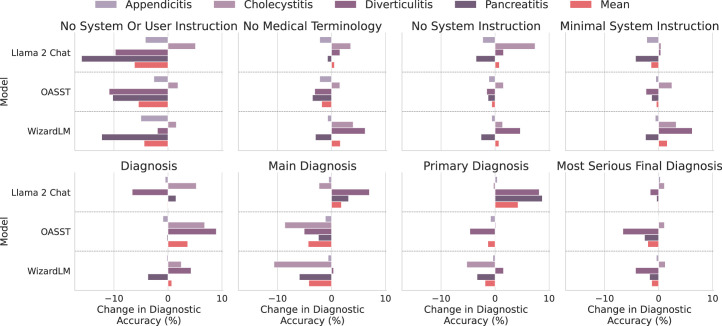
“Additionally, we see that even minor changes in instructions can greatly change diagnostic accuracy such as asking for the ‘main diagnosis’ (up to +7.0% for Chat on diverticulitis, down to −10.6% for WizardLM on cholecystitis) or ‘primary diagnosis’ (up +8.7% for Chat on pancreatitis, down to −5.2% for WizardLM on cholecystitis) instead of ‘final diagnosis’.”
§ Evaluation and mitigation of the limitations of large language models in clinical decision-making > Results > Current LLMs require extensive clinician supervision
plainstates a cause- Asserted: passes — The authors put it forward as true.
- Checkable: passes — It can be checked against evidence.
- Load-bearing: passes — The paper’s conclusions depend on it.
- Based: passes — The paper gives a reason why it holds.
A result the paper reports from its own data — it cites no other source for it, so there is none to check. The quote shows it is in the paper.
In the paper
“We show that current state-of-the-art LLMs do not accurately diagnose patients across all pathologies (performing significantly worse than physicians)”
§ Evaluation and mitigation of the limitations of large language models in clinical decision-making > Abstract
plainn = 2,400- Asserted: passes — The authors put it forward as true.
- Checkable: passes — It can be checked against evidence.
- Load-bearing: passes — The paper’s conclusions depend on it.
- Based: passes — The paper gives a reason why it holds.
59 more claims
Create a free account to see all 117 claims and to verify the 1 reference still open.
- It may state two separate claims as one. 40
- Probably not a substantial claim. 20
- The quote only partly states this claim. 1
Claims other papers make about this one
Each is checked against this paper’s own text: does it say what the citing paper says it does?
The source backs part of the claim, not all of it — or backs it for a different population, condition or comparison.
In the citing paper
“While medical licensing exams and diagnostic tasks are prioritized in 64% of LLM healthcare evaluations8, many administrative and operational tasks that represent significant human bottlenecks are often overlooked.”
From Holistic evaluation of large language models for medical tasks with MedHELM (2026) · cites this paper as [9]
Experimental — accuracy not yet measuredThe source backs part of the claim, not all of it — or backs it for a different population, condition or comparison.
In the citing paper
“While these models offer powerful foundational capabilities, adapting them to specific tasks and datasets without losing robustness is a significant hurdle, often resulting in significant variability in accuracy across different settings.7,9,10”
From Advancing methodological development of artificial intelligence in patient-centered comparative clinical effectiveness research: Patient-Centered Outcomes Research Institute’s unique contribution to research done differently (2025) · cites this paper as [9]
Experimental — accuracy not yet measuredThe cited source says what the claim attributes to it.
In the citing paper
“While LLM performance on medical QA benchmarks has been demonstrated to rival human-level performance, their capabilities in simulated real-world medical scenarios have been more limited12.”
From Limitations of large language models in clinical problem-solving arising from inflexible reasoning (2025) · cites this paper as [12]
The cited source says what the claim attributes to it.
In the citing paper
“Another study demonstrated that while LLMs show potential for clinical decision-making, they currently underperform compared to human clinicians in diagnosing common conditions such as appendicitis, cholecystitis, diverticulitis, and pancreatitis.”
From Enhancing diagnostic capability with multi-agents conversational large language models (2025) · cites this paper as [30]
Citations
Cites
Language Models are Few-Shot Learners
Brown, T. B., Mann, B., Ryder, N., Subbiah, M., Kaplan, J., Dhariwal, P., Neelakantan, A., Shyam, P., Sastry, G., Askell, A., et al. (2020) · arXiv · doi:10.48550/arxiv.2005.14165 · Cited by 23,372
Goldberger, A. L., Amaral, L. A. N., Glass, L., Hausdorff, J. M., Ivanov, P. C., Mark, R. G., Mietus, J. E., Moody, G. B., Peng, C.-K., & Stanley, H. E. (2000) · Circulation · doi:10.1161/01.cir.101.23.e215 · Cited by 14,809
Exploring the Limits of Transfer Learning with a Unified Text-to-Text Transformer
Raffel, C., Shazeer, N., Roberts, A., Lee, K., Narang, S., Matena, M., Zhou, Y., Li, W., & Liu, P. J. (2019) · arXiv · doi:10.48550/arxiv.1910.10683 · Cited by 10,929
Scaling Laws for Neural Language Models
Kaplan, J., McCandlish, S., Henighan, T., Brown, T. B., Chess, B., Child, R., Gray, S., Radford, A., Wu, J., & Amodei, D. (2020) · arXiv · doi:10.48550/arxiv.2001.08361 · Cited by 9,550
Chain-Of-Thought Prompting Elicits Reasoning in Large Language Models
Wei, J., Wang, X., Schuurmans, D., Bosma, M., Ichter, B., Xia, F., Chi, E., Le, Q. V., & Zhou, D. (2022) · Advances in Neural Information Processing Systems 35 · doi:10.52202/068431-1800 · Cited by 4,505
Chain-of-Thought Prompting Elicits Reasoning in Large Language Models
Wei, J., Wang, X., Schuurmans, D., Bosma, M., Ichter, B., Xia, F., Chi, E., Le, Q., & Zhou, D. (2022) · arXiv · doi:10.48550/arxiv.2201.11903 · Cited by 4,263 · cited 1×
“Given these constraints, we calculate and use the per-class accuracy throughout our work, which is the only metric that can be calculated without bias as it only requires the samples of a single class.”
Training language models to follow instructions with human feedback
Ouyang, L., Wu, J., Jiang, X., Almeida, D., Wainwright, C. L., Mishkin, P., Zhang, C., Agarwal, S., Slama, K., Ray, A., et al. (2022) · arXiv · doi:10.48550/arxiv.2203.02155 · Cited by 4,208
Kung, T. H., Cheatham, M., ChatGPT, Medenilla, A., Sillos, C., De Leon, L., Elepaño, C., Madriaga, M., Aggabao, R., Diaz-Candido, G., et al. (2022) · doi:10.1101/2022.12.19.22283643 · Cited by 4,115
Kung, T. H., Cheatham, M., Medenilla, A., Sillos, C., De Leon, L., Elepaño, C., Madriaga, M., Aggabao, R., Diaz-Candido, G., Maningo, J., et al. (2023) · PLOS Digital Health · doi:10.1371/journal.pdig.0000198 · Cited by 4,115
Large Language Models Encode Clinical Knowledge
Singhal, K., Azizi, S., Tu, T., Mahdavi, S. S., Wei, J., Chung, H. W., Scales, N., Tanwani, A., Cole-Lewis, H., Pfohl, S., et al. (2022) · arXiv · doi:10.48550/arxiv.2212.13138 · Cited by 4,083
Research works printed but not linked: 4
- Di Saverio, S. et al. Diagnosis and treatment of acute appendicitis: 2020 update of the WSES Jerusalem guidelines. World J. Emerg. Surg. 15, 27 (2020). · DOI · Paper page
- Zheng, C., Zhou, H., Meng, F., Zhou, J. & Huang, M. On large language models’ selection bias in multi-choice questions. In 12th International Conference on Learning Representations (ICLR, 2024).
- Golkar, Siavash, et al. xVal: a continuous number encoding for large language models. In NeurIPS 2023 AI for Science Workshop (2023).
- Radford, A. et al. Language models are unsupervised multitask learners. OpenAI blog 1, 9 (2019).
Cited by
Items 301–400 of 736
Comparative Evaluation of Deep-Reasoning Large Language Models for Ophthalmic Emergencies
Lin, X., Yang, Y., Ren, Y., Wang, L., & Cai, L. (2026) · Ophthalmology Science · doi:10.1016/j.xops.2026.101158 · Cited by 3
“12 Most current AI studies evaluate LLMs under “complete information” scenarios, failing to assess performance amid the uncertainty inherent in initial patient encounters, where limited history and basic ocular findings guide early decision-making.”
Abbas, A. E., Hupman, A. C., & Monger, R. (2026) · Decision Analysis · doi:10.1287/deca.2025.0467 · Cited by 3
Med-R 2 : Crafting Trustworthy LLM Physicians via Retrieval and Reasoning of Evidence-Based Medicine
Lu, K., Zheng, L., Pan, D., Zhang, S., Dong, G., Leng, H., Cui, B., wu, Z., & Zhang, W. (2026) · International World Wide Web Conference (WWW) · doi:10.1145/3774904.3792076 · Cited by 26
Agentic AI system for generating evidence-based second medical opinions
Hawashin, D., Salah, K., Jayaraman, R., & Ellahham, S. H. (2026) · Clinical eHealth · doi:10.1016/j.ceh.2026.04.001 · Cited by 6
How to meaningfully evaluate AI in clinical medicine
Omar, M., Agbareia, R., Gorenshtein, A., Ramaswamy, A., Sakhuja, A., Barash, Y., Ting, D. S. W., Klang, E., & Nadkarni, G. N. (2026) · Nature Medicine · doi:10.1038/s41591-026-04350-5 · Cited by 8
Metzger, A., Patil, S., Sugarmann, L., Karabacak, M., & Margetis, K. D. (2026) · JMIR AI · doi:10.2196/81134 · Cited by 2
Dashti, M., Khosraviani, F., Meyari, A., Amirzade-Iranaq, M. H., Chaurasia, A., Hefzi, D., Ghadimi, N., Tichý, A., Khurshid, Z., & Schwendicke, F. (2026) · International Dental Journal · doi:10.1016/j.identj.2026.109609 · Cited by 8
“As noted by Hager et al, 66 current LLMs fail to consistently follow diagnostic or treatment guidelines across pathologies and cannot reliably interpret laboratory results, which underscores their unsuitability for autonomous clinical decision-making.”
Umer, F., Mr, S., & Rahman, A. J. (2026) · BDJ Open · doi:10.1038/s41405-026-00462-9 · Cited by 2
“The FDA has not yet authorised any LLM for clinical use but has acknowledged the need for specialised assessment tools suited to clinical deployment contexts [12].”
InfluentialMedicalGLM: A Pediatric Medical Question Answering Model with a quality evaluation mechanism
Wang, X., Sun, Z., Wang, P., & Wei, B. (2025) · Journal of Biomedical Informatics · doi:10.1016/j.jbi.2025.104793 · Cited by 5
Grinberg, N., Ianculovici, C., Whitefield, S., Kleinman, S., Feldman, S., & Peleg, O. (2025) · Oral Radiology · doi:10.1007/s11282-025-00836-z · Cited by 6
“The integration of multiple data sources and the ability to consider patient-specific factors remains a significant challenge [41, 42].”
Current State of Artificial Intelligence and Trauma Video Review: Insights for Trauma Resuscitation
Villarreal, J. A., Suh, E., Forrester, J. D., Jopling, J. K., & Dumas, R. P. (2025) · Current Trauma Reports · doi:10.1007/s40719-025-00293-3 · Cited by 3
“LLM studies comparing the quality of LLM outputs through expertise scoring by clinicians show promising but imperfect results and often lack methodological rigor— limiting generalizability[18].”
Golder, S., O’Connor, K., López-García, G., Tatonetti, N. P., & Gonzalez‐Hernandez, G. (2025) · Annual Review of Biomedical Data Science · doi:10.1146/annurev-biodatasci-111224-124530 · Cited by 9
Chang, M., Srinivasan, A., & Palani, S. (2026) · ACM International Conference on Intelligent User Interfaces (IUI) · doi:10.1145/3742413.3789077 · Cited by 5
Who Does What? Archetypes of Roles Assigned to LLMs During Human-AI Decision-Making
Chappidi, S., Singh, J., & Krauze, A. V. (2026) · CHI Conference on Human Factors in Computing Systems · doi:10.1145/3772318.3791428 · Cited by 8
Gao, Y., Myers, S., Chen, S., Dligach, D., Miller, T. A., Bitterman, D. S., Chen, G., Mayampurath, A. M., Churpek, M. M., & Afshar, M. (2024) · medRxiv · doi:10.1101/2024.11.06.24316848 · Cited by 2
“Unlike previous work exploring LLM medical uncertainty estimation on question-answering tasks or case reports (Saposnik et al., 2016; Hager et al., 2024; Abdullahi et al., 2024), our study was based on a set of annotated structured data in the electronic health records (EHRs) from a cohort of 660…”
BackgroundMethodRoeschl, T., Hoffmann, M., Hashemi, D., Rarreck, F., Hinrichs, N., Trippel, T. D., Gröschel, M. I., Unbehaun, A., Klein, C., Kempfert, J., et al. (2024) · medRxiv · doi:10.1101/2024.11.20.24313385 · Cited by 2
Kadhim, A., Green, Z., Nazari, I., Baker, J., George, M., Heinson, A., Stammers, M., Kipps, C., Beattie, R. M., Ashton, J., et al. (2025) · medRxiv · doi:10.1101/2025.03.07.25323569 · Cited by 1
Golder, S., O’Connor, K., López-García, G., Tatonetti, N. P., & Gonzalez‐Hernandez, G. (2025) · medRxiv · doi:10.1101/2025.03.20.25324320 · Cited by 3
A Systematic Multi-LLM AI Framework for Immunotherapy Biomarker Discovery and Target IdentificationPreprint
Park, N., & Lee, J. H. (2025) · bioRxiv (Cold Spring Harbor Laboratory) · doi:10.1101/2025.06.10.658988 · Cited by 2
“To our knowledge, this represents the first systematic application of a multi-LLM strategy to the field of immunotherapy biomarker discovery 4,5 .”
HealthBench: Advancing AI evaluation in healthcare, but not yet clinically ready
Liu, J., & Liu, S. (2025) · Digital Health · doi:10.1177/20552076251390447 · Cited by 7
Modi, M., Krull, J. E., Gauntner, T. D., Li, M., Johnson, D., Wang, X., Cheng, H., Zhao, J., Ma, A., Zhang, P., et al. (2026) · npj Digital Medicine · doi:10.64898/2026.01.26.26344845 · Cited by 4
The AI Agent in the Room: Rethinking Consumer Decision‐Making in the Age of Autonomous AI
Bilgihan, A., Ostinelli, M., Lorenz, M. P., & Zhang, Y. (2026) · Psychology and Marketing · doi:10.1002/mar.70165 · Cited by 6
“Almost no marketing research examines AIA processing, what information agents prioritize, what systematic biases they embed, or how prompt wording and presentation order alter outputs (Allouah et al. 2025; Hager et al. 2024; Dubois et al. 2025).”
Auditing medical multi-agent AI reveals risks of false consensus
Zhu, Y., Gu, L., Wang, Z., Sang, H., Sui, D., Tang, W., Mi, L., Wang, Y., Gao, J., Yao, L., et al. (2025) · arXiv · doi:10.48550/arxiv.2510.10185 · Cited by 17
Ou, J., & Holve, E. (2025) · JAMIA Open · doi:10.1093/jamiaopen/ooaf081 · Cited by 1
Ardila, C. M., & Yadalam, P. K. (2025) · International Dental Journal · doi:10.1016/j.identj.2025.02.027 · Cited by 1
Ke, Y., Lin, H., Ruan, Y., Tang, J., & Li, L. (2025) · Mathematics · doi:10.3390/math13091538 · Cited by 8
Xiong, Y., Zeng, Y.-M., Liu, H.-N., Sun, Y., Tang, W., & Liu, C. (2025) · Frontiers in Public Health · doi:10.3389/fpubh.2025.1582377 · Cited by 1
Large language models and their performance for the diagnosis of histoplasmosis
Nacher, M., Françoise, U., & Adenis, A. A. (2025) · PLoS neglected tropical diseases · doi:10.1371/journal.pntd.0013151 · Cited by 1
„Large language models – hype or hope?“
Knitza, J., & Kühn, S. (2025) · Die Dermatologie · doi:10.1007/s00105-025-05576-z · Cited by 1
Large language model‐based identification of venous thromboembolism diagnostic delays
Schaye, V. E., Sartori, D. J., Signoriello, L., Malhotra, K., Guzman, B. V., Rajput, B., Reinstein, I., & Burk‐Rafel, J. (2025) · Journal of Hospital Medicine · doi:10.1002/jhm.70194 · Cited by 2
Learning to Be a Doctor: Searching for Effective Medical Agent Architectures
Zhuang, Y., Jiang, W., Zhang, J., Yang, Z., Zhou, J. T., & Zhang, C. (2025) · ACM International Conference on Multimedia (ACM MM) · doi:10.1145/3746027.3755559 · Cited by 16
Performance of the large language model in general medicine
Tao, L., Liu, J., Lu, X., Zhao, Y., Zhang, Y., Zhu, Z., Li, T., Zhang, Z., Zhang, Y., Yan, W., et al. (2025) · Global Transitions · doi:10.1016/j.glt.2025.10.004 · Cited by 1
Said-Criado, I., Pietrantonio, F., Montagna, M., Rosiello, F., Missikoff, O., Drago, C., Leung, T. I., Vinci, A., Signorini, A., & Gómez‐Huelgas, R. (2025) · Clinics and Practice · doi:10.3390/clinpract15110200 · Cited by 1
“However, Generative AI faces challenges when it comes to integration into existing workflows due to missed instructions and variable accuracy depending on the pathology or discipline [23].”
Physician Perspectives on Large Language Models in Health Care: A Cross-Sectional Survey Study
Hong, H. J., Shah, N. H., Pfeffer, M. A., & Lehmann, L. S. (2025) · Applied Clinical Informatics · doi:10.1055/a-2735-0527 · Cited by 5
Towards Context-Aware Clinical Decision Support with Retrieval-Augmented Generation
Hartono, L. A., Widagda, I. K. G. P., Agastya, G. N. R., Qomariyah, N. N., & Setiawan, F. (2025) · Procedia Computer Science · doi:10.1016/j.procs.2025.09.116 · Cited by 2
Dietrich, N. T., Bradbury, N., & Loh, C. (2025) · American Journal of Roentgenology · doi:10.2214/ajr.25.33947 · Cited by 4
Dietrich, L. G., Pellegrin, L. D., Rinaldi, V., Harder, Y., Vögelin, E., & Rothenfluh, E. (2025) · Journal of Clinical Medicine · doi:10.3390/jcm14228045 · Cited by 1
“This is particularly critical in fields such as hand surgery, where treatment often requires careful balancing of patient-specific factors, surgeon experience, and evolving clinical evidence [23].”
Kulkarni Kale, U., & Vemulapalli, G. (2025) · The Cancer Journal · doi:10.1097/ppo.0000000000000799 · Cited by 1
Mehta, M. (2025) · American Journal of Health-System Pharmacy · doi:10.1093/ajhp/zxaf309 · Cited by 1
Clinician’s Guide to Artificial Intelligence
Schroeder, A. W., Tran, Z. K., Sexton, K. W., & Salzberg, A. D. (2025) · Medical Clinics of North America · doi:10.1016/j.mcna.2025.07.010 · Cited by 3
Artificial Intelligence in Mental Health
Earnhardt, A. V., Riordan, P. A., Kahlon, C. H., Nwajei, F. I., & McCants, K. M. (2025) · Nursing Clinics of North America · doi:10.1016/j.cnur.2025.09.011 · Cited by 2
Performance of large language model in cross-specialty medical scenarios
Cui, Z., Liu, W., Tian, X., You, C., Meng, X., ZHANG, H., Gong, K., Wang, X., & Wu, J. (2025) · Journal of Translational Medicine · doi:10.1186/s12967-025-07577-x · Cited by 5
“Despite diagnostic competence, making appropriate decisions remains difficult [34, 35].”
Zhang, J., Ubuzima, P., Huang, G., Lee, E.-H., Wang, Y., Xu, H., Xia, L., & Wu, T. (2025) · BMC Oral Health · doi:10.1186/s12903-025-07540-8 · Cited by 3
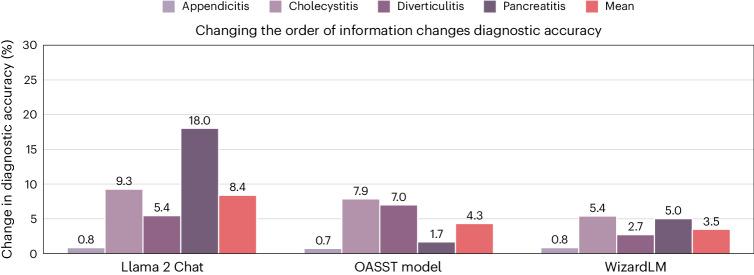
“Hager et al. reported that LLMs’ accuracy declined by up to 18% when the presentation order of clinical information was changed [25].”
Fan, L., Sivakumar, S., Marin, E., Cao, M., Brodie, D., Whitman, G. J. R., & Cho, S.-M. (2025) · Perfusion · doi:10.1177/02676591251412271 · Cited by 1
“20 Thus, our work reinforces the consensus that generative AI for ICU applications, including procedural coding, remains a work in progress.”
Hierarchical agent reflection for aligning LLM reasoning with clinical diagnostic processes
Wang, X., Li, X., Zhao, D., Feng, K., Liang, L., Zhang, Z., Ding, K., Chen, H., Wan, B., & Zhang, Q. (2026) · Health Information Science and Systems · doi:10.1007/s13755-025-00410-1 · Cited by 2
“Despite the rapid advancements of large models in the medical field and their high accuracy on static medical evaluation benchmarks, they have yet to demonstrate optimal performance in the domain of medical diagnosis [10–12].”
Rosen, D., Zwanzig, D., Vogel, B. A., Erhart, M., & Reiter, N. L. (2026) · Physiotherapy Theory and Practice · doi:10.1080/09593985.2025.2606058 · Cited by 3
Tumor Board–Inspired Multiagent Artificial Intelligence System for Interpreting Oncology Guidelines
Wang, J., Arora, K., Swoboda, D. M., & Nazha, A. (2026) · JCO Clinical Cancer Informatics · doi:10.1200/cci-25-00286 · Cited by 4
Small, W. R., Crowley, R. J., Pariente, C. S., Zhang, J., Eaton, K. P., Jiang, L. Y., Oermann, E. K., & Aphinyanaphongs, Y. (2026) · npj Health Systems · doi:10.1038/s44401-025-00059-8 · Cited by 2
“Further, these models are limited by fi nite input sizes and poor explainability (outputs a score between 0 and 1), often leading to truncation of unstructured clinical documentation and information loss 25 – 29 .”
PEER: Towards reliable and efficient inference via Patience-Based Early Exiting with Rejection
Zhan, Z., Zhou, S., & Zhang, R. (2026) · Journal of Biomedical Informatics · doi:10.1016/j.jbi.2026.104988 · Cited by 4
Large Language Models in Radiologic Numerical Tasks: A Thorough Evaluation and Error Analysis
Nowroozi, A., Bondarenko, M., Serapio, A., Schnitzler, T., Brar, S. S., & Sohn, J. H. (2026) · Journal of Imaging Informatics in Medicine · doi:10.1007/s10278-025-01824-9 · Cited by 2
Kodan, A. (2026) · Cureus · doi:10.7759/cureus.102219 · Cited by 2
“Systems that prioritize apparent helpfulness over correctness risk eroding trust and exposing members to unexpected financial outcomes [5,8,11].”
InfluentialMiao, Q., Zhou, R. H. F. L., Meng, J., & Wei, Y. (2025) · IEEE International Conference on Bioinformatics and Biomedicine (BIBM) · doi:10.1109/bibm66473.2025.11356825 · Cited by 1
“This gap arises not from limited knowledge, but from LLMs’ generative bias toward fluent text, which conflicts with the rigid output control required for structured prediction [19].”
How to bring generative AI to oncology practice
Truhn, D., & Kather, J. (2026) · ESMO Real World Data and Digital Oncology · doi:10.1016/j.esmorw.2025.100679 · Cited by 3
Wang, S., Chi, X., Hao, Q., Wang, H., Tao, H., Xiao, J., Wu, C., Deng, J., Xu, H., & Sun, R. (2026) · BMC Medical Education · doi:10.1186/s12909-026-08704-y · Cited by 2
“Thus, the enhanced test accuracy of AI tools should be viewed as an opportunity to augment, rather than replace, human expertise [40].”
Kim, B., Kang, J., Jung, Y. J., & Ahn, J. (2026) · The Asian Journal of Kinesiology · doi:10.15758/ajk.2026.28.1.58 · Cited by 1
“Recent evidence further indicates that autonomous LLM-driven diagnosis remains unreliable in complex clinical environments, often performing significantly worse than physicians [6].”
The role of large language models in emergency care: a comprehensive benchmarking study
Naderi, B., Liu, L., Ghandehari, A., Khoshons, D., Taylor, R. A., Bhavsar, N., Balasubramanian, S., Tanouye, R., Creech, N., Davidson, C., et al. (2026) · npj Artificial Intelligence · doi:10.1038/s44387-026-00078-2 · Cited by 4
“In down-stream evaluations, GPT-5 appeared to maintain coherence and diagnostic accuracy as additional layers of patient information were introduced, highlighting scalability in contextualreasoning 17 .”
Safranek, C. W., Socrates, V., Wright, D., Huang, T., Alashi, A., McCann, K., Taylor, R. A., & Chartash, D. (2026) · BMC Medical Informatics and Decision Making · doi:10.1186/s12911-026-03381-9 · Cited by 1
“We also address a methodological limitation of prior stepwise evaluations, including Hager et al. and preprint efforts by Schmidgall et al. and Sun et al., that return a within-normal-limits reference value or an “Unavail-able” token whenever a requested lab, vital, or image is absent [8–10].”
InfluentialKong, G. (2026) · Frontiers in Psychology · doi:10.3389/fpsyg.2026.1768505 · Cited by 3
“By presenting pre-structured choices or suggesting complex decisions that users adopt with minimal reflection and deliberation (Shneiderman, 2020), GenAI challenges human autonomy before any motor output is executed (Hager et al., 2024; Mukherjee and Chang, 2025).”
Miller, K., Sturm, S. R., Dean, K., Brochu, B. M., Kassira, W., & Thaller, S. R. (2026) · Journal of Craniofacial Surgery · doi:10.1097/scs.0000000000012095 · Cited by 1
Alignment of large language models in solving medical ethical dilemmas
Sorin, V., Glicksberg, B. S., Korfiatis, P. D., Collins, J. D., Yeow, M.-E., Brandeland, M. A., Nadkarni, G. N., & Klang, E. (2026) · Digital Health · doi:10.1177/20552076261428395 · Cited by 8
“10 To ensure safe clinical practice, we must guard against overreliance on algorithmic suggestions, particularly in ethically sensitive situations.”
Waldock, W. J., Gilchrist, M. J., Ashrafian, H., Darzi, A. W., & Franklin, B. D. (2026) · npj Antimicrobials and Resistance · doi:10.1038/s44259-026-00187-7 · Cited by 2
“Employing decision-mapping frameworks helps de fi ne clear points where AI intervention can provide the greatest value 7 , while behavioural science insights inform strategies to enhance user engagement and con fi dence 8 .”
Hong, D., Huang, C.-Y., & Jt, G. (2026) · Frontiers in Digital Health · doi:10.3389/fdgth.2026.1772965 · Cited by 3
“Consistent with prior studies, ChatGPT-assisted learning can support short-term knowledge acquisition when used with appropriate oversight (4, 5, 12–14).”
Yang, H., Chang, F., Muroi, F., Liu, Z., Zhang, W., & Cai, J. (2026) · Translational Psychiatry · doi:10.1038/s41398-026-03872-3 · Cited by 5
Promises and challenges of applying large language models in the healthcare domain
Wang, Q., Gong, Z., Lai, Z., Bu, L., Dahlweid, F.-M., & Sun, H. (2026) · Frontiers in Digital Health · doi:10.3389/fdgth.2026.1772274 · Cited by 4
“Consensus suggests that the primary value of text-based LLMs currently lies in information synthesis and alleviating administrative burdens; their deployment as independent diagnostic agents remain hindered by the need for robust reliability verification frameworks (37, 52).”
InfluentialContext-aware knowledge graph reasoning for road maintenance decision-making
Kang, R., Zhu, J., de Silva, L., & Brilakis, I. K. (2026) · Advanced Engineering Informatics · doi:10.1016/j.aei.2026.104618 · Cited by 2
Grounding large language models in clinical diagnostics
Chen, X., Zhou, H., Yi, H., You, M., Liu, W., Li, W., Qin, Z., Li, H., Zhang, X., Guo, Y., et al. (2026) · Nature Communications · doi:10.1038/s41467-026-70274-w · Cited by 21
“The EmergencyCasesubsetincludes2400electronichealthrecordsdrawn from the MIMIC-IV-Ext Clinical Decision Making dataset 12,21,22 , representing real-world emergency department encounters.”
InfluentialKadirli, K., & Cantürk, A. (2026) · European Journal of Radiology · doi:10.1016/j.ejrad.2026.112838 · Cited by 2
Shinde, A., Mhaismale, H., Pawar, P., Mane, S., & Bembde, A. (2026) · Drug Development and Industrial Pharmacy · doi:10.1080/03639045.2026.2649846 · Cited by 3
“…expert judgment. llMs therefore serve primarily to assist scientists and clinicians in making formulation or therapeutic decisions [58,61,62,73]. therefore, the ways in which the llMs can be discussed are as something used to assist people in making decisions and not the systems which can…”
Cerrato, C., Ripa, F., van Balken, M. R., Rogers, E. T., & Somani, B. K. (2026) · Therapeutic Advances in Urology · doi:10.1177/17562872261441968 · Cited by 1
Li, J., Chang, Y., Liu, Y., Wang, Y., Ou, B., Lin, S., Tang, S.-K., & Zheng, L. (2026) · Frontiers in Medicine · doi:10.3389/fmed.2026.1804478 · Cited by 5
“However, while general-purpose LLMs have some eectiveness in the medical field, they still fall far short of expert levels (5), and sometimes they may produce incorrect or misleading content due to “hallucinations,” which may be related to the quality of training data, model architecture, training…”
Khan, R. R., Ryali, R., Dhunna, D. P., Tao, B. S., Azario, R., El-Hajj, N., Kim, M., Abiad, J., Shah, N. V., Tannoury, T. Y., et al. (2026) · Clinical Spine Surgery A Spine Publication · doi:10.1097/bsd.0000000000002083 · Cited by 1
iS2C2: a cointelligent platform for mechanistic discovery of disease cellular crosstalk
Sheng, J., Ahn, J. Y., Yang, L., Wan, Z., Qi, S., Yu, X., Xu, Z., Cao, Y., Vasquez, M., Irfan, A., et al. (2026) · Signal Transduction and Targeted Therapy · doi:10.1038/s41392-026-02691-8 · Cited by 2
“To evaluate the interpretability axis of robustness for the iS2C2 platform, we assessed whether iS2C2 enhances interpretability in automated hypothesis generation through a structured, expert-based assessment 24,44,45 (Supplementary Note 1F).”
Sum-of-Checks: structured reasoning for surgical safety with large vision-language models
You, W., Goldberg, C., Madani, A., Hashimoto, D. A., & Wong, E. (2026) · International Journal of Computer Assisted Radiology and Surgery · doi:10.1007/s11548-026-03643-x · Cited by 1
“However, large foundation models still struggle with certain clinically important tasks, particularly those requiring reasoning over diverse and interdependent visual evidence rather than simple recognition of isolated cues [8, 9].”
Dani, M., Prakash, M. J., Rosa, F., Akata, Z., & Liebe, S. (2026) · Communications Medicine · doi:10.1038/s43856-026-01653-z · Cited by 6
“Neurological disorders, such as epilepsy, provide a particularly compelling use case to explore this question, as behavioral and sensory symptoms can often be directly linked to underlying brain pathologies.”
Jadhav, P. D., Shruthi, P., Jain, S., et al. (2026) · Cureus · doi:10.7759/cureus.109410 · Cited by 1
“However, concerns remain regarding their clinical reliability, contextual understanding, and ability to replicate nuanced human judgments in complex treatment planning scenarios [6].”
Automated RECIST tumor response classification through prompt-guided large language models
Mergen, M., Busch, F., Sauter, A. P., Pfeiffer, D., Makowski, M. R., Spitzl, D., & Gassert, F. T. (2026) · Scientific Reports · doi:10.1038/s41598-026-54979-y · Cited by 2
Self-citationMAP: evaluation and multi-agent enhancement of large language models for inpatient pathways
Chen, Z., Peng, Z., Liang, X., Wang, C., Liang, P., Zeng, L., Ju, M., & Yuan, Y. (2026) · npj Health Systems · doi:10.1038/s44401-026-00085-0 · Cited by 18
Karataş, S. Ş., & Öner, S. F. (2026) · Health Policy and Technology · doi:10.1016/j.hlpt.2026.101281 · Cited by 1
A roadmap for medical large language models: a review of foundations, applications, and challenges
Sha, Y.-Y., Yu, L., Lin, Z.-H., Kaur, A., Lou, Y., Gornale, S. S., Zhang, T., Wong, L. S., Wang, Z., Yan, Y., et al. (2026) · Military Medical Research · doi:10.1016/j.mmr.2026.100050 · Cited by 4
“They also reflect the need for effective human oversight when these systems are integrated into clinical workflows [40].”
InfluentialZhang, W., Xu, J., Dong, T., Hao, X., Yang, Q., Zhang, J., & Han, Y. (2026) · Exploratory Research in Clinical and Social Pharmacy · doi:10.1016/j.rcsop.2026.100821 · Cited by 2
“6 13 However, significant vulnerabilities remain in the safety and effectiveness of LLMs; they may produce erroneous or inaccurate information in medical outputs, posing potential risks to patient health 14,15 .”
Ontological deskilling: clinical expertise and the changing disease object in precision medicine
Germenis, A. E. (2026) · Medicine Health Care and Philosophy · doi:10.1007/s11019-026-10377-9 · Cited by 2
“The certainty of action is weakened when the same molecular profile can support multiple therapeu - tic options, none of which carries the determinacy associated with classical diagnosis-treatment scripts (Alyass et al. 2015; Hager et al. 2024).”
How to benchmark medical AI agents
Estévez, S. R., Ferber, D., van der Schaar, M., & Kather, J. N. (2026) · PLoS Medicine · doi:10.1371/journal.pmed.1005170 · Cited by 8
Cheng, Q., Lou, W., Mou, G., & Yali, L. (2026) · Journal of Obstetrics and Gynaecology · doi:10.1080/01443615.2026.2695784 · Cited by 1
Leibovitch, L., Ahituv, A., Gorenshtein, A., Aran, D., Sorka, M., Miron, K., & Shelly, S. (2026) · Nature Medicine · doi:10.1038/s41591-026-04601-5 · Cited by 7
Development of a hybrid artificial intelligence framework for pharmacotherapy optimization
Rose, O., Clemens, S., Leiherer, A., Bücker, M., Petersson, F., Lirk, G., Mosch, C., Pachmayr, J., & Hoti, K. (2026) · International Journal of Clinical Pharmacy · doi:10.1007/s11096-026-02205-0 · Cited by 2
EAIRA: Establishing a methodology for evaluating LLMs as scientific research assistants
Cappello, F., Madireddy, S., Underwood, R., Getty, N., Chia, N., Ramachandra, N., Nguyen, T. D., Keçeli, M., Mallick, T., Li, Z., et al. (2026) · The International Journal of High Performance Computing Applications · doi:10.1177/10943420261467786 · Cited by 21
On-premise medical AI agents for reliable clinical decision-making
Zhang, L., Wölflein, G., Ferber, D., Liang, J., Carrero, Z. I., Wu, X., Vibert, J., Clusmann, J., Möhrmann, L., Möhrmann, E. E., et al. (2026) · Nature Medicine · doi:10.1038/s41591-026-04609-x · Cited by 3
Integration of AI With ML for Neuropsychological Applications
Kaur, P., Sachdeva, C., Gupta, R. K., & Jasrai, L. (2025) · Advances in psychology, mental health, and behavioral studies (APMHBS) book series · doi:10.4018/979-8-3693-9341-3.ch004 · Cited by 1
Künstliche Intelligenz in der Medizin – Chancen und Risiken aus ethischer Sicht
Metan, S., & Bruns, F. (2025) · Die Ophthalmologie · doi:10.1007/s00347-025-02224-8 · Cited by 2
“Vorsichtige Skepsis hin-sichtlich der Kliniktauglichkeit von LLMs wie ChatGPT und anderen ist auch au-ßerhalb der Augenheilkunde angebracht, wie jüngst anhand typischer Fallkonstel-lationen aus der Inneren Medizin gezeigt worden ist [23].”
Bilon, X. J. (2025) · Journal of HIV & Social Services · doi:10.1080/15381501.2025.2547229 · Cited by 3
“Emerging research highlights how biases embedded in LLMs across social dimensions such as race and gender (Hu et al., 2025; Qu & Wang, 2024) can lead to discriminatory outcomes that disproportionately impact margi - nalized communities (Hager et al., 2024; Omar et al., 2025).”
Kadhim, A. Z., Green, Z., Nazari, I., Baker, J., George, M. R., Heinson, A., Vadgama, B., Stammers, M., Kipps, C., Beattie, R. M., et al. (2025) · Med · doi:10.1016/j.medj.2025.100895 · Cited by 9
Obstet-LLM: Large Language Model for Early Prediction of SGA-LGA Newborns
Xu, G.-X., Jiang, H., Nguyen, S. V., Wu, D., Liu, Z.-D., Sha, F., & Li, Y. (2026) · Journal of Computer Science and Technology · doi:10.1007/s11390-025-5020-0 · Cited by 2
Summarizing Clinical Notes using LLMs for ICU Bounceback and Length-of-Stay PredictionPreprint
Choudhuri, A., Polgreen, P. M., Segre, A. M., et al. (2025) · medRxiv · doi:10.1101/2025.01.19.25320797 · Cited by 1
“We did not use the LLM to directly predict the outcome due to the known issue of low accuracy in the point predictions of LLMs [32].”
Is it time for the neurologist to use Large Language Models in everyday practice?Preprint
Maiorana, N. V., Marceglia, S. R. F., Treddenti, M., Tosi, M., Guidetti, M., Creta, M. F., Bocci, T., Oliveri, S., Boneschi, F. M., & Priori, A. (2025) · medRxiv · doi:10.1101/2025.01.23.25320945 · Cited by 4
“These conditions often require nuanced clinical judgment, experience in interpreting subtle clinical signs, and the ability to integrate information 48 .”
InfluentialHazard-aware adaptations bridge the generalization gap in large language models: a nationwide studyPreprint
Wu, J. T.-Y., Conover, S., Su, C. C., Corrigan, J., Culnan, J. M., Liu, Y., Kelley, M., Do, N., Arya, S., Harris, A. H. S., et al. (2025) · medRxiv · doi:10.1101/2025.02.14.25322312 · Cited by 1
“With increasing interest in the use of large language models (LLMs) in healthcare settings, from drafting documentation 1,2 to aiding diagnosis 3,4 , a high bar for evaluation and validation of these LLMs is required.”
Mustafa, G., Ong, J., Shaikh, M. Z., Askari, S., Anjum, S., Adhi, M. I., Memon, A. S., Rauf, M. U. A., Rizvi, A., Iqbal, I., et al. (2025) · medRxiv · doi:10.1101/2025.06.24.25329401 · Cited by 1
Sohail, A., Patel, O. P., Choi, J., Venditti, J. C. S., & Wu, A. J. (2025) · medRxiv · doi:10.1101/2025.07.06.25330972 · Cited by 1
Liu, J., Cao, W., Yuan, B., Xie, W., Wang, C., & Liu, S. (2025) · medRxiv · doi:10.1101/2025.08.28.25331796 · Cited by 3
PGxRAG: A Retrieval Augmented Generation supported Pharmacogenomics AssistantPreprint
Borishetty, D., Banda, P., Andhi, N., Desai, A. P., Uppili, B., Samudrala, N. M., Palanki, S. S., Bobbili, D. R., & Iyer, G. R. (2025) · medRxiv · doi:10.1101/2025.09.24.25336524 · Cited by 3
McCradden, M. D., Tng, S., Jeyaseelan, D., Leane, C., Campbell, M., Braund, T., Earle-Bandaralage, L., Ebrahimi, M., Sharma, A. K., & TANG, J. C. Y. (2025) · medRxiv · doi:10.1101/2025.09.30.25336928 · Cited by 1
“There is immense interest in the potential for generative artificial intelligence (GenAI) such as large language models (LLMs) for alleviating healthcare-related documentation burdens [1-4].”
Metadata
- Authors
- Hager, P., Jungmann, F., Holland, R., Bhagat, K., Hubrecht, I., Knauer, M., Vielhauer, J., Makowski, M., Braren, R., Kaissis, G., & Rueckert, D.
- Affiliations
- TUM Klinikum (DE)
- Imperial College London (GB)
- Christiana Care Health System (US)
- Ludwig-Maximilians-Universität München (DE)
- Corresponding author
- Hager, Paul
- ORCID
- Venue
- Nature Medicine
- Published
- 2024-07-04
- Volume
- 30
- Issue
- 9
- Pages
- 2613-2622
- ISSN
- 1078-8956 (ISSN-L)
- 1546-170X
- PMC
- PMC11405275
- OpenAlex
- W4400324908
- Cited by
- 798
- References
- 74
- Citations by year
- 2026: 435 · 2025: 317 · 2024: 46
- FWCI
- 74.24
- Type
- journal article
- Language
- en
- Open access
- hybrid
- doi.org
- Licence
- cc-by
- creativecommons.org/licenses/by/4.0 (tdm)
- creativecommons.org/licenses/by/4.0 (vor)
- Locations
- Nature Medicine (publishedVersion, cc-by)
- medRxiv (acceptedVersion, cc-by-nc)
- PubMed Central (publishedVersion, cc-by)
- PubMed (publishedVersion)
- PuSH - Publication Server of Helmholtz Zentrum München (submittedVersion, cc-by)
- mediaTUM – the media and publications repository of the Technical University Munich (Technical University Munich) (submittedVersion)
- Funders
- Technische Universität München
- H2020 European Research Council (884622)
- Topics
- Health Sciences › Medicine › Health Informatics › Artificial Intelligence in Healthcare and Education
- Physical Sciences › Computer Science › Artificial Intelligence › Machine Learning in Healthcare
- Health Sciences › Health Professions › Health Information Management › Artificial Intelligence in Healthcare
- Keywords
- large language models, clinical decision-making, artificial intelligence in healthcare, MIMIC-III, abdominal pathology, diagnostic accuracy, clinical guidelines adherence, laboratory test interpretation, clinical workflow integration, medical licensing examinations, LLM limitations
- MeSH terms
- Clinical Decision-Making, Artificial Intelligence, Humans, Decision Support Systems, Clinical
About these checks
Registry, retraction, Cites and statistics results are computed, not judged, with one exception: a printed reference that no index lists is read once by a model before it counts as a citation error. Claims are extracted by a model and kept only when their quote appears verbatim in the text; each cited source is then checked, with a model’s help, for whether it says what the claim relies on. Those verdicts can be wrong — read the claim’s quote and the cited source before relying on one.
The claim verdicts this report counts are experimental: their accuracy is not yet measured.
A language model drew the claims from the paper on 2026-10-10, under version 3 of the claim definition (model deepseek-v4.1-flash, prompt extract-v3).
A second model labelled each claim on 2026-10-10 (model jev-1.13-20260917, definition revision gold-guideline-v0.2).
Cited sources are checked with a language model’s help (gpt-6-sol).
Statistics and arithmetic are recomputed, not judged.
Confidence bands are shown only for fields calibrated on our annotated test set. None is calibrated yet, so no band is shown.
What counts as a claim ›How we measure confidence ›How we check this ›
Are you an author, or do you see a problem with this page? Request a review
Data sources
Bibliographic data: Semantic Scholar, OpenAlex, Crossref.
Contains information from the Semantic Scholar Academic Graph Datasets, made available under the ODC Attribution License (ODC-BY 1.0).
Semantic Scholar’s data is described in: Kinney, R., et al. (2023). The Semantic Scholar Open Data Platform. arXiv:2301.10140.
