

Evaluation and mitigation of the limitations of large language models in clinical decision-making
Open accessPublished version of a preprint
The DOI matches its Crossref record; 92 of the 92 references it cites were found in a registry or an index; 20 of the 24 sources its claims cite were checked for support.
Abstract
Clinical decision-making is one of the most impactful parts of a physician's responsibilities and stands to benefit greatly from artificial intelligence solutions and large language models (LLMs) in particular. However, while LLMs have achieved excellent performance on medical licensing exams, these tests fail to assess many skills necessary for deployment in a realistic clinical decision-making environment, including gathering information, adhering to guidelines, and integrating into clinical workflows. Here we have created a curated dataset based on the Medical Information Mart for Intensive Care database spanning 2,400 real patient cases and four common abdominal pathologies as well as a framework to simulate a realistic clinical setting. We show that current state-of-the-art LLMs do not accurately diagnose patients across all pathologies (performing significantly worse than physicians), follow neither diagnostic nor treatment guidelines, and cannot interpret laboratory results, thus posing a serious risk to the health of patients. Furthermore, we move beyond diagnostic accuracy and demonstrate that they cannot be easily integrated into existing workflows because they often fail to follow instructions and are sensitive to both the quantity and order of information. Overall, our analysis reveals that LLMs are currently not ready for autonomous clinical decision-making while providing a dataset and framework to guide future studies.
Overview
CoChat Summary
TL;DR
This study evaluates open-access LLMs on a realistic clinical decision-making task using 2,400 real emergency department cases of acute abdominal pain from MIMIC-IV. The models performed significantly worse than physicians, failed to follow diagnostic/treatment guidelines, and were too fragile and instruction-sensitive for autonomous clinical use.
Key findings
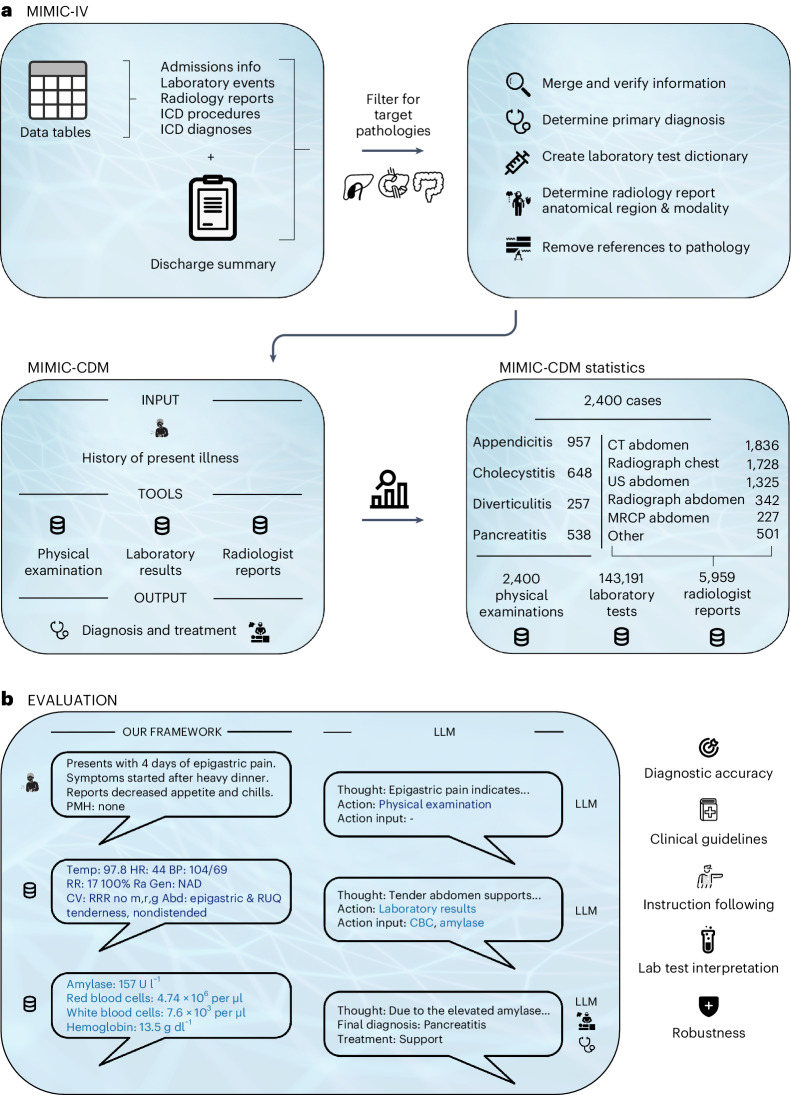
- The curated dataset, MIMIC-CDM, contains 2,400 unique patients with appendicitis (957), cholecystitis (648), diverticulitis (257), and pancreatitis (538).
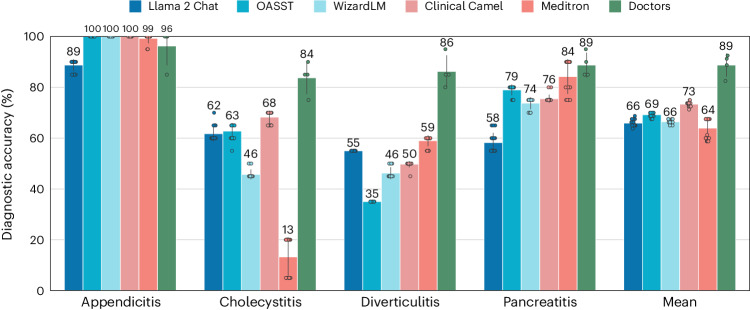
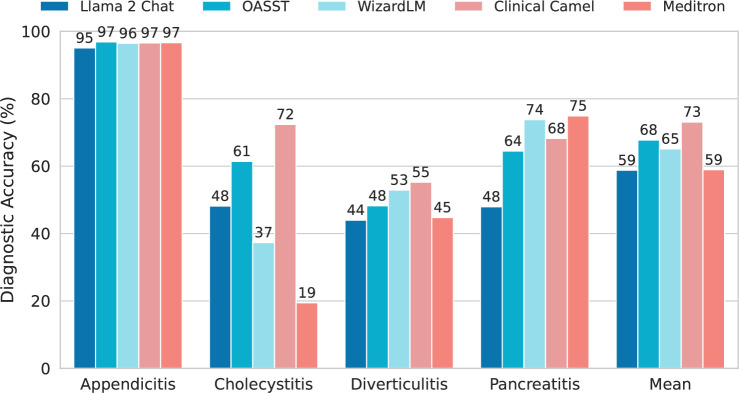
- On a reader study with 80 patients and 4 hospitalists, current LLMs performed significantly worse than clinicians on aggregate across all diseases (P < 0.001 for doctors versus Llama 2 Chat, OASST, WizardLM, Clinical Camel, and Meditron).
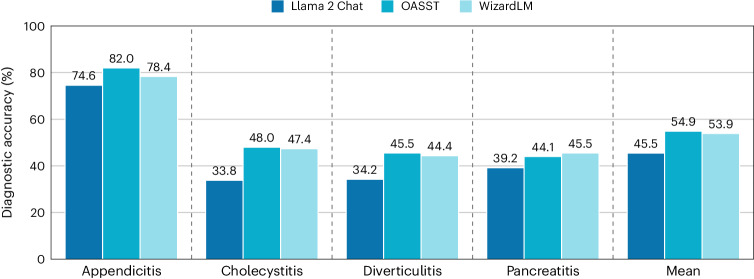
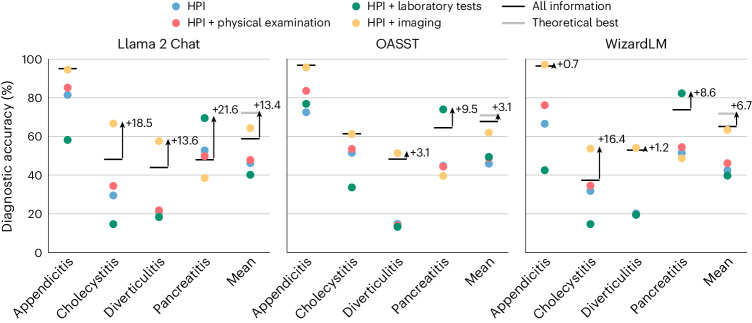
- Diagnostic performance dropped further when models had to gather information themselves: mean diagnostic accuracy fell to 45.5% for Llama 2 Chat, 54.9% for OASST, and 53.9% for WizardLM, versus 58.8%, 67.8%, and 65.1% on the full-information setup, respectively.
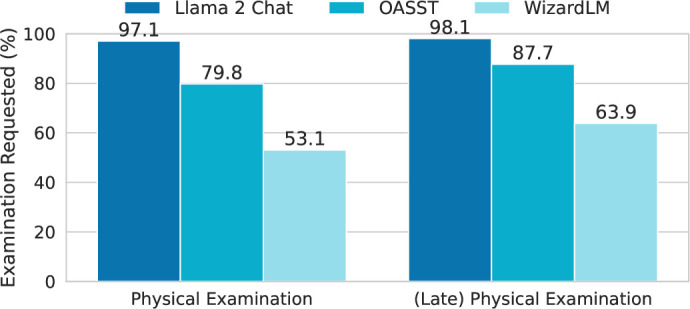
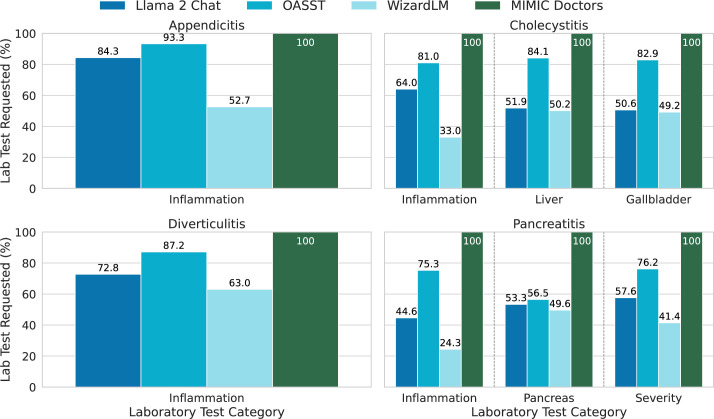
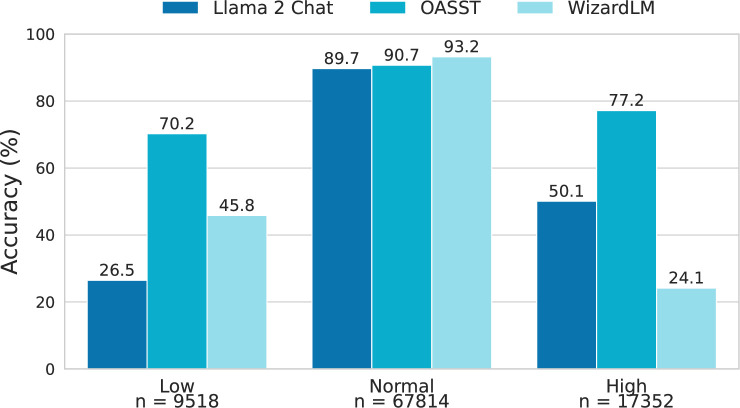
- Models also failed basic safety checks: only Llama 2 Chat consistently requested physical examination information (97.1% as first action; 98.1% at all), and laboratory interpretation was poor even with reference ranges (for example, low results: 26.5% Chat, 70.2% OASST, 45.8% WizardLM; high results: 50.1%, 77.2%, 24.1%).
Methods
- The authors built MIMIC-CDM from the MIMIC-IV EHR database by filtering to emergency department cases with acute abdominal pain and a primary diagnosis of one of four target pathologies, then extracting history of present illness, physical exams, labs, microbiology, imaging, and procedures.
- They evaluated open-access models derived from Llama 2, focusing mainly on Llama 2 Chat, OASST, and WizardLM, and compared them with clinicians on a 100-patient reader study (80 target cases plus 5 each of other conditions), with each LLM evaluated 20 times on the physician comparison subset using different seeds.
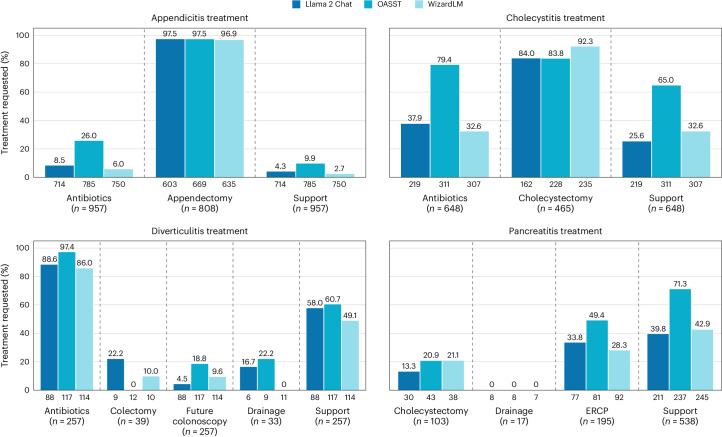
- Main analysis included per-class accuracy, guideline adherence for diagnostic tests and treatments, lab interpretation tasks, instruction-following, robustness to changes in wording, order, and amount of information, and comparisons using two-sided Student’s t-tests with Bonferroni correction.
Limitations
- The paper states that the dataset and models have a clear bias toward the USA, so generalizability to other languages or countries with different guidelines is unknown.
- The authors note that, because they used real-world clinical data, they had to deny requests for information not in the dataset; they argue this was mitigated because MIMIC-IV contains all data gathered during the hospital stay.
- Evident from the text: the study focuses only on four abdominal pathologies, so it does not cover the full breadth of clinical decision-making (the paper itself notes this as a constraint).
Model-written summary. Check it against the paper before relying on it.
Integrity signals
Registry
Cites
Statistics
Figures
Verification
Claims the paper makes
6 Valid · 2 Not valid · 3 Not checked · 106 Own results and interpretations
Some cited sources support this claim and some don’t — read each source’s verdict below.
In the paper
“where LLMs score well above passing8–10,17–20”
§ Evaluation and mitigation of the limitations of large language models in clinical decision-making > Main
What the sources say
- Supportedcites [8] Singhal, K. et al. Towards expert-level medical question answering with large language models. Preprint at https://arxiv.org/abs/2305.09617 (2023). source
The Abstract (page not supplied) reports that Med-PaLM 2 scored 86.5% on MedQA, a dataset of USMLE-style questions, and that its predecessor had exceeded a passing score at 67.2%. This supports the claim about LLM performance on medical-licensing-exam-style questions. (LLM, conf=0.93)
- Partly supportedcites [9] Singhal, K. et al. Large language models encode clinical knowledge. Nature 620, 172–180 (2023). sourceExperimental — accuracy not yet measured
The ‘State of the art on MedQA’ section reports that Flan-PaLM scored 67.6% on USMLE-style questions, supporting strong performance on a medical-exam benchmark. Our copy does not establish a passing threshold or show that LLMs scored well above it on actual licensing exams. (LLM, conf=0.86)
- Supportedcites [10] Nori, H., King, N., McKinney, S. M., Carignan, D. & Horvitz, E. Capabilities of GPT-4 on medical challenge problems. Preprint at https://arxiv.org/abs/2303.13375 (2023). source
The Abstract (p. 1) reports that GPT-4 exceeded the USMLE passing score by over 20 points. The Introduction (p. 2) specifies that the results came from official sample exams and self-assessment materials, supporting this citation as an example of an LLM scoring well above passing on medical licensing exam materials. (LLM, conf=0.93)
- Disputedcites [17] Kung, T. H. et al. Performance of chatgpt on usmle: potential for ai-assisted medical education using large language models. PLoS Digital Health 2, 0000198 (2023). sourceExperimental — accuracy not yet measured
The Discussion (‘The rising accuracy of ChatGPT’) says ChatGPT exceeded 60% accuracy in some analyses, while the USMLE passing threshold is approximately 60%; it concludes that ChatGPT ‘approaches the passing range.’ The paper describes performance as at or near passing, not well above it. (LLM, conf=0.88)
Checked by a reasoning model — may be wrong.
- Disputedcites [18] Gilson, A. et al. How does chatgpt perform on the United States medical licensing examination? The implications of large language models for medical education and knowledge assessment. JMIR Med. Educ. 9, 45312 (2023). sourceExperimental — accuracy not yet measured
The Results (Overall Performance; page unavailable) report that ChatGPT exceeded the paper’s approximately 60% passing benchmark on only one of four question sets, scoring 64.4%. It scored below that benchmark on the other three; InstructGPT and GPT-3 scored below it on all four. The paper therefore does not show LLMs scoring well above passing. (LLM, conf=0.90)
Checked by a reasoning model — may be wrong.
- Partly supportedcites [19] Toma, A. et al. Clinical camel: an open-source expert-level medical language model with dialogue-based knowledge encoding. Preprint at https://arxiv.org/abs/2305.12031 (2023). sourceExperimental — accuracy not yet measured
Table 4 reports strong five-shot scores on the USMLE Sample Exam, including 86.6% for GPT-4 and 64.3% for Clinical Camel-70B. But the paper gives no passing threshold, and other models score substantially lower, so it does not establish that LLMs generally score well above passing. (LLM, conf=0.82)
- Supportedcites [20] Nori, H. et al. Can generalist foundation models outcompete special-purpose tuning? Case study in medicine. Preprint at https://arxiv.org/abs/2311.16452 (2023). source
Section 2.1 reports that GPT-4 exceeded the USMLE passing score by over 20 points. The Abstract also reports that GPT-4 with Medprompt surpassed 90% on MedQA, a USMLE-style exam-question dataset. These passages support the cited claim that LLMs can score well above passing on medical licensing exam questions. (LLM, conf=0.91)
boosted- Asserted: passes — The authors put it forward as true.
- Checkable: passes — It can be checked against evidence.
- Load-bearing: unclear — It is unclear whether the paper’s conclusions depend on it.
- Based: passes — The paper gives a reason why it holds.
- Supported
The cited sources support only part of this claim — read each source’s verdict below.
In the paper
“We note that Llama 2, Clinical Camel and Meditron have been shown to match and even exceed Chat-GPT performance on medical licensing exams and biomedical question answering tests19,35.”
§ Evaluation and mitigation of the limitations of large language models in clinical decision-making > Results > Creating the MIMIC-CDM dataset and evaluation framework
What the sources say
- Partly supportedcites [19] Toma, A. et al. Clinical camel: an open-source expert-level medical language model with dialogue-based knowledge encoding. Preprint at https://arxiv.org/abs/2305.12031 (2023). sourceExperimental — accuracy not yet measured
Section 4 (Evaluation) and Table 4 report that Clinical Camel-70B exceeded GPT-3.5 on five-shot medical benchmarks, including MedQA, PubMedQA and the USMLE sample exam. The paper does not show that LLaMA 2 or Meditron achieved those results; Clinical Camel was fine-tuned from LLaMA 2. It also says Clinical Camel generally fell short of GPT-4, except on PubMedQA. Page numbers were not available in our copy. (LLM, conf=0.88)
- Partly supportedcites [35] Chen, Z. et al. MEDITRON-70B: scaling medical pretraining for large language models. Preprint at https://arxiv.org/abs/2311.16079 (2023). sourceExperimental — accuracy not yet measured
Section 6.2 reports that MEDITRON-70B outperformed GPT-3.5 on the medical benchmarks, including MedQA and PubMedQA. It evaluates Llama-2 and Clinical-Camel as baselines but does not establish that either matched or exceeded GPT-3.5 on those tests. The benchmark comparison also uses text-davinci-003 as GPT-3.5, not ChatGPT itself. (LLM, conf=0.87)
boosted- Asserted: passes — The authors put it forward as true.
- Checkable: passes — It can be checked against evidence.
- Load-bearing: unclear — It is unclear whether the paper’s conclusions depend on it.
- Based: passes — The paper gives a reason why it holds.
- Partly supported
The cited sources support only part of this claim — read each source’s verdict below.
In the paper
“All guidelines recommended physical examinations as an essential part of the diagnostic process, preferably as the first action.”
§ Evaluation and mitigation of the limitations of large language models in clinical decision-making > Results > Current LLMs are hasty and unsafe clinical decision-makers
What the sources say
- Partly supportedcites [36] Di Saverio, S. et al. Diagnosis and treatment of acute appendicitis: 2020 update of the WSES Jerusalem guidelines. World J. Emerg. Surg. 15, 27 (2020). sourceExperimental — accuracy not yet measured
In Results, Topic 1: Diagnosis, the WSES guideline includes physical examination and clinical signs in its diagnostic approach, and Recommendation 1.10 makes imaging conditional on clinical assessment. This supports an early role for examination, but this single guideline does not establish what all guidelines recommend or explicitly say physical examination should be the first action. (LLM, conf=0.85)
- Partly supportedcites [37] Pisano, M. et al. 2020 World Society of Emergency Surgery updated guidelines for the diagnosis and treatment of acute calculus cholecystitis. World J. Emerg. Surg. 15, 61 (2020). sourceExperimental — accuracy not yet measured
Section 1, Diagnosis of ACC (page not provided), suggests including a complete clinical examination alongside history, laboratory tests and imaging. It does not say examination should be the first action, and this single guideline does not establish what all guidelines recommend. (LLM, conf=0.87)
- Partly supportedcites [38] Hall, J. et al. The american society of colon and rectal surgeons clinical practice guidelines for the treatment of left-sided colonic diverticulitis. Dis. Colon Rectum 63, 728–747 (2020). sourceExperimental — accuracy not yet measured
In “Initial Evaluation of Acute Diverticulitis” (recommendation 1; page not supplied), this guideline recommends a physical examination as part of the initial evaluation. It does not establish what all guidelines recommend or say that the examination should preferably be the first action. (LLM, conf=0.84)
plain- Asserted: passes — The authors put it forward as true.
- Checkable: passes — It can be checked against evidence.
- Load-bearing: passes — The paper’s conclusions depend on it.
- Based: passes — The paper gives a reason why it holds.
- Partly supported
A result the paper reports from its own data — it cites no other source for it, so there is none to check. The quote shows it is in the paper.
In the paper
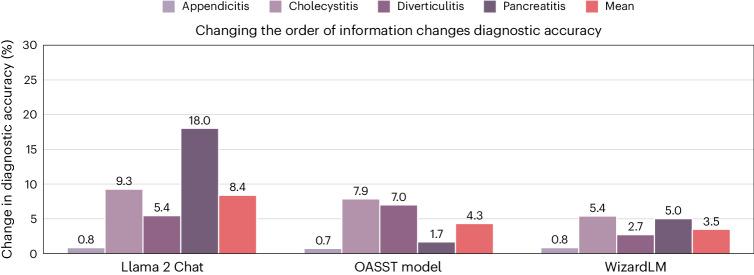
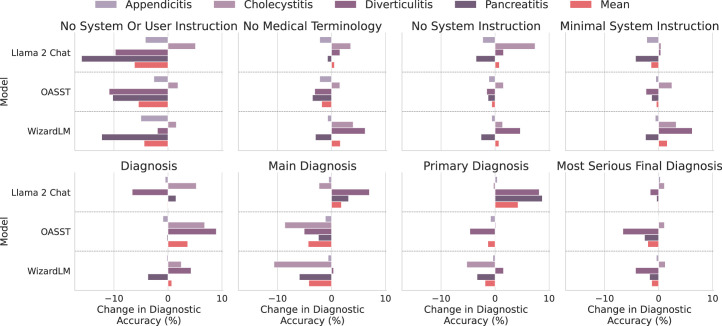
“Additionally, we see that even minor changes in instructions can greatly change diagnostic accuracy such as asking for the ‘main diagnosis’ (up to +7.0% for Chat on diverticulitis, down to −10.6% for WizardLM on cholecystitis) or ‘primary diagnosis’ (up +8.7% for Chat on pancreatitis, down to −5.2% for WizardLM on cholecystitis) instead of ‘final diagnosis’.”
§ Evaluation and mitigation of the limitations of large language models in clinical decision-making > Results > Current LLMs require extensive clinician supervision
plainstates a cause- Asserted: passes — The authors put it forward as true.
- Checkable: passes — It can be checked against evidence.
- Load-bearing: passes — The paper’s conclusions depend on it.
- Based: passes — The paper gives a reason why it holds.
A result the paper reports from its own data — it cites no other source for it, so there is none to check. The quote shows it is in the paper.
In the paper
“We show that current state-of-the-art LLMs do not accurately diagnose patients across all pathologies (performing significantly worse than physicians)”
§ Evaluation and mitigation of the limitations of large language models in clinical decision-making > Abstract
plainn = 2,400- Asserted: passes — The authors put it forward as true.
- Checkable: passes — It can be checked against evidence.
- Load-bearing: passes — The paper’s conclusions depend on it.
- Based: passes — The paper gives a reason why it holds.
59 more claims
Create a free account to see all 117 claims and to verify the 1 reference still open.
- It may state two separate claims as one. 40
- Probably not a substantial claim. 20
- The quote only partly states this claim. 1
Claims other papers make about this one
Each is checked against this paper’s own text: does it say what the citing paper says it does?
The source backs part of the claim, not all of it — or backs it for a different population, condition or comparison.
In the citing paper
“While medical licensing exams and diagnostic tasks are prioritized in 64% of LLM healthcare evaluations8, many administrative and operational tasks that represent significant human bottlenecks are often overlooked.”
From Holistic evaluation of large language models for medical tasks with MedHELM (2026) · cites this paper as [9]
Experimental — accuracy not yet measuredThe source backs part of the claim, not all of it — or backs it for a different population, condition or comparison.
In the citing paper
“While these models offer powerful foundational capabilities, adapting them to specific tasks and datasets without losing robustness is a significant hurdle, often resulting in significant variability in accuracy across different settings.7,9,10”
From Advancing methodological development of artificial intelligence in patient-centered comparative clinical effectiveness research: Patient-Centered Outcomes Research Institute’s unique contribution to research done differently (2025) · cites this paper as [9]
Experimental — accuracy not yet measuredThe cited source says what the claim attributes to it.
In the citing paper
“While LLM performance on medical QA benchmarks has been demonstrated to rival human-level performance, their capabilities in simulated real-world medical scenarios have been more limited12.”
From Limitations of large language models in clinical problem-solving arising from inflexible reasoning (2025) · cites this paper as [12]
The cited source says what the claim attributes to it.
In the citing paper
“Another study demonstrated that while LLMs show potential for clinical decision-making, they currently underperform compared to human clinicians in diagnosing common conditions such as appendicitis, cholecystitis, diverticulitis, and pancreatitis.”
From Enhancing diagnostic capability with multi-agents conversational large language models (2025) · cites this paper as [30]
Citations
Cites
Language Models are Few-Shot Learners
Brown, T. B., Mann, B., Ryder, N., Subbiah, M., Kaplan, J., Dhariwal, P., Neelakantan, A., Shyam, P., Sastry, G., Askell, A., et al. (2020) · arXiv · doi:10.48550/arxiv.2005.14165 · Cited by 23,372
Goldberger, A. L., Amaral, L. A. N., Glass, L., Hausdorff, J. M., Ivanov, P. C., Mark, R. G., Mietus, J. E., Moody, G. B., Peng, C.-K., & Stanley, H. E. (2000) · Circulation · doi:10.1161/01.cir.101.23.e215 · Cited by 14,809
Exploring the Limits of Transfer Learning with a Unified Text-to-Text Transformer
Raffel, C., Shazeer, N., Roberts, A., Lee, K., Narang, S., Matena, M., Zhou, Y., Li, W., & Liu, P. J. (2019) · arXiv · doi:10.48550/arxiv.1910.10683 · Cited by 10,929
Scaling Laws for Neural Language Models
Kaplan, J., McCandlish, S., Henighan, T., Brown, T. B., Chess, B., Child, R., Gray, S., Radford, A., Wu, J., & Amodei, D. (2020) · arXiv · doi:10.48550/arxiv.2001.08361 · Cited by 9,550
Chain-Of-Thought Prompting Elicits Reasoning in Large Language Models
Wei, J., Wang, X., Schuurmans, D., Bosma, M., Ichter, B., Xia, F., Chi, E., Le, Q. V., & Zhou, D. (2022) · Advances in Neural Information Processing Systems 35 · doi:10.52202/068431-1800 · Cited by 4,505
Chain-of-Thought Prompting Elicits Reasoning in Large Language Models
Wei, J., Wang, X., Schuurmans, D., Bosma, M., Ichter, B., Xia, F., Chi, E., Le, Q., & Zhou, D. (2022) · arXiv · doi:10.48550/arxiv.2201.11903 · Cited by 4,263 · cited 1×
“Given these constraints, we calculate and use the per-class accuracy throughout our work, which is the only metric that can be calculated without bias as it only requires the samples of a single class.”
Training language models to follow instructions with human feedback
Ouyang, L., Wu, J., Jiang, X., Almeida, D., Wainwright, C. L., Mishkin, P., Zhang, C., Agarwal, S., Slama, K., Ray, A., et al. (2022) · arXiv · doi:10.48550/arxiv.2203.02155 · Cited by 4,208
Kung, T. H., Cheatham, M., ChatGPT, Medenilla, A., Sillos, C., De Leon, L., Elepaño, C., Madriaga, M., Aggabao, R., Diaz-Candido, G., et al. (2022) · doi:10.1101/2022.12.19.22283643 · Cited by 4,115
Kung, T. H., Cheatham, M., Medenilla, A., Sillos, C., De Leon, L., Elepaño, C., Madriaga, M., Aggabao, R., Diaz-Candido, G., Maningo, J., et al. (2023) · PLOS Digital Health · doi:10.1371/journal.pdig.0000198 · Cited by 4,115
Large Language Models Encode Clinical Knowledge
Singhal, K., Azizi, S., Tu, T., Mahdavi, S. S., Wei, J., Chung, H. W., Scales, N., Tanwani, A., Cole-Lewis, H., Pfohl, S., et al. (2022) · arXiv · doi:10.48550/arxiv.2212.13138 · Cited by 4,083
Research works printed but not linked: 4
- Di Saverio, S. et al. Diagnosis and treatment of acute appendicitis: 2020 update of the WSES Jerusalem guidelines. World J. Emerg. Surg. 15, 27 (2020). · DOI · Paper page
- Zheng, C., Zhou, H., Meng, F., Zhou, J. & Huang, M. On large language models’ selection bias in multi-choice questions. In 12th International Conference on Learning Representations (ICLR, 2024).
- Golkar, Siavash, et al. xVal: a continuous number encoding for large language models. In NeurIPS 2023 AI for Science Workshop (2023).
- Radford, A. et al. Language models are unsupervised multitask learners. OpenAI blog 1, 9 (2019).
Cited by
Items 501–600 of 736
Russ, P. G., Bedenbender, S., Einloft, J., Meyer, H. L., Wenzel, L. T., Ganser, A., Hirsch, M. C., & Grgic, I. (2026) · Scientific Reports · doi:10.1038/s41598-026-46846-7 · Cited by 3
“Even when an LLM provides correct information, it is the physician who contextualizes and integrates that knowledge into a broader clinical picture, as current LLMs lack the capability for safe and autonomous clinical decision-making 47 .”
MedEvalArena: A Self-Generated, Peer-Judged Benchmark for Medical Reasoning (Preprint)Preprint
Kuppa, V., Prem, P., Shidara, K., Wheeler, E., Chang, G., Liu, F., Alaa, A., & Bernardo, D. (2026) · doi:10.2196/preprints.96885
Artificial Intelligence in the Nursing Profession: Applications, Challenges, and Future Directions
Philip, R. (2026) · International Journal of Medical Pharmaceutical and Health Sciences (IJMPHS). · doi:10.62946/ijmphs/3.1.473-485 · Cited by 1
“According to one of those experiments, students' learning of how to do a bronchoscopy was greatly enhanced by instantaneous feedback from AI, possibly due to increased task engagement [65,66] .”
Castano-Villegas, N., Villa, M. C., Barrientos, K. M., Llano, I., Velásquez, L., & Zea, J. (2026) · Mayo Clinic Proceedings Digital Health · doi:10.1016/j.mcpdig.2026.100356 · Cited by 1
“More recent work has highlighted important limitations of these approaches, 6 including their static nature, limited contextual realism, susceptibility to hallucinated references, and insufficient assessment of patient safety, bias, and contextual appropriateness.”
TVM-SimpleQA: A Factuality Evaluation Dataset for Traditional Vietnamese Medicine
Nguyen, G., Nguyen, T., Nguyen, L., & Đinh, Đ. (2026) · Communications in computer and information science · doi:10.1007/978-3-032-21631-1_36
Kim, M. J., Park, J. S., & Kang, S. H. (2026) · Scientific Reports · doi:10.1038/s41598-026-44333-7
“Consistent with prior studies, our findings underscore the limitations of LLMs in pediatric image interpretation and indicate the need for further improvements in commercial models or the development of dedicated fine-tuned systems 5,6,11,28 .”
Integrating large language models for enhanced predictive analytics in healthcare
Wang, Y., Dai, Y., Wang, R., Mehta, T. I., Trivedi, P. S., Vu, T., Lin, C. T., Yang, L. N., Jiao, Z., Kamel, I. R., et al. (2026) · npj Digital Medicine · doi:10.1038/s41746-026-02572-y · Cited by 7
“However, general-purpose LLMs continue to struggle with clinical depth, often producing factual inaccuracies, incomplete reasoning, or inconsistent conclusions 46 – 48 .”
Comparative Evaluation of Large Language Models in Clinical Diagnostics for Real-World Medical Cases
Młodawski, M., Deniziak, S. R., Płaza, M., Kwiatkowska, A., Jaszczyk, D., Gajda, A., & Twardowski, K. (2026) · Applied Sciences · doi:10.3390/app16073499 · Cited by 1
Comparing Large Language Models' Performances on Otolaryngology Knowledge Assessment Questions
Cook, R., Kahan, A. A., Scharfenberger, T., Tasoulas, J., Hawks-Ladds, N., Chouake, R. J., Jariwala, S. P., & Arora, S. (2026) · Applied Clinical Informatics · doi:10.1055/a-2835-4634 · Cited by 1
Hwang, H. J., Kim, J., Heo, D., You, J. Y., Lee, J., Kwon, S., Yoo, K. D., Park, J. H. Y., Suh, B., Lee, J. P., et al. (2026) · Interactive Journal of Medical Research · doi:10.2196/96501
Sammour, F., Zhang, Y., Wang, X., Hu, M., & Zhang, Z. (2026) · SSRN Electronic Journal · doi:10.2139/ssrn.6552781 · Cited by 2
Üçdal, M. T., Keskin, S., Yurtsever, K., & Eybatova, L. (2026) · Research Square · doi:10.21203/rs.3.rs-9045948/v1
Chunking for Medical Knowledge Dataset Construction and LLM-Based Question Answering
Chiu, Y., Chang, H.-Y., & Chuang, C.-C. (2025) · International Conference on Biomedical Engineering and Technology (ICBET) · doi:10.1109/icbet66094.2025.11470113
“Notably, models like GPT-4 have exhibited promising advancements in medical applications, such as identifying genomic biomarkers and generating automated healthcare reports [1, 2].”
Altunışık, N., Toplu, S. A., & Türkmen, D. (2026) · Cutaneous and Ocular Toxicology · doi:10.1080/15569527.2026.2656177 · Cited by 1
“%) are consistent with previous reports in the general medical field [10–13].”
Comment on “Comparison of large language models in oral and maxillofacial surgery”
Mourão, C. F., Juliasse, L. E. R., & Pereira, R. D. S. (2026) · British Journal of Oral and Maxillofacial Surgery · doi:10.1016/j.bjoms.2026.02.017
Targeted use of large language models for EHR-based computable phenotyping
Owens, D., Cao, J., Gupta, M., Nguyen, D., Peterson, E. D., & Navar, A. M. (2026) · Journal of the American Medical Informatics Association · doi:10.1093/jamia/ocag051 · Cited by 1
Guo, Y., Meng, X., Yu, E., Zhang, W., Yang, Y., Ma, H., Shao, C., Wang, W., Wang, R., Wang, H., et al. (2026) · npj Digital Medicine · doi:10.1038/s41746-026-02644-z · Cited by 3
“These shortcomings raise legitimate concerns about the fairness, accuracy, and practical usability of LLMs in medical decision-making 31 – 33 .”
CoreAnchor-QA: Center-Anchored and Self-Improving for Question-Answer Generation
Huang, M., Fu, Q., Chen, J., Wu, H., Lu, Y., & Wang, Y. (2026) · IEEE International Conference on Acoustics Speech and Signal Processing · doi:10.1109/icassp55912.2026.11464418
Rising Fast, Prone to Risk: How Open-Source LLM-Powered Apps Are Designed and Secured
Gomez-Rangel, J., Vazquez, A., Lee, Y., Demir, K. A., & Liu, B. (2025) · Conference on AI x Software Engineering (AIxSE) · doi:10.1109/aixse64906.2025.00016
“This trend has given rise to enormous projects on open-source platforms [2]– [4] ( e.g. , GitHub), where developers collaborate and share code to leverage and explore the potential of LLMs in a wide range of domains, from clinical decision support [5], [6] to code generation [7], [8].”
Güler, I., Muir, L., Grieb, G., Moog, P., Kraus, A., & Stelling, H. (2026) · Journal of Hand Surgery (European Volume) · doi:10.1177/17531934261436305
“…of inter-run stability remain uncommon, leaving uncertainty about consistency under repeated testing (Bolgova et al., 2025; Gumilar et al., 2024; Hager et al., 2024; Jung et al., 2023; Lai et al., 2024; Liu et al., 2020; Meskó, 2023; Tam et al., 2024; Wei et al., 2024; Windisch et al., 2024).”
Carter, J., Anoruo, N., Rehman, N., Otaki, Y., Lydston, M., & BURKE, H. B. (2026) · Current Epidemiology Reports · doi:10.1007/s40471-026-00381-1
OpenEvidence errs on the safe side in a structured test of triage recommendations
Jia, E., Omar, M., Barash, Y., Brook, O. R., Ahmed, M., Kruskal, J. B., Gorenshtein, A., & Klang, E. (2026) · International Journal of Medical Informatics · doi:10.1016/j.ijmedinf.2026.106687 · Cited by 3
Shi, J., Chen, H., Shi, C., Su, C., Yue, S., Li, W., Liu, X., Zhou, Y., Zhong, Y., Chen, B., et al. (2026) · BMC Nursing · doi:10.1186/s12912-026-04647-3 · Cited by 1
“First, their knowledge sources often rely on open online data or non-authoritative web content, leading to potential inaccuracies and unreliable outputs [15, 16].”
Yuan, D., Zhao, X., Wu, Z., Peng, S., Duan, N., Cui, K., Yu, Z., Zhang, H., Yang, W., Wei, W., et al. (2026) · Visual Neuroscience · doi:10.48130/vns-0026-0016
Zhang, Y., Wang, Y., Chen, S., et al. (2026) · SSRN Electronic Journal · doi:10.2139/ssrn.6669386
Рябцев, М. В., Ponomarenko, G. N., SOKUROV, A. V., & Михайлишин, В. В. (2026) · Medical and Social Expert Evaluation and Rehabilitation · doi:10.17816/mser704964
HOLA: Hierarchical OODA-LLM Agent Architecture With Commander-Like Cognition
Kuang, X., Zeng, D., Li, G., Yang, F., & Li, X. (2026) · IEEE Transactions on Games · doi:10.1109/tg.2026.3689572 · Cited by 1
“More recently, large language models (LLMs) have emerged as a promising alternative, offering strong reasoning ability, contextual understanding and cross-task generalization [9], [10], [11], [12], [13], [14], [15].”
Taşkan, H., Eşki, S., Eravcı, Ö., İliş, D., & Çakal, S. (2026) · Bulletin of Cardiovasculer Academy · doi:10.4274/kvbulten.galenos.2026.08370
Pérez-Ferrer, A., Díaz, E. G., Sánchez, J. D. V., Luengo, A. R., Rodríguez, M. Á. P., Báez, Y. L., Filippini, S. E. D., García, R. H., García, R. G., Ogea, M. A. C. C., et al. (2026) · European Journal of Anaesthesiology · doi:10.1097/eja.0000000000002418 · Cited by 2
K'Orimba, K., Mwema, E., Obat, E., & Bowers, C. P. (2026) · Research Square · doi:10.21203/rs.3.rs-9596467/v1
Heslin, S. M. (2026) · Advances in Medical Education and Practice · doi:10.2147/amep.s592114 · Cited by 1
Open-weight language models for procedural impression generation
Jia, X., Zhu, W., & Huang, K. (2026) · European Radiology · doi:10.1007/s00330-026-12612-6
ChatGPT Health triage advice falls short in key cases
(2026) · Nature Medicine · doi:10.1038/s41591-026-04427-1
Brar, K., Chattha, I., Gobraeil, S., Mocanu, V., Corcelles, R., Kroh, M., Shin, T. H., Dang, J. T., & Lee, Y. (2026) · Surgery for Obesity and Related Diseases · doi:10.1016/j.soard.2026.05.002
Large Language Models as Additional Support to Compilers: A Case of Learning to Program
Ramabu, T. J., Maelbane, T., & Raphiri, T. S. (2026) · Springer eBooks · doi:10.1007/978-981-95-8240-2_28
Atadağ, Y. B., Seyhan, T. K., Hilaloğlu, U., & Akbayram, H. T. (2026) · Turkish Journal of Family Medicine & Primary Care · doi:10.21763/tjfmpc.1809491
Hyperbolic neurodynamics and graph convolutional networks in drug combination prediction
Li, J., Chen, J., Shang, Y., & Lei, X. (2026) · Physica A Statistical Mechanics and its Applications · doi:10.1016/j.physa.2026.131637
Gürses, K. M., Tezcan, H., Tunçez, A., Özen, Y., & Yalçın, M. U. (2026) · Frontiers in Cardiovascular Medicine · doi:10.3389/fcvm.2026.1808572
Смирнов, А. С., Levashova, T. V., & Ponomarev, A. (2026) · Conference of Open Innovations Association (FRUCT) · doi:10.23919/fruct70069.2026.11506563
“In the decision support scenario for diagnosing and developing a patient treatment plan recommendation [5], when diagnosing and developing the recommendation, the LLM uses the patient's description, their medical history, completed tests, and medical guidelines for diagnosis and treatment.”
Harada, Y. (2026) · Cureus · doi:10.7759/cureus.108768 · Cited by 2
“This interpretation is consistent with clinical evaluations showing degradation in decision-support performance when models must follow instructions, elicit information, or operate within more realistic workflows rather than answer self-contained examination-style items [8,13,19-21].”
Yeh, Y., Shih, M., Backer, D. D., Celi, L. A., See, K. C., Fujii, T., Ling, L., Mongkolpun, W., Hu, H.-W., Chen, H.-Y., et al. (2026) · Annals of Intensive Care · doi:10.1016/j.aicoj.2026.100078
“They struggle with clinical guidelines and show problematic sensitivity to information ordering [8].”
Artificial intelligence and toxicology: Knowledge compared with other medical specialties
Nogué, S., Ríos, J., Saavedra, C., & Amigó‐Tadín, M. (2026) · Medicina Clínica (English Edition) · doi:10.1016/j.medcle.2026.107407
Soerensen, A. L., Frøslev-Friis, C., Kjærgaard-Andersen, G., Bhavsar, S., Quitzau, L. H., Desurkar, V., Rao, A., Krishna, S., Bhosale, R., & Bhavsar, R. P. (2026) · Journal of Clinical Medicine · doi:10.3390/jcm15103871 · Cited by 1
“Recent advances in machine learning and natural language processing have enabled development of models that assign or predict ASA-PS using structured electronic health record variables or pre-anesthetic text summaries, explicitly aiming to address limitations in human reproducibility [11].”
Marton, T. M., Corpman, D. W., Lai, L., Gabriel, R. A., & Chen, Y. (2026) · doi:10.2196/preprints.101566
Core Techniques for Explaining LLMs in Healthcare
Farhadi, A., & Siasifar, R. (2026) · Springer eBooks · doi:10.1007/978-3-032-15088-2_4 · Cited by 1
Santos, J. F., Duarte, R. D. B., Mota, I., Santos, R., Moreira, J.-M., Campos, J., Silva, N. A., Neves, B., Ladeiras‐Lopes, R., Leite, F., et al. (2026) · European Heart Journal - Digital Health · doi:10.1093/ehjdh/ztag073
“16,17,23,30 Reassuringly, performance was broadly consistent across Portuguese and English prompts, with no statistically significant language-related differences in the main outcomes.”
Benchmarking general and medical LLM performance in Parkinson's disease management
Shechter, Y., Klevor, R., Kouchache, T., Bouhadoun, S., & Postuma, R. B. (2026) · Clinical Parkinsonism & Related Disorders · doi:10.64898/2026.05.13.26353021
Artificial intelligence to revolutionize surgical decision-making is still just around the corner
Zhang, S. K., & Rodman, A. M. (2026) · Surgery · doi:10.1016/j.surg.2026.110326
Gaetano, D., Lomonaco, V., Ferraioli, S., Pota, V., Colella, U., Pace, M. C., & Sansone, P. (2026) · BMC Anesthesiology · doi:10.1186/s12871-026-03937-2 · Cited by 1
“Formal educational programs should therefore address not only basic AI concepts but also safe use in clinical contexts, including limitations, hallucinations, the need for verification, and medico-legal considerations [14, 26].”
Vijayasimha, M., & Srikanth, M. (2026) · European Journal of Plastic Surgery · doi:10.1007/s00238-026-02479-7
Jarrassier, A., de Saint-Léger, F. B., de Rocquigny, G., et al. (2026) · Anesthesia & Analgesia · doi:10.1213/ane.0000000000008103
Gorecki, G.-P., Săndesc, D., Moldovan, H., Drăgoescu, A. N., Stănculescu, A. D., Păpurică, M., Barsac, C. R., Băloi, A., & Bedreag, O. H. (2026) · Frontiers in Medicine · doi:10.3389/fmed.2026.1797446
“Research shows that digital systems which enable record interoperability through automated alert systems and data monitoring platforms have been suggested to support improvements in both situational awareness and preventable errors in intensive care units (25, 26).”
Retrieval-Augmented Language Models for Checking Safety Consistency in Pharmaceutical Product Labels
Dupont, C., & Martin, J. (2025) · Pharmacophore · doi:10.51847/fzeuaxeluk
Zhu, Z., Huang, H., & Wu, X. (2026) · Communications in computer and information science · doi:10.1007/978-981-95-7299-1_30 · Cited by 1
Domain-Specific NLP for Personalized Radiation Treatment Pathways with LLM Fine-Tuning
Biswas, A., Patwary, M. O., Momo, M., Tasnim, S., Sultan, T., & Bhowmik, A. (2025) · IEEE International Women in Engineering (WIE) Conference on Electrical and Computer Engineering (WIECON-ECE) · doi:10.1109/wiecon-ece69386.2025.11526388
“Ahn [20] and Kim [21] proposed mitigation strategies, and Hager et al. [22] emphasized the need for human oversight.”
Ebara, M., Kawazoe, Y., Seki, T., Shinohara, E., Nakazawa, E., & Ohe, K. (2026) · AI and Ethics · doi:10.1007/s43681-026-00998-4
Yu, X., & Qianqian, Y. (2026) · Neuropsychiatric Disease and Treatment · doi:10.2147/ndt.s614952
“13 The research field also needs a similar transformation: AI assistants should be evaluated within realistic scientific workflows that include uncertainty communication and source verification as explicit performance criteria.”
Text-guided few-shot liver and tumor segmentation
Chen, H., Xu, A., Zhang, L., Ouyang, M., Zhu, Z., & Wang, J. (2026) · Frontiers in Digital Health · doi:10.3389/fdgth.2026.1823870
Demir, Ş., & Demir, M. (2026) · Endouroloji Bulteni · doi:10.54233/endourolbull-1792399
Exploring migration research with large language model: methods and insights
Iacus, S. M., Qi, H., & Han, J. (2026) · Royal Society Open Science · doi:10.1098/rsos.251577 · Cited by 1
Sun, S.-P., Niu, D.-Y., Yuan, M., Liu, L., Li, Y., & Min, H. (2026) · World Journal of Gastroenterology · doi:10.3748/wjg.119857
Yano, Y., Kakizaki, H., Nagasu, H., Kishi, S., Koshida, T., Nihei, Y., Hirano, A., Nangaku, M., Mori, H., (43611), T. N., et al. (2026) · JMIR Formative Research · doi:10.2196/89726 · Cited by 1
Küçük, E. E., & Küçük, D. (2026) · Advances in computational intelligence and robotics book series · doi:10.4018/979-8-2600-2173-6.ch007
Qi, H., Li, J. D., Ge, Y., Wu, H., Cai, Y., Che, S., Sheng, T., Zhao, Q., & Chen, C. (2026) · IEEE Transactions on Knowledge and Data Engineering · doi:10.1109/tkde.2026.3700611 · Cited by 2
“However, recent studies highlight their limitations in subspecialties such as anesthesiology [5], [6], where complex domain knowledge and real-time decision making demand high precision, yet existing models remain closed-source, general-purpose, and insuf-ficiently validated models for clinical use…”
Lee, E. J., Jung, J. Y., Kim, D. K., Park, J. W., & Kwak, Y. H. (2026) · PLoS ONE · doi:10.1371/journal.pone.0350770
“These models face several barriers to clinical application, including substantial computational cost, privacy concerns, restricted domain adaptation, reduced reliability, and potential data contamination risks [17,18].”
Generative artificial intelligence tools as an aid for pharmacy career preparation
Hughes, J., Strachan, D. A., Stover, K. R., Edwards, K. L., & Cain, J. J. (2026) · American Journal of Health-System Pharmacy · doi:10.1093/ajhp/zxag171
Transforming Rheumatology Practice
García-Agúndez, A., Creasman, M., Schmajuk, G., & Yazdany, J. (2026) · Rheumatic Disease Clinics of North America · doi:10.1016/j.rdc.2026.04.002 · Cited by 1
Xia, T., Zhang, Y., Li, S., Zhou, Y., Tian, W., Jiang, Z., Shao, Y., & Wang, J. (2026) · BMC Musculoskeletal Disorders · doi:10.1186/s12891-026-10051-4
“However, if a response omits warning signs, underestimates progression requirements, or fails to advise professional reassessment, fluent expression may obscure potential risk [14, 32].”
Zhu, J., Pan, W., Wang, Y., Yan, K., Fang, Z., & Yang, X. (2026) · Journal of Medical Internet Research · doi:10.2196/91222
“This taxonomy was adapted from established LLM error classification frameworks for clinical text [14,15].”
Evaluating the Robustness in Federated Learning for Medical Imaging
Halima, S., Guelzim, I., Hirchoua, B., & Nait‐Charif, H. (2025) · International Conference on Data Analytics for Business and Industry (ICDABI) · doi:10.1109/icdabi67967.2025.11547694 · Cited by 1
“Their ability to provide semantic reasoning and correct noisy annotations could enhance both robustness and interpretability [9], [10].”
LLMs as emerging tools for understanding and managing bone metastasis and cancer-induced bone pain
Li, J., Xie, Y., Li, B., He, R., Meng, W., Gong, J., Fan, Y., Li, L., & Li, B. (2026) · iScience · doi:10.1016/j.isci.2026.116158 · Cited by 1
“38,39 The assessment of completeness tests the capacity for comprehensive information retrieval and synthesis across various sub-topics, ensuring all critical aspects are addressed without significant omissions or fragmented knowledge representation.”
Patel, A., Khand, Y., Vallamchetla, S. K., Li, P., Tao, C., & Cheung, J. (2026) · doi:10.2196/preprints.104092
Nurfadhilah, E., Aini, L. R., Santosa, A., Uliniansyah, M. T., Gunarso, G., Putra, P. K., Pebiana, S., Fajri, R., Hidayati, N. N., Prastowo, R. D., et al. (2026) · Advances in computational intelligence and robotics book series · doi:10.4018/979-8-3373-7862-6.ch003
Rajeev, M., & Narayan, A. (2026) · medRxiv · doi:10.64898/2026.06.06.26354838
Mirza, Y., Sarı, F., & Arslan, S. (2026) · The Knee · doi:10.1016/j.knee.2026.104524
A multimodal generative model for structured and unstructured electronic health records
Sivarajkumar, S., Zhang, H., Ji, Y., Bilalpur, M., Wu, X., Li, C., Kwak, M. G., Visweswaran, S., & Wang, Y. (2026) · npj Health Systems · doi:10.1038/s44401-026-00095-y · Cited by 5
“Third, processing long textual records pushesagainstLLMcontextlengthlimits-importanthistoricaldatamaybe truncated,especiallyforpatientswithlengthyrecords 15 .”
Fan, H., Ma, Z., Ma, Y., Wang, L., Pang, Z., Cao, Z., & Liu, L. (2026) · Frontiers in Sports and Active Living · doi:10.3389/fspor.2026.1775462
“Among these applications, the potential of LLMs in assisting clinical decision-making has garnered particular attention (25).”
Zhang, X., Wei, J., Liang, Y., You, L., Zhang, M., & Shang, H. (2026) · Science of Traditional Chinese Medicine · doi:10.1097/st9.0000000000000095 · Cited by 1
Research and Scholarly Methods: Using Artificial Intelligence
Trinkley, K. E., & Maw, A. (2026) · JACCP JOURNAL OF THE AMERICAN COLLEGE OF CLINICAL PHARMACY · doi:10.1002/jac5.70239
Hard to Halt: Automation Bias in Agent-Driven Sequencing Prior Authorization WorkflowsPreprint
Nie, M., Chung, W. K., Waxler, J. L., Lee, M., Weng, C., Lewis, R., Ahimaz, P. R., Wang, K., & Liu, C. (2026) · medRxiv · doi:10.64898/2026.06.16.26355782 · Cited by 1
“18,19 In this study, we aim to . investigate the behavior of an LLM-based browser agent in a controlled sandbox environment simulating the ES/GS PA workflow, characterize its task completion performance, identify systematic failure patterns, and establish a quantitative foundation to guide future…”
McCradden, M. D., Tng, S., Jeyaseelan, D., Leane, C., Campbell, M., Braund, T., Earle-Bandaralage, L., Ebrahimi, M., Sharma, A., & Tang, J. (2026) · BMJ Open · doi:10.1136/bmjopen-2025-111656
Generative explainers in Spanish healthcare prognosis: a novel assessment framework
Lebeña, N., Casillas, A., & Pérez, A. (2026) · International Journal of Data Science and Analytics · doi:10.1007/s41060-026-01167-w · Cited by 1
Benchmark evaluation of multi-modal large language models for ophthalmic diagnosis in real world
Huang, S., Chen, J., Wang, J., Zhang, P., Du, W., Yuan, H., Kong, D., Lou, W., Lai, M., & Yang, W. (2026) · Frontiers in Medicine · doi:10.3389/fmed.2026.1842016
Hier, D. B., & Obafemi-Ajayi, T. (2026) · Frontiers in Artificial Intelligence · doi:10.3389/frai.2026.1805890
Zhang, X., Wang, T., Yan, C., Najdawi, F., Zhou, K., Ma, Y., Cheung, Y.-M., Yeung, M. C. F., & Malin, B. (2026) · Nature Biomedical Engineering · doi:10.1038/s41551-026-01694-8 · Cited by 5
AI-CURA, an automated LLM workflow for high-accuracy genetic variant classification
Ma, W., Fong, G., Lai, J., Wu, H., Hue, S. P. Y., Ying, D., Chen, L., Tang, W., Preusch, C. B., Chu, A. T. W., et al. (2026) · Science Translational Medicine · doi:10.1126/scitranslmed.adz4172 · Cited by 3
I and Human Creativity: Can Artificial Intelligence Replace Human Innovation
Vishwakarma, A. S. A. P. S. K. (2026) · International Journal of Advanced Research in Science Communication and Technology · doi:10.48175/ijarsct-37149
Ran, B., Qiu, S., Zhang, M., Chen, Z. Y., Chen, B., Li, J., Bai, J., Chen, J., Jian, B., Chen, S., et al. (2026) · Intelligent Oncology · doi:10.1016/j.intonc.2026.100069
Quennelle, S., Malekzadeh-Milani, S. G., Garcelon, N., Burgun, A., Bonnet, D., & Neuraz, A. (2026) · BMC Cardiovascular Disorders · doi:10.1186/s12872-026-06065-4
“Numerous examples [24, 25] have shown that this assumption is false, and as a promising solution, domain adaptation has attracted considerable attention in recent years [20].”
Evaluating LLM diagnostic reasoning: a new frontier for clinical AI assessment
Brigo, F., Zaboli, A., Maida, E., & Lavorgna, L. (2026) · Neurological Sciences · doi:10.1007/s10072-026-09204-z
Maw, A., Lupi, A. L., Johnson-Koenke, R. A., Coats, H., Zhou, L., Li, B. H., Mitchell, J., Kotz, A., Plasek, J. M., & Goss, F. R. (2026) · JMIR Formative Research · doi:10.2196/89837
“While the emergence of large language models (LLMs) has accelerated the development of conversational AI systems in health care, evaluation methods have not kept pace with deployment [9,10].”
Predicting Low Back Pain Using Machine Learning Techniques: A Systematic Review
KÖSEOĞLU, D., & Akkoyunlu, M. C. (2026) · Acta Infologica · doi:10.26650/acin.1704458
Sun, Y., & Sun, J. (2026) · ACM Interactive Health Conference · doi:10.1145/3786579.3804942
Hunt, D., & Miceli, M. D. (2026) · American Journal of STEM Education · doi:10.32674/tfptev94 · Cited by 1
A Dual-source Fusion Enhancement method for Question Answering on Acute Mountain Sickness
Sui, M., Bi, X., Yu, G., Zhang, L. H., Xu, H., & Zhao, K. (2026) · International Conference on Computer Supported Cooperative Work in Design (CSCWD) · doi:10.1109/cscwd68734.2026.11582261
“Non-expert users may also struggle to judge the correctness of generated medical responses [5].”
Epistemologically Guided LLM Reasoning for Differential Diagnosis
Rancati, S., Bergomi, L., Parimbelli, E., Nicora, G., & Bellazzi, R. (2026) · Lecture notes in computer science · doi:10.1007/978-3-032-30710-1_14 · Cited by 2
Scallan, R. M., Atwood, B. I., Moser, C. H., Eberhardt, G. L., Stucky, C. H., & Kessinger, S. K. (2026) · Military Medicine · doi:10.1093/milmed/usag312
Large Language Models for Oncology Guideline Maintenance: Prospective Case Study
Knauer, M., Greß, J., Kather, J. N., & May, P. (2026) · JMIR AI · doi:10.2196/93239 · Cited by 2
“Previous studies demonstrate that general-purpose and domain-adapted LLMs can retrieve and integrate trial evidence, suggest reasonable treatment options, and support tumor boards, with performance varying across tasks, tumor types, and model families [1,18-21].”
Self-citation
Metadata
- Authors
- Hager, P., Jungmann, F., Holland, R., Bhagat, K., Hubrecht, I., Knauer, M., Vielhauer, J., Makowski, M., Braren, R., Kaissis, G., & Rueckert, D.
- Affiliations
- TUM Klinikum (DE)
- Imperial College London (GB)
- Christiana Care Health System (US)
- Ludwig-Maximilians-Universität München (DE)
- Corresponding author
- Hager, Paul
- ORCID
- Venue
- Nature Medicine
- Published
- 2024-07-04
- Volume
- 30
- Issue
- 9
- Pages
- 2613-2622
- ISSN
- 1078-8956 (ISSN-L)
- 1546-170X
- PMC
- PMC11405275
- OpenAlex
- W4400324908
- Cited by
- 798
- References
- 74
- Citations by year
- 2026: 435 · 2025: 317 · 2024: 46
- FWCI
- 74.24
- Type
- journal article
- Language
- en
- Open access
- hybrid
- doi.org
- Licence
- cc-by
- creativecommons.org/licenses/by/4.0 (tdm)
- creativecommons.org/licenses/by/4.0 (vor)
- Locations
- Nature Medicine (publishedVersion, cc-by)
- medRxiv (acceptedVersion, cc-by-nc)
- PubMed Central (publishedVersion, cc-by)
- PubMed (publishedVersion)
- PuSH - Publication Server of Helmholtz Zentrum München (submittedVersion, cc-by)
- mediaTUM – the media and publications repository of the Technical University Munich (Technical University Munich) (submittedVersion)
- Funders
- Technische Universität München
- H2020 European Research Council (884622)
- Topics
- Health Sciences › Medicine › Health Informatics › Artificial Intelligence in Healthcare and Education
- Physical Sciences › Computer Science › Artificial Intelligence › Machine Learning in Healthcare
- Health Sciences › Health Professions › Health Information Management › Artificial Intelligence in Healthcare
- Keywords
- large language models, clinical decision-making, artificial intelligence in healthcare, MIMIC-III, abdominal pathology, diagnostic accuracy, clinical guidelines adherence, laboratory test interpretation, clinical workflow integration, medical licensing examinations, LLM limitations
- MeSH terms
- Clinical Decision-Making, Artificial Intelligence, Humans, Decision Support Systems, Clinical
About these checks
Registry, retraction, Cites and statistics results are computed, not judged, with one exception: a printed reference that no index lists is read once by a model before it counts as a citation error. Claims are extracted by a model and kept only when their quote appears verbatim in the text; each cited source is then checked, with a model’s help, for whether it says what the claim relies on. Those verdicts can be wrong — read the claim’s quote and the cited source before relying on one.
The claim verdicts this report counts are experimental: their accuracy is not yet measured.
A language model drew the claims from the paper on 2026-10-10, under version 3 of the claim definition (model deepseek-v4.1-flash, prompt extract-v3).
A second model labelled each claim on 2026-10-10 (model jev-1.13-20260917, definition revision gold-guideline-v0.2).
Cited sources are checked with a language model’s help (gpt-6-sol).
Statistics and arithmetic are recomputed, not judged.
Confidence bands are shown only for fields calibrated on our annotated test set. None is calibrated yet, so no band is shown.
What counts as a claim ›How we measure confidence ›How we check this ›
Are you an author, or do you see a problem with this page? Request a review
Data sources
Bibliographic data: Semantic Scholar, OpenAlex, Crossref.
Contains information from the Semantic Scholar Academic Graph Datasets, made available under the ODC Attribution License (ODC-BY 1.0).
Semantic Scholar’s data is described in: Kinney, R., et al. (2023). The Semantic Scholar Open Data Platform. arXiv:2301.10140.
