

Evaluation and mitigation of the limitations of large language models in clinical decision-making
Open accessPublished version of a preprint
The DOI matches its Crossref record; 92 of the 92 references it cites were found in a registry or an index; 20 of the 24 sources its claims cite were checked for support.
Abstract
Clinical decision-making is one of the most impactful parts of a physician's responsibilities and stands to benefit greatly from artificial intelligence solutions and large language models (LLMs) in particular. However, while LLMs have achieved excellent performance on medical licensing exams, these tests fail to assess many skills necessary for deployment in a realistic clinical decision-making environment, including gathering information, adhering to guidelines, and integrating into clinical workflows. Here we have created a curated dataset based on the Medical Information Mart for Intensive Care database spanning 2,400 real patient cases and four common abdominal pathologies as well as a framework to simulate a realistic clinical setting. We show that current state-of-the-art LLMs do not accurately diagnose patients across all pathologies (performing significantly worse than physicians), follow neither diagnostic nor treatment guidelines, and cannot interpret laboratory results, thus posing a serious risk to the health of patients. Furthermore, we move beyond diagnostic accuracy and demonstrate that they cannot be easily integrated into existing workflows because they often fail to follow instructions and are sensitive to both the quantity and order of information. Overall, our analysis reveals that LLMs are currently not ready for autonomous clinical decision-making while providing a dataset and framework to guide future studies.
Overview
CoChat Summary
TL;DR
This study evaluates open-access LLMs on a realistic clinical decision-making task using 2,400 real emergency department cases of acute abdominal pain from MIMIC-IV. The models performed significantly worse than physicians, failed to follow diagnostic/treatment guidelines, and were too fragile and instruction-sensitive for autonomous clinical use.
Key findings
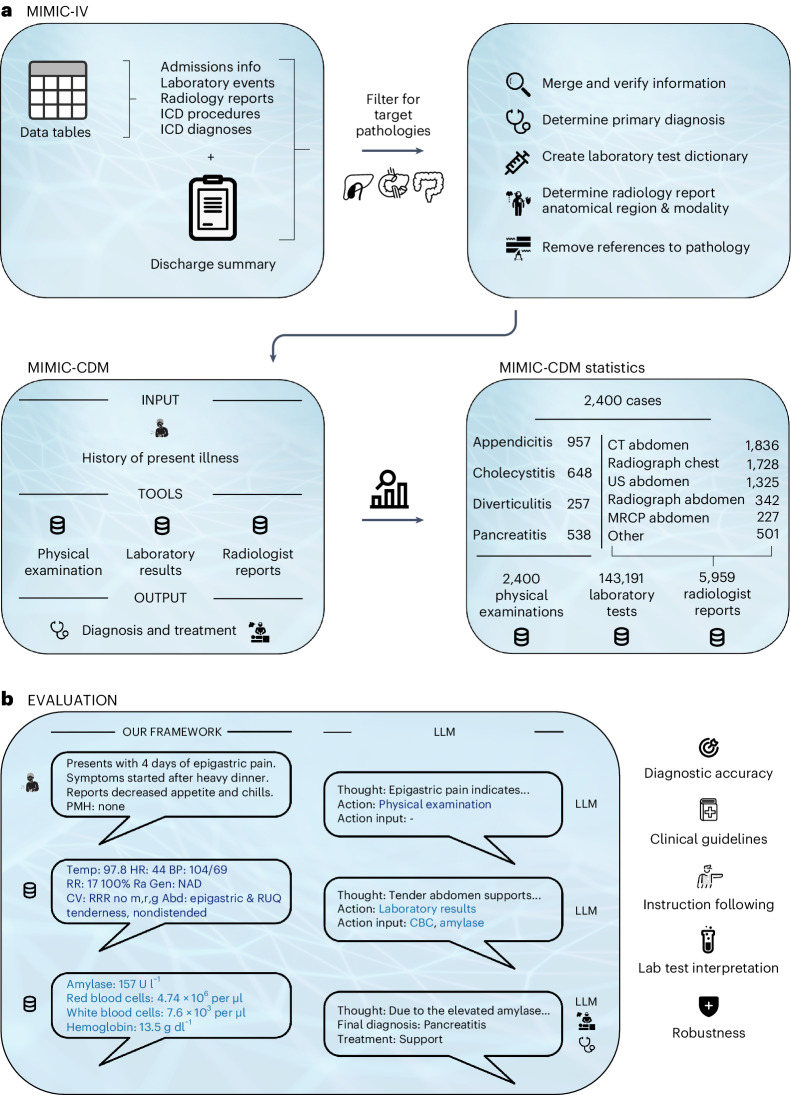
- The curated dataset, MIMIC-CDM, contains 2,400 unique patients with appendicitis (957), cholecystitis (648), diverticulitis (257), and pancreatitis (538).
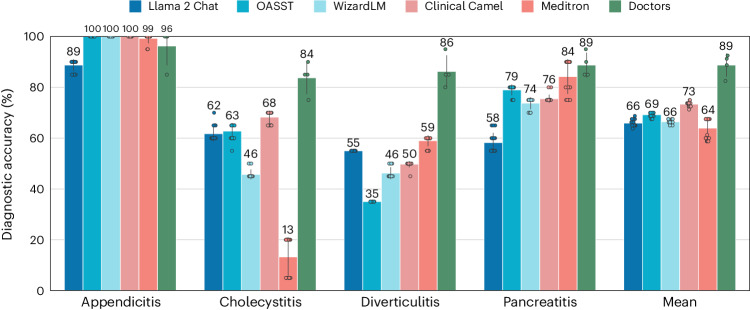
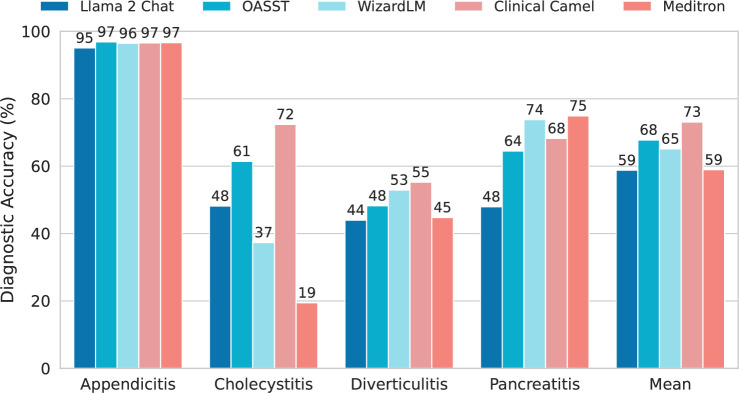
- On a reader study with 80 patients and 4 hospitalists, current LLMs performed significantly worse than clinicians on aggregate across all diseases (P < 0.001 for doctors versus Llama 2 Chat, OASST, WizardLM, Clinical Camel, and Meditron).
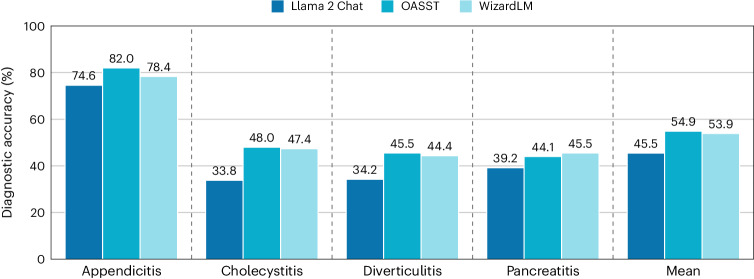
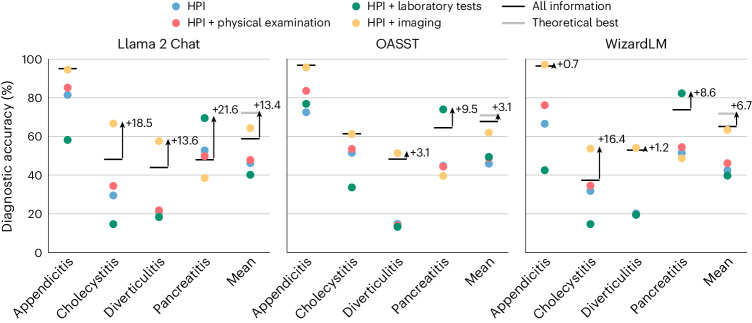
- Diagnostic performance dropped further when models had to gather information themselves: mean diagnostic accuracy fell to 45.5% for Llama 2 Chat, 54.9% for OASST, and 53.9% for WizardLM, versus 58.8%, 67.8%, and 65.1% on the full-information setup, respectively.
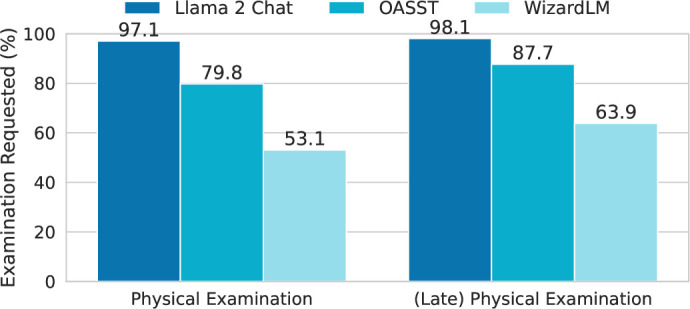
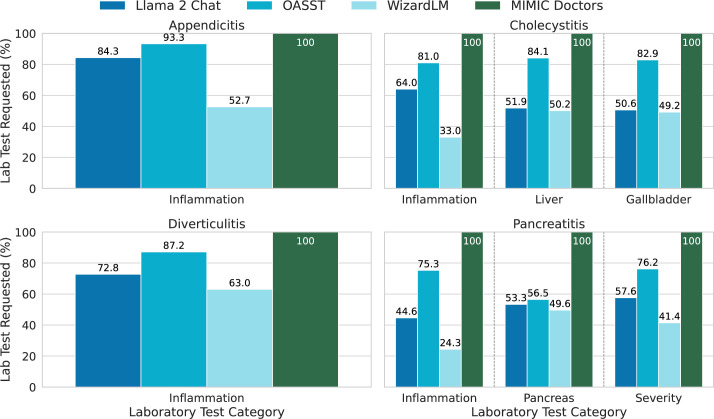
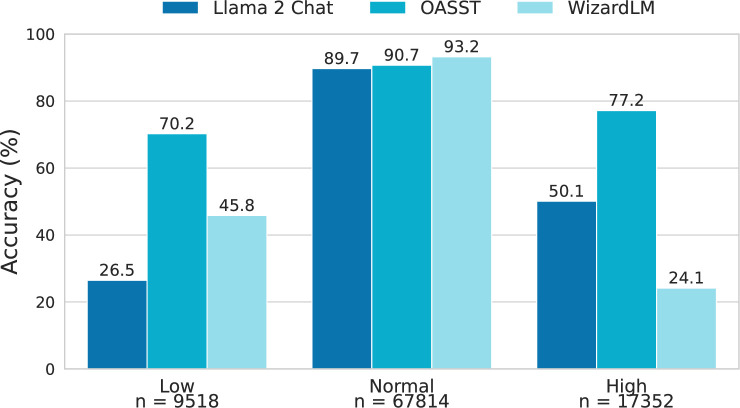
- Models also failed basic safety checks: only Llama 2 Chat consistently requested physical examination information (97.1% as first action; 98.1% at all), and laboratory interpretation was poor even with reference ranges (for example, low results: 26.5% Chat, 70.2% OASST, 45.8% WizardLM; high results: 50.1%, 77.2%, 24.1%).
Methods
- The authors built MIMIC-CDM from the MIMIC-IV EHR database by filtering to emergency department cases with acute abdominal pain and a primary diagnosis of one of four target pathologies, then extracting history of present illness, physical exams, labs, microbiology, imaging, and procedures.
- They evaluated open-access models derived from Llama 2, focusing mainly on Llama 2 Chat, OASST, and WizardLM, and compared them with clinicians on a 100-patient reader study (80 target cases plus 5 each of other conditions), with each LLM evaluated 20 times on the physician comparison subset using different seeds.
- Main analysis included per-class accuracy, guideline adherence for diagnostic tests and treatments, lab interpretation tasks, instruction-following, robustness to changes in wording, order, and amount of information, and comparisons using two-sided Student’s t-tests with Bonferroni correction.
Limitations
- The paper states that the dataset and models have a clear bias toward the USA, so generalizability to other languages or countries with different guidelines is unknown.
- The authors note that, because they used real-world clinical data, they had to deny requests for information not in the dataset; they argue this was mitigated because MIMIC-IV contains all data gathered during the hospital stay.
- Evident from the text: the study focuses only on four abdominal pathologies, so it does not cover the full breadth of clinical decision-making (the paper itself notes this as a constraint).
Model-written summary. Check it against the paper before relying on it.
Integrity signals
Registry
Cites
Statistics
Figures
Verification
Claims the paper makes
6 Valid · 2 Not valid · 3 Not checked · 106 Own results and interpretations
Some cited sources support this claim and some don’t — read each source’s verdict below.
In the paper
“where LLMs score well above passing8–10,17–20”
§ Evaluation and mitigation of the limitations of large language models in clinical decision-making > Main
What the sources say
- Supportedcites [8] Singhal, K. et al. Towards expert-level medical question answering with large language models. Preprint at https://arxiv.org/abs/2305.09617 (2023). source
The Abstract (page not supplied) reports that Med-PaLM 2 scored 86.5% on MedQA, a dataset of USMLE-style questions, and that its predecessor had exceeded a passing score at 67.2%. This supports the claim about LLM performance on medical-licensing-exam-style questions. (LLM, conf=0.93)
- Partly supportedcites [9] Singhal, K. et al. Large language models encode clinical knowledge. Nature 620, 172–180 (2023). sourceExperimental — accuracy not yet measured
The ‘State of the art on MedQA’ section reports that Flan-PaLM scored 67.6% on USMLE-style questions, supporting strong performance on a medical-exam benchmark. Our copy does not establish a passing threshold or show that LLMs scored well above it on actual licensing exams. (LLM, conf=0.86)
- Supportedcites [10] Nori, H., King, N., McKinney, S. M., Carignan, D. & Horvitz, E. Capabilities of GPT-4 on medical challenge problems. Preprint at https://arxiv.org/abs/2303.13375 (2023). source
The Abstract (p. 1) reports that GPT-4 exceeded the USMLE passing score by over 20 points. The Introduction (p. 2) specifies that the results came from official sample exams and self-assessment materials, supporting this citation as an example of an LLM scoring well above passing on medical licensing exam materials. (LLM, conf=0.93)
- Disputedcites [17] Kung, T. H. et al. Performance of chatgpt on usmle: potential for ai-assisted medical education using large language models. PLoS Digital Health 2, 0000198 (2023). sourceExperimental — accuracy not yet measured
The Discussion (‘The rising accuracy of ChatGPT’) says ChatGPT exceeded 60% accuracy in some analyses, while the USMLE passing threshold is approximately 60%; it concludes that ChatGPT ‘approaches the passing range.’ The paper describes performance as at or near passing, not well above it. (LLM, conf=0.88)
Checked by a reasoning model — may be wrong.
- Disputedcites [18] Gilson, A. et al. How does chatgpt perform on the United States medical licensing examination? The implications of large language models for medical education and knowledge assessment. JMIR Med. Educ. 9, 45312 (2023). sourceExperimental — accuracy not yet measured
The Results (Overall Performance; page unavailable) report that ChatGPT exceeded the paper’s approximately 60% passing benchmark on only one of four question sets, scoring 64.4%. It scored below that benchmark on the other three; InstructGPT and GPT-3 scored below it on all four. The paper therefore does not show LLMs scoring well above passing. (LLM, conf=0.90)
Checked by a reasoning model — may be wrong.
- Partly supportedcites [19] Toma, A. et al. Clinical camel: an open-source expert-level medical language model with dialogue-based knowledge encoding. Preprint at https://arxiv.org/abs/2305.12031 (2023). sourceExperimental — accuracy not yet measured
Table 4 reports strong five-shot scores on the USMLE Sample Exam, including 86.6% for GPT-4 and 64.3% for Clinical Camel-70B. But the paper gives no passing threshold, and other models score substantially lower, so it does not establish that LLMs generally score well above passing. (LLM, conf=0.82)
- Supportedcites [20] Nori, H. et al. Can generalist foundation models outcompete special-purpose tuning? Case study in medicine. Preprint at https://arxiv.org/abs/2311.16452 (2023). source
Section 2.1 reports that GPT-4 exceeded the USMLE passing score by over 20 points. The Abstract also reports that GPT-4 with Medprompt surpassed 90% on MedQA, a USMLE-style exam-question dataset. These passages support the cited claim that LLMs can score well above passing on medical licensing exam questions. (LLM, conf=0.91)
boosted- Asserted: passes — The authors put it forward as true.
- Checkable: passes — It can be checked against evidence.
- Load-bearing: unclear — It is unclear whether the paper’s conclusions depend on it.
- Based: passes — The paper gives a reason why it holds.
- Supported
The cited sources support only part of this claim — read each source’s verdict below.
In the paper
“We note that Llama 2, Clinical Camel and Meditron have been shown to match and even exceed Chat-GPT performance on medical licensing exams and biomedical question answering tests19,35.”
§ Evaluation and mitigation of the limitations of large language models in clinical decision-making > Results > Creating the MIMIC-CDM dataset and evaluation framework
What the sources say
- Partly supportedcites [19] Toma, A. et al. Clinical camel: an open-source expert-level medical language model with dialogue-based knowledge encoding. Preprint at https://arxiv.org/abs/2305.12031 (2023). sourceExperimental — accuracy not yet measured
Section 4 (Evaluation) and Table 4 report that Clinical Camel-70B exceeded GPT-3.5 on five-shot medical benchmarks, including MedQA, PubMedQA and the USMLE sample exam. The paper does not show that LLaMA 2 or Meditron achieved those results; Clinical Camel was fine-tuned from LLaMA 2. It also says Clinical Camel generally fell short of GPT-4, except on PubMedQA. Page numbers were not available in our copy. (LLM, conf=0.88)
- Partly supportedcites [35] Chen, Z. et al. MEDITRON-70B: scaling medical pretraining for large language models. Preprint at https://arxiv.org/abs/2311.16079 (2023). sourceExperimental — accuracy not yet measured
Section 6.2 reports that MEDITRON-70B outperformed GPT-3.5 on the medical benchmarks, including MedQA and PubMedQA. It evaluates Llama-2 and Clinical-Camel as baselines but does not establish that either matched or exceeded GPT-3.5 on those tests. The benchmark comparison also uses text-davinci-003 as GPT-3.5, not ChatGPT itself. (LLM, conf=0.87)
boosted- Asserted: passes — The authors put it forward as true.
- Checkable: passes — It can be checked against evidence.
- Load-bearing: unclear — It is unclear whether the paper’s conclusions depend on it.
- Based: passes — The paper gives a reason why it holds.
- Partly supported
The cited sources support only part of this claim — read each source’s verdict below.
In the paper
“All guidelines recommended physical examinations as an essential part of the diagnostic process, preferably as the first action.”
§ Evaluation and mitigation of the limitations of large language models in clinical decision-making > Results > Current LLMs are hasty and unsafe clinical decision-makers
What the sources say
- Partly supportedcites [36] Di Saverio, S. et al. Diagnosis and treatment of acute appendicitis: 2020 update of the WSES Jerusalem guidelines. World J. Emerg. Surg. 15, 27 (2020). sourceExperimental — accuracy not yet measured
In Results, Topic 1: Diagnosis, the WSES guideline includes physical examination and clinical signs in its diagnostic approach, and Recommendation 1.10 makes imaging conditional on clinical assessment. This supports an early role for examination, but this single guideline does not establish what all guidelines recommend or explicitly say physical examination should be the first action. (LLM, conf=0.85)
- Partly supportedcites [37] Pisano, M. et al. 2020 World Society of Emergency Surgery updated guidelines for the diagnosis and treatment of acute calculus cholecystitis. World J. Emerg. Surg. 15, 61 (2020). sourceExperimental — accuracy not yet measured
Section 1, Diagnosis of ACC (page not provided), suggests including a complete clinical examination alongside history, laboratory tests and imaging. It does not say examination should be the first action, and this single guideline does not establish what all guidelines recommend. (LLM, conf=0.87)
- Partly supportedcites [38] Hall, J. et al. The american society of colon and rectal surgeons clinical practice guidelines for the treatment of left-sided colonic diverticulitis. Dis. Colon Rectum 63, 728–747 (2020). sourceExperimental — accuracy not yet measured
In “Initial Evaluation of Acute Diverticulitis” (recommendation 1; page not supplied), this guideline recommends a physical examination as part of the initial evaluation. It does not establish what all guidelines recommend or say that the examination should preferably be the first action. (LLM, conf=0.84)
plain- Asserted: passes — The authors put it forward as true.
- Checkable: passes — It can be checked against evidence.
- Load-bearing: passes — The paper’s conclusions depend on it.
- Based: passes — The paper gives a reason why it holds.
- Partly supported
A result the paper reports from its own data — it cites no other source for it, so there is none to check. The quote shows it is in the paper.
In the paper
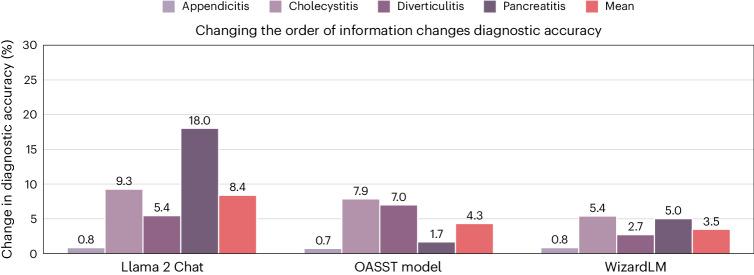
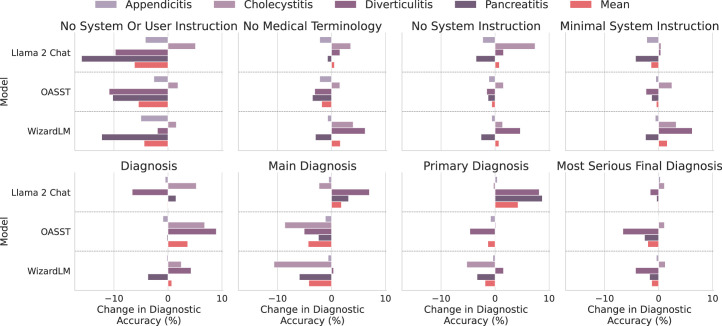
“Additionally, we see that even minor changes in instructions can greatly change diagnostic accuracy such as asking for the ‘main diagnosis’ (up to +7.0% for Chat on diverticulitis, down to −10.6% for WizardLM on cholecystitis) or ‘primary diagnosis’ (up +8.7% for Chat on pancreatitis, down to −5.2% for WizardLM on cholecystitis) instead of ‘final diagnosis’.”
§ Evaluation and mitigation of the limitations of large language models in clinical decision-making > Results > Current LLMs require extensive clinician supervision
plainstates a cause- Asserted: passes — The authors put it forward as true.
- Checkable: passes — It can be checked against evidence.
- Load-bearing: passes — The paper’s conclusions depend on it.
- Based: passes — The paper gives a reason why it holds.
A result the paper reports from its own data — it cites no other source for it, so there is none to check. The quote shows it is in the paper.
In the paper
“We show that current state-of-the-art LLMs do not accurately diagnose patients across all pathologies (performing significantly worse than physicians)”
§ Evaluation and mitigation of the limitations of large language models in clinical decision-making > Abstract
plainn = 2,400- Asserted: passes — The authors put it forward as true.
- Checkable: passes — It can be checked against evidence.
- Load-bearing: passes — The paper’s conclusions depend on it.
- Based: passes — The paper gives a reason why it holds.
59 more claims
Create a free account to see all 117 claims and to verify the 1 reference still open.
- It may state two separate claims as one. 40
- Probably not a substantial claim. 20
- The quote only partly states this claim. 1
Claims other papers make about this one
Each is checked against this paper’s own text: does it say what the citing paper says it does?
The source backs part of the claim, not all of it — or backs it for a different population, condition or comparison.
In the citing paper
“While medical licensing exams and diagnostic tasks are prioritized in 64% of LLM healthcare evaluations8, many administrative and operational tasks that represent significant human bottlenecks are often overlooked.”
From Holistic evaluation of large language models for medical tasks with MedHELM (2026) · cites this paper as [9]
Experimental — accuracy not yet measuredThe source backs part of the claim, not all of it — or backs it for a different population, condition or comparison.
In the citing paper
“While these models offer powerful foundational capabilities, adapting them to specific tasks and datasets without losing robustness is a significant hurdle, often resulting in significant variability in accuracy across different settings.7,9,10”
From Advancing methodological development of artificial intelligence in patient-centered comparative clinical effectiveness research: Patient-Centered Outcomes Research Institute’s unique contribution to research done differently (2025) · cites this paper as [9]
Experimental — accuracy not yet measuredThe cited source says what the claim attributes to it.
In the citing paper
“While LLM performance on medical QA benchmarks has been demonstrated to rival human-level performance, their capabilities in simulated real-world medical scenarios have been more limited12.”
From Limitations of large language models in clinical problem-solving arising from inflexible reasoning (2025) · cites this paper as [12]
The cited source says what the claim attributes to it.
In the citing paper
“Another study demonstrated that while LLMs show potential for clinical decision-making, they currently underperform compared to human clinicians in diagnosing common conditions such as appendicitis, cholecystitis, diverticulitis, and pancreatitis.”
From Enhancing diagnostic capability with multi-agents conversational large language models (2025) · cites this paper as [30]
Citations
Cites
Language Models are Few-Shot Learners
Brown, T. B., Mann, B., Ryder, N., Subbiah, M., Kaplan, J., Dhariwal, P., Neelakantan, A., Shyam, P., Sastry, G., Askell, A., et al. (2020) · arXiv · doi:10.48550/arxiv.2005.14165 · Cited by 23,372
Goldberger, A. L., Amaral, L. A. N., Glass, L., Hausdorff, J. M., Ivanov, P. C., Mark, R. G., Mietus, J. E., Moody, G. B., Peng, C.-K., & Stanley, H. E. (2000) · Circulation · doi:10.1161/01.cir.101.23.e215 · Cited by 14,809
Exploring the Limits of Transfer Learning with a Unified Text-to-Text Transformer
Raffel, C., Shazeer, N., Roberts, A., Lee, K., Narang, S., Matena, M., Zhou, Y., Li, W., & Liu, P. J. (2019) · arXiv · doi:10.48550/arxiv.1910.10683 · Cited by 10,929
Scaling Laws for Neural Language Models
Kaplan, J., McCandlish, S., Henighan, T., Brown, T. B., Chess, B., Child, R., Gray, S., Radford, A., Wu, J., & Amodei, D. (2020) · arXiv · doi:10.48550/arxiv.2001.08361 · Cited by 9,550
Chain-Of-Thought Prompting Elicits Reasoning in Large Language Models
Wei, J., Wang, X., Schuurmans, D., Bosma, M., Ichter, B., Xia, F., Chi, E., Le, Q. V., & Zhou, D. (2022) · Advances in Neural Information Processing Systems 35 · doi:10.52202/068431-1800 · Cited by 4,505
Chain-of-Thought Prompting Elicits Reasoning in Large Language Models
Wei, J., Wang, X., Schuurmans, D., Bosma, M., Ichter, B., Xia, F., Chi, E., Le, Q., & Zhou, D. (2022) · arXiv · doi:10.48550/arxiv.2201.11903 · Cited by 4,263 · cited 1×
“Given these constraints, we calculate and use the per-class accuracy throughout our work, which is the only metric that can be calculated without bias as it only requires the samples of a single class.”
Training language models to follow instructions with human feedback
Ouyang, L., Wu, J., Jiang, X., Almeida, D., Wainwright, C. L., Mishkin, P., Zhang, C., Agarwal, S., Slama, K., Ray, A., et al. (2022) · arXiv · doi:10.48550/arxiv.2203.02155 · Cited by 4,208
Kung, T. H., Cheatham, M., ChatGPT, Medenilla, A., Sillos, C., De Leon, L., Elepaño, C., Madriaga, M., Aggabao, R., Diaz-Candido, G., et al. (2022) · doi:10.1101/2022.12.19.22283643 · Cited by 4,115
Kung, T. H., Cheatham, M., Medenilla, A., Sillos, C., De Leon, L., Elepaño, C., Madriaga, M., Aggabao, R., Diaz-Candido, G., Maningo, J., et al. (2023) · PLOS Digital Health · doi:10.1371/journal.pdig.0000198 · Cited by 4,115
Large Language Models Encode Clinical Knowledge
Singhal, K., Azizi, S., Tu, T., Mahdavi, S. S., Wei, J., Chung, H. W., Scales, N., Tanwani, A., Cole-Lewis, H., Pfohl, S., et al. (2022) · arXiv · doi:10.48550/arxiv.2212.13138 · Cited by 4,083
Research works printed but not linked: 4
- Di Saverio, S. et al. Diagnosis and treatment of acute appendicitis: 2020 update of the WSES Jerusalem guidelines. World J. Emerg. Surg. 15, 27 (2020). · DOI · Paper page
- Zheng, C., Zhou, H., Meng, F., Zhou, J. & Huang, M. On large language models’ selection bias in multi-choice questions. In 12th International Conference on Learning Representations (ICLR, 2024).
- Golkar, Siavash, et al. xVal: a continuous number encoding for large language models. In NeurIPS 2023 AI for Science Workshop (2023).
- Radford, A. et al. Language models are unsupervised multitask learners. OpenAI blog 1, 9 (2019).
Cited by
Items 401–500 of 736
How Large Language Models Can Affect Clinical Reasoning: A Randomized Clinical TrialPreprint
Levels, M., Levels, M., Rounding, Dijksman, Fouarge, D. J. A. G., Fregin, Steens, Velasco, Boer, D., Bont, D., et al. (2025) · medRxiv · doi:10.64898/2025.12.17.25342338 · Cited by 2
Large Language Models Generate Stigmatizing Language During Reasoning Over Real-World Clinical DataPreprint
Yang, Y., Gu, B., Hathaway, D. B., Wyss, R., Marengo, L., Gibbons, J. B., Lyndon, S., Wu, J., Chen, Q., Liu, N., et al. (2026) · medRxiv · doi:10.64898/2026.08.12.26360210 · Cited by 1
A Scoping Review of LLM-as-a-Judge in Healthcare and the MedJUDGE Framework
Li, C., Akhtar, Z., Kwak, M., Ji, Y., Zhang, H., Obi, T., Ren, Y., Wu, X., Sivarajkumar, S., Lehmann, H. P., et al. (2026) · arXiv · doi:10.48550/arxiv.2604.25933 · Cited by 1
Overcoming Medical Overuse with AI Assistance: An Experimental InvestigationPreprint
Wang, Z., Wei, L., & Xue, L. (2024) · SSRN Electronic Journal · doi:10.2139/ssrn.4828970 · Cited by 3
Huang, Y., Li, L., Dong, W., Dong, Y., Huang, Y., & Liu, H. (2024) · doi:10.2196/preprints.65435 · Cited by 1
Artificial, but is it intelligent?
Levitt, M. R., & Vargas, J. (2024) · Journal of NeuroInterventional Surgery · doi:10.1136/jnis-2024-022412
Editorial Comment on Can artificial intelligence pass the Japanese urology board examinations?
Okada, A. (2024) · International Journal of Urology · doi:10.1111/iju.15613
Reply to “Enhancing breast imaging strategies: The role of ChatGPT in optimizing screening pathways”
Capiro, N. M., Fischer, C. P., & Sadigh, G. (2024) · Clinical Imaging · doi:10.1016/j.clinimag.2024.110313
Improving clinical expertise in large language models using electronic medical recordsPreprint
Zhu, L., Liu, J., Wang, J., Zhang, W., Jiang, S., Yang, H., Wang, C., Ye, Q., Ruan, T., Rui, X., et al. (2024) · Research Square · doi:10.21203/rs.3.rs-5285540/v1 · Cited by 1
Can Large Language Models facilitate evidence-based decision support for conservation?Preprint
Iyer, R., Christie, A. P., Madhavapeddy, A., Reynolds, S., Sutherland, W. J., & Jaffer, S. (2024) · Research Square · doi:10.21203/rs.3.rs-5409185/v1
Biomedical Foundation Models Need Tailored Robustness TestsPreprint
Xian, P., Baker, N. R., David, T., et al. (2024) · SSRN Electronic Journal · doi:10.2139/ssrn.5013799
Yano, Y., OHASHI, M., Miyagami, T., et al. (2024) · doi:10.2196/preprints.68527
Overcoming Medical Overuse with Ai Assistance: An Experimental InvestigationPreprint
Wang, Z., Wei, L., & Xue, L. (2024) · SSRN Electronic Journal · doi:10.2139/ssrn.5037526
Morel, D., & Verlingue, L. (2024) · Bulletin du Cancer · doi:10.1016/j.bulcan.2024.12.005
Iyer, R., Christie, A. P., Madhavapeddy, A., Reynolds, S., Sutherland, W. J., & Jaffer, S. (2025) · Research Square · doi:10.21203/rs.3.rs-5409185/v2
How AI May Impact Customer-Intensive ServicesPreprint
Hu, M., Li, X., Yuan, Q., & Zhu, H. H. (2025) · SSRN Electronic Journal · doi:10.2139/ssrn.5077583 · Cited by 7
KG-Infused LLM for Virtual Health Assistant: Accelerated Inference and Enhanced Performance
Katta, S. K., Ray, A., Firouzi, F., & Chakrabarty, K. (2024) · International Conference on Machine Learning and Applications · doi:10.1109/icmla61862.2024.00099 · Cited by 2
“Despite substantial progress, several limitations persist, constraining the ability of LLMs to generate precise and reliable responses, which are crucial for clinical decision-making and medical research [7], [15], [16].”
Toal, M. P., Hill, C. J., Quinn, M. P., O’Neill, C., & Maxwell, A. P. (2025) · doi:10.2196/preprints.73603
Continuous-Discrete Differentiable Particle Filters for Irregular Time Series
Wen, H., Krause, P., & Gillam, L. (2025) · IEEE International Conference on Acoustics Speech and Signal Processing · doi:10.1109/icassp49660.2025.10889175
“Time series are ubiquitous in a variety of applications including traffic forecasting [1]–[3], weather and climate predictions [4]–[6], clinical decision-making [7]–[9], and the demand and supply of energy [10]–[12].”
Chen, C., Hu, Y., Cai, W., et al. (2025) · SSRN Electronic Journal · doi:10.2139/ssrn.5153016
Localized large language model TCNNet 9B for Taiwanese networking and cybersecurity
Yang, J.-Y., & Wu, C. (2025) · Scientific Reports · doi:10.1038/s41598-025-90320-9
“For instance, the nuances of technical language and the importance of contextual relevance necessitate tailored evaluation approaches that reflect the unique requirements of specialized applications 20,21 .”
Chen, C.-L., Guan, M., Yue, W., Wang, X., Wu, Y., & Wang, X. (2025) · Communications in computer and information science · doi:10.1007/978-981-96-3752-2_6
Luo, O., Zhou, J. Y., & Gou, F. (2025) · Journal of X-Ray Science and Technology · doi:10.1177/08953996251325092
The Wicked Problem of Context in Clinical Practice and Implementation Research
Aron, D. C. (2025) · Journal of Evaluation in Clinical Practice · doi:10.1111/jep.70120
Cornelius, J., Knitza, J., Hack, J., Pavlović, M., & Kühn, S. (2025) · Die Unfallchirurgie · doi:10.1007/s00113-025-01581-y
Zhang, R., Zhao, Z., Long, F., Xu, J., Guan, J., Tan, R., long, Y., & Hongping, Q. (2025) · Research Square · doi:10.21203/rs.3.rs-6605707/v1
Chao, C., Kumar, A., Mishra, A., Wang, Y.-C., Tsai, C.-M., Ali, N. B., Sharma, S., Farina, J., Arsanjani, R., Jiang, Y., et al. (2025) · medRxiv · doi:10.1101/2025.05.17.25327814
A Convolutional Transformer Network for Anomaly Detection in Wireless Body Area Networks
Bagadia, G., Bose, S., & Hota, C. (2025) · IEEE Journal of Selected Areas in Sensors · doi:10.1109/jsas.2025.3572860 · Cited by 1
“This rich patient-specific information allows for a realistic evaluation of monitoring systems in critical care environments [24].”
Implementing Large Language Models in Critical Care
Gharib, K. E. (2025) · CHEST Critical Care · doi:10.1016/j.chstcc.2025.100180 · Cited by 1
Ma, W., Fong, G., Lai, J., Wu, H., Hue, S. P. Y., Ying, J., The Hong Kong Genome Project, Chu, A. T.-W., & Chung, B. H. Y. (2025) · medRxiv · doi:10.1101/2025.06.03.25328923
Exploring Large Language Models' Responses to Moral Reasoning DilemmasPreprint
Nabizadeh, D., Walker, D. I., Han, H., & Laird, E. (2025) · Research Square · doi:10.21203/rs.3.rs-6823916/v1
Large Language Models for the assessment of medical students’ clinical decision-makingPreprint
Benker, S. C., Vollprecht, J., Papan, C., Lu, M. H., & Darici, D. (2025) · Research Square · doi:10.21203/rs.3.rs-6660928/v1
Pareto-Optimized Open-Source LLMs for Healthcare via Context Retrieval
Bayarri-Planas, J., Gururajan, A. K., & García-Gasulla, D. (2025) · IFIP advances in information and communication technology · doi:10.1007/978-3-031-96235-6_27 · Cited by 6
“Finally, the predominant reliance on Multiple-Choice Question Answering (MCQA) benchmarks for evaluation presents limitations [6].”
Modern Bio-Technological Applications: Innovations and Insights in Life Sciences
Mohammed, W. M. A., Mohamed, W. A. A., Odeh, A. A. M., Hassan, I. I. A., & Hamid, Z. Z. N. (2025) · Bright Sky Publications eBooks · doi:10.62906/bs.book.410
Luo, J., Ma, J., Wang, T., Qiu, Y., Yang, Y., Qiu, H., Chen, G., & Wang, W. (2025) · medRxiv · doi:10.1101/2025.07.15.25331552
Enhancing Cybersecurity Skills Through Gamified Learning: Practical Applications and Strategies
Asrifan, A., Vivekanantharasa, R., & Aini, N. (2025) · IGI Global eBooks · doi:10.4018/979-8-3373-0477-9.ch002
A hybrid deployment model for generative artificial intelligence in hospitals
Griot, M., Hemptinne, C., Vanderdonckt, J. M., & Yüksel, D. (2025) · Machine Learning Health · doi:10.1088/3049-477x/addb51 · Cited by 2
Fotedar, N., & Masthi, N. R. R. (2025) · doi:10.2196/preprints.81501
Chetla, N., Patel, S., Naidu, T., et al. (2025) · Research Square · doi:10.21203/rs.3.rs-7180985/v1
Artificial Intelligence: Its Role in Clinical Medicine?
Li, J. S. Y., & Robertson, H. (2025) · Transplantation · doi:10.1097/tp.0000000000005505 · Cited by 2
Color-Dp: A Conjugate Low-Rank Optimized Dp Mechanism for Lora Fine-TuningPreprint
Zhang, K., Xu, Y., Lin, W., Tsai, P., Hong, C., & Yuan, X. (2025) · SSRN Electronic Journal · doi:10.2139/ssrn.5390790
An explainable language model predicts survival from medical reports in oncologyPreprint
Clément, P. I. A. T., Blampey, Q., Joutard, A., Qabel, M. A., Piazza, T. D., Benassayag, U., Vienne, R., Reme, R., Morel, D., Choffe, M., et al. (2025) · Research Square · doi:10.21203/rs.3.rs-7121466/v1
An Overview of Artificial Intelligence in Neurology
Parker, T., & Brush, B. (2025) · Seminars in Neurology · doi:10.1055/a-2693-0547 · Cited by 2
Evaluation of LLMs Accuracy and Application in Oncology Principles and PracticePreprint
Liang, J., Lin, Y., Guo, Z., Qi, J., Liang, H., Ni, J., Lin, D., Huang, Z., Wang, W., Liu, S., et al. (2025) · SSRN Electronic Journal · doi:10.2139/ssrn.5421583
Yano, Y., Kakizaki, H., Nagasu, H., Kishi, S., Koshida, T., Nihei, Y., Hirano, A., Nangaku, M., Mori, H., Naito, T., et al. (2025) · medRxiv · doi:10.1101/2025.09.04.25334460
de la Cruz, S. A., Arenas-Hernández, P. E., Fernández-Herrera, M. F., Quiñones-Díaz, R. A., Llaca-Díaz, J. M., Díaz‐Chuc, E. A., Robles-Espino, D. G., & Miguel-Garay, E. A. S. (2025) · Journal of Clinical Medicine · doi:10.3390/jcm14186676 · Cited by 3
“In medicine, LLMs have demonstrated strong performance in medical licensing examinations [3].”
Ahmed, H. S., Suhas, D., D’Souza, L., Jayaram, P. R., Gupta, A. K., & Sache, M. S. (2025) · General Thoracic and Cardiovascular Surgery · doi:10.1007/s11748-025-02203-5 · Cited by 1
“Challenges such as algorithmic bias, overreliance, plagiarism, misinformation, inequity, privacy, and copyright concerns also limit the use of LLMs [4].”
Performance of a Large Language Model in BI-RADS Classification of Ultrasound Based Breast LesionsPreprint
Pillai, K., & Nausheen, F. (2025) · medRxiv · doi:10.1101/2025.09.28.25336860
Einsatz von Foundation-Modellen entlang der Patientenreise
Antweiler, D., Rüping, S., & Wrobel, S. (2025) · Springer eBooks · doi:10.1007/978-3-658-48573-3_40
Li, J., & Zhang, P. (2025) · Sustainability · doi:10.3390/su17209051 · Cited by 2
Recognizing "Conformity Bias" in Large Language Models: A New Risk for Clinical UsePreprint
Nowroozzadeh, M. H., & Salari, R. (2025) · Research Square · doi:10.1101/2025.10.19.25338293
“Conformity Bias could lead to incorrect diagnoses based on user-driven misinformation, inappropriate or even harmful treatment recommendations,[11] and delayed or misdirected patient care due to reliance on falsely reassuring AI outputs.”
Large language models in radiologic numerical tasks: A thorough evaluation and error analysisPreprint
Nowroozi, A., Bondarenko, M., Serapio, A., et al. (2025) · medRxiv · doi:10.1101/2025.10.16.25337607 · Cited by 2
“One previously documented weakness of LLMs has been their difficulty with numerical reasoning and calculations (5,6), which has also recently been a focus of attention in medical studies involving LLMs and has been suggested as a source for suboptimal LLM performance (1,7).”
InfluentialExtracting Symptoms of Sepsis From Admission Notes With LLM—Maybe AI Knows Something That We Do Not
Baghdadi, J. D., & Guillamet, C. V. (2025) · JAMA Network Open · doi:10.1001/jamanetworkopen.2025.39275
Ahmad, H. F., Sajid, J., Rasool, R. U., & Malik, A. W. (2025) · Cluster Computing · doi:10.1007/s10586-025-05793-0 · Cited by 1
“In a field where timely and accurate information is crucial, these models can provide substantial benefits, such as reducing administrative burdens and supporting decision-making processes with advanced language understanding [20, 21].”
Semantic Fusion for Connected Medicine
Muhala, B., Deo, M. M., Bukasa-Kakamba, J., et al. (2025) · Analecta Technica Szegedinensia · doi:10.14232/analecta.2025.2.46-66
Evaluating LLMs in Anesthesia: Beyond Single-Round Interactions
Cheng, W., Liu, E., & Yu, Z. (2025) · Journal of Medical Systems · doi:10.1007/s10916-025-02294-w
“Since documentation richness and guideline coverage likely influence model responses, incorporating harmonized case templates or balanced sampling across specialties may help clarify whether differences arise from clinical complexity or input variation [ 4].”
Abaluck, J., Pless, R. B., Ravi, N., Sautmann, A., & Schwartz, A. L. (2025) · medRxiv · doi:10.1101/2025.10.31.25339278
“A smaller number of studies have tested LLMs with real patient information, or LLM decision support in realistic clinical environment (Goh et al., 2024; Cadamuro et al., 2023; Gaber et al., 2025; Hager et al., 2024).”
Nakaura, T., Kobayashi, N., Shiraishi, K., Yoshida, N., Nagayama, Y., Uetani, H., Kidoh, M., Oda, S., Funama, Y., & Hirai, T. (2025) · Journal of Computer Assisted Tomography · doi:10.1097/rct.0000000000001807
Parenti, S. I., Maglioni, A., Evangelisti, E., Gracco, A. L. T., Badiali, G., Bonetti, G. A., & Bartolucci, M. L. (2025) · Applied Sciences · doi:10.3390/app152312441 · Cited by 1
Kang, B., Kwon, K., Huilin, P., Hong, S.-G., Choi, S., & Oh, H. (2026) · JMIR Medical Informatics · doi:10.2196/87887
“Large-scale benchmarking illustrates this limitation: Hager et al [8] found that state-of-the-art LLMs, despite high test performance, frequently failed guideline adherence and clinical reasoning on 2400 real patient cases.”
Performance assessment strategies for language model applications in healthcare
García, V., Sidulova, M., & Badano, A. G. (2026) · Artificial Intelligence in the Life Sciences · doi:10.1016/j.ailsci.2026.100162 · Cited by 1
“…a curated dataset of 2,400 patient cases from the Medical Information Mart for Intensive Care (MIMIC-IV)[28] where models must iteratively request and assess the provided clinical data to diagnoses one of four pathologies (appendicitis, pancreatitis, cholecystitis, and diverticulitis)[29, 30].”
Performance of reasoning large language models on nephrology multiple-choice questionsPreprint
Kitano, F., Masaki, M., Ichikawa, D., Shibagaki, Y., & Noda, R. (2025) · medRxiv · doi:10.64898/2025.12.03.25341427
Multimorbidity measurement strategies for predicting hospital visits
Neves, B. D., Moreira, J. M., Gonçalves, S., Cerejo, J., Mota, I., Silva, N. A., Leite, F., & Silva, M. J. (2025) · BMC Health Services Research · doi:10.1186/s12913-025-13817-z
Zhang, Y., Yang, D., Shi, Y., & Liu, Y. (2025) · Cureus · doi:10.7759/cureus.99026 · Cited by 2
“Grok-3’s superior performance may stem from its chain-of-thought reasoning approach, which systematically evaluates possibilities, unlike pattern-matching-reliant open-source models that are unsuitable for autonomous clinical decisions [19-21].”
Liu, D., Long, Y., Zuoqiu, S., Liu, D., Li, K., Xie, K., Yang, R., Lin, Y., Liu, H., Yin, R., et al. (2026) · Journal of Medical Internet Research · doi:10.2196/97221 · Cited by 1
“Despite their outstanding performance, when these state-of-the-art (SOTA) models are applied to specialized real-world clinical cases to support the realistic diagnosis operation, they seem to encounter some obstacles [17, 18].”
Kim, S., Choi, D., & Son, J. (2025) · World Journal of Pediatric Surgery · doi:10.1136/wjps-2025-001117
“11 12 Notably, models such as ChatGPT have demonstrated promising results on medical licensing exams and other standardized objective assessments, achieving performance levels comparable to those of human”
Vasilev, Y. A., Tyrov, I. A., Arzamasov, K. M., Vladzymyrskyy, A. V., Omelyanskaya, O. V., Pamova, A. P., Arzamasova, L., Krylova, E. A., Raznitsyna, I. A., Petrov, E. A., et al. (2025) · Vrach i informacionnye tehnologii · doi:10.25881/18110193_2025_4_72 · Cited by 1
Benchmarking large language models for cardiovascular risk stratification using clinical vignettesPreprint
Santos, J. F., Duarte, R. D. B., Mota, I., Santos, R. C., Moreira, J.-M., Campos, J., Silva, N. A., Neves, B. D., Ladeiras‐Lopes, R., Leite, F., et al. (2025) · Research Square · doi:10.21203/rs.3.rs-8307079/v1
Фролов, Е. М., Ермолаева, Д. Н., Мокшин, К. Ю., Шемонаев, Д. Д., Фролов, М. Ю., & Георгиевич, Ж. М. (2025) · International journal of open information technologies · doi:10.25559/injoit.2307-8162.13.202508.94-104 · Cited by 1
Pinuer, L. P., Zapata, I. T., & Quintanilla, H. B. (2026) · Lecture notes in networks and systems · doi:10.1007/978-3-032-09074-4_42
Towards an Explainable Framework for Personalized Treatment Recommendations
Labraoui, M. O., Benzadri, Z., & Marir, N. (2025) · IEEE/ACS International Conference on Computer Systems and Applications (AICCSA) · doi:10.1109/aiccsa66935.2025.11315487
“The problem is further complicated by the need for trans-parency and trust: clinicians must understand the reasoning behind treatment suggestions in order to confidently apply them in practice [2].”
Yang, X., Zhu, J., Pan, W., Wang, Y., Yan, K., & Fang, Z. (2026) · doi:10.2196/preprints.91222
Generative AI to Assist Physicians
Rutledge, G. W. (2026) · Health informatics · doi:10.1007/978-3-032-11938-4_8
Human Intelligence and the Caring Imperative
Hübner, U. H. (2026) · Health informatics · doi:10.1007/978-3-032-11938-4_3
Wu, S., Xu, C., Xue, Z., Huang, Y., Xu, G., Cui, Y., Ma, J., Ma, R., & Xie, C. (2026) · Frontiers in Earth Science · doi:10.3389/feart.2025.1695920
Searching the druggable genome using large language models
Schimmelpfennig, L. E., Cannon, M. J., Cody, Q., McMichael, J. F., Coffman, A. C., Kiwala, S., Krysiak, K., Wagner, A. H., Griffith, M., & Griffith, O. L. (2026) · Bioinformatics · doi:10.1093/bioinformatics/btag632 · Cited by 1
“…of biomedical applications, including literature summarization and clinical decision support, due to their ability to synthesize complex information and respond flexibly to natural-language questions (Hager et al. 2024, Li et al. 2024, Williams et al. 2024, Chen et al. 2025, Wang et al. 2025).”
Artificial intelligence as a clinical tool? Comparing ChatGPT to expert opinions in tinnitus
İçöz, Ö., & Kocabay, A. P. (2026) · The Egyptian Journal of Otolaryngology · doi:10.1186/s43163-026-01021-7 · Cited by 1
“The model’s tendency to produce confident outputs even in the absence of clear evidence has been noted in prior evaluations and is considered a current limitation of LLMs [17].”
Bootstrapping Large Language Models as Clinical Predictors for Multimodal Irregular Time Series
He, Y., Cai, J., & Zhao, G. (2025) · IEEE International Conference on Bioinformatics and Biomedicine (BIBM) · doi:10.1109/bibm66473.2025.11356732 · Cited by 1
“Numerous efforts have been made to harness the capabilities of LLMs for clinical prediction tasks [3].”
Towards Trustworthy Knowledge Extension in Clinical Decision Support: An LLM-Agent Approach
Wang, S., Xiao, L., Chen, J., et al. (2025) · IEEE International Conference on Bioinformatics and Biomedicine (BIBM) · doi:10.1109/bibm66473.2025.11356848
“The primary function of the Decision-Centric Knowledge Discovery Agent is to extract potential novel knowledge within partitioned decision units using a large language model (see Figure 6)[16].”
MedEvalarena: A Self-Generated, Peer-Judged Benchmark for Medical ReasoningPreprint
Prem, P., Shidara, K., Kuppa, V., Wheeler, E., Liu, F., Alaa, A. M., & Bernardo, D. (2026) · medRxiv · doi:10.64898/2026.01.27.26344905 · Cited by 4
Novikov, Z., Mehra, N. V., Xiao, L., Wells, R., Ottosen, M. J., Hwang, K. O., Avritscher, E. B. C., Green, C., Lee, K. H., Oguin, X., et al. (2026) · BMJ Open · doi:10.1136/bmjopen-2025-112391
“15 In addition, technology is limited in supporting patient engagement and cannot ensure timely completion of recommended blood tests—both of which are essential for achieving diagnostic accuracy and continuity of care.”
Knauer, M., Greß, J., Kather, J. N., & May, P. (2026) · doi:10.2196/preprints.93239
Self-citationChen, Z., & Ran, W. (2026) · Sensor Review · doi:10.1108/sr-11-2025-0957
Anindo, I. R., Sajid, M. A. U. I., Mahmood, M. S., Prottush, N., & Morol, M. K. (2025) · IEEE International Conference on Computing, Applications and Systems (COMPAS) · doi:10.1109/compas67506.2025.11381760
“Hager et al. [7] investigate this.”
AI hallucination risks and mitigation strategies
Domingues-dos-Santos, L., Maltarollo, T. F. H., & Macedo, M. C. S. (2026) · BDJ · doi:10.1038/s41415-026-9583-0
Gomez-Rangel, J., Vazquez, A., Lee, Y., Demir, K. A., & Liu, B. (2026) · International Journal of Semantic Computing · doi:10.1142/s1793351x26410059 · Cited by 1
LLM-based medical dialogue dataset generation with automated instructions
Zhou, H., Hu, X., He, T., You, H., Yin, J., Xu, J., Lin, Z., & Wang, H. (2026) · Scientific Reports · doi:10.1038/s41598-025-34835-1
AI/ML Trustworthiness for Medical Predictions – Experimental Results
Karim, M., Pias, T. S., Viswanath, B., & Yao, D. D. (2025) · Annual Computer Security Applications Conference Workshops (ACSAC Workshops) · doi:10.1109/acsacw69556.2025.00032
“On the other hand, LLMs are not fully capable of accurately diagnosing patients across all pathologies and do not follow diagnostic or treatment guidelines [14].”
Dual-stage and Lightweight Patient Chart Summarization for Emergency Physicians
Wu, J., Zaidi, S., Teitge, B. D., Leung, H., Zhou, J., Holodinsky, J. K., & Drew, S. (2025) · IEEE Annual Congress on Artificial Intelligence of Things (AIoT) · doi:10.1109/aiot66900.2025.00018 · Cited by 4
“Similarly, Hager et al. [30] conducted a comprehensive evaluation of state-of-the-art LLMs on 2,400 real hospital cases and found that even fine-tuned models fell far short of physician accuracy in full clinical decision-making tasks.”
Future directions in infertility research: the role of generative AI and large language models
Jamil, H. M. (2026) · Systems Biology in Reproductive Medicine · doi:10.1080/19396368.2026.2627889 · Cited by 1
Inteligencia artificial y toxicología: conocimientos frente a los de otras especialidades médicas
Nogué, S., Ríos, J., Saavedra, C., & Amigó‐Tadín, M. (2026) · Medicina Clínica · doi:10.1016/j.medcli.2026.107407
Harada, Y. (2026) · Cureus · doi:10.7759/cureus.105796 · Cited by 2
“In more realistic clinical decision-making settings, models have shown failure modes that are not captured by benchmark accuracy alone, including clinically meaningful sensitivity to how information is presented [27].”
Real-world performance of open-source large language models in diabetes diagnosis
Yang, S., Liu, S., Ma, Y., Gai, B., Liu, J., Wang, L., Gao, F., & Zhou, Z. (2026) · Frontiers in Endocrinology · doi:10.3389/fendo.2026.1747468
“This de fi cit, analogous to the “ factual hallucination ” and “ computational weakness ” observed in other domains (4, 24, 25), suggested that the probabilistic nature of LLMs inhibited their function as reliable “ rule engines, ” a limitation that was particularly acute when diagnostic criteria…”
Vladika, J., Fichtl, A. M., & Matthes, F. (2026) · Scientific Reports · doi:10.1038/s41598-026-45245-2 · Cited by 1
“…studies have shown that LLMs perform better in routine classification tasks while struggling in realistic patient diagnostics and adhering to clinical guidelines 12,34 , highlighting a mismatch between actual capabilities of current LLMs and expected error rate thresholds from survey participants.”
Kulshrestha, S., Kumar, N., Verma, P., Sikri, K., Gangwar, M., Sengupta, A., Aggarwal, S., & Narad, P. (2026) · Reproduction Fertility and Development · doi:10.1071/rd25145
Retrieval as governance: A medical informatics perspective on clinical large language models
Wang, B., Wang, Z., & Zhong, Y. (2026) · Digital Medicine · doi:10.1097/dm-2026-00009
A Comparative Study in Surgical AI: Potential and Limitations of Data, Compute, and ScalingPreprint
Skobelev, K., Fithian, E., Baranovski, Y., Cook, J., Angara, S., Otto, S., Yi, Z.-F., Zhu, J., Mainkar, N., Masson-Forsythe, M., et al. (2026) · medRxiv · doi:10.64898/2026.03.26.26349455 · Cited by 1
Asl, M. M. B., & Spiotta, A. M. (2026) · The Joint Commission Journal on Quality and Patient Safety · doi:10.1016/j.jcjq.2026.03.011
A Comparative Study in Surgical AI: Datasets, Foundation Models, and Barriers to Med-AGIPreprint
Skobelev, K., Fithian, E., Baranovski, Y., Cook, J., Angara, S., Otto, S., Yi, Z.-F., Zhu, J., Donoho, D. A., Han, X. Y., et al. (2026) · SSRN Electronic Journal · doi:10.2139/ssrn.6476260
Luo, J., Ma, J., Qiu, Y., Wang, T., Yang, Y., Qiu, G., Chen, H., Pang, J., & Wang, W. (2026) · npj Digital Medicine · doi:10.1038/s41746-026-02591-9
Metadata
- Authors
- Hager, P., Jungmann, F., Holland, R., Bhagat, K., Hubrecht, I., Knauer, M., Vielhauer, J., Makowski, M., Braren, R., Kaissis, G., & Rueckert, D.
- Affiliations
- TUM Klinikum (DE)
- Imperial College London (GB)
- Christiana Care Health System (US)
- Ludwig-Maximilians-Universität München (DE)
- Corresponding author
- Hager, Paul
- ORCID
- Venue
- Nature Medicine
- Published
- 2024-07-04
- Volume
- 30
- Issue
- 9
- Pages
- 2613-2622
- ISSN
- 1078-8956 (ISSN-L)
- 1546-170X
- PMC
- PMC11405275
- OpenAlex
- W4400324908
- Cited by
- 798
- References
- 74
- Citations by year
- 2026: 435 · 2025: 317 · 2024: 46
- FWCI
- 74.24
- Type
- journal article
- Language
- en
- Open access
- hybrid
- doi.org
- Licence
- cc-by
- creativecommons.org/licenses/by/4.0 (tdm)
- creativecommons.org/licenses/by/4.0 (vor)
- Locations
- Nature Medicine (publishedVersion, cc-by)
- medRxiv (acceptedVersion, cc-by-nc)
- PubMed Central (publishedVersion, cc-by)
- PubMed (publishedVersion)
- PuSH - Publication Server of Helmholtz Zentrum München (submittedVersion, cc-by)
- mediaTUM – the media and publications repository of the Technical University Munich (Technical University Munich) (submittedVersion)
- Funders
- Technische Universität München
- H2020 European Research Council (884622)
- Topics
- Health Sciences › Medicine › Health Informatics › Artificial Intelligence in Healthcare and Education
- Physical Sciences › Computer Science › Artificial Intelligence › Machine Learning in Healthcare
- Health Sciences › Health Professions › Health Information Management › Artificial Intelligence in Healthcare
- Keywords
- large language models, clinical decision-making, artificial intelligence in healthcare, MIMIC-III, abdominal pathology, diagnostic accuracy, clinical guidelines adherence, laboratory test interpretation, clinical workflow integration, medical licensing examinations, LLM limitations
- MeSH terms
- Clinical Decision-Making, Artificial Intelligence, Humans, Decision Support Systems, Clinical
About these checks
Registry, retraction, Cites and statistics results are computed, not judged, with one exception: a printed reference that no index lists is read once by a model before it counts as a citation error. Claims are extracted by a model and kept only when their quote appears verbatim in the text; each cited source is then checked, with a model’s help, for whether it says what the claim relies on. Those verdicts can be wrong — read the claim’s quote and the cited source before relying on one.
The claim verdicts this report counts are experimental: their accuracy is not yet measured.
A language model drew the claims from the paper on 2026-10-10, under version 3 of the claim definition (model deepseek-v4.1-flash, prompt extract-v3).
A second model labelled each claim on 2026-10-10 (model jev-1.13-20260917, definition revision gold-guideline-v0.2).
Cited sources are checked with a language model’s help (gpt-6-sol).
Statistics and arithmetic are recomputed, not judged.
Confidence bands are shown only for fields calibrated on our annotated test set. None is calibrated yet, so no band is shown.
What counts as a claim ›How we measure confidence ›How we check this ›
Are you an author, or do you see a problem with this page? Request a review
Data sources
Bibliographic data: Semantic Scholar, OpenAlex, Crossref.
Contains information from the Semantic Scholar Academic Graph Datasets, made available under the ODC Attribution License (ODC-BY 1.0).
Semantic Scholar’s data is described in: Kinney, R., et al. (2023). The Semantic Scholar Open Data Platform. arXiv:2301.10140.
