

Evaluation and mitigation of the limitations of large language models in clinical decision-making
Open accessPublished version of a preprint
The DOI matches its Crossref record; 92 of the 92 references it cites were found in a registry or an index; 20 of the 24 sources its claims cite were checked for support.
Abstract
Clinical decision-making is one of the most impactful parts of a physician's responsibilities and stands to benefit greatly from artificial intelligence solutions and large language models (LLMs) in particular. However, while LLMs have achieved excellent performance on medical licensing exams, these tests fail to assess many skills necessary for deployment in a realistic clinical decision-making environment, including gathering information, adhering to guidelines, and integrating into clinical workflows. Here we have created a curated dataset based on the Medical Information Mart for Intensive Care database spanning 2,400 real patient cases and four common abdominal pathologies as well as a framework to simulate a realistic clinical setting. We show that current state-of-the-art LLMs do not accurately diagnose patients across all pathologies (performing significantly worse than physicians), follow neither diagnostic nor treatment guidelines, and cannot interpret laboratory results, thus posing a serious risk to the health of patients. Furthermore, we move beyond diagnostic accuracy and demonstrate that they cannot be easily integrated into existing workflows because they often fail to follow instructions and are sensitive to both the quantity and order of information. Overall, our analysis reveals that LLMs are currently not ready for autonomous clinical decision-making while providing a dataset and framework to guide future studies.
Overview
CoChat Summary
TL;DR
This study evaluates open-access LLMs on a realistic clinical decision-making task using 2,400 real emergency department cases of acute abdominal pain from MIMIC-IV. The models performed significantly worse than physicians, failed to follow diagnostic/treatment guidelines, and were too fragile and instruction-sensitive for autonomous clinical use.
Key findings
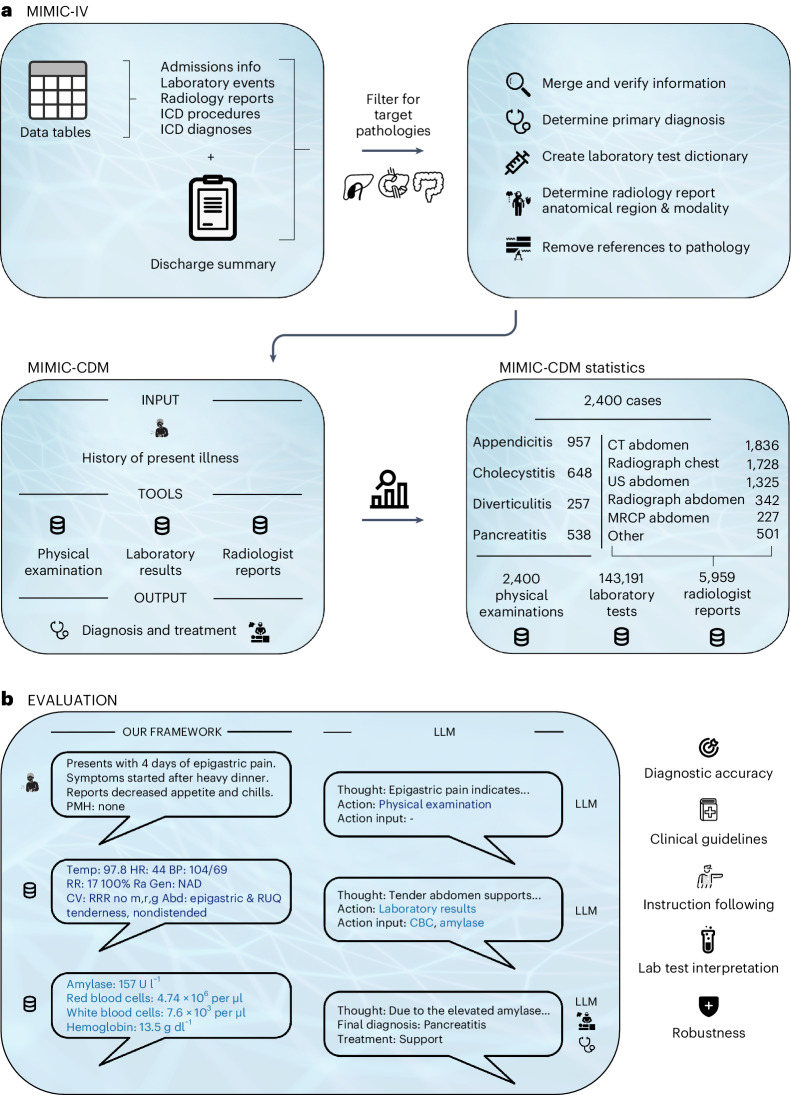
- The curated dataset, MIMIC-CDM, contains 2,400 unique patients with appendicitis (957), cholecystitis (648), diverticulitis (257), and pancreatitis (538).
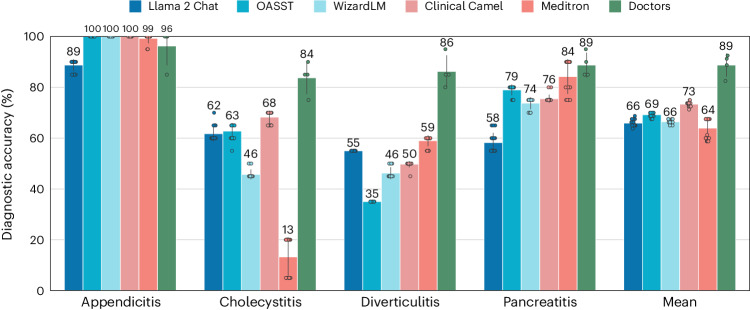
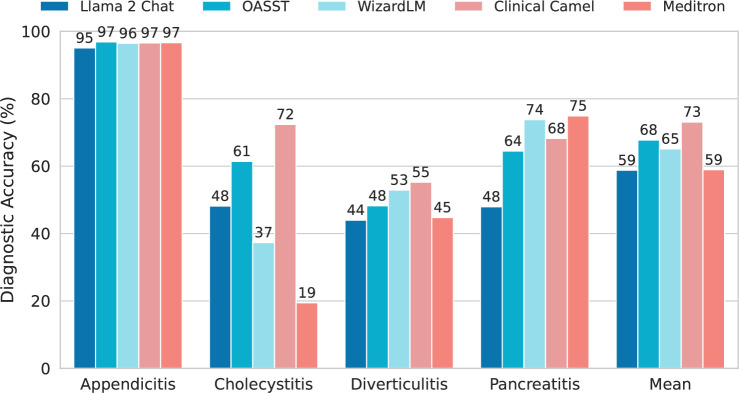
- On a reader study with 80 patients and 4 hospitalists, current LLMs performed significantly worse than clinicians on aggregate across all diseases (P < 0.001 for doctors versus Llama 2 Chat, OASST, WizardLM, Clinical Camel, and Meditron).
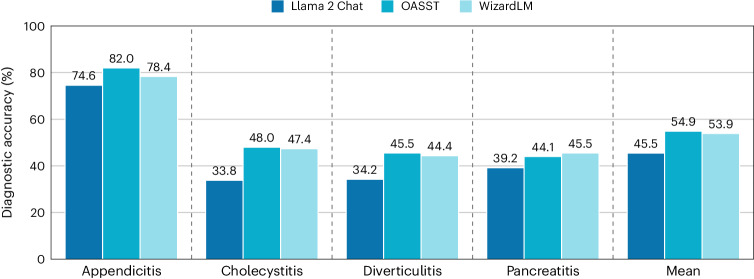
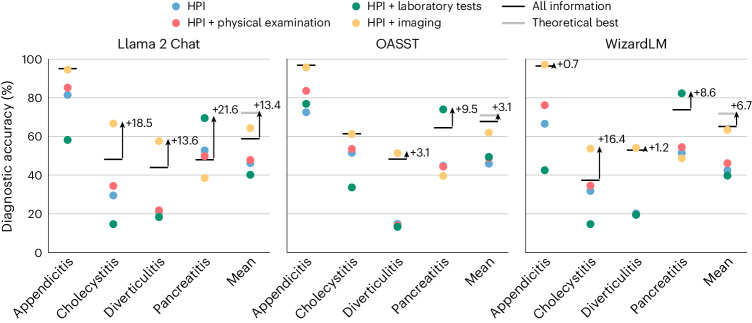
- Diagnostic performance dropped further when models had to gather information themselves: mean diagnostic accuracy fell to 45.5% for Llama 2 Chat, 54.9% for OASST, and 53.9% for WizardLM, versus 58.8%, 67.8%, and 65.1% on the full-information setup, respectively.
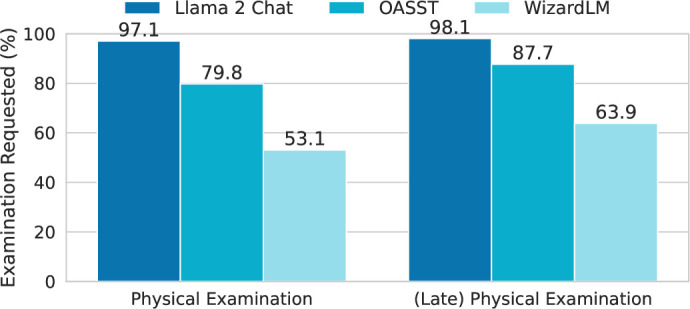
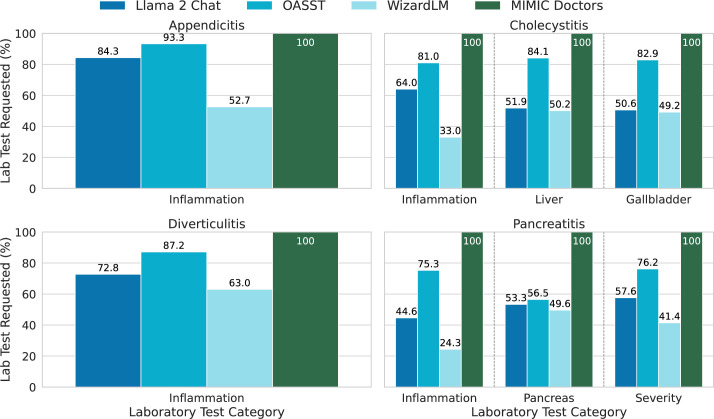
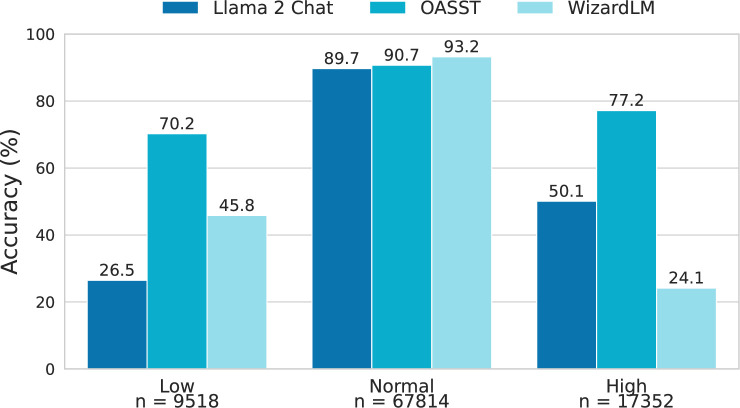
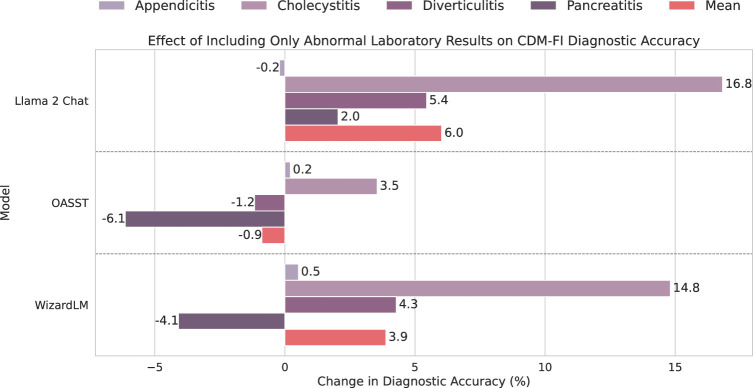
- Models also failed basic safety checks: only Llama 2 Chat consistently requested physical examination information (97.1% as first action; 98.1% at all), and laboratory interpretation was poor even with reference ranges (for example, low results: 26.5% Chat, 70.2% OASST, 45.8% WizardLM; high results: 50.1%, 77.2%, 24.1%).
Methods
- The authors built MIMIC-CDM from the MIMIC-IV EHR database by filtering to emergency department cases with acute abdominal pain and a primary diagnosis of one of four target pathologies, then extracting history of present illness, physical exams, labs, microbiology, imaging, and procedures.
- They evaluated open-access models derived from Llama 2, focusing mainly on Llama 2 Chat, OASST, and WizardLM, and compared them with clinicians on a 100-patient reader study (80 target cases plus 5 each of other conditions), with each LLM evaluated 20 times on the physician comparison subset using different seeds.
- Main analysis included per-class accuracy, guideline adherence for diagnostic tests and treatments, lab interpretation tasks, instruction-following, robustness to changes in wording, order, and amount of information, and comparisons using two-sided Student’s t-tests with Bonferroni correction.
Limitations
- The paper states that the dataset and models have a clear bias toward the USA, so generalizability to other languages or countries with different guidelines is unknown.
- The authors note that, because they used real-world clinical data, they had to deny requests for information not in the dataset; they argue this was mitigated because MIMIC-IV contains all data gathered during the hospital stay.
- Evident from the text: the study focuses only on four abdominal pathologies, so it does not cover the full breadth of clinical decision-making (the paper itself notes this as a constraint).
Model-written summary. Check it against the paper before relying on it.
Integrity signals
Registry
Cites
Statistics
Figures
Verification
Claims the paper makes
6 Valid · 2 Not valid · 3 Not checked · 106 Own results and interpretations
Some cited sources support this claim and some don’t — read each source’s verdict below.
In the paper
“where LLMs score well above passing8–10,17–20”
§ Evaluation and mitigation of the limitations of large language models in clinical decision-making > Main
What the sources say
- Supportedcites [8] Singhal, K. et al. Towards expert-level medical question answering with large language models. Preprint at https://arxiv.org/abs/2305.09617 (2023). source
The Abstract (page not supplied) reports that Med-PaLM 2 scored 86.5% on MedQA, a dataset of USMLE-style questions, and that its predecessor had exceeded a passing score at 67.2%. This supports the claim about LLM performance on medical-licensing-exam-style questions. (LLM, conf=0.93)
- Partly supportedcites [9] Singhal, K. et al. Large language models encode clinical knowledge. Nature 620, 172–180 (2023). sourceExperimental — accuracy not yet measured
The ‘State of the art on MedQA’ section reports that Flan-PaLM scored 67.6% on USMLE-style questions, supporting strong performance on a medical-exam benchmark. Our copy does not establish a passing threshold or show that LLMs scored well above it on actual licensing exams. (LLM, conf=0.86)
- Supportedcites [10] Nori, H., King, N., McKinney, S. M., Carignan, D. & Horvitz, E. Capabilities of GPT-4 on medical challenge problems. Preprint at https://arxiv.org/abs/2303.13375 (2023). source
The Abstract (p. 1) reports that GPT-4 exceeded the USMLE passing score by over 20 points. The Introduction (p. 2) specifies that the results came from official sample exams and self-assessment materials, supporting this citation as an example of an LLM scoring well above passing on medical licensing exam materials. (LLM, conf=0.93)
- Disputedcites [17] Kung, T. H. et al. Performance of chatgpt on usmle: potential for ai-assisted medical education using large language models. PLoS Digital Health 2, 0000198 (2023). sourceExperimental — accuracy not yet measured
The Discussion (‘The rising accuracy of ChatGPT’) says ChatGPT exceeded 60% accuracy in some analyses, while the USMLE passing threshold is approximately 60%; it concludes that ChatGPT ‘approaches the passing range.’ The paper describes performance as at or near passing, not well above it. (LLM, conf=0.88)
Checked by a reasoning model — may be wrong.
- Disputedcites [18] Gilson, A. et al. How does chatgpt perform on the United States medical licensing examination? The implications of large language models for medical education and knowledge assessment. JMIR Med. Educ. 9, 45312 (2023). sourceExperimental — accuracy not yet measured
The Results (Overall Performance; page unavailable) report that ChatGPT exceeded the paper’s approximately 60% passing benchmark on only one of four question sets, scoring 64.4%. It scored below that benchmark on the other three; InstructGPT and GPT-3 scored below it on all four. The paper therefore does not show LLMs scoring well above passing. (LLM, conf=0.90)
Checked by a reasoning model — may be wrong.
- Partly supportedcites [19] Toma, A. et al. Clinical camel: an open-source expert-level medical language model with dialogue-based knowledge encoding. Preprint at https://arxiv.org/abs/2305.12031 (2023). sourceExperimental — accuracy not yet measured
Table 4 reports strong five-shot scores on the USMLE Sample Exam, including 86.6% for GPT-4 and 64.3% for Clinical Camel-70B. But the paper gives no passing threshold, and other models score substantially lower, so it does not establish that LLMs generally score well above passing. (LLM, conf=0.82)
- Supportedcites [20] Nori, H. et al. Can generalist foundation models outcompete special-purpose tuning? Case study in medicine. Preprint at https://arxiv.org/abs/2311.16452 (2023). source
Section 2.1 reports that GPT-4 exceeded the USMLE passing score by over 20 points. The Abstract also reports that GPT-4 with Medprompt surpassed 90% on MedQA, a USMLE-style exam-question dataset. These passages support the cited claim that LLMs can score well above passing on medical licensing exam questions. (LLM, conf=0.91)
boosted- Asserted: passes — The authors put it forward as true.
- Checkable: passes — It can be checked against evidence.
- Load-bearing: unclear — It is unclear whether the paper’s conclusions depend on it.
- Based: passes — The paper gives a reason why it holds.
- Supported
The cited sources support only part of this claim — read each source’s verdict below.
In the paper
“We note that Llama 2, Clinical Camel and Meditron have been shown to match and even exceed Chat-GPT performance on medical licensing exams and biomedical question answering tests19,35.”
§ Evaluation and mitigation of the limitations of large language models in clinical decision-making > Results > Creating the MIMIC-CDM dataset and evaluation framework
What the sources say
- Partly supportedcites [19] Toma, A. et al. Clinical camel: an open-source expert-level medical language model with dialogue-based knowledge encoding. Preprint at https://arxiv.org/abs/2305.12031 (2023). sourceExperimental — accuracy not yet measured
Section 4 (Evaluation) and Table 4 report that Clinical Camel-70B exceeded GPT-3.5 on five-shot medical benchmarks, including MedQA, PubMedQA and the USMLE sample exam. The paper does not show that LLaMA 2 or Meditron achieved those results; Clinical Camel was fine-tuned from LLaMA 2. It also says Clinical Camel generally fell short of GPT-4, except on PubMedQA. Page numbers were not available in our copy. (LLM, conf=0.88)
- Partly supportedcites [35] Chen, Z. et al. MEDITRON-70B: scaling medical pretraining for large language models. Preprint at https://arxiv.org/abs/2311.16079 (2023). sourceExperimental — accuracy not yet measured
Section 6.2 reports that MEDITRON-70B outperformed GPT-3.5 on the medical benchmarks, including MedQA and PubMedQA. It evaluates Llama-2 and Clinical-Camel as baselines but does not establish that either matched or exceeded GPT-3.5 on those tests. The benchmark comparison also uses text-davinci-003 as GPT-3.5, not ChatGPT itself. (LLM, conf=0.87)
boosted- Asserted: passes — The authors put it forward as true.
- Checkable: passes — It can be checked against evidence.
- Load-bearing: unclear — It is unclear whether the paper’s conclusions depend on it.
- Based: passes — The paper gives a reason why it holds.
- Partly supported
The cited sources support only part of this claim — read each source’s verdict below.
In the paper
“All guidelines recommended physical examinations as an essential part of the diagnostic process, preferably as the first action.”
§ Evaluation and mitigation of the limitations of large language models in clinical decision-making > Results > Current LLMs are hasty and unsafe clinical decision-makers
What the sources say
- Partly supportedcites [36] Di Saverio, S. et al. Diagnosis and treatment of acute appendicitis: 2020 update of the WSES Jerusalem guidelines. World J. Emerg. Surg. 15, 27 (2020). sourceExperimental — accuracy not yet measured
In Results, Topic 1: Diagnosis, the WSES guideline includes physical examination and clinical signs in its diagnostic approach, and Recommendation 1.10 makes imaging conditional on clinical assessment. This supports an early role for examination, but this single guideline does not establish what all guidelines recommend or explicitly say physical examination should be the first action. (LLM, conf=0.85)
- Partly supportedcites [37] Pisano, M. et al. 2020 World Society of Emergency Surgery updated guidelines for the diagnosis and treatment of acute calculus cholecystitis. World J. Emerg. Surg. 15, 61 (2020). sourceExperimental — accuracy not yet measured
Section 1, Diagnosis of ACC (page not provided), suggests including a complete clinical examination alongside history, laboratory tests and imaging. It does not say examination should be the first action, and this single guideline does not establish what all guidelines recommend. (LLM, conf=0.87)
- Partly supportedcites [38] Hall, J. et al. The american society of colon and rectal surgeons clinical practice guidelines for the treatment of left-sided colonic diverticulitis. Dis. Colon Rectum 63, 728–747 (2020). sourceExperimental — accuracy not yet measured
In “Initial Evaluation of Acute Diverticulitis” (recommendation 1; page not supplied), this guideline recommends a physical examination as part of the initial evaluation. It does not establish what all guidelines recommend or say that the examination should preferably be the first action. (LLM, conf=0.84)
plain- Asserted: passes — The authors put it forward as true.
- Checkable: passes — It can be checked against evidence.
- Load-bearing: passes — The paper’s conclusions depend on it.
- Based: passes — The paper gives a reason why it holds.
- Partly supported
A result the paper reports from its own data — it cites no other source for it, so there is none to check. The quote shows it is in the paper.
In the paper
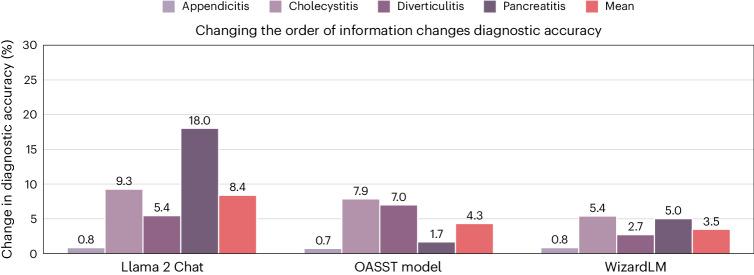
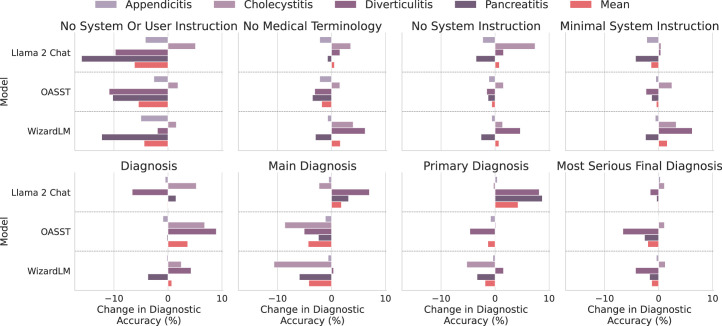
“Additionally, we see that even minor changes in instructions can greatly change diagnostic accuracy such as asking for the ‘main diagnosis’ (up to +7.0% for Chat on diverticulitis, down to −10.6% for WizardLM on cholecystitis) or ‘primary diagnosis’ (up +8.7% for Chat on pancreatitis, down to −5.2% for WizardLM on cholecystitis) instead of ‘final diagnosis’.”
§ Evaluation and mitigation of the limitations of large language models in clinical decision-making > Results > Current LLMs require extensive clinician supervision
plainstates a cause- Asserted: passes — The authors put it forward as true.
- Checkable: passes — It can be checked against evidence.
- Load-bearing: passes — The paper’s conclusions depend on it.
- Based: passes — The paper gives a reason why it holds.
A result the paper reports from its own data — it cites no other source for it, so there is none to check. The quote shows it is in the paper.
In the paper
“We show that current state-of-the-art LLMs do not accurately diagnose patients across all pathologies (performing significantly worse than physicians)”
§ Evaluation and mitigation of the limitations of large language models in clinical decision-making > Abstract
plainn = 2,400- Asserted: passes — The authors put it forward as true.
- Checkable: passes — It can be checked against evidence.
- Load-bearing: passes — The paper’s conclusions depend on it.
- Based: passes — The paper gives a reason why it holds.
59 more claims
Create a free account to see all 117 claims and to verify the 1 reference still open.
- It may state two separate claims as one. 40
- Probably not a substantial claim. 20
- The quote only partly states this claim. 1
Claims other papers make about this one
Each is checked against this paper’s own text: does it say what the citing paper says it does?
The source backs part of the claim, not all of it — or backs it for a different population, condition or comparison.
In the citing paper
“While medical licensing exams and diagnostic tasks are prioritized in 64% of LLM healthcare evaluations8, many administrative and operational tasks that represent significant human bottlenecks are often overlooked.”
From Holistic evaluation of large language models for medical tasks with MedHELM (2026) · cites this paper as [9]
Experimental — accuracy not yet measuredThe source backs part of the claim, not all of it — or backs it for a different population, condition or comparison.
In the citing paper
“While these models offer powerful foundational capabilities, adapting them to specific tasks and datasets without losing robustness is a significant hurdle, often resulting in significant variability in accuracy across different settings.7,9,10”
From Advancing methodological development of artificial intelligence in patient-centered comparative clinical effectiveness research: Patient-Centered Outcomes Research Institute’s unique contribution to research done differently (2025) · cites this paper as [9]
Experimental — accuracy not yet measuredThe cited source says what the claim attributes to it.
In the citing paper
“While LLM performance on medical QA benchmarks has been demonstrated to rival human-level performance, their capabilities in simulated real-world medical scenarios have been more limited12.”
From Limitations of large language models in clinical problem-solving arising from inflexible reasoning (2025) · cites this paper as [12]
The cited source says what the claim attributes to it.
In the citing paper
“Another study demonstrated that while LLMs show potential for clinical decision-making, they currently underperform compared to human clinicians in diagnosing common conditions such as appendicitis, cholecystitis, diverticulitis, and pancreatitis.”
From Enhancing diagnostic capability with multi-agents conversational large language models (2025) · cites this paper as [30]
Citations
Cites
Language Models are Few-Shot Learners
Brown, T. B., Mann, B., Ryder, N., Subbiah, M., Kaplan, J., Dhariwal, P., Neelakantan, A., Shyam, P., Sastry, G., Askell, A., et al. (2020) · arXiv · doi:10.48550/arxiv.2005.14165 · Cited by 23,372
Goldberger, A. L., Amaral, L. A. N., Glass, L., Hausdorff, J. M., Ivanov, P. C., Mark, R. G., Mietus, J. E., Moody, G. B., Peng, C.-K., & Stanley, H. E. (2000) · Circulation · doi:10.1161/01.cir.101.23.e215 · Cited by 14,809
Exploring the Limits of Transfer Learning with a Unified Text-to-Text Transformer
Raffel, C., Shazeer, N., Roberts, A., Lee, K., Narang, S., Matena, M., Zhou, Y., Li, W., & Liu, P. J. (2019) · arXiv · doi:10.48550/arxiv.1910.10683 · Cited by 10,929
Scaling Laws for Neural Language Models
Kaplan, J., McCandlish, S., Henighan, T., Brown, T. B., Chess, B., Child, R., Gray, S., Radford, A., Wu, J., & Amodei, D. (2020) · arXiv · doi:10.48550/arxiv.2001.08361 · Cited by 9,550
Chain-Of-Thought Prompting Elicits Reasoning in Large Language Models
Wei, J., Wang, X., Schuurmans, D., Bosma, M., Ichter, B., Xia, F., Chi, E., Le, Q. V., & Zhou, D. (2022) · Advances in Neural Information Processing Systems 35 · doi:10.52202/068431-1800 · Cited by 4,505
Chain-of-Thought Prompting Elicits Reasoning in Large Language Models
Wei, J., Wang, X., Schuurmans, D., Bosma, M., Ichter, B., Xia, F., Chi, E., Le, Q., & Zhou, D. (2022) · arXiv · doi:10.48550/arxiv.2201.11903 · Cited by 4,263 · cited 1×
“Given these constraints, we calculate and use the per-class accuracy throughout our work, which is the only metric that can be calculated without bias as it only requires the samples of a single class.”
Training language models to follow instructions with human feedback
Ouyang, L., Wu, J., Jiang, X., Almeida, D., Wainwright, C. L., Mishkin, P., Zhang, C., Agarwal, S., Slama, K., Ray, A., et al. (2022) · arXiv · doi:10.48550/arxiv.2203.02155 · Cited by 4,208
Kung, T. H., Cheatham, M., ChatGPT, Medenilla, A., Sillos, C., De Leon, L., Elepaño, C., Madriaga, M., Aggabao, R., Diaz-Candido, G., et al. (2022) · doi:10.1101/2022.12.19.22283643 · Cited by 4,115
Kung, T. H., Cheatham, M., Medenilla, A., Sillos, C., De Leon, L., Elepaño, C., Madriaga, M., Aggabao, R., Diaz-Candido, G., Maningo, J., et al. (2023) · PLOS Digital Health · doi:10.1371/journal.pdig.0000198 · Cited by 4,115
Large Language Models Encode Clinical Knowledge
Singhal, K., Azizi, S., Tu, T., Mahdavi, S. S., Wei, J., Chung, H. W., Scales, N., Tanwani, A., Cole-Lewis, H., Pfohl, S., et al. (2022) · arXiv · doi:10.48550/arxiv.2212.13138 · Cited by 4,083
Research works printed but not linked: 4
- Di Saverio, S. et al. Diagnosis and treatment of acute appendicitis: 2020 update of the WSES Jerusalem guidelines. World J. Emerg. Surg. 15, 27 (2020). · DOI · Paper page
- Zheng, C., Zhou, H., Meng, F., Zhou, J. & Huang, M. On large language models’ selection bias in multi-choice questions. In 12th International Conference on Learning Representations (ICLR, 2024).
- Golkar, Siavash, et al. xVal: a continuous number encoding for large language models. In NeurIPS 2023 AI for Science Workshop (2023).
- Radford, A. et al. Language models are unsupervised multitask learners. OpenAI blog 1, 9 (2019).
Cited by
Items 201–300 of 736
Awan, S. A., Khan, M. A., Khan, A. A., Sathio, A. A., Alsayaydeh, J. A. J., Bacarra, R., Herawan, S. G., & Aziz, R. (2025) · Journal Of Big Data · doi:10.1186/s40537-025-01330-3 · Cited by 10
Xie, F., Chung, P., Reiss, J. D., Tjoa, E., Francesco, D. D., Phongpreecha, T., Haberkorn, W. J., Chakraborty, D., Chang, A. L., James, T. K., et al. (2025) · The Lancet Digital Health · doi:10.1016/j.landig.2025.100926 · Cited by 8
Exploring large language models’ responses to moral reasoning dilemmas
Nabizadeh, D., Walker, D., Han, H., & Laird, E. (2025) · Ethics & Behavior · doi:10.1080/10508422.2025.2601022 · Cited by 8
“…considerations involving patient privacy, diagnostic accuracy, and resource allocation, where modern privacy-preserving techniques such as federated learning and differential privacy demonstrate that these concerns can be addressed without simple trade-offs (Armitage, 2025; Hager et al., 2024).”
The Use of Artificial Intelligence for Personalized Treatment in Psychiatry
Jalali, S., You, Q., Xu, V., Chen, L., Zini, J., Zamorano, T., Luo, Y., Friesen, T., Fontana, G. J., & Benrimoh, D. A. (2025) · Current Psychiatry Reports · doi:10.1007/s11920-025-01656-y · Cited by 9
“LLMs misclassified lab values, failed to request essential diagnostic tests, and performed poorly when generating workups autonomously [91 ].”
InfluentialMay, P., Nokodian, S., Nuernbergk, C., Knauer, M., Hefter, M., von Rose, A. B., Bassermann, F., & Jung, J. (2026) · JCO Clinical Cancer Informatics · doi:10.1200/cci-25-00194 · Cited by 7
“22,23 Alternative approaches such as RAG should be further explored for effective and reliable clinical integration of local LLMs.”
Self-citationDebsarkar, S. S., & Prasath, V. B. S. (2026) · Computerized Medical Imaging and Graphics · doi:10.1016/j.compmedimag.2026.102704 · Cited by 7
Imran, M., & Lee, Y. (2026) · IEEE Access · doi:10.1109/access.2026.3656368 · Cited by 15
“General-purpose LLMs face well-documented constraints in clinical settings [25], [26], [27], [28], [29]: knowledge cut-offs, hallucinations, and unimodal limitations.”
Large Language Models in Cardiovascular Prevention: A Narrative Review and Governance Framework
Santos, J. F., & Dores, H. (2026) · Diagnostics · doi:10.3390/diagnostics16030390 · Cited by 9
“Nevertheless, even when discrimination is improved, calibration, clinical utility, and safety remain critical concerns, particularly when models are applied across populations and healthcare settings different from those used for development [37,39,57,59].”
InfluentialErginoğlu, S. E., Ülgen, N. K., Yiğit, N., Nazlıgül, A. S., & Akkurt, M. O. (2026) · Diagnostics · doi:10.3390/diagnostics16030476 · Cited by 9
“Large language models like LLMs are newly acquiring the capability to process image data directly and currently demonstrate limited performance compared to traditional deep learning-based image analysis systems [27].”
Reese, J., Chimirri, L., Bridges, Y., Danis, D., Caufield, J. H., Gargano, M. A., Kroll, C., Schmeder, A. W., Liu, F., Wissink, K., et al. (2026) · European Journal of Human Genetics · doi:10.1038/s41431-026-02054-5 · Cited by 34
“We did not undertake fi ne-tuning or prompt-tuning in this analysis; these procedures may increase performance on speci fi c clinical decision-making tasks [32].”
BRIDGE: benchmarking large language models for understanding real-world clinical practice texts
Wu, J., Gu, B., Zhou, R., Xie, K., Snyder, D., Jiang, Y., Carducci, V., Wyss, R., Desai, R. J., Alsentzer, E., et al. (2026) · Nature Biomedical Engineering · doi:10.1038/s41551-026-01719-2 · Cited by 51
AI and the ethics of techno-solutionism in pain management
Buchman, D. Z. (2024) · Pain · doi:10.1097/j.pain.0000000000003389 · Cited by 5
Lee, J. J., Zepeda, A., Arbour, G., Isaac, K. V., Ng, R. T., & Nichol, A. (2024) · JCO Clinical Cancer Informatics · doi:10.1200/cci.24.00107 · Cited by 7
“41,49 50-53 However, notable challenges remain regarding feasibility, scalability, and implementation in real-world health care settings.”
Application of Generative Artificial Intelligence in Dyslipidemia Care
Ahn, J., & Kim, B.-K. (2025) · Journal of Lipid and Atherosclerosis · doi:10.12997/jla.2025.14.1.77 · Cited by 8
Toal, M. P., Hill, C. J., Quinn, M., O’Neill, C., & Maxwell, A. P. (2025) · Journal of Medical Internet Research · doi:10.2196/73603 · Cited by 10
Frantzidιs, C. A. (2025) · Brain Sciences · doi:10.3390/brainsci15070667 · Cited by 6
“Additionally, deployment in real-world rural and remote healthcare environments, accompanied by usability and feasibility studies, will be essential to validate the practical impact of the sleepCare framework [48,49].”
Kim, S. H., Schramm, S., Schmitzer, L., Serguen, K., Ziegelmayer, S., Busch, F., Komenda, A., Makowski, M. R., Adams, L. C., Bressem, K. K., et al. (2025) · European Radiology · doi:10.1007/s00330-025-11989-0 · Cited by 9
“Our study extends the fi ndings of previous studies revealing the potential of LLMs in the biomedical fi eld overall [18 – 20], and more speci fi cally in (semi-)automating imaging protocols [11 – 15].”
Self-citationMIRA: A Novel Framework for Fusing Modalities in Medical RAG
Wang, J., Ashraf, T., Han, Z., Laaksonen, J. T., & Anwer, R. M. (2025) · ACM International Conference on Multimedia (ACM MM) · doi:10.1145/3746027.3755760 · Cited by 15
The effect of medical explanations from large language models on diagnostic decisions in radiologyPreprint
Spitzer, P., Hendriks, D., Rudolph, J., Schlaeger, S., Ricke, J., Kühl, N., Hoppe, B. F., & Feuerriegel, S. (2025) · medRxiv · doi:10.1101/2025.03.04.25323357 · Cited by 10
Azmakan, H., & Hashemian, F. (2026) · Journal of the American Pharmacists Association · doi:10.1016/j.japh.2026.103019 · Cited by 4
Leveraging Datathons to Teach AI in Undergraduate Medical Education: Case Study
Yao, M. S., Huang, L., Leventhal, E. L., Sun, C., Stephen, S. J., & Liou, L. (2025) · JMIR Medical Education · doi:10.2196/63602 · Cited by 6
“While such technologies have the potential to improve health care delivery, recent work has highlighted a growing need to better evaluate how clinicians can use these tools responsibly before real-world integration is possible [21-23].”
Du, S., Liang, S., & Gu, Y. (2025) · Journal of Biomedical Informatics · doi:10.1016/j.jbi.2025.104811 · Cited by 6
Quo Vadis, AI-Empowered Doctor?
Takahashi, G., von Liechti, L., & Tarshizi, E. (2025) · JMIR Medical Education · doi:10.2196/70079 · Cited by 5
Bandeira, A., Gonçalves, L. H. D. N., Holl, F., Shaibu, J. U., Gonçalves, M. L., Payinda, R., Paudel, S., Berionni, A., WFPHA, Y., Purnat, T. D., et al. (2025) · JMIR Infodemiology · doi:10.2196/69474 · Cited by 15
“…and other current limitations, LLMs can potentially identify patterns in patient data that may indicate a risk of developing certain conditions (digital twins), enabling early diagnosis and interventions, and remind patients and health professionals about regular checkups and screenings [92].”
Park, J. S., Hwang, J., Kim, P. H., Shim, W. H., Seo, M. J., Kim, D. H., Shin, J. I., Kim, I. H., Heo, H., & Suh, C. H. (2025) · Korean Journal of Radiology · doi:10.3348/kjr.2025.0240 · Cited by 8
Wang, H., Shan, W., Liu, R. Z., & Wang, Z. (2025) · Digital Health · doi:10.1177/20552076251390280 · Cited by 11
“34 Collectively, these leaders frame AI as a double-edged sword: ef fi ciency gains must be balanced against potential disruption of traditional pedagogical models.”
Asif, S., Hadi, F., Ain, Q. U., Yan, Y., Wang, V. Y., & Xu, D. (2025) · Computer Science Review · doi:10.1016/j.cosrev.2025.100847 · Cited by 6
Reimagining cancer treatments in the era of generative AI
Derbal, Y. (2025) · DIGITAL HEALTH · doi:10.1177/20552076251394631 · Cited by 4
“71 On the other hand, other GenAI models were found to be acceptable by oncologists, albeit lacking the speci fi cation of treatment order and exhibiting limitations with respect to intricate cases.”
Li, X., Li, G., Zhao, Y., Liang, Y., Dong, Y., & Zhang, J. (2025) · Clinical Interventions in Aging · doi:10.2147/cia.s551572 · Cited by 6
PARROT, an open multilingual radiology reports dataset
Guellec, B. L., Adambounou, K. F. T., Adams, L. C., Agripnidis, T., Ahn, S. S., Chalal, R. A., D’Antonoli, T. A., Amouyel, P., Andersson, H., Bentegeac, R., et al. (2025) · European Journal of Radiology Artificial Intelligence · doi:10.1016/j.ejrai.2025.100066 · Cited by 12
Self-citationReis, F., Agha-Mir-Salim, L., Hickstein, R., Reis, M., Piper, S. K., Balzer, F., & Boie, S. D. (2026) · Journal of Medical Internet Research · doi:10.2196/84668 · Cited by 10
“LLMs are susceptible to hallucinations and sometimes fail to follow instructions or guidelines [8,9].”
Development and Evaluation of a Retrieval-Augmented Generation System for Radiology Guidelines
Komenda, A., Makowski, M., Can, E., Prucker, P., Busch, F., Wachter, A., Weller, D., Kim, S. H., Ziegelmayer, S., Bressem, K. K., et al. (2026) · Journal of Imaging Informatics in Medicine · doi:10.1007/s10278-025-01835-6 · Cited by 7
Self-citationZhou, S., Huang, M., Wei, J., Fang, H., Yang, W., Yu, H., & Xu, Y. (2026) · Scientific Reports · doi:10.1038/s41598-026-39444-0 · Cited by 5
“Nevertheless, LLM outputs remain probabilistic in nature, and variability in their assessments raises concerns about reproducibility and reliability in medical contexts 16,17 .”
Liang, C., Cui, Y., Shi, R., Zha, G., Yin, X., Xiao, M., Xu, D. M., Duan, X., & Huang, B. (2026) · International Journal of Applied Earth Observation and Geoinformation · doi:10.1016/j.jag.2026.105195 · Cited by 15
Hack, S., Craig, J. R., Lin, C.-F., Fu, C., Kwiatkowska, M. A., Kocum, P., Allevi, F., & Saibene, A. M. (2026) · European Archives of Oto-Rhino-Laryngology · doi:10.1007/s00405-026-10040-2 · Cited by 5
Yeh, Y., Yang, H.-Y., Chiu, C., Chao, A., Chuang, Y.-C., & Chan, W.-S. (2026) · Intensive Care Medicine Experimental · doi:10.1186/s40635-026-00900-w · Cited by 6
Aguirre, J., & Cha, W. C. (2025) · Applied Sciences · doi:10.3390/app15041796 · Cited by 8
Alon, Y., Naimi, E., Levin, C., Videl, H., & Saban, M. (2025) · Journal of Biomedical Informatics · doi:10.1016/j.jbi.2025.104829 · Cited by 9
Park, S., Wee, C. W., Choi, S. H., Kim, K. H., Chang, J. S., Yoon, H. I., Lee, I. J., Kim, Y. B., Cho, J., Keum, K. C., et al. (2025) · Radiotherapy and Oncology · doi:10.1016/j.radonc.2025.111052 · Cited by 7
The impact of prompting on ChatGPT’s adherence to status epilepticus treatment guidelines
Kliem, P. S. C., Fisch, U., Baumann, S. M., Berger, S., Amacher, S. A., Hunziker, S., & Sutter, R. (2025) · Scientific Reports · doi:10.1038/s41598-025-16902-9 · Cited by 5
“…a realistic clinical setting and demonstrated that current state-of-the-art LLMs do not accurately diagnose patients across various pathologies, fail to follow diagnostic and treatment guidelines, and cannot interpret laboratory results accurately, posing serious risks to patient health 20 .”
Li, N., Shi, Y., Zhao, Y., & Zhan, S. (2025) · Intelligent Medicine · doi:10.1016/j.imed.2025.07.002 · Cited by 6
Firoozeh, N., Mastrodicasa, D., Behr, S. C., Muglia, V. F., & Westphalen, A. C. (2025) · Radiology Imaging Cancer · doi:10.1148/rycan.250119 · Cited by 8
How AI will transform cancer care
Kather, J. N., & Abernethy, A. P. (2024) · Annals of Oncology · doi:10.1016/j.annonc.2024.08.2335 · Cited by 4
Luo, P., Fan, C., Li, A., Jiang, T., Jiang, A., Chang, Q., Gan, W., Zhu, L., Mou, W., Zeng, D., et al. (2025) · International Journal of Surgery · doi:10.1097/js9.0000000000002582 · Cited by 5
AI vs Human Performance in Conversational Hospital-Based Neurological DiagnosisPreprint
Sorka, M., Gorenshtein, A., Abramovitch, H., Soontrapa, P., Shelly, S., & Aran, D. (2025) · medRxiv · doi:10.1101/2025.08.13.25333529 · Cited by 4
“8 While these findings highlighted important limitations, the study used older AI models and relatively simple evaluation frameworks that may not reflect the full potential of current AI systems or the complexity of real clinical workflows.”
InfluentialEmpowering Breast Cancer Diagnostics: SHAP-Enhanced Explainable AI
Ansari, Z. A., Ahmed, R., Tripathi, M. M., Farooqui, N. A., Ansari, M. S. H., Siddiqui, S., & Fatima, S. (2025) · Artificial intelligence-enhanced software and systems engineering · doi:10.1007/978-3-031-99882-9_22 · Cited by 4
Tini, P., Novi, F., Donnini, F., Perrella, A., Bagnacci, G., Mazzei, M. A., & Minniti, G. C. (2025) · Journal of Neuro-Oncology · doi:10.1007/s11060-025-05254-z · Cited by 8
Zeng, H., Liu, G., Liu, W., Zou, S.-Y., Chen, B., Yang, R., Lin, F., Peng, J., Gao, Y., & Hao, L. (2025) · Public Health · doi:10.1016/j.puhe.2025.106042 · Cited by 5
Ophtimus-V2-Tx: a compact domain-specific LLM for ophthalmic diagnosis and treatment planning
Kwon, M., Jang, K. J., Baek, S. J., Han, Y. S., Choi, H., Lee, I., & Kim, J. H. (2025) · Scientific Reports · doi:10.1038/s41598-025-27410-1 · Cited by 2
“While LLMs have achieved strong performance in medical question answering and clinical reasoning tasks 47,48 , they still face limitations in effectively supporting the end-to-end, structured clinical decision-making process in real-world healthcare environments.”
Kartal, A., Manalil, N. F., Cheng, C. D., Chung, L. K., Gebhard, H., Greenberg, M. D., Härtl, R., & Elsayed, G. A. (2025) · Global Spine Journal · doi:10.1177/21925682251411225 · Cited by 6
More, V., Lu, L., Ding, Z., Ding, Z., Xi, Z., Mizia, S., & Guo, N. (2026) · npj Precision Oncology · doi:10.1038/s41698-025-01265-1 · Cited by 14
“However, systematic evaluations reveal limitations in clinical decision-making applications, including inaccurate diagnoses and failure to follow clinical guidelines 34 .”
Pan, J., Hager, P., Schlager, M., et al. (2026) · Nature Health · doi:10.1038/s44360-026-00053-w · Cited by 3
Self-citationA Survey on Medical Competence Evaluation Benchmarks for Large Language Models
Wang, Q., Zou, H., Zhang, H., Huang, Y., Junzhang, T., & Cheng, W. (2026) · Health care science · doi:10.1002/hcs2.70050 · Cited by 8
Jalali, P., Wang, F., Ourang, S. A., Zahedrozegar, S., Mohammad‐Rahimi, H., & Nosrat, A. (2026) · Journal of Endodontics · doi:10.1016/j.joen.2026.02.014 · Cited by 6
Xue, J., Wang, S., Yang, J., Guo, X., Shen, J., & Wang, Q. (2026) · JMIR Formative Research · doi:10.2196/90673 · Cited by 3
“To assess the usage of LLMs in an autonomous, real-world context, rigorous testing with authentic data and within practical, real-life conditions is essential [29].”
Freyer, O., Mathias, R., Muti, H. S., Orlovsky, H., Buch, S., Ostermann, M., Schönfelder, A., Poncette, A.-S., Bassily‐Marcus, A., & Gilbert, S. (2026) · npj Digital Medicine · doi:10.1038/s41746-026-02535-3 · Cited by 7
“…50,60 – 62 , high output variability (the generation of different types of output with the same input) 50 , non-determinism (the architectural feature leading to output variability) 63 , and performance degradation in real-world applications, partly caused by inappropriate benchmarking 64,65 .”
Li, Z., Liu, H., Tan, W., Tang, D., Duan, S., Zhou, B., Tang, L., Hu, X., Huang, L., Zhao, P., et al. (2026) · npj Digital Medicine · doi:10.1038/s41746-026-02645-y · Cited by 9
“Although the content they generate may appear convincing, it can be incorrect and may even deviate from established medical guidelines 10 – 12 .”
Lin, J., Dai, G., Peng, W., Huang, S., Lao, Y., Zhang, H., & Chen, T. (2026) · Pattern Recognition · doi:10.1016/j.patcog.2026.113679 · Cited by 3
A domain-adapted large language model to support clinicians in psychiatric clinical practice
Wang, R., Liu, S., Zhang, L., Zhu, X., Yang, Z., Wang, H., Huang, J., Wang, Y., Yang, X., Wu, F., et al. (2026) · Nature Machine Intelligence · doi:10.1038/s42256-026-01224-w · Cited by 9
Pan, H., Liu, J., & Liu, S. (2026) · Journal of Medical Internet Research · doi:10.2196/88058 · Cited by 5
“In contrast, generative AI systems produce context-sensitive natural language outputs that may appear coherent and persuasive while still being false, inaccurate, biased, or incomplete [28].”
Summarizing Clinical Notes using LLMs for ICU Bounceback and Length-of-Stay Prediction
Choudhuri, A., Polgreen, P. M., Segre, A. M., & Adhikari, B. (2024) · IEEE ... International Conference on Data Mining workshops · doi:10.1109/icdmw65004.2024.00118 · Cited by 13
Neural Reasoning for Sure Through Constructing Explainable Models
Dong, T., Jamnik, M., & Lió, P. (2025) · Proceedings of the AAAI Conference on Artificial Intelligence · doi:10.1609/aaai.v39i11.33262 · Cited by 7
Antiperovitch, P., Liu, I., Mokhtar, A. T., & Tang, A. (2025) · Canadian Journal of Cardiology · doi:10.1016/j.cjca.2025.04.008 · Cited by 9
Areas of research focus and trends in the research on the application of AIGC in healthcare
Wang, C., Zhu, Y., Zhang, X., Chen, X., Li, Y., Tan, Y., & Qi, H. (2025) · Journal of Health Population and Nutrition · doi:10.1186/s41043-025-00947-7 · Cited by 6
“…its utilization by analyzing electronic health records, medical literature, clinical guidelines, etc., assisting physicians in providing support and recommendations for the most likely differential diagnosis [42], and ultimately providing personalized treatment options for patients [5, 43].”
Challenges, Limitations, and Ethical Considerations of AI in Immunology and Healthcare
Rajchenberg, D., Hess, R., Lins, M. P., Manor, A., Degany, O., & Shoenfeld, Y. (2025) · Advances in computational intelligence and robotics book series · doi:10.4018/979-8-3693-9725-1.ch014 · Cited by 5
Genomic and Health Data as Fuel to Advance a Health Data Economy for Artificial Intelligence
Silva, P. J., Silva, P. A., & Ramos, K. S. (2025) · BioMed Research International · doi:10.1155/bmri/6565955 · Cited by 4
Zhang, X., Wang, T., Yan, C., Najdawi, F., Zhou, K., Ma, Y., Cheung, Y., & Malin, B. (2024) · medRxiv · doi:10.1101/2024.12.27.24319715 · Cited by 3
“As trustworthiness takes center stage in medical AI, the ability to systematically address foundational models’ limitations in clinical settings becomes critical [ 45, 46].”
Steinbuch, S., de Vos‐Hillebrand, L., O'Neill-Dee, C., Wu, I., Steinbuch, H., Kulcsár, Z., Ranjan, A., Verma, A., Landsberg, J., Dietrich, D., et al. (2026) · medRxiv · doi:10.64898/2026.01.23.26344723 · Cited by 4
Alcaraz, J. M. L., & Strodthoff, N. (2025) · Scientific Reports · doi:10.1038/s41598-025-26715-5 · Cited by 14
“…in machine learning have enabled ECG to model diverse physiological factors beyond cardiovascular health, the integration of ECG with machine learning towards modeling laboratory values presents new opportunities for learning complex interactions which can enhance clinical decision making 13 .”
Postoperative complication management: How do large language models measure up to human expertise?
Schwarzkopf, S.-C., Bereuter, J., Geissler, M. E., Weitz, J., Distler, M., & Kolbinger, F. R. (2025) · PLOS Digital Health · doi:10.1371/journal.pdig.0000933 · Cited by 3
“[2,3] However, evidence concerning their usability in surgery remains limited.”
Narita, Z. C., Ledsam, J. R., Niwa, M., Kawada, N., Galatzer‐Levy, I. R., & Kim, Y. (2025) · BMJ Digital Health & AI · doi:10.1136/bmjdhai-2025-000042 · Cited by 2
A recurrent-attention mechanism for medical image segmentation
Li, G., Liu, L., Du, Y., Liu, P., Li, X., Qi, T., Qiao, Z., Chen, D., & Song, Z. (2025) · Pattern Recognition · doi:10.1016/j.patcog.2025.112252 · Cited by 7
Kahan, R., Shen, C. P., Wellborn, P. K., Lauder, A. S., Berchuck, S. I., Javeed, H., Pean, C. A., & Federer, A. E. (2025) · Journal of the American Academy of Orthopaedic Surgeons · doi:10.5435/jaaos-d-25-00456 · Cited by 3
ChatGPT’s role in the rapidly evolving hematologic cancer landscape
Nong, T., Britton, S., Bhanderi, V. K., & Taylor, J. (2025) · Future Science OA · doi:10.1080/20565623.2025.2546259 · Cited by 6
“…found that it was unable to provide accurate treatment recommendations [17], and another found that they often do not follow diagnostic guidelines [18]. similar studies have shown mostly accurate responses by chatGPt when evaluated by oncologists, to more generalized questions regarding cancer…”
Murat, A., Chinnam, R. B., Rana, S., et al. (2025) · SAE technical papers on CD-ROM/SAE technical paper series · doi:10.4271/2025-01-0455 · Cited by 2
Hou, R., Chen, S., Fan, Y., Yu, G., Zhu, L., Sun, J., Liu, J., & Ruan, T. (2025) · Knowledge-Based Systems · doi:10.1016/j.knosys.2025.114524 · Cited by 20
Bielick, C. G., Awwad, A., Ellen, J., Jalilian, L., McCoy, L. G., Mishra, V., Osmanlliu, E., Pfohl, S. R., & Celi, L. A. (2026) · PLOS Digital Health · doi:10.1371/journal.pdig.0001115 · Cited by 8
“One comprehensive evaluation using 2,400 real patient cases found that general-purpose LLMs were unable to reliably order diagnostic tests appropriately, follow instructions for a prolonged period of time, or produce consistent outputs across different prompt formulations [18].”
ChatGPT answers patient questions about hallux rigidus: Is it satisfactory?
Kalem, M., Balaban, K., Savran, M. D., Kocaoğlu, H., & Şahin, E. (2025) · Foot and Ankle Surgery · doi:10.1016/j.fas.2025.10.006 · Cited by 4
Candito, A., Mun, T. S. H., Holbrey, R., Doran, S., Messiou, C., Koh, D., & Blackledge, M. (2025) · Journal of Imaging Informatics in Medicine · doi:10.1007/s10278-025-01712-2 · Cited by 3
Jarchow, H., Bobrowski, C., Falk, S. S. I., Hermann, A., Kulaga, A. Y., Põder, J.-C., Unfried, M., Usanov, N., Zendeh, B., Kennedy, B. K., et al. (2025) · npj Digital Medicine · doi:10.1038/s41746-025-01996-2 · Cited by 10
“Many studies have already demonstrated that LLM responses can be highly dependent on prompt design and on the ordering of information within a prompt 31,32 , posing a risk in healthcare in particular.”
Mwaniki, P., Musau, W., Isaaka, L., Wanyama, C. W., Menon, V., Denniston, A. K., Liu, X., Emmanuel-Fabula, M., Williams, G., Mateen, B. A., et al. (2026) · BMJ Digital Health & AI · doi:10.1136/bmjdh-2026-000081 · Cited by 3
“In reality, patient-provider exchanges are complex, often involving a mix of languages, dialects and code-switching that vary across geographies and patient populations.”
Large language models in clinical psychiatry: Applications and optimization strategies
Wang, Y., Li, M.-D., Wang, S.-H., Fang, Y., Sun, J., Lü, L., & Yan, W. (2025) · World Journal of Psychiatry · doi:10.5498/wjp.v15.i11.108199 · Cited by 8
Ghorbian, M., & Ghobaei‐Arani, M. (2025) · Journal Of Big Data · doi:10.1186/s40537-025-01304-5 · Cited by 7
Déniz, C., Marcé, J., Macía, I., Rivas, F., Muñoz, A., Paradela, M., García, S., Moreno, C., Serratosa, I., García, M., et al. (2025) · Frontiers in Digital Health · doi:10.3389/fdgth.2025.1633278 · Cited by 7
“…found that LLMs tend to make hasty decisions without consistently following diagnostic guidelines, often omitting essential physical examinations and misinterpreting basic laboratory results—fundamental errors that pose serious risks to patient safety without extensive clinician supervision (18).”
Toppeta, A., Corradi, M., Mantia, B., Randazzo, A., Schettino, M., Lisi, S. D., Dell’Era, A., Carmagnola, S., & Salerno, R. (2025) · The American Journal of Gastroenterology · doi:10.14309/ajg.0000000000003837 · Cited by 2
Assessment of ChatGPT in Recommending Immunohistochemistry Panels for Salivary Gland Tumors
Cuevas‐Nunez, M., Galletti, C., Fiorillo, L., Meto, A., Díaz-Castañeda, W. R., Shahrabi‐Farahani, S., Fadda, G., Zuccalà, V., Gil-Manich, V., Bara-Casaus, J., et al. (2025) · BioMedInformatics · doi:10.3390/biomedinformatics5040066 · Cited by 3
“Rule-based systems, while inflexible, ensure standardized and vetted outputs that minimize risk in high-stakes clinical settings [31,32].”
PatientSafeBench: Evaluating the Safety of Medical LLMs for Patient Use
Kim, M., Park, H., Kim, W., Choi, S. H., Kim, H. E., Sohn, H., Park, J., Kim, S., Yu, S.-C., & Oh, Y. (2025) · IEEE-EMBS International Conference on Biomedical and Health Informatics (BHI ...) · doi:10.1109/bhi67747.2025.11269553 · Cited by 7
“Current evaluations emphasize technical metrics like factual accuracy and guideline adherence [8]–[10], overlooking socio-technical factors critical to patient engagement.”
Mobile health applications on frailty: A scoping review
Li, Q. S., Lin, J., Hilmer, S. N., & Thillainadesan, J. (2025) · Ageing Research Reviews · doi:10.1016/j.arr.2025.103002 · Cited by 3
Sahoo, H. S., Kumar, A. R. P., Durvasulu, A., & Ravichandran, A. (2025) · Journal of Dentistry · doi:10.1016/j.jdent.2025.106309 · Cited by 6
Li, X., Hu, X., Xu, H., Zhi'ang, S., Yu, P., & Ju, H. (2026) · PLoS ONE · doi:10.1371/journal.pone.0338328 · Cited by 3
“Prior research has shown that systematic LLM errors can reinforce misconceptions among learners and introduce biased or unsafe content into educational materials [26].”
Zhang, R., He, H., Bi, Z., et al. (2026) · Respiratory Research · doi:10.1186/s12931-025-03489-y · Cited by 2
“Unlike traditional machine learning approaches that require extensive computational resources and specialized expertise, ChatGPT provides a potentially cost-effective solution for automated medical image analysis [16].”
InfluentialLi, W., Zhang, Y., Wang, C. R., Li, Y., He, X., Wang, A. L., Xu, M., Zhang, F., Sun, H., Wang, K., et al. (2026) · Expert Systems with Applications · doi:10.1016/j.eswa.2026.131476 · Cited by 4
Agentic memory-augmented retrieval and evidence grounding for medical question-answering tasks
Jia, S., Bit, S., Jasodanand, V. H., Liu, Y., & Kolachalama, V. B. (2026) · International Journal of Medical Informatics · doi:10.1016/j.ijmedinf.2026.106339 · Cited by 14
Demirpolat, E., Tuncel, M. S., Gurer, F., & Şanlı, N. M. (2026) · Journal of Oncology Pharmacy Practice · doi:10.1177/10781552261418957 · Cited by 4
The value of doubt: training LLMs to consider diagnostic uncertainty may improve clinical utility
Sui, M., Rosen, K. L., Heydari, K., Enichen, E. J., & Kvedar, J. C. (2026) · npj Digital Medicine · doi:10.1038/s41746-025-02307-5 · Cited by 3
Eşki, S., & Taşkan, H. (2026) · Health Policy and Technology · doi:10.1016/j.hlpt.2026.101183 · Cited by 3
CDAFlow: Enhancing LLM clinical decision-making through agentic workflow
Hou, R., Xue, D., Sun, H., He, P., Zhang, W., & Ruan, T. (2026) · Expert Systems with Applications · doi:10.1016/j.eswa.2026.131806 · Cited by 4
Khoruzhaya, A. N., Varyukhina, M. D., Erizhokov, R. A., Blokhin, I. A., Reshetnikov, R. V., Kodenko, M. R., Pamova, A. P., Burtsev, T., Arzamasov, K. M., Omelyanskaya, O. V., et al. (2026) · Frontiers in Digital Health · doi:10.3389/fdgth.2026.1761601 · Cited by 4
Kopka, M., & Feufel, M. A. (2026) · JMIR Biomedical Engineering · doi:10.2196/88053 · Cited by 2
“However, when existing models are evaluated on real-world datasets, which more accurately reflect the complexity and ambiguity in real decision-making, their performance seems to be considerably worse [2,35,46].”
Sortino, M., Trovato, B., Chiaramonte, R., Carrera, A., Sapienza, M., Roggio, F., & Musumeci, G. (2026) · Journal of Functional Morphology and Kinesiology · doi:10.3390/jfmk11010113 · Cited by 4
“This reinforces the importance of expert oversight when AI is integrated into clinical exercise prescription workflows [31].”
Metadata
- Authors
- Hager, P., Jungmann, F., Holland, R., Bhagat, K., Hubrecht, I., Knauer, M., Vielhauer, J., Makowski, M., Braren, R., Kaissis, G., & Rueckert, D.
- Affiliations
- TUM Klinikum (DE)
- Imperial College London (GB)
- Christiana Care Health System (US)
- Ludwig-Maximilians-Universität München (DE)
- Corresponding author
- Hager, Paul
- ORCID
- Venue
- Nature Medicine
- Published
- 2024-07-04
- Volume
- 30
- Issue
- 9
- Pages
- 2613-2622
- ISSN
- 1078-8956 (ISSN-L)
- 1546-170X
- PMC
- PMC11405275
- OpenAlex
- W4400324908
- Cited by
- 798
- References
- 74
- Citations by year
- 2026: 435 · 2025: 317 · 2024: 46
- FWCI
- 74.24
- Type
- journal article
- Language
- en
- Open access
- hybrid
- doi.org
- Licence
- cc-by
- creativecommons.org/licenses/by/4.0 (tdm)
- creativecommons.org/licenses/by/4.0 (vor)
- Locations
- Nature Medicine (publishedVersion, cc-by)
- medRxiv (acceptedVersion, cc-by-nc)
- PubMed Central (publishedVersion, cc-by)
- PubMed (publishedVersion)
- PuSH - Publication Server of Helmholtz Zentrum München (submittedVersion, cc-by)
- mediaTUM – the media and publications repository of the Technical University Munich (Technical University Munich) (submittedVersion)
- Funders
- Technische Universität München
- H2020 European Research Council (884622)
- Topics
- Health Sciences › Medicine › Health Informatics › Artificial Intelligence in Healthcare and Education
- Physical Sciences › Computer Science › Artificial Intelligence › Machine Learning in Healthcare
- Health Sciences › Health Professions › Health Information Management › Artificial Intelligence in Healthcare
- Keywords
- large language models, clinical decision-making, artificial intelligence in healthcare, MIMIC-III, abdominal pathology, diagnostic accuracy, clinical guidelines adherence, laboratory test interpretation, clinical workflow integration, medical licensing examinations, LLM limitations
- MeSH terms
- Clinical Decision-Making, Artificial Intelligence, Humans, Decision Support Systems, Clinical
About these checks
Registry, retraction, Cites and statistics results are computed, not judged, with one exception: a printed reference that no index lists is read once by a model before it counts as a citation error. Claims are extracted by a model and kept only when their quote appears verbatim in the text; each cited source is then checked, with a model’s help, for whether it says what the claim relies on. Those verdicts can be wrong — read the claim’s quote and the cited source before relying on one.
The claim verdicts this report counts are experimental: their accuracy is not yet measured.
A language model drew the claims from the paper on 2026-10-10, under version 3 of the claim definition (model deepseek-v4.1-flash, prompt extract-v3).
A second model labelled each claim on 2026-10-10 (model jev-1.13-20260917, definition revision gold-guideline-v0.2).
Cited sources are checked with a language model’s help (gpt-6-sol).
Statistics and arithmetic are recomputed, not judged.
Confidence bands are shown only for fields calibrated on our annotated test set. None is calibrated yet, so no band is shown.
What counts as a claim ›How we measure confidence ›How we check this ›
Are you an author, or do you see a problem with this page? Request a review
Data sources
Bibliographic data: Semantic Scholar, OpenAlex, Crossref.
Contains information from the Semantic Scholar Academic Graph Datasets, made available under the ODC Attribution License (ODC-BY 1.0).
Semantic Scholar’s data is described in: Kinney, R., et al. (2023). The Semantic Scholar Open Data Platform. arXiv:2301.10140.
