

Evaluation and mitigation of the limitations of large language models in clinical decision-making
Open accessPublished version of a preprint
The DOI matches its Crossref record; 92 of the 92 references it cites were found in a registry or an index; 20 of the 24 sources its claims cite were checked for support.
Abstract
Clinical decision-making is one of the most impactful parts of a physician's responsibilities and stands to benefit greatly from artificial intelligence solutions and large language models (LLMs) in particular. However, while LLMs have achieved excellent performance on medical licensing exams, these tests fail to assess many skills necessary for deployment in a realistic clinical decision-making environment, including gathering information, adhering to guidelines, and integrating into clinical workflows. Here we have created a curated dataset based on the Medical Information Mart for Intensive Care database spanning 2,400 real patient cases and four common abdominal pathologies as well as a framework to simulate a realistic clinical setting. We show that current state-of-the-art LLMs do not accurately diagnose patients across all pathologies (performing significantly worse than physicians), follow neither diagnostic nor treatment guidelines, and cannot interpret laboratory results, thus posing a serious risk to the health of patients. Furthermore, we move beyond diagnostic accuracy and demonstrate that they cannot be easily integrated into existing workflows because they often fail to follow instructions and are sensitive to both the quantity and order of information. Overall, our analysis reveals that LLMs are currently not ready for autonomous clinical decision-making while providing a dataset and framework to guide future studies.
Overview
CoChat Summary
TL;DR
This study evaluates open-access LLMs on a realistic clinical decision-making task using 2,400 real emergency department cases of acute abdominal pain from MIMIC-IV. The models performed significantly worse than physicians, failed to follow diagnostic/treatment guidelines, and were too fragile and instruction-sensitive for autonomous clinical use.
Key findings
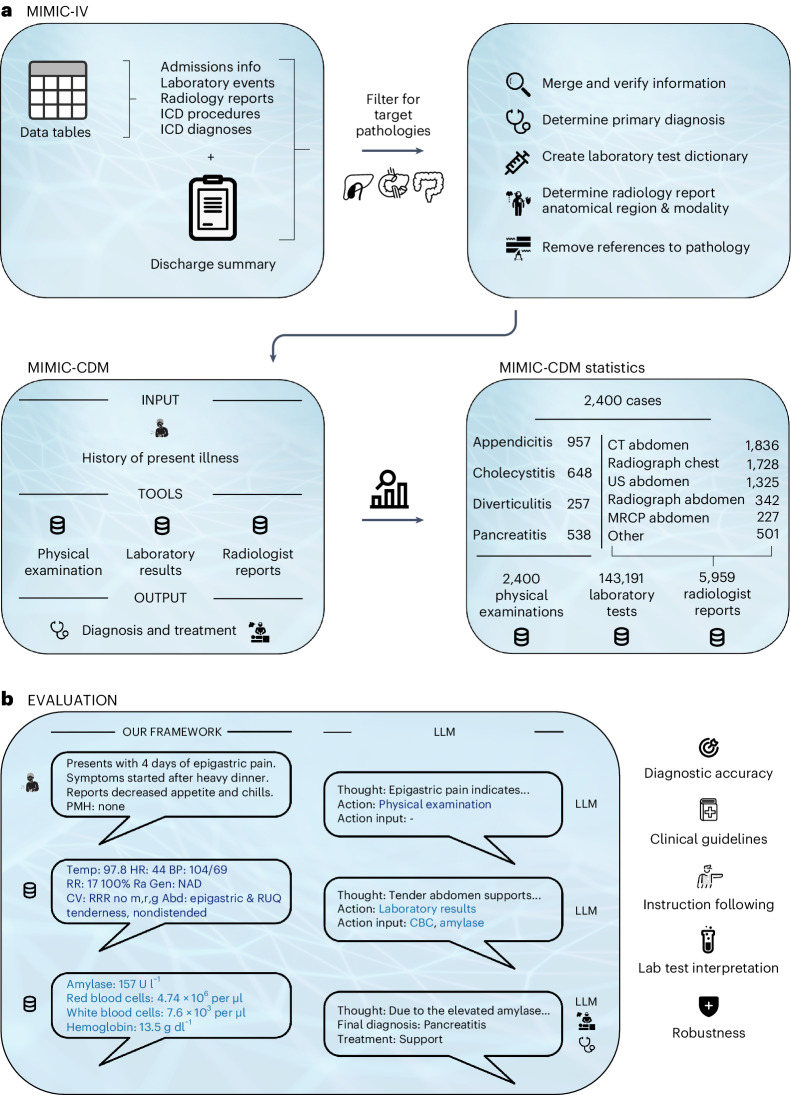
- The curated dataset, MIMIC-CDM, contains 2,400 unique patients with appendicitis (957), cholecystitis (648), diverticulitis (257), and pancreatitis (538).
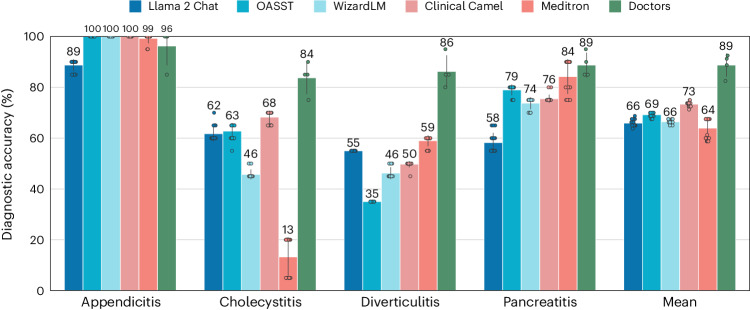
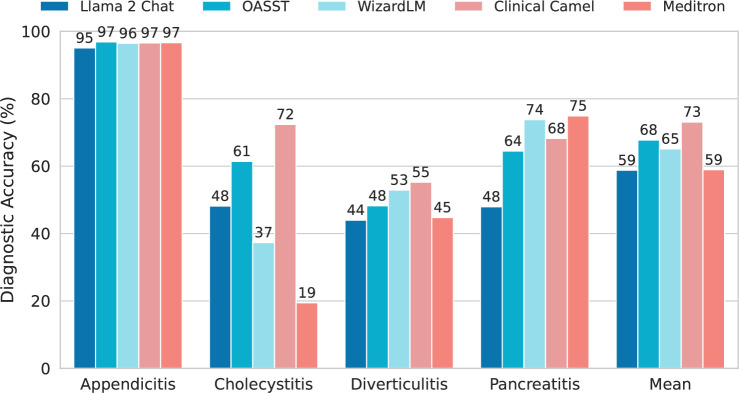
- On a reader study with 80 patients and 4 hospitalists, current LLMs performed significantly worse than clinicians on aggregate across all diseases (P < 0.001 for doctors versus Llama 2 Chat, OASST, WizardLM, Clinical Camel, and Meditron).
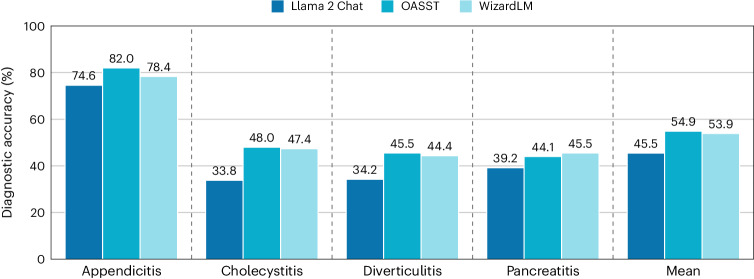
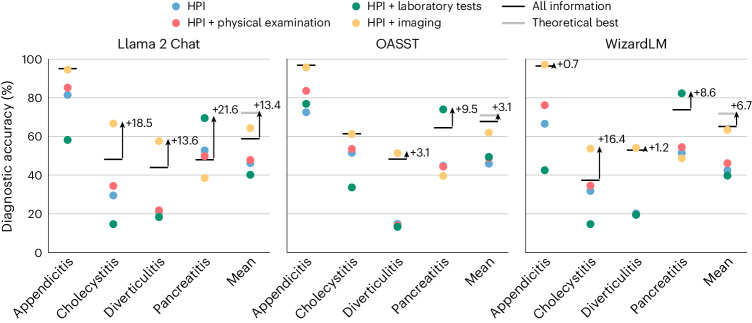
- Diagnostic performance dropped further when models had to gather information themselves: mean diagnostic accuracy fell to 45.5% for Llama 2 Chat, 54.9% for OASST, and 53.9% for WizardLM, versus 58.8%, 67.8%, and 65.1% on the full-information setup, respectively.
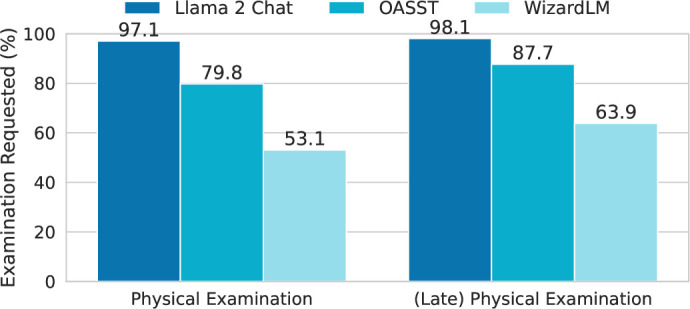
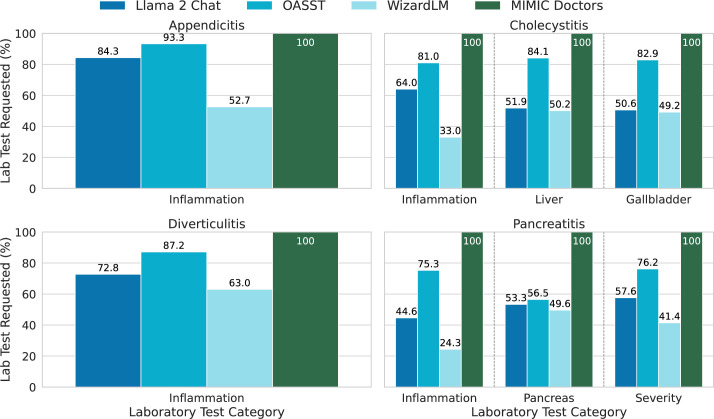
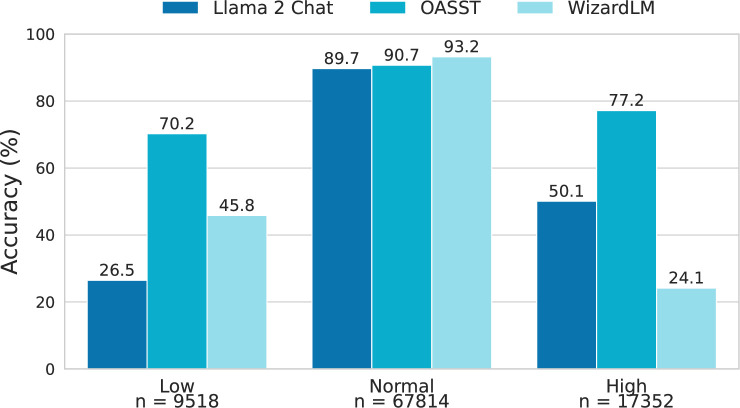
- Models also failed basic safety checks: only Llama 2 Chat consistently requested physical examination information (97.1% as first action; 98.1% at all), and laboratory interpretation was poor even with reference ranges (for example, low results: 26.5% Chat, 70.2% OASST, 45.8% WizardLM; high results: 50.1%, 77.2%, 24.1%).
Methods
- The authors built MIMIC-CDM from the MIMIC-IV EHR database by filtering to emergency department cases with acute abdominal pain and a primary diagnosis of one of four target pathologies, then extracting history of present illness, physical exams, labs, microbiology, imaging, and procedures.
- They evaluated open-access models derived from Llama 2, focusing mainly on Llama 2 Chat, OASST, and WizardLM, and compared them with clinicians on a 100-patient reader study (80 target cases plus 5 each of other conditions), with each LLM evaluated 20 times on the physician comparison subset using different seeds.
- Main analysis included per-class accuracy, guideline adherence for diagnostic tests and treatments, lab interpretation tasks, instruction-following, robustness to changes in wording, order, and amount of information, and comparisons using two-sided Student’s t-tests with Bonferroni correction.
Limitations
- The paper states that the dataset and models have a clear bias toward the USA, so generalizability to other languages or countries with different guidelines is unknown.
- The authors note that, because they used real-world clinical data, they had to deny requests for information not in the dataset; they argue this was mitigated because MIMIC-IV contains all data gathered during the hospital stay.
- Evident from the text: the study focuses only on four abdominal pathologies, so it does not cover the full breadth of clinical decision-making (the paper itself notes this as a constraint).
Model-written summary. Check it against the paper before relying on it.
Integrity signals
Registry
Cites
Statistics
Figures
Verification
Claims the paper makes
6 Valid · 2 Not valid · 3 Not checked · 106 Own results and interpretations
Some cited sources support this claim and some don’t — read each source’s verdict below.
In the paper
“where LLMs score well above passing8–10,17–20”
§ Evaluation and mitigation of the limitations of large language models in clinical decision-making > Main
What the sources say
- Supportedcites [8] Singhal, K. et al. Towards expert-level medical question answering with large language models. Preprint at https://arxiv.org/abs/2305.09617 (2023). source
The Abstract (page not supplied) reports that Med-PaLM 2 scored 86.5% on MedQA, a dataset of USMLE-style questions, and that its predecessor had exceeded a passing score at 67.2%. This supports the claim about LLM performance on medical-licensing-exam-style questions. (LLM, conf=0.93)
- Partly supportedcites [9] Singhal, K. et al. Large language models encode clinical knowledge. Nature 620, 172–180 (2023). sourceExperimental — accuracy not yet measured
The ‘State of the art on MedQA’ section reports that Flan-PaLM scored 67.6% on USMLE-style questions, supporting strong performance on a medical-exam benchmark. Our copy does not establish a passing threshold or show that LLMs scored well above it on actual licensing exams. (LLM, conf=0.86)
- Supportedcites [10] Nori, H., King, N., McKinney, S. M., Carignan, D. & Horvitz, E. Capabilities of GPT-4 on medical challenge problems. Preprint at https://arxiv.org/abs/2303.13375 (2023). source
The Abstract (p. 1) reports that GPT-4 exceeded the USMLE passing score by over 20 points. The Introduction (p. 2) specifies that the results came from official sample exams and self-assessment materials, supporting this citation as an example of an LLM scoring well above passing on medical licensing exam materials. (LLM, conf=0.93)
- Disputedcites [17] Kung, T. H. et al. Performance of chatgpt on usmle: potential for ai-assisted medical education using large language models. PLoS Digital Health 2, 0000198 (2023). sourceExperimental — accuracy not yet measured
The Discussion (‘The rising accuracy of ChatGPT’) says ChatGPT exceeded 60% accuracy in some analyses, while the USMLE passing threshold is approximately 60%; it concludes that ChatGPT ‘approaches the passing range.’ The paper describes performance as at or near passing, not well above it. (LLM, conf=0.88)
Checked by a reasoning model — may be wrong.
- Disputedcites [18] Gilson, A. et al. How does chatgpt perform on the United States medical licensing examination? The implications of large language models for medical education and knowledge assessment. JMIR Med. Educ. 9, 45312 (2023). sourceExperimental — accuracy not yet measured
The Results (Overall Performance; page unavailable) report that ChatGPT exceeded the paper’s approximately 60% passing benchmark on only one of four question sets, scoring 64.4%. It scored below that benchmark on the other three; InstructGPT and GPT-3 scored below it on all four. The paper therefore does not show LLMs scoring well above passing. (LLM, conf=0.90)
Checked by a reasoning model — may be wrong.
- Partly supportedcites [19] Toma, A. et al. Clinical camel: an open-source expert-level medical language model with dialogue-based knowledge encoding. Preprint at https://arxiv.org/abs/2305.12031 (2023). sourceExperimental — accuracy not yet measured
Table 4 reports strong five-shot scores on the USMLE Sample Exam, including 86.6% for GPT-4 and 64.3% for Clinical Camel-70B. But the paper gives no passing threshold, and other models score substantially lower, so it does not establish that LLMs generally score well above passing. (LLM, conf=0.82)
- Supportedcites [20] Nori, H. et al. Can generalist foundation models outcompete special-purpose tuning? Case study in medicine. Preprint at https://arxiv.org/abs/2311.16452 (2023). source
Section 2.1 reports that GPT-4 exceeded the USMLE passing score by over 20 points. The Abstract also reports that GPT-4 with Medprompt surpassed 90% on MedQA, a USMLE-style exam-question dataset. These passages support the cited claim that LLMs can score well above passing on medical licensing exam questions. (LLM, conf=0.91)
boosted- Asserted: passes — The authors put it forward as true.
- Checkable: passes — It can be checked against evidence.
- Load-bearing: unclear — It is unclear whether the paper’s conclusions depend on it.
- Based: passes — The paper gives a reason why it holds.
- Supported
The cited sources support only part of this claim — read each source’s verdict below.
In the paper
“We note that Llama 2, Clinical Camel and Meditron have been shown to match and even exceed Chat-GPT performance on medical licensing exams and biomedical question answering tests19,35.”
§ Evaluation and mitigation of the limitations of large language models in clinical decision-making > Results > Creating the MIMIC-CDM dataset and evaluation framework
What the sources say
- Partly supportedcites [19] Toma, A. et al. Clinical camel: an open-source expert-level medical language model with dialogue-based knowledge encoding. Preprint at https://arxiv.org/abs/2305.12031 (2023). sourceExperimental — accuracy not yet measured
Section 4 (Evaluation) and Table 4 report that Clinical Camel-70B exceeded GPT-3.5 on five-shot medical benchmarks, including MedQA, PubMedQA and the USMLE sample exam. The paper does not show that LLaMA 2 or Meditron achieved those results; Clinical Camel was fine-tuned from LLaMA 2. It also says Clinical Camel generally fell short of GPT-4, except on PubMedQA. Page numbers were not available in our copy. (LLM, conf=0.88)
- Partly supportedcites [35] Chen, Z. et al. MEDITRON-70B: scaling medical pretraining for large language models. Preprint at https://arxiv.org/abs/2311.16079 (2023). sourceExperimental — accuracy not yet measured
Section 6.2 reports that MEDITRON-70B outperformed GPT-3.5 on the medical benchmarks, including MedQA and PubMedQA. It evaluates Llama-2 and Clinical-Camel as baselines but does not establish that either matched or exceeded GPT-3.5 on those tests. The benchmark comparison also uses text-davinci-003 as GPT-3.5, not ChatGPT itself. (LLM, conf=0.87)
boosted- Asserted: passes — The authors put it forward as true.
- Checkable: passes — It can be checked against evidence.
- Load-bearing: unclear — It is unclear whether the paper’s conclusions depend on it.
- Based: passes — The paper gives a reason why it holds.
- Partly supported
The cited sources support only part of this claim — read each source’s verdict below.
In the paper
“All guidelines recommended physical examinations as an essential part of the diagnostic process, preferably as the first action.”
§ Evaluation and mitigation of the limitations of large language models in clinical decision-making > Results > Current LLMs are hasty and unsafe clinical decision-makers
What the sources say
- Partly supportedcites [36] Di Saverio, S. et al. Diagnosis and treatment of acute appendicitis: 2020 update of the WSES Jerusalem guidelines. World J. Emerg. Surg. 15, 27 (2020). sourceExperimental — accuracy not yet measured
In Results, Topic 1: Diagnosis, the WSES guideline includes physical examination and clinical signs in its diagnostic approach, and Recommendation 1.10 makes imaging conditional on clinical assessment. This supports an early role for examination, but this single guideline does not establish what all guidelines recommend or explicitly say physical examination should be the first action. (LLM, conf=0.85)
- Partly supportedcites [37] Pisano, M. et al. 2020 World Society of Emergency Surgery updated guidelines for the diagnosis and treatment of acute calculus cholecystitis. World J. Emerg. Surg. 15, 61 (2020). sourceExperimental — accuracy not yet measured
Section 1, Diagnosis of ACC (page not provided), suggests including a complete clinical examination alongside history, laboratory tests and imaging. It does not say examination should be the first action, and this single guideline does not establish what all guidelines recommend. (LLM, conf=0.87)
- Partly supportedcites [38] Hall, J. et al. The american society of colon and rectal surgeons clinical practice guidelines for the treatment of left-sided colonic diverticulitis. Dis. Colon Rectum 63, 728–747 (2020). sourceExperimental — accuracy not yet measured
In “Initial Evaluation of Acute Diverticulitis” (recommendation 1; page not supplied), this guideline recommends a physical examination as part of the initial evaluation. It does not establish what all guidelines recommend or say that the examination should preferably be the first action. (LLM, conf=0.84)
plain- Asserted: passes — The authors put it forward as true.
- Checkable: passes — It can be checked against evidence.
- Load-bearing: passes — The paper’s conclusions depend on it.
- Based: passes — The paper gives a reason why it holds.
- Partly supported
A result the paper reports from its own data — it cites no other source for it, so there is none to check. The quote shows it is in the paper.
In the paper
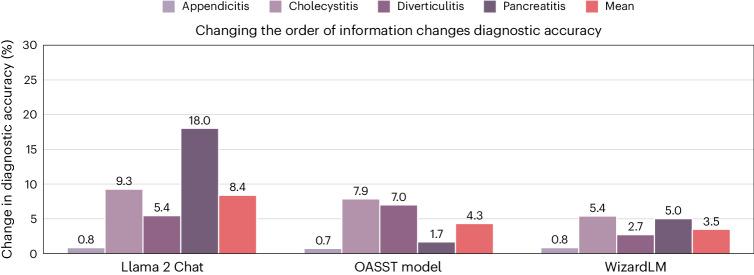
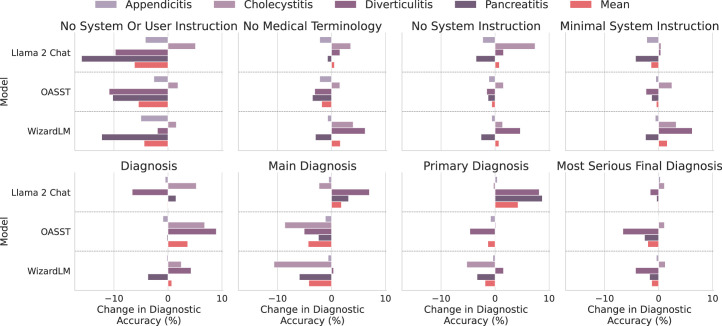
“Additionally, we see that even minor changes in instructions can greatly change diagnostic accuracy such as asking for the ‘main diagnosis’ (up to +7.0% for Chat on diverticulitis, down to −10.6% for WizardLM on cholecystitis) or ‘primary diagnosis’ (up +8.7% for Chat on pancreatitis, down to −5.2% for WizardLM on cholecystitis) instead of ‘final diagnosis’.”
§ Evaluation and mitigation of the limitations of large language models in clinical decision-making > Results > Current LLMs require extensive clinician supervision
plainstates a cause- Asserted: passes — The authors put it forward as true.
- Checkable: passes — It can be checked against evidence.
- Load-bearing: passes — The paper’s conclusions depend on it.
- Based: passes — The paper gives a reason why it holds.
A result the paper reports from its own data — it cites no other source for it, so there is none to check. The quote shows it is in the paper.
In the paper
“We show that current state-of-the-art LLMs do not accurately diagnose patients across all pathologies (performing significantly worse than physicians)”
§ Evaluation and mitigation of the limitations of large language models in clinical decision-making > Abstract
plainn = 2,400- Asserted: passes — The authors put it forward as true.
- Checkable: passes — It can be checked against evidence.
- Load-bearing: passes — The paper’s conclusions depend on it.
- Based: passes — The paper gives a reason why it holds.
59 more claims
Create a free account to see all 117 claims and to verify the 1 reference still open.
- It may state two separate claims as one. 40
- Probably not a substantial claim. 20
- The quote only partly states this claim. 1
Claims other papers make about this one
Each is checked against this paper’s own text: does it say what the citing paper says it does?
The source backs part of the claim, not all of it — or backs it for a different population, condition or comparison.
In the citing paper
“While medical licensing exams and diagnostic tasks are prioritized in 64% of LLM healthcare evaluations8, many administrative and operational tasks that represent significant human bottlenecks are often overlooked.”
From Holistic evaluation of large language models for medical tasks with MedHELM (2026) · cites this paper as [9]
Experimental — accuracy not yet measuredThe source backs part of the claim, not all of it — or backs it for a different population, condition or comparison.
In the citing paper
“While these models offer powerful foundational capabilities, adapting them to specific tasks and datasets without losing robustness is a significant hurdle, often resulting in significant variability in accuracy across different settings.7,9,10”
From Advancing methodological development of artificial intelligence in patient-centered comparative clinical effectiveness research: Patient-Centered Outcomes Research Institute’s unique contribution to research done differently (2025) · cites this paper as [9]
Experimental — accuracy not yet measuredThe cited source says what the claim attributes to it.
In the citing paper
“While LLM performance on medical QA benchmarks has been demonstrated to rival human-level performance, their capabilities in simulated real-world medical scenarios have been more limited12.”
From Limitations of large language models in clinical problem-solving arising from inflexible reasoning (2025) · cites this paper as [12]
The cited source says what the claim attributes to it.
In the citing paper
“Another study demonstrated that while LLMs show potential for clinical decision-making, they currently underperform compared to human clinicians in diagnosing common conditions such as appendicitis, cholecystitis, diverticulitis, and pancreatitis.”
From Enhancing diagnostic capability with multi-agents conversational large language models (2025) · cites this paper as [30]
Citations
Cites
Language Models are Few-Shot Learners
Brown, T. B., Mann, B., Ryder, N., Subbiah, M., Kaplan, J., Dhariwal, P., Neelakantan, A., Shyam, P., Sastry, G., Askell, A., et al. (2020) · arXiv · doi:10.48550/arxiv.2005.14165 · Cited by 23,372
Goldberger, A. L., Amaral, L. A. N., Glass, L., Hausdorff, J. M., Ivanov, P. C., Mark, R. G., Mietus, J. E., Moody, G. B., Peng, C.-K., & Stanley, H. E. (2000) · Circulation · doi:10.1161/01.cir.101.23.e215 · Cited by 14,809
Exploring the Limits of Transfer Learning with a Unified Text-to-Text Transformer
Raffel, C., Shazeer, N., Roberts, A., Lee, K., Narang, S., Matena, M., Zhou, Y., Li, W., & Liu, P. J. (2019) · arXiv · doi:10.48550/arxiv.1910.10683 · Cited by 10,929
Scaling Laws for Neural Language Models
Kaplan, J., McCandlish, S., Henighan, T., Brown, T. B., Chess, B., Child, R., Gray, S., Radford, A., Wu, J., & Amodei, D. (2020) · arXiv · doi:10.48550/arxiv.2001.08361 · Cited by 9,550
Chain-Of-Thought Prompting Elicits Reasoning in Large Language Models
Wei, J., Wang, X., Schuurmans, D., Bosma, M., Ichter, B., Xia, F., Chi, E., Le, Q. V., & Zhou, D. (2022) · Advances in Neural Information Processing Systems 35 · doi:10.52202/068431-1800 · Cited by 4,505
Chain-of-Thought Prompting Elicits Reasoning in Large Language Models
Wei, J., Wang, X., Schuurmans, D., Bosma, M., Ichter, B., Xia, F., Chi, E., Le, Q., & Zhou, D. (2022) · arXiv · doi:10.48550/arxiv.2201.11903 · Cited by 4,263 · cited 1×
“Given these constraints, we calculate and use the per-class accuracy throughout our work, which is the only metric that can be calculated without bias as it only requires the samples of a single class.”
Training language models to follow instructions with human feedback
Ouyang, L., Wu, J., Jiang, X., Almeida, D., Wainwright, C. L., Mishkin, P., Zhang, C., Agarwal, S., Slama, K., Ray, A., et al. (2022) · arXiv · doi:10.48550/arxiv.2203.02155 · Cited by 4,208
Kung, T. H., Cheatham, M., ChatGPT, Medenilla, A., Sillos, C., De Leon, L., Elepaño, C., Madriaga, M., Aggabao, R., Diaz-Candido, G., et al. (2022) · doi:10.1101/2022.12.19.22283643 · Cited by 4,115
Kung, T. H., Cheatham, M., Medenilla, A., Sillos, C., De Leon, L., Elepaño, C., Madriaga, M., Aggabao, R., Diaz-Candido, G., Maningo, J., et al. (2023) · PLOS Digital Health · doi:10.1371/journal.pdig.0000198 · Cited by 4,115
Large Language Models Encode Clinical Knowledge
Singhal, K., Azizi, S., Tu, T., Mahdavi, S. S., Wei, J., Chung, H. W., Scales, N., Tanwani, A., Cole-Lewis, H., Pfohl, S., et al. (2022) · arXiv · doi:10.48550/arxiv.2212.13138 · Cited by 4,083
Research works printed but not linked: 4
- Di Saverio, S. et al. Diagnosis and treatment of acute appendicitis: 2020 update of the WSES Jerusalem guidelines. World J. Emerg. Surg. 15, 27 (2020). · DOI · Paper page
- Zheng, C., Zhou, H., Meng, F., Zhou, J. & Huang, M. On large language models’ selection bias in multi-choice questions. In 12th International Conference on Learning Representations (ICLR, 2024).
- Golkar, Siavash, et al. xVal: a continuous number encoding for large language models. In NeurIPS 2023 AI for Science Workshop (2023).
- Radford, A. et al. Language models are unsupervised multitask learners. OpenAI blog 1, 9 (2019).
Cited by
Bedi, S., Liu, Y., Orr-Ewing, L., Dash, D., Koyejo, S., Callahan, A., Fries, J. A., Wornow, M., Swaminathan, A., Lehmann, L. S., et al. (2024) · doi:10.1101/2024.04.15.24305869 · Cited by 738
Testing and Evaluation of Health Care Applications of Large Language Models: A Systematic Review
Bedi, S., Liu, Y., Orr-Ewing, L., Dash, D., Koyejo, S., Callahan, A., Fries, J. A., Wornow, M., Swaminathan, A., Lehmann, L. S., et al. (2025) · JAMA · doi:10.1001/jama.2024.21700 · Cited by 662
A Survey of Large Language Models in Medicine: Progress, Application, and Challenge
Zhou, H., Liu, F., Gu, B., Zou, X., Huang, J., Wu, J., Li, Y., Chen, S. S., Zhou, P., Liu, J., et al. (2023) · arXiv · doi:10.48550/arxiv.2311.05112 · Cited by 240
“Moreover, more efforts from the government and large corporations are spent to regularize and monitor the use of AI in various fields, including healthcare and medicine.”
BackgroundBenchmark evaluation of DeepSeek large language models in clinical decision-making
Sandmann, S., Hegselmann, S., Fujarski, M., Bickmann, L., Wild, B., Eils, R., & Varghese, J. (2025) · Nature Medicine · doi:10.1038/s41591-025-03727-2 · Cited by 233
Takita, H., Kabata, D., Walston, S. L., Tatekawa, H., Saito, K., Tsujimoto, Y., Miki, Y., & Ueda, D. (2025) · npj Digital Medicine · doi:10.1038/s41746-025-01543-z · Cited by 203
“…physicians outperformed the model, whereas negative values (to the left) indicate that the model was more accurate than the physicians. that of physicians, recent research demonstrates that generative AI may perform signi fi cantly worse than physicians in more complex scenarios 80 .”
Gaber, F., Shaik, M., Allega, F., Bilecz, A. J., Busch, F., Goon, K., Franke, V., & Akalin, A. (2025) · npj Digital Medicine · doi:10.1038/s41746-025-01684-1 · Cited by 165
Vrdoljak, J., Boban, Z., Vilović, M., Kumrić, M., & Božić, J. (2025) · Healthcare · doi:10.3390/healthcare13060603 · Cited by 163
“However, it is important to note that both this study and the one by Benary et al. may not reflect the capabilities of the most recent open-source models, such as Llama 3 70b and 405b, which have demonstrated performance comparable to GPT-4 [30,31].”
Fine-Tuning Large Language Models for Specialized Use Cases
Anisuzzaman, D., Malins, J. G., Friedman, P. A., & Attia, Z. I. (2024) · Mayo Clinic Proceedings Digital Health · doi:10.1016/j.mcpdig.2024.11.005 · Cited by 266
Enhancing diagnostic capability with multi-agents conversational large language models
Chen, X., Yi, H., You, M., Liu, W., Wang, L., Li, H., Zhang, X., Guo, Y., Fan, L., Chen, G., et al. (2025) · npj Digital Medicine · doi:10.1038/s41746-025-01550-0 · Cited by 147
“However,itshould be noted that this study used older models such as Llama-2, which may perform less optimally than more advanced models like GPT-4 30 .”
Large language models for disease diagnosis: a scoping review
Zhou, S., Xu, Z., Zhang, M., Xu, C., Guo, Y., Zhan, Z., Fang, Y., Ding, S., Wang, J., Xu, K., et al. (2025) · npj Artificial Intelligence · doi:10.1038/s44387-025-00011-z · Cited by 122
Image biomarkers and explainable AI: handcrafted features versus deep learned features
Rundo, L., & Militello, C. (2024) · European Radiology Experimental · doi:10.1186/s41747-024-00529-y · Cited by 121
Application of large language models in medicine
Liu, F., Zhou, H., Gu, B., Zou, X., Huang, J., Wu, J., Li, Y., Chen, S. S., Hua, Y., Zhou, P., et al. (2025) · Nature Reviews Bioengineering · doi:10.1038/s44222-025-00279-5 · Cited by 94
“However, these metrics alone are not sufficient, and evaluation should also focus on diagnostic accuracy, patient satisfaction and adherence to medical guidelines 127 .”
Chow, J. C. L., & Li, K. (2025) · Information · doi:10.3390/info16070549 · Cited by 84
Limitations of large language models in clinical problem-solving arising from inflexible reasoning
Kim, J., Podlasek, A., Shidara, K., Liu, F., Alaa, A., & Bernardo, D. (2025) · Scientific Reports · doi:10.1038/s41598-025-22940-0 · Cited by 78
“While LLM performance on medical QA benchmarks has been demonstrated to rival human-level performance, their capabilities in simulated real-world medical scenarios have been more limited[12].”
Hallmarks of artificial intelligence contributions to precision oncology
Chang, T., Park, S., Schäffer, A. A., Jiang, P., & Ruppin, E. (2025) · Nature Cancer · doi:10.1038/s43018-025-00917-2 · Cited by 98
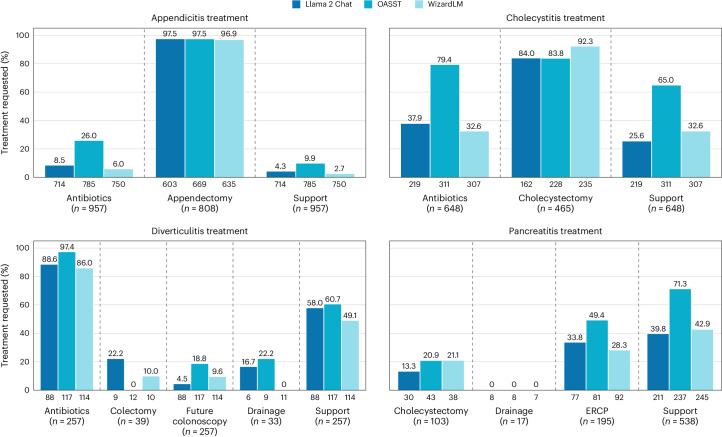
“LLMs are also susceptible to generating misleading content that poisons medical knowledge graphs constructed from medical literature 158 , often struggle with following instructions accurately and are sensitive to input order and quantity, posing risks to patient safety 159 .”
Salvi, M., Seoni, S., Campagner, A., Gertych, A., Acharya, U. R., Molinari, F., & Cabitza, F. (2025) · International Journal of Medical Informatics · doi:10.1016/j.ijmedinf.2025.105846 · Cited by 115
Jung, K.-H. (2025) · Healthcare Informatics Research · doi:10.4258/hir.2025.31.2.114 · Cited by 105
“Although Although strong performance on standardized assessments is reassuring, studies simulating real clinical scenarios have identified significant deficiencies [27].”
Zero shot health trajectory prediction using transformer
Renc, P., Jia, Y., Samir, A. E., Wąs, J., Li, Q., Bates, D. W., & Sitek, A. (2024) · npj Digital Medicine · doi:10.1038/s41746-024-01235-0 · Cited by 187
“Studies, such as those by Hager et al. 31 and Wang and Zhao 32 , highlight the ,emphasizingthepotentialneedforspecializedmodelslikeETHOS.”
ChatGPT Health performance in a structured test of triage recommendations
Ramaswamy, A., Tyagi, A., Hugo, H., Jiang, J. J., Jayaraman, P., Jangda, M., Te, A. E., Kaplan, S. A., Lampert, J. M., Freeman, R., et al. (2026) · Nature Medicine · doi:10.1038/s41591-026-04297-7 · Cited by 153
“The failure to escalate emergencies extends prior evidence that LLM behavior can be brittle under clinically demanding decision tasks and may need human oversight for clinical judgment 9 .”
Foundation models and intelligent decision-making: Progress, challenges, and perspectives
Huang, J., Xu, Y., Wang, Q., Wang, Q., Liang, X., Wang, F., Zhang, Z., Wei, W., Zhang, B., Huang, L., et al. (2025) · The Innovation · doi:10.1016/j.xinn.2025.100948 · Cited by 186
Quantifying the reasoning abilities of LLMs on clinical cases
Qiu, P., Wu, C., Liu, S., Fan, Y., Zhao, W., Chen, Z., Gu, H., Peng, C., Zhang, Y., Wang, Y., et al. (2025) · Nature Communications · doi:10.1038/s41467-025-64769-1 · Cited by 53
“Similar to previous works 14,26,27 , we initialize an LLM-powered agent to play the role of the patient.”
Natural Language Processing in medicine and ophthalmology: A review for the 21st-century clinician
Rojas-Carabali, W. A., Agrawal, R., Gutiérrez-Sinisterra, L., Baxter, S. L., Cifuentes‐González, C., Wei, Y. C., Abisheganaden, J. A., Kannapiran, P., Wong, S., Lee, B. T. K., et al. (2024) · Asia-Pacific Journal of Ophthalmology · doi:10.1016/j.apjo.2024.100084 · Cited by 82
Buess, L., Keicher, M., Navab, N., Maier, A., & Arasteh, S. T. (2025) · Biomedical Engineering Letters · doi:10.1007/s13534-025-00497-1 · Cited by 107
“To further advance the development and responsible deployment of generative AI in medicine, several areas need attention [168–170].”
Large language models for drug discovery and development
Zheng, Y., Koh, H. Y., Ju, J., Yang, M., May, L. T., Webb, G. I., Li, L., Pan, S., & Church, G. M. (2025) · Patterns · doi:10.1016/j.patter.2025.101346 · Cited by 133
Towards evaluating and building versatile large language models for medicine
Wu, C., Qiu, P., Liu, J., Gu, H., Li, N., Zhang, Y., Wang, Y., & Xie, W. (2025) · npj Digital Medicine · doi:10.1038/s41746-024-01390-4 · Cited by 52
“For instance, LLMs have demonstrated poor comprehension of ICD codes [39], produced inaccurate predictions related to clinical procedures [11], and misinterpreted Electronic Health Record (EHR) data [9].”
Transforming sepsis management: AI-driven innovations in early detection and tailored therapies
Papareddy, P., Lobo, T. J., Holub, M., Bouma, H., Maca, J., Strodthoff, N., & Herwald, H. (2025) · Critical Care · doi:10.1186/s13054-025-05588-0 · Cited by 49
“…should be contrasted with severe short-comings of a direct application of LLMs as highlighted in a recent study in a critical care context [107] namely in part significantly worse performance levels compared to physicians, failure to following guidelines or to interpret certain kinds of…”
Holistic evaluation of large language models for medical tasks with MedHELM
Bedi, S., Cui, H., Fuentes, M., Unell, A., Wornow, M., Banda, J. M., Kotecha, N., Keyes, T., Mai, Y., Oez, M., et al. (2026) · Nature Medicine · doi:10.1038/s41591-025-04151-2 · Cited by 59
Verlingue, L., Boyer, C., Olgiati, L., Brutti Mairesse, C., Morel, D., & Blay, J.-Y. (2024) · The Lancet Regional Health - Europe · doi:10.1016/j.lanepe.2024.101064 · Cited by 44
“15 These systems may lack the ability to guide treatment over novel authorized options.”
BackgroundInfluentialMenezes, M. C. S., Hoffmann, A. F., Tan, A. L. M., Nalbandyan, M., Omenn, G. S., Mazzotti, D. R., Hernández-Arango, A., Visweswaran, S., Venkatesh, S., Mandl, K. D., et al. (2024) · The Lancet Digital Health · doi:10.1016/s2589-7500(24)00246-2 · Cited by 61
Generative AI for decision-making: A multidisciplinary perspective
Albashrawi, M. A. (2025) · Journal of Innovation & Knowledge · doi:10.1016/j.jik.2025.100751 · Cited by 104
Mishra, R., & Shridevi, S. (2024) · Scientific Reports · doi:10.1038/s41598-024-75784-5 · Cited by 58
RetractedAI Agents in Clinical Medicine: A Systematic ReviewPreprint
Gorenshtein, A., Omar, M., Glicksberg, B. S., Nadkarni, G. N., & Klang, E. (2025) · medRxiv · doi:10.1101/2025.08.22.25334232 · Cited by 94
“4,5 However, clinical deployment faces critical safety challenges 6,7,8,9 LLMs can generate plausible but incorrect information, known as hallucinations.”
Li, H., Fu, J., & Python, A. (2025) · Journal of Medical Internet Research · doi:10.2196/71916 · Cited by 68
“They have not reliably interpreted a wide range of medical images [90,143] and have not reached the level of human physicians in clinical diagnosis in various contexts [107,144-146].”
Collaborative, T. C. (2025) · BMJ · doi:10.1136/bmj-2024-083305 · Cited by 72
“48 For example, patients in a hernia clinic might be randomised to receiving preoperative advice from a clinician or a generative AI-driven chatbot for general health advice for weight loss, with the goal of reducing BMI at the time of surgery.”
Chatziisaak, D., Burri, P., Sparn, M. B., Hahnloser, D., Steffen, T., & Bischofberger, S. (2025) · BJS Open · doi:10.1093/bjsopen/zraf040 · Cited by 43
“In another publication there was a limited utilization of LLMs in the decision-making process for acute surgical problems, such as appendicitis or cholecystitis 24 .”
Challenges of Implementing LLMs in Clinical Practice: Perspectives
Artsi, Y., Sorin, V., Glicksberg, B. S., Korfiatis, P. D., Freeman, R., Nadkarni, G. N., & Klang, E. (2025) · Journal of Clinical Medicine · doi:10.3390/jcm14176169 · Cited by 66
“This self-referential loop may also contribute to the deskilling of clinicians, who might underutilize critical thinking in favor of convenience [21,66].”
Shashikumar, S. P., Mohammadi, S., Krishnamoorthy, R., Patel, A., Wardi, G., Ahn, J. C., Singh, K., Aronoff-Spencer, E. S., & Nemati, S. (2025) · npj Digital Medicine · doi:10.1038/s41746-025-01689-w · Cited by 58
“This aligns with previous studies that have also noted the dif fi culties of using standalone LLMs fordiagnosticpurposes 44 – 46 ,andhighlightstheimportanceofcombiningthe strengths of predictive modeling (for initial risk strati fi cation) and differential diagnosis (for addressing prediction…”
Prompt architecture induces methodological artifacts in large language models
Brucks, M. S., & Toubia, O. (2025) · PLoS ONE · doi:10.1371/journal.pone.0319159 · Cited by 87
Large language model-based biological age prediction in large-scale populations
Li, Y., Huang, Q. Z., Jiang, J., Du, X., Xiang, W., Zhang, S., Pan, Z., Zhao, L., Cui, Y., Ke, L., et al. (2025) · Nature Medicine · doi:10.1038/s41591-025-03856-8 · Cited by 50
“Furthermore, for vulnerable populations, such LLMs may struggle to provide predictive capability, probably due to a lack of representative pretraining data from these groups 50–52 .”
Wu, X. Y., Cai, G., Guo, B., Ma, L., Shao, S., Yu, J., Zheng, Y., Wang, L., & Yang, F. (2025) · BMC Oral Health · doi:10.1186/s12903-025-06619-6 · Cited by 55
“These limitations often preclude satisfactory outcomes in implant treatment planning scenarios that necessitate considering multimodal data, various patient-specific and surgical site factors, and even integrating systemic health conditions and laboratory indicators [16, 26].”
Considerations for Patient Privacy of Large Language Models in Health Care: Scoping Review
Zhong, X., Li, S., Zhao, C. X., Ge, L., Yu, D., Wang, S.-J., You, L., & Shang, H. (2025) · Journal of Medical Internet Research · doi:10.2196/76571 · Cited by 64
“A substantial portion of current research on LLMs for health care applications uses publicly available resources [9], such as the Medical Information Mart for Intensive Care-IV [10].”
Generative AI in Medicine and Healthcare: Moving Beyond the ‘Peak of Inflated Expectations’
Zhang, P., Shi, J., & Boulos, M. N. K. (2024) · Future Internet · doi:10.3390/fi16120462 · Cited by 44
Medical accuracy of artificial intelligence chatbots in oncology: a scoping review
Chen, D. J., Avison, K., Alnassar, S., Huang, R. S., & Raman, S. (2025) · The Oncologist · doi:10.1093/oncolo/oyaf038 · Cited by 49
“…oncology-related examinations, including questions sourced from professional society and established board examinations included in this review, 81,85 underscores the utility of LLMs to serve as an information resource that can be consulted for clinical recommendations to in part inform clinical…”
Large language models for batteries
Zuo, W., Zheng, H., He, T., Vishwanath, V., Chan, M. K. Y., Stevens, R. L., Amine, K., & Xu, G. (2025) · Joule · doi:10.1016/j.joule.2025.102037 · Cited by 40
Artificial intelligence and infectious disease diagnostics: state of the art and future perspectives
Miglietta, L., Rawson, T. M., Galiwango, R. M., Tasker, A. J., Ming, D. K. Y., Akogo, D., Ferreyra, C., Aboagye, E. O., Gordon, N. C., García‐Vidal, C., et al. (2025) · The Lancet Infectious Diseases · doi:10.1016/s1473-3099(25)00354-8 · Cited by 53
Towards autonomous medical artificial intelligence agents
Ferber, D., Hilgers, L., Höper, C., Kinny‐Köster, B., Eckardt, J., Egger‐Heidrich, K., Bill, M., Schneider, M. M. K., Clusmann, J., Kadric, L., et al. (2026) · Nature · doi:10.1038/s41586-026-10675-5 · Cited by 80
“It concluded that current models still lack the reliability necessary to autonomously manage complex medical cases 18 .”
InfluentialGenerative artificial intelligence: implications for biomedical and health professions education
Hersh, W. (2025) · Annual Review of Biomedical Data Science · doi:10.1146/annurev-biodatasci-103123-094756 · Cited by 28
Multi-modal large language models in radiology: principles, applications, and potential
Shen, Y., Xu, Y., Ma, J., Rui, W., Zhao, C., Heacock, L. C., & Huang, C. (2024) · Abdominal Radiology · doi:10.1007/s00261-024-04708-8 · Cited by 41
“They found that both generalist and specialist LLMs performed significantly worse than radiologists, particularly for conditions such as cholecystitis (84% accuracy for radiologists vs. 13–62% for LLMs) and diverticulitis (86% for radiologists vs. 36–59% for LLMs) [80].”
Jeon, S., & Kim, H. (2025) · Computers in Biology and Medicine · doi:10.1016/j.compbiomed.2025.110614 · Cited by 55
Human–large language model collaboration in clinical medicine: a systematic review and meta-analysis
Wang, G., Zhang, K., Jiang, J., Wang, C., Bi, H., Liang, H., Qi, Z., Huang, Y., Li, Y., & Yang, X. (2026) · npj Digital Medicine · doi:10.1038/s41746-026-02382-2 · Cited by 67
“This tension between theoretical expectations and empirical fi ndings highlights persistent uncertainty about how to collaborate and when collaboration adds value 25,45,46 .”
Uncertainty-aware large language models for explainable disease diagnosis
Zhou, S., Wang, J., Xu, Z., Wang, S., Brauer, D., Welton, L., Cogan, J., Chung, Y.-H., Tian, L., Zhan, Z., et al. (2025) · npj Digital Medicine · doi:10.1038/s41746-025-02071-6 · Cited by 27
“Smaller models often lack suf fi cient clinical knowledge or robust instruction-following capabilities 2,53 , limiting their applicability in evidence-based diagnosis.”
InfluentialLatest developments of generative artificial intelligence and applications in ophthalmology
Feng, X., Xu, K., Luo, M., Chen, H., Yang, Y., He, Q., Song, C., Li, R., Wu, Y., Wang, H., et al. (2024) · Asia-Pacific Journal of Ophthalmology · doi:10.1016/j.apjo.2024.100090 · Cited by 39
Nezhat, C. R., Oskotsky, T. T., Robinson, J. F., Fisher, S. J., Tsuei, A., Liu, B., Irwin, J. C., Gaudilliere, B., Sirota, M., Stevenson, D. K., et al. (2025) · npj Women s Health · doi:10.1038/s44294-024-00052-w · Cited by 25
Ethical engagement with artificial intelligence in medical education
Mondal, H. (2025) · AJP Advances in Physiology Education · doi:10.1152/advan.00188.2024 · Cited by 40
Neuro-symbolic AI for auditable cognitive information extraction from medical reports
Prenosil, G., Weitzel, T., Bello, S. C., Mingels, C., Manzini, G., Meier, L. P., Shi, K., Rominger, A., & Afshar‐Oromieh, A. (2025) · Communications Medicine · doi:10.1038/s43856-025-01194-x · Cited by 49
Evaluating the clinical benefits of LLMs
Bedi, S., Jain, S. S., & Shah, N. H. (2024) · Nature Medicine · doi:10.1038/s41591-024-03181-6 · Cited by 28
Guellec, B. L., Bruge, C., Chalhoub, N., Chaton, V., Sousa, E. D., Gaillandre, Y., Hanafi, R., Masy, M., Vannod‐Michel, Q., Hamroun, A., et al. (2025) · Diagnostic and Interventional Imaging · doi:10.1016/j.diii.2025.04.006 · Cited by 31
Automating expert-level medical reasoning evaluation of large language models
Zhou, S., Xie, W., Li, J., Zhan, Z., Song, M., Yang, H., Espinoza, C., Welton, L., Mai, X., Jin, Y., et al. (2025) · npj Digital Medicine · doi:10.1038/s41746-025-02208-7 · Cited by 30
“We also examined the sensitivity of the LLM-w-Rationale framework to different prompt formulations by composing fi ve prompt variations with similar semantics (Supplementary Note 9).”
Wang, S., Tang, Z., Yang, H., Gong, Q., Gu, T., Ma, H., Wang, Y., Sun, W., Lian, Z., Mao, K., et al. (2025) · arXiv · doi:10.48550/arxiv.2507.23486 · Cited by 23
Comparison of Frontier Open-Source and Proprietary Large Language Models for Complex Diagnoses
Buckley, T. A., Crowe, B., Abdulnour, R.-E. E., Rodman, A. M., & Manrai, A. K. (2025) · JAMA Health Forum · doi:10.1001/jamahealthforum.2025.0040 · Cited by 31
Wang, S., Tang, Z., Yang, H., Gong, Q., Gu, T., Ma, H., Wang, Y., Sun, W., Lian, Z., Mao, K., et al. (2025) · npj Digital Medicine · doi:10.1038/s41746-025-02277-8 · Cited by 80
“For scored rating items, the prompts enumerate specific scoring dimensions such as relevance, completeness, and accuracy, along with the respective point allocations for each dimension.”
A large language model for complex cardiology care
O’Sullivan, J. W., Palepu, A. K., Saab, K. K., Weng, W., Amponsah, D., Cheng, E., Cheng, Y., Chu, E. L., Desai, Y. B., Elezaby, A., et al. (2026) · Nature Medicine · doi:10.1038/s41591-025-04190-9 · Cited by 50
“It remains unclear whether LLMs possess the nuanced understanding and intricate knowledge base required to effectively replicate the decision-making process of experts in highly specialized medical fields 14 .”
InfluentialDietrich, N. T., & Stubbert, B. (2025) · Canadian Association of Radiologists Journal · doi:10.1177/08465371251323124 · Cited by 23
“4 Consequently, they can produce outputs that lack alignment with expert consensus or fail to account for subtleties relevant to a particular patient population or healthcare system.”
Utilizing large language models for gastroenterology research: a conceptual framework
Berry, P., Dhanakshirur, R. R., & Khanna, S. (2025) · Therapeutic Advances in Gastroenterology · doi:10.1177/17562848251328577 · Cited by 29
Wang, N., Chen, Y., & Zhang, D. (2025) · The Innovation Energy · doi:10.59717/j.xinn-energy.2025.100087 · Cited by 36
Transforming healthcare delivery with conversational AI platforms
Mahajan, A., & Powell, D. (2025) · npj Digital Medicine · doi:10.1038/s41746-025-01968-6 · Cited by 27
Esfahani, H. H., Toyonaga, S., & Oyibo, K. (2025) · Digital Health · doi:10.1177/20552076251355669 · Cited by 33
Large Language Models in Critical Care Medicine: Scoping Review
Shi, T., Ma, J., Yu, Z., Xu, H., Yang, R., Xiong, M., Xiao, M., Li, Y., Zhao, H., & Kong, G. (2025) · JMIR Medical Informatics · doi:10.2196/76326 · Cited by 21
Explainable differential diagnosis with dual-inference large language models
Zhou, S., Lin, M., Ding, S., Wang, J., Chen, C., Melton, G. B., Zou, J., & Zhang, R. (2025) · npj Health Systems · doi:10.1038/s44401-025-00015-6 · Cited by 20
“Second, numerous studies have highlighted LLMs ’ inherent dif fi culties with complex reasoning tasks 23,24 , suchas multi-step logical reasoning 25,26 and clinical decision-making 27,28 .”
Ophthalmological Question Answering and Reasoning Using OpenAI o1 vs Other Large Language Models
Srinivasan, S., Ai, X., Zou, M., Zou, K., Kim, H., Lo, T. W. S., Pushpanathan, K., Yang, G. D., Goh, J. H. L., Kong, Y., et al. (2025) · JAMA Ophthalmology · doi:10.1001/jamaophthalmol.2025.2413 · Cited by 26
Hung, T. K. W., Kuperman, G. J., Sherman, E. J., Ho, A. L., Weng, C., Pfister, D. G., & Mao, J. J. J. (2024) · Journal of Medical Internet Research · doi:10.2196/60695 · Cited by 29
“…questions with impressive accuracy without specialized training or reinforcement [1,2]; however, leveraging LLMs in oncology decision support has not yet demonstrated suitable performance, as LLMs would produce responses that deviate from cancer expert recommendations and guidelines [3-5].”
Schaye, V. E., DiTullio, D. J., Guzman, B. V., Vennemeyer, S., Shih, H., Reinstein, I., Weber, D., Goodman, A., Wu, D. T. Y., Sartori, D. J., et al. (2025) · Journal of Medical Internet Research · doi:10.2196/67967 · Cited by 30
“In addition, initial studies have shown LLMs do not perform as well digesting the complexity of information in the EHR to make accurate diagnoses [30].”
InfluentialGenerative Artificial Intelligence in Medicine
Shanmugam, D., Agrawal, M., Movva, R., Chen, I. Y., Ghassemi, M., Jacobs, M. L., & Pierson, E. (2025) · Annual Review of Biomedical Data Science · doi:10.1146/annurev-biodatasci-103123-095332 · Cited by 41
Reliability engineering, risk management, and trustworthiness assurance for AI systems
Zhang, X., Wang, T., Ma, L., & Mahadevan, S. (2025) · Journal of Reliability Science and Engineering · doi:10.1088/3050-2454/adcef2 · Cited by 34
Vrdoljak, J., Boban, Z., Maleš, I., Škrabić, R., Kumrić, M., Ottosen, A., Clemencau, A., Božić, J., & Völker, S. (2025) · Computers in Biology and Medicine · doi:10.1016/j.compbiomed.2025.110351 · Cited by 29
Large multimodal models evaluation: a survey
Zhang, Z., Wang, J., Wen, F., Guo, Y., Zhao, X., Fang, X., Ding, S., Jia, Z., Xiao, J., Shen, Y., et al. (2025) · Science China Information Sciences · doi:10.1007/s11432-025-4676-4 · Cited by 71
“Although open-ended questions provide greater flexibility, they lack robust and reliable evaluation metrics to assess factual correctness and clinical appropriateness [288].”
Carchiolo, V., & Malgeri, M. (2025) · Future Internet · doi:10.3390/fi17020076 · Cited by 26
“One key area is Clinical Decision Support, where LLM s provide evidence-based recommendations, diagnostic suggestions, and treatment options, enhancing clinical efficiency and accuracy [1].”
Powell, C., & Riccardi, A. (2025) · Journal of Intelligent Information Systems · doi:10.1007/s10844-025-00940-w · Cited by 23
TIMER: temporal instruction modeling and evaluation for longitudinal clinical records
Cui, H., Unell, A., Chen, B., Fries, J., Alsentzer, E., Koyejo, S., & Shah, N. H. (2025) · npj Digital Medicine · doi:10.1038/s41746-025-01965-9 · Cited by 80
Potential risks of GenAI on medical education
Hough, J., Culley, N., Erganian, C., & Alahdab, F. (2025) · BMJ Evidence-Based Medicine · doi:10.1136/bmjebm-2025-114339 · Cited by 29
“17 18 This requires careful and critical assessment of the model outputs by the learners, along with learning how to search for, retrieve, understand and assess relevant evidence-based information to measure against the models’ responses.”
An LLM chatbot to facilitate primary-to-specialist care transitions: a randomized controlled trial
Tao, X., Zhou, S., Ding, K., Li, S., Li, Y., Wu, B., Huang, Q., Chen, W., Shen, M., Meng, E., et al. (2026) · Nature Medicine · doi:10.1038/s41591-025-04176-7 · Cited by 63
“…requires overcoming two critical barriers: mitigating the systematic biases that arise when training patient-facing LLMs on local medical dialogues from resource-limited settings 26,27 , and establishing real-world evidence of their clinical utility within time-pressured hospital workflows 28–31 .”
Qazi, I. A., Ali, A., Khawaja, A. U., Akhtar, M. J., Sheikh, A. Z., & Alizai, M. H. (2026) · NEJM AI · doi:10.1056/aioa2501001 · Cited by 74
Using Large Language Models to Promote Health Equity
Pierson, E., Shanmugam, D., Movva, R., Kleinberg, J. M., Agrawal, M., Dredze, M. H., Ferryman, K. S., Gichoya, J. W., Jurafsky, D., Koh, P. W., et al. (2025) · NEJM AI · doi:10.1056/aip2400889 · Cited by 39
Gumilar, K. E., Wardhana, M. P., Akbar, M. I. A., Putra, A., Banjarnahor, D. P., Mulyana, R. S., Fatati, I., Yu, Z.-Y., Hsu, Y., Dachlan, E. G., et al. (2025) · Computational and Structural Biotechnology Journal · doi:10.1016/j.csbj.2025.03.026 · Cited by 26
“Studies indicate that AI-LLMs often struggle to strictly follow explicit instructions, and are highly sensitive to both the amount and sequence of input data [24].”
Are chatbots a reliable source for patient frequently asked questions on neck masses?
Hack, S., Alsleibi, S., Saleh, N., Alon, E. E., Rabinovics, N., & Remer, E. (2025) · European Archives of Oto-Rhino-Laryngology · doi:10.1007/s00405-025-09433-6 · Cited by 20
“However, reliability alone does not ensure optimal information delivery, emphasizing the need for broader evaluation of LLMs in clinical settings. in guideline adherence, underscoring the need for caution when using LLMs in clinical practice [36, 39].”
Advances in computational nephropathology
Hölscher, D. L., Bülow, R. D., Strauch, M., & Boor, P. (2025) · Kidney International · doi:10.1016/j.kint.2025.06.029 · Cited by 20
Digital twins for personalized treatment in uro-oncology in the era of artificial intelligence
Görtz, M., Brandl, C., Nitschke, A., Riediger, A. L., Stromer, D., Byczkowski, M., Heuveline, V., & Weidemüller, M. (2025) · Nature Reviews Urology · doi:10.1038/s41585-025-01096-6 · Cited by 28
“…support systems in close collaboration with clinicians, current studies in realistic clinical decision-making scenarios indicate that current models do not achieve satisfactory diagnostic accuracy, perform substantially worse than trained physicians, and fail to follow treatment guidelines 76 .”
Based on Medicine, The Now and Future of Large Language Models
Su, Z., Tang, G., Huang, R., Yang, Q. W., Zhang, Z., & Dai, X. (2024) · Cellular and Molecular Bioengineering · doi:10.1007/s12195-024-00820-3 · Cited by 20
“Additionally, these models exhibit high sensitivity to the order and amount of information when processing clinical data, which can lead to inconsistent diagnostic accuracy [94].”
Hopson, S., Mildon, C., Hassard, K., Kubalek, C., Laverty, L., Urie, P., & Corte, D. D. (2025) · BMC Medical Education · doi:10.1186/s12909-025-07556-2 · Cited by 17
A large manufacturing decision model for human-centric decision-making
Li, X., Nassehi, A., Hu, S. J., Joung, B. G., & Gao, R. X. (2025) · CIRP Annals · doi:10.1016/j.cirp.2025.04.017 · Cited by 18
Large Language Models—Misdiagnosing Diagnostic Excellence?
Ranji, S. R. (2024) · JAMA Network Open · doi:10.1001/jamanetworkopen.2024.40901 · Cited by 23
Artificial Intelligence: An Emerging Tool for Studying Drug‐Induced Liver Injury
Niu, H., Álvarez‐Álvarez, I., & Chen, M. (2025) · Liver International · doi:10.1111/liv.70038 · Cited by 20
Iyer, R., Christie, A. P., Madhavapeddy, A., Reynolds, S., Sutherland, W. J., & Jaffer, S. (2025) · PLoS ONE · doi:10.1371/journal.pone.0323563 · Cited by 26
“Few studies have quantitatively evaluated the reliability of using LLMs for decision support [12,20] and none, to our knowledge, in conservation have made comparisons with human experts.”
Hussain, Z. S., Delsoz, M., Elahi, M., Jerkins, B. M., Kanner, E. M., Wright, C., Munir, W. M., Soleimani, M., Djalilian, A., Lao, P. A., et al. (2025) · medRxiv · doi:10.1101/2025.03.14.25323836 · Cited by 29
Bunnell, D. J., Bondy, M. J., Fromtling, L. M., Ludeman, E. M., & Gourab, K. (2025) · medRxiv · doi:10.1101/2025.04.01.25325033 · Cited by 32
Primer on large language models: an educational overview for intensivists
Idan, D., & Einav, S. (2025) · Critical Care · doi:10.1186/s13054-025-05479-4 · Cited by 26
“There is no robust clinical validation, and the wide-spread use of these tools has also brought attention to their limitations and associated challenges [46, 47].”
Benchmarking vision-language models for diagnostics in emergency and critical care settings
Kurz, C., Merzhevich, T., Eskofier, B. M., Kather, J. N., & Gmeiner, B. (2025) · npj Digital Medicine · doi:10.1038/s41746-025-01837-2 · Cited by 26
“To foster equitable AI solutions for all patients, models must be trained on diverse datasets that re fl ect the population-level variation seen in emergency and acute care settings 15 .”
Haque, M. A., & Siddique, H. R. (2025) · Computational Biology and Chemistry · doi:10.1016/j.compbiolchem.2025.108611 · Cited by 24
Yang, T., Xiao, Y., Bao, Z., Hao, J., & Peng, J. (2025) · Briefings in Bioinformatics · doi:10.1093/bib/bbaf601 · Cited by 34
Scaling medical AI across clinical contexts
Li, M. M., Reis, B. Y., Rodman, A. M., Cai, T., Dagan, N., Balicer, R. D., Loscalzo, J., Kohane, I. S., & Žitnik, M. (2026) · Nature Medicine · doi:10.1038/s41591-025-04184-7 · Cited by 31
“Pretraining followed by prompting and fine-tuning represents an initial step toward context-adaptive models, but remains limited because adaptation depends on carefully curated examples and repeated fine-tuning for each new task 17,19,20,34 .”
Metadata
- Authors
- Hager, P., Jungmann, F., Holland, R., Bhagat, K., Hubrecht, I., Knauer, M., Vielhauer, J., Makowski, M., Braren, R., Kaissis, G., & Rueckert, D.
- Affiliations
- TUM Klinikum (DE)
- Imperial College London (GB)
- Christiana Care Health System (US)
- Ludwig-Maximilians-Universität München (DE)
- Corresponding author
- Hager, Paul
- ORCID
- Venue
- Nature Medicine
- Published
- 2024-07-04
- Volume
- 30
- Issue
- 9
- Pages
- 2613-2622
- ISSN
- 1078-8956 (ISSN-L)
- 1546-170X
- PMC
- PMC11405275
- OpenAlex
- W4400324908
- Cited by
- 798
- References
- 74
- Citations by year
- 2026: 435 · 2025: 317 · 2024: 46
- FWCI
- 74.24
- Type
- journal article
- Language
- en
- Open access
- hybrid
- doi.org
- Licence
- cc-by
- creativecommons.org/licenses/by/4.0 (tdm)
- creativecommons.org/licenses/by/4.0 (vor)
- Locations
- Nature Medicine (publishedVersion, cc-by)
- medRxiv (acceptedVersion, cc-by-nc)
- PubMed Central (publishedVersion, cc-by)
- PubMed (publishedVersion)
- PuSH - Publication Server of Helmholtz Zentrum München (submittedVersion, cc-by)
- mediaTUM – the media and publications repository of the Technical University Munich (Technical University Munich) (submittedVersion)
- Funders
- Technische Universität München
- H2020 European Research Council (884622)
- Topics
- Health Sciences › Medicine › Health Informatics › Artificial Intelligence in Healthcare and Education
- Physical Sciences › Computer Science › Artificial Intelligence › Machine Learning in Healthcare
- Health Sciences › Health Professions › Health Information Management › Artificial Intelligence in Healthcare
- Keywords
- large language models, clinical decision-making, artificial intelligence in healthcare, MIMIC-III, abdominal pathology, diagnostic accuracy, clinical guidelines adherence, laboratory test interpretation, clinical workflow integration, medical licensing examinations, LLM limitations
- MeSH terms
- Clinical Decision-Making, Artificial Intelligence, Humans, Decision Support Systems, Clinical
About these checks
Registry, retraction, Cites and statistics results are computed, not judged, with one exception: a printed reference that no index lists is read once by a model before it counts as a citation error. Claims are extracted by a model and kept only when their quote appears verbatim in the text; each cited source is then checked, with a model’s help, for whether it says what the claim relies on. Those verdicts can be wrong — read the claim’s quote and the cited source before relying on one.
The claim verdicts this report counts are experimental: their accuracy is not yet measured.
A language model drew the claims from the paper on 2026-10-10, under version 3 of the claim definition (model deepseek-v4.1-flash, prompt extract-v3).
A second model labelled each claim on 2026-10-10 (model jev-1.13-20260917, definition revision gold-guideline-v0.2).
Cited sources are checked with a language model’s help (gpt-6-sol).
Statistics and arithmetic are recomputed, not judged.
Confidence bands are shown only for fields calibrated on our annotated test set. None is calibrated yet, so no band is shown.
What counts as a claim ›How we measure confidence ›How we check this ›
Are you an author, or do you see a problem with this page? Request a review
Data sources
Bibliographic data: Semantic Scholar, OpenAlex, Crossref.
Contains information from the Semantic Scholar Academic Graph Datasets, made available under the ODC Attribution License (ODC-BY 1.0).
Semantic Scholar’s data is described in: Kinney, R., et al. (2023). The Semantic Scholar Open Data Platform. arXiv:2301.10140.
