

FlyWire: online community for whole-brain connectomics
Open accessPublished version of a preprint
The DOI matches its Crossref record; 75 of the 76 references it cites were found in a registry or an index; 41 of the 56 sources its claims cite were checked for support.
Abstract
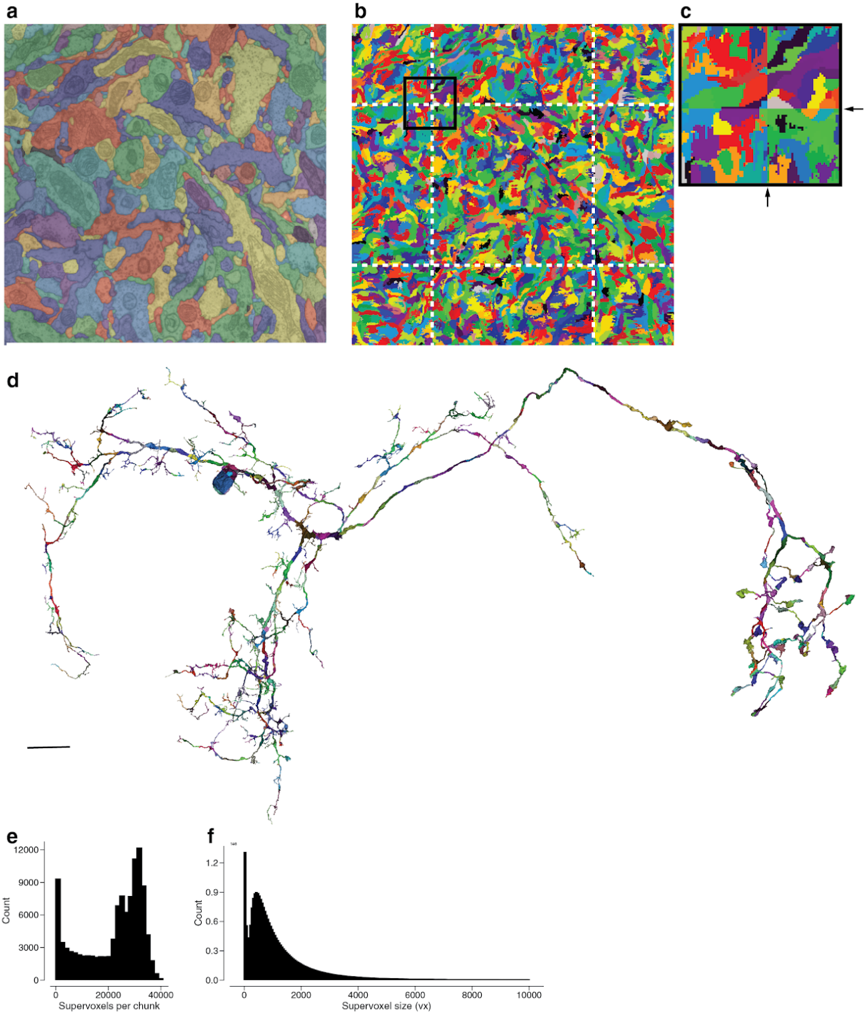
Due to advances in automated image acquisition and analysis, whole-brain connectomes with 100,000 or more neurons are on the horizon. Proofreading of whole-brain automated reconstructions will require many person-years of effort, due to the huge volumes of data involved. Here we present FlyWire, an online community for proofreading neural circuits in a Drosophila melanogaster brain and explain how its computational and social structures are organized to scale up to whole-brain connectomics. Browser-based three-dimensional interactive segmentation by collaborative editing of a spatially chunked supervoxel graph makes it possible to distribute proofreading to individuals located virtually anywhere in the world. Information in the edit history is programmatically accessible for a variety of uses such as estimating proofreading accuracy or building incentive systems. An open community accelerates proofreading by recruiting more participants and accelerates scientific discovery by requiring information sharing. We demonstrate how FlyWire enables circuit analysis by reconstructing and analyzing the connectome of mechanosensory neurons.
Overview
CoChat Summary
TL;DR
FlyWire is an open online community and computational platform for proofreading a whole-brain Drosophila connectome, built on a ChunkedGraph data structure and browser-based 3D editing. It demonstrates scalable proofreading and circuit discovery by reconstructing mechanosensory pathways, estimating roughly 19 minutes of human effort per neuron.
Key findings
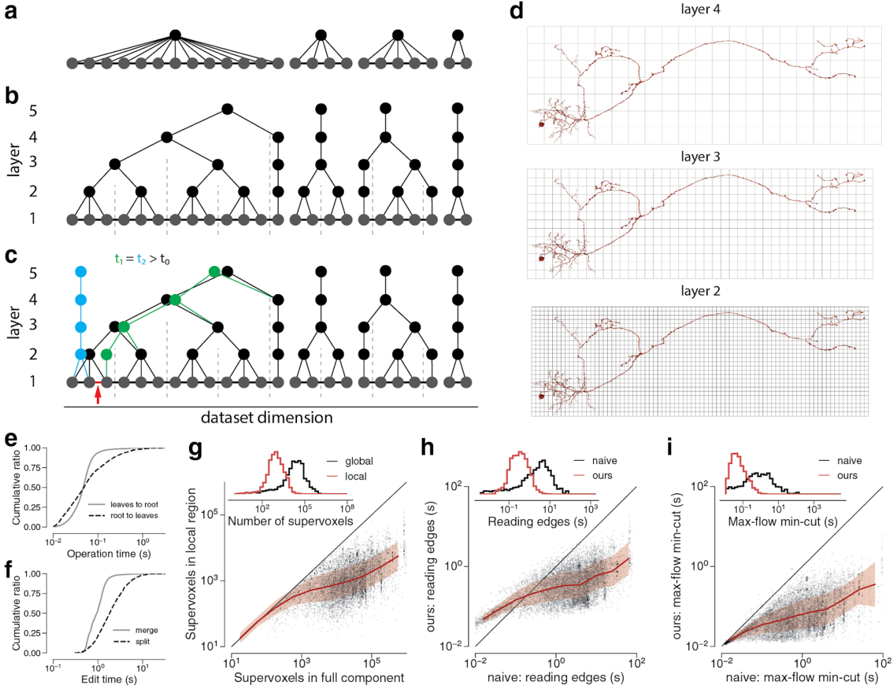
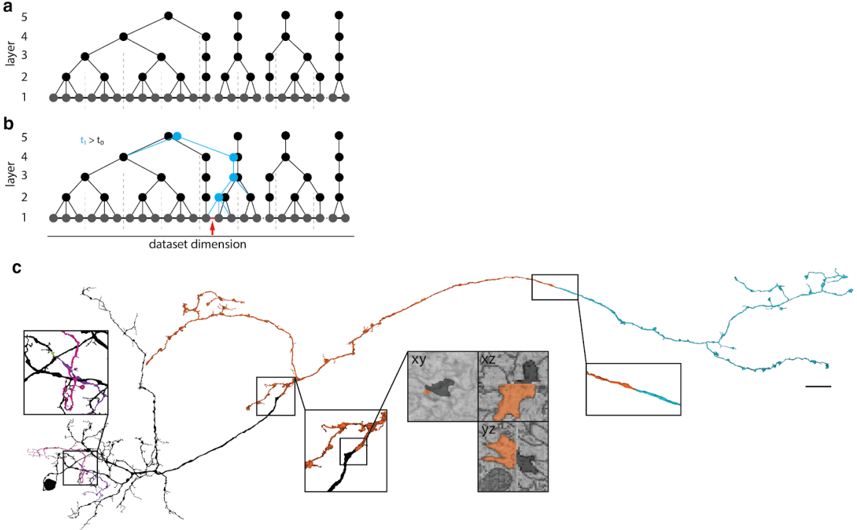
- The ChunkedGraph made edit operations over an order of magnitude faster than a naive supervoxel graph; server response times during beta were median 47 ms for supervoxel-to-root (95th percentile 111 ms, n=12,096) and median 48 ms for root-to-supervoxels per displayed chunk (95th percentile 465 ms, n=3,080,494). Merge edits had median 940 ms (95th percentile 1,841 ms, n=4,612); split edits had median 1,818 ms (95th percentile 7,137 ms, n=2,497).
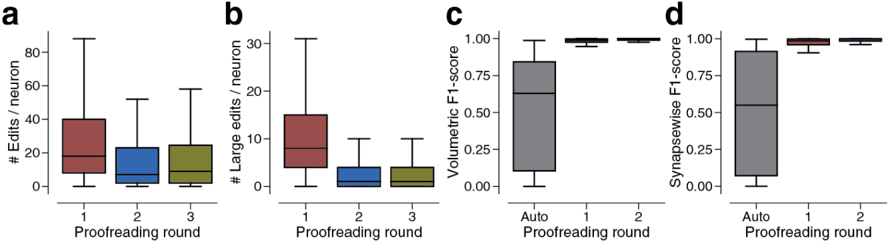
- Proofreading 183 neurons with 13 proofreaders over three rounds yielded median F1 scores of 0.99 for volumetric completeness and 0.99 for synapse assignment after one round; a faster regimen took a median of 13 minutes per cell, with mean proofreading time 19.1 minutes. A whole-brain backbone connectome for ~100,000 cells was estimated at 16 person-years.
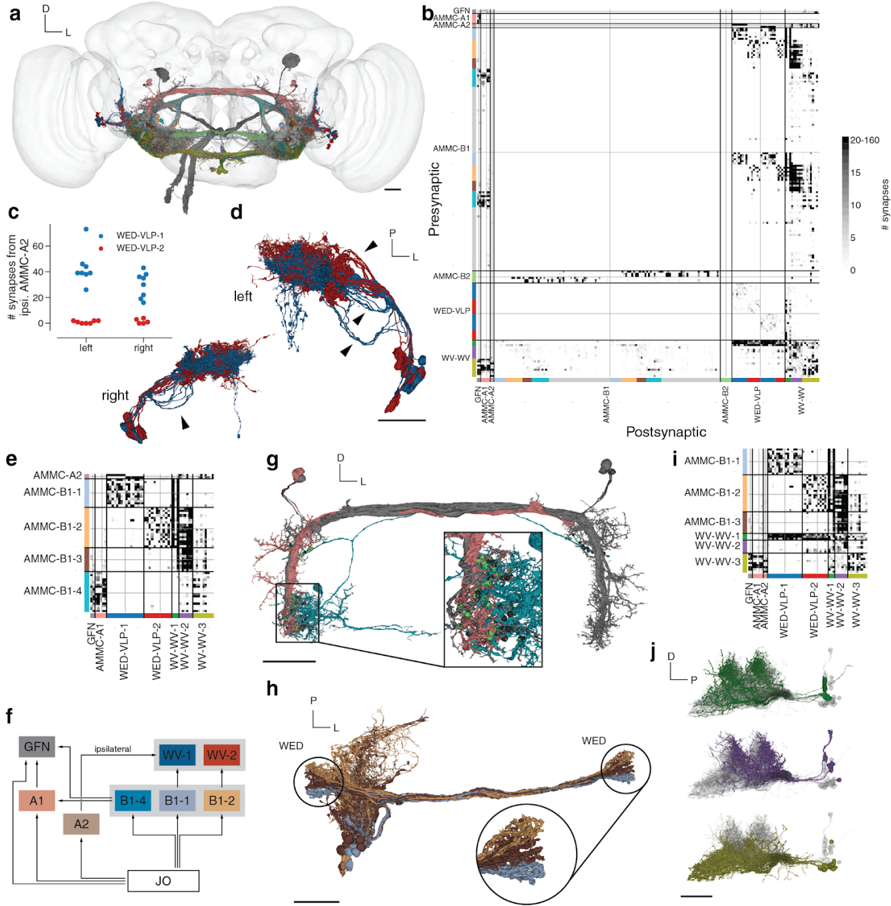
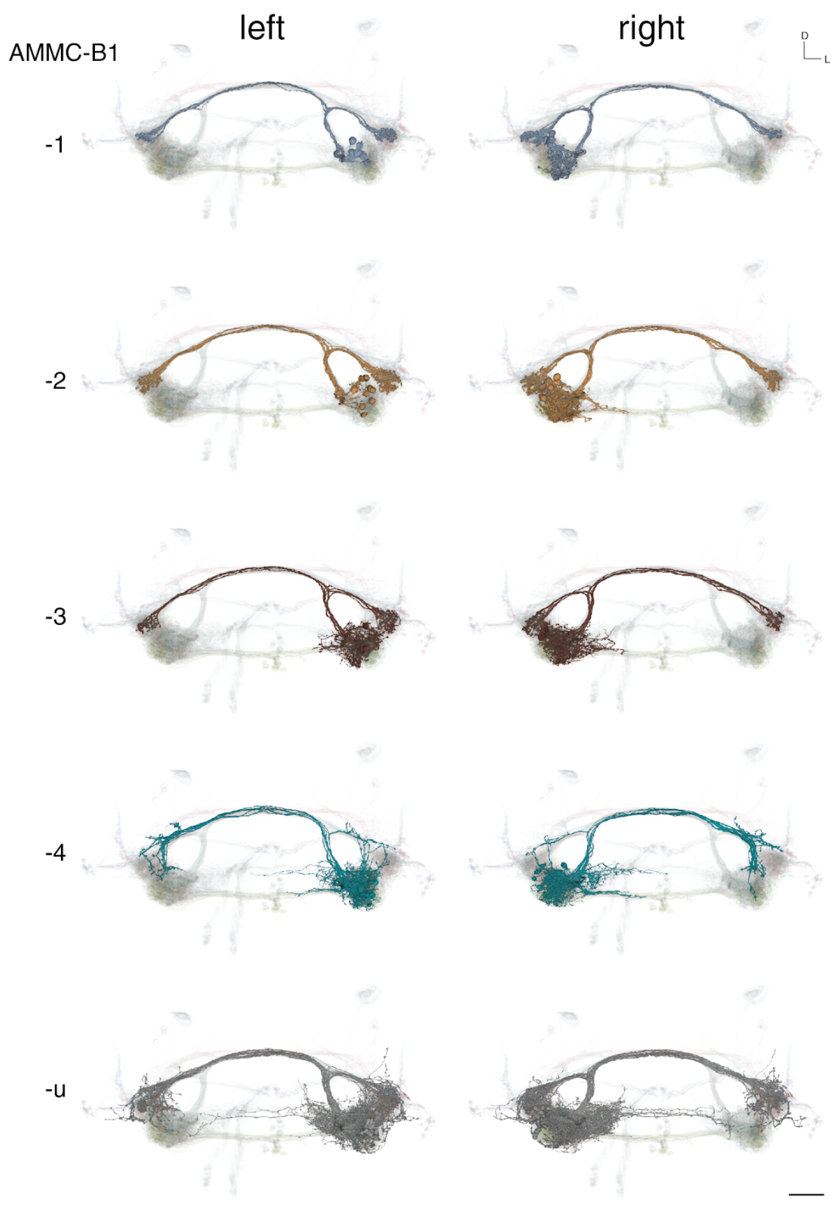
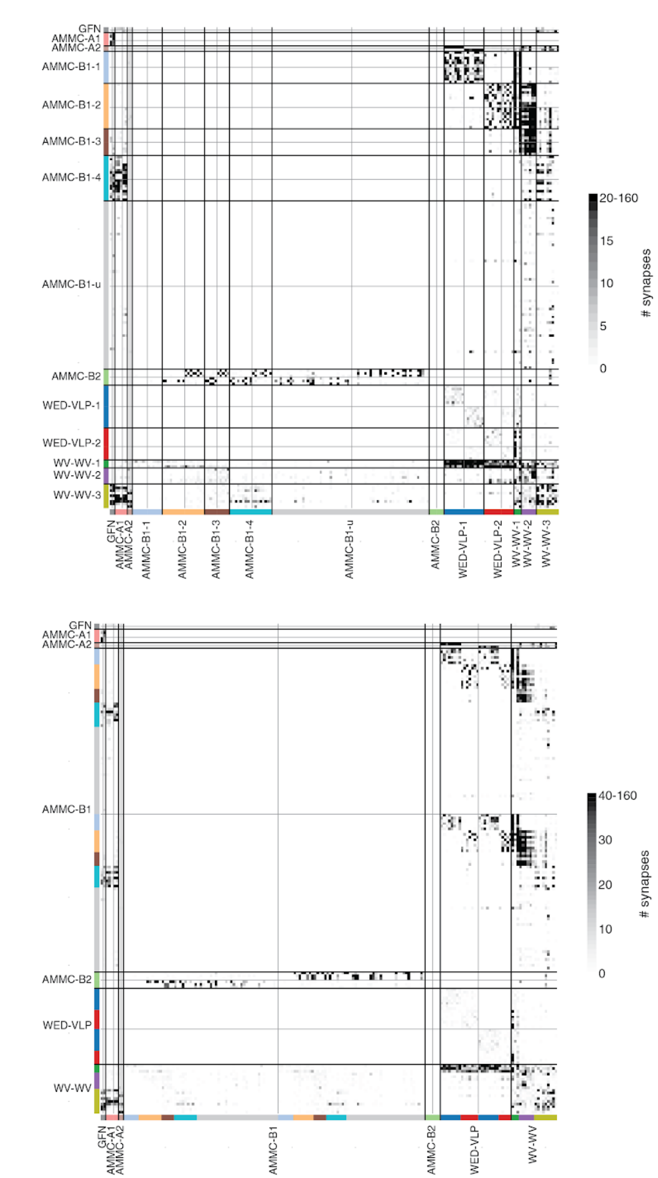
- In 178 mechanosensory neurons across seven cell classes, the authors identified 59 left and 58 right AMMC-B1 neurons, versus prior work identifying only 10 per hemisphere; only 14 of 59 left and 14 of 58 right AMMC-B1 neurons innervated WED-VLPs, and AMMC-B1 neurons divided into at least five connectivity-based subtypes.
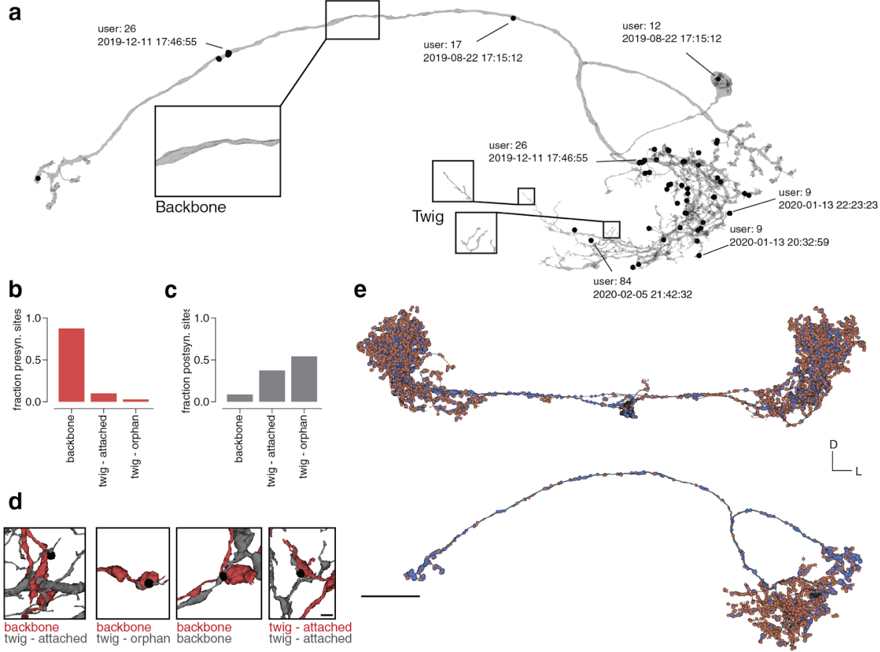
- Synapse omission from orphan twigs was quantified at 612 randomly picked synaptic locations: 40.6% of postsynaptic and 78.2% of presynaptic twigs were attached to backbones, leading to an estimate that 44.6% of synapses had both pre- and postsynaptic segments attached after proofreading; major connections (>9 synapses) were maintained at 99.7% with at least one synapse, and most minor connections with at least 3 synapses at 83%.
Methods
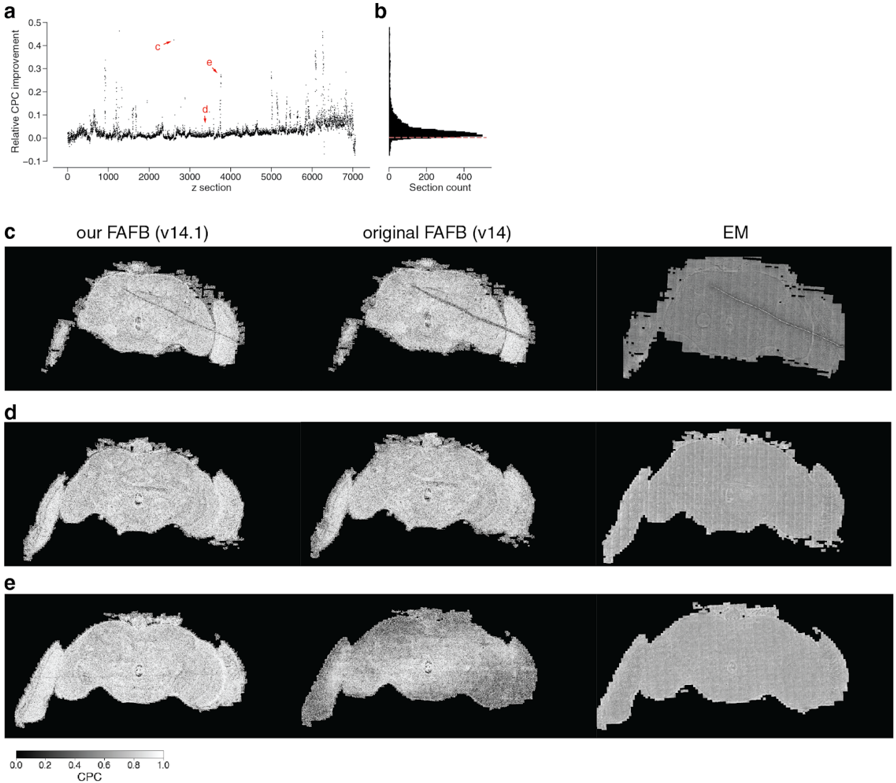
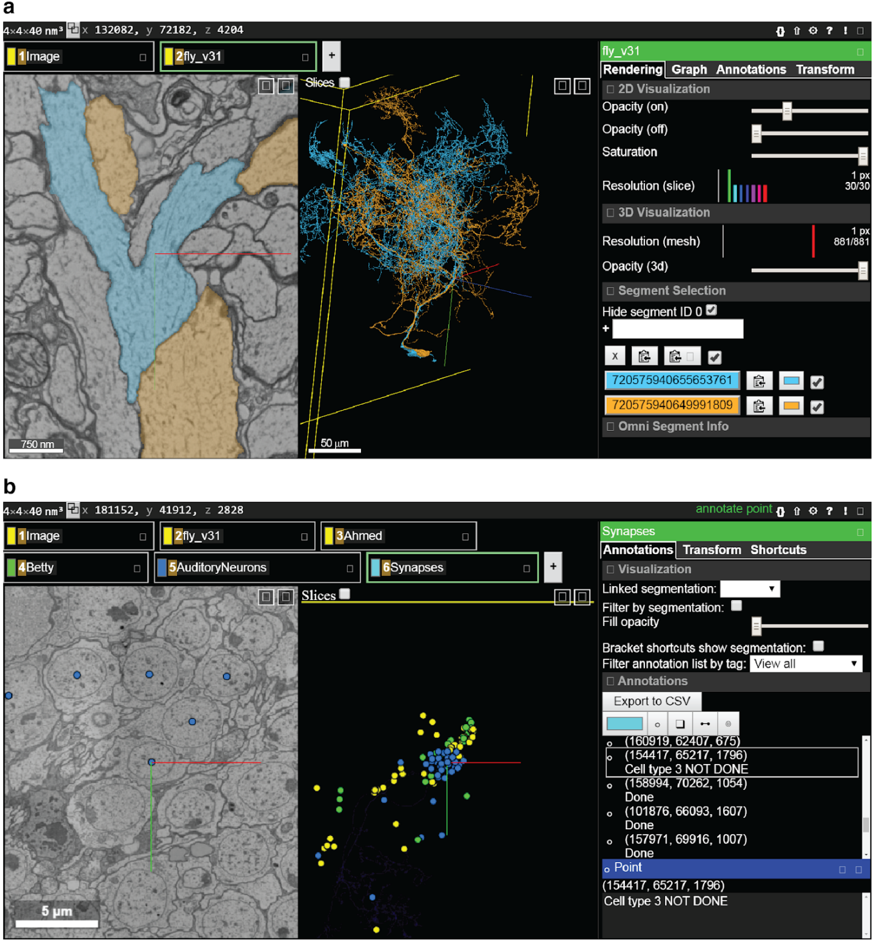
- Design: an open online proofreading community using a ChunkedGraph supervoxel graph with octree hierarchy, Google BigTable storage, and a Neuroglancer-based browser frontend; the FAFB EM dataset was realigned from v14 to v14.1 using self-supervised deep learning displacement fields.
- Data and sample: adult Drosophila melanogaster FAFB EM volume and automated segmentation; 183 neurons proofread by 13 proofreaders in three rounds; 178 mechanosensory neurons analyzed; 612 synaptic locations assessed for twig attachment; 999 synapses expert-evaluated; NBLAST comparison against 16,129 FlyCircuit cells.
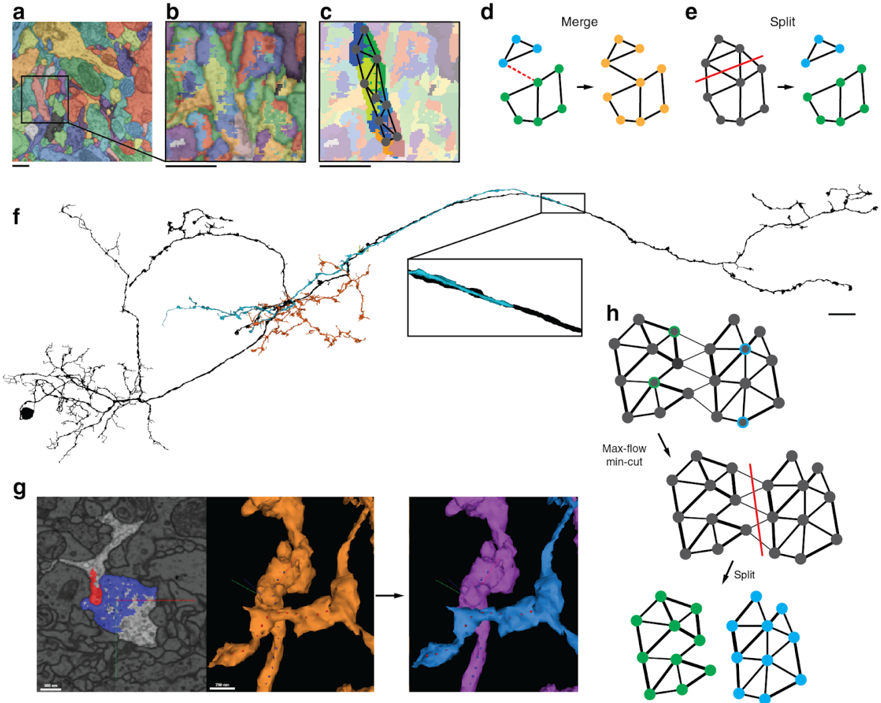
- Analysis: server response timing for graph operations; F1 scores for volumetric completeness and synapse assignment; NBLAST matching; connectivity diagrams and subtype classification by synapse thresholds; max-flow min-cut for split operations.
Limitations
- Stated: proofreading largely avoided orphan twigs, so synapses involving orphan twigs are missing; false positive synapses remain among reported cell-type-to-cell-type connections; some left-hemisphere AMMC-B1 neurons lacked part of their arbor, possibly a developmental deformity; whole-brain proofreading time assumes ~100,000 neurons and 2,000 work hours per person-year; beta server timings were affected by load and are an underestimate.
- Stated: the open community relies on entry tests and subsequent spot checks, and recruitment initially came from Drosophila labs, with plans to expand to non-scientists later.
- Evident from the text: the connectome is a draft proofread mainly at the backbone level, with accuracy depending on the user’s desired proofreading level; the mechanosensory analysis is limited to one fly brain and selected cell classes, and some connectivity calls depend on manual exclusion of questionable synapses.
Model-written summary. Check it against the paper before relying on it.
Integrity signals
Registry
Cites
Statistics
Figures
Verification
Claims the paper makes
20 Valid · 9 Not valid · 8 Not checked · 98 Own results and interpretations
The cited sources support only part of this claim — read each source’s verdict below.
In the paper
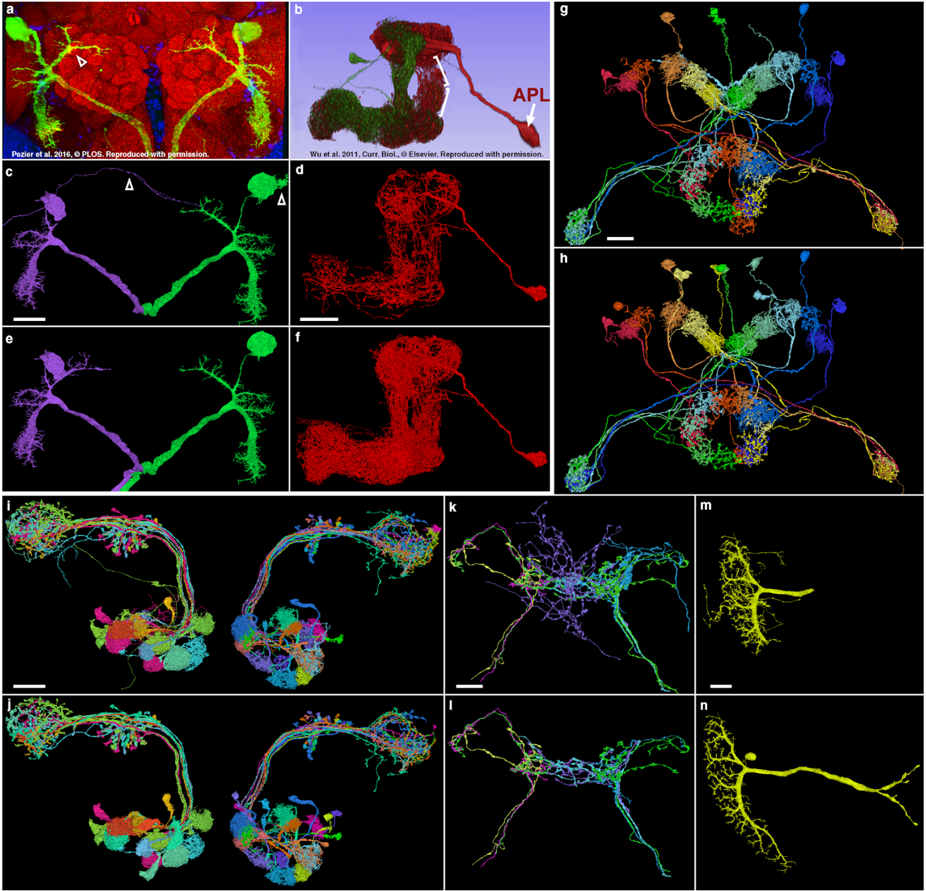
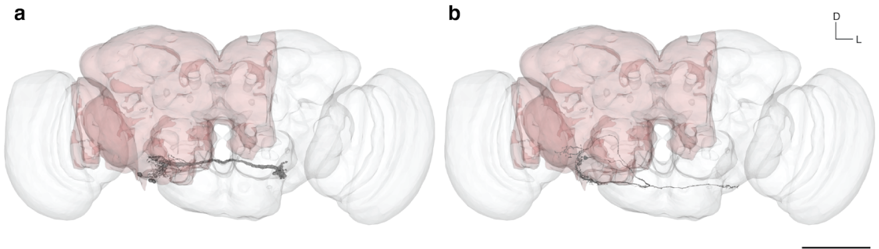
“Qualitative comparison between images of light microscopy-level stains of the giant fiber neurons 22 (Fig. 1 a,c,e) and a mushroom body APL neuron23 (Fig. 1 b,d,f) show that our semi-automated segmentation procedures are able to capture large enough portions of neurons to be easily recognizable.”
§ FlyWire: Online community for whole-brain connectomics > RESULTS > Neuron segmentation
What the sources say
- Could not verifycites [22] 22. Pézier AP, Jezzini SH, Bacon JP & Blagburn JM Shaking B Mediates Synaptic Coupling between Auditory Sensory Neurons and the Giant Fiber of Drosophila melanogaster. PLoS One 11, e0152211 (2016) doi: 10.1371/journal.pone.0152211. 27043822 PMC4833477 sourceExperimental — accuracy not yet measured
Split into 2 atoms — 0 confirmed, 0 partially supported, 0 disputed, 0 misattributed, 2 unverifiable. Expand the claim to see per-atom verdicts.
- Supportedcites [23] 23. Wu C-L Heterotypic gap junctions between two neurons in the drosophila brain are critical for memory. Curr. Biol. 21, 848– 854 (2011) doi: 10.1016/j.cub.2011.02.041. 21530256 source
Split into 2 atoms — 2 confirmed, 0 partially supported, 0 disputed, 0 misattributed, 0 unverifiable. Expand the claim to see per-atom verdicts.
plainstates a cause- Asserted: passes — The authors put it forward as true.
- Checkable: passes — It can be checked against evidence.
- Load-bearing: unclear — It is unclear whether the paper’s conclusions depend on it.
- Based: passes — The paper gives a reason why it holds.
- Could not verify
The cited sources support only part of this claim — read each source’s verdict below.
In the paper
“The walled garden community has historically used manual skeletonization to reconstruct neural circuits from FAFB 15,16.”
§ FlyWire: Online community for whole-brain connectomics > INTRODUCTION
What the sources say
- Partly supportedcites [15] 15. Felsenberg J Integration of Parallel Opposing Memories Underlies Memory Extinction. Cell 175, 709– 722.e15 (2018) doi: 10.1016/j.cell.2018.08.021. 30245010 PMC6198041 sourceExperimental — accuracy not yet measured
The STAR★Methods ‘Neuron reconstruction – tracing’ section (page unavailable) describes tracing neurons in FAFB with CATMAID along their centerlines, followed by review by experienced tracers. This supports manual, skeleton-like reconstruction of neural circuits from FAFB, but the paper does not identify a ‘walled garden community’ or establish that community’s historical practice. (LLM, conf=0.84)
- Supportedcites [16] 16. Dolan M-J Communication from Learned to Innate Olfactory Processing Centers Is Required for Memory Retrieval in Drosophila. Neuron 100, 651– 668.e8 (2018) doi: 10.1016/j.neuron.2018.08.037. 30244885 PMC6226615 source
The STAR★Methods (Method Details; page unavailable) describe manually tracing neurons in a whole adult female Drosophila brain EM volume to produce neuronal skeletons. The paper is therefore an example of the manual skeleton reconstruction practice cited in the sentence. (LLM, conf=0.86)
plain- Asserted: passes — The authors put it forward as true.
- Checkable: passes — It can be checked against evidence.
- Load-bearing: unclear — It is unclear whether the paper’s conclusions depend on it.
- Based: passes — The paper gives a reason why it holds.
- Partly supported
The cited sources support only part of this claim — read each source’s verdict below.
In the paper
“Fortunately, many fly neurons are redundantly connected, with up to hundreds of synapses between a connected pair 39.”
§ FlyWire: Online community for whole-brain connectomics > RESULTS > Extracting synaptic connections
What the sources say
- Partly supportedcites [39] 39. Takemura S-Y A visual motion detection circuit suggested by Drosophila connectomics. Nature 500, 175– 181 (2013) doi: 10.1038/nature12450. 23925240 PMC3799980 sourceExperimental — accuracy not yet measured
The Results sections on motor-neuron inputs and wiring-diagram errors describe connections with multiple synapses, often spread across multiple twigs, supporting the redundancy point. But the reported motor-neuron pairs have 1–28 synaptic inputs each; the passages do not substantiate hundreds of synapses between a connected pair. (LLM, conf=0.86)
plain- Asserted: passes — The authors put it forward as true.
- Checkable: passes — It can be checked against evidence.
- Load-bearing: passes — The paper’s conclusions depend on it.
- Based: passes — The paper gives a reason why it holds.
- Partly supported
The cited sources support only part of this claim — read each source’s verdict below.
In the paper
“adult connectomes have been mapped for only one species, C. elegans 2,3.”
§ FlyWire: Online community for whole-brain connectomics > INTRODUCTION
What the sources say
- Not checked — no full text of the sourcecites [2] 2. White JG, Southgate E, Thomson JN & Brenner S The structure of the nervous system of the nematode Caenorhabditis elegans. Philos. Trans. R. Soc. Lond. B Biol. Sci. 314, 1– 340 (1986) doi: 10.1098/rstb.1986.0056. 22462104 source
- Partly supportedcites [3] 3. Cook SJ Whole-animal connectomes of both Caenorhabditis elegans sexes. Nature 571, 63– 71 (2019) doi: 10.1038/s41586-019-1352-7. 31270481 PMC6889226 sourceExperimental — accuracy not yet measured
The Abstract reports whole-animal connectomes for both adult sexes of C. elegans. It also lists neural maps for other species, without establishing whether any are adult connectomes. The claim that C. elegans is the only species with mapped adult connectomes is therefore not supported by this copy. (LLM, conf=0.82)
plain- Asserted: passes — The authors put it forward as true.
- Checkable: passes — It can be checked against evidence.
- Load-bearing: passes — The paper’s conclusions depend on it.
- Based: passes — The paper gives a reason why it holds.
Every source the paper cites for this claim was checked and supports it.
In the paper
“Errors in the reconstruction were corrected by 50 person-years of human proofreading to create a first draft of the hemibrain connectome.”
§ FlyWire: Online community for whole-brain connectomics > INTRODUCTION
What the sources say
- Supportedcites [4] 4. Scheffer LK A connectome and analysis of the adult Drosophila central brain. Elife 9, (2020) doi: 10.7554/eLife.57443. PMC7546738 32880371 source
The Connectome reconstruction section reports over 50 person-years of proofreading effort to produce the hemibrain’s neuron and connectivity data. The Proofreading section says human proofreaders corrected errors left by machine segmentation. The paper says “over 50,” rather than exactly 50, person-years. (LLM, conf=0.91)
plainstates a cause- Asserted: passes — The authors put it forward as true.
- Checkable: passes — It can be checked against evidence.
- Load-bearing: unclear — It is unclear whether the paper’s conclusions depend on it.
- Based: passes — The paper gives a reason why it holds.
- Supported
50 more claims · 4 with their cited sources checked
Create a free account to see all 135 claims and to verify the 1 reference still open.
- Probably not a substantial claim. 36
- It may state two separate claims as one. 54
- The quote only partly states this claim. 1
Claims other papers make about this one
Each is checked against this paper’s own text: does it say what the citing paper says it does?
The cited source doesn’t support the claim as written.
In the citing paper
“The completion of the first whole-brain connectome of an adult fly, containing over 130,000 neurons and millions of synaptic connections1–3, offers an opportunity to analyse the statistical properties and topological features of a complete brain.”
From Network statistics of the whole-brain connectome of Drosophila (2024) · cites this paper as [2]
Checked by a reasoning model — may be wrong.
Experimental — accuracy not yet measuredThe source backs part of the claim, not all of it — or backs it for a different population, condition or comparison.
In the citing paper
“As previously described55, proofreading of the connectome was focused on the microtubule-rich ‘backbones’ of neurons. Microtubule-free ‘twigs’ were only added if discovered incidentally or sought out specifically by members of the community.”
From Neuronal wiring diagram of an adult brain (2023) · cites this paper as [55]
Experimental — accuracy not yet measuredThe source backs part of the claim, not all of it — or backs it for a different population, condition or comparison.
In the citing paper
“Whole nervous system connectome projects are nearing completion for the adult fruit fly 2,13”
From Connectome-constrained deep mechanistic networks predict neural responses across the fly visual system at single-neuron resolution (2023) · cites this paper as [13]
Experimental — accuracy not yet measuredThe source backs part of the claim, not all of it — or backs it for a different population, condition or comparison.
In the citing paper
“In the connectome we built using FlyWire 31, which allows proofreading of EM reconstructions in an entire female brain 39”
From Neural network organization for courtship-song feature detection in Drosophila (2022) · cites this paper as [31]
Experimental — accuracy not yet measuredThe source backs part of the claim, not all of it — or backs it for a different population, condition or comparison.
In the citing paper
“When ready, an onboarding coordinator tested the new proofreader before giving access to the Production dataset8.”
From Neuronal wiring diagram of an adult brain (2024) · cites this paper as [8]
Experimental — accuracy not yet measured
10 more claims about this paper
Create a free account to see every claim other papers make about this one.
Self-check
Percentages, sums and reported differences re-computed from the paper’s own numbers.
Each contradiction between two passages listed here was confirmed by an independent check.
Rated major: it would touch a result — a value a result rests on, reported and recomputed p-values on opposite sides of the significance level, two passages that conflict with no sign which is right, or a cited work retracted before this paper was published.
In the paper
§ FlyWire: Online community for whole-brain connectomics > RESULTS > Connections and subtypes in mechanosensory pathways
“AMMC-B1–4 neurons target only the WV-WV neurons”
§ FlyWire: Online community for whole-brain connectomics > METHODS > Cell type division by connectivity
“From the remaining AMMC-B1 cells, we labeled those as AMMC-B1–4 if they made at least 20 synapses onto AMMC-A1, AMMC-A2 and GFN cells combined.”
Rated minor: it would not touch a result — a value no result rests on, a p-value that stays on the same side of the significance level, or a conflict that is clerical, resolved elsewhere in the paper, or outside its own findings.
In the paper
§ FlyWire: Online community for whole-brain connectomics > RESULTS > Extracting synaptic connections
“We quantified synapses missing due to orphan twigs by evaluating the segmentation at 612 randomly picked synaptic locations.”
§ FlyWire: Online community for whole-brain connectomics > METHODS > Twig and backbone synapse evaluation
“One expert evaluated all synapses as true positive (615), false positive (285) or ambiguous (99) synapses. Next, this expert evaluated the reconstructions of the pre- and postsynaptic sides of the true positive synapses”
Citations
Cites
The structure of the nervous system of the nematode Caenorhabditis elegans
White, J. G., Southgate, E., Thomson, J. N., & Brenner, S. (1986) · Philosophical Transactions of the Royal Society of London. B, Biological Sciences · doi:10.1098/rstb.1986.0056 · Cited by 5,589
Bigtable: A Distributed Storage System for Structured Data
Chang, F., Dean, J., Ghemawat, S., Hsieh, W. C., Wallach, D. A., Burrows, M., Chandra, T., Fikes, A., & Gruber, R. E. (2008) · ACM Transactions on Computer Systems · doi:10.1145/1365815.1365816 · Cited by 3,460
Internet encyclopaedias go head to head
Giles, J. (2005) · Nature · doi:10.1038/438900a · Cited by 1,978
Whole-brain functional imaging at cellular resolution using light-sheet microscopy
Ahrens, M. B., Orger, M. B., Robson, D. N., Li, J. M., & Keller, P. J. (2013) · Nature Methods · doi:10.1038/nmeth.2434 · Cited by 1,392
A connectome and analysis of the adult Drosophila central brain
Scheffer, L. K., Xu, C. S., Januszewski, M., Lu, Z., Takemura, S.-Y., Hayworth, K. J., Huang, G. B., Shinomiya, K., Maitlin-Shepard, J., Berg, S., et al. (2020) · eLife · doi:10.7554/elife.57443 · Cited by 1,128 · cited 3×
“(4) 8 bits for a counter Dorkenwald et al.”
BackgroundInfluentialA Complete Electron Microscopy Volume of the Brain of Adult Drosophila melanogaster
Zheng, Z., Lauritzen, J. S., Perlman, E., Robinson, C. G., Nichols, M., Milkie, D., Torrens, O., Price, J., Fisher, C. B., Sharifi, N., et al. (2018) · Cell · doi:10.1016/j.cell.2018.06.019 · Cited by 1,050
Whole-animal connectomes of both Caenorhabditis elegans sexes
Cook, S. J., Jarrell, T. A., Brittin, C. A., Wang, Y., Bloniarz, A. E., Yakovlev, M. A., Nguyen, K. C. Q., Tang, L. T.-H., Bayer, E. A., Duerr, J. S., et al. (2019) · Nature · doi:10.1038/s41586-019-1352-7 · Cited by 921
Chiang, A.-S., Lin, C.-Y., Chuang, C.-C., Chang, H.-M., Hsieh, C.-H., Yeh, C.-W., Shih, C.-T., Wu, J.-J., Wang, G.-T., Chen, Y.-C., et al. (2011) · Current Biology · doi:10.1016/j.cub.2010.11.056 · Cited by 767
Self-citationNeural dynamics for landmark orientation and angular path integration
Seelig, J. D., & Jayaraman, V. (2015) · Nature · doi:10.1038/nature14446 · Cited by 718
A visual motion detection circuit suggested by Drosophila connectomics
Takemura, S.-Y., Bharioke, A., Lu, Z., Nern, A., Vitaladevuni, S., Rivlin, P. K., Katz, W. T., Olbris, D. J., Plaza, S. M., Winston, P., et al. (2013) · Nature · doi:10.1038/nature12450 · Cited by 686
Research works printed but not linked: 1
- Mu, S. et al. 3D reconstruction of cell nuclei in a full Drosophila brain. Preprint at bioRxiv https://doi.org/10.1101/2020.04.17.047167 (2021). · DOI · Paper page
Cited by
Neuronal wiring diagram of an adult brain
Dorkenwald, S., Matsliah, A., Sterling, A. R., Schlegel, P., Yu, S.-C., McKellar, C. E., Lin, A., Costa, M., Eichler, K., Yin, Y., et al. (2024) · Nature · doi:10.1038/s41586-024-07558-y · Cited by 570
“We previously rea-ligned the electron microscopy images, automatically segmented all neurons in the images, created a computational system that allows interactive proofreading of the segmentation 50 , and assembled an online community 8 (FlyWire).”
BackgroundMethodInfluentialSelf-citationWhole-brain annotation and multi-connectome cell typing of Drosophila
Schlegel, P., Yin, Y., Bates, A. S., Dorkenwald, S., Eichler, K., Brooks, P., Han, D. S., Gkantia, M., dos Santos, M., Munnelly, E. J., et al. (2024) · Nature · doi:10.1038/s41586-024-07686-5 · Cited by 413
Self-citationHulse, B. K., Haberkern, H., Franconville, R., Turner-Evans, D., Takemura, S.-Y., Wolff, T., Noorman, M., Dreher, M., Dan, C., Parekh, R., et al. (2021) · eLife · doi:10.7554/elife.66039 · Cited by 392
A petavoxel fragment of human cerebral cortex reconstructed at nanoscale resolution
Shapson-Coe, A., Januszewski, M., Berger, D. R., Pope, A., Wu, Y., Blakely, T., Schalek, R. L., Li, P. H., Wang, S., Maitin-Shepard, J., et al. (2024) · Science · doi:10.1126/science.adk4858 · Cited by 361
Self-citationQuantifying behavior to understand the brain
Pereira, T. D., Shaevitz, J. W., & Murthy, M. (2020) · Nature Neuroscience · doi:10.1038/s41593-020-00734-z · Cited by 309
Self-citationEckstein, N., Bates, A. S., Champion, A., Du, M., Yin, Y., Schlegel, P., Lu, A. K.-Y., Rymer, T., Finley-May, S., Paterson, T., et al. (2024) · Cell · doi:10.1016/j.cell.2024.03.016 · Cited by 277
“…to generate the connectome for a large part of the D. melanogaster brain (Scheffer et al., 2020a) and are being used to generate the first full brain connectome for D. melanogaster (Zheng et al., 2018; Dorkenwald et al., 2022) and a connectome for its ventral nervous system (Azevedo et al., 2022).”
InfluentialSelf-citationPhelps, J. S., Hildebrand, D. G. C., Graham, B. J., Kuan, A. T., Thomas, L. A., Nguyen, T. M., Buhmann, J., Azevedo, A. W., Sustar, A., Agrawal, S., et al. (2021) · Cell · doi:10.1016/j.cell.2020.12.013 · Cited by 265
A connectomic study of a petascale fragment of human cerebral cortex
Shapson-Coe, A., Januszewski, M., Berger, D. R., Pope, A., Wu, Y., Blakely, T., Schalek, R. L., Li, P. H., Wang, S., Maitin-Shepard, J., et al. (2021) · doi:10.1101/2021.05.29.446289 · Cited by 243
Self-citationPeddie, C. J., Genoud, C., Kreshuk, A., Meechan, K., Micheva, K. D., Narayan, K., Pape, C., Parton, R. G., Schieber, N. L., Schwab, Y., et al. (2022) · Nature Reviews Methods Primers · doi:10.1038/s43586-022-00131-9 · Cited by 225
Functional connectomics spanning multiple areas of mouse visual cortex
The MICrONS Consortium, Bae, J. A., Baptiste, M., Baptiste, M. R., Bishop, C. A., Bodor, A. L., Brittain, D., Brooks, V., Buchanan, J., Bumbarger, D. J., et al. (2025) · Nature · doi:10.1038/s41586-025-08790-w · Cited by 190
Self-citationFunctional connectomics spanning multiple areas of mouse visual cortex
The MICrONS Consortium, Bae, J. A., Baptiste, M., Bishop, C. A., Bodor, A. L., Brittain, D., Buchanan, J., Bumbarger, D. J., Castro, M. A., Celii, B., et al. (2021) · doi:10.1101/2021.07.28.454025 · Cited by 214
Self-citationReconstruction of neocortex: Organelles, compartments, cells, circuits, and activity
Turner, N. L., Macrina, T., Bae, J. A., Yang, R., Wilson, A. M., Schneider-Mizell, C., Lee, K., Lu, R., Wu, J., Bodor, A. L., et al. (2022) · Cell · doi:10.1016/j.cell.2022.01.023 · Cited by 206
Self-citationInformation flow, cell types and stereotypy in a full olfactory connectome
Schlegel, P., Bates, A. S., Stürner, T., Jagannathan, S. R., Drummond, N., Hsu, J., Serratosa Capdevila, L., Javier, A., Marin, E. C., Barth-Maron, A., et al. (2021) · eLife · doi:10.7554/elife.66018 · Cited by 178
“ai/) (Dorkenwald et al., 2020) where we reconstructed neurons that descend from the brain through the neck connective.”
BackgroundResultNeuronal wiring diagram of an adult brain
Dorkenwald, S., Matsliah, A., Sterling, A. R., Schlegel, P., Yu, S.-C., McKellar, C. E., Lin, A., Costa, M., Eichler, K., Yin, Y., et al. (2023) · doi:10.1101/2023.06.27.546656 · Cited by 149
Self-citationNetwork statistics of the whole-brain connectome of Drosophila
Lin, A., Yang, R., Dorkenwald, S., Matsliah, A., Sterling, A. R., Schlegel, P., Yu, S.-C., McKellar, C. E., Costa, M., Eichler, K., et al. (2024) · Nature · doi:10.1038/s41586-024-07968-y · Cited by 147
“We then compared this expec-982 tation to the true frequency of motifs with these neurotransmit-983 ter combinations.”
Self-citationInhibitory specificity from a connectomic census of mouse visual cortex
Schneider-Mizell, C. M., Bodor, Á. L., Brittain, D., Buchanan, J., Bumbarger, D. J., Elabbady, L., Gamlin, C. R., Kapner, D., Kinn, S., Mahalingam, G., et al. (2025) · Nature · doi:10.1038/s41586-024-07780-8 · Cited by 150
“Each chunk is called a ‘level 2 chunk’, and the complete set of chunks for a neuron and their adjacency we call the ‘level 2 graph’ on the basis of its location in the hierarchy of the PyChunkedGraph data structure 27 .”
Self-citationNetwork Statistics of the Whole-Brain Connectome of Drosophila
Lin, A., Yang, R., Dorkenwald, S., Matsliah, A., Sterling, A. R., Schlegel, P., Yu, S.-C., McKellar, C. E., Costa, M., Eichler, K., et al. (2023) · doi:10.1101/2023.07.29.551086 · Cited by 147
Self-citationChemoreceptor co-expression in Drosophila melanogaster olfactory neurons
Task, D., Lin, C.-C., Vulpe, A., Afify, A., Ballou, S., Brbic, M., Schlegel, P., Raji, J., Jefferis, G. S., Li, H., et al. (2022) · eLife · doi:10.7554/elife.72599 · Cited by 141
Eckstein, N., Bates, A. S., Champion, A., Du, M., Yin, Y., Schlegel, P., Lu, A. K.-Y., Rymer, T., Finley-May, S., Paterson, T., et al. (2020) · doi:10.1101/2020.06.12.148775 · Cited by 115
Self-citationSynaptic connectome of the Drosophila circadian clock
Reinhard, N., Fukuda, A., Manoli, G., Derksen, E., Saito, A., Möller, G., Sekiguchi, M., Rieger, D., Helfrich-Förster, C., Yoshii, T., et al. (2024) · Nature Communications · doi:10.1038/s41467-024-54694-0 · Cited by 103
“For visualizing a large number of neurons, Codex (doi: 10.13140/ RG.2.2.35928.67844) and FlyWire neuroglancer were used 92 .”
InfluentialTools for connectomic reconstruction and analysis of a female Drosophila ventral nerve cord
Azevedo, A., Lesser, E., Phelps, J. S., Mark, B., Elabbady, L., Kuroda, S., Sustar, A., Moussa, A., Kandelwal, A., Dallmann, C. J., et al. (2022) · doi:10.1101/2022.12.15.520299 · Cited by 120
Self-citationConnectomic reconstruction of a female Drosophila ventral nerve cord
Azevedo, A., Lesser, E., Phelps, J. S., Mark, B., Elabbady, L., Kuroda, S., Sustar, A., Moussa, A., Khandelwal, A., Dallmann, C. J., et al. (2024) · Nature · doi:10.1038/s41586-024-07389-x · Cited by 120
“…soma, requiring merging two objects; a missing branch—for example, from the primary neurite, requiring merging the branch onto the larger MN object; or incorrect merges with glia, which wrap around the MN axons in the nerve and can be segmented with the MN, requiring splitting the object 21 .”
InfluentialSelf-citationThe neural basis for a persistent internal state in Drosophila females
Deutsch, D., Pacheco, D., Encarnacion-Rivera, L., Pereira, T., Fathy, R., Clemens, J., Girardin, C., Calhoun, A., Ireland, E., Burke, A., et al. (2020) · eLife · doi:10.7554/elife.59502 · Cited by 115
Self-citationStructure and function of axo-axonic inhibition
Schneider-Mizell, C. M., Bodor, A. L., Collman, F., Brittain, D., Bleckert, A., Dorkenwald, S., Turner, N. L., Macrina, T., Lee, K., Lu, R., et al. (2021) · eLife · doi:10.7554/elife.73783 · Cited by 80
Self-citationThe Neural Basis for a Persistent Internal State in Drosophila Females
Deutsch, D., Pacheco, D. A., Encarnacion-Rivera, L. J., Pereira, T., Fathy, R., Calhoun, A., Ireland, E. C., Burke, A. T., Dorkenwald, S., McKellar, C., et al. (2020) · doi:10.1101/2020.02.13.947952 · Cited by 115
Self-citationSynaptic connectome of the Drosophila circadian clock
Reinhard, N., Fukuda, A., Manoli, G., Derksen, E., Saito, A., Möller, G., Sekiguchi, M., Rieger, D., Helfrich-Förster, C., Yoshii, T., et al. (2023) · doi:10.1101/2023.09.11.557222 · Cited by 110
Functional connectomics reveals general wiring rule in mouse visual cortex
Ding, Z., Fahey, P. G., Papadopoulos, S., Wang, E. Y., Celii, B., Papadopoulos, C., Chang, A., Kunin, A. B., Tran, D., Fu, J., et al. (2025) · Nature · doi:10.1038/s41586-025-08840-3 · Cited by 95
Self-citationWhole-brain annotation and multi-connectome cell typing quantifies circuit stereotypy in Drosophila
Schlegel, P., Yin, Y., Bates, A. S., Dorkenwald, S., Eichler, K., Brooks, P., Han, D. S., Gkantia, M., dos Santos, M., Munnelly, E. J., et al. (2023) · doi:10.1101/2023.06.27.546055 · Cited by 102
Self-citationVitessce: integrative visualization of multimodal and spatially resolved single-cell data
Keller, M. S., Gold, I., McCallum, C., Manz, T., Kharchenko, P. V., & Gehlenborg, N. (2024) · Nature Methods · doi:10.1038/s41592-024-02436-x · Cited by 123
A Drosophila computational brain model reveals sensorimotor processing
Shiu, P. K., Sterne, G. R., Spiller, N., Franconville, R., Sandoval, A., Zhou, J., Simha, N., Kang, C. H., Yu, S., Kim, J. S., et al. (2024) · Nature · doi:10.1038/s41586-024-07763-9 · Cited by 97
“…that generate behaviour, we implement a simple leaky integrate-and-fire model using the connection weights derived from the entire adult Drosophila central brain connectome of reconstructed electron microscopy neurons 1,17–20 , as well as neurotransmitter predictions for each neuron 3,21 .”
MethodSelf-citationSterne, G. R., Otsuna, H., Dickson, B. J., & Scott, K. (2021) · eLife · doi:10.7554/elife.71679 · Cited by 93
“Labial- GAL4 was crossed to a reporter line with UAS- nlsGCaMP6s (this work) and UAS- His2Av- mRFP (Emery et al., 2005).”
MethodNeuronal parts list and wiring diagram for a visual system
Matsliah, A., Yu, S.-C., Kruk, K., Bland, D., Burke, A. T., Gager, J., Hebditch, J., Silverman, B., Willie, K. P., Willie, R., et al. (2024) · Nature · doi:10.1038/s41586-024-07981-1 · Cited by 85
“The brain of a single Drosophila adult female was reconstructed by the FlyWire Consortium 24,31 .”
MethodSelf-citationCAVE: Connectome Annotation Versioning Engine
Dorkenwald, S., Schneider-Mizell, C. M., Brittain, D., Halageri, A., Jordan, C., Kemnitz, N., Castro, M. A., Silversmith, W., Maitin-Shephard, J., Troidl, J., et al. (2025) · Nature Methods · doi:10.1038/s41592-024-02426-z · Cited by 78
“13,28,40), FlyWire 29 and FANC 37,44 , users have created over 120 annotation tables (including 29 reference tables) using 21 distinct schemas and capturing over 1.8 billion annotations.”
InfluentialSelf-citationTheory of the Multiregional Neocortex: Large-Scale Neural Dynamics and Distributed Cognition
Wang, X.-J. (2022) · Annual Review of Neuroscience · doi:10.1146/annurev-neuro-110920-035434 · Cited by 83
Applications of deep learning in electron microscopy
Treder, K. P., Huang, C., Kim, J. S., & Kirkland, A. I. (2022) · Microscopy · doi:10.1093/jmicro/dfab043 · Cited by 91
“While still not fully automated, the connectomic reconstruction of mouse retina [37] and fly brain [181] has attracted significant interest accompanied by further advancement in ML methods [103,122–124] and innovative data annotation through cloud-based environments [123] and crowdsourcing [37,135].”
CAVE: Connectome Annotation Versioning Engine
Dorkenwald, S., Schneider-Mizell, C. M., Brittain, D., Halageri, A., Jordan, C., Kemnitz, N., Castro, M. A., Silversmith, W., Maitin-Shephard, J., Troidl, J., et al. (2023) · doi:10.1101/2023.07.26.550598 · Cited by 79
Self-citationGenerating parallel representations of position and identity in the olfactory system
Taisz, I., Donà, E., Münch, D., Bailey, S. N., Morris, B. J., Meechan, K. I., Stevens, K. M., Varela-Martínez, I., Gkantia, M., Schlegel, P., et al. (2023) · Cell · doi:10.1016/j.cell.2023.04.038 · Cited by 79
Imaging whole-brain activity to understand behaviour
Lin, A., Witvliet, D. K., Hernandez-Nunez, L., Linderman, S. W., Samuel, A. D. T., & Venkatachalam, V. (2022) · Nature Reviews Physics · doi:10.1038/s42254-022-00430-w · Cited by 87
Local shape descriptors for neuron segmentation
Sheridan, A., Nguyen, T. M., Deb, D., Lee, W.-C. A., Saalfeld, S., Turaga, S. C., Manor, U., & Funke, J. (2023) · Nature Methods · doi:10.1038/s41592-022-01711-z · Cited by 71
“We further investigated how VOI and ERL relate to proof-reading effort given the capabilities of contemporary proof-reading tools (Zhao et al., 2018; Dorkenwald et al., 2022) and found that VOI is a considerably more reliable proxy for proof-reading effort than ERL (see Figure 3B, 3D, Figure 18, and…”
Structured sampling of olfactory input by the fly mushroom body
Zheng, Z., Li, F., Fisher, C., Ali, I. J., Sharifi, N., Calle-Schuler, S., Hsu, J., Masoodpanah, N., Kmecova, L., Kazimiers, T., et al. (2022) · Current Biology · doi:10.1016/j.cub.2022.06.031 · Cited by 75
Synaptic architecture of leg and wing premotor control networks in Drosophila
Lesser, E., Azevedo, A. W., Phelps, J. S., Elabbady, L., Cook, A., Syed, D. S., Mark, B., Kuroda, S., Sustar, A., Moussa, A., et al. (2024) · Nature · doi:10.1038/s41586-024-07600-z · Cited by 71
“Motor neuron volume and surface area were calculated using the statistics of the level 2 cache, which is the graph of ‘level 2 chunks’ in the hierarchy of the PyChunkedGraph data structure 43,64 .”
Self-citationSynaptic architecture of leg and wing premotor control networks in Drosophila
Lesser, E., Azevedo, A. W., Phelps, J. S., Elabbady, L., Cook, A., Syed, D. S., Mark, B., Kuroda, S., Sustar, A., Moussa, A., et al. (2023) · doi:10.1101/2023.05.30.542725 · Cited by 71
“Motor neuron volume and surface area were calculated using the statistics of the level 2 cache, which is the graph of “level 2 chunks” in the hierarchy of the ChunkedGraph data structure (Dorkenwald et al., 2022; Schneider-Mizell et al., 2023).”
Self-citationDistributed control circuits across a brain-and-cord connectome
Bates, A. S., Phelps, J. S., Kim, M., Yang, H. H., Matsliah, A., Ajabi, Z., Perlman, E., Delgado, K. M., Osman, M. A. M., Salmon, C. K., et al. (2026) · Nature · doi:10.1038/s41586-026-10735-w · Cited by 100
“We considered a neuron ‘backbone proofread’ [backbone_proofread.parquet] when its primary neurites (if not sensory) or major microtubule-rich processes had undergone a thorough review 27 .”
Self-citationNeural circuit mechanisms for steering control in walking Drosophila
Rayshubskiy, A., Holtz, S. L., Bates, A. S., Vanderbeck, Q. X., Capdevila, L. S., Rockwell, V., & Wilson, R. I. (2020) · doi:10.1101/2020.04.04.024703 · Cited by 64
“We contributed all this information (proofreading and cell type names) to the FlyWire community platform (Dorkenwald et al., 2022) as this study progressed.”
Neuronal circuits integrating visual motion information in Drosophila melanogaster
Shinomiya, K., Nern, A., Meinertzhagen, I. A., Plaza, S. M., & Reiser, M. B. (2022) · Current Biology · doi:10.1016/j.cub.2022.06.061 · Cited by 64
Descending neurons coordinate anterior grooming behavior in Drosophila
Guo, L., Zhang, N., & Simpson, J. H. (2022) · Current Biology · doi:10.1016/j.cub.2021.12.055 · Cited by 63
Kind, E., Longden, K. D., Nern, A., Zhao, A., Sancer, G., Flynn, M. A., Laughland, C. W., Gezahegn, B., Ludwig, H. D., Thomson, A. G., et al. (2021) · eLife · doi:10.7554/elife.71858 · Cited by 64
Connectomics and the neural basis of behaviour
Galili, D. S., Jefferis, G. S., & Costa, M. (2022) · Current Opinion in Insect Science · doi:10.1016/j.cois.2022.100968 · Cited by 54
“2 This, together with image alignment optimisation methods has resulted in better outputs from automated segmentation methods for neuronal profiles [3,5,6] and synaptic partners [3,7,8].”
BackgroundMethodAscending neurons convey behavioral state to integrative sensory and action selection brain regions
Chen, C.-L., Aymanns, F., Minegishi, R., Matsuda, V. D. V., Talabot, N., Günel, S., Dickson, B. J., & Ramdya, P. (2023) · Nature Neuroscience · doi:10.1038/s41593-023-01281-z · Cited by 58
“This hypothesis may soon be tested using con-nectomics datasets 54–56 .”
MethodMapping the neural dynamics of locomotion across the Drosophila brain
Brezovec, B. E., Berger, A. B., Hao, Y. A., Chen, F., Druckmann, S., & Clandinin, T. R. (2024) · Current Biology · doi:10.1016/j.cub.2023.12.063 · Cited by 58
Neural network organization for courtship-song feature detection in Drosophila
Baker, C. A., McKellar, C., Pang, R., Nern, A., Dorkenwald, S., Pacheco, D. A., Eckstein, N., Funke, J., Dickson, B. J., & Murthy, M. (2022) · Current Biology · doi:10.1016/j.cub.2022.06.019 · Cited by 57
Self-citationTaste quality and hunger interactions in a feeding sensorimotor circuit
Shiu, P. K., Sterne, G. R., Engert, S., Dickson, B. J., & Scott, K. (2022) · eLife · doi:10.7554/elife.79887 · Cited by 56
Petascale neural circuit reconstruction: automated methods
Macrina, T., Lee, K., Lu, R., Turner, N. L., Wu, J., Popovych, S., Silversmith, W., Kemnitz, N., Bae, J. A., Castro, M. A., et al. (2021) · doi:10.1101/2021.08.04.455162 · Cited by 55
“A 100 TB dataset of an entire Drosophila brain (Zheng et al. 2018) has been automatically reconstructed and is currently being proofread (P. H. Li et al. 2019; S. Dorkenwald et al. 2020).”
MethodSelf-citationLi, P. H., Lindsey, L. F., Januszewski, M., Zheng, Z., Bates, A. S., Taisz, I., Tyka, M., Nichols, M., Li, F., Perlman, E., et al. (2019) · doi:10.1101/605634 · Cited by 55
“One alternative segmentation of FAFB based on further refinement of the global alignment and an expanded training dataset has recently been released through the open-access, centrally-managed FlyWire tracing environment (Dorkenwald et al. 2020).”
MethodCheong, H. S., Eichler, K., Stürner, T., Asinof, S. K., Champion, A. S., Marin, E. C., Oram, T. B., Sumathipala, M., Venkatasubramanian, L., Namiki, S., et al. (2026) · eLife · doi:10.7554/elife.96084 · Cited by 54
Neural circuit mechanisms underlying context-specific halting in Drosophila
Sapkal, N., Mancini, N., Kumar, D. S., Spiller, N., Murakami, K., Vitelli, G., Bargeron, B., Maier, K., Eichler, K., Jefferis, G. S. X. E., et al. (2023) · doi:10.1101/2023.09.25.559438 · Cited by 54
Neural circuit mechanisms underlying context-specific halting in Drosophila
Sapkal, N., Mancini, N., Kumar, D. S., Spiller, N., Murakami, K., Vitelli, G., Bargeron, B., Maier, K., Eichler, K., Jefferis, G. S. X. E., et al. (2024) · Nature · doi:10.1038/s41586-024-07854-7 · Cited by 54
“Guided by the whole fly brain connectome and the FlyWire toolkit 26 , we asked if and where the halting and walking pathways might converge.”
Virtual Fly Brain—An interactive atlas of the Drosophila nervous system
Court, R., Costa, M., Pilgrim, C., Millburn, G., Holmes, A., McLachlan, A., Larkin, A., Matentzoglu, N., Kir, H., Parkinson, H., et al. (2023) · Frontiers in Physiology · doi:10.3389/fphys.2023.1076533 · Cited by 55
Descending networks transform command signals into population motor control
Braun, J., Hurtak, F., Wang-Chen, S., & Ramdya, P. (2024) · Nature · doi:10.1038/s41586-024-07523-9 · Cited by 51
“We investigated these possibilities by examining DN–DN connectivity within the female adult fly brain connectome 7,37,38 .”
Cheong, H. S., Eichler, K., Stürner, T., Asinof, S. K., Champion, A. S., Marin, E. C., Oram, T. B., Sumathipala, M., Venkatasubramanian, L., Namiki, S., et al. (2024) · doi:10.7554/elife.96084.1 · Cited by 51
Motor control on the move: from insights in insects to general mechanisms
Büschges, A., & Ache, J. M. (2024) · Physiological Reviews · doi:10.1152/physrev.00009.2024 · Cited by 58
González-Segarra, A. J., Pontes, G. B., Jourjine, N., Toro, A. D., & Scott, K. (2023) · eLife · doi:10.7554/elife.88143 · Cited by 46
Eye structure shapes neuron function in Drosophila motion vision
Zhao, A., Gruntman, E., Nern, A., Iyer, N., Rogers, E. M., Koskela, S., Siwanowicz, I., Dreher, M., Flynn, M. A., Laughland, C. W., et al. (2025) · Nature · doi:10.1038/s41586-025-09276-5 · Cited by 56
“We also used two auto-segmentations of the same dataset, FAFB-FFN1 61 and FlyWire 62 , to quickly examine many auto-segmented fragments for neurons of interest.”
Gliotransmission of D-serine promotes thirst-directed behaviors in Drosophila
Park, A., Croset, V., Otto, N., Agarwal, D., Treiber, C. D., Meschi, E., Sims, D., & Waddell, S. (2022) · Current Biology · doi:10.1016/j.cub.2022.07.038 · Cited by 45
Olfactory navigation in arthropods
Steele, T., Lanz, A. J., & Nagel, K. I. (2023) · Journal of Comparative Physiology A · doi:10.1007/s00359-022-01611-9 · Cited by 50
Connectomic reconstruction predicts visual features used for navigation
Garner, D., Kind, E., Lai, J. Y. H., Nern, A., Zhao, A., Houghton, L., Sancer, G., Wolff, T., Rubin, G. M., Wernet, M. F., et al. (2024) · Nature · doi:10.1038/s41586-024-07967-z · Cited by 56
“We used the FlyWire interface, which auto-segmented FAFB EM data to construct three-dimensional seg-mentations of individual neurons 29 .”
InfluentialHow innovations in methodology offer new prospects for volume electron microscopy
Kievits, A. J., Lane, R. I., Carroll, E. C., & Hoogenboom, J. P. (2022) · Journal of Microscopy · doi:10.1111/jmi.13134 · Cited by 47
Perisomatic ultrastructure efficiently classifies cells in mouse cortex
Elabbady, L., Seshamani, S., Mu, S., Mahalingam, G., Schneider-Mizell, C. M., Bodor, Á. L., Bae, J. A., Brittain, D., Buchanan, J., Bumbarger, D. J., et al. (2025) · Nature · doi:10.1038/s41586-024-07765-7 · Cited by 45
“Proofreading was carried out by five expert neuro-anatomists using the Connectome Annotation Versioning Engine 56,57 and a modified version of Neuroglancer 58 .”
Self-citationFlexible circuit mechanisms for context-dependent song sequencing
Roemschied, F. A., Pacheco, D. A., Aragon, M. J., Ireland, E. C., Li, X., Thieringer, K., Pang, R., & Murthy, M. (2023) · Nature · doi:10.1038/s41586-023-06632-1 · Cited by 44
Self-citationNEURD offers automated proofreading and feature extraction for connectomics
Celii, B., Papadopoulos, S., Ding, Z., Fahey, P. G., Wang, E. Y., Papadopoulos, C., Kunin, A. B., Patel, S. S., Bae, J. A., Bodor, Á. L., et al. (2025) · Nature · doi:10.1038/s41586-025-08660-5 · Cited by 49
Self-citationPetascale pipeline for precise alignment of images from serial section electron microscopy
Popovych, S., Macrina, T., Kemnitz, N., Castro, M., Nehoran, B., Jia, Z., Bae, J. A., Mitchell, E., Mu, S., Trautman, E. T., et al. (2024) · Nature Communications · doi:10.1038/s41467-023-44354-0 · Cited by 39
“1 alignment Dorkenwald, et al. 31 used a network architecture presented in Hui, et al. 33 in combination with loss drop similar to Yoo, et al. 17 , but applied speci fi cally to defects detected by a convolutional net 23 .”
BackgroundMethodSelf-citationDescending control and regulation of spontaneous flight turns in Drosophila
Ros, I. G., Omoto, J. J., & Dickinson, M. H. (2024) · Current Biology · doi:10.1016/j.cub.2023.12.047 · Cited by 36
Predicting visual function by interpreting a neuronal wiring diagram
Seung, H. S. (2024) · Nature · doi:10.1038/s41586-024-07953-5 · Cited by 50
“As detailed elsewhere 16,61 , neurons were reconstructed by human proofreading of a 3D electron micrograph that was automatically segmented using convolutional nets.”
Self-citationThe fly connectome reveals a path to the effectome
Pospisil, D. A., Aragon, M. J., Dorkenwald, S., Matsliah, A., Sterling, A. R., Schlegel, P., Yu, S.-C., McKellar, C. E., Costa, M., Eichler, K., et al. (2024) · Nature · doi:10.1038/s41586-024-07982-0 · Cited by 36
Self-citationSerotonergic modulation of swallowing in a complete fly vagus nerve connectome
Schoofs, A., Miroschnikow, A., Schlegel, P., Zinke, I., Schneider-Mizell, C. M., Cardona, A., & Pankratz, M. J. (2024) · Current Biology · doi:10.1016/j.cub.2024.08.025 · Cited by 33
Self-citationMolecular and cellular origins of behavioral sex differences: a tiny little fly tells a lot
Sato, K., & Yamamoto, D. (2023) · Frontiers in Molecular Neuroscience · doi:10.3389/fnmol.2023.1284367 · Cited by 29
“Since D. melanogaster is one of only a few species in which the whole brain connectome has been completed (Scheffer et al., 2020; Dorkenwald et al., 2021), the neurons found to be important for a particular behavior can immediately be mapped in the deduced connectomic circuits.”
BackgroundConnectomics of predicted Sst transcriptomic types in mouse visual cortex
Gamlin, C. R., Schneider-Mizell, C. M., Mallory, M., Elabbady, L., Gouwens, N. W., Williams, G., Mukora, A., Dalley, R. A., Bodor, Á. L., Brittain, D., et al. (2025) · Nature · doi:10.1038/s41586-025-08805-6 · Cited by 37
“These meshes can be proofread (merged or split) within the ChunkedGraph system 33,63 Neuroglancer framework to facilitate proofreading of cells.”
Self-citationLappalainen, J. K., Tschopp, F. D., Prakhya, S., McGill, M., Nern, A., Shinomiya, K., Takemura, S.-Y., Gruntman, E., Macke, J. H., & Turaga, S. C. (2023) · doi:10.1101/2023.03.11.532232 · Cited by 31
“Whole nervous system connectome projects are nearing completion for the adult fruit fly 2,13 , and whole mouse brain connectome projects are now being discussed 121 .”
BackgroundRoboEM: automated 3D flight tracing for synaptic-resolution connectomics
Schmidt, M., Motta, A., Sievers, M., & Helmstaedter, M. N. (2024) · Nature Methods · doi:10.1038/s41592-024-02226-5 · Cited by 40
A competitive disinhibitory network for robust optic flow processing in Drosophila
Erginkaya, M., Cruz, T. L., Brotas, M., Marques, A., Steck, K., Nern, A., Torrão, F., Varela, N., Bock, D. D., Reiser, M. B., et al. (2025) · Nature Neuroscience · doi:10.1038/s41593-025-01948-9 · Cited by 29
Eye structure shapes neuron function in Drosophila motion vision
Zhao, A., Gruntman, E., Nern, A., Iyer, N. A., Rogers, E. M., Koskela, S., Siwanowicz, I., Dreher, M., Flynn, M. A., Laughland, C. W., et al. (2022) · doi:10.1101/2022.12.14.520178 · Cited by 28
Flexibility of neural circuits regulating mating behaviors in mice and flies
Karigo, T., & Deutsch, D. S. (2022) · Frontiers in Neural Circuits · doi:10.3389/fncir.2022.949781 · Cited by 29
Self-citationNeural circuit mechanisms for steering control in walking Drosophila
Rayshubskiy, A., Holtz, S. L., Bates, A. S., Vanderbeck, Q. X., Serratosa Capdevila, L., Rockwell, V., & Wilson, R. (2025) · eLife · doi:10.7554/elife.102230 · Cited by 27
Current Progress and Challenges in Large-Scale 3D Mitochondria Instance Segmentation
Franco-Barranco, D., Lin, Z., Jang, W.-D., Wang, X., Shen, Q., Yin, W., Fan, Y., Li, M., Chen, C., Xiong, Z., et al. (2023) · IEEE Transactions on Medical Imaging · doi:10.1109/tmi.2023.3320497 · Cited by 30
Olfactory stimuli and moonwalker SEZ neurons can drive backward locomotion in Drosophila
Israel, S., Rozenfeld, E., Weber, D., Huetteroth, W., & Parnas, M. (2022) · Current Biology · doi:10.1016/j.cub.2022.01.035 · Cited by 26
Organization of an ascending circuit that conveys flight motor state in Drosophila
Cheong, H. S. J., Boone, K. N., Bennett, M. M., Salman, F., Ralston, J. D., Hatch, K., Allen, R. F., Phelps, A. M., Cook, A. P., Phelps, J. S., et al. (2024) · Current Biology · doi:10.1016/j.cub.2024.01.071 · Cited by 26
Mating activates neuroendocrine pathways signaling hunger in Drosophila females
Laturney, M., Sterne, G. R., & Scott, K. (2023) · eLife · doi:10.7554/elife.85117 · Cited by 26
“We identified postsynaptic partners of SAG and pC1 using automated analysis ( Buhmann et al., 2021 ; Heinrich et al., 2018 ) of a fly brain electron microscopy (EM) connectome ( Zheng et al., 2018 ; Dorkenwald et al., 2022 ).”
The synaptic architecture of layer 5 thick tufted excitatory neurons in mouse visual cortex
Bodor, A. L., Schneider-Mizell, C. M., Zhang, C., Elabbady, L., Mallen, A., Bergeson, A., Brittain, D., Buchanan, J., Bumbarger, D. J., Dalley, R. A., et al. (2025) · Nature Neuroscience · doi:10.1038/s41593-025-02004-2 · Cited by 30
“Following the methods described previously 41,70 , proofreaders used a modified version of Neuroglancer with annotation capabilities as a user interface to make manual splits and merge edits to neurons.”
Self-citationA Survey of Visualization and Analysis in High‐Resolution Connectomics
Beyer, J., Troidl, J., Boorboor, S., Hadwiger, M., Kaufman, A. E., & Pfister, H. (2022) · Computer Graphics Forum · doi:10.1111/cgf.14574 · Cited by 30
Diversity of visual inputs to Kenyon cells of the Drosophila mushroom body
Ganguly, I., Heckman, E. L., Litwin-Kumar, A., Clowney, E. J., & Behnia, R. (2024) · Nature Communications · doi:10.1038/s41467-024-49616-z · Cited by 36
“Data and accompanying annotations from the FlyWire v630 snapshot were used unless stated otherwise 8,47 – 49 , 106 – 108 .”
Chemoreceptor Co-Expression in Drosophila Olfactory NeuronsPreprint
Task, D., Lin, C., Vulpe, A., Afify, A., Ballou, S., Brbić, M., Schlegel, P., Jefferis, G. S. X. E., Li, H., Menuz, K., et al. (2020) · bioRxiv (Cold Spring Harbor Laboratory) · doi:10.1101/2020.11.07.355651 · Cited by 28
AxonEM Dataset: 3D Axon Instance Segmentation of Brain Cortical Regions
Wei, D., Lee, K., Li, H., Lu, R., Bae, J. A., Liu, Z., Zhang, L., dos Santos, M., Lin, Z., Uram, T. D., et al. (2021) · Lecture notes in computer science · doi:10.1007/978-3-030-87193-2_17 · Cited by 35
Self-citationCompensatory enhancement of input maintains aversive dopaminergic reinforcement in hungry Drosophila
Meschi, E., Duquenoy, L., Otto, N., Dempsey, G., & Waddell, S. (2024) · Neuron · doi:10.1016/j.neuron.2024.04.035 · Cited by 27
Olfactory responses of Drosophila are encoded in the organization of projection neurons
Choi, K., Kim, W. K., & Hyeon, C. (2022) · eLife · doi:10.7554/elife.77748 · Cited by 23
In situ X-ray-assisted electron microscopy staining for large biological samples
Ströh, S., Hammerschmith, E. W., Tank, D. W., Seung, H. S., & Wanner, A. A. (2022) · eLife · doi:10.7554/elife.72147 · Cited by 23
Self-citationOnline conversion of reconstructed neural morphologies into standardized SWC format
Mehta, K., Ljungquist, B., Ogden, J., Nanda, S., Ascoli, R., Ng, L., & Ascoli, G. A. (2023) · Nature Communications · doi:10.1038/s41467-023-42931-x · Cited by 27
Guillemin, J., Li, J., Li, V., McDowell, S. A. T., Audette, K., Davis, G., Jelen, M., Slamani, S., Kelliher, L., Gordon, M. D., et al. (2024) · Cell Reports · doi:10.1016/j.celrep.2024.114625 · Cited by 22
Synaptic-resolution connectomics: towards large brains and connectomic screening
Helmstaedter, M. N. (2025) · Nature reviews. Neuroscience · doi:10.1038/s41583-025-00998-z · Cited by 31
“The resulting manual labour was still substantial, and is still limiting connectomic reconstruction throughput 9 .”
SyConn2: dense synaptic connectivity inference for volume electron microscopy
Schubert, P. J., Dorkenwald, S., Januszewski, M., Klimesch, J., Svara, F., Mancu, A., Ahmad, H., Fee, M. S., Jain, V., & Kornfeld, J. M. R. (2022) · Nature Methods · doi:10.1038/s41592-022-01624-x · Cited by 25
“Myelin predictions were mapped onto cell skeletons by storing the fraction of myelin voxels within a cube of size [11, 11, 5] voxels (voxel size (nm): 40, 40, 100) at every skeleton node and thresholding (per voxel probability threshold 0.5 and classification via majority vote).”
BackgroundMethodInfluentialSelf-citationDivergent neural circuits for proprioceptive and exteroceptive sensing of the Drosophila leg
Lee, S.-Y. J., Dallmann, C. J., Cook, A., Tuthill, J. C., & Agrawal, S. (2025) · Nature Communications · doi:10.1038/s41467-025-59302-3 · Cited by 26
Metadata
- Authors
- Dorkenwald, S., McKellar, C. E., Macrina, T., Kemnitz, N., Lee, K., Lu, R., Wu, J., Popovych, S., Mitchell, E., Nehoran, B., Jia, Z., Bae, J. A., Mu, S., Ih, D., Castro, M., Ogedengbe, O., Halageri, A., Kuehner, K., Sterling, A. R., Ashwood, Z., Zung, J., Brittain, D., Collman, F., Schneider-Mizell, C., Jordan, C., Silversmith, W., Baker, C., Deutsch, D., Encarnacion-Rivera, L., Kumar, S., Burke, A., Bland, D., Gager, J., Hebditch, J., Koolman, S., Moore, M., Morejohn, S., Silverman, B., Willie, K., Willie, R., Yu, S.-C., Murthy, M., & Seung, H. S.
- Affiliations
- Princeton University (US)
- Allen Institute for Brain Science (US)
- Corresponding author
- Murthy, Mala
- Seung, H. Sebastian
- ORCID
- Dorkenwald, Sven
- McKellar, Claire E.
- Macrina, Thomas
- Kemnitz, Nico
- Lee, Kisuk
- Lu, Ran
- Wu, Jingpeng
- Mitchell, Eric
- Nehoran, Barak
- Jia, Zhen
- Bae, J. Alexander
- Mu, Shang
- Ih, Dodam
- Castro, Manuel
- Halageri, Akhilesh
- Sterling, Amy R.
- Ashwood, Zoe
- Zung, Jonathan
- Brittain, Derrick
- Collman, Forrest
- Schneider-Mizell, Casey
- Jordan, Chris
- Silversmith, William
- Baker, Christa
- Deutsch, David
- Kumar, Sandeep
- Burke, Austin
- Gager, Jay
- Koolman, Selden
- Yu, Szi-chieh
- Murthy, Mala
- Seung, H. Sebastian
- Venue
- Nature Methods
- Published
- 2021-12-23
- Volume
- 19
- Issue
- 1
- Pages
- 119-128
- ISSN
- 1548-7091 (ISSN-L)
- 1548-7105
- PMC
- PMC8903166
- OpenAlex
- W4206755867
- Semantic Scholar
- 3149671f907078eac6835a05a99da756c493a15b
- Cited by
- 289
- References
- 66
- Citations by year
- 2026: 45 · 2025: 59 · 2024: 74 · 2023: 50 · 2022: 36 · 2021: 17
- FWCI
- 20.06
- Type
- journal article
- Language
- en
- Open access
- green
- doi.org
- Licence
- cc-by-nd
- www.springer.com/tdm (tdm)
- www.springer.com/tdm (vor)
- Locations
- Nature Methods (publishedVersion)
- bioRxiv (Cold Spring Harbor Laboratory) (acceptedVersion, cc-by-nd)
- PubMed (publishedVersion)
- PubMed Central (acceptedVersion)
- Funders
- ODNI | Intelligence Advanced Research Projects Activity (D16PC00004, D16PC0005, D16PC00003, D16PC00005)
- G. Harold and Leila Y. Mathers Foundation
- Amazon Web Services
- U.S. Department of Health & Human Services | NIH | National Institute of Mental Health (RF1 MH117815-01, RF1MH123400-01, PRIME NIH MH #5-U01MH117072 (MIT sub), 5U01MH114824-04 (CSHL subaward))
- Howard Hughes Medical Institute (Faculty Scholar Award)
- Topics
- Life Sciences › Biochemistry, Genetics and Molecular Biology › Biophysics › Cell Image Analysis Techniques
- Life Sciences › Neuroscience › Cellular and Molecular Neuroscience › Neurobiology and Insect Physiology Research
- Social Sciences › Education › Undergraduate Neuroscience Education and Research
- Keywords
- Drosophila melanogaster brain, online collaborative editing, edit history, incentive mechanisms, mechanosensory neurons, neural circuit reconstruction, FlyWire
- MeSH terms
- Data Visualization, Animals, Brain, Computer Graphics, Drosophila melanogaster, Neurons, Software, Imaging, Three-Dimensional, Connectome
About these checks
Registry, retraction, Cites and statistics results are computed, not judged, with one exception: a printed reference that no index lists is read once by a model before it counts as a citation error. Claims are extracted by a model and kept only when their quote appears verbatim in the text; each cited source is then checked, with a model’s help, for whether it says what the claim relies on. Those verdicts can be wrong — read the claim’s quote and the cited source before relying on one.
The claim verdicts this report counts are experimental: their accuracy is not yet measured.
A language model drew the claims from the paper on 2026-11-09, under version 3 of the claim definition (model deepseek-v4.1-flash, prompt extract-v3).
A second model labelled each claim on 2026-11-09 (model jev-1.13-20260917, definition revision gold-guideline-v0.2).
Cited sources are checked with a language model’s help (gpt-6-sol).
Statistics and arithmetic are recomputed, not judged.
Confidence bands are shown only for fields calibrated on our annotated test set. None is calibrated yet, so no band is shown.
What counts as a claim ›How we measure confidence ›How we check this ›
Are you an author, or do you see a problem with this page? Request a review
Data sources
Bibliographic data: Semantic Scholar, OpenAlex, Crossref.
Contains information from the Semantic Scholar Academic Graph Datasets, made available under the ODC Attribution License (ODC-BY 1.0).
Semantic Scholar’s data is described in: Kinney, R., et al. (2023). The Semantic Scholar Open Data Platform. arXiv:2301.10140.
