

Large-scale foundation model on single-cell transcriptomics
Open accessThe DOI matches its Crossref record; 114 of the 114 references it cites were found in a registry or an index; 11 of the 16 sources its claims cite were checked for support.
Abstract
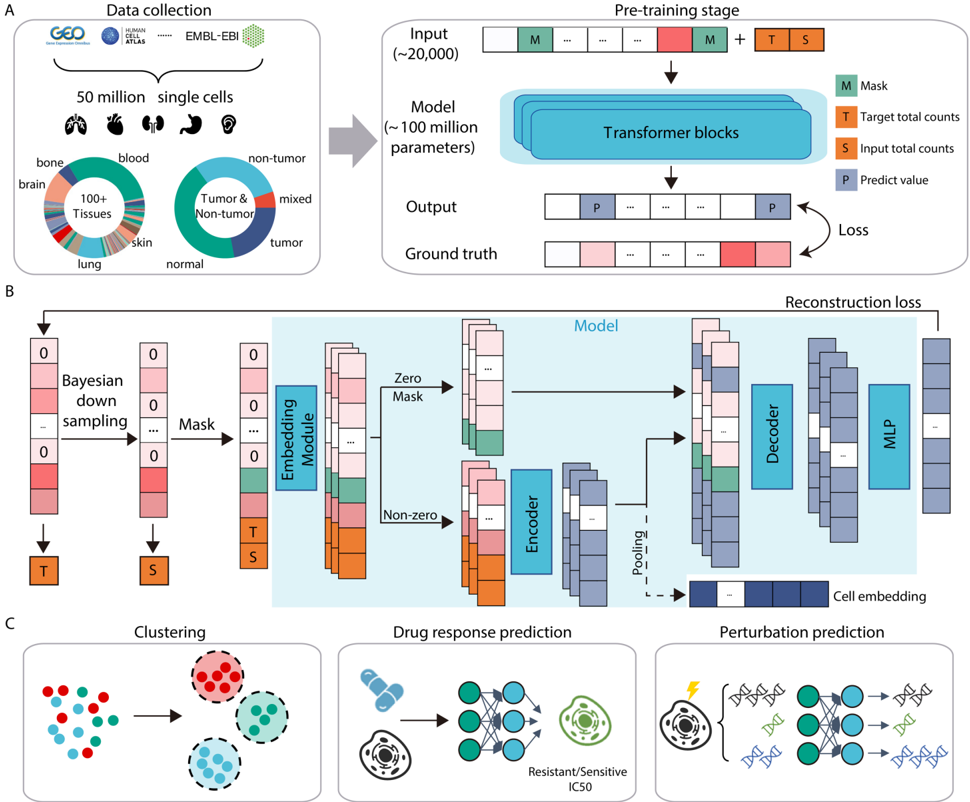
Large pretrained models have become foundation models leading to breakthroughs in natural language processing and related fields. Developing foundation models for deciphering the 'languages' of cells and facilitating biomedical research is promising yet challenging. Here we developed a large pretrained model scFoundation, also named 'xTrimoscFoundation α ', with 100 million parameters covering about 20,000 genes, pretrained on over 50 million human single-cell transcriptomic profiles. scFoundation is a large-scale model in terms of the size of trainable parameters, dimensionality of genes and volume of training data. Its asymmetric transformer-like architecture and pretraining task design empower effectively capturing complex context relations among genes in a variety of cell types and states. Experiments showed its merit as a foundation model that achieved state-of-the-art performances in a diverse array of single-cell analysis tasks such as gene expression enhancement, tissue drug response prediction, single-cell drug response classification, single-cell perturbation prediction, cell type annotation and gene module inference.
Overview
CoChat Summary
TL;DR
scFoundation is a 100M-parameter foundation model pretrained on over 50 million human single-cell transcriptomics profiles covering 19,264 genes. It achieves improved or state-of-the-art performance across gene expression enhancement, cancer drug response prediction, single-cell drug response classification, and perturbation prediction without fine-tuning the pretrained model.
Key findings
- Pretrained on >50 million human scRNA-seq profiles and 19,264 genes with 100M parameters, scFoundation is described as the largest model in parameter size, gene coverage, and data scale in the single-cell field.
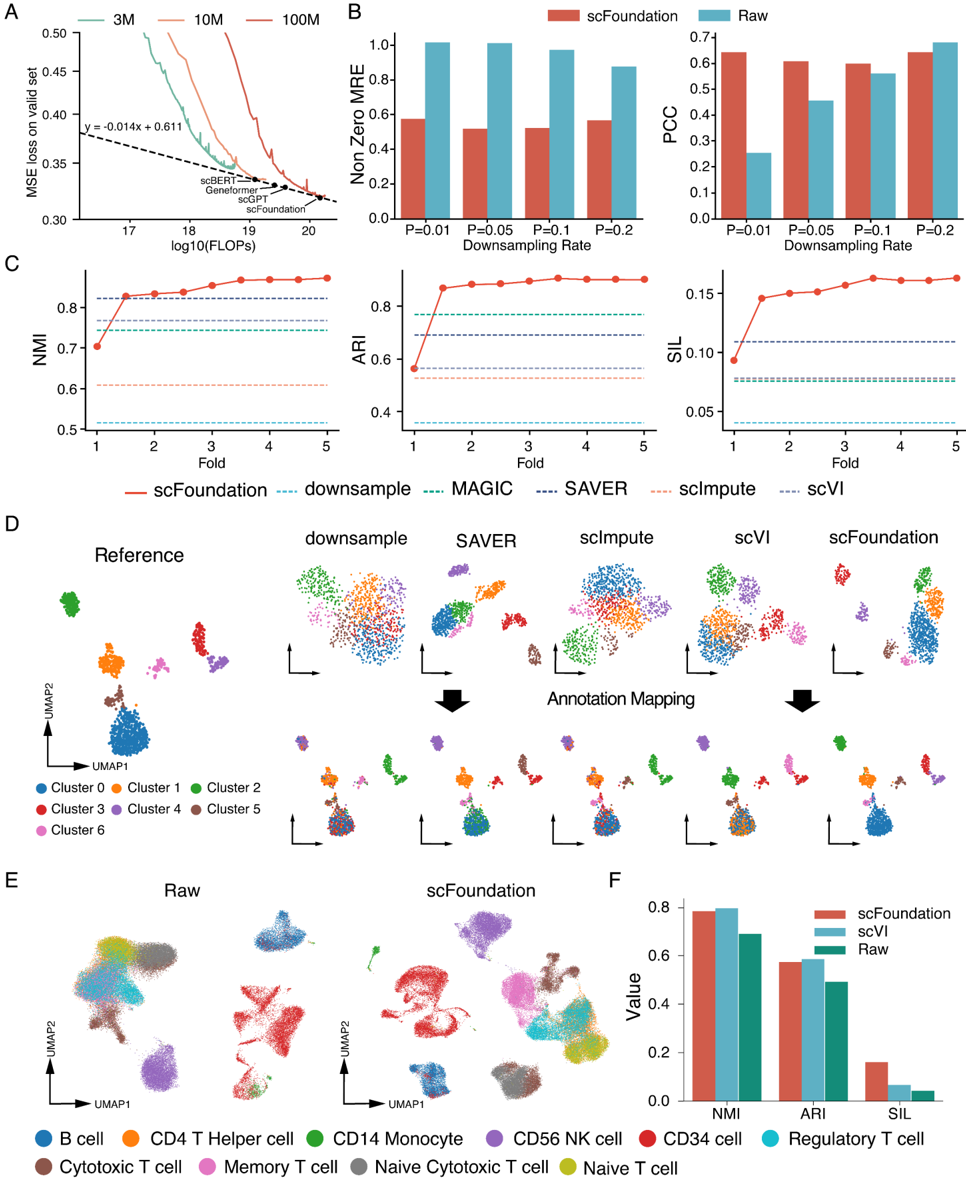
- For read-depth enhancement without fine-tuning, scFoundation reduced MAE and MRE by half versus the non-enhanced baseline; when downsampling was below 10%, baseline MRE was 97.5% while scFoundation maintained an MRE of 60%. On the Zheng68K PBMC dataset (~600,000 cells), scFoundation embeddings had comparable NMI and ARI to scVI and a higher SIL score.
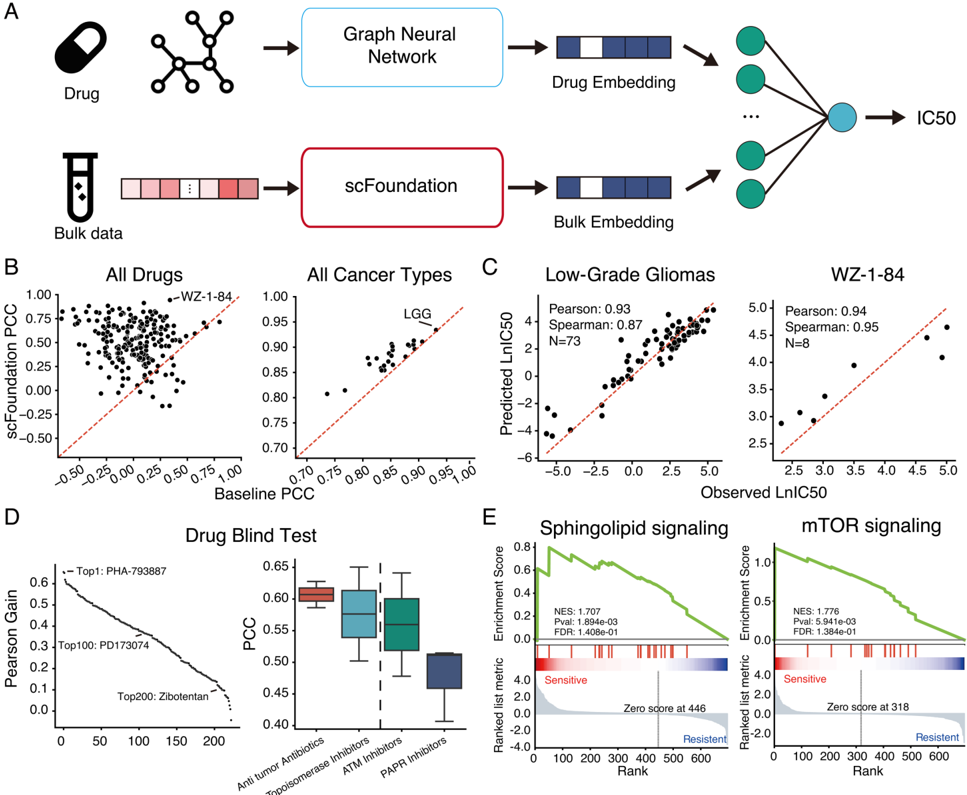
- In cancer drug response prediction with DeepCDR, scFoundation embeddings improved PCC for most drugs and all cancer types; in leave-one-drug-out blind tests, PHA-793887 improved from PCC 0.07 to 0.73 and Zobotentan from 0.49 to 0.64, with the best case achieving PCC above 0.93.
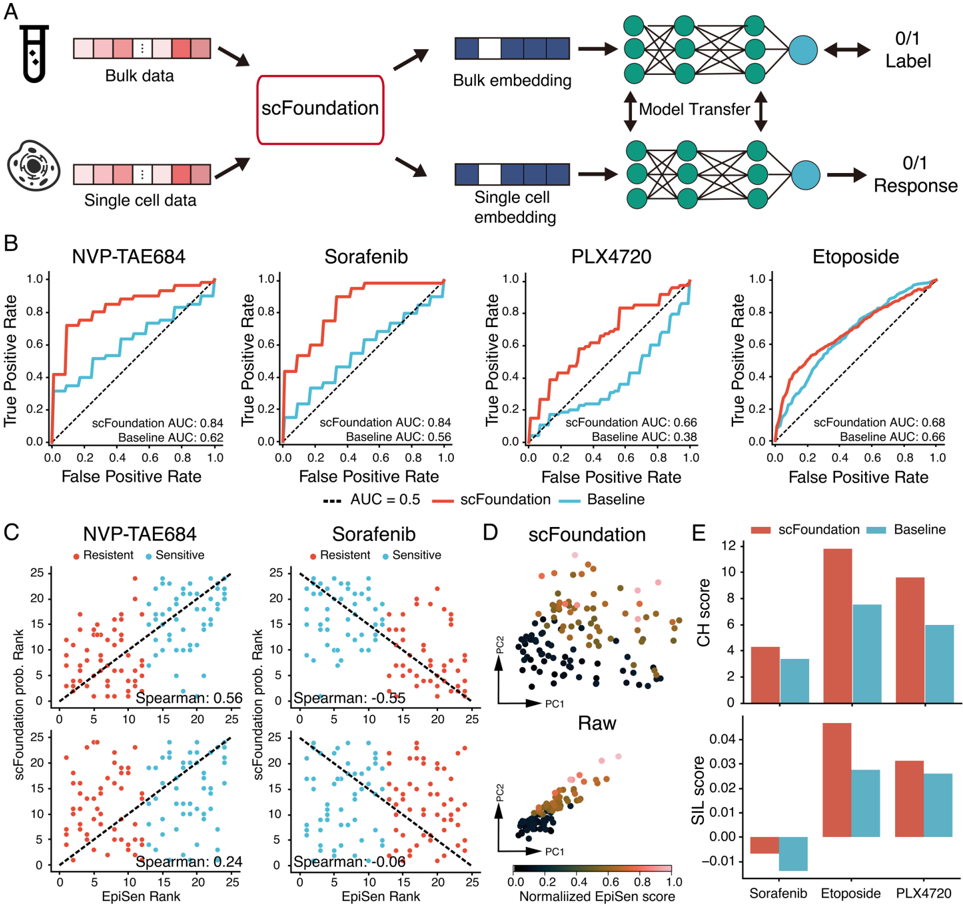
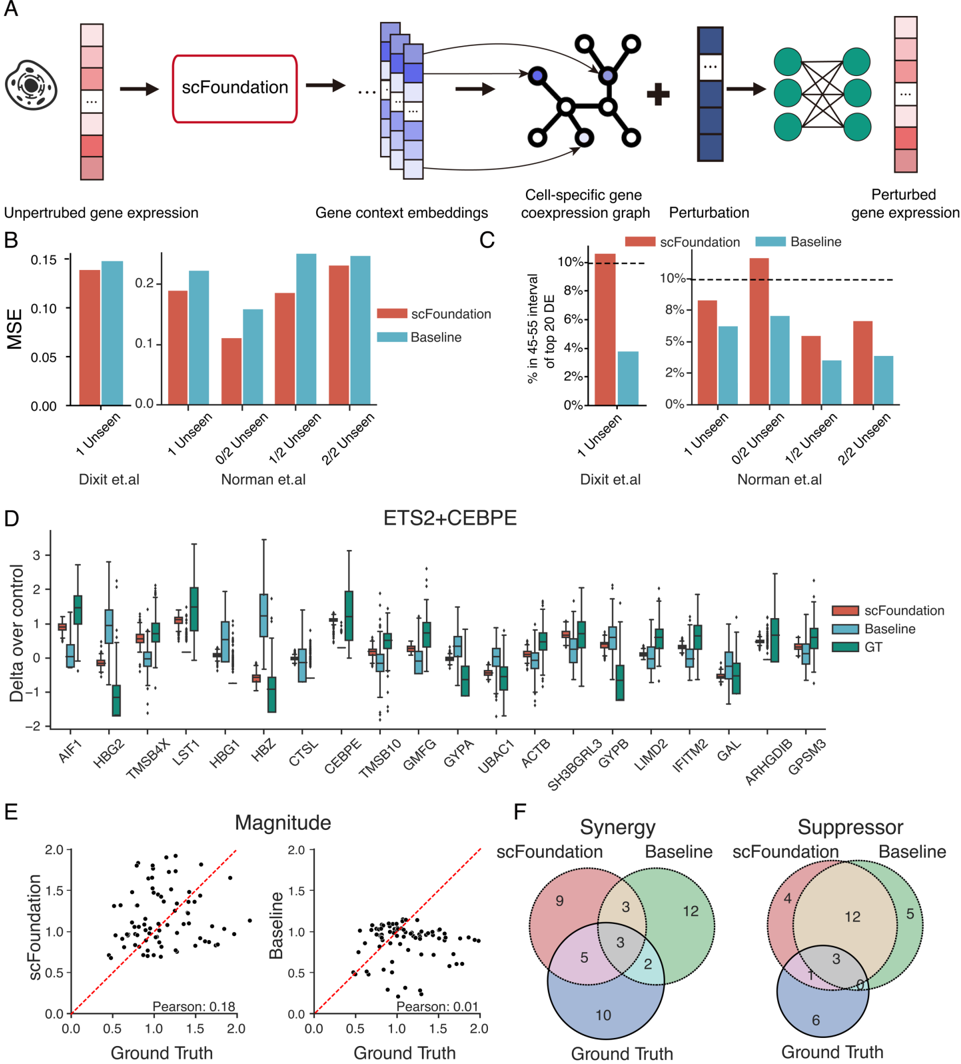
- In single-cell drug response classification, scFoundation embeddings achieved higher AUROC for all four tested drugs; for NVP-TAE684 and Sorafenib, AUROC improved by above 0.2, and Spearman correlations with EpiSen scores were 0.56 and −0.55 versus baseline 0.24 and −0.06. In perturbation prediction, scFoundation-combined GEARS achieved lower MSE on all 1-gene perturbation datasets and the lowest MSE in the 0/2 unseen 2-gene case.
Methods
- Model architecture: xTrimoGene, an asymmetric encoder-decoder transformer with an embedding module that converts continuous gene expression scalars into learnable embeddings; the encoder processes only non-zero and non-masked expressed genes, while the decoder integrates all genes.
- Pretraining data and task: over 50 million human scRNA-seq profiles collected from GEO, Single Cell Portal, HCA, EMBL-EBI, and other resources, aligned to 19,264 genes and filtered for cells with >200 expressed genes; read-depth-aware modeling used hierarchical Bayesian downsampling, 30% masking, and MSE regression loss with total count indicators T and S.
- Downstream evaluation: pretrained cell or gene embeddings were fed into DeepCDR, SCAD, and GEARS without fine-tuning the pretrained model; metrics included MAE, MRE, PCC, NMI, ARI, SIL, AUROC, MSE, and Spearman correlation.
Limitations
- The paper does not include an explicit limitations section.
- Evident from the text: pretraining used only human scRNA-seq data, so generalization to other species or multi-omics settings is not demonstrated.
- Evident from the text: downstream performance depends on existing task-specific models (DeepCDR, SCAD, GEARS) and public datasets, and the paper does not quantify residual batch effects or technical noise beyond describing read-depth-aware pretraining as a mitigation.
Model-written summary. Check it against the paper before relying on it.
Integrity signals
Registry
Cites
Statistics
Figures
Verification
Claims the paper makes
2 Valid · 7 Not valid · 2 Not checked · 74 Own results and interpretations
The cited sources that could be checked couldn’t confirm or dispute this claim.
In the paper
“We developed a new pre-training task called the read-depth-aware (RDA) modeling, which was an extension of masked language modeling 16 , considering single-cell gene expression data had a high variance in read depth, especially in the large-scale pre-training data.”
§ Large Scale Foundation Model on Single-cell Transcriptomics > The scFoundation pre-training framework
What the sources say
- Could not verifycites [16] Choromanski, K. et al. Rethinking Attention with Performers. Preprint at https://doi.org/10.48550/arXiv.2009.14794 (2022). sourceExperimental — accuracy not yet measured
The Experiments section (p. 6) mentions masked language modelling as a task used to evaluate Performers, but does not describe read-depth-aware modelling or an extension of that task. Searches for RDA, read depth, and single-cell gene expression found no passage addressing the attributed claim. (LLM, conf=0.75)
plain- Asserted: passes — The authors put it forward as true.
- Checkable: passes — It can be checked against evidence.
- Load-bearing: passes — The paper’s conclusions depend on it.
- Based: passes — The paper gives a reason why it holds.
- Could not verify
The cited sources that could be checked couldn’t confirm or dispute this claim.
In the paper
“Existing work had to restrict their models to a small list of selected genes.”
§ Large Scale Foundation Model on Single-cell Transcriptomics > Introduction
What the sources say
- Could not verifycites [8] Papatheodorou, I. et al. Expression Atlas update: from tissues to single cells. Nucleic Acids Research 48, D77-D83 (2020). sourceExperimental — accuracy not yet measured
The Introduction describes Single Cell Expression Atlas as a source of expression matrices for downstream computational methods, and the Data analysis section describes its quantification pipeline. Neither addresses whether earlier pre-training models had to use a small, selected gene list. Searches for pre-training, model limitations, and gene selection found no passage supporting that claim. (LLM, conf=0.76)
- Not checked — no full text of the sourcecites [9] Svensson, V., Vento-Tormo, R. & Teichmann, S. A. Exponential scaling of single-cell RNA-seq in the past decade. Nature Protocols 13, 599-604 (2018). source
- Could not verifycites [10] Brown, T. B. et al. Language Models are Few-Shot Learners. Preprint at https://doi.org/10.48550/arXiv.2005.14165 (2020). sourceExperimental — accuracy not yet measured
The Introduction (p. 3) discusses pre-trained language models and task-specific datasets, not single-cell gene expression. Searches for single-cell gene expression, selected genes, and restrictions to a small gene list found no passage addressing the claim. (LLM, conf=0.78)
- Could not verifycites [11] Zhao, W. X. et al. A Survey of Large Language Models. Preprint at https://doi.org/10.48550/arXiv.2303.18223 (2023). sourceExperimental — accuracy not yet measured
The Pre-training section (p. 4) discusses language-model training corpora, not single-cell gene-expression data. Searches for “single-cell gene expression selected genes” and “gene expression genes” found no passage addressing whether earlier models were restricted to a small list of genes. (LLM, conf=0.76)
plainstates a cause- Asserted: passes — The authors put it forward as true.
- Checkable: passes — It can be checked against evidence.
- Load-bearing: passes — The paper’s conclusions depend on it.
- Based: passes — The paper gives a reason why it holds.
- Could not verify
The cited sources support only part of this claim — read each source’s verdict below.
In the paper
“We constructed a comprehensive single-cell gene expression data set by collecting data from all publicly available single-cell resources, including GEO 17 , Single Cell Portal, HCA 4 , EMBL-EBI 18 , etc.”
§ Large Scale Foundation Model on Single-cell Transcriptomics > The scFoundation pre-training framework
What the sources say
- Could not verifycites [17] Ma, X. et al. Luna: Linear Unified Nested Attention. Preprint at http://arxiv.org/abs/2106.01540 (2021). sourceExperimental — accuracy not yet measured
Our copy of Luna (arXiv 2106.01540) is entirely about linear nested attention for sequence modelling; every data passage concerns NLP/vision benchmarks — the Abstract's three benchmarks, §4.1's Long Range Arena tasks (ListOps, Text, Retrieval, Image, Pathfinder), WMT'14 English-German (4.5M sentence pairs, Additional information), GLUE/QA (Table 6), and MLM pre-training on BookCorpus/Wikipedia/CC-News/OpenWebText/Stories. Nothing in it addresses single-cell gene expression, GEO, Single Cell Portal, HCA or EMBL-EBI (searched: 'single-cell gene expression dataset collection from public resources', 'scRNA-seq single cell RNA sequencing gene expression GEO Human Cell Atlas EMBL-EBI'). The cited sentence therefore cannot be checked against this source; our copy neither supports nor contradicts it. (LLM, conf=0.72)
- Partly supportedcites [4] Chen, S. et al. hECA: The cell-centric assembly of a cell atlas. iScience 25, 104318 (2022). sourceExperimental — accuracy not yet measured
The hECA 'Dataset collection' section (STAR Methods > Method details) does state the same ambition as the claim — 'collecting all accessible human single-cell data into a unified atlas' — and the Abstract/Introduction confirm it assembled a single-cell gene expression resource (1,093,299 cells, 116 published datasets, 38 organs) from scattered public data. But the realized scope is narrower than 'all publicly available single-cell resources': they selected 20–21 peer-reviewed studies, transcriptomic data of healthy donors only, and the Discussion concedes 'the number of cells in hECA v1.0 is still small and the coverage of organs and cell types is very limited'. Our copy also never lists Single Cell Portal, HCA, or EMBL-EBI as the repositories collected from (only GEO accessions and an NCBI BioProject appear, in the COVID-19 validation experiments), so that enumeration is not supported by this source. (LLM, conf=0.72)
- Partly supportedcites [18] Gong, J. et al. xTrimoGene: An Efficient and Scalable Representation Learner for Single-Cell RNA-Seq Data. 2023.03.24.534055 Preprint at https://doi.org/10.1101/2023.03.24.534055 (2023). sourceExperimental — accuracy not yet measured
Our copy confirms the large curated pre-training data set: the Additional information section states 'we curated about 5 million scRNA-seq data for training' processed with a unified pipeline. However, it attributes collection to a single repository, not 'all publicly available single-cell resources': 'Recently, scRNA-seq data ... mostly has been uploaded to the Gene Expression Omnibus (GEO) repository ... We collected data from GEO' and 'all the scRNA-seq data are collected from the Gene Expression Omnibus (GEO) repository with a keyword searching and data retrieval process.' Searches for HCA / Human Cell Atlas, EMBL-EBI and Single Cell Portal returned no data-source passage in our copy, so the multi-resource scope the citing sentence claims is not supported by this paper. (LLM, conf=0.82)
plain- Asserted: passes — The authors put it forward as true.
- Checkable: passes — It can be checked against evidence.
- Load-bearing: passes — The paper’s conclusions depend on it.
- Based: passes — The paper gives a reason why it holds.
- Could not verify
A result the paper reports from its own data — it cites no other source for it, so there is none to check. The quote shows it is in the paper.
In the paper
“From a cell ontology perspective, the data encompassed almost all known human cell types and cell states.”
§ Large Scale Foundation Model on Single-cell Transcriptomics > The scFoundation pre-training framework
plain- Asserted: passes — The authors put it forward as true.
- Checkable: passes — It can be checked against evidence.
- Load-bearing: passes — The paper’s conclusions depend on it.
- Based: passes — The paper gives a reason why it holds.
A result the paper states — it cites no source for it, so there is none to check. The quote shows it is in the paper.
In the paper
“We observed that, based on scFoundation-predicted results, drugs belonging to chemotherapy, such as anti-tumor antibiotics and topoisomerase inhibitors, had a higher PCC than drugs belonging to targeted therapy, such as ATM and PARP inhibitors (Fig. 3C right).”
§ Large Scale Foundation Model on Single-cell Transcriptomics > scFoundation improves cancer drug response prediction
plainstates an association- Asserted: passes — The authors put it forward as true.
- Checkable: passes — It can be checked against evidence.
- Load-bearing: unclear — It is unclear whether the paper’s conclusions depend on it.
- Based: passes — The paper gives a reason why it holds.
37 more claims
Create a free account to see all 85 claims and to verify the 3 references still open.
- Probably not a substantial claim. 13
- It may state two separate claims as one. 36
- The quote only partly states this claim. 2
Claims other papers make about this one
Each is checked against this paper’s own text: does it say what the citing paper says it does?
The source backs part of the claim, not all of it — or backs it for a different population, condition or comparison.
In the citing paper
“Compared to tasks such as cell annotation and batch correction, perturbation prediction offers experimentally generated model input/output with well-defined objectives, making it a more robust benchmark for assessing foundation models (15, 20, 21).”
From A systematic comparison of single-cell perturbation response prediction models (2026) · cites this paper as [21]
Experimental — accuracy not yet measuredThe source backs part of the claim, not all of it — or backs it for a different population, condition or comparison.
In the citing paper
“These models are pre-trained on vast amounts (> 10 M examples) of unlabelled scRNA-seq data, with the aim that such large datasets allow the models to capture general principles of gene regulation and signalling.”
From Benchmarking foundation cell models for post-perturbation RNA-seq prediction (2025) · cites this paper as [7]
Experimental — accuracy not yet measuredIn the citing paper
“scFoundation [15] strengthens the modular design, aiming to combine different modules to adapt to a variety of single-cell tasks, and is very flexible and scalable.”
From Challenges in AI-driven Biomedical Multimodal Data Fusion and Analysis (2025) · cites this paper as [15]
Self-check
Percentages, sums and reported differences re-computed from the paper’s own numbers.
Each contradiction between two passages listed here was confirmed by an independent check.
Rated minor: it would not touch a result — a value no result rests on, a p-value that stays on the same side of the significance level, or a conflict that is clerical, resolved elsewhere in the paper, or outside its own findings.
In the paper
§ Large Scale Foundation Model on Single-cell Transcriptomics > scFoundation predicts more accurate perturbation responses
“the Adamson dataset 49 with 87 1-gene perturbations”
§ Large Scale Foundation Model on Single-cell Transcriptomics > References
“49. Rood, J. E., Maartens, A., Hupalowska, A., Teichmann, S. A. & Regev, A. Impact of the Human Cell Atlas on medicine. Nat Med 28, 2486-2496 (2022).”
Rated minor: it would not touch a result — a value no result rests on, a p-value that stays on the same side of the significance level, or a conflict that is clerical, resolved elsewhere in the paper, or outside its own findings.
In the paper
§ Large Scale Foundation Model on Single-cell Transcriptomics > scFoundation predicts more accurate perturbation responses
“We combined the scFoundation with an advanced model GEARS 51 for the perturbation prediction task.”
§ Large Scale Foundation Model on Single-cell Transcriptomics > References
“51. Dixit, A. et al. Perturb-Seq: Dissecting Molecular Circuits with Scalable Single-Cell RNA Profiling of Pooled Genetic Screens. Cell 167, 1853-1866.e17 (2016).”
Rated minor: it would not touch a result — a value no result rests on, a p-value that stays on the same side of the significance level, or a conflict that is clerical, resolved elsewhere in the paper, or outside its own findings.
In the paper
§ Large Scale Foundation Model on Single-cell Transcriptomics > scFoundation transfers bulk-level drug sensitivity prediction model to single-cell data
“based on the SCAD 44 downstream model.”
§ Large Scale Foundation Model on Single-cell Transcriptomics > References
“44. Jerby-Arnon, L. et al. A Cancer Cell Program Promotes T Cell Exclusion and Resistance to Checkpoint Blockade. Cell 175, 984-997.e24 (2018).”
Citations
Cites
BERT: Pre-training of Deep Bidirectional Transformers for Language Understanding
Devlin, J., Chang, M.-W., Lee, K., & Toutanova, K. (2018) · arXiv · doi:10.48550/arxiv.1810.04805 · Cited by 73,173
Scikit-learn: Machine Learning in Python
Pedregosa, F., Varoquaux, G., Gramfort, A., Michel, V., Thirion, B., Grisel, O., Blondel, M., Müller, A., Nothman, J., Louppe, G., et al. (2012) · arXiv · doi:10.48550/arxiv.1201.0490 · Cited by 71,016
Subramanian, A., Tamayo, P., Mootha, V. K., Mukherjee, S., Ebert, B. L., Gillette, M. A., Paulovich, A., Pomeroy, S. L., Golub, T. R., Lander, E. S., et al. (2005) · Proceedings of the National Academy of Sciences · doi:10.1073/pnas.0506580102 · Cited by 53,625
KEGG: Kyoto Encyclopedia of Genes and Genomes
Kanehisa, M. (2000) · Nucleic Acids Research · doi:10.1093/nar/28.1.27 · Cited by 37,077
KEGG: Kyoto Encyclopedia of Genes and Genomes
Ogata, H., Goto, S., Sato, K., Fujibuchi, W., Bono, H., & Kanehisa, M. (1999) · Nucleic Acids Research · doi:10.1093/nar/27.1.29 · Cited by 31,232 · cited 1×
“According to the Kyoto Encyclopedia of Genes and Genome database 41 , this pathway was related to sphingomyelin and its metabolism.”
Language Models are Few-Shot Learners
Brown, T. B., Mann, B., Ryder, N., Subbiah, M., Kaplan, J., Dhariwal, P., Neelakantan, A., Shyam, P., Sastry, G., Askell, A., et al. (2020) · arXiv · doi:10.48550/arxiv.2005.14165 · Cited by 23,372 · cited 5×
“Please refer to Supplementary Notes 9 and 10 for details of the sampling strategy and count indicators calculation.”
InfluentialIntegrated analysis of multimodal single-cell data
Hao, Y., Hao, S., Andersen-Nissen, E., Mauck, W. M., Zheng, S., Butler, A., Lee, M. J., Wilk, A. J., Darby, C., Zagar, M., et al. (2020) · doi:10.1101/2020.10.12.335331 · Cited by 15,508
Kaugeranna, R., Kaugeranna, E., & Aion, (. S. 4. 6. (2023) · DROPS (Schloss Dagstuhl – Leibniz Center for Informatics) · doi:10.4230/lipics.giscience.2023.43 · Cited by 13,690
Gene Expression Omnibus: NCBI gene expression and hybridization array data repository
Edgar, R. (2002) · Nucleic Acids Research · doi:10.1093/nar/30.1.207 · Cited by 13,288 · cited 3×
“…a comprehensive single-cell dataset by collecting data from all publicly available single-cell resources, including Gene Expression Omnibus (GEO) 22 , Single Cell Portal, HCA 3 , human Ensemble Cell Atlas (hECA) 4 , Deeply Integrated human Single-Cell Omics data (DISCO) 7 , European Molecular…”
Scaling Laws for Neural Language Models
Kaplan, J., McCandlish, S., Henighan, T., Brown, T. B., Chess, B., Child, R., Gray, S., Radford, A., Wu, J., & Amodei, D. (2020) · arXiv · doi:10.48550/arxiv.2001.08361 · Cited by 9,550 · cited 1×
“This is a large-scale model of large parameter size, gene coverage and data scale in the single-cell field.”
SCANPY: large-scale single-cell gene expression data analysis
Wolf, F. A., Angerer, P., & Theis, F. J. (2018) · Genome Biology · doi:10.1186/s13059-017-1382-0 · Cited by 8,881
Masked Autoencoders Are Scalable Vision Learners
He, K., Chen, X., Xie, S., Li, Y., Dollar, P., & Girshick, R. (2022) · 2022 IEEE/CVF Conference on Computer Vision and Pattern Recognition (CVPR) · doi:10.1109/cvpr52688.2022.01553 · Cited by 8,489
The Cancer Cell Line Encyclopedia enables predictive modelling of anticancer drug sensitivity
Barretina, J., Caponigro, G., Stransky, N., Venkatesan, K., Margolin, A. A., Kim, S., Wilson, C. J., Lehár, J., Kryukov, G. V., Sonkin, D., et al. (2012) · Nature · doi:10.1038/nature11003 · Cited by 7,950 · cited 1×
“We used the Cancer Cell Line Encyclopedia 36 and Genomics of Cancer Drug Sensitivity 37 datasets to obtain the input cell line gene expression data, the input drugs and IC 50 labels (Methods).”
Enrichr: interactive and collaborative HTML5 gene list enrichment analysis tool
Chen, E. Y., Tan, C. M., Kou, Y., Duan, Q., Wang, Z., Meirelles, G. V., Clark, N. R., & Ma’ayan, A. (2013) · BMC Bioinformatics · doi:10.1186/1471-2105-14-128 · Cited by 7,814
Massively parallel digital transcriptional profiling of single cells
Zheng, G. X. Y., Terry, J. M., Belgrader, P., Ryvkin, P., Bent, Z. W., Wilson, R., Ziraldo, S. B., Wheeler, T. D., McDermott, G. P., Zhu, J., et al. (2017) · Nature Communications · doi:10.1038/ncomms14049 · Cited by 7,353 · cited 2×
“To assess the performance of scFoundation, we conducted experiments using the Zheng68K dataset 30 and the Segerstolpe dataset 57 that were shown to be challenging in the previous study 13 .”
Scenic: single-cell regulatory network inference and clustering.
Aibar, S., González-Blas, C. B., Moerman, T., Huynh-Thu, V. A., Imrichova, H., Hulselmans, G., Rambow, F., Marine, J.-C., Geurts, P., Aerts, J., et al. (2017) · Nature Methods · doi:10.1038/nmeth.4463 · Cited by 6,520
Tumour heterogeneity and resistance to cancer therapies
Dagogo-Jack, I., & Shaw, A. T. (2018) · Nature Reviews Clinical Oncology · doi:10.1038/nrclinonc.2017.166 · Cited by 3,846 · cited 1×
“https://doi.org/10.1038/s41592-024-02305-7 sequenced on an early 10x Chromium platform.”
InfluentialClonal heterogeneity and tumor evolution: past, present, and the future
McGranahan, N., & Swanton, C. (2017) · Cell · doi:10.1016/j.cell.2017.01.018 · Cited by 2,840 · cited 1×
“Each cell had about 500 expressed genes and fewer than 2,000 total reads, making cell type distinction challenging 13,31 (Supplementary Fig.”
Deep generative modeling for single-cell transcriptomics
Lopez, R., Regier, J., Cole, M. B., Jordan, M. I., & Yosef, N. (2018) · Nature Methods · doi:10.1038/s41592-018-0229-2 · Cited by 2,530 · cited 1×
“We then estimated the performance of various scale xTrimoGene architecture models with parameter sizes equivalent to previous transformer-based models 13–15 , and compared with scVI 25 (Supplementary Note 2).”
Longformer: The Long-Document Transformer
Beltagy, I., Peters, M. E., & Cohan, A. (2020) · arXiv · doi:10.48550/arxiv.2004.05150 · Cited by 2,281
Regev, A., Teichmann, S. A., Lander, E. S., Amit, I., Benoist, C., Birney, E., Bodenmiller, B., Campbell, P., Carninci, P., Clatworthy, M., et al. (2017) · eLife · doi:10.7554/elife.27041 · Cited by 2,232 · cited 3×
“Many human scRNA-seq data were deposited in the Gene Expression Omnibus (GEO) repository, HCA, Single Cell Portal, EMBL-EBI and so on.”
A Survey of Large Language Models
Zhao, W. X., Zhou, K., Li, J., Tang, T., Dong, Z., Hou, Y., Zhang, B., Min, Y., Zhang, J., Liu, P., et al. (2026) · Frontiers of Computer Science · doi:10.1007/s11704-026-60308-3 · Cited by 2,093
A Landscape of Pharmacogenomic Interactions in Cancer
Iorio, F., Knijnenburg, T. A., Vis, D. J., Bignell, G. R., Menden, M. P., Schubert, M., Aben, N., Gonçalves, E., Barthorpe, S., Lightfoot, H., et al. (2016) · Cell · doi:10.1016/j.cell.2016.06.017 · Cited by 2,090 · cited 2×
“We used the Cancer Cell Line Encyclopedia 36 and Genomics of Cancer Drug Sensitivity 37 datasets to obtain the input cell line gene expression data, the input drugs and IC 50 labels (Methods).”
A Survey of Large Language Models
Zhao, W. X., Zhou, K., Li, J., Tang, T., Wang, X., Hou, Y., Min, Y., Zhang, B., Zhang, J., Dong, Z., et al. (2023) · arXiv · doi:10.48550/arxiv.2303.18223 · Cited by 2,090
Dixit, A., Parnas, O., Li, B., Chen, J., Fulco, C. P., Jerby-Arnon, L., Marjanovic, N. D., Dionne, D., Burks, T., Raychowdhury, R., et al. (2016) · Cell · doi:10.1016/j.cell.2016.11.038 · Cited by 1,863
Recovering Gene Interactions from Single-Cell Data Using Data Diffusion
van Dijk, D., Sharma, R., Nainys, J., Yim, K., Kathail, P., Carr, A. J., Burdziak, C., Moon, K. R., Chaffer, C. L., Pattabiraman, D., et al. (2018) · Cell · doi:10.1016/j.cell.2018.05.061 · Cited by 1,829
Single-cell RNA sequencing technologies and bioinformatics pipelines
Hwang, B., Lee, J. H., & Bang, D. (2018) · Experimental & Molecular Medicine · doi:10.1038/s12276-018-0071-8 · Cited by 1,781
scGPT: Towards Building a Foundation Model for Single-Cell Multi-omics Using Generative AI
Cui, H., Wang, C., Maan, H., Pang, K., Luo, F., & Wang, B. (2023) · doi:10.1101/2023.04.30.538439 · Cited by 1,694
Single-Cell Transcriptome Profiling of Human Pancreatic Islets in Health and Type 2 Diabetes
Segerstolpe, Å., Palasantza, A., Eliasson, P., Andersson, E.-M., Andréasson, A.-C., Sun, X., Picelli, S., Sabirsh, A., Clausen, M., Bjursell, M. K., et al. (2016) · Cell Metabolism · doi:10.1016/j.cmet.2016.08.020 · Cited by 1,550 · cited 1×
“To assess the performance of scFoundation, we conducted experiments using the Zheng68K dataset 30 and the Segerstolpe dataset 57 that were shown to be challenging in the previous study 13 .”
Baron, M., Veres, A., Wolock, S. L., Faust, A. L., Gaujoux, R., Vetere, A., Ryu, J. H., Wagner, B. K., Shen-Orr, S. S., Klein, A. M., et al. (2016) · Cell Systems · doi:10.1016/j.cels.2016.08.011 · Cited by 1,508
The Technology and Biology of Single-Cell RNA Sequencing
Kolodziejczyk, A. A., Kim, J. K., Svensson, V., Marioni, J. C., & Teichmann, S. A. (2015) · Molecular Cell · doi:10.1016/j.molcel.2015.04.005 · Cited by 1,487
Benchmarking atlas-level data integration in single-cell genomics
Luecken, M. D., Büttner, M., Chaichoompu, K., Danese, A., Interlandi, M., Mueller, M. F., Strobl, D. C., Zappia, L., Dugas, M., Colomé-Tatché, M., et al. (2022) · Nature Methods · doi:10.1038/s41592-021-01336-8 · Cited by 1,438 · cited 1×
“Note that merely aligning the read depth would not eliminate the entire batch effect since batch effects can involve other variations such as donor gender, experiment treatment, cell cycle and so on 32 .”
A Cancer Cell Program Promotes T Cell Exclusion and Resistance to Checkpoint Blockade
Jerby-Arnon, L., Shah, P., Cuoco, M. S., Rodman, C., Su, M.-J., Melms, J. C., Leeson, R., Kanodia, A., Mei, S., Lin, J.-R., et al. (2018) · Cell · doi:10.1016/j.cell.2018.09.006 · Cited by 1,429 · cited 1×
“2). scFoundation was used without fine-tuning to enhance cell embeddings by setting the T value as 10,000.”
Regev, A., Teichmann, S. A., Lander, E. S., Amit, I., Benoist, C. O., Birney, E., Bodenmiller, B., & Campbell, P. J. (2017) · Zurich Open Repository and Archive (University of Zurich) · doi:10.5167/uzh-162597 · Cited by 1,399
Single‐cell RNA sequencing technologies and applications: A brief overview
Jovic, D., Liang, X., Zeng, H., Lin, L., Xu, F., & Luo, Y. (2022) · Clinical and Translational Medicine · doi:10.1002/ctm2.694 · Cited by 1,271 · cited 1×
“Single-cell RNA sequencing (scRNA-seq) data, also known as single-cell transcriptomics, offer high-throughput observations into cellular systems 2 , providing massive archives of transcriptomic sentences of all types of cells for developing foundation models.”
Adamson, B., Norman, T. M., Jost, M., Cho, M. Y., Nuñez, J. K., Chen, Y., Villalta, J. E., Gilbert, L. A., Horlbeck, M. A., Hein, M. Y., et al. (2016) · Cell · doi:10.1016/j.cell.2016.11.048 · Cited by 1,193 · cited 1×
“Using Perturb-seq 51,52 data resources to train models for modeling cellular response to perturbations is a key task of computational biology 53–55 .”
Transfer learning enables predictions in network biology
Theodoris, C. V., Xiao, L., Chopra, A., Chaffin, M. D., Al Sayed, Z. R., Hill, M. C., Mantineo, H., Brydon, E. M., Zeng, Z., Liu, X. S., et al. (2023) · Nature · doi:10.1038/s41586-023-06139-9 · Cited by 1,193 · cited 3×
“We then estimated the performance of various scale xTrimoGene architecture models with parameter sizes equivalent to previous transformer-based models 13–15 , and compared with scVI 25 (Supplementary Note 2).”
Cross-tissue immune cell analysis reveals tissue-specific features in humans
Domínguez Conde, C., Xu, C., Jarvis, L. B., Rainbow, D. B., Wells, S. B., Gomes, T., Howlett, S. K., Suchanek, O., Polanski, K., King, H. W., et al. (2022) · Science · doi:10.1126/science.abl5197 · Cited by 1,159 · cited 4×
“We got the prediction results of test data from the corresponding function such as ‘celltypist.annotate’ of CellTypist.”
InfluentialChromatin Potential Identified by Shared Single-Cell Profiling of RNA and Chromatin
Ma, S., Zhang, B., LaFave, L. M., Earl, A. S., Chiang, Z., Hu, Y., Ding, J., Brack, A., Kartha, V. K., Tay, T., et al. (2020) · Cell · doi:10.1016/j.cell.2020.09.056 · Cited by 1,146
Exponential scaling of single-cell RNA-seq in the past decade
Svensson, V., Vento-Tormo, R., & Teichmann, S. A. (2018) · Nature Protocols · doi:10.1038/nprot.2017.149 · Cited by 1,034 · cited 4×
“9 and 10).”
InfluentialBBKNN: fast batch alignment of single cell transcriptomes
Polański, K., Young, M. D., Miao, Z., Meyer, K. B., Teichmann, S. A., & Park, J.-E. (2020) · Bioinformatics · doi:10.1093/bioinformatics/btz625 · Cited by 932 · cited 3×
“Given that batch effects or modality differences may encompass a range of variations, we took the strategy in scFoundation to consider only read depth and leave other possible differences to cooperative methods on downstream tasks, such as BBKNN and SCAD.”
(2020) · doi:10.1109/sc41405.2020.00024 · Cited by 928
Geeleher, P., Cox, N. J., & Huang, R. S. (2014) · Genome Biology · doi:10.1186/gb-2014-15-3-r47 · Cited by 890 · cited 1×
“This may be due to the fact that specific gene mutations often have important impacts on targeted therapy 34 but such information is hardly revealed in gene expression data, while chemotherapy drugs were widely reported to be related to gene expression 38,39 so their IC 50 is easier to predict.”
High-throughput sequencing of the transcriptome and chromatin accessibility in the same cell
Chen, S., Lake, B. B., & Zhang, K. (2019) · Nature Biotechnology · doi:10.1038/s41587-019-0290-0 · Cited by 810
SAVER: gene expression recovery for single-cell RNA sequencing
Huang, M., Wang, J., Torre, E., Dueck, H., Shaffer, S., Bonasio, R., Murray, J. I., Raj, A., Li, M., & Zhang, N. R. (2018) · Nature Methods · doi:10.1038/s41592-018-0033-z · Cited by 747
An accurate and robust imputation method scImpute for single-cell RNA-seq data
Li, W. V., & Li, J. J. (2018) · Nature Communications · doi:10.1038/s41467-018-03405-7 · Cited by 699 · cited 1×
“We treated the total count as one cell’s read depth and defined two total counts indicators: T (‘target’) and S (‘source’), for the total counts of the raw and the input samples, Article https://doi.org/10.1038/s41592-024-02305-7 We then compared scFoundation with imputation methods including MAGIC…”
InfluentialRethinking Attention with Performers
Choromanski, K., Likhosherstov, V., Dohan, D., Song, X., Gane, A., Sarlos, T., Hawkins, P., Davis, J., Mohiuddin, A., Kaiser, L., et al. (2020) · arXiv · doi:10.48550/arxiv.2009.14794 · Cited by 695 · cited 5×
“In Performer, the kernelizable attention mechanism is used: where ∅(•) is a kernel function that used for approximating the A matrix in the original attention equation.”
InfluentialXu, C., Lopez, R., Mehlman, E., Regier, J., Jordan, M. I., & Yosef, N. (2021) · Molecular Systems Biology · doi:10.15252/msb.20209620 · Cited by 691 · cited 1×
“We benchmarked scFoundation against the methods CellTypist 58 , scBERT 13 , scANVI 59 , ACTINN 60 , Scanpy 61 and SingleCellNet 62 (Methods).”
Dissecting cell identity via network inference and in silico gene perturbation
Kamimoto, K., Stringa, B., Hoffmann, C. M., Jindal, K., Solnica-Krezel, L., & Morris, S. A. (2023) · Nature · doi:10.1038/s41586-022-05688-9 · Cited by 677
scGen predicts single-cell perturbation responses
Lotfollahi, M., Wolf, F. A., & Theis, F. J. (2019) · Nature Methods · doi:10.1038/s41592-019-0494-8 · Cited by 661
Spotlight on protein N-terminal acetylation
Ree, R., Varland, S., & Arnesen, T. (2018) · Experimental & Molecular Medicine · doi:10.1038/s12276-018-0116-z · Cited by 646
A comparison of automatic cell identification methods for single-cell RNA sequencing data
Abdelaal, T., Michielsen, L., Cats, D., Hoogduin, D., Mei, H., Reinders, M. J. T., & Mahfouz, A. (2019) · Genome Biology · doi:10.1186/s13059-019-1795-z · Cited by 628
Yang, F., Wang, W., Wang, F., Fang, Y., Tang, D., Huang, J., Lu, H., & Yao, J. (2021) · doi:10.1101/2021.12.05.471261 · Cited by 617
ZeRO: Memory Optimization Towards Training A Trillion Parameter ModelsPreprint
Rajbhandari, S., Rasley, J., Ruwase, O., & He, Y. (2019) · arXiv.org · doi:10.48550/arxiv.1910.02054 · Cited by 612
The human body at cellular resolution: the NIH Human Biomolecular Atlas Program
HuBMAP Consortium, Writing Group, Snyder, M. P., Lin, S., Posgai, A., Atkinson, M., Regev, A., Rood, J., Rozenblatt-Rosen, O., Gaffney, L., et al. (2019) · Nature · doi:10.1038/s41586-019-1629-x · Cited by 595
Self-citationBock, C., Datlinger, P., Chardon, F., Coelho, M. A., Dong, M. B., Lawson, K. A., Lu, T., Maroc, L., Norman, T. M., Song, B., et al. (2022) · Nature Reviews Methods Primers · doi:10.1038/s43586-021-00093-4 · Cited by 571
Beyond the Imitation Game: Quantifying and extrapolating the capabilities of language models
Srivastava, A., Rastogi, A., Rao, A., Shoeb, A. A. M., Abid, A., Fisch, A., Brown, A. R., Santoro, A., Gupta, A., Garriga-Alonso, A., et al. (2022) · arXiv · doi:10.48550/arxiv.2206.04615 · Cited by 569 · cited 1×
“These models trained on huge corpora become foundation models due to their fundamental roles in leading breakthroughs in many downstream tasks and their ability in discerning patterns and entity relationships within language 1 .”
Self-citationTraining Deep Nets with Sublinear Memory Cost
Chen, T., Xu, B., Zhang, C., & Guestrin, C. (2016) · arXiv · doi:10.48550/arxiv.1604.06174 · Cited by 561
Genenames.org: the HGNC resources in 2023
Seal, R. L., Braschi, B., Gray, K., Jones, T. E. M., Tweedie, S., Haim-Vilmovsky, L., & Bruford, E. A. (2023) · Nucleic Acids Research · doi:10.1093/nar/gkac888 · Cited by 527 · cited 2×
“We aligned all data to a gene list composed of 19,264 protein-coding and common mitochondrial genes, as identified by the HUGO Gene Nomenclature Committee 23 .”
Pan-cancer single-cell RNA-seq identifies recurring programs of cellular heterogeneity
Kinker, G. S., Greenwald, A. C., Tal, R., Orlova, Z., Cuoco, M. S., McFarland, J. M., Warren, A., Rodman, C., Roth, J. A., Bender, S. A., et al. (2020) · Nature Genetics · doi:10.1038/s41588-020-00726-6 · Cited by 445 · cited 1×
“For drug sorafenib and NVP-TAE684-affected cells, the cells’ sensitive labels were determined by the value of senescence-related (EpiSen) program scores that were proven to have a relation with drug responses previously 49 (Methods).”
Exploring genetic interaction manifolds constructed from rich single-cell phenotypes
Norman, T. M., Horlbeck, M. A., Replogle, J. M., Ge, A. Y., Xu, A., Jost, M., Gilbert, L. A., & Weissman, J. S. (2019) · Science · doi:10.1126/science.aax4438 · Cited by 392 · cited 1×
“We used the robust regression with a Theil–Sen estimator following the same procedure used in previous study 72 .”
Tan, Y., & Cahan, P. (2019) · Cell Systems · doi:10.1016/j.cels.2019.06.004 · Cited by 368
Predicting transcriptional outcomes of novel multigene perturbations with GEARS
Roohani, Y., Huang, K., & Leskovec, J. (2024) · Nature Biotechnology · doi:10.1038/s41587-023-01905-6 · Cited by 355 · cited 11×
“Then, we trained the GEARS baseline model by setting epoch to 15 and batch size to 30.”
InfluentialPredicting cellular responses to complex perturbations in high‐throughput screens
Lotfollahi, M., Klimovskaia Susmelj, A., De Donno, C., Hetzel, L., Ji, Y., Ibarra, I. L., Srivatsan, S. R., Naghipourfar, M., Daza, R. M., Martin, B., et al. (2023) · Molecular Systems Biology · doi:10.15252/msb.202211517 · Cited by 307
DeepCDR: a hybrid graph convolutional network for predicting cancer drug response
Liu, Q., Hu, Z., Jiang, R., & Zhou, M. (2020) · Bioinformatics · doi:10.1093/bioinformatics/btaa822 · Cited by 263
ACTINN: automated identification of cell types in single cell RNA sequencing
Ma, F., & Pellegrini, M. (2020) · Bioinformatics · doi:10.1093/bioinformatics/btz592 · Cited by 252
Roles of Bioactive Sphingolipids in Cancer Biology and Therapeutics
Saddoughi, S. A., Song, P., & Ogretmen, B. (2008) · Subcellular Biochemistry · doi:10.1007/978-1-4020-8831-5_16 · Cited by 243
Expression Atlas update: from tissues to single cells
Papatheodorou, I., Moreno, P., Manning, J., Fuentes, A. M.-P., George, N., Fexova, S., Fonseca, N. A., Füllgrabe, A., Green, M., Huang, N., et al. (2019) · Nucleic Acids Research · doi:10.1093/nar/gkz947 · Cited by 224 · cited 6×
“The ablation studies (Supplementary Note 1) of taking downsampling strategy (Supplementary Table 8) and regression loss (Supplementary Fig.”
InfluentialImpact of the Human Cell Atlas on medicine
Rood, J. E., Maartens, A., Hupalowska, A., Teichmann, S. A., & Regev, A. (2022) · Nature Medicine · doi:10.1038/s41591-022-02104-7 · Cited by 222 · cited 5×
“The original DeepCDR model used drug structural information and multiomics data as input and outputted the predicted IC 50 .”
InfluentialDISCO: A database of Deeply Integrated human Single-Cell Omics data
Li, M., Zhang, X., Ang, K. S., Ling, J., Sethi, R., Lee, N. Y. S., Ginhoux, F., & Chen, J. (2022) · Nucleic Acids Research · doi:10.1093/nar/gkab1020 · Cited by 205
Self-citationMasked Autoencoders Are Scalable Vision Learners
He, K., Chen, X., Xie, S., Li, Y., Dollár, P., & Girshick, R. (2021) · arXiv (Cornell University) · doi:10.48550/arxiv.2111.06377 · Cited by 198
Transformer for one stop interpretable cell type annotation
Chen, J., Xu, H., Tao, W., Chen, Z., Zhao, Y., & Han, J.-D. J. (2023) · Nature Communications · doi:10.1038/s41467-023-35923-4 · Cited by 189 · cited 1×
“The embedding module converted continuous gene expression scalars into learnable high-dimensional vectors ensuring full retention of raw expression values, which was a notable improvement over the discretized values used in previous models 13,19 .”
Transcriptional mediators of treatment resistance in lethal prostate cancer
He, M. X., Cuoco, M. S., Crowdis, J., Bosma-Moody, A., Zhang, Z., Bi, K., Kanodia, A., Su, M.-J., Ku, S.-Y., Garcia, M. M., et al. (2021) · Nature Medicine · doi:10.1038/s41591-021-01244-6 · Cited by 184
Exponential scaling of single-cell RNA-seq in the last decade
Svensson, V., Tormo, R. V., & Teichmann, S. A. (2017) · arXiv (Cornell University) · doi:10.48550/arxiv.1704.01379 · Cited by 164
Kruppel-like Transcription Factor 6 Regulates Inflammatory Macrophage Polarization
Date, D., Das, R., Narla, G., Simon, D. I., Jain, M. K., & Mahabeleshwar, G. H. (2014) · Journal of Biological Chemistry · doi:10.1074/jbc.m113.526749 · Cited by 156
The Tabula Sapiens: a multiple organ single cell transcriptomic atlas of humansPreprint
Quake, S. R. (2021) · bioRxiv (Cold Spring Harbor Laboratory) · doi:10.1101/2021.07.19.452956 · Cited by 145
Chromatin potential identified by shared single cell profiling of RNA and chromatinPreprint
Ma, S., Zhang, B. M., LaFave, L. M., et al. (2020) · bioRxiv (Cold Spring Harbor Laboratory) · doi:10.1101/2020.06.17.156943 · Cited by 125
Jarnot, P., Ziemska-Legiecka, J., Dobson, L., Merski, M., Mier, P., Andrade-Navarro, M. A., Hancock, J. M., Dosztányi, Z., Paladin, L., Necci, M., et al. (2020) · Nucleic Acids Research · doi:10.1093/nar/gkaa339 · Cited by 114
Environmental sensing by mature B cells is controlled by the transcription factors PU.1 and SpiB
Willis, S. N., Tellier, J., Liao, Y., Trezise, S., Light, A., O’Donnell, K., Garrett-Sinha, L. A., Shi, W., Tarlinton, D. M., & Nutt, S. L. (2017) · Nature Communications · doi:10.1038/s41467-017-01605-1 · Cited by 112
On Layer Normalization in the Transformer Architecture
Xiong, R., Yang, Y., He, D., Zheng, K. W., Zheng, S., Xing, C., Zhang, H., Lan, Y., Wang, L., & Liu, T. (2020) · arXiv (Cornell University) · doi:10.48550/arxiv.2002.04745 · Cited by 99
Ho, Y.-J., Anaparthy, N., Molik, D., Mathew, G., Aicher, T., Patel, A., Hicks, J., & Hammell, M. G. (2018) · Genome Research · doi:10.1101/gr.234062.117 · Cited by 97 · cited 1×
“For drug PLX4720 and etoposide-affected single cells, cells from untreated cell lines were considered sensitive, while cells that survived after drug exposure were considered resis tant 48 .”
Regev, A., Teichmann, S. A., Lander, E. S., Amit, I., Benoist, C., Birney, E., Bodenmiller, B., Campbell, P., Carninci, P., Clatworthy, M., et al. (2017) · bioRxiv (Cold Spring Harbor Laboratory) · doi:10.1101/121202 · Cited by 74
Prediction of individual response to anticancer therapy: historical and future perspectives
Unger, F. T., Witte, I., & David, K. A. (2015) · Cellular and Molecular Life Sciences · doi:10.1007/s00018-014-1772-3 · Cited by 66
Assessing the limits of zero-shot foundation models in single-cell biology
Kedzierska, K. Z., Crawford, L., Amini, A. P., & Lu, A. X. (2023) · bioRxiv (Cold Spring Harbor Laboratory) · doi:10.1101/2023.10.16.561085 · Cited by 61 · cited 3×
“This phenomenon wherein the read depth is unaltered has also been reported in a recent work 29 .”
InfluentialZibelman, M. R., Wong, Y., Devarajan, K., Malizzia, L., Corrigan, A., Olszanski, A. J., Denlinger, C. S., Roethke, S. K., Tetzlaff, C. H., & Plimack, E. R. (2015) · Investigational New Drugs · doi:10.1007/s10637-015-0261-3 · Cited by 60 · cited 1×
“Other clinical studies have also shown that mTOR inhibitors were often used in conjunction with vorinostat 44,45 , suggesting a relationship between vorinostat and the mTOR pathway.”
Enabling Single‐Cell Drug Response Annotations from Bulk RNA‐Seq Using SCAD
Zheng, Z., Chen, J., Chen, X., Huang, L., Xie, W., Lin, Q., Li, X., & Wong, K. (2023) · Advanced Science · doi:10.1002/advs.202204113 · Cited by 60 · cited 7×
“In our setting, we used non-fine-tuned scFoundation to obtain unified embeddings of bulk and single-cell data, and used these embeddings to train SCAD models (Fig.”
InfluentialKurundkar, D., Srivastava, R. K., Chaudhary, S. C., Ballestas, M. E., Kopelovich, L., Elmets, C. A., & Athar, M. (2012) · Toxicology and Applied Pharmacology · doi:10.1016/j.taap.2012.11.002 · Cited by 54 · cited 1×
“Previous studies have shown that vorinostat inhibits carcinoma growth by dampening the mTOR signaling pathway 43 .”
Park, H., Garrido‐Laguna, I., Naing, A., Fu, S., Falchook, G. S., Piha-Paul, S. A., Wheler, J. J., Hong, D. S., Tsimberidou, A. M., Subbiah, V., et al. (2016) · Oncotarget · doi:10.18632/oncotarget.11750 · Cited by 51 · cited 1×
“Other clinical studies have also shown that mTOR inhibitors were often used in conjunction with vorinostat 44,45 , suggesting a relationship between vorinostat and the mTOR pathway.”
Learning interpretable cellular responses to complex perturbations in high-throughput screens
Lotfollahi, M., Susmelj, A. K., De Donno, C., Ji, Y., Ibarra, I. L., Wolf, F. A., Yakubova, N., Theis, F. J., & Lopez-Paz, D. (2021) · bioRxiv (Cold Spring Harbor Laboratory) · doi:10.1101/2021.04.14.439903 · Cited by 48 · cited 1×
“Using Perturb-seq 51,52 data resources to train models for modeling cellular response to perturbations is a key task of computational biology 53–55 .”
hECA: The cell-centric assembly of a cell atlas
Chen, S., Luo, Y., Gao, H., Li, F., Chen, Y., Li, J., You, R., Hao, M., Bian, H., Xi, X., et al. (2022) · iScience · doi:10.1016/j.isci.2022.104318 · Cited by 48
Self-citationBarretina, J. G., Caponigro, G., Stransky, N., Venkatesan, K., Margolin, A. A., Kim, S., Wilson, C. J., Lehár, J., Kryukov, G. V., Sonkin, D., et al. (2012) · Nature · doi:10.1038/nature11735 · Cited by 44
GEARS: Predicting transcriptional outcomes of novel multi-gene perturbations
Roohani, Y., Huang, K., & Leskovec, J. (2022) · bioRxiv (Cold Spring Harbor Laboratory) · doi:10.1101/2022.07.12.499735 · Cited by 40
Recovering Gene Interactions from Single-Cell Data Using Data DiffusionPreprint
van Dijk, D., Sharma, R., Nainys, J., et al. (2018) · SSRN Electronic Journal · doi:10.2139/ssrn.3155779 · Cited by 40
Evaluating Progress on Machine Learning for Longitudinal Electronic Healthcare DataPreprint
Bellamy, D., Celi, L. A., & Beam, A. L. (2020) · arXiv (Cornell University) · doi:10.48550/arxiv.2010.01149 · Cited by 30 · cited 1×
“This may be due to the fact that specific gene mutations often have important impacts on targeted therapy 34 but such information is hardly revealed in gene expression data, while chemotherapy drugs were widely reported to be related to gene expression 38,39 so their IC 50 is easier to predict.”
SAVER: Gene expression recovery for UMI-based single cell RNA sequencing
Huang, M., Wang, J., Torre, E., Dueck, H., Shaffer, S., Bonasio, R., Murray, J., Raj, A., Li, M., & Zhang, N. R. (2017) · bioRxiv (Cold Spring Harbor Laboratory) · doi:10.1101/138677 · Cited by 30
Vasudevan, S., Adejumobi, I. A., Alkhatib, H., Chowdhury, S. R., Stefansky, S., Rubinstein, A. M., & Kravchenko‐Balasha, N. (2021) · Cancers · doi:10.3390/cancers13195009 · Cited by 25
Xu, C., Lopez, R., Mehlman, E., Regier, J., Jordan, M. I., & Yosef, N. (2019) · bioRxiv (Cold Spring Harbor Laboratory) · doi:10.1101/532895 · Cited by 24
scPretrain: multi-task self-supervised learning for cell-type classification
Zhang, R., Luo, Y., Ma, J., Zhang, M., & Wang, S. (2022) · Bioinformatics · doi:10.1093/bioinformatics/btac007 · Cited by 22 · cited 15×
“Recently, progress has been made in pretraining models on single-cell data 12–15 , but creating large-scale foundation models still presents unique challenges.”
InfluentialSelf-citationVasilevsky, N. A., Ruby, C. E., Hurlin, P. J., & Weinberg, A. D. (2011) · European Journal of Immunology · doi:10.1002/eji.201040449 · Cited by 19
xTrimoGene: An Efficient and Scalable Representation Learner for Single-Cell RNA-Seq Data
Gong, J., Hao, M., Zeng, X., Liu, C., Ma, J., Cheng, X., Wang, T., Zhang, X., & Song, L. (2023) · doi:10.1101/2023.03.24.534055 · Cited by 17
Self-citationScanpy for analysis of large-scale single-cell gene expression data
Wolf, F., Angerer, P., & Theis, F. J. (2017) · bioRxiv · doi:10.1101/174029 · Cited by 15
Pan-cancer single cell RNA-seq uncovers recurring programs of cellular heterogeneityPreprint
Kinker, G. S., Greenwald, A., Tal, R., Orlova, Z., Cuoco, M. S., McFarland, J. M., Warren, A. C., Rodman, C., Roth, J. A., Bender, S. A., et al. (2019) · bioRxiv (Cold Spring Harbor Laboratory) · doi:10.1101/807552 · Cited by 14
Abstract A44: A landscape of pharmacogenomic interactions in cancer
Iorio, F., Knijnenburg, T., Vis, D. J., Bignell, G. R., Menden, M. P., Wessels, L. F. A., Sáez-Rodríguez, J., McDermott, U., & Garnett, M. J. (2017) · Clinical Cancer Research · doi:10.1158/1557-3265.pmccavuln16-a44 · Cited by 9
Exploring genetic interaction manifolds constructed from rich phenotypes
Norman, T. M., Horlbeck, M., Replogle, J., et al. (2019) · bioRxiv · doi:10.1101/601096 · Cited by 9
Ho, Y.-J., Anaparthy, N., Molik, D. C., Aicher, T. P., Patel, A. K., Hicks, J. B., & Hammell, M. (2017) · bioRxiv (Cold Spring Harbor Laboratory) · doi:10.1101/239319 · Cited by 2
scFoundation:Large Scale Foundation Model on Single-cell Transcriptomics - processed datasets
Hao, M. (2023) · Figshare · doi:10.6084/m9.figshare.24049200 · Cited by 1
Self-citationcode of scFoundation:Large Scale Foundation Model on Single-cell Transcriptomics
Hao, M. (2023) · Zenodo (CERN European Organization for Nuclear Research) · doi:10.5281/zenodo.8330924 · Cited by 1
Self-citationGeeleher, P., Cox, N. J., & Huang, R. S. (2014) · Cancer Research · doi:10.1158/1538-7445.am2014-5561 · Cited by 1
Park, H., Garrido‐Laguna, I., Naing, A., Fu, S., Falchook, G. S., Piha-Paul, S. A., Wheler, J. J., Hong, D. S., Subbiah, V., Tsimberidou, A. M., et al. (2015) · Journal of Clinical Oncology · doi:10.1200/jco.2015.33.15_suppl.2584 · Cited by 1
Luna: Linear Unified Nested Attention
Ma, X., Kong, X., Wang, S., Zhou, C., May, J., Ma, H., & Zettlemoyer, L. (2021) · arXiv · doi:10.48550/arxiv.2106.01540
scFoundation:Large Scale Foundation Model on Single-cell Transcriptomics - processed datasets
Hao, M. (2024) · figshare · doi:10.6084/m9.figshare.24049200.v3
Self-citationscImpute: Accurate And Robust Imputation For Single Cell RNA-Seq Data
Li, W. V., & Li, J. J. (2017) · doi:10.1101/141598
DeepCDR: a hybrid graph convolutional network for predicting cancer drug response
Liu, Q., Hu, Z., Jiang, R., & Zhou, M. (2020) · doi:10.1101/2020.07.08.192930
hECA: the cell-centric assembly of a cell atlas
Chen, S., Luo, Y., Gao, H., Li, F., Li, J., Chen, Y., You, R., Hao, M., Bian, H., Xi, X., et al. (2021) · doi:10.1101/2021.07.21.453289
Self-citation
Research works printed but not linked: 1
- He, K. et al. in Proc. IEEE/CVF Conference on Computer Vision and Pattern Recognition 16000–16009 (IEEE, 2022).
Cited by
Profiling cell identity and tissue architecture with single-cell and spatial transcriptomics
Gulati, G. S., D’Silva, J. P., Liu, Y., Wang, L., & Newman, A. M. (2025) · Nature Reviews Molecular Cell Biology · doi:10.1038/s41580-024-00768-2 · Cited by 293
“…other datasets that resemble their input cell 254 , perform data integration across datasets 257,262 , transfer labels (such as cell types or states) from a labelled dataset to an unlabelled one 262–264 , or predict the effects of perturbations on the transcriptional state of a cell 251,258 (Fig.”
Baião, A. R., Cai, Z., Poulos, R. C., Robinson, P. J., Reddel, R. R., Zhong, Q., Vinga, S., & Gonçalves, E. (2025) · Briefings in Bioinformatics · doi:10.1093/bib/bbaf355 · Cited by 211
“In single-cell omics, scFoundation [182], pre-trained on tens of millions of scRNA-seq profiles, demonstrated strong performance across a variety of downstream tasks including cell type annotation, perturbation response prediction, and gene module inference.”
The diversification of methods for studying cell–cell interactions and communication
Armingol, E., Baghdassarian, H. M., & Lewis, N. E. (2024) · Nature Reviews Genetics · doi:10.1038/s41576-023-00685-8 · Cited by 201
Wu, Y., & Xie, L. (2025) · Computational and Structural Biotechnology Journal · doi:10.1016/j.csbj.2024.12.030 · Cited by 178
Transformers in single-cell omics: a review and new perspectives
Szałata, A., Hrovatin, K., Becker, S., Tejada-Lapuerta, A., Cui, H., Wang, B., & Theis, F. J. (2024) · Nature Methods · doi:10.1038/s41592-024-02353-z · Cited by 171
“Embeddings generated by transformers can also be used to inform other models that rely on predefined gene embeddings 26,39,45 , such as the perturbation response prediction model GEARS 46 .”
Influential
Metadata
- Authors
- Hao, M., Gong, J., Zeng, X., Liu, C., Guo, Y., Cheng, X., Wang, T., Ma, J., Zhang, X., & Song, L.
- Affiliations
- Tsinghua University (CN)
- Beijing National Research Center for Information Science and Technology (CN)
- Mohamed bin Zayed University of Artificial Intelligence (AE)
- Corresponding author
- Ma, Jianzhu
- Zhang, Xuegong
- Song, Le
- ORCID
- Venue
- Nature Methods
- Published
- 2024-06-06
- Volume
- 21
- Issue
- 8
- Pages
- 1481-1491
- ISSN
- 1548-7091 (ISSN-L)
- 1548-7105
- OpenAlex
- W4399387478
- Semantic Scholar
- c520d8a888355f7abb7728b2e2510fe7bc63f814
- Cited by
- 628
- References
- 93
- Citations by year
- 2026: 286 · 2025: 247 · 2024: 89
- FWCI
- 71.63
- Type
- journal article
- Language
- en
- Open access
- green
- doi.org
- Licence
- cc-by
- www.springernature.com/gp/researchers/text-and-data-mining (tdm)
- www.springernature.com/gp/researchers/text-and-data-mining (vor)
- Locations
- Nature Methods (publishedVersion)
- bioRxiv (Cold Spring Harbor Laboratory) (acceptedVersion, cc-by)
- PubMed (publishedVersion)
- Funders
- National Natural Science Foundation of China (61721003, 62250005)
- Tsinghua University
- Topics
- Life Sciences › Biochemistry, Genetics and Molecular Biology › Molecular Biology › Single-cell and spatial transcriptomics
- Life Sciences › Biochemistry, Genetics and Molecular Biology › Molecular Biology › Gene expression and cancer classification
- Life Sciences › Biochemistry, Genetics and Molecular Biology › Molecular Biology › Gene Regulatory Network Analysis
- Keywords
- single-cell transcriptomics, foundation models, transformer models, gene expression enhancement, drug response prediction, cell type annotation
- MeSH terms
- Algorithms, Humans, Computational Biology, Gene Expression Profiling, Single-Cell Analysis, Transcriptome
About these checks
Registry, retraction, Cites and statistics results are computed, not judged, with one exception: a printed reference that no index lists is read once by a model before it counts as a citation error. Claims are extracted by a model and kept only when their quote appears verbatim in the text; each cited source is then checked, with a model’s help, for whether it says what the claim relies on. Those verdicts can be wrong — read the claim’s quote and the cited source before relying on one.
The claim verdicts this report counts are experimental: their accuracy is not yet measured.
A language model drew the claims from the paper on 2026-11-10, under version 3 of the claim definition (model deepseek-v4.1-flash, prompt extract-v3).
A second model labelled each claim on 2026-11-10 (model jev-1.13-20260917, definition revision gold-guideline-v0.2).
Cited sources are checked with a language model’s help (gpt-6-sol and qwen3.8-omni-flash).
Statistics and arithmetic are recomputed, not judged.
Confidence bands are shown only for fields calibrated on our annotated test set. None is calibrated yet, so no band is shown.
What counts as a claim ›How we measure confidence ›How we check this ›
Are you an author, or do you see a problem with this page? Request a review
Data sources
Bibliographic data: Semantic Scholar, OpenAlex, Crossref.
Contains information from the Semantic Scholar Academic Graph Datasets, made available under the ODC Attribution License (ODC-BY 1.0).
Semantic Scholar’s data is described in: Kinney, R., et al. (2023). The Semantic Scholar Open Data Platform. arXiv:2301.10140.
