

Large-scale foundation model on single-cell transcriptomics
Open accessThe DOI matches its Crossref record; 117 of the 117 references it cites were found in a registry or an index; 11 of the 16 sources its claims cite were checked for support.
Abstract
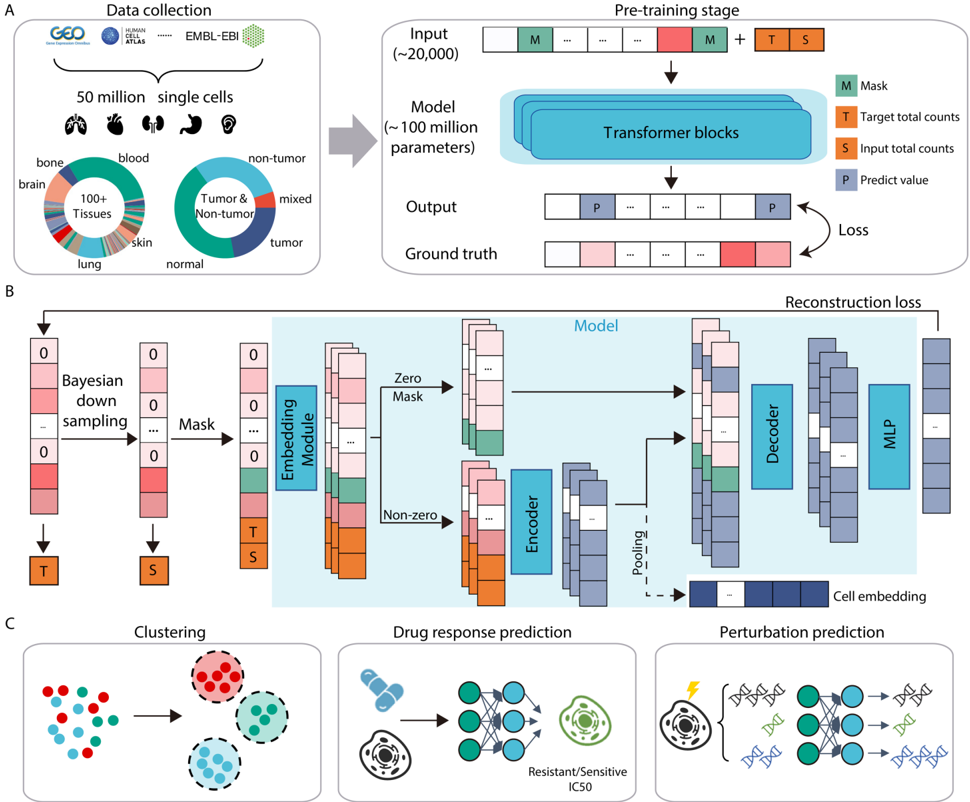
Large pretrained models have become foundation models leading to breakthroughs in natural language processing and related fields. Developing foundation models for deciphering the 'languages' of cells and facilitating biomedical research is promising yet challenging. Here we developed a large pretrained model scFoundation, also named 'xTrimoscFoundation α ', with 100 million parameters covering about 20,000 genes, pretrained on over 50 million human single-cell transcriptomic profiles. scFoundation is a large-scale model in terms of the size of trainable parameters, dimensionality of genes and volume of training data. Its asymmetric transformer-like architecture and pretraining task design empower effectively capturing complex context relations among genes in a variety of cell types and states. Experiments showed its merit as a foundation model that achieved state-of-the-art performances in a diverse array of single-cell analysis tasks such as gene expression enhancement, tissue drug response prediction, single-cell drug response classification, single-cell perturbation prediction, cell type annotation and gene module inference.
Overview
CoChat Summary
TL;DR
scFoundation is a 100M-parameter foundation model pretrained on over 50 million human single-cell transcriptomics profiles covering 19,264 genes. It achieves improved or state-of-the-art performance across gene expression enhancement, cancer drug response prediction, single-cell drug response classification, and perturbation prediction without fine-tuning the pretrained model.
Key findings
- Pretrained on >50 million human scRNA-seq profiles and 19,264 genes with 100M parameters, scFoundation is described as the largest model in parameter size, gene coverage, and data scale in the single-cell field.
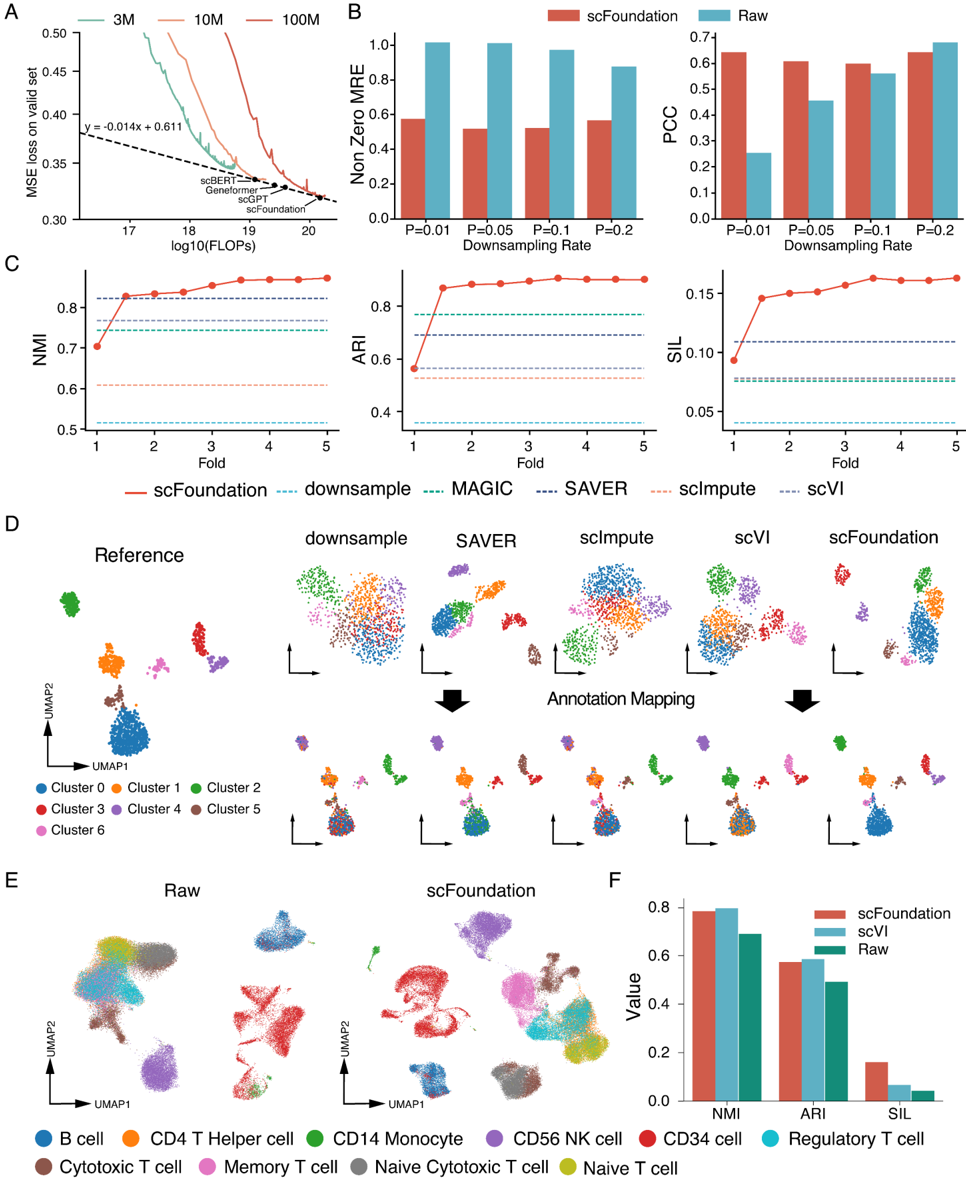
- For read-depth enhancement without fine-tuning, scFoundation reduced MAE and MRE by half versus the non-enhanced baseline; when downsampling was below 10%, baseline MRE was 97.5% while scFoundation maintained an MRE of 60%. On the Zheng68K PBMC dataset (~600,000 cells), scFoundation embeddings had comparable NMI and ARI to scVI and a higher SIL score.
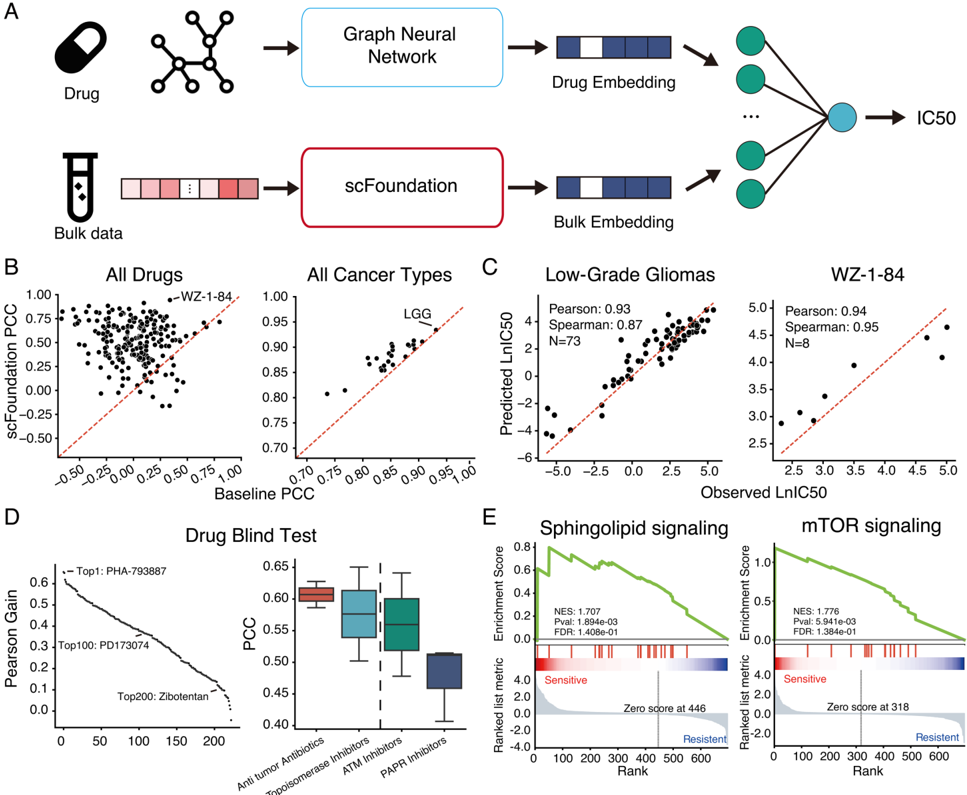
- In cancer drug response prediction with DeepCDR, scFoundation embeddings improved PCC for most drugs and all cancer types; in leave-one-drug-out blind tests, PHA-793887 improved from PCC 0.07 to 0.73 and Zobotentan from 0.49 to 0.64, with the best case achieving PCC above 0.93.
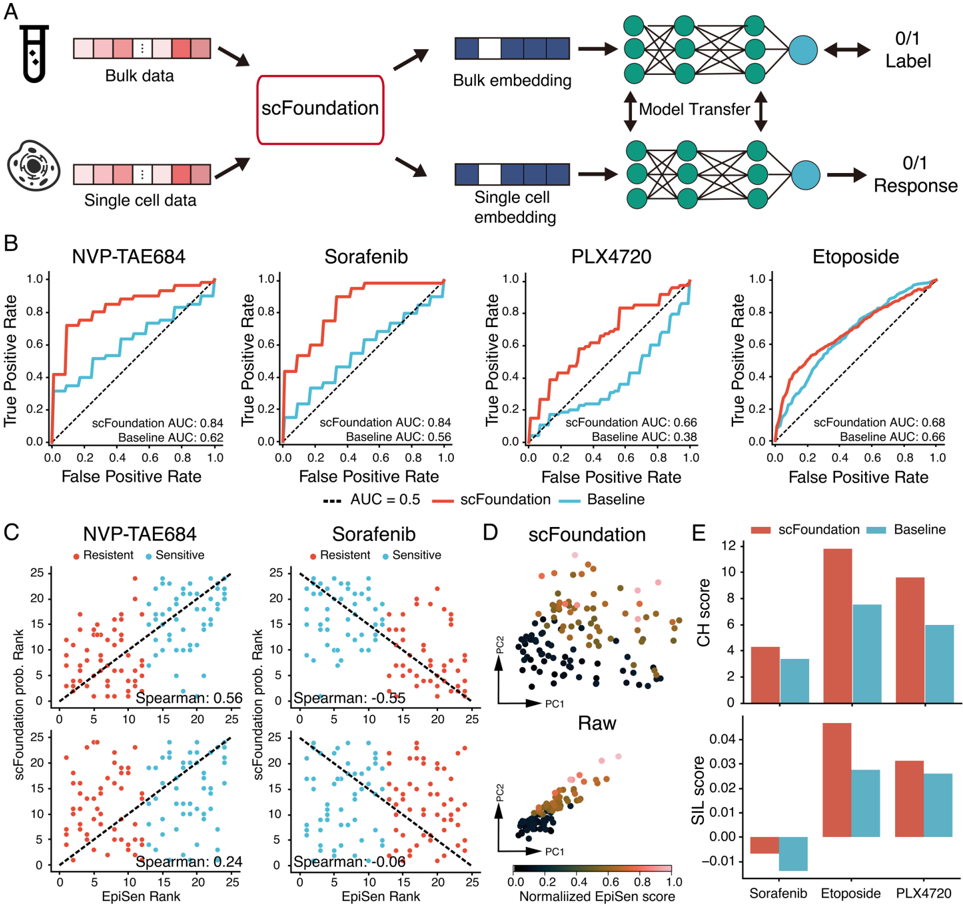
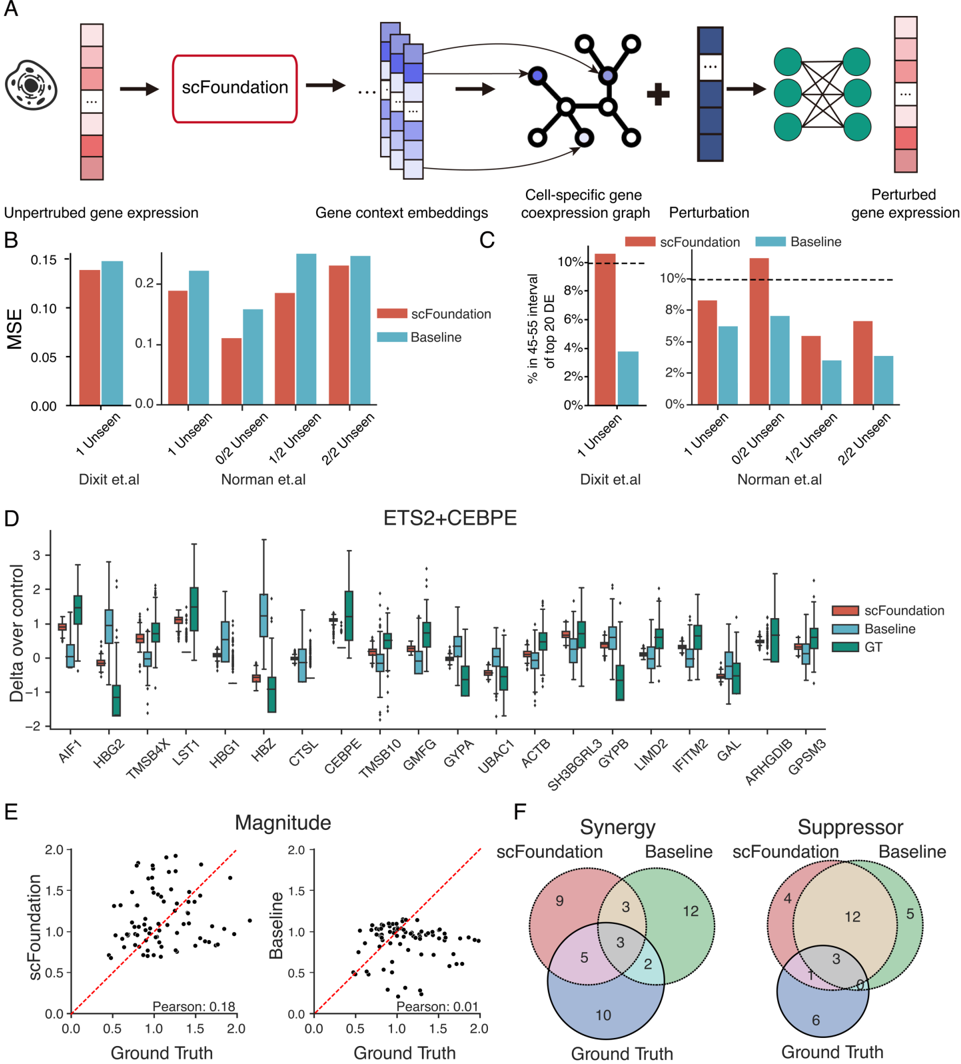
- In single-cell drug response classification, scFoundation embeddings achieved higher AUROC for all four tested drugs; for NVP-TAE684 and Sorafenib, AUROC improved by above 0.2, and Spearman correlations with EpiSen scores were 0.56 and −0.55 versus baseline 0.24 and −0.06. In perturbation prediction, scFoundation-combined GEARS achieved lower MSE on all 1-gene perturbation datasets and the lowest MSE in the 0/2 unseen 2-gene case.
Methods
- Model architecture: xTrimoGene, an asymmetric encoder-decoder transformer with an embedding module that converts continuous gene expression scalars into learnable embeddings; the encoder processes only non-zero and non-masked expressed genes, while the decoder integrates all genes.
- Pretraining data and task: over 50 million human scRNA-seq profiles collected from GEO, Single Cell Portal, HCA, EMBL-EBI, and other resources, aligned to 19,264 genes and filtered for cells with >200 expressed genes; read-depth-aware modeling used hierarchical Bayesian downsampling, 30% masking, and MSE regression loss with total count indicators T and S.
- Downstream evaluation: pretrained cell or gene embeddings were fed into DeepCDR, SCAD, and GEARS without fine-tuning the pretrained model; metrics included MAE, MRE, PCC, NMI, ARI, SIL, AUROC, MSE, and Spearman correlation.
Limitations
- The paper does not include an explicit limitations section.
- Evident from the text: pretraining used only human scRNA-seq data, so generalization to other species or multi-omics settings is not demonstrated.
- Evident from the text: downstream performance depends on existing task-specific models (DeepCDR, SCAD, GEARS) and public datasets, and the paper does not quantify residual batch effects or technical noise beyond describing read-depth-aware pretraining as a mitigation.
Model-written summary. Check it against the paper before relying on it.
Integrity signals
Registry
Cites
Statistics
Figures
Verification
Claims the paper makes
2 Valid · 6 Not valid · 3 Not checked · 74 Own results and interpretations
The cited sources that could be checked couldn’t confirm or dispute this claim.
In the paper
“We developed a new pre-training task called the read-depth-aware (RDA) modeling, which was an extension of masked language modeling 16 , considering single-cell gene expression data had a high variance in read depth, especially in the large-scale pre-training data.”
§ Large Scale Foundation Model on Single-cell Transcriptomics > The scFoundation pre-training framework
What the sources say
- Could not verifycites [16] Choromanski, K. et al. Rethinking Attention with Performers. Preprint at https://doi.org/10.48550/arXiv.2009.14794 (2022). sourceExperimental — accuracy not yet measured
The Experiments section (p. 6) mentions masked language modelling as a task used to evaluate Performers, but does not describe read-depth-aware modelling or an extension of that task. Searches for RDA, read depth, and single-cell gene expression found no passage addressing the attributed claim. (LLM, conf=0.75)
plain- Asserted: passes — The authors put it forward as true.
- Checkable: passes — It can be checked against evidence.
- Load-bearing: passes — The paper’s conclusions depend on it.
- Based: passes — The paper gives a reason why it holds.
- Could not verify
None of the sources cited for this claim have been checked yet.
In the paper
“Existing work had to restrict their models to a small list of selected genes.”
§ Large Scale Foundation Model on Single-cell Transcriptomics > Introduction
What the sources say
- Could not verifycites [8] Papatheodorou, I. et al. Expression Atlas update: from tissues to single cells. Nucleic Acids Research 48, D77-D83 (2020). sourceExperimental — accuracy not yet measured
The Introduction describes Single Cell Expression Atlas as a source of expression matrices for downstream computational methods, and the Data analysis section describes its quantification pipeline. Neither addresses whether earlier pre-training models had to use a small, selected gene list. Searches for pre-training, model limitations, and gene selection found no passage supporting that claim. (LLM, conf=0.76)
- Not checked yetcites [9] Svensson, V., Vento-Tormo, R. & Teichmann, S. A. Exponential scaling of single-cell RNA-seq in the past decade. Nature Protocols 13, 599-604 (2018). source
Checked before — its earlier verdict is held back until a new check runs.
- Could not verifycites [10] Brown, T. B. et al. Language Models are Few-Shot Learners. Preprint at https://doi.org/10.48550/arXiv.2005.14165 (2020). sourceExperimental — accuracy not yet measured
The Introduction (p. 3) discusses pre-trained language models and task-specific datasets, not single-cell gene expression. Searches for single-cell gene expression, selected genes, and restrictions to a small gene list found no passage addressing the claim. (LLM, conf=0.78)
- Could not verifycites [11] Zhao, W. X. et al. A Survey of Large Language Models. Preprint at https://doi.org/10.48550/arXiv.2303.18223 (2023). sourceExperimental — accuracy not yet measured
The Pre-training section (p. 4) discusses language-model training corpora, not single-cell gene-expression data. Searches for “single-cell gene expression selected genes” and “gene expression genes” found no passage addressing whether earlier models were restricted to a small list of genes. (LLM, conf=0.76)
plainstates a cause- Asserted: passes — The authors put it forward as true.
- Checkable: passes — It can be checked against evidence.
- Load-bearing: passes — The paper’s conclusions depend on it.
- Based: passes — The paper gives a reason why it holds.
- Could not verify
The cited sources support only part of this claim — read each source’s verdict below.
In the paper
“We constructed a comprehensive single-cell gene expression data set by collecting data from all publicly available single-cell resources, including GEO 17 , Single Cell Portal, HCA 4 , EMBL-EBI 18 , etc.”
§ Large Scale Foundation Model on Single-cell Transcriptomics > The scFoundation pre-training framework
What the sources say
- Could not verifycites [17] Ma, X. et al. Luna: Linear Unified Nested Attention. Preprint at http://arxiv.org/abs/2106.01540 (2021). sourceExperimental — accuracy not yet measured
Our copy of Luna (arXiv 2106.01540) is entirely about linear nested attention for sequence modelling; every data passage concerns NLP/vision benchmarks — the Abstract's three benchmarks, §4.1's Long Range Arena tasks (ListOps, Text, Retrieval, Image, Pathfinder), WMT'14 English-German (4.5M sentence pairs, Additional information), GLUE/QA (Table 6), and MLM pre-training on BookCorpus/Wikipedia/CC-News/OpenWebText/Stories. Nothing in it addresses single-cell gene expression, GEO, Single Cell Portal, HCA or EMBL-EBI (searched: 'single-cell gene expression dataset collection from public resources', 'scRNA-seq single cell RNA sequencing gene expression GEO Human Cell Atlas EMBL-EBI'). The cited sentence therefore cannot be checked against this source; our copy neither supports nor contradicts it. (LLM, conf=0.72)
- Partly supportedcites [4] Chen, S. et al. hECA: The cell-centric assembly of a cell atlas. iScience 25, 104318 (2022). sourceExperimental — accuracy not yet measured
The hECA 'Dataset collection' section (STAR Methods > Method details) does state the same ambition as the claim — 'collecting all accessible human single-cell data into a unified atlas' — and the Abstract/Introduction confirm it assembled a single-cell gene expression resource (1,093,299 cells, 116 published datasets, 38 organs) from scattered public data. But the realized scope is narrower than 'all publicly available single-cell resources': they selected 20–21 peer-reviewed studies, transcriptomic data of healthy donors only, and the Discussion concedes 'the number of cells in hECA v1.0 is still small and the coverage of organs and cell types is very limited'. Our copy also never lists Single Cell Portal, HCA, or EMBL-EBI as the repositories collected from (only GEO accessions and an NCBI BioProject appear, in the COVID-19 validation experiments), so that enumeration is not supported by this source. (LLM, conf=0.72)
- Partly supportedcites [18] Gong, J. et al. xTrimoGene: An Efficient and Scalable Representation Learner for Single-Cell RNA-Seq Data. 2023.03.24.534055 Preprint at https://doi.org/10.1101/2023.03.24.534055 (2023). sourceExperimental — accuracy not yet measured
Our copy confirms the large curated pre-training data set: the Additional information section states 'we curated about 5 million scRNA-seq data for training' processed with a unified pipeline. However, it attributes collection to a single repository, not 'all publicly available single-cell resources': 'Recently, scRNA-seq data ... mostly has been uploaded to the Gene Expression Omnibus (GEO) repository ... We collected data from GEO' and 'all the scRNA-seq data are collected from the Gene Expression Omnibus (GEO) repository with a keyword searching and data retrieval process.' Searches for HCA / Human Cell Atlas, EMBL-EBI and Single Cell Portal returned no data-source passage in our copy, so the multi-resource scope the citing sentence claims is not supported by this paper. (LLM, conf=0.82)
plain- Asserted: passes — The authors put it forward as true.
- Checkable: passes — It can be checked against evidence.
- Load-bearing: passes — The paper’s conclusions depend on it.
- Based: passes — The paper gives a reason why it holds.
- Could not verify
A result the paper reports from its own data — it cites no other source for it, so there is none to check. The quote shows it is in the paper.
In the paper
“From a cell ontology perspective, the data encompassed almost all known human cell types and cell states.”
§ Large Scale Foundation Model on Single-cell Transcriptomics > The scFoundation pre-training framework
plain- Asserted: passes — The authors put it forward as true.
- Checkable: passes — It can be checked against evidence.
- Load-bearing: passes — The paper’s conclusions depend on it.
- Based: passes — The paper gives a reason why it holds.
A result the paper states — it cites no source for it, so there is none to check. The quote shows it is in the paper.
In the paper
“We observed that, based on scFoundation-predicted results, drugs belonging to chemotherapy, such as anti-tumor antibiotics and topoisomerase inhibitors, had a higher PCC than drugs belonging to targeted therapy, such as ATM and PARP inhibitors (Fig. 3C right).”
§ Large Scale Foundation Model on Single-cell Transcriptomics > scFoundation improves cancer drug response prediction
plainstates an association- Asserted: passes — The authors put it forward as true.
- Checkable: passes — It can be checked against evidence.
- Load-bearing: unclear — It is unclear whether the paper’s conclusions depend on it.
- Based: passes — The paper gives a reason why it holds.
37 more claims
Create a free account to see all 85 claims and to verify the 5 references still open.
- Probably not a substantial claim. 13
- It may state two separate claims as one. 36
- The quote only partly states this claim. 2
Claims other papers make about this one
Each is checked against this paper’s own text: does it say what the citing paper says it does?
The source backs part of the claim, not all of it — or backs it for a different population, condition or comparison.
In the citing paper
“Compared to tasks such as cell annotation and batch correction, perturbation prediction offers experimentally generated model input/output with well-defined objectives, making it a more robust benchmark for assessing foundation models (15, 20, 21).”
From A systematic comparison of single-cell perturbation response prediction models (2026) · cites this paper as [21]
Experimental — accuracy not yet measuredThe source backs part of the claim, not all of it — or backs it for a different population, condition or comparison.
In the citing paper
“These models are pre-trained on vast amounts (> 10 M examples) of unlabelled scRNA-seq data, with the aim that such large datasets allow the models to capture general principles of gene regulation and signalling.”
From Benchmarking foundation cell models for post-perturbation RNA-seq prediction (2025) · cites this paper as [7]
Experimental — accuracy not yet measuredIn the citing paper
“scFoundation [15] strengthens the modular design, aiming to combine different modules to adapt to a variety of single-cell tasks, and is very flexible and scalable.”
From Challenges in AI-driven Biomedical Multimodal Data Fusion and Analysis (2025) · cites this paper as [15]
Self-check
Percentages, sums and reported differences re-computed from the paper’s own numbers.
Each contradiction between two passages listed here was confirmed by an independent check.
Rated minor: it would not touch a result — a value no result rests on, a p-value that stays on the same side of the significance level, or a conflict that is clerical, resolved elsewhere in the paper, or outside its own findings.
In the paper
§ Large Scale Foundation Model on Single-cell Transcriptomics > scFoundation predicts more accurate perturbation responses
“the Adamson dataset 49 with 87 1-gene perturbations”
§ Large Scale Foundation Model on Single-cell Transcriptomics > References
“49. Rood, J. E., Maartens, A., Hupalowska, A., Teichmann, S. A. & Regev, A. Impact of the Human Cell Atlas on medicine. Nat Med 28, 2486-2496 (2022).”
Rated minor: it would not touch a result — a value no result rests on, a p-value that stays on the same side of the significance level, or a conflict that is clerical, resolved elsewhere in the paper, or outside its own findings.
In the paper
§ Large Scale Foundation Model on Single-cell Transcriptomics > scFoundation predicts more accurate perturbation responses
“We combined the scFoundation with an advanced model GEARS 51 for the perturbation prediction task.”
§ Large Scale Foundation Model on Single-cell Transcriptomics > References
“51. Dixit, A. et al. Perturb-Seq: Dissecting Molecular Circuits with Scalable Single-Cell RNA Profiling of Pooled Genetic Screens. Cell 167, 1853-1866.e17 (2016).”
Rated minor: it would not touch a result — a value no result rests on, a p-value that stays on the same side of the significance level, or a conflict that is clerical, resolved elsewhere in the paper, or outside its own findings.
In the paper
§ Large Scale Foundation Model on Single-cell Transcriptomics > scFoundation transfers bulk-level drug sensitivity prediction model to single-cell data
“based on the SCAD 44 downstream model.”
§ Large Scale Foundation Model on Single-cell Transcriptomics > References
“44. Jerby-Arnon, L. et al. A Cancer Cell Program Promotes T Cell Exclusion and Resistance to Checkpoint Blockade. Cell 175, 984-997.e24 (2018).”
Citations
Cites
BERT: Pre-training of Deep Bidirectional Transformers for Language Understanding
Devlin, J., Chang, M.-W., Lee, K., & Toutanova, K. (2018) · arXiv · doi:10.48550/arxiv.1810.04805 · Cited by 73,173
Scikit-learn: Machine Learning in Python
Pedregosa, F., Varoquaux, G., Gramfort, A., Michel, V., Thirion, B., Grisel, O., Blondel, M., Müller, A., Nothman, J., Louppe, G., et al. (2012) · arXiv · doi:10.48550/arxiv.1201.0490 · Cited by 71,016
Subramanian, A., Tamayo, P., Mootha, V. K., Mukherjee, S., Ebert, B. L., Gillette, M. A., Paulovich, A., Pomeroy, S. L., Golub, T. R., Lander, E. S., et al. (2005) · Proceedings of the National Academy of Sciences · doi:10.1073/pnas.0506580102 · Cited by 53,625
KEGG: Kyoto Encyclopedia of Genes and Genomes
Kanehisa, M. (2000) · Nucleic Acids Research · doi:10.1093/nar/28.1.27 · Cited by 37,077
KEGG: Kyoto Encyclopedia of Genes and Genomes
Ogata, H., Goto, S., Sato, K., Fujibuchi, W., Bono, H., & Kanehisa, M. (1999) · Nucleic Acids Research · doi:10.1093/nar/27.1.29 · Cited by 31,232 · cited 1×
“According to the Kyoto Encyclopedia of Genes and Genome database 41 , this pathway was related to sphingomyelin and its metabolism.”
Language Models are Few-Shot Learners
Brown, T. B., Mann, B., Ryder, N., Subbiah, M., Kaplan, J., Dhariwal, P., Neelakantan, A., Shyam, P., Sastry, G., Askell, A., et al. (2020) · arXiv · doi:10.48550/arxiv.2005.14165 · Cited by 23,372 · cited 5×
“Please refer to Supplementary Notes 9 and 10 for details of the sampling strategy and count indicators calculation.”
InfluentialIntegrated analysis of multimodal single-cell data
Hao, Y., Hao, S., Andersen-Nissen, E., Mauck, W. M., Zheng, S., Butler, A., Lee, M. J., Wilk, A. J., Darby, C., Zagar, M., et al. (2020) · doi:10.1101/2020.10.12.335331 · Cited by 15,508
Kaugeranna, R., Kaugeranna, E., & Aion, (. S. 4. 6. (2023) · DROPS (Schloss Dagstuhl – Leibniz Center for Informatics) · doi:10.4230/lipics.giscience.2023.43 · Cited by 13,690
Gene Expression Omnibus: NCBI gene expression and hybridization array data repository
Edgar, R. (2002) · Nucleic Acids Research · doi:10.1093/nar/30.1.207 · Cited by 13,288 · cited 3×
“…a comprehensive single-cell dataset by collecting data from all publicly available single-cell resources, including Gene Expression Omnibus (GEO) 22 , Single Cell Portal, HCA 3 , human Ensemble Cell Atlas (hECA) 4 , Deeply Integrated human Single-Cell Omics data (DISCO) 7 , European Molecular…”
Scaling Laws for Neural Language Models
Kaplan, J., McCandlish, S., Henighan, T., Brown, T. B., Chess, B., Child, R., Gray, S., Radford, A., Wu, J., & Amodei, D. (2020) · arXiv · doi:10.48550/arxiv.2001.08361 · Cited by 9,550 · cited 1×
“This is a large-scale model of large parameter size, gene coverage and data scale in the single-cell field.”
Research works printed but not linked: 1
- He, K. et al. in Proc. IEEE/CVF Conference on Computer Vision and Pattern Recognition 16000–16009 (IEEE, 2022).
Cited by
Profiling cell identity and tissue architecture with single-cell and spatial transcriptomics
Gulati, G. S., D’Silva, J. P., Liu, Y., Wang, L., & Newman, A. M. (2025) · Nature Reviews Molecular Cell Biology · doi:10.1038/s41580-024-00768-2 · Cited by 293
“…other datasets that resemble their input cell 254 , perform data integration across datasets 257,262 , transfer labels (such as cell types or states) from a labelled dataset to an unlabelled one 262–264 , or predict the effects of perturbations on the transcriptional state of a cell 251,258 (Fig.”
Baião, A. R., Cai, Z., Poulos, R. C., Robinson, P. J., Reddel, R. R., Zhong, Q., Vinga, S., & Gonçalves, E. (2025) · Briefings in Bioinformatics · doi:10.1093/bib/bbaf355 · Cited by 211
“In single-cell omics, scFoundation [182], pre-trained on tens of millions of scRNA-seq profiles, demonstrated strong performance across a variety of downstream tasks including cell type annotation, perturbation response prediction, and gene module inference.”
The diversification of methods for studying cell–cell interactions and communication
Armingol, E., Baghdassarian, H. M., & Lewis, N. E. (2024) · Nature Reviews Genetics · doi:10.1038/s41576-023-00685-8 · Cited by 201
Wu, Y., & Xie, L. (2025) · Computational and Structural Biotechnology Journal · doi:10.1016/j.csbj.2024.12.030 · Cited by 178
Transformers in single-cell omics: a review and new perspectives
Szałata, A., Hrovatin, K., Becker, S., Tejada-Lapuerta, A., Cui, H., Wang, B., & Theis, F. J. (2024) · Nature Methods · doi:10.1038/s41592-024-02353-z · Cited by 171
“Embeddings generated by transformers can also be used to inform other models that rely on predefined gene embeddings 26,39,45 , such as the perturbation response prediction model GEARS 46 .”
InfluentialThe Human Cell Atlas from a cell census to a unified foundation model
Rood, J. E., Wynne, S., Robson, L., Hupalowska, A., Randell, J., Teichmann, S. A., & Regev, A. (2025) · Nature · doi:10.1038/s41586-024-08338-4 · Cited by 161
Ahlmann-Eltze, C., Huber, W., & Anders, S. (2025) · Nature Methods · doi:10.1038/s41592-025-02772-6 · Cited by 238
Yang, X., Liu, G., Feng, G., Bu, D., Wang, P., Jiang, J., Chen, S., Yang, Q., Miao, H., Zhang, Y., et al. (2024) · Cell Research · doi:10.1038/s41422-024-01034-y · Cited by 148
“Compared with existing studies, 14,15,17 GeneCompass built a multi-task learning paradigm to predict both expression value and ID of the masked genes based on the encoded gene embedding in the meanwhile.”
Self-citationYang, X., Liu, G., Feng, G., Bu, D., Wang, P., Jiang, J., Chen, S., Yang, Q., Zhang, Y., Man, Z., et al. (2023) · doi:10.1101/2023.09.26.559542 · Cited by 148
A cell atlas foundation model for scalable search of similar human cells
Heimberg, G., Kuo, T., DePianto, D. J., Salem, O., Heigl, T., Diamant, N., Scalia, G., Biancalani, T., Turley, S. J., Rock, J. R., et al. (2025) · Nature · doi:10.1038/s41586-024-08411-y · Cited by 136
A foundation model of transcription across human cell types
(2025) · doi:10.1038/s41586-024-08391-z · Cited by 130
“Future enhancements to GET could involve the incorporation of multiple layers of biological information, including but not limited to nucleotide-level regulator footprints 13,56,57 , three-dimensional chromatin architecture 58,59 , and regulator expression profiles or single-cell embeddings 18–20 .”
Foundation Model for Advancing Healthcare: Challenges, Opportunities and Future Directions
He, Y., Huang, F., Jiang, X., Nie, Y., Wang, M., Wang, J., & Chen, H. (2024) · IEEE Reviews in Biomedical Engineering · doi:10.1109/rbme.2024.3496744 · Cited by 247
“For scRNA-seq data, some BFM works [141], [144], [145], [146] utilized MOM to encode the expression values and gene names thus extracting representative information from the high-dimensional and sparse data. scBERT [141] trained its model on 1.1 million human scRNA-seq data via the MOM for an…”
InfluentialFoundation models in bioinformatics
Guo, F., Guan, R., Li, Y., Liu, Q., Wang, X., Yang, C., & Wang, J. (2025) · National Science Review · doi:10.1093/nsr/nwaf028 · Cited by 110
A visual–omics foundation model to bridge histopathology with spatial transcriptomics
Chen, W., Zhang, P., Tran, T. N., Xiao, Y., Li, S., Shah, V. V., Cheng, H., Brannan, K. W., Youker, K., Lai, L., et al. (2025) · Nature Methods · doi:10.1038/s41592-025-02707-1 · Cited by 118
“Unlike single-cell foundation models like scGPT 57 , Geneformer 26 and scFoundation 27 , our approach models omics data as text, effectively bridging molecular and visual modalities.”
Zero-shot evaluation reveals limitations of single-cell foundation models
Kedzierska, K. Z., Crawford, L., Amini, A. P., & Lu, A. X. (2025) · Genome Biology · doi:10.1186/s13059-025-03574-x · Cited by 109
Transformers and genome language models
Consens, M. E., Dufault, C., Wainberg, M., Forster, D., Karimzadeh, M., Goodarzi, H., Theis, F. J., Moses, A. M., & Wang, B. (2025) · Nature Machine Intelligence · doi:10.1038/s42256-025-01007-9 · Cited by 196
A Comprehensive Survey of Foundation Models in Medicine
Khan, W., Leem, S., See, K. B., Wong, J. K., Zhang, S.-T., & Fang, R.-G. (2024) · IEEE Reviews in Biomedical Engineering · doi:10.1109/rbme.2025.3531360 · Cited by 174
“Other works include [78], [100], [101], [102], [103], [104], [105].”
The Large Language Models on Biomedical Data Analysis: A Survey
Lan, W., Tang, Z., Liu, M., Chen, Q., Peng, W., Chen, Y. P., & Pan, Y. F. (2025) · IEEE Journal of Biomedical and Health Informatics · doi:10.1109/jbhi.2025.3530794 · Cited by 114
“The scFoundation [77] is a large-scale pre-trained model based on more than 50 million human single-cell transcriptome data.”
CellFM: a large-scale foundation model pre-trained on transcriptomics of 100 million human cells
Zeng, Y., Xie, J., Shangguan, N., Wei, Z., Li, W., Su, Y., Yang, S., Zhang, C., Zhang, J., Fang, N., et al. (2025) · Nature Communications · doi:10.1038/s41467-025-59926-5 · Cited by 156
“To integrate metadata information, scELMo 20 leverages LLMs like GPT-3.”
Predicting cellular responses to perturbation across diverse contexts with State
Adduri, A. K., Gautam, D., Bevilacqua, B., Naghipourfar, M., Imran, A., Shah, R., Teyssier, N., Verma, R., Carpenter, C., Eraslan, B., et al. (2026) · Cell · doi:10.1016/j.cell.2026.07.052 · Cited by 100
Ge, S., Sun, S., Xu, H., Cheng, Q. S., & Ren, Z. (2025) · Briefings in Bioinformatics · doi:10.1093/bib/bbaf136 · Cited by 108
Benchmarking algorithms for single-cell multi-omics prediction and integration
Hu, Y., Wan, S., Luo, Y., Li, Y., Wu, T., Deng, W., Jiang, C., Jiang, S., Zhang, Y., Liu, N., et al. (2024) · Nature Methods · doi:10.1038/s41592-024-02429-w · Cited by 95
Hallmarks of artificial intelligence contributions to precision oncology
Chang, T., Park, S., Schäffer, A. A., Jiang, P., & Ruppin, E. (2025) · Nature Cancer · doi:10.1038/s43018-025-00917-2 · Cited by 99
Digital twins in healthcare: a comprehensive review and future directions
Rudsari, H. K., Tseng, B., Zhu, H., Song, L., Gu, C., Roy, A., Irajizad, E., Butner, J. D., Long, J. P., & Do, K.-A. (2025) · Frontiers in Digital Health · doi:10.3389/fdgth.2025.1633539 · Cited by 152
Self-citationChallenges in AI-driven Biomedical Multimodal Data Fusion and Analysis
Liu, J., Cen, X., Yi, C., Wang, F.-A., Ding, J., Cheng, J., Wu, Q., Gai, B., Zhou, Y., He, R., et al. (2025) · Genomics, Proteomics & Bioinformatics · doi:10.1093/gpbjnl/qzaf011 · Cited by 75
Ahlmann-Eltze, C., Huber, W., & Anders, S. (2024) · doi:10.1101/2024.09.16.613342 · Cited by 268
Advances and applications in single-cell and spatial genomics
Wang, J., Ye, F., Chai, H., Jiang, Y., Wang, T., Ran, X., Xia, Q., Xu, Z., Fu, Y., Zhang, G., et al. (2024) · Science China Life Sciences · doi:10.1007/s11427-024-2770-x · Cited by 79
Self-citationNicheformer: A Foundation Model for Single-Cell and Spatial OmicsPreprint
Schaar, A. C., Tejada-Lapuerta, A., Palla, G., Gutgesell, R. M., Halle, L., Minaeva, M., Vornholz, L., Dony, L., Drummer, F., Bahrami, M., et al. (2024) · bioRxiv (Cold Spring Harbor Laboratory) · doi:10.1101/2024.04.15.589472 · Cited by 66
Harnessing artificial intelligence to fill global shortfalls in biodiversity knowledge
Pollock, L. J., Kitzes, J. A., Beery, S., Gaynor, K. M., Jarzyna, M. A., Aodha, O. M., Meyer, B. E., Rolnick, D., Taylor, G. W., Tuia, D., et al. (2025) · Nature Reviews Biodiversity · doi:10.1038/s44358-025-00022-3 · Cited by 107
“…analysis of the realistic limitations of AI technologies; although the proliferation of foundation models (including molecular 19 , cellular 20,21 and organismal 22 models) coupled with generative AI holds promise for reducing all biodiversity shortfalls, AI is not the answer to every…”
Evaluating the Utilities of Foundation Models in Single-cell Data Analysis
Liu, T., Li, K., Wang, Y., Li, H., & Zhao, H. (2023) · doi:10.1101/2023.09.08.555192 · Cited by 62
“Inspired by [33], we compared models with large parameter size of pre-training to models of small parameter size.”
Evaluating the Utilities of Foundation Models in Single‐Cell Data Analysis
Liu, T., Li, K., Wang, Y., Li, H., & Zhao, H. (2026) · Advanced Science · doi:10.1002/advs.202514490 · Cited by 61
Assessing the limits of zero-shot foundation models in single-cell biology
Kedzierska, K. Z., Crawford, L., Amini, A. P., & Lu, A. X. (2023) · bioRxiv (Cold Spring Harbor Laboratory) · doi:10.1101/2023.10.16.561085 · Cited by 61
“These include scBERT [4], Geneformer [5], scGPT [6], tGPT [7], scFoundation [8], SCimilarity [9], GET [10], GeneCompass [11], and GENEPT [12] which all present themselves as general models applicable to diverse analyses.”
BackgroundProgress and opportunities of foundation models in bioinformatics
Li, Q., Hu, Z., Wang, Y., Li, L., Fan, Y., King, I., Jia, G., Wang, S., Song, L., & Li, Y. (2024) · Briefings in Bioinformatics · doi:10.1093/bib/bbae548 · Cited by 91
“For instance, scFoundation [116] serves as a versatile FM, harmonizing diverse biological data sources including sequence information, structural features, and chemical compounds.”
BackgroundSelf-citationSaunders, R. A., Allen, W. E., Pan, X., Sandhu, J., Lu, J., Lau, T. K., Smolyar, K., Sullivan, Z. A., Dulac, C. G., Weissman, J. S., et al. (2025) · Cell · doi:10.1016/j.cell.2025.05.022 · Cited by 99
scTab: Scaling cross-tissue single-cell annotation models
Fischer, F., Fischer, D. S., Mukhin, R., Isaev, A., Biederstedt, E., Villani, A.-C., & Theis, F. J. (2024) · Nature Communications · doi:10.1038/s41467-024-51059-5 · Cited by 59
Viñas Torné, R., Wiatrak, M., Piran, Z., Fan, S., Jiang, L., Teichmann, S. A., Nitzan, M., & Brbić, M. (2026) · Nature Biotechnology · doi:10.1038/s41587-025-02777-8 · Cited by 58
“To navigate the complex combinatorial landscape of perturbations, computational approaches have been developed to predict transcriptional outcomes of genetic perturbations that were never experimentally tested 1–3 .”
Simple and effective embedding model for single-cell biology built from ChatGPT
Chen, Y. T., & Zou, J. (2024) · Nature Biomedical Engineering · doi:10.1038/s41551-024-01284-6 · Cited by 264
“…RNA-seq data and demonstrated state-of-the-art performance in cell-type annotation and novel cell-type discovery, as well as scFoundation 14 , where the authors expanded the training to 50 million cells and utilized an asymmetric encoder–decoder architecture to accommodate for the…”
A mini-review on perturbation modelling across single-cell omic modalities
Gavriilidis, G. I., Vasileiou, V., Orfanou, A., Ishaque, N., & Psomopoulos, F. (2024) · Computational and Structural Biotechnology Journal · doi:10.1016/j.csbj.2024.04.058 · Cited by 54
“Finally, scFoundation [71], is trained on a vast dataset of over 19, 264 genes with 100 million parameters on over 50 million scRNA-seq data, and it stands out as the most significant model regarding train-able parameters, gene dimensionality, and the number of cells used in pre-training.…”
MethodLi, Y., Huang, Z., Xu, L., Fan, Y., Ping, J., Li, G., Chen, Y., Yu, C., Wang, Q., Song, T., et al. (2025) · Nature Methods · doi:10.1038/s41592-024-02586-y · Cited by 70
“6 and 7 for a more detailed cost comparison.”
Large language models for drug discovery and development
Zheng, Y., Koh, H. Y., Ju, J., Yang, M., May, L. T., Webb, G. I., Li, L., Pan, S., & Church, G. M. (2025) · Patterns · doi:10.1016/j.patter.2025.101346 · Cited by 134
New horizons at the interface of artificial intelligence and translational cancer research
Yates, J., & Allen, E. M. V. (2025) · Cancer Cell · doi:10.1016/j.ccell.2025.03.018 · Cited by 63
scPRINT: pre-training on 50 million cells allows robust gene network predictions
Kalfon, J., Samaran, J., Peyré, G., & Cantini, L. (2025) · Nature Communications · doi:10.1038/s41467-025-58699-1 · Cited by 100
“While most other methods have used masking as a pretraining task, our method is related to the down-sampling and masking task of scFoundation 41 .”
scDiffusion: conditional generation of high-quality single-cell data using diffusion model
Luo, E., Hao, M., Wei, L., & Zhang, X. (2024) · Bioinformatics · doi:10.1093/bioinformatics/btae518 · Cited by 100
“There are no such models in the single-cell field until the recent emergence of the foundation models (Theodoris et al. 2023, Bian et al. 2024, Cui et al. 2024, Hao et al. 2024).”
Self-citationBenchmarking foundation cell models for post-perturbation RNA-seq prediction
Csendes, G., Sanz, G., Szalay, K. Z., & Szalai, B. (2025) · BMC Genomics · doi:10.1186/s12864-025-11600-2 · Cited by 47
“To address these challenges, several Transformer-based, foundation cell models have emerged recently [4, 6, 7].”
Single-cell foundation models: bringing artificial intelligence into cell biology
Baek, S., Song, K., & Lee, I. (2025) · Experimental & Molecular Medicine · doi:10.1038/s12276-025-01547-5 · Cited by 46
“There are also models with an encoder – decoder combination or custom modi fi cations 34 .”
Ma, C., Zhang, H., Rao, Y., Jiang, X., Liu, B., Sun, Z., Song, Z., Gao, Y., Cui, Y., Liu, X., et al. (2025) · npj Digital Medicine · doi:10.1038/s41746-025-02198-6 · Cited by 76
“Foundation models for virtual cells trained on tens of millions of single cells deliver strong performance in cell-type annotation and gene-function inference (GeneFormer 55 ; scFoundation 56 ).”
Novae: a graph-based foundation model for spatial transcriptomics data
Blampey, Q., Benkirane, H., Bercovici, N., Mulder, K., Gessain, G., Ginhoux, F., André, F., & Cournède, P.-H. (2025) · Nature Methods · doi:10.1038/s41592-025-02899-6 · Cited by 73
“Novae is a graph-based foundation model 18,19 that we trained on a large single-cell spatial transcriptomics dataset composed of about 30 million cells.”
A Deep Dive into Single-Cell RNA Sequencing Foundation Models
Boiarsky, R., Singh, N., Buendia, A., Getz, G., & Sontag, D. (2023) · bioRxiv (Cold Spring Harbor Laboratory) · doi:10.1101/2023.10.19.563100 · Cited by 43
“…foundation models for single-cell RNA sequencing data could substantially improve the performance of single-cell RNA-sequencing analysis pipelines, and several such models have recently been developed, such as scBERT [7], scGPT [8], Geneformer [9], scFoundation [10], and scSimilarity [11].”
BackgroundMethodGraph neural networks for single-cell omics data: a review of approaches and applications
Li, S., Hua, H., & Chen, S. (2025) · Briefings in Bioinformatics · doi:10.1093/bib/bbaf109 · Cited by 43
Large language model for knowledge synthesis and AI-enhanced biomanufacturing.
Li, W.-Y., Mao, Z.-T., Xiao, Z.-Y., Liao, X.-P., Koffas, M., Chen, Y.-X., Ma, H.-W., & Tang, Y.-J. J. (2025) · Trends in Biotechnology · doi:10.1016/j.tibtech.2025.02.008 · Cited by 44
Benchmarking algorithms for generalizable single-cell perturbation response prediction
Wei, Z., Wang, Y., Gao, Y., Wang, S., Li, P., Si, D., Gao, Y., Wu, S., Li, D., Dong, K., et al. (2026) · Nature Methods · doi:10.1038/s41592-025-02980-0 · Cited by 42
“In addition, single-cell foundation models have established a paradigm for in silico perturbation prediction through pretraining and fine-tuning strategies 6–9 .”
Huang, A. C., Hsieh, T.-H. S., Zhu, J., Michuda, J., Teng, A., Kim, S., Rumsey, E. M., Lam, S. K., Anigbogu, I., Wright, P., et al. (2025) · bioRxiv (Cold Spring Harbor Laboratory) · doi:10.1101/2025.06.11.659105 · Cited by 69
Scaling Large Language Models for Next-Generation Single-Cell AnalysisPreprint
Rizvi, S. A., Levine, D., Patel, A. M., Zhang, S., Wang, E., Perry, C. J., Vrkic, I., Constante, N. M., Fu, Z., He, S., et al. (2025) · bioRxiv (Cold Spring Harbor Laboratory) · doi:10.1101/2025.04.14.648850 · Cited by 76
“Recent transcriptomic foundation models (FMs), such as scGPT [4], Geneformer [5], scFoundation [6], and scGenePT [7] have shown promise in modeling single-cell transcriptomic data at scale.”
Hou, J., Zhang, R., Xie, Y., Li, C., & Qin, W. (2025) · npj Digital Medicine · doi:10.1038/s41746-025-02257-y · Cited by 38
“In medicine, various foundation models handle different data modalities,suchasscFoundationforgenesequencingdata 45 ,UNIforwhole-slide images 46 , CONCH 24 and MUSK 47 for image-text pairs.”
Designing interpretable deep learning applications for functional genomics: a quantitative analysis
van Hilten, A., Katz, S., Saccenti, E., Niessen, W. J., & Roshchupkin, G. V. (2024) · Briefings in Bioinformatics · doi:10.1093/bib/bbae449 · Cited by 44
“GPT (e.g. [27,28,71]) will be a popular tool for at least the short-term future.”
PertEval-scFM: Benchmarking Single-Cell Foundation Models for Perturbation Effect Prediction
Wenteler, A., Occhetta, M., Branson, N., Curean, V., Huebner, M., Dee, W., Connell, W., Chung, S. P., Hawkins-Hooker, A., Ektefaie, Y., et al. (2024) · doi:10.1101/2024.10.02.616248 · Cited by 37
“…on downstream applications, such as cell-type classification, gene regulatory network inference, and the prediction of cellular responses to perturbations (Yang et al., 2022; Kedzierska et al., 2023; Theodoris et al., 2023; Rosen et al., 2023; Cui et al., 2024; Wen et al., 2023; Hao et al., 2023).”
scMulan: A Multitask Generative Pre-Trained Language Model for Single-Cell Analysis
Bian, H., Chen, Y., Dong, X., Li, C., Hao, M., Chen, S., Hu, J., Sun, M., Wei, L., & Zhang, X. (2024) · Lecture notes in computer science · doi:10.1007/978-1-0716-3989-4_57 · Cited by 46
Self-citationTransformer-Based Single-Cell Language Model: A Survey
Lan, W., He, G., Liu, M., Chen, Q., Cao, J., & Peng, W. (2024) · Big Data Mining and Analytics · doi:10.26599/bdma.2024.9020034 · Cited by 47
Ge, Y., Leng, J., Tang, Z., Wang, K., Kaicheng, U., Zhang, S. M., Han, S., Zhang, Y., Xiang, J., Yang, S., et al. (2025) · Research · doi:10.34133/research.0568 · Cited by 44
“Our investigation also did not explicitly explore the potential of integrating foundation models in transcriptomics or genomics, which may require more computational resources for pretraining but extract more biologically meaningful features from the gene expression data [ 53 ].”
Harnessing artificial intelligence to advance CRISPR-based genome editing technologies
Thomson, T., Li, G. L., Strilchuk, A. W., Cui, H., Wang, B., & Li, B. (2025) · Nature Reviews Genetics · doi:10.1038/s41576-025-00907-1 · Cited by 43
“Several other foundation models contribute to this growing ecosystem. scFoundation, trained on 50 million single-cell profiles, produces general-purpose embeddings that support downstream perturbation modelling 189 .”
AI-empowered perturbation proteomics for complex biological systems
Qian, L., Sun, R., Aebersold, R. H., Bühlmann, P., Sander, C., & Guo, T. (2024) · Cell Genomics · doi:10.1016/j.xgen.2024.100691 · Cited by 37
Droplet Microfluidics for Advanced Single‐Cell Analysis
Liu, C., & Xu, X. (2025) · Smart Medicine · doi:10.1002/smmd.70002 · Cited by 41
Self-citationAdvancing bioinformatics with language models: components, applications, and perspectives
Liu, J., Yang, M., Yu, Y., Xu, H., Wang, T., Li, K., & Zhou, X. (2026) · Briefings in Bioinformatics · doi:10.1093/bib/bbag367 · Cited by 72
Self-citationYoungblut, N. D., Carpenter, C., Nayebnazar, A., Adduri, A. K., Shah, R., Ricci-Tam, C., Prashar, J., Ilango, R., Teyssier, N., Konermann, S., et al. (2025) · bioRxiv · doi:10.1101/2025.02.27.640494 · Cited by 18
scELMo: Embeddings from Language Models are Good Learners for Single-cell Data Analysis
Liu, T., Chen, T., Zheng, W., Luo, X., Chen, Y., & Zhao, H. (2023) · doi:10.1101/2023.12.07.569910 · Cited by 30
“However, as a recent work, GenePT [1] questions the contribution of only using the sequencing information for biological analysis.”
MethylGPT: a foundation model for the DNA methylomePreprint
Ying, K., Song, J., Cui, H., Zhang, Y., Li, S., Chen, X., Liu, H., Eames, A. W., McCartney, D. L., Marioni, R. E., et al. (2024) · bioRxiv (Cold Spring Harbor Laboratory) · doi:10.1101/2024.10.30.621013 · Cited by 46
“In the single-cell domain, models like Geneformer 24 , scGPT 25 , and scFoundation 26 have enabled zero-shot cell-type classification and in-silico per-76 turbation.”
MethodEmbeddings from language models are good learners for single-cell data analysis
Liu, T., Chen, T., Zheng, W., Luo, X., Chen, Y. T., & Zhao, H. (2026) · Patterns · doi:10.1016/j.patter.2025.101431 · Cited by 44
“Notable examples include scGPT, 7 Gene-former, 8 and scFoundation, 15 which leverage extensive single-cell transcriptomic data to learn biological patterns.”
Wong, D. R., Hill, A. S., & Moccia, R. (2025) · Bioinformatics · doi:10.1093/bioinformatics/btaf317 · Cited by 27
“Due to the ease of data loading, many studies 27,28,33,43,44 have recently used the ready-made datasets provided by the GEARS 44 repository for training and evaluating models.”
Liu, Y., Zhu, K., Peng, W., Liu, Z., & Mao, X. (2026) · Signal Transduction and Targeted Therapy · doi:10.1038/s41392-026-02631-6 · Cited by 51
“206 – 208 The complexity of the gut microbial Fig.”
Sankar, B. S., Gilliland, D., Rincon, J., Hermjakob, H., Yan, Y., Adam, I., Lemaster, G., Wang, D., Watson, K., Bui, A., et al. (2024) · Bioengineering · doi:10.3390/bioengineering11100984 · Cited by 26
“Despite”
A Systematic Comparison of Single-Cell Perturbation Response Prediction Models
Li, L., You, Y., Fu, Y., Liao, W., Fan, X., Lu, S., Cao, Y., Li, B., Ren, W., Kong, J., et al. (2024) · bioRxiv (Cold Spring Harbor Laboratory) · doi:10.1101/2024.12.23.630036 · Cited by 25
“Compared to tasks such as cell annotation and batch correction, perturbation prediction offers experimentally generated model input/output with well-defined objectives, making it a more robust benchmark for assessing foundation models ( 15, 20, 21 ).”
An overview of computational methods in single-cell transcriptomic cell type annotation
Li, T., Wang, Z., Liu, Y., He, S., Zou, Q., & Zhang, Y. (2025) · Briefings in Bioinformatics · doi:10.1093/bib/bbaf207 · Cited by 39
“In recent years, several large-scale pretrained models for single-cell annotation, such as scBERT [17], scGPT [133], and scFoundation [134], have made remarkable advances.”
EpiAgent: foundation model for single-cell epigenomics
Chen, X., Li, K., Cui, X., Wang, Z., Jiang, Q., Lin, J., Li, Z., Gao, Z., Lv, H., & Jiang, R. (2025) · Nature Methods · doi:10.1038/s41592-025-02822-z · Cited by 46
Quantized multi-task learning for context-specific representations of gene network dynamicsPreprint
Chen, H., Venkatesh, M. S., Ortega, J. G., Mahesh, S. V., Nandi, T., Madduri, R., Pelka, K., & Theodoris, C. V. (2024) · bioRxiv (Cold Spring Harbor Laboratory) · doi:10.1101/2024.08.16.608180 · Cited by 39
Deeper evaluation of a single-cell foundation model
Boiarsky, R., Singh, N. M., Buendia, A., Amini, A. P., Getz, G., & Sontag, D. (2024) · Nature Machine Intelligence · doi:10.1038/s42256-024-00949-w · Cited by 25
A large model for non-invasive and personalized management of breast cancer from multiparametric MRI
Luo, L., Wu, M., Li, M., Xin, Y., Wang, Q., Vardhanabhuti, V., Chu, C. W., Li, Z., Zhou, J., Rajpurkar, P., et al. (2025) · Nature Communications · doi:10.1038/s41467-025-58798-z · Cited by 42
“In medical image analysis, recent studies also demonstrated that these methods could match medical specialists’ performance, such as chest X-rays [27, 28], pathology images [29–31], and transcriptomics [32].”
Chinese Immune Multi-Omics Atlas
Yin, J., Zheng, Y., Huang, Z., Zhou, W., Yuan, Y., Cai, P., Bai, Y., Yang, S., Gao, Y., Duan, S., et al. (2026) · Science · doi:10.1126/science.adt3130 · Cited by 54
Self-citationLimitations of cell embedding metrics assessed using drifting islands
Wang, H., Leskovec, J., & Regev, A. (2025) · Nature Biotechnology · doi:10.1038/s41587-025-02702-z · Cited by 36
“With a dramatic growth in single-cell data, including the Human Cell Atlas 3,4 , multiple efforts have focused on learning universal embeddings for diverse single-cell data, with different integration methods or foundation models 5–10 .”
Artificial intelligence in bioinformatics: a survey
Jiang, J., Li, Y., Cao, S., Shan, Y., Liu, Y., Fei, T., Yu, Y., Feng, Y., Li, Y., Li, Y., et al. (2025) · Briefings in Bioinformatics · doi:10.1093/bib/bbaf576 · Cited by 35
“…samples, possessing capabilities for batch and multi-omics integration, cell-type annotation, and gene perturbation prediction. scFoundation [79] pretrained on over 50 million single cells, demonstrating high accuracy and robustness in drug response prediction and tr anscriptional…”
Benchmarking AI Models for In Silico Gene Perturbation of Cells
Li, C., Gao, H., She, Y., Bian, H., Chen, Q., Liu, K., Wei, L., & Zhang, X. (2024) · doi:10.1101/2024.12.20.629581 · Cited by 24
Self-citationXia, X., Zhu, C., Zhong, F., & Liu, L. (2024) · BMC Biology · doi:10.1186/s12915-024-02023-8 · Cited by 32
“For instance, Minsheng Hao et al. replaced the MLP-based cell line transcriptional feature extraction module in DeepCDR with scFoundation and demonstrated that the scFoundation-based model significantly outperformed the original model [56].”
BackgroundResultRediscovering publicly available single-cell data with the DISCO platform
Li, M., Ang, K. S., Teo, B. K. H., Uddamvathanak, R., Nguyen, M. N., Maurer‐Stroh, S., & Chen, J. (2024) · Nucleic Acids Research · doi:10.1093/nar/gkae1108 · Cited by 31
Biology-driven insights into the power of single-cell foundation models
Wu, J., Ye, Q., Wang, Y., Hu, R., Zhu, Y., Yin, M., Wang, T., Wang, J., Hsieh, C., & Hou, T. (2025) · Genome biology · doi:10.1186/s13059-025-03781-6 · Cited by 50
“To assess the current progress of modeling scRNA-seq data using foundation models, we consider six prominent and widely used scFMs (namely, Geneformer [7], scGPT [2], UCE [8], scFoundation [4], LangCell [9], and scCello [10]) across various pretraining settings as part of our benchmarking workflow.”
Self-citationLi, Z., Du, Z., Huang, D.-S., & Teschendorff, A. E. (2025) · Scientific Reports · doi:10.1038/s41598-025-89646-1 · Cited by 30
Timilsina, M., Buosi, S., Razzaq, M. A., Haque, R., Judge, C. S., & Curry, E. (2025) · Computers in Biology and Medicine · doi:10.1016/j.compbiomed.2025.109925 · Cited by 32
Systems Human Immunology and AI: Immune Setpoint and Immune Health
Lei, Y., & Tsang, J. S. (2025) · Annual Review of Immunology · doi:10.1146/annurev-immunol-090122-042631 · Cited by 31
Generalizable AI predicts immunotherapy outcomes across cancers and treatments
Shen, W. X., Moon, I., Nguyen, T. H., Li, M. M., Huang, Y., Nair, N., Marbach, D., & Žitnik, M. (2026) · Nature Medicine · doi:10.1038/s41591-026-04502-7 · Cited by 40
MGM as a Large‐Scale Pretrained Foundation Model for Microbiome Analyses in Diverse Contexts
Zhang, H., Zhang, Y., Kang, Z., Xiong, J., Yang, R., & Ning, K. (2026) · Advanced Science · doi:10.1002/advs.202513333 · Cited by 31
“Recent advancements in the application of LLMs have shown promise in the analysis of biological tabular data [ 29–32 ].”
Foundation models for bioinformatics
Chen, Z., Wei, L., & Gao, G. (2024) · Quant. Biol. · doi:10.1002/qub2.69 · Cited by 71
“Meanwhile, scBERT [61], scGPT [62], scFoundation [63], and xTrimoGene [64] replace the position embedding in classic transformer models into gene embedding and regard binned or transformed expression as tokens.”
DenAdel, A., Hughes, M., Thoutam, A., Gupta, A., Navia, A. W., Fusi, N., Raghavan, S., Winter, P. S., Amini, A. P., & Crawford, L. A. (2026) · Nature Methods · doi:10.1038/s41592-026-03120-y · Cited by 52
“While conceptualizing a cell as ‘a bag of RNA’ 50 is a useful starting point for many models, the concept of a cell as ‘a sentence of genes’ 12–15 may be less effective.”
InfluentialSex differences in bladder cancer: understanding biological and clinical implications
Chaudhary, P., Singha, B., Abdel-Hafiz, H. A., Velegraki, M., Sundi, D., Satturwar, S. P., Parwani, A. V., Grivennikov, S. I., You, S., Goodridge, H. S., et al. (2025) · Biology of Sex Differences · doi:10.1186/s13293-025-00715-6 · Cited by 31
Unravelling tumour spatiotemporal heterogeneity using spatial multimodal data
Zuo, C., Zhu, J., Zou, J., & Chen, L. (2025) · Clinical and Translational Medicine · doi:10.1002/ctm2.70331 · Cited by 24
General-purpose pre-trained large cellular models for single-cell transcriptomics
Bian, H., Chen, Y., Luo, E., Wu, X., Hao, M., Wei, L., & Zhang, X. (2024) · National Science Review · doi:10.1093/nsr/nwae340 · Cited by 32
Self-citationGenePert: Leveraging GenePT Embeddings for Gene Perturbation PredictionPreprint
Chen, Y. T., & Zou, J. (2024) · bioRxiv (Cold Spring Harbor Laboratory) · doi:10.1101/2024.10.27.620513 · Cited by 31
“More recently, with the rise of large-scale pretrained “foundation models” for single-cell transcriptomics [Cui et al., 2024, Theodoris et al., 2023, Hao et al., 2024], studies have shown state-of-the-art predictive performance by fine-tuning these learned embeddings for perturbation screen…”
BackgroundVisible neural networks for multi-omics integration: a critical review
Selby, D., Jakhmola, R., Sprang, M., Großmann, G., Raki, H., Maani, N., Pavliuk, D., Ewald, J., & Vollmer, S. J. (2025) · Frontiers in Artificial Intelligence · doi:10.3389/frai.2025.1595291 · Cited by 26
“Flexible architectures with less restrictive activation functions may better capture the multi-layered complexity of cellular biology, bridging trends in explainability and the training of molecular foundation models (Ma et al., 2024; Hao et al., 2024; Cui et al., 2024).”
AttentionPert: accurately modeling multiplexed genetic perturbations with multi-scale effects
Bai, D., Ellington, C. N., Mo, S., Song, L., & Xing, E. P. (2024) · Bioinformatics · doi:10.1093/bioinformatics/btae244 · Cited by 33
“Current single-cell LLMs often take GEARS as a downstream probe in predicting perturbational effects (Cui et al. 2024, Gong et al. 2023, Hao et al. 2024, Yang et al. 2024).”
BackgroundSelf-citationVisual–language foundation models in medicine
Liu, C., Jin, Y., Guan, Z., Li, T., Qin, Y., Qian, B., Jiang, Z., Wu, Y.-L., Wang, X., Zheng, Y. F., et al. (2024) · The Visual Computer · doi:10.1007/s00371-024-03579-w · Cited by 44
“Recently, foundation models (FMs) which refer to models pretrained on large-scale data and endowed with the capability to adapt to various tasks have shown immense potential in the healthcare domain [8, 9].”
Self-citationExploring the heterogeneous targets of metabolic aging at single-cell resolution
Sun, S., Jiang, M., Ma, S., Ren, J., & Liu, G. (2024) · Trends in Endocrinology and Metabolism · doi:10.1016/j.tem.2024.07.009 · Cited by 21
In silico biological discovery with large perturbation models
Miladinovic, D., Höppe, T., Chevalley, M., Georgiou, A., Stuart, L., Mehrjou, A., Bantscheff, M., Schölkopf, B., & Schwab, P. (2025) · Nature Computational Science · doi:10.1038/s43588-025-00870-1 · Cited by 36
“These models (frequently referred to as “foundation models”) include Geneformer [26], scGPT [27], scFoundation [28], and GenePT [29].”
ChemFM as a scaling law guided foundation model pre-trained on informative chemicals
Cai, F., Zacour, K., Zhu, T., Tzeng, T.-R. J., Duan, Y., Liu, L., Pilla, S., Li, G., & Luo, F. (2025) · Communications Chemistry · doi:10.1038/s42004-025-01793-8 · Cited by 42
“Asaresult,thedatasetsoftencontainedredundant ornoisymoleculesandlackedsystematicevaluationofchemicaldiversity, hinderingmeaningfulscalinganalysisandlimitinggeneralizationacross tasks.”
Metadata
- Authors
- Hao, M., Gong, J., Zeng, X., Liu, C., Guo, Y., Cheng, X., Wang, T., Ma, J., Zhang, X., & Song, L.
- Affiliations
- Tsinghua University (CN)
- Beijing National Research Center for Information Science and Technology (CN)
- Mohamed bin Zayed University of Artificial Intelligence (AE)
- Corresponding author
- Ma, Jianzhu
- Zhang, Xuegong
- Song, Le
- ORCID
- Venue
- Nature Methods
- Published
- 2024-06-06
- Volume
- 21
- Issue
- 8
- Pages
- 1481-1491
- ISSN
- 1548-7091 (ISSN-L)
- 1548-7105
- OpenAlex
- W4399387478
- Semantic Scholar
- c520d8a888355f7abb7728b2e2510fe7bc63f814
- Cited by
- 988
- References
- 93
- Citations by year
- 2026: 597 · 2025: 294 · 2024: 93
- FWCI
- 93.98
- Type
- journal article
- Language
- en
- Open access
- green
- doi.org
- Licence
- cc-by
- www.springernature.com/gp/researchers/text-and-data-mining (tdm)
- www.springernature.com/gp/researchers/text-and-data-mining (vor)
- Locations
- Nature Methods (publishedVersion)
- bioRxiv (Cold Spring Harbor Laboratory) (submittedVersion, cc-by)
- PubMed (publishedVersion)
- Funders
- National Natural Science Foundation of China (61721003, 62250005)
- Tsinghua University
- National Key Research and Development Program of China (2021YFF1200901, 61721003)
- Topics
- Life Sciences › Biochemistry, Genetics and Molecular Biology › Molecular Biology › Single-cell and spatial transcriptomics
- Life Sciences › Biochemistry, Genetics and Molecular Biology › Molecular Biology › Gene expression and cancer classification
- Life Sciences › Biochemistry, Genetics and Molecular Biology › Molecular Biology › Gene Regulatory Network Analysis
- Keywords
- single-cell transcriptomics, foundation models, pre-trained models, gene expression enhancement, drug response prediction, cell type annotation
- MeSH terms
- Algorithms, Humans, Computational Biology, Gene Expression Profiling, Single-Cell Analysis, Transcriptome
About these checks
Registry, retraction, Cites and statistics results are computed, not judged, with one exception: a printed reference that no index lists is read once by a model before it counts as a citation error. Claims are extracted by a model and kept only when their quote appears verbatim in the text; each cited source is then checked, with a model’s help, for whether it says what the claim relies on. Those verdicts can be wrong — read the claim’s quote and the cited source before relying on one.
The claim verdicts this report counts are experimental: their accuracy is not yet measured.
A language model drew the claims from the paper on 2026-11-10, under version 3 of the claim definition (model deepseek-v4.1-flash, prompt extract-v3).
A second model labelled each claim on 2026-11-10 (model jev-1.13-20260917, definition revision gold-guideline-v0.2).
Cited sources are checked with a language model’s help (gpt-6-sol and qwen3.8-omni-flash).
Statistics and arithmetic are recomputed, not judged.
Confidence bands are shown only for fields calibrated on our annotated test set. None is calibrated yet, so no band is shown.
What counts as a claim ›How we measure confidence ›How we check this ›
Are you an author, or do you see a problem with this page? Request a review
Data sources
Bibliographic data: Semantic Scholar, OpenAlex, Crossref.
Contains information from the Semantic Scholar Academic Graph Datasets, made available under the ODC Attribution License (ODC-BY 1.0).
Semantic Scholar’s data is described in: Kinney, R., et al. (2023). The Semantic Scholar Open Data Platform. arXiv:2301.10140.
