

Deep-learning-based gene perturbation effect prediction does not yet outperform simple linear baselines
Open accessPublished version of a preprint
The DOI matches its Crossref record; 43 of the 44 references it cites were found in a registry or an index; 14 of the 22 sources its claims cite were checked for support.
Abstract
Recent research in deep-learning-based foundation models promises to learn representations of single-cell data that enable prediction of the effects of genetic perturbations. Here we compared five foundation models and two other deep learning models against deliberately simple baselines for predicting transcriptome changes after single or double perturbations. None outperformed the baselines, which highlights the importance of critical benchmarking in directing and evaluating method development.
Overview
CoChat Summary
TL;DR
This benchmark compared five single-cell foundation models and two other deep learning models against deliberately simple baselines for predicting transcriptome changes after single or double gene perturbations. None of the deep learning models consistently outperformed the simple baselines, and a linear model with perturbation embeddings pretrained on Replogle data was the best performer.
Key findings
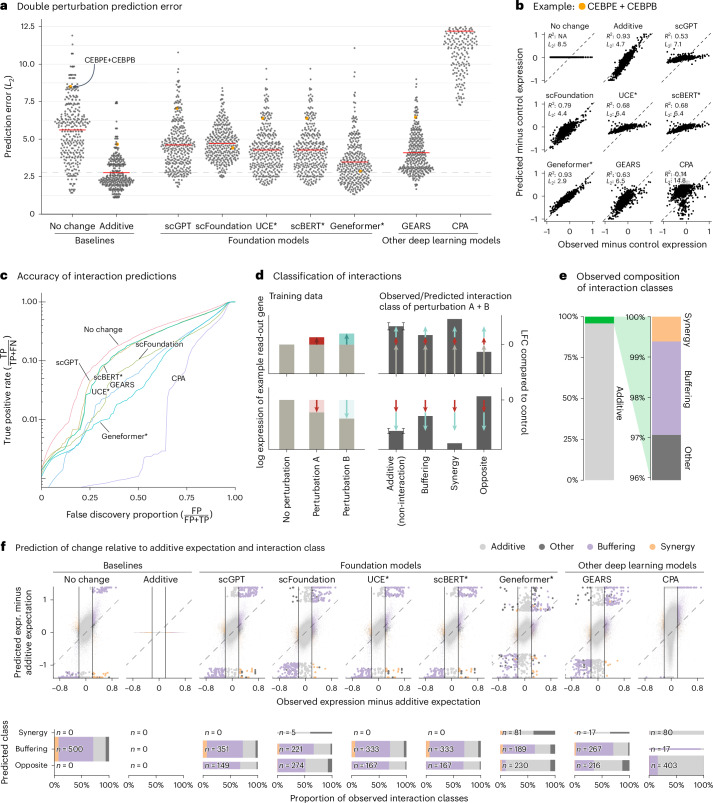
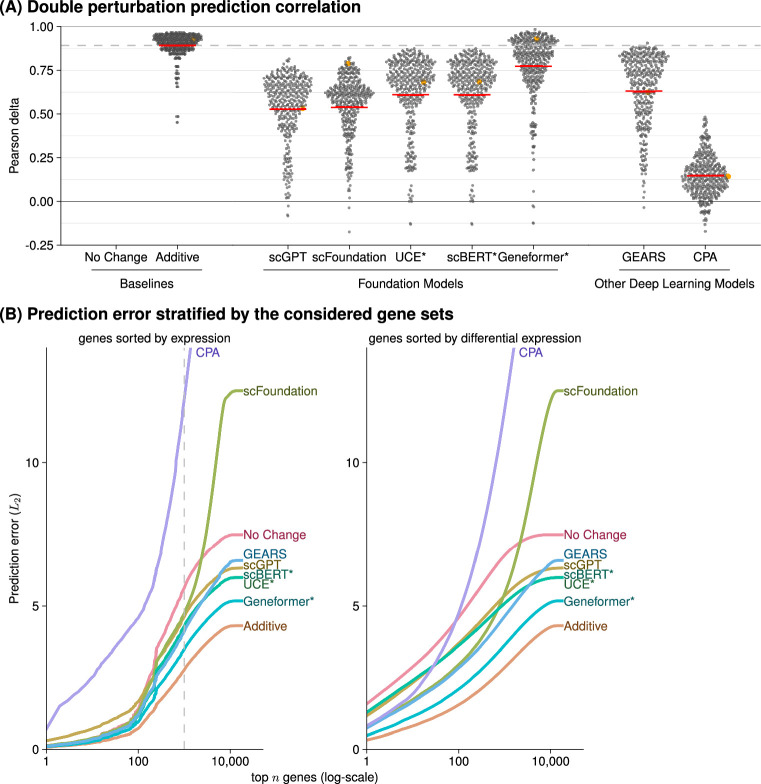
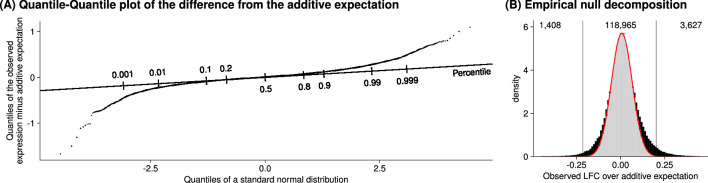
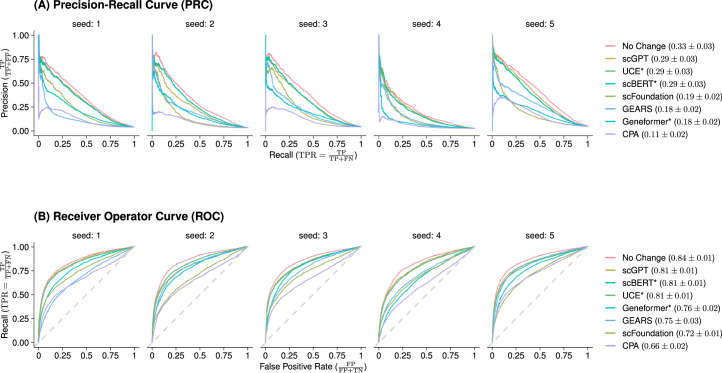
- In the double perturbation benchmark on Norman et al. data (100 single genes, 124 gene pairs, 19,264 genes), all models had prediction error substantially higher than the additive baseline, and none was better than the “no change” baseline for genetic interaction prediction. Using the full dataset, the authors identified 5,035 genetic interactions out of potentially 124,000 at a 5% false discovery rate.
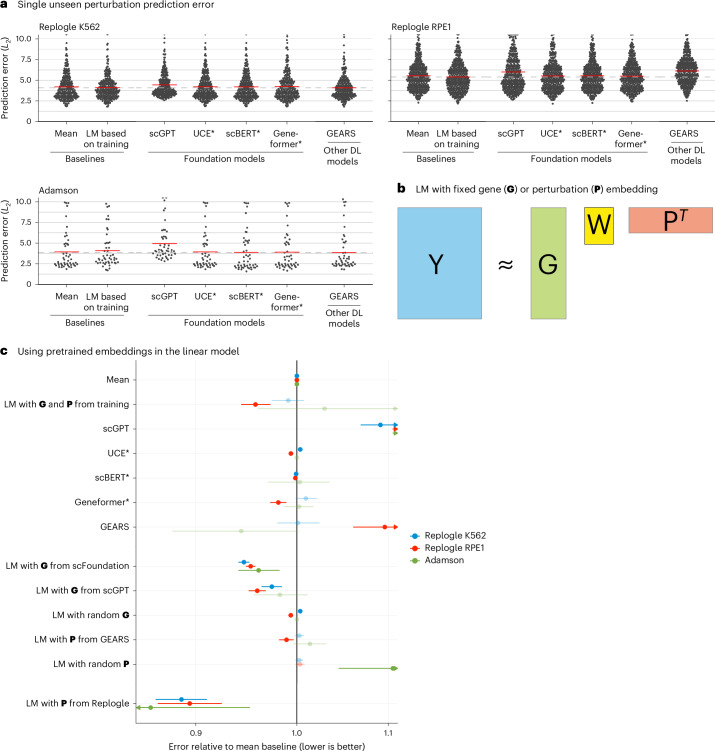
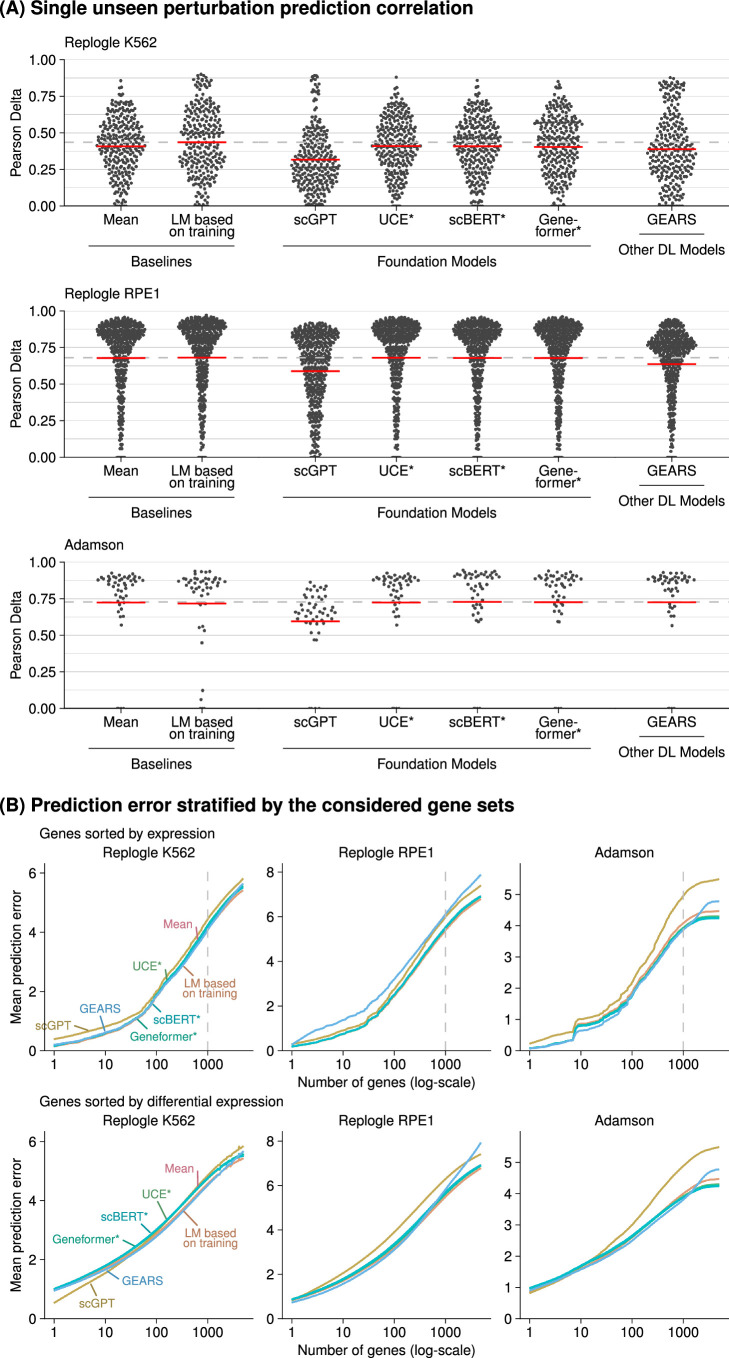
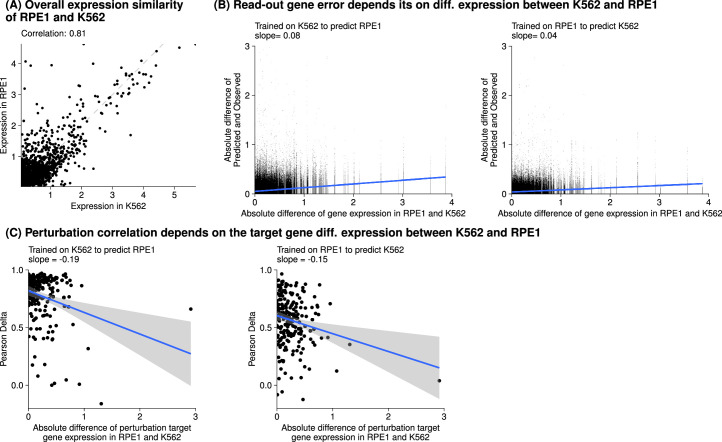
- In the unseen single perturbation benchmark, none of the deep learning models consistently outperformed the mean prediction or the linear model. A linear model with perturbation embeddings pretrained on Replogle data consistently outperformed all other models; gene embeddings from scFoundation and scGPT outperformed the mean baseline but did not consistently outperform the linear model using G and P from the training data.
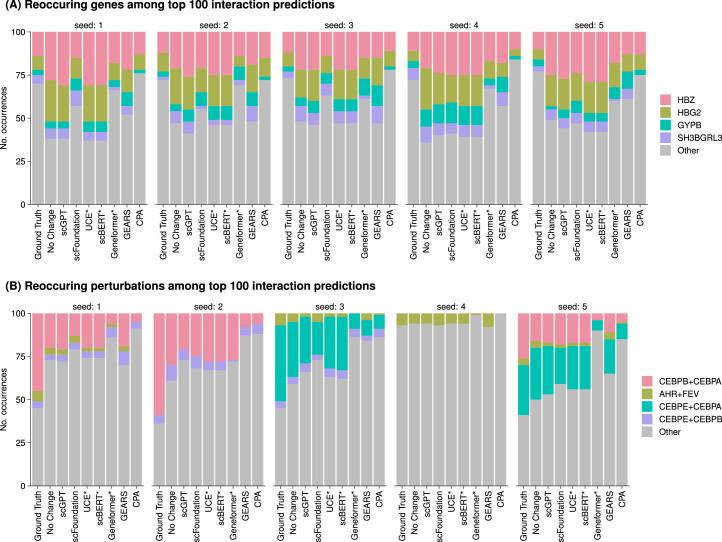
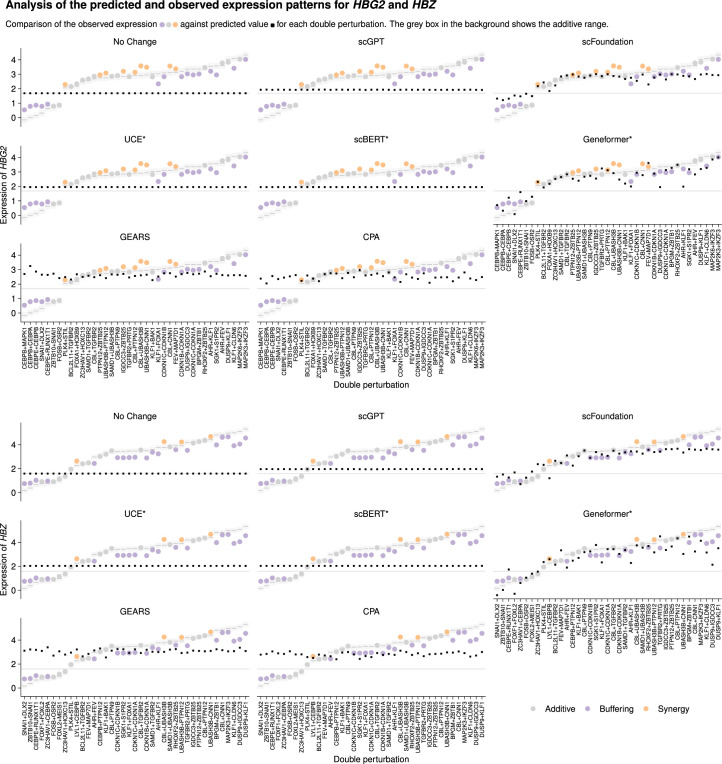
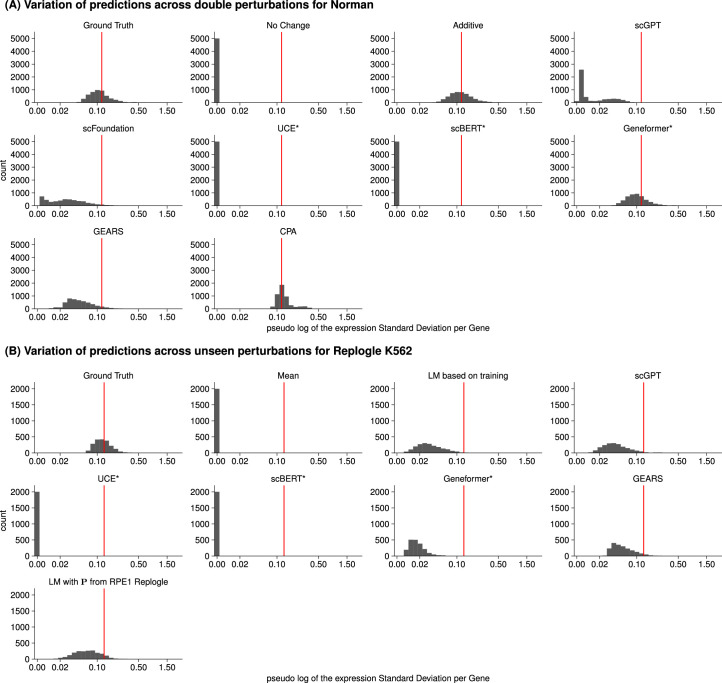
- All models mostly predicted buffering interactions, rarely predicted synergistic interactions, and even more rarely predicted them correctly. For most genes, scGPT, UCE and scBERT predictions did not vary across perturbations, and GEARS and scFoundation predictions varied considerably less than the ground truth.
Methods
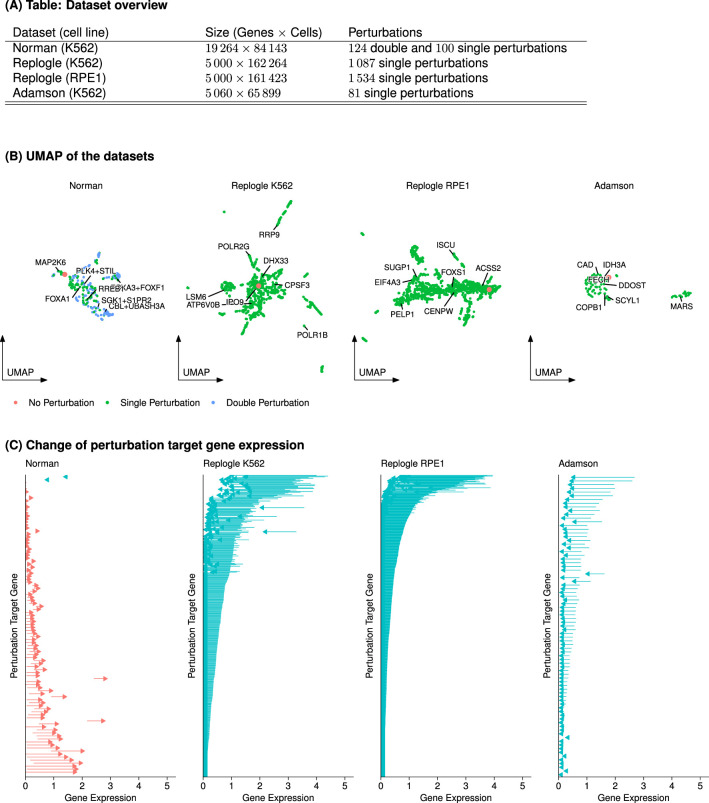
- Benchmarked GEARS v0.1.2, scGPT v0.2.1, scFoundation, CPA v0.8.8, Geneformer v0.1.0, scBERT and UCE against simple baselines. Double perturbation analysis used Norman et al. data, training on all 100 single perturbations and 62 double perturbations and testing on the remaining 62 double perturbations across five random splits. Single perturbation analysis used Adamson et al. and Replogle et al. K562/RPE1 datasets with GEARS’ simulation test–training splitting repeated twice.
- Prediction error was the L2 distance between predicted and observed expression for the 1,000 most highly expressed genes; Pearson delta and other gene subsets were also examined. Genetic interactions were defined as deviations from additive expectation using Efron’s empirical null approach with the locfdr package at a 5% false discovery rate, and true-positive rate versus false discovery proportion curves were computed.
- The linear model represented read-out genes with matrix G and perturbations with matrix P, found W via normal equations with ridge penalty λ = 0.1, and used K = 10. Baselines included “no change,” “additive” and “mean.” For Geneformer, UCE and scBERT, a ridge regression linear decoder mapped perturbed embeddings to gene expression.
Limitations
- The paper states that only four datasets were used, chosen because they were used in the publications presenting GEARS, scGPT and scFoundation; all datasets are from cancer cell lines; and the authors did not attempt to improve original quality control, for example by excluding perturbations that did not affect their own target gene.
- The paper acknowledges that for UCE and scBERT, the post-perturbation embedding was calculated by overwriting rows for perturbed genes with values from the ground truth expression matrix, so test data leakage could theoretically give those models an advantage. It also notes that CPA authors submitted a code fix, but because the new code had worse performance, the original code results are reported.
Model-written summary. Check it against the paper before relying on it.
Integrity signals
Registry
Cites
Statistics
Figures
Verification
Claims the paper makes
6 Valid · 0 Not valid · 5 Not checked · 32 Own results and interpretations
Every source the paper cites for this claim was checked and supports it.
In the paper
“The approach that did consistently outperform all other models was a linear model with P pretrained on the Replogle data (using the K562 cell line data as pretraining for the Adamson and RPE1 data and the RPE1 cell line for the K562 data).”
§ Deep-learning-based gene perturbation effect prediction does not yet outperform simple linear baselines > Main
What the sources say
- Supportedcites Replogle et al.13 Replogle, J. M. et al. Mapping information-rich genotype-phenotype landscapes with genome-scale Perturb-seq. Cell 185, 2559–2575 (2022). 35688146 PMC9380471 source
The Methods describe Perturb-seq datasets generated in K562 and RPE1 cells, confirming that this paper is the source of the identified Replogle data. The statement that a pretrained linear model outperformed other models is the citing authors’ comparison, not a result attributed to Replogle et al. (LLM, conf=0.88)
plain- Asserted: passes — The authors put it forward as true.
- Checkable: passes — It can be checked against evidence.
- Load-bearing: passes — The paper’s conclusions depend on it.
- Based: passes — The paper gives a reason why it holds.
- Supported
The cited sources support only part of this claim — read each source’s verdict below.
In the paper
“Since the release of our paper as a preprint, several other benchmarks15,16,22–27 were released that also show that deep learning models struggle to outperform simple baselines.”
§ Deep-learning-based gene perturbation effect prediction does not yet outperform simple linear baselines > Main
What the sources say
- Supportedcites [15] Kernfeld, E., Yang, Y., Weinstock, J. S., Battle, A. & Cahan, P. A systematic comparison of computational methods for expression forecasting. Preprint at bioRxiv10.1101/2023.07.28.551039 (2024). sourceExperimental — accuracy not yet measured
The Discussion reports that very simple baselines typically performed at least as well as the methods benchmarked. This paper is one of the benchmarks cited in the sentence; it need not itself establish the findings of the other cited benchmarks. (LLM, conf=0.90)
- Supportedcites [16] Csendes, G., Sanz, G., Szalay, K. Z. & Szalai, B. Benchmarking foundation cell models for post-perturbation RNA-seq prediction. BMC Genomics 26, 393 (2025). 40269681 PMC12016270 sourceExperimental — accuracy not yet measured
The Discussion reports that this benchmark compared foundation models with baselines and found that the simple Train Mean model outperformed scGPT and scFoundation in most cases. The source therefore supports its use as one example among the cited benchmarks; it does not, by itself, establish what the other benchmarks found. (LLM, conf=0.91)
- Not checked — no full text of the sourcecites [22] Wenteler, A. et al. PertEval-scFM: benchmarking single-cell foundation models for perturbation effect prediction. In Proc. 42nd International Conference on Machine Learning (ICML, 2025). source
- Supportedcites [23] Bendidi, I. et al. Benchmarking transcriptomics foundation models for perturbation analysis: one PCA still rules them all. Preprint at https://arxiv.org/abs/2410.13956 (2024). source
This source is a benchmark comparing transcriptomics foundation models with simpler baselines. Its Conclusion (section 6) reports that scVI and PCA outperform the foundation models on most perturbation-related tasks, supporting its use as an example of the benchmarks cited. The timing relative to the citing authors’ preprint is their framing, not a finding attributed to this source. (LLM, conf=0.91)
- Supportedcites [24] Wu, Y. et al. PerturBench: benchmarking machine learning models for cellular perturbation analysis. Preprint at https://arxiv.org/abs/2408.10609 (2024). source
The Introduction reports that simple architectures can outperform more sophisticated models on larger datasets. Section 6 (Discussion) likewise says the Latent Additive and Decoder-Only baselines outperform more complex methods on larger datasets, while acknowledging that the complex methods perform best on some smaller datasets. This supports the claim that deep learning models can struggle to outperform simple baselines; the timing of the benchmark's release is the citing authors' framing. (LLM, conf=0.91)
- Partly supportedcites [25] Li, L. et al. A systematic comparison of single-cell perturbation response prediction models. Preprint at bioRxiv10.1101/2024.12.23.630036 (2024). PMC13557097 42715312 sourceExperimental — accuracy not yet measured
The Abstract identifies this paper as a benchmark comparing methods and baselines and reports limits to model performance. It does not say that deep-learning models struggled to outperform simple baselines, so the specific finding attributed to this benchmark is not supported by our copy. (LLM, conf=0.78)
- Not checked — no full text of the sourcecites [26] Li, C. et al. Benchmarking AI models for in silico gene perturbation of cells. Preprint at bioRxiv10.1101/2024.12.20.629581 (2025). source
- Supportedcites [27] Wong, D. R., Hill, A. S. & Moccia, R. Simple controls exceed best deep learning algorithms and reveal foundation model effectiveness for predicting genetic perturbations. Bioinformatics41, btaf317 (2025). PMC12202205 40407144 sourceExperimental — accuracy not yet measured
The Abstract (Results) says this paper's simple baseline outperforms state-of-the-art deep-learning methods. Section 3.1 reports that the CRISPR-informed mean model performed better on average than all deep-learning models tested, while acknowledging conditions in which deep-learning models did better. It therefore supports the citing sentence as one of the benchmarks showing that deep-learning models struggle to outperform simple baselines. (LLM, conf=0.91)
plain- Asserted: passes — The authors put it forward as true.
- Checkable: passes — It can be checked against evidence.
- Load-bearing: unclear — It is unclear whether the paper’s conclusions depend on it.
- Based: passes — The paper gives a reason why it holds.
- Supported
Every source the paper cites for this claim was checked and supports it.
In the paper
“Using the full dataset, we identified 5,035 genetic interactions (out of potentially 124,000) at a false discovery rate of 5%.”
§ Deep-learning-based gene perturbation effect prediction does not yet outperform simple linear baselines > Main
What the sources say
- Supportedcites Norman et al.11 Norman, T. M. et al. Exploring genetic interaction manifolds constructed from rich single-cell phenotypes. Science 365, 786–793 (2019). 31395745 PMC6746554 source
The ‘An overexpression strategy identifies strong genetic interactions’ section (page unavailable) describes Norman et al.’s genetic-interaction dataset, supporting its identification as the dataset used. The 5,035 interactions, 124,000 potential interactions, and 5% false-discovery rate are presented as the citing authors’ own analysis (‘we identified’), not as findings attributed to Norman et al.; the cited paper does not report those figures. (LLM, conf=0.84)
plain- Asserted: passes — The authors put it forward as true.
- Checkable: passes — It can be checked against evidence.
- Load-bearing: unclear — It is unclear whether the paper’s conclusions depend on it.
- Based: passes — The paper gives a reason why it holds.
- Supported
Every source the paper cites for this claim was checked and supports it.
In the paper
“Another limitation is that all datasets are from cancer cell lines, which, for example, Theodoris et al.5 excluded from their training data because of concerns about their high mutational burden.”
§ Deep-learning-based gene perturbation effect prediction does not yet outperform simple linear baselines > Main
What the sources say
- Supportedcites Theodoris et al.5 Theodoris, C. V. et al. Transfer learning enables predictions in network biology. Nature 618, 616–624 (2023). 37258680 PMC10949956 source
The Geneformer architecture and pretraining section states that Theodoris et al. excluded cells with high mutational burdens, including immortalized cell lines, from their pretraining corpus because mutations could substantially rewire networks. The cited paper does not establish that all datasets in the citing authors’ benchmark came from cancer cell lines; that is the citing authors’ own description, not the point attributed to this source. (LLM, conf=0.94)
plain- Asserted: passes — The authors put it forward as true.
- Checkable: passes — It can be checked against evidence.
- Load-bearing: unclear — It is unclear whether the paper’s conclusions depend on it.
- Based: passes — The paper gives a reason why it holds.
- Supported
A result the paper reports from its own data — it cites no other source for it, so there is none to check. The quote shows it is in the paper.
In the paper
“all models except Geneformer and scFoundation predicted LFC ≈ 0—like the ‘no change’ baseline—for the double perturbation of these two genes, despite their strong individual effects (Extended Data Fig. 6).”
§ Deep-learning-based gene perturbation effect prediction does not yet outperform simple linear baselines > Main
plain- Asserted: passes — The authors put it forward as true.
- Checkable: passes — It can be checked against evidence.
- Load-bearing: unclear — It is unclear whether the paper’s conclusions depend on it.
- Based: passes — The paper gives a reason why it holds.
22 more claims
Create a free account to see all 43 claims and to verify the 2 references still open.
- Probably not a substantial claim. 15
- It may state two separate claims as one. 3
Claims other papers make about this one
Each is checked against this paper’s own text: does it say what the citing paper says it does?
The cited source says what the claim attributes to it.
In the citing paper
“Besides, simple baselines proved highly competitive with complex deep learning models, which is consistent with a previous study (25).”
From A systematic comparison of single-cell perturbation response prediction models (2026) · cites this paper as [25]
The cited source says what the claim attributes to it.
In the citing paper
“This finding extends recent observations that simple additive or linear baselines remain difficult to outperform in double-perturbation prediction (25, 31).”
From A systematic comparison of single-cell perturbation response prediction models (2026) · cites this paper as [25]
The cited source says what the claim attributes to it.
In the citing paper
“Recent studies have provided initial benchmarks comparing foundation models, other deep learning architectures, and simple baselines for perturbation effect prediction and reported that complex models do not consistently outperform the simpler alternatives (22–26).”
From A systematic comparison of single-cell perturbation response prediction models (2026) · cites this paper as [25]
The cited source says what the claim attributes to it.
In the citing paper
“While this work provides valuable insights, its evaluation was limited in dataset diversity and task coverage, leaving the question of whether such conclusions generalize across broader biological contexts.”
From A systematic comparison of single-cell perturbation response prediction models (2026) · cites this paper as [25]
Citations
Cites
A Survey on Evaluation of Large Language Models
Chang, Y., Wang, X., Wang, J., Wu, Y., Yang, L., Zhu, K., Chen, H., Yi, X., Wang, C., Wang, Y., et al. (2024) · ACM Transactions on Intelligent Systems and Technology · doi:10.1145/3641289 · Cited by 4,254
A Survey on Evaluation of Large Language Models
Chang, Y., Wang, X., Wang, J., Wu, Y., Yang, L., Zhu, K., Chen, H., Yi, X., Wang, C., Wang, Y., et al. (2023) · arXiv · doi:10.48550/arxiv.2307.03109 · Cited by 3,159
The Gene Ontology knowledgebase in 2023
The Gene Ontology Consortium, Aleksander, S. A., Balhoff, J., Carbon, S., Cherry, J. M., Drabkin, H. J., Ebert, D., Feuermann, M., Gaudet, P., Harris, N. L., et al. (2023) · GENETICS · doi:10.1093/genetics/iyad031 · Cited by 2,664
Regev, A., Teichmann, S. A., Lander, E. S., Amit, I., Benoist, C., Birney, E., Bodenmiller, B., Campbell, P., Carninci, P., Clatworthy, M., et al. (2017) · eLife · doi:10.7554/elife.27041 · Cited by 2,232
scGPT: Towards Building a Foundation Model for Single-Cell Multi-omics Using Generative AI
Cui, H., Wang, C., Maan, H., Pang, K., Luo, F., & Wang, B. (2023) · doi:10.1101/2023.04.30.538439 · Cited by 1,694
Benchmarking atlas-level data integration in single-cell genomics
Luecken, M. D., Büttner, M., Chaichoompu, K., Danese, A., Interlandi, M., Mueller, M. F., Strobl, D. C., Zappia, L., Dugas, M., Colomé-Tatché, M., et al. (2022) · Nature Methods · doi:10.1038/s41592-021-01336-8 · Cited by 1,438
Adamson, B., Norman, T. M., Jost, M., Cho, M. Y., Nuñez, J. K., Chen, Y., Villalta, J. E., Gilbert, L. A., Horlbeck, M. A., Hein, M. Y., et al. (2016) · Cell · doi:10.1016/j.cell.2016.11.048 · Cited by 1,193 · cited 2×
“For the single gene perturbation benchmarks, we used the data from Adamson et al. 14 and Replogle et al. 13 as provided by GEARS (details in ‘Data availability’).”
Transfer learning enables predictions in network biology
Theodoris, C. V., Xiao, L., Chopra, A., Chaffin, M. D., Al Sayed, Z. R., Hill, M. C., Mantineo, H., Brydon, E. M., Zeng, Z., Liu, X. S., et al. (2023) · Nature · doi:10.1038/s41586-023-06139-9 · Cited by 1,193 · cited 1×
“Another limitation is that all datasets are from cancer cell lines, which, for example, Theodoris et al. 5 excluded from their training data because of concerns about their high mutational burden.”
Large-scale foundation model on single-cell transcriptomics
Hao, M., Gong, J., Zeng, X., Liu, C., Guo, Y., Cheng, X., Wang, T., Ma, J., Zhang, X., & Song, L. (2024) · Nature Methods · doi:10.1038/s41592-024-02305-7 · Cited by 988
Large-Scale Inference: Empirical Bayes Methods for Estimation, Testing, and Prediction
Efron, B. (2010) · Cambridge University Press eBooks · doi:10.1017/cbo9780511761362 · Cited by 813
Research works printed but not linked: 1
- Märtens, K., Donovan-Maiye, R. & Ferkinghoff-Borg, J. Enhancing generative perturbation models with LLM-informed gene embeddings. In Proc. Workshop on Machine Learning for Genomics Explorations (ICLR, 2024). https://openreview.net/forum?id=eb3ndUlkt4
Cited by
Baião, A. R., Cai, Z., Poulos, R. C., Robinson, P. J., Reddel, R. R., Zhong, Q., Vinga, S., & Gonçalves, E. (2025) · Briefings in Bioinformatics · doi:10.1093/bib/bbaf355 · Cited by 211
The Human Cell Atlas from a cell census to a unified foundation model
Rood, J. E., Wynne, S., Robson, L., Hupalowska, A., Randell, J., Teichmann, S. A., & Regev, A. (2025) · Nature · doi:10.1038/s41586-024-08338-4 · Cited by 161
Predicting cellular responses to perturbation across diverse contexts with State
Adduri, A. K., Gautam, D., Bevilacqua, B., Naghipourfar, M., Imran, A., Shah, R., Teyssier, N., Verma, R., Carpenter, C., Eraslan, B., et al. (2026) · Cell · doi:10.1016/j.cell.2026.07.052 · Cited by 100
Viñas Torné, R., Wiatrak, M., Piran, Z., Fan, S., Jiang, L., Teichmann, S. A., Nitzan, M., & Brbić, M. (2026) · Nature Biotechnology · doi:10.1038/s41587-025-02777-8 · Cited by 58
PerturbNet predicts single-cell responses to unseen chemical and genetic perturbations
Yu, H., Qian, W., Song, Y., & Welch, J. D. (2025) · Molecular Systems Biology · doi:10.1038/s44320-025-00131-3 · Cited by 57
Benchmarking foundation cell models for post-perturbation RNA-seq prediction
Csendes, G., Sanz, G., Szalay, K. Z., & Szalai, B. (2025) · BMC Genomics · doi:10.1186/s12864-025-11600-2 · Cited by 47
Benchmarking algorithms for generalizable single-cell perturbation response prediction
Wei, Z., Wang, Y., Gao, Y., Wang, S., Li, P., Si, D., Gao, Y., Wu, S., Li, D., Dong, K., et al. (2026) · Nature Methods · doi:10.1038/s41592-025-02980-0 · Cited by 42
“(1) In certain test scenarios, the available datasets are currently insufficient, which may lead to bias in the conclusions drawn; (2) Our proposed cellular context embedding strategy is currently applicable only to cell-line-derived contexts and cannot be directly applied to patient-derived contexts (Supplementary No…”
InfluentialMa, C., Zhang, H., Rao, Y., Jiang, X., Liu, B., Sun, Z., Song, Z., Gao, Y., Cui, Y., Liu, X., et al. (2025) · npj Digital Medicine · doi:10.1038/s41746-025-02198-6 · Cited by 76
PertEval-scFM: Benchmarking Single-Cell Foundation Models for Perturbation Effect Prediction
Wenteler, A., Occhetta, M., Branson, N., Curean, V., Huebner, M., Dee, W., Connell, W., Chung, S. P., Hawkins-Hooker, A., Ektefaie, Y., et al. (2024) · doi:10.1101/2024.10.02.616248 · Cited by 37
Wong, D. R., Hill, A. S., & Moccia, R. (2025) · Bioinformatics · doi:10.1093/bioinformatics/btaf317 · Cited by 27
A Systematic Comparison of Single-Cell Perturbation Response Prediction Models
Li, L., You, Y., Fu, Y., Liao, W., Fan, X., Lu, S., Cao, Y., Li, B., Ren, W., Kong, J., et al. (2024) · bioRxiv (Cold Spring Harbor Laboratory) · doi:10.1101/2024.12.23.630036 · Cited by 25
“This find-344 ing extends recent observations that simple additive or linear baselines remain difficult to outperform in double-perturbation prediction ( 25, 31 ).”
Benchmarking AI Models for In Silico Gene Perturbation of Cells
Li, C., Gao, H., She, Y., Bian, H., Chen, Q., Liu, K., Wei, L., & Zhang, X. (2024) · doi:10.1101/2024.12.20.629581 · Cited by 24
Biology-driven insights into the power of single-cell foundation models
Wu, J., Ye, Q., Wang, Y., Hu, R., Zhu, Y., Yin, M., Wang, T., Wang, J., Hsieh, C., & Hou, T. (2025) · Genome biology · doi:10.1186/s13059-025-03781-6 · Cited by 50
“…similar genes should be embedded in close proximity in the latent space, analog word embeddings in large language models (LLMs) [25, 26]. scFMs automatically learn a gene embedding matrix from diverse cellular contexts, which has proven to be useful for perturbation effect prediction [5, 27].”
Zhu, R., Dann, E., Yan, J., Retana, J. R., Goto, R., Guitche, R. C., Brixi, L., Ota, M., Hartman, A., Roth, T. L., et al. (2026) · Cell · doi:10.1016/j.cell.2026.08.002 · Cited by 58
Deep learning perturbation models can outperform baselines on calibrated metrics
Miller, H. E., Mejia, G. M., Leblanc, F. J. A., Swain, B., Wang, B., & de Lima Camillo, L. P. (2026) · Nature Biotechnology · doi:10.1038/s41587-026-03307-w · Cited by 18
AI agents in drug discovery: applications and case studies
Huynh, D. L., Seal, S., Seal, S., Huynh, D. L., Chelbi, M., Patra, A., Khosravi, S., Kumar, A., Thieme, M., Wilks, I., et al. (2026) · Drug Discovery Today · doi:10.1016/j.drudis.2026.104650 · Cited by 48
Bai, D., Mo, S., Zhang, R., Luo, Y., Gao, J., Yang, J. P., Wu, Q., Rahmani, H., Amariuta, T., Grotjahn, D., et al. (2026) · Nature Communications · doi:10.1038/s41467-026-69102-y · Cited by 15
A systematic comparison of computational methods for expression forecasting
Kernfeld, E., Yang, Y., Weinstock, J. S., Battle, A., & Cahan, P. (2023) · doi:10.1101/2023.07.28.551039 · Cited by 15
Wang, C., Karimzadeh, M., Ravindra, N. G., Bounds, L. R., Alerasool, N., Huang, A., Ma, S., Gulbranson, D. R., Cui, H., Lee, Y., et al. (2026) · bioRxiv (Cold Spring Harbor Laboratory) · doi:10.64898/2026.03.18.712807 · Cited by 28
Multimodal foundation transformer models for multiscale genomics
Khan, S. A., Martinez‐de‐Morentin, X., Alsabbagh, A. R., Maillo, A., Lagani, V., Gómez-Cabrero, D., Lehmann, R., & Tegner, J. N. (2025) · Nature Methods · doi:10.1038/s41592-025-02918-6 · Cited by 31
Foundation Models Improve Perturbation Response PredictionPreprint
Cole, E., Huizing, G.-J., Addagudi, S., Ho, N., Hasanaj, E., Kuijs, M., Johnstone, T., Carilli, M., Davi, A., Ellington, C. N., et al. (2026) · bioRxiv (Cold Spring Harbor Laboratory) · doi:10.64898/2026.02.18.706454 · Cited by 19
“However, other recent publications [31, 32] take a contradictory view, arguing that FMs do not improve on simple baseline methods.”
Interpretation, extrapolation and perturbation of single cells
Dimitrov, D., Schrod, S., Rohbeck, M., & Stegle, O. (2026) · Nature Reviews Genetics · doi:10.1038/s41576-025-00920-4 · Cited by 39
Virtual Cells Need Context, Not Just ScalePreprint
Dibaeinia, P., Babu, S., Knudson, M. K., ElSheikh, A., Wen, Y., Liu, H., Perera, J. F., & Khan, A. A. (2026) · bioRxiv (Cold Spring Harbor Laboratory) · doi:10.64898/2026.02.04.703804 · Cited by 28
Artificial Intelligence Revolution in Transcriptomics: From Single Cells to Spatial Atlases
Li, S., Xiao, T., Lan, Y., Wu, C., Li, Z., Liu, R., Fang, Q., & Zhang, C. (2025) · Advanced Science · doi:10.1002/advs.202518949 · Cited by 15
Generalist biological artificial intelligence in modeling the language of life
Rao, V. M., Zhang, S., Plosky, B. S., Hsu, P. D., Wang, B., Zou, J., Žitnik, M., Topol, E. J., & Rajpurkar, P. (2026) · Nature Biotechnology · doi:10.1038/s41587-026-03064-w · Cited by 21
“Notably, cellular foundation models are far less effective at accurately predicting gene perturbation effects, with several studies finding that current models do not outperform far simpler methods 172–174 .”
Miller, H. E., Mejia, G., Leblanc, F., Wang, B., Swain, B., & Camillo, L. P. D. L. (2025) · bioRxiv (Cold Spring Harbor Laboratory) · doi:10.1101/2025.10.20.683304 · Cited by 6
Alsulami, R., Lehmann, R., Khan, S. A., Lagani, V., Maillo, A., Gómez-Cabrero, D., Kiani, N. A., & Tegner, J. N. (2026) · Nature Machine Intelligence · doi:10.1038/s42256-026-01202-2 · Cited by 16
He, F., Fei, R., Krull, J. E., Yu, Y., Zhang, X., Wang, X., Cheng, H., Gao, M., Su, L., Chen, Y., et al. (2025) · Nature Machine Intelligence · doi:10.1038/s42256-025-01170-z · Cited by 5
Artificial intelligence tools for enzyme engineering and metabolic engineering
Volk, M., Pillalamarri, V. K., Guo, R., Liu, G., & Zhao, H. (2026) · Current Opinion in Biotechnology · doi:10.1016/j.copbio.2026.103522 · Cited by 7
Tackling the complexity of cancer with generative models
Conard, A. M., Hughes, M., Hall, J., Tenenholtz, N., Zimmermann, E., Crawford, L. A., Amini, A. P., & Severson, K. (2026) · Cell · doi:10.1016/j.cell.2026.03.027 · Cited by 5
SpatialProp: tissue perturbation modeling with spatially resolved single-cell transcriptomicsPreprint
Sun, E., Buendia, A., Brunet, A., & Zou, J. (2025) · bioRxiv (Cold Spring Harbor Laboratory) · doi:10.64898/2025.11.30.691355 · Cited by 9
“Several computational and machine learning models have been developed to bridge limitations of cost and scale with some success in modeling cell-intrinsic perturbations [7, 8, 9, 10, 11, 12, 13, 14, 15, 16, 17].”
Counting cells can accurately predict small-molecule bioactivity benchmarks
Seal, S., Dee, W., Shah, A., Cerisier, N., Zhang, A., Miglietta, E. A., Titterton, K., Cabrera, Á. A., Boiko, D., Beatson, A., et al. (2026) · Nature Communications · doi:10.1038/s41467-026-68725-5 · Cited by 14
Foundation models in clinical oncology: Progresses and perspectives
Li, J., Fu, J., Geng, X., & Wang, H. (2025) · Cancer Letters · doi:10.1016/j.canlet.2025.218220 · Cited by 11
Overcoming barriers to the wide adoption of single-cell large language models in biomedical research
Xie, F., Zhao, B., Xu, S., Wang, Z., Moon, J. J., & Garmire, L. X. (2025) · Nature Biotechnology · doi:10.1038/s41587-025-02846-y · Cited by 8
Machine learning in applied microbiology, from data quality to model validation and implementation
Barcan, R. A., Carradori, S., Samsing, F., Nguyen, N.-L., He, L., Wang, Y., & Barcan, A. S. (2026) · Microbiological Research · doi:10.1016/j.micres.2026.128588 · Cited by 5
Conditional Monge Gap enables generalizable single-cell perturbation modelling
Driessen, A., Rajwade, D. A., Harsanyi, B., Rapsomaniki, M., & Born, J. (2026) · Nature Machine Intelligence · doi:10.1038/s42256-026-01242-8 · Cited by 17
“This frugality, grounded in an OT framework tailored to the nature of the perturbation prediction problem, makes CMonge an attractive alternative to emerging foundation models that, despite having 100 million or more parameters 17,18,37 , still face challenges in perturbation prediction 20,21,38 .”
Decoding cell fate: integrated experimental and computational analysis at the single-cell level
Zhou, Y., Hou, S., Miao, X., Zhang, G., Li, Z., Zhang, D., Lin, Y., & Lin, Y. (2025) · Bioinformatics · doi:10.1093/bioinformatics/btaf603 · Cited by 4
“Benchmarking studies show that they often fail to outperform linear baselines (Wu et al. 2024, Ahlmann-Eltze et al. 2025), and may approach random guessing in zero-shot predictions (Li et al. 2024a).”
Evaluating Single-Cell Perturbation Response Models Is Far from StraightforwardPreprint
Heidari, M., Karimpour, M., Srivatsa, S., & Montazeri, H. (2026) · bioRxiv (Cold Spring Harbor Laboratory) · doi:10.64898/2026.02.14.705879 · Cited by 7
“In particular, the no-perturbation model, which assumes that perturbations have no impact on gene expression, as well as simple multilayer perceptron (MLP) models, have frequently been shown to achieve performance comparable to that of more complex models 10,11 .”
Resolving misconceptions and constraints in growth-coupled bioproduction
Hümmler, L. M., Hristov, S., Hille, L., Noor, Ε., & Lindner, S. N. (2025) · Current Opinion in Biotechnology · doi:10.1016/j.copbio.2025.103388 · Cited by 5
Dodero‐Rojas, E., Mendieta, A., Fehlis, Y., Mayala, N., Contessoto, V. G., & Onuchic, J. N. (2025) · PLoS Computational Biology · doi:10.1371/journal.pcbi.1012326 · Cited by 4
PATTY corrects open-chromatin bias for improved bulk and single-cell CUT&Tag profiling
Hu, S. S., Su, Z., Liu, L., Chen, Q., Grieco, M. C., Tian, M., Dutta, A., & Zang, C. (2026) · Nature Communications · doi:10.1038/s41467-026-73599-8 · Cited by 3
“L2 regularization was used to prevent over fi tting.”
Jin, R., Guo, Y., Qu, Y., Yang, M., Shang, C., Yang, Q., Chao, L., Zhou, Y., Xu, R. M., Xu, Z., et al. (2025) · bioRxiv (Cold Spring Harbor Laboratory) · doi:10.1101/2025.09.03.674085 · Cited by 16
Pang, J., Qiu, P. S., He, Y., Deng, Y., Tang, W., Huang, Z., Yan, J., Li, B., Lin, A., Cao, L., et al. (2025) · bioRxiv (Cold Spring Harbor Laboratory) · doi:10.64898/2025.12.29.696804 · Cited by 3
Pioneer: Dynamical Systems Biology for Spatiotemporal Omics Data
Chen, L. (2026) · Journal of Molecular Biology · doi:10.1016/j.jmb.2026.169864 · Cited by 3
Additive baselines furnish no evidence for epistasis learning by MULTI-evolvePreprint
Visani, G. M., Verma, A., & DeWitt, W. S. (2026) · bioRxiv (Cold Spring Harbor Laboratory) · doi:10.64898/2026.04.23.719915 · Cited by 5
“More broadly across machine learning, it is standard practice to compare complex nonlinear models such as neural networks against simple linear baselines to establish that the former are learning nontrivial patterns [34, 35].”
Spurious correlation inflates performance in single-cell perturbation predictionPreprint
Nicol, P. B., Shivakumar, S., & Irizarry, R. A. (2026) · bioRxiv (Cold Spring Harbor Laboratory) · doi:10.64898/2026.05.07.723486 · Cited by 11
TwinCell: Large Causal Cell Model for Reliable and Interpretable Therapeutic Target PrioritisationPreprint
Morlot, J.-B., Dias, T. L., Légaré, S., Romualdi, A., Hatem, E., & Abraham, Y. (2026) · bioRxiv (Cold Spring Harbor Laboratory) · doi:10.64898/2026.01.29.702072 · Cited by 5
HEIMDALL: Disentangling tokenizer design for robust transfer in single-cell foundation modelsPreprint
Haber, E., Alam, S., Ho, N., Liu, R., Trop, E., Liang, S., Yang, M., Krieger, S., & Ma, J. (2025) · bioRxiv (Cold Spring Harbor Laboratory) · doi:10.1101/2025.11.09.687403 · Cited by 6
“Prior benchmarks compare fully pretrained scFMs, measuring performance after finetuning or in zero-shot settings [14, 15, 17, 18].”
Systems biology in the era of AI: “winter” or “evolution”?
Helmy, M., & Selvarajoo, K. (2026) · Frontiers in Systems Biology · doi:10.3389/fsysb.2026.1818525 · Cited by 1
Evaluating the learnability of single-cell large language models on multiple tasks
Yan, Y., Wang, X., & Song, D. (2026) · BMC Genomics · doi:10.1186/s12864-026-12975-6 · Cited by 1
“Despite these critical findings, the reasons why large-scale models often fail to outperform smaller, specialized counterparts remain poorly understood [31–34].”
Deep learning models for chemical perturbation prediction do not yet utilise drug molecular featuresPreprint
Bai, J., Prince, S., & Nitschke, G. (2026) · bioRxiv (Cold Spring Harbor Laboratory) · doi:10.64898/2026.05.13.724458 · Cited by 2
“In genetic perturbation prediction, Ahlmann-75 Eltze et al. [12] found that single-cell foundation models did not outperform simple linear baselines; in drug sensitivity prediction, Branson et al. [13] reported that deep learning models failed to surpass baselines that did not use molecular…”
A systematic comparison of single-cell perturbation response prediction models
Li, L., You, Y., Fu, Y., Liao, W., Fan, X., Lu, S., Cao, Y., Li, B., Ren, W., Kong, J., et al. (2026) · Science Advances · doi:10.1126/sciadv.aed3414 · Cited by 1
Yang, R., & Chen, J. (2025) · Innovative Food Science & Emerging Technologies · doi:10.1016/j.ifset.2025.104244 · Cited by 2
Cao, Z., Guo, T., Cheng, L., Zhang, F., Lü, P., Gu, C., Guo, F., & Gao, G. (2025) · bioRxiv (Cold Spring Harbor Laboratory) · doi:10.1101/2025.11.20.689377 · Cited by 2
Hou, S., Yang, P., Ma, W., Xiang, J., Wang, J. X., Wan, H., Ma, Y., & Zhou, X. (2026) · bioRxiv (Cold Spring Harbor Laboratory) · doi:10.64898/2026.01.06.698060 · Cited by 7
“Together, these challenges underscore the urgent need for standardized, repro-78 ducible frameworks to deploy, evaluate, and interpret scFMs in real-world biological applications.”
pertTF: context-aware AI modeling for genome-scale and cross-system perturbation predictionPreprint
Su, Y., Liu, D., Menon, V. K., Song, B., Boccara, S., Zhang, N., Zhao, H., Zhao, J. H., Wang, L., Hu, N., et al. (2026) · bioRxiv (Cold Spring Harbor Laboratory) · doi:10.64898/2026.03.12.711379 · Cited by 3
“Despite their promise, initial benchmarks have raised caution that current models do not yet decisively outperform simple baselines 29,30 and have poor generalizability in unseen cellular contexts 31 .”
Discovering Candidate Anti-Aging Perturbations Using a Foundation Model for Gene Expression
Tadevosyan, E., Efimov, E., Kriukov, D. V., & Khrameeva, E. E. (2025) · International Journal of Molecular Sciences · doi:10.3390/ijms262411977 · Cited by 5
“…scGPT’s advantage lies not in maximizing AUC but in its ability, learned during pre-training, to implicitly model the gene regulatory network [12], thereby capturing how perturbing a single gene propagates through the transcriptome even when that gene lacks a direct linear association with…”
Shi, L. M., Bao, W., Culhane, A. C., Fang, X., Furlanello, C., Hao, R., Jones, W. D., Kusko, R. L., Lababidi, S., Mason, C. E., et al. (2026) · Nature Biotechnology · doi:10.1038/s41587-026-03267-1 · Cited by 1
Toward generalizable and interpretable AI in regulatory genomics
NAGAI, M., Murphy, A. E., Rizzo, K., & Koo, P. K. (2026) · Nature Genetics · doi:10.1038/s41588-026-02670-3 · Cited by 18
“Current single-cell foundation models encode aspects of cell identity, but often struggle to capture cellular dynamics and perturbation responses 162,163 , reducing their ability to encode the state variables most relevant for context-specific regulation.”
CFM-GP: unified conditional flow matching to learn gene perturbation across cell types
Abir, A. R., Dip, S. A., & Choi, J. M. (2026) · NAR Genomics and Bioinformatics · doi:10.1093/nargab/lqag087 · Cited by 6
“This motivates the need for scalable computational models that can generalize perturbation effects across unseen conditions and cell identities [ 17–19 ], serving as powerful surrogates for costly experiments and enabling in silico hypothesis generation.”
Benchmarking biomedical foundation models
Sáez-Rodríguez, J., Schäfer, P. S. L., Kalavros, N., & Stolovitzky, G. A. (2026) · Nature Methods · doi:10.1038/s41592-026-03182-y · Cited by 7
Hao, N., Yang, X., Yan, B., Li, D., Huang, J., Wu, X., Ruiz, E. S., de Luzuriaga, A. R., Zhao, C., & Wan, G. (2026) · Briefings in Bioinformatics · doi:10.1093/bib/bbag387 · Cited by 1
“…show that scFMs such as scGPT and Geneformer can be matched or surpassed by simple baselines (e.g. linear models) in clustering and perturbation prediction [ 96, 97], suggesting that current pretraining objectives capture co-expression statistics rather than mechanistic gene–gene relationships.”
Language may be all omics needs: Harmonizing multimodal data for omics understanding with CellHermesPreprint
Gao, Y., Wang, W., Zhao, Y., Dong, K., Shan, C., Zheng, W., Richter, T., Li, Z., Chen, S., Theis, F. J., et al. (2025) · bioRxiv (Cold Spring Harbor Laboratory) · doi:10.1101/2025.11.07.687322 · Cited by 7
“We benchmarked CellHermes against 9 existing single-cell foundation models, including scGPT 21 and Cell2Sentence-27B 36 , as well as PCA 57 and Random embeddings baselines (Supplementary Note 3).”
Shang, E., Wei, Y., & Roeder, K. (2025) · Proceedings of the National Academy of Sciences · doi:10.1073/pnas.2525268122 · Cited by 18
From virtual experiments to biomedical insight with synthetic data
Victoriano, M., Pavlović, M., Sandve, G. K., Oliveira, H. P., Rocha, A., & Greiff, V. (2026) · Nature Machine Intelligence · doi:10.1038/s42256-026-01244-6 · Cited by 7
“However, current benchmarking studies show that deep models do not yet consistently outperform simpler, interpretable baselines in many biological prediction tasks, underscoring the continued value of controlled synthetic datasets for evaluation and alignment 112 .”
An operational perturbation proteomics-based virtual cell model
Sun, R., Qian, L., Li, Y., Liu, T., Cheng, H., Zhang, X., Zhou, X., Zhan, Y., zhang, G., Luo, Z., et al. (2026) · Nature · doi:10.1038/s41586-026-11001-9 · Cited by 10
The cell as a token: high-dimensional geometry in language models and cell embeddings
Gilpin, W. (2025) · Bioinformatics · doi:10.1093/bioinformatics/btaf595 · Cited by 4
“However, these tasks have unclear difficulty compared to language modeling tasks like standardized exams, leading to conflicting results regarding the efficacy of current single-cell foundation models (Kedzierska et al. 2023; Csendes et al. 2025; Ahlmann-Eltze et al. 2025; Wenteler et al. 2024).”
Tabular Foundation Models Are Competitive Cellular Perturbation Predictors Across Biological ScalesPreprint
Palla, G., Hillsley, A. V., Kim, Y. J., & Royer, L. A. (2026) · bioRxiv (Cold Spring Harbor Laboratory) · doi:10.64898/2026.06.28.735106 · Cited by 7
“Computational approaches for predicting cellular responses to perturbations have progressed from linear and additive models [Ahlmann-Eltze et al., 2025, ?”
Pan, X., Saunders, R. A., Replogle, J. M., Weissman, J. S., & Zhuang, X. (2026) · bioRxiv (Cold Spring Harbor Laboratory) · doi:10.64898/2026.05.16.725005 · Cited by 5
Evaluating the learnability of single-cell large language models on multiple tasks
Yan, Y., Wang, X., & Song, D. (2026) · doi:10.21203/rs.3.rs-8919408/v1 · Cited by 1
Dai, J., Dong, L., Xu, J., et al. (2026) · Chemometrics and Intelligent Laboratory Systems · doi:10.1016/j.chemolab.2025.105591
Zhu, Y., Zhao, Y., Khan, G. A., & Whelan, J. (2026) · Molecular Plant · doi:10.1016/j.molp.2026.05.016 · Cited by 1
PerturbLDM: conditional latent diffusion for modelling single-cell perturbation responsesPreprint
Yu, L., Hsieh, K., Chu, Y., Lan, Q., Zhao, X., Hsu, Y.-C., Wood, C. S., Rasmy, L., Pilie, P. G., Zhi, D., et al. (2026) · bioRxiv (Cold Spring Harbor Laboratory) · doi:10.64898/2026.08.07.743610
Predicting transcriptional regulators in plants in the era of artificial intelligence
Ko, D. K., & Brandizzí, F. (2026) · Current Opinion in Plant Biology · doi:10.1016/j.pbi.2026.102955
Impact of AI-Driven Techniques in Software Impact Analysis
Fawareh, H. J., Alkhmali, A., & Hassan, M. A. (2026) · WSEAS TRANSACTIONS ON COMPUTER RESEARCH · doi:10.37394/232018.2026.14.39
CellOS: Learning a World Model of Cellular State through Joint Embedding PredictionPreprint
Zhou, Q., Le, Y., Qi, X., Lu, H., Chang, S., Wu, Y., Wang, H. Z., Ran, R., & Li, X. F. (2026) · bioRxiv (Cold Spring Harbor Laboratory) · doi:10.64898/2026.06.18.733163 · Cited by 2
Virtual cell construction for artificial intelligence‐driven drug discovery
Jia, Y., Xing, X., Han, H., Zhao, Y., Zhou, S., & Chen, J. (2026) · British Journal of Pharmacology · doi:10.1111/bph.70585 · Cited by 1
Li, W., Aziz, A. U. R., Xu, B., Xu, J., Yu, X., Wang, D., & Ha, C. (2026) · Frontiers in Cell and Developmental Biology · doi:10.3389/fcell.2026.1900624 · Cited by 1
Task-adapted biological foundation models uncover perturbation-centric representationsPreprint
Pareja-Lorente, E., & Aloy, P. (2026) · bioRxiv (Cold Spring Harbor Laboratory) · doi:10.64898/2026.06.30.735584
Multimodal artificial intelligence for predictive and programmable virtual cells
Ramadurai, K. W., & Banerjee, A. (2026) · Trends Open · doi:10.1016/j.treopn.2026.07.007 · Cited by 2
The changing landscape of gene expression analysis
Zhao, Q., Shen, S., Shim, W. J., & Palpant, N. J. (2026) · Briefings in Bioinformatics · doi:10.1093/bib/bbag185 · Cited by 3
“Recent benchmarks in gene perturbation effect prediction suggest that deep-learning-based foundation models do not consistently out-perform simple linear baselines [112].”
Scalable imaging-based profiling of CRISPR perturbations with protein barcodesPreprint
Choudhary, K., & McManus, M. T. (2025) · bioRxiv (Cold Spring Harbor Laboratory) · doi:10.1101/2025.11.11.687767
“…the biological information quality in our data, we called high-confidence epistatic interactions if double-knockdown effects were significantly negative for both guides (FDR<0.2) while single-knockdown effects were positive (known as reciprocal-sign epistasis 32 or “opposite” interactions 31 ; Fig.”
InfluentialYao, S., & Chen, X. (2026) · Frontiers in Pharmacology · doi:10.3389/fphar.2026.1962508
Wang, X., Liu, M., Jia, M., Wang, Q., Li, X., Zou, Q., Huang, X., Zhang, L., Lv, X., Wang, J., et al. (2026) · The Innovation Oncology · doi:10.59717/j.xinn-oncol.2026.100027 · Cited by 1
Li, J., & Röst, H. L. (2026) · bioRxiv (Cold Spring Harbor Laboratory) · doi:10.64898/2026.06.23.734131
Artificial Intelligence for Plant Gene Regulatory Networks
Yu, H. (2026) · International Journal of Molecular Sciences · doi:10.3390/ijms27198819
AART enables fast and accurate cross-platform proteomic translationPreprint
Chen, Y., & Zhang, S. (2026) · bioRxiv (Cold Spring Harbor Laboratory) · doi:10.64898/2026.06.29.735313
A Multi-modal LLM-Knowledge Fusion Framework for Predicting Single-cell Genetic Perturbation EffectsPreprint
Lu, M., You, N., Zhang, H., Zheng, L., Li, B., Jiang, W., Zhang, Y., Sun, H., & Zhou, Y. (2026) · bioRxiv (Cold Spring Harbor Laboratory) · doi:10.64898/2026.04.24.720560 · Cited by 1
“However, purely data-driven approaches often lack perturbation-specific inductive biases 36, 74 , while knowledge-based methods provide biological interpretability at the cost of flexibility.”
Fifteen challenges for generative AI applications to cell biology
Dupire, L., Khan, A. A., Karaletsos, T., Kelley, S., Lundberg, E. K., Ma, J., Paull, E., Quake, S. R., Rabadán, R., Cassius, R., et al. (2026) · Cell · doi:10.1016/j.cell.2026.07.004 · Cited by 4
A confound-diagnostic toolkit for in silico perturbation with single-cell foundation modelsPreprint
Qiu, R., & Zhao, M. M. (2026) · bioRxiv (Cold Spring Harbor Laboratory) · doi:10.64898/2026.08.04.732812
Li, Z., Bu, Y., Yuan, J., Yan, X., & Wang, X. (2026) · The Journal of Physical Chemistry Letters · doi:10.1021/acs.jpclett.6c00653
Sun, B., Zheng, H., Chen, J., & Jin, J. (2026) · Genes · doi:10.3390/genes17070816
Chen, T., Unjitwattana, T., Guo, X., Thakur, P., Zhou, S., Zheng, J., Yang, Y., Du, Y., Zou, W., & Garmire, L. X. (2026) · Nature Biomedical Engineering · doi:10.1038/s41551-026-01754-z
Noori, A., Fishman, N., Fang, A., Fesser, L., & Žitnik, M. (2026) · Cell · doi:10.1016/j.cell.2026.08.032 · Cited by 6
Strope, B., Varghese, D., Bowie, W., Wang, S., & Zhu, Q. (2025) · bioRxiv (Cold Spring Harbor Laboratory) · doi:10.64898/2025.12.22.696102
“Previous works in scRNAseq have shown the importance of comparing LLMs to a linear regression or correlation-based baseline method, for in silico perturbation studies 59,60 .”
COMPASS: Component-Wise Inference of Shared and Gene-Specific Perturbation ResponsePreprint
Liang, H., & Singh, R. (2026) · bioRxiv (Cold Spring Harbor Laboratory) · doi:10.64898/2026.08.03.742643 · Cited by 2
Magnitov, M. D., van der Weide, R. H., Witvliet, A. F., Hernández-Quiles, M., Martinovic, M., Teunissen, H., Braccioli, L., Vermeulen, M., & de Wit, E. (2026) · Nature Communications · doi:10.1038/s41467-026-72392-x
Lin¹, D., Chen², Y., Liu², Y., & Zhang¹, Y. (2026) · Research Square · doi:10.21203/rs.3.rs-10446347/v1
Xu, Y., Zhao, Y., Yang, S., Li, H., Diao, X., Zhang, Q., Yu, S., Wang, S., Jiang, F., Wang, Q., et al. (2026) · iScience · doi:10.1016/j.isci.2026.117527
Wang, X., Tan, R., & Cristea, S. (2026) · bioRxiv (Cold Spring Harbor Laboratory) · doi:10.64898/2026.02.12.705621
Metadata
- Authors
- Ahlmann-Eltze, C., Huber, W., & Anders, S.
- Affiliations
- Heidelberg University (DE)
- European Molecular Biology Laboratory (DE)
- Corresponding author
- Ahlmann-Eltze, Constantin
- Venue
- Nature Methods
- Published
- 2025-08
- Volume
- 22
- Issue
- 8
- Pages
- 1657-1661
- ISSN
- 1548-7091 (ISSN-L)
- 1548-7105
- PMC
- PMC12328236
- OpenAlex
- W4412929241
- Semantic Scholar
- 60999330de9f4b79b788725e1e81249131c6e50c
- Cited by
- 238
- References
- 31
- Citations by year
- 2026: 147 · 2025: 78
- FWCI
- 67.16
- Type
- journal article
- Language
- en
- Open access
- hybrid
- doi.org
- Licence
- cc-by
- creativecommons.org/licenses/by/4.0 (tdm)
- creativecommons.org/licenses/by/4.0 (vor, 3 d)
- Locations
- Nature Methods (publishedVersion, cc-by)
- bioRxiv (Cold Spring Harbor Laboratory) (acceptedVersion, cc-by-nc)
- PubMed Central (publishedVersion, cc-by)
- PubMed (publishedVersion)
- Funders
- Klaus Tschira Stiftung (00.022.2019)
- Topics
- Life Sciences › Biochemistry, Genetics and Molecular Biology › Molecular Biology › Single-cell and spatial transcriptomics
- Life Sciences › Biochemistry, Genetics and Molecular Biology › Molecular Biology › Gene Regulatory Network Analysis
- Life Sciences › Biochemistry, Genetics and Molecular Biology › Molecular Biology › Bioinformatics and Genomic Networks
- Keywords
- single-cell transcriptomics, foundation models, deep learning, benchmarking, transcriptome changes
- MeSH terms
- Deep Learning, Algorithms, Humans, Computational Biology, Gene Expression Profiling, Single-Cell Analysis, Transcriptome
About these checks
Registry, retraction, Cites and statistics results are computed, not judged, with one exception: a printed reference that no index lists is read once by a model before it counts as a citation error. Claims are extracted by a model and kept only when their quote appears verbatim in the text; each cited source is then checked, with a model’s help, for whether it says what the claim relies on. Those verdicts can be wrong — read the claim’s quote and the cited source before relying on one.
The claim verdicts this report counts are experimental: their accuracy is not yet measured.
A language model drew the claims from the paper on 2026-10-10, under version 3 of the claim definition (model deepseek-v4.1-flash, prompt extract-v3).
A second model labelled each claim on 2026-10-10 (model jev-1.13-20260917, definition revision gold-guideline-v0.2).
Cited sources are checked with a language model’s help (gpt-6-sol).
Statistics and arithmetic are recomputed, not judged.
Confidence bands are shown only for fields calibrated on our annotated test set. None is calibrated yet, so no band is shown.
What counts as a claim ›How we measure confidence ›How we check this ›
Are you an author, or do you see a problem with this page? Request a review
Data sources
Bibliographic data: Semantic Scholar, OpenAlex, Crossref.
Contains information from the Semantic Scholar Academic Graph Datasets, made available under the ODC Attribution License (ODC-BY 1.0).
Semantic Scholar’s data is described in: Kinney, R., et al. (2023). The Semantic Scholar Open Data Platform. arXiv:2301.10140.
