

Shared computational principles for language processing in humans and deep language models
Open accessThe DOI matches its Crossref record; 65 of the 65 references it cites were found in a registry or an index.
Abstract
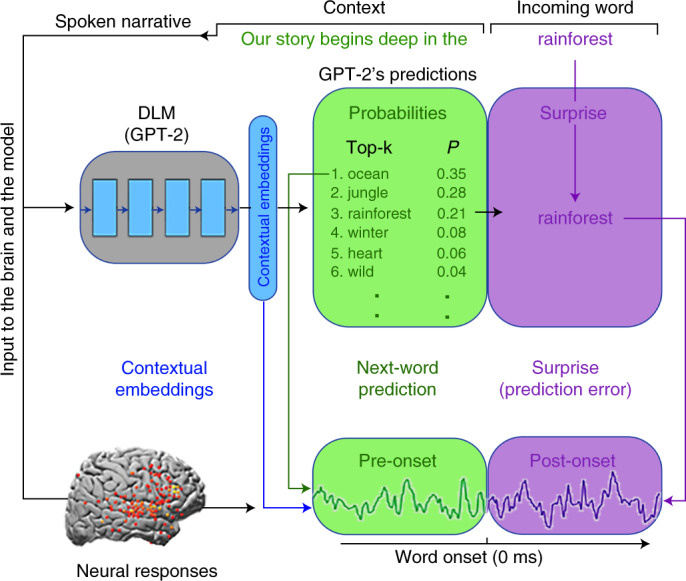
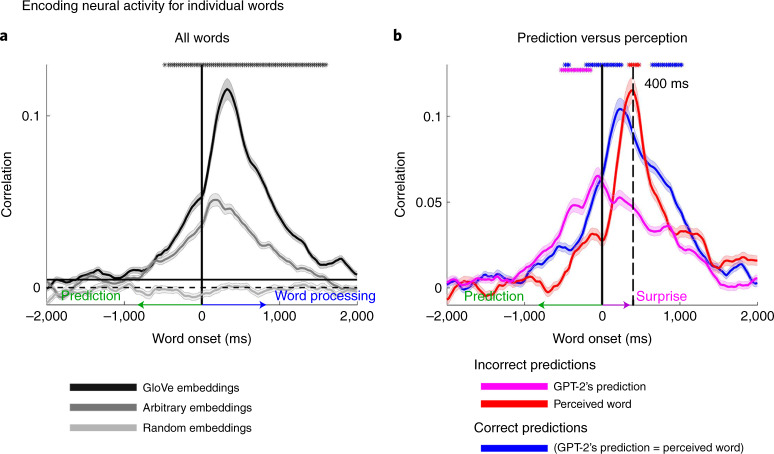
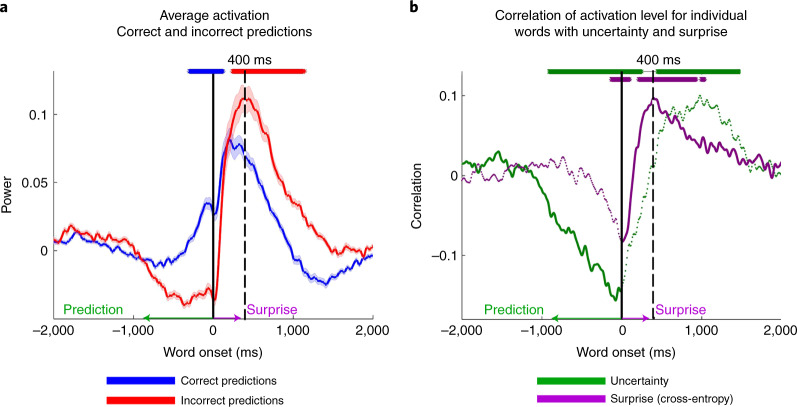
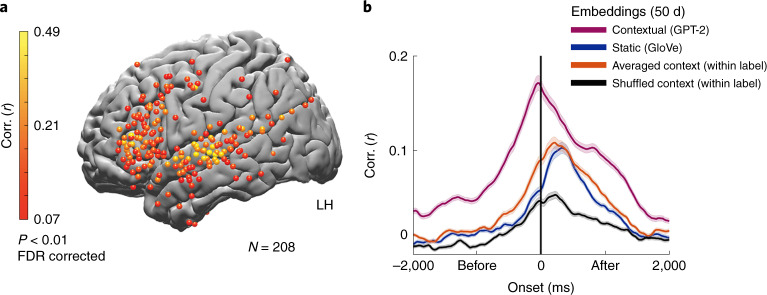
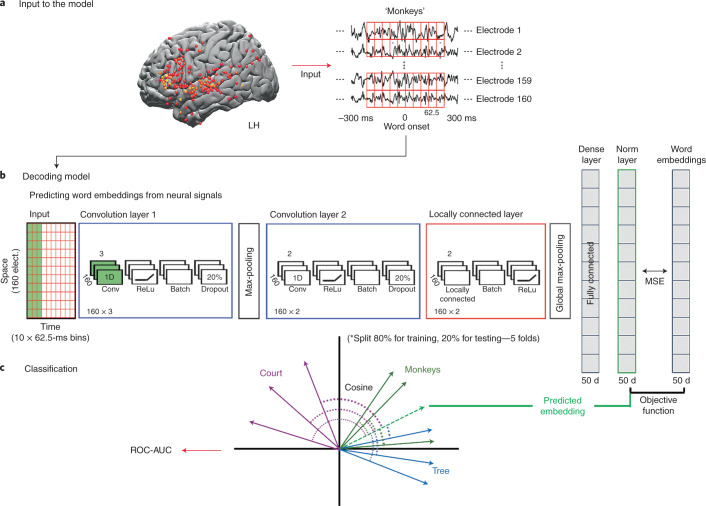
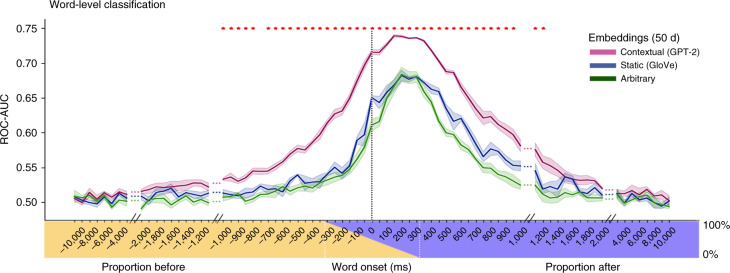
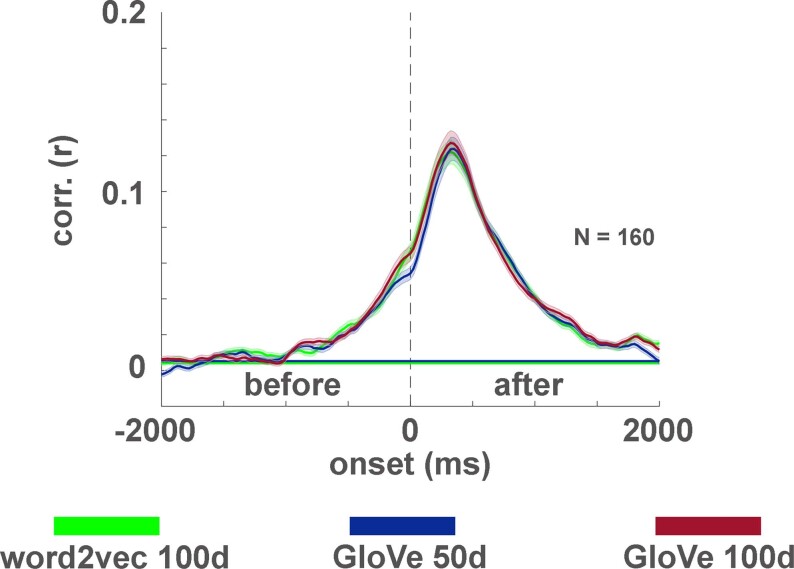
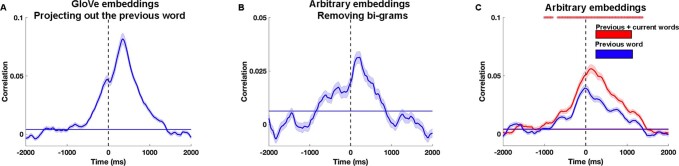
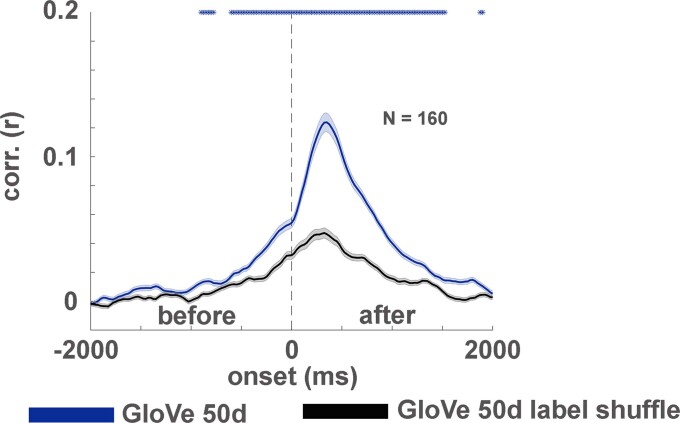
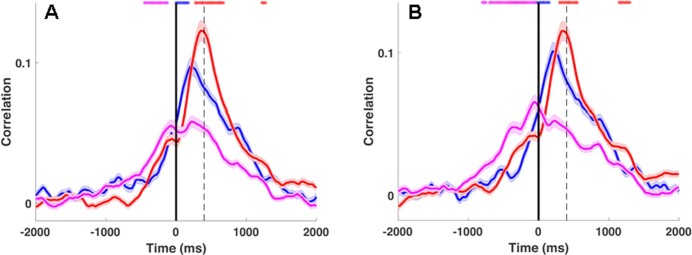
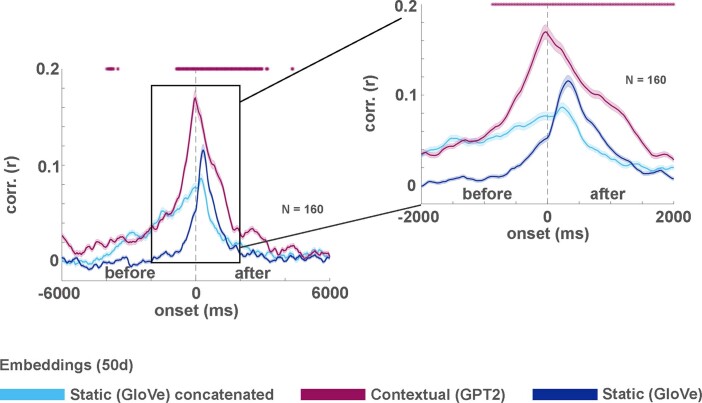
Departing from traditional linguistic models, advances in deep learning have resulted in a new type of predictive (autoregressive) deep language models (DLMs). Using a self-supervised next-word prediction task, these models generate appropriate linguistic responses in a given context. In the current study, nine participants listened to a 30-min podcast while their brain responses were recorded using electrocorticography (ECoG). We provide empirical evidence that the human brain and autoregressive DLMs share three fundamental computational principles as they process the same natural narrative: (1) both are engaged in continuous next-word prediction before word onset; (2) both match their pre-onset predictions to the incoming word to calculate post-onset surprise; (3) both rely on contextual embeddings to represent words in natural contexts. Together, our findings suggest that autoregressive DLMs provide a new and biologically feasible computational framework for studying the neural basis of language.
Overview
The claims and statistics of this paper haven’t been checked yet.
Free: it reads the open-access text and checks the first 5 claims that cite a source we can check. Create a free account to check every claim.
Integrity signals
Registry
Cites
Statistics
Figures
Verification
Claims the paper makes
The claims and statistics of this paper haven’t been checked yet.
Free: it reads the open-access text and checks the first 5 claims that cite a source we can check. Create a free account to check every claim.
Claims other papers make about this one
Each is checked against this paper’s own text: does it say what the citing paper says it does?
The cited source doesn’t support the claim as written.
In the citing paper
“Previous studies in the neural encoding literature all used LLMs that were only aware of the short-term context, i.e., where the context window size was as large as several tens of words1–10.”
From Incremental accumulation of linguistic context in artificial and biological neural networks (2025) · cites this paper as [10]
Checked by a reasoning model — may be wrong.
Experimental — accuracy not yet measuredThe cited source says what the claim attributes to it.
In the citing paper
“Studying AI can also advance psychological science (80–82).”
From Evaluating large language models in theory of mind tasks (2024) · cites this paper as [82]
The cited source says what the claim attributes to it.
In the citing paper
“Large Language Models (LLMs) have shown success in predicting neural signals associated with narrative processing”
From Incremental accumulation of linguistic context in artificial and biological neural networks (2025) · cites this paper as [10]
The cited source says what the claim attributes to it.
In the citing paper
“This was the case even though the participants in these studies were exposed to language stimuli that encompassed hundreds and even thousands of words.”
From Incremental accumulation of linguistic context in artificial and biological neural networks (2025) · cites this paper as [10]
Self-check
Percentages, sums and reported differences re-computed from the paper’s own numbers.
The self-check needs the paper’s full text.
Citations
Cites
Controlling the False Discovery Rate: A Practical and Powerful Approach to Multiple Testing
Benjamini, Y., & Hochberg, Y. (1995) · Journal of the Royal Statistical Society Series B: Statistical Methodology · doi:10.1111/j.2517-6161.1995.tb02031.x · Cited by 109,482
Glove: Global Vectors for Word Representation
Pennington, J., Socher, R., & Manning, C. (2014) · Proceedings of the 2014 Conference on Empirical Methods in Natural Language Processing (EMNLP) · doi:10.3115/v1/d14-1162 · Cited by 34,071
Language Models are Few-Shot Learners
Brown, T. B., Mann, B., Ryder, N., Subbiah, M., Kaplan, J., Dhariwal, P., Neelakantan, A., Shyam, P., Sastry, G., Askell, A., et al. (2020) · arXiv · doi:10.48550/arxiv.2005.14165 · Cited by 23,372
ASPECTS OF THE THEORY OF SYNTAX
Chomsky, N. (1964) · doi:10.21236/ad0616323 · Cited by 13,587
Oostenveld, R., Fries, P., Maris, E., & Schoffelen, J.-M. (2011) · Computational Intelligence and Neuroscience · doi:10.1155/2011/156869 · Cited by 10,323
Lewis, M., Liu, Y., Goyal, N., Ghazvininejad, M., Mohamed, A., Levy, O., Stoyanov, V., & Zettlemoyer, L. (2020) · Proceedings of the 58th Annual Meeting of the Association for Computational Linguistics · doi:10.18653/v1/2020.acl-main.703 · Cited by 8,821
Self-citationLewis, M., Liu, Y., Goyal, N., Ghazvininejad, M., Mohamed, A., Levy, O., Stoyanov, V., & Zettlemoyer, L. (2019) · arXiv · doi:10.48550/arxiv.1910.13461 · Cited by 8,816
Self-citationChomsky, N. (1957) · doi:10.1515/9783112316009 · Cited by 7,885
Whatever next? Predictive brains, situated agents, and the future of cognitive science
Clark, A. (2013) · Behavioral and Brain Sciences · doi:10.1017/s0140525x12000477 · Cited by 5,924
Reading Senseless Sentences: Brain Potentials Reflect Semantic Incongruity
Kutas, M., & Hillyard, S. A. (1980) · Science · doi:10.1126/science.7350657 · Cited by 4,888
Research works printed but not linked: 9
- Yang, Z. et al. XLNet: generalized autoregressive pretraining for language understanding. in Advances in Neural Information Processing Systems (eds. Wallach, H. et al.) 5753–5763 (Curran Associates, 2019).
- Schwartz, D. et al. Inducing brain-relevant bias in natural language processing models. in Advances in Neural Information Processing Systems (eds. Wallach, H. et al.) 14123–14133 (Curran Associates, 2019).
- Athanasiou, N., Iosif, E. & Potamianos, A. Neural activation semantic models: computational lexical semantic models of localized neural activations. in Proceedings of the 27th International Conference on Computational Linguistics 2867–2878 (Association for Computational Linguistics, 2018).
- Caucheteux, C., Gramfort, A. & King, J.-R. GPT-2’s activations predict the degree of semantic comprehension in the human brain. Preprint at bioRxiv https://doi.org/10.1101/2021.04.20.440622 (2021). · DOI
- Mikolov, T., Sutskever, I., Chen, K., Corrado, G. S. & Dean, J. Distributed Representations of Words and Phrases and their Compositionality. in Advances in Neural Information Processing Systems (eds. Burges et al.) 3111–3119 (Curran Associates, 2013).
- Toneva, M. & Wehbe, L. Interpreting and improving natural-language processing (in machines) with natural language-processing (in the brain). in 33rd Conference on Neural Information Processing Systems (2019).
- Khandelwal, U., Levy, O., Jurafsky, D., Zettlemoyer, L. & Lewis, M. Generalization through memorization: nearest neighbor language models. in International Conference on Learning Representations (2020).
- Goldberg, A. E. Explain me This: Creativity, Competition, and the Partial Productivity of Constructions (Princeton University Press, 2019). · DOI · Paper page
- Marcus, G. F. The Algebraic Mind: Integrating Connectionism and Cognitive Science (MIT Press, 2019).
Cited by
Items 401–500 of 710
DNRHP: Temporal Network Representation Learning via Hawkes Point Process
Ying, C., Li, Q., Wang, C., & Yu, D. (2025) · IEEE Transactions on Neural Networks and Learning Systems · doi:10.1109/tnnls.2025.3540195 · Cited by 2
Towards A Neurobiologically Inspired Model of Syntax Processing
Kröger, B. J. (2024) · eScholarship (California Digital Library) · Cited by 2
Probing Next-Word and Long-Distance Prediction Using Encoding Modelling and MEG
Schönmann, I., de Lange, F. P., & Heilbron, M. (2023) · Conference on Cognitive Computational Neuroscience (CCN) · doi:10.32470/ccn.2023.1454-0 · Cited by 2
The neural dynamics of word recognition and integration
Gauthier, J., & Lévy, R. (2023) · Conference on Empirical Methods in Natural Language Processing (EMNLP) · doi:10.18653/v1/2023.emnlp-main.62 · Cited by 2
Bird’s Eye View of Artificial Intelligence in Neuroscience
Zhou, M. H., Lin, E., Ye, A. Q., Mukherjee, P., & Yuh, E. L. (2025) · AI in neuroscience. · doi:10.1089/ains.2024.0001 · Cited by 2
Frontal cortex organization supporting audiovisual processing during naturalistic viewing
Zhou, F., Khalilian-Gourtani, A., Dugan, P. C., Michalak, A. J., Devinsky, O., Rozman, P. A., Doyle, W., Friedman, D., & Flinker, A. (2026) · Nature Communications · doi:10.1038/s41467-026-73947-8 · Cited by 2
Self-citationVenhuizen, N. J., & Brouwer, H. (2025) · The Psychology of learning and motivation/The psychology of learning and motivation · doi:10.1016/bs.plm.2025.07.007 · Cited by 2
Mapping the mind’s landscape: Common neural encoding for spatial and morality concepts
Wang, J., Qian, M., & Cai, Q. (2025) · NeuroImage · doi:10.1016/j.neuroimage.2025.121485 · Cited by 2
Lin, Y.-C., Zhu, H., & Schuler, W. (2026) · Findings of the Association for Computational Linguistics: EMNLP (Findings of EMNLP) · doi:10.18653/2026.findings-emnlp.1903 · Cited by 2
LLMs highlight the importance of interaction in human language learning
Kristensen‐McLachlan, R. D., Kallens, P. C., & Christiansen, M. H. (2025) · Linguistics Vanguard · doi:10.1515/lingvan-2024-0254 · Cited by 2
Instruction-tuned LLMs with World Knowledge are More Aligned to the Human Brain
Aw, K. L., Montariol, S., AlKhamissi, B., Schrimpf, M., & Bosselut, A. (2024) · Infoscience (Ecole Polytechnique Fédérale de Lausanne) · Cited by 2
Dorrell, W., Latham, P. E., & Whittington, J. C. R. (2026) · International Conference on Learning Representations · doi:10.48550/arxiv.2601.10482 · Cited by 2
Comprehenders' Error Correction Mechanisms Are Finely Calibrated to Language Production Statistics
Qian, P., & Lévy, R. (2026) · Cognitive Science · doi:10.31234/osf.io/e3v5b · Cited by 2
Lost in Translation: The Algorithmic Gap Between LMs and the BrainPreprint
Tosato, T., Notsawo, P. T., Helbling, S., Rish, I., & Dumas, G. (2024) · arXiv (Cornell University) · doi:10.48550/arxiv.2407.04680 · Cited by 2
Information-making processes in the speaker’s brain drive human conversationsPreprint
Goldstein, A., Wang, H., Sheffer, T., Lioubashevski, D., Schain, M., Zada, Z., Niekerken, L., Aubrey, B., Nastase, S. A., Taubenfeld, A., et al. (2024) · bioRxiv (Cold Spring Harbor Laboratory) · doi:10.1101/2024.08.27.609946 · Cited by 2
Self-citationWhen Abstract Becomes Concrete: Naturalistic Encoding of Concepts in the BrainPreprint
Kewenig, V. N., Vigliocco, G., & Skipper, J. I. (2024) · eLife · doi:10.7554/elife.91522.2 · Cited by 2
Modeling Sensorimotor Processing with Physics-Informed Neural NetworksPreprint
Rotondo, A. P., Vargas, A. M., Dimitriou, M., & Mathis, A. (2024) · bioRxiv (Cold Spring Harbor Laboratory) · doi:10.1101/2024.09.14.613030 · Cited by 2
Chen, P., Xiang, S., He, L., Chang, E. F., & Li, Y. (2024) · bioRxiv (Cold Spring Harbor Laboratory) · doi:10.1101/2024.12.28.630582 · Cited by 2
Metareasoning constraints couple narratives, affect and cognitionPreprint
Onysk, J., & Huys, Q. J. M. (2025) · arXiv (Cornell University) · doi:10.48550/arxiv.2502.09487 · Cited by 2
Reading ahead: Localized neural signatures of parafoveal word processing and skipping decisionsPreprint
Flick, G., & Pylkkänen, L. (2025) · bioRxiv (Cold Spring Harbor Laboratory) · doi:10.1101/2025.04.25.650296 · Cited by 1
A Predictive Processing Framework for Joint Action and CommunicationPreprint
Pezzulo, G., Knoblich, G., Maisto, D., Donnarumma, F., Pacherie, É., & Hasson, U. (2025) · PsyArXiv (OSF Preprints) · doi:10.31234/osf.io/q4jnr_v2 · Cited by 2
Self-citationEncoding models in functional magnetic resonance imaging: the Voxelwise Encoding Model frameworkPreprint
Castello, M. V. D. O., Deniz, F., la Tour, T. D., & Gallant, J. L. (2025) · PsyArXiv (OSF Preprints) · doi:10.31234/osf.io/nt2jq_v4 · Cited by 2
Exploring Similarity between Neural and LLM Trajectories in Language ProcessingPreprint
Xiao, X., Wei, K., Zhong, J., Wei, X., & Zhou, M. (2025) · arXiv (Cornell University) · doi:10.48550/arxiv.2509.24307 · Cited by 2
Binhuraib, T. O. A., Tuckute, G., & Blauch, N. M. (2025) · arXiv (Cornell University) · doi:10.48550/arxiv.2510.18745 · Cited by 3
Neural Correlates of Language Models Are Specific to Human Language
Parra, I. (2026) · Proceedings of Machine Learning Research · doi:10.48550/arxiv.2510.03156 · Cited by 2
Can LLMs capture stable human-generated sentence entropy measures?Preprint
Pivel-Villanueva, E., Sterner, E., & Knolle, F. (2026) · arXiv (Cornell University) · doi:10.48550/arxiv.2602.04570 · Cited by 2
How does longer temporal context enhance multimodal narrative video processing in the brain?Preprint
Jindal, P., Khandelwal, A., Gupta, M., Bapi, R. S., Oota, S. R., & Chakraborty, T. (2026) · arXiv (Cornell University) · doi:10.48550/arxiv.2602.07570 · Cited by 2
Sparse Autoencoders Map Brain-LLM Alignment onto Cortical Semantic TopographyPreprint
Guo, D., Wu, J., & Yiu, S. (2026) · arXiv (Cornell University) · doi:10.48550/arxiv.2605.23035 · Cited by 2
Ciferri, M., Boccato, T., Olak, M., Ferrante, M., & Toschi, N. (2026) · arXiv (Cornell University) · doi:10.48550/arxiv.2606.02305 · Cited by 2
Gehmacher, Q., Kaltenmaier, A., Schubert, J., Weisz, N., & Press, C. (2026) · bioRxiv (Cold Spring Harbor Laboratory) · doi:10.64898/2026.06.12.731866 · Cited by 2
Information Dynamics of Language CommunicationPreprint
Goodall, L. S., Luppi, A. I., & Mediano, P. A. M. (2026) · arXiv (Cornell University) · doi:10.48550/arxiv.2606.30096 · Cited by 2
Sun, K., & Wang, R. (2026) · arXiv (Cornell University) · doi:10.48550/arxiv.2607.04107 · Cited by 2
Bavaresco, A., Klaric, I., Fernández, R., & Moens, M. (2026) · arXiv (Cornell University) · doi:10.48550/arxiv.2607.16214 · Cited by 2
Hong, Z., Wang, H., Zada, Z., Gazula, H., Turner, D., Aubrey, B., Niekerken, L., Doyle, W., Devore, S., Dugan, P., et al. (2024) · doi:10.1101/2024.06.12.598513 · Cited by 1
Self-citationA theory of appropriateness with applications to generative artificial intelligence
Leibo, J. Z., Vezhnevets, A. S., Diaz, M., Agapiou, J. P., Cunningham, W. A., Sunehag, P., Haas, J., Koster, R., Duéñez-Guzmán, E. A., Isaac, W. S., et al. (2024) · arXiv · doi:10.48550/arxiv.2412.19010 · Cited by 1
Are Large Language Models Literary Critics?
Koul, R. (2024) · Poetics Today · doi:10.1215/03335372-11092831 · Cited by 1
Li, J., Wang, Q., Zhou, Q., Yang, L., Shen, Y., Huang, S., Wang, S., Pylkkänen, L., & Huang, Z. (2026) · eLife · doi:10.7554/elife.100056.4 · Cited by 1
A primate grammar enabling incremental processing
Gallot, Q., Tillé, Y., Depriester, C., Moran, S., & Zuberbühler, K. (2025) · iScience · doi:10.1016/j.isci.2025.112229 · Cited by 1
Puffay, C., Mischler, G., Choudhari, V., Vanthornhout, J., Bickel, S., Mehta, A. D., Schevon, C. A., McKhann, G. M., hamme, H. V., Francart, T., et al. (2026) · Imaging Neuroscience · doi:10.1162/imag.a.1227 · Cited by 1
Semantic control regions actively generate rule-based semantic predictions
Belluzzi, A., & Fairhall, S. L. (2025) · NeuroImage · doi:10.1016/j.neuroimage.2025.121379 · Cited by 1
Lei, Y., Liu, L., Chen, J., Tang, C., Fan, S., Cai, Y., & Ding, G. (2025) · Behavioral Sciences · doi:10.3390/bs15091159 · Cited by 1
LLM-based Simulations of Human Behavior in Psychological Research
Sánchez, S. F. (2025) · Proceedings of the AAAI/ACM Conference on AI Ethics and Society · doi:10.1609/aies.v8i1.36603 · Cited by 1
Using computational semantics to study meaning in the brain.
Fodor, J., & Suzuki, S. (2025) · Neuroscience and Biobehavioral Reviews · doi:10.1016/j.neubiorev.2025.106514 · Cited by 1
Modeling infant cortical tracking of statistical learning in simple recurrent networks
Xu, Q., Sjuls, G. S., Kalashnikova, M., & Magnuson, J. S. (2024) · eScholarship (California Digital Library) · Cited by 1
Linguistic Competence and New Empiricism in Philosophy and Science
Subotić, V. (2023) · PhilPapers (PhilPapers Foundation) · Cited by 2
Miao, G. Q., Jiang, Y., Binnquist, A. L., Pluta, A., Steen, F., Dale, R., & Lieberman, M. D. (2024) · eScholarship (California Digital Library) · Cited by 1
In silico neuronal morphology classification: A systematic review
Lobato, F. M. F., Leite, J. B. P., Jacob, A. C., & Santana, R. (2026) · Neuroscience · doi:10.1016/j.neuroscience.2026.02.044 · Cited by 1
Giraldi, E., Frosolone, M., Corcoran, A. W., Barca, L., Corsini, A., Donnarumma, F., D’Ausilio, A., & Pezzulo, G. (2026) · Imaging Neuroscience · doi:10.1162/imag.a.1178 · Cited by 1
Trust Modulates Speech Entrainment: Enhanced Cortical Tracking for Low-trust Speakers
Hannah, J. A., & Liberto, G. M. D. (2026) · Journal of Cognitive Neuroscience · doi:10.1162/jocn.a.2734 · Cited by 1
Zhang, Z., Zhou, W. H., Zhang, S., Li, X., Zhang, L., & Li, L. (2026) · Neural Networks · doi:10.1016/j.neunet.2026.108916 · Cited by 1
What drives regressions in reading? Insights from surprisal and saliency from language models
Rego, A. T. L., Melo, A. N., Snell, J., & Meeter, M. (2026) · Cognition · doi:10.1016/j.cognition.2026.106535 · Cited by 1
Sleep strengthens successor representations of learned sequences in humans
He, X., Büchel, P. K., Faghel-Soubeyrand, S., Klingspohr, J., Kehl, M. S., & Staresina, B. P. (2026) · PLoS Biology · doi:10.1371/journal.pbio.3003740 · Cited by 1
Wu, X., Wang, H., Yan, Z., Xiaohan, T., Xu, P., Siok, W. T., Li, P., Gao, J., Lyu, B., & Qin, L. (2026) · Computers in Human Behavior · doi:10.1016/j.chb.2026.109051 · Cited by 1
Building word meanings from memories and predictions
Rodd, J. M. (2026) · Trends in Cognitive Sciences · doi:10.1016/j.tics.2026.05.003 · Cited by 2
Nair, S., & Phillips, C. (2026) · Behavioral and Brain Sciences · doi:10.1017/s0140525x26104701 · Cited by 1
Zhang, Z., Zhou, W. H., Xu, H., Zhang, L., & Li, L. (2026) · Proceedings of the conference - Association for Computational Linguistics. Meeting · doi:10.18653/v1/2026.acl-long.1911 · Cited by 1
Hunt, D., & Miceli, M. D. (2026) · American Journal of STEM Education · doi:10.32674/tfptev94 · Cited by 1
Time after time: neural codes of speech comprehension
Gwilliams, L. (2026) · Trends in Cognitive Sciences · doi:10.1016/j.tics.2026.09.003 · Cited by 1
Privileged representational axes in biological and artificial neural networks
Khosla, M., Srivastava, S., Williams, A. H., McDermott, J. H., & Kanwisher, N. (2026) · Nature Human Behaviour · doi:10.1038/s41562-026-02515-3 · Cited by 1
How Can We Track Cognitive Representations with Deep Neural Networks and Intracranial EEG?
Pacheco, D. (2023) · Studies in neuroscience, psychology and behavioral economics · doi:10.1007/978-3-031-20910-9_50 · Cited by 1
The neural dynamics of auditory word recognition and integration
Gauthier, J., & Lévy, R. (2023) · Conference on Cognitive Computational Neuroscience (CCN) · doi:10.32470/ccn.2023.1591-0 · Cited by 1
Computation or Weight Adaptation? Rethinking the Role of Plasticity in Learning
Lior, G., Shalev, Y., Stanovsky, G., & Goldstein, A. (2026) · Cognitive Science · doi:10.1111/cogs.70271 · Cited by 1
Self-citationAlgani, Y. M. A., & Saravanakumar, R. (2025) · International Conference on Mobile Computing and Sustainable Informatics (ICMCSI) · doi:10.1109/icmcsi64620.2025.10883491 · Cited by 1
How the (Tensor-) Brain Uses Embeddings and Embodiment to Encode Senses and Symbols
Tresp, V., & Li, H. (2025) · Frontiers in artificial intelligence and applications · doi:10.3233/faia250200 · Cited by 1
Deep neural network models of emotion understanding
Thornton, M. A. (2025) · Cognition & Emotion · doi:10.1080/02699931.2025.2543569 · Cited by 1
Cognitive and Cultural Topology of Linguistic Categories:A Semantic-Pragmatic Metric ApproachPreprint
Ji, E. Y. (2021) · arXiv (Cornell University) · doi:10.48550/arxiv.2112.06876 · Cited by 1
Humans as next-token predictors: Measuring the flow of memes through mindsPreprint
Cashman, M. (2022) · PsyArXiv (OSF Preprints) · doi:10.31234/osf.io/xnrvy · Cited by 1
Human Attention during Goal-directed Reading Comprehension Relies on Task OptimizationPreprint
Zou, J., Zhang, Y., Li, J., Tian, X., & Ding, N. (2023) · eLife · doi:10.7554/elife.87197.1 · Cited by 1
Finding structure during incremental speech comprehensionPreprint
Lyu, B., Marslen‐Wilson, W. D., Fang, Y., & TYLER, L. K. (2023) · eLife · doi:10.7554/elife.89311.1 · Cited by 1
Dini, S., Hammrich, P. L., & Foster, A. N. (2023) · iDEA - Drexel University Institutional Repository · doi:10.17918/00001686 · Cited by 1
Su, Z., & Fang, M. (2023) · Preprints.org · doi:10.20944/preprints202311.0137.v1 · Cited by 1
When Abstract Becomes Concrete: Naturalistic Encoding of Concepts in the BrainPreprint
Kewenig, V. N., Vigliocco, G., & Skipper, J. I. (2024) · doi:10.7554/elife.91522.1 · Cited by 1
Inferring neural dynamics of memory during naturalistic social communicationPreprint
Pang, R., Baker, C. A., Murthy, M., & Pillow, J. W. (2024) · bioRxiv (Cold Spring Harbor Laboratory) · doi:10.1101/2024.01.26.577404 · Cited by 2
Language representations in deep learning algorithms and the brain
Caucheteux, C. (2023) · theses.fr (ABES) · doi:10.70675/9258df96z16fbz4531zb578za0d6684b0d14 · Cited by 1
DeepSpeech models show Human-like Performance and Processing of Cochlear Implant InputsPreprint
Steinhardt, C. R., Keshishian, M., Mesgarani, N., & Stachenfeld, K. (2024) · arXiv (Cornell University) · doi:10.48550/arxiv.2407.20535 · Cited by 1
Zhao, W., Li, Z., Li, X., & Du, Y. (2025) · eLife · doi:10.7554/elife.99416 · Cited by 1
Tripartite organization of brain state dynamics underlying spoken narrative comprehensionPreprint
Liu, L., Jiang, J., Li, H., & Ding, G. (2025) · eLife · doi:10.7554/elife.99997.2 · Cited by 1
Canonical Representational Mapping for Cognitive NeurosciencePreprint
Schottdorf, M., & Michelmann, S. (2025) · bioRxiv (Cold Spring Harbor Laboratory) · doi:10.1101/2025.09.01.673485 · Cited by 1
Optimizing Language Model Embeddings to Voxel Activity Improves Brain Activity PredictionsPreprint
Negi, A., Tseng, C., Núñez-Elizalde, A. O., Gong, X. L., & Deniz, F. (2025) · bioRxiv (Cold Spring Harbor Laboratory) · doi:10.1101/2025.09.18.676935 · Cited by 1
A Predictive Processing Framework for Joint Action and CommunicationPreprint
Pezzulo, G., Knoblich, G., Maisto, D., Donnarumma, F., Pacherie, É., & Hasson, U. (2025) · PsyArXiv (OSF Preprints) · doi:10.31234/osf.io/q4jnr_v3 · Cited by 1
Self-citationStructure leads and dominates comprehension in naturalistic readingPreprint
Wang, N., Wu, H., & Li, J. (2026) · SSRN Electronic Journal · doi:10.2139/ssrn.7115090 · Cited by 1
Cognition Without Consciousness: AI Transformers and the Revival of Human ThoughtPreprint
Straňák, P. (2025) · Preprints.org · doi:10.20944/preprints202511.0683.v1 · Cited by 1
Neural Signatures of Predictive Processing during Natural Mandarin Speech ComprehensionPreprint
Wang, Q., Szewczyk, J., Fazekas, J., Berlot, E., & de Lange, F. P. (2025) · bioRxiv (Cold Spring Harbor Laboratory) · doi:10.1101/2025.11.23.690006 · Cited by 1
Karami, B., Zandi, F., & Hatami, J. (2025) · Research Square · doi:10.21203/rs.3.rs-8270539/v1 · Cited by 1
Implicit In-Context Learning: Evidence from Artificial Language ExperimentsPreprint
Ma, X., & Xu, Q. (2025) · arXiv (Cornell University) · doi:10.48550/arxiv.2503.24190 · Cited by 1
Li, J., Guo, C., Zhang, C., Chang, E. F., & Li, Y. (2025) · eLife · doi:10.7554/elife.109400.1 · Cited by 1
Law, Language, And Authority: The Algorithmic Turn
Turnbull, A. (2024) · YorkSpace (York University) · Cited by 1
Liu, O. D., Tang, H., Feldman, N. H., & Goldwater, S. (2026) · bioRxiv (Cold Spring Harbor Laboratory) · doi:10.64898/2026.01.16.700011 · Cited by 1
Linguistic properties and model scale in brain encoding: from small to compressed language modelsPreprint
Oota, S. R., Rowtula, V., Satya Sai Srinath Namburi, G. N. V. V., Pahwa, K., Khandelwal, A., Gupta, M., Chakraborty, T., & Bapi, R. S. (2026) · arXiv (Cornell University) · doi:10.48550/arxiv.2602.07547 · Cited by 1
Hierarchical Signatures of Language in the Human BrainPreprint
Eichert, N., Favre, C., Cabalo, D. G., Ngo, A., DeKraker, J., Hwang, Y., Smith, M., Crooks, V., Bautin, P., Rodríguez‐Cruces, R., et al. (2026) · bioRxiv (Cold Spring Harbor Laboratory) · doi:10.64898/2026.02.15.705992 · Cited by 1
Neural signatures of impaired semantic contextualization in Autism Spectrum DisorderPreprint
Franch, M. C., Katlowitz, K. A., Mickiewicz, E. A., Belanger, J. L., Mathura, R. K., Zhu, H., Yan, X., Ismail, T., Chavez, A. G., Chericoni, A., et al. (2026) · bioRxiv (Cold Spring Harbor Laboratory) · doi:10.64898/2026.03.16.712048 · Cited by 1
Large Language Models Align with the Human Brain during Creative ThinkingPreprint
Ismayilzada, M., Luchini, S. A., Gökce, A., AlKhamissi, B., Bosselut, A., Laverghetta, A., van der Plas, L., & Beaty, R. E. (2026) · arXiv (Cornell University) · doi:10.48550/arxiv.2604.03480 · Cited by 1
Dunagan, D. G., Low, D. S., Yue, S., Meyer, L., & Hale, J. T. (2026) · bioRxiv (Cold Spring Harbor Laboratory) · doi:10.64898/2026.04.20.719609 · Cited by 1
Azizpour, S., Westner, B. U., Szewczyk, J., Güçlü, U., & Geerligs, L. (2026) · eLife · doi:10.7554/elife.110085 · Cited by 1
Cortical localization and dynamics of elementary mathematical conceptsPreprint
Debray, S., Karami, A., Valério, D., Cauté, M., Pallier, C., & Dehaene, S. (2026) · bioRxiv (Cold Spring Harbor Laboratory) · doi:10.64898/2026.04.30.721827 · Cited by 1
Kloots, M. D. H., Kazemian, A., Turner, W., Parvizi, J., & Gwilliams, L. (2026) · bioRxiv (Cold Spring Harbor Laboratory) · doi:10.64898/2026.05.13.724774 · Cited by 1
Oota, S. R., Khandelwal, A., Pahwa, K., Satya Sai Srinath Namburi, G. N. V. V., Chakraborty, T., Bapi, R. S., & Gupta, M. (2026) · arXiv (Cornell University) · doi:10.48550/arxiv.2605.19352 · Cited by 1
Yang, N., He, R., Homan, P., Sommer, I. E., Staub, D., & Hinzen, W. (2026) · arXiv (Cornell University) · doi:10.48550/arxiv.2605.21049 · Cited by 1
Metadata
- Authors
- Goldstein, A., Zada, Z., Buchnik, E., Schain, M., Price, A., Aubrey, B., Nastase, S. A., Feder, A., Emanuel, D., Cohen, A., Jansen, A., Gazula, H., Choe, G., Rao, A., Kim, C., Casto, C., Fanda, L., Doyle, W., Friedman, D., Dugan, P., Melloni, L., Reichart, R., Devore, S., Flinker, A., Hasenfratz, L., Levy, O., Hassidim, A., Brenner, M., Matias, Y., Norman, K. A., Devinsky, O., & Hasson, U.
- Affiliations
- Google (United States) (US)
- Princeton University (US)
- New York University (US)
- Technion – Israel Institute of Technology (IL)
- Tel Aviv University (IL)
- Corresponding author
- Goldstein, Ariel
- ORCID
- Goldstein, Ariel
- Zada, Zaid
- Price, Amy
- Nastase, Samuel A.
- Feder, Amir
- Cohen, Alon
- Gazula, Harshvardhan
- Choe, Gina
- Kim, Catherine
- Casto, Colton
- Fanda, Lora
- Doyle, Werner
- Friedman, Daniel
- Dugan, Patricia
- Melloni, Lucia
- Reichart, Roi
- Devore, Sasha
- Flinker, Adeen
- Hasenfratz, Liat
- Levy, Omer
- Hassidim, Avinatan
- Brenner, Michael
- Matias, Yossi
- Norman, Kenneth A.
- Devinsky, Orrin
- Hasson, Uri
- Venue
- Nature Neuroscience
- Published
- 2022-03
- Volume
- 25
- Issue
- 3
- Pages
- 369-380
- ISSN
- 1097-6256 (ISSN-L)
- 1546-1726
- PMC
- PMC8904253
- OpenAlex
- W4220949944
- Cited by
- 447
- References
- 62
- Citations by year
- 2026: 97 · 2025: 123 · 2024: 111 · 2023: 94 · 2022: 21
- FWCI
- 44.98
- Type
- journal article
- Language
- en
- Open access
- hybrid
- doi.org
- Licence
- cc-by
- creativecommons.org/licenses/by/4.0 (tdm)
- creativecommons.org/licenses/by/4.0 (vor, 6 d)
- Locations
- Nature Neuroscience (publishedVersion, cc-by)
- PubMed Central (publishedVersion, cc-by)
- PubMed (publishedVersion)
- Funders
- Finding A Cure for Epilepsy and Seizures
- National Institutes of Health
- National Institute of Mental Health (R01MH112566)
- National Institute of Neurological Disorders and Stroke (R01NS109367)
- Eunice Kennedy Shriver National Institute of Child Health and Human Development (DP1HD091948)
- Topics
- Life Sciences › Neuroscience › Cognitive Neuroscience › Neurobiology of Language and Bilingualism
- Social Sciences › Psychology › Developmental and Educational Psychology › Reading and Literacy Development
- Social Sciences › Psychology › Developmental and Educational Psychology › Language Development and Disorders
- Keywords
- deep language models, autoregressive language models, language processing, next-word prediction, contextual embeddings, neural basis of language, electrocorticography, narrative comprehension
- MeSH terms
- Brain, Humans, Language, Linguistics
About these checks
Registry, retraction, Cites and statistics results are computed, not judged, with one exception: a printed reference that no index lists is read once by a model before it counts as a citation error. Claims are extracted by a model and kept only when their quote appears verbatim in the text; each cited source is then checked, with a model’s help, for whether it says what the claim relies on. Those verdicts can be wrong — read the claim’s quote and the cited source before relying on one.
Statistics and arithmetic are recomputed, not judged.
Confidence bands are shown only for fields calibrated on our annotated test set. None is calibrated yet, so no band is shown.
What counts as a claim ›How we measure confidence ›How we check this ›
Are you an author, or do you see a problem with this page? Request a review
Data sources
Bibliographic data: Semantic Scholar, OpenAlex, Crossref.
Contains information from the Semantic Scholar Academic Graph Datasets, made available under the ODC Attribution License (ODC-BY 1.0).
Semantic Scholar’s data is described in: Kinney, R., et al. (2023). The Semantic Scholar Open Data Platform. arXiv:2301.10140.
