

Shared computational principles for language processing in humans and deep language models
Open accessThe DOI matches its Crossref record; 65 of the 65 references it cites were found in a registry or an index.
Abstract
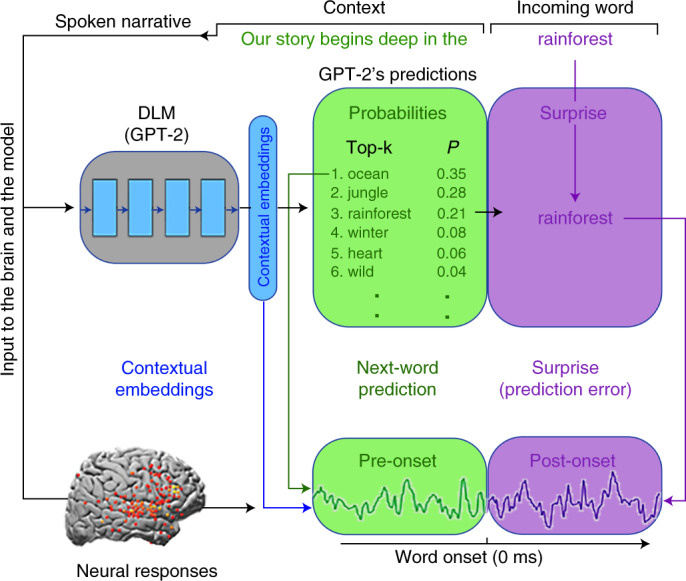
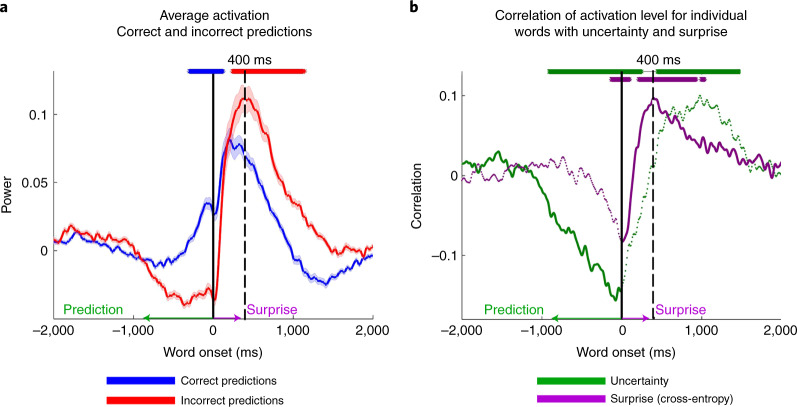
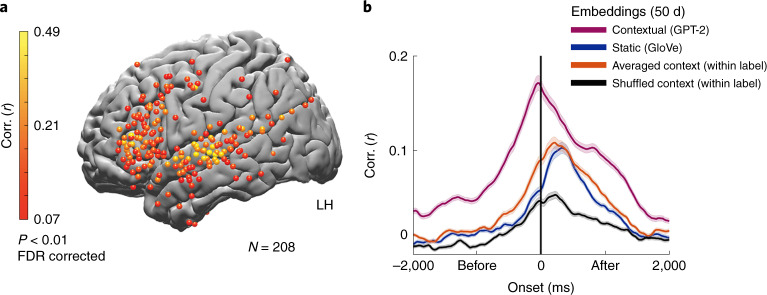
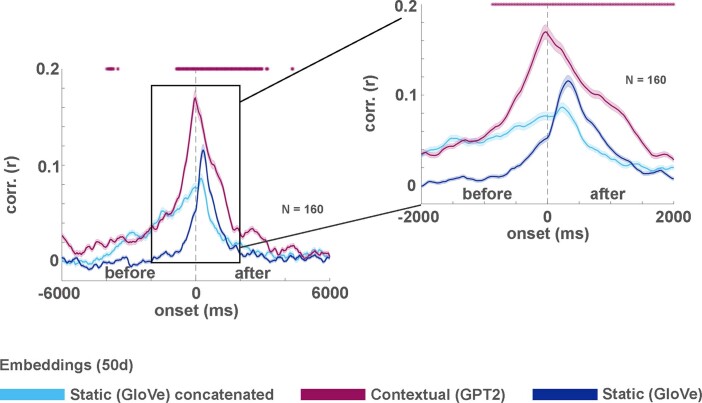
Departing from traditional linguistic models, advances in deep learning have resulted in a new type of predictive (autoregressive) deep language models (DLMs). Using a self-supervised next-word prediction task, these models generate appropriate linguistic responses in a given context. In the current study, nine participants listened to a 30-min podcast while their brain responses were recorded using electrocorticography (ECoG). We provide empirical evidence that the human brain and autoregressive DLMs share three fundamental computational principles as they process the same natural narrative: (1) both are engaged in continuous next-word prediction before word onset; (2) both match their pre-onset predictions to the incoming word to calculate post-onset surprise; (3) both rely on contextual embeddings to represent words in natural contexts. Together, our findings suggest that autoregressive DLMs provide a new and biologically feasible computational framework for studying the neural basis of language.
Overview
The claims and statistics of this paper haven’t been checked yet.
Free: it reads the open-access text and checks the first 5 claims that cite a source we can check. Create a free account to check every claim.
Integrity signals
Registry
Cites
Statistics
Figures
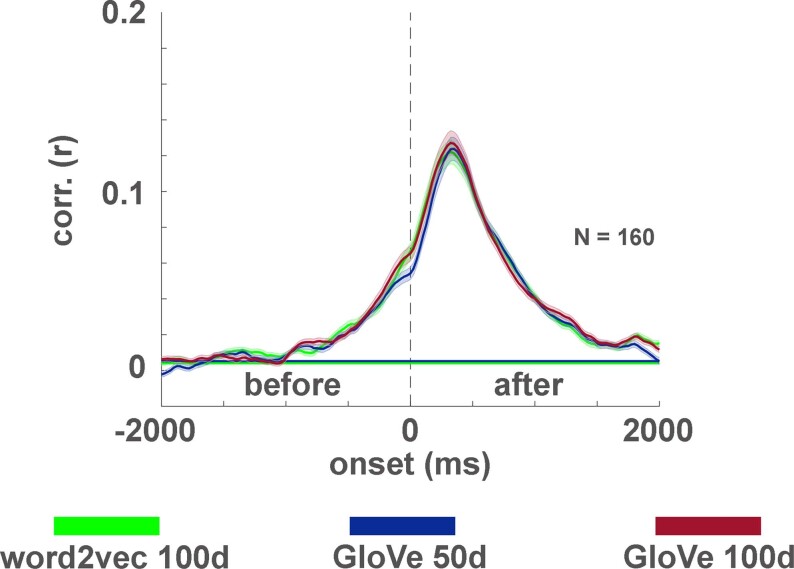
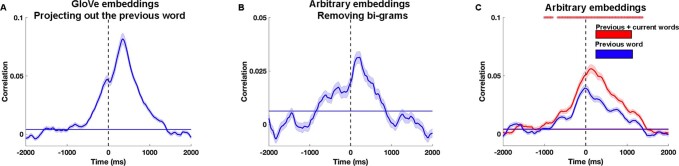
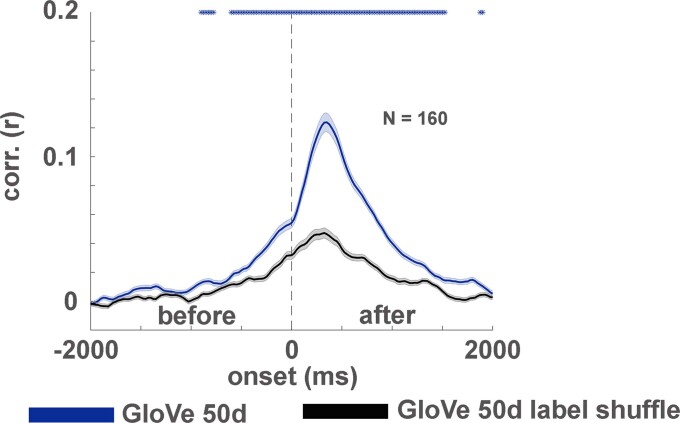
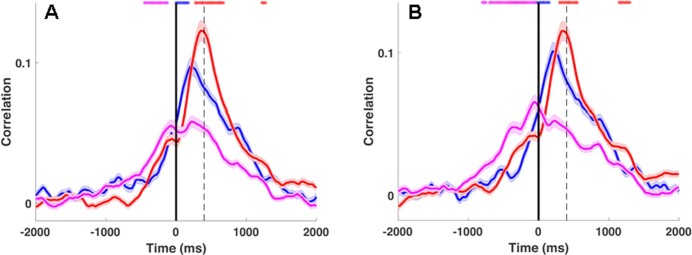
Verification
Claims the paper makes
The claims and statistics of this paper haven’t been checked yet.
Free: it reads the open-access text and checks the first 5 claims that cite a source we can check. Create a free account to check every claim.
Claims other papers make about this one
Each is checked against this paper’s own text: does it say what the citing paper says it does?
The cited source doesn’t support the claim as written.
In the citing paper
“Previous studies in the neural encoding literature all used LLMs that were only aware of the short-term context, i.e., where the context window size was as large as several tens of words1–10.”
From Incremental accumulation of linguistic context in artificial and biological neural networks (2025) · cites this paper as [10]
Checked by a reasoning model — may be wrong.
Experimental — accuracy not yet measuredThe cited source says what the claim attributes to it.
In the citing paper
“Studying AI can also advance psychological science (80–82).”
From Evaluating large language models in theory of mind tasks (2024) · cites this paper as [82]
The cited source says what the claim attributes to it.
In the citing paper
“Large Language Models (LLMs) have shown success in predicting neural signals associated with narrative processing”
From Incremental accumulation of linguistic context in artificial and biological neural networks (2025) · cites this paper as [10]
The cited source says what the claim attributes to it.
In the citing paper
“This was the case even though the participants in these studies were exposed to language stimuli that encompassed hundreds and even thousands of words.”
From Incremental accumulation of linguistic context in artificial and biological neural networks (2025) · cites this paper as [10]
Self-check
Percentages, sums and reported differences re-computed from the paper’s own numbers.
The self-check needs the paper’s full text.
Citations
Cites
Controlling the False Discovery Rate: A Practical and Powerful Approach to Multiple Testing
Benjamini, Y., & Hochberg, Y. (1995) · Journal of the Royal Statistical Society Series B: Statistical Methodology · doi:10.1111/j.2517-6161.1995.tb02031.x · Cited by 109,482
Glove: Global Vectors for Word Representation
Pennington, J., Socher, R., & Manning, C. (2014) · Proceedings of the 2014 Conference on Empirical Methods in Natural Language Processing (EMNLP) · doi:10.3115/v1/d14-1162 · Cited by 34,071
Language Models are Few-Shot Learners
Brown, T. B., Mann, B., Ryder, N., Subbiah, M., Kaplan, J., Dhariwal, P., Neelakantan, A., Shyam, P., Sastry, G., Askell, A., et al. (2020) · arXiv · doi:10.48550/arxiv.2005.14165 · Cited by 23,372
ASPECTS OF THE THEORY OF SYNTAX
Chomsky, N. (1964) · doi:10.21236/ad0616323 · Cited by 13,587
Oostenveld, R., Fries, P., Maris, E., & Schoffelen, J.-M. (2011) · Computational Intelligence and Neuroscience · doi:10.1155/2011/156869 · Cited by 10,323
Lewis, M., Liu, Y., Goyal, N., Ghazvininejad, M., Mohamed, A., Levy, O., Stoyanov, V., & Zettlemoyer, L. (2020) · Proceedings of the 58th Annual Meeting of the Association for Computational Linguistics · doi:10.18653/v1/2020.acl-main.703 · Cited by 8,821
Self-citationLewis, M., Liu, Y., Goyal, N., Ghazvininejad, M., Mohamed, A., Levy, O., Stoyanov, V., & Zettlemoyer, L. (2019) · arXiv · doi:10.48550/arxiv.1910.13461 · Cited by 8,816
Self-citationChomsky, N. (1957) · doi:10.1515/9783112316009 · Cited by 7,885
Whatever next? Predictive brains, situated agents, and the future of cognitive science
Clark, A. (2013) · Behavioral and Brain Sciences · doi:10.1017/s0140525x12000477 · Cited by 5,924
Reading Senseless Sentences: Brain Potentials Reflect Semantic Incongruity
Kutas, M., & Hillyard, S. A. (1980) · Science · doi:10.1126/science.7350657 · Cited by 4,888
Research works printed but not linked: 9
- Yang, Z. et al. XLNet: generalized autoregressive pretraining for language understanding. in Advances in Neural Information Processing Systems (eds. Wallach, H. et al.) 5753–5763 (Curran Associates, 2019).
- Schwartz, D. et al. Inducing brain-relevant bias in natural language processing models. in Advances in Neural Information Processing Systems (eds. Wallach, H. et al.) 14123–14133 (Curran Associates, 2019).
- Athanasiou, N., Iosif, E. & Potamianos, A. Neural activation semantic models: computational lexical semantic models of localized neural activations. in Proceedings of the 27th International Conference on Computational Linguistics 2867–2878 (Association for Computational Linguistics, 2018).
- Caucheteux, C., Gramfort, A. & King, J.-R. GPT-2’s activations predict the degree of semantic comprehension in the human brain. Preprint at bioRxiv https://doi.org/10.1101/2021.04.20.440622 (2021). · DOI
- Mikolov, T., Sutskever, I., Chen, K., Corrado, G. S. & Dean, J. Distributed Representations of Words and Phrases and their Compositionality. in Advances in Neural Information Processing Systems (eds. Burges et al.) 3111–3119 (Curran Associates, 2013).
- Toneva, M. & Wehbe, L. Interpreting and improving natural-language processing (in machines) with natural language-processing (in the brain). in 33rd Conference on Neural Information Processing Systems (2019).
- Khandelwal, U., Levy, O., Jurafsky, D., Zettlemoyer, L. & Lewis, M. Generalization through memorization: nearest neighbor language models. in International Conference on Learning Representations (2020).
- Goldberg, A. E. Explain me This: Creativity, Competition, and the Partial Productivity of Constructions (Princeton University Press, 2019). · DOI · Paper page
- Marcus, G. F. The Algebraic Mind: Integrating Connectionism and Cognitive Science (MIT Press, 2019).
Cited by
Items 501–600 of 710
A Shared Valence Axis Across Modern LLMs and Human EEG: The Saturation RegularityPreprint
Radwan, Y. A., Liu, X., Haydarov, K., Fu, Y., & Elhoseiny, M. (2026) · arXiv (Cornell University) · doi:10.48550/arxiv.2606.00129 · Cited by 1
NEvo: Neural-Guided Evolutionary Video Synthesis for Dynamic Visual SelectivityPreprint
Tang, Y., Salehi, S., Zhou, M., Zamir, A., Işık, L., & Schrimpf, M. (2026) · arXiv (Cornell University) · doi:10.48550/arxiv.2607.02317 · Cited by 1
Prior knowledge reveals two computational regimes for syntactic processing in the human brainPreprint
Iaia, C., & Tavano, A. (2026) · bioRxiv (Cold Spring Harbor Laboratory) · doi:10.64898/2026.07.11.737945 · Cited by 1
Evidence of predictive information compression in latent space in humans during speech listeningPreprint
Corsini, A., Schneider, S., Tomassini, A., Pedani, L., Fadiga, L., & D’Ausilio, A. (2026) · bioRxiv (Cold Spring Harbor Laboratory) · doi:10.64898/2026.07.14.738305 · Cited by 1
Contextual Semantic Relevance Tracks fMRI BOLD Responses During Naturalistic Speech ComprehensionPreprint
Sun, K., & Wang, R. (2026) · arXiv (Cornell University) · doi:10.48550/arxiv.2607.15856 · Cited by 1
Linguistic structure and probability are jointly encoded in high gamma powerPreprint
Slaats, S., & Hervais‐Adelman, A. (2026) · bioRxiv (Cold Spring Harbor Laboratory) · doi:10.64898/2026.07.21.739808 · Cited by 1
Brain-Language Alignment During Naturalistic Reading and Its Disruption by Mind-WanderingPreprint
Sun, H., & Jangraw, D. C. (2026) · bioRxiv (Cold Spring Harbor Laboratory) · doi:10.64898/2026.08.14.744875 · Cited by 1
Cortical encoding of probabilistic temporal predictions during speech perceptionPreprint
Deyna, L., Albouy, P., Trébuchon, A., Schön, D., Morillon, B., & Guilleminot, P. H. (2026) · bioRxiv (Cold Spring Harbor Laboratory) · doi:10.64898/2026.08.16.745095 · Cited by 1
Xie, P., & Alanwar, A. (2026) · arXiv (Cornell University) · doi:10.48550/arxiv.2609.07474 · Cited by 1
Zhang, P., Tian, B., Li, X., & Liu, L. (2026) · arXiv (Cornell University) · doi:10.48550/arxiv.2609.10947 · Cited by 1
Brain-to-Language Decoding: Paradigms, Signals, Methods, Evaluation, Practical Use and BeyondPreprint
Yang, Y., Duan, Y., Liu, C., Wang, Y., Zhou, X., Lin, C.-T., & Zhang, Y. (2026) · arXiv (Cornell University) · doi:10.48550/arxiv.2609.27650 · Cited by 1
High-level prediction of continuous speech during mind-wandering
Chen, G. R., Finkelstein, R., Goldstein, A., Hassin, R. R., & Deouell, L. Y. (2026) · Communications Psychology · doi:10.1038/s44271-026-00518-4
Self-citationHuman Attention during Goal-directed Reading Comprehension Relies on Task OptimizationPreprint
Zou, J., Zhang, Y., Li, J., Tian, X., & Ding, N. (2021) · arXiv (Cornell University) · doi:10.48550/arxiv.2107.05799
AI model helps decode brain activity underlying conversation
Katsnelson, A. (2023) · The Transmitter · doi:10.53053/ezyf6002
eLife Assessment: Finding structure during incremental speech comprehension
Ding, N. (2023) · eLife · doi:10.7554/elife.89311.1.sa4
Zou, J., Zhang, Y., Li, J., Tian, X., & Ding, N. (2023) · eLife · doi:10.7554/elife.87197.2.sa4
Beinborn, L., & Hollenstein, N. (2023) · Synthesis lectures on human language technologies · doi:10.1007/978-3-031-43260-6_5
Reinforcement learning in biological systems for adaptive regulationPreprint
Yamaguchi, T. (2023) · Research Square · doi:10.21203/rs.3.rs-3571702/v1
Causal Graph in Language Model Rediscovers Cortical Hierarchy in Human Narrative ProcessingPreprint
He, Z., & Toyoizumi, T. (2023) · arXiv (Cornell University) · doi:10.48550/arxiv.2311.10431
Deep neural network models of emotion understandingPreprint
Thornton, M. A. (2024) · PsyArXiv (OSF Preprints) · doi:10.31234/osf.io/s2rbq
Author response: Finding structure during incremental speech comprehension
Lyu, B., Marslen‐Wilson, W. D., Fang, Y., & TYLER, L. K. (2024) · eLife · doi:10.7554/elife.89311.3.sa3
Generalisability & scalability
Zeng, Y., Brown, C., Raymond, J., et al. (2024) · doi:10.5194/egusphere-2024-449-cc1
A search for the neural bases of compositionality
Desbordes, T. (2022) · theses.fr (ABES) · doi:10.70675/a2fa0307z6b04z4e78zb9a3z86520bd75e74
BORCĂ, M. A., Borcă, A., Ciobica, A. S., & Beraru, G. (2024) · Bulletin of Integrative Psychiatry · doi:10.36219/bpi.2024.2.09
Cognition of Time and Thinking Beyond
Bi, Z. (2024) · Advances in experimental medicine and biology · doi:10.1007/978-3-031-60183-5_10
Syntax, the brain, and linguistic theory: a critical reassessment
(2024) · Frontiers research topics · doi:10.3389/978-2-8325-5181-3
VTVBrain: A Two-stage Brain Encoding Model for Decoding Key Neural Responses in Multimodal Contexts
Wang, Y., Gui, R., Zhu, W., Yin, Y., & Tong, M. S. (2024) · Photonics & Electromagnetics Research Symposium (PIERS) · doi:10.1109/piers62282.2024.10618584
Tripartite organization of brain state dynamics underlying spoken narrative comprehensionPreprint
Liu, L., Jiang, J., Li, H., & Ding, G. (2024) · eLife · doi:10.7554/elife.99997.1
LinBridge: A Learnable Framework for Interpreting Nonlinear Neural Encoding ModelsPreprint
Gao, X., Yue, C., Li, P., Niu, Y., Ren, Y., Liu, Y., Sun, H., Li, Z., Xing, W., & Hu, X. (2024) · arXiv (Cornell University) · doi:10.48550/arxiv.2410.20053
Schmälzle, R., Lim, S., Jahn, N. T., Wilcox, S., & Ye, Q. (2024) · Asian Communication Research · doi:10.20879/acr.2024.21.024
Diverging views on the role of structured representations in linguistics and language modelingPreprint
Coopmans, C. W., & Martin, A. E. (2024) · PsyArXiv (OSF Preprints) · doi:10.31234/osf.io/9yvj6
Ohmae, S., & Ohmae, K. (2024) · arXiv (Cornell University) · doi:10.48550/arxiv.2411.16075
Zhao, W., Li, Z., Li, X., & Du, Y. (2024) · eLife · doi:10.7554/elife.99416.1
Advances in Computational Pipelines and Workflows in Bioinformatics
Chandra, A. A., López, Y., Dehzangi, A., Shatabda, S., Sattar, A., Kamola, P. J., Sharma, R., Shigemizu, D., Tsunoda, T., & Sharma, A. K. (2024) · Elsevier eBooks · doi:10.1016/b978-0-323-95502-7.00283-9
Zeng, Y. (2024) · doi:10.5194/egusphere-2024-449-ac2
Zeng, Y. (2024) · doi:10.5194/egusphere-2024-449-ac3
Zeng, Y. (2024) · doi:10.5194/egusphere-2024-449-ac1
Schroeter, K. (2024) · Conflict Resolution Quarterly · doi:10.1002/crq.21460
Liu, L., Jiang, J., Li, H., & Ding, G. (2025) · eLife · doi:10.7554/elife.99997.2.sa0
Bridging Auditory Perception and Language Comprehension through MEG-Driven Encoding ModelsPreprint
Ciferri, M., Ferrante, M., & Toschi, N. (2025) · arXiv (Cornell University) · doi:10.48550/arxiv.2501.03246
Mind the Gap: Aligning the Brain with Language Models Requires a Nonlinear and Multimodal ApproachPreprint
Han, D. D., Cho, Y., Cha, J., & Lee, J.-Y. (2025) · arXiv (Cornell University) · doi:10.48550/arxiv.2502.12771
Expectation management in humans and LLMs
Menashe, B. A., Drake, A., & Ben‐Shachar, M. (2026) · Scientific Reports · doi:10.1038/s41598-026-62526-y
Li, J., Wang, Q., Zhou, Q., Yang, L., Shen, Y., Huang, S., Wang, S., Pylkkänen, L., & Huang, Z. (2025) · eLife · doi:10.7554/elife.100056.2.sa0
Li, J., Wang, Q., Zhou, Q., Yang, L., Shen, Y., Huang, S., Wang, S., Pylkkänen, L., & Huang, Z. (2025) · eLife · doi:10.7554/elife.100056.2
Research and Application of English Language Processing Algorithm Based on Deep Learning
Li, X. (2025) · International Conference on Big Data and Informatization Education (ICBDIE) · doi:10.1145/3729605.3729610
Giraldi, E., Frosolone, M., Corcoran, A. W., Barca, L., Corsini, A., Donnarumma, F., D’Ausilio, A., & Pezzulo, G. (2025) · PsyArXiv (OSF Preprints) · doi:10.31234/osf.io/3gmw2_v1
Kubo, R., Nishimoto, S., & Nakai, T. (2025) · bioRxiv (Cold Spring Harbor Laboratory) · doi:10.1101/2025.06.17.660057
Boeve, S., & Bogaerts, L. (2025) · OSF Preprints (OSF Preprints) · doi:10.31219/osf.io/vqnw6_v2
Language Models and Brain Alignment: Brain Encoding and Decoding
Oota, S. R., & Bapi, R. S. (2024) · Joint International Conference on Data Science & Management of Data (CODS-COMAD) · doi:10.1145/3703323.3704280
The Effect of Teaching English Culture on EFL Saudi Learner's Comprehension
Mustafa, M. E. E. (2025) · Digital Education and E-Learning Innovations · doi:10.64220/deei.v1i1.005
The Semantic Underpinnings of Speech Disorganization in SchizophreniaPreprint
Fradkin, I., Moran, R., Adams, R. A., Jefferies, E., & Dolan, R. J. (2025) · bioRxiv (Cold Spring Harbor Laboratory) · doi:10.1101/2025.08.10.669589
Cognitive Architecture Analysis of LargePreprint
Moghadasi, M. N. (2025) · SSRN Electronic Journal · doi:10.2139/ssrn.5412641
Bowers, J. S. (2025) · PsyArXiv (OSF Preprints) · doi:10.31234/osf.io/5wt9m_v2
Encoding models in functional magnetic resonance imaging: the Voxelwise Encoding Model frameworkPreprint
Castello, M. V. D. O., Deniz, F., la Tour, T. D., & Gallant, J. L. (2025) · PsyArXiv (OSF Preprints) · doi:10.31234/osf.io/nt2jq_v1
Normative clinical language data and task specific effectsPreprint
Stark, B. C., & Themistocleous, C. K. (2025) · PsyArXiv (OSF Preprints) · doi:10.31234/osf.io/4x8am_v1
How Large Language Models Align with the Brain: A Multidataset Neuroimaging StudyPreprint
Fodor, J., & Suzuki, S. (2025) · Research Square · doi:10.21203/rs.3.rs-7614621/v1
Ma, M. K.-H., Feng, Y., Li, C. P.-H., & Fong, M. C. (2026) · Interspeech (USB) · doi:10.21437/interspeech.2026-527
Impact of Cognitive Computational Models in Neuroscience
Kakulapati, V., Sadiq, M. J., & Varanasi, A. (2025) · Artificial intelligence · doi:10.5772/intechopen.1011884
Chenwei, X., Ma, M. K.-H., Wang, W., & Wang, W. Y. (2025) · Conference on Empirical Methods in Natural Language Processing (EMNLP) · doi:10.18653/v1/2025.emnlp-main.1404
The Roads Not Taken: The Neural Dynamics of Lexical Alternatives During Free Language ProductionPreprint
Lioubashevski, D., Friedman, D. J., Flinker, A., & Goldstein, A. (2025) · bioRxiv (Cold Spring Harbor Laboratory) · doi:10.1101/2025.11.09.687421
Self-citationPrompting Large Language Models for fMRI-Based Brain Semantic Decoding
Sato, A., & Kobayashi, I. (2025) · Lecture notes in computer science · doi:10.1007/978-981-95-4378-6_27
Sensory context improves language prediction in humans and LLMs
Botch, T. L., & Finn, E. S. (2026) · Proceedings of the National Academy of Sciences · doi:10.1073/pnas.2600317123
Computational Modeling of Second Language Learning
Zhao, X., & Li, P. (2025) · Wiley eBooks · doi:10.1002/9781405198431.wbeal20371
How AI can advance psychological science
Yovel, G. (2025) · British Journal of Psychology · doi:10.1111/bjop.70047
Auditory representations of words during silent visual readingPreprint
Li, J., Doerig, A., & Cichy, R. M. (2025) · bioRxiv (Cold Spring Harbor Laboratory) · doi:10.64898/2025.12.12.693932
Solving Geometry Problems of the International Mathematical Olympiad Using Computational Methods
Novotný, P., & Bachratý, H. (2025) · International Conference on Emerging eLearning Technologies and Applications (ICETA) · doi:10.1109/iceta67772.2025.11280042
Outraged AI: Large language models prioritise emotion over cost in fairness enforcementPreprint
Wu, Z., Liu, H., Dai, Y., Tan, H., Lei, Y., & Zhou, Y. (2025) · Research Square · doi:10.21203/rs.3.rs-7830884/v1
Model Connectomes: A Generational Approach to Data-Efficient Language ModelsPreprint
Kotar, K., & Tuckute, G. (2025) · arXiv (Cornell University) · doi:10.48550/arxiv.2504.21047
The computational bridge: Interfacing theory and data in cognitive science
Kallens, P. C. (2023) · eCommons (Cornell University) · doi:10.7298/99q7-5006
On how gestures facilitate prediction and fast responding during conversation
Bekke, M. E. T. (2025) · Radboud Repository (Radboud University)
Multi-level models of language comprehension in the mind and brain
Gauthier, J. (2023) · DSpace@MIT (Massachusetts Institute of Technology)
Mun, S., & Shin, G.-H. (2024) · eScholarship (California Digital Library)
Semantic decoding of natural speech production from sEEG via deep learning
Zanuccoli, A. (2023) · AMS Degree Thesis (University of Bologna)
Ngo, D., Sun, M., zhang, Z., Ramayya, A. G., Schnitzer, M. J., & Zhao, Z. (2025) · arXiv (Cornell University) · doi:10.48550/arxiv.2509.08831
Semantic control regions actively generate rule-based semantic predictionsPreprint
Belluzzi, A. (2024) · OSF Preprints (OSF Preprints) · doi:10.17605/osf.io/jtkag
Језичка компетенција и нови емпиризам у филозофији и науци
Subotić, V. (2023) · National Repository of Dissertations in Serbia
Distinct post-sentence neural patterns representing lexical items vs. sentence integration
Gwon, Y., & Chung, C. K. (2026) · NeuroImage · doi:10.1016/j.neuroimage.2026.121703
Bouton, S., Chambon, V., Golestani, N., Formisano, E., Proix, T., & Giraud, A. (2026) · Imaging Neuroscience · doi:10.1162/imag.a.1132
Li, J., Wang, Q., Zhou, Q., Yang, L., Shen, Y., Huang, S., Wang, S., Pylkkänen, L., & Huang, Z. (2026) · eLife · doi:10.7554/elife.100056.3
Li, J., Guo, C., Zhang, C., Chang, E. F., & Li, Y. (2026) · eLife · doi:10.7554/elife.109400.2
Li, J., Guo, C., Zhang, C., Chang, E. F., & Li, Y. (2026) · eLife · doi:10.7554/elife.109400.2.sa0
Training-Driven Representational Geometry Modularization Predicts Brain Alignment in Language ModelsPreprint
Liu, Y., Ma, Z., Tang, L., Gan, R., Zhang, X., Li, J., Xie, C., & Song, S. (2026) · arXiv (Cornell University) · doi:10.48550/arxiv.2602.07539
Nothing to See, Nothing to Say, and Noting How Much Three Essays on Information and Behavior
Cashman, M. (2023) · DSpace@MIT (Massachusetts Institute of Technology)
Neural Functional Alignment Space: Brain-Referenced Representation of Artificial Neural NetworksPreprint
Yan, R., Jiang, H., Pan, Y., Li, X., Liu, T., Jiang, X., & Zhao, L. (2026) · arXiv (Cornell University) · doi:10.48550/arxiv.2603.00793
Schönmann, I., Szewczyk, J., de Lange, F. P., & Heilbron, M. (2026) · eLife · doi:10.7554/elife.106543.2
Li, X., Angele, B., & 陈宝国 (2026) · Psychonomic Bulletin & Review · doi:10.3758/s13423-026-03033-z
What does Surprisal have to do with Information Status?
Dyer, A. T. (2026) · Workshop on Research in Computational Linguistic Typology and Multilingual NLP (SIGTYP) · doi:10.18653/v1/2026.sigtyp-main.4
Metadata
- Authors
- Goldstein, A., Zada, Z., Buchnik, E., Schain, M., Price, A., Aubrey, B., Nastase, S. A., Feder, A., Emanuel, D., Cohen, A., Jansen, A., Gazula, H., Choe, G., Rao, A., Kim, C., Casto, C., Fanda, L., Doyle, W., Friedman, D., Dugan, P., Melloni, L., Reichart, R., Devore, S., Flinker, A., Hasenfratz, L., Levy, O., Hassidim, A., Brenner, M., Matias, Y., Norman, K. A., Devinsky, O., & Hasson, U.
- Affiliations
- Google (United States) (US)
- Princeton University (US)
- New York University (US)
- Technion – Israel Institute of Technology (IL)
- Tel Aviv University (IL)
- Corresponding author
- Goldstein, Ariel
- ORCID
- Goldstein, Ariel
- Zada, Zaid
- Price, Amy
- Nastase, Samuel A.
- Feder, Amir
- Cohen, Alon
- Gazula, Harshvardhan
- Choe, Gina
- Kim, Catherine
- Casto, Colton
- Fanda, Lora
- Doyle, Werner
- Friedman, Daniel
- Dugan, Patricia
- Melloni, Lucia
- Reichart, Roi
- Devore, Sasha
- Flinker, Adeen
- Hasenfratz, Liat
- Levy, Omer
- Hassidim, Avinatan
- Brenner, Michael
- Matias, Yossi
- Norman, Kenneth A.
- Devinsky, Orrin
- Hasson, Uri
- Venue
- Nature Neuroscience
- Published
- 2022-03
- Volume
- 25
- Issue
- 3
- Pages
- 369-380
- ISSN
- 1097-6256 (ISSN-L)
- 1546-1726
- PMC
- PMC8904253
- OpenAlex
- W4220949944
- Cited by
- 447
- References
- 62
- Citations by year
- 2026: 97 · 2025: 123 · 2024: 111 · 2023: 94 · 2022: 21
- FWCI
- 44.98
- Type
- journal article
- Language
- en
- Open access
- hybrid
- doi.org
- Licence
- cc-by
- creativecommons.org/licenses/by/4.0 (tdm)
- creativecommons.org/licenses/by/4.0 (vor, 6 d)
- Locations
- Nature Neuroscience (publishedVersion, cc-by)
- PubMed Central (publishedVersion, cc-by)
- PubMed (publishedVersion)
- Funders
- Finding A Cure for Epilepsy and Seizures
- National Institutes of Health
- National Institute of Mental Health (R01MH112566)
- National Institute of Neurological Disorders and Stroke (R01NS109367)
- Eunice Kennedy Shriver National Institute of Child Health and Human Development (DP1HD091948)
- Topics
- Life Sciences › Neuroscience › Cognitive Neuroscience › Neurobiology of Language and Bilingualism
- Social Sciences › Psychology › Developmental and Educational Psychology › Reading and Literacy Development
- Social Sciences › Psychology › Developmental and Educational Psychology › Language Development and Disorders
- Keywords
- deep language models, autoregressive language models, language processing, next-word prediction, contextual embeddings, neural basis of language, electrocorticography, narrative comprehension
- MeSH terms
- Brain, Humans, Language, Linguistics
About these checks
Registry, retraction, Cites and statistics results are computed, not judged, with one exception: a printed reference that no index lists is read once by a model before it counts as a citation error. Claims are extracted by a model and kept only when their quote appears verbatim in the text; each cited source is then checked, with a model’s help, for whether it says what the claim relies on. Those verdicts can be wrong — read the claim’s quote and the cited source before relying on one.
Statistics and arithmetic are recomputed, not judged.
Confidence bands are shown only for fields calibrated on our annotated test set. None is calibrated yet, so no band is shown.
What counts as a claim ›How we measure confidence ›How we check this ›
Are you an author, or do you see a problem with this page? Request a review
Data sources
Bibliographic data: Semantic Scholar, OpenAlex, Crossref.
Contains information from the Semantic Scholar Academic Graph Datasets, made available under the ODC Attribution License (ODC-BY 1.0).
Semantic Scholar’s data is described in: Kinney, R., et al. (2023). The Semantic Scholar Open Data Platform. arXiv:2301.10140.
