

Shared computational principles for language processing in humans and deep language models
Open accessThe DOI matches its Crossref record; 65 of the 65 references it cites were found in a registry or an index.
Abstract
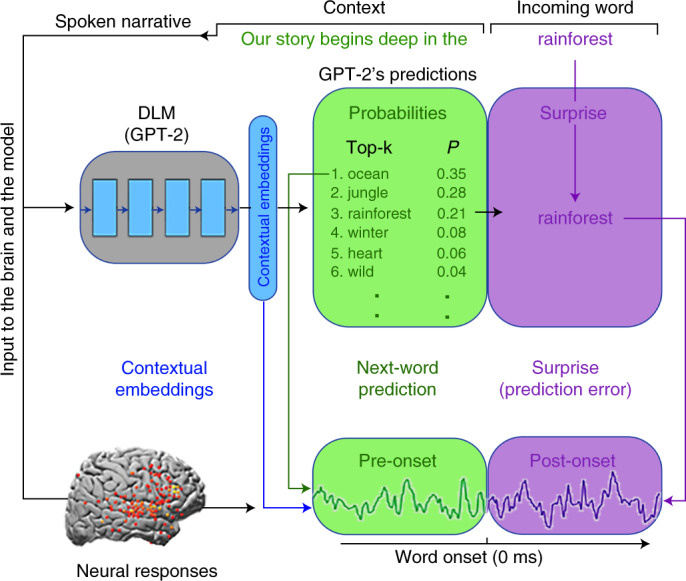
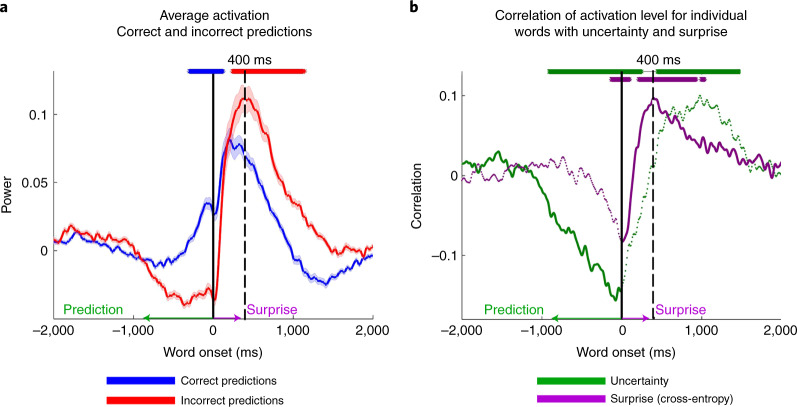
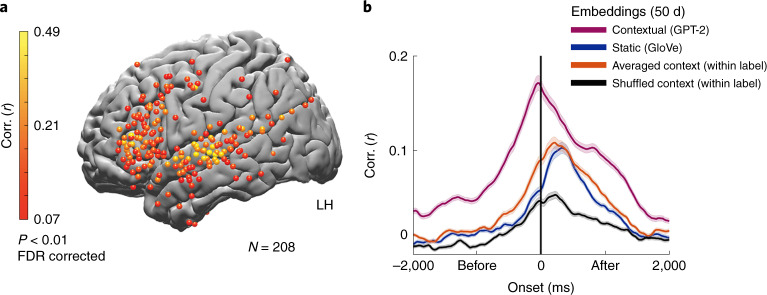
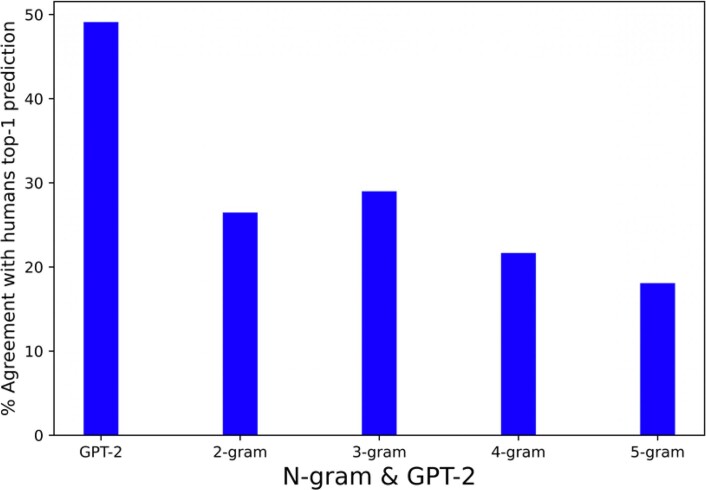
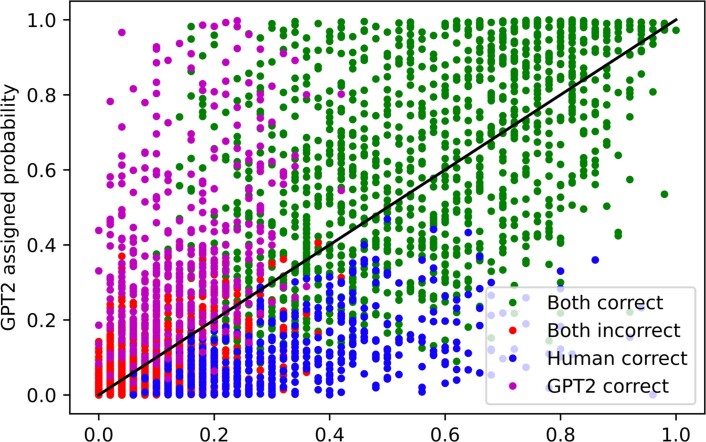
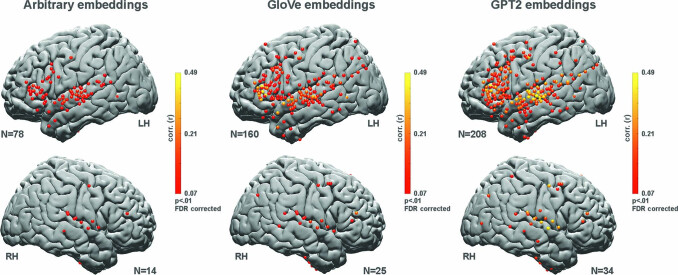
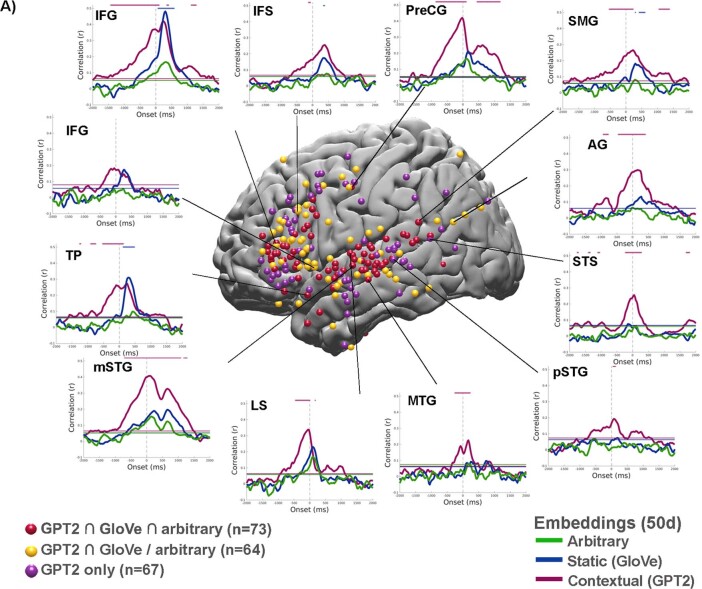
Departing from traditional linguistic models, advances in deep learning have resulted in a new type of predictive (autoregressive) deep language models (DLMs). Using a self-supervised next-word prediction task, these models generate appropriate linguistic responses in a given context. In the current study, nine participants listened to a 30-min podcast while their brain responses were recorded using electrocorticography (ECoG). We provide empirical evidence that the human brain and autoregressive DLMs share three fundamental computational principles as they process the same natural narrative: (1) both are engaged in continuous next-word prediction before word onset; (2) both match their pre-onset predictions to the incoming word to calculate post-onset surprise; (3) both rely on contextual embeddings to represent words in natural contexts. Together, our findings suggest that autoregressive DLMs provide a new and biologically feasible computational framework for studying the neural basis of language.
Overview
The claims and statistics of this paper haven’t been checked yet.
Free: it reads the open-access text and checks the first 5 claims that cite a source we can check. Create a free account to check every claim.
Integrity signals
Registry
Cites
Statistics
Figures
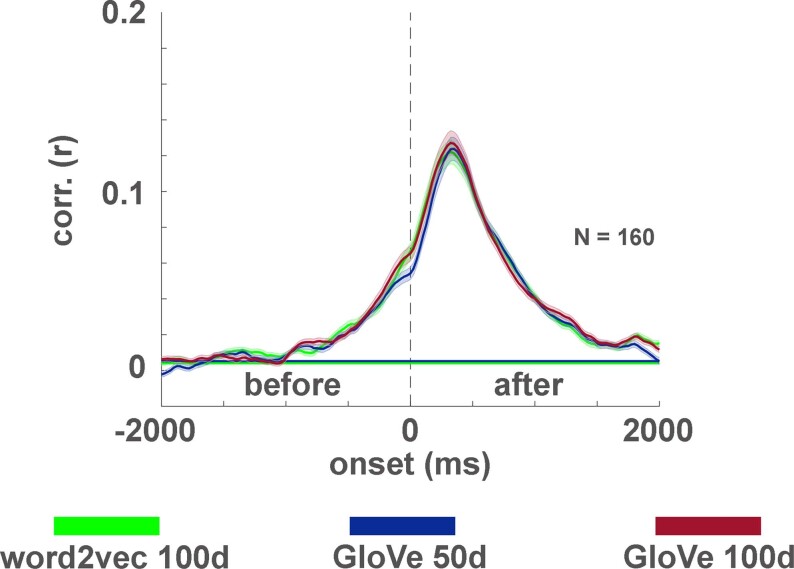
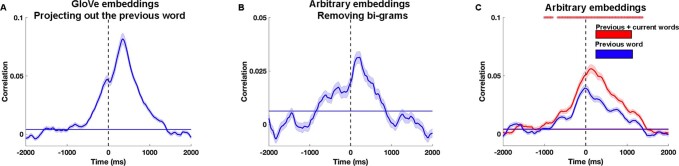
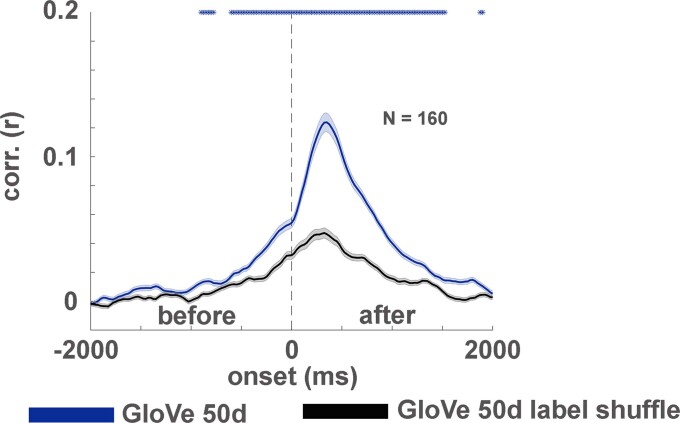
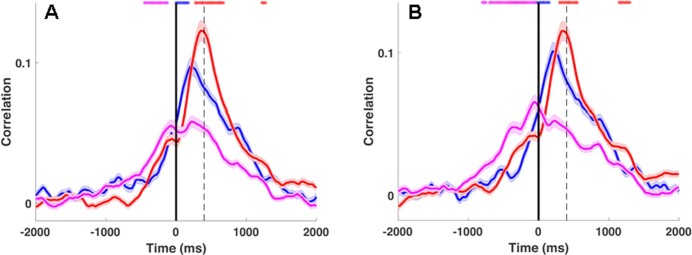
Verification
Claims the paper makes
The claims and statistics of this paper haven’t been checked yet.
Free: it reads the open-access text and checks the first 5 claims that cite a source we can check. Create a free account to check every claim.
Claims other papers make about this one
Each is checked against this paper’s own text: does it say what the citing paper says it does?
The cited source doesn’t support the claim as written.
In the citing paper
“Previous studies in the neural encoding literature all used LLMs that were only aware of the short-term context, i.e., where the context window size was as large as several tens of words1–10.”
From Incremental accumulation of linguistic context in artificial and biological neural networks (2025) · cites this paper as [10]
Checked by a reasoning model — may be wrong.
Experimental — accuracy not yet measuredThe cited source says what the claim attributes to it.
In the citing paper
“Studying AI can also advance psychological science (80–82).”
From Evaluating large language models in theory of mind tasks (2024) · cites this paper as [82]
The cited source says what the claim attributes to it.
In the citing paper
“Large Language Models (LLMs) have shown success in predicting neural signals associated with narrative processing”
From Incremental accumulation of linguistic context in artificial and biological neural networks (2025) · cites this paper as [10]
The cited source says what the claim attributes to it.
In the citing paper
“This was the case even though the participants in these studies were exposed to language stimuli that encompassed hundreds and even thousands of words.”
From Incremental accumulation of linguistic context in artificial and biological neural networks (2025) · cites this paper as [10]
Self-check
Percentages, sums and reported differences re-computed from the paper’s own numbers.
The self-check needs the paper’s full text.
Citations
Cites
Controlling the False Discovery Rate: A Practical and Powerful Approach to Multiple Testing
Benjamini, Y., & Hochberg, Y. (1995) · Journal of the Royal Statistical Society Series B: Statistical Methodology · doi:10.1111/j.2517-6161.1995.tb02031.x · Cited by 109,482
Glove: Global Vectors for Word Representation
Pennington, J., Socher, R., & Manning, C. (2014) · Proceedings of the 2014 Conference on Empirical Methods in Natural Language Processing (EMNLP) · doi:10.3115/v1/d14-1162 · Cited by 34,071
Language Models are Few-Shot Learners
Brown, T. B., Mann, B., Ryder, N., Subbiah, M., Kaplan, J., Dhariwal, P., Neelakantan, A., Shyam, P., Sastry, G., Askell, A., et al. (2020) · arXiv · doi:10.48550/arxiv.2005.14165 · Cited by 23,372
ASPECTS OF THE THEORY OF SYNTAX
Chomsky, N. (1964) · doi:10.21236/ad0616323 · Cited by 13,587
Oostenveld, R., Fries, P., Maris, E., & Schoffelen, J.-M. (2011) · Computational Intelligence and Neuroscience · doi:10.1155/2011/156869 · Cited by 10,323
Lewis, M., Liu, Y., Goyal, N., Ghazvininejad, M., Mohamed, A., Levy, O., Stoyanov, V., & Zettlemoyer, L. (2020) · Proceedings of the 58th Annual Meeting of the Association for Computational Linguistics · doi:10.18653/v1/2020.acl-main.703 · Cited by 8,821
Self-citationLewis, M., Liu, Y., Goyal, N., Ghazvininejad, M., Mohamed, A., Levy, O., Stoyanov, V., & Zettlemoyer, L. (2019) · arXiv · doi:10.48550/arxiv.1910.13461 · Cited by 8,816
Self-citationChomsky, N. (1957) · doi:10.1515/9783112316009 · Cited by 7,885
Whatever next? Predictive brains, situated agents, and the future of cognitive science
Clark, A. (2013) · Behavioral and Brain Sciences · doi:10.1017/s0140525x12000477 · Cited by 5,924
Reading Senseless Sentences: Brain Potentials Reflect Semantic Incongruity
Kutas, M., & Hillyard, S. A. (1980) · Science · doi:10.1126/science.7350657 · Cited by 4,888
Research works printed but not linked: 9
- Yang, Z. et al. XLNet: generalized autoregressive pretraining for language understanding. in Advances in Neural Information Processing Systems (eds. Wallach, H. et al.) 5753–5763 (Curran Associates, 2019).
- Schwartz, D. et al. Inducing brain-relevant bias in natural language processing models. in Advances in Neural Information Processing Systems (eds. Wallach, H. et al.) 14123–14133 (Curran Associates, 2019).
- Athanasiou, N., Iosif, E. & Potamianos, A. Neural activation semantic models: computational lexical semantic models of localized neural activations. in Proceedings of the 27th International Conference on Computational Linguistics 2867–2878 (Association for Computational Linguistics, 2018).
- Caucheteux, C., Gramfort, A. & King, J.-R. GPT-2’s activations predict the degree of semantic comprehension in the human brain. Preprint at bioRxiv https://doi.org/10.1101/2021.04.20.440622 (2021). · DOI
- Mikolov, T., Sutskever, I., Chen, K., Corrado, G. S. & Dean, J. Distributed Representations of Words and Phrases and their Compositionality. in Advances in Neural Information Processing Systems (eds. Burges et al.) 3111–3119 (Curran Associates, 2013).
- Toneva, M. & Wehbe, L. Interpreting and improving natural-language processing (in machines) with natural language-processing (in the brain). in 33rd Conference on Neural Information Processing Systems (2019).
- Khandelwal, U., Levy, O., Jurafsky, D., Zettlemoyer, L. & Lewis, M. Generalization through memorization: nearest neighbor language models. in International Conference on Learning Representations (2020).
- Goldberg, A. E. Explain me This: Creativity, Competition, and the Partial Productivity of Constructions (Princeton University Press, 2019). · DOI · Paper page
- Marcus, G. F. The Algebraic Mind: Integrating Connectionism and Cognitive Science (MIT Press, 2019).
Cited by
Items 601–700 of 710
Riding Brainwaves in LLM Space: Understanding Activation Patterns Using Individual Neural SignaturesPreprint
Subramanian, A., Bettadapura, S., & Sathish, R. (2026) · arXiv (Cornell University) · doi:10.48550/arxiv.2603.21847
When Language Models Lose Their Mind: The Consequences of Brain Misalignment
Merlin, G., & Toneva, M. (2026) · International Conference on Learning Representations · doi:10.48550/arxiv.2603.23091
Bayram, A., & Aydemir, E. (2026) · Acta Infologica · doi:10.26650/acin.1769461
Apprentissage multi-capteurs pour le contrôle non destructif de matériaux
Helvig, K. (2024) · theses.fr (ABES) · doi:10.70675/c16d7388z68e0z4102zbff6z9c859b838687
Cui, Y., Sun, J., Sun, Y., Wang, Y., Zhang, Y., Li, J., Wang, S., Zhou, H., Hale, J., Zong, C., et al. (2026) · arXiv · doi:10.48550/arxiv.2604.10627
Rhythm in Prosody and at the Prosody–Syntax Interface
Meyer, L., & Strauß, A. (2026) · Cambridge University Press eBooks · doi:10.1017/9781009295888.018
Azizpour, S., Westner, B. U., Szewczyk, J., Güçlü, U., & Geerligs, L. (2026) · eLife · doi:10.7554/elife.110085.1.sa0
Acoustic and Sublexical Rhythms
Meyer, L., & Strauß, A. (2026) · Cambridge University Press eBooks · doi:10.1017/9781009295888.010
Does the brain really know what word is coming next?
Antonello, R. (2026) · eLife · doi:10.7554/elife.111163
Scholz, R. (2025) · Qucosa (Saxon State and University Library Dresden)
Shin, G., Lee, S.-H., & Lee, C. (2026) · Language Resources and Evaluation Conference (LREC) · doi:10.63317/2icd7h29b849
Ghosh, S., Bose, S., Adhikary, A., Rajbanshi, C., & Chakraborty, S. (2026) · IGI Global eBooks · doi:10.4018/979-8-3373-6816-0.ch007
Predictive and feedback signals differently shape the formation of language representationsPreprint
Yang, S., Yu, S., Jiang, X., Wang, S., & Feng, G. (2026) · arXiv (Cornell University) · doi:10.48550/arxiv.2605.09409
Do Language Models Align with Brains? Prediction Scores Are Not EnoughPreprint
Jia, X. (2026) · arXiv (Cornell University) · doi:10.48550/arxiv.2605.14025
Human-like sequential sound-to-meaning transfer drives artificial speech comprehensionPreprint
Zhang, S., Li, S., Yang, R., Chen, G., Tian, X., Wang, Q., & Fang, F. (2026) · bioRxiv (Cold Spring Harbor Laboratory) · doi:10.64898/2026.05.13.723203
Zyryanov, A., Pierz, V., & Oganian, Y. (2026) · bioRxiv (Cold Spring Harbor Laboratory) · doi:10.64898/2026.05.15.724229
Zhao, J., & Brennan, J. (2026) · bioRxiv (Cold Spring Harbor Laboratory) · doi:10.64898/2026.05.15.725490
A Survey of Large Language Models for Perception and Measurement of Human Psychology
Li, Y., Chen, X., Cai, J., Zhong, Z., Yang, H., Tang, H., & Shen, L. (2026) · IEEE Transactions on Cognitive and Developmental Systems · doi:10.1109/tcds.2026.3695985
Brain-LLM Alignment Tracks Training Data, Not TypologyPreprint
Guo, D., Wu, J., & Yiu, S. (2026) · arXiv · doi:10.48550/arxiv.2605.23032
Do VLMs Align Better with Humans than LLMs during Natural Reading?Preprint
Wu, J., Ma, Z., Li, J., Tang, B., & Lu, Z. (2026) · arXiv (Cornell University) · doi:10.48550/arxiv.2605.28818
Tracking the dynamic breakdown of contextual coherence in schizophrenia using language models
Ryu, S., Kim, J., Jhon, M., Chung, Y., Kim, S. J., Lee, S., Kim, J.-M., & Kim, S.-W. (2026) · Frontiers in Psychiatry · doi:10.3389/fpsyt.2026.1848956
Chen, Y., Ghavami, M., St‐Laurent, M., Bellec, P., & Ghosh, S. (2026) · bioRxiv (Cold Spring Harbor Laboratory) · doi:10.64898/2026.05.31.729141
Chang, H.-J., Çatal, Y., Wolman, A., Ibáñez, A. M., Smith, D., Su, I.-W., Cheng, K.-Y., & Northoff, G. (2026) · Computer Speech & Language · doi:10.1016/j.csl.2026.102013
Nakai, T., Kubo, T., & Nishimoto, S. (2026) · Science Advances · doi:10.1126/sciadv.aej5555
Retiring Linguistics for a Unified Language Science
Albu, I., & Voß, T. E. (2026) · Neurolinguistic Communication Intervention · doi:10.54963/nci.v1i1.2379
Nadeau, S. E. (2026) · Cognitive and Behavioral Neurology · doi:10.1097/wnn.0000000000000424
Heterogeneous Neural Predictivity from Language Models During Naturalistic ComprehensionPreprint
Jia, X. (2026) · arXiv (Cornell University) · doi:10.48550/arxiv.2606.26880
Estimation of neuronal tuning for word meaning from passively recorded naturalistic speechPreprint
Ismail, T., Chavez, A. G., Yan, X., Zhu, H., Franch, M. C., Belanger, J. L., Chamarthi, S., Kabotyanski, K. E., Katlowitz, K. A., Chericoni, A., et al. (2026) · bioRxiv (Cold Spring Harbor Laboratory) · doi:10.64898/2026.06.23.733980
Hierarchical Predictive Processing during Natural ReadingPreprint
Chan, L., Dimigen, O., Gagl, B., & Maurer, U. (2026) · bioRxiv (Cold Spring Harbor Laboratory) · doi:10.64898/2026.06.24.734402
Getting Close to Cloze: Investigating Language Model and Human Cloze-test Performance in Afrikaans
Lotz, S., van Noord, R., & van Noord, G. (2026) · Language Resources and Evaluation Conference (LREC) · doi:10.63317/4th5sqwn9wjb
Proceedings of Resources for African Indigenous Languages (RAIL) 2026 @ LREC 2026
(2026) · Language Resources and Evaluation Conference (LREC) · doi:10.63317/44hkfj5cg3wf
Toward Cognitive Alignment in Large Language Models: Integrating Linguistic Theory and Human Data
Zaghouani, W. (2026) · Language Resources and Evaluation Conference (LREC) · doi:10.63317/5d9kn8b26y4q
Non-literal Meaning Representation in the Brain during Naturalistic Listening
Ma, Z., Huang, Y., Wang, C., & Li, J. (2026) · Society for Computation in Linguistics (SCiL) · doi:10.18653/v1/2026.scil-main.22
Wang, S., & Cai, Z. G. (2026) · Conference on Computational Natural Language Learning · doi:10.18653/v1/2026.conll-main.6
Traces in the Brain: Neural Evidence for Syntactic Movement in English and Chinese
Huang, Y., Ma, Z., 齐, 锦., Chan, B., Shen, Z., Lai, J. Y., Hale, J. T., & Li, J. (2026) · Findings of the Association for Computational Linguistics: ACL (Findings of ACL) · doi:10.18653/v1/2026.findings-acl.1027
Duan, X., Ma, Z., Yao, Z., Li, J., & Cai, Z. G. (2026) · Society for Computation in Linguistics (SCiL) · doi:10.18653/v1/2026.scil-main.44
The human language processing system straightens natural speechPreprint
Xu, J., Nguyen, T. D., Tang, J., Huth, A. G., & Goris, R. L. T. (2026) · bioRxiv (Cold Spring Harbor Laboratory) · doi:10.64898/2026.06.30.735613
Akzam, I., & Abdullah, M. I. B. (2026) · Al-Ta rib Jurnal Ilmiah Program Studi Pendidikan Bahasa Arab IAIN Palangka Raya · doi:10.23971/altarib.v14i1.11511
Steele, A. N. (2026) · Digital Access to Scholarship at Harvard (DASH) (Harvard University)
BCCWJ-Brain: A Multi-Modal fMRI, MEG, and EEG Dataset of Naturalistic Japanese ReadingPreprint
Sugimoto, Y., Asahara, M., Jeong, H., Kanno, A., Koizumi, M., & Oseki, Y. (2026) · bioRxiv (Cold Spring Harbor Laboratory) · doi:10.64898/2026.07.05.736621
Bonnasse‐Gahot, L., & Pallier, C. (2026) · Neurobiology of Language · doi:10.1162/nol.a.284
Reward Valuation in Large Language Models: Causal Induction of AnhedoniaPreprint
Honarmand, M., Aghabagher, S. M., & Schrimpf, M. (2026) · arXiv (Cornell University) · doi:10.48550/arxiv.2607.06626
Prior Context Scaffolds Sentential Semantic Integration during Noisy Speech ComprehensionPreprint
Zhang, X., Li, Z., & Zhang, D. (2026) · bioRxiv (Cold Spring Harbor Laboratory) · doi:10.64898/2026.07.11.737996
Xiao, B., Xu, X., Li, S., Yan, Y., Wu, X., Cheng, H., & Chen, J. (2026) · arXiv (Cornell University) · doi:10.48550/arxiv.2607.12071
Surprisal contributes little beyond contextual embeddings in high-gamma ECoG encodingPreprint
Sakuma, T. (2026) · bioRxiv (Cold Spring Harbor Laboratory) · doi:10.64898/2026.07.10.737662
Encoding EEG Signals to Examine Human-Like Next-Word Prediction Behaviour in Language ModelsPreprint
Quach, B. M., Bt, N., Gurrin, C., & HEALY, G. (2026) · arXiv (Cornell University) · doi:10.48550/arxiv.2607.16549
Global Energy Crisis Sentiment: A Comparative AI Study on Imbalanced Data
Hidayatullah, D., Musa, H. G., Ramadhan, A., Fahrozi, T. N., & Firlaudy, A. Z. (2026) · IEEE International Conference on Signals and Systems (ICSigSys) · doi:10.1109/icsigsys71160.2026.11613899
Heo, J.-H., Wisniewska, A. J., Lee, S., & Lee, S.-W. (2026) · arXiv (Cornell University) · doi:10.48550/arxiv.2607.19394
Causality organizes episodic memory and neural reinstatementPreprint
Antony, J. W., Abbas, S., Babb, M., Reagh, Z., & Ranganath, C. (2026) · bioRxiv (Cold Spring Harbor Laboratory) · doi:10.64898/2026.07.22.740141
Artificial intelligence – one brain for all?
Lang, E. (2026) · Tidsskrift for Den norske legeforening · doi:10.4045/tidsskr.26.0261
Shin, G., Kwon, N., & Mun, S. (2026) · Humanities and Social Sciences Communications · doi:10.1057/s41599-026-08299-1
Temporal Context Reinstatement Drives Episodic-Like Order Memory in Long-Context Language Models
Pink, M., Vo, V. A., Wu, Q., Mu, J., Turek, J. S., Hasson, U., Norman, K. A., Michelmann, S., Huth, A. G., & Toneva, M. (2026) · PubMed · doi:10.48550/arxiv.2607.22575
Self-citationPan, G., Yang, Y., Chen, S., Zheng, Y., Zhen, Y., Zheng, H., & Tang, S. (2026) · arXiv (Cornell University) · doi:10.48550/arxiv.2607.28204
From Large Language Models to Multimodal Intelligence: Bridging AI and Cognitive SciencePreprint
Jiang, Y., & Dale, R. A. C. (2026) · Research Square · doi:10.21203/rs.3.rs-8922724/v1
Semenkov, I., Kleeva, D. F., Dakhtin, I., Maksudova, Z., & Ossadtchi, A. E. (2026) · arXiv (Cornell University) · doi:10.48550/arxiv.2608.01481
Dynamics and learning in cortical neuronal networks
Falorsi, L. (2026) · IRIS Research product catalog (Sapienza University of Rome)
Generating and analyzing personality questionnaires using large language models
Monsa, R., Zohar, A., & Arzy, S. (2026) · iScience · doi:10.1016/j.isci.2026.116909
In Machina N400: Pinpointing Where a Causal Language Model Detects Semantic Violations
Zacharopoulos, C.-N., & Kyriakoglou, R. (2026) · Communications in computer and information science · doi:10.1007/978-3-032-25809-0_14
Asami, D., Naoe, T., Makuuchi, M., & Koizumi, M. (2026) · Human Brain Mapping · doi:10.1002/hbm.70604
Nakai, T., & Prado, J. (2026) · iScience · doi:10.1016/j.isci.2026.117180
Guan, X., Newman‐Norlund, R., Yang, Y., Ahmadi, S., Willis, R., Salman, N., Warren, K., Nelakuditi, S., Rorden, C., Bonilha, L., et al. (2026) · arXiv (Cornell University) · doi:10.48550/arxiv.2608.12717 · Cited by 2
Using Large Language Model Embeddings to Analyze Neural Activity During Language Processing
Shao, P., Shimamoto, G. A., & Cai, J. (2026) · Methods in molecular biology · doi:10.1007/978-1-0716-5440-8_14
Hierarchical gist representation of events in human brain during naturalistic stimuli
Li, K. X., Ren, P., Liu, Q., Zhang, Z., Li, S., Li, Z., Sun, L., Ding, X., & Liang, X. (2026) · NeuroImage · doi:10.1016/j.neuroimage.2026.122191
Zhang, F., & Li, N. (2026) · International Conference on Machine Intelligence and Digital Applications (MIDA) · doi:10.1145/3801438.3803133
A structured framework for human–AI resemblance: Evidence, inference and perception
Wang, P., Law, E. L., Zou, L., Jiang, Y., Hertwig, R., PAAS, F. G. W. C., & Laureys, S. (2026) · Physics of Life Reviews · doi:10.1016/j.plrev.2026.09.003
From silicon to synapse: Why the artificial unit is not a kind of neuron
Mangalam, M. (2026) · Neuroscience & Biobehavioral Reviews · doi:10.1016/j.neubiorev.2026.106944
Deep-layer cortical tracking abruptly collapses in the absence of language comprehensionPreprint
Yang, C., Thwaites, A., Wingfield, C., Zhang, C., & Woolgar, A. (2026) · bioRxiv (Cold Spring Harbor Laboratory) · doi:10.64898/2026.09.04.747128
Neural tracking of surprisal and semantic distance in naturalistic movie viewingPreprint
O’Leary, R. M., Smith, H. C., Myers, E. B., Reilly, J. J., & Peelle, J. E. (2026) · bioRxiv (Cold Spring Harbor Laboratory) · doi:10.64898/2026.09.09.749230
AI-like parallelogram geometry of word relations in the human neocortexPreprint
Wang, R., Tian, Y., Ohmae, K., & Ohmae, S. (2026) · bioRxiv (Cold Spring Harbor Laboratory) · doi:10.64898/2026.09.07.749996
Neural encoding of auditory processing in schizophrenia
Vuyyuru, L. R., & Raju, A. (2026) · Frontiers in Neuroscience · doi:10.3389/fnins.2026.1893300
Content-Sensitive Linguistic Representations in the Human Multiple-Demand NetworkPreprint
Havin, M., Meshulam, M., Karidi, T., Tikochinski, R., Hasson, U., & Goldstein, A. (2026) · bioRxiv (Cold Spring Harbor Laboratory) · doi:10.64898/2026.09.14.749455
Self-citationXie, B., Hu, Y., & Zhao, L. (2026) · Frontiers in Neurorobotics · doi:10.3389/fnbot.2026.1930227
Head-level lesion-symptom mapping of picture naming in vision-language modelsPreprint
Nemati, S., Newman‐Norlund, R., Ahmadi, S., Guan, X., Warren, K., Yang, Y., Nelakuditi, S., Rorden, C., Bonilha, L., & Fridriksson, J. (2026) · SSRN Electronic Journal · doi:10.2139/ssrn.7513276
A retrospective analysis on the use of LLMs to study infant syntax learning
Bazin, H., Barberousse, A., & Yvon, F. (2026) · Conference on Empirical Methods in Natural Language Processing (EMNLP) · doi:10.18653/2026.emnlp-main.2181
Low-dimensional GPT-2 features improve cross-narrative prediction of shared fMRI responses
Karaman, B. (2026) · Journal of Neurolinguistics · doi:10.1016/j.jneuroling.2026.101381
Seeing hand gestures’ early beginnings improves predictions of upcoming utterance meaning
ter Bekke, M., van Otterdijk, L., Drijvers, L., & Holler, J. (2026) · Discourse Processes · doi:10.1080/0163853x.2026.2729660
Using LMs to Model the Effects of Context and Coreference during Sentence Comprehension
Kajikawa, K., Ai, L., Kuribayashi, T., & Wilcox, E. (2026) · Conference on Empirical Methods in Natural Language Processing (EMNLP) · doi:10.18653/2026.emnlp-main.871
Zhang, Y., Zhang, Y., Chen, Y., Xie, P., Jian, S., 谢松云, Xie, X., Li, N., & Zhang, X. (2026) · Neurocomputing · doi:10.1016/j.neucom.2026.135265
Cross-modal Deep Generative Models Reveal the Cortical Representation of Dancing
Takagi, Y. (2026) · Journal of Japan Society of Kansei Engineering · doi:10.5057/kansei.24.3_93
Lv, J., & Lu, S. (2026) · Research Square · doi:10.21203/rs.3.rs-11198219/v1
Which Attention Heads are like the Human Head? Not the Ones that ComputePreprint
Pinier, C., Opiełka, G., Rosenbusch, H., Webb, T., Nunez, M. D., & Stevenson, C. E. (2026) · arXiv (Cornell University) · doi:10.48550/arxiv.2609.37991
Ma, J., Yu, R., Tang, T., & Li, X. (2026) · arXiv (Cornell University) · doi:10.48550/arxiv.2609.37009
Cognitive Expert Language Models Better Align with the Corresponding Brain SystemsPreprint
Sourati, Z., Wu, M. H., Ghazizadeh, N., Kaplan, J., Dehghani, M., & Nastase, S. A. (2026) · arXiv (Cornell University) · doi:10.48550/arxiv.2609.36239
Self-citationFrom Neurons to Conversation: Speech Brain-Computer InterfacesPreprint
Khajehnejad, M., Habibollahi, F., Boccato, T., Sousa, M., Olak, M., Sheiban, F. J., & Ferrante, M. (2026) · arXiv (Cornell University) · doi:10.48550/arxiv.2609.36736
Causal event structure shapes convergent reactivation signatures in human cortex and language modelPreprint
Zhang, Z., Chen, Y., Liu, Q., Zhao, X., Ding, X., Fei, X., Du, J., Bao, Y., Gao, J., Huang, X., et al. (2026) · bioRxiv (Cold Spring Harbor Laboratory) · doi:10.64898/2026.09.28.754904
Normative clinical language data and task specific effects
Stark, B. C., & Themistocleous, C. K. (2026) · Brain and Language · doi:10.1016/j.bandl.2026.105850
Optimizing pre-listening activities with AI-assisted priming for L2 listening comprehension
Vu, D. C., & Vu, B. C. (2026) · Discover Education · doi:10.1007/s44217-026-02256-5
Zhang, T., Shaw, D. J., Zhou, S., Zhu, L., & Lu, C. (2026) · bioRxiv (Cold Spring Harbor Laboratory) · doi:10.64898/2026.10.03.756413
Nakagi, Y., Chiba, Y., & Kishino, Y. (2026) · arXiv (Cornell University) · doi:10.48550/arxiv.2610.22961
Deep LLM layers expose passage-level context in EEG during silent readingPreprint
Marquardt, I., Alchanat, A., & Jain, P. (2026) · arXiv (Cornell University) · doi:10.48550/arxiv.2610.23638
Başar, E., Matusevych, Y., van Dooren, A., & Bisazza, A. (2026) · Findings of the Association for Computational Linguistics: EMNLP (Findings of EMNLP) · doi:10.18653/2026.findings-emnlp.1044
Gao, S., Leong, Y. C., & Rosenberg, M. D. (2026) · bioRxiv (Cold Spring Harbor Laboratory) · doi:10.64898/2026.10.21.760815
Han, S., Song, J., Choi, B. Y., Koo, J., & Chang, M. Y. (2026) · Hearing Research · doi:10.1016/j.heares.2026.109845
Wu, Y., Chang, T., Chen, S., Quan, Y., Sun, Q., Hulle, M. M. V., Liu, Y., Jiang, N., Farina, D., Yang, Y., et al. (2026) · Science Advances · doi:10.1126/sciadv.adx5564
Multiple Recovery Paths in a Lesioned Transformer: Internal Rerouting and Readout Remapping
Cannata, L., & Hasson, U. (2026) · BlackboxNLP Workshop on Analyzing and Interpreting Neural Networks for NLP (BlackboxNLP) · doi:10.18653/2026.blackboxnlp-1.25
Self-citationParis, Z., & Finn, E. (2026) · arXiv (Cornell University) · doi:10.48550/arxiv.2610.40511
Hierarchical Uncertainty Transformation During Multimodal ComprehensionPreprint
Zhao, W., Jiawang, Y. A. N. G., Li, Z., & Du, Y. (2026) · bioRxiv (Cold Spring Harbor Laboratory) · doi:10.64898/2026.10.29.762725
Metadata
- Authors
- Goldstein, A., Zada, Z., Buchnik, E., Schain, M., Price, A., Aubrey, B., Nastase, S. A., Feder, A., Emanuel, D., Cohen, A., Jansen, A., Gazula, H., Choe, G., Rao, A., Kim, C., Casto, C., Fanda, L., Doyle, W., Friedman, D., Dugan, P., Melloni, L., Reichart, R., Devore, S., Flinker, A., Hasenfratz, L., Levy, O., Hassidim, A., Brenner, M., Matias, Y., Norman, K. A., Devinsky, O., & Hasson, U.
- Affiliations
- Google (United States) (US)
- Princeton University (US)
- New York University (US)
- Technion – Israel Institute of Technology (IL)
- Tel Aviv University (IL)
- Corresponding author
- Goldstein, Ariel
- ORCID
- Goldstein, Ariel
- Zada, Zaid
- Price, Amy
- Nastase, Samuel A.
- Feder, Amir
- Cohen, Alon
- Gazula, Harshvardhan
- Choe, Gina
- Kim, Catherine
- Casto, Colton
- Fanda, Lora
- Doyle, Werner
- Friedman, Daniel
- Dugan, Patricia
- Melloni, Lucia
- Reichart, Roi
- Devore, Sasha
- Flinker, Adeen
- Hasenfratz, Liat
- Levy, Omer
- Hassidim, Avinatan
- Brenner, Michael
- Matias, Yossi
- Norman, Kenneth A.
- Devinsky, Orrin
- Hasson, Uri
- Venue
- Nature Neuroscience
- Published
- 2022-03
- Volume
- 25
- Issue
- 3
- Pages
- 369-380
- ISSN
- 1097-6256 (ISSN-L)
- 1546-1726
- PMC
- PMC8904253
- OpenAlex
- W4220949944
- Cited by
- 447
- References
- 62
- Citations by year
- 2026: 97 · 2025: 123 · 2024: 111 · 2023: 94 · 2022: 21
- FWCI
- 44.98
- Type
- journal article
- Language
- en
- Open access
- hybrid
- doi.org
- Licence
- cc-by
- creativecommons.org/licenses/by/4.0 (tdm)
- creativecommons.org/licenses/by/4.0 (vor, 6 d)
- Locations
- Nature Neuroscience (publishedVersion, cc-by)
- PubMed Central (publishedVersion, cc-by)
- PubMed (publishedVersion)
- Funders
- Finding A Cure for Epilepsy and Seizures
- National Institutes of Health
- National Institute of Mental Health (R01MH112566)
- National Institute of Neurological Disorders and Stroke (R01NS109367)
- Eunice Kennedy Shriver National Institute of Child Health and Human Development (DP1HD091948)
- Topics
- Life Sciences › Neuroscience › Cognitive Neuroscience › Neurobiology of Language and Bilingualism
- Social Sciences › Psychology › Developmental and Educational Psychology › Reading and Literacy Development
- Social Sciences › Psychology › Developmental and Educational Psychology › Language Development and Disorders
- Keywords
- deep language models, autoregressive language models, language processing, next-word prediction, contextual embeddings, neural basis of language, electrocorticography, narrative comprehension
- MeSH terms
- Brain, Humans, Language, Linguistics
About these checks
Registry, retraction, Cites and statistics results are computed, not judged, with one exception: a printed reference that no index lists is read once by a model before it counts as a citation error. Claims are extracted by a model and kept only when their quote appears verbatim in the text; each cited source is then checked, with a model’s help, for whether it says what the claim relies on. Those verdicts can be wrong — read the claim’s quote and the cited source before relying on one.
Statistics and arithmetic are recomputed, not judged.
Confidence bands are shown only for fields calibrated on our annotated test set. None is calibrated yet, so no band is shown.
What counts as a claim ›How we measure confidence ›How we check this ›
Are you an author, or do you see a problem with this page? Request a review
Data sources
Bibliographic data: Semantic Scholar, OpenAlex, Crossref.
Contains information from the Semantic Scholar Academic Graph Datasets, made available under the ODC Attribution License (ODC-BY 1.0).
Semantic Scholar’s data is described in: Kinney, R., et al. (2023). The Semantic Scholar Open Data Platform. arXiv:2301.10140.
