

Shared computational principles for language processing in humans and deep language models
Open accessThe DOI matches its Crossref record; 65 of the 65 references it cites were found in a registry or an index.
Abstract
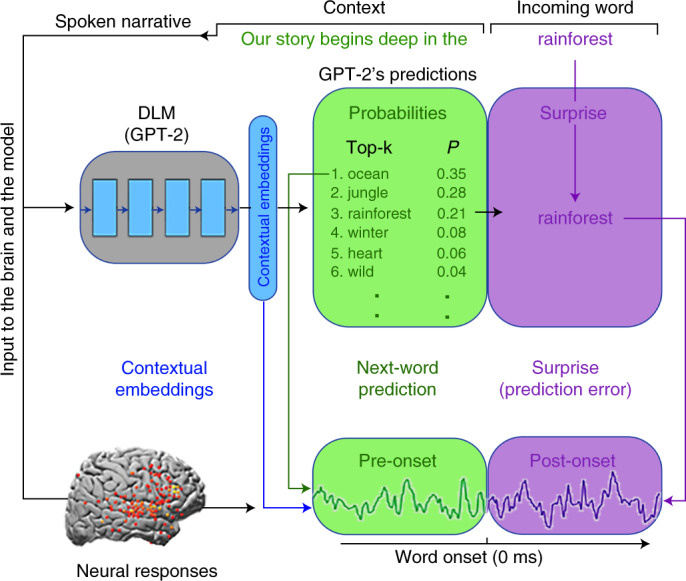
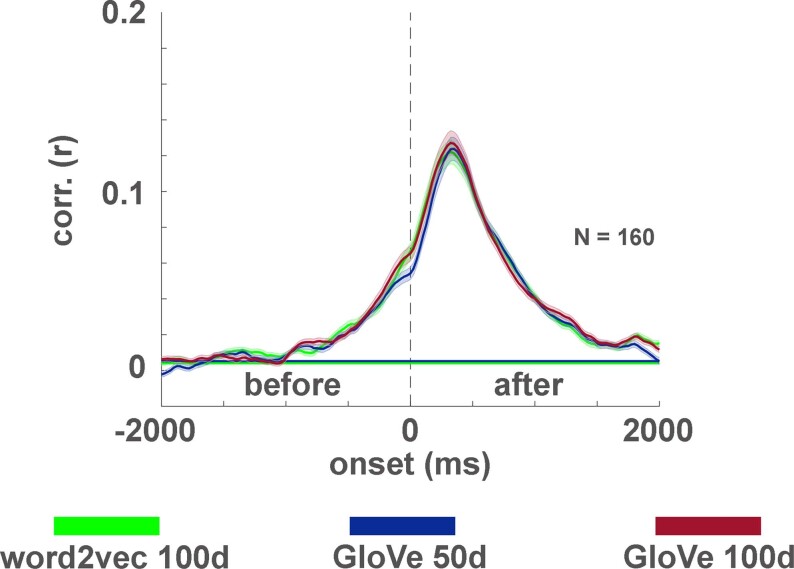
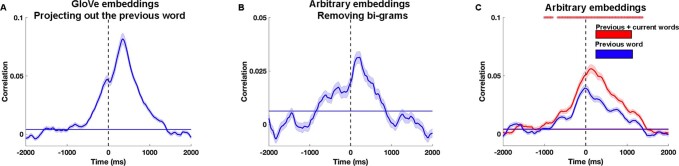
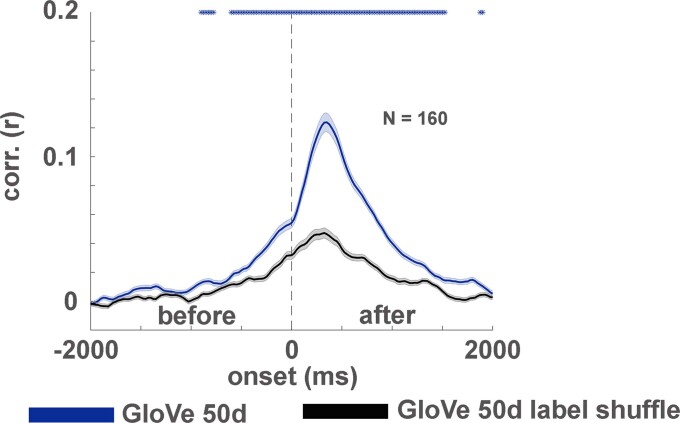
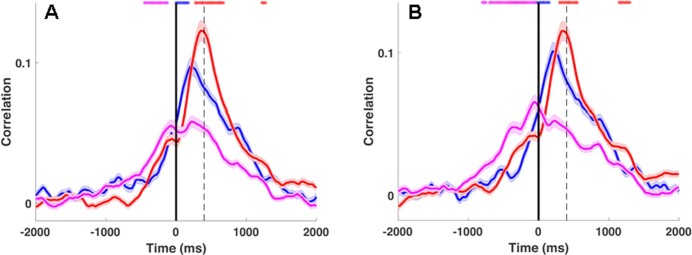
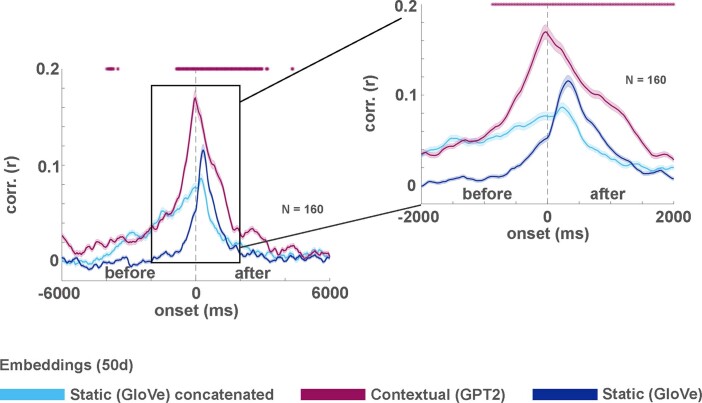
Departing from traditional linguistic models, advances in deep learning have resulted in a new type of predictive (autoregressive) deep language models (DLMs). Using a self-supervised next-word prediction task, these models generate appropriate linguistic responses in a given context. In the current study, nine participants listened to a 30-min podcast while their brain responses were recorded using electrocorticography (ECoG). We provide empirical evidence that the human brain and autoregressive DLMs share three fundamental computational principles as they process the same natural narrative: (1) both are engaged in continuous next-word prediction before word onset; (2) both match their pre-onset predictions to the incoming word to calculate post-onset surprise; (3) both rely on contextual embeddings to represent words in natural contexts. Together, our findings suggest that autoregressive DLMs provide a new and biologically feasible computational framework for studying the neural basis of language.
Overview
The claims and statistics of this paper haven’t been checked yet.
Free: it reads the open-access text and checks the first 5 claims that cite a source we can check. Create a free account to check every claim.
Integrity signals
Registry
Cites
Statistics
Figures
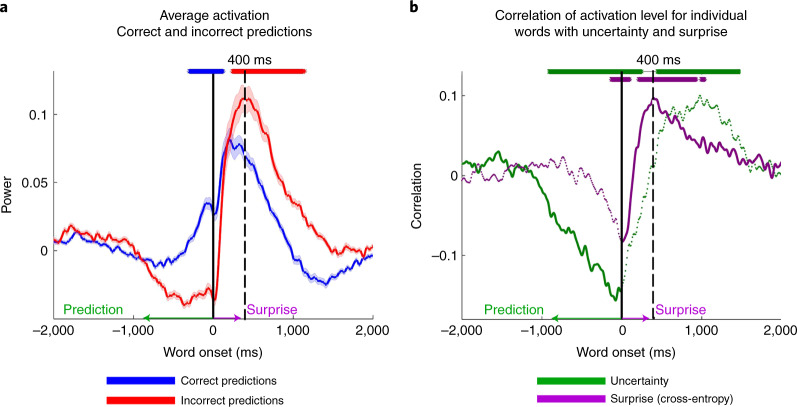
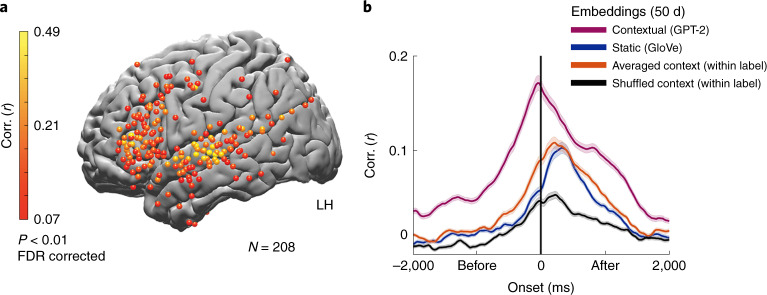
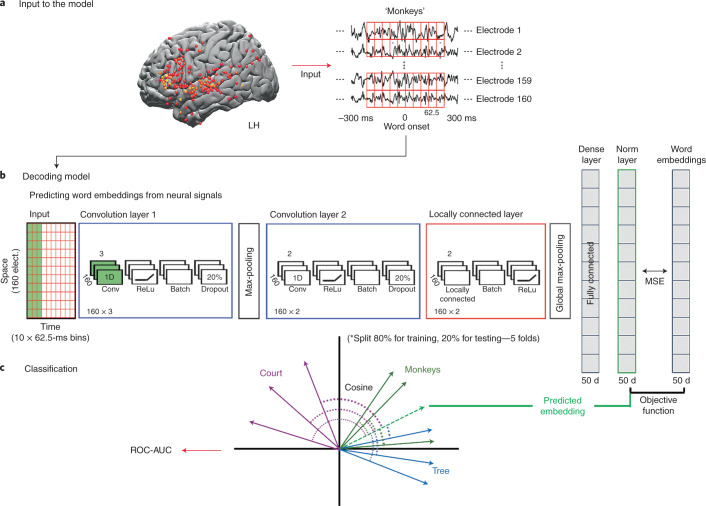
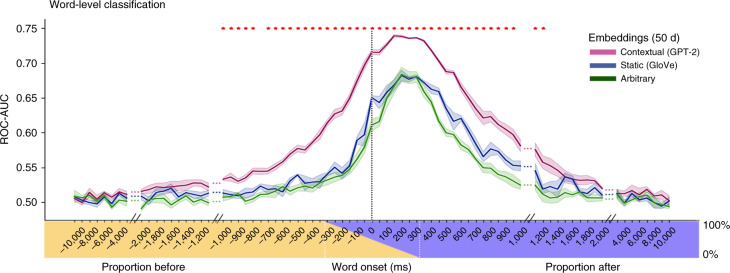
Verification
Claims the paper makes
The claims and statistics of this paper haven’t been checked yet.
Free: it reads the open-access text and checks the first 5 claims that cite a source we can check. Create a free account to check every claim.
Claims other papers make about this one
Each is checked against this paper’s own text: does it say what the citing paper says it does?
The cited source doesn’t support the claim as written.
In the citing paper
“Previous studies in the neural encoding literature all used LLMs that were only aware of the short-term context, i.e., where the context window size was as large as several tens of words1–10.”
From Incremental accumulation of linguistic context in artificial and biological neural networks (2025) · cites this paper as [10]
Checked by a reasoning model — may be wrong.
Experimental — accuracy not yet measuredThe cited source says what the claim attributes to it.
In the citing paper
“Studying AI can also advance psychological science (80–82).”
From Evaluating large language models in theory of mind tasks (2024) · cites this paper as [82]
The cited source says what the claim attributes to it.
In the citing paper
“Large Language Models (LLMs) have shown success in predicting neural signals associated with narrative processing”
From Incremental accumulation of linguistic context in artificial and biological neural networks (2025) · cites this paper as [10]
The cited source says what the claim attributes to it.
In the citing paper
“This was the case even though the participants in these studies were exposed to language stimuli that encompassed hundreds and even thousands of words.”
From Incremental accumulation of linguistic context in artificial and biological neural networks (2025) · cites this paper as [10]
Self-check
Percentages, sums and reported differences re-computed from the paper’s own numbers.
The self-check needs the paper’s full text.
Citations
Cites
Controlling the False Discovery Rate: A Practical and Powerful Approach to Multiple Testing
Benjamini, Y., & Hochberg, Y. (1995) · Journal of the Royal Statistical Society Series B: Statistical Methodology · doi:10.1111/j.2517-6161.1995.tb02031.x · Cited by 109,482
Glove: Global Vectors for Word Representation
Pennington, J., Socher, R., & Manning, C. (2014) · Proceedings of the 2014 Conference on Empirical Methods in Natural Language Processing (EMNLP) · doi:10.3115/v1/d14-1162 · Cited by 34,071
Language Models are Few-Shot Learners
Brown, T. B., Mann, B., Ryder, N., Subbiah, M., Kaplan, J., Dhariwal, P., Neelakantan, A., Shyam, P., Sastry, G., Askell, A., et al. (2020) · arXiv · doi:10.48550/arxiv.2005.14165 · Cited by 23,372
ASPECTS OF THE THEORY OF SYNTAX
Chomsky, N. (1964) · doi:10.21236/ad0616323 · Cited by 13,587
Oostenveld, R., Fries, P., Maris, E., & Schoffelen, J.-M. (2011) · Computational Intelligence and Neuroscience · doi:10.1155/2011/156869 · Cited by 10,323
Lewis, M., Liu, Y., Goyal, N., Ghazvininejad, M., Mohamed, A., Levy, O., Stoyanov, V., & Zettlemoyer, L. (2020) · Proceedings of the 58th Annual Meeting of the Association for Computational Linguistics · doi:10.18653/v1/2020.acl-main.703 · Cited by 8,821
Self-citationLewis, M., Liu, Y., Goyal, N., Ghazvininejad, M., Mohamed, A., Levy, O., Stoyanov, V., & Zettlemoyer, L. (2019) · arXiv · doi:10.48550/arxiv.1910.13461 · Cited by 8,816
Self-citationChomsky, N. (1957) · doi:10.1515/9783112316009 · Cited by 7,885
Whatever next? Predictive brains, situated agents, and the future of cognitive science
Clark, A. (2013) · Behavioral and Brain Sciences · doi:10.1017/s0140525x12000477 · Cited by 5,924
Reading Senseless Sentences: Brain Potentials Reflect Semantic Incongruity
Kutas, M., & Hillyard, S. A. (1980) · Science · doi:10.1126/science.7350657 · Cited by 4,888
Research works printed but not linked: 9
- Yang, Z. et al. XLNet: generalized autoregressive pretraining for language understanding. in Advances in Neural Information Processing Systems (eds. Wallach, H. et al.) 5753–5763 (Curran Associates, 2019).
- Schwartz, D. et al. Inducing brain-relevant bias in natural language processing models. in Advances in Neural Information Processing Systems (eds. Wallach, H. et al.) 14123–14133 (Curran Associates, 2019).
- Athanasiou, N., Iosif, E. & Potamianos, A. Neural activation semantic models: computational lexical semantic models of localized neural activations. in Proceedings of the 27th International Conference on Computational Linguistics 2867–2878 (Association for Computational Linguistics, 2018).
- Caucheteux, C., Gramfort, A. & King, J.-R. GPT-2’s activations predict the degree of semantic comprehension in the human brain. Preprint at bioRxiv https://doi.org/10.1101/2021.04.20.440622 (2021). · DOI
- Mikolov, T., Sutskever, I., Chen, K., Corrado, G. S. & Dean, J. Distributed Representations of Words and Phrases and their Compositionality. in Advances in Neural Information Processing Systems (eds. Burges et al.) 3111–3119 (Curran Associates, 2013).
- Toneva, M. & Wehbe, L. Interpreting and improving natural-language processing (in machines) with natural language-processing (in the brain). in 33rd Conference on Neural Information Processing Systems (2019).
- Khandelwal, U., Levy, O., Jurafsky, D., Zettlemoyer, L. & Lewis, M. Generalization through memorization: nearest neighbor language models. in International Conference on Learning Representations (2020).
- Goldberg, A. E. Explain me This: Creativity, Competition, and the Partial Productivity of Constructions (Princeton University Press, 2019). · DOI · Paper page
- Marcus, G. F. The Algebraic Mind: Integrating Connectionism and Cognitive Science (MIT Press, 2019).
Cited by
Items 301–400 of 710
Replay as a Basis for Backpropagation Through Time in the Brain
Cheng, H., & Brown, J. W. (2025) · Neural Computation · doi:10.1162/neco_a_01735 · Cited by 6
Memory in humans and deep language models: Linking hypotheses for model augmentationPreprint
Raccah, O., Chen, P., Willke, T., Poeppel, D., & Vo, V. A. (2022) · arXiv (Cornell University) · doi:10.48550/arxiv.2210.01869 · Cited by 6
Kewenig, V. N., Lampinen, A. K., Nastase, S. A., Edwards, C., D'Elascombe, Q., Rechardt, A., Skipper, J. I., & Vigliocco, G. (2024) · Research Square · doi:10.21203/rs.3.rs-3913308/v1 · Cited by 6
Self-citationWhen Meaning Matters Most: Rethinking Cloze Probability in N400 ResearchPreprint
Arkhipova, Y., Lopopolo, A., Vasishth, S., & Rabovsky, M. (2025) · bioRxiv (Cold Spring Harbor Laboratory) · doi:10.1101/2025.04.29.651301 · Cited by 6
Executive resources shape the impact of language predictability across the adult lifespanPreprint
Schuckart, M. M., Martin, S., Tune, S., Schmitt, L., Hartwigsen, G., & Obleser, J. (2026) · eLife · doi:10.7554/elife.108176 · Cited by 6
SayNext-Bench: Why Do LLMs Struggle with Next-Utterance Anticipation?Preprint
Yang, Y., Liu, H., Kang, F., Zhang, M., Lian, Z., Tang, H., & Chen, H. (2026) · arXiv (Cornell University) · doi:10.48550/arxiv.2602.00327 · Cited by 6
Agmon, G., Cho, S., Ash, S., Cousins, K. A. Q., Blennow, K., Zetterberg, H., Shaw, L. M. J., Pradhan, S., Kim, Y. D., Liberman, M., et al. (2025) · Aphasiology · doi:10.1080/02687038.2025.2462282 · Cited by 5
Emergence of a temporal processing gradient from naturalistic inputs and network connectivity
Chang, C. H. C., Nastase, S. A., Hasson, U., & Dominey, P. F. (2025) · Proceedings of the National Academy of Sciences · doi:10.1073/pnas.2420105122 · Cited by 5
Self-citationReusable Noncomplementary DNA-Based Neural Network
Sun, C., Liu, X., Zhong, J., Zhou, Q., & Cheng, J. (2025) · Journal of the American Chemical Society · doi:10.1021/jacs.5c04886 · Cited by 5
Mischler, G., Li, Y. A., Bickel, S., Mehta, A. D., & Mesgarani, N. (2025) · Nature Communications · doi:10.1038/s41467-025-63961-7 · Cited by 5
Jia, X., Song, K., Cheng, M., Li, H., Yang, H., & Wang, S. (2026) · Computer Methods in Applied Mechanics and Engineering · doi:10.1016/j.cma.2025.118253 · Cited by 5
The hippocampus as a latent diffusion engine for memory, perception and cognitive dysfunction
Jones, D. T., & Breakspear, M. J. (2026) · Brain · doi:10.1093/brain/awag325 · Cited by 5
Human-like cognitive generalization for large models via mental representation-guided supervision
Chen, J., Qi, Y., Wang, Y., & Pan, G. (2026) · Nature Communications · doi:10.1038/s41467-026-71267-5 · Cited by 5
The first 1000 days: Modeling language learning from individual children’s everyday speech
Raviv, H., Tsyhanov, A., Gousios, K., Altenhof, A., Wang, H., Chen, B., Raviv, O., Rosenwein, T., Lew‐Williams, C., Hasenfratz, L., et al. (2026) · Science · doi:10.64898/2026.03.28.715023 · Cited by 5
Self-citationHierarchical syntactic structure in human-like language models
Wolfman, M., Dunagan, D. G., Brennan, J., & Hale, J. (2024) · Workshop on Cognitive Modeling and Computational Linguistics (CMCL) · doi:10.18653/v1/2024.cmcl-1.6 · Cited by 5
Bruera, A., & Poesio, M. (2024) · PLoS ONE · doi:10.1371/journal.pone.0291099 · Cited by 5
Challenges and Methods in Annotating Natural Speech for Neurolinguistic Research
Agmon, G., Jaeger, M., Magen, E., Pinto, D., Perelmuter, Y., Golumbic, E. Z., & Bleichner, M. G. (2025) · Neurobiology of Language · doi:10.1162/nol.a.12 · Cited by 5
Tuckute, G., Finzi, D., Margalit, E., Yates, J. L., Zylberberg, J., Fyshe, A., Chung, S., Fedorenko, E. G., Kriegeskorte, N., Grill-Spector, K., et al. (2025) · Neurons Behavior Data analysis and Theory · doi:10.51628/001c.127807 · Cited by 5
Mapping the learning curves of deep learning networks
Jiang, Y., & Dale, R. A. C. (2025) · PLoS Computational Biology · doi:10.1371/journal.pcbi.1012286 · Cited by 5
Syntactic Preposing and Discourse Relations
Dong, Y., Liao, X., & Webber, B. (2024) · Conference of the European Chapter of the Association for Computational Linguistics · doi:10.18653/v1/2024.eacl-long.170 · Cited by 5
How Does Artificial Intelligence Contribute to iEEG Research?
Berezutskaya, J., Saive, A.-L., Jerbi, K., & van Gerven, M. A. J. (2023) · Studies in neuroscience, psychology and behavioral economics · doi:10.1007/978-3-031-20910-9_47 · Cited by 5
Gu, Y. (2022) · arXiv (Cornell University) · doi:10.48550/arxiv.2212.10536 · Cited by 5
Divergences between Language Models and Human BrainsPreprint
Zhou, Y., Liu, E., Neubig, G., Tarr, M. J., & Wehbe, L. (2023) · PubMed Central · doi:10.48550/arxiv.2311.09308 · Cited by 5
Li, J., Wang, Q., Zhou, Q., Yang, L., Shen, Y., Huang, S., Wang, S., Pylkkänen, L., & Huang, Z. (2024) · eLife · doi:10.7554/elife.100056.1 · Cited by 5
Apidianaki, M., Fourtassi, A., & Padó, S. (2024) · Computational Linguistics · doi:10.1162/coli_e_00539 · Cited by 5
Charting trajectories of human thought using large language modelsPreprint
Nour, M. M., McNamee, D., Fradkin, I., & Dolan, R. J. (2025) · arXiv (Cornell University) · doi:10.48550/arxiv.2509.14455 · Cited by 6
Larger language models better align with neural representations of natural language
Hong, Z., Wang, H., Zada, Z., Gazula, H., Turner, D. D., Aubrey, B., Niekerken, L., Doyle, W., Devore, S., Dugan, P. C., et al. (2026) · eLife · doi:10.7554/elife.101204 · Cited by 4
Self-citationMapping meaning in the brain's language
Brouwer, H. (2025) · Cortex · doi:10.1016/j.cortex.2025.10.012 · Cited by 4
Liang, Y., Wang, Y., Li, Y., & Zeng, Y. (2026) · Neural Networks · doi:10.1016/j.neunet.2026.108642 · Cited by 4
Li, J., Guo, C., Zhang, C., Chang, E. F., & Li, Y. (2026) · eLife · doi:10.7554/elife.109400.3 · Cited by 4
Carta, S., Aličković, E., Zaar, J., Valdés, A. L., & Liberto, G. M. D. (2026) · PLoS Biology · doi:10.1371/journal.pbio.3003876 · Cited by 4
Unifying the structures of language in a neural population code
Nastase, S. A., Zada, Z., Goldberg, A., & Hasson, U. (2026) · Neuron · doi:10.1016/j.neuron.2026.07.024 · Cited by 4
Self-citationModelling child comprehension: A case of suffixal passive construction in Korean
Shin, G., & Mun, S. (2024) · Computer Speech & Language · doi:10.1016/j.csl.2024.101701 · Cited by 4
A contest of sentiment analysis: k-nearest neighbor versus neural network
Kurniawan, F., & Supriyatno, T. (2025) · IAES International Journal of Artificial Intelligence · doi:10.11591/ijai.v14.i2.pp1625-1633 · Cited by 4
Disentangling Superpositions: Interpretable Brain Encoding Model with Sparse Concept Atoms
Zeng, A., & Gallant, J. L. (2025) · neural information processing systems · doi:10.52202/085713-3208 · Cited by 5
Cometa, A., d’Orio, P., Revay, M., Bottoni, F., Repetto, C., Russo, G. L., Cappa, S. F., Moro, A., Micera, S., & Artoni, F. (2023) · Journal of Neural Engineering · doi:10.1088/1741-2552/accaa8 · Cited by 4
Osuna, J. J. O., Jorge‐Botana, G., Martínez‐Huertas, J. Á., Olmos, R., & Martínez-Mingo, A. (2023) · Political Research Exchange · doi:10.1080/2474736x.2023.2287036 · Cited by 4
Sentence Reconstruction Leveraging Contextual Meaning from Speech-Related Brain Signals
Lee, J., Lee, S., Lee, Y.-E., Kim, S.-W., & Lee, S. (2023) · Conference proceedings/Conference proceedings - IEEE International Conference on Systems, Man, and Cybernetics · doi:10.1109/smc53992.2023.10394348 · Cited by 4
Enhancing aspect-based multi-labeling with ensemble learning for ethical logistics
Almazroi, A. A., & Ayub, N. (2024) · PLoS ONE · doi:10.1371/journal.pone.0295248 · Cited by 4
Comparison and Transformer Model and its Variant Algorithms in Natural Language Processing
Ma, Y. (2024) · International Conference on Networks, Multimedia and Information Technology (NMITCON) · doi:10.1109/nmitcon62075.2024.10698967 · Cited by 4
Transformer verbatim in-context retrieval across time and scale
Armeni, K., Pranjić, M., & Pollak, S. (2024) · Conference on Computational Natural Language Learning · doi:10.18653/v1/2024.conll-1.6 · Cited by 4
Action features dominate cortical representation during natural vision
Jung, H., Jain, H., Han, X., Feilong, M., Han, J., Shokeen, D., Uden, C. V., Hanson, I., Connolly, A. C., Wager, T. D., et al. (2026) · Proceedings of the National Academy of Sciences · doi:10.1073/pnas.2625018123 · Cited by 4
Self-citationLi, Z., Jiang, Q., Wu, Z., Liu, A., Wu, H., Huang, M., Huang, K., & Ku, Y. (2023) · IEEE Transactions on Affective Computing · doi:10.1109/taffc.2023.3279311 · Cited by 4
Shain, C. (2021) · DSpace@MIT (Massachusetts Institute of Technology) · doi:10.17605/osf.io/ah429 · Cited by 4
Emergence and Function of Abstract Representations in Self-Supervised TransformersPreprint
Ferry, Q., Ching, J., & Kawai, T. (2023) · arXiv.org · doi:10.48550/arxiv.2312.05361 · Cited by 4
Multiple Realizability and the Rise of Deep LearningPreprint
McGrath, S. W., & Russin, J. (2024) · arXiv (Cornell University) · doi:10.48550/arxiv.2405.13231 · Cited by 4
Boeve, S., & Bogaerts, L. (2024) · OSF Preprints (OSF Preprints) · doi:10.31219/osf.io/vqnw6 · Cited by 4
Sampaolo, E., Handjaras, G., Lettieri, G., & Cecchetti, L. (2025) · Scientific Data · doi:10.1038/s41597-025-05159-6 · Cited by 4
Ip, E. Y. J., Akkaya, A., Winchester, M., Bishop, S. J., Cowan, B. R., & Liberto, G. M. D. (2025) · bioRxiv (Cold Spring Harbor Laboratory) · doi:10.1101/2025.09.23.674728 · Cited by 4
Outraged AI: Large language models prioritise emotion over cost in fairness enforcementPreprint
Liu, H., Dai, Y., Tan, H., Yu, L., Zhou, Y., & Wu, Z. (2025) · PsyArXiv (OSF Preprints) · doi:10.31234/osf.io/fnk57_v3 · Cited by 4
Fine-grained Analysis of Brain-LLM Alignment through Input AttributionPreprint
Proietti, M., Capobianco, R., & Toneva, M. (2025) · arXiv (Cornell University) · doi:10.48550/arxiv.2510.12355 · Cited by 4
Liu, O. D., Tang, H., Feldman, N. H., & Goldwater, S. (2024) · arXiv (Cornell University) · doi:10.48550/arxiv.2405.08237 · Cited by 4
Yehudai, A., Karidi, T., Stanovsky, G., Goldstein, A., & Abend, O. (2024) · arXiv (Cornell University) · doi:10.48550/arxiv.2405.14863 · Cited by 4
Self-citationEmergence of Phonemic, Syntactic, and Semantic Representations in Artificial Neural NetworksPreprint
Orhan, P., Diego-Simón, P., Chemla, E., Lakretz, Y., Boubenec, Y., & King, J.-R. (2026) · arXiv (Cornell University) · doi:10.48550/arxiv.2601.18617 · Cited by 4
Abstraction Induces the Brain Alignment of Language and Speech Models
Cheng, E., Vaidya, A. R., & Antonello, R. (2026) · arXiv (Cornell University) · doi:10.48550/arxiv.2602.04081 · Cited by 4
Gao, S., Nash, R., Burns, S. M., & Leong, Y. C. (2025) · Social Cognitive and Affective Neuroscience · doi:10.1093/scan/nsaf043 · Cited by 3
Affective connotations according to LLMs: implications for meaning measurement and cultural bias
Combs, A., Dametto, D., Blaison, C., Leung, R., Malhotra, A., Schröder, T., Hoey, J., & Smith‐Lovin, L. (2025) · Cognition & Emotion · doi:10.1080/02699931.2025.2568551 · Cited by 3
Nakai, T., Daikoku, T., & Oseki, Y. (2025) · Neuroscience Research · doi:10.1016/j.neures.2025.105001 · Cited by 3
Structural priming in humans and large language models
Sinclair, A., Klimovich‐Gray, A., Jumelet, J., Adamian, N., & Konopka, A. E. (2026) · Journal of Memory and Language · doi:10.1016/j.jml.2025.104713 · Cited by 3
Memory efficiency and resource-rational encoding in sentence processing
Xu, W., Dillon, B., & Futrell, R. (2026) · Proceedings of the conference - Association for Computational Linguistics. Meeting · doi:10.18653/v1/2026.acl-long.1550 · Cited by 3
Mechanistic Interpretability of Animacy Effects on Structure Choice in GPT-2
Li, Y., Cong, Y., & Francis, E. J. (2026) · Conference on Computational Natural Language Learning · doi:10.18653/v1/2026.conll-main.38 · Cited by 3
A decade of comparing brains to DNNs: Progress and perspectives
Schmitt, L., Dong, D. T., Çelik, E., de Lange, F. P., & Toneva, M. (2026) · Trends in Cognitive Sciences · doi:10.1016/j.tics.2026.06.011 · Cited by 3
Nakai, T., Constant-Varlet, C., & Prado, J. (2024) · Developmental Cognitive Neuroscience · doi:10.1016/j.dcn.2024.101470 · Cited by 3
Improve Language Model and Brain Alignment via Associative Memory
Yin, C., Zhang, Y., Wen, X., & Li, P. (2025) · Findings of the Association for Computational Linguistics: ACL (Findings of ACL) · doi:10.18653/v1/2025.findings-acl.55 · Cited by 3
Shimizu, R., Antonello, R., Singh, C., & Mesgarani, N. (2026) · PLoS Computational Biology · doi:10.1371/journal.pcbi.1014906 · Cited by 3
Munich Sentence (MuSe) Database: Completion norms and audio recordings for 619 German sentences
Sterner, E., Stadler, M., & Knolle, F. (2026) · Behavior Research Methods · doi:10.3758/s13428-026-02993-3 · Cited by 3
Semantic Representations of Speech Production in Intracranial EEG
Herff, C., Verwoert, M., Amigó-Vega, J., & Ottenhoff, M. C. (2023) · Conference proceedings/Conference proceedings - IEEE International Conference on Systems, Man, and Cybernetics · doi:10.1109/smc53992.2023.10394550 · Cited by 3
Jiang, J., Guoyu, Z. H. A. O., Yingbo, M. A., Ding, G., & Lanfang, L. I. U. (2023) · Advances in Psychological Science · doi:10.3724/sp.j.1042.2023.01002 · Cited by 3
Hierarchical organization of language predictions in the brain
(2023) · Nature Human Behaviour · doi:10.1038/s41562-023-01534-8 · Cited by 3
Floyd, S., Jouravlev, O., Mineroff, Z., Poliak, M., Gibson, E. A. F., & Fedorenko, E. G. (2023) · PsyArXiv (OSF Preprints) · doi:10.31234/osf.io/e2xta · Cited by 3
MacBehaviour: An R package for behavioural experimentation on large language modelsPreprint
Duan, X., Li, S., & Cai, Z. G. (2024) · arXiv (Cornell University) · doi:10.48550/arxiv.2405.07495 · Cited by 3
Li, J., Wang, Q., Zhou, Q., Yang, L., Shen, Y., Huang, S., Wang, S., Pylkkänen, L., & Huang, Z. (2026) · eLife · doi:10.7554/elife.100056 · Cited by 3
A gradient of complementary learning systems emerges through meta-learningPreprint
Zhou, Z., & Schapiro, A. C. (2025) · bioRxiv (Cold Spring Harbor Laboratory) · doi:10.1101/2025.07.10.664201 · Cited by 3
Christiansen, M. H., & Kallens, P. C. (2022) · The Conversation · doi:10.64628/aai.qy449s577 · Cited by 3
Saha, S., Li, S., Tuckute, G., Li, Y., Zhang, R., Wehbe, L., Fedorenko, E. G., & Khosla, M. (2025) · arXiv (Cornell University) · doi:10.48550/arxiv.2510.02354 · Cited by 3
Oota, S. R., Pahwa, K., Jindal, P., Satya Sai Srinath Namburi, G. N. V. V., Singh, M., Chakraborty, T., Bapi, R. S., & Gupta, M. (2025) · arXiv (Cornell University) · doi:10.48550/arxiv.2506.08277 · Cited by 3
Coherence in the brain unfolds across separable temporal regimesPreprint
Staub, D., Rabe, F., Misra, A. R., Pauli, Y., Hüppi, R. M., Yang, N., Lang, N., Michels, L., Edkins, V., Frühholz, S., et al. (2025) · arXiv (Cornell University) · doi:10.48550/arxiv.2512.20481 · Cited by 3
Timkey, W., Dillon, B., & Linzen, T. (2026) · arXiv (Cornell University) · doi:10.48550/arxiv.2605.15440 · Cited by 3
Skrill, D., Feather, J., & Norman-Haignere, S. (2026) · bioRxiv (Cold Spring Harbor Laboratory) · doi:10.64898/2026.08.05.743059 · Cited by 3
Invariant neural representation of parts of speech in the human brain
Misra, P., Shih, Y., Yu, H., Weisholtz, D. S., Madsen, J. R., Sceillig, S., & Kreiman, G. (2026) · Current Biology · doi:10.1016/j.cub.2026.07.029 · Cited by 2
Beyond Acoustics: Capacity Limitations of Linguistic Levels
Giroud, J., & Morillon, B. (2026) · Cambridge University Press eBooks · doi:10.1017/9781009295888.016 · Cited by 2
A neurobiologically inspired model of sentence comprehension
Kröger, B. J., & Bekolay, T. (2025) · Language Cognition and Neuroscience · doi:10.1080/23273798.2025.2473537 · Cited by 2
RUIZ, Y. L., & Nazar, R. (2024) · RLA. Revista de lingüística teórica y aplicada · doi:10.29393/rla62-2ctyr20002 · Cited by 2
Temporal propagation of neural state boundaries in naturalistic context
Oetringer, D., Henderson, S., Gözükara, D., & Geerligs, L. (2025) · Cerebral Cortex · doi:10.1093/cercor/bhaf284 · Cited by 2
An LLM as a virtual simulation model for language-eloquent area surgery in human
Nam, S. M., Park, N., Park, C., Chang, M., & Yoon, S. (2025) · Medical Hypotheses · doi:10.1016/j.mehy.2025.111792 · Cited by 2
Hussen, J., Polas, M. R. H., Momotaz, T., Eva, R. A., & Emu, M. N. A. (2025) · IGI Global eBooks · doi:10.4018/979-8-3373-7694-3.ch003 · Cited by 2
What does my network learn? Assessing interpretability of deep learning for EEG
Göktepe-Kavis, P., Aellen, F. M., Alnes, S. L., & Tzovara, A. (2025) · Imaging Neuroscience · doi:10.1162/imag.a.1033 · Cited by 2
The HeCz corpus: A large, richly annotated reading corpus of newspaper headlines in Czech
Chromý, J., Ceháková, M., & Brand, J. (2025) · Behavior Research Methods · doi:10.3758/s13428-025-02863-4 · Cited by 2
Kölbl, N., Tziridis, K., Maier, A., Kinfe, T. M., Chavarriaga, R., Schilling, A., & Krauß, P. (2026) · NeuroImage · doi:10.1016/j.neuroimage.2026.121966 · Cited by 2
Kimchi, I., & Siegelman, N. (2025) · Psychonomic Bulletin & Review · doi:10.3758/s13423-025-02829-9 · Cited by 2
Cen, C., Zhang, Q., Xu, Z., Wen, F., Lin, Z., Liu, H., Xu, Y., Zou, Y., & Liang, Y. (2025) · doi:10.1145/3769698.3771223 · Cited by 2
Comparing Eye-gaze and Transformer Attention Mechanisms in Reading Tasks
Mouratidi, M., & Poesio, M. (2025) · doi:10.26615/978-954-452-104-2-004 · Cited by 2
Kemmerer, D. L., & Dove, G. O. (2026) · Cortex · doi:10.1016/j.cortex.2026.02.008 · Cited by 2
A dual-process neuro-symbolic framework for cognition-driven language understanding
Zhu, D. (2026) · Applied Soft Computing · doi:10.1016/j.asoc.2026.114887 · Cited by 2
Divergent neural dynamics of multidimensional semantic access for concrete and abstract words
Zhang, Y., Wang, S., Zong, C., & Lin, N. (2026) · Brain and Language · doi:10.1016/j.bandl.2026.105830 · Cited by 2
Toward a Realistic Encoding Model of Auditory Affective Understanding in the Brain
Pan, G., Yang, Y., Chen, S., Wang, X., Liu, L., Zheng, H., & Tang, S. (2026) · IEEE Transactions on Affective Computing · doi:10.1109/taffc.2026.3670015 · Cited by 2
Leveraging NTPs for Efficient Hallucination Detection in VLMs
Azachi, O., Eliyahu, K., Ani, E. E., Himelstein, R., Reichart, R., Pinter, Y., & Calderon, N. (2025) · doi:10.18653/v1/2025.chomps-main.4 · Cited by 2
Self-citationBrain-AI convergence: Generative world models and hierarchical attention for human intelligence
Ohmae, S., & Ohmae, K. (2026) · Patterns · doi:10.1016/j.patter.2026.101593 · Cited by 2
Intonation Units: Prosodic Regularity in Spontaneous Speech as a Window onto Cognitive Dynamics
Inbar, M., Grossman, E., & Landau, A. N. (2026) · Cambridge University Press eBooks · doi:10.1017/9781009295888.019 · Cited by 2
Learning to Write Rationally: How Information Is Distributed in Non-native Speakers’ Essays
Tang, Z., & van Hell, J. G. (2024) · Conference on Empirical Methods in Natural Language Processing (EMNLP) · doi:10.18653/v1/2024.emnlp-main.715 · Cited by 2
Metadata
- Authors
- Goldstein, A., Zada, Z., Buchnik, E., Schain, M., Price, A., Aubrey, B., Nastase, S. A., Feder, A., Emanuel, D., Cohen, A., Jansen, A., Gazula, H., Choe, G., Rao, A., Kim, C., Casto, C., Fanda, L., Doyle, W., Friedman, D., Dugan, P., Melloni, L., Reichart, R., Devore, S., Flinker, A., Hasenfratz, L., Levy, O., Hassidim, A., Brenner, M., Matias, Y., Norman, K. A., Devinsky, O., & Hasson, U.
- Affiliations
- Google (United States) (US)
- Princeton University (US)
- New York University (US)
- Technion – Israel Institute of Technology (IL)
- Tel Aviv University (IL)
- Corresponding author
- Goldstein, Ariel
- ORCID
- Goldstein, Ariel
- Zada, Zaid
- Price, Amy
- Nastase, Samuel A.
- Feder, Amir
- Cohen, Alon
- Gazula, Harshvardhan
- Choe, Gina
- Kim, Catherine
- Casto, Colton
- Fanda, Lora
- Doyle, Werner
- Friedman, Daniel
- Dugan, Patricia
- Melloni, Lucia
- Reichart, Roi
- Devore, Sasha
- Flinker, Adeen
- Hasenfratz, Liat
- Levy, Omer
- Hassidim, Avinatan
- Brenner, Michael
- Matias, Yossi
- Norman, Kenneth A.
- Devinsky, Orrin
- Hasson, Uri
- Venue
- Nature Neuroscience
- Published
- 2022-03
- Volume
- 25
- Issue
- 3
- Pages
- 369-380
- ISSN
- 1097-6256 (ISSN-L)
- 1546-1726
- PMC
- PMC8904253
- OpenAlex
- W4220949944
- Cited by
- 447
- References
- 62
- Citations by year
- 2026: 97 · 2025: 123 · 2024: 111 · 2023: 94 · 2022: 21
- FWCI
- 44.98
- Type
- journal article
- Language
- en
- Open access
- hybrid
- doi.org
- Licence
- cc-by
- creativecommons.org/licenses/by/4.0 (tdm)
- creativecommons.org/licenses/by/4.0 (vor, 6 d)
- Locations
- Nature Neuroscience (publishedVersion, cc-by)
- PubMed Central (publishedVersion, cc-by)
- PubMed (publishedVersion)
- Funders
- Finding A Cure for Epilepsy and Seizures
- National Institutes of Health
- National Institute of Mental Health (R01MH112566)
- National Institute of Neurological Disorders and Stroke (R01NS109367)
- Eunice Kennedy Shriver National Institute of Child Health and Human Development (DP1HD091948)
- Topics
- Life Sciences › Neuroscience › Cognitive Neuroscience › Neurobiology of Language and Bilingualism
- Social Sciences › Psychology › Developmental and Educational Psychology › Reading and Literacy Development
- Social Sciences › Psychology › Developmental and Educational Psychology › Language Development and Disorders
- Keywords
- deep language models, autoregressive language models, language processing, next-word prediction, contextual embeddings, neural basis of language, electrocorticography, narrative comprehension
- MeSH terms
- Brain, Humans, Language, Linguistics
About these checks
Registry, retraction, Cites and statistics results are computed, not judged, with one exception: a printed reference that no index lists is read once by a model before it counts as a citation error. Claims are extracted by a model and kept only when their quote appears verbatim in the text; each cited source is then checked, with a model’s help, for whether it says what the claim relies on. Those verdicts can be wrong — read the claim’s quote and the cited source before relying on one.
Statistics and arithmetic are recomputed, not judged.
Confidence bands are shown only for fields calibrated on our annotated test set. None is calibrated yet, so no band is shown.
What counts as a claim ›How we measure confidence ›How we check this ›
Are you an author, or do you see a problem with this page? Request a review
Data sources
Bibliographic data: Semantic Scholar, OpenAlex, Crossref.
Contains information from the Semantic Scholar Academic Graph Datasets, made available under the ODC Attribution License (ODC-BY 1.0).
Semantic Scholar’s data is described in: Kinney, R., et al. (2023). The Semantic Scholar Open Data Platform. arXiv:2301.10140.
