

Shared computational principles for language processing in humans and deep language models
Open accessThe DOI matches its Crossref record; 65 of the 65 references it cites were found in a registry or an index.
Abstract
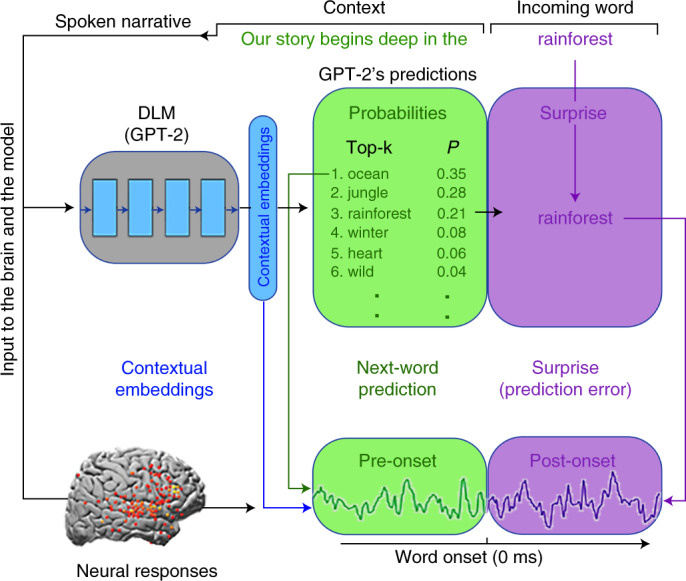
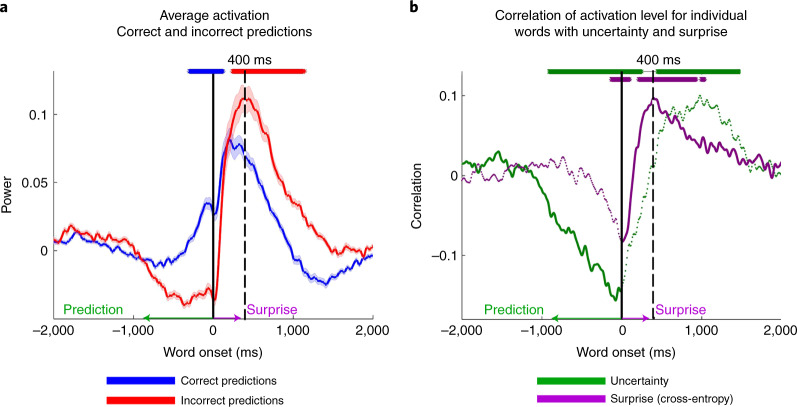
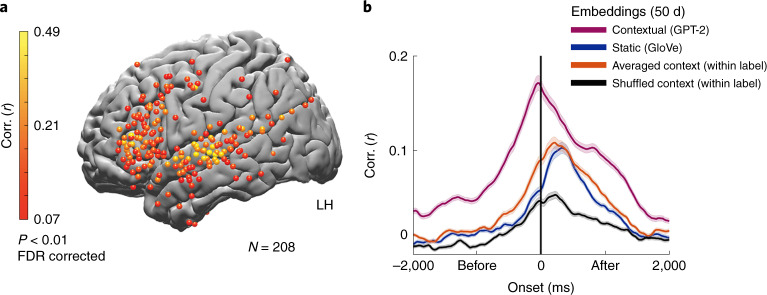
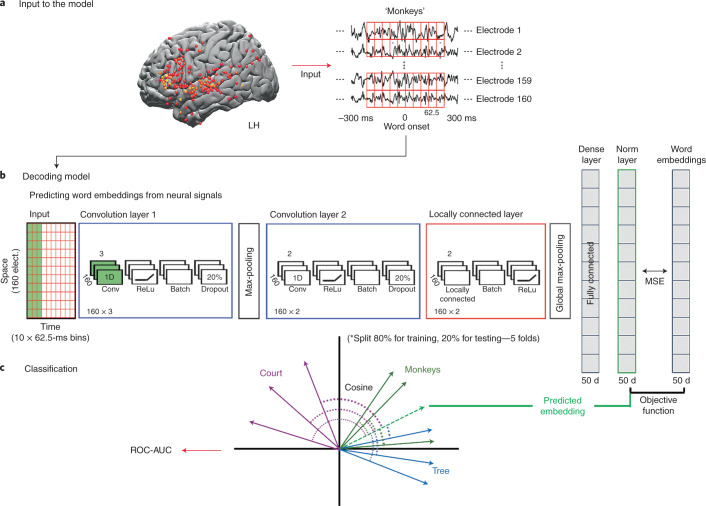
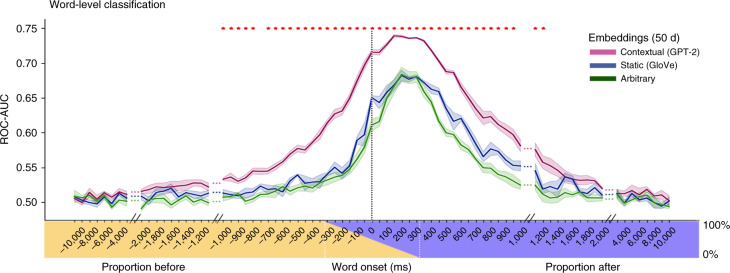
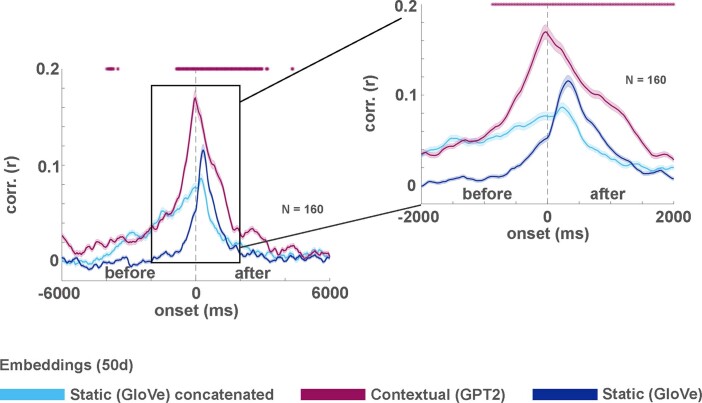
Departing from traditional linguistic models, advances in deep learning have resulted in a new type of predictive (autoregressive) deep language models (DLMs). Using a self-supervised next-word prediction task, these models generate appropriate linguistic responses in a given context. In the current study, nine participants listened to a 30-min podcast while their brain responses were recorded using electrocorticography (ECoG). We provide empirical evidence that the human brain and autoregressive DLMs share three fundamental computational principles as they process the same natural narrative: (1) both are engaged in continuous next-word prediction before word onset; (2) both match their pre-onset predictions to the incoming word to calculate post-onset surprise; (3) both rely on contextual embeddings to represent words in natural contexts. Together, our findings suggest that autoregressive DLMs provide a new and biologically feasible computational framework for studying the neural basis of language.
Overview
The claims and statistics of this paper haven’t been checked yet.
Free: it reads the open-access text and checks the first 5 claims that cite a source we can check. Create a free account to check every claim.
Integrity signals
Registry
Cites
Statistics
Figures
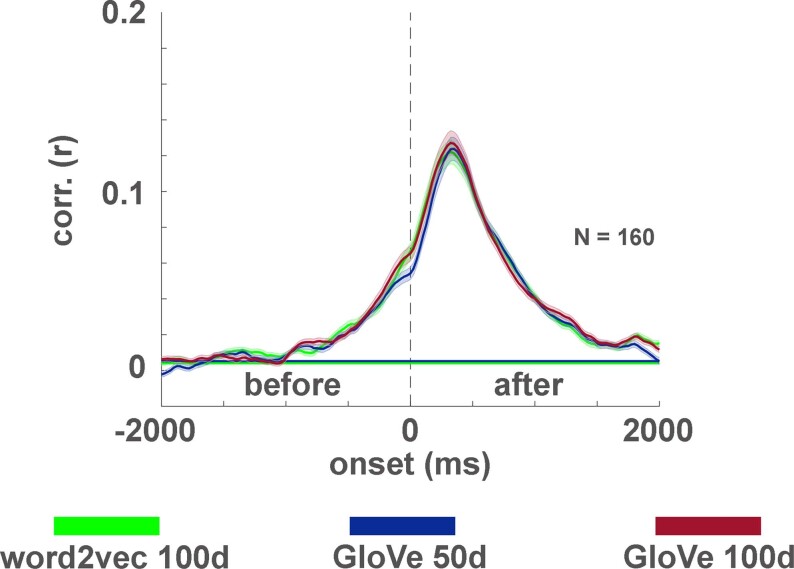
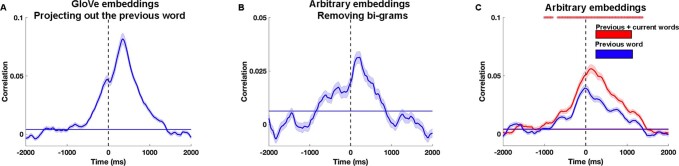
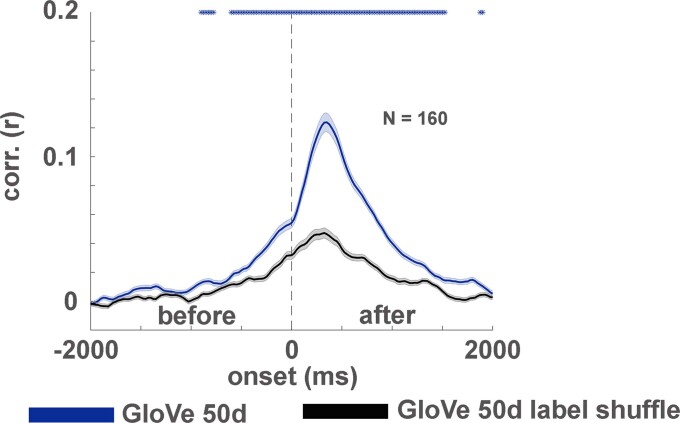
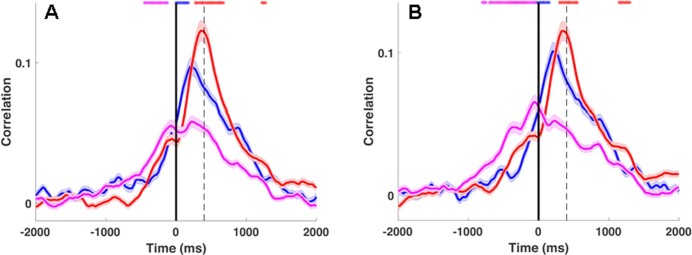
Verification
Claims the paper makes
The claims and statistics of this paper haven’t been checked yet.
Free: it reads the open-access text and checks the first 5 claims that cite a source we can check. Create a free account to check every claim.
Claims other papers make about this one
Each is checked against this paper’s own text: does it say what the citing paper says it does?
The cited source doesn’t support the claim as written.
In the citing paper
“Previous studies in the neural encoding literature all used LLMs that were only aware of the short-term context, i.e., where the context window size was as large as several tens of words1–10.”
From Incremental accumulation of linguistic context in artificial and biological neural networks (2025) · cites this paper as [10]
Checked by a reasoning model — may be wrong.
Experimental — accuracy not yet measuredThe cited source says what the claim attributes to it.
In the citing paper
“Studying AI can also advance psychological science (80–82).”
From Evaluating large language models in theory of mind tasks (2024) · cites this paper as [82]
The cited source says what the claim attributes to it.
In the citing paper
“Large Language Models (LLMs) have shown success in predicting neural signals associated with narrative processing”
From Incremental accumulation of linguistic context in artificial and biological neural networks (2025) · cites this paper as [10]
The cited source says what the claim attributes to it.
In the citing paper
“This was the case even though the participants in these studies were exposed to language stimuli that encompassed hundreds and even thousands of words.”
From Incremental accumulation of linguistic context in artificial and biological neural networks (2025) · cites this paper as [10]
Self-check
Percentages, sums and reported differences re-computed from the paper’s own numbers.
The self-check needs the paper’s full text.
Citations
Cites
Controlling the False Discovery Rate: A Practical and Powerful Approach to Multiple Testing
Benjamini, Y., & Hochberg, Y. (1995) · Journal of the Royal Statistical Society Series B: Statistical Methodology · doi:10.1111/j.2517-6161.1995.tb02031.x · Cited by 109,482
Glove: Global Vectors for Word Representation
Pennington, J., Socher, R., & Manning, C. (2014) · Proceedings of the 2014 Conference on Empirical Methods in Natural Language Processing (EMNLP) · doi:10.3115/v1/d14-1162 · Cited by 34,071
Language Models are Few-Shot Learners
Brown, T. B., Mann, B., Ryder, N., Subbiah, M., Kaplan, J., Dhariwal, P., Neelakantan, A., Shyam, P., Sastry, G., Askell, A., et al. (2020) · arXiv · doi:10.48550/arxiv.2005.14165 · Cited by 23,372
ASPECTS OF THE THEORY OF SYNTAX
Chomsky, N. (1964) · doi:10.21236/ad0616323 · Cited by 13,587
Oostenveld, R., Fries, P., Maris, E., & Schoffelen, J.-M. (2011) · Computational Intelligence and Neuroscience · doi:10.1155/2011/156869 · Cited by 10,323
Lewis, M., Liu, Y., Goyal, N., Ghazvininejad, M., Mohamed, A., Levy, O., Stoyanov, V., & Zettlemoyer, L. (2020) · Proceedings of the 58th Annual Meeting of the Association for Computational Linguistics · doi:10.18653/v1/2020.acl-main.703 · Cited by 8,821
Self-citationLewis, M., Liu, Y., Goyal, N., Ghazvininejad, M., Mohamed, A., Levy, O., Stoyanov, V., & Zettlemoyer, L. (2019) · arXiv · doi:10.48550/arxiv.1910.13461 · Cited by 8,816
Self-citationChomsky, N. (1957) · doi:10.1515/9783112316009 · Cited by 7,885
Whatever next? Predictive brains, situated agents, and the future of cognitive science
Clark, A. (2013) · Behavioral and Brain Sciences · doi:10.1017/s0140525x12000477 · Cited by 5,924
Reading Senseless Sentences: Brain Potentials Reflect Semantic Incongruity
Kutas, M., & Hillyard, S. A. (1980) · Science · doi:10.1126/science.7350657 · Cited by 4,888
Research works printed but not linked: 9
- Yang, Z. et al. XLNet: generalized autoregressive pretraining for language understanding. in Advances in Neural Information Processing Systems (eds. Wallach, H. et al.) 5753–5763 (Curran Associates, 2019).
- Schwartz, D. et al. Inducing brain-relevant bias in natural language processing models. in Advances in Neural Information Processing Systems (eds. Wallach, H. et al.) 14123–14133 (Curran Associates, 2019).
- Athanasiou, N., Iosif, E. & Potamianos, A. Neural activation semantic models: computational lexical semantic models of localized neural activations. in Proceedings of the 27th International Conference on Computational Linguistics 2867–2878 (Association for Computational Linguistics, 2018).
- Caucheteux, C., Gramfort, A. & King, J.-R. GPT-2’s activations predict the degree of semantic comprehension in the human brain. Preprint at bioRxiv https://doi.org/10.1101/2021.04.20.440622 (2021). · DOI
- Mikolov, T., Sutskever, I., Chen, K., Corrado, G. S. & Dean, J. Distributed Representations of Words and Phrases and their Compositionality. in Advances in Neural Information Processing Systems (eds. Burges et al.) 3111–3119 (Curran Associates, 2013).
- Toneva, M. & Wehbe, L. Interpreting and improving natural-language processing (in machines) with natural language-processing (in the brain). in 33rd Conference on Neural Information Processing Systems (2019).
- Khandelwal, U., Levy, O., Jurafsky, D., Zettlemoyer, L. & Lewis, M. Generalization through memorization: nearest neighbor language models. in International Conference on Learning Representations (2020).
- Goldberg, A. E. Explain me This: Creativity, Competition, and the Partial Productivity of Constructions (Princeton University Press, 2019). · DOI · Paper page
- Marcus, G. F. The Algebraic Mind: Integrating Connectionism and Cognitive Science (MIT Press, 2019).
Cited by
Items 201–300 of 710
A predictive coding model for online sentence processing
Ohams, C., Nair, S., Bhattasali, S., & Resnik, P. (2025) · Journal of Memory and Language · doi:10.1016/j.jml.2025.104705 · Cited by 12
Li, Z., Hong, B., Nolte, G., Engel, A. K., & Zhang, D. (2024) · Social Cognitive and Affective Neuroscience · doi:10.1093/scan/nsae051 · Cited by 12
Measuring Meaning Composition in the Human Brain with Composition Scores from Large Language Models
Gao, C., Li, J., Chen, J., & Huang, S. (2024) · Proceedings of the conference - Association for Computational Linguistics. Meeting · doi:10.18653/v1/2024.acl-long.609 · Cited by 12
TopoLM: brain-like spatio-functional organization in a topographic language model
Rathi, N., Mehrer, J., AlKhamissi, B., Binhuraib, T. O. A., Blauch, N. M., & Schrimpf, M. (2024) · International Conference on Learning Representations · doi:10.48550/arxiv.2410.11516 · Cited by 12
A non-Hebbian code for episodic memory
Pang, R., & Recanatesi, S. (2025) · Science Advances · doi:10.1126/sciadv.ado4112 · Cited by 13
Rafiq, M., Jucla, M., Guerrier, L., Péran, P., Pariente, J., & Pistono, A. (2022) · Frontiers in Aging Neuroscience · doi:10.3389/fnagi.2022.959405 · Cited by 12
BrainLLM: Generative Language Decoding from Brain RecordingsPreprint
Ye, Z., Ai, Q., Liu, Y., de Rijke, M., Zhang, M., Lioma, C., & Ruotsalo, T. (2023) · arXiv (Cornell University) · doi:10.48550/arxiv.2311.09889 · Cited by 12
Computational Models to Study Language Processing in the Human Brain: A SurveyPreprint
Wang, S., Sun, J., Zhang, Y., Lin, N., Moens, M., & Zong, C. (2024) · arXiv (Cornell University) · doi:10.48550/arxiv.2403.13368 · Cited by 12
Linguistic contextualization in the human hippocampusPreprint
Katlowitz, K. A., Belanger, J. L., Ismail, T., Chavez, A. G., Chericoni, A., Franch, M. C., Mickiewicz, E. A., Mathura, R. K., Paulo, D. L., Bartoli, E., et al. (2025) · bioRxiv (Cold Spring Harbor Laboratory) · doi:10.1101/2025.06.23.661103 · Cited by 12
Emergence of Language in the Developing BrainPreprint
Evanson, L., Bulteau, C., Chipaux, M., Dorfmüller, G., Ferrand‐Sorbets, S., Raffo, E., Rosenberg, S. D., Bourdillon, P., & King, J.-R. (2025) · arXiv (Cornell University) · doi:10.48550/arxiv.2512.05718 · Cited by 12
Language models align with brain regions that represent concepts across modalitiesPreprint
Ryskina, M., Tuckute, G., Fung, A., Malkin, A., & Fedorenko, E. G. (2025) · arXiv (Cornell University) · doi:10.48550/arxiv.2508.11536 · Cited by 12
A unified neural representation model for spatial and conceptual computations
Haga, T., Oseki, Y., & Fukai, T. (2025) · Proceedings of the National Academy of Sciences · doi:10.1073/pnas.2413449122 · Cited by 11
Boeve, S., & Bogaerts, L. (2025) · Behavior Research Methods · doi:10.3758/s13428-025-02774-4 · Cited by 11
Zhou, F., Zhou, S., Long, Y., Flinker, A., & Lu, C. (2025) · Communications Biology · doi:10.1038/s42003-025-09377-x · Cited by 11
Self-citationNeurobiological Causal Models of Language Processing
Fitz, H., Hagoort, P., & Petersson, K. M. (2024) · Neurobiology of Language · doi:10.1162/nol_a_00133 · Cited by 52
Neural Networks as Cognitive Models of the Processing of Syntactic Constraints
Arehalli, S., & Linzen, T. (2024) · Open Mind · doi:10.1162/opmi_a_00137 · Cited by 11
Hosseini, E. A., & Fedorenko, E. G. (2023) · bioRxiv (Cold Spring Harbor Laboratory) · doi:10.1101/2023.11.05.564832 · Cited by 11
Evidence from fMRI Supports a Two-Phase Abstraction Process in Language ModelsPreprint
Cheng, E., & Antonello, R. (2024) · arXiv (Cornell University) · doi:10.48550/arxiv.2409.05771 · Cited by 11
Universality of representation in biological and artificial neural networks
Hosseini, E., Casto, C., Zaslavsky, N., Conwell, C., Richardson, M., & Fedorenko, E. (2024) · doi:10.1101/2024.12.26.629294 · Cited by 10
Self-citationTraining language models to summarize narratives improves brain alignment
Aw, K. L., & Toneva, M. (2022) · arXiv · doi:10.48550/arxiv.2212.10898 · Cited by 10
Nakai, T., Tirou, C., & Prado, J. (2024) · Imaging Neuroscience · doi:10.1162/imag_a_00219 · Cited by 10
Heitmeier, M., Schmidt, V., Lensch, H. P. A., & Baayen, R. H. (2025) · Linguistics Vanguard · doi:10.1515/lingvan-2024-0192 · Cited by 10
On the limits of LLM surprisal as a functional explanation of the N400 and P600
Krieger, B., Brouwer, H., Aurnhammer, C., & Crocker, M. W. (2025) · Brain Research · doi:10.1016/j.brainres.2025.149841 · Cited by 10
Lei, Y., Ge, X., Zhang, Y., Yang, Y., & Ma, B. (2026) · Proceedings of the AAAI Conference on Artificial Intelligence · doi:10.1609/aaai.v40i1.37022 · Cited by 10
Mapping the neuronal building blocks of human language with language models
Cai, J., Kfir, Y., Jamali, M., Huang, H., Kim, Y. J., Cash, S. S., & Williams, Z. M. (2026) · Nature · doi:10.1038/s41586-026-10691-5 · Cited by 11
Yang, S., Chen, F. R., Yang, Y., & Zhu, Z. (2023) · International Joint Conference on Robotics and Artificial Intelligence (JCRAI) · doi:10.1145/3632971.3632973 · Cited by 10
Mapping and modeling the semantic space of math concepts
Debray, S., & Dehaene, S. (2024) · Cognition · doi:10.1016/j.cognition.2024.105971 · Cited by 10
Speaker-induced Suppression in EEG during a Naturalistic Reading and Listening Task
Kurteff, G., Lester‐Smith, R. A., CCC-SLP, Martinez, A., Currens, N., Holder, J., Villarreal, C., Mercado, V. R., Truong, C., Huber, C., et al. (2023) · Journal of Cognitive Neuroscience · doi:10.1162/jocn_a_02037 · Cited by 10
LLMorphism: When humans come to see themselves as language modelsPreprint
Capraro, V. (2026) · arXiv (Cornell University) · doi:10.48550/arxiv.2605.05419 · Cited by 11
Judgments of learning distinguish humans from large language models in predicting memory
Huff, M., & Ulakci, E. (2025) · Scientific Reports · doi:10.1038/s41598-025-22290-x · Cited by 9
“By utilizing the acknowledged importance of prior context in language for both LLMs and humans 25 as a basis for their predictive processing 26 , and the role of relatedness as an intrinsic cue in shaping human judgments during predicting 16,18 , we demonstrated the inability of LLMs to predict…”
IDyOMpy: A new Python-based model for the statistical analysis of musical expectations
Marion, G., Gao, F., Gold, B. P., Liberto, G. M. D., & Shamma, S. (2024) · Journal of Neuroscience Methods · doi:10.1016/j.jneumeth.2024.110347 · Cited by 9
Rosen, Z. P., & Dale, R. A. C. (2025) · Humanities and Social Sciences Communications · doi:10.1057/s41599-025-04647-9 · Cited by 9
Nadler, E. O., Guilbeault, D., Ringold, S. M., Williamson, T., Bellemare‐Pepin, A., Comșa, I. M., Jerbi, K., Narayanan, S., & Aziz‐Zadeh, L. (2025) · Cognitive Science · doi:10.1111/cogs.70083 · Cited by 9
Far from the Shallow: Brain-Predictive Reasoning Embedding through Residual Disentanglement
He, L., Zhong, T., Antonello, R., Mischler, G., Goldblum, M., & Mesgarani, N. (2025) · neural information processing systems · doi:10.52202/085713-2386 · Cited by 9
Human attention during goal-directed reading comprehension relies on task optimization
Zou, J., Zhang, Y., Li, J., Tian, X., & Ding, N. (2023) · eLife · doi:10.7554/elife.87197 · Cited by 9
The unique contribution of uncertainty reduction during naturalistic language comprehension
Ming, S., Wang, J., & Cai, Q. (2024) · Cortex · doi:10.1016/j.cortex.2024.09.007 · Cited by 9
Imitation and Large Language Models
Boisseau, É. (2024) · Minds and Machines · doi:10.1007/s11023-024-09698-6 · Cited by 9
Embodied and Contextual Intelligence: Towards a Policy Framework for Higher Education
Prabakaran, M. (2024) · Higher Education for the Future · doi:10.1177/23476311241286107 · Cited by 9
Xu, J., Zhou, Y., Liu, Q., Li, K., & Yang, H. (2025) · PLoS ONE · doi:10.1371/journal.pone.0321154 · Cited by 9
On the limits of LLM surprisal as a functional explanation of ERPs
Krieger, B., Brouwer, H., Aurnhammer, C., & Crocker, M. W. (2024) · eScholarship (California Digital Library) · doi:10.13140/rg.2.2.24516.64648 · Cited by 9
Xu, Q., & Li, P. (2023) · Language Learning · doi:10.1111/lang.12605 · Cited by 9
Natural Language Processing in Psychiatry: A Field at an Inflection Point
Nour, M. M., & Huys, Q. J. M. (2023) · Biological Psychiatry Cognitive Neuroscience and Neuroimaging · doi:10.1016/j.bpsc.2023.08.001 · Cited by 9
de Varda, A. G., Malik-Moraleda, S., Tuckute, G., & Fedorenko, E. G. (2025) · bioRxiv (Cold Spring Harbor Laboratory) · doi:10.1101/2025.02.01.636044 · Cited by 9
Schippers, A., Vansteensel, M. J., Freudenburg, Z. V., & Ramsey, N. F. (2024) · doi:10.1101/2024.01.21.23300437 · Cited by 9
Generating Meaning: Active Inference and the Scope and Limits of Passive AI
Pezzulo, G., Parr, T., Cisek, P., Clark, A., & Friston, K. (2023) · doi:10.31234/osf.io/8xgzv · Cited by 8
State and capacity in neural models of cognition and consciousness
Wang, P., Liu, H., Ilievski, F., Ganushchak, L., Zou, L., Laureys, S., & Paas, F. (2026) · Trends Open · doi:10.1016/j.treopn.2026.04.004 · Cited by 8
The Science of Language in the Era of Generative AI
Lévy, R., Kim, Y., & Fox, D. (2025) · doi:10.21428/e4baedd9.f6a0052d · Cited by 8
Brain-tuning Improves Generalizability and Efficiency of Brain Alignment in Speech Models
Moussa, O., & Toneva, M. (2025) · neural information processing systems · doi:10.52202/085713-4079 · Cited by 8
A predictive processing framework for joint action and communication
Pezzulo, G., Knoblich, G., Maisto, D., Donnarumma, F., Pacherie, É., & Hasson, U. (2026) · Physics of Life Reviews · doi:10.1016/j.plrev.2026.03.001 · Cited by 8
Self-citationPredicting EEG Responses to Attended Speech via Deep Neural Networks for Speech
Alickovic, E., Dorszewski, T., Christiansen, T. U., Eskelund, K., Gizzi, L., Skoglund, M. A., & Wendt, D. (2023) · Annual International Conference of the IEEE Engineering in Medicine and Biology Society (EMBC) · doi:10.1109/embc40787.2023.10340027 · Cited by 8
Executive resources shape the impact of language predictability across the adult lifespan
Schuckart, M. M., Martin, S., Tune, S., Schmitt, L., Hartwigsen, G., & Obleser, J. (2026) · eLife · doi:10.1101/2024.05.08.592872 · Cited by 8
MacBehaviour: An R package for behavioural experimentation on large language models
Duan, X., Li, S., & Cai, Z. G. (2024) · Behavior Research Methods · doi:10.3758/s13428-024-02524-y · Cited by 8
Tripartite organization of brain state dynamics underlying spoken narrative comprehension
Liu, L., Jiang, J., Li, H., & Ding, G. (2025) · eLife · doi:10.7554/elife.99997.3 · Cited by 8
Context, not grammar, is key to structural priming
Nielsen, Y. A., & Christiansen, M. H. (2025) · Trends in Cognitive Sciences · doi:10.1016/j.tics.2025.05.016 · Cited by 8
Donnarumma, F., Frosolone, M., & Pezzulo, G. (2025) · Physics of Life Reviews · doi:10.1016/j.plrev.2025.08.008 · Cited by 8
Decoding Stumpers: Large Language Models vs. Human Problem-Solvers
Goldstein, A., Havin, M., Reichart, R., & Goldstein, A. (2023) · Findings of the Association for Computational Linguistics: EMNLP (Findings of EMNLP) · doi:10.18653/v1/2023.findings-emnlp.779 · Cited by 8
Self-citationNeural Generative Models and the Parallel Architecture of Language: A Critical Review and Outlook
Rambelli, G., Chersoni, E., Testa, D., Blache, P., & Lenci, A. (2024) · Topics in Cognitive Science · doi:10.1111/tops.12733 · Cited by 8
Don’t put words in my mouth: speech perception can falsely activate a brain-computer interface
Schippers, A., Vansteensel, M. J., Freudenburg, Z. V., Luo, S., Crone, N. E., & Ramsey, N. F. (2025) · Journal of NeuroEngineering and Rehabilitation · doi:10.1186/s12984-025-01689-7 · Cited by 8
When abstract becomes concrete, naturalistic encoding of concepts in the brain
Kewenig, V. N., Vigliocco, G., & Skipper, J. I. (2024) · eLife · doi:10.7554/elife.91522.3 · Cited by 8
Linguistic inputs must be syntactically parsable to fully engage the language networkPreprint
Kauf, C., Kim, H. S., Lee, E. J., Jhingan, N., She, J. S., Taliaferro, M., Gibson, E. A. F., & Fedorenko, E. G. (2024) · bioRxiv (Cold Spring Harbor Laboratory) · doi:10.1101/2024.06.21.599332 · Cited by 8
Cortical language areas are coupled via a soft hierarchy of model-based linguistic featuresPreprint
Samara, A., Zada, Z., Vanderwal, T., Hasson, U., & Nastase, S. A. (2025) · bioRxiv (Cold Spring Harbor Laboratory) · doi:10.1101/2025.06.02.657491 · Cited by 8
Self-citationShen, G., Zhao, D., Dong, Y., Zhang, Q., & Zeng, Y. (2025) · Research Square · doi:10.21203/rs.3.rs-6950065/v1 · Cited by 8
Evaluating Scientific Theories As Predictive Models in Language NeurosciencePreprint
Singh, C., Antonello, R., Guo, S., Mischler, G., Gao, J., Mesgarani, N., & Huth, A. G. (2025) · SSRN Electronic Journal · doi:10.1101/2025.08.12.669958 · Cited by 8
Probing Neural Topology of Large Language ModelsPreprint
Zheng, Y., Yuan, Y., Zhuo, Y., Li, Y., Kreiman, G., Poggio, T., & Santi, P. (2025) · arXiv (Cornell University) · doi:10.48550/arxiv.2506.01042 · Cited by 8
Nakagi, Y., Tada, K., Yoshino, S., Nishimoto, S., & Takagi, Y. (2025) · arXiv (Cornell University) · doi:10.48550/arxiv.2502.20779 · Cited by 8
A geometric foundation for word meaning in the brainPreprint
Zhu, H., Franch, M. C., Mickiewicz, E. A., Belanger, J. L., Cowan, R. L., Katlowitz, K. A., Chavez, A. G. L., Chericoni, A., Paulo, D. L., Yan, X., et al. (2026) · bioRxiv (Cold Spring Harbor Laboratory) · doi:10.64898/2026.01.28.702241 · Cited by 8
Keshishian, M., Mischler, G., Thomas, S., Kingsbury, B. E. D., Bickel, S., Mehta, A. D., & Mesgarani, N. (2026) · Nature Machine Intelligence · doi:10.1038/s42256-026-01185-0 · Cited by 7
Linguistics and human brain: a perspective of computational neuroscience
Zhang, F., Chai, B., Wu, Y., Siok, W. T., & Wang, N. (2026) · Cognitive Neurodynamics · doi:10.1007/s11571-026-10496-2 · Cited by 7
Attention, not scale, drives human-AI alignment in multimodal language prediction
Kewenig, V. N., Lampinen, A. K., Nastase, S. A., Edwards, C., D’Elascombe, Q., Rechardt, A., Skipper, J. I., & Vigliocco, G. (2026) · npj Artificial Intelligence · doi:10.1038/s44387-026-00086-2 · Cited by 7
Self-citationLow-frequency cortical activity reflects context-dependent parsing of word sequences
Chen, H., Zhang, M., Ye, T., Wolpert, M. A., & Ding, N. (2025) · iScience · doi:10.1016/j.isci.2025.112650 · Cited by 7
Brain-Informed Fine-Tuning for Improved Multilingual Understanding in Language Models
Negi, A., Oota, S. R., Núñez-Elizalde, A. O., Gupta, M., & Deniz, F. (2025) · neural information processing systems · doi:10.52202/085713-5084 · Cited by 7
Cross-modal deep generative models reveal the cortical representation of dancing
Takagi, Y., Shimizu, D., Wakabayashi, M., Ohata, R., & Imamizu, H. (2025) · Nature Communications · doi:10.1038/s41467-025-65039-w · Cited by 7
Speech Neurophysiology in Realistic Contexts: Big Hype or Big Leap?
Liberto, G. M. D., & Ip, E. Y. J. (2026) · European Journal of Neuroscience · doi:10.1111/ejn.70496 · Cited by 7
Linguistic Rule Induction Improves Adversarial and OOD Robustness in Large Language Models
Jiang, S., Chen, Q., Xiang, Y., Pan, Y., & Lin, Y. (2024) · Language Resources and Evaluation Conference (LREC) · doi:10.63317/5biyijjjsxp2 · Cited by 7
Interpretable Next-token Prediction via the Generalized Induction Head
Kim, E., Mantena, S., Yang, W., Singh, C., Yoon, S., & Gao, J. (2025) · neural information processing systems · doi:10.52202/085713-3901 · Cited by 7
Classifying coherent versus nonsense speech perception from EEG using linguistic speech features
Puffay, C., Vanthornhout, J., Gillis, M., Clercq, P. D., Accou, B., hamme, H. V., & Francart, T. (2024) · Scientific Reports · doi:10.1038/s41598-024-69568-0 · Cited by 7
Neural Representations of Concreteness and Concrete Concepts Are Specific to the Individual
Botch, T. L., & Finn, E. S. (2024) · Journal of Neuroscience · doi:10.1523/jneurosci.0288-24.2024 · Cited by 8
Tuckute, G., Sathe, A., Wang, M., Yoder, H., Shain, C., & Fedorenko, E. G. (2022) · doi:10.18653/v1/2022.naacl-demo.11 · Cited by 7
Azizpour, S., Westner, B. U., Szewczyk, J., Güçlü, U., & Geerligs, L. (2026) · eLife · doi:10.7554/elife.110085.1 · Cited by 7
Schönmann, I., Szewczyk, J., de Lange, F. P., & Heilbron, M. (2025) · eLife · doi:10.7554/elife.106543.1 · Cited by 7
De Santis, E., & Rizzi, A. (2025) · arXiv (Cornell University) · doi:10.48550/arxiv.2508.02622 · Cited by 7
A Theory of Appropriateness That Accounts for Norms of RationalityPreprint
Leibo, J. Z., Vezhnevets, A. S., Diaz, M., Agapiou, J., Cunningham, W. A., Sunehag, P., Cross, L., Koster, R., Bileschi, S., Chang, M., et al. (2026) · arXiv (Cornell University) · doi:10.48550/arxiv.2603.14050 · Cited by 7
Predicting other people shapes the social mind
Tamir, D., & Thornton, M. A. (2023) · Advances in experimental social psychology · doi:10.1016/bs.aesp.2023.11.003 · Cited by 6
Ling, S., Murphy, A., & Fyshe, A. (2024) · Computational Linguistics · doi:10.1162/coli_a_00533 · Cited by 6
Comparison of Large Language Model with Aphasia
Watanabe, T., Inoue, K., Kuniyoshi, Y., Nakajima, K., & Aihara, K. (2025) · Advanced Science · doi:10.1002/advs.202414016 · Cited by 6
Inferring neural population codes for Drosophila acoustic communication
Pang, R., Baker, C. A., Murthy, M., & Pillow, J. W. (2025) · Proceedings of the National Academy of Sciences · doi:10.1073/pnas.2417733122 · Cited by 6
Individual Differences in Statistical Learning and Semantic Adaptation: An N400 Study
Munding, M., Forgács, B., Lukics, K. S., & Lukács, Á. (2025) · Psychophysiology · doi:10.1111/psyp.70125 · Cited by 6
Advances in bilingualism as a dynamic process: 30 years of exploration in bilingual mind and brain
Gu, C., Peng, Y., & Li, P. (2025) · Journal of Neurolinguistics · doi:10.1016/j.jneuroling.2025.101288 · Cited by 6
XAI ‐Guided Continual Learning: Rationale, Methods, and Future Directions
Proietti, M., Ragno, A., & Capobianco, R. (2025) · Wiley Interdisciplinary Reviews Data Mining and Knowledge Discovery · doi:10.1002/widm.70046 · Cited by 6
Inducing Dyslexia in Vision Language Models
Honarmand, M., Sharma, A., AlKhamissi, B., Mehrer, J., & Schrimpf, M. (2026) · International Conference on Learning Representations · doi:10.48550/arxiv.2509.24597 · Cited by 6
Beyond representational alignment with brain-guided language models for robust reasoning
Xiao, M., Du, K., & Lin, Z. (2026) · Nature Machine Intelligence · doi:10.1038/s42256-026-01278-w · Cited by 6
The compositionality continuum as a principle for studying the neural basis of intelligence
Riveland, R., Pouget, A., & Driscoll, L. N. (2026) · Nature Neuroscience · doi:10.1038/s41593-026-02382-1 · Cited by 4
Shin, G., Jung, B. K., & Mun, S. (2024) · Natural Language Processing Journal · doi:10.1016/j.nlp.2024.100060 · Cited by 6
Subotić, V. (2024) · Synthese · doi:10.1007/s11229-024-04514-1 · Cited by 6
Can ChatGPT help researchers understand how the human brain handles language?
Waldrop, M. M. (2024) · Proceedings of the National Academy of Sciences · doi:10.1073/pnas.2410196121 · Cited by 6
Brain and grammar: revealing electrophysiological basic structures with competing statistical models
Cometa, A., Battaglini, C., Artoni, F., Greco, M., Frank, R., Repetto, C., Bottoni, F., Cappa, S. F., Micera, S., Ricciardi, E., et al. (2024) · Cerebral Cortex · doi:10.1093/cercor/bhae317 · Cited by 6
Lexicon-Level Contrastive Visual-Grounding Improves Language Modeling
Zhuang, C., Fedorenko, E. G., & Andreas, J. (2024) · Findings of the Association for Computational Linguistics: ACL (Findings of ACL) · doi:10.18653/v1/2024.findings-acl.15 · Cited by 6
Brain-model neural similarity reveals abstractive summarization performance
Zhang, Z., Guo, S.-L., Zhou, W. H., Luo, Y., Zhu, Y., Zhang, L., & Li, L. (2025) · Scientific Reports · doi:10.1038/s41598-024-84530-w · Cited by 6
Correlating instruction-tuning (in multimodal models) with vision-language processing (in the brain)
Oota, S. R., Jindal, A., Mondal, I., Pahwa, K., Satya Sai Srinath Namburi, G. N. V. V., Shrivastava, M., Singh, M., Bapi, R. S., & Gupta, M. (2025) · International Conference on Learning Representations · doi:10.48550/arxiv.2505.20029 · Cited by 6
Morgan, A. M., Devinsky, O., Doyle, W., Dugan, P. C., Friedman, D. J., & Flinker, A. (2026) · Science Advances · doi:10.1126/sciadv.aec0518 · Cited by 6
Self-citation
Metadata
- Authors
- Goldstein, A., Zada, Z., Buchnik, E., Schain, M., Price, A., Aubrey, B., Nastase, S. A., Feder, A., Emanuel, D., Cohen, A., Jansen, A., Gazula, H., Choe, G., Rao, A., Kim, C., Casto, C., Fanda, L., Doyle, W., Friedman, D., Dugan, P., Melloni, L., Reichart, R., Devore, S., Flinker, A., Hasenfratz, L., Levy, O., Hassidim, A., Brenner, M., Matias, Y., Norman, K. A., Devinsky, O., & Hasson, U.
- Affiliations
- Google (United States) (US)
- Princeton University (US)
- New York University (US)
- Technion – Israel Institute of Technology (IL)
- Tel Aviv University (IL)
- Corresponding author
- Goldstein, Ariel
- ORCID
- Goldstein, Ariel
- Zada, Zaid
- Price, Amy
- Nastase, Samuel A.
- Feder, Amir
- Cohen, Alon
- Gazula, Harshvardhan
- Choe, Gina
- Kim, Catherine
- Casto, Colton
- Fanda, Lora
- Doyle, Werner
- Friedman, Daniel
- Dugan, Patricia
- Melloni, Lucia
- Reichart, Roi
- Devore, Sasha
- Flinker, Adeen
- Hasenfratz, Liat
- Levy, Omer
- Hassidim, Avinatan
- Brenner, Michael
- Matias, Yossi
- Norman, Kenneth A.
- Devinsky, Orrin
- Hasson, Uri
- Venue
- Nature Neuroscience
- Published
- 2022-03
- Volume
- 25
- Issue
- 3
- Pages
- 369-380
- ISSN
- 1097-6256 (ISSN-L)
- 1546-1726
- PMC
- PMC8904253
- OpenAlex
- W4220949944
- Cited by
- 447
- References
- 62
- Citations by year
- 2026: 97 · 2025: 123 · 2024: 111 · 2023: 94 · 2022: 21
- FWCI
- 44.98
- Type
- journal article
- Language
- en
- Open access
- hybrid
- doi.org
- Licence
- cc-by
- creativecommons.org/licenses/by/4.0 (tdm)
- creativecommons.org/licenses/by/4.0 (vor, 6 d)
- Locations
- Nature Neuroscience (publishedVersion, cc-by)
- PubMed Central (publishedVersion, cc-by)
- PubMed (publishedVersion)
- Funders
- Finding A Cure for Epilepsy and Seizures
- National Institutes of Health
- National Institute of Mental Health (R01MH112566)
- National Institute of Neurological Disorders and Stroke (R01NS109367)
- Eunice Kennedy Shriver National Institute of Child Health and Human Development (DP1HD091948)
- Topics
- Life Sciences › Neuroscience › Cognitive Neuroscience › Neurobiology of Language and Bilingualism
- Social Sciences › Psychology › Developmental and Educational Psychology › Reading and Literacy Development
- Social Sciences › Psychology › Developmental and Educational Psychology › Language Development and Disorders
- Keywords
- deep language models, autoregressive language models, language processing, next-word prediction, contextual embeddings, neural basis of language, electrocorticography, narrative comprehension
- MeSH terms
- Brain, Humans, Language, Linguistics
About these checks
Registry, retraction, Cites and statistics results are computed, not judged, with one exception: a printed reference that no index lists is read once by a model before it counts as a citation error. Claims are extracted by a model and kept only when their quote appears verbatim in the text; each cited source is then checked, with a model’s help, for whether it says what the claim relies on. Those verdicts can be wrong — read the claim’s quote and the cited source before relying on one.
Statistics and arithmetic are recomputed, not judged.
Confidence bands are shown only for fields calibrated on our annotated test set. None is calibrated yet, so no band is shown.
What counts as a claim ›How we measure confidence ›How we check this ›
Are you an author, or do you see a problem with this page? Request a review
Data sources
Bibliographic data: Semantic Scholar, OpenAlex, Crossref.
Contains information from the Semantic Scholar Academic Graph Datasets, made available under the ODC Attribution License (ODC-BY 1.0).
Semantic Scholar’s data is described in: Kinney, R., et al. (2023). The Semantic Scholar Open Data Platform. arXiv:2301.10140.
