

Model metamers reveal divergent invariances between biological and artificial neural networks
Open accessPublished version of a preprint
The DOI matches its Crossref record; 115 of the 115 references it cites were found in a registry or an index.
Abstract
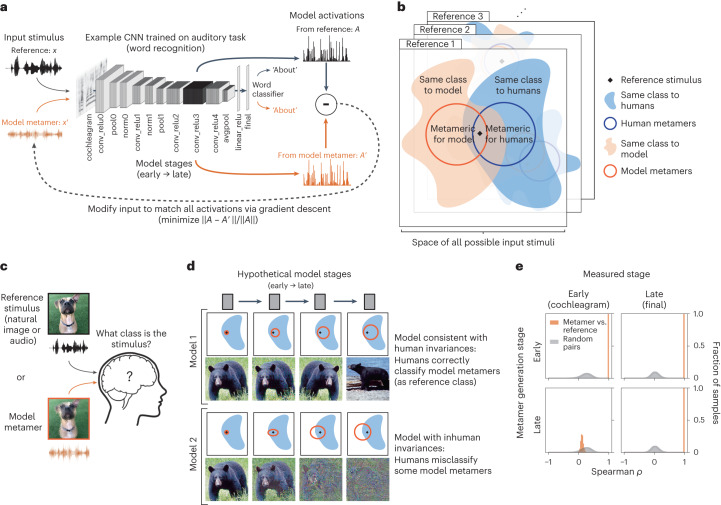
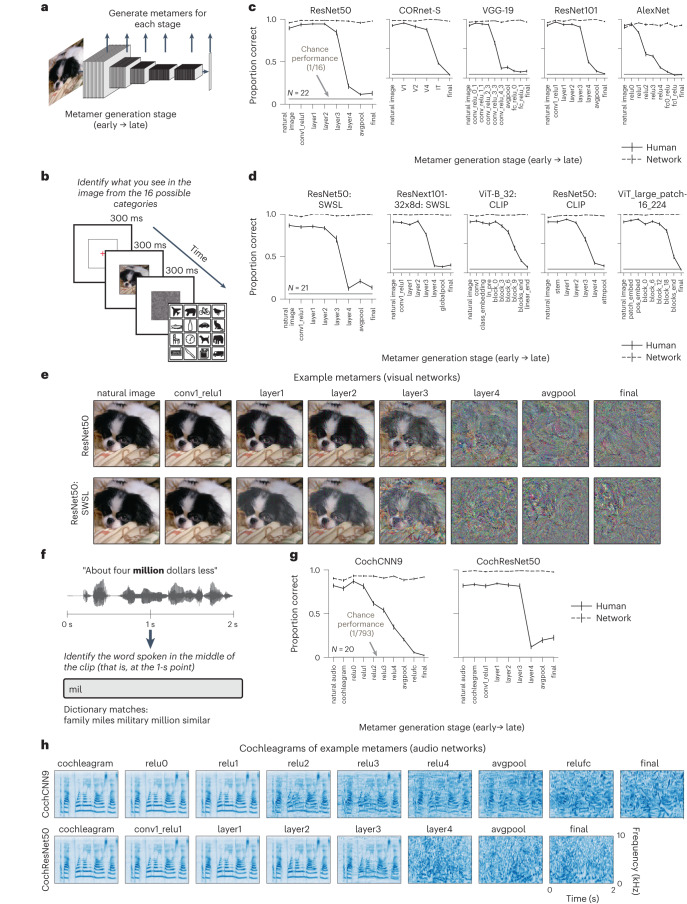
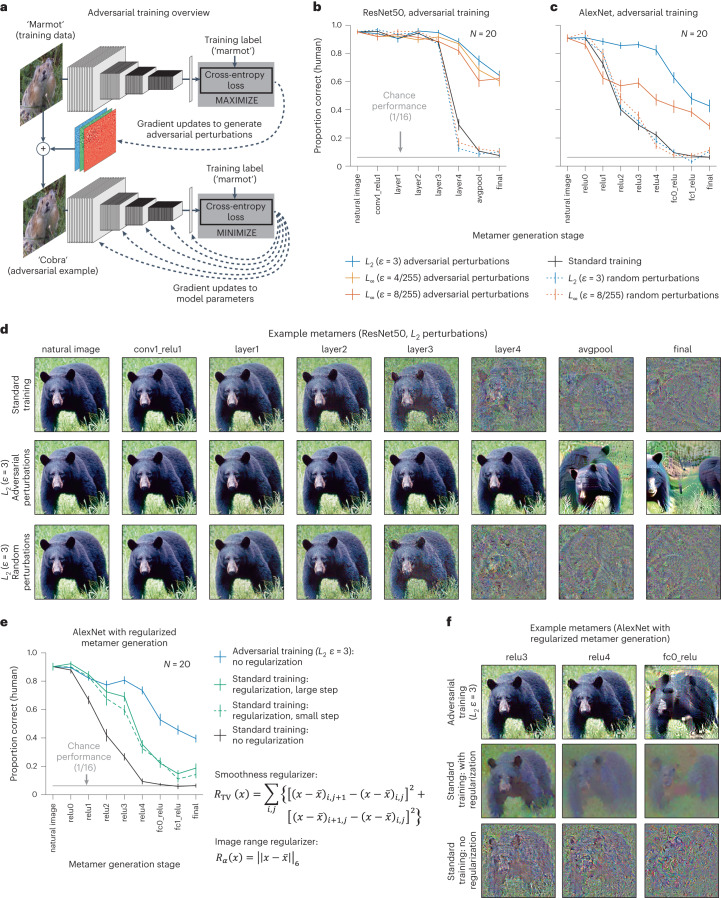
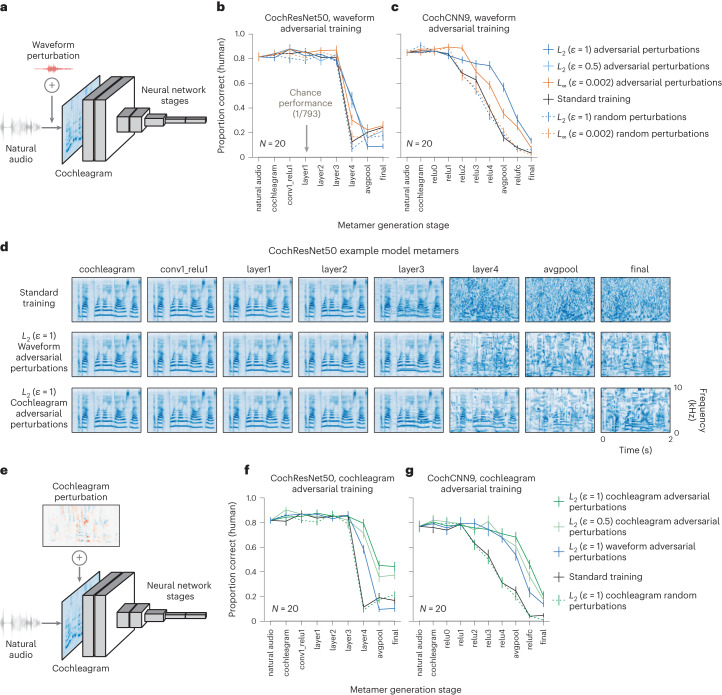
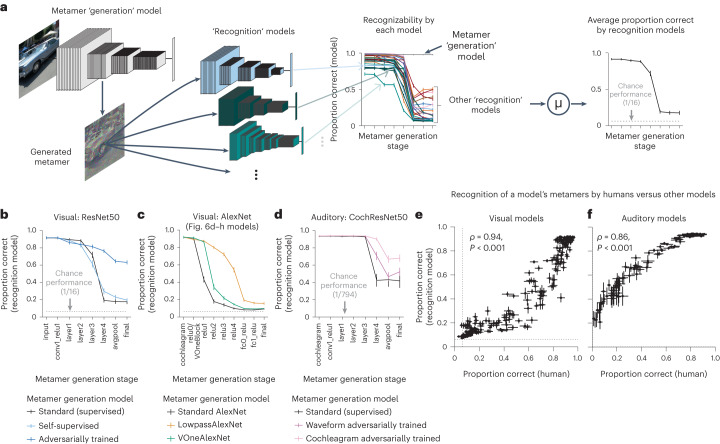
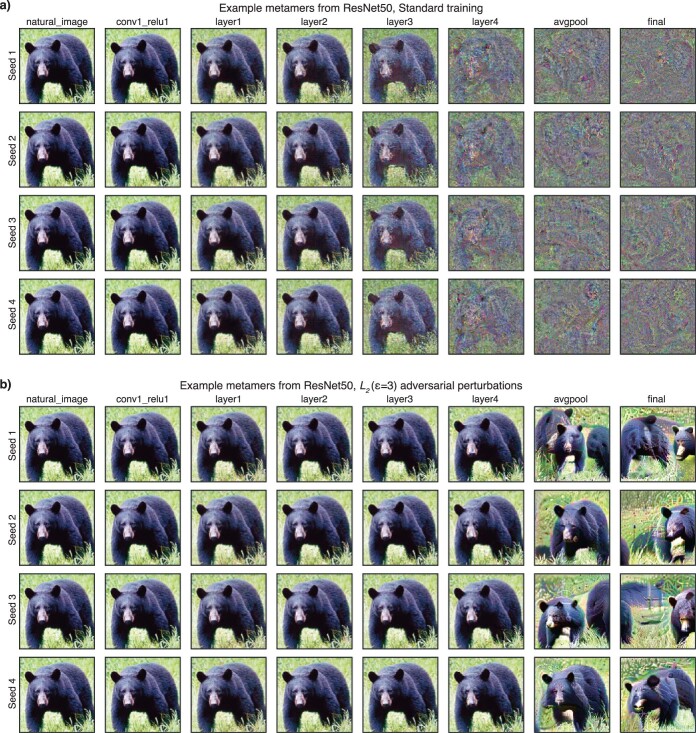
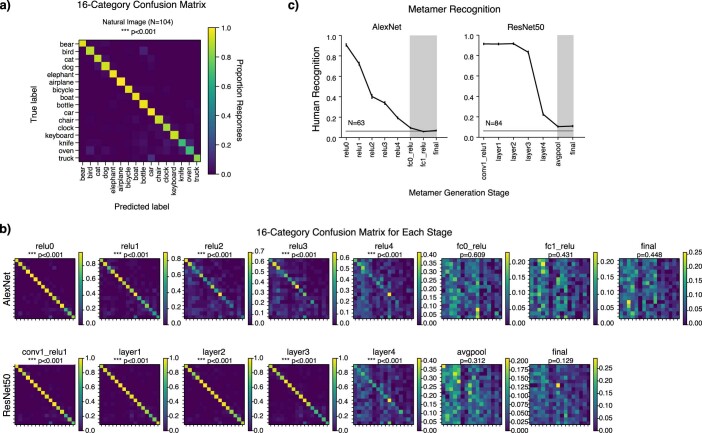
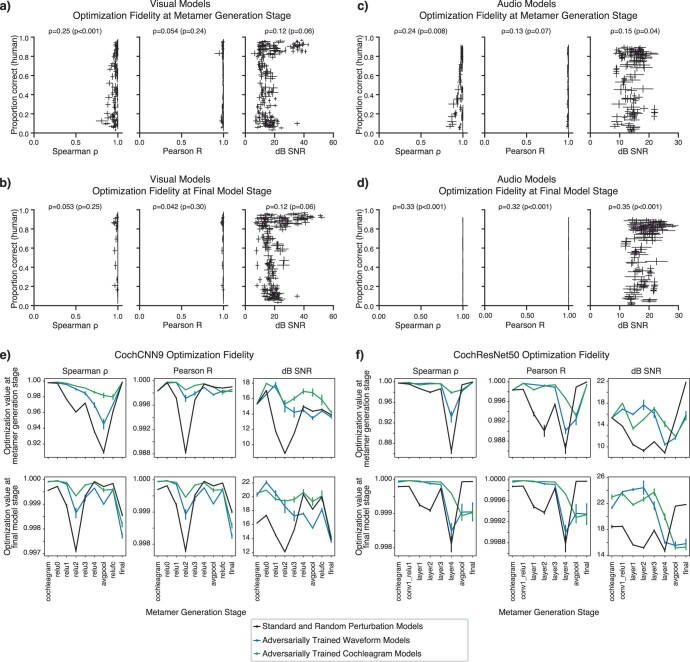
Deep neural network models of sensory systems are often proposed to learn representational transformations with invariances like those in the brain. To reveal these invariances, we generated ‘model metamers’, stimuli whose activations within a model stage are matched to those of a natural stimulus. Metamers for state-of-the-art supervised and unsupervised neural network models of vision and audition were often completely unrecognizable to humans when generated from late model stages, suggesting differences between model and human invariances. Targeted model changes improved human recognizability of model metamers but did not eliminate the overall human–model discrepancy. The human recognizability of a model’s metamers was well predicted by their recognizability by other models, suggesting that models contain idiosyncratic invariances in addition to those required by the task. Metamer recognizability dissociated from both traditional brain-based benchmarks and adversarial vulnerability, revealing a distinct failure mode of existing sensory models and providing a complementary benchmark for model assessment.
Overview
The claims and statistics of this paper haven’t been checked yet.
Free: it reads the open-access text and checks the first 5 claims that cite a source we can check. Create a free account to check every claim.
Integrity signals
Registry
Cites
Statistics
Figures
Verification
Claims the paper makes
The claims and statistics of this paper haven’t been checked yet.
Free: it reads the open-access text and checks the first 5 claims that cite a source we can check. Create a free account to check every claim.
Claims other papers make about this one
Each is checked against this paper’s own text: does it say what the citing paper says it does?
The source backs part of the claim, not all of it — or backs it for a different population, condition or comparison.
In the citing paper
“Moreover, systematic individual differences also arise across ANNs when varying network depth, dropout, and random initializations [73,79]”
From The Umwelt Representation Hypothesis: rethinking Universality (2026) · cites this paper as [73]
Experimental — accuracy not yet measured
Self-check
Percentages, sums and reported differences re-computed from the paper’s own numbers.
The self-check needs the paper’s full text.
Citations
Cites
Scikit-learn: Machine Learning in Python
Pedregosa, F., Varoquaux, G., Gramfort, A., Michel, V., Thirion, B., Grisel, O., Blondel, M., Müller, A., Nothman, J., Louppe, G., et al. (2012) · arXiv · doi:10.48550/arxiv.1201.0490 · Cited by 71,016
Faul, F., Erdfelder, E., Lang, A.-G., & Buchner, A. (2007) · Behavior Research Methods · doi:10.3758/bf03193146 · Cited by 65,971
ImageNet: A large-scale hierarchical image database
Deng, J., Dong, W., Socher, R., Li, L.-J., Li, K., & Fei-Fei, L. (2009) · 2009 IEEE Conference on Computer Vision and Pattern Recognition · doi:10.1109/cvpr.2009.5206848 · Cited by 65,333 · cited 1×
“We generated metamers for multiple stages of five standard visual neural networks trained to recognize objects 26–29 (trained on the ImageNet1K dataset 30 ; Fig.”
MethodStatistical power analyses using G∗Power 3.1: tests for correlation and regression analyses
Faul, F., Erdfelder, E., Buchner, A., & Lang, A.-G. (2009) · Behavior Research Methods · doi:10.3758/brm.41.4.1149 · Cited by 37,615
PyTorch: An Imperative Style, High-Performance Deep Learning Library
Paszke, A., Gross, S., Massa, F., Lerer, A., Bradbury, J., Chanan, G., Killeen, T., Lin, Z., Gimelshein, N., Antiga, L., et al. (2019) · arXiv · doi:10.48550/arxiv.1912.01703 · Cited by 31,473
Learning Transferable Visual Models From Natural Language Supervision
Radford, A., Kim, J. W., Hallacy, C., Ramesh, A., Goh, G., Agarwal, S., Sastry, G., Askell, A., Mishkin, P., Clark, J., et al. (2021) · arXiv · doi:10.48550/arxiv.2103.00020 · Cited by 15,293 · cited 1×
“We subsequently ran a second experiment on an additional five models pre-trained on larger datasets that became available at later stages of the project 32–34 .”
MethodAggregated Residual Transformations for Deep Neural Networks
Xie, S., Girshick, R., Dollar, P., Tu, Z., & He, K. (2017) · 2017 IEEE Conference on Computer Vision and Pattern Recognition (CVPR) · doi:10.1109/cvpr.2017.634 · Cited by 12,465
Identity mappings in deep residual networks
He, K., Zhang, X., Ren, S., & Sun, J. (2016) · Lecture Notes in Computer Science · doi:10.1007/978-3-319-46493-0_38 · Cited by 10,741
Intriguing properties of neural networks
Szegedy, C., Zaremba, W., Sutskever, I., Bruna, J., Erhan, D., Goodfellow, I., & Fergus, R. (2013) · arXiv · doi:10.48550/arxiv.1312.6199 · Cited by 8,143 · cited 2×
“A known peculiarity of contemporary artificial neural networks is their vulnerability to small adversarial perturbations designed to change the class label predicted by a model 14,15 .”
BackgroundThe proof and measurement of association between two things
Spearman, C. (1904) · The American Journal of Psychology · doi:10.2307/1412159 · Cited by 8,039
Distributed hierarchical processing in the primate cerebral cortex
Felleman, D. J., & Van Essen, D. C. (1991) · Cerebral Cortex · doi:10.1093/cercor/1.1.1 · Cited by 7,783 · cited 1×
“The hierarchical nature of biological sensory systems 1 has motivated the use of hierarchical neural network models that transform sensory inputs into task-relevant representations 2,3 .”
BackgroundNWChem: A comprehensive and scalable open-source solution for large scale molecular simulations
Valiev, M., Bylaska, E. J., Govind, N., Kowalski, K., Straatsma, T. P., Van Dam, H. J. J., Wang, D., Nieplocha, J., Apra, E., Windus, T. L., et al. (2010) · Computer Physics Communications · doi:10.1016/j.cpc.2010.04.018 · Cited by 5,779
Fukushima, K. (1980) · Biological Cybernetics · doi:10.1007/bf00344251 · Cited by 5,759
Arbitrary Style Transfer in Real-Time with Adaptive Instance Normalization
Huang, X., & Belongie, S. (2017) · 2017 IEEE International Conference on Computer Vision (ICCV) · doi:10.1109/iccv.2017.167 · Cited by 5,076
Bootstrap Your Own Latent: A New Approach to Self-Supervised Learning
Grill, J.-B., Strub, F., Altché, F., Tallec, C., Richemond, P. H., Buchatskaya, E., Doersch, C., Pires, B. A., Guo, Z. D., Azar, M. G., et al. (2020) · arXiv · doi:10.48550/arxiv.2006.07733 · Cited by 3,846
Preface: Cerebral Cortex Has Come of Age
Goldman-Rakic, P. S., & Rakic, P. (1991) · Cerebral Cortex · doi:10.1093/cercor/1.1.1-a · Cited by 3,393
Hierarchical models of object recognition in cortex
Riesenhuber, M., & Poggio, T. (1999) · Nature Neuroscience · doi:10.1038/14819 · Cited by 3,309 · cited 2×
“Sensory systems are hypothesized to build up invariances 8,9 that enable robust recognition.”
BackgroundResultDeep neural networks are easily fooled: High confidence predictions for unrecognizable images
Nguyen, A., Yosinski, J., & Clune, J. (2015) · 2015 IEEE Conference on Computer Vision and Pattern Recognition (CVPR) · doi:10.1109/cvpr.2015.7298640 · Cited by 3,258
Deep Neural Networks are Easily Fooled: High Confidence Predictions for Unrecognizable Images
Nguyen, A., Yosinski, J., & Clune, J. (2014) · arXiv · doi:10.48550/arxiv.1412.1897 · Cited by 3,258
Audio Set: An ontology and human-labeled dataset for audio events
Gemmeke, J. F., Ellis, D. P. W., Freedman, D., Jansen, A., Lawrence, W., Moore, R. C., Plakal, M., & Ritter, M. (2017) · 2017 IEEE International Conference on Acoustics, Speech and Signal Processing (ICASSP) · doi:10.1109/icassp.2017.7952261 · Cited by 3,134
Cyclical Learning Rates for Training Neural Networks
Smith, L. N. (2017) · 2017 IEEE Winter Conference on Applications of Computer Vision (WACV) · doi:10.1109/wacv.2017.58 · Cited by 2,670
RECEPTIVE FIELDS AND FUNCTIONAL ARCHITECTURE IN TWO NONSTRIATE VISUAL AREAS (18 AND 19) OF THE CAT
Hubel, D. H., & Wiesel, T. N. (1965) · Journal of Neurophysiology · doi:10.1152/jn.1965.28.2.229 · Cited by 2,603
Building machines that learn and think like people
Lake, B. M., Ullman, T. D., Tenenbaum, J. B., & Gershman, S. J. (2017) · Behavioral and Brain Sciences · doi:10.1017/s0140525x16001837 · Cited by 2,550
Building Machines That Learn and Think Like People
Lake, B. M., Ullman, T. D., Tenenbaum, J. B., & Gershman, S. J. (2016) · arXiv · doi:10.48550/arxiv.1604.00289 · Cited by 2,550
Derivation of auditory filter shapes from notched-noise data
Glasberg, B. R., & Moore, B. C. J. (1990) · Hearing Research · doi:10.1016/0378-5955(90)90170-t · Cited by 2,423 · cited 1×
“https://doi.org/10.1038/s41593-023-01442-0 inspired ‘cochleagram’ representation 35,36 , followed by a convolutional neural network (CNN) whose parameters were optimized during training.”
BackgroundInfluentialImproved Baselines with Momentum Contrastive Learning
Chen, X., Fan, H., Girshick, R., & He, K. (2020) · arXiv (Cornell University) · doi:10.48550/arxiv.2003.04297 · Cited by 1,956
Evasion attacks against machine learning at test time
Biggio, B., Corona, I., Maiorca, D., Nelson, B. A., Srndic, N., Laskov, P., Giacinto, G., & Roli, F. (2017) · CINECA IRIS Institutial Research Information System (University of Genoa) · Cited by 1,872
Understanding deep image representations by inverting them
Mahendran, A., & Vedaldi, A. (2015) · 2015 IEEE Conference on Computer Vision and Pattern Recognition (CVPR) · doi:10.1109/cvpr.2015.7299155 · Cited by 1,827
A Parametric Texture Model Based on Joint Statistics of Complex Wavelet Coefficients
Portilla, J., & Simoncelli, E. P. (2000) · International Journal of Computer Vision · doi:10.1023/a:1026553619983 · Cited by 1,806
Using goal-driven deep learning models to understand sensory cortex
Yamins, D. L. K., & DiCarlo, J. J. (2016) · Nature Neuroscience · doi:10.1038/nn.4244 · Cited by 1,621
Natural speech reveals the semantic maps that tile human cerebral cortex
Huth, A. G., de Heer, W. A., Griffiths, T. L., Theunissen, F. E., & Gallant, J. L. (2016) · Nature · doi:10.1038/nature17637 · Cited by 1,504 · cited 1×
“If voxels and/or predictions are very unreliable, this can lead to large corrected variance explained measures 101 .”
BackgroundGeirhos, R., Rubisch, P., Michaelis, C., Bethge, M., Wichmann, F. A., & Brendel, W. (2018) · arXiv · doi:10.48550/arxiv.1811.12231 · Cited by 1,490 · cited 2×
“Another commonly noted discrepancy between current models and humans is the tendency for models to base their judgments on texture rather than shape 43–45 .”
BackgroundUnderstanding Neural Networks Through Deep Visualization
Yosinski, J., Clune, J., Nguyen, A. M., Fuchs, T. J., & Lipson, H. (2015) · arXiv (Cornell University) · doi:10.48550/arxiv.1506.06579 · Cited by 1,358 · cited 1×
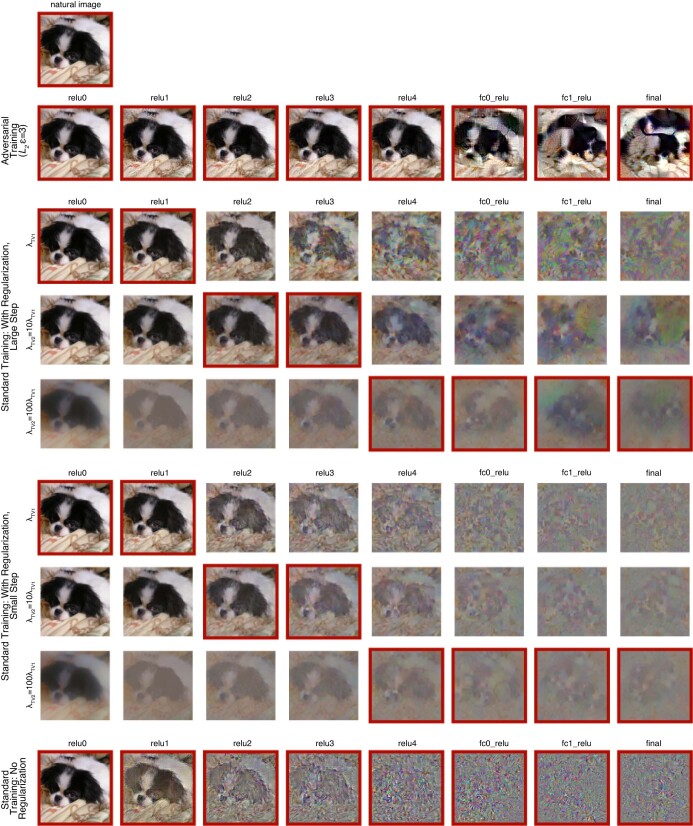
“One contributing factor may be that model visualizations have often been constrained by added natural image priors or other forms of regularization 64 that help make visualizations look more natural but mask the extent to which they otherwise diverge from a perceptually meaningful stimulus.”
BackgroundDeep supervised, but not unsupervised, models may explain IT cortical representation
Khaligh-Razavi, S.-M., & Kriegeskorte, N. (2014) · PLoS Computational Biology · doi:10.1371/journal.pcbi.1003915 · Cited by 1,204 · cited 1×
“We used this upper bound rather than noise correcting the human–model RDM correlation to be consistent with prior modeling papers 102 .”
MethodCORRELATION CALCULATED FROM FAULTY DATA
SPEARMAN, C. (1910) · British Journal of Psychology, 1904-1920 · doi:10.1111/j.2044-8295.1910.tb00206.x · Cited by 1,144 · cited 1×
“Voxel response reliability ( r ′ v ) was computed as the median Spearman–Brown-corrected Pearson correlation between all three pairs of scans, where the Spearman–Brown correction accounts for increased reliability expected from tripling the amount of data 100 .”
MethodThe design for the wall street journal-based CSR corpus
Paul, D. B., & Baker, J. M. (1992) · Proceedings of the workshop on Speech and Natural Language - HLT '91 · doi:10.3115/1075527.1075614 · Cited by 1,099
Kriegeskorte, N. (2015) · Annual Review of Vision Science · doi:10.1146/annurev-vision-082114-035447 · Cited by 1,093
Audio Adversarial Examples: Targeted Attacks on Speech-to-Text
Carlini, N., & Wagner, D. (2018) · 2018 IEEE Security and Privacy Workshops (SPW) · doi:10.1109/spw.2018.00009 · Cited by 1,035
Adversarial Examples Are Not Bugs, They Are Features
Ilyas, A., Santurkar, S., Tsipras, D., Engstrom, L., Tran, B., & Madry, A. (2019) · arXiv · doi:10.48550/arxiv.1905.02175 · Cited by 971 · cited 1×
“This adversarial training procedure yields models that are less susceptible to adversarial examples for reasons that remain debated 47 .”
MethodUntangling invariant object recognition
DiCarlo, J. J., & Cox, D. D. (2007) · Trends in Cognitive Sciences · doi:10.1016/j.tics.2007.06.010 · Cited by 959
A feedforward architecture accounts for rapid categorization
Serre, T., Oliva, A., & Poggio, T. (2007) · Proceedings of the National Academy of Sciences · doi:10.1073/pnas.0700622104 · Cited by 918 · cited 2×
“The hierarchical nature of biological sensory systems 1 has motivated the use of hierarchical neural network models that transform sensory inputs into task-relevant representations 2,3 .”
BackgroundEvasion Attacks against Machine Learning at Test Time
Biggio, B., Corona, I., Maiorca, D., Nelson, B., Šrndić, N., Laskov, P., Giacinto, G., & Roli, F. (2013) · Lecture Notes in Computer Science · doi:10.1007/978-3-642-40994-3_25 · Cited by 890
Julesz, B. (1962) · IEEE Transactions on Information Theory · doi:10.1109/tit.1962.1057698 · Cited by 886 · cited 1×
“…that are indistinguishable to human observers because they produce the same response at some stage of a sensory system), which have previously been characterized in the domains of color perception 16,17 , texture 18–20 , cue combination 21 , Bayesian decision-making 22 and visual crowding 23,24 .”
BackgroundOlah, C., Mordvintsev, A., & Schubert, L. (2017) · Distill · doi:10.23915/distill.00007 · Cited by 880
Multiresolution spectrotemporal analysis of complex sounds
Chi, T., Ru, P., & Shamma, S. A. (2005) · The Journal of the Acoustical Society of America · doi:10.1121/1.1945807 · Cited by 673 · cited 1×
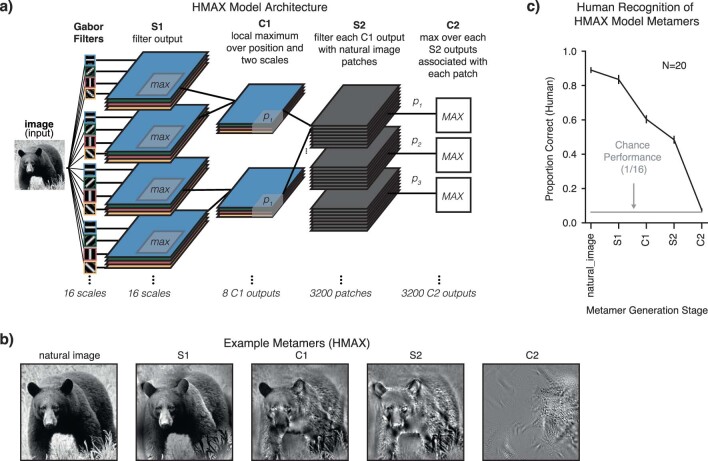
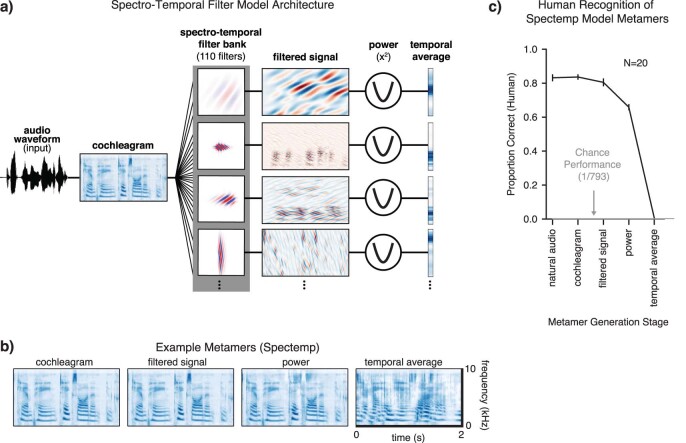
“Analogous results with two classical sensory system models (HMAX 3,8 and a spectrotemporal modulation filterbank 42 ), which further illustrate the general applicability of the method, are shown in Extended Data Figs.”
ResultMetamers of the ventral stream
Freeman, J., & Simoncelli, E. P. (2011) · Nature Neuroscience · doi:10.1038/nn.2889 · Cited by 667 · cited 1×
“…that are indistinguishable to human observers because they produce the same response at some stage of a sensory system), which have previously been characterized in the domains of color perception 16,17 , texture 18–20 , cue combination 21 , Bayesian decision-making 22 and visual crowding 23,24 .”
BackgroundConvolutional Neural Networks as a Model of the Visual System: Past, Present, and Future
Lindsay, G. W. (2021) · Journal of Cognitive Neuroscience · doi:10.1162/jocn_a_01544 · Cited by 557 · cited 1×
“Biological systems typically do not have access to labels at the scale that is needed for supervised learning 37 and instead must rely in large part on unsupervised learning.”
BackgroundKell, A. J. E., Yamins, D. L. K., Shook, E. N., Norman-Haignere, S. V., & McDermott, J. H. (2018) · Neuron · doi:10.1016/j.neuron.2018.03.044 · Cited by 544 · cited 8×
“The auditory experiment was similar to that used in earlier publications 4,25 .”
BackgroundMethodInfluentialSelf-citationCombining Sensory Information: Mandatory Fusion Within, but Not Between, Senses
Hillis, J. M., Ernst, M. O., Banks, M. S., & Landy, M. S. (2002) · Science · doi:10.1126/science.1075396 · Cited by 486
Distinct Cortical Pathways for Music and Speech Revealed by Hypothesis-Free Voxel Decomposition
Norman-Haignere, S., Kanwisher, N. G., & McDermott, J. H. (2015) · Neuron · doi:10.1016/j.neuron.2015.11.035 · Cited by 465 · cited 8×
“The auditory fMRI analysis closely followed that of a previous publication 4 using the fMRI dataset collected in another previous publication 60 .”
MethodInfluentialSelf-citationBrain-Score: Which Artificial Neural Network for Object Recognition is most Brain-Like?
Schrimpf, M., Kubilius, J., Hong, H., Majaj, N. J., Rajalingham, R., Issa, E. B., Kar, K., Bashivan, P., Prescott-Roy, J., Geiger, F., et al. (2018) · bioRxiv (Cold Spring Harbor Laboratory) · doi:10.1101/407007 · Cited by 458
Headphone screening to facilitate web-based auditory experiments
Woods, K. J. P., Siegel, M. H., Traer, J., & McDermott, J. H. (2017) · Attention, Perception, & Psychophysics · doi:10.3758/s13414-017-1361-2 · Cited by 433 · cited 1×
“To increase data quality, participants first completed a short experiment (six trials) that screened for the use of headphones 83 .”
BackgroundSelf-citationSound Texture Perception via Statistics of the Auditory Periphery: Evidence from Sound Synthesis
McDermott, J. H., & Simoncelli, E. P. (2011) · Neuron · doi:10.1016/j.neuron.2011.06.032 · Cited by 403
Self-citationA summary statistic representation in peripheral vision explains visual search
Rosenholtz, R., Huang, J., Raj, A., Balas, B. J., & Ilie, L. (2012) · Journal of Vision · doi:10.1167/12.4.14 · Cited by 389
Rust, N. C., & DiCarlo, J. J. (2010) · The Journal of Neuroscience · doi:10.1523/jneurosci.0179-10.2010 · Cited by 387 · cited 2×
“In many models there is limited invariance in the early stages (as is believed to be true of early stages of biological sensory systems 9 ), with model metamers closely approximating the stimulus from which they are generated (Fig.”
BackgroundA Study and Comparison of Human and Deep Learning Recognition Performance under Visual Distortions
Dodge, S., & Karam, L. (2017) · 2017 26th International Conference on Computer Communication and Networks (ICCCN) · doi:10.1109/icccn.2017.8038465 · Cited by 380 · cited 1×
“6j) 10,57,58 .”
A functional and perceptual signature of the second visual area in primates
Freeman, J., Ziemba, C. M., Heeger, D. J., Simoncelli, E. P., & Movshon, J. A. (2013) · Nature Neuroscience · doi:10.1038/nn.3402 · Cited by 340 · cited 2×
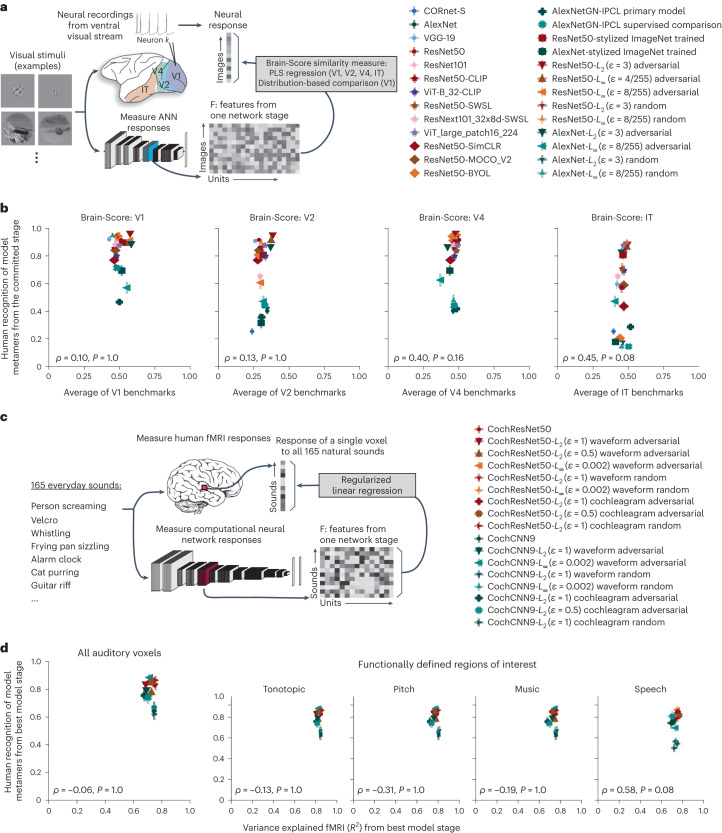
“Evaluation data for V1 consisted of the average of 23 benchmarks: 22 distribution-based comparison benchmarks from Marques et al. 89 and the V1 partial least squares (PLS) regression benchmark from Freeman et al. 90 .”
MethodExplicit information for category-orthogonal object properties increases along the ventral stream
Hong, H., Yamins, D. L. K., Majaj, N. J., & DiCarlo, J. J. (2016) · Nature Neuroscience · doi:10.1038/nn.4247 · Cited by 337 · cited 1×
“One explanation for the human–model discrepancies we observed could be that biological sensory systems do not instantiate invari-ances per se in the sense of mapping multiple different inputs onto the same representation 73,74 .”
BackgroundUnsupervised neural network models of the ventral visual stream
Zhuang, C., Yan, S., Nayebi, A., Schrimpf, M., Frank, M. C., DiCarlo, J. J., & Yamins, D. L. K. (2021) · Proceedings of the National Academy of Sciences · doi:10.1073/pnas.2014196118 · Cited by 337 · cited 1×
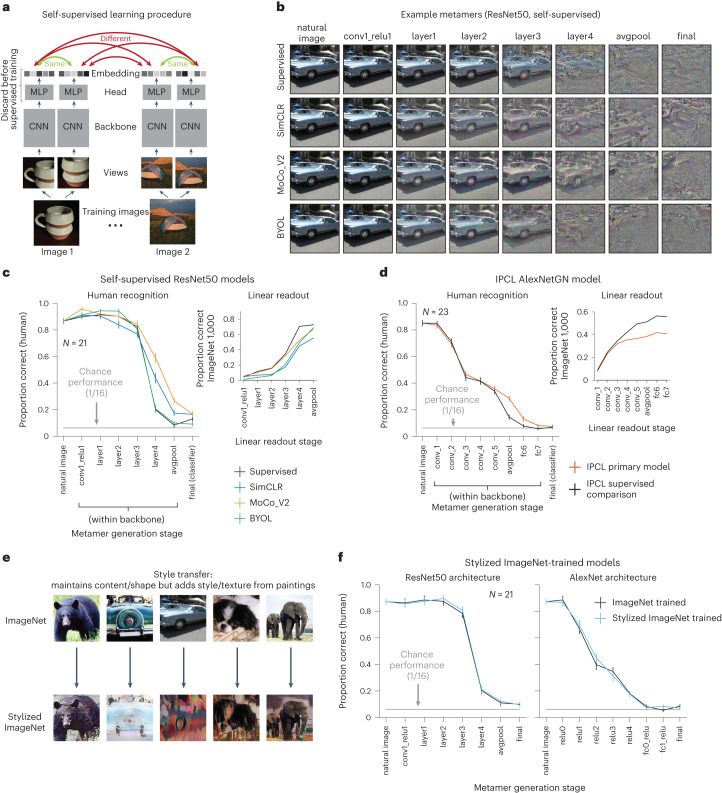
“Unsupervised learning potentially provides a more biologically plausible computational theory of learning 41,68 but produced qualitatively similar model metamers as supervised learning.”
BackgroundBillion-scale semi-supervised learning for image classification
Yalniz, I. Z., Jégou, H., Chen, K., Paluri, M., & Mahajan, D. (2019) · arXiv · doi:10.48550/arxiv.1905.00546 · Cited by 299
A summary-statistic representation in peripheral vision explains visual crowding
Balas, B., Nakano, L., & Rosenholtz, R. (2009) · Journal of Vision · doi:10.1167/9.12.13 · Cited by 298 · cited 1×
“…that are indistinguishable to human observers because they produce the same response at some stage of a sensory system), which have previously been characterized in the domains of color perception 16,17 , texture 18–20 , cue combination 21 , Bayesian decision-making 22 and visual crowding 23,24 .”
BackgroundTonotopic organization of human auditory cortex
Humphries, C., Liebenthal, E., & Binder, J. R. (2010) · NeuroImage · doi:10.1016/j.neuroimage.2010.01.046 · Cited by 297
Adversarial Robustness as a Prior for Learned RepresentationsPreprint
Engstrom, L., Ilyas, A., Santurkar, S., Tsipras, D., Tran, B., & Mądry, A. (2019) · arXiv (Cornell University) · doi:10.48550/arxiv.1906.00945 · Cited by 297
Self-citationHow to train your ViT? Data, Augmentation, and Regularization in Vision Transformers
Steiner, A., Kolesnikov, A., Zhai, X., Wightman, R., Uszkoreit, J., & Beyer, L. (2021) · arXiv · doi:10.48550/arxiv.2106.10270 · Cited by 292 · cited 1×
“We subsequently ran a second experiment on an additional five models pre-trained on larger datasets that became available at later stages of the project 32–34 .”
MethodRobustBench: a standardized adversarial robustness benchmark
Croce, F., Andriushchenko, M., Sehwag, V., Debenedetti, E., Flammarion, N., Chiang, M., Mittal, P., & Hein, M. (2020) · arXiv · doi:10.48550/arxiv.2010.09670 · Cited by 284 · cited 1×
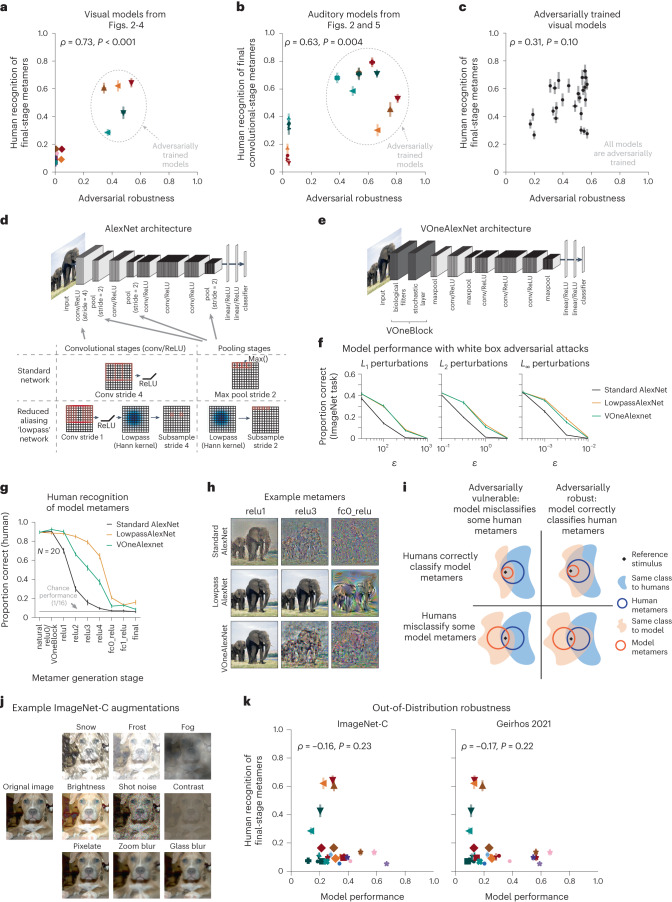
“To further assess whether variations in robustness produce variation in metamer recognizability, we compared the robustness of a large set of adversarially trained models (taken from a well-known robustness evaluation 52 ) to the recognizability of their metamers from the final model stage.”
MethodThe cortical analysis of speech-specific temporal structure revealed by responses to sound quilts
Overath, T., McDermott, J. H., Zarate, J. M., & Poeppel, D. (2015) · Nature Neuroscience · doi:10.1038/nn.4021 · Cited by 241 · cited 1×
“Speech-selective voxels were identified from responses to German speech and to temporally scrambled (‘quilted’) speech stimuli generated from the same German source recordings 97 .”
BackgroundSelf-citationSantoro, R., Moerel, M., De Martino, F., Goebel, R., Ugurbil, K., Yacoub, E., & Formisano, E. (2014) · PLoS Computational Biology · doi:10.1371/journal.pcbi.1003412 · Cited by 240
Poison Frogs! Targeted Clean-Label Poisoning Attacks on Neural Networks
Shafahi, A., Huang, W., Najibi, M., Suciu, O., Studer, C., Dumitraş, T., & Goldstein, T. (2018) · arXiv (Cornell University) · doi:10.3929/ethz-b-000460348 · Cited by 236
Integrative benchmarking to advance neurally mechanistic models of human intelligence
Schrimpf, M., Kubilius, J., Lee, M. J., Ratan Murty, N. A., Ajemian, R., & DiCarlo, J. J. (2020) · Neuron · doi:10.1016/j.neuron.2020.07.040 · Cited by 233 · cited 4×
“For the visual models, we used the Brain-Score platform to measure the similarity of model representations to neural benchmarks for visual areas V1, V2 and V4 and the inferior temporal cortex (IT 26,31 ; Fig.”
MethodInfluentialSummary statistics in auditory perception
McDermott, J. H., Schemitsch, M., & Simoncelli, E. P. (2013) · Nature Neuroscience · doi:10.1038/nn.3347 · Cited by 231 · cited 1×
“For instance, there is considerable evidence for time-averaged auditory statistics in auditory perception 19,70 even though they do not produce human-recognizable metamers for speech (Extended Data Fig.”
BackgroundSelf-citationEagleman, D. (2010) · Journal of Vision · doi:10.1167/9.8.1 · Cited by 209
Majaj, N. J., Hong, H., Solomon, E. A., & DiCarlo, J. J. (2015) · The Journal of Neuroscience · doi:10.1523/jneurosci.5181-14.2015 · Cited by 204 · cited 4×
“Evaluation data for IT consisted of the average of four benchmarks: the PLS IT benchmark from Majaj et al.(91), the PLS IT benchmark from Sanghavi and DiCarlo(92), the PLS IT benchmark from Sanghavi et al.”
MethodInfluentialNorman-Haignere, S., Kanwisher, N., & McDermott, J. H. (2013) · The Journal of Neuroscience · doi:10.1523/jneurosci.2880-13.2013 · Cited by 171 · cited 2×
“Pitch-selective voxels were identified from responses to harmonic tones and spectrally matched noise 96 as the top 5% of voxels in each participant with the lowest P values from a one-tailed t -test comparing those conditions.”
MethodSelf-citationXu, Y., & Vaziri-Pashkam, M. (2021) · Nature Communications · doi:10.1038/s41467-021-22244-7 · Cited by 153
Individual differences among deep neural network models
Mehrer, J., Spoerer, C. J., Kriegeskorte, N., & Kietzmann, T. C. (2020) · Nature Communications · doi:10.1038/s41467-020-19632-w · Cited by 133 · cited 1×
“This finding is loosely consistent with findings that the representational dissimilarity matrices for natural images can vary between individual neural network models 62 .”
ResultA self-supervised domain-general learning framework for human ventral stream representation
Konkle, T., & Alvarez, G. A. (2022) · Nature Communications · doi:10.1038/s41467-022-28091-4 · Cited by 133 · cited 2×
“We generated model metamers for four such models 38–41 along with supervised comparison models with the same architectures.”
BackgroundMethodPartial success in closing the gap between human and machine vision
Geirhos, R., Narayanappa, K., Mitzkus, B., Thieringer, T., Bethge, M., Wichmann, F. A., & Brendel, W. (2021) · arXiv · doi:10.48550/arxiv.2106.07411 · Cited by 129 · cited 2×
“This type of robustness (measured by two common benchmarks) was again not correlated with metamer recognizability (ImageNet-C: ρ = –0.16, P = 0.227; Geirhos 2021: ρ = –0.17, P = 0.215; Fig.”
BackgroundInfluentialTuckute, G., Feather, J., Boebinger, D., & McDermott, J. H. (2023) · PLoS Biology · doi:10.1371/journal.pbio.3002366 · Cited by 123
Self-citationToward an integration of deep learning and neuroscience
Marblestone, A. H., Wayne, G., & Kording, K. P. (2016) · Frontiers in Computational Neuroscience · doi:10.3389/fncom.2016.00094 · Cited by 119
Simulating a Primary Visual Cortex at the Front of CNNs Improves Robustness to Image Perturbations
Dapello, J., Marques, T., Schrimpf, M., Geiger, F., Cox, D. D., & DiCarlo, J. J. (2020) · bioRxiv (Cold Spring Harbor Laboratory) · doi:10.1101/2020.06.16.154542 · Cited by 117 · cited 1×
“6e) and had been previously demonstrated to increase adversarial robustness 55 .”
BackgroundNorman-Haignere, S., & McDermott, J. H. (2018) · PLoS Biology · doi:10.1371/journal.pbio.2005127 · Cited by 110
Self-citationAnalyzing biological and artificial neural networks: challenges with opportunities for synergy?
Barrett, D. G., Morcos, A. S., & Macke, J. H. (2019) · Current Opinion in Neurobiology · doi:10.1016/j.conb.2019.01.007 · Cited by 109
Do Adversarially Robust ImageNet Models Transfer Better?
Salman, H., Ilyas, A., Engstrom, L., Kapoor, A., & Mądry, A. (2020) · arXiv (Cornell University) · doi:10.48550/arxiv.2007.08489 · Cited by 108
Self-citationControversial stimuli: Pitting neural networks against each other as models of human cognition
Golan, T., Raju, P. C., & Kriegeskorte, N. (2020) · Proceedings of the National Academy of Sciences · doi:10.1073/pnas.1912334117 · Cited by 106
Comparison of Object Recognition Behavior in Human and Monkey
Rajalingham, R., Schmidt, K., & DiCarlo, J. J. (2015) · The Journal of Neuroscience · doi:10.1523/jneurosci.0573-15.2015 · Cited by 105 · cited 1×
“Models optimized for object recognition 78 , speech recognition 4 , sound localization 79 and pitch recognition 80 all exhibit qualitative and often quantitative similarities to human judgments when run in traditional psychophysical experiments with natural or relatively naturalistic stimuli (that…”
BackgroundTranscription and Alignment of the TIMIT Database
Zue, V. W., & Seneff, S. (1996) · Elsevier eBooks · doi:10.1016/b978-044481607-8/50088-8 · Cited by 100
Brain-Like Object Recognition with High-Performing Shallow Recurrent ANNs
Kubilius, J., Schrimpf, M., Kar, K., Hong, H., Majaj, N. J., Rajalingham, R., Issa, E. B., Bashivan, P., Prescott-Roy, J., Schmidt, K., et al. (2019) · arXiv (Cornell University) · doi:10.48550/arxiv.1909.06161 · Cited by 98
Francl, A., & McDermott, J. H. (2022) · Nature Human Behaviour · doi:10.1038/s41562-021-01244-z · Cited by 92 · cited 1×
“Models optimized for object recognition 78 , speech recognition 4 , sound localization 79 and pitch recognition 80 all exhibit qualitative and often quantitative similarities to human judgments when run in traditional psychophysical experiments with natural or relatively naturalistic stimuli (that…”
BackgroundSelf-citationUnsupervised learning predicts human perception and misperception of gloss
Storrs, K. R., Anderson, B. L., & Fleming, R. W. (2021) · Nature Human Behaviour · doi:10.1038/s41562-021-01097-6 · Cited by 92
Harnessing the power of artificial intelligence to transform hearing healthcare and research
Lesica, N. A., Mehta, N., Manjaly, J., Deng, L., Wilson, B. S., & Zeng, F. (2021) · Nature Machine Intelligence · doi:10.1038/s42256-021-00394-z · Cited by 86 · cited 1×
“…of the human–model discrepancies demonstrated here seem important to understand, both because they may clarify biological sensory systems and because many potential model applications, such as model-based signal enhancement 71,72 , are likely to be hindered by human-discrepant model invariances.”
BackgroundAdaptive and Selective Time Averaging of Auditory Scenes
McWalter, R., & McDermott, J. H. (2018) · Current Biology · doi:10.1016/j.cub.2018.03.049 · Cited by 81 · cited 1×
“For instance, there is considerable evidence for time-averaged auditory statistics in auditory perception 19,70 even though they do not produce human-recognizable metamers for speech (Extended Data Fig.”
BackgroundSelf-citationImage content is more important than Bouma’s Law for scene metamers
Wallis, T. S. A., Funke, C. M., Ecker, A. S., Gatys, L. A., Wichmann, F. A., & Bethge, M. (2019) · eLife · doi:10.7554/elife.42512 · Cited by 75
Saddler, M. R., Gonzalez, R., & McDermott, J. H. (2021) · Nature Communications · doi:10.1038/s41467-021-27366-6 · Cited by 66 · cited 1×
“Models optimized for object recognition 78 , speech recognition 4 , sound localization 79 and pitch recognition 80 all exhibit qualitative and often quantitative similarities to human judgments when run in traditional psychophysical experiments with natural or relatively naturalistic stimuli (that…”
BackgroundSelf-citationSchema learning for the cocktail party problem
Woods, K. J. P., & McDermott, J. H. (2018) · Proceedings of the National Academy of Sciences · doi:10.1073/pnas.1801614115 · Cited by 65 · cited 1×
“We have repeatedly found that online auditory psychophysical experiments qualitatively and quantitatively reproduce in-lab results, provided that steps such as these are taken to help ensure good audio presentation quality and attentive participants 84–87 .”
BackgroundSelf-citationJang, H., McCormack, D. R., & Tong, F. (2021) · PLoS Biology · doi:10.1371/journal.pbio.3001418 · Cited by 61 · cited 1×
“For instance, model judgments are often impaired by stimulus manipulations to which human judgments are invariant, such as additive noise 10,11 or small translations of the input 12,13 .”
BackgroundUnsupervised Neural Network Models of the Ventral Visual StreamPreprint
Zhuang, C., Yan, S., Nayebi, A., et al. (2020) · bioRxiv (Cold Spring Harbor Laboratory) · doi:10.1101/2020.06.16.155556 · Cited by 57
Invariant Recognition Shapes Neural Representations of Visual Input
Tacchetti, A., Işık, L., & Poggio, T. (2018) · Annual Review of Vision Science · doi:10.1146/annurev-vision-091517-034103 · Cited by 47 · cited 1×
“One hypothesis for why artificial neural network models might replicate computations found in biological sensory systems is that they instantiate invariances that mirror those in such systems 6,7 .”
BackgroundHarmonicity aids hearing in noise
McPherson, M. J., Grace, R. C., & McDermott, J. H. (2022) · Attention Perception & Psychophysics · doi:10.3758/s13414-021-02376-0 · Cited by 47 · cited 1×
“We have repeatedly found that online auditory psychophysical experiments qualitatively and quantitatively reproduce in-lab results, provided that steps such as these are taken to help ensure good audio presentation quality and attentive participants 84–87 .”
BackgroundSelf-citationExploiting Excessive Invariance caused by Norm-Bounded Adversarial RobustnessPreprint
Jacobsen, J.-H., Behrmann, J., Carlini, N., Tramèr, F., & Papernot, N. (2019) · arXiv (Cornell University) · doi:10.48550/arxiv.1903.10484 · Cited by 42 · cited 1×
“…of adversarial example generated by adding small perturbations to an image from one class such that the activations of a classifier (or internal stage) match those of a reference image from a different class 56,65 , despite being seen as different classes by humans when tested informally 66,67 .”
BackgroundTime-dependent discrimination advantages for harmonic sounds suggest efficient coding for memory
McPherson, M. J., & McDermott, J. H. (2020) · Proceedings of the National Academy of Sciences · doi:10.1073/pnas.2008956117 · Cited by 41
Self-citationCausal inference in environmental sound recognition
Traer, J. A., Norman-Haignere, S., & McDermott, J. H. (2021) · Cognition · doi:10.1016/j.cognition.2021.104627 · Cited by 37
Self-citationSinger, J., Seeliger, K., Kietzmann, T. C., & Hebart, M. N. (2022) · Journal of Vision · doi:10.1167/jov.22.2.4 · Cited by 34 · cited 2×
“Another commonly noted discrepancy between current models and humans is the tendency for models to base their judgments on texture rather than shape 43–45 .”
BackgroundOpposing effects of selectivity and invariance in peripheral vision
Ziemba, C. M., & Simoncelli, E. P. (2021) · Nature Communications · doi:10.1038/s41467-021-24880-5 · Cited by 32 · cited 1×
“…that are indistinguishable to human observers because they produce the same response at some stage of a sensory system), which have previously been characterized in the domains of color perception 16,17 , texture 18–20 , cue combination 21 , Bayesian decision-making 22 and visual crowding 23,24 .”
BackgroundKong, N. C. L., Margalit, E., Gardner, J. L., & Norcia, A. M. (2022) · PLoS Computational Biology · doi:10.1371/journal.pcbi.1009739 · Cited by 32 · cited 1×
“…trained models look less noise-like than those from standard models and that standard models may overrepresent high spatial frequencies 50 , we wondered whether the improvement in recognizability could be replicated in a standard-trained model by including a smoothness regularizer in…”
BackgroundMarques, T., Schrimpf, M., & DiCarlo, J. J. (2021) · bioRxiv (Cold Spring Harbor Laboratory) · doi:10.1101/2021.03.01.433495 · Cited by 27 · cited 2×
“Evaluation data for V1 consisted of the average of 23 benchmarks: 22 distribution-based comparison benchmarks from Marques et al. 89 and the V1 partial least squares (PLS) regression benchmark from Freeman et al. 90 .”
MethodNeural Population Geometry Reveals the Role of Stochasticity in Robust Perception
Dapello, J., Feather, J., Le, H., Marques, T., Cox, D., McDermott, J. H., DiCarlo, J. J., & Chung, S. (2021) · neural information processing systems · doi:10.48550/arxiv.2111.06979 · Cited by 24 · cited 1×
“The second model was a CNN that contained an initial processing block inspired by the primary visual cortex in primates 54 .”
MethodSelf-citationTowards Bridging the Performance Gaps of Joint Energy-Based Models
Yang, X., Su, Q. F., & Ji, S. (2023) · IEEE Computer Society Conference on Computer Vision and Pattern Recognition/Proceedings - IEEE Computer Society Conference on Computer Vision and Pattern Recognition/Proceedings · doi:10.1109/cvpr52729.2023.01510 · Cited by 23 · cited 1×
“But currently, we lack methods for building such models that can support human-level recognition at scale 76,77 .”
MethodValidating model-based Bayesian integration using prior–cost metamers
Sohn, H., & Jazayeri, M. (2021) · Proceedings of the National Academy of Sciences · doi:10.1073/pnas.2021531118 · Cited by 22 · cited 1×
“…that are indistinguishable to human observers because they produce the same response at some stage of a sensory system), which have previously been characterized in the domains of color perception 16,17 , texture 18–20 , cue combination 21 , Bayesian decision-making 22 and visual crowding 23,24 .”
BackgroundOn the surprising similarities between supervised and self-supervised models
Geirhos, R., Narayanappa, K., Mitzkus, B., Bethge, M., Wichmann, F. A., & Brendel, W. (2020) · arXiv (Cornell University) · doi:10.48550/arxiv.2010.08377 · Cited by 20
Speech Denoising with Auditory Models
Saddler, M. R., Francl, A. F., Feather, J., Qian, K., Zhang, Y., & McDermott, J. H. (2021) · Interspeech (USB) · doi:10.21437/interspeech.2021-1973 · Cited by 9 · cited 1×
“…of the human–model discrepancies demonstrated here seem important to understand, both because they may clarify biological sensory systems and because many potential model applications, such as model-based signal enhancement 71,72 , are likely to be hindered by human-discrepant model invariances.”
BackgroundSelf-citationTuckute, G., Feather, J., Boebinger, D., et al. (2022) · bioRxiv (Cold Spring Harbor Laboratory) · doi:10.1101/2022.09.06.506680 · Cited by 6
Self-citationTuckute, G., Feather, J., Boebinger, D., & McDermott, J. H. (2022) · Conference on Cognitive Computational Neuroscience (CCN) · doi:10.32470/ccn.2022.1065-0 · Cited by 4
Self-citationSanghaviJozwik2020Preprint
Sanghavi, S., Jozwik, K. M., & DiCarlo, J. J. (2021) · doi:10.17605/osf.io/fhy36 · Cited by 2
SanghaviMurty2020Preprint
Sanghavi, S., Murty, N. A. R., & DiCarlo, J. J. (2021) · doi:10.17605/osf.io/fchme · Cited by 2
Sanghavi2020Preprint
Sanghavi, S., & DiCarlo, J. J. (2021) · doi:10.17605/osf.io/chwdk · Cited by 1
Research works printed but not linked: 17
- 7. Goodfellow, I., Lee, H., Le, Q., Saxe, A. & Ng, A. Measuring invariances in deep networks. In Advances in Neural Information Processing Systems 22 (eds Bengio, Y., Schuurmans, D., Lafferty, J., Williams, C. & Culotta, A.) 646–654 (Curran Associates, Inc., 2009).
- 10. Geirhos, R., Temme, C. R. M. & Rauber, J. Generalisation in humans and deep neural networks. In Advances in Neural Information Processing Systems 31 (eds Bengio, S. et al.) 7538–7550 (Curran Associates, Inc., 2018).
- 12. Zhang, R. Making convolutional networks shift-invariant again. In Proc. 36th International Conference on Machine Learning (eds Chaudhuri K., and Salakhutdinov, R.) 7324-7334 (PMLR, 2019).
- 17. Wyszecki, G. & Stiles, W. S. Color Science 2nd edn (Wiley, 1982).
- 25. Feather, J., Durango, A., Gonzalez, R. & McDermott, J. Metamers of neural networks reveal divergence from human perceptual systems. In Advances in Neural Information Processing Systems 32 (eds Wallach, H. et al.) 10078–10089 (Curran Associates, Inc. 2019).
- 27. Simonyan, K. & Zisserman, A. Very deep convolutional networks for large-scale image recognition. In 3rd International Conference on Learning Representations (eds Bengio Y. & LeCun Y.) (2015)
- 29. Krizhevsky, A., Sutskever, I. & Hinton, G. E. ImageNet classification with deep convolutional neural networks. In Advances in Neural Information Processing Systems 25 (eds Pereira, F., Burges, C. J., Bottou, L. & Weinberger, K. Q.) 1097–1105 (Curran Associates, Inc., 2012).
- 38. Chen, T., Kornblith, S., Norouzi, M. & Hinton, G. A simple framework for contrastive learning of visual representations. In Proc. 37th International Conference on Machine Learning (eds Daumé III, H. & Singh, A.) 1597–1607 (PMLR, 2020).
- 44. Hermann, K., Chen, T. & Kornblith, S. The origins and prevalence of texture bias in convolutional neural networks. In Advances in Neural Information Processing Systems33 (eds Larochelle, H., Ranzato, M., Hadsell, R., Balcan, M. F. & Lin, H.) 19000–19015 (Curran Associates, Inc., 2020).
- 46. Madry, A., Makelov, A., Schmidt, L., Tsipras, D. & Vladu, A. Towards deep learning models resistant to adversarial attacks. In Proc. 6th International Conference on Learning Representations (eds Bengio, Y., LeCun, Y., Sainath, T., Murray, I., Ranzato, M., & Vinyals, O.) (2018).
- 49. Goodfellow, I., Shlens, J. & Szegedy, C. Explaining and harnessing adversarial examples. In Proc. 3rd International Conference on Learning Representations (eds Bengio, Y. & LeCun, Y.) (2015).
- 53. Hénaff, O. J. & Simoncelli, E. P. Geodesics of learned representations. In Proc. 4th International Conference on Learning Representations (eds Bengio, Y. & LeCun, Y.) (2016).
- 56. Sabour, S., Cao, Y., Faghri, F. & Fleet, D. J. Adversarial manipulation of deep representations. In Proc. 4th International Conference on Learning Representations (eds Bengio, Y. & LeCun, Y.) (2016).
- 57. Hendrycks, D. & Dietterich, T. Benchmarking neural network robustness to common corruptions and perturbations. In Proc. 7th International Conference on Learning Representations (eds Sainath, T., Rush, A., Levine, S. Livescu, K. & Mohamed, S.) (2019).
- 66. Jacobsen, J.-H., Behrmann, J., Zemel, R. & Bethge, M. Excessive invariance causes adversarial vulnerability. In Proc. 7th International Conference on Learning Representations, (ICLR) (eds Sainath, T., Rush, A., Levine, S. Livescu, K. & Mohamed, S.) (2019).
- 74. Thorat, S., Aldegheri, G. & Kietzmann, T. C. Category-orthogonal object features guide information processing in recurrent neural networks trained for object categorization. In SVRHM 2021 Workshop @ NeurIPS (2021).
- 76. Fetaya, E., Jacobsen, J.-H., Grathwohl, W. & Zemel, R. Understanding the limitations of conditional generative models. In Proc. 8th International Conference on Learning Representations (eds Rush, A., Mohamed, S., Song, D., Cho, K., & White, M.) (2020).
Cited by
Conwell, C., Prince, J. S., Kay, K. N., Alvarez, G. A., & Konkle, T. (2022) · doi:10.1101/2022.03.28.485868 · Cited by 160
Conwell, C., Prince, J. S., Kay, K. N., Alvarez, G. A., & Konkle, T. (2024) · Nature Communications · doi:10.1038/s41467-024-53147-y · Cited by 100
Tuckute, G., Feather, J., Boebinger, D., & McDermott, J. H. (2023) · PLoS Biology · doi:10.1371/journal.pbio.3002366 · Cited by 123
Self-citationSelf-attention in vision transformers performs perceptual grouping, not attention
Mehrani, P., & Tsotsos, J. K. (2023) · Frontiers in Computer Science · doi:10.3389/fcomp.2023.1178450 · Cited by 58
Human-like object concept representations emerge naturally in multimodal large language models
Du, C., Fu, K., Wen, B., Sun, Y., Peng, J., Wei, W., Gao, Y., Wang, S., Zhang, C., Li, J., et al. (2025) · Nature Machine Intelligence · doi:10.1038/s42256-025-01049-z · Cited by 83
“While these endeavors have led to notable advancements 28–31 , the critical question remains unanswered: can human-like psychological representations naturally emerge without task-specific training?”
Metadata
- Authors
- Feather, J., Leclerc, G., Mądry, A., & McDermott, J. H.
- Affiliations
- McGovern Institute for Brain Research (US)
- MIT Computer Science and Artificial Intelligence Laboratory (US)
- Harvard University (US)
- Corresponding author
- Feather, Jenelle
- McDermott, Josh H.
- Venue
- Nature Neuroscience
- Published
- 2023-10-16
- Volume
- 26
- Issue
- 11
- Pages
- 2017-2034
- ISSN
- 1097-6256 (ISSN-L)
- 1546-1726
- PMC
- PMC10620097
- OpenAlex
- W4387666878
- Cited by
- 59
- References
- 111
- Citations by year
- 2026: 26 · 2025: 19 · 2024: 9 · 2023: 3
- FWCI
- 2.71
- Type
- journal article
- Language
- en
- Open access
- hybrid
- doi.org
- Licence
- cc-by
- creativecommons.org/licenses/by/4.0 (tdm)
- creativecommons.org/licenses/by/4.0 (vor)
- Locations
- Nature Neuroscience (publishedVersion, cc-by)
- Conference on Cognitive Computational Neuroscience (CCN) (publishedVersion, cc-by)
- bioRxiv (Cold Spring Harbor Laboratory) (acceptedVersion, cc-by-nc-nd)
- PubMed Central (publishedVersion, cc-by)
- PubMed (publishedVersion)
- DSpace@MIT (Massachusetts Institute of Technology) (submittedVersion, cc-by)
- OSTI OAI (U.S. Department of Energy Office of Scientific and Technical Information) (submittedVersion)
- Funders
- U.S. Department of Health & Human Services | NIH | National Institute on Deafness and Other Communication Disorders (R01DC017970)
- National Science Foundation (BCS-1634050)
- Topics
- Physical Sciences › Computer Science › Artificial Intelligence › Neural Networks and Applications
- Physical Sciences › Computer Science › Computer Vision and Pattern Recognition › Advanced Neural Network Applications
- Life Sciences › Neuroscience › Cognitive Neuroscience › Visual perception and processing mechanisms
- Keywords
- invariance, deep neural network, visual models, auditory model, adversarial vulnerability
- MeSH terms
- Brain, Humans, Learning, Neural Networks, Computer
About these checks
Registry, retraction, Cites and statistics results are computed, not judged, with one exception: a printed reference that no index lists is read once by a model before it counts as a citation error. Claims are extracted by a model and kept only when their quote appears verbatim in the text; each cited source is then checked, with a model’s help, for whether it says what the claim relies on. Those verdicts can be wrong — read the claim’s quote and the cited source before relying on one.
Statistics and arithmetic are recomputed, not judged.
Confidence bands are shown only for fields calibrated on our annotated test set. None is calibrated yet, so no band is shown.
What counts as a claim ›How we measure confidence ›How we check this ›
Are you an author, or do you see a problem with this page? Request a review
Data sources
Bibliographic data: Semantic Scholar, OpenAlex, Crossref.
Contains information from the Semantic Scholar Academic Graph Datasets, made available under the ODC Attribution License (ODC-BY 1.0).
Semantic Scholar’s data is described in: Kinney, R., et al. (2023). The Semantic Scholar Open Data Platform. arXiv:2301.10140.
